E-invoicing in Slovakia: eFaktúra and the 2027 B2B mandate
Overview
Slovakia's domestic e-invoicing mandate, eFaktúra, starts on 1 January 2027. From that date a Slovak VAT payer that supplies goods or services in Slovakia to a Slovak taxable person, or to a Slovak non-taxable legal person, must issue a structured electronic invoice. No consent from the customer is needed. The rule is §85o(2) of the VAT Act (Act 222/2004), as inserted by Act 385/2025 Coll.: the supplier "je povinný vyhotoviť elektronickú faktúru" (is obliged to issue an electronic invoice), and "Vyhotovenie elektronickej faktúry nepodlieha súhlasu príjemcu plnenia" (issuing an electronic invoice is not subject to the recipient's consent). (VAT Act 222/2004, version in force 1 January 2027 – 30 June 2030, §85o(2), checked 2026-09-29)
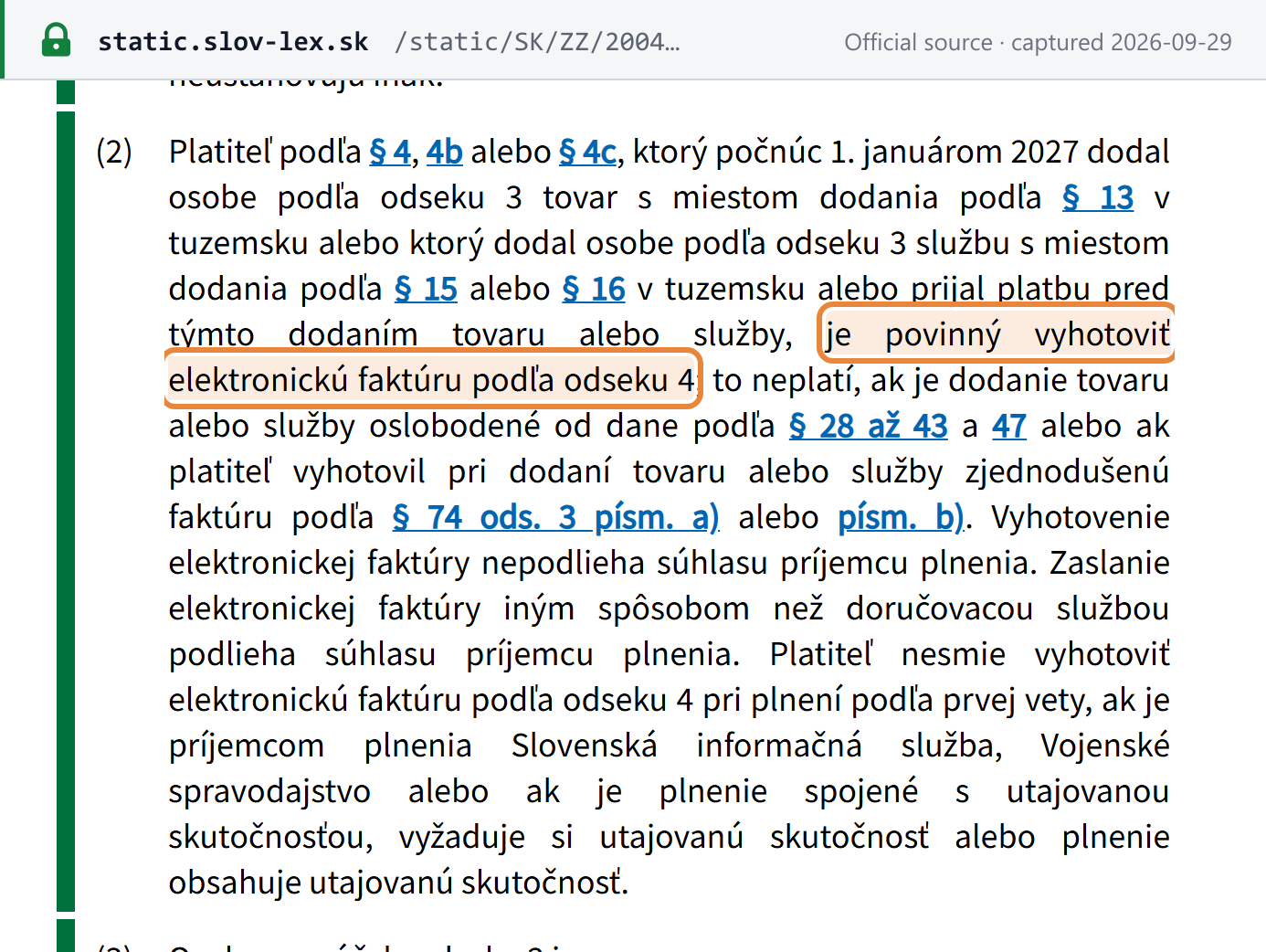 Source snapshot captured 2026-09-29 — original
The system is run by the Finančná správa (Financial Administration), through the Finančné riaditeľstvo SR (Financial Directorate, FR SR). FR SR is also the Peppol Authority for Slovakia and keeps the register of certified delivery-service providers, which Slovak guidance calls digitálni poštári ("digital postmen"). (Finančná správa — eFaktúra; FR SR eFaktúra FAQ, 15 September 2026 edition, checked 2026-09-29)
The model is Peppol interchange with reporting at issue, not clearance. The invoice travels from the supplier's certified provider to the buyer's provider over Peppol. The supplier's provider also derives the tax data from the invoice and sends it to the Financial Directorate's endpoint. The Financial Directorate does not approve, stamp or return the invoice, and, as at 30 September 2026, Finančná správa publishes no QR-code, hash or clearance-stamp requirement.
| Slovakia | |
|---|---|
| B2B (domestic) | Mandatory from 1 January 2027: Slovak VAT payers issue; every legal person and every taxable person, VAT-registered or not, must be able to receive. Voluntary exchange through certified providers without consent during 2026 |
| B2G | Same rules as B2B from 1 January 2027 (public bodies are legal persons); contracting authorities must be able to receive through the delivery service (Act 215/2019 as rewritten). The planned central IS EFA platform was cancelled in 2024 |
| B2C | Out of scope. Retail sales are recorded through eKasa cash registers (Act 384/2025) |
| Non-residents | Out of scope until 30 June 2030, for both issuing and receiving (FR SR) |
| Format | EN 16931 (Implementing Decision (EU) 2017/1870) in UBL 2.1 or UN/CEFACT CII; Peppol BIS Billing 3.0 with the Slovak transposition, version 1.11 of 10 September 2026 |
| Network | Peppol, through FR SR-certified providers; participant ID 0245:DIČ (the 10-digit tax number) |
| Reporting | Supplier reports invoice data at issue by handing the invoice to its provider; enacted buyer reporting within 5 days is proposed for deletion (bill 1454) |
| Cross-border | From 1 July 2030 (ViDA): intra-EU e-invoicing and reporting; the control statement and EC Sales List are abolished |
| Authority | Finančná správa / Finančné riaditeľstvo SR |
| Legislation | VAT Act 222/2004 as amended by Act 385/2025 Coll. (§71(5), §76a, §85o); Act 215/2019 (B2G) |
Mandate status & timeline
| Stage | Who / what | Date | Status | Legal basis |
|---|---|---|---|---|
| Act in force; provider register opens | Act 385/2025 generally in force: the delivery-service and provider-register rules (§76a) and the 2026 voluntary regime (§85o(18)–(22)) | 1 January 2026 | in force | Act 385/2025, Art VIII [1] |
| Voluntary window | A VAT payer may send an EN 16931 e-invoice to a domestic business or legal person without consent if it goes through a certified provider and the recipient can receive through one | 1 January – 31 December 2026 | running | VAT Act §85o(21)–(22) [1] |
| State infrastructure live | The Financial Directorate's endpoint accepts tax data from e-invoices automatically and confirms receipt to the provider | 21 August 2026 | passed | Finančná správa release [2] |
| Provider proof deadline | Certified providers must prove automated reporting capability, or are struck off on 1 January 2027 | 15 December 2026 | upcoming | VAT Act §85o(19)(a) [3] |
| Mandatory domestic stage | Domestic VAT payers issue e-invoices for domestic B2B and B2G supplies; supplier (and, as enacted, buyer) reporting; every legal person and taxable person must be able to receive; contracting authorities receive through the delivery service | 1 January 2027 | enacted, upcoming | Act 385/2025, Art VIII; VAT Act §71(5), §85o(1)–(16) [1] |
| No-fines period (proposed) | No fine for late e-invoices or reporting breaches arising 1 January – 30 June 2027 | 1 January – 30 June 2027 | proposed — bill 1454, first reading as at 2026-09-30 | NR SR print 1454 [4] |
| Cross-border (ViDA) stage | Intra-EU e-invoicing and per-transaction reporting; permanent domestic reporting; the control statement and EC Sales List are abolished; 10-day invoicing deadline | 1 July 2030 | enacted, upcoming | Act 385/2025, Art VIII; FR SR information 1/DPH/2026/I [5] |
Article VIII of Act 385/2025 is the commencement clause. It brings the Act into force on 1 January 2026, holds back §71(5), §72(12), §85o(1)–(16) and (23), and Articles V and VII until 1 January 2027, and holds back the cross-border provisions until 1 July 2030.
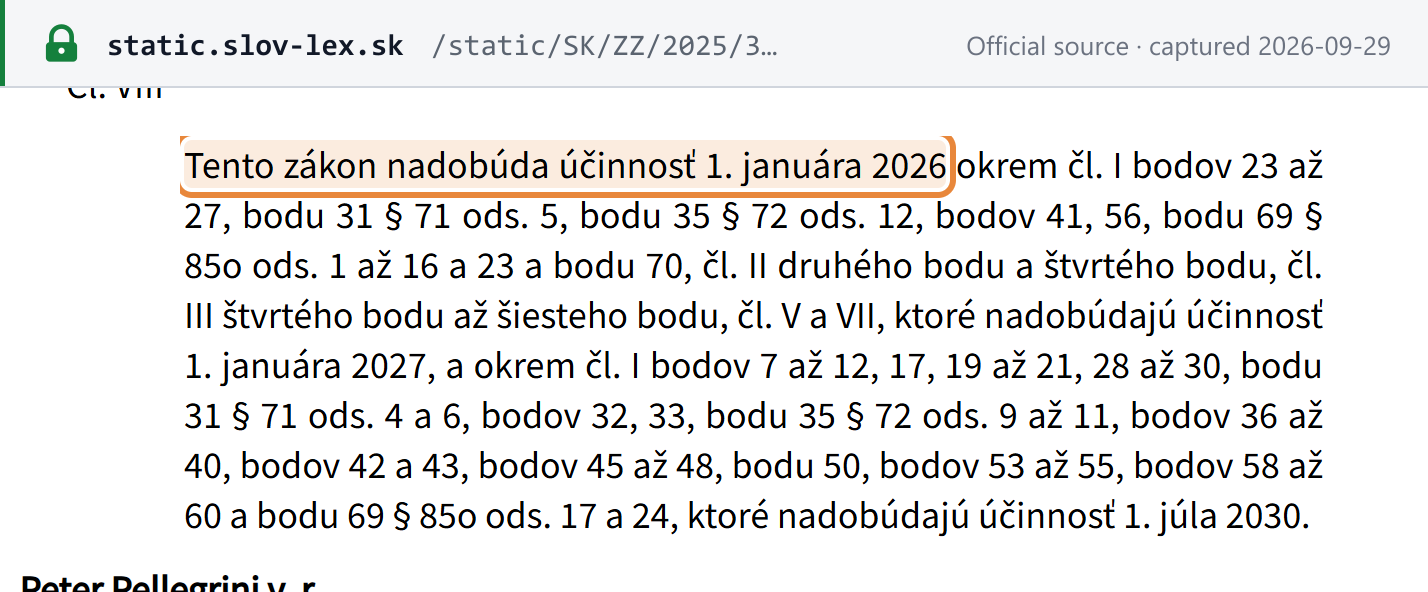 Source snapshot captured 2026-09-29 — original
Two different "transitional periods". Slovak guidance uses prechodné obdobie for two different things. The 2026 voluntary window runs from 1 January to 31 December 2026 (§85o(21)). The 2027–2030 domestic regime is the mandatory §85o regime that runs from 1 January 2027 to 30 June 2030, which FR SR information 1/DPH/2026/I also calls the transitional period.
2026 in practice. During the voluntary window, an e-invoice sent outside the delivery service still needs the recipient's consent. The window does not apply to exempt supplies or simplified invoices. Finančná správa says voluntary implementation has been available to businesses from the second quarter of 2026. (VAT Act §85o(21)–(22); Finančná správa — eFaktúra, checked 2026-09-29)
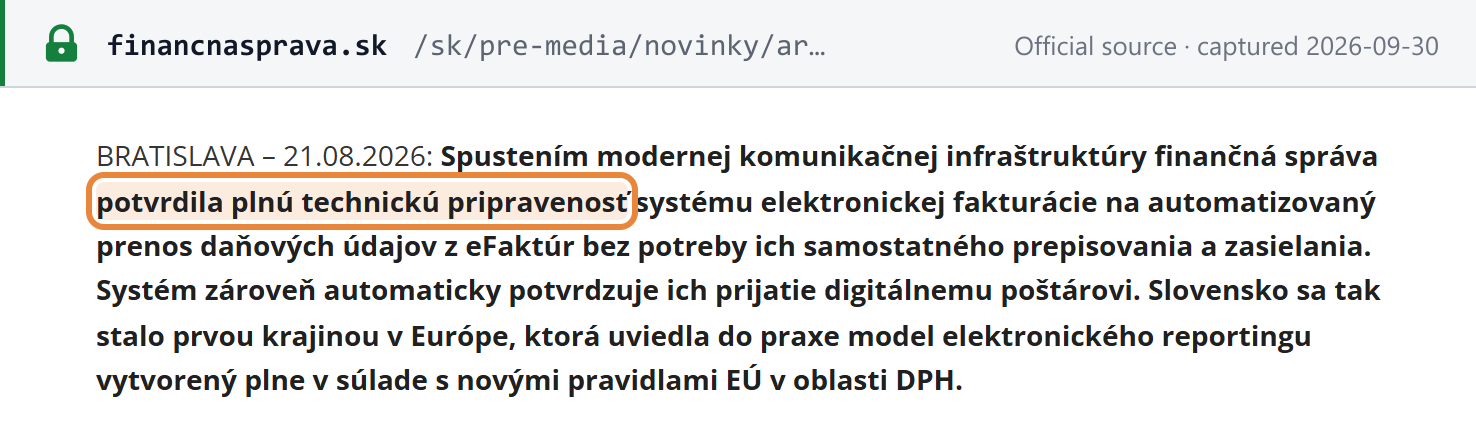 Source snapshot captured 2026-09-30 — original
Pending amendment: bill 1454
The government bill amending the VAT Act, NR SR parliamentary print 1454, was delivered to the National Council on 27 August 2026. As at 2026-09-30 its status is first reading ("I. čítanie"). The Speaker set committee deadlines of 13 November 2026, and 16 November 2026 for the lead finance and budget committee. (NR SR — print 1454, checked 2026-09-29)
As delivered, the bill proposes these e-invoicing changes, all from 1 January 2027:
- a no-fines period from 1 January to 30 June 2027, for failing to issue an e-invoice within the deadline and for reporting breaches. The explanatory memorandum says it lengthens the three-month adaptation period of the earlier draft after business comments. The period would not suspend the duty to be able to receive;
- deleting buyer-side reporting (§85o(10)), which the memorandum calls temporary until 30 June 2030;
- corrective e-invoices carrying full invoice data rather than only the changes;
- more supplies for which an e-invoice must not be issued (defence supplies to the Ministry of Defence, and "limited" information);
- releasing a non-VAT taxable person from the receive duty for invoices on exempt letting of immovable property (§38(3)) that is not a business asset. The release would not apply where the person must be able to receive e-invoices for other supplies (bill Art I point 63, new last sentence of §71(5)).
(Bill text, print 1454; explanatory memorandum, checked 2026-09-29)
The same bill also carries VAT-in-the-Digital-Age (ViDA) second-step changes: from 1 January 2027, EU supplies of gas, electricity and heat or cooling are treated as distance sales under the One Stop Shop until 30 June 2028; from 1 July 2028 the call-off stock scheme (§8a) is repealed (with a run-off to 30 June 2029 for call-off stock already started) alongside other single-VAT-registration points; further points apply from 1 July 2030. These are outside the eFaktúra mandate itself.
None of this is law. The consolidated VAT Act on Slov-Lex shows no amendment after Act 385/2025, so until the bill is passed and published, the enacted rules apply: fines from 1 January 2027 and buyer reporting within 5 days.
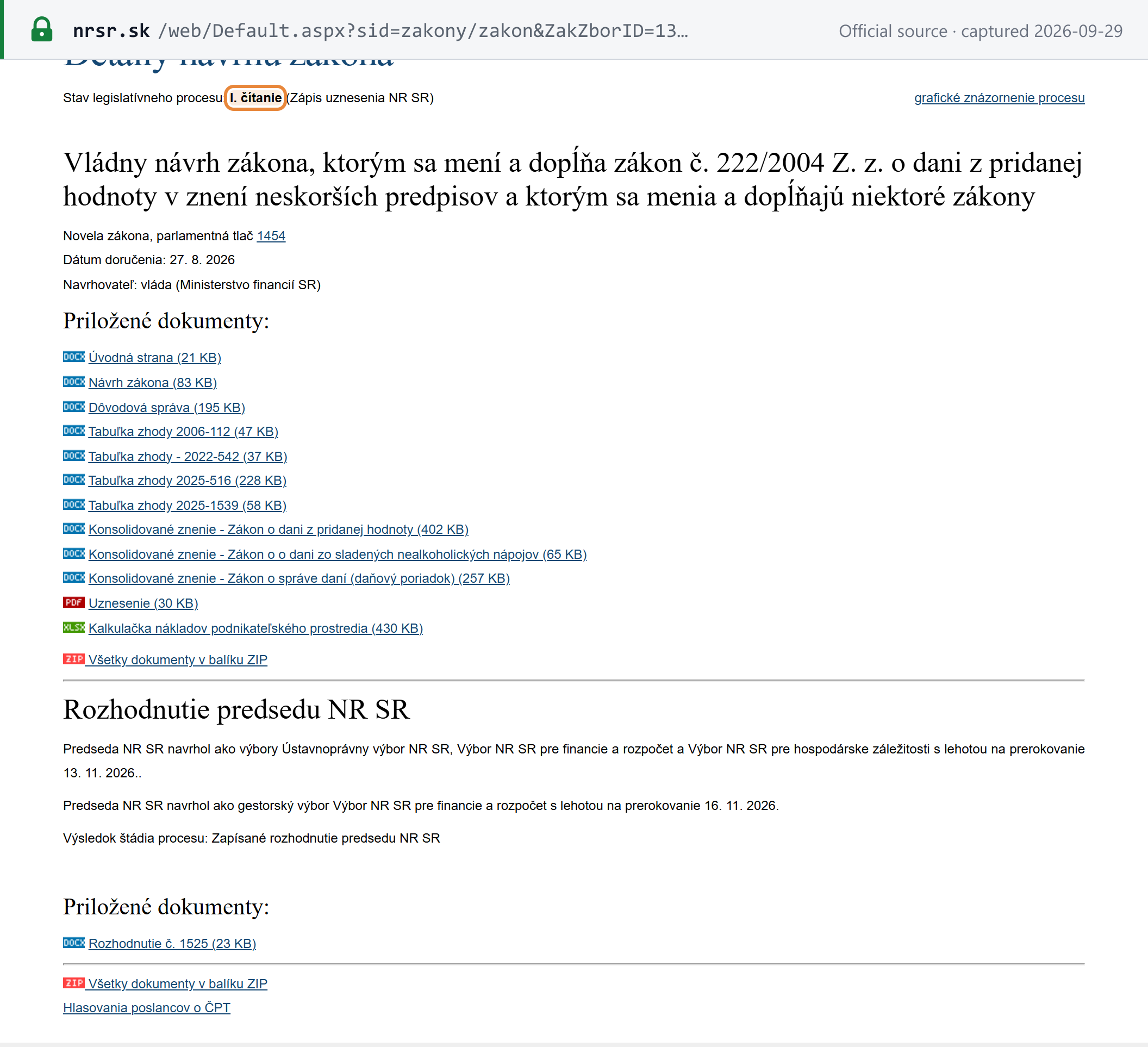 Source snapshot captured 2026-09-29 — original
Postponements. None enacted. The 1 January 2027 date has not moved since Act 385/2025 was promulgated.
Legal basis
- Act 385/2025 Coll. (zákon č. 385/2025 Z. z.), amending the VAT Act 222/2004. Approved by the National Council on 9 December 2025 and promulgated in the Collection of Laws on 19 December 2025. Article I transposes Council Directive (EU) 2025/516 (ViDA). It also amends the Tax Procedure Code (Act 563/2009), the Accounting Act (431/2002), the Income Tax Act (595/2003), the Public Procurement Act (343/2015), Act 112/2018 and Act 215/2019. It comes into force in three stages (1 January 2026, 1 January 2027, 1 July 2030). [1]
- VAT Act 222/2004, as amended — the operative provisions:
- §71(5): the duty to be able to send and receive e-invoices through the delivery service;
- §76a: the delivery service, the European delivery standard (Peppol) and the provider register;
- §85o: the 2027–2030 domestic regime (duty to issue, format, deadlines, reporting, fines, retention) and the 2026 voluntary window. [3]
- Act 215/2019 Coll. on B2G e-invoicing, rewritten by Article VII of Act 385/2025 from 1 January 2027 into a duty on contracting authorities to receive through the delivery service. [6]
- Act 384/2025 Coll. on the recording of sales (eKasa), in force 1 January 2026 — the B2C side, outside eFaktúra. [7]
- Technical standard: Commission Implementing Decision (EU) 2017/1870, i.e. EN 16931, adopted in Slovakia as STN EN 16931-1+A1:2020 and STN P CEN/TS 16931-2:2017, both free on normoff.gov.sk. The VAT Act makes compliance with it binding through §85o(4). [5]
- Official guidance: FR SR methodical information 7/DPH/2025/I and 1/DPH/2026/I, and the eFaktúra FAQ 9/DPH/2025/IM (15 September 2026 edition). Guidance explains the law; it does not change it.
Retention. A payer keeps the e-invoice for 10 years from the end of the calendar year it relates to (§85o(15)), and must keep its authenticity of origin, integrity and legibility from issue to the end of that period (§71(3)). The tax office may access and download electronically stored invoices (§76). The providers' own logs, kept for at least 6 months, do not replace the payer's archive. [3]
Scope
B2B: who must issue
From 1 January 2027 to 30 June 2030, §85o(2)–(3) requires an e-invoice when all of these hold:
- the supplier is a Slovak VAT payer (registered under §4, §4b or §4c);
- the supply is of goods with a Slovak place of supply (§13) or of services with a Slovak place of supply (§15 or §16), or the supplier received an advance payment for such a supply;
- the recipient is either a taxable person established, domiciled or habitually resident in Slovakia, or a non-taxable legal person with its seat in Slovakia.
Self-billed invoices and corrective invoices are e-invoices too (FAQ). (VAT Act §85o(2)–(3), checked 2026-09-29)
"B2B and B2G" is Finančná správa's shorthand. In law the test is a domestic VAT-payer supplier plus a domestic taxable person or domestic non-taxable legal person as recipient.
Taxable persons that are not VAT payers do not have to issue e-invoices under §85o (FAQ). (FR SR eFaktúra FAQ, checked 2026-09-29)
B2B: who must be able to receive
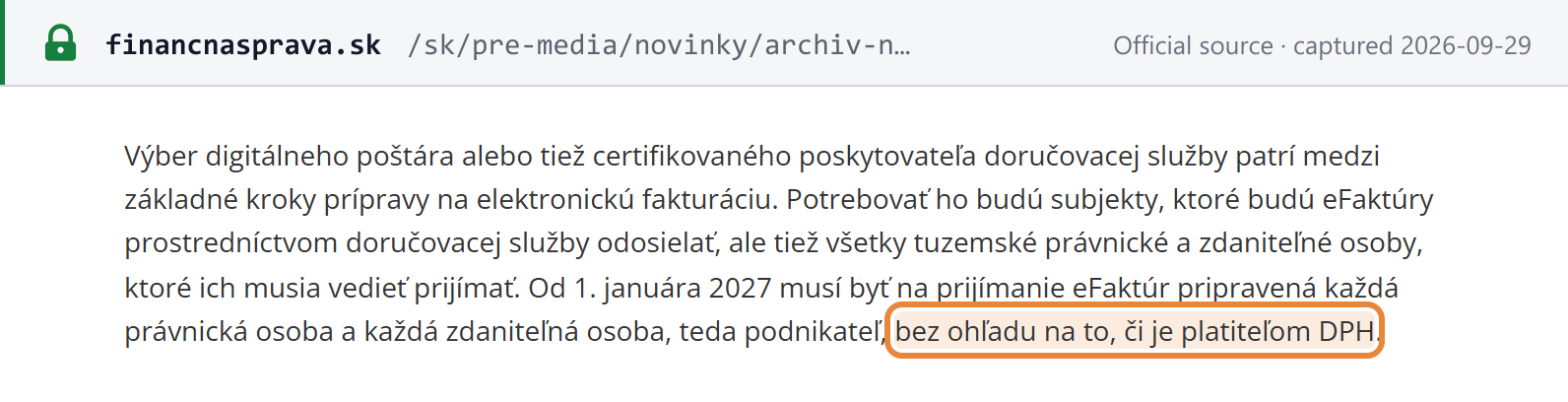
Receiving is wider than issuing. Under §71(5), from 1 January 2027, anyone obliged to issue an e-invoice must be able to send and receive through the delivery service, and anyone to whom such a supply is made in Slovakia must be able to receive through it. Finančná správa reads this as covering every legal person and every taxable person, whether or not it is a VAT payer: "Od 1. januára 2027 musí byť na prijímanie eFaktúr pripravená každá právnická osoba a každá zdaniteľná osoba, teda podnikateľ, bez ohľadu na to, či je platiteľom DPH." (From 1 January 2027 every legal person and every taxable person, that is every entrepreneur, must be ready to receive eFaktúry, regardless of whether it is a VAT payer.) (Finančná správa, 24 September 2026, checked 2026-09-29)
 Source snapshot captured 2026-09-29 — original
That includes civic associations, foundations, non-profit organisations and other non-VAT legal persons. Those without a tax number (DIČ) are being registered for income tax by the tax office so that they get one; Finančná správa said on 25 September 2026 that this is almost complete, and that a DIČ does not make an entity a VAT payer. (Finančná správa, 25 September 2026, checked 2026-09-29)
Non-established businesses
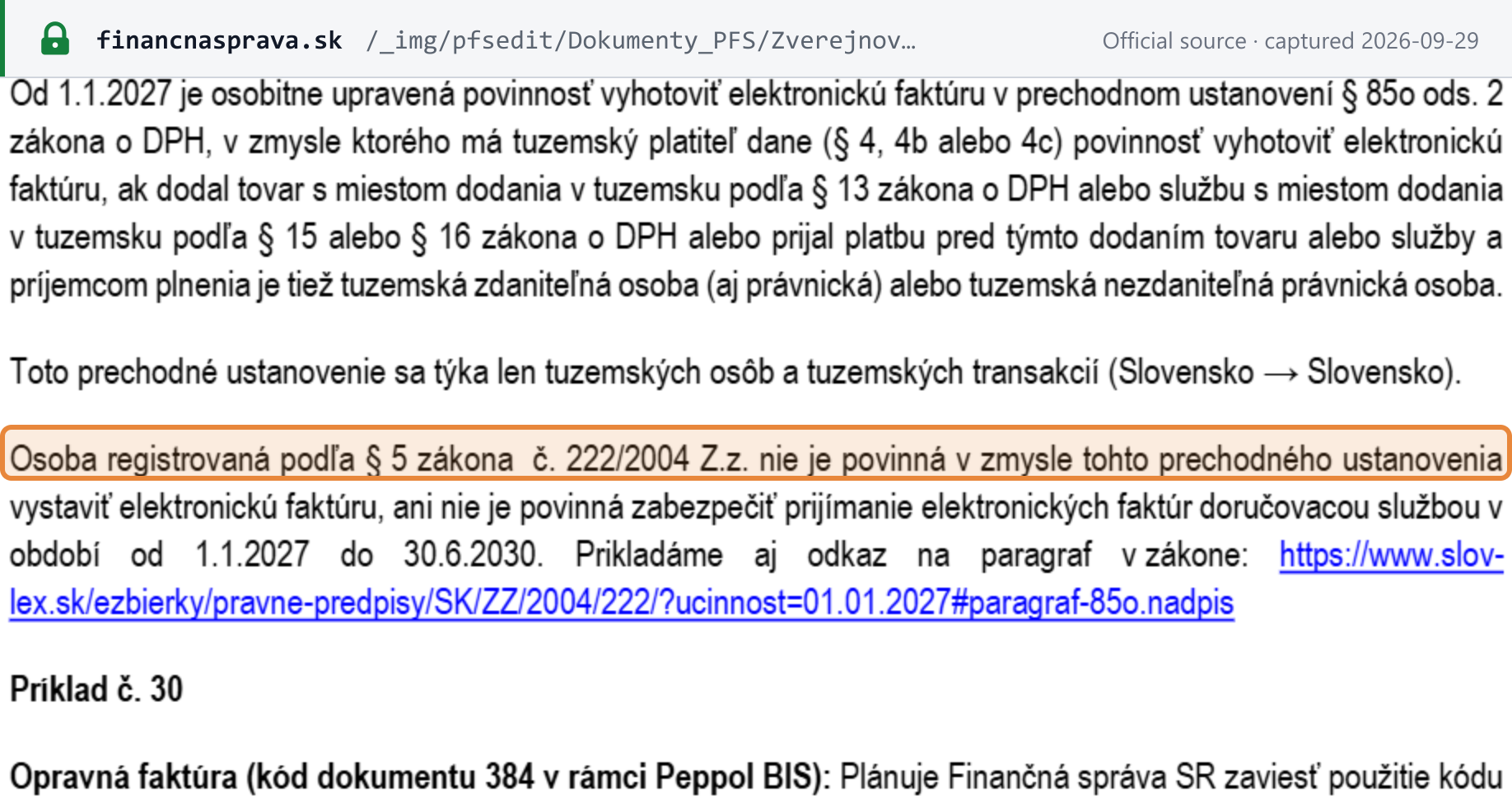
Out of scope until 30 June 2030. Both supplier and recipient must be domestic persons. The FAQ says a person registered for VAT under §5 (a foreign person) need neither issue e-invoices nor arrange to receive them through the delivery service between 1 January 2027 and 30 June 2030. FR SR explains that, before 1 July 2030, the VAT Directive does not allow mandatory e-invoicing for persons not established in the member state. Separately, from 1 January 2027 a payer established in another EU member state issues an invoice under Slovak law only where it is liable for the tax in Slovakia under §69(1) (§72(12)). (FR SR eFaktúra FAQ; FR SR information 1/DPH/2026/I, checked 2026-09-29)
 Source snapshot captured 2026-09-29 — original
Excluded transactions and simplified invoices
No e-invoice is required for:
- exempt supplies under §28–43 and §47, including intra-EU supplies of goods (§43), exports, and financial and insurance services;
- simplified invoices under §74(3): a document for goods or services where the price including VAT is EUR 100 or less, or an eKasa (or unattended fuel-pump) receipt where the price including VAT is EUR 400 or less;
- supplies within a VAT group, which are not taxable supplies (FAQ).
An e-invoice must not be issued for supplies to the Slovak Information Service or Military Intelligence, or for supplies involving classified information. (VAT Act §74(3), §85o(2); FR SR eFaktúra FAQ, checked 2026-09-29)
Cross-border supplies (to or from another member state, imports and exports) stay outside the domestic regime until the ViDA stage on 1 July 2030.
B2G
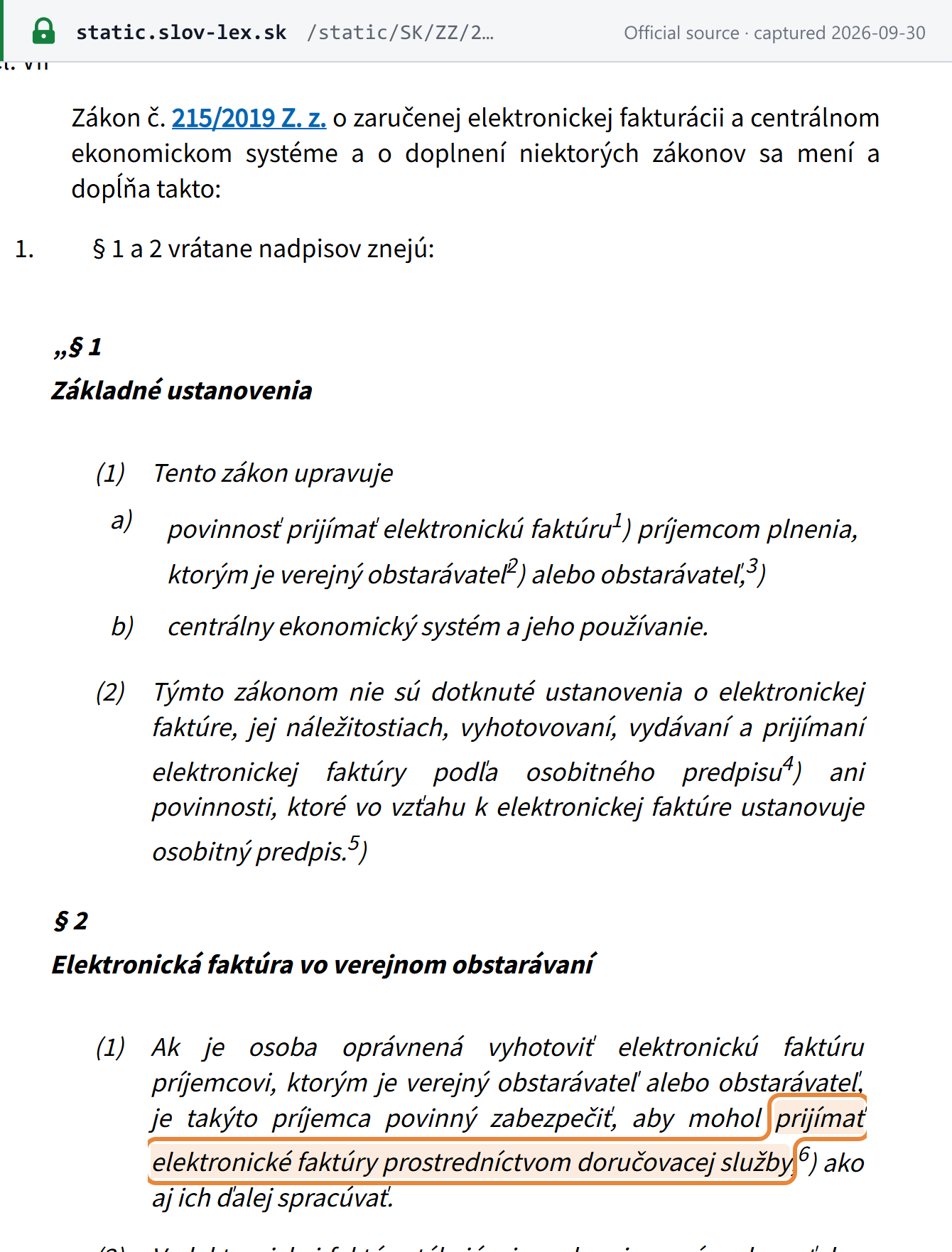
Public bodies are legal persons, so a Slovak VAT payer invoicing a ministry, municipality or region issues an e-invoice under the same rules as B2B, addressed by the body's DIČ. From 1 January 2027, Article VII of Act 385/2025 rewrites Act 215/2019: public contracting authorities and contracting entities must be able to receive e-invoices through the delivery service and process them, and an e-invoice under a public contract must carry the procurement notice number. The old "guaranteed e-invoice" rules of Act 215/2019 (§3–6) are deleted. (Act 385/2025, Art VII, checked 2026-09-29)
 Source snapshot captured 2026-09-30 — original
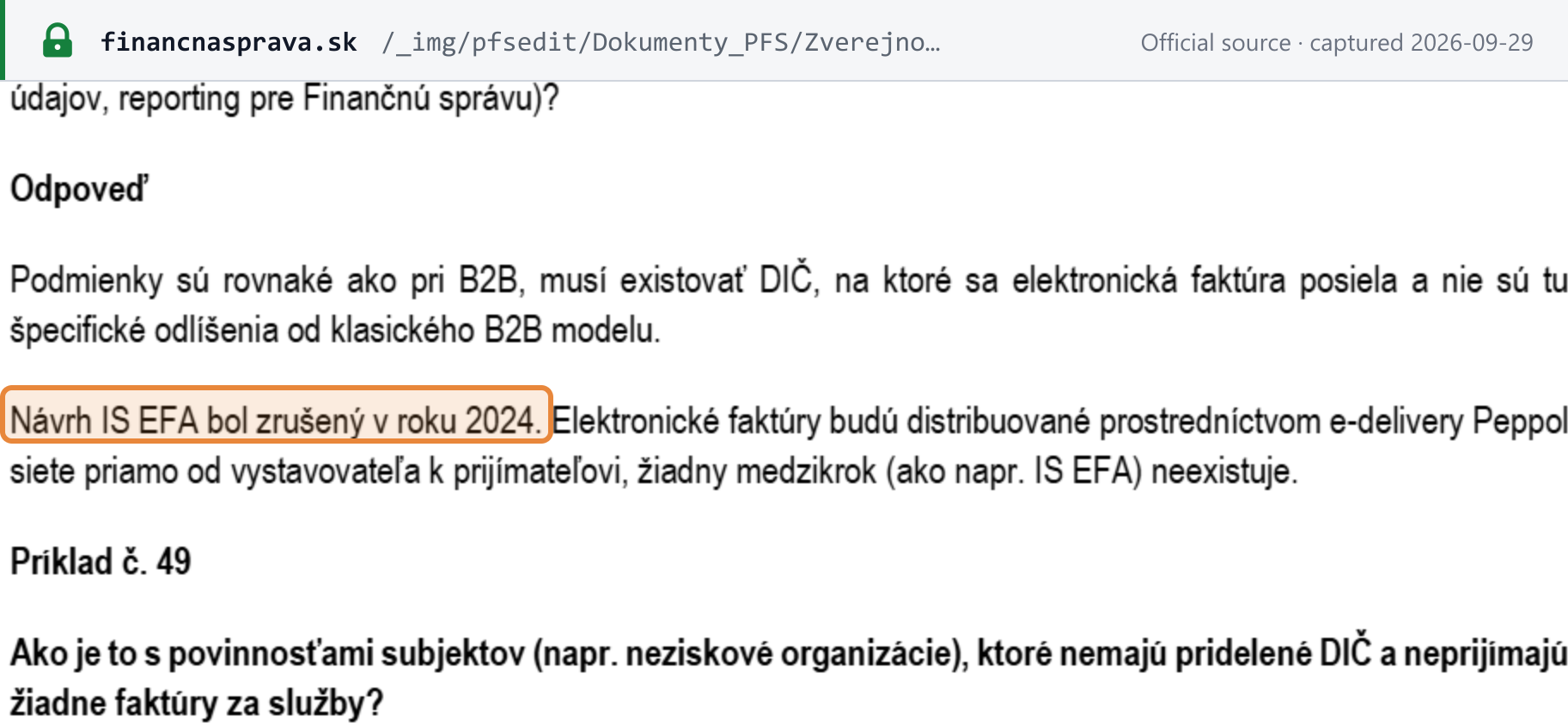
There is no central government invoicing hub. The FAQ says the design of the IS EFA central system was cancelled in 2024 and that public-sector invoices go directly from issuer to recipient over Peppol, with no intermediate step.
 Source snapshot captured 2026-09-29 — original
B2C
Out of scope. The FAQ states that eFaktúra currently covers only B2B and B2G invoicing. Retail sales are recorded without undue delay through eKasa cash registers under Act 384/2025 Coll. on the recording of sales, in force since 1 January 2026, which replaced Act 289/2008. An eKasa receipt of EUR 400 or less is a simplified invoice, so it needs no e-invoice even when the buyer is a business. (FR SR eFaktúra FAQ; Act 384/2025, checked 2026-09-29)
Format & network
CTC model: Peppol five-corner with reporting at issue
The "European delivery standard" that §76a requires is OpenPeppol. Slovakia uses the Peppol five-corner model: the supplier's certified provider delivers the invoice to the buyer's provider over Peppol, and also sends a tax data extract to the Financial Directorate's endpoint (the fifth corner). The FAQ says reporting to that endpoint happens whether or not the invoice is delivered successfully. Since 21 August 2026 the endpoint receives the data automatically and confirms receipt back to the provider. (FR SR eFaktúra FAQ; Finančná správa, 21 August 2026, checked 2026-09-29)
Format: EN 16931 in UBL 2.1 or CII
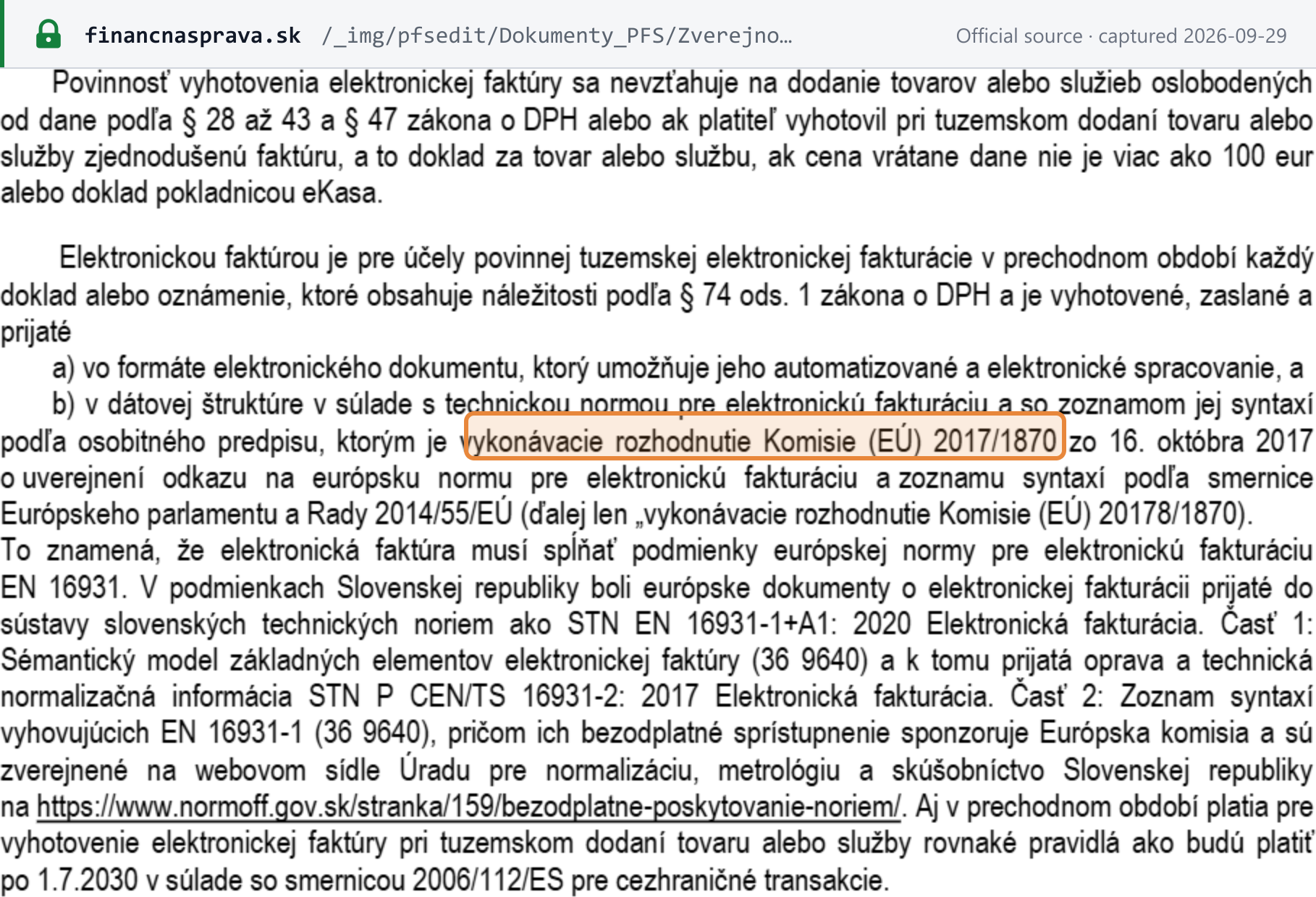
Under §85o(4) an e-invoice carries the §74(1) invoice particulars "v dátovej štruktúre v súlade s technickou normou pre elektronickú fakturáciu a so zoznamom jej syntaxí" (in a data structure complying with the technical standard for e-invoicing and its list of syntaxes). FR SR information 1/DPH/2026/I identifies that standard as Commission Implementing Decision (EU) 2017/1870, meaning an e-invoice must meet EN 16931.
 Source snapshot captured 2026-09-29 — original
- Syntax: UBL 2.1 or UN/CEFACT CII. Even an invoice sent outside Peppol, with the recipient's consent, must be UBL 2.1 or CII under EN 16931 (FAQ).
- Peppol profile: Peppol BIS Billing 3.0 (UBL 2.1), with Finančná správa's Slovak transposition, last updated 10 September 2026 (version 1.11). (Finančná správa — eFaktúra, checked 2026-09-29)
- What does not qualify: a PDF is not an eFaktúra, and EDIFACT does not meet the definition for domestic transactions from 1 January 2027 (FAQ).
- Implementation details in the FAQ: a mapping of VAT category codes (S, E, K, G, AE, O, Z) and VATEX exemption codes to Slovak cases, and a recommendation to correct an invoice with a credit note plus a new invoice rather than type code 384.
Participant ID: 0245 plus the DIČ
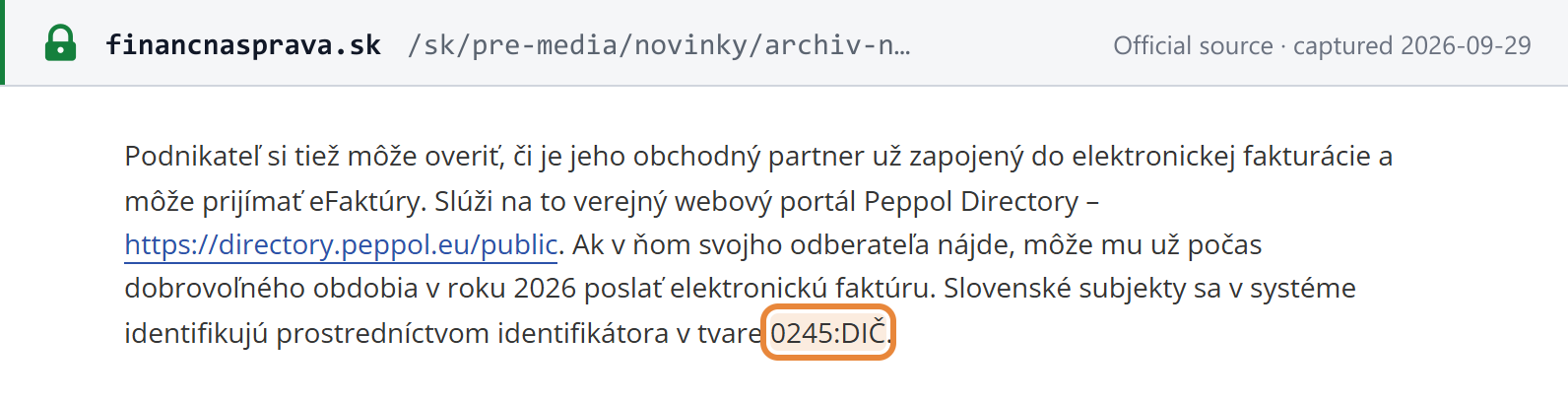
Slovak end users are registered on Peppol under scheme 0245 followed by the DIČ, the 10-digit tax number, not the IČ DPH VAT number. Finančná správa: "Slovenské subjekty sa v systéme identifikujú prostredníctvom identifikátora v tvare 0245:DIČ." (Slovak entities are identified in the system by an identifier in the form 0245:DIČ.) Registration goes to a central SMP, and a provider that is being replaced must deregister the user within 3 working days. (Finančná správa, 24 September 2026; Slovakia Peppol Authority specific requirements, checked 2026-09-29) See the Slovakia tax identification number guide for the DIČ format.
 Source snapshot captured 2026-09-29 — original
Integrity
The certified provider must automatically check the formal requirements of each e-invoice, and must secure identification of sender and addressee, the origin, integrity and legibility of the invoice, and proof of when it was sent, delivered and received (§76a(2)). A qualified electronic signature is only one optional way to meet the §71(3) integrity duty, and a QR code may be added only as a separate attachment or inside a PDF attachment (FAQ). As noted in the overview, no clearance, QR-code or hash requirement applies. (Act 385/2025, §76a)
Issue deadline
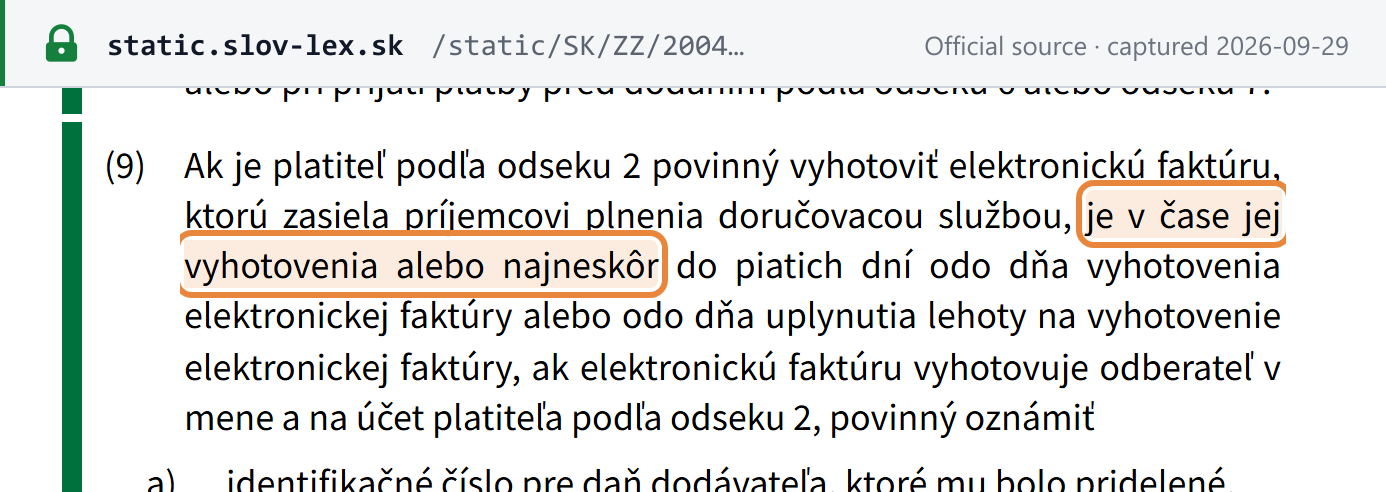
The e-invoice is due within 15 days of the supply, of receiving an advance payment, or, for a tax-base correction, of the end of the month in which the correction arose (§85o(6)). One summary e-invoice may cover up to a calendar month and is due within 15 days of the month's end (§85o(7)). Where the buyer tells the supplier only later that it is an in-scope person, the deadline counts from that notice (§85o(8)). If the supplier sends through the delivery service and the recipient cannot receive, the supplier has still met its duty (FAQ). From 1 July 2030 the deadline becomes 10 days. (VAT Act §85o(6)–(8); FR SR information 1/DPH/2026/I, checked 2026-09-29)
E-reporting
Supplier reporting (§85o(9), (11)). A VAT payer that sends an e-invoice through the delivery service must report specified invoice data to the Financial Directorate at the time of issue, or within 5 days of issue where the buyer self-bills on its behalf. The data are the supplier's and buyer's IČ DPH (or the buyer's name if it has none), specified §74(1) particulars, the cash-accounting flag and, for a corrective invoice, the original invoice number and the changed data. The report goes through the delivery service, and the duty "sa považuje za splnenú odovzdaním elektronickej faktúry doručovacej službe" (is treated as met by handing the e-invoice to the delivery service). (VAT Act §85o(9), (11), checked 2026-09-29)
 Source snapshot captured 2026-09-29 — original
Buyer reporting (§85o(10)), as enacted. A Slovak VAT payer that receives an e-invoice through the delivery service must report the same data within 5 days of receipt. Bill 1454 proposes deleting this duty before it takes effect (see Pending amendment); until the bill is enacted, the duty stands.
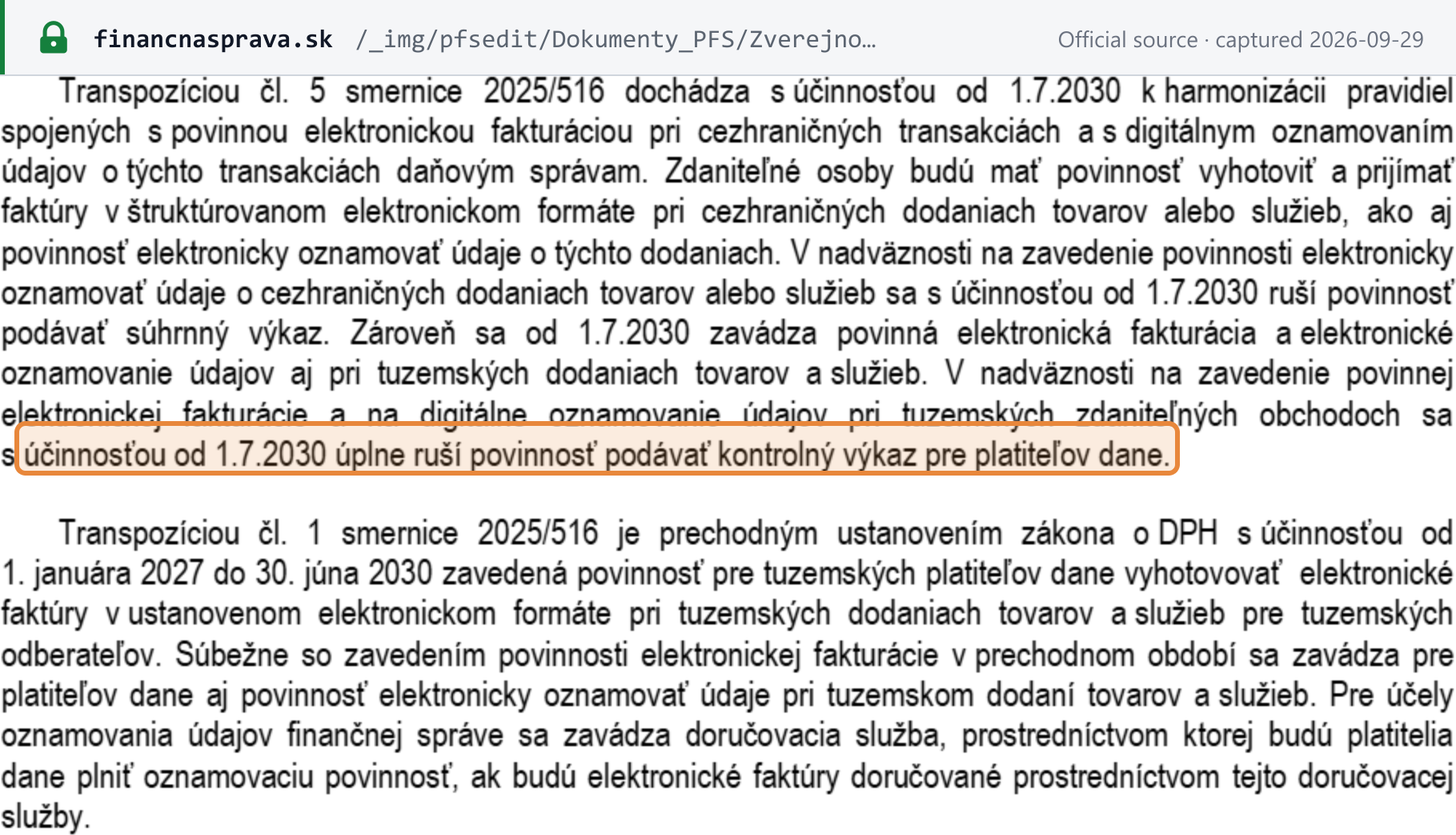
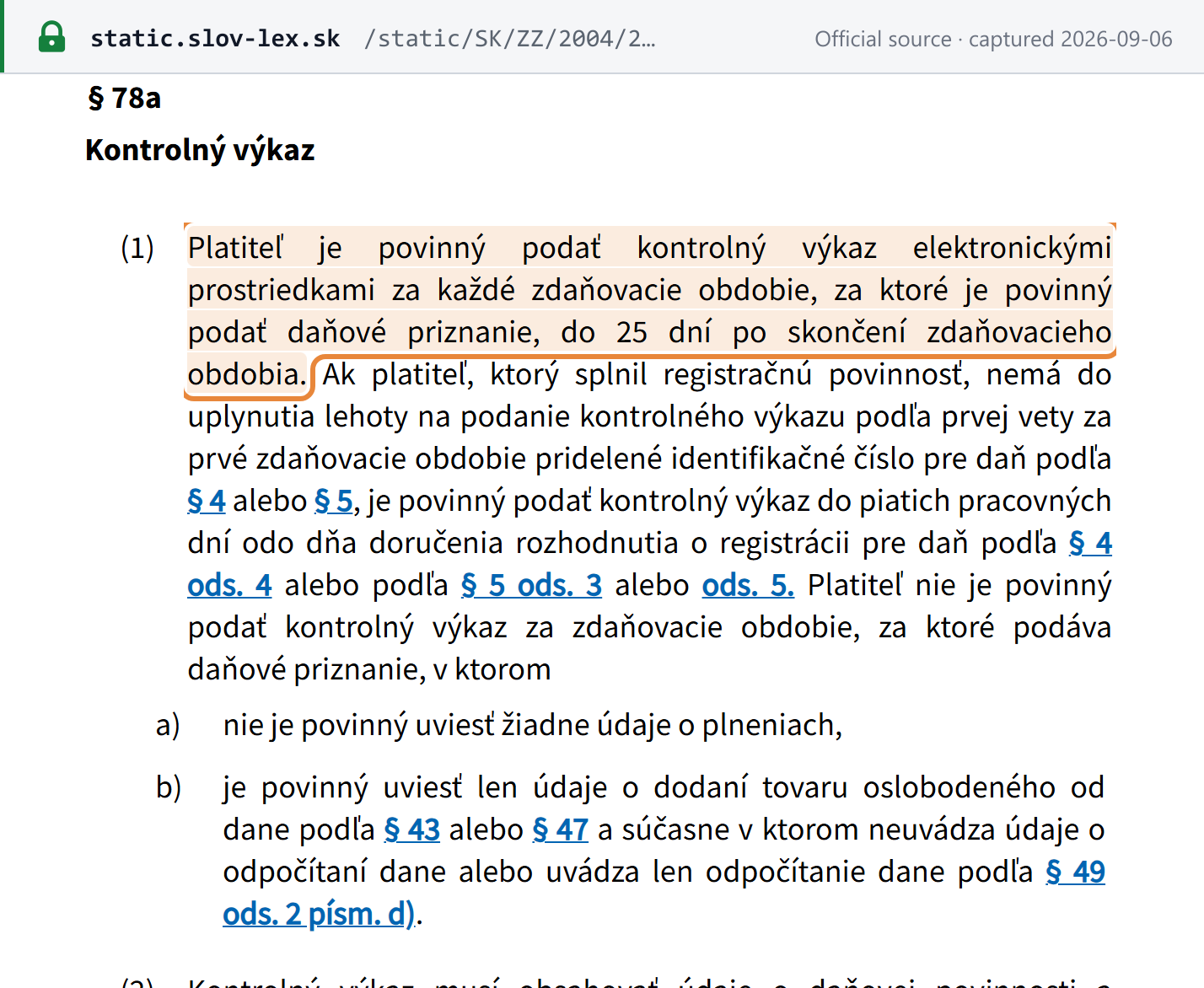
The control statement continues until mid-2030. eFaktúra reporting does not replace the kontrolný výkaz (control statement, §78a), which stays due with each VAT return, within 25 days of the period's end, for periods ending up to 30 June 2030. The FAQ confirms that the control statement and the EC Sales List are abolished only from 1 July 2030. From then the new §80a domestic reporting takes over, input VAT on reportable supplies becomes deductible only with an e-invoice, and intra-EU supplies are reported per transaction under a new §80. (FR SR eFaktúra FAQ; FR SR information 1/DPH/2026/I, checked 2026-09-29)
 Source snapshot captured 2026-09-29 — original
 Source snapshot captured 2026-09-06 — original
Onboarding: how to comply
Steps for a business
- Choose a digital postman (certified provider) at vpds.financnasprava.sk, logged in to the Finančná správa portal with authority to act for the entity. Choosing a provider there is not yet a contract; the contract is made with the provider.
- Register one receiving postman per DIČ. An entity may have only one digital postman for receiving per DIČ, but may use more than one for sending.
- To switch provider, end the contract; the old provider must deregister you within 3 working days.
- Check whether a partner can already receive in the public Peppol Directory, searching for 0245 plus the partner's DIČ. Finančná správa notes that a partner found there can be sent an e-invoice already during the 2026 voluntary window.
- Small businesses can use a provider's web inbox rather than an integration. Finančná správa says free basic options exist; the FAQ's estimate for a simple inbox is EUR 5–12 a month (an estimate, not a regulated price).
(Finančná správa, 24 September 2026; FR SR eFaktúra FAQ, checked 2026-09-29)
Finančná správa said on 25 September 2026 that more than 12,000 entities had chosen a digital postman. (Finančná správa, 25 September 2026)
Connection modes
- Provider web inbox — for small senders and receivers; send and receive through the provider's portal.
- Integration with accounting or ERP software — the software creates EN 16931 UBL or CII and hands it to the provider, which delivers over Peppol and reports to the Financial Directorate.
There is no government portal for sending e-invoices; every exchange runs through a certified provider.
Accreditation of providers
Only providers entered in the FR SR register may provide the delivery service in Slovakia (§76a(7)). FR SR keeps the register on its website from 1 January 2026 and enters an applicant within 30 days where it:
- has its seat or place of business in the EU;
- has a clean record (no intentional criminal offence), for the company and its statutory body;
- proves the §76a(2) capabilities (format checks, identification, integrity, proof of sending and receipt, and reporting); and
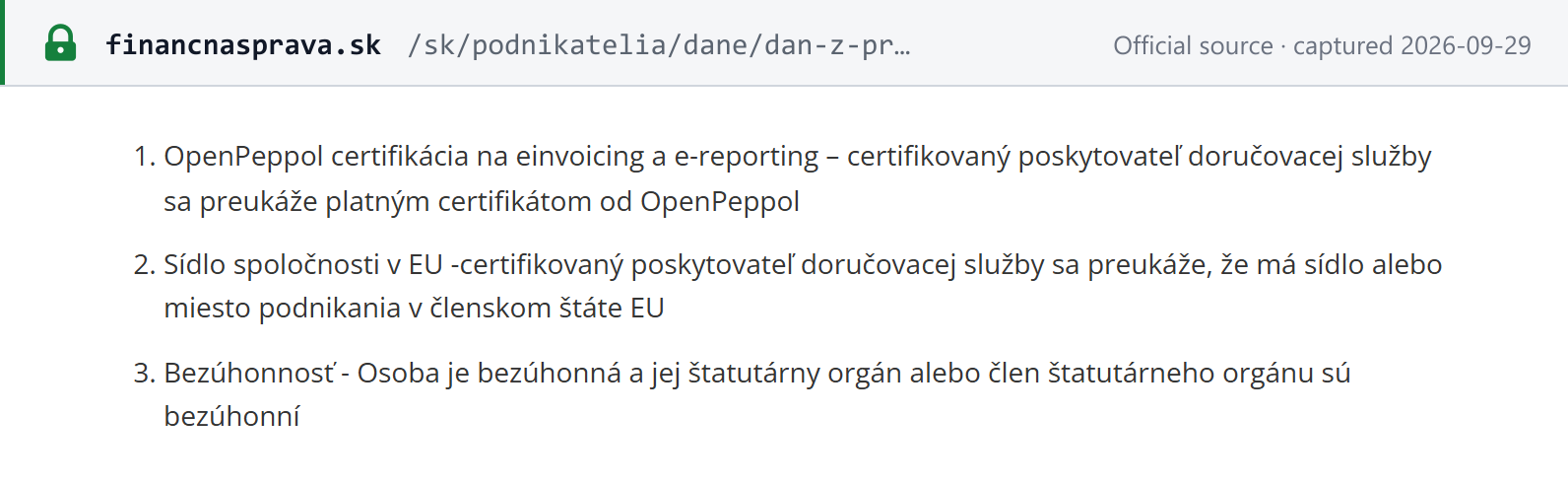
- is authorised to operate under the European delivery standard, shown by a valid OpenPeppol certificate.
Providers keep delivery and receipt logs for at least 6 months. A provider that stops meeting the conditions faces non-monetary sanctions: publication, suspension of access or withdrawal of authorisation. FR SR removes, on 1 January 2027, any provider that has not proven by 15 December 2026 that it can report automatically (§85o(19)(a)). (Act 385/2025, §76a; VAT Act §85o(19); Finančná správa — eFaktúra, checked 2026-09-29)
 Source snapshot captured 2026-09-29 — original
On 22 September 2026 Finančná správa counted 75 certified providers, with 11 more in certification. The count changes often; use the live list of certified providers. (Finančná správa, 22 September 2026, checked 2026-09-29)
 Source snapshot captured 2026-09-29 — original
Testing
Providers must pass the Slovak onboarding tests on the Peppol Testbed. Finančná správa's eFaktúra page links the Slovak test suites (billing and self-billing), which software vendors can also use. (Finančná správa — eFaktúra; Slovakia Peppol Authority specific requirements, checked 2026-09-29)
Support: the Finančná správa call centre (048/4317 222) and [email protected].
Penalties
The fines in §85o apply from 1 January 2027 and concern reporting:
| Breach | Fine | Provision |
|---|---|---|
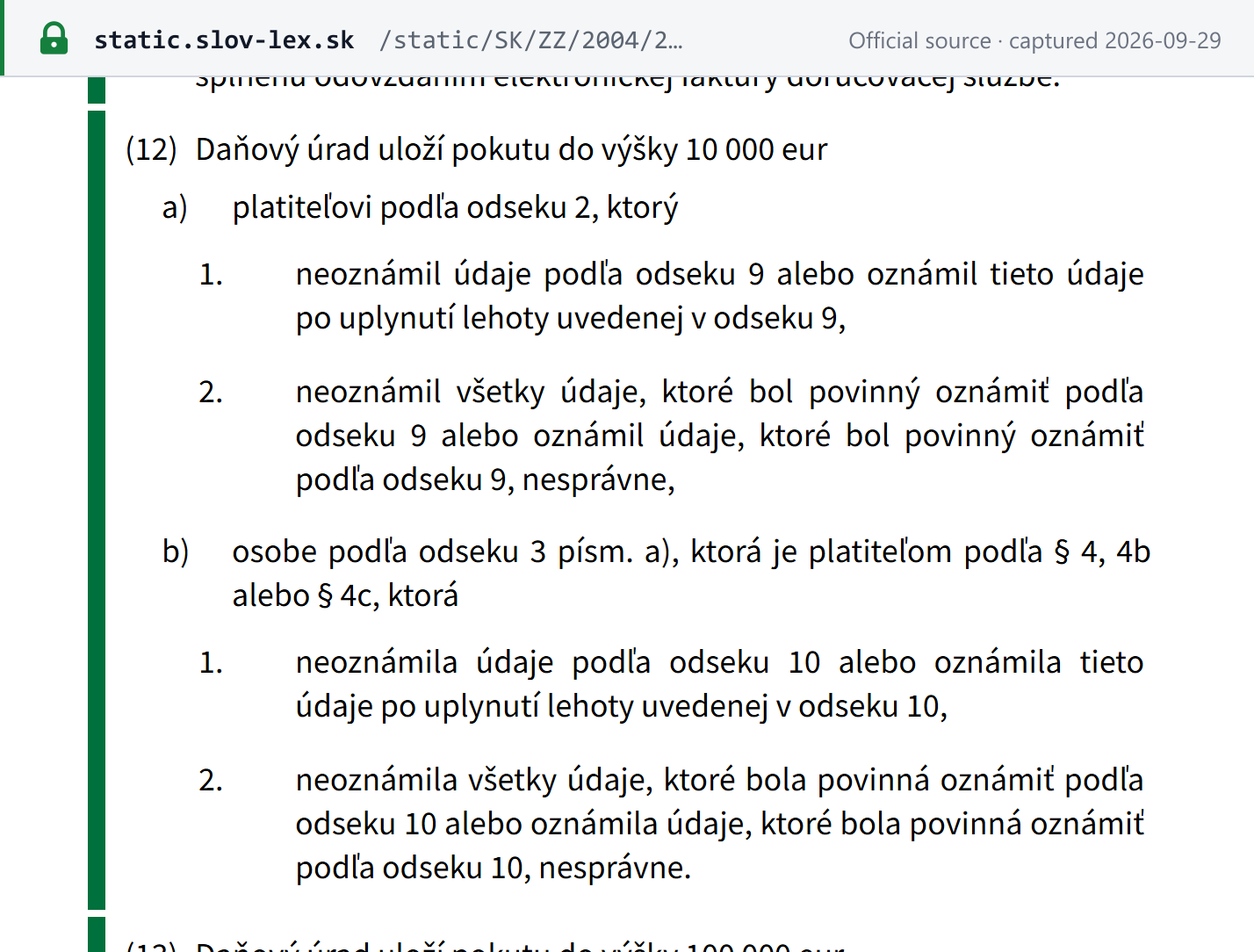
| Supplier fails to report, or reports late, incompletely or incorrectly (§85o(9)) | up to EUR 10,000 | §85o(12)(a) |
| VAT-payer recipient does the same for buyer reporting (§85o(10), as enacted) | up to EUR 10,000 | §85o(12)(b) |
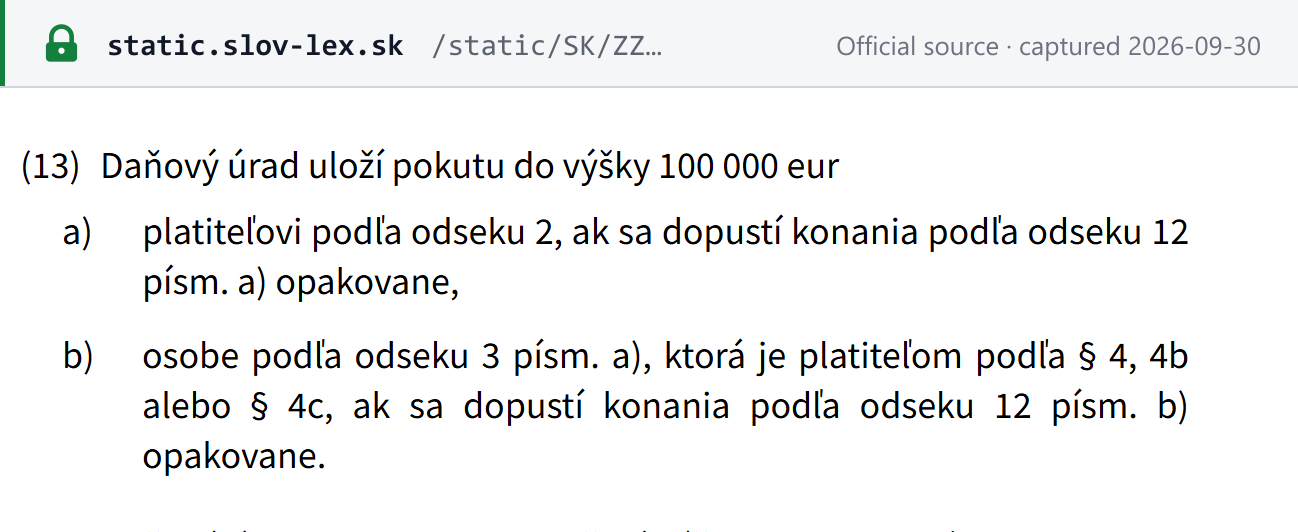
| Repeated breach | up to EUR 100,000 | §85o(13) |
The tax office weighs the seriousness and duration of the breach. It imposes no fine where an obviously wrong figure is corrected, or where a delay was caused by a demonstrable technical fault at the certified provider and the data were reported without delay once it was fixed (§85o(14)). (VAT Act §85o(12)–(14), checked 2026-09-29)
 Source snapshot captured 2026-09-29 — original
 Source snapshot captured 2026-09-30 — original
Late or missing issue of an e-invoice is sanctioned under the Tax Procedure Code (Act 563/2009), §155(1)(e), not under §85o.
Enforcement posture. As enacted, the fines apply from 1 January 2027. Bill 1454 proposes that no fine be imposed for late e-invoices or reporting breaches arising between 1 January and 30 June 2027. It is at first reading as at 2026-09-30 and is not law (see Pending amendment).
Frequently asked questions
We are a Slovak company that is not VAT-registered. Do we need eFaktúra?
You do not have to issue e-invoices, but from 1 January 2027 you must be able to receive them. Finančná správa says every legal person and every taxable person must be ready to receive eFaktúry from that date, whether or not it is a VAT payer; that includes associations, foundations and non-profits. In practice this means registering one receiving digital postman for your DIČ. (Finančná správa, 24 September 2026; FR SR FAQ, 15 September 2026 edition)
Does the mandate apply to a foreign company registered for VAT in Slovakia?
No, not until 30 June 2030. FR SR's FAQ says a person registered under §5 of the VAT Act need neither issue e-invoices nor arrange to receive them through the delivery service between 1 January 2027 and 30 June 2030. Cross-border e-invoicing starts with the ViDA stage on 1 July 2030. (FR SR FAQ, 15 September 2026 edition)
Is there a grace period without fines in 2027?
Not in law as at 2026-09-30. Under Act 385/2025, the reporting fines (up to EUR 10,000, or EUR 100,000 if repeated) apply from 1 January 2027. Government bill 1454, at first reading in the National Council, proposes no fines for breaches arising between 1 January and 30 June 2027. It becomes law only if it is passed and published. (VAT Act §85o(12)–(13); NR SR print 1454)
Who reports the invoice data to the Financial Directorate?
The supplier, at the time of issue, by handing the e-invoice to its certified provider, which sends the tax data to the Financial Directorate. As enacted, a VAT-payer buyer must also report within 5 days of receipt, but bill 1454 proposes deleting that buyer duty. The control statement is still filed until periods ending 30 June 2030. (VAT Act §85o(9)–(11); FR SR FAQ)
Which identifier do we use on Peppol — the DIČ or the IČ DPH?
The DIČ. Slovak entities are registered on Peppol as 0245 followed by the 10-digit DIČ, not the IČ DPH VAT number. You can check whether a partner can receive by searching for 0245 and its DIČ in the Peppol Directory. (Finančná správa, 24 September 2026)
Do small receipts and exempt supplies need an e-invoice?
No. Exempt supplies (§28–43 and §47 of the VAT Act) and simplified invoices are excluded. A simplified invoice is a document of EUR 100 or less including VAT, or an eKasa receipt of EUR 400 or less including VAT. (VAT Act §74(3), §85o(2))
Recent changes
- 2026-09-24 — Finančná správa confirmed that from 1 January 2027 every legal person and every taxable person, VAT-registered or not, must be able to receive eFaktúry, and that Slovak entities are identified on Peppol as 0245:DIČ. (Finančná správa)
- 2026-09-22 — Finančná správa counted 75 certified digital postmen, with 11 more in certification. (Finančná správa)
- 2026-08-27 — Government bill 1454 amending the VAT Act delivered to the National Council; it proposes a no-fines period from 1 January to 30 June 2027 and deleting buyer reporting. As at 2026-10-05 the bill was at first reading, with committee deadlines of 13–16 November 2026; not law. (NR SR) — see event
- 2026-08-21 — The Financial Directorate's e-invoicing infrastructure went live, receiving tax data from eFaktúry automatically and confirming receipt to providers. (Finančná správa) — see event · issue
- 2026-07-07 — Finančná správa's FAQ confirmed mandatory domestic B2B and B2G eFaktúra from 1 January 2027 under Act 385/2025, after the 2026 voluntary window. (Slov-Lex) — see event · issue
- 2026-01-01 — Act 385/2025 in force: the provider register opens and the voluntary window for consent-free e-invoices through certified providers runs until 31 December 2026. (Slov-Lex)
Related resources
- Slovakia VAT guide — rates, registration, filing and the control statement
- Slovakia tax identification numbers — the DIČ is the Peppol participant ID
- Validate a Slovak IČ DPH
- Slovakia tax-change chronology — every tracked Slovak change, dated and sourced
- E-invoicing status and networks worldwide — Slovakia's row in global context
- Peppol network explainer and country requirements for Peppol
- ViDA — VAT in the Digital Age — the EU framework behind the 2030 stage
- How to verify an EU VAT number (VIES)
- Neighbouring mandates: Czech Republic, Poland
Important websites
- Finančná správa — eFaktúra — official portal: Slovak Peppol BIS transposition, provider conditions, test-suite links
- Choose a digital postman (VPDS) — provider selection, logged in to the Finančná správa portal
- List of certified providers — the FR SR register (PDF, updated regularly)
- FR SR eFaktúra FAQ (15 September 2026 edition)
- Slovakia Peppol Authority specific requirements
- Peppol Directory — check whether a partner can receive (search 0245 plus the DIČ)
- VAT Act 222/2004, version from 1 January 2027 and Act 385/2025 — consolidated texts on Slov-Lex
- NR SR — print 1454 — the pending amending bill