E-invoicing in Croatia: Fiskalizacija 2.0 and the eRačun mandate
Overview
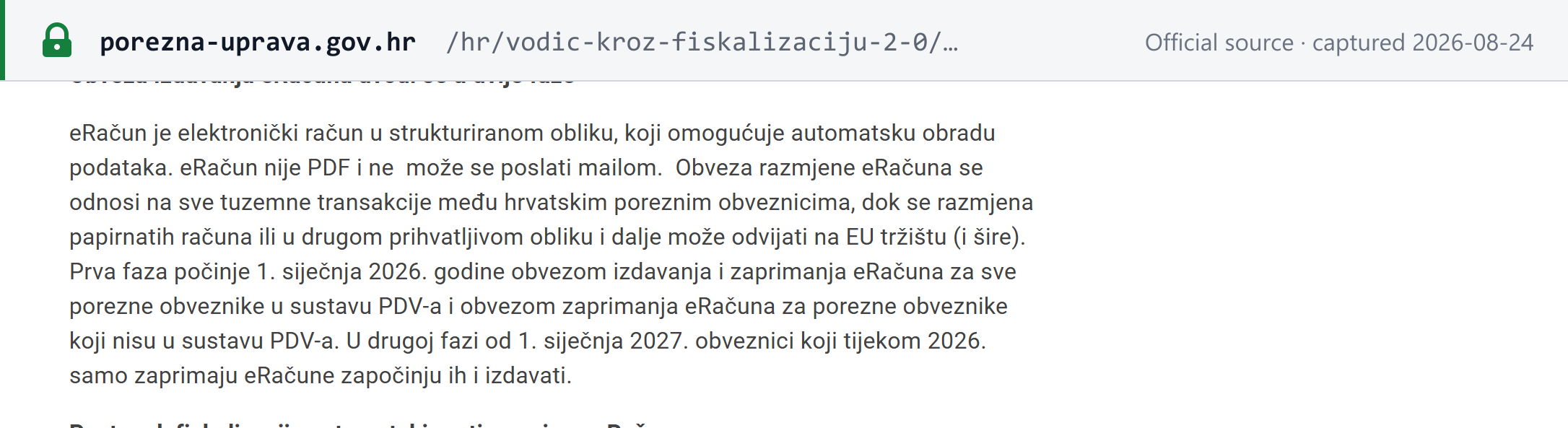
Croatia's B2B e-invoicing mandate is already live. Since 1 January 2026, every Croatian VAT-registered taxpayer must issue and receive structured electronic invoices (eRačun) for domestic transactions, and every other taxpayer in scope must be able to receive them. On 1 January 2027 (Phase 2) the non-VAT-registered taxpayers and public bodies that only receive today start issuing too. Porezna uprava's guide puts the two phases this way: "Prva faza počinje 1. siječnja 2026. godine obvezom izdavanja i zaprimanja eRačuna za sve porezne obveznike u sustavu PDV-a i obvezom zaprimanja eRačuna za porezne obveznike koji nisu u sustavu PDV-a." (In English: the first phase begins on 1 January 2026 with the obligation to issue and receive eRačun for all taxpayers in the VAT system, and the obligation to receive eRačun for taxpayers outside it.) (Porezna uprava — Vodič kroz Fiskalizaciju 2.0, checked 2026-09-24)
 Source snapshot captured 2026-08-24 — original
The programme is called Fiskalizacija 2.0. It sits alongside the older Fiskalizacija 1.0, the real-time fiscalisation of receipts to consumers, and one law now governs both: the Zakon o fiskalizaciji (Fiscalization Act, NN 89/2025). The Porezna uprava (Ministry of Finance, Tax Administration) runs the central fiscalisation system, the AMS address directory (Adresar metapodatkovnih servisa) and the FiskAplikacija taxpayer app. (Zakon o fiskalizaciji, Art 1–2, checked 2026-09-24)
Croatia's model is decentralised exchange with fiscalisation by both parties. It is not a clearance model, and the domestic network is not Peppol. The invoice travels between the two parties' access points over a national eDelivery network. Separately, the issuer's and the recipient's software each send a fiscalisation message (an extract of the invoice data) to Porezna uprava, which cross-checks the two. Porezna uprava does not validate, stamp or return the invoice itself.
| Croatia | |
|---|---|
| B2B (domestic) | Mandatory since 1 January 2026 for VAT-registered taxpayers (issue + receive) and all other in-scope taxpayers (receive). Non-VAT income-tax and profit-tax payers start issuing on 1 January 2027 |
| B2G | Mandatory since 1 July 2019 for suppliers (public contracting authorities receive since 1 December 2018), via FINA, under a separate law (NN 94/2018); non-VAT public bodies also start issuing B2B-style eRačun on 1 January 2027 |
| B2C | No e-invoice. Receipts are fiscalised in real time (Fiskalizacija 1.0); since 1 January 2026 this covers every payment method |
| Non-residents | Out of scope. Taxpayers without a seat, residence or habitual residence in Croatia neither issue nor receive eRačun (Porezna uprava FAQ) |
| Format | EN 16931-1:2017 + Porezna uprava's national specification with extensions (the "CIUS-HR"), current version 1.8 of 12 March 2026; syntax UBL 2.1 |
| Network | National eDelivery network, "eRačun-AS4" profile (CEF eDelivery AS4 1.15), certified access points, AMS/MPS discovery. Not Peppol for domestic B2B; FINA runs a Peppol access point for cross-border B2G |
| Fiscalisation / reporting | Issuer fiscalises at issue; recipient within 5 working days; payment and rejection reports by the 20th of the following month |
| Authority | Porezna uprava (Ministry of Finance); FINA for B2G |
| Legislation | Zakon o fiskalizaciji (NN 89/2025); Pravilnik o eRačunu (NN 11/2026); Zakon o elektroničkom izdavanju računa u javnoj nabavi (NN 94/2018) |
Mandate status & timeline
| Phase | Who / what | Date | Status | Legal basis |
|---|---|---|---|---|
| B2G — receiving | Public and sectoral contracting authorities must receive and process EN 16931 e-invoices | 1 December 2018 | passed | NN 94/2018, Art 6(1) and Art 16 [1] |
| B2G — issuing | Suppliers to public contracting authorities must issue e-invoices | 1 July 2019 | passed | NN 94/2018, Art 7 and Art 16 [1] |
| Act in force | General entry into force of the Zakon o fiskalizaciji; the old cash-transactions Fiscalization Act is repealed; preparation and access-point testing begin | 1 September 2025 | passed | NN 89/2025, Arts 79–80 [2] |
| AMS registration deadline | eRačun recipients supply and confirm the address through which their receiving endpoint is found in the AMS | 31 December 2025 | passed | Porezna uprava eRačun portal; Act Art 44 [3] |
| Phase 1 | VAT-registered taxpayers established in Croatia issue and receive eRačun; everyone else in scope (non-VAT companies, crafts, liberal professions, public bodies) receives. B2C receipt fiscalisation extended to all payment methods | 1 January 2026 | in force | NN 89/2025, Art 80 [2] |
| Phase 2 | Non-VAT-registered income-tax (self-employed) and profit-tax payers, and non-VAT public bodies, start issuing eRačun; MIKROeRAČUN gains issuing | 1 January 2027 | enacted, upcoming | NN 89/2025, Art 80 (Art 38(1) points 2–3; Arts 54–56) [2] |
| B2C certificates | Receipt-fiscalisation certificates may come from any eIDAS trusted-list provider; signing method moves to the Technical Specification | 1 January 2027 | enacted, upcoming | NN 97/2026, Art 13 [4] |
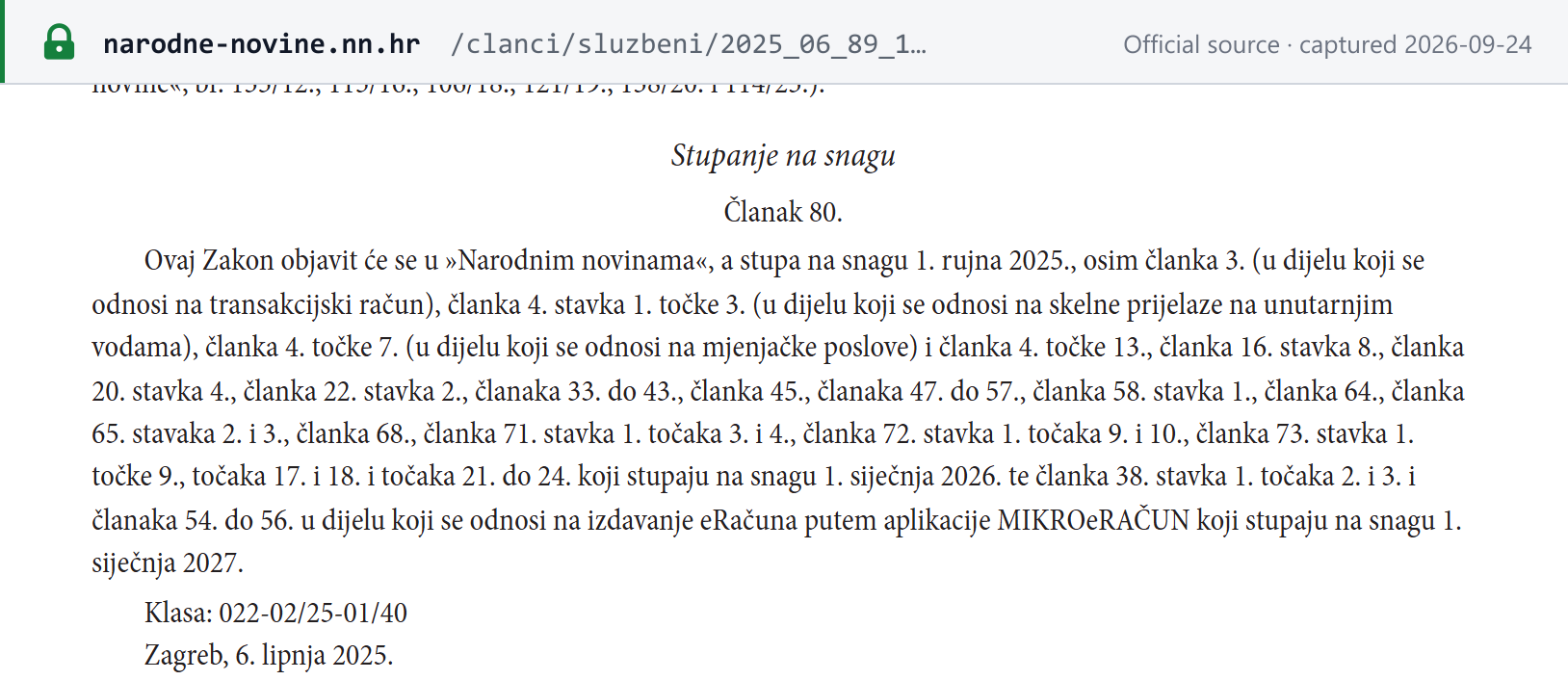
Article 80 of the Act is the phase-in clause. It sets 1 September 2025 as the general date, lists the eRačun articles (Arts 33–43, 45, 47–57 and others) that took effect on 1 January 2026, and holds back Art 38(1) points 2 and 3, and Arts 54–56 as far as they concern issuing through MIKROeRAČUN, until 1 January 2027.
 Source snapshot captured 2026-09-24 — original
Phase 2 is the next milestone. Porezna uprava's guide says: "U drugoj fazi od 1. siječnja 2027. obveznici koji tijekom 2026. samo zaprimaju eRačune započinju ih i izdavati." (In the second phase, from 1 January 2027, obligors who during 2026 only receive eRačun begin to issue them too.) Until then, Porezna uprava's FAQ confirms that taxpayers outside the VAT system, including flat-rate crafts (paušalni obrt), have no obligation to issue eRačun in 2026 and may invoice as before. (Vodič; Porezna uprava FAQ, checked 2026-09-24)
On 2 September 2026 Porezna uprava said that an upgraded MIKROeRAČUN app with issuing will be available for testing during October 2026, ahead of the issuing obligation that starts on 1 January 2027. The October test window is a plan announced by Porezna uprava, not yet an event. (Porezna uprava news, 2 September 2026, checked 2026-09-24) Porezna uprava's MIKROeRAČUN page adds that issuing through the app will be enabled from 1 January 2027, and that anyone who needs to issue eRačun during 2026 must contract another information intermediary. (Porezna uprava — MIKROeRAČUN, checked 2026-09-24)
Postponements. None. Neither phase date has moved since the Act was published on 13 June 2025, and no amending act to NN 89/2025 had been published as at 2026-09-24.
Transition. The Act does not apply to invoices issued before 1 January 2026. Porezna uprava's view is that credit notes and corrections that reference 2025 invoices need not be issued as eRačun either. (Porezna uprava FAQ, checked 2026-09-24)
Legal basis
-
Zakon o fiskalizaciji (Fiscalization Act), NN 89/2025, document 1233, printed 13 June 2025. The Sabor adopted it on 6 June 2025, and it entered into force generally on 1 September 2025, with the phased dates above (Art 80). Article 1: "Ovim se Zakonom uređuje fiskalizacija računa u krajnjoj potrošnji, izdavanje i fiskalizacija elektroničkog računa (u daljnjem tekstu: eRačun) u poslovanju poreznih obveznika." (This Act regulates the fiscalisation of invoices in final consumption and the issuing and fiscalisation of electronic invoices, eRačun, in taxpayers' business.) Part Two is Fiskalizacija 1.0 (B2C); Part Three is the eRačun regime. It repealed the old Zakon o fiskalizaciji u prometu gotovinom (NN 133/12 and amendments) from 1 September 2025 (Art 79). [2]
-
Pravilnik o eRačunu (Rulebook on eRačun), NN 11/2026, document 88, printed and signed 30 January 2026, adopted by the Minister of Finance under Art 64 of the Act. It enters into force on the first day after publication, 31 January 2026. It sets the AS4 exchange, AMS/MPS discovery, certificate and conformity-testing rules, and it makes Porezna uprava's Technical Specification binding: Art 2(1)(18) defines it as documentation published on the Fiskalizacija 2.0/eRačun portal that "obvezna je za primjenu radi usklađenosti sa Zakonom" (is mandatory to apply for compliance with the Act). [5]
-
Pravilnik o fiskalizaciji računa u krajnjoj potrošnji (B2C Rulebook), NN 153/2025, document 2278, printed 17 December 2025, in force 1 January 2026. It replaced the Pravilnik o fiskalizaciji u prometu gotovinom. [6]
-
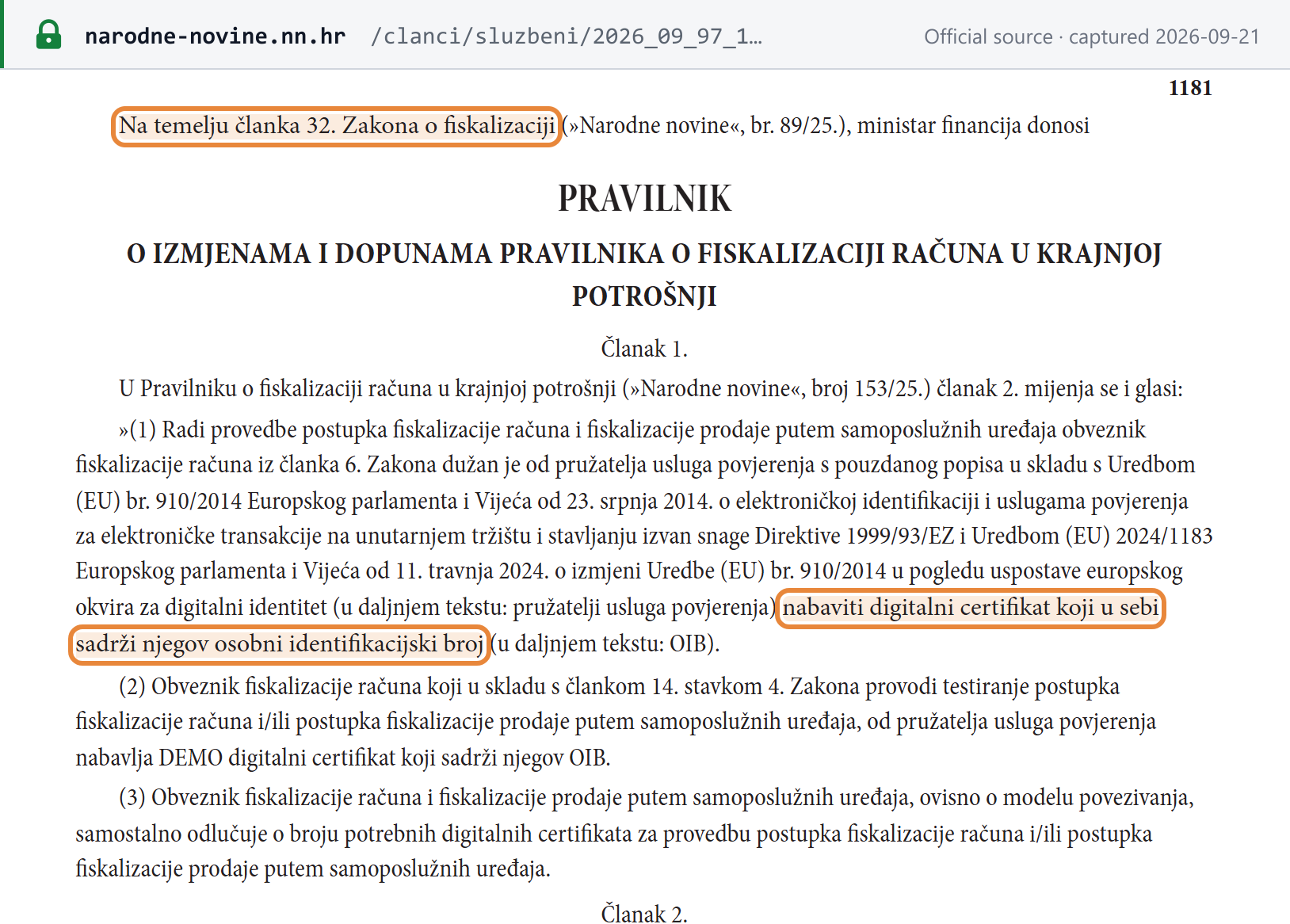
NN 97/2026 (document 1181), the rulebook amending the B2C Rulebook. It was signed in Zagreb on 27 August 2026, its printed issue is dated 2 September 2026 (Porezna uprava's news item about it followed on 3 September), and it enters into force on 1 January 2027. It changes which certificates are accepted for receipt fiscalisation and how signing is specified (see Onboarding), and it widens the self-service-device rule to sales paid by card, mobile app or similar means, and drops the PKI-registration article (Arts 2 and 8). [4]
-
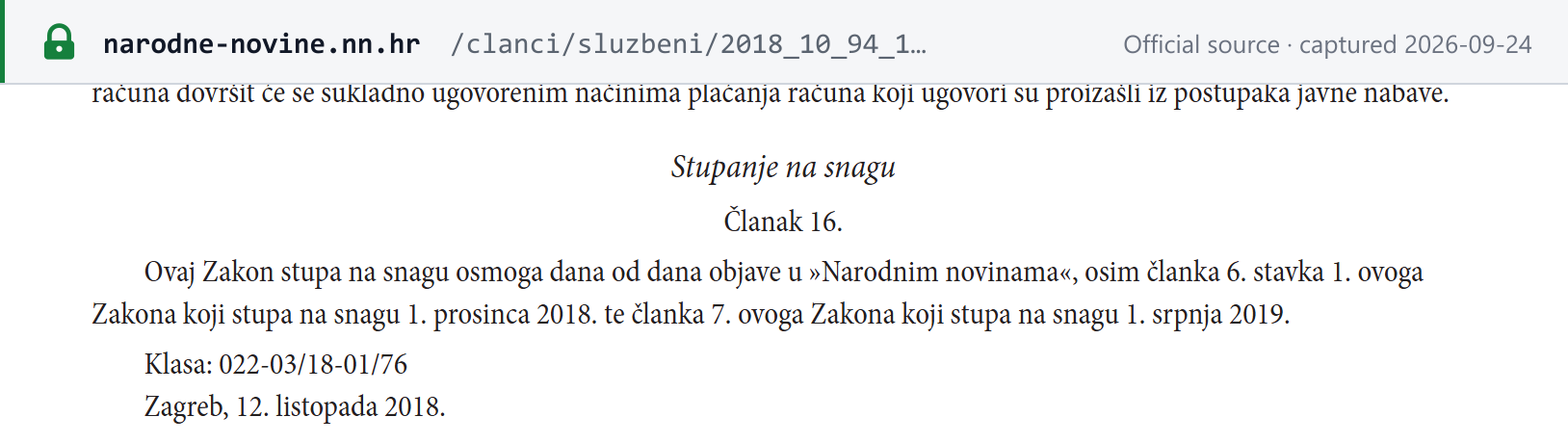
Zakon o elektroničkom izdavanju računa u javnoj nabavi (Act on e-invoicing in public procurement), NN 94/2018, document 1817, printed 24 October 2018. It transposes Directive 2014/55/EU and governs B2G. Contracting authorities (public and sectoral) have had to receive e-invoices since 1 December 2018 (Art 6(1)), and suppliers have had to issue them since 1 July 2019 (Art 7), per its commencement clause (Art 16). Art 33(1) of the Fiscalization Act applies its e-invoice rules mutatis mutandis to the B2B regime. [1]
 Source snapshot captured 2026-09-24 — original
 -
Technical standards that bind: EN 16931-1:2017 together with Porezna uprava's Specifikacija osnovne uporabe eRačuna s proširenjima (the national CIUS with extensions); the AS4 access-point specification; and the AMS/MPS specifications, all published on the Fiskalizacija 2.0 / eRačun portal. The Act's definition of "EU norma" (Art 2(1)(9)) names both the European standard and the Porezna uprava specification, and Art 36 requires every eRačun to comply with it.
Scope
B2B: who must issue and who must receive
Art 38(1) of the Act names three classes of eRačun issuer, and Art 2(1)(24) defines recipients in the same three classes:
- VAT-registered taxpayers with a seat, residence or habitual residence in Croatia. They have issued since 1 January 2026.
- Non-VAT-registered income-tax payers (self-employed activity) and profit-tax payers established in Croatia. They receive now and issue from 1 January 2027.
- State administration bodies, local and regional self-government units, and budget and extra-budget users in the Register of budget users that are not VAT-registered. They receive now and issue from 1 January 2027.
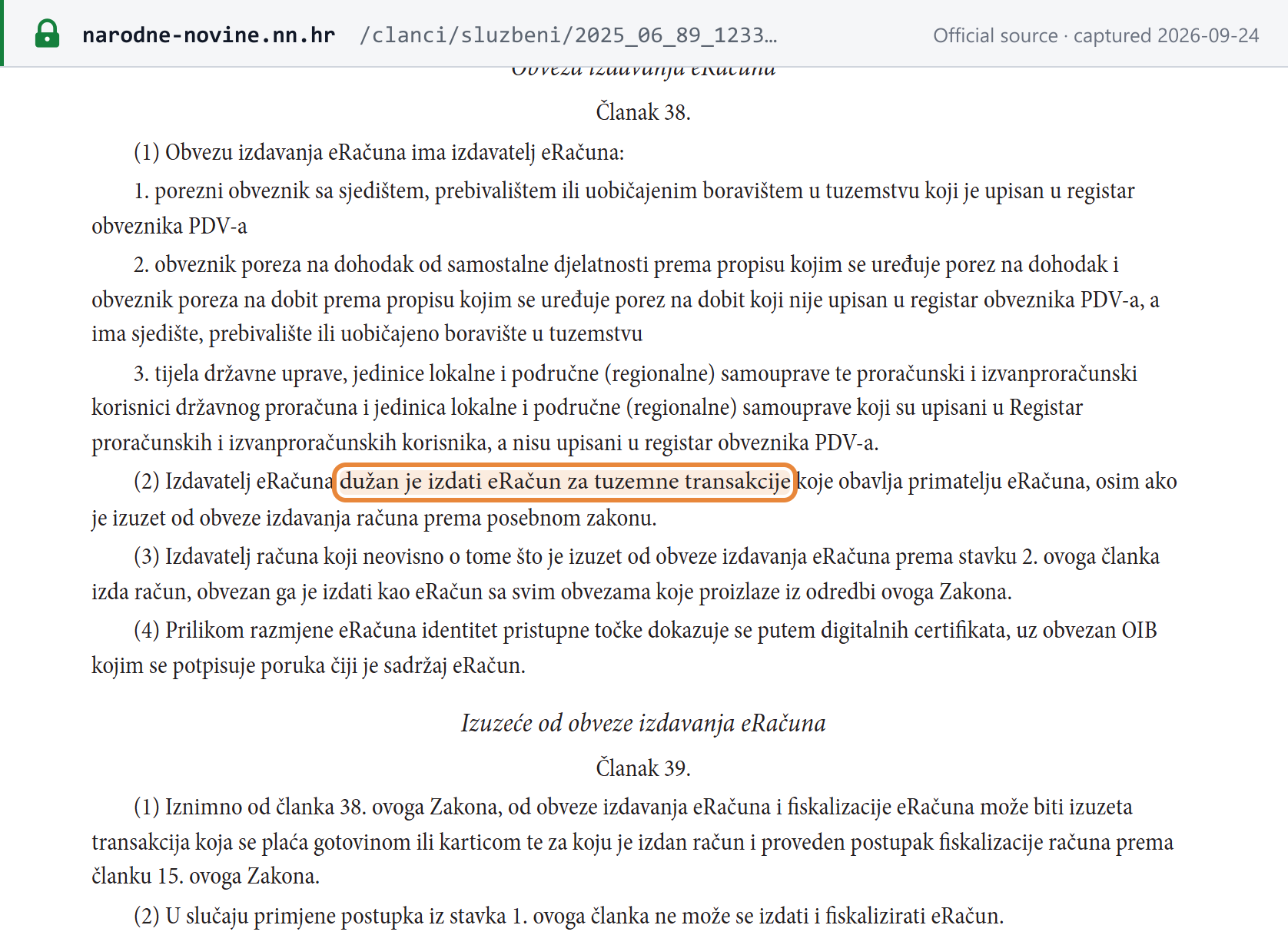
The issuer "dužan je izdati eRačun za tuzemne transakcije koje obavlja primatelju eRačuna" (must issue an eRačun for domestic transactions it performs for an eRačun recipient), unless a special law exempts it from invoicing (Art 38(2)). An issuer that is exempt but issues an invoice anyway must make it an eRačun (Art 38(3)). There is no turnover threshold: Porezna uprava's FAQ says a flat-rate craft must issue regardless of how few invoices it issues. (Zakon o fiskalizaciji, Art 38, checked 2026-09-24)
 Source snapshot captured 2026-09-24 — original
"Domestic" means both parties are established in Croatia. A tuzemna transakcija is a supply (or prepayment) subject to Croatian VAT, taxable or exempt, "pod uvjetom da su izdavatelj i primatelj eRačuna porezni obveznici sa sjedištem ili prebivalištem u Republici Hrvatskoj" (provided the issuer and the recipient are taxpayers with seat or residence in Croatia) (Art 2(1)(34)). Porezna uprava's FAQ (17 April 2026) spells out the consequence: the Act imposes no eRačun exchange where the parties are seated in other EU Member States or in third countries, and those invoices are issued on paper or in another acceptable form. (Porezna uprava FAQ, checked 2026-09-24)
Non-established businesses
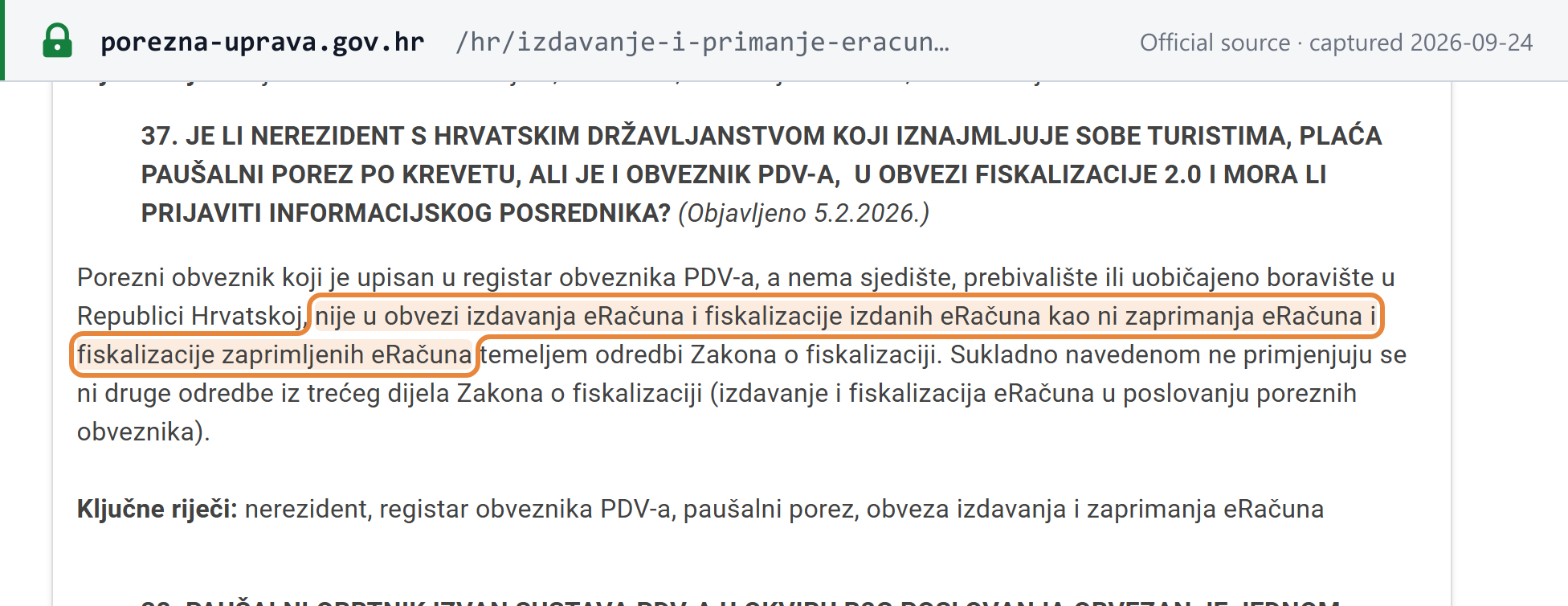
Out of scope. Porezna uprava's FAQ (published 5 February 2026) says that a VAT-registered taxpayer without a seat, residence or habitual residence in Croatia "nije u obvezi izdavanja eRačuna i fiskalizacije izdanih eRačuna kao ni zaprimanja eRačuna i fiskalizacije zaprimljenih eRačuna temeljem odredbi Zakona o fiskalizaciji" (is not obliged to issue eRačun and fiscalise issued eRačun, nor to receive eRačun and fiscalise received eRačun, under the Fiscalization Act), and that none of Part Three of the Act applies to it.
 Source snapshot captured 2026-09-24 — original
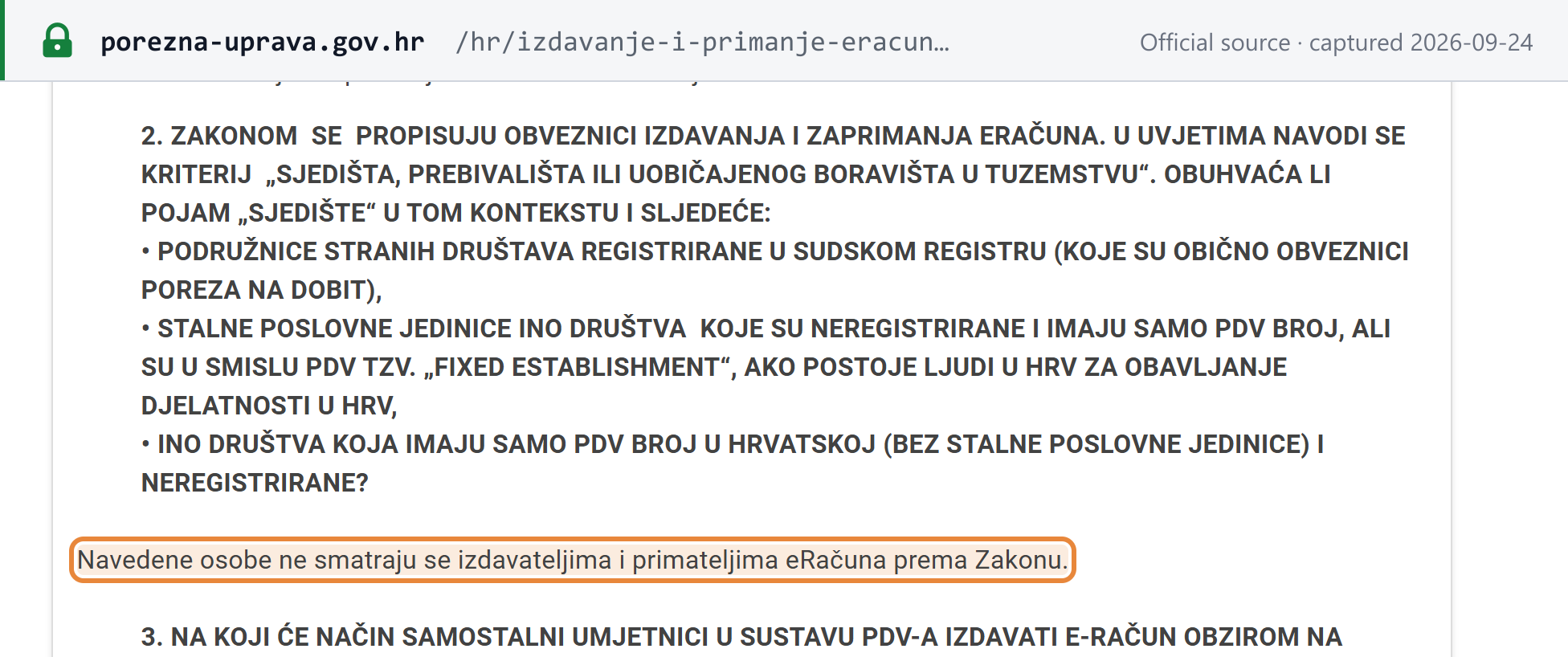
Porezna uprava's published position (FAQ, question 2) goes further. It covers three cases: branches of foreign companies registered in the Croatian court register, unregistered fixed establishments that hold only a VAT number, and foreign companies with only a Croatian VAT number. Its answer: "Navedene osobe ne smatraju se izdavateljima i primateljima eRačuna prema Zakonu." (The listed persons are not considered eRačun issuers or recipients under the Act.) This is an administrative interpretation with no reasoning given. Treat it as the Tax Administration's stated position, not as a statutory exclusion, and confirm your own case with Porezna uprava.
 Source snapshot captured 2026-09-24 — original
The knock-on effect: the Act gives a Croatian business no right to demand an eRačun from these suppliers, and Porezna uprava's FAQ confirms that invoices foreign issuers send with Croatian VAT are not fiscalised.
Excluded and exempt transactions
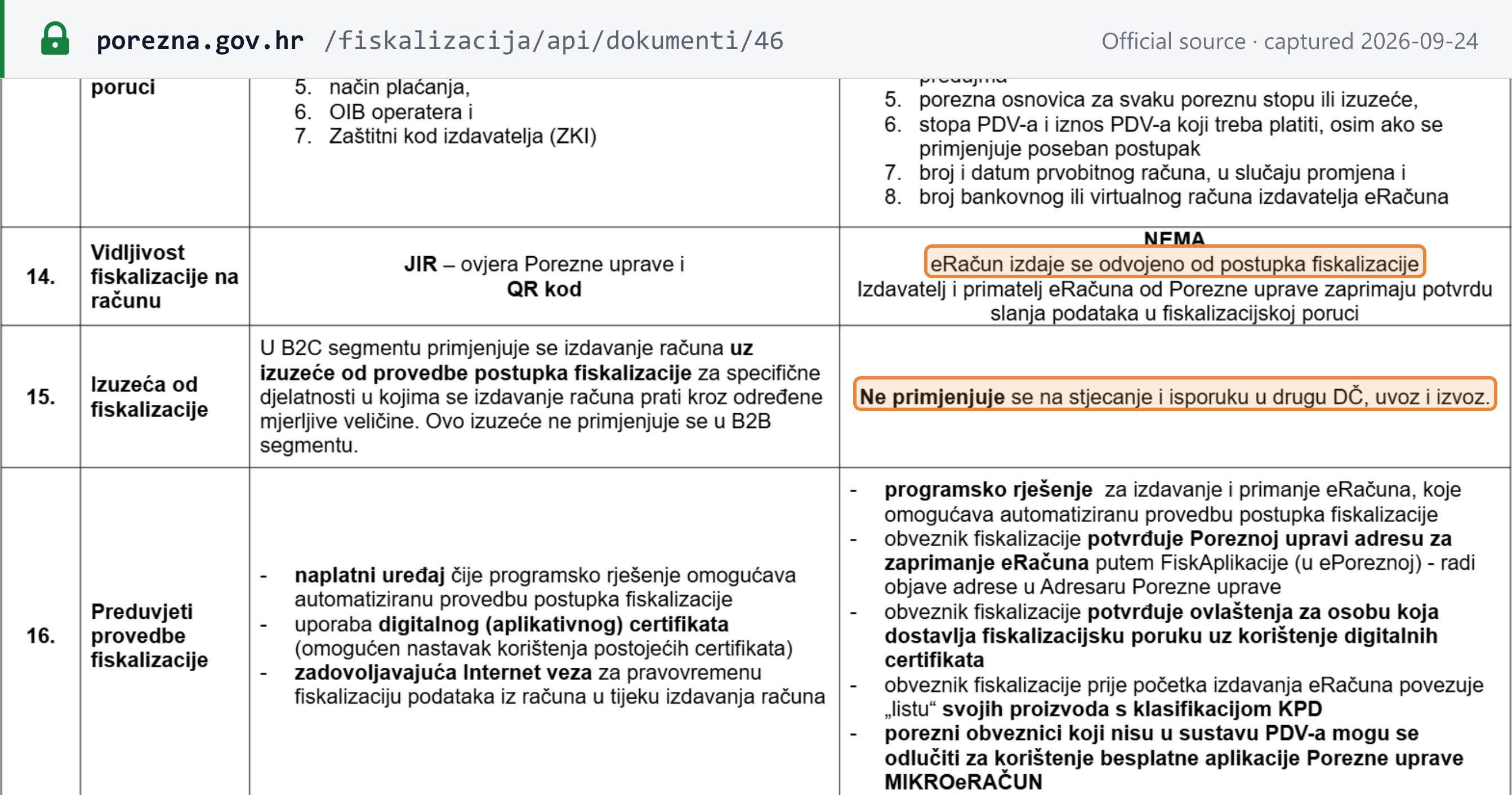
- Cross-border supplies: intra-EU acquisitions and supplies, imports and exports are outside eRačun fiscalisation. Porezna uprava's comparison sheet says: "Ne primjenjuje se na stjecanje i isporuku u drugu DČ, uvoz i izvoz." (Does not apply to acquisitions from and supplies to another Member State, imports and exports.) (Porezna uprava comparison sheet, checked 2026-09-24)
- Classified procurement: supplies under contracts protected by a prescribed security classification (Art 33(2)).
- Cash or card B2B sales fiscalised as receipts: a sale paid in cash or by card may be receipt-fiscalised under Fiskalizacija 1.0 instead (Art 39(1)), with the buyer's OIB sent with the receipt data (Art 15(6)). If that route is used, an eRačun must not also be issued and fiscalised for the same sale (Art 39(2)).
- Recipient not in the AMS: if the recipient's identifier is not in the AMS, the issuer is not liable for failing to issue an eRačun (Art 40(1)). It may issue on paper, and it must then e-report the supply through eIzvještavanje where the recipient is a company, a craftsman or a liberal-profession holder (Arts 40(2) and 51). (Zakon o fiskalizaciji, checked 2026-09-24)
Simplified invoices. Neither the Fiscalization Act nor the Pravilnik o eRačunu mentions a simplified invoice or a value threshold below which a paper invoice is allowed between Croatian taxpayers (checked 2026-09-24). In practice, the route for small sales is the Art 39 cash/card receipt described above.
B2G
B2G issuing is still governed by NN 94/2018, with FINA (Financijska agencija) as the central platform. Public contracting authorities generally must use FINA as their intermediary (Art 6(2)); local and regional self-government units and bodies they control, and sectoral contracting authorities, may use any registered intermediary (Art 6(3)–(4)) (NN 94/2018). Porezna uprava's FAQ puts it this way: "B2G segment ostaje uređen Zakonom o elektroničkom izdavanju računa u javnoj nabavi (Narodne novine, br. 94/18), prema kojem je Financijska agencija (FINA) središnja platforma za zaprimanje i razmjenu eRačuna." (The B2G segment remains governed by the Act on e-invoicing in public procurement, under which FINA is the central platform for receiving and exchanging eRačun.) Fiscalisation and e-reporting under the Fiscalization Act apply on top, to B2G as well as B2B. A non-VAT supplier to a public body has no eRačun duty under the Fiscalization Act in 2026 and has one from 1 January 2027, while NN 94/2018 applies to it regardless (FAQ). (Porezna uprava FAQ, checked 2026-09-24)
B2C
No e-invoice for consumers. B2C sales stay under Fiskalizacija 1.0: each receipt's data are signed and sent to Porezna uprava in real time, which returns a JIR (Jedinstveni identifikator računa, unique invoice identifier). The receipt must carry the JIR, the ZKI (issuer protective code) and a QR code (Arts 7 and 15). The QR code carries at least Porezna uprava's receipt-verification URL, the JIR or ZKI, the date and time, and the total (NN 153/2025, Art 17). Receipt fiscalisation applies to income-tax (self-employed) and profit-tax payers. It has covered every payment method since 1 January 2026, bank transfer included: Art 3 now reads "gotovinom, karticama, transakcijskim računom i na ostale načine" (cash, cards, transaction account and other ways). Listed activities are exempt, for example lotteries, some public-transport tickets, tolls, banking and insurance, and metered utilities (Art 4). (Zakon o fiskalizaciji; Porezna uprava B2C FAQ, checked 2026-09-24)
Format & network
CTC model: exchange between access points, fiscalisation by both parties
- Exchange: "(1) Razmjena eRačuna obavlja se putem pristupnih točaka." (eRačun exchange takes place through access points.) (Act Art 37(1).) By way of exception, the Act allows other exchange technologies if authenticity, integrity and legibility are ensured to the end of the retention period (Art 37(3)); the Pravilnik then requires access points to use AS4. The sender's access point delivers the invoice to the recipient's access point. Porezna uprava's AS4 specification calls this a four-corner topology.
- Fiscalisation: each party's software separately extracts a prescribed data set and sends a signed fiscalisation message to Porezna uprava's Centralni sustav za fiskalizaciju i eIzvještavanje. The Vodič says: "Na temelju dostavljenih fiskalizacijskih poruka Porezna uprava provodi unakrsnu provjeru podataka u realnom vremenu." (On the basis of the fiscalisation messages received, the Tax Administration cross-checks the data in real time.)
- Nothing is stamped on the invoice. Porezna uprava's comparison of B2C and B2B fiscalisation lists B2B visibility of fiscalisation on the invoice as NEMA (none): "eRačun izdaje se odvojeno od postupka fiskalizacije" (the eRačun is issued separately from the fiscalisation procedure). There is no JIR, QR code or hash on a B2B eRačun. The parties receive only a confirmation that the data were sent, and FiskAplikacija shows the matching status (received, paid, rejected, unmatched, discrepancy).
- Porezna uprava itself does not use the words "clearance" or "5-corner". "Decentralised exchange with near-real-time reporting by both parties" is our description of the model, not an official term.
 Source snapshot captured 2026-09-24 — original
Format: EN 16931 + CIUS-HR, UBL 2.1
-
Standard: "Svaki eRačun mora biti u skladu s EU normom." (Every eRačun must comply with the EU norm.) (Act Art 36.) The Act defines the EU norm as EN 16931-1:2017 together with Porezna uprava's Tehnička specifikacija osnovne uporabe eRačuna s proširenjima (Art 2(1)(9)).
-
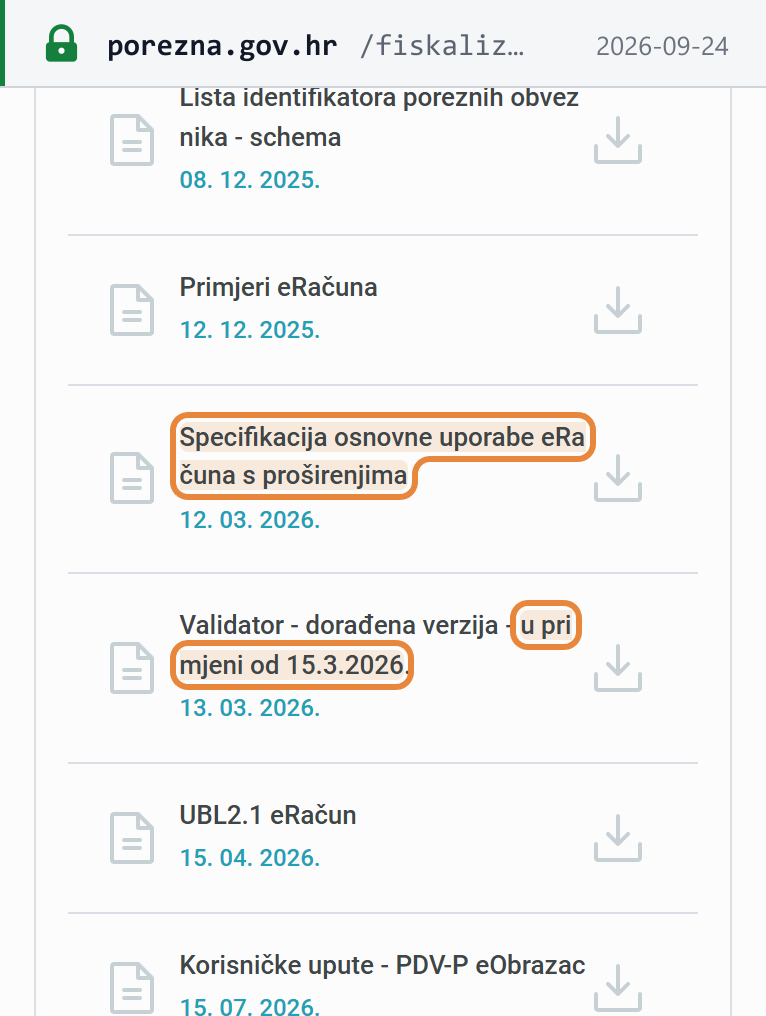
National CIUS: the Specifikacija osnovne uporabe eRačuna s proširenjima, built on HRN EN 16931-1:2020 and covering both B2B and B2G. The current version is 1.8 of 12 March 2026, which added rules HR-BR-48 to HR-BR-56. A revised validator has been in use since 15 March 2026. The CustomizationID (BT-24, rule HR-BR-5) is
urn:cen.eu:en16931:2017#compliant#urn:mfin.gov.hr:cius-2025:1.0#conformant#urn:mfin.gov.hr:ext-2025:1.0. National data travel in the UBL extensionhrextac:HRFISK20Data. The "HR-FISK" label seen in vendor material comes from this element; it is not the name of a platform. (Porezna uprava documentation, checked 2026-09-24) -
Syntax: UBL 2.1 (Invoice and CreditNote). The CIUS maps business terms to UBL XPaths only and gives no CII binding. On 15 April 2026 Porezna uprava published the canonical UBL 2.1 xsd, which "služi xsd validaciji svih UBL dokumenata koji se razmjenjuju unutar RH eDelivery mreže" (serves xsd validation of all UBL documents exchanged within the Croatian eDelivery network). (Porezna uprava news, 15 April 2026, checked 2026-09-24)
 Source snapshot captured 2026-09-24 — original
 -
Product codes: every goods or services line must carry the correct six-digit KPD 2025 code (Klasifikacija proizvoda po djelatnostima, maintained by the Croatian Bureau of Statistics) (Act Art 42). Credit notes that grant subsequent discounts are relieved of the quantity, type and KPD data (Pravilnik Art 11(4)).
-
Not an eRačun: a PDF, or anything sent by email. Porezna uprava's FAQ: "Prema navedenom eRačunom se ne smatra pdf format računa niti se eRačun može poslati na mail." (Accordingly, a PDF invoice is not an eRačun, nor can an eRačun be sent by email.)
Network: national eRačun-AS4, not Peppol
The Pravilnik o eRačunu sets the transport rules (Arts 6–9):
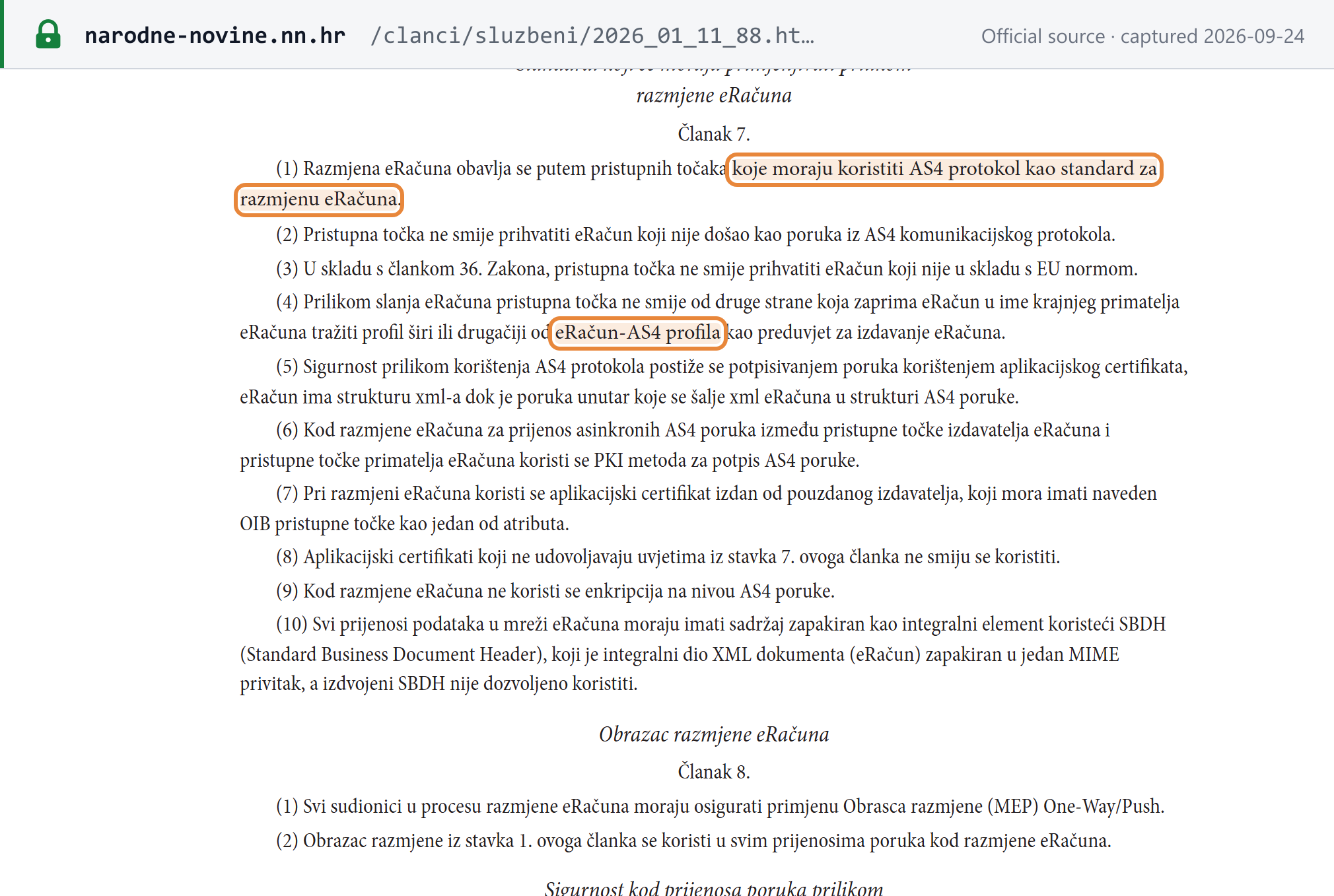
- Access points must use AS4: "(1) Razmjena eRačuna obavlja se putem pristupnih točaka koje moraju koristiti AS4 protokol kao standard za razmjenu eRačuna." (eRačun exchange takes place through access points, which must use the AS4 protocol as the exchange standard.) An access point must not accept an eRačun that did not arrive as an AS4 message, or one that does not conform to the EU norm. It must not demand a profile broader than, or different from, the eRačun-AS4 profile (Art 7(2)–(4)).
- Discovery: the sender's access point queries the AMS by DNS. The AMS returns an N-APTR record pointing to the recipient's metadata service (MPS), and the MPS returns the recipient's access-point URL. Delivery is HTTPS plus AS4, one-way/push, with an SBDH envelope.
- Security: TLS under the European Commission's eDelivery AS4 1.15 specification. AS4 messages are signed with an application certificate that carries the access point's OIB. There is no AS4 message-level encryption (Art 7(5)–(9), Art 9). Porezna uprava's AS4 specification requires implementations to follow the CEF eDelivery AS4 Profile v1.15. (Pravilnik o eRačunu; AS4 specification, checked 2026-09-24)
 Source snapshot captured 2026-09-24 — original
Not Peppol-based for domestic B2B. Neither the Act, the Pravilnik o eRačunu nor Porezna uprava's AS4 and CIUS specifications names Peppol as the domestic network. They prescribe the national eRačun-AS4 profile (checked 2026-09-24). The one place Peppol appears is cross-border B2G, where FINA runs a Peppol access point: "Putem Finine pristupne točke (Access Point) unutar PEPPOL mreže svi obveznici javne nabave u Hrvatskoj su prepoznatljivi i dohvatljivi inozemnim dobavljačima." (Through FINA's access point in the PEPPOL network, all public-procurement obligors in Croatia can be found and reached by foreign suppliers.) See the Peppol explainer for how that network works. (FINA, checked 2026-09-24)
 Source snapshot captured 2026-09-24 — original
Integrity: certificates, not a QR code or a qualified signature
- Fiscalisation messages must be signed with a digital certificate whose structure contains the OIB of the person authorised to submit them (Act Art 48(6)).
- Access points prove their identity in the AS4 exchange with a certificate carrying their OIB (Act Art 38(4); Pravilnik Art 7(7)).
- Under the Pravilnik, "digital certificate" means an application certificate, and one certificate may serve both B2C receipt fiscalisation and eRačun fiscalisation (Art 10(1)–(2)).
- Neither the Act nor the Pravilnik requires a qualified electronic signature on the invoice, and a B2B eRačun carries no QR code, JIR or hash (checked 2026-09-24).
Fiscalisation deadlines and e-reporting (eIzvještavanje)
| Obligation | Who | Deadline | Article |
|---|---|---|---|
| Fiscalise an issued eRačun | Issuer | At the moment of issue; for self-billing, within 5 working days after issue | Art 48(3) |
| Fiscalise a received eRačun | Recipient | Within 5 working days of receipt | Art 48(4) |
| Fiscalise after a technical failure or loss of connection | Either party | Within 5 working days of the outage | Art 49(1) |
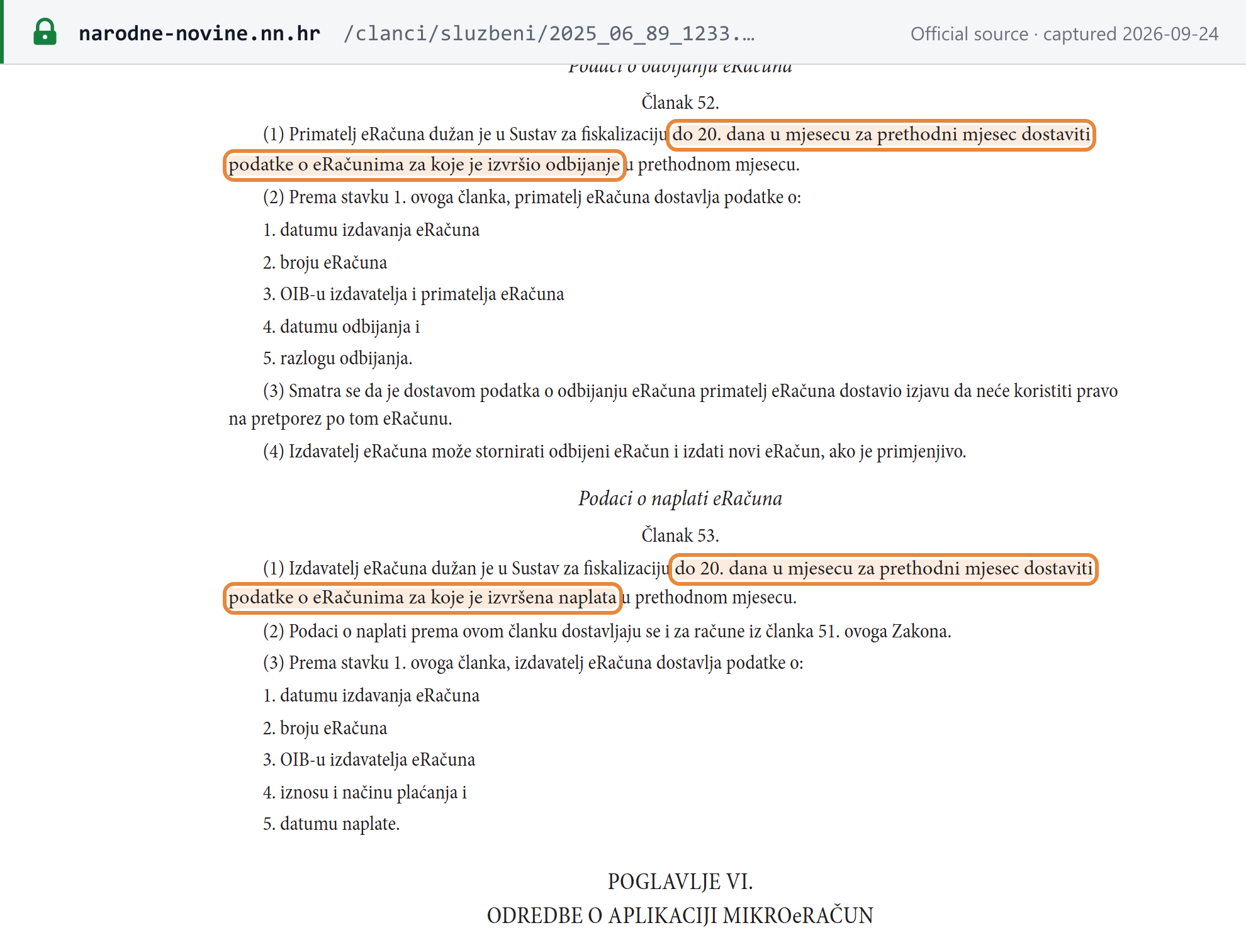
| Report rejected eRačun (date, number, both OIBs, rejection date, reason) | Recipient | By the 20th of the following month | Art 52 |
| Report paid eRačun (date, number, issuer OIB, amount, payment method, payment date) | Issuer | By the 20th of the following month | Art 53 |
| Report supplies for which no eRačun could be issued | Issuer | On the issuer's fiscalisation timeline | Arts 40, 51 |
Reporting a rejection counts as a declaration that the recipient will not claim input VAT on that invoice (Art 52(3)). E-reporting can go through a web service, an information intermediary or FiskAplikacija (Art 50). Porezna uprava published an application-response specification for rejections on 28 July 2026, on its eRačun documentation page. (Zakon o fiskalizaciji, Arts 47–53, checked 2026-09-24)
 Source snapshot captured 2026-09-24 — original
Archiving
Issued and received eRačun must be kept in their original form for six years from the end of the year of issue, provided they were fiscalised (Act Art 35(1)). Failing to keep them is a minor offence (Art 73(1) point 17). Other Croatian record-keeping laws may set their own periods; this guide does not cover them. (Zakon o fiskalizaciji, Art 35, checked 2026-09-24)
Onboarding: how to comply
The five steps Porezna uprava prescribes
- Map your goods and services to KPD 2025, so that every invoice line can carry its six-digit code.
- Choose an information intermediary (informacijski posrednik) from Porezna uprava's list, or build your own access point (see connection modes below).
- Sign a contract. The intermediary can also fiscalise your incoming and outgoing eRačun for you.
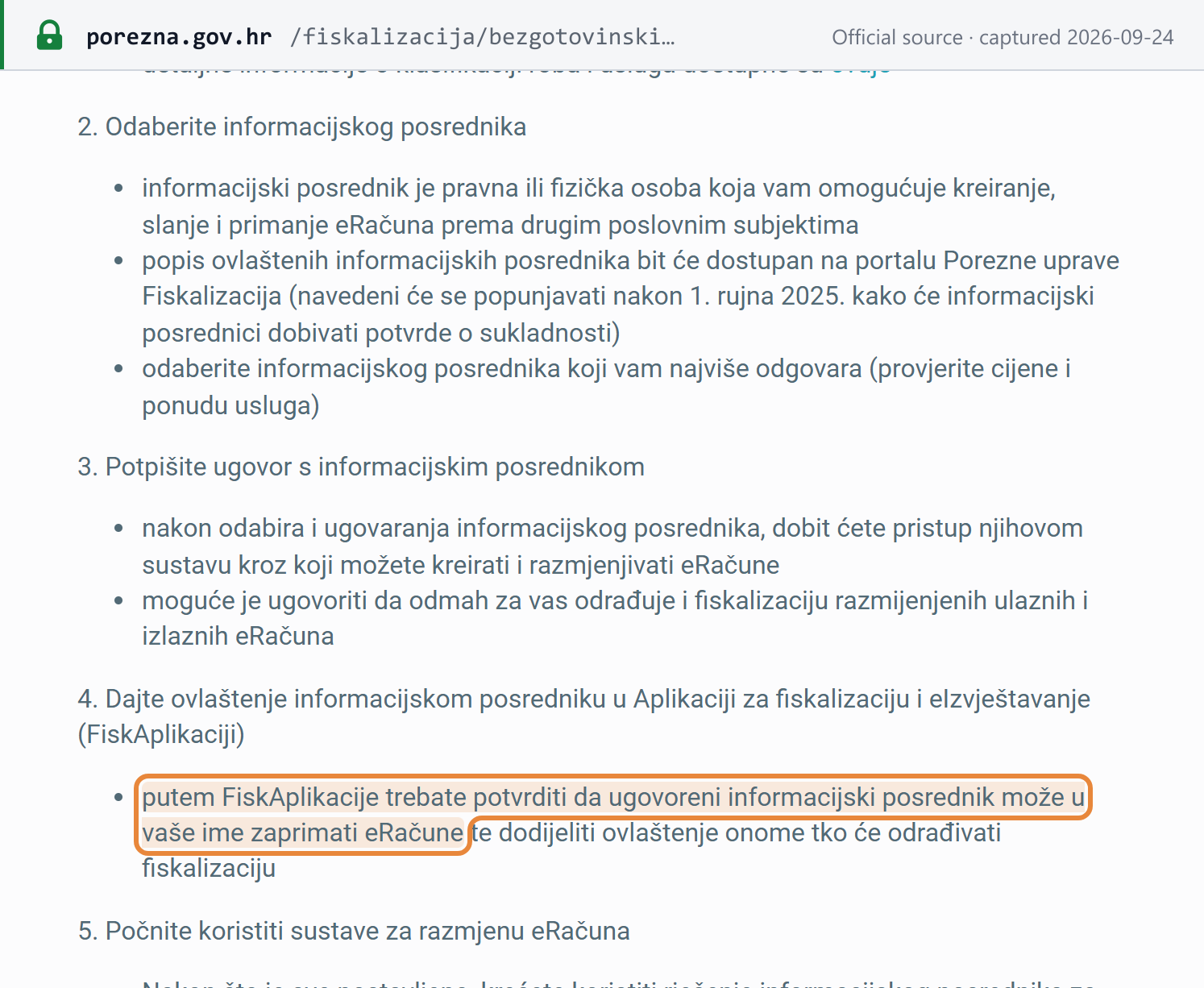
- Authorise it in FiskAplikacija. Confirm the receiving address, which is then published in the AMS, and grant the fiscalisation authorisation (ovlaštenje za fiskalizaciju) to whoever will fiscalise. Porezna uprava: "putem FiskAplikacije trebate potvrditi da ugovoreni informacijski posrednik može u vaše ime zaprimati eRačune te dodijeliti ovlaštenje onome tko će odrađivati fiskalizaciju" (through FiskAplikacija you must confirm that the contracted intermediary may receive eRačun on your behalf, and grant authorisation to whoever will carry out fiscalisation).
- Start exchanging.
(Porezna uprava eRačun portal, checked 2026-09-24)
 Source snapshot captured 2026-09-24 — original
FiskAplikacija (Aplikacija za fiskalizaciju i eIzvještavanje) is Porezna uprava's free app inside ePorezna. You log in through NIAS, the national identification and authentication system, and powers of attorney run through eOvlaštenja. In the app you can view fiscalised data, manage exchange and fiscalisation authorisations, see invoice statuses, view an informative pre-filled VAT return, and enter fiscalisation and e-reporting data (Act Arts 2(1)(2) and 68).
The receiving address had to be in the AMS by 31 December 2025. The duty continues after that date: a recipient must publish its identifier before it starts receiving and must report any change immediately (Act Art 44(1) and (4)).
Connection modes
| Route | Who it suits | Notes |
|---|---|---|
| Certified information intermediary | Most businesses | The intermediary provides the access point and can fiscalise and e-report for you. You remain liable for correct issuing, receiving, fiscalisation and e-reporting (Act Art 58(2)) |
| Own access point | Large ERP users and service providers | Pass Porezna uprava's conformity test. You receive a certificate of conformity but are not published on the intermediary list (Act Art 63) |
| MIKROeRAČUN | Taxpayers outside the VAT system | Porezna uprava's free web app; see below |
| FiskAplikacija | Everyone, for e-reporting and oversight | Not an exchange channel. Used for authorisations, statuses and manual e-reporting |
| FINA e-Račun za državu (B2G) | Suppliers to public bodies | A free web app with online self-registration (needs a certificate, up to 15 e-invoices a month), a web service linked to your accounting software, or any intermediary (FINA, checked 2026-09-24) |
Accreditation of intermediaries
An intermediary needs a potvrda o sukladnosti (certificate of conformity) from Porezna uprava (Act Arts 59–62). It must file four things and pass conformity testing, which ends with a final report:
- a GDPR Art 32 security document;
- a current ISO/IEC 27001 certificate;
- a statement that data stay within the EU;
- a statement of the services it offers.
Porezna uprava then lists it on the Javni portal with its name, OIB and service scope (eRačun and fiscalisation, eIzvještavanje, MPS).
No fixed accreditation term. When the ISO/IEC 27001 certificate expires, the renewed one must be filed within 60 days. An intermediary that misses this is deleted from the list, and Porezna uprava notifies its contracted clients (Art 62). The intermediary is liable for the correctness of its software (Art 58(1)); offering incorrect software is a "most serious" offence (Art 71(1) point 4).
As at 2026-09-24, Porezna uprava's list of certified intermediaries showed 34 entries. They include FINA (listed as Financijska agencija) and several foreign providers. The count changes as certificates are issued, so check the list itself. (Zakon o fiskalizaciji, Arts 58–63, checked 2026-09-24)
Testing
Conformity testing runs through Porezna uprava's Portal za testiranje sukladnosti, reached via ePorezna or NIAS, in a controlled test environment called CIS DEMO. The Pravilnik says it "u kojoj se simulira produkcijski rad, a može se provoditi više puta do ishođenja potvrde o sukladnosti" (simulates production work, and testing may be repeated until the certificate of conformity is obtained). Intermediary tests cover exchange and fiscalisation via MPS, TLS 1.2 or later, an application certificate carrying the OIB, and the XML structure (Pravilnik Art 18). (Pravilnik o eRačunu, checked 2026-09-24)
MIKROeRAČUN for non-VAT taxpayers
MIKROeRAČUN is Porezna uprava's free app for issuing, receiving, storing and fiscalising eRačun (Act Art 54). Porezna uprava itself acts as the access point and intermediary for its users (Art 58(3)).
- Who may use it: ePorezna users that are not VAT-registered and are not public contracting authorities under the B2G law (Art 55(1)).
- Cost: free: "(1) Korištenje aplikacije MIKROeRAČUN se ne naplaćuje." (Use of MIKROeRAČUN is free of charge.) (Art 56(1).) Login is through NIAS, and no digital certificate is needed.
- What it does today: receive, fiscalise receipt, view, reject, fiscalise the rejection, and archive for the retention period.
- From 1 January 2027: issuing, and fiscalisation of issued invoices.
- Losing eligibility: a user that becomes VAT-registered loses access on 1 January of the following year. It must register its own receiving address in the AMS before its receiving obligation starts (Art 57).
(Porezna uprava — MIKROeRAČUN; Zakon o fiskalizaciji, Arts 54–58, checked 2026-09-24)
B2C certificates from 1 January 2027 (NN 97/2026)
For receipt fiscalisation (Fiskalizacija 1.0), NN 97/2026 changes the certificate rules from 1 January 2027:
- Provider: today the certificate must be a production application certificate from a Croatian trust service provider (NN 153/2025 Art 16(2)). From 2027 the obligor must obtain a digital certificate containing its OIB from any trust service provider on the EU trusted list under eIDAS (Regulation (EU) No 910/2014, as amended by Regulation (EU) 2024/1183). A DEMO certificate is used for testing, and the obligor decides how many certificates it needs (new Art 2).
- Signing: the rulebook no longer names RSA-SHA1 or MD5. Signing will follow the methods in the Technical Specification that Porezna uprava publishes, and the ZKI stays a 32-character lowercase hexadecimal string (Art 5).
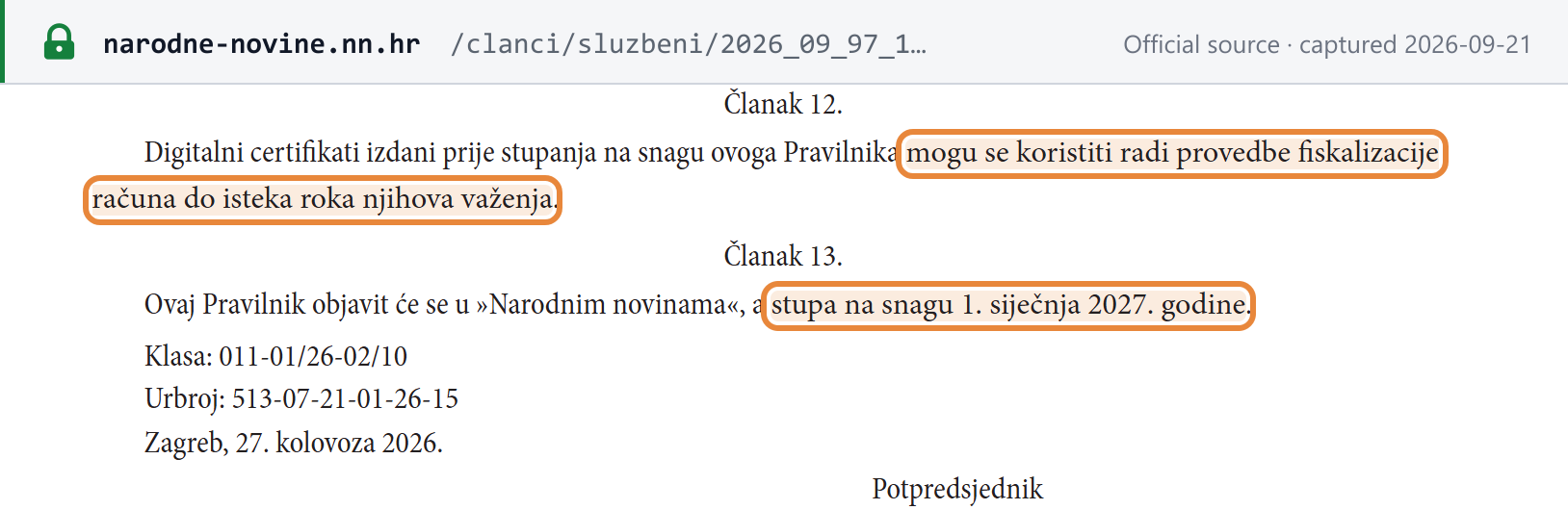
- Transition: "Digitalni certifikati izdani prije stupanja na snagu ovoga Pravilnika mogu se koristiti radi provedbe fiskalizacije računa do isteka roka njihova važenja." (Digital certificates issued before this Rulebook enters into force may be used for receipt fiscalisation until they expire.) (Art 12.)
(NN 97/2026, checked 2026-09-24)
 Source snapshot captured 2026-09-21 — original
 Source snapshot captured 2026-09-21 — original
Separately, Porezna uprava replaced its own "Fiskalcis" response-signing certificate on 8 September 2026 at 05:00, as announced on 4 August 2026. (Porezna uprava notice, checked 2026-09-24)
Penalties
The Fiscalization Act grades offences into three bands (Arts 71–73). All amounts are in euros, as printed.
| Offence | Legal person | Responsible person in the legal person | Craftsman / other self-employed natural person | Repeat offence |
|---|---|---|---|---|
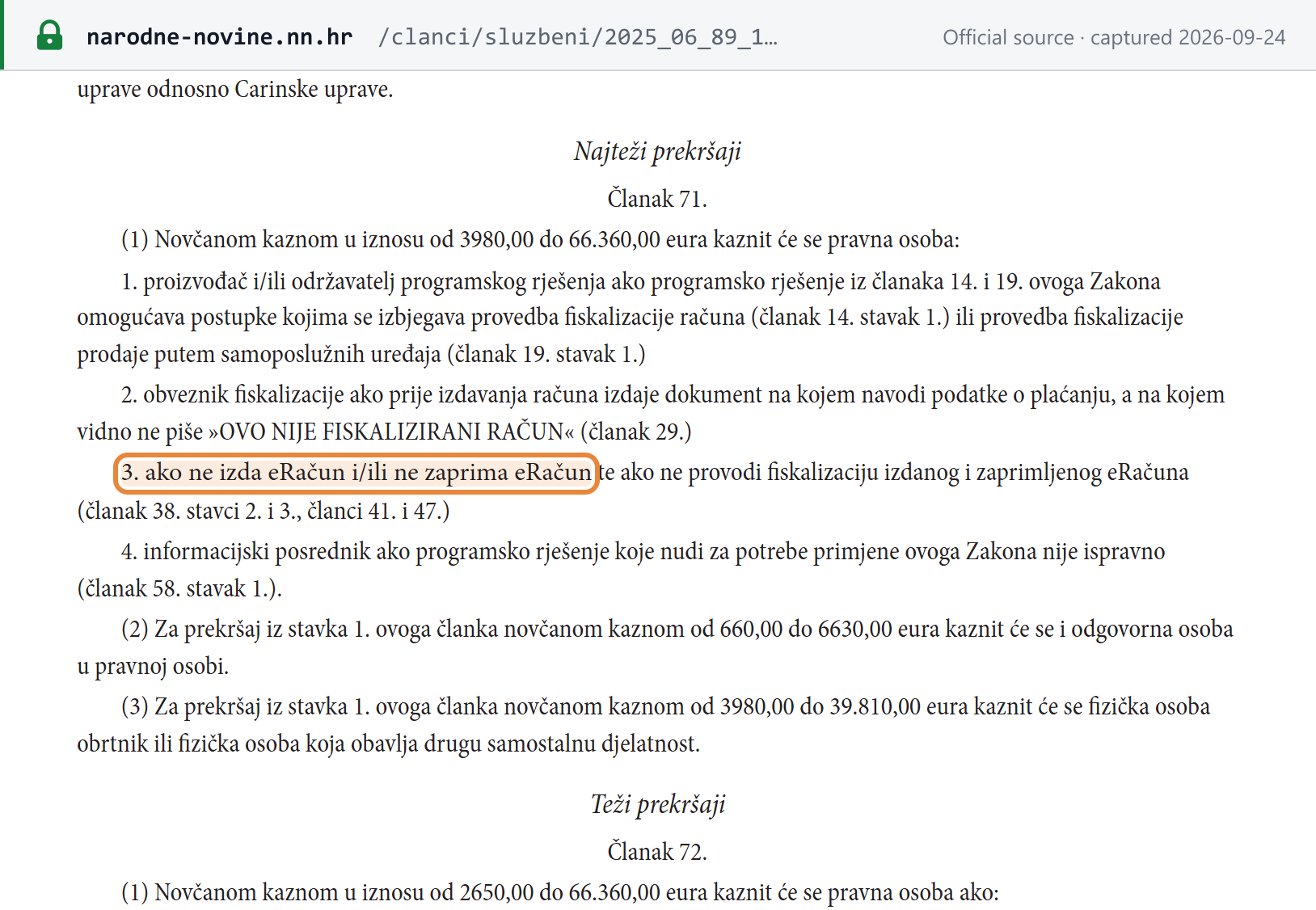
| Most serious (Art 71): not issuing an eRačun, not receiving one, or not fiscalising issued or received eRačun (point 3); an intermediary's software is not correct (point 4) | EUR 3,980 – 66,360 | EUR 660 – 6,630 | EUR 3,980 – 39,810 | No uplift written into Art 71 |
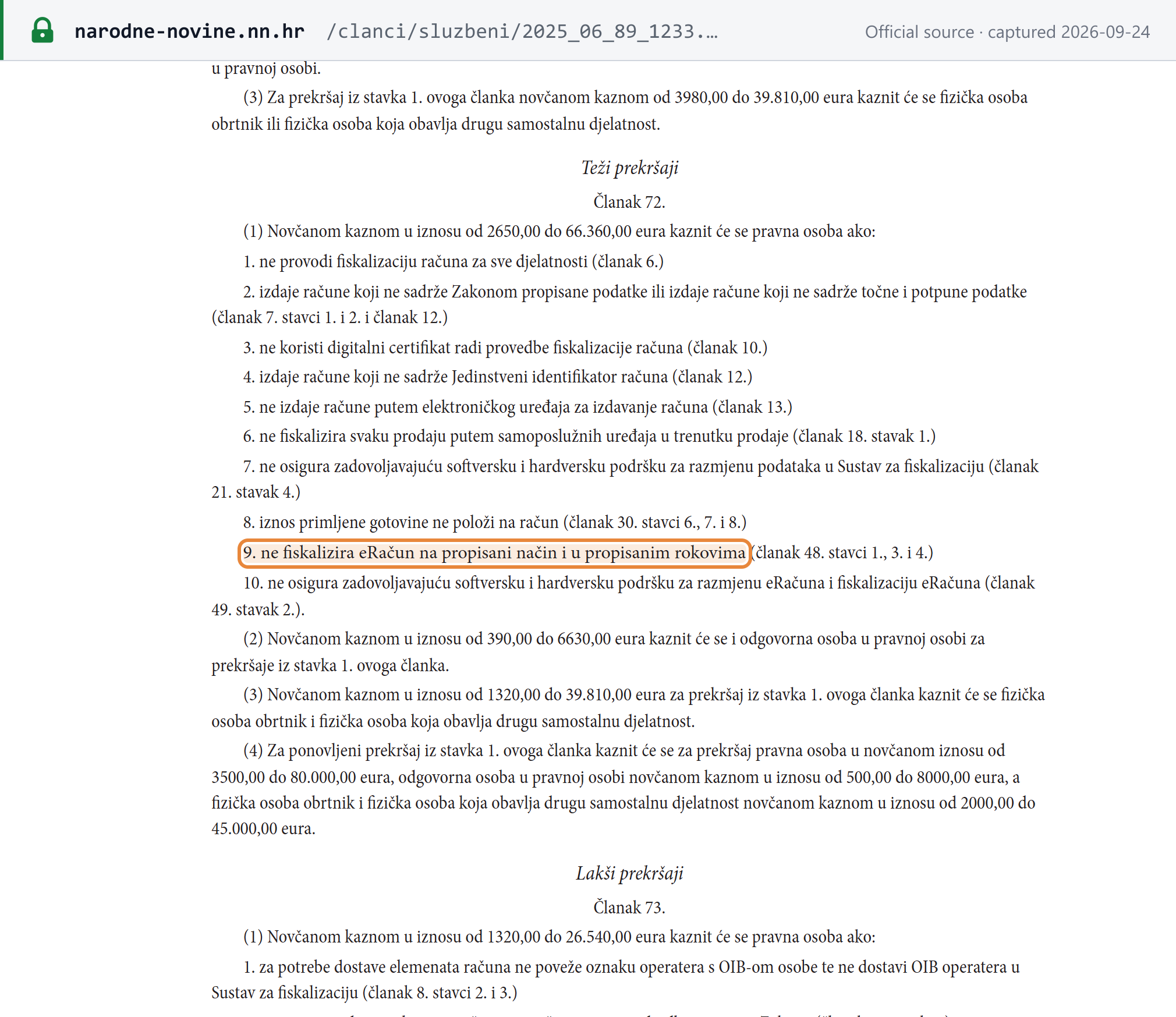
| Serious (Art 72): not fiscalising an eRačun in the prescribed way and on time (point 9); no adequate software and hardware support for exchange and fiscalisation (point 10) | EUR 2,650 – 66,360 | EUR 390 – 6,630 | EUR 1,320 – 39,810 | Legal person EUR 3,500 – 80,000; responsible person EUR 500 – 8,000; natural person EUR 2,000 – 45,000 |
| Minor (Art 73): not keeping eRačun (17); missing KPD codes (18); not supplying the AMS identifier (19) or updating it after changing intermediary (20); missing the Art 49 outage window (21); not e-reporting supplies without an eRačun (22); not reporting rejections (23) or payments (24), or reporting them late | EUR 1,320 – 26,540 | EUR 260 – 2,650 | See note | Legal person EUR 2,500 – 35,000; responsible person EUR 500 – 4,000; natural person EUR 1,000 – 20,000 |
Note on natural persons and minor offences. Art 73(3) sets a first-offence fine of EUR 660 – 13,270 for craftsmen and other self-employed natural persons, but it lists only points 1–5 and 7–14 of Art 73(1), which are B2C receipt-fiscalisation duties. None of the eRačun points 17–24 appears in that list. (Zakon o fiskalizaciji, Arts 71–73, checked 2026-09-24)
 Source snapshot captured 2026-09-24 — original
 Source snapshot captured 2026-09-24 — original
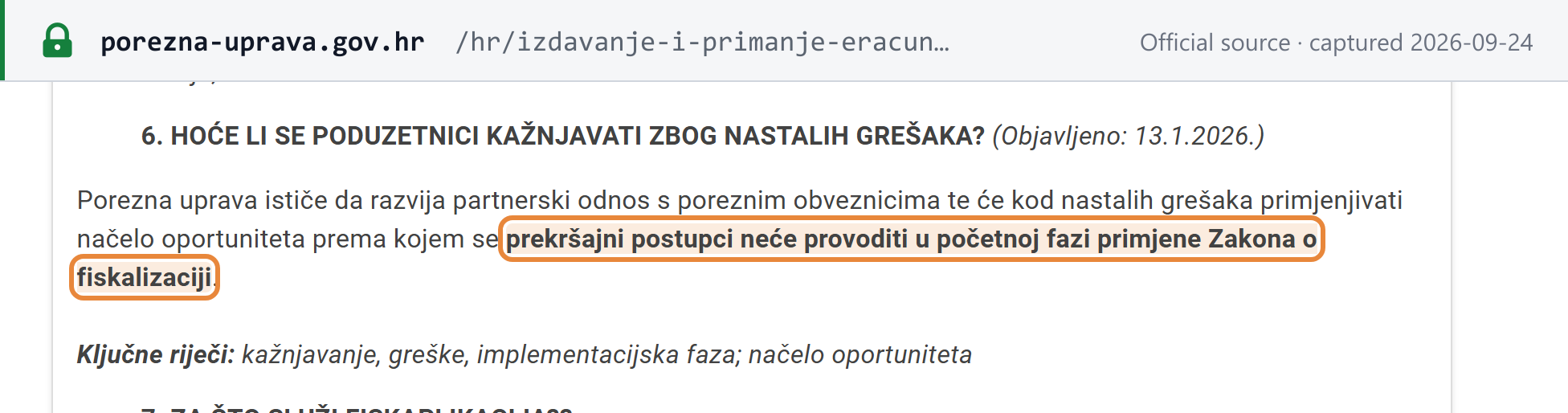
Enforcement posture (dated, not a statutory grace period). In a FAQ answer published 13 January 2026, Porezna uprava "ističe da razvija partnerski odnos s poreznim obveznicima te će kod nastalih grešaka primjenjivati načelo oportuniteta prema kojem se prekršajni postupci neće provoditi u početnoj fazi primjene Zakona o fiskalizaciji." (stresses that it is developing a partnership with taxpayers and will apply the principle of opportunity to errors, under which misdemeanour proceedings will not be brought in the initial phase of application of the Fiscalization Act.) A later FAQ answer repeats that during the Fiskalizacija 2.0 implementation period it will not sanction unintentional errors, especially those caused by technical adjustments to systems. No end date has been published for either statement, and the Art 71–73 fines apply in law throughout. (Porezna uprava FAQ, checked 2026-09-24)
 Source snapshot captured 2026-09-24 — original
B2G fines are printed in kuna. NN 94/2018 Art 14, as originally printed, fines a contracting authority (including one that fails to issue e-invoices as an eRačun issuer) HRK 10,000 – 100,000, and its responsible person HRK 5,000 – 20,000. An intermediary that provides a non-compliant service faces HRK 10,000 – 100,000. Since the euro changeover on 1 January 2023, kuna amounts in legislation are read as euro amounts at the fixed rate of 7.53450 (Euro Introduction Act, NN 57/2022, Art 13(2)). That is EUR 1,327.23 – 13,272.28 for the authority or intermediary and EUR 663.61 – 2,654.46 for the responsible person. (NN 94/2018; Zakon o uvođenju eura, NN 57/2022, checked 2026-09-24)
Frequently asked questions
Is Croatia's B2B e-invoicing mandate already in force, or does it start in 2027?
It is already in force. Since 1 January 2026 every VAT-registered taxpayer established in Croatia must issue and receive eRačun for domestic transactions, and non-VAT companies, crafts, liberal professions and public bodies must be able to receive them. 1 January 2027 is Phase 2, when those non-VAT taxpayers and public bodies also start issuing. (Zakon o fiskalizaciji, NN 89/2025, Art 80; Porezna uprava, checked 2026-09-24)
We are a foreign company registered for VAT in Croatia. Do we have to send or receive eRačun?
No, according to Porezna uprava. Its FAQ (5 February 2026) says a VAT-registered taxpayer without a seat, residence or habitual residence in Croatia has no obligation to issue, receive or fiscalise eRačun. It also treats branches of foreign companies, unregistered fixed establishments and VAT-number-only foreign companies as outside the eRačun rules. That branch position is an administrative interpretation, so confirm your own case. The Act gives your Croatian customers no right to demand an eRačun from you, and cross-border invoices go on paper or another acceptable form. (Porezna uprava FAQ, checked 2026-09-24)
Can we keep emailing PDF invoices to Croatian customers?
Not for domestic B2B transactions in scope. Porezna uprava states that a PDF invoice is not an eRačun and that an eRačun cannot be sent by email. It must be a structured UBL 2.1 invoice that conforms to EN 16931 and Porezna uprava's national specification (version 1.8 of 12 March 2026), exchanged between access points over the national eRačun-AS4 network. (Porezna uprava FAQ; Zakon o fiskalizaciji Art 36, checked 2026-09-24)
Is Croatia's e-invoicing network Peppol?
Not for domestic B2B. The Pravilnik o eRačunu requires access points to use AS4 with the national "eRačun-AS4" profile (CEF eDelivery AS4 1.15), with recipients found through Porezna uprava's AMS directory, and none of the Act, the Pravilnik or Porezna uprava's specifications names Peppol as the domestic network. Peppol is used for cross-border B2G: FINA runs a Peppol access point so that foreign suppliers can reach Croatian public-procurement bodies. (Pravilnik o eRačunu, NN 11/2026, Art 7; FINA, checked 2026-09-24)
What do we have to report to Porezna uprava besides exchanging the invoice?
Each side fiscalises every eRačun separately from the exchange. The issuer does so at the moment of issue (within 5 working days for self-billing), and the recipient within 5 working days of receipt. In addition, the issuer reports which eRačun were paid, and the recipient reports which eRačun it rejected, both by the 20th of the following month. Reporting a rejection counts as a declaration that input VAT on that invoice will not be claimed. (Zakon o fiskalizaciji Arts 48, 52, 53, checked 2026-09-24)
What are the fines for not issuing or receiving eRačun?
Not issuing, not receiving or not fiscalising an eRačun is a "most serious" offence under Art 71. The fine is EUR 3,980 to 66,360 for a legal person, EUR 660 to 6,630 for its responsible person, and EUR 3,980 to 39,810 for a craftsman or other self-employed person. Fiscalising late or wrongly is an Art 72 offence: EUR 2,650 to 66,360 for a legal person, and EUR 3,500 to 80,000 for a repeat offence. Porezna uprava said on 13 January 2026 that it will not bring misdemeanour proceedings in the initial phase of the Act. It has published no end date for that, and the fines remain law. (Zakon o fiskalizaciji Arts 71–72; Porezna uprava FAQ, checked 2026-09-24)
We are a small business outside the VAT system. What do we need, and is there a free option?
You must be able to receive eRačun now, and you must issue them from 1 January 2027. Porezna uprava's MIKROeRAČUN app is free for ePorezna users that are not VAT-registered (and are not public contracting authorities). You log in through NIAS and need no digital certificate. It receives, rejects, fiscalises and archives eRačun today, and gains issuing on 1 January 2027. Porezna uprava said on 2 September 2026 that a test version with issuing will be available during October 2026. If you need to issue during 2026, you must contract an information intermediary. (Zakon o fiskalizaciji Arts 54–57; Porezna uprava, checked 2026-09-24)
Recent changes
- 2026-09-02 — NN 97/2026 printed: the amended B2C fiscalisation Rulebook accepts receipt-fiscalisation certificates from any eIDAS trusted-list provider and moves signing methods to Porezna uprava's Technical Specification, in force 1 January 2027; certificates issued earlier stay valid until they expire. (Narodne novine) — see event
- 2026-09-02 — Porezna uprava announced that the MIKROeRAČUN app will be able to issue eRačun, with a test version during October 2026, ahead of Phase 2 on 1 January 2027, when non-VAT taxpayers and public bodies that only receive in 2026 must also issue. (Porezna uprava) — see event
- 2026-04-15 — Porezna uprava published the canonical UBL 2.1 xsd for validating every UBL document exchanged on the Croatian eDelivery network. (Porezna uprava)
- 2026-03-12 — Version 1.8 of the national eRačun specification (CIUS with extensions) issued, adding rules HR-BR-48 to HR-BR-56; a revised validator has been in use since 15 March 2026. (Porezna uprava)
- 2026-01-30 — Pravilnik o eRačunu (NN 11/2026) published, setting the AS4 exchange, AMS/MPS discovery, certificate and conformity-testing rules. (Narodne novine)
- 2026-01-13 — Porezna uprava stated that no misdemeanour proceedings will be brought in the initial phase of the Fiscalization Act (no end date published). (Porezna uprava)
- 2026-01-01 — Phase 1 of Fiskalizacija 2.0 in force: VAT-registered taxpayers issue and receive eRačun, all other in-scope taxpayers receive; B2C receipt fiscalisation extended to every payment method. (Narodne novine)
Related resources
- E-invoicing status and networks worldwide — Croatia's row in global context
- Croatia tax identification numbers (OIB) — the OIB is the eRačun identifier and a required attribute of every fiscalisation certificate
- Validate a Croatian OIB
- Croatia tax-change chronology — every tracked Croatian change, dated and sourced
- Peppol network explainer — relevant to Croatia only for cross-border B2G via FINA
- How to verify an EU VAT number (VIES) — for cross-border invoices, which fall outside the eRačun mandate
- ViDA — VAT in the Digital Age — the EU framework that domestic mandates like Croatia's will have to fit
- Other decentralised or CTC mandates for comparison: Belgium, Poland
Important websites
- Fiskalizacija 2.0 portal (Porezna uprava) — news, documentation, MIKROeRAČUN
- eRačun technical documentation — CIUS specification, AS4 and AMS/MPS specifications, validator, UBL 2.1 xsd
- List of certified information intermediaries
- Porezna uprava eRačun FAQ — the official Q&A, updated regularly
- Vodič kroz Fiskalizaciju 2.0 — Porezna uprava's guide
- MIKROeRAČUN — the free app for non-VAT taxpayers
- Zakon o fiskalizaciji (NN 89/2025) and Pravilnik o eRačunu (NN 11/2026) — official gazette texts
- FINA — e-Račun u javnoj nabavi — B2G platform and Peppol access point
- Fiskalizacija 1.0 (B2C receipts) — receipt fiscalisation rules and news