Uganda TIN Guide — URA TIN, NIN & BRN Explained
Uganda's tax number is the Taxpayer Identification Number (TIN), a 10-digit number issued free of charge by the Uganda Revenue Authority (URA). Anyone "likely to transact in any tax related business with URA" must apply for one. [1] The TIN is set to be replaced: an amendment to the Tax Procedures Code enacted in June 2025 will make the National Identification Number (NIN) the tax identification number for individuals and the Uganda Registration Services Bureau (URSB) registration number the tax identification number for companies and other organisations once it is brought into force, and since May 2026 URA has required every taxpayer to add those numbers to their tax registration. [2] [3] As of 13 October 2026, URA still issues and uses TINs while the switch-over is in progress. For VAT rates, invoicing and filing, see the Uganda VAT guide.
Uganda's Tax IDs at a Glance
| Number | Issuer | Format | Who has one | Check digit |
|---|---|---|---|---|
| TIN (Taxpayer Identification Number) | URA | 10 digits | Every registered taxpayer, individual or organisation | Yes, per URA — algorithm not published |
| NIN (National Identification Number) | National Identification and Registration Authority (NIRA) | Printed on the National ID | Individuals; set to replace the TIN for tax purposes | Not published |
| BRN (Business Registration Number) | URSB | Printed on the certificate of registration or incorporation | Companies and other registered organisations; set to replace the TIN for tax purposes | Not published |
| Foreign TIN | A foreign tax authority | As issued abroad | Foreign persons from countries with a tax treaty or information-exchange agreement with Uganda | — |
Uganda issues no separate VAT number. One TIN covers every tax URA administers — income tax, VAT, PAYE, withholding tax and customs — and a business's VAT registration is recorded against it. [4]
The TIN
| Field | Detail |
|---|---|
| Length | 10 digits, numbers only |
| Issued by | URA, free of charge |
| Structure | First nine digits assigned in sequence; tenth digit a check digit |
| Validity | Does not expire; one TIN per person |
| Example | URA publishes no test TIN — never use a real one in documentation |
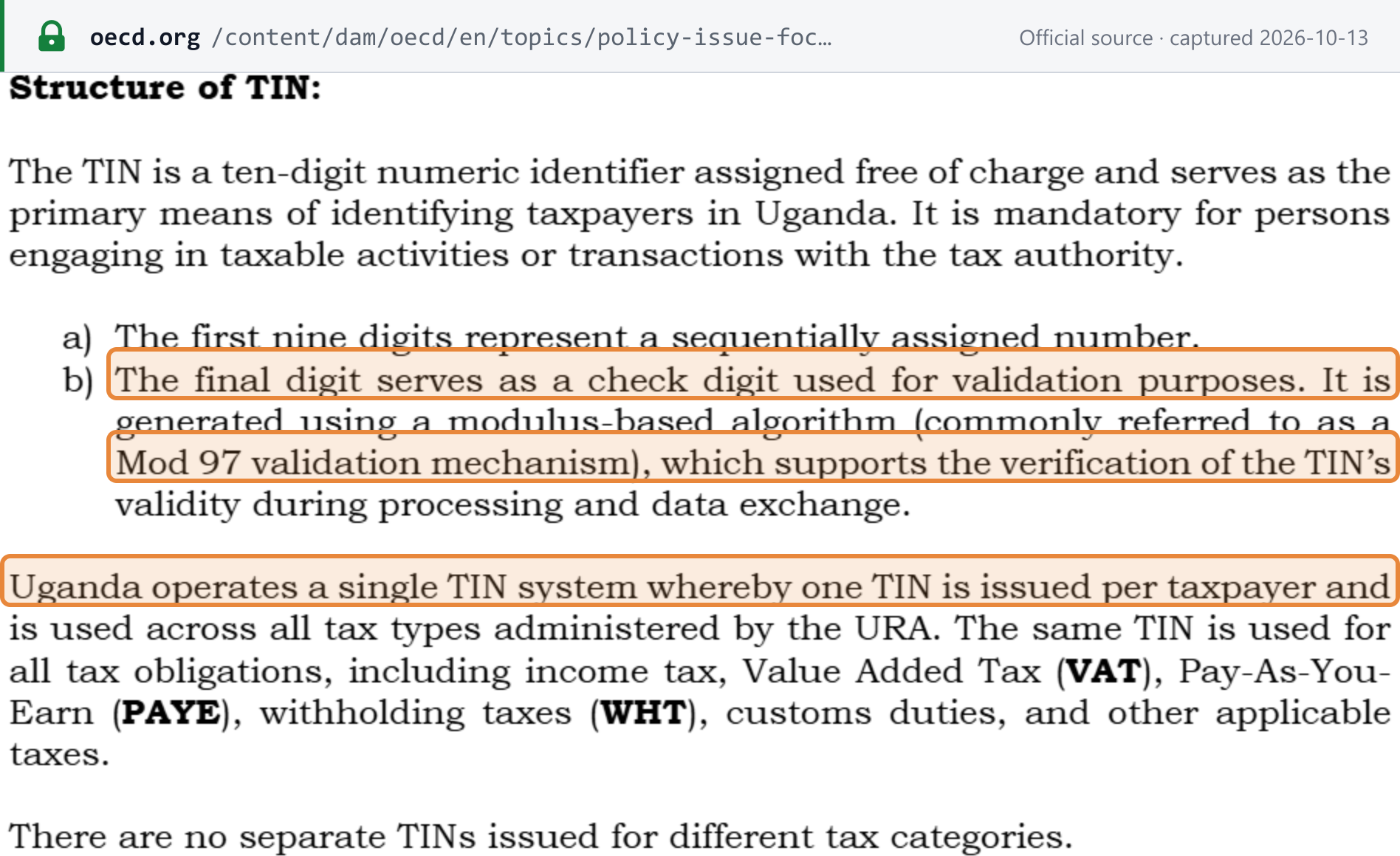
URA describes the TIN as "a 10-digit unique number allocated and issued free of charge by URA to identify a person as a registered taxpayer". [1] According to the TIN information URA supplied to the OECD in April 2026, the first nine digits are a sequentially assigned number, the tenth is a check digit, and the same TIN is used for all tax obligations — "There are no separate TINs issued for different tax categories." [4]

A TIN is personal to its holder. Using a false TIN, or someone else's, on a return or other tax document is an offence under the Tax Procedures Code, punishable by a fine of up to 150 currency points (UGX 3,000,000), up to six years' imprisonment, or both. [5]
The Switch to the NIN and BRN
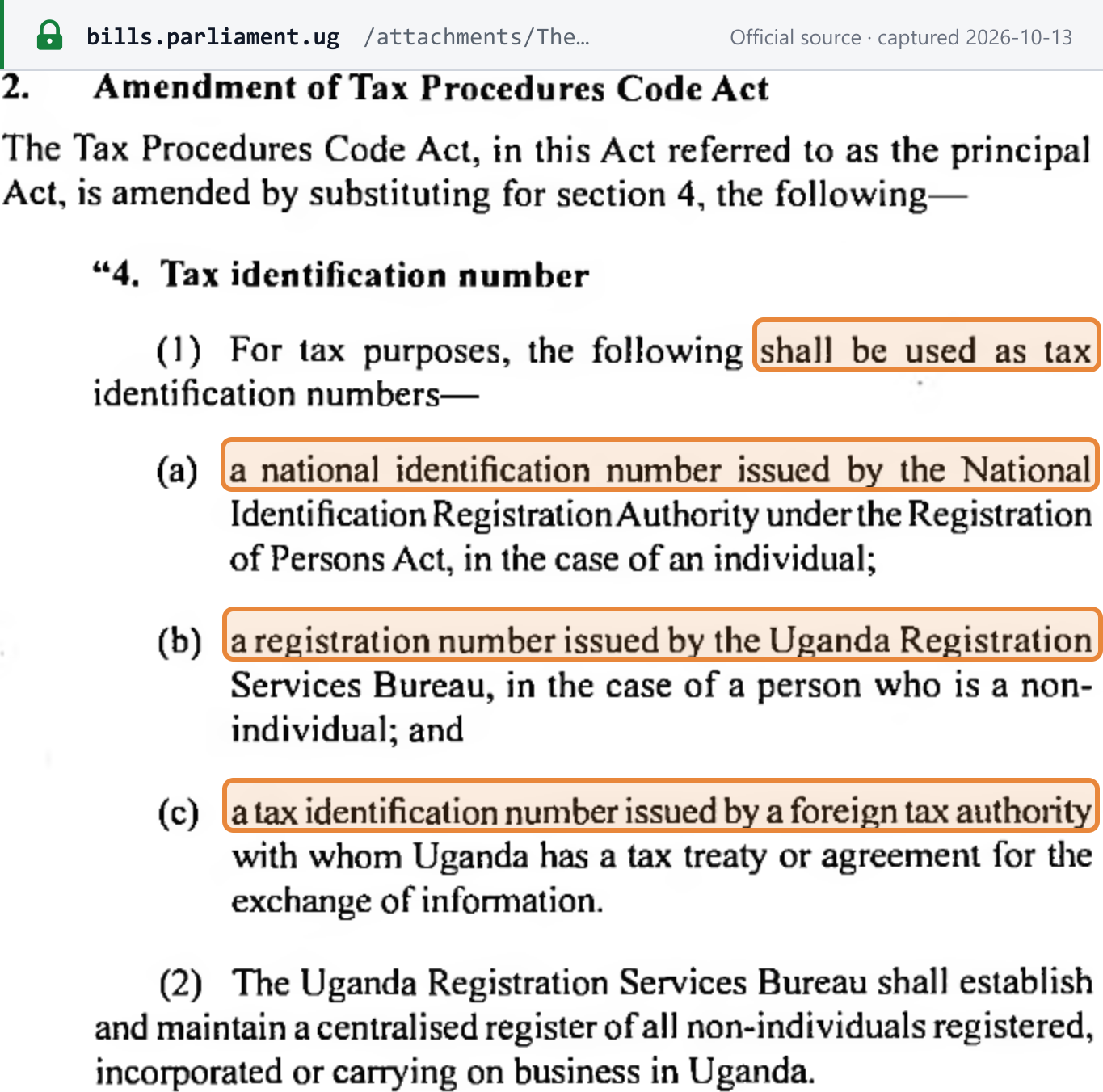
The Tax Procedures Code (Amendment) Act 2025, assented on 30 June 2025, substitutes a new section 4 in the Tax Procedures Code. It states that "the following shall be used as tax identification numbers":
- for an individual — the national identification number issued by NIRA;
- for a non-individual — the registration number issued by URSB;
- for a foreign person — a TIN issued by a foreign tax authority with which Uganda has a tax treaty or an agreement for the exchange of information. [2]
Once in force, the new section will also require that number on every return and tax document, and bar licences, business authorisations and stamp-duty registrations for anyone without one.
URA began requiring taxpayers to add their NIN or BRN with a public notice first published on 21 May 2026. It tells all registered taxpayers to update their registration with "the NIN for individuals or BRN for non-individuals", along with a current phone number, physical address and nature of business. Taxpayers whose details are not up to date are prompted to update them on logging in to the URA portal "before proceeding with any transaction". [3]

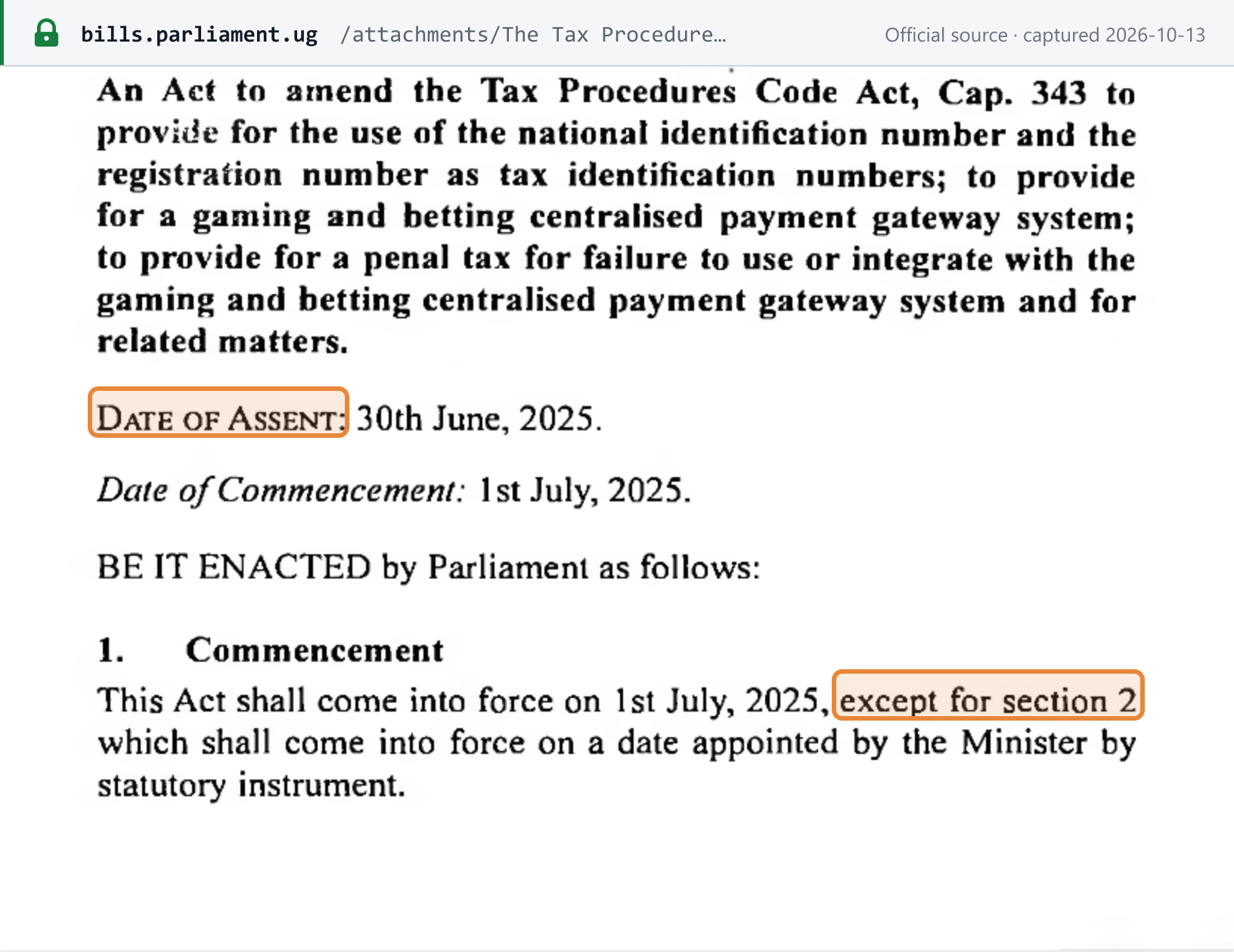
What this means in practice: URA's notice dates the requirement from 1 July 2025, but the Act itself brings section 4 into force only on a date the Minister appoints by statutory instrument, and no such instrument had been published as of 13 October 2026. Meanwhile URA's TIN application services remain open and continue to issue 10-digit TINs. Existing TIN holders should link their NIN or BRN now; systems that store Ugandan tax IDs should be ready to accept the NIN or BRN alongside the TIN.
Check Digit
URA states that the tenth digit is a check digit "generated using a modulus-based algorithm (commonly referred to as a Mod 97 validation mechanism)", but publishes no weights, worked example or test number. [4] Without the algorithm, the check digit cannot be recomputed outside URA: software can confirm only that a TIN has 10 digits.
Who Needs a TIN
Any person, company or organisation likely to transact tax business with URA must apply. URA's application pages list the documents each applicant needs: [1]
| Applicant | Key document |
|---|---|
| Ugandan citizen, 18 or over | National ID (mandatory) |
| Non-citizen | Passport (mandatory), plus a work permit or refugee ID where applicable |
| Minor | Legal or court guardianship document |
| Sole proprietor | Business name registration certificate, plus the owner's ID |
| Private company | Certificate of incorporation and company form 20 |
| Foreign company with a Ugandan branch | Certificate of registration and company forms 19 and 21 |
| Partnership | Certificate of registration and statement of particulars |
| Government body, club, society, trust or NGO | Establishing law or gazette, or registration certificate |
How to get a TIN
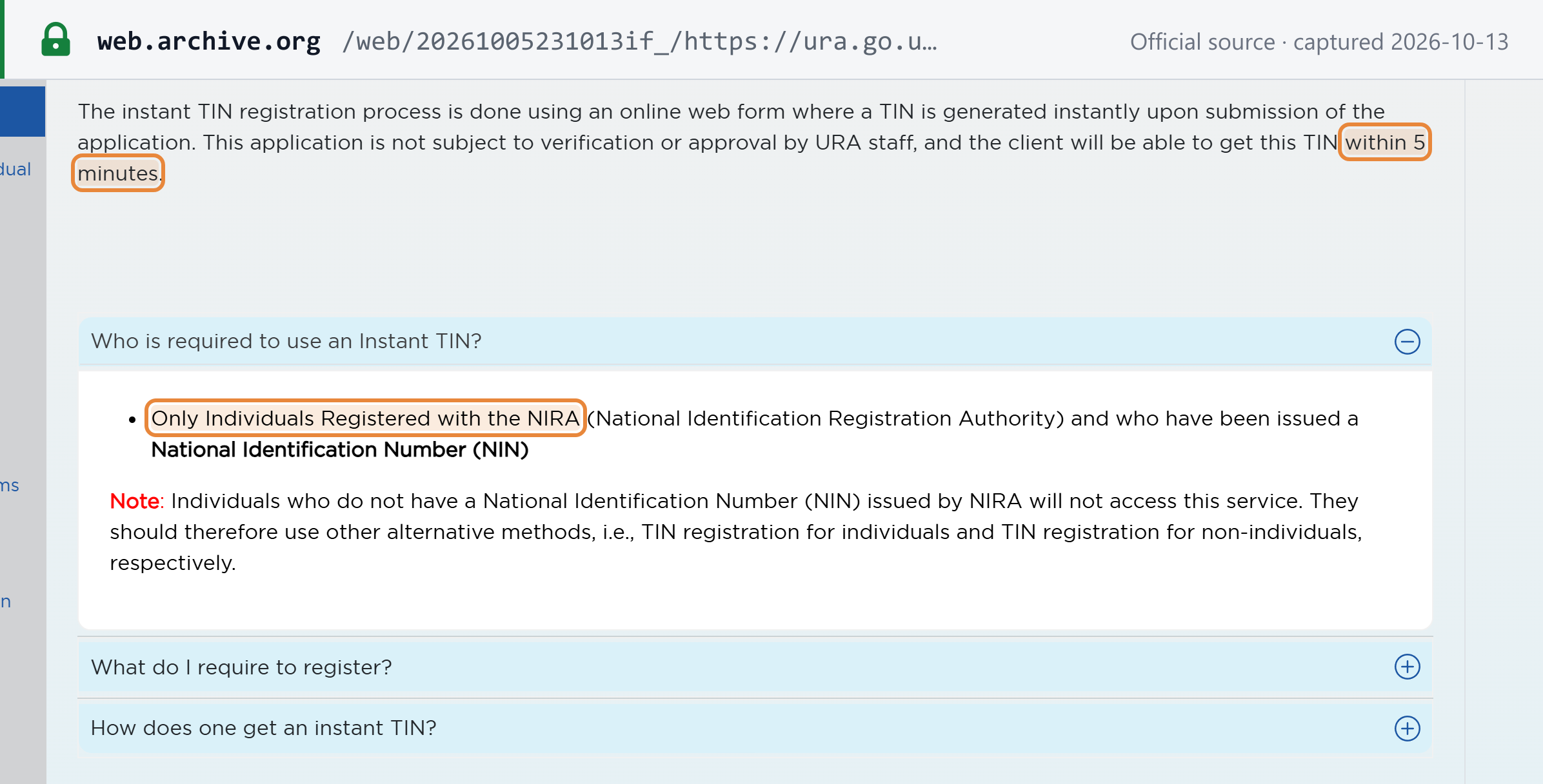
- Instant TIN (individuals with a NIN) — an online form that draws on NIRA's records. The TIN is generated on submission, without review by URA staff, "within 5 minutes", and is open "only [to] Individuals Registered with the NIRA … and who have been issued a National Identification Number (NIN)". [6]
- Standard application — individuals without a NIN and all organisations apply online and submit their documents; the application is verified and approved by URA staff before the TIN is issued.
- Group TIN — a company and its directors who do not yet have TINs can apply together, using the directors' NINs and the company's BRN.
VAT Registration
A business must register for VAT when its taxable turnover exceeds, or is expected to exceed, UGX 75,000,000 in any three consecutive calendar months — one quarter of the annual threshold of UGX 300,000,000. It must apply within 20 days after a three-month period in which the limit was exceeded, or at the start of a period in which it expects to exceed it. [7] The threshold was raised from UGX 150,000,000 by the VAT (Amendment) Act 2026, with effect from 1 July 2026. [8] Some reports gave the new figure as UGX 250 million, which was the bill's figure before Parliament amended it.

VAT registration does not produce a new tax ID: the business's TIN, or the NIN or BRN replacing it, continues to identify it on VAT returns and invoices.
Cross-Border Notes
- Non-resident suppliers of digital services register through a dedicated URA e-service. Electronic services supplied to a recipient in Uganda who is not a taxable person — that is, to consumers — are within the VAT net. See VAT on digital services from non-resident suppliers.
- Foreign individuals and companies with a presence in Uganda apply for a TIN with a passport, or with the branch's certificate of registration and company forms 19 and 21.
- Foreign TINs — under the new section 4, a TIN issued by a treaty partner's tax authority counts as a tax identification number in Uganda.
EFRIS e-invoicing
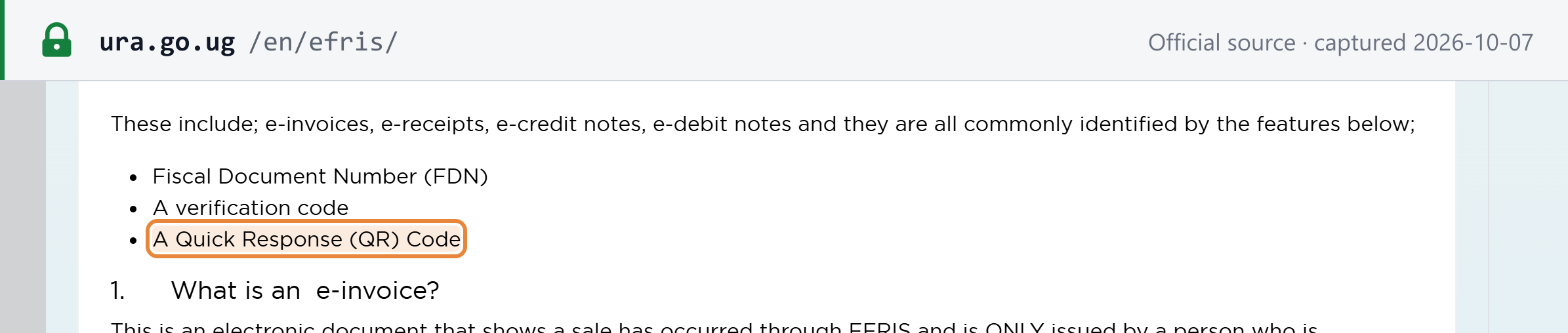
A TIN is required to register for EFRIS, URA's Electronic Fiscal Receipting and Invoicing Solution. EFRIS is mandatory for all VAT-registered businesses and for most businesses in designated sectors whether or not they are VAT-registered; very small businesses in those sectors are exempt. Every e-invoice or e-receipt carries a Fiscal Document Number (FDN), a verification code and a QR code. [9] The FDN is a 12- to 20-digit number. [10] For EFRIS scope and invoice content, see the Uganda VAT guide.

How to Verify a Ugandan TIN
URA publishes no public lookup that confirms another person's or company's TIN (checked 13 October 2026). Its tools work as follows:
| Tool | What it does | Can a third party use it? |
|---|---|---|
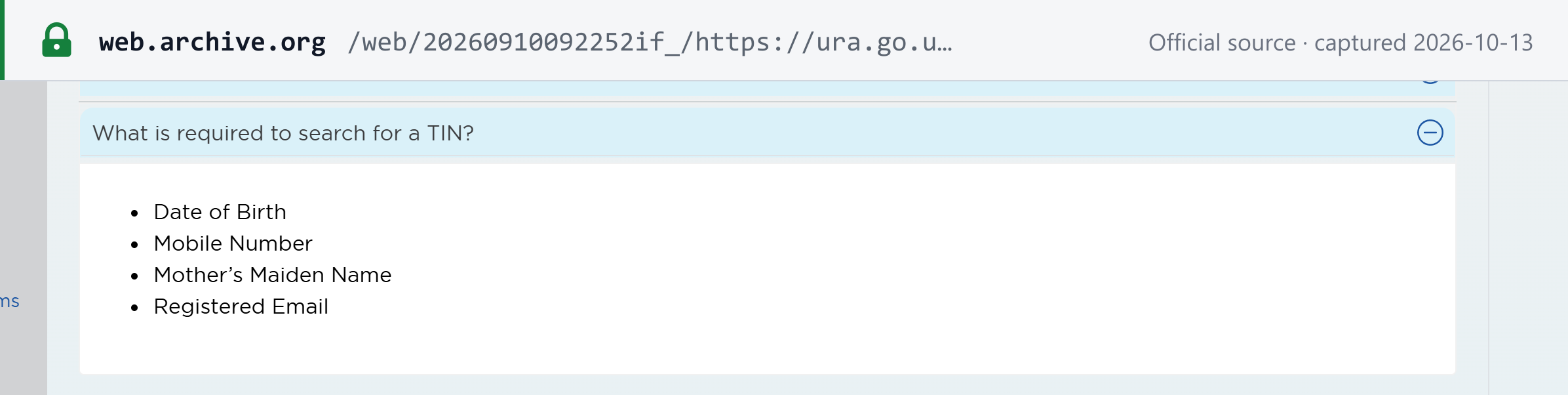
| Search TIN and the AskURA app | Recovers your own TIN; asks for date of birth, mobile number, mother's maiden name and registered email | No |
| EFRIS FDN validation | Enter an invoice's FDN to authenticate it | Yes — it validates an invoice, not a TIN |
| Document authentication | Confirms URA certificates by number, including a Tax Clearance Certificate | Yes — TIN and VAT certificates are not on its list |
To check a Ugandan supplier, ask for its TIN certificate or Tax Clearance Certificate and authenticate the latter on URA's portal, or validate an EFRIS invoice you have received from it using its FDN. [10]
Lookuptax does not yet offer a Uganda TIN validator.
Recent Changes
- 2026-08-10 — URA published a notice extending mandatory EFRIS use to businesses in twelve designated sectors, stated as effective from 1 July 2025. (URA) — see event
- 2026-07-01 — VAT registration threshold raised from UGX 150 million to UGX 300 million a year. (Parliament of Uganda) — see event
- 2026-05-21 — URA notice requiring all taxpayers to add their NIN or BRN to their tax registration. (URA)
Frequently Asked Questions
Is my TIN being replaced by my National ID number?
Yes, that is the direction of the law. The Tax Procedures Code (Amendment) Act 2025 will make the National Identification Number the tax identification number for individuals and the URSB registration number the tax identification number for companies once the Minister brings it into force. Since May 2026 URA has required taxpayers to add their NIN or BRN to their tax registration. As of 13 October 2026, URA still issues and uses 10-digit TINs during the transition.
Is a Ugandan VAT number different from the TIN?
No separate VAT number is issued. URA uses one TIN for every tax it administers, including VAT, and a business's VAT registration is recorded against that TIN.
How do I check a supplier's TIN in Uganda?
URA has no public lookup for someone else's TIN. Its Search TIN tool recovers your own TIN and asks for details such as your date of birth and mother's maiden name. To check a supplier, ask for its TIN certificate or Tax Clearance Certificate and authenticate the clearance certificate on URA's portal, or validate one of its EFRIS invoices by entering the Fiscal Document Number.
I forgot my TIN. How do I find it?
Use URA's Search TIN service or the AskURA app with the email address or phone number you registered with. You can also visit a URA office. Do not apply for a second TIN: each person may hold only one.
Is the VAT registration threshold UGX 250 million or 300 million?
It is UGX 300 million a year, applied as UGX 75 million in any three consecutive calendar months, from 1 July 2026. UGX 250 million was the figure in the bill as introduced; Parliament raised it to UGX 300 million before passing the law.
Can a foreigner get a Ugandan TIN?
Yes. A non-citizen individual applies with a passport, plus a work permit or refugee ID where applicable. A foreign company with a branch in Uganda applies with its certificate of registration and company forms 19 and 21. Non-resident suppliers of digital services have their own registration route.
Does a Ugandan TIN have a check digit?
Yes. URA states that the tenth digit is a check digit generated with a modulus-97-based method, but it does not publish the algorithm, so the check digit cannot be recomputed outside URA. Software can only confirm that the TIN has 10 digits.
Do I need a TIN to use EFRIS?
Yes. A TIN is required to register for EFRIS, which is mandatory for all VAT-registered businesses and for most businesses in designated sectors.
Related Resources
- Uganda VAT guide — rates, registration, EFRIS and filing
- Worldwide VAT, GST and sales tax registration thresholds
- Global e-invoicing status tracker
- VAT on digital services from non-resident suppliers
- Uganda tax changes — chronology
- East African tax ID guides: Kenya
How Lookuptax can help you in VAT validation?
Lookuptax VAT validation revolutionizes VAT number validation with its robust platform, empowering businesses to seamlessly verify VAT numbers across over 100 countries. Our cutting-edge technology ensures accurate and efficient validation, reducing errors and enhancing compliance.