Slovenia Tax Number Guide — Davčna številka, ID za DDV & EMŠO
Slovenia's tax identification number is the davčna številka (tax number) — an 8-digit number the Financial Administration of the Republic of Slovenia (FURS — Finančna uprava Republike Slovenije) assigns to every taxpayer, individual or business, and which is used for all taxes. A business that is identified for VAT uses the same digits with the prefix SI as its VAT number (identifikacijska številka za DDV, "ID za DDV"). Two other numbers are often confused with it: the matična številka, the business-register number assigned by AJPES, and the EMŠO, the 13-digit personal register number, which is not a tax number at all. [1] For VAT rates, invoicing and filing, see the Slovenia VAT guide.
Slovenia's Tax Numbers at a Glance
| Davčna številka | ID za DDV | Matična številka | EMŠO | |
|---|---|---|---|---|
| What it is | Tax number, used for all taxes | VAT identification number | Business-register number | Personal register number — not a tax ID |
| Issuer | FURS | FURS (on application) | AJPES (Slovenian Business Register) | Central Population Register (Ministry of the Interior and Public Administration) |
| Who has one | Every taxpayer — individuals and entities | Only persons identified for VAT | Companies, sole traders, associations, branches | Resident individuals; foreigners only when needed |
| Format | 8 digits, first digit not 0 — ^[1-9]\d{7}$ | SI + the 8-digit tax number — ^SI[1-9]\d{7}$ | 10 characters, usually quoted as the first 7 | 13 digits — DDMMYYY 50 SSS K |
| Check digit | Modulus 11 (weights not officially published) | As the tax number | Modulus 11, official weights 7-6-5-4-3-2 | Modulus 11, official weights 7-6-5-4-3-2 repeated |
| Example | 82646716 (Krka, d. d.) | SI82646716 | 5043611000 / 5043611 (Krka) | 2902932505526 (official fictitious example) |
Davčna številka (Tax Number)
| Field | Detail |
|---|---|
| Length | 8 digits |
| Regex | ^[1-9]\d{7}$ |
| Structure | Digits 1–7 are random (1,000,000–9,999,999); digit 8 is a check digit |
| Check digit | Modulus 11 |
| Example | 82646716 — Krka, d. d., Novo mesto |
| Issued to | Every taxpayer: resident individuals (including newborns), sole traders, legal entities, and non-residents with Slovenian tax obligations |
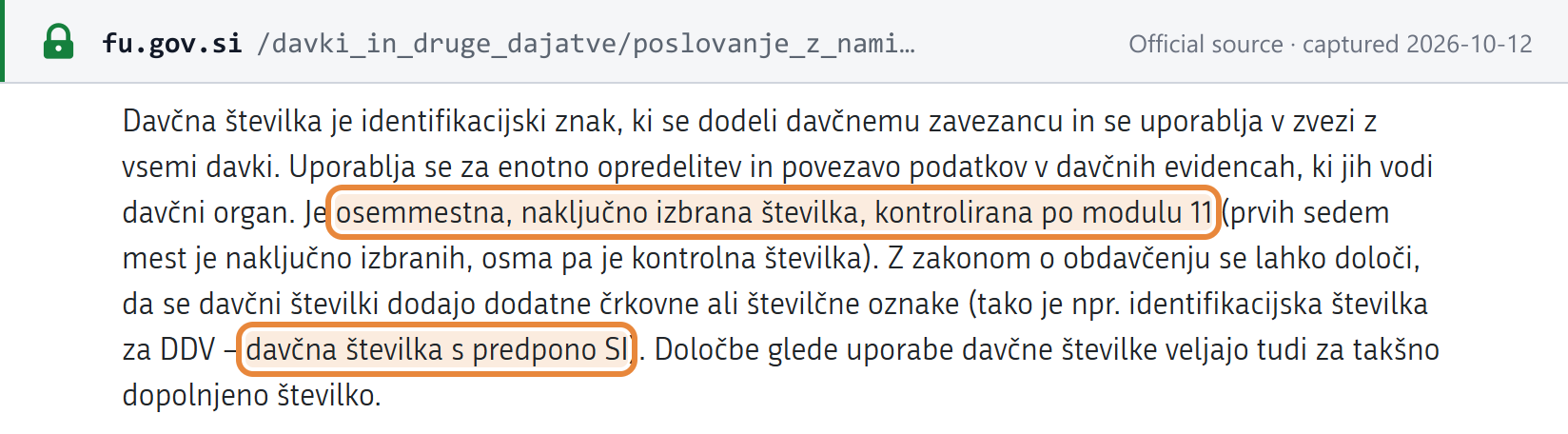
FURS describes the tax number as an eight-digit, randomly chosen number controlled under modulus 11, whose first digit cannot be 0. The digits carry no meaning — there is no date of birth, region or entity-type code. [1] [2]
Who receives one
- Resident individuals are entered in the tax register automatically; a newborn's parents receive the tax-number certificate by post about a month after the birth. [3]
- Legal entities are entered automatically by the tax office from the Slovenian Business Register.
- Sole traders (s.p.) keep the tax number they already hold as individuals.
- Non-resident individuals with Slovenian taxable income or property apply on form DR-02; the certificate arrives within eight days of a complete application. [4]
- Non-resident entities without a seat in Slovenia file form DR-04 before they start activity in Slovenia. [2]
The tax number is not printed on passports or identity cards; it appears on the FURS registration certificate. [2]
ID za DDV (VAT Identification Number)
The VAT number is the tax number with the prefix SI — "Identifikacijska številka za DDV je davčna številka s predpono SI" (VAT Act ZDDV-1, art. 79(2)). [5] It is written without a space, for example SI82646716, and VIES expects the same layout: SI followed by one block of 8 digits.
Registration for tax is not registration for VAT. A business has a tax number from the start, but the SI form exists only once FURS has identified it for VAT on a separate application (eDavki form DDV-P2, or DDV-P3 for non-established businesses). [6] [7]
Special forms: -EX, VAT groups and limited-scope IDs
SI12345678-EX— a Slovenian business using the EU cross-border SME exemption in another member state receives an individual identification number made of the tax number with the country code SI and the suffix -EX (ZDDV-1 art. 94.c(5), as amended by ZDDV-1O). It is used only for that scheme. [8] See the EU VAT SME scheme explainer.- VAT groups (from 1 January 2026) — a VAT group receives its own tax number and VAT ID. When a business joins, its own VAT identification ends automatically, and members must use the group's VAT ID in transactions with anyone outside the group (ZDDV-1 arts. 78.b and 137.h(6)). [8] A member's own number therefore shows as invalid in VIES, while the group number is valid and is displayed with the name "VAT group / DDV skupina". See the VAT grouping explainer.
- Limited-scope identification — FURS marks some VAT-identified persons with the flag P (atypical taxpayers that do not charge VAT on domestic supplies) or O (occasional international road passenger transport). Their
SInumbers are valid, but the prefix alone does not tell you the scope of the identification. [7]
Matična Številka (Business-Register Number)
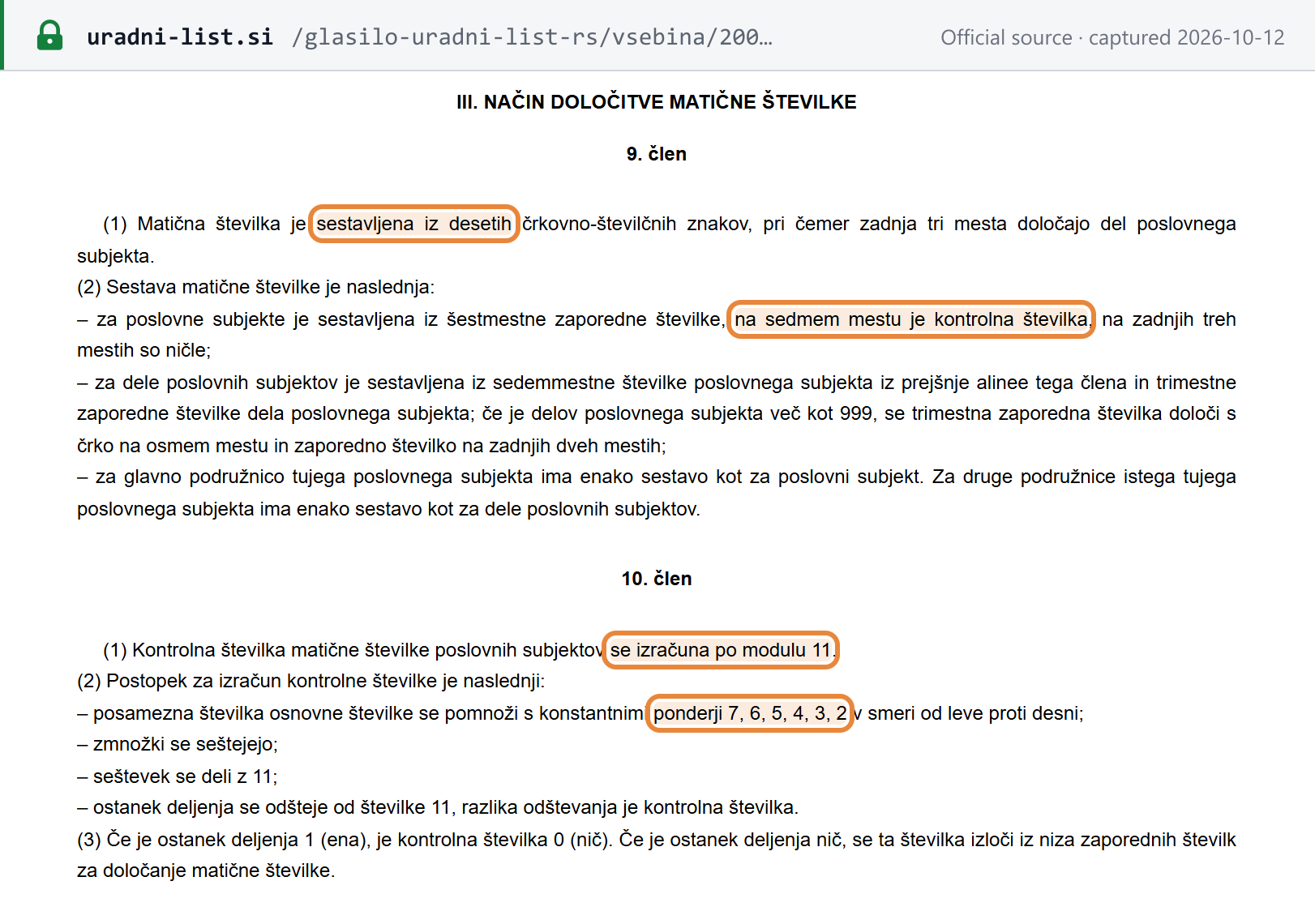
AJPES assigns a matična številka to every business entity entered in the Slovenian Business Register (Poslovni register Slovenije). It has ten characters: [9]
| Positions | Meaning |
|---|---|
| 1–6 | Sequential number |
| 7 | Check digit |
| 8–10 | Unit code — 000 for the business entity itself, 001 onwards for its branches or other parts (above 999 parts, position 8 becomes a letter) |
Because the head entity always ends in 000, the number is usually quoted by its first seven digits — for Krka, 5043611, which FURS's taxpayer lists carry as 5043611000. A 7- or 10-digit number from a Slovenian supplier is therefore a matična številka, not a tax number.
EMŠO (Personal Register Number)
The EMŠO (enotna matična številka občana) is the 13-digit personal identification number kept in the Central Population Register. It is not a tax number and must never be used in its place. Its structure is set by the Central Population Register Act (ZCRP, art. 8): [10]
| Digits | Meaning |
|---|---|
| 1–7 | Date of birth — day, month and the last three digits of the year (DDMMYYY) |
| 8–9 | Register code — 50 for Slovenia |
| 10–12 | Sex and serial number — 000–499 male, 500–999 female |
| 13 | Check digit, modulus 11 |
A foreigner receives an EMŠO only when exercising rights or obligations in Slovenia; for tax purposes it is requested through FURS. [11] Anyone collecting an EMŠO must state the legal basis and purpose (ZCRP art. 9(3)). For testing, use only the official fictitious example 2902932505526, which the 1999 decree states has never been and never will be assigned. [12]
Check Digit Algorithms
All three numbers use modulus 11, but with different weights and different handling of the edge cases — a common source of validation bugs.
Davčna številka
FURS publishes that the eighth digit is a modulus-11 check digit but does not publish the weights. The standard weighting below matches every tax number on FURS's published taxpayer lists:
- Multiply digits 1–7 by 8, 7, 6, 5, 4, 3, 2 and add the products.
- Divide by 11 and take the remainder.
- Check digit = 11 − remainder. A result of 10 becomes 0. A remainder of 0 does not occur on FURS's lists.
Worked example — Krka 82646716: 8·8 + 2·7 + 6·6 + 4·5 + 6·4 + 7·3 + 1·2 = 181; 181 mod 11 = 5; 11 − 5 = 6, matching the last digit.
The placeholder SI12345678, used in FURS guidance to illustrate the layout, fails this check (the check digit would be 9). Treat it as layout only.
Matična številka (official)
The Business Register decree publishes the rule (art. 10): multiply the first six digits by 7, 6, 5, 4, 3, 2, add the products, divide by 11, and subtract the remainder from 11. If the remainder is 1, the check digit is 0; if the remainder is 0, that sequential number is never assigned. [9] For Krka 504361|1: 5·7 + 0·6 + 4·5 + 3·4 + 6·3 + 1·2 = 87; 87 mod 11 = 10; 11 − 10 = 1. Some older numbers on FURS's lists — notably most sole traders' numbers beginning with 5 — do not satisfy this check, so a failed check alone is not proof that a matična številka is wrong.
EMŠO (official)
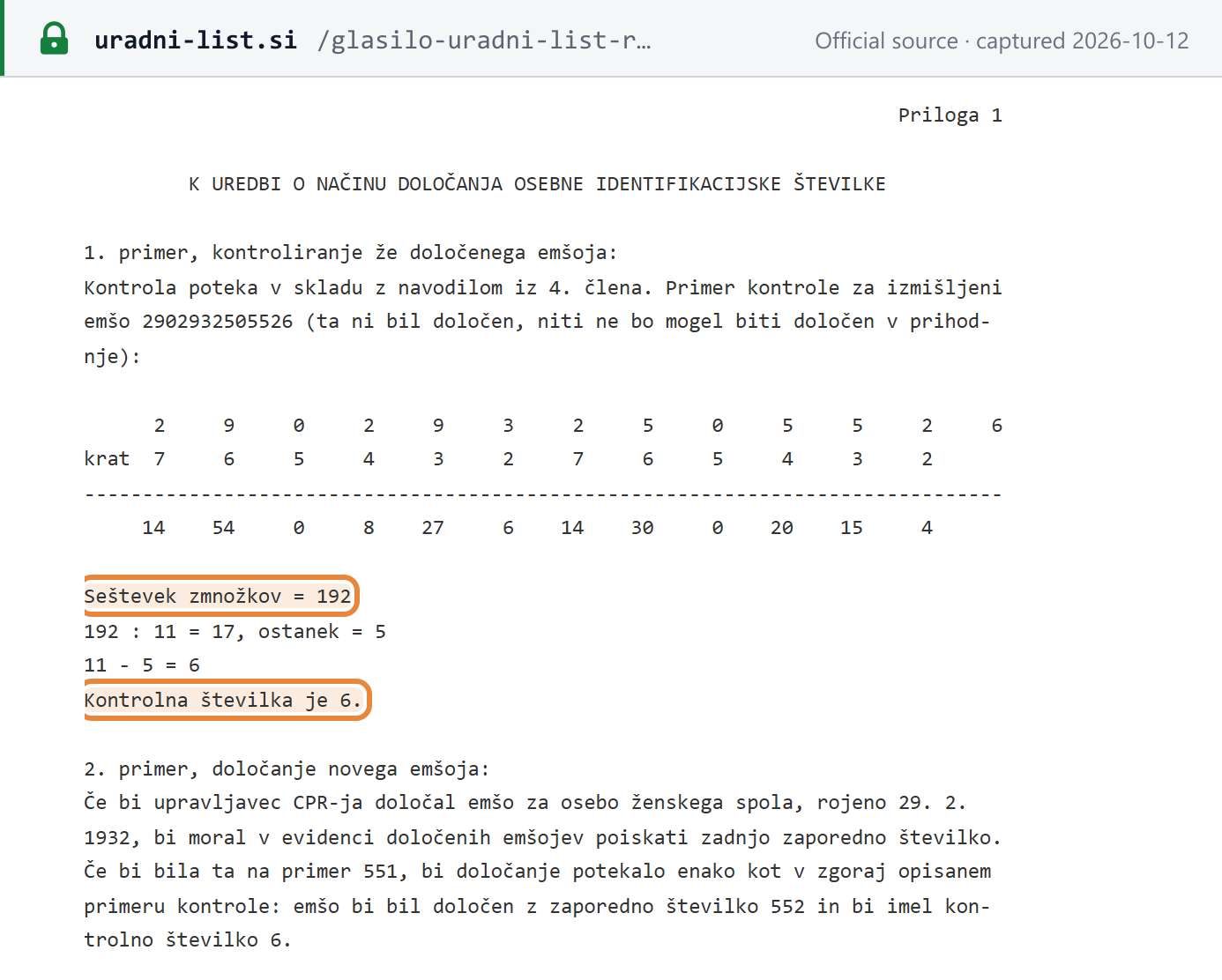
Multiply the first twelve digits by 7, 6, 5, 4, 3, 2, 7, 6, 5, 4, 3, 2, add the products, divide by 11 and subtract the remainder from 11. A remainder of 0 gives check digit 0; where the remainder is 1 the register skips that serial number. The decree's worked example for 2902932505526 gives a sum of 192, remainder 5, and check digit 6. [12]
| Number | Remainder 0 | Remainder 1 |
|---|---|---|
| Davčna številka (observed, not published) | Does not occur | Check digit 0 (11 − 1 = 10 → 0) |
| Matična številka | Never issued | Check digit 0 |
| EMŠO | Check digit 0 | Never issued |
A number that passes its check digit is well-formed; it does not show that the number was issued or that the holder is identified for VAT.
Who Must Register for VAT
| Who | Rule | Since |
|---|---|---|
| Businesses established in Slovenia | Exempt as a small taxable person while Slovenian turnover did not exceed EUR 60,000 in the previous calendar year and does not exceed it in the current one | 1 January 2025 |
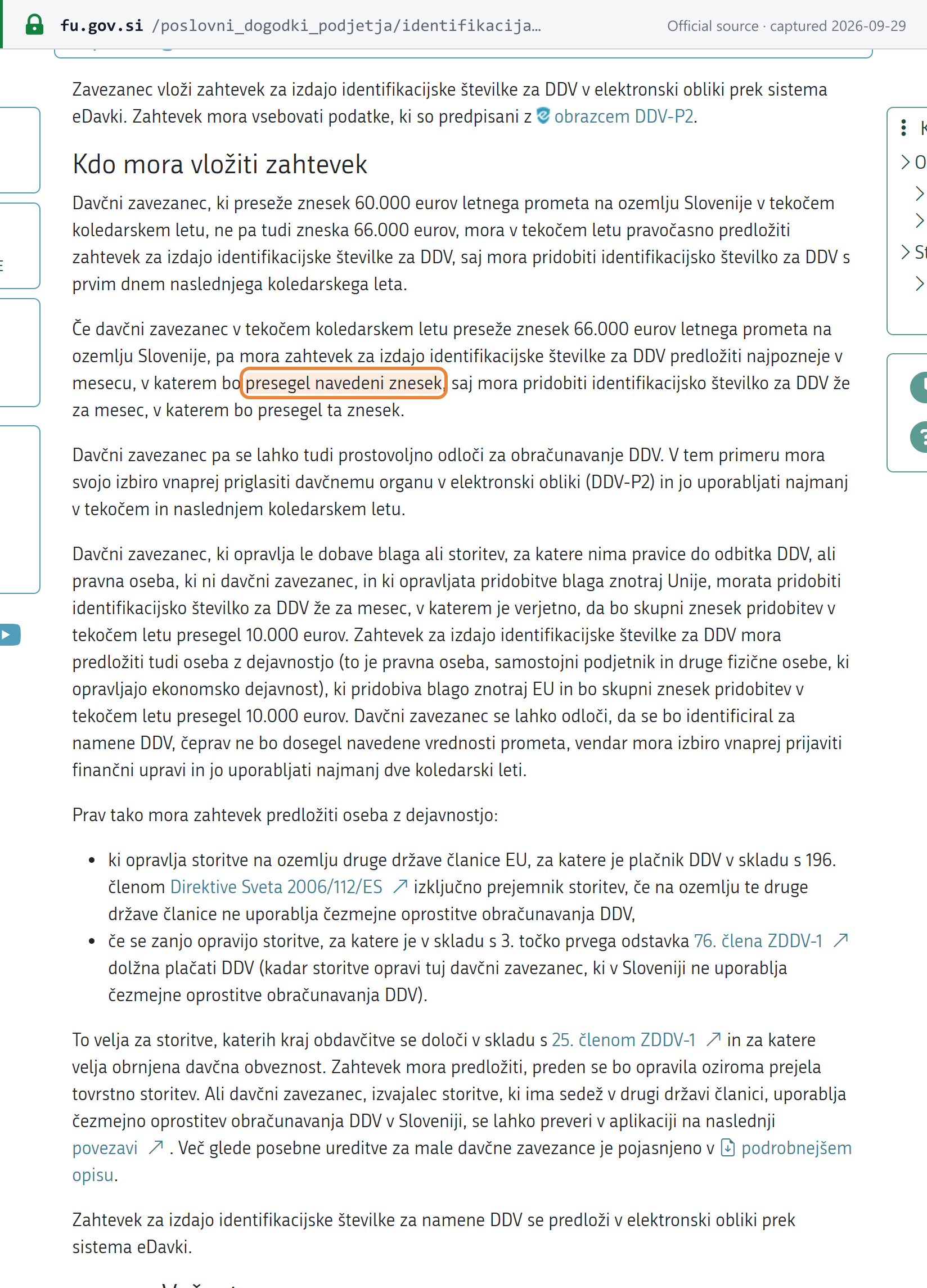
| — crossing EUR 60,000 (but not EUR 66,000) in the year | Must hold a VAT ID from 1 January of the following year | 1 January 2025 |
| — crossing EUR 66,000 in the year | Must apply no later than the month in which the EUR 66,000 is exceeded | 1 January 2025 |
| Exempt persons and non-taxable legal persons | Must identify for VAT once intra-EU acquisitions of goods are likely to exceed EUR 10,000 in the year | — |
| Businesses established outside Slovenia (not using the EU SME scheme) | No threshold — a VAT ID is needed before the first taxable supply; apply on DDV-P3 at least 15 days beforehand | — |
The threshold is measured per calendar year, not over a rolling 12 months (ZDDV-1 art. 94, as replaced by ZDDV-1O, applying from 1 January 2025). [8] [13] A business established in a non-EU country must appoint a tax representative; for a business established in another member state this is optional. A non-established business whose Slovenian supplies all go to customers identified for VAT in Slovenia, who account for the VAT under the reverse charge, does not need to register. [14] Compare Slovenia with other countries in the worldwide VAT registration thresholds table.
How to Register
- Tax number: automatic for residents and for entities in the Business Register. Non-residents file DR-02 (individuals) or DR-04 (entities) with a financial office. [4]
- VAT ID: apply electronically through eDavki on form DDV-P2 (established businesses) or DDV-P3 (non-established businesses). [13]
The steps, documents and timing are covered in the Slovenia VAT guide's registration section.
Cross-Border Notes
Withholding on payments to non-residents
A Slovenian payer withholds 15% on Slovenian-source dividends, interest and royalties paid to non-residents. To apply a lower treaty rate at source, the non-resident gives the payer the relevant FURS form before payment — KIDO 1 for dividends, KIDO 2 for interest, KIDO 3 for royalties — with a certificate of residence from its own tax authority. Refund claims (KIDO 9, 10, 11) can be filed within five years of payment. [15]
E-invoicing
As at 2026-10-13, e-invoicing to public bodies (B2G) has been mandatory since 2015, and B2B e-invoicing becomes mandatory on 1 January 2028 under the ZIERDED Act; its rules for e-invoice route providers apply from 1 April 2027. No new e-invoicing number is created — the Act keys the system on existing numbers: the list of e-invoice route providers and their recipients kept by the Public Payments Administration (UJP) records each recipient's matična številka and davčna številka (art. 12(4)), and the data kept by providers must identify issuer and recipient by at least the tax number (art. 19(2)). [16] See e-invoicing in Slovenia.
How to Verify a Slovenian Tax Number
| What you want to confirm | Official tool | What it returns |
|---|---|---|
An SI VAT ID is valid for intra-EU trade | EU VIES | Valid or invalid, with the business name and address for Slovenia |
An SI…-EX number is valid for the EU SME scheme | European Commission SME-on-the-web | Validity of the EX number |
| A tax number, its VAT status, scope flag or VAT group | FURS lists of taxpayers | Free downloadable files, refreshed daily between 7 and 8 a.m. — there is no interactive FURS search |
| A business exists in the register | AJPES ePRS | Search by name, matična številka or tax number |
There is no public EMŠO lookup — an EMŠO is personal data, so only its check digit can be validated. VIES returns "invalid" both for the bare tax number of a business that is not identified for VAT and for the own number of a VAT-group member; check the FURS lists before concluding that a supplier's number is wrong. [7]
For a walkthrough of the VIES check, see how to verify an EU VAT number in VIES. To check the format and check digit of a Slovenian VAT number instantly, use the Lookuptax Slovenia DDV number validator.
Frequently Asked Questions
Is my davčna številka the same as my Slovenian VAT number?
The digits are the same, but they are not the same thing. Every taxpayer has a davčna številka, while the VAT number — the tax number with the prefix SI — exists only once FURS has identified you for VAT on a separate application through eDavki. Entering the tax register does not put a business in the VAT system.
Why does VIES say a large Slovenian company's VAT number is invalid?
There are two common reasons. Either the company is not identified for VAT, or, since 1 January 2026, it has joined a VAT group. Joining a group ends the member's own VAT identification automatically, and members must use the group's SI number when trading with anyone outside the group. In VIES the group number appears as valid with the name "VAT group / DDV skupina". FURS's VAT-group list shows which group a company belongs to.
A Slovenian supplier gave me a 7- or 10-digit number. Is that its tax number?
No. That is the matična številka, the business-register number assigned by AJPES. It has ten characters and is usually quoted by its first seven digits, because the last three are 000 for the company itself. The tax number has eight digits, and the VAT number is SI followed by those eight digits.
How is the check digit of a Slovenian tax number calculated, and why does SI12345678 fail?
FURS states that the eighth digit is calculated modulo 11. Multiply the first seven digits by 8, 7, 6, 5, 4, 3 and 2, add the results, take the remainder after dividing by 11 and subtract it from 11; a result of 10 becomes 0. This weighting matches every tax number on FURS's public list of legal entities. SI12345678 is only a layout illustration used in FURS guidance: its check digit would be 9, not 8, so it fails.
I'm a foreigner with income or property in Slovenia. How do I get a tax number, and do I also need an EMŠO?
File form DR-02 with a Slovenian financial office, in person, through a proxy or by post. FURS sends the tax-number certificate within eight days of receiving a complete application. An EMŠO is a separate personal register number that a foreigner receives only when exercising rights or obligations in Slovenia; for tax purposes it is requested through FURS.
Where can I find my davčna številka? It isn't on my ID card.
That is expected. The Slovenian tax number is not printed on passports or identity cards. It appears on the tax-register certificate FURS issues, and you can see it in the eDavki portal. For a newborn, the certificate is posted to the parents about a month after the birth.
What does SI…-EX mean on an invoice?
It is the individual identification number of a Slovenian business using the EU cross-border SME exemption to sell VAT-free in another member state. The number is the business's tax number with the country code SI and the suffix -EX, and it is used only for that scheme. EX numbers are checked in the European Commission's SME-on-the-web service, not in VIES.
From 2028, which number will my customers need to send me e-invoices in Slovenia?
Your existing numbers. B2B e-invoicing becomes mandatory on 1 January 2028, and the ZIERDED Act does not create a new e-invoicing identifier. The public list of e-invoice recipients records each recipient's matična številka and tax number, and the data that e-invoice providers keep must identify the issuer and recipient by at least the tax number.
Related Resources
- Slovenia VAT guide — rates, registration, invoicing and filing
- E-invoicing in Slovenia — the ZIERDED B2B mandate from 2028
- How to verify an EU VAT number in VIES
- Slovenia tax changes — chronology
- EU VAT SME scheme and EX numbers
- VAT grouping explained
- Worldwide VAT, GST and sales tax registration thresholds
- Global e-invoicing status tracker
- Neighbouring tax ID guides: Croatia, Austria, Italy, Hungary
How Lookuptax can help you in VAT validation?
Lookuptax VAT validation revolutionizes VAT number validation with its robust platform, empowering businesses to seamlessly verify VAT numbers across over 100 countries. Our cutting-edge technology ensures accurate and efficient validation, reducing errors and enhancing compliance.