EU VAT SME scheme — the special scheme for small enterprises
The EU VAT special scheme for small enterprises (the "SME scheme") lets a small business established in an EU member state sell without charging VAT: at home, where that state offers the exemption and the business's turnover there does not exceed the national threshold (at most EUR 85,000); and, since 1 January 2025, in other member states that offer it, provided its EU-wide turnover is no more than EUR 100,000 and its sales in each of those states stay within that state's own threshold. The exempt business cannot deduct input VAT and may not show VAT on its invoices. To use the exemption abroad it notifies its own tax office in advance and receives an individual number ending in "EX".
The rules are EU law, set by the Council of the European Union and applied by each member state's tax administration. The European Commission's Directorate-General for Taxation and Customs Union (DG TAXUD) publishes each state's national rules on a dedicated portal, sme-vat-rules.ec.europa.eu, as Article 32(1) of Regulation (EU) No 904/2010 (as amended) requires. The legal package, as listed on the Commission's EU legislation page (checked 2026-09-24):
- Council Directive (EU) 2020/285 of 18 February 2020 (OJ L 62, 2.3.2020, p. 13). It rewrites the special scheme for small enterprises in the VAT Directive 2006/112/EC (including new Articles 284, 284a–284d and 288a) and amends Regulation (EU) No 904/2010 on administrative cooperation. Member states had to transpose it by 31 December 2024 and apply it from 1 January 2025 (Arts 3 and 4). (EUR-Lex, checked 2026-09-24)
- Council Directive (EU) 2022/542 of 5 April 2022. Its Article 2 replaced the new turnover definition (Article 288) before it applied, updating its cross-references; it also applies from 1 January 2025. (EUR-Lex, checked 2026-09-24)
- Commission Implementing Regulation (EU) 2021/2007 of 16 November 2021 (OJ L 407, 17.11.2021, p. 27). It sets the detailed rules for the information exchange between tax administrations that the cross-border scheme runs on, and applies from 1 January 2025. (EUR-Lex, checked 2026-09-24)
Other citations of an implementing regulation numbered "2021/2251" for this scheme are wrong: the implementing act is 2021/2007.
 Source snapshot captured 2026-09-24 — original
How it works
The domestic exemption — optional for member states, capped at EUR 85,000
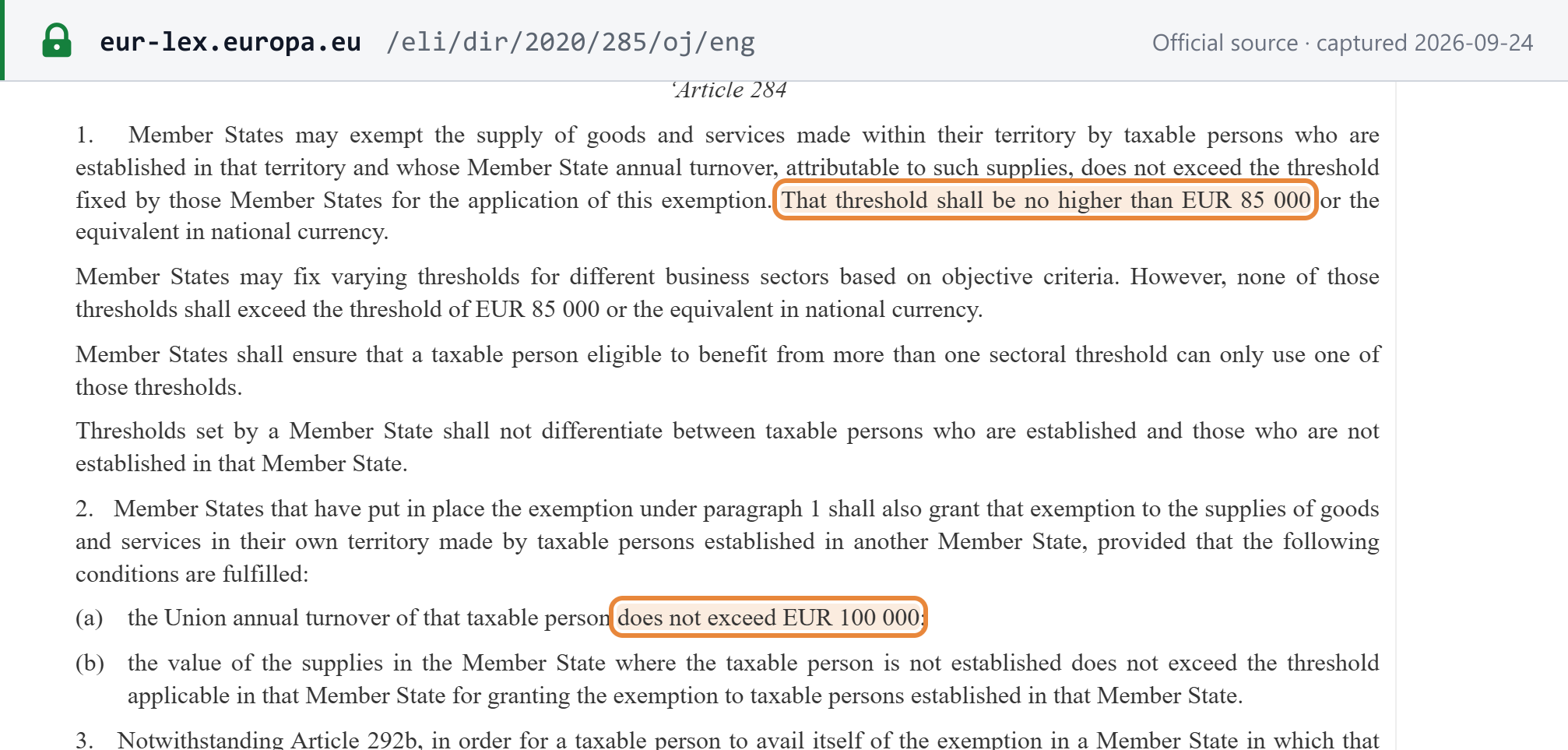
A member state may exempt supplies made in its territory by businesses established there whose annual turnover in that state stays within a national threshold. Article 284(1): "That threshold shall be no higher than EUR 85 000 or the equivalent in national currency." A state may set different thresholds for different sectors on objective criteria, each no higher than EUR 85,000, and a business can use only one of them. Thresholds "shall not differentiate between taxable persons who are established and those who are not established in that Member State." (Directive (EU) 2020/285, Art 1(12), checked 2026-09-24)
Turnover for the threshold is counted excluding VAT and does not include disposals of capital assets (Article 288(1)–(2), as replaced by Directive (EU) 2022/542).
The cross-border exemption — mandatory wherever a domestic exemption exists
A state that offers the domestic exemption shall also grant it to businesses established in another member state, provided (Article 284(2)):
- the business's Union annual turnover does not exceed EUR 100,000; and
- its supplies in the state granting the exemption stay within that state's own threshold.
Being over EUR 100,000 EU-wide never costs a business its exemption at home. Recital 9 of the directive: enterprises below their national threshold "should be able to continue to make exempt supplies in that Member State irrespective of the turnover they generate in other Member States, even if their overall turnover exceeds the Union threshold."
Notification, the EX number, and the 35-working-day rule
To use the exemption in another state, the business deals only with its state of establishment (the Commission's guidance calls it the MSEST; the state granting the exemption is the MSEXE):
- Prior notification to the state of establishment (Art 284(3)(a)). The notification gives the business's name, activity, legal form and address; the state or states where it wants the exemption; and the value of its supplies in its own state and in each other state in the previous calendar year and the current year so far (Art 284a(1)).
- One identification number, issued at home only. The number "shall have the suffix “EX”, or the suffix “EX” shall be added to that number" (Art 284(3)). The Commission's Explanatory Notes add: "The EX number is not a VAT identification number as such. It is only used for the purpose of the functioning of the cross-border SME scheme." (Explanatory Notes, §4.4, 24 October 2024, not legally binding; checked 2026-09-24)
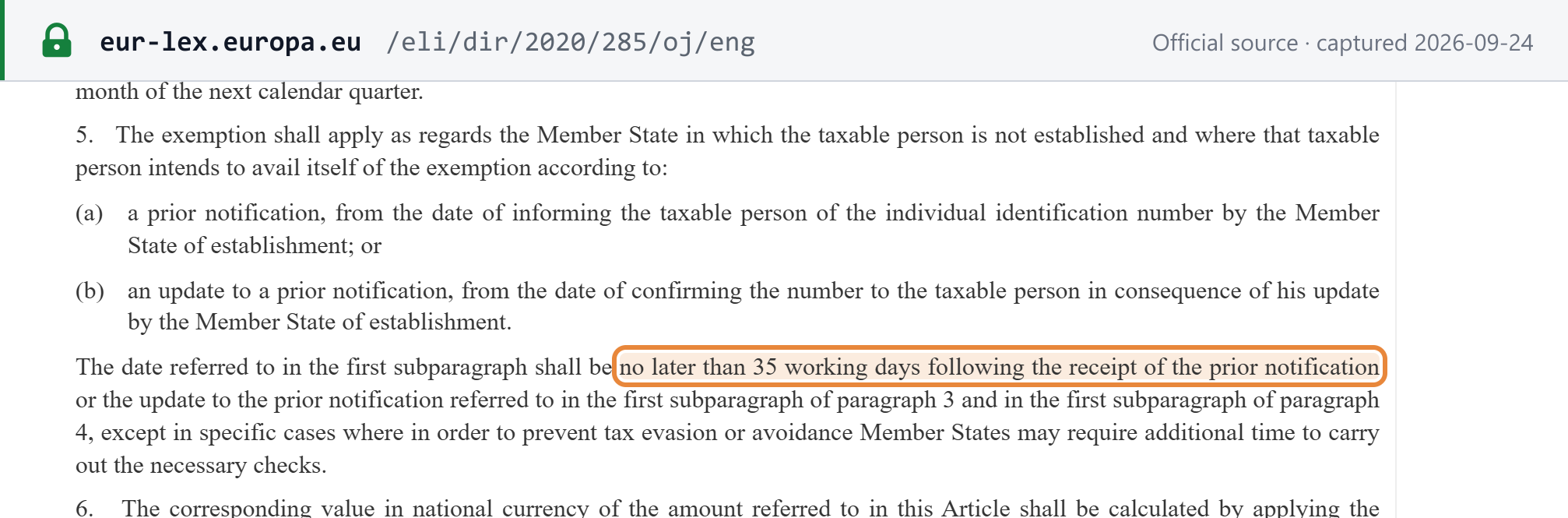
- Start date. The exemption applies in the other state from the date the state of establishment informs the business of its number. That date "shall be no later than 35 working days following the receipt of the prior notification", except where a state needs more time for anti-fraud checks (Art 284(5)).
- No registration and no VAT return in the other state. For the exempt supplies, the business need not register for VAT there (Arts 213 and 214) or file returns there (Art 250) (Art 284d(1)). If it fails its reporting duties, that state may impose the normal obligations (Art 284d(3)).
 Source snapshot captured 2026-09-24 — original
National formats differ. Czechia issues a separate number, for example CZ12345678901-EX
(Finanční správa,
checked 2026-09-24). Slovenia uses the tax number with the suffix, SI12345678-EX
(FURS SME guidance, 4th edition, January 2026,
checked 2026-09-24). Finland issues an "Exempt ID" that is "similar to the VAT identification
number, except for the letters "EX" added at the end"
(Vero Skatt,
checked 2026-09-24).
 Source snapshot captured 2026-09-24 — original
Quarterly reporting and the 15-working-day notice
- Every calendar quarter, the business reports to its state of establishment the value of its supplies in that state and in every other member state, and must do so "within one month from the end of the calendar quarter" (Art 284b(2)). The Commission adds that the report covers all 27 member states, whether or not the business uses the scheme in each, and that a quarterly report can be corrected for three years. (Commission cross-border page, checked 2026-09-24)
- Crossing EUR 100,000. "When the Union annual turnover threshold … is exceeded, the taxable person shall inform the Member State of establishment within 15 working days" (Art 284b(3)).
- Currency. Values are reported in euro. States outside the euro may require their national currency (Art 284c(1)); Denmark does, and requires the values in DKK (Commission Denmark page, checked 2026-09-24).
- Leaving voluntarily. Stopping the exemption in a state takes effect on the first day of the next calendar quarter after the state of establishment receives the update, or, if the update arrives in the last month of a quarter, on the first day of the second month of the next quarter (Art 284(4)).
Going over a threshold — Article 288a
Article 288a sets separate rules for the national threshold and the EU-wide one:
- National threshold, previous year. A business that exceeded a state's threshold in the preceding calendar year cannot use that state's exemption for one calendar year. The state may extend this to two years (Art 288a(1)).
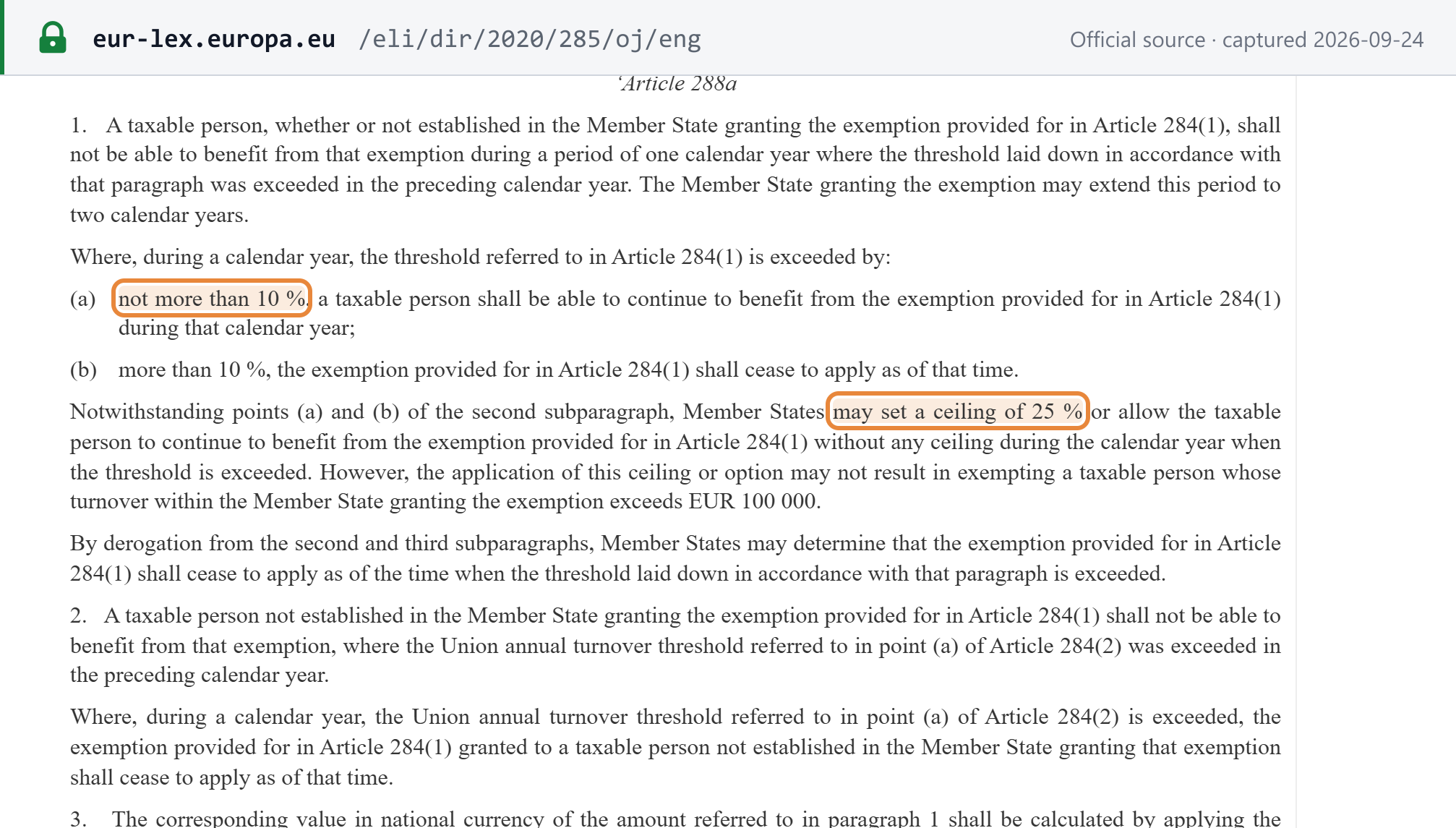
- National threshold, during the year — the directive's default. If the threshold is exceeded by "not more than 10 %", the exemption continues for the rest of that calendar year; by "more than 10 %", it "shall cease to apply as of that time."
- Member-state options. A state "may set a ceiling of 25 %" or allow no ceiling for the rest of the year, but never so as to exempt a business whose turnover in that state exceeds EUR 100,000. A state may instead end the exemption at the moment the threshold is exceeded.
- EU-wide threshold. Exceeding EUR 100,000 of Union turnover in the previous year bars the cross-border exemption for the following year. Exceeding it during the year ends the cross-border exemption "as of that time", with no tolerance (Art 288a(2)).
The 10% rule is therefore the directive's default, not an EU-wide rule. Many states use the option to end the exemption immediately. Check the "In-year overrun" column in the table below.
 Source snapshot captured 2026-09-24 — original
Input VAT, invoices, and opting out
- No input VAT deduction. "Taxable persons exempt from VAT shall not be entitled to deduct VAT … and may not show the VAT on their invoices" (Article 289 of Directive 2006/112/EC, unchanged by the reform). Directive 2020/285 also amended Article 169(a), so that supplies exempt under Article 284 in another state give no right to deduct at home either. In the Commission's Explanatory Notes (Examples 43–44), a business that is exempt at home but taxed in another state cannot deduct input VAT on purchases in its state of establishment, citing CJEU case C-507/16.
- Simplified invoices. Member states "shall allow" a business using the Article 284 exemption to issue simplified invoices (Article 220a(1)(c), inserted by Directive 2020/285).
- Fewer domestic formalities, at each state's choice. For businesses using the exemption only at home, a state may waive the registration statement or else complete identification within 15 working days (Art 292b), and waive the VAT return or else allow a simplified annual return (Art 292c). A state may also release any exempt small enterprise from "certain or all" of the obligations in Articles 217 to 271, which include invoicing, record-keeping and VAT returns (Art 292d).
- Opting out. A business entitled to the exemption may opt for normal VAT; each state sets the conditions (Article 290). Lock-in periods differ. For example, Germany binds a business that waives the exemption for at least five calendar years (§ 19(3) UStG).
How it fits with OSS and IOSS
The Commission's guidance (not legislation) on the cross-border scheme page (checked 2026-09-24):
- "The SME scheme and the One-Stop-Shop (OSS) Union scheme can coexist." However, "it is not possible to apply both the SME and OSS Union schemes at the same time in the same jurisdiction."
- The SME scheme and the Import One Stop Shop (IOSS) are mutually exclusive: a small enterprise "would have to opt out of the SME scheme to use the IOSS."
- A business cannot use the SME scheme in a state where it has a fixed establishment "unless the fixed establishment is deregistered."
Worked example
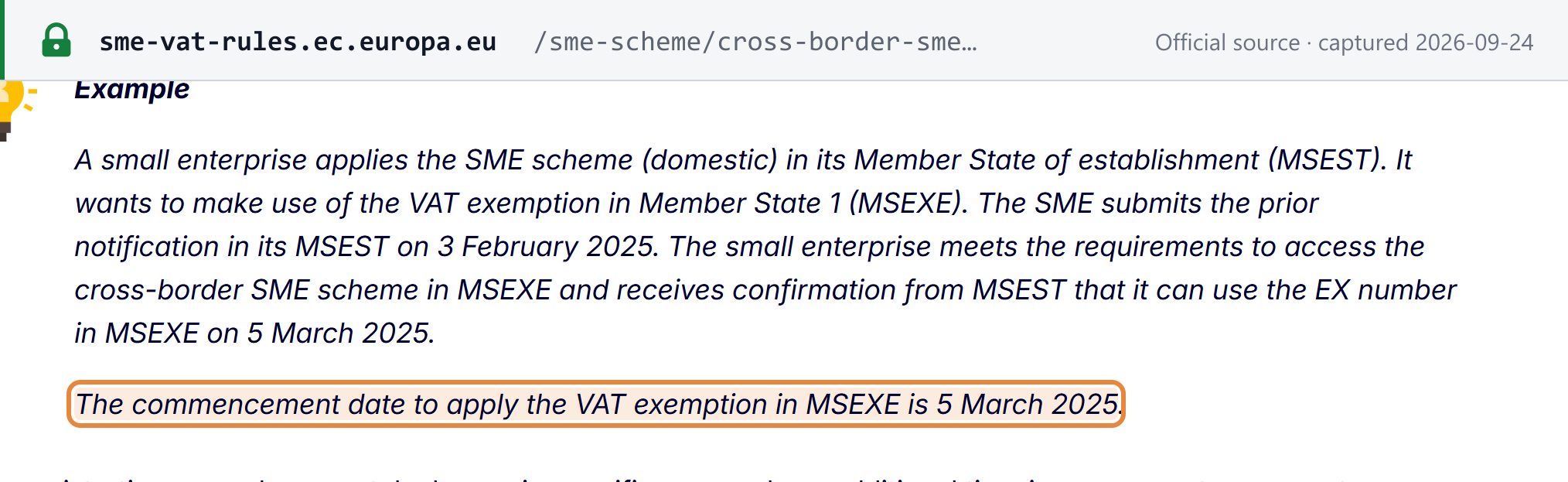
The Commission's timeline. A small enterprise already uses the domestic scheme at home and wants the exemption in a second member state. It submits the prior notification on 3 February 2025. It meets the conditions, and its state of establishment confirms on 5 March 2025 that it can use its EX number in the second state. "The commencement date to apply the VAT exemption in MSEXE is 5 March 2025." (Commission cross-border page, checked 2026-09-24)
 Source snapshot captured 2026-09-24 — original
Applied to a real pair of states. A business established in Austria makes EUR 30,000 of supplies in Austria and EUR 15,000 in Germany, with similar figures the year before. Its Union turnover is EUR 45,000, under EUR 100,000. Its Austrian turnover is under Austria's EUR 55,000 threshold. Its German supplies are under Germany's test of EUR 25,000 in the previous year and EUR 100,000 in the current year. It notifies the Austrian tax office that it wants the exemption in Germany. Once Austria confirms its EX number for Germany (within 35 working days), the business:
- invoices German customers without German VAT, and does not register or file VAT returns in Germany;
- deducts no input VAT on costs linked to its exempt supplies, in either country;
- files one quarterly report in Austria, within a month of each quarter-end, showing its supplies in all 27 member states;
- tells the Austrian tax office within 15 working days if its EU-wide turnover passes EUR 100,000. From that moment its German exemption ends. Its Austrian exemption continues if it is still under the Austrian threshold.
Who it affects
- Small businesses established in an EU member state. The domestic exemption covers businesses established in the state granting it. The cross-border exemption covers businesses established in another member state (Art 284(1)–(2)). Both depend on the turnover limits above.
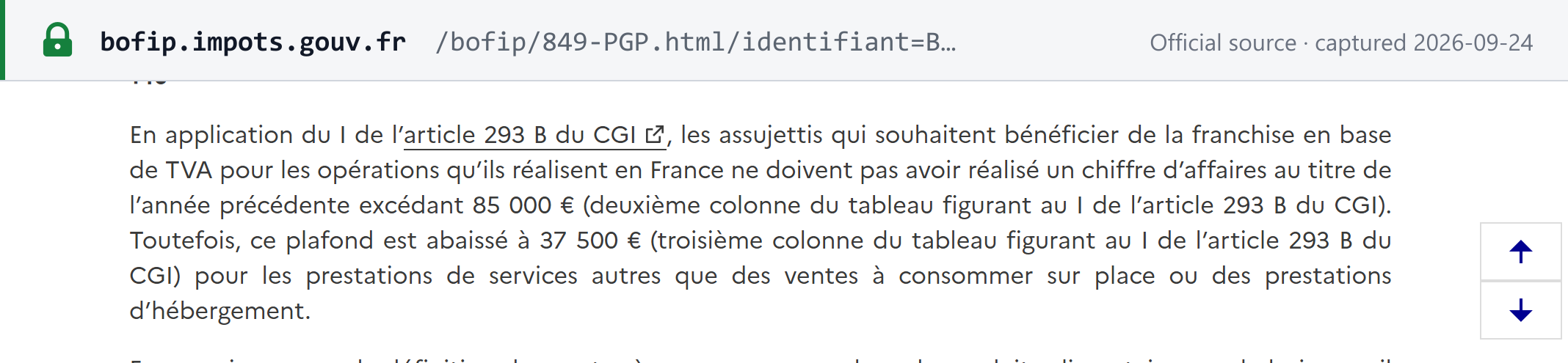
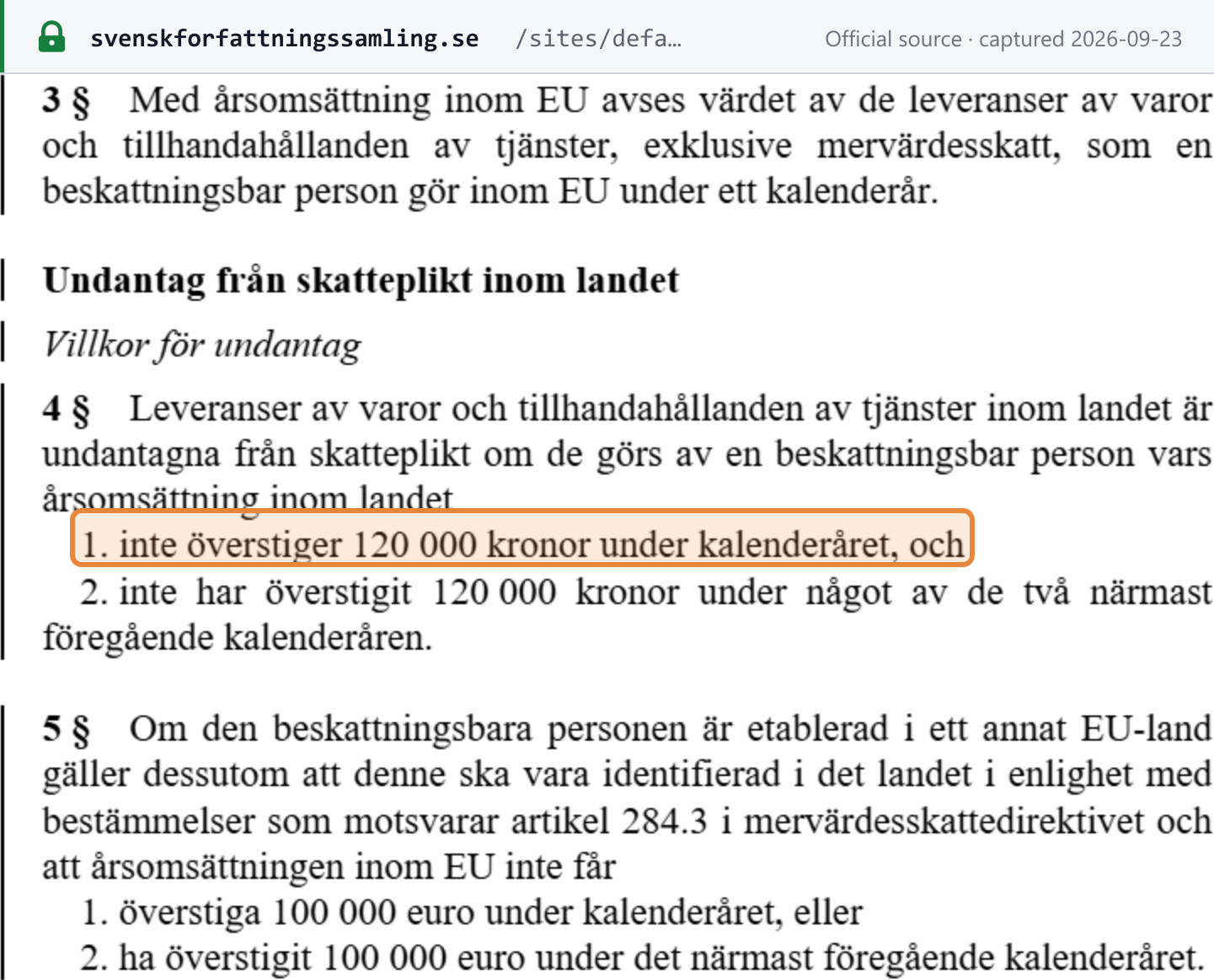
- Not businesses established outside the EU. Article 284 reaches only businesses established in a member state, so a UK, US or other non-EU company cannot use the cross-border scheme. National rules say so expressly. Finland: "The possibility of companies established outside the EU to apply the VAT exemption for small businesses in Finland was eliminated" (Vero Skatt, checked 2026-09-24). Sweden's law excludes businesses that are "inte är etablerade i något EU-land" ("not established in any EU country") (SFS 2024:942, ML 18 kap. 6 §, checked 2026-09-24). One narrow exception: France lets a business headquartered outside the EU that has a fixed establishment in France choose France as its attachment state for the franchise (BOFiP BOI-TVA-DECLA-40-10-10-20260701 §10, checked 2026-09-24).
- Italy: natural persons only. "Only for natural persons, it is possible to opt for the SME scheme in Italy." That applies to both the Italian domestic franchise and incoming cross-border SMEs (Commission Italy page; Agenzia delle Entrate, Circolare n. 13/E of 16 December 2025; both checked 2026-09-24).
- Spanish businesses cannot use it yet. Spain has not transposed the directive, so it issues no EX numbers and offers no exemption to incoming SMEs (see below).
 Source snapshot captured 2026-09-24 — original
Current status and dates
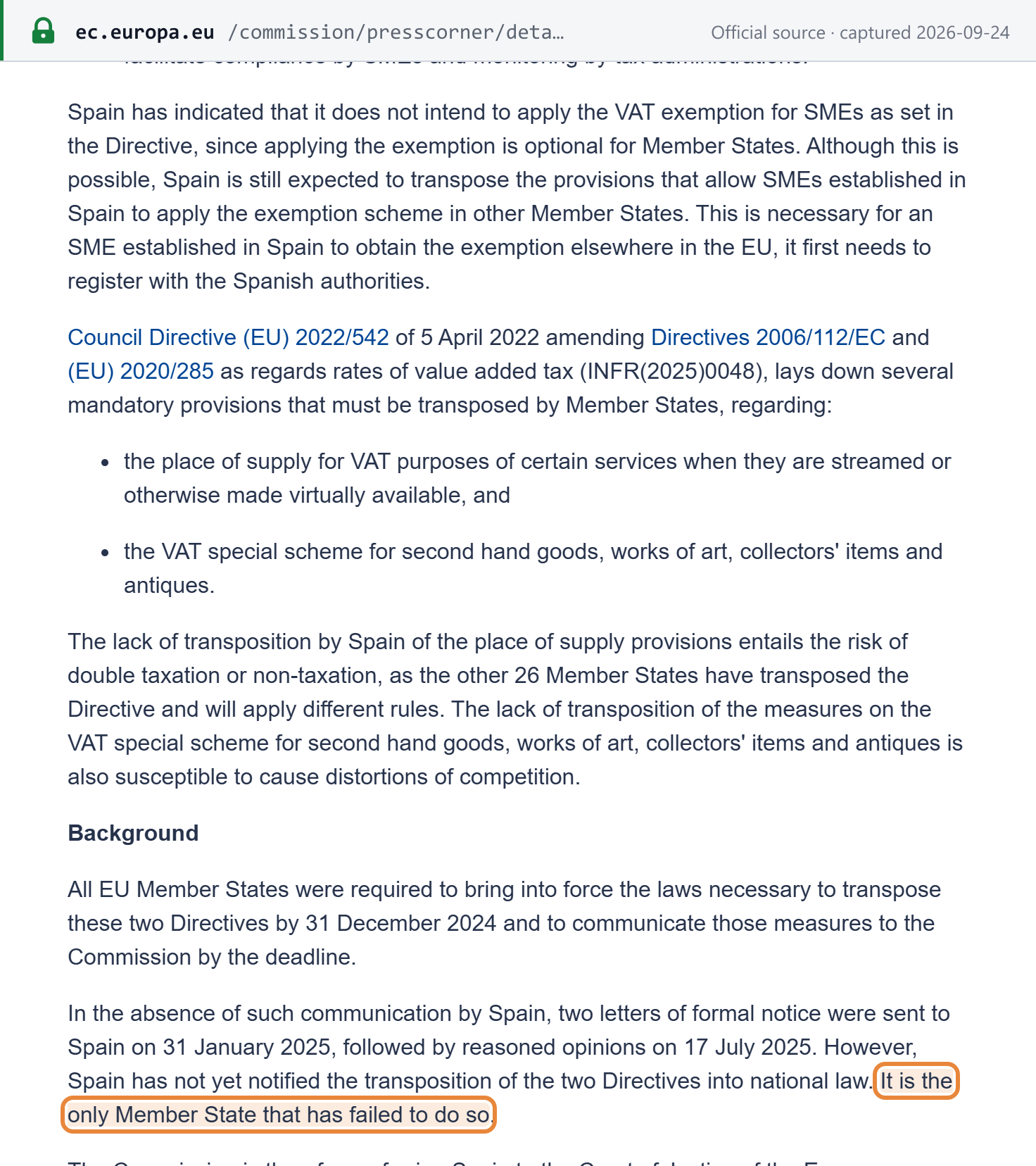
Applies from 1 January 2025; transposed by 26 of the 27 member states (as at 2026-09-24). Spain has not transposed it; Portugal opened its cross-border route in March 2025, and Bulgaria's regimes apply from 1 January 2026. The European Commission's press release IP/26/442 of 11 March 2026: "Spain has not yet notified the transposition of the two Directives into national law. It is the only Member State that has failed to do so." Spain has said it will not offer the domestic exemption, which the directive allows, but the Commission says Spain "is still expected to transpose the provisions that allow SMEs established in Spain to apply the exemption scheme in other Member States." The Commission referred Spain to the Court of Justice of the EU on 11 March 2026 (infringement INFR(2025)0047). (European Commission, IP/26/442, checked 2026-09-24)
 Source snapshot captured 2026-09-24 — original
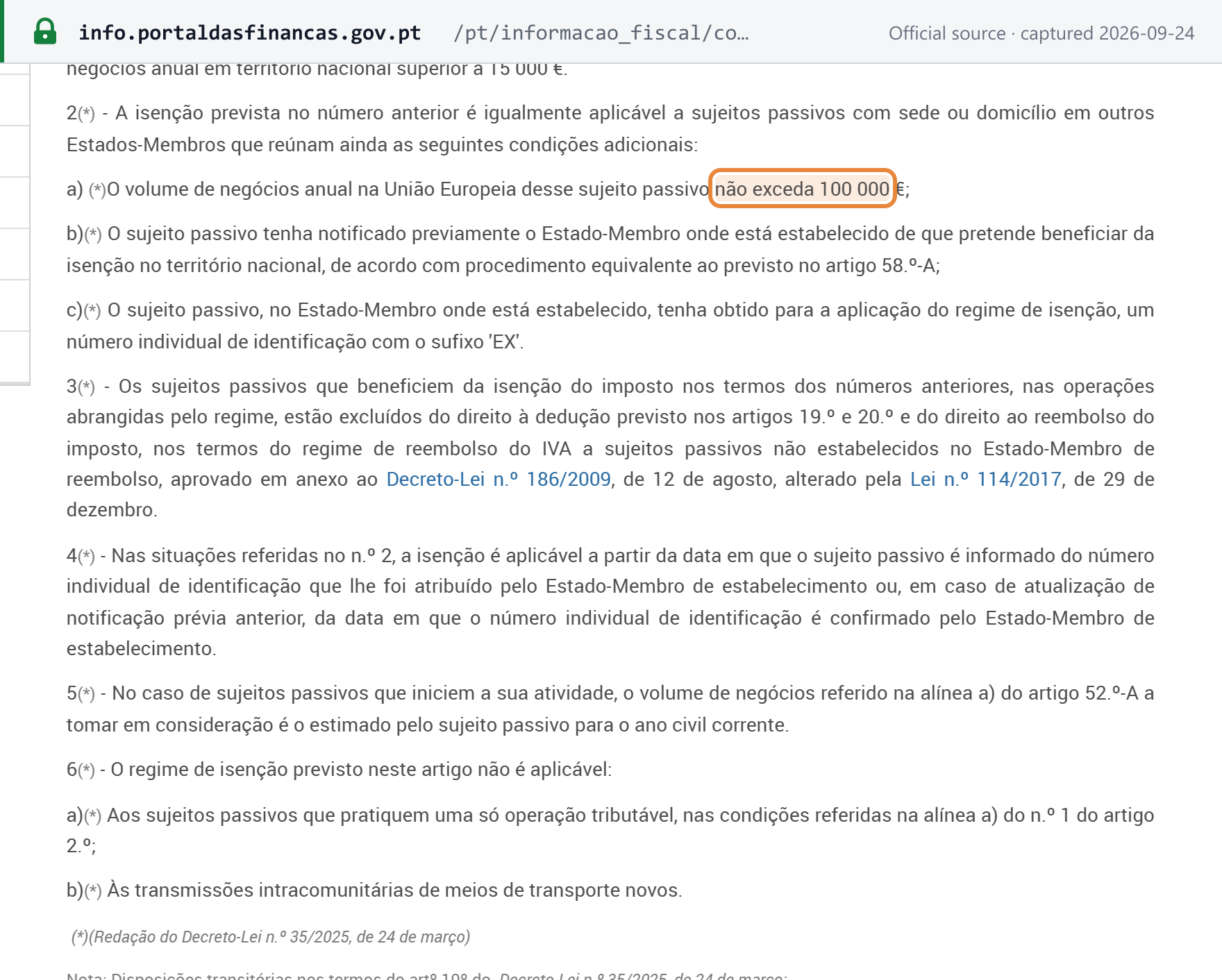
Two member states started late. Portugal opened the cross-border route with Decreto-Lei n.º 35/2025 of 24 March 2025, which rewrote article 53 of the VAT Code (CIVA); under its transitional rules, businesses established in other states lost access to Portugal's old exemption regime from 1 July 2025. Bulgaria applies its small-enterprise regimes from 1 January 2026. The Commission's portal carries a standing warning: "Some Member States are facing a delay in the implementation of the SME scheme. For more information and to know whether you may be impacted by the delay, please contact your local tax authorities." (Commission national rules index, checked 2026-09-24)
 Source snapshot captured 2026-09-24 — original
| Date | Event | Source |
|---|---|---|
| 18 Feb 2020 | Council adopts Directive (EU) 2020/285 (OJ L 62, 2.3.2020) | EUR-Lex |
| 16 Nov 2021 | Commission adopts Implementing Regulation (EU) 2021/2007 (OJ L 407, 17.11.2021) | EUR-Lex |
| 5 Apr 2022 | Directive (EU) 2022/542 replaces the new turnover definition (Art 288) | EUR-Lex |
| 24 Oct 2024 | Commission publishes its Explanatory Notes on the SME scheme | Commission guides |
| 31 Dec 2024 | Transposition deadline | Directive 2020/285, Art 3(1) |
| 1 Jan 2025 | Scheme applies: domestic and cross-border exemption, information exchange | Directive 2020/285, Arts 3–4; Reg. 2021/2007 |
| 31 Jan 2025 | Letter of formal notice to Spain | IP/26/442 |
| 24 Mar 2025 | Portugal: Decreto-Lei n.º 35/2025 rewrites CIVA art. 53, opening the cross-border route | Portal das Finanças |
| 17 Jul 2025 | Reasoned opinion to Spain | IP/26/442 |
| 1 Sep 2025 | Romania raises its threshold from RON 300,000 to RON 395,000 | Ministry of Finance |
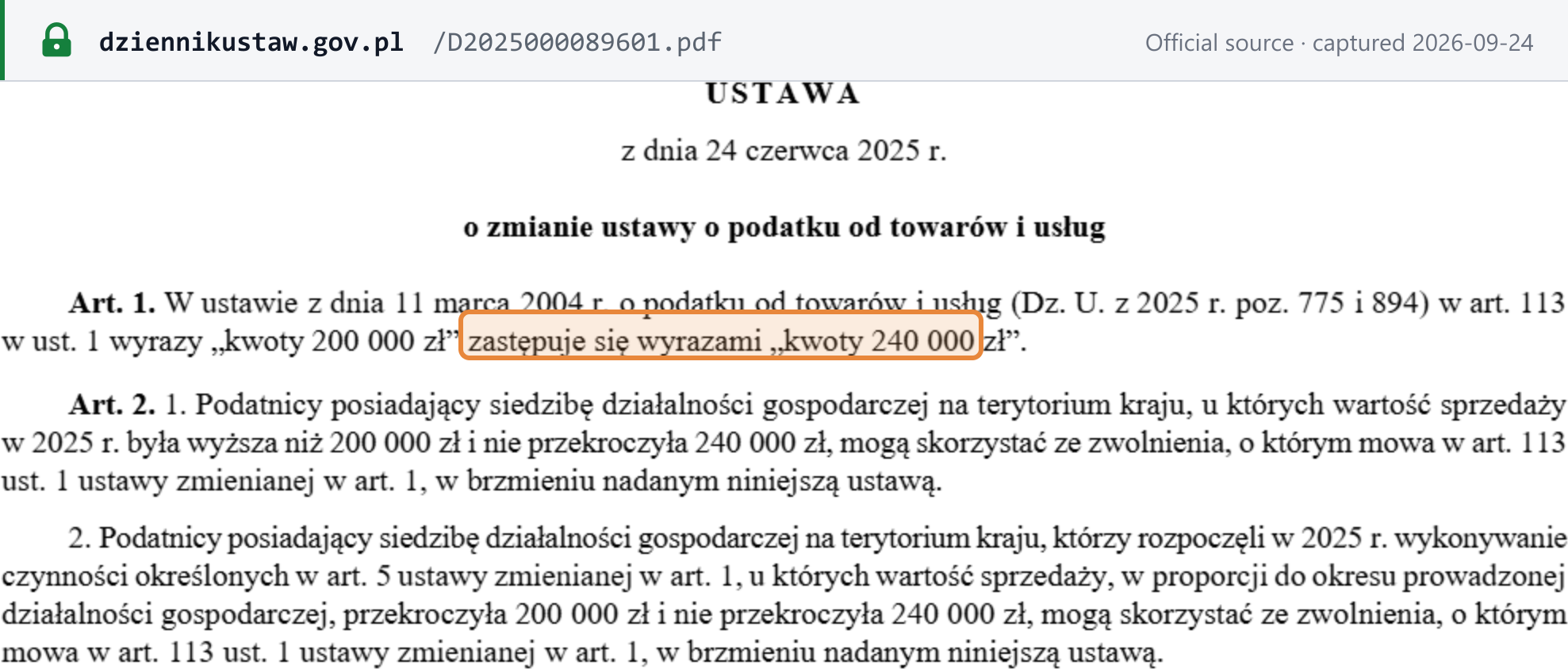
| 1 Jan 2026 | Poland PLN 200,000 → PLN 240,000; Hungary HUF 18m → HUF 20m; Bulgaria's regimes apply, at EUR 51,130 | Dz.U. 2025 poz. 896; NAV; Bulgaria: see the table below |
| 11 Mar 2026 | Commission refers Spain to the Court of Justice | IP/26/442 |
| 1 Jul 2026 | BOFiP updates the French franchise commentary (loi n° 2025-1044 of 3 November 2025) | BOFiP |
| 1 Jan 2027 / 1 Jan 2028 | Hungary's threshold scheduled to rise to HUF 22m, then HUF 24m | NAV |
Watching, not in force (as at 2026-09-24): Spain has not enacted any transposing law. A private member's bill from Junts per Catalunya (Proposición de Ley 122/000291, BOCG Serie B núm. 345-1, 26 June 2026) proposes a domestic franchise for turnover below EUR 85,000; it has not been passed. Separately, Bundesrat committees have recommended changes to § 19 UStG, Germany's small-business rule, in their recommendations on the Annual Tax Act 2026 (Bundesrat-Drucksache 447/1/26 of 14 September 2026); the Act is still at bill stage.
Member-state thresholds and cross-border participation (2026)
"Cross-border" means the state admits SMEs established in other member states that hold an EX number, and issues EX numbers to its own SMEs. Every state that has transposed the directive must do both (Art 284(2)–(3)). Spain is the only one that has not. "In-year overrun" is the rule when the national threshold is exceeded during the year (Art 288a(1)). "None" means the state applies no transitional period, so the exemption ends when the threshold is passed, as stated on the Commission's country page for that state. Amounts are in the national currency. Several "thresholds" are technically registration or non-payer limits (Czechia, Slovakia, Estonia, Latvia, Finland), but the Commission treats each as that state's SME threshold.
| Member state | Domestic threshold (2026) | In-year overrun | Cross-border | Last confirmed | Source |
|---|---|---|---|---|---|
| Austria | EUR 55,000 (previous year, and not yet exceeded in the current year) | Up to 10% over: exempt to year-end | Yes | 2026-09-24 | RIS, § 6(1)(27) UStG; USP |
| Belgium | EUR 25,000 (optional franchise) | Transitional period (figure published on the EU TEDB database) | Yes | 2026-09-24 | SPF Finances, Fisconetplus; Commission BE page |
| Bulgaria | EUR 51,130 | None | Yes, from 1 Jan 2026 | 2026-09-24 | State Gazette (DV) No. 115/2025, VAT Act amendment; Commission BG page |
| Croatia | EUR 60,000 | None | Yes | 2026-09-24 | Porezna uprava |
| Cyprus | EUR 15,600 | None | Yes | 2026-09-24 | Tax Department; Commission CY page |
| Czechia | CZK 2,000,000 (previous year) | VAT payer from the day after in-year turnover exceeds CZK 2,536,500 | Yes | 2026-09-24 | Finanční správa (GFŘ); SME page |
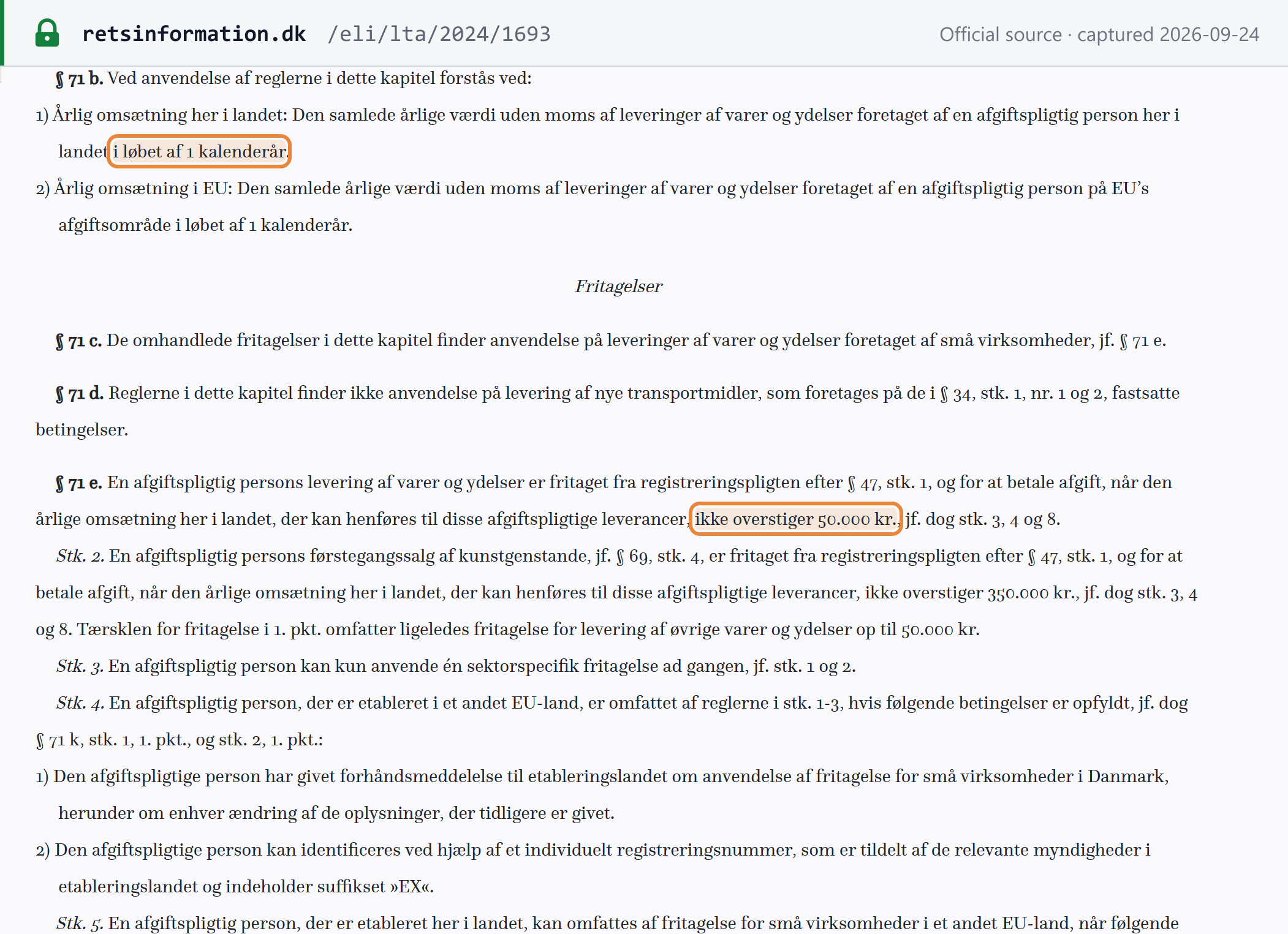
| Denmark | DKK 50,000 per calendar year; DKK 350,000 for first-time sales of certain works of art | None | Yes (values reported in DKK) | 2026-09-24 | Lov nr. 1693/2024, momsloven § 71 b and § 71 e |
| Estonia | EUR 40,000 | None | Yes | 2026-09-24 | Commission EE page; EMTA handbook (updated 8 Jan 2025) |
| Finland | EUR 20,000 (current and previous calendar year) | None | Yes (not for businesses based in Åland) | 2026-09-24 | Vero Skatt; Commission FI page |
| France | EUR 85,000 goods, on-site consumption and accommodation; EUR 37,500 other services (lawyers, authors, artists: EUR 50,000 / EUR 35,000) | Exempt up to EUR 93,500 / EUR 41,250 (EUR 55,000 / EUR 38,500); lost from the date these are crossed | Yes | 2026-09-24 | BOFiP BOI-TVA-DECLA-40-10-10-20260701; Commission FR page |
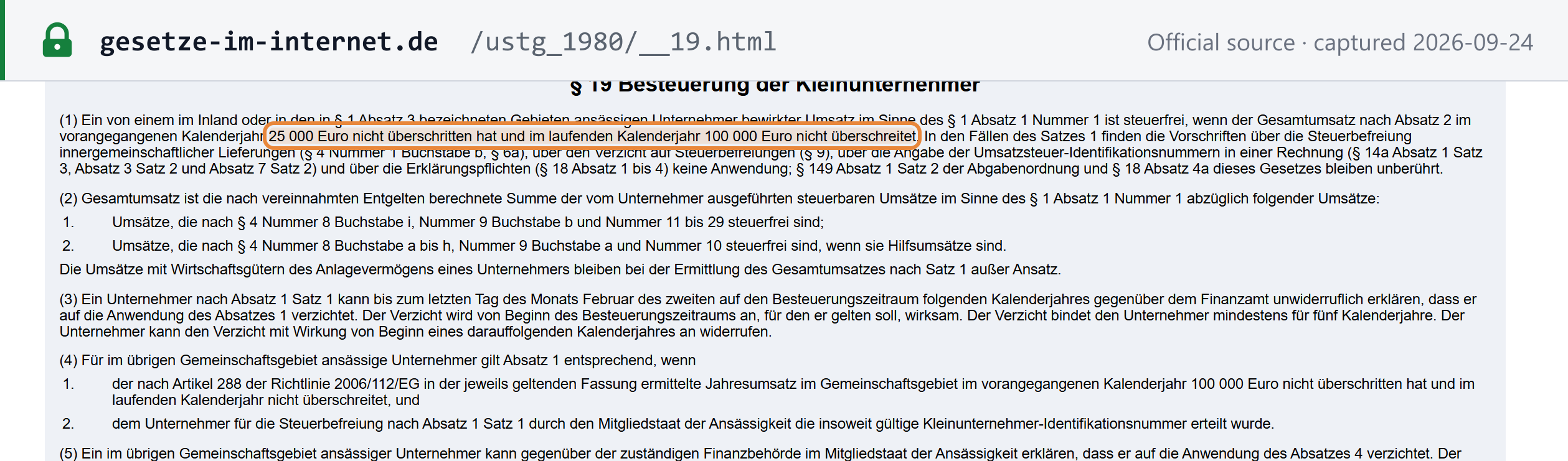
| Germany | EUR 25,000 (previous year) and EUR 100,000 (current year) | Current-year test of EUR 100,000 | Yes (§ 19(4) UStG) | 2026-09-24 | § 19 UStG, Gesetze im Internet |
| Greece | EUR 10,000 | None | Yes | 2026-09-24 | Commission EL page (member-state information published by the Commission) |
| Hungary | HUF 20,000,000 (HUF 22m from 2027, HUF 24m from 2028) | None | Yes (§ 195/G Áfa tv.) | 2026-09-24 | NAV |
| Ireland | EUR 85,000 goods; EUR 42,500 services; nil for supplies of immovable goods | None | Yes | 2026-09-24 | Revenue; Commission IE page |
| Italy | EUR 85,000 (natural persons only) | Over EUR 85,000: excluded from the next 1 January; over EUR 100,000: excluded at once | Yes. Into Italy: natural persons only; Italian-established companies can use it in other states (Circolare 13/E)¹ | 2026-09-24 | Agenzia delle Entrate, Circolare 13/E; Commission IT page |
| Latvia | EUR 50,000 | Up to 10% over (EUR 55,000): registration deferred to 1 January of the next year | Yes | 2026-09-24 | VID methodology (2 Jan 2025); Commission LV page |
| Lithuania | EUR 45,000 | None | Yes (Art 71(2¹)) | 2026-09-24 | VAT Law, e-seimas |
| Luxembourg | EUR 50,000 | Up to 10% over (EUR 55,000): exempt to year-end | Yes | 2026-09-24 | AED; AED SME FAQ |
| Malta | EUR 35,000 | None | Yes | 2026-09-24 | MTCA explanatory notes; Commission MT page |
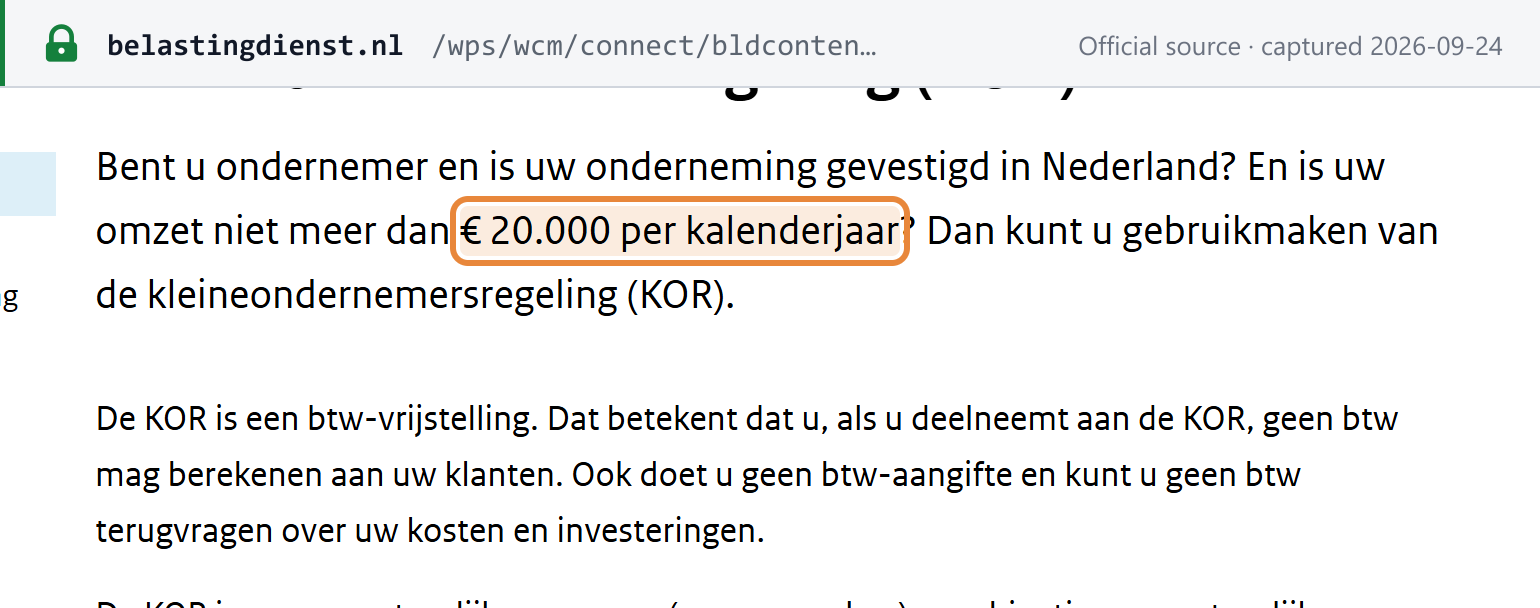
| Netherlands | EUR 20,000 per calendar year (KOR) | None | Yes (EU-KOR) | 2026-09-24 | Belastingdienst |
| Poland | PLN 240,000 (from 1 Jan 2026) | None | Yes (art. 113a) | 2026-09-24 | Dz.U. 2025 poz. 896 |
| Portugal | EUR 15,000 (previous year) | Exempt unless exceeded by more than 25% (art. 58(5)(b)) | Yes (art. 53(2)) | 2026-09-24 | Portal das Finanças, CIVA art. 53 |
| Romania | RON 395,000 (from 1 Sep 2025) | None | Yes | 2026-09-24 | Ministry of Finance; Commission RO page |
| Slovakia | EUR 50,000 (previous year) | VAT payer once current-year turnover exceeds EUR 62,500 | Yes (§ 68f / § 68g) | 2026-09-24 | Slov-Lex, Act 222/2004 (text from 1 Jan 2026) |
| Slovenia | EUR 60,000 | Up to 10% over (EUR 66,000): exempt to year-end | Yes | 2026-09-24 | FURS SME guidance, 4th edition, January 2026; Commission SI page |
| Spain | No domestic exemption | — | No — not transposed | 2026-09-24 | European Commission, IP/26/442 |
| Sweden | SEK 120,000 (current year and each of the two preceding years) | None | Yes (ML 18 kap. 5 §) | 2026-09-24 | SFS 2024:942 |
¹ The Commission's Italy page says the cross-border scheme is open to Italian small enterprises that are natural persons only; Agenzia delle Entrate's Circolare 13/E, for the cross-border scheme, applies the natural-person condition only to SMEs from other member states using the exemption in Italy; the Italian domestic franchise remains limited to natural persons.
Austria's EUR 55,000 counts "das gesamte vereinbarte Entgelt" (the full agreed consideration), per the USP page. The Commission's Hungary page leads with the 2025 figure of HUF 18 million, then gives HUF 20 million from 1 January 2026. The Commission's country pages defer some transitional-period figures to the EU's TEDB database, so check your national authority before relying on a tolerance. See also the global VAT threshold table.
Source snapshots for the national rows
 Source snapshot captured 2026-09-24 — original
 Source snapshot captured 2026-09-24 — original
 Source snapshot captured 2026-09-24 — original
 Source snapshot captured 2026-09-24 — original
 Source snapshot captured 2026-09-24 — original
 Source snapshot captured 2026-09-24 — original
 Source snapshot captured 2026-09-24 — original
 Source snapshot captured 2026-09-24 — original
 Source snapshot captured 2026-09-24 — original
 Source snapshot captured 2026-08-19 — original
 Source snapshot captured 2026-09-23 — original
Related changes from the feed
No change to the EU SME scheme has been recorded in the weekly tax-changes feed yet (as at 2026-09-24). The two items under watch, Spain's transposition and the German § 19 UStG proposals, are described under Current status and dates; neither is in force.
Frequently asked questions
I'm under my home threshold. Can I stop charging VAT in other EU countries too?
Yes, if three conditions hold: your EU-wide turnover is no more than EUR 100,000, your supplies in each target country stay within that country's own threshold, and your home tax office has issued an EX number valid for that country. The exemption starts on the date your home tax office confirms the number, no later than 35 working days after it receives your prior notification, unless the state needs extra time for anti-fraud checks. Spain cannot be a target country, because it has not transposed the directive. (Directive (EU) 2020/285, Art 284(2), (3) and (5); European Commission IP/26/442; checked 2026-09-24)
Is the EX number my new VAT number? What goes on my invoices?
No. The Commission's guidance says the EX number "is not a VAT identification number as such"; it exists only to run the cross-border scheme. An exempt small business may not show VAT on its invoices, and member states must let it issue simplified invoices. (Commission Explanatory Notes §4.4; Directive 2006/112/EC, Arts 289 and 220a(1)(c))
What happens the day my EU-wide sales pass EUR 100,000?
Your exemption in every other member state ends at once, and you must tell your home tax office within 15 working days. You also cannot use the cross-border exemption in the following calendar year. Your exemption at home continues if you are still under your home country's threshold. (Directive (EU) 2020/285, Arts 284b(3) and 288a(2), recital 9)
Is there a 10% margin everywhere if I go over a national threshold?
No. Staying exempt until year-end when the threshold is exceeded by no more than 10% is the directive's default, but member states may choose a 25% ceiling, no ceiling, or an immediate end. Austria, France, Luxembourg and Slovenia keep a 10% margin; Portugal uses 25%; Germany tests current-year turnover against EUR 100,000; many others, including Croatia, Denmark, Hungary, Ireland, the Netherlands, Poland and Sweden, apply no transitional period. (Directive (EU) 2020/285, Art 288a(1); national sources in the table above; checked 2026-09-24)
Can I reclaim VAT on my costs while I use the scheme?
No. An exempt small business cannot deduct input VAT. A business that is exempt in another member state under the cross-border scheme also has no right to deduct, at home, the VAT on costs used for those exempt supplies. (Directive 2006/112/EC, Art 289; Art 169(a) as amended by Directive (EU) 2020/285)
Can I use the SME scheme together with OSS or IOSS? And does it help a non-EU business?
OSS yes, but not for the same country: the Commission says the two schemes "can coexist" but cannot apply at the same time in the same jurisdiction. IOSS no: the SME scheme and IOSS are mutually exclusive. A business established outside the EU generally cannot use the cross-border scheme, because it applies to businesses established in a member state; the narrow exception is a non-EU business with a fixed establishment in a state that lets it attach there (France does). (European Commission cross-border SME scheme page; Directive (EU) 2020/285, Art 284(1)–(2); checked 2026-09-24)
Related resources
- One Stop Shop (OSS) — can run alongside the SME scheme, but not in the same country
- Import One Stop Shop (IOSS) — mutually exclusive with the SME scheme
- ViDA — VAT in the Digital Age — the next wave of EU VAT reform, including how member states may treat SME-scheme suppliers on platforms
- Reverse charge and VIES and Intrastat — the other intra-EU mechanics a small cross-border seller meets
- VAT registration thresholds worldwide — the global threshold table
- How to register for VAT in Germany — where § 19 UStG meets registration
- Country guides with SME-scheme detail: Austria, Belgium, Cyprus, France, Germany, Hungary, Ireland, Italy, Lithuania, Luxembourg, Malta, Poland, Portugal, Slovakia, Spain, Sweden
- EU tax-change chronology — every tracked EU-level change
Reference links
- Council Directive (EU) 2020/285 — the SME scheme directive (EUR-Lex)
- Council Directive (EU) 2022/542 — Article 2 replaces the turnover definition
- Commission Implementing Regulation (EU) 2021/2007 — information exchange for the SME scheme
- European Commission — SME scheme portal — national rules for all 27 member states
- European Commission — cross-border SME scheme — mechanics, FAQ and worked example
- European Commission — Explanatory Notes on the SME scheme (24 October 2024; not legally binding)