Chain transactions — which sale gets the transport when goods are sold several times but shipped once
A chain transaction is a series of sales of the same goods that travel once, directly from the first supplier to the last customer, from one EU Member State to another. Only one sale in the chain — the "moving supply" — gets the transport and the exemption for intra-Community supplies; every other sale is a domestic supply in the departure or arrival state. Since 1 January 2020, Article 36a of the VAT Directive decides which sale that is when an intermediary in the chain arranges the transport.
The core rule is Article 36a(1) of the VAT Directive (Council Directive 2006/112/EC): "Where the same goods are supplied successively and those goods are dispatched or transported from one Member State to another Member State directly from the first supplier to the last customer in the chain, the dispatch or transport shall be ascribed only to the supply made to the intermediary operator." The exception in Article 36a(2) moves the transport to the intermediary's own supply where it "has communicated to his supplier the VAT identification number issued to him by the Member State from which the goods are dispatched or transported." Article 36a(3) defines the intermediary operator as "a supplier within the chain other than the first supplier in the chain who dispatches or transports the goods either himself or through a third party acting on his behalf." (VAT Directive, consolidated version of 14.04.2025)
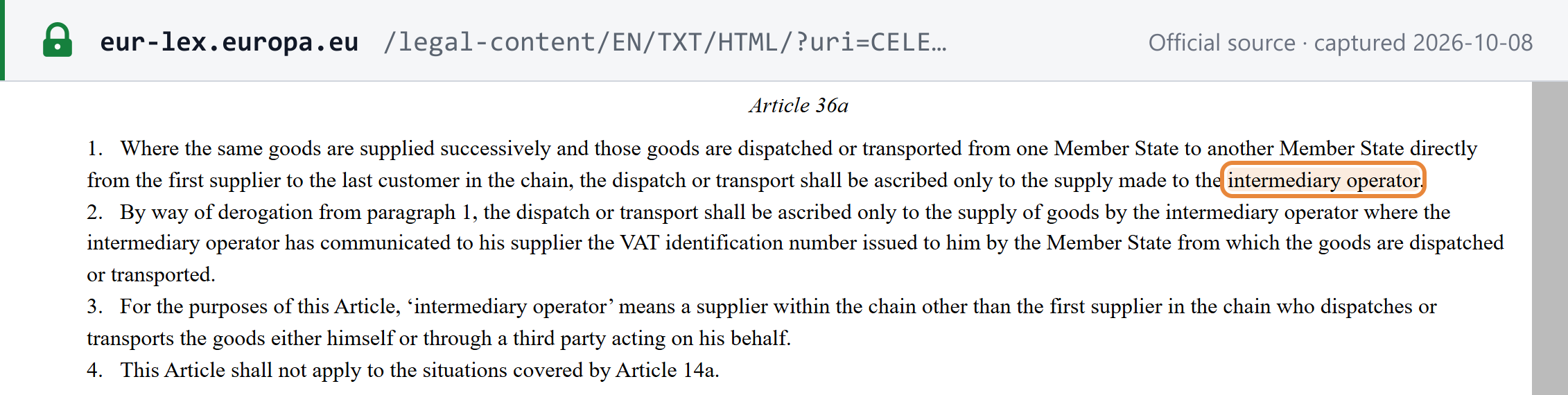 Source snapshot captured 2026-10-08 — original (EUR-Lex, consolidated text of 14.04.2025)
Who owns the rule. Article 36a was inserted by Council Directive (EU) 2018/1910 of 4 December 2018 (OJ L 311, 7.12.2018), one of the "2020 Quick Fixes" alongside call-off stock and the tightened conditions for the intra-Community supply exemption. Member States had to transpose it by 31 December 2019 and "apply those provisions from 1 January 2020" (Article 2(1)). (Directive (EU) 2018/1910, EUR-Lex) The European Commission (DG TAXUD) published Explanatory Notes on the Quick Fixes in December 2019; chain transactions are Chapter 3. The Notes say they "are not legally binding and only contain practical and informal guidance", but national administrations and practitioners rely on them heavily, and this page uses them where the Directive is silent. (Explanatory Notes, 2020 Quick Fixes)
Why the rule exists. Recital (6) of Directive 2018/1910 states the problem plainly: "The intra-Community movement of the goods should only be ascribed to one of the supplies, and only that supply should benefit from the VAT exemption provided for the intra-Community supplies. The other supplies in the chain should be taxed and could require the VAT identification of the supplier in the Member State of supply." Before 2020, Member States allocated the transport differently, which the recital says "may lead to double taxation or non-taxation". A common rule was meant to end that.
How it works
Step 1 — is this a chain at all? The three conditions
The Explanatory Notes (§3.3, p. 45) reduce Article 36a(1) to three conditions. All must be met:
- The goods are supplied successively, so at least three persons are involved.
- The goods move from one Member State to another. Chains with an import or export leg, and chains entirely within one Member State, are not covered.
- The goods are transported directly from the first supplier to the last customer.
If any condition fails, Article 36a does not apply, and the general place-of-supply rules (and, for third-country legs, national law) decide the outcome. The test looks at where the goods are and what contracts exist when the goods move. The Notes stress that the "relevant elements will be determining where the goods are located, and not where the suppliers are located, and what transactions have taken place when the movements of the goods are carried out" (p. 59). If no onward sale existed when the goods were shipped, there is no chain. A change of vehicle (truck to ship, or between trucks) "does not necessarily alter the consideration of the transport as a single transport" (p. 56). If two different chain parties each organise a leg, there are two transports, and Article 36a can apply only to a sub-chain.
Article 36a(4) also carves out platform cases: "This Article shall not apply to the situations covered by Article 14a." Where an electronic interface is deemed to have bought and resold the goods, Article 36b ascribes the transport to the supply made by the platform instead (see marketplace deemed-supplier rules).
Step 2 — who organised the transport?
Article 36a only tells you what happens when an intermediary transports. The first supplier cannot be an intermediary operator (the definition excludes it), and the last customer is not a "supplier within the chain". For those two cases the answer is still fixed, by the general rule the Notes set out (§3.6.4, p. 52): "If the first supplier has organised it, the transport will be assigned to the supply made by him. If it is the last customer the one who organised the transport, the transport will be assigned to the supply made to him."
Who counts as the party that "dispatches or transports"? The Notes (§3.6.5, p. 53) say "the most suitable criterion would be that of the taxable person within the chain that transports the goods himself or makes the necessary arrangements with a third party for the transport of the goods, concluding a contract with that third party." They add that "the fact that one of the parties in the chain pays for the transport is not enough on its own to conclude that this person is the intermediary operator." The Notes also say that splitting the risk by Incoterm creates difficulties, so neither paying the freight invoice nor the Incoterm is a reliable test on its own; the contract with the carrier is the strongest evidence.
Step 3 — where the intermediary transports: default or exception
- Default — Article 36a(1). The transport is ascribed to the supply made to the intermediary. That supply is the exempt intra-Community supply from the departure state, and the intermediary makes an intra-Community acquisition in the arrival state.
- Exception — Article 36a(2). If the intermediary has given its supplier the VAT number issued by the departure Member State, the transport is ascribed to the supply made by the intermediary. The intermediary then buys domestically in the departure state and makes the exempt intra-Community supply itself.
Any other VAT number — the intermediary's home number, or a number from a third Member State — leaves the default in place. That is the trap in the Italian ruling described below.
Step 4 — place every other supply in the chain
Article 36a decides only which supply moves. The moving supply is located where the transport begins (Article 32, first paragraph: "the place where the goods are located at the time when dispatch or transport of the goods to the customer begins") and can be exempt under Article 138. Every other supply is a supply without transport under Article 31, located "where the goods are located at the time when the supply takes place".
The Directive does not say expressly which supplies fall before and after the transport. That split comes from the Court of Justice in EMAG Handel Eder (C-245/04) and from the Notes (pp. 47–48), which say the other supplies "will qualify as domestic supplies, either in the Member State of departure of the goods or in the Member State of arrival of the goods." In practice:
- Supplies before the moving supply are domestic supplies in the departure state.
- Supplies after the moving supply are domestic supplies in the arrival state.
Germany (§ 3 Abs. 7 Satz 2 UStG) and Poland (art. 22 ust. 3 of the VAT Act) write this before/after rule into statute (see the national table). A party that makes a domestic supply in a state where it is not VAT-identified may have to register there, as recital (6) of Directive 2018/1910 anticipates.
The Notes also stress (§3.5, p. 48) that Article 36a only allocates the transport: "These rules do not have any impact on the liability for the tax, which is determined according to the general rules." Whether a domestic supply by a non-established supplier is reverse-charged to the customer depends on the arrival or departure state's own options (see reverse charge).
Communicating the VAT number — and proving it
The Notes (§§3.6.10–3.6.14, pp. 60–63) set out how the Article 36a(2) communication works:
- To whom. "Article 36a(2) VD does not require a communication to any of the tax administrations involved, only to the supplier." Other parties in the chain do not need to be told.
- How. "It can be done by any means allowing to prove that the communication has been received by the supplier. In that regard, an exchange of emails could be enough." A standing instruction per Member State can work.
- When. "In principle, it would seem that, under normal circumstances, this communication should be done before the chargeable event takes place." A later correction is possible, with consequences that depend on whether the VAT return deadline has passed.
- No proof. If the communication cannot be proved, the default in Article 36a(1) applies, unless the invoice shows the departure-state number and charges departure-state VAT.
Germany sets its own deadline in statute: the intermediary must use the departure-state number "bis zum Beginn der Beförderung oder Versendung" (by the time transport begins). France's doctrine requires both parties to keep proof of the communication: "À défaut, la règle générale s'appliquera" (failing that, the general rule applies). See the national table.
If the intermediary gives no VAT number at all
The exemption for the moving supply depends on the customer's VAT number. Article 138(1)(b) requires that the customer "is identified for VAT purposes in a Member State other than that in which the dispatch or transport of the goods begins and has indicated this VAT identification number to the supplier." If the intermediary gives no number, the Notes (§3.6.16, p. 64) conclude that its supplier "will have to charge VAT on the transaction", even though the goods leave the country, and add that this "does not impede the taxation of the intra-Community acquisition" at destination. Whether this VAT-number condition is truly substantive is the question now before the General Court in T-689/25 (see Current status). Art 138(1a) adds a second condition: a correct recapitulative statement (VIES and Intrastat).
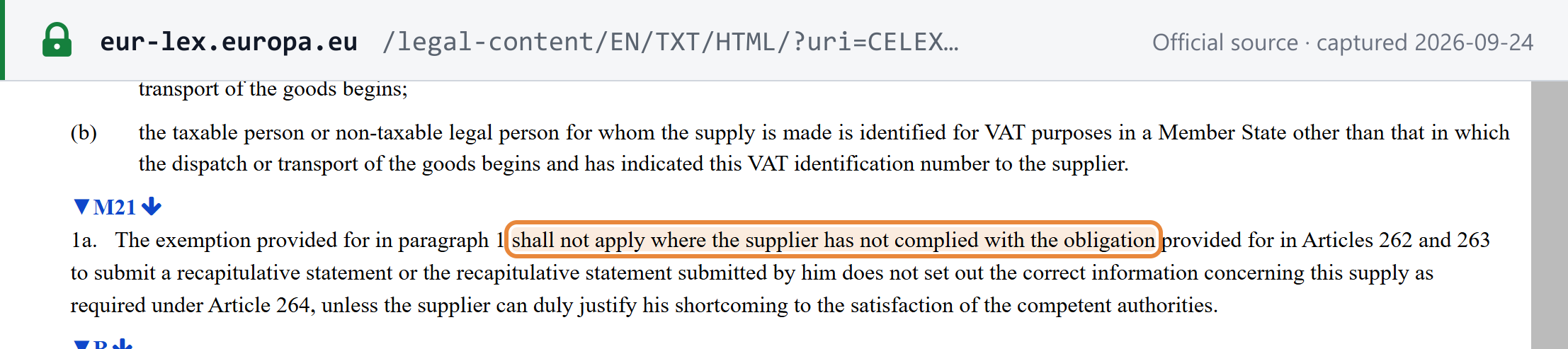 Source snapshot captured 2026-09-24 — original (EUR-Lex, consolidated text of 14.04.2025)
Worked example: A → B → C → D, goods shipped once from Germany to Poland
A (Germany) sells goods to B (France). B sells them to C (Italy), and C sells them to D (Poland). The goods travel once, by one transport, directly from A's warehouse in Germany to D in Poland. The outcomes below follow the Explanatory Notes Example 2 (§3.5.2(a)–(c), pp. 49–50) and the French administration's examples 3 to 5 (BOFiP BOI-TVA-CHAMP-30-20-10, §128), with the parties relabelled.
| Who organises the transport | VAT number the intermediary gives its supplier | Exempt intra-EU supply (Art 138), from Germany | Intra-EU acquisition in Poland | Domestic supplies |
|---|---|---|---|---|
| A (first supplier) | Not relevant: Art 36a not engaged | A → B | B | B → C and C → D in Poland |
| D (last customer) | Not relevant: Art 36a not engaged | C → D | D | A → B and B → C in Germany |
| C (intermediary), default 36a(1) | A non-German number (for example Italian, French or Polish) | B → C | C | A → B in Germany; C → D in Poland |
| C (intermediary), exception 36a(2) | German number | C → D | D | A → B and B → C in Germany |
| B (intermediary), default 36a(1) | A non-German number | A → B | B | B → C and C → D in Poland |
| B (intermediary), exception 36a(2) | German number | B → C | C | A → B in Germany; C → D in Poland |
The Notes' own wording for the exception case (their chain is B-C-D-E, with C as the intermediary giving a departure-state number): "there would be an intra-Community supply of goods by C in MS 2 exempt from VAT (if the conditions in Article 138 VD are fulfilled) and an intra-Community acquisition by D taxable in MS 5. The supply from B to C will be a domestic transaction in MS 2 and the supply from D to E will be a domestic transaction in MS 5."
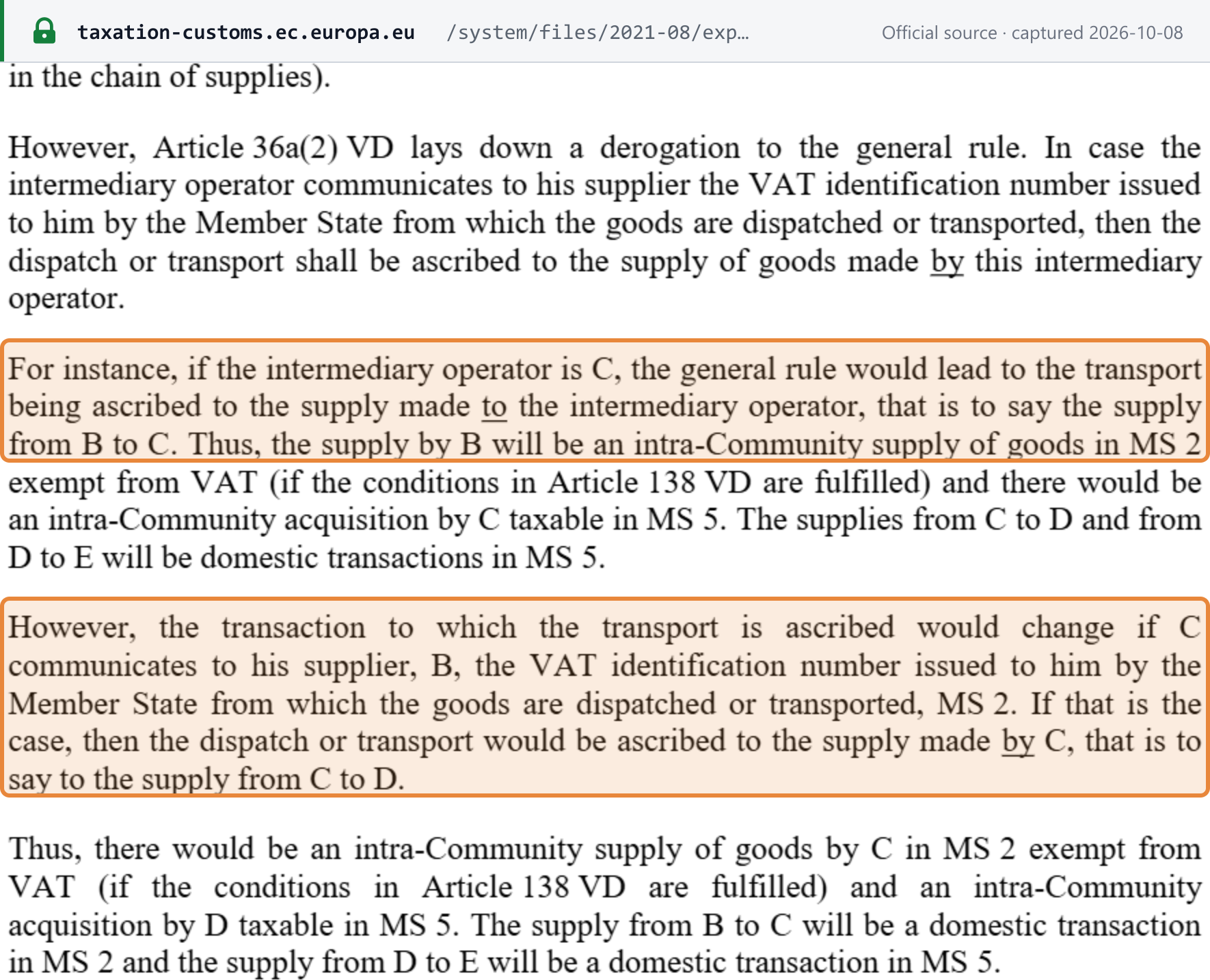 Source snapshot captured 2026-10-08 — original (European Commission, DG TAXUD, Explanatory Notes, p. 50)
Read the table as a compliance map. Take the C default row. C acquires the goods in Poland and then sells to D in Poland, so C makes a domestic Polish supply and may need a Polish VAT registration. B's purchase from A is a domestic German supply, and B's sale to C is an exempt supply from Germany, so B is dealing in Germany. In the C exception row, C buys domestically in Germany and makes the exempt supply from Germany itself; that only works if C holds a German VAT number, which is exactly what the exception requires.
Triangulation: the relief for the party that acquires in the arrival state
Article 36a decides which supply moves. A separate simplification, triangulation (Articles 141 and 197 of the VAT Directive), can then spare the party that makes the intra-EU acquisition from registering in the arrival state, if its own customer is identified there and designated as liable for the VAT. The VAT Committee guidelines of 3 June 2019, reproduced in the Notes (p. 51), say that "only the taxable person making the intra-Community acquisition" may use the Article 141 simplification in a chain. The Notes confirm (§3.6.17, p. 64) that the chain rules do not remove the possibility of triangulation "when all conditions in Article 141 VD are met."
In the worked example, the C default row is the shape where triangulation can help: C acquires in Poland and sells on to D, a Polish-identified customer. The invoice must carry the right mention: in Luxury Trust Automobil (C-247/21, 8 December 2022) the Court of Justice held that the final customer "has not been validly designated as liable" where the intermediary's invoice lacks the words "Reverse charge" required by Article 226(11a). (C-247/21, EUR-Lex) The full conditions are in the triangulation explainer.
 Source snapshot captured 2026-09-24 — original (EUR-Lex, consolidated text of 14.04.2025)
A real case: Italy, Risposta n. 111/2026 (29 May 2026)
The Italian Revenue Agency's ruling n. 111 of 29 May 2026 shows the default rule biting. A German company bought furniture from a Polish supplier and resold it to an Italian company. The goods went directly from Poland to Italy, and the German company organised the transport ("Il trasporto, avvenuto direttamente dalla Polonia all'Italia, è stato curato dall'Istante"). It gave the Polish supplier its German VAT number, not a Polish one.
The Agency applied the chain rule. The German company was the intermediary operator, and because it did not use a number from the departure state (Poland), the transport went to the supply made to it: the Polish supplier's sale was the exempt intra-Community supply, and the German company made an intra-Community acquisition in Italy. Its onward sale to the Italian customer was therefore a domestic Italian supply. The Agency's conclusion: "Ne consegue che l'operazione di acquisto tra la Società e l'acquirente italiano è un'operazione interna e che la Società era tenuta a identificarsi in Italia" — the company had to identify for VAT in Italy.
The taxpayer argued triangulation, but its invoice to the Italian customer referred neither to Article 141 nor to the reverse charge, and did not designate the customer as liable for the tax. The Agency decided the case on the chain rule alone and declared the question on penalties inadmissible. (Agenzia delle Entrate, Risposta n. 111/2026)
The lesson: a non-departure VAT number leaves the intermediary with a domestic sale in the arrival state.
Who it affects
Article 36a has no threshold or size band; neither the Directive nor the Notes set one. It applies to any business in a chain that meets the three conditions:
- Distributors and traders who drop-ship — the typical intermediary operator, which must decide which VAT number to give its supplier.
- Manufacturers selling ex-works to traders, whose sale may or may not be the exempt one depending on what their customer does downstream.
- Buyers who collect, who as last customer make the supply to them the moving supply.
- Last customers generally, who carry input-VAT risk if the chain is misclassified (Kreuzmayr, below).
Out of scope:
- import and export chains (Notes §3.3);
- purely domestic chains;
- platform deemed-supplier chains under Article 14a, which follow Article 36b instead. The Notes (§3.6.2) list the cases: distance sales of imported goods in consignments of an intrinsic value not exceeding EUR 150, and supplies within the EU by a non-EU seller to a non-taxable person, where an electronic interface facilitates them.
Germany and Poland have national rules for chains with a third-country leg (§ 3 Abs. 6a UStG; art. 22 ust. 2a and ust. 4 of the Polish VAT Act).
Current status and dates
As at 2026-10-08, Article 36a is in force, unchanged since it was inserted, and applies EU-wide from 1 January 2020. That is the Directive's application date; national transposition varied (the Netherlands 1 January 2020, Spain 1 March 2020, Italy 1 December 2021). The consolidated VAT Directive of 14.04.2025, which already includes ViDA, marks Article 36a with Directive 2018/1910 as its only source and shows no later amendment.
- ViDA does not amend it. Directive (EU) 2025/516 (ViDA) contains no amendment to Article 36a or Article 36b. ViDA does change the triangulation neighbours from 1 July 2030 (its Article 5): Article 42(b) is rewritten to refer to the new Article 262(1)(c) data obligation, and Article 226(11a) adds the mention "triangular transaction" for supplies under Article 197. (Directive (EU) 2025/516, EUR-Lex; see ViDA)
- Pending: T-689/25 James Howden & Company Limited v Finanzamt Österreich. The Austrian Bundesfinanzgericht (Außenstelle Graz) made a preliminary reference to the General Court on 18 September 2025, published in the Official Journal on 9 March 2026 (OJ C/2026/1220). Since the 2024 reform (Regulation (EU, Euratom) 2024/2019) the General Court hears preliminary references in VAT, hence the "T-" number. The first question asks whether communicating a VAT number of a Member State other than the departure state, under Article 138(1)(b) as amended by Directive 2018/1910, is "a substantive condition for the exemption of an intra-Community supply, so that the supply is taxable in the absence of notification of such a VAT identification number". Further questions ask whether a late-communicated number that was already valid allows the invoice to be corrected, and whether that correction works ex tunc or ex nunc. The case concerns the Article 138(1)(b) VAT-number condition generally. It matters for chains because Article 36a assigns the transport regardless of the number, but the moving supply is only exempt under Article 138(1)(b) where the customer has given its supplier a VAT number of a Member State other than the departure state (Notes §3.6.16). No judgment had been published as at 2026-10-08. (OJ notice, T-689/25, EUR-Lex)
- No judgment yet interprets Article 36a itself. The Court of Justice and General Court have cited Directive 2018/1910 in later cases, but none construes Article 36a. That leaves one question open: whether the pre-2020 Toridas and VSTR timing test (below) can still override the mechanical Article 36a allocation. The point is unsettled.
- Italy: art. 41-ter is repealed from 1 January 2027. Art. 41-ter of DL 331/1993 applies until 31 December 2026; from 1 January 2027 it is repealed by D.Lgs. 19 January 2026, n. 10, the new VAT consolidated text (see the national table).
Case law: what still matters
The Court of Justice built the chain rules case by case before 2020. Article 36a codified part of that case law and overrode another part.
| Case | Holding | Still matters? |
|---|---|---|
| EMAG Handel Eder, C-245/04, 6 Apr 2006 | One intra-EU transport "can be ascribed to only one of the two supplies, which alone will be exempted"; the other supply is in the departure or arrival state "according to whether that supply is the first or the second". | Yes. The foundation of Article 36a and of the before/after split, which the Directive itself does not spell out. |
| Euro Tyre Holding, C-430/09, 16 Dec 2010 | Allocation needs "an overall assessment of all the circumstances"; where the first buyer states its intention to transport the goods to another Member State and gives that state's VAT number, the transport is ascribed to the first supply, provided the onward transfer happens in the destination state. | Partly. Article 36a now gives a mechanical answer for intermediaries who transport. The overall assessment survives where Article 36a does not reach, such as whether a chain exists at all and who actually organised the transport. |
| VSTR, C-587/10, 27 Sep 2012 | The VAT number is a formal condition: the exemption cannot be refused on that ground alone where the supplier acted in good faith and has other proof (operative part). Where the second transfer of the right to dispose took place before transport, the transport can no longer be ascribed to the first supply (para 32). | Operative part arguably overtaken by the 2020 Article 138(1)(b) wording, which makes the number a condition and which recital (7) of Directive 2018/1910 calls substantive; the question is pending in T-689/25. Para 32 is the same timing point as Toridas. |
| Toridas, C-386/16, 26 Jul 2017 | The first supply is not exempt where the middleman told its supplier, before buying, that the goods would be resold immediately to a buyer in a third Member State and they were then shipped there. | Unsettled. Under Article 36a(1), an intermediary who transports and gives a non-departure number receives the exempt supply regardless of when it resold. No judgment has yet decided how Toridas interacts with Article 36a. |
| Kreuzmayr, C-628/16, 21 Feb 2018 | Article 32 can apply to the second of two supplies. The last buyer cannot deduct VAT paid solely on the basis of invoices from an intermediary that misclassified its supply. | Yes. The risk lesson for last customers, and confirmation that the second supply can move (the Article 36a(2) outcome). |
| AREX CZ, C-414/17, 19 Dec 2018 | For excise goods moved under duty suspension, that arrangement "does not constitute a decisive factor" in allocating the transport. | Yes, for fuel and other excise-goods chains. |
| Herst, C-401/18, 23 Apr 2020 | A carrier that transports excise goods intending to buy them can acquire the right to dispose as owner if it can take decisions affecting their legal situation, including selling them. | Moderately. Pre-2020 facts; bears on who is party to the chain and who transports. |
| C-696/20, 7 Jul 2022 | A Member State may tax an intra-EU acquisition that the parties wrongly treated as domestic at the first stage of a chain, but proportionality and neutrality preclude this where the related supply was not treated as exempt in that Member State. | Yes, for the cost of using the wrong VAT number. |
| Luxury Trust Automobil, C-247/21, 8 Dec 2022 | In a triangular transaction, the last customer is not validly designated as liable if the invoice lacks "Reverse charge". | Yes, see triangulation. |
Sources: EUR-Lex judgments C-245/04, C-430/09, C-587/10, C-386/16, C-628/16, C-414/17, C-401/18, C-696/20, C-247/21.
Timeline
| Date | Event | Status (as at 2026-10-08) | Source |
|---|---|---|---|
| 6 Apr 2006 | EMAG (C-245/04): one transport, one exempt supply | Case law | EUR-Lex |
| 16 Dec 2010 | Euro Tyre (C-430/09): overall assessment; intention plus destination VAT number | Case law | EUR-Lex |
| 27 Sep 2012 | VSTR (C-587/10) | Case law; VAT-number holding arguably overtaken in 2020 (pending in T-689/25) | EUR-Lex |
| 26 Jul 2017 | Toridas (C-386/16) | Case law; interaction with Art 36a unsettled | EUR-Lex |
| 21 Feb 2018 | Kreuzmayr (C-628/16) | Case law | EUR-Lex |
| 4 Dec 2018 | Directive (EU) 2018/1910 adopted (OJ L 311, 7.12.2018) | Adopted | EUR-Lex |
| 19 Dec 2018 | AREX CZ (C-414/17) | Case law | EUR-Lex |
| Dec 2019 | Commission Explanatory Notes on the 2020 Quick Fixes | Non-binding guidance | European Commission |
| 1 Jan 2020 | Article 36a applies EU-wide (transposition deadline); Netherlands art. 5c Wet OB in force the same day | In force | EUR-Lex; Netherlands |
| 1 Mar 2020 | Spain: art. 68.Dos.1º B) Ley 37/1992, as amended by art. 214.6 RDL 3/2020, applies | In force | BOE |
| 23 Apr 2020 | Herst (C-401/18) | Case law | EUR-Lex |
| 1 Dec 2021 | Italy: art. 41-ter DL 331/1993 in force (late transposition) | In force until 31 Dec 2026 | Normattiva |
| 7 Jul 2022 | C-696/20: misclassified chain and Article 41 | Case law | EUR-Lex |
| 8 Dec 2022 | Luxury Trust Automobil (C-247/21): triangulation invoice mention | Case law | EUR-Lex |
| 18 Sep 2025 | Reference T-689/25 James Howden made (OJ C/2026/1220, 9 Mar 2026) | Pending | EUR-Lex |
| 29 May 2026 | Agenzia delle Entrate, Risposta n. 111/2026 | Administrative ruling | Agenzia delle Entrate |
| 1 Jan 2027 | Italy: art. 41-ter repealed by D.Lgs. 10/2026 (Testo unico IVA) | Enacted, future effect | Normattiva |
| 1 Jul 2030 | ViDA Article 5: Articles 42(b), 138(1a) and 226(11a) amended; Article 36a untouched | Enacted, future effect | EUR-Lex |
National rules: how Member States transposed Article 36a
Selected Member States (as at 2026-10-08). Most copy Article 36a closely; Germany and Poland go further and codify the cases the Directive leaves to case law.
| Member State | Provision | Default (Art 36a(1)) | Exception (Art 36a(2)) | Beyond Article 36a? | Source |
|---|---|---|---|---|---|
| Germany | § 3 Abs. 6a UStG (Reihengeschäft, Zwischenhändler) | Transport to the supply to the Zwischenhändler, unless it proves it transported as supplier | Zwischenhändler uses a departure-state USt-IdNr "bis zum Beginn der Beförderung oder Versendung" | Yes: codifies first-supplier and last-customer cases and export and import chains; § 3 Abs. 7 Satz 2 codifies the before/after place rule | gesetze-im-internet.de, § 3 UStG |
| Netherlands | Art. 5c Wet op de omzetbelasting 1968 (tussenhandelaar), in force 1 Jan 2020 (Stb. 2019, 515) | Supply to the tussenhandelaar | Tussenhandelaar communicated the departure-state btw-identificatienummer | No, near-verbatim | wetten.overheid.nl, art. 5c (text checked via the KOOP repository) |
| France | CGI art. 262 ter, I-1° bis; BOI-TVA-CHAMP-30-20-10 §§122–128 | Supply to the opérateur intermédiaire | Opérateur intermédiaire gives its French number (art. 286 ter CGI); framed with France as the departure state | Doctrine: both parties keep proof of the communication, otherwise the default applies | BOFiP, publication of 01/07/2026 |
| Italy | Art. 41-ter DL 331/1993 (cessioni a catena, operatore intermedio); in force 1 Dec 2021 to 31 Dec 2026; repealed from 1 Jan 2027 by D.Lgs. 10/2026 | Departure from Italy: the supply to the intermediary is the non-taxable intra-EU supply. Arrival in Italy: the intermediary's purchase is the intra-EU acquisition | Intermediary gives its Italian number (departure from Italy) or its departure-state number (arrival in Italy) | Separate departure-from-Italy (co. 2) and arrival-in-Italy (co. 3) rules | Normattiva, art. 41-ter |
| Poland | Art. 22 ust. 2–2e and ust. 3 of the VAT Act (consolidated text Dz.U. 2026 poz. 1263) | Ust. 2b: supply to the podmiot pośredniczący | Ust. 2c: it gave its supplier the departure-state VAT-EU number | Yes: ust. 2a (exports), ust. 2e (first supplier and last buyer), ust. 3 (before/after), ust. 4 (imports) | Dziennik Ustaw, Dz.U. 2026 poz. 1263 |
| Spain | Art. 68.Dos.1º B) Ley 37/1992 del IVA (amended by art. 214.6 RDL 3/2020), applicable since 1 Mar 2020 | Supply to the intermediario | Intermediario gave a Spanish NIF-IVA (Spain as departure state) | No | BOE, consolidated Ley 37/1992, art. 68 |
Germany's statute is the most complete. Sentence 1 of § 3 Abs. 6a defines the Reihengeschäft: where several businesses contract over the same goods and the goods reach the last customer directly from the first business, "so ist die Beförderung oder Versendung des Gegenstands nur einer der Lieferungen zuzuordnen" (the transport is ascribed to only one of the supplies). Sentence 4 sets the default for the Zwischenhändler. Sentence 5 sets the departure-state USt-IdNr exception and its deadline, the start of transport. § 3 Abs. 7 Satz 2 then places supplies before the moving supply where transport begins and supplies after it where transport ends. (§ 3 UStG; see the Germany guide)
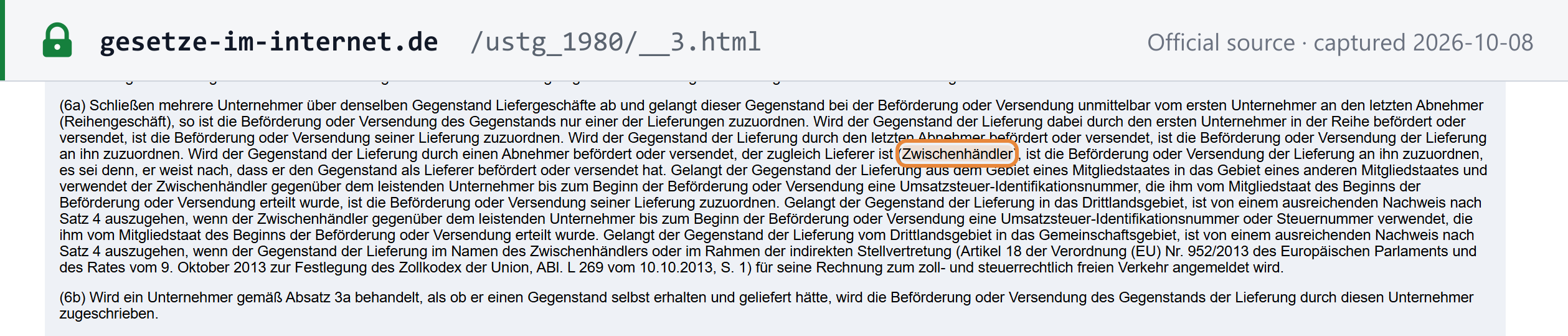 Source snapshot captured 2026-10-08 — original (Bundesministerium der Justiz, gesetze-im-internet.de)
France's BOFiP (§126) notes that "seuls deux États membres peuvent être concernés" — meaning the departure and arrival states of the transport, not that the parties must be established in only two countries. The same doctrine (§127) confirms that the chain rule does not exclude triangulation under CGI art. 258 D, which transposes Article 141.
Italy's art. 41-ter is the only national text in the table with a fixed end date. Its co. 2 covers transport that starts in Italy and co. 3 transport that ends there (on its repeal, see Current status). See the Italy guide.
For the other countries, see the Netherlands, France, Poland and Spain guides.
Related changes
No recent legislative change affects Article 36a. The two recent developments on this page — the Italian Risposta n. 111/2026 and the pending T-689/25 reference — are described under Current status. Adjacent developments:
- Call-off stock — the ViDA phase-out (dispatch cut-off 30 June 2028)
- ViDA — VAT in the Digital Age — the 1 July 2030 amendments to the triangulation provisions
- Tax-change chronologies: European Union and Italy
Frequently asked questions
Which supply is exempt when the intermediary arranges the transport?
By default, the supply made to the intermediary operator (Article 36a(1) of the VAT Directive). If the intermediary gave its supplier the VAT number issued by the Member State where the transport begins, the supply made by the intermediary is the exempt one instead (Article 36a(2)). All other supplies in the chain are domestic supplies in the departure or arrival state. (VAT Directive Article 36a)
Who counts as the intermediary operator?
A supplier in the chain, other than the first supplier, who dispatches or transports the goods itself or through a third party acting on its behalf (Article 36a(3)). The Commission's Explanatory Notes point to the party that transports the goods itself or contracts with the carrier, and say that paying for the transport is not enough on its own. (VAT Directive Article 36a(3); Explanatory Notes §3.6.5)
What if the first supplier or the last customer arranges the transport?
Article 36a does not apply, because neither can be an intermediary operator. If the first supplier organises the transport, it is ascribed to the supply made by the first supplier; if the last customer organises it, it is ascribed to the supply made to the last customer. (Explanatory Notes §3.6.4)
How does the intermediary prove it communicated its VAT number?
By any means that proves the supplier received it; the Commission's Explanatory Notes say an exchange of emails could be enough. The number goes to the supplier only, not to tax authorities, and should normally be given before the chargeable event. Without proof, the default rule applies, unless the invoice shows the departure-state number and charges departure-state VAT. Germany requires the number to be used by the start of transport, and France requires both parties to keep proof. (Explanatory Notes §§3.6.10–3.6.14; § 3 Abs. 6a UStG; BOFiP §123)
Does ViDA change the chain transaction rules?
No. Directive (EU) 2025/516 (ViDA) contains no amendment to Article 36a or Article 36b. From 1 July 2030 it amends the triangulation-related Articles 42(b) and 226(11a), and Article 138(1a). Separately, as at 2026-10-08 the General Court has a pending reference, T-689/25 James Howden, on whether the VAT-number condition in Article 138(1)(b) is substantive. (Directive (EU) 2025/516; OJ C/2026/1220)
Related resources
- Triangulation — the Article 141/197 relief for the party that acquires in the arrival state
- Intra-community supply — the Article 138 exemption that only the moving supply gets
- Call-off stock — the other 2020 Quick Fixes flow
- VIES and Intrastat and VAT listings explained — reporting the exempt supply on the recapitulative statement
- Reverse charge — who pays the VAT on the domestic supplies, and the Article 226(11a) mention
- ViDA — VAT in the Digital Age — what changes in 2030, and what does not
- Marketplace deemed-supplier rules — the Article 14a chains that Article 36b governs instead
- OSS explainer — for B2C distance sales, which are not chain transactions
- Country guides: Germany, Netherlands, France, Italy, Poland, Spain
- Tax-change chronologies: European Union, Italy
Reference links
- VAT Directive 2006/112/EC, consolidated version of 14.04.2025 — Articles 31, 32, 36a, 36b, 138, 141, 197, 226 (EUR-Lex)
- Council Directive (EU) 2018/1910 — recital (6), Article 1(2), Article 2(1) (EUR-Lex)
- Council Directive (EU) 2025/516 (ViDA) — Article 5 (EUR-Lex)
- Explanatory Notes on the 2020 Quick Fixes — Chapter 3 (European Commission, DG TAXUD)
- T-689/25 James Howden, OJ notice (EUR-Lex)
- Agenzia delle Entrate, Risposta n. 111/2026 (Italy)