Intra-Community supplies and acquisitions — the EU's "transitional" VAT system
An intra-Community supply is a sale of goods that are transported from one EU Member State to a business customer identified for VAT in another Member State. The seller exempts the sale from VAT in the departure state under Article 138 of the VAT Directive, and the buyer accounts for the VAT on an "intra-Community acquisition" in the Member State where the goods arrive. The two halves are one system: the exempt supply moves the tax to the destination, and the taxed acquisition collects it there. It has applied since the EU abolished fiscal controls at its internal frontiers on 1 January 1993, and Article 402 of the VAT Directive still calls it "transitional".
The rules are EU law, set by the Council of the EU in Council Directive 2006/112/EC (the VAT Directive) and transposed by each Member State into national VAT law. Article 138(1) reads: "Member States shall exempt the supply of goods dispatched or transported to a destination outside their respective territory but within the Community, by or on behalf of the vendor or the person acquiring the goods, where the following conditions are met: (a) the goods are supplied to another taxable person, or to a non-taxable legal person acting as such in a Member State other than that in which dispatch or transport of the goods begins; (b) the taxable person or non-taxable legal person for whom the supply is made is identified for VAT purposes in a Member State other than that in which the dispatch or transport of the goods begins and has indicated this VAT identification number to the supplier."[1]
In practice, people often call these sales "zero-rated" or "VAT-exempt intra-EU B2B sales". In German law the supply is an innergemeinschaftliche Lieferung (§ 6a UStG) and the acquisition an innergemeinschaftlicher Erwerb.
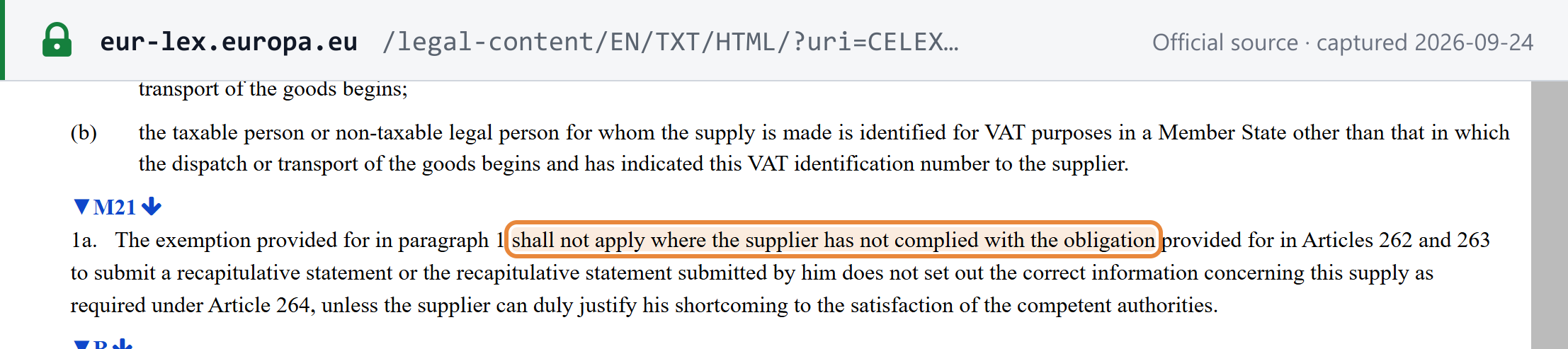 Source snapshot captured 2026-09-24 — original (consolidated VAT Directive, 14.04.2025)
Why it is called "transitional"
The system was built for the single market. Council Directive 91/680/EEC of 16 December 1991 inserted a new Title XVIa, "Transitional arrangements for the taxation of trade between Member States", into the Sixth VAT Directive. Its recitals record that "fiscal controls at internal frontiers will be definitively abolished as from 1 January 1993 for all transactions between Member States". Article 28l set the clock: "The transitional arrangements provided for in this Title shall enter into force on 1 January 1993. … The transitional arrangement shall enter into force for four years and shall accordingly apply until 31 December 1996. The period of application of the transitional arrangements shall be extended automatically until the date of entry into force of the definitive system and in any event until the Council has decided on the definitive system." (Directive 91/680/EEC, EUR-Lex, checked 2026-10-08)
The Council never decided on a definitive system, so the extension still runs. When the Sixth Directive was recast as Directive 2006/112/EC (in force from 1 January 2007, Article 413), the label moved to Title XV, Chapter 1. Article 402(1) still reads: "The arrangements provided for in this Directive for the taxation of trade between Member States are transitional and shall be replaced by definitive arrangements based in principle on the taxation in the Member State of origin of the supply of goods or services." Article 402(2) leaves the switch to the Council. Articles 403 and 404, the Commission report and review clause, were deleted by Directive (EU) 2018/1910 ("Articles 403 and 404 are deleted").[1] (Directive (EU) 2018/1910, EUR-Lex, checked 2026-10-08)
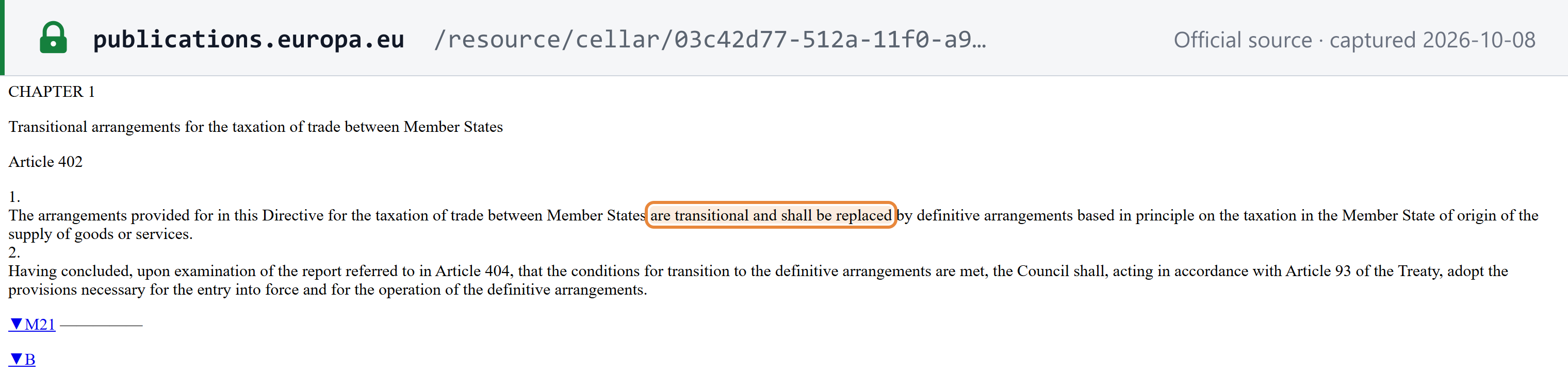 Source snapshot captured 2026-10-08 — original (consolidated VAT Directive, 14.04.2025)
Note the direction. Article 402 still points to taxation in the Member State of origin. The Commission's 2017 and 2018 proposals for a definitive system pursued taxation at destination instead, and the 2017 proposal would have rewritten Article 402 to say so. That rewrite was dropped when only the Quick Fixes were adopted in 2018, so Article 402 still reads "origin" (see Current status). (COM(2017) 569, point 8, checked 2026-10-08)
How it works
The two halves: an exempt supply and a taxed acquisition
The supplier's side. The supply is exempt in the departure Member State when the conditions of Article 138(1) are met: the goods physically leave for another Member State, the customer is a taxable person (or a non-taxable legal person acting as such), and the customer is VAT-identified in a Member State other than the departure state and has given that number to the supplier.
The customer's side. Under Article 2(1)(b)(i), "the intra-Community acquisition of goods for consideration within the territory of a Member State by: (i) a taxable person acting as such, or a non-taxable legal person" is a taxable transaction, where the vendor is a taxable person who is not SME-exempt (Article 284) and not covered by the distance-sales or installation rules (Articles 33 and 36). Article 20 defines the acquisition as "the acquisition of the right to dispose as owner of movable tangible property dispatched or transported to the person acquiring the goods … in a Member State other than that in which dispatch or transport of the goods began." Its place is set by Article 40: "the place where dispatch or transport of the goods to the person acquiring them ends." Article 200: "VAT shall be payable by any person making a taxable intra-Community acquisition of goods."[1]
The deduction. Article 168(c) lets a taxable person deduct "the VAT due in respect of intra-Community acquisitions of goods pursuant to Article 2(1)(b)(i)", to the extent the goods are used for its taxed transactions. For a fully taxable business the acquisition costs nothing in cash: the same amount is declared as due and as deductible in the same return. For a partly exempt business, the non-deductible share is a real cost, charged at the arrival state's rate.
The effect is that VAT on intra-EU business trade in goods is collected at the rate of the country where the goods are used, without the seller charging foreign VAT or registering abroad for the sale.
The Article 41 safety net: quoting the "wrong" VAT number
The acquisition is taxed where the goods arrive (Article 40). But if the customer buys under a VAT number from a third Member State, Article 41 adds a second place of taxation: the acquisition is "deemed to be within the territory of the Member State which issued the VAT identification number under which the person acquiring the goods made the acquisition, unless the person acquiring the goods establishes that VAT has been applied to that acquisition in accordance with Article 40." If VAT is later applied in the arrival state, the taxable amount in the number-issuing state is reduced. Article 42 switches the safety net off for the middle party in a correctly reported simplified triangular transaction.[1]
The safety-net VAT is not a wash. In Facet (Joined Cases C-536/08 and C-539/08, 22 April 2010) the Court of Justice held that a taxable person caught by the predecessor of Article 41 "does not have the right immediately to deduct the input value added tax charged on an intra-Community acquisition." (C-536/08, EUR-Lex, checked 2026-10-08)
When VAT becomes chargeable, and the invoice
For an exempt Article 138 supply, Article 67 makes VAT chargeable "on issue of the invoice, or on expiry of the time limit referred to in the first paragraph of Article 222 if no invoice has been issued by that time". Article 69 applies the same rule to the matching acquisition. Article 222 sets the deadline: the invoice "shall be issued no later than on the fifteenth day of the month following that in which the chargeable event occurs."[1]
Under Article 226, the invoice for an Article 138 supply must show:
- the customer's VAT identification number "under which the customer … received a supply of goods as referred to in Article 138" (point 4), alongside the supplier's own number;
- "in the case of an exemption, reference to the applicable provision of this Directive, or to the corresponding national provision, or any other reference indicating that the supply of goods or services is exempt" (point 11);
- for a new means of transport, the vehicle characteristics (point 12).
The Directive's text requires the customer's VAT number and the exemption reference on an Article 138 invoice. The acquisition is the customer's own taxable transaction under Article 200, not a reverse-charged supply, so check the departure state's rules before adding the Article 226(11a) "Reverse charge" mention or anything else. See the reverse charge explainer for the Article 196 and 197 cases.
The 2020 Quick Fixes: three conditions that now decide the exemption
Since 1 January 2020, three rules adopted on 4 December 2018 (Directive (EU) 2018/1910 and Implementing Regulation (EU) 2018/1912) govern whether the exemption holds.
1. The customer's VAT number is a substantive condition. Recital 7 of Directive 2018/1910 explains the change: the inclusion of the customer's VAT number in VIES, "assigned by a Member State other than that in which the transport of the goods begins", was to become, alongside the transport of the goods out of the Member State of supply, "a substantive condition for the application of exemption rather than a formal requirement." Article 138(1)(b) now makes the number a condition of the exemption. The VAT Committee then agreed unanimously that "where the person acquiring the goods does not indicate his VAT identification number to the supplier or where the VAT identification number indicated has been issued by the Member State from which the goods are dispatched or transported, the conditions for applying the exemption of Article 138 must be seen as not being fulfilled and the supplier shall have no other option but to charge VAT." That guideline is reproduced in the Commission's 2019 Explanatory Notes, which state that they "are not legally binding": read it as the Commission and VAT Committee position, not as law. (Directive (EU) 2018/1910; European Commission, Explanatory Notes on the 2020 Quick Fixes, p. 71, checked 2026-10-08)
2. A correct recapitulative statement is a condition of the exemption. New Article 138(1a): "The exemption provided for in paragraph 1 shall not apply where the supplier has not complied with the obligation provided for in Articles 262 and 263 to submit a recapitulative statement or the recapitulative statement submitted by him does not set out the correct information concerning this supply as required under Article 264, unless the supplier can duly justify his shortcoming to the satisfaction of the competent authorities."[1] The Commission's Explanatory Notes (§4.3.6) give three examples of a justified shortcoming, each provided the supplier corrects the mistake once aware of it and the authority has no reason to suspect fraud: the supply was left off the right period's statement by accident but included in the next one; it was reported with an unintentional value error; or, after the customer restructured, the supplier kept using the customer's old VAT number for a short period in which both numbers still existed. The VAT Committee "almost unanimously" agreed that the exemption "may only be revoked retroactively, if and when the tax authorities establish non-compliance" (p. 72). The statement itself, its frequency and the EUR 50,000 quarterly option are covered in the VIES and Intrastat guide and VAT listings explained.
3. A presumption of transport. Article 45a of Implementing Regulation (EU) No 282/2011, inserted by Implementing Regulation (EU) 2018/1912 and applying "from 1 January 2020", presumes that goods were transported to another Member State in two cases:
- The vendor arranges transport (itself or through a third party) and holds at least two non-contradictory items from list (a), or one item from list (a) plus one from list (b), "issued by two different parties that are independent of each other, of the vendor and of the acquirer".
- The acquirer arranges transport, and the vendor holds the acquirer's written statement that the goods were transported, plus the same two independent items. "The acquirer shall furnish the vendor with the written statement … by the tenth day of the month following the supply."
List (a) covers transport documents: "a signed CMR document or note, a bill of lading, an airfreight invoice or an invoice from the carrier of the goods". List (b) covers a transport insurance policy, bank documents proving payment for the transport, official documents such as a notary's confirming arrival, and a warehouse keeper's receipt in the destination state. "A tax authority may rebut a presumption that has been made under paragraph 1." (Implementing Regulation (EU) 2018/1912, EUR-Lex, checked 2026-10-08)
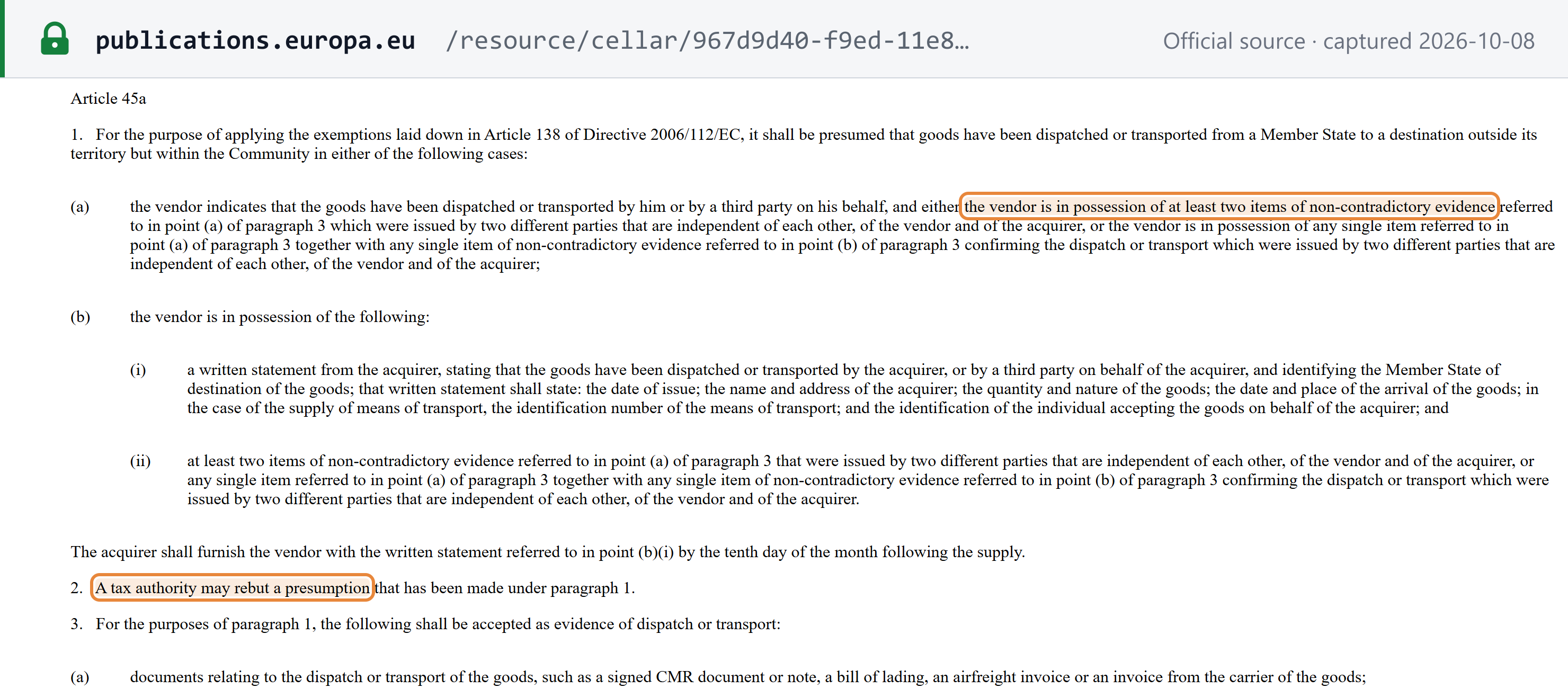 Source snapshot captured 2026-10-08 — original (Implementing Regulation (EU) 2018/1912)
Article 45a is a safe harbour, not the only route. The Commission's Explanatory Notes say that failing its conditions "does not mean automatically that the exemption of Article 138 VD will not apply. In this case it will remain up to the supplier to prove, to the satisfaction of the tax authorities, that the conditions for the exemption (transport included) of Article 138 VD are met" (§5.3.3), and that "existing national VAT rules which establish conditions regarding proof of transport more flexible than those provided for in Article 45a IR may continue to be applied" (§5.3.2). "Independent" excludes parties that share legal personality or have Article 80-type family, management, ownership, financial or legal ties. (Non-binding guidance; Explanatory Notes, pp. 77–78, checked 2026-10-08)
The other two Quick Fixes, call-off stock (Article 17a) and chain transactions (Article 36a), have their own explainers: call-off stock and chain transactions.
What the Court of Justice has said
The exemption's case law turns on substance, good faith and fraud. These judgments interpret the law before or around the 2020 Quick Fixes, not the 2020 wording of Article 138(1)(b) and (1a).
- Physical departure, and good faith protects the supplier — Teleos (C-409/04, 27 September 2007). The exemption applies "only when the right to dispose of the goods as owner has been transferred to the purchaser and the supplier establishes that those goods have been dispatched or transported to another Member State and that, as a result of that dispatch or that transport, they have physically left the territory of the Member State of supply." A supplier who acted in good faith, took "every reasonable measure in his power", and held evidence establishing the exemption "at first sight" cannot later be made to account for VAT just because that evidence proves false, unless its involvement in the evasion is established. The customer's acquisition declaration in the destination state is supporting evidence, not conclusive proof. (C-409/04, EUR-Lex)
- Substance over late paperwork — Collée (C-146/05, 27 September 2007). A Member State may not refuse to exempt an intra-Community supply "which actually took place … solely on the ground that the evidence of such a supply was not produced in good time." (C-146/05, EUR-Lex)
- Fraud knowledge, not retroactive deregistration — Mecsek-Gabona (C-273/11, 6 September 2012). The exemption can be refused where objective evidence shows the vendor failed its evidential obligations, or knew or should have known it was taking part in the purchaser's fraud and did not take every reasonable step. It may not be refused "solely on the ground that the tax authority of another Member State has removed the purchaser's VAT identification number from the register, with retroactive effect from a date prior to the sale of the goods". (C-273/11, EUR-Lex)
- The pre-2020 "VAT number is formal" line — Plöckl (C-24/15, 20 October 2016). Under the Sixth Directive, a Member State could not refuse to exempt an intra-Community transfer "on the ground that the taxable person has not provided a VAT identification number issued by the Member State of destination, where there is no specific evidence of tax evasion, the goods have been moved to another Member State and the other conditions of exemption from tax are also met." Directive 2018/1910 then made the VAT number a substantive condition from 1 January 2020 (recital 7). Read Plöckl as the case law the Quick Fixes legislated against, not as current law on the VAT-number condition. (C-24/15, EUR-Lex)
- Which supply in a chain is exempt — Toridas (C-386/16, 26 July 2017) and Kreuzmayr (C-628/16, 21 February 2018). In Toridas, the first supply was not exempt where the buyer had told the supplier before the sale that the goods would be resold at once to a customer in a third Member State. In Kreuzmayr, where the second supply in a two-supply chain was the intra-Community one, the final buyer who had deducted departure-state VAT "solely on the basis of the invoices provided by the intermediary operator which incorrectly classified its supply" could not keep the deduction on grounds of legitimate expectations. Article 36a now codifies which supply carries the transport (see chain transactions). (C-386/16; C-628/16, EUR-Lex)
Who is outside Article 138(1)
Article 139 limits the exemption. It does not apply to "the supply of goods carried out by taxable persons who, within the Member State in which the supply is carried out, are covered by the exemption for small enterprises provided for in Article 284", so an SME-exempt seller cannot zero-rate (see the EU SME scheme). "Nor shall that exemption apply to the supply of goods to taxable persons, or non-taxable legal persons, whose intra-Community acquisitions of goods are not subject to VAT pursuant to Article 3(1)" (see Who it affects). Margin-scheme and auction goods, and second-hand means of transport under their transitional scheme, are also excluded.[1]
Moving your own goods: a deemed supply and a deemed acquisition
There need not be a customer. Article 17(1): "The transfer by a taxable person of goods forming part of his business assets to another Member State shall be treated as a supply of goods for consideration." That deemed supply is exempt under Article 138(2)(c) if it would have qualified had it been made to another taxable person, and the business makes a matching deemed acquisition in the arrival state (Article 21), which usually means registering for VAT there. The taxable amount is "the purchase price of the goods or of similar goods or, in the absence of a purchase price, the cost price, determined at the time the transfer takes place" (Article 76), not market value.
Article 17(2) lists movements that are not transfers, among them distance sales (Article 33), goods installed or assembled by the supplier (Article 36), supplies on board ships, aircraft or trains, gas and electricity, exempt supplies under Articles 138 and 146–148, 151 and 152, goods sent for valuation or work and then returned, temporary use for the business's own services in the arrival state, and "the temporary use of the goods, for a period not exceeding twenty-four months" where temporary-importation relief would apply. If one of these conditions later fails, a transfer is deemed to take place at that moment (Article 17(3)).[1] Stock sent to a known customer under a call-off stock arrangement is handled separately; see call-off stock.
Special cases in brief
- New means of transport. Taxed in the destination state whoever buys them, including private individuals; the seller exempts the supply under Article 138(2)(a). "New" means a land vehicle supplied within six months of first entry into service or with no more than 6,000 km, a vessel within three months or 100 hours, or an aircraft within three months or 40 hours (Article 2(2)).
- Excise goods (energy products, alcohol, manufactured tobacco) bought by the Article 3(1) exempt purchasers are taxed as acquisitions where excise is chargeable in the arrival state; the seller exempts them under Article 138(2)(b).
- Sales to consumers are a different regime. B2C intra-EU distance sales are not Article 138 supplies. They are taxed where the goods arrive (Article 33(a)), unless the seller is established in only one Member State and stays under the EU-wide EUR 10,000 threshold of Article 59c. The seller declares them through the One-Stop Shop; see the OSS guide.
- Three parties, one movement. Where goods move once along a chain, only one supply carries the exemption (Article 36a, see chain transactions). In the simplified A→B→C case, B's acquisition in the arrival state is not taxed and C accounts for B's onward supply (Articles 141 and 197, see triangulation).
All from the consolidated VAT Directive.[1] The rate the customer applies on its acquisition is the arrival state's; see EU VAT rate rules.
Worked example: a German supplier and a French customer
The parties and figures are illustrative. Müller GmbH, VAT-registered in Germany, sells machine parts for EUR 10,000 net to Dupont SAS, which is VAT-registered in France and gives Müller its French VAT number. Müller ships by carrier from Stuttgart to Lyon on 12 March 2026. Dupont is fully taxable.
| Step | Who | What | Amount | Authority |
|---|---|---|---|---|
| 1 | Müller | Checks Dupont's French VAT number on VIES and keeps the consultation record (good practice; the legal condition is that Dupont holds and gives a valid non-German number) | — | Art 138(1)(b); EU VIES check |
| 2 | Müller | Ships, and keeps the carrier's invoice (a list-(a) item) and its bank's proof of paying for the transport (a list-(b) item): two items from two different parties independent of each other, of Müller and of Dupont | — | Reg 282/2011 Art 45a(1)(a) |
| 3 | Müller | Issues the invoice by 15 April 2026, showing both VAT numbers and an exemption reference (for example "Steuerfreie innergemeinschaftliche Lieferung, § 4 Nr. 1 b UStG / Art 138 Directive 2006/112/EC") | EUR 10,000; VAT EUR 0 | Arts 222, 226(4), 226(11); § 4 Nr. 1 b UStG |
| 4 | Müller | Reports the supply against Dupont's French number in its German recapitulative statement (Zusammenfassende Meldung, ZM) for the period in which VAT became chargeable: on issue of the invoice, or at the latest on 15 April 2026. The ZM is due by the 25th day after the end of the period | EUR 10,000 | Arts 67, 262, 264; § 18a UStG |
| 5 | Dupont | Declares an intra-Community acquisition in France and accounts for French VAT at 20% | EUR 2,000 due | Arts 2(1)(b)(i), 40, 69, 200; CGI art. 278 |
| 6 | Dupont | Deducts the same VAT in the same return | EUR 2,000 deductible, net EUR 0 | Art 168(c) |
Germany's § 4 Nr. 1 b UStG transposes Article 138(1a) directly: the exemption does not apply "wenn der Unternehmer seiner Pflicht zur Abgabe der Zusammenfassenden Meldung (§ 18a) nicht nachgekommen ist oder soweit er diese im Hinblick auf die jeweilige Lieferung unrichtig oder unvollständig abgegeben hat". § 6a(1) Nr. 4 UStG requires that the customer has "eine ihm von einem anderen Mitgliedstaat erteilte gültige Umsatzsteuer-Identifikationsnummer verwendet". The German standard rate is 19% (§ 12(1) UStG); the French standard rate is 20% (CGI art. 278, being recodified into the Code des impositions sur les biens et services by Ordonnance n° 2025-1247). (§ 4 UStG, § 6a UStG, § 12 UStG, gesetze-im-internet.de; CGI art. 278, Légifrance; checked 2026-10-08)
What goes wrong, with numbers:
- Dupont gives no valid VAT number from outside Germany. The exemption fails at once (Article 138(1)(b); the VAT Committee's "no other option but to charge VAT"). Müller charges German VAT at 19%: EUR 1,900.
- Müller leaves the supply off its ZM, or reports it wrongly. The exemption is lost retroactively unless the shortcoming is duly justified (Article 138(1a); § 4 Nr. 1 b UStG; Explanatory Notes §4.3.6). That puts EUR 1,900 of German VAT at risk on a EUR 10,000 sale.
- Dupont quotes its Belgian VAT number instead of its French one. France still taxes the acquisition where the goods arrive (Article 40): EUR 2,000. Belgium also taxes it as the number-issuing state (Article 41) until Dupont proves French VAT was applied, and under Facet that Belgian VAT is not immediately deductible.
- Dupont's information was false and Müller could not have spotted it. Germany's § 6a(4) UStG keeps the supply exempt where the exemption rested on the customer's incorrect information and the supplier could not detect it with a prudent merchant's care; "In diesem Fall schuldet der Abnehmer die entgangene Steuer" (the customer owes the lost tax). This is the national form of the Teleos good-faith protection.
Arithmetic: 10,000 × 20% = 2,000; 10,000 × 19% = 1,900. For how the acquisition is declared in a French return, see the France guide.
Who it affects
- Every VAT-registered business that sells goods to business customers in other Member States (the exemption, the invoice, the recapitulative statement and the proof of transport) and every business that buys goods from another Member State (the acquisition and its deduction).
- Businesses moving their own stock between Member States, who make a deemed supply in the departure state and a deemed acquisition, usually with a registration, in the arrival state (Article 17).
- "Exempt purchasers" under Article 3. Acquisitions by flat-rate farmers, by taxable persons making only supplies with no right of deduction (exempt businesses), and by non-taxable legal persons are not taxed as acquisitions while their total intra-Community acquisitions stay under a threshold "which the Member States shall determine but which may not be less than EUR 10 000 or the equivalent in national currency", in both the current and the previous calendar year. They may opt into acquisition taxation, for "a period of two calendar years" at least. New means of transport and excise goods are carved out of this relief.[1] The threshold is at least EUR 10,000 and is set nationally: Germany's Erwerbsschwelle is EUR 12,500 (as at 2026-10-08), tested on the previous year and the expected current year (§ 1a(3) UStG, gesetze-im-internet.de). Suppliers to these customers cannot apply Article 138(1) (Article 139(1)).
- SME-exempt sellers, who cannot zero-rate intra-EU sales while they use the small-enterprise exemption (Article 139(1)).
- Private buyers of new cars, boats and aircraft from another Member State, who account for VAT in their own country (Article 2(1)(b)(ii)).
Current status and dates
As at 2026-10-08, the 1993 system is the law, with no replacement pending. The Commission's proposal for a definitive system was withdrawn in 2025, and the enacted ViDA package (Directive (EU) 2025/516) modernises the existing system rather than replacing it.
The definitive system that was never adopted
- COM(2017) 569, 4 October 2017: cornerstones split off and never adopted. The proposal would have set the "cornerstones" of a definitive system taxing intra-EU B2B supplies of goods at destination: "one taxable supply of goods located for VAT purposes in the Member State of destination (the so-called intra-Union supply of goods)" would replace "an exempt supply of goods in the Member State of departure and a taxed intra-Community acquisition in the Member State of destination". It also introduced the "certified taxable person" and four Quick Fixes. The Council adopted only the Quick Fixes, on 4 December 2018 (Directive (EU) 2018/1910, Regulation (EU) 2018/1909 and Implementing Regulation (EU) 2018/1912). In the Commission's words, "The cornerstones of the definitive VAT system and the certified taxable person have been deleted from this proposal in order to speed up the adoption of the four 'quick fixes'" and moved into the 2018 technical proposal. The European Parliament's Legislative Observatory lists the 2017 procedure as completed, with Directive 2018/1910 as the final act. (COM(2017) 569, EUR-Lex; Commission REFIT Scoreboard; Legislative Observatory, 2017/0251(CNS), checked 2026-10-08)
- COM(2018) 329, 25 May 2018: withdrawn on 6 October 2025. The "detailed technical measures for the operation of the definitive VAT system for the taxation of trade between Member States" were on the withdrawal list annexed to the Commission's 2025 Work Programme (COM(2025) 45, Annex IV, 11 February 2025), with the reason "No foreseeable agreement – discussions are suspended since 2019 and further progress is unlikely." The Council's information note records: "On 16 July 2025, the Commission approved the withdrawal of those pending proposals in a list published in the Official Journal of the European Union on 6 October 2025" (OJ C, C/2025/5423). The Legislative Observatory marks the procedure "Procedure lapsed or withdrawn". (Council of the EU, ST 13873/25; Council of the EU, ST 5985/25 ADD 1; Legislative Observatory, 2018/0164(CNS), checked 2026-10-08)
So the 2017 cornerstones were split off and never adopted, and the 2018 proposal that carried them was withdrawn in 2025. Article 402 still calls the arrangements transitional and still points, on paper, to origin taxation, but no proposal to replace them is pending.
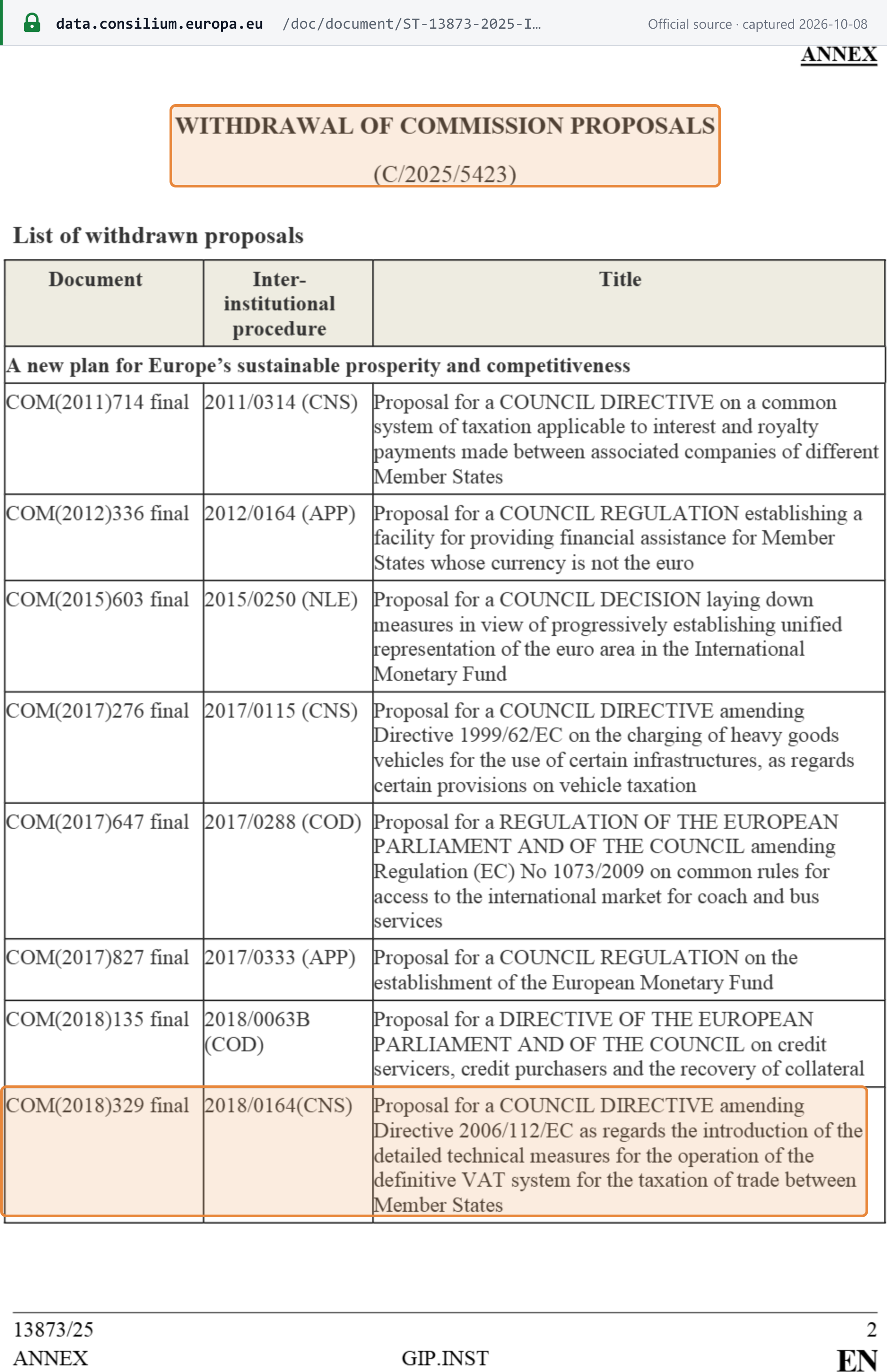 Source snapshot captured 2026-10-08 — original (Council of the EU)
What ViDA changes, by date (enacted, future effect)
Directive (EU) 2025/516 of 11 March 2025 (VAT in the Digital Age) keeps the exempt-supply and taxed-acquisition structure and changes the compliance around it. (Directive (EU) 2025/516, EUR-Lex, checked 2026-10-08)
- 1 January 2027 — call-off stock is wound down. Article 17a covers only goods dispatched "on or before 30 June 2028", and new Article 17a(8) says "This Article shall cease to apply on 30 June 2029" (ViDA Article 2).
- 1 July 2028 — an OSS scheme for transfers of own goods. A new special scheme (Title XII, Chapter 6, Section 5) lets a business declare transfers of its own goods through the One-Stop Shop. Under new Article 369xi, "the intra-Community acquisition of goods in the Member State to which the goods are dispatched or transported is exempt" and does "not give rise to a registration obligation". Article 138(1) gains a subparagraph disapplying the customer-VAT-number condition of point (b) for transfers declared under that scheme (ViDA Article 3).
- 1 July 2029 — the call-off stock register (Article 243(3)) and its recapitulative-statement line (Article 262(2)) are deleted (ViDA Article 4).
- 1 July 2030 — recapitulative statements end, and the exemption follows the new data. "Articles 265 to 271 are deleted". Recast Articles 262 and 263 require per-transaction data from the supplier "at the time when the invoice is issued or should have been issued" and from the acquirer "no later than 5 days after the invoice is received" (Member States may waive the acquirer-side data). New Article 138(1a) makes the exemption depend on the supplier having complied "with the obligation provided for in Articles 262 and 263 to communicate the data on intra-Community transactions", again unless duly justified. Intra-EU B2B invoices must be electronic invoices to the European standard (EN 16931), and the Article 222 deadline becomes "no later than 10 days following the chargeable event" (ViDA Article 5, applying "from 1 July 2030" under Article 6(5)).
The digital reporting system itself is explained in the ViDA guide.
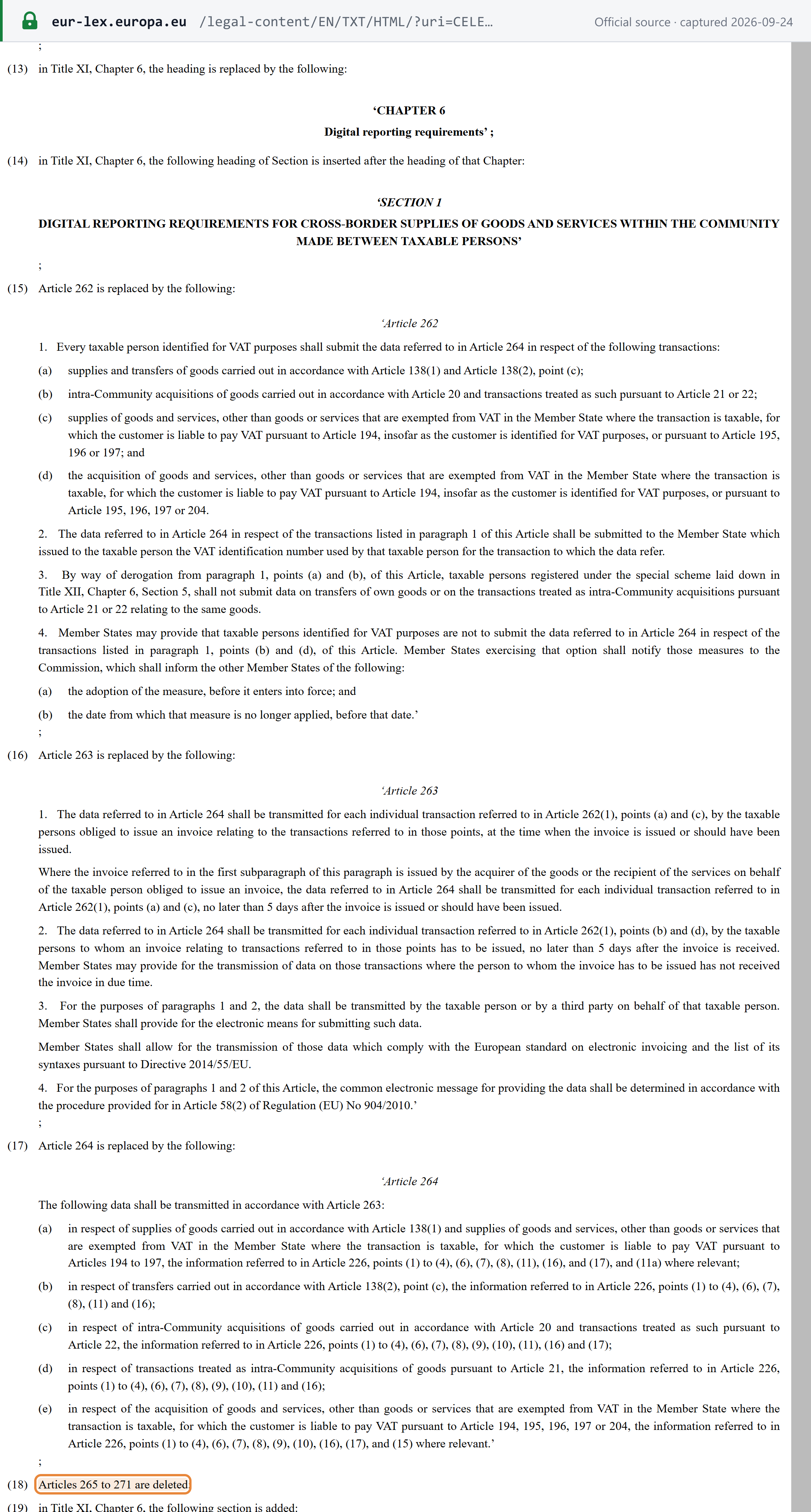 Source snapshot captured 2026-09-24 — original
Timeline
| Date | Event | Status (as at 2026-10-08) | Source |
|---|---|---|---|
| 16 Dec 1991 | Directive 91/680/EEC adopts the transitional arrangements | Adopted | EUR-Lex |
| 1 Jan 1993 | Fiscal frontiers abolished; exempt supply plus taxed acquisition system starts | In force since | EUR-Lex |
| 31 Dec 1996 | Original end date, extended automatically until the Council decides on a definitive system | Passed, extended | EUR-Lex |
| 1 Jan 2007 | Recast into Directive 2006/112/EC; Article 402 keeps the "transitional" label | In force | EUR-Lex |
| 4 Oct 2017 | COM(2017) 569: definitive-system cornerstones, certified taxable person and Quick Fixes proposed | Cornerstones never adopted | EUR-Lex |
| 25 May 2018 | COM(2018) 329: detailed definitive-system measures proposed | Withdrawn 6 Oct 2025 | Council, ST 13873/25 |
| 4 Dec 2018 | Quick Fixes adopted (Directive 2018/1910, Regulation 2018/1909, Implementing Regulation 2018/1912) | Adopted | EUR-Lex |
| 1 Jan 2020 | Quick Fixes apply: VAT number substantive, Article 138(1a), Article 17a call-off stock, Article 36a chains, Article 45a proof of transport | In force since | EUR-Lex |
| 1 Jul 2021 | EU e-commerce package: Article 33 distance sales, EUR 10,000 Article 59c threshold, OSS | In force since | Council Decision (EU) 2020/1109 |
| 11 Feb, 16 Jul and 6 Oct 2025 | COM(2018) 329 listed for withdrawal, withdrawal approved, list published (OJ C/2025/5423) | Withdrawn | Council, ST 13873/25 |
| 1 Jan 2027 | ViDA: call-off stock limited to goods moved by 30 Jun 2028; Article 17a ends 30 Jun 2029 | Enacted, future effect | EUR-Lex |
| 1 Jul 2028 | ViDA: OSS special scheme for transfers of own goods; Article 138(1)(b) disapplied for those transfers | Enacted, future effect | EUR-Lex |
| 1 Jul 2029 | ViDA: Article 243(3) call-off register and Article 262(2) deleted | Enacted, future effect | EUR-Lex |
| 1 Jul 2030 | ViDA: recapitulative statements (Articles 265–271) replaced by per-transaction digital reporting; new Article 138(1a); EN 16931 e-invoices for intra-EU B2B; invoice within 10 days | Enacted, future effect | EUR-Lex |
Related changes
Recent national changes that touch intra-Community trade are the ViDA transpositions that wind down call-off stock:
- 2027-01-01 — Finland: Law 597/2026, given on 26 June 2026, applies the first ViDA changes, including allowing call-off-stock transfers only for goods moved until 30 June 2028. (Finlex — Law 597/2026) — see event
- 2026-09-28 — Estonia: the Government's ViDA transposition bill 992 SE completed its first reading; it adds transitional provisions for call-off stock arrangements until 30 June 2028. A bill, not law. (Riigikogu) — see event
- 2026-06-05 — Czech Republic: government bill print 218 would repeal call-off stock from 1 July 2028, with transitional use to 30 June 2029. A bill, not law. (Chamber of Deputies) — see event
Frequently asked questions
Why does a seller charge no VAT on an intra-EU sale of goods to a business?
Because the sale is exempt in the departure Member State under Article 138(1) of the VAT Directive, and the VAT is collected instead from the buyer. The buyer accounts for VAT on an intra-Community acquisition in the Member State where the goods arrive (Articles 2(1)(b)(i), 40 and 200) and, if fully taxable, deducts the same amount in the same return (Article 168(c)). (VAT Directive 2006/112/EC, consolidated 14.04.2025, checked 2026-10-08)
Is a valid VIES check enough to apply the exemption?
No. The customer's VAT number from another Member State is one condition. The supplier must also be able to show that the goods physically left the Member State of supply (Teleos, C-409/04), for example through the Article 45a presumption or other evidence, and since 1 January 2020 must report the supply correctly in its recapitulative statement (EC Sales List), because Article 138(1a) makes that a condition of the exemption unless the shortcoming is duly justified. (VAT Directive Art 138; Implementing Regulation 2018/1912; CJEU C-409/04, checked 2026-10-08)
What if my customer gives me a VAT number from the wrong country?
If the number was issued by your own Member State, the departure state, the VAT Committee's agreed view is that the Article 138 conditions are not met and you must charge VAT. If it was issued by a third Member State, the sale can still be exempt, but under Article 41 the customer's acquisition is also taxed in the state that issued the number until the customer proves VAT was applied where the goods arrived, and that VAT is not immediately deductible (Facet, C-536/08). (Commission Explanatory Notes on the 2020 Quick Fixes, p. 71; VAT Directive Art 41; CJEU C-536/08, checked 2026-10-08)
Is the 1993 intra-EU VAT system still temporary?
On paper, yes: Article 402 of the VAT Directive still calls the arrangements transitional. In practice, no replacement is pending. The 2017 cornerstones of a definitive system were never adopted, and the 2018 proposal for the definitive system, COM(2018) 329, was withdrawn with a list published in the Official Journal on 6 October 2025. The ViDA package modernises the existing system from 2027 to 2030 rather than replacing it. (VAT Directive Art 402; Council of the EU, ST 13873/25; Directive (EU) 2025/516, checked 2026-10-08)
What changes for intra-Community supplies on 1 July 2030?
Recapitulative statements (EC Sales Lists) are abolished and replaced by per-transaction digital reporting by the supplier, at the time the invoice is issued, and by the customer, within 5 days of receiving it. The exemption then depends on the supplier having transmitted correct transaction data. Intra-EU B2B invoices must be electronic invoices to the European standard EN 16931, issued no later than 10 days after the chargeable event. (Directive (EU) 2025/516, Articles 5 and 6(5), checked 2026-10-08)
Related resources
- Sibling explainers: chain transactions, triangulation, call-off stock and EU VAT rate rules
- VIES and Intrastat for traders and VAT listings explained — the recapitulative statement that Article 138(1a) depends on
- Reverse charge — Articles 196 and 197, and the 2030 "triangular transaction" invoice mention
- OSS guide — B2C distance sales and the 2028 own-goods scheme; IOSS for imports
- ViDA — VAT in the Digital Age — the 2030 digital reporting requirements
- EU SME scheme — why an SME-exempt seller cannot zero-rate
- Verify a customer's VAT number: EU VIES verification, French TVA number check and free VAT number checks by country
- Country pages for the worked example: Germany VAT guide, Germany tax IDs, registering for VAT in Germany, France VAT guide and France tax IDs
- Tax-change chronologies: European Union, Germany, France
Reference links
- VAT Directive 2006/112/EC, consolidated version of 14.04.2025 — Arts 2, 3, 17, 20, 40–42, 67, 69, 138–139, 168, 200, 222, 226, 402 (EUR-Lex)
- Directive 91/680/EEC, Directive (EU) 2018/1910, Implementing Regulation (EU) 2018/1912 and Directive (EU) 2025/516 (EUR-Lex)
- European Commission, Explanatory Notes on the 2020 Quick Fixes (non-binding guidance)
- COM(2017) 569; Council information note ST 13873/25 on the withdrawal of COM(2018) 329
- CJEU judgments (EUR-Lex): C-409/04 Teleos, C-146/05 Collée, C-536/08 Facet, C-273/11 Mecsek-Gabona, C-24/15 Plöckl, C-386/16 Toridas, C-628/16 Kreuzmayr
- Germany: § 1a, § 4, § 6a and § 12 UStG (gesetze-im-internet.de)