Triangulation — how the middle business in an A→B→C sale avoids registering in the customer's country
Triangulation (the "simplified triangular transaction") is an EU VAT simplification for a chain of two sales between three businesses identified for VAT in three different Member States, where the goods travel once, directly from the first supplier (A) to the final customer (C). The intermediary (B) is spared VAT registration in C's state: its acquisition there is not taxed, and C pays the VAT on B's sale under the reverse charge.
The rule sits in three articles of the VAT Directive (Council Directive 2006/112/EC). Article 141 tells each Member State to "take specific measures to ensure that VAT is not charged on the intra-Community acquisition of goods within its territory" when five cumulative conditions are met. Article 197 makes the final customer liable for the VAT on the intermediary's onward sale. Article 42 switches off the second, "fallback" acquisition that the intermediary would otherwise make in the state whose VAT number it used. (VAT Directive, consolidated version of 14.04.2025)
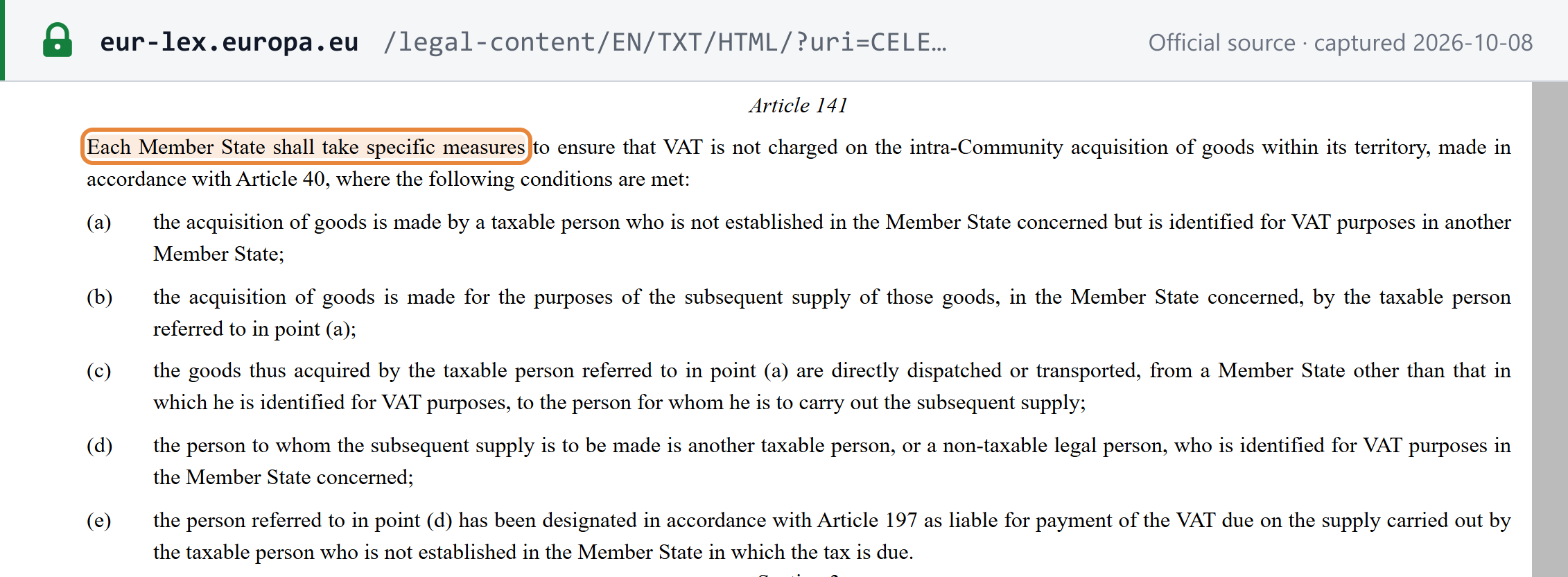 Source snapshot captured 2026-10-08 — original (EUR-Lex, consolidated text of 14.04.2025)
The Court of Justice gives the shortest definition. In Luxury Trust Automobil (C-247/21, 8 December 2022, para 41), "a triangular transaction is a transaction by which goods are supplied by a supplier, identified for VAT purposes in one Member State, to an intermediary acquiring the goods, identified for VAT purposes in a second Member State, who, in turn, supplies those goods to a final customer, identified for VAT purposes in a third Member State, those goods being transported directly from the first Member State to the third Member State." (C-247/21, EUR-Lex) Practitioners also call it an "ABC transaction"; Germany calls it the innergemeinschaftliches Dreiecksgeschäft, the Netherlands the vereenvoudigde ABC-levering.
Who owns the rule. The Council of the EU owns the text: Articles 42, 141, 197 and 265 of the VAT Directive. The Court of Justice interprets it, and since 1 October 2024 preliminary references in VAT matters go to the General Court under Article 50b of the Statute of the Court of Justice, which is why the two most recent triangulation judgments carry "T-" numbers. The European Commission's Explanatory Notes on the 2020 Quick Fixes add guidance on triangulation inside longer chains; they say they are "not legally binding and only contain practical and informal guidance". (Explanatory Notes, 2020 Quick Fixes)
Why the rule exists. Without it, B is caught twice. B's intra-Community acquisition takes place where the transport ends (Article 40), so B would have to register in C's state, pay acquisition VAT there and then charge local VAT to C. Article 41 adds a second acquisition in the state "which issued the VAT identification number under which the person acquiring the goods made the acquisition, unless the person acquiring the goods establishes that VAT has been applied to that acquisition in accordance with Article 40." The Court has put the purpose plainly: Article 141 exists "to avoid a situation whereby the intermediary contractor ... has to satisfy identification and declaration obligations in the Member State of destination of the goods" (Firma Hans Bühler, C-580/16, para 41). (C-580/16, EUR-Lex)
How it works
The three roles
- A — the first supplier. Makes an exempt intra-Community supply to B from the departure state (Article 138; see intra-Community supply). Nothing special happens on A's side.
- B — the intermediary acquiring the goods. Makes an intra-Community acquisition in C's state and then a domestic supply to C in that same state. Triangulation removes both the acquisition VAT and B's need to register there.
- C — the final customer. Identified for VAT in the arrival state. C accounts for the VAT on B's supply under the reverse charge and, if entitled, deducts it on the same return.
The goods move once, from A's state to C's state. They never pass through B's state.
Step 1 — the five conditions of Article 141
All five must be met. In the Directive's words, condensed:
| Condition | What it means in practice | |
|---|---|---|
| (a) | B "is not established in the Member State concerned but is identified for VAT purposes in another Member State" | B has no establishment in C's state and holds a VAT number elsewhere |
| (b) | B acquires the goods "for the purposes of the subsequent supply of those goods" in C's state | B buys to resell to C, not for its own use |
| (c) | The goods go "directly ... from a Member State other than that in which he is identified" to B's customer | One transport, from a state other than the one whose number B uses |
| (d) | C is "another taxable person, or a non-taxable legal person" identified in the arrival state | C quotes a VAT number of the arrival state |
| (e) | C "has been designated in accordance with Article 197 as liable" for the VAT on B's supply | C becomes the person liable — which in practice depends on the invoice |
Condition (c) turns on the VAT number B actually uses, not on where B lives. In Bühler the Court held that the requirement "is met where the taxable person is resident and identified for value added tax (VAT) purposes in the Member State from which the goods are dispatched or transported, but that that taxable person uses the VAT identification number of another Member State for that specific intra-Community acquisition." Where B is registered in several states, "only the VAT identification number under which he made the intra-Community acquisition must be taken into account" (para 38). So a German-resident trader shipping from Germany to Czechia can triangulate if it buys under its Austrian number — but not under its German or Czech number.
Article 141 does not say "three persons in three different Member States". That reading follows from conditions (a) and (c) applied to the numbers used. Nor does Article 141 say who must transport the goods; several Member States add their own rule on that (see the national table).
Step 2 — C pays the VAT on B's sale: Article 197
Article 197(1) makes the customer liable where "(a) the taxable transaction is a supply of goods carried out in accordance with the conditions laid down in Article 141; (b) the person to whom the goods are supplied is another taxable person, or a non-taxable legal person, identified for VAT purposes in the Member State in which the supply is carried out; (c) the invoice issued by the taxable person not established in the Member State of the person to whom the goods are supplied is drawn up in accordance with Sections 3 to 5 of Chapter 3." Article 197(2) lets Member States derogate where a tax representative is appointed as the person liable under Article 204.
This is one of the mandatory reverse charges in the Directive: Member States cannot choose to leave the liability with B once the conditions are met. Condition (c) — a correct invoice — is what makes C's designation effective, and the Court treats it as substantive (see the invoice below). See reverse charge for the wider map.
Step 3 — B's fallback acquisition is switched off: Article 42
Article 42 provides that "the first paragraph of Article 41 shall not apply and VAT shall be deemed to have been applied to the intra-Community acquisition of goods in accordance with Article 40" where:
- (a) B "establishes that he has made the intra-Community acquisition for the purposes of a subsequent supply, within the territory of the Member State identified in accordance with Article 40, for which the person to whom the supply is made has been designated in accordance with Article 197 as liable for payment of VAT"; and
- (b) B "has satisfied the obligations laid down in Article 265 relating to submission of the recapitulative statement."
Condition (a) is substantive: it depends on C being validly designated under Article 197. Condition (b) is formal. Bühler held that Articles 42 and 265 preclude a Member State from applying Article 41 "solely on the ground that ... the recapitulative statement ... was not submitted in good time", and that these obligations "must be regarded as being formal" (para 49). The simplification can still be refused for intentional fraud, or where the defect "would effectively prevent the production of conclusive evidence that the substantive requirements have been satisfied" (paras 57 and 59).
The invoice: "Reverse charge" and C's VAT number
B's invoice to C carries no VAT and must show:
- C's VAT number in the arrival state — Article 226(4) requires "the customer's VAT identification number ... under which the customer received a supply of goods ... in respect of which he is liable for payment of VAT";
- the mention "Reverse charge" — Article 226(11a): "where the customer is liable for the payment of the VAT, the mention ‘Reverse charge’";
- B's own VAT number (the one used for the acquisition), and any national wording B's invoicing rules require.
 Source snapshot captured 2026-09-24 — original (EUR-Lex, consolidated text of 14.04.2025)
Whose invoicing rules apply. Under Article 219a(2)(a)(i), where the supplier is not established in the state of supply and the customer is liable for the VAT, the invoice follows "the rules applying in the Member State in which the supplier has established his business or has a fixed establishment from which the supply is made". That is B's establishment state, which may differ from the state whose VAT number B uses. The mention may appear in the official wording of the invoice language — for example "Steuerschuldnerschaft des Leistungsempfängers" (German), "btw verlegd" (Dutch), « Autoliquidation » (French), "inversión del sujeto pasivo" (Spanish), "odwrotne obciążenie" (Polish) or "inversione contabile" (Italian).
The words are not optional. In Luxury Trust Automobil an Austrian intermediary sold cars that went directly from the United Kingdom to a Czech customer, and its invoices said only "Exempt intra-Community triangular transaction". The Court ruled that "in a triangular transaction, the final customer has not been validly designated as liable for the value added tax (VAT) where the invoice issued by the intermediary acquiring the goods does not contain the words ‘Reverse charge’", and that the omission "may not subsequently be corrected by adding a statement that that invoice relates to an intra-Community triangular transaction and that the tax liability is transferred to the person to whom the supply is made."
 Source snapshot captured 2026-10-08 — original (EUR-Lex, judgment in C-247/21)
The Court added that B "cannot substitute another statement for the words ‘Reverse charge’" (para 51), that because the derogation "is optional, it is the formality required by Article 226(11a) ... which makes it possible to ensure that the final recipient of a supply is aware of his or her tax obligations" (para 55), and that issuing the required invoice later "is the issuance of the required invoice for the first time, which cannot have retroactive effect" (para 61). Without a valid designation, B is liable "in the Member State which issued it with the identification number which it used" (para 66). And the requirements of Articles 42, 141(e) and 226(11a) "cannot vary from one Member State to another" (para 67).
When must the invoice be issued? Today the Directive's harmonised deadline in Article 222 (the 15th day of the month after the chargeable event) covers intra-Community supplies under Article 138 and reverse-charged services under Article 196, not Article 197 supplies; the deadline for a triangulation invoice is set nationally. From 1 July 2030 a 10-day deadline applies EU-wide (see Current status).
The recapitulative statement — B reports the sale to C
B lists its supply to C on the recapitulative statement (EC Sales List) of the Member State whose VAT number it used. Article 265(1) requires "his VAT identification number in that Member State and under which he made the acquisition and subsequent supply of goods", "the VAT identification number, in the Member State in which dispatch or transport of the goods ended, of the person to whom the subsequent supply was made", and, for each such customer, "the total value, exclusive of VAT". This is the filing that satisfies Article 42(b). The mechanics — including the triangulation flag and why B files no Intrastat declaration — are covered in VIES and Intrastat: triangulation and VAT listings explained.
How triangulation fits with the chain-transaction rule
Triangulation works only if the intra-EU transport is ascribed to the A→B supply, because that is what gives B an intra-Community acquisition to relieve. Article 36a of the VAT Directive decides this when B, as intermediary operator, arranges the transport: by default the transport is ascribed to the supply made to B, but it moves to B's own supply if B gave A a VAT number of the departure state. Using a departure-state number would also breach Article 141(c). The Commission's Explanatory Notes (§3.6.17) confirm that Article 36a only allocates the transport and does not affect "the possibility to apply the simplification laid down for triangular transactions when all conditions in Article 141 VD are met." The full allocation rules, and the Euro Tyre Holding (C-430/09) and Kreuzmayr (C-628/16) judgments on chain allocation and the last buyer's right to deduct, are in chain transactions.
Worked example (illustrative): Italy → Germany → France
The facts and figures below are illustrative. The example uses the same parties as the French administration's example of an Italian seller, an intermediary from another state and a French buyer (BOFiP BOI-TVA-CHAMP-20-40, §60); the simplification itself is set out at §180.
- A is an Italian manufacturer using its Italian VAT number.
- B is a distributor established in Germany, using its German VAT number. It has no establishment in France.
- C is a French retailer with a French VAT number.
- A sells to B for EUR 8,000; B sells to C for EUR 10,000.
- A ships the goods from Milan to Lyon on B's order. The transport is ascribed to the A→B supply: A organised it, and even if B had arranged it, B used a non-Italian number (Article 36a(1)).
| Party | What happens | Invoice | Filings |
|---|---|---|---|
| A (IT) | Exempt intra-EU supply to B (Art 138) | EUR 8,000, no VAT, B's DE number | Italian recapitulative statement |
| B (DE) | Acquisition in France not taxed (Art 141); fallback acquisition in Germany switched off (Art 42) | EUR 10,000, no VAT, B's DE and C's FR numbers, "Reverse charge" | German recapitulative statement, C's FR number, EUR 10,000, flagged as triangular |
| C (FR) | Liable for French VAT on B's supply (Art 197) | — | French return: VAT due and deductible |
C's French VAT is 20% of EUR 10,000 = EUR 2,000 (French standard rate 20%; see the France guide). C declares EUR 2,000 as output VAT and, if fully taxable, deducts the same EUR 2,000 on the same return, so the net cash cost is nil. B does not register in France.
Because B is established in Germany, B invoices under German rules (Article 219a). German law adds that the invoice must refer to the triangular transaction and to the last customer's liability (§ 14a Abs. 7 UStG); the German administration accepts wording such as "Vereinfachungsregelung nach Artikel 141 MwStSystRL" for the first part (UStAE 25b.1(8)). A reference to Article 141 of Directive 2006/112/EC is also the wording French doctrine prescribes for triangulation invoices. A practical invoice therefore carries both "Reverse charge" (or "Steuerschuldnerschaft des Leistungsempfängers") and an Article 141 reference.
The failure version. Suppose B's invoice says only "intra-Community triangular transaction", or C collects the goods itself in a state that excludes collection by C (Germany and Poland do; see the national table). The simplification fails. B has a taxable acquisition and a domestic supply in France, must register there and charge French VAT to C, and is exposed in Germany under Article 41 until it proves the acquisition was taxed in France. Re-issuing the invoice later does not repair it (Luxury Trust; T-773/25, below).
Four-party chains
Triangulation can apply inside a longer chain, but only to the three parties around the single intra-Community acquisition. The Commission's Explanatory Notes (§3.6.17.2, p. 68) say: "the rules for chain transactions apply independently of the number of parties involved in the chain. However, the simplification for triangular transactions is applicable only when for the transactions involving three parties in that chain, all the conditions for that triangular simplification are met. In practice, only one of the taxable persons involved in the chain of transactions, that is the one in that chain making the intra-Community acquisition, can potentially benefit from the triangular simplification." The VAT Committee guidelines reproduced in the Notes (Working Paper No 975) add that condition (c) is met where the goods go "to the place designated by the person for whom X carries out the subsequent supply", and that a further sale by C "shall have no impact" on B's simplification. Those guidelines are not binding.
The General Court has since confirmed this in MS Ključarovci (T-646/24, 3 December 2025, EU:T:2025:1081). The chain ran from a German supplier to MS (using a Slovenian VAT number), then to a Danish company, then to a Danish final customer, with one transport from Germany directly to the fourth company. Slovenia had refused the simplification because more than three operators were involved. The Court ruled that delivery to C's own customer, "who is identified for value added tax (VAT) purposes in the same Member State as the reseller, does not preclude the condition laid down in that provision from being regarded as satisfied." (T-646/24, EUR-Lex)
 Source snapshot captured 2026-10-08 — original (EUR-Lex, judgment in T-646/24)
The Court also held that Articles 141(c) and (d) do "not require that the person to whom a ‘subsequent supply’ is to be made ... must physically possess the tangible property supplied" (para 48); that B's knowledge of where the goods ultimately go "has no bearing" on the condition; and that the state that issued B's number refuses the scheme if B "knew or should have known" it was participating in VAT fraud in the chain.
Germany's administrative guidance is narrower. UStAE 25b.1(2), in the version of 2 June 2026, accepts a triangle inside a longer chain only "wenn die drei unmittelbar nacheinander liefernden Unternehmer am Ende der Lieferkette stehen" — where the three businesses are at the end of the chain. That is stricter than the Commission's example of a triangle followed by a further sale, and than the facts of T-646/24.
Who it affects
There are no monetary thresholds. The regime is available to:
- B: any taxable person using a VAT number of a Member State other than the departure and arrival states, and not established in the arrival state (Article 141(a), (c)). This is typically a distributor, trading company or group procurement hub that drop-ships from a supplier in one country to a customer in another.
- C: a taxable person or a non-taxable legal person identified for VAT in the arrival state (Article 141(d); Article 197(1)(b)). Germany adds that C can be a partly exempt business, a small business or a flat-rate farmer, provided it is VAT-registered in the arrival state (UStAE 25b.1(2)). C must be able to self-assess and should check B's invoice before booking it.
- A: any supplier making an exempt intra-Community supply. A's position does not change.
Out of scope: chains where B uses a VAT number of the departure or arrival state; chains with an import or export leg; chains where the goods pass through B's state; and chains where C is not identified in the arrival state.
Is it optional? The Court described the derogation in Articles 42 and 141 as "optional" (Luxury Trust, para 55). Germany says the shift of liability to the last customer is mandatory once the conditions are met ("bei Vorliegen der Voraussetzungen zwingend vorgeschrieben", UStAE 25b.1(6)). The two fit together: the simplification is an arrangement the parties choose to use — B decides to structure and invoice the sale that way — but once its conditions are met, the shift of liability to C follows mandatorily. In practice B chooses by the invoice it issues: without the required mentions, the conditions are not met.
Current status and dates
As at 2026-10-08, Articles 141, 42, 197, 226(11a), 262(1)(b) and 265 apply in the form quoted on this page (consolidated VAT Directive of 14.04.2025). The "Reverse charge" mention has applied since 1 January 2013 (Directive 2010/45/EU) and the Article 36a chain rule since 1 January 2020 (Quick Fixes). Italy's triangulation provisions move to the Testo Unico IVA on 1 January 2027 (see Italy). Directive (EU) 2025/516 (ViDA) does not amend Articles 141 or 197. It changes the reporting and invoicing around them in two later steps. (Directive (EU) 2025/516, EUR-Lex)
- From 1 July 2028: the recast Article 262(1) keeps point (b), so B still lists its supplies made after an Article 42 acquisition (ViDA Article 3; Article 6(3)).
- From 1 July 2030 (ViDA Article 5; Article 6(5)):
- Article 42(b) is rewritten. B's formal condition becomes compliance with "the obligations laid down in Article 262(1), point (c), regarding the supply for which the tax is payable by the customer in accordance with Article 197" — per-transaction digital reporting, transmitted "at the time when the invoice is issued or should have been issued" (recast Article 263(1)).
- A second invoice mention. Article 226(11a) will require "the mention “Reverse charge”, and in the case of a supply of goods for which the customer is liable to pay VAT pursuant to Article 197, additionally the mention “triangular transaction”".
- A 10-day invoice deadline. The recast Article 222 requires an invoice "no later than 10 days following the chargeable event" for supplies where VAT is payable by the customer under Articles 194 to 197.
- C reports too. The acquirer transmits its data "no later than 5 days after the invoice is received" (Article 263(2)), unless its Member State uses the Article 262(4) option to waive reporting of acquisitions.
- Recapitulative statements end. "Articles 265 to 271 are deleted".
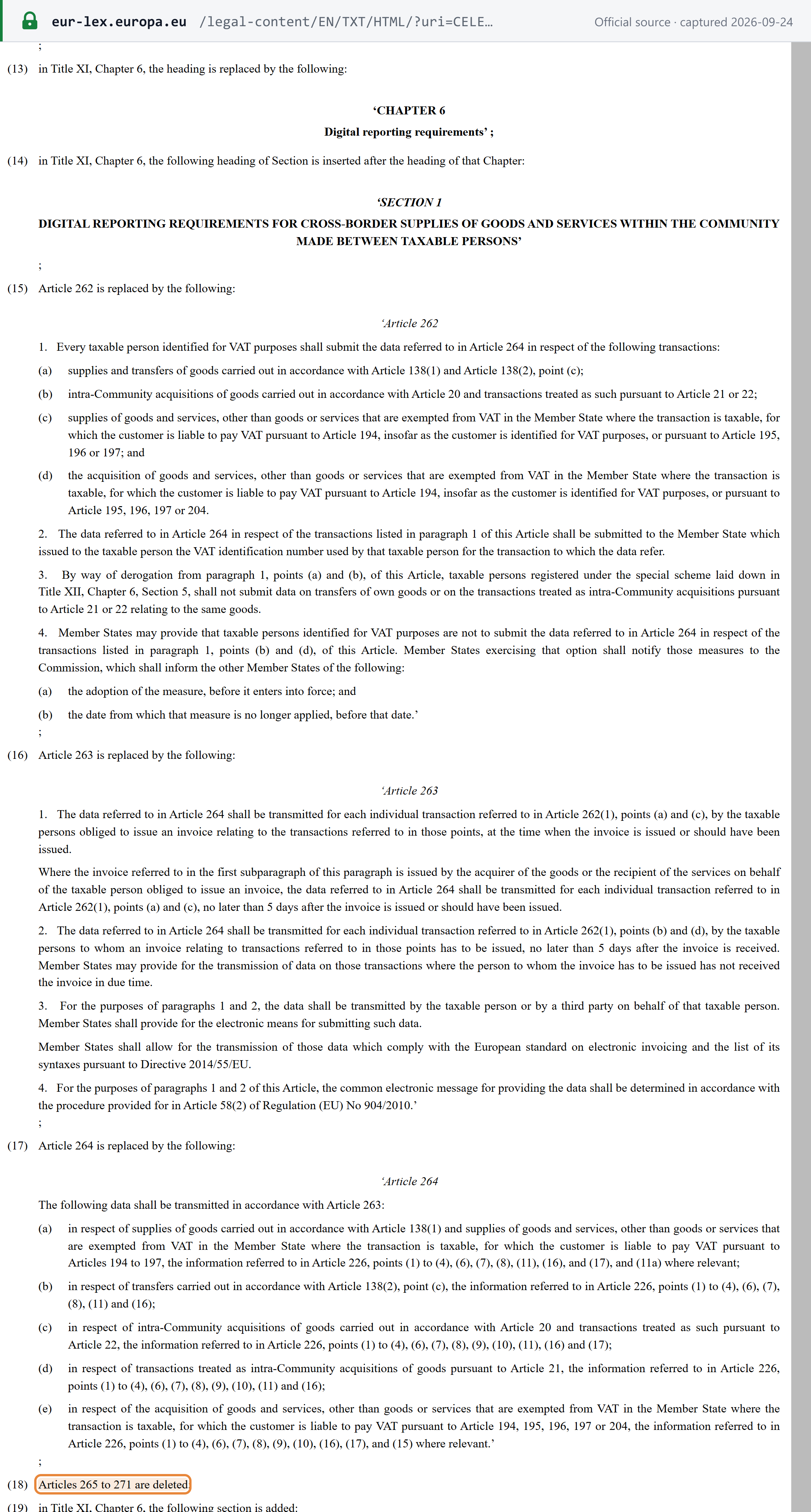 Source snapshot captured 2026-09-24 — original (EUR-Lex, Directive (EU) 2025/516)
One question is open for 2030: Bühler treated the Article 42(b) recapitulative-statement condition as formal. No court has yet ruled whether the new real-time reporting condition will be read the same way. The 2030 B2B cross-border e-invoicing rules also apply to B's invoice; see ViDA.
The newest judgment: T-773/25 (7 October 2026)
On 7 October 2026 the General Court (Second Chamber, sitting in a five-judge formation) gave judgment in Finanzamt für Großbetriebe v F GmbH (T-773/25, ECLI:EU:T:2026:638), on a reference from the Austrian Verwaltungsgerichtshof; it is published in German. F had corrected its 2011–2014 invoices in 2015 to add triangulation and reverse-charge references. The Court ruled that issuing invoices with the "Steuerschuldnerschaft des Leistungsempfängers" mention for the first time, several years after the supplies, does not trigger the legal consequences of the simplification for those supplies, so no VAT adjustment can be declared for the current or any future period. Luxury Trust ruled out a retroactive fix; T-773/25 rules out a late fix effective from the new invoice. (T-773/25, EUR-Lex, German)
Case law at a glance
| Case | Holding | Practical point |
|---|---|---|
| Bühler, C-580/16, 19 Apr 2018 | The VAT number used for the acquisition governs Art 141(c); a late recapitulative statement is a formal defect | B can be resident in the dispatch state if it buys under a third state's number |
| Luxury Trust Automobil, C-247/21, 8 Dec 2022 | No "Reverse charge" mention, no valid designation of C; no later correction | The mention is a substantive condition |
| MS Ključarovci, T-646/24, 3 Dec 2025 | Delivery to C's customer in the same state can satisfy Art 141(c) | Four-party chains can qualify |
| F GmbH, T-773/25, 7 Oct 2026 | A first-time compliant invoice issued years later does not trigger the regime, even ex nunc | Get the invoice right at the time of supply |
For Euro Tyre Holding (C-430/09) and Kreuzmayr (C-628/16), which concern chain allocation rather than triangulation, see chain transactions. Judgments: C-580/16, C-247/21, T-646/24, T-773/25 (German).
National rules: how Member States apply triangulation
Selected Member States, as at 2026-10-08. The EU conditions cannot vary between states (Luxury Trust, para 67), but national texts differ on who may transport, which registrations bar B, and the invoice wording.
| Member State | Where it is in law | B must not be … in C's state | Who may transport | Longer chains | Invoice wording |
|---|---|---|---|---|---|
| EU baseline | VAT Directive Arts 42, 141, 197, 265 | Established | Not specified | Yes, around the one acquisition | "Reverse charge" |
| Germany | § 25b, § 14a(7) UStG; UStAE 25b.1 | Resident (ansässig) | A, or B as buyer; not C | Only at the end of the chain | Triangular transaction + last customer liable |
| France | CGI art 258 D; BOFiP BOI-TVA-CHAMP-20-40 | Established or identified | Not specified | Not addressed | « Application de l'article 141 de la directive 2006/112/CE … » |
| Spain | LIVA art 26.Tres, art 84.Uno.2º.a) | Established or identified | Not specified | Not addressed | «inversión del sujeto pasivo» |
| Italy | DL 331/1993 arts 38(7), 40(2), 44(2)(a), 46(2) | Rule refers to B identified "in altro Stato membro" | Not specified | Not addressed | C's VAT number + C designated as debtor |
| Netherlands | Belastingdienst guidance; policy decree on the Quick Fixes | — | B agrees transport with A | Yes | 'btw verlegd' |
| Poland | VAT Act arts 135–138 | Seat (siedziba) | A, or B | Not addressed | "VAT: Faktura WE uproszczona …" + C settles the tax |
| Austria | UStG 1994 Annex, Art 25 | Business or permanent establishment | Not specified | Yes, since 1 Jan 2023 | Triangular transaction + customer liable |
"Not addressed" means the national text is silent on the point.
Germany. § 25b(1) UStG requires that the goods are transported "durch den ersten Lieferer oder den ersten Abnehmer" — by A or B. The administration states that where the last customer transports or collects (Abholfall), "liegt ebenfalls kein innergemeinschaftliches Dreiecksgeschäft vor" (UStAE 25b.1(5)). Only the number used counts: "Die Ansässigkeit in einem dieser Mitgliedstaaten ist nicht erforderlich", but if several parties use numbers from the same Member State there is no triangular transaction (UStAE 25b.1(3)). The § 14a(7) invoice is a material condition (UStAE 25b.1(8), citing BFH XI R 35/22 of 17 July 2024). Under § 25f, where a party knew or should have known of fraud, the deemed taxation of B's acquisition (§ 25b(3)) and C's deduction (§ 25b(5)) are denied. (§ 25b UStG; § 14a UStG; UStAE, BMF; see the Germany guide)
France and Spain go further than Article 141(a). France bars a B that "n'est pas établi ou identifié en France" — B must be neither established nor identified in France, nor have appointed a tax representative there (BOFiP §180). Spain's art 26.Tres requires that B "no esté establecido ni identificado" in Spain. A B that already holds a French or Spanish VAT number therefore cannot use the simplification for sales into that country. France's doctrine on invoice mentions (BOI-TVA-DECLA-30-20-20-30, 8 January 2025) lists the Article 141 reference for triangulation, and does not list « Autoliquidation » for this case; since Luxury Trust requires the words "Reverse charge" (or the official equivalent), B should carry both. (BOFiP BOI-TVA-CHAMP-20-40; BOFiP BOI-TVA-DECLA-30-20-20-30; Ley 37/1992, BOE; see the France and Spain guides)
Italy. Art 38(7) DL 331/1993 relieves the acquisition in Italy; art 44(2)(a) makes the designated Italian customer liable; art 40(2) and art 46(2) cover an Italian B, whose invoice must show C's destination VAT number and C's "designazione ... quale debitore dell'imposta". From 1 January 2027 these provisions move, near-verbatim, into the new VAT consolidated text (Testo Unico IVA, D.Lgs. 19 January 2026, n. 10): art 38(7) becomes art 8(8), art 40(2) art 16(2), art 44(2)(a) art 66(2) and art 46(2) art 97(2). (Normattiva, art 40 DL 331/1993; see the Italy guide)
Netherlands. The Belastingdienst lists the conditions in its own words, including that B agrees the transport with A ("U maakt met A de afspraak over het vervoer van de goederen") and that the invoice carries C's VAT number and "de vermelding: 'btw verlegd'". It accepts a triangle followed by a fourth party. The former Kennisgroep position KG:210:2024:3 (A in Poland, B in the Netherlands, C and D in France, goods sent directly to D) applied the simplification to A-B-C; it lapsed on 11 October 2024, when it was incorporated into the policy decree "Omzetbelasting. Toelichting snelle oplossingen btw" (Besluit of 21 August 2024), which now carries it. (Belastingdienst, conditions; Kennisgroep; see the Netherlands guide)
Poland. Art 135(1)(2)(b) requires transport "przez pierwszego lub też transportowany przez drugiego w kolejności podatnika VAT lub na ich rzecz" — by A or B, not C. A Polish B's invoice must carry "VAT: Faktura WE uproszczona na mocy art. 135–138 ustawy o ptu" (or the Article 141 equivalent), a statement that the last taxpayer settles the tax, and — under art 106e(1)(18) — "odwrotne obciążenie". (Dz.U. 2026 poz. 1263; see the Poland guide)
Austria. Since 1 January 2023, Article 25(1) of the Binnenmarkt annex to the UStG 1994 defines a triangular transaction by reference to any Reihengeschäft ("Ein Dreiecksgeschäft liegt vor, wenn bei einem Reihengeschäft ... die in Abs. 3 genannten Voraussetzungen erfüllt werden"), so it can apply inside chains of more than three parties. Article 25(2) still says the exemption lapses retroactively if B fails its reporting duty; under Bühler, a statement that is late but complete cannot by itself defeat the simplification. (RIS, UStG 1994 Annex Art 25; see the Austria guide)
Guides for Belgium, Cyprus, the Czech Republic, Ireland, Luxembourg, Malta and Sweden also cover national triangulation invoicing points.
Related changes
No recent legislative change amends Articles 141 or 197. The developments that matter are the T-773/25 judgment of 7 October 2026 and the ViDA changes from 1 July 2030, both described under Current status. Adjacent:
- Italy — Testo Unico IVA from 1 January 2027, which renumbers the Italian triangulation provisions
- ViDA — VAT in the Digital Age — digital reporting and the 2030 invoice rules
- Tax-change chronologies: European Union and Italy
Frequently asked questions
Does the intermediary have to register for VAT in the customer's country?
No, if all the Article 141 conditions are met. The intermediary's intra-Community acquisition in the arrival state is not taxed, the final customer accounts for the VAT on the intermediary's sale under the reverse charge (Article 197), and the intermediary lists that sale on the recapitulative statement of the Member State whose VAT number it used (Articles 42 and 265). (VAT Directive Articles 42, 141, 197, 265; Bühler C-580/16, para 41)
What must the intermediary's invoice say?
It must show the final customer's VAT number in the arrival state and the words “Reverse charge”, or the official equivalent in the invoice language (Article 226(4) and (11a)). Another statement cannot replace those words. National rules can add wording, such as the reference to a triangular transaction required in Germany. From 1 July 2030 the invoice must also say “triangular transaction” and be issued within 10 days. (Luxury Trust C-247/21, para 51 and operative part; Directive (EU) 2025/516 Article 5)
Can a missing “Reverse charge” mention be fixed later?
No. Adding the mention afterwards is the issuance of the required invoice for the first time and cannot have retroactive effect (Luxury Trust, 8 December 2022). In its judgment of 7 October 2026 (T-773/25, published in German), the General Court held that first-time compliant invoices issued years after the supplies do not trigger the simplification even from the date of the new invoice. (C-247/21, para 61; T-773/25)
Does triangulation work with four companies in the chain?
It can, for the three parties around the single intra-Community acquisition. The General Court held in T-646/24 (3 December 2025) that delivery to the final customer's own customer in the same Member State does not prevent Article 141(c) from being met, and the Commission's Explanatory Notes take the same view. Germany's administrative guidance accepts it only where the three parties are at the end of the chain. (T-646/24; Explanatory Notes §3.6.17.2; UStAE 25b.1(2))
Can the intermediary use a VAT number from the country the goods leave?
No. The intermediary must use a VAT number of a Member State other than the departure state for the acquisition, and other than the arrival state. It may still be resident and registered in the departure state, as long as it buys under another state's number (Bühler). France and Spain also exclude an intermediary that is identified in the arrival state. (Bühler C-580/16; BOFiP BOI-TVA-CHAMP-20-40 §180; LIVA art 26.Tres)
Related resources
- Chain transactions — Article 36a: which supply gets the transport, and Euro Tyre and Kreuzmayr
- Intra-community supply — the Article 138 exemption on A's supply
- Call-off stock — the other 2020 Quick Fixes simplification
- VIES and Intrastat and VAT listings explained — B's recapitulative statement
- Reverse charge — Article 197 among the EU reverse charges, and the Article 226(11a) mention
- ViDA — VAT in the Digital Age — the 2030 reporting and invoicing changes
- Check a VAT number — validate C's arrival-state number before invoicing
- Tax glossary and worldwide tax rates
- Country guides: Germany, France, Spain, Italy, Netherlands, Poland, Austria, Belgium
- Tax-change chronologies: European Union, Italy
Reference links
- VAT Directive 2006/112/EC, consolidated version of 14.04.2025 — Articles 36a, 40, 41, 42, 141, 197, 219a, 222, 226, 262, 265 (EUR-Lex)
- Council Directive (EU) 2025/516 (ViDA) — Articles 3, 5 and 6 (EUR-Lex)
- Explanatory Notes on the 2020 Quick Fixes — §3.6.17 (European Commission, DG TAXUD)
- Judgments: C-580/16 Bühler, C-247/21 Luxury Trust Automobil, T-646/24 MS Ključarovci, T-773/25 (German) (EUR-Lex)
- Germany: § 25b UStG, § 14a UStG, § 25f UStG
- France: BOFiP BOI-TVA-CHAMP-20-40, BOFiP BOI-TVA-DECLA-30-20-20-30
- Spain: Ley 37/1992 del IVA, RD 1619/2012
- Italy: DL 331/1993 art 38, Testo Unico IVA, GU S.O. n. 4 of 30 January 2026
- Poland: VAT Act, Dz.U. 2026 poz. 1263
- Austria: UStG 1994 Annex Art 25 (RIS)