Fiscal devices and certified cash registers
A fiscal device is a cash register, or certified till software, that a national law requires retailers to use (or, where a business uses one, regulates) so that every sale to a consumer is recorded tamper-proof. Depending on the country it stores sales in unalterable memory, signs them with a certified security module, or sends receipt data to the tax authority, sometimes before the receipt can be issued.
Neither the EU VAT Directive nor OECD guidance sets a common fiscal-device standard (as at 2026-10-07): each regime is national law, owned by the national tax authority. The two ends of the spectrum show the range. Tanzania's regulations define an electronic fiscal device as a registered machine "including Electronic Tax Register, electronic fiscal printer and electronic signature device" (VAT (Electronic Fiscal Devices) Regulations 2010, GN No. 192, reg. 3; TanzLII). Croatia's Tax Administration defines fiscalisation as the automated programmatic delivery of data from receipts and e-invoices to the Tax Administration in real time ("Fiskalizacija predstavlja automatiziranu programsku dostavu podataka iz računa/eRačuna Poreznoj upravi u realnom vremenu"; Porezna uprava comparison table, row 1). Both checked 2026-10-07.
How it works
Every regime solves the same problem — cash sales that are never recorded — but with one of four architectures. Several countries have moved from one to another, so the model a country uses today is a dated fact, not a constant.
| Architecture | What the device does | Does data reach the tax authority? | Examples (as at 2026-10-07) |
|---|---|---|---|
| A. Fiscal memory, offline | Prints an itemised fiscal receipt, keeps a journal and stores sales in memory that cannot be altered | No automatic transmission; inspectors read the device | Malta |
| B. Certified security module | Every transaction is signed by a certified module; the receipt carries the signature or a check value | No per-sale transmission; the device is notified or registered | Germany (TSE); Austria (signature chain + FinanzOnline registration) |
| C. Online till reporting to a central system | The register keeps a connection to a tax-authority repository and sends sales data continuously or in a daily aggregate | Yes, after the sale | Poland (CRK); Italy (registratori telematici); Russia (via a fiscal data operator); Hungary; Tanzania (licensed EFDs, at least at every daily Z closure) |
| D. Per-receipt real-time clearance or verification | Each receipt is sent to, or checked against, the tax authority's system as it is issued; in Croatia and Slovenia an identifier returned by the system is printed on it | Yes, before or as the receipt is issued | Croatia (JIR); Slovenia (EOR); Serbia (QR verified on the Tax Administration portal); Uganda (EFRIS) |
A. Fiscal memory without transmission — Malta
Malta's VAT Act (Cap. 406, Thirteenth Schedule) requires retailers and food caterers to issue fiscal receipts "by means of a fiscal cash register" (item 3(1)). Item 13(2) lists the register's functions: an itemised receipt, the registering of all day-to-day transactions on a printed or electronic journal, and "storing of predefined data in an inaccessible and unalterable memory". The Schedule sets no requirement to transmit receipt data to the MTCA (as at 2026-10-07). (legislation.mt, Cap. 406)
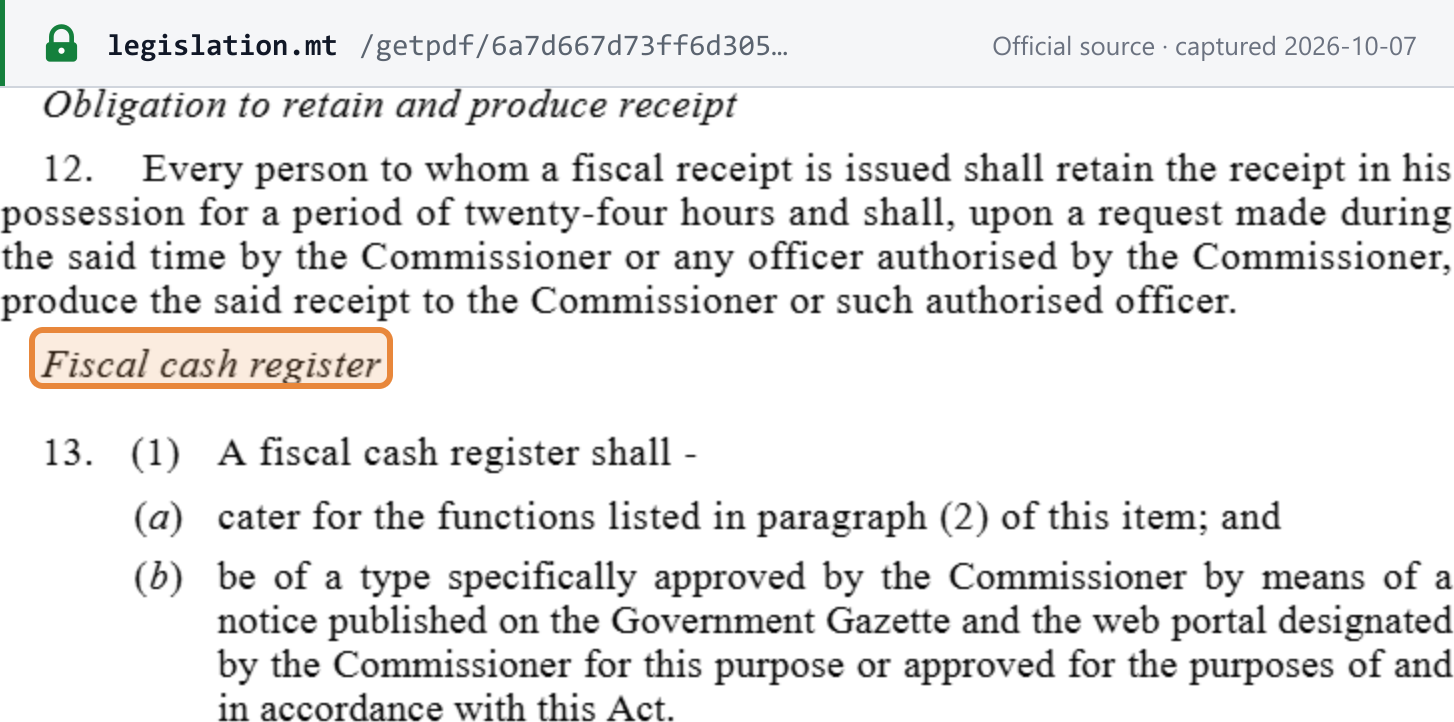 Source snapshot captured 2026-10-07 — original
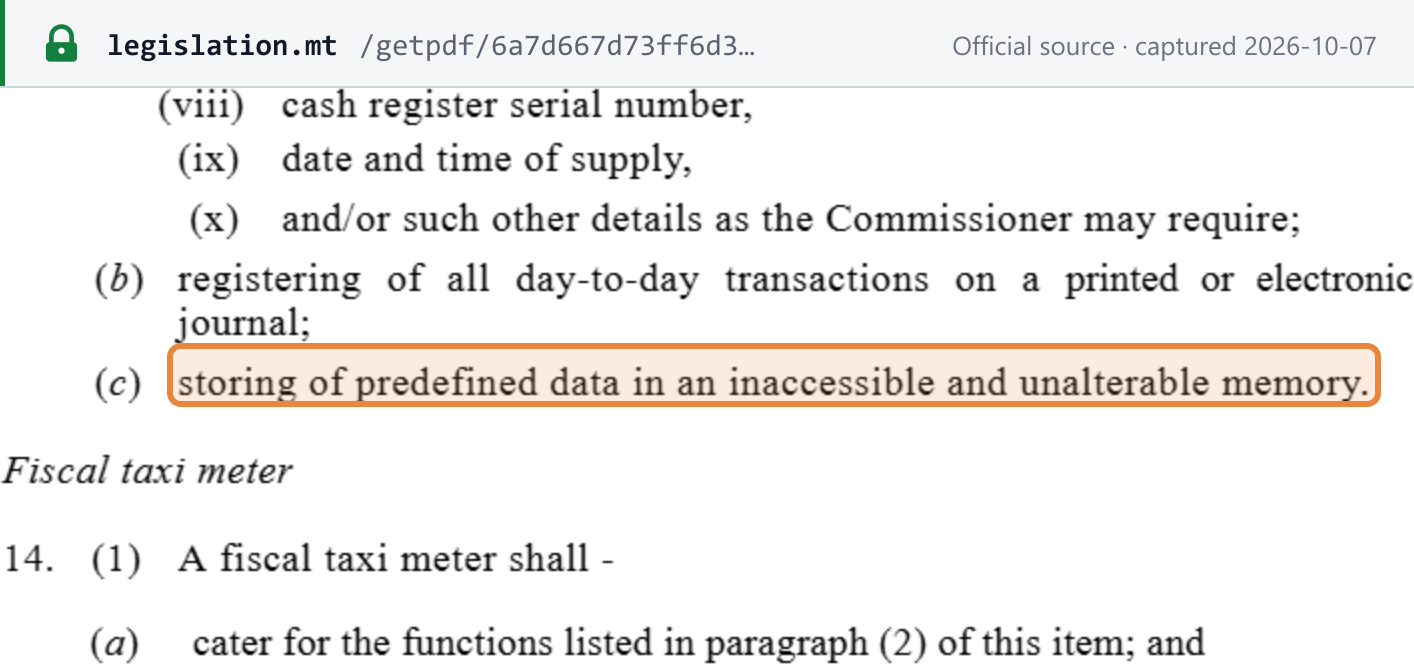 Source snapshot captured 2026-10-07 — original
B. A certified security module — Germany and Austria
Germany (§146a AO, KassenSichV). Anyone who records transactions with an electronic recording system must use one that records each transaction individually, completely, correctly, promptly and in order, and must protect it with a certified technical security device (TSE). The TSE "muss aus einem Sicherheitsmodul, einem Speichermedium und einer einheitlichen digitalen Schnittstelle bestehen" — it consists of a security module, a storage medium and a uniform digital interface. The Federal Office for Information Security (BSI) certifies it (§146a(3)). The business must issue a receipt to the customer (§146a(2), the Belegausgabepflicht) and must notify the tax office of its systems within one month of acquiring or decommissioning one (§146a(4)). (§146a AO, checked 2026-10-07)
 Source snapshot captured 2026-10-07 — original
The systems in scope are "elektronische oder computergestützte Kassensysteme oder Registrierkassen" — electronic or computer-based till systems and cash registers (KassenSichV §1(1)). Taximeters and odometers are also in scope (§1(2)). Ticket and parking machines, EV charge points, vending machines, ATMs, gaming machines and accounting software are excluded. Nothing is transmitted per sale: the TSE's signature data sit on the receipt and in the system for a tax audit. (KassenSichV, last amended by Art. 3 of the Verordnung of 14 January 2026, checked 2026-10-07)
Austria (Registrierkassenpflicht, RKSV). Every register must have a technical security device. The BMF explains how it works: the receipt carries a machine-readable code (for example a QR code) containing a signature value, and "Mit der Signatur werden die Barumsätze der Registrierkasse in chronologischer Reihenfolge miteinander verkettet" — the signature chains the register's cash sales in chronological order, so manipulating any record breaks the chain and is detectable. The register is registered in FinanzOnline and its start receipt is checked. The technical details are in the Registrierkassensicherheitsverordnung (RKSV). (BMF — Registrierkassen, page last updated 1 January 2026, checked 2026-10-07)
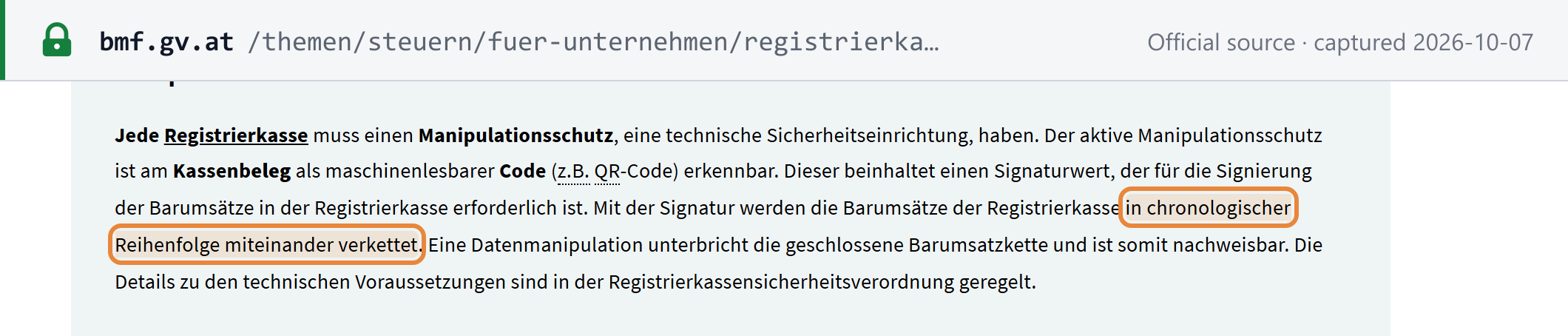 Source snapshot captured 2026-10-07 — original
C. Online devices reporting to a central system — Poland, Italy, Russia, Hungary, Tanzania
Poland (kasy online). Under art. 111(1) of the VAT Act, businesses selling to individuals not running a business and to flat-rate farmers "są obowiązani prowadzić ewidencję sprzedaży przy zastosowaniu kas rejestrujących" — they must record those sales on cash registers. The register must keep a connection that allows data to flow to the Centralne Repozytorium Kas (CRK), the Central Cash Register Repository (art. 111(3a) pt 12). Data move from the till to the CRK "directly, continuously, automatically or on demand" of the Head of the National Revenue Administration, and the CRK sends commands back to the till, including its fiscalisation (art. 111a(3)). Each till's fiscal memory has a unique number assigned by the Minister of Finance (art. 111(6a)), and every till type needs confirmation from the President of the Central Office of Measures (GUM) that it meets the technical requirements (art. 111(6b)). Alongside hardware tills, a separate regulation covers cash registers in the form of software (Dz.U. 2025 poz. 861). (consolidated VAT Act, Dz.U. 2026 poz. 1263, pp. 148–153, checked 2026-10-07)
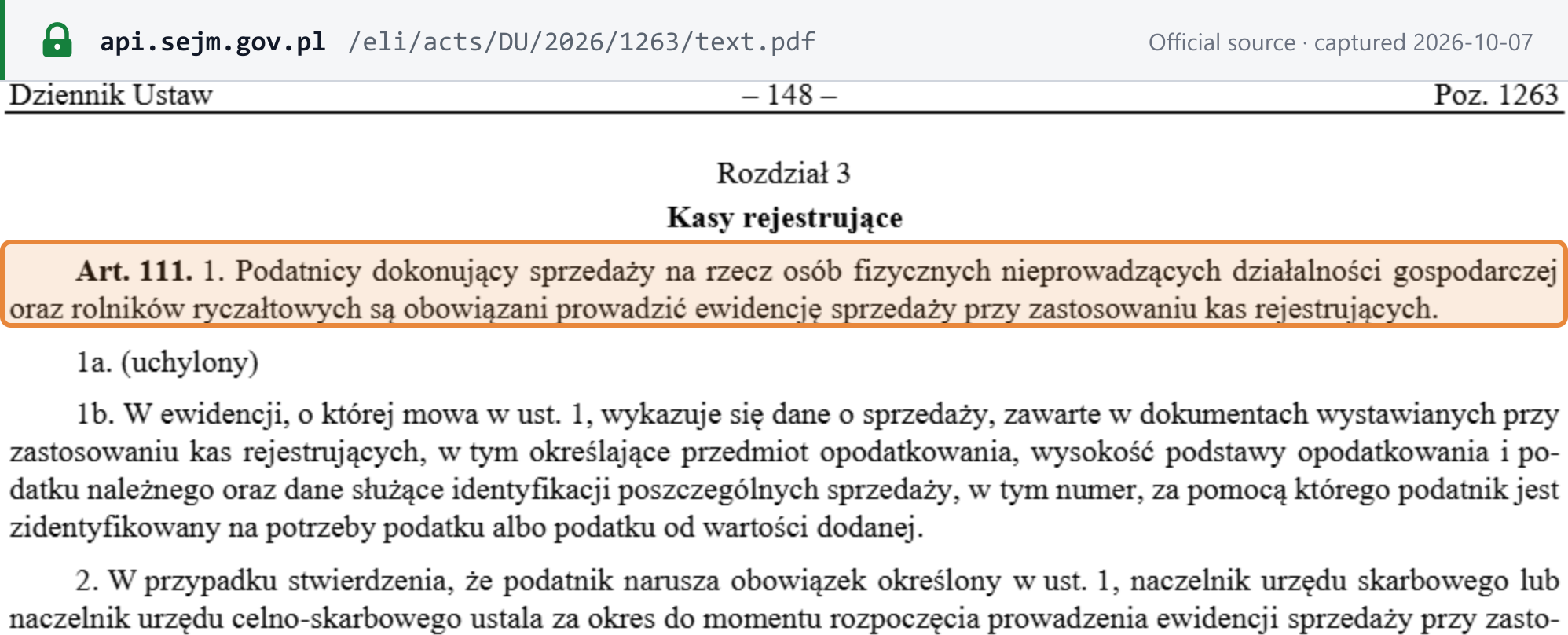 Source snapshot captured 2026-10-07 — original
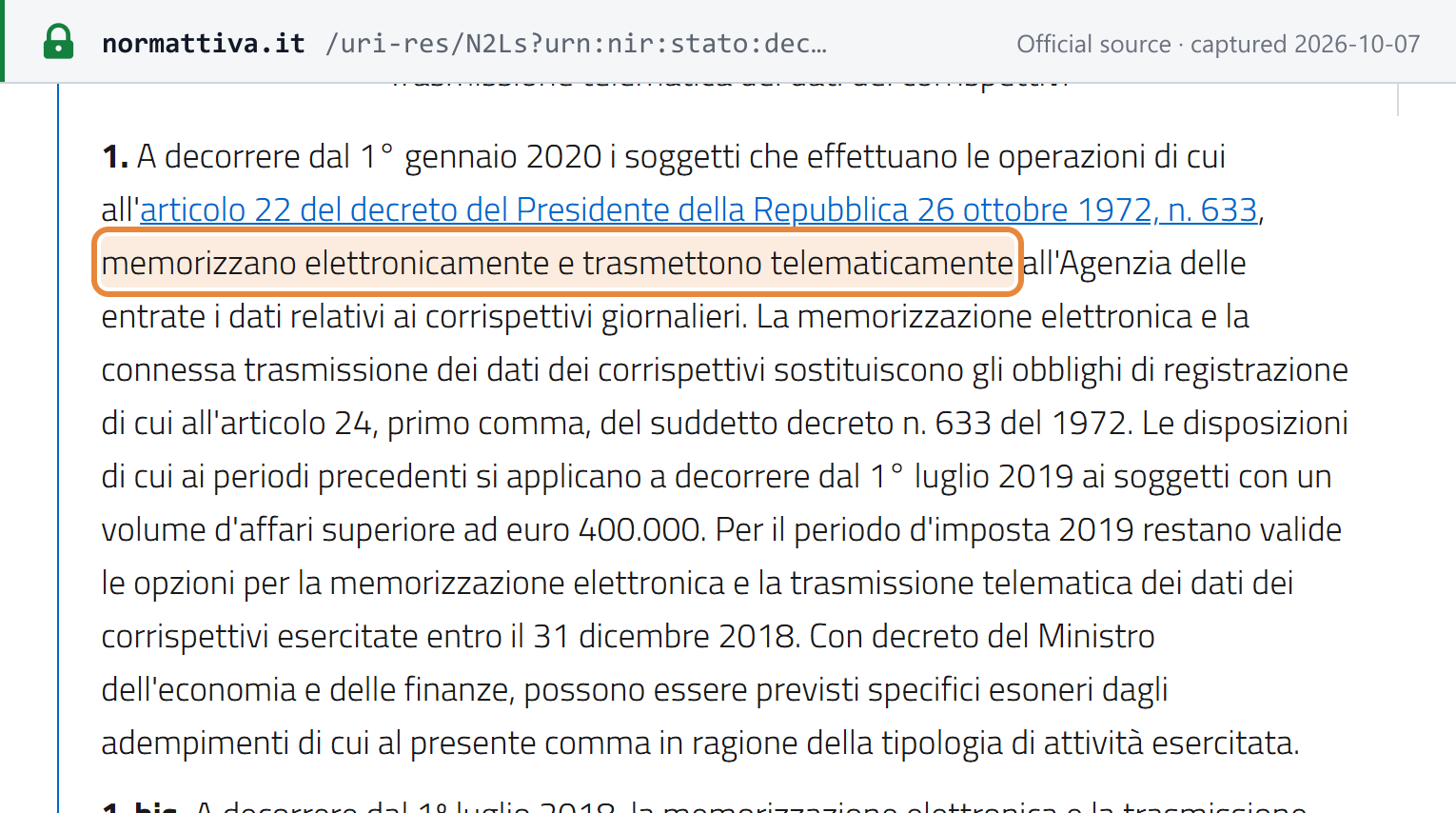
Italy (registratori telematici). Under art. 2(1) of d.lgs. 127/2015, as in force on 2026-10-07, everyone making retail-type supplies (art. 22 DPR 633/1972) "memorizzano elettronicamente e trasmettono telematicamente all'Agenzia delle entrate i dati relativi ai corrispettivi giornalieri" — electronically stores and transmits to the Agenzia delle Entrate the data on daily takings. The data travel "in forma aggregata", as a daily aggregate rather than receipt by receipt. Electronic storage and transmission replace the art. 24 takings register. Since 1 January 2026 (2025 Budget Law, L. 207/2024 art. 1(77)) the electronic-payment (POS) tool must always be connected to the instrument that records and transmits the takings (art. 2(3)). An invoice is still issued when the customer asks for one. (Normattiva, art. 2 d.lgs. 127/2015, version in force 2026-10-07)
 Source snapshot captured 2026-10-07 — original
Russia (online-KKT). The 2016 revision of Federal Law 54-FZ, in force 15 July 2016, moved businesses to cash registers that send settlement data for cash and electronic payments to the tax authorities through a fiscal data operator (OFD). Online registers became mandatory from 1 July 2017, with some groups deferred to 1 July 2018. The OFD stores the fiscal documents it receives in a form that cannot be corrected, and the user must keep the register's fiscal drive for five years after it is taken out of use. (FNS announcement of the 2016 reform, which FNS marks as an archival publication; checked 2026-10-07)
Hungary (online pénztárgép → e-pénztárgép). Hungary is replacing its online cash registers with e-cash registers under NGM Decree 8/2025. Each e-receipt goes to NAV's receipt store (nyugtatár), which keeps the data for ten years, and NAV carries out the type testing. The more than 200,000 online cash registers in use remain usable until 1 July 2028. (NAV, 1 April 2025, checked 2026-10-07)
 Source snapshot captured 2026-09-30 — original
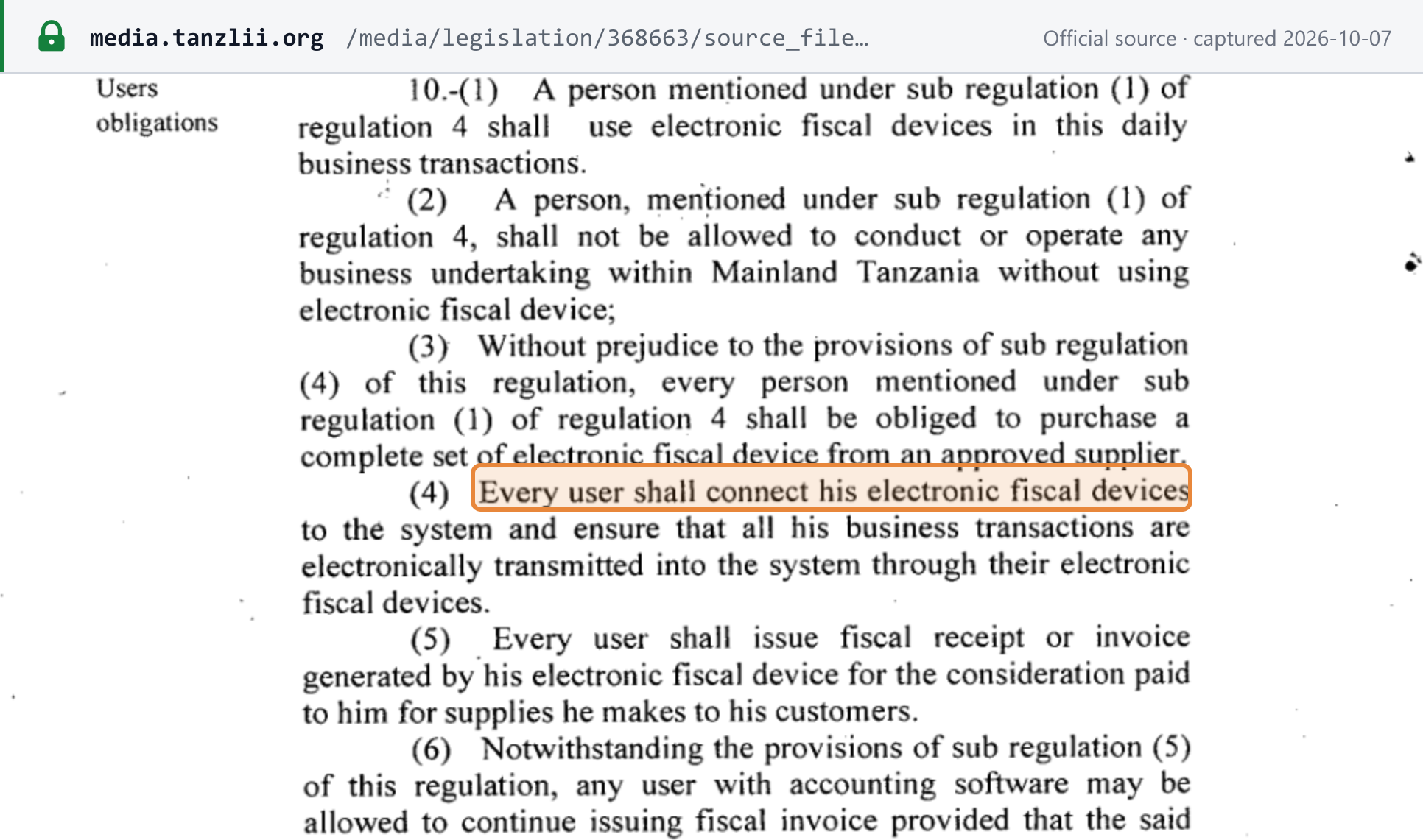
Tanzania (electronic fiscal devices). Tanzania's EFDs are licensed devices connected to a transmission system the Commissioner establishes (GN No. 192 of 2010, reg. 9(1)). "Every user shall connect his electronic fiscal devices to the system and ensure that all his business transactions are electronically transmitted into the system through their electronic fiscal devices" (reg. 10(4)). The schedule's connectivity specification requires a GPRS modem that transmits data "upon every daily Z closure to TRA". Each device must be licensed with the Commissioner (reg. 5(1)), and devices may only be supplied by a supplier "duly certified by the Commissioner" (reg. 6(1)). (GN No. 192 of 2010, TanzLII, checked 2026-10-07)
 Source snapshot captured 2026-10-07 — original
D. Per-receipt real-time clearance or verification — Croatia, Slovenia, Serbia, Uganda
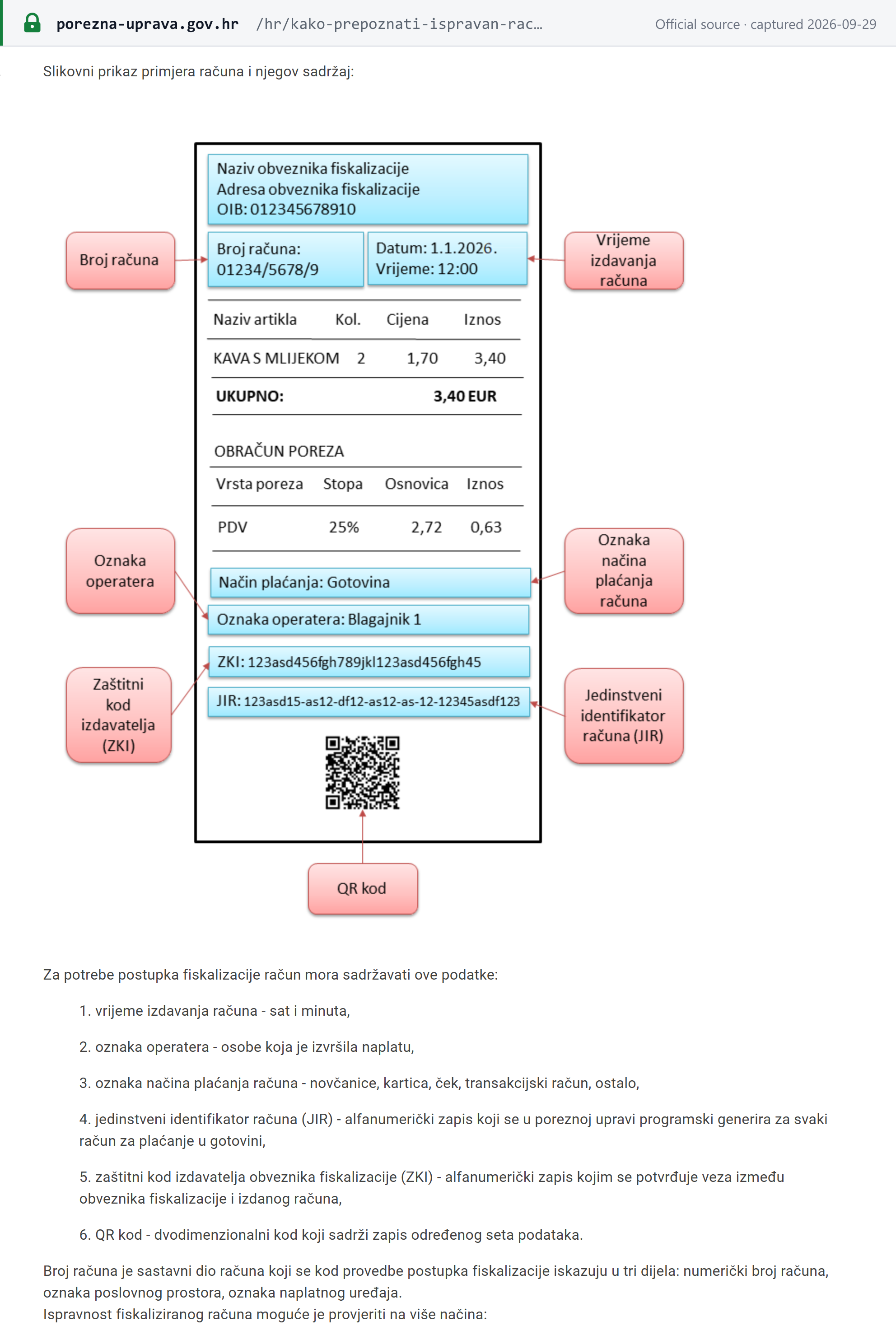
Croatia (fiskalizacija u krajnjoj potrošnji). For every receipt for final consumption, the business signs the receipt elements electronically and sends them to the Sustav za fiskalizaciju (the fiscalisation system). If the message is complete and the certificate is valid, the system assigns a JIR (Jedinstveni identifikator računa, unique invoice identifier) and returns it to the business (Zakon o fiskalizaciji, art. 15(1) and (3)). Article 7(1) lists the six fiscal data items every receipt carries: time of issue, operator, payment method, JIR, the issuer's protective code ZKI, and a QR code. B2C fiscalisation applies whatever the payment method — cash, card, bank transfer or other. (Zakon o fiskalizaciji, NN 89/2025; Porezna uprava comparison table, row 2; checked 2026-10-07)
 Source snapshot captured 2026-09-29 — original
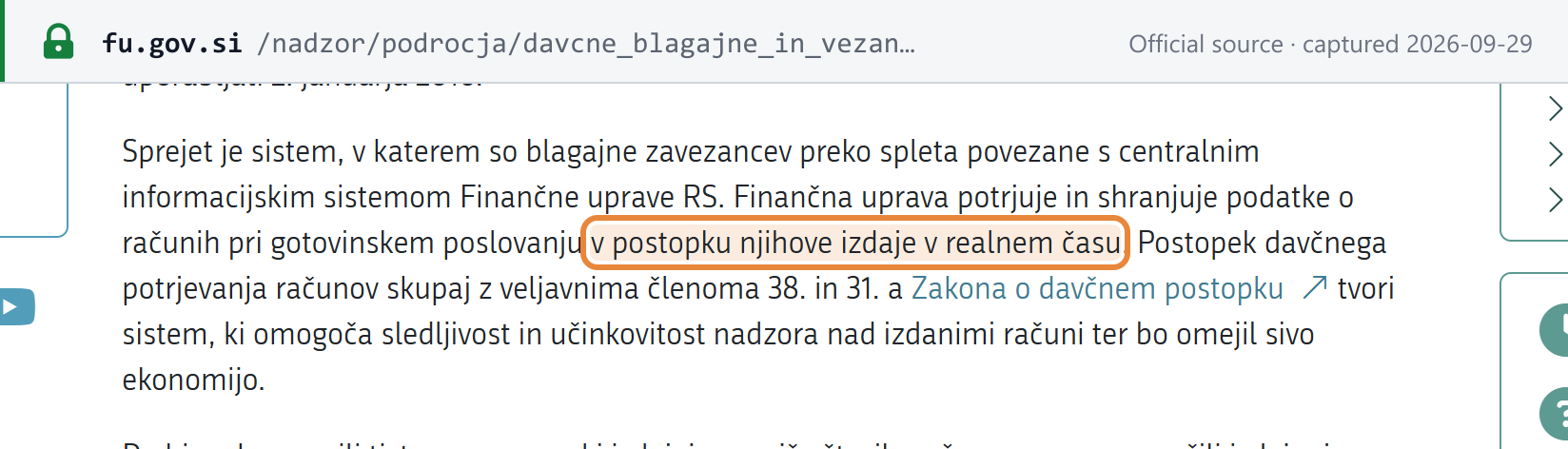
Slovenia (davčne blagajne). Since 2 January 2016, registers have been connected online to the FURS central information system, which "potrjuje in shranjuje podatke o računih pri gotovinskem poslovanju v postopku njihove izdaje v realnem času" — verifies and stores invoice data for cash transactions in real time, as the invoices are issued (FURS, checked 2026-10-07). Card payments count as cash for this purpose, and the invoice carries the EOR returned by FURS and the issuer's protective mark ZOI (ZDavPR, art. 2; Uradni list RS 57/2015).
 Source snapshot captured 2026-09-29 — original
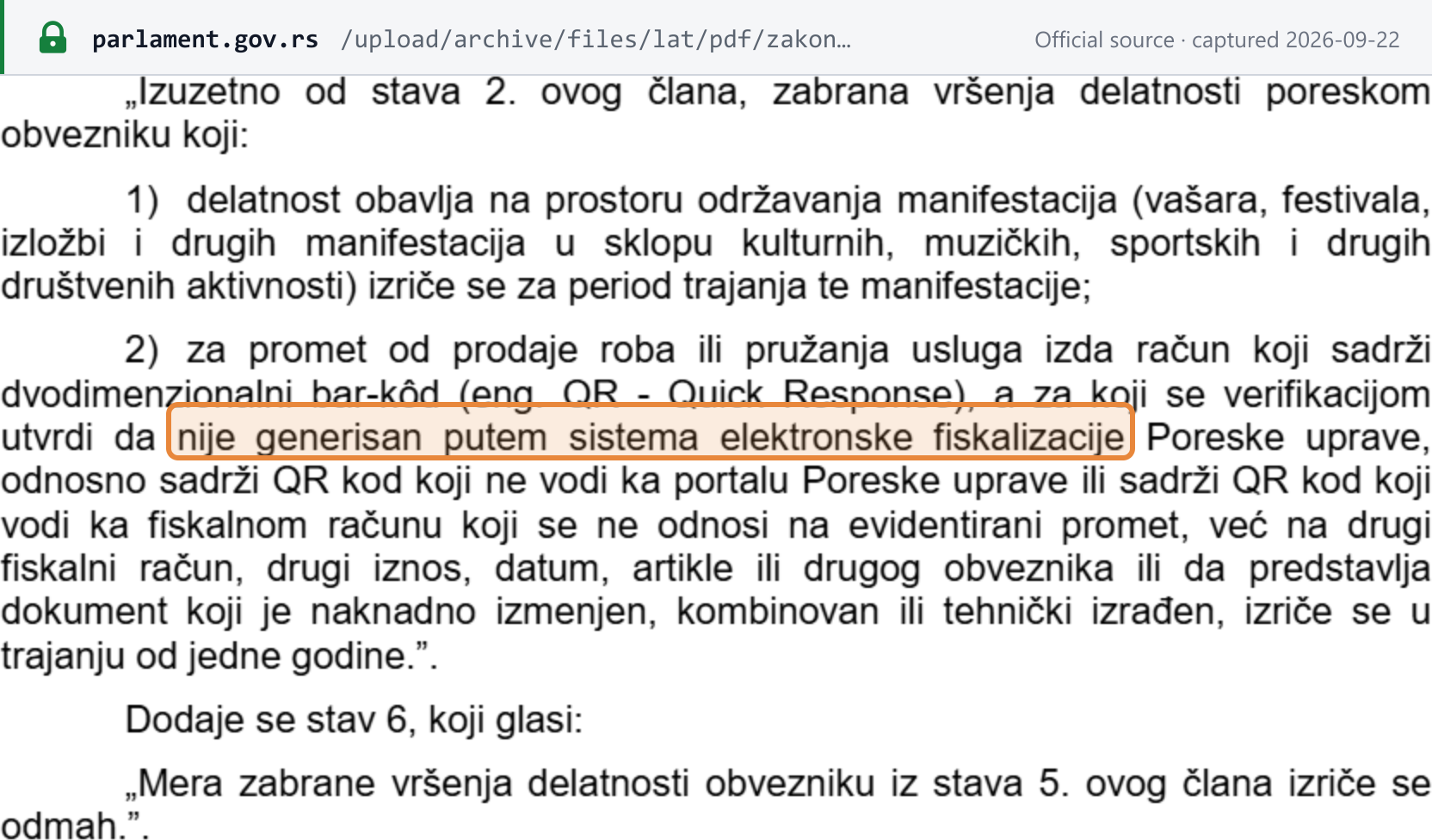
Serbia (elektronska fiskalizacija). A Serbian receipt carries a QR code that resolves to the Tax Administration portal. A 2026 amendment to the Law on Fiscalization makes a receipt whose QR code fails that check — not generated through the e-fiscalisation system, not leading to the portal, or leading to a different receipt, amount, date, items or taxpayer — grounds for a one-year business ban (see Who it affects).
Uganda (EFRIS). The Electronic Fiscal Receipting and Invoicing Solution lets businesses "record transactions and share transaction information with the Uganda Revenue Authority in real time". One system covers both B2B e-invoices and B2C e-receipts. Businesses can comply through a mobile app; an EFD, a point-of-sale device with a virtual Sales Data Controller and a secure memory that transmits to URA; a desktop client that works offline for up to five days; the URA web portal; a system-to-system API; or an Electronic Dispenser Controller at fuel stations. (URA — EFRIS, checked 2026-10-07)
Kenya (TIMS/eTIMS). Kenya's eTIMS sits between a fiscal device and an e-invoicing system: tax invoices are generated and transmitted through the KRA's eTIMS. Every VAT-registered taxpayer must onboard on eTIMS, and "A tax invoice should be serially numbered and generated from eTIMs" (KRA VAT guide, checked 2026-10-07). Since 31 August 2026, suppliers to government entities must generate eTIMS invoices whose details match those submitted for payment through IFMIS (KRA public notice 2388).
What the receipt must show — the German example
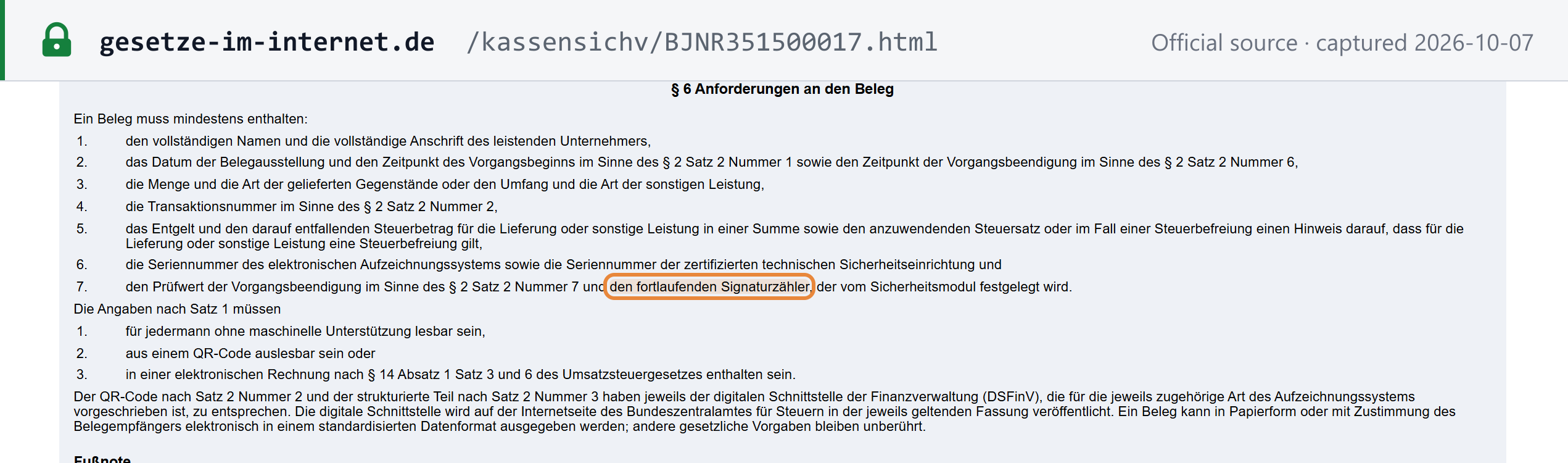
A receipt is where the architecture becomes visible to the customer. Under KassenSichV §6 a German receipt must carry at least: the supplier's full name and address; the date of issue and the start and end times of the transaction; the quantity and type of goods or services; the transaction number; the consideration and tax with the rate, or a note of the exemption; the serial numbers of the recording system and of the TSE; and the TSE's check value (Prüfwert) together with "den fortlaufenden Signaturzähler, der vom Sicherheitsmodul festgelegt wird" — the running signature counter set by the security module. The data must be readable without a machine, readable from a QR code, or contained in an e-invoice; the QR code follows the DSFinV published by the BZSt. The receipt may be on paper or, with the customer's consent, electronic. (KassenSichV §6, checked 2026-10-07)
 Source snapshot captured 2026-10-07 — original
Austria's minimum receipt content includes the business identity, a sequential number, the date and time of issue, the goods or services, the cash amount and the amount by VAT rate, the cash-register identification number (Kassenidentifikationsnummer) and the content of the machine-readable code; a copy is kept for seven years (BMF). Croatia requires the six fiscal data items above. Malta's MTCA guidelines of 13 July 2026 add that a fiscal receipt from a supplier registered under article 11 of the VAT Act shows "EXP" before the VAT number, and exempt-without-credit lines are marked "E" or "Exempt" (MTCA guidelines).
Fiscal receipts are not B2B e-invoices
Fiscalisation covers sales to consumers. B2B e-invoicing under a continuous transaction control (CTC) model covers invoices between businesses. Some countries run both through one system (Uganda's EFRIS), but the European trend is to separate the two channels by law.
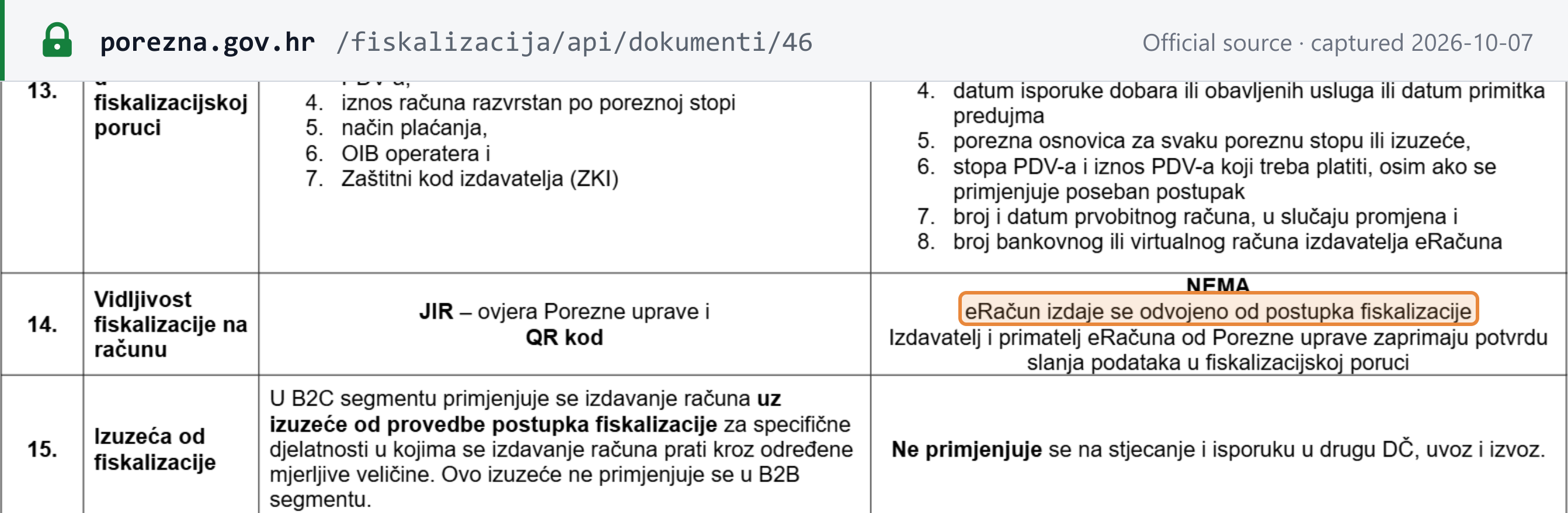
Croatia's official comparison table draws the line. In the B2C model the till sends one message to the Tax Administration and receives a JIR, and the receipt carries the JIR and a QR code. For a B2B eRačun, both the issuer and the recipient send fiscalisation messages, which allows the data to be cross-checked; the e-invoice itself carries no fiscalisation mark ("NEMA") and "eRačun izdaje se odvojeno od postupka fiskalizacije" — it is issued separately from the fiscalisation procedure. A PDF sent by e-mail is not an eRačun. (Porezna uprava comparison table, row 14, checked 2026-10-07)
 Source snapshot captured 2026-10-07 — original
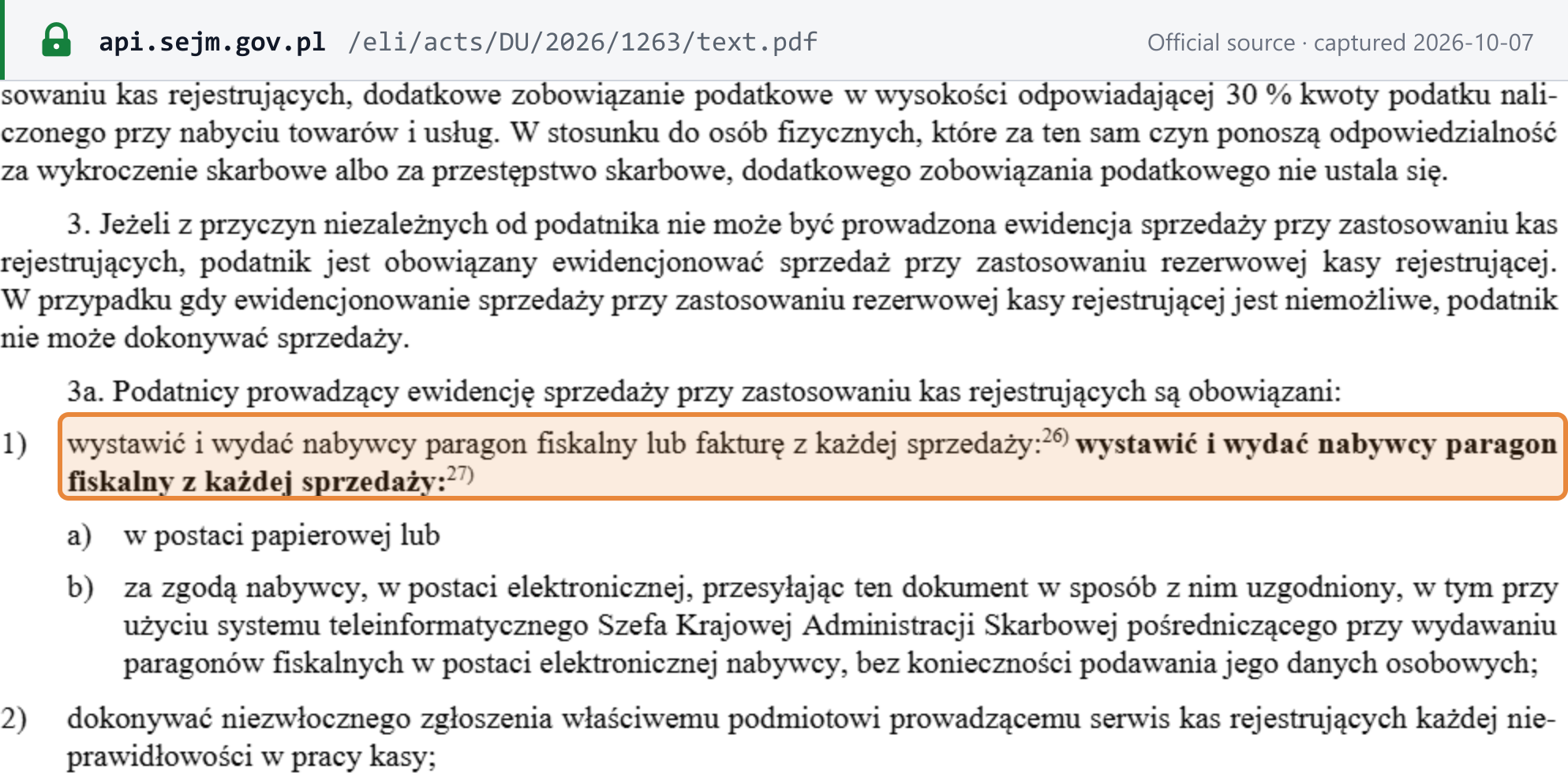
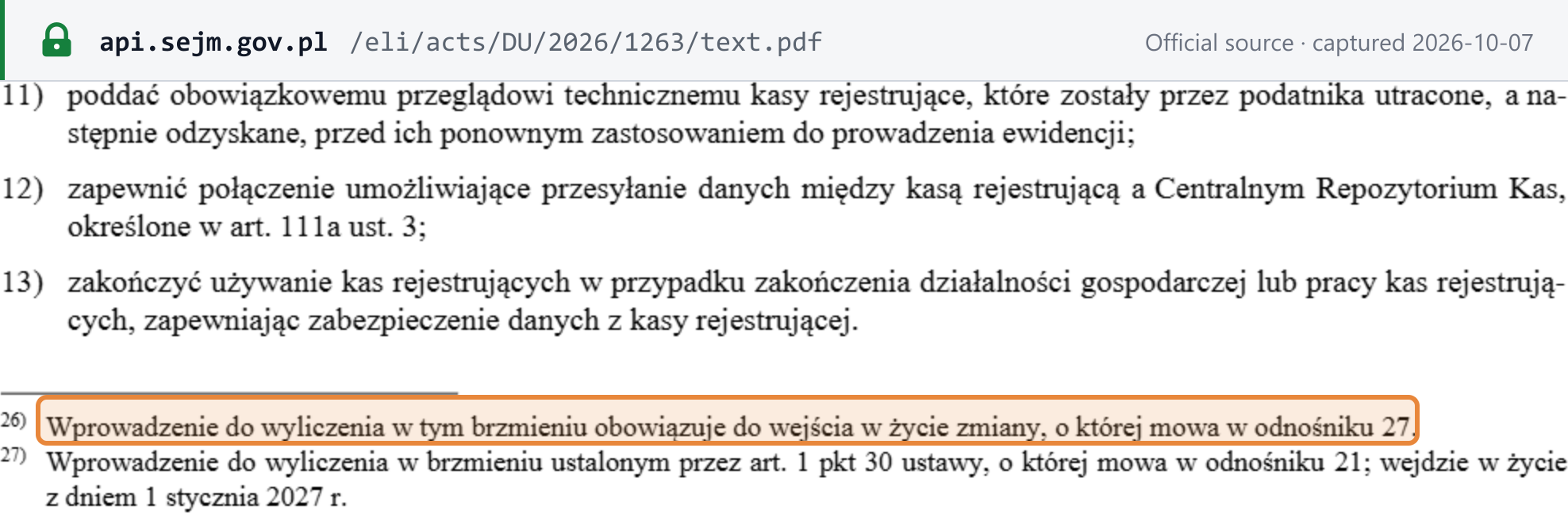
Poland writes the same split into its VAT Act. Today art. 111(3a)(1) requires the till to issue a "paragon fiskalny lub fakturę" — a fiscal receipt or an invoice — for every sale. From 1 January 2027 the wording becomes "paragon fiskalny z każdej sprzedaży": the till issues a fiscal receipt for every sale, and the invoice option is dropped. The change comes from art. 1 pt 30 of the Act of 16 June 2023 (Dz.U. 2023 poz. 1598), the act that introduced KSeF. The receipt can still be on paper or, with the buyer's consent, electronic, including through the National Revenue Administration's e-receipt system. (VAT Act art. 111(3a)(1) and footnotes 26–27, Dz.U. 2026 poz. 1263, p. 148, checked 2026-10-07)
 Source snapshot captured 2026-10-07 — original
 Source snapshot captured 2026-10-07 — original
For the B2B side — clearance, real-time reporting and interchange models — see the CTC e-invoicing models explainer.
Who it affects
Fiscal-device rules apply to businesses that sell to consumers, typically for cash and, in many countries, for card payments too. Scope and thresholds are set nationally and differ widely; the figures below are the ones these countries publish, as at 2026-10-07. They are not a general pattern.
-
Germany. §146a AO applies to anyone who chooses to record transactions on an electronic recording system. Today it imposes no general duty to own a register. A government bill would introduce one from 2028 for businesses with annual turnover of EUR 100,000 or more, exempting businesses with annual cash sales below EUR 12,000 — a proposal, not yet law (see Current status).
-
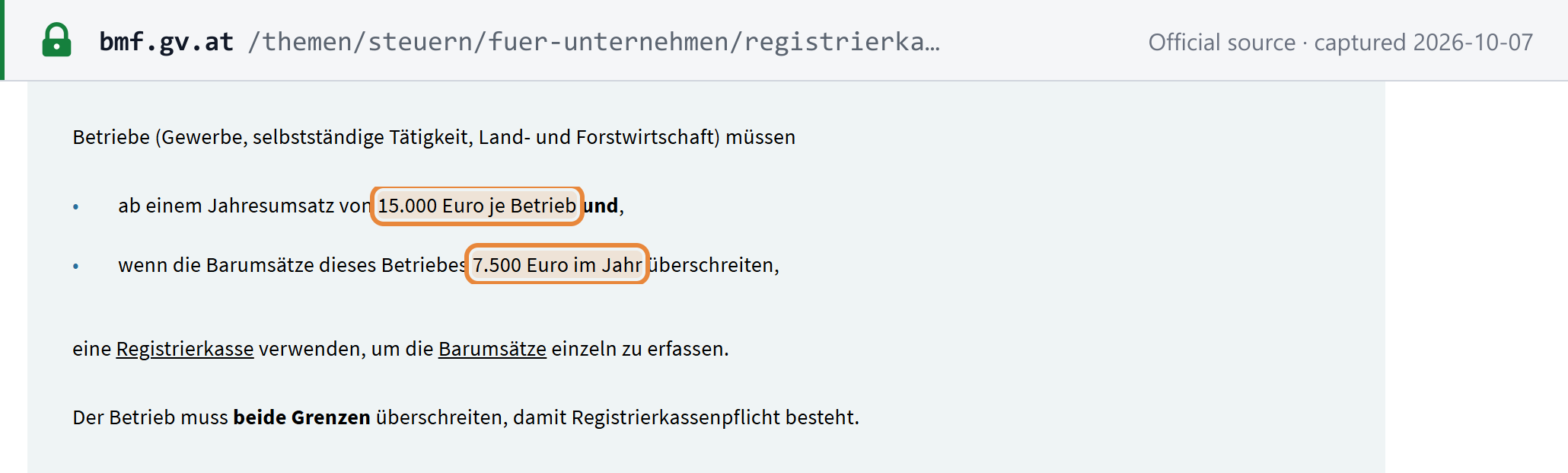
Austria. A register is required "ab einem Jahresumsatz von 15.000 Euro je Betrieb" and where the business's cash sales exceed EUR 7,500 a year; both limits must be exceeded. The duty starts from the fourth month after the end of the VAT return period in which the limits were first exceeded. The duty to issue a receipt applies from the first cash sale, whatever the turnover. Exemptions include outdoor sales ("kalte Hände") up to EUR 45,000 net and mountain huts. (BMF, checked 2026-10-07)
 Source snapshot captured 2026-10-07 — original
 -
Poland. Businesses whose prior-year sales to individuals and flat-rate farmers did not exceed PLN 20,000 are exempt from using a till, at the latest until 31 December 2027, and listed activities are exempt as well (Regulation of the Minister of Finance of 17 December 2024, Dz.U. 2024 poz. 1902, §3(1)(1); a 2026 amendment, Dz.U. 2026 poz. 420, changed only annex items 38 and 59). A business buying a till can deduct 90% of its net price, up to PLN 700 (VAT Act art. 111(4)).
-
Italy. The obligation has applied to all retail-type suppliers since 1 January 2020; it started on 1 July 2019 for businesses with turnover above EUR 400,000 (art. 2(1) d.lgs. 127/2015).
-
Uganda. EFRIS is mandatory for all VAT-registered businesses and, whether or not they are VAT-registered, for businesses in twelve designated sectors listed in a URA notice that states an effective date of 1 July 2025 (URA). Passenger land transport and non-resident digital-services-tax payers are excluded. The URA web portal option is open only to businesses with fewer than 100 transactions a day and annual sales below UGX 2 billion (URA — EFRIS). Small businesses in the listed sectors with annual turnover below UGX 10,000,000 need not use EFRIS, though they may do so voluntarily (URA notice).
-
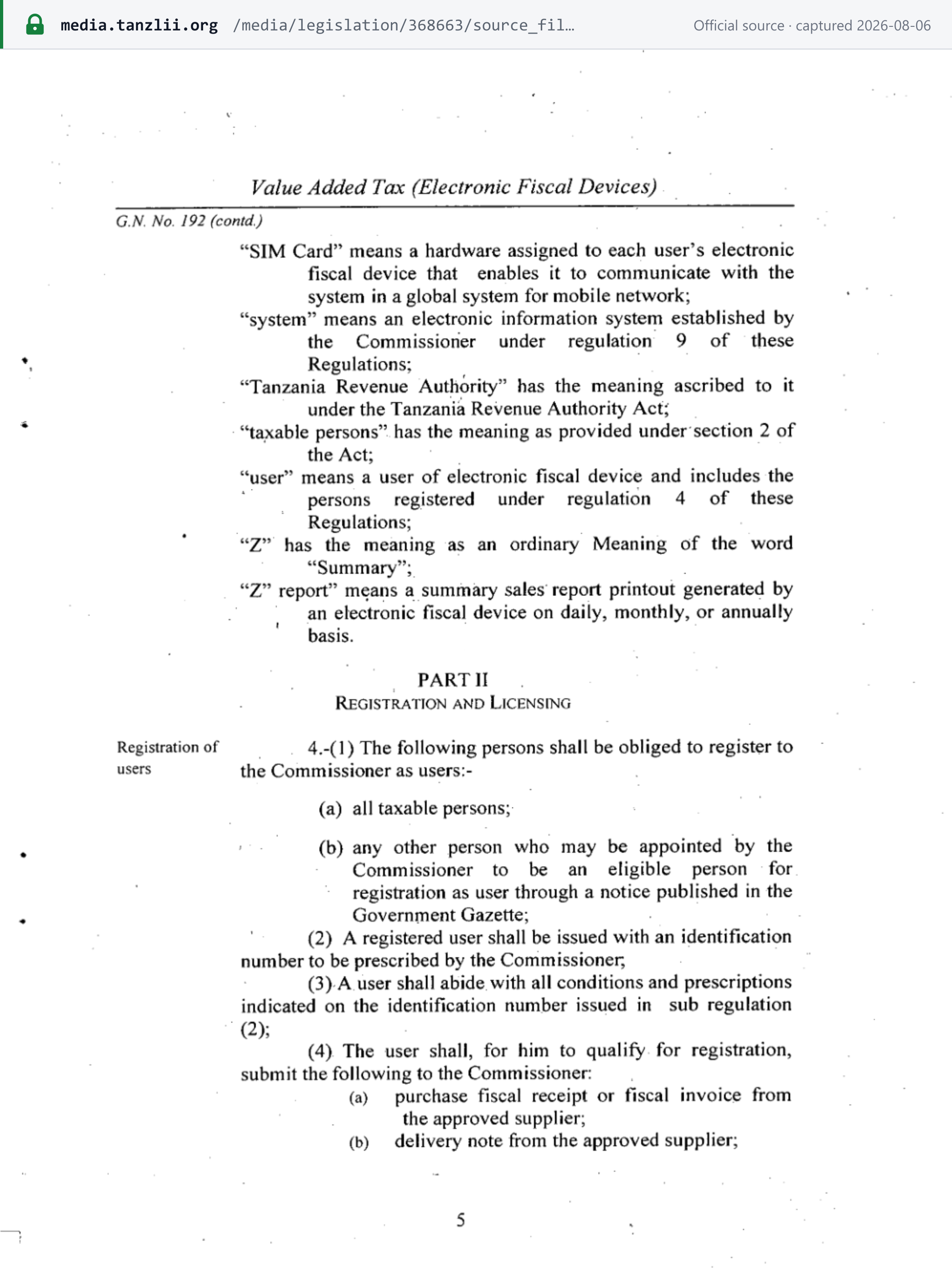
Tanzania. All taxable persons must register as EFD users, plus anyone the Commissioner appoints by gazette notice (GN No. 192 of 2010, reg. 4(1)).
 Source snapshot captured 2026-08-06 — original
Penalties
-
Germany. Not using, or wrongly using, a §146a system, failing to protect it, and commercially advertising or selling non-compliant systems are administrative offences where they enable tax reduction (§379(1) nos. 4–6 AO), punishable by a fine of up to EUR 25,000 (§379(6)). (§379 AO)
 Source snapshot captured 2026-10-07 — original
 -
Austria. Having no register or no security device is a fiscal administrative offence punishable by a fine of up to EUR 5,000 (BMF).
-
Poland. Breaching the duty to use a till triggers an additional tax liability equal to 30% of input VAT on purchases (art. 111(2)). Missing a till's mandatory technical inspection costs a PLN 300 fine (art. 111(6ka)). A second, separate PLN 300 penalty applies from 1 January 2027 for failing to apply to deregister a till by the deadline (Act of 4 September 2026, Dz.U. 2026 poz. 1270).
-
Serbia. Issuing a receipt whose QR code fails verification, or a receipt altered, combined or technically fabricated after the fact, leads to a business ban of one year, imposed immediately (amended art. 12(5)–(6) of the Law on Fiscalization, Sl. glasnik RS 80/2026, in force 8 September 2026). (Narodna skupština, act 2591-26)
-
Hungary. Manually issued and computer-generated receipts must be reported to NAV within three days from 1 September 2026; no fines apply until 31 December 2026, and fines apply from 1 January 2027 (NAV).
 Source snapshot captured 2026-09-22 — original
Current status and dates
As at 2026-10-07. Each row is cited in this page.
| Date | What changes | Status |
|---|---|---|
| 2 Jan 2016 | Slovenia: real-time verification of cash invoices by FURS | In force |
| 1 Jul 2017 | Russia: online cash registers mandatory (some groups from 1 Jul 2018) | In force |
| 1 Jan 2020 | Germany: §146a AO applies (registers that could not be upgraded allowed until 31 Dec 2022); Italy: daily takings transmission for all retail-type suppliers | In force |
| 1 Jan 2026 | Italy: POS tools must be connected to the registratore telematico | In force; pairing deadline for POS in use in January 2026 was 20 Apr 2026 |
| 31 Jan 2026 | Malawi: transition from EFDs to the Electronic Invoicing System ends; EFD invoices are not accepted for input tax from 1 Feb 2026 | In force |
| 1 Sep 2026 | Hungary: manual and computer receipts reported to NAV within 3 days | In force; fines from 1 Jan 2027 |
| 8 Sep 2026 | Serbia: one-year business ban for a receipt QR code that fails verification | In force |
| 1 Oct 2026 | Austria: digital receipts under §132a BAO (e-mail, app or on-screen code) | In force |
| 31 Dec 2026 | Fiji: EFD Phase 3 deadline for wholesalers, manufacturers and retailers; EFD Version 2.0 ends | Enacted |
| 31 Dec 2026 | Italy: last day art. 2 d.lgs. 127/2015 applies | Enacted |
| 1 Jan 2027 | Italy: the Testo unico IVA (d.lgs. 10/2026) takes over; Poland: tills issue only fiscal receipts, and the deregistration penalty starts; Croatia: amended B2C fiscalisation rulebook (NN 97/2026) in force | Enacted |
| 31 Dec 2027 | Poland: the PLN 20,000 till exemption ends at the latest | Enacted |
| 2028 | Germany: register duty from EUR 100,000 turnover and digital receipts by default | Proposed — Cabinet bill of 23 Sep 2026; needs the Bundestag and Bundesrat |
| 1 Jul 2028 | Hungary: online cash registers can no longer be used | Enacted |
Germany — 2020 start and the 2028 bill. §146a AO applies "erstmals für Kalenderjahre nach Ablauf des 31. Dezember 2019", and registers bought before then that could not be upgraded with a TSE could be used until 31 December 2022 (EGAO Art. 97 §30; gesetze-im-internet.de). On 23 September 2026 the Federal Cabinet adopted a bill that would end the paper-receipt duty from 2028 and introduce the register duty above. It is still a draft law ("Gesetzentwurf"). (Bundesregierung, checked 2026-10-07)
 Source snapshot captured 2026-09-27 — original
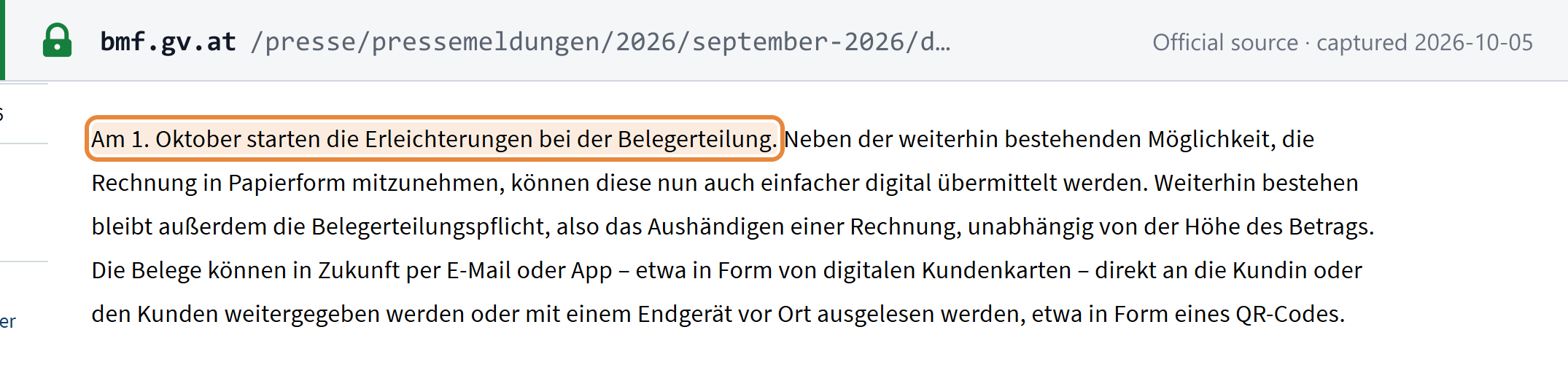
Austria — digital receipts from 1 October 2026. Under §132a BAO the e-receipt may be sent into the customer's control (e-mail, app) or shown on a screen for the customer to read on the spot. The register must still create and sign the receipt at the time of the cash payment, and the customer or a tax official may ask for a paper receipt up to close of business that day. (BMF, checked 2026-10-07)
 Source snapshot captured 2026-10-05 — original
Italy — legal basis moves on 1 January 2027. Art. 2 d.lgs. 127/2015 applies until 31 December 2026. In the version in force from 1 January 2027, Normattiva shows its paragraphs as repealed by d.lgs. 19 January 2026, n. 10, the Testo unico IVA (GU n. 24 of 30 January 2026, S.O. n. 4), which takes over the VAT rules from that date. For the RT–POS link, existing terminals had to be paired through the "Gestione collegamenti" service by 20 April 2026 (Agenzia delle Entrate, 17 April 2026).
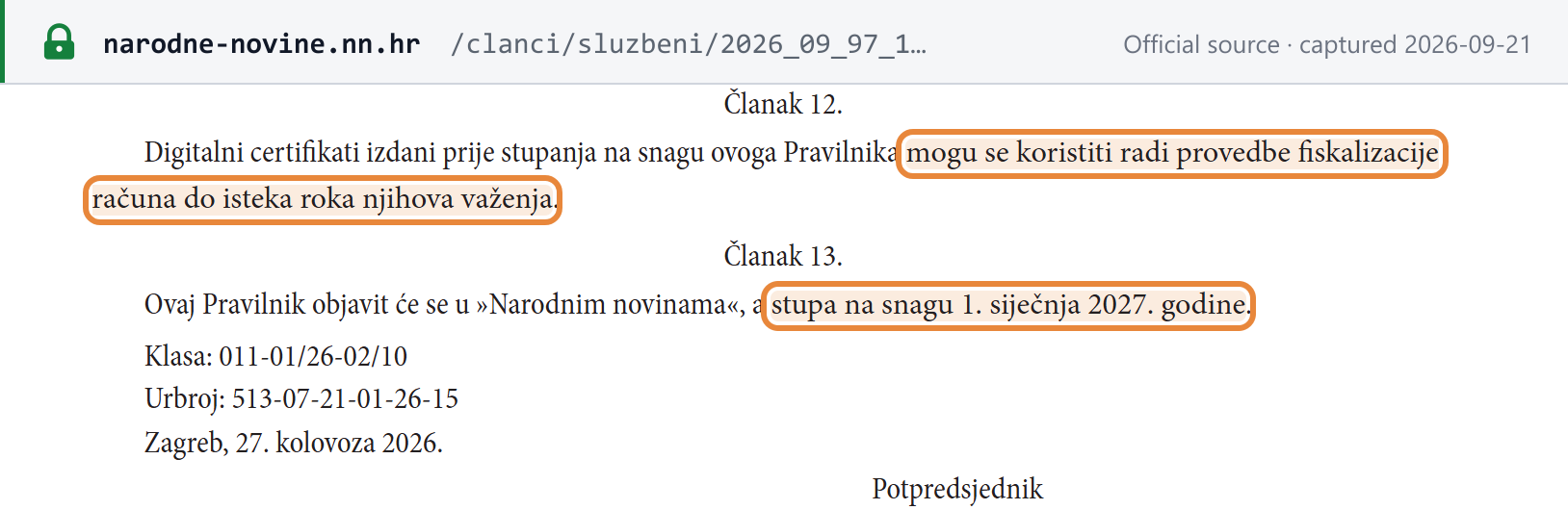
Croatia — NN 97/2026. The Pravilnik amending the rulebook on fiscalisation of receipts for final consumption was published in Narodne novine 97/2026 on 2 September 2026 and enters into force on 1 January 2027. Digital certificates issued before then remain usable for fiscalisation until they expire (arts. 12–13). (Narodne novine)
 Source snapshot captured 2026-09-21 — original
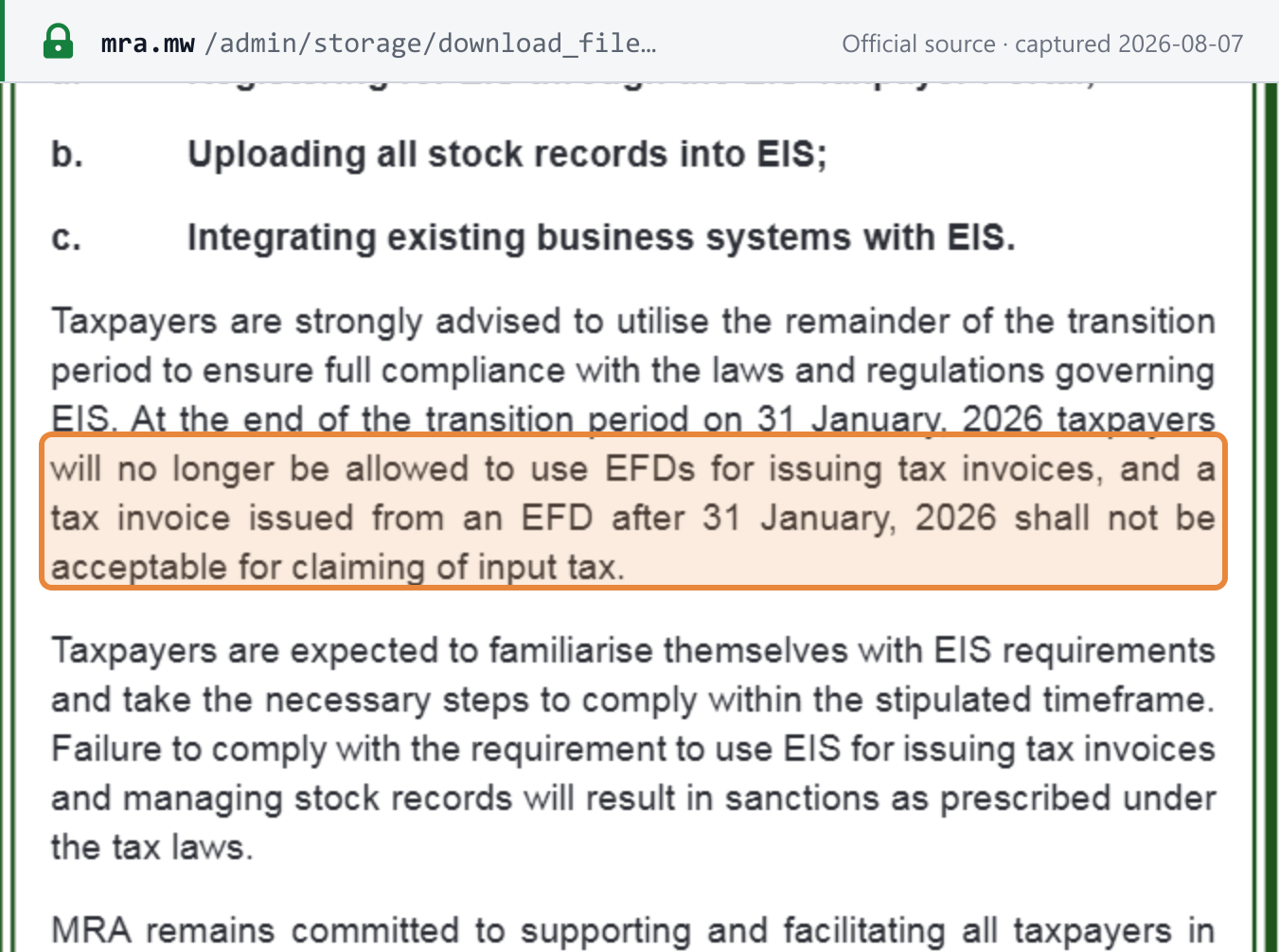
Moving away from standalone devices. Several countries are replacing hardware fiscal devices with software or central systems. Malawi ended its EFD transition on 31 January 2026, and from 1 February 2026 a tax invoice issued from an EFD "shall not be acceptable for claiming of input tax" (MRA). Fiji's Phase 3 requires businesses with turnover of FJD 50,000 or more in the wholesale, manufacturing and retail group to implement EFDs by 31 December 2026, when FRCS ends EFD Version 2.0 (FRCS). Sierra Leone's Finance Act 2026 requires a business whose electronic cash register is damaged or faulty to replace it at a cost the Commissioner-General gazettes, from 1 January 2026.
 Source snapshot captured 2026-08-07 — original
Jurisdiction table
Every row below is dated and sourced. The list is not exhaustive: a country missing from it is not a statement that the country has no fiscal-device rules.
| Jurisdiction | Model | Key rules | Legal basis | Last confirmed | Source |
|---|---|---|---|---|---|
| Germany | B. Certified security module (TSE), BSI-certified | No per-sale transmission; receipt duty; systems notified to the tax office within one month | §146a AO; KassenSichV | 2026-10-07 | gesetze-im-internet.de |
| Austria | B. Signature-chained register with QR code | FinanzOnline registration; EUR 15,000 turnover and EUR 7,500 cash-sales thresholds; e-receipts from 1 Oct 2026 | BAO (§132a for e-receipts) and RKSV | 2026-10-07 | BMF |
| Italy | C. Registratore telematico | Daily aggregated transmission; POS link since 1 Jan 2026 | Art. 2 d.lgs. 127/2015 to 31 Dec 2026; Testo unico IVA (d.lgs. 10/2026) from 1 Jan 2027 | 2026-10-07 | Normattiva |
| Poland | C. Online till linked to the CRK | GUM type approval; software tills; fiscal receipt only from 1 Jan 2027 | Arts. 111–111a VAT Act | 2026-10-07 | Dz.U. 2026 poz. 1263 |
| Hungary | C. Online cash register moving to e-cash register | e-receipts stored in NAV's nyugtatár for 10 years; online registers usable until 1 Jul 2028 | VAT Act; NGM Decree 8/2025 | 2026-10-07 | NAV |
| Croatia | D. Per-receipt real-time clearance | JIR returned for every receipt; ZKI and QR code printed | Zakon o fiskalizaciji, NN 89/2025 | 2026-10-07 | Narodne novine |
| Slovenia | D. Real-time verification | Cash and card invoices; EOR and ZOI on the invoice | ZDavPR (since 2 Jan 2016) | 2026-10-07 | FURS; ZDavPR |
| Malta | A. Offline fiscal cash register | Unalterable memory; no transmission requirement in the Thirteenth Schedule | Cap. 406, Thirteenth Schedule | 2026-10-07 | legislation.mt |
| Russia | C. Online cash register with fiscal drive | Data sent through a fiscal data operator; mandatory since 1 Jul 2017 | Federal Law 54-FZ (2016 revision) | 2026-10-07 (archival FNS publication) | FNS |
| Serbia | D. Online e-fiscalisation | Receipt QR code verified against the Tax Administration portal; one-year ban for failures | Law on Fiscalization (amended 2026) | 2026-10-07 | Narodna skupština |
| Kenya | Invoices generated through eTIMS | Tax invoices generated from eTIMS; IFMIS matching for government suppliers | KRA VAT guide (administrative guidance) | 2026-10-07 | KRA |
| Tanzania | C. Licensed EFDs (ETR, fiscal printer, signature device) connected to the TRA system | Transactions transmitted at least at every daily Z closure; all taxable persons register as users; certified suppliers only | GN No. 192 of 2010; VAT Act CAP 148 | 2026-10-07 | TanzLII |
| Uganda | D. EFRIS real time | EFD, app, desktop, portal or API; B2B and B2C in one system | URA EFRIS guidance and public notice | 2026-10-07 | URA |
 Source snapshot captured 2026-09-07 — original
Related changes from the feed
- 2026-10-01 — Austria: §132a BAO lets register receipts be provided digitally by e-mail, app or on-screen code; paper stays available on request. (BMF) — see event
- 2026-09-23 — Germany (proposed): Cabinet bill for a register duty from EUR 100,000 turnover and digital receipts by default from 2028. (Bundesregierung) — see event
- 2026-09-08 — Serbia: one-year business ban for a receipt QR code that fails verification. (Narodna skupština) — see event
- 2026-09-07 — Kenya: KRA announces stock-management functionality for eTIMS users, no go-live date. (KRA) — see event
- 2026-09-02 — Croatia: amended B2C fiscalisation rulebook published in NN 97/2026, in force 1 January 2027. (Narodne novine) — see event
- 2026-08-31 — Kenya: eTIMS–IFMIS integration for suppliers to government. (KRA) — see event
- 2026-08-10 — Uganda: EFRIS notice lists twelve additional sectors, effective 1 July 2025. (URA) — see event
- 2026-07-13 — Malta: "EXP" designation on fiscal receipts of article 11 exempt SMEs. (MTCA) — see event
- 2026-04-20 — Italy: deadline to pair POS terminals with registratori telematici. (Agenzia delle Entrate) — see event
- 2026-01-31 — Malawi: EFD-to-EIS transition ends; EFD invoices not accepted for input tax from 1 February. (MRA) — see event
- 2026-01-01 — Sierra Leone: duty to replace a faulty electronic cash register at a gazetted cost. (NRA) — see event
Upcoming: Fiji EFD Phase 3 on 31 December 2026 (event); Vanuatu VSMS (event); Poland's till-deregistration penalty from 1 January 2027 (event); Hungary's receipt-reporting fines from 1 January 2027 (event); Italy's move to the Testo unico IVA (event).
Country chronologies: Germany · Austria · Italy · Poland · Hungary · Croatia · Slovenia · Malta · Russia · Serbia · Kenya · Tanzania · Uganda
Frequently asked questions
Is a fiscal receipt the same as an e-invoice?
No. Fiscalisation covers sales to consumers through a till; B2B e-invoicing covers invoices between businesses. In Croatia a B2C receipt carries a JIR and QR code from the Tax Administration, while a B2B eRačun carries no fiscalisation mark and is issued separately from the fiscalisation procedure. Poland's VAT Act separates the channels from 1 January 2027, when a till may issue only a fiscal receipt, not an invoice. Uganda's EFRIS is an exception: one system covers both B2B e-invoices and B2C e-receipts. (Porezna uprava; VAT Act art. 111(3a)(1); URA; checked 2026-10-07)
Does every German business need a cash register?
Not today. §146a AO applies to businesses that record transactions on an electronic recording system: that system must be protected by a BSI-certified technical security device (TSE), a receipt must be issued, and the system must be notified to the tax office within one month of acquisition. A government bill adopted by the Federal Cabinet on 23 September 2026 would introduce a register duty from 2028 for businesses with annual turnover of EUR 100,000 or more, exempting those with annual cash sales below EUR 12,000. It still needs the Bundestag and Bundesrat. (checked 2026-10-07)
When does an Austrian business need a cash register?
When turnover per business is at least EUR 15,000 a year, of which cash sales exceed EUR 7,500 — both limits must be exceeded. The duty starts from the fourth month after the end of the VAT return period in which the limits were first exceeded. The duty to issue a receipt applies from the first cash sale, whatever the turnover, and since 1 October 2026 the receipt may be provided digitally under §132a BAO. (BMF, checked 2026-10-07)
Can a Polish cash register still issue an invoice after 2026?
No. Until 31 December 2026, VAT Act art. 111(3a)(1) requires a fiscal receipt or an invoice for every sale. From 1 January 2027 the till must issue a fiscal receipt for every sale, under art. 1 pt 30 of the Act of 16 June 2023 (Dz.U. 2023 poz. 1598). Businesses whose prior-year sales to individuals and flat-rate farmers did not exceed PLN 20,000 are exempt from using a till until 31 December 2027 at the latest. (checked 2026-10-07)
Does a fiscal receipt have to be printed on paper?
Not always. In Germany a receipt may be paper or, with the customer's consent, electronic (KassenSichV §6). In Austria, since 1 October 2026, the signed receipt may be sent by e-mail or app or shown on a screen, and the customer may ask for paper up to close of business that day (§132a BAO). In Poland a fiscal receipt may be electronic with the buyer's consent (VAT Act art. 111(3a)(1)(b)). (checked 2026-10-07)
What changes for Italian registratori telematici on 1 January 2027?
The legal basis. Art. 2 d.lgs. 127/2015, which requires retail-type suppliers to store and transmit daily takings data to the Agenzia delle Entrate, applies until 31 December 2026. From 1 January 2027 its paragraphs are repealed by d.lgs. 10/2026, the Testo unico IVA, which takes over the VAT rules from that date. (Normattiva, checked 2026-10-07)
Related resources
- CTC e-invoicing models — clearance, reporting and interchange for B2B invoices
- GoBD explainer — Germany's record-keeping rules, the companion to §146a AO
- SAF-T explainer — audit-file exports, including Austria's SAF-T AT
- E-invoicing status worldwide — every national mandate, dated and sourced
- Country guides: Germany · Austria · Italy · Poland · Hungary · Croatia · Slovenia · Malta · Russia · Kenya · Tanzania
- E-invoicing guides: Croatia (Fiskalizacija) · Hungary (Online Számla) · Slovenia · Malta · Poland (KSeF) · Germany
Reference links
- §146a AO and KassenSichV — Germany
- BMF — Registrierkassen — Austria
- Consolidated VAT Act, Dz.U. 2026 poz. 1263 — Poland, arts. 111–111a
- Art. 2 d.lgs. 127/2015, version in force 2026-10-07 — Italy
- Zakon o fiskalizaciji, NN 89/2025 — Croatia
- FURS — Davčne blagajne — Slovenia
- URA — EFRIS — Uganda