E-invoicing CTC models: clearance, reporting and interchange
Continuous transaction controls (CTC) are rules that give a tax authority invoice data at, or shortly after, the moment of each sale, instead of in a periodic return. The main models are clearance (the authority, or a provider it authorises, must approve or deliver the invoice before it is valid), real-time reporting (the invoice moves freely and its data follow), and decentralised exchange networks such as Peppol, to which some authorities add themselves as a "fifth corner".
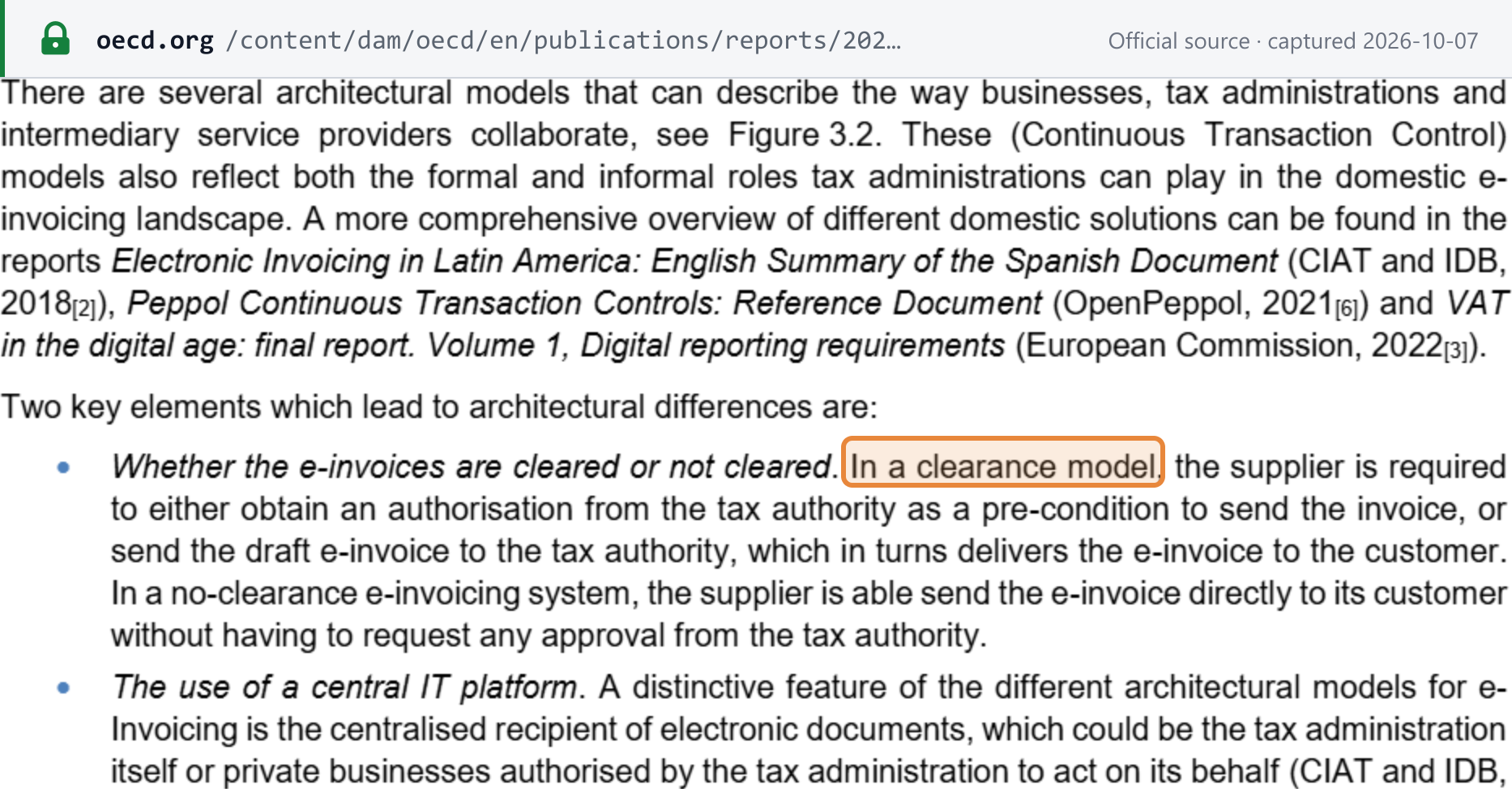
There is no binding legal taxonomy of CTC models. As at 2026-10-07, neither the OECD FTA report, Directive (EU) 2025/516 nor OpenPeppol's reference documents define the categories as legal terms, and each country's law uses its own vocabulary. The closest official reference is the OECD Forum on Tax Administration's report Tax Administration 3.0 and Electronic Invoicing: Initial Findings (28 September 2022). It states that "There are several architectural models that can describe the way businesses, tax administrations and intermediary service providers collaborate", and names two elements that separate them (printed p. 30):
- Whether invoices are cleared. "In a clearance model, the supplier is required to either obtain an authorisation from the tax authority as a pre-condition to send the invoice, or send the draft e-invoice to the tax authority, which in turns delivers the e-invoice to the customer." In a no-clearance system the supplier sends the e-invoice straight to the customer, without asking the authority for approval.
- Whether a central IT platform receives the documents. That recipient can be "the tax administration itself or private businesses authorised by the tax administration to act on its behalf".
 Source snapshot captured 2026-10-07 — original
The labels themselves come from two other bodies, and the OECD report reproduces both:
- The European Commission's 2022 classification of digital reporting requirements (DRR). OECD Box 1.2 (printed p. 16) groups them into two periodic forms (VAT listings and SAF-T) and two continuous forms: real-time reporting, defined as transmitting transaction data "shortly after issuance of the invoice" where "the invoice itself does not need be transmitted to the tax authority", and e-invoicing with or without clearance. The source is the Commission's VAT in the digital age: final report, Volume 1 (doi 10.2778/541384).
- OpenPeppol's four CTC models. OpenPeppol, the non-profit association that owns the Peppol framework, analysed "CTC implementations in over 60 countries" and grouped them into an interoperability model, a real-time invoice reporting model, a centralised exchange model and a clearance model (Peppol CTC Reference Document v1.0, September 2021, §3.2). The same Reference Document describes the "5-corner" model, and OpenPeppol's Addendum (September 2023) bases Peppol CTC on "Decentralised Continuous Transaction Controls and Exchange". The UAE Ministry of Finance uses the acronym "DCTCE" for its model, and Singapore's IRAS describes a "5th corner to the 4-corner model". At least two tax authorities have adopted this terminology in their own documents, as at 2026-10-07 (see below). OpenPeppol is a framework owner, not a tax authority, so its labels describe architectures, not anyone's legal obligation.
How it works
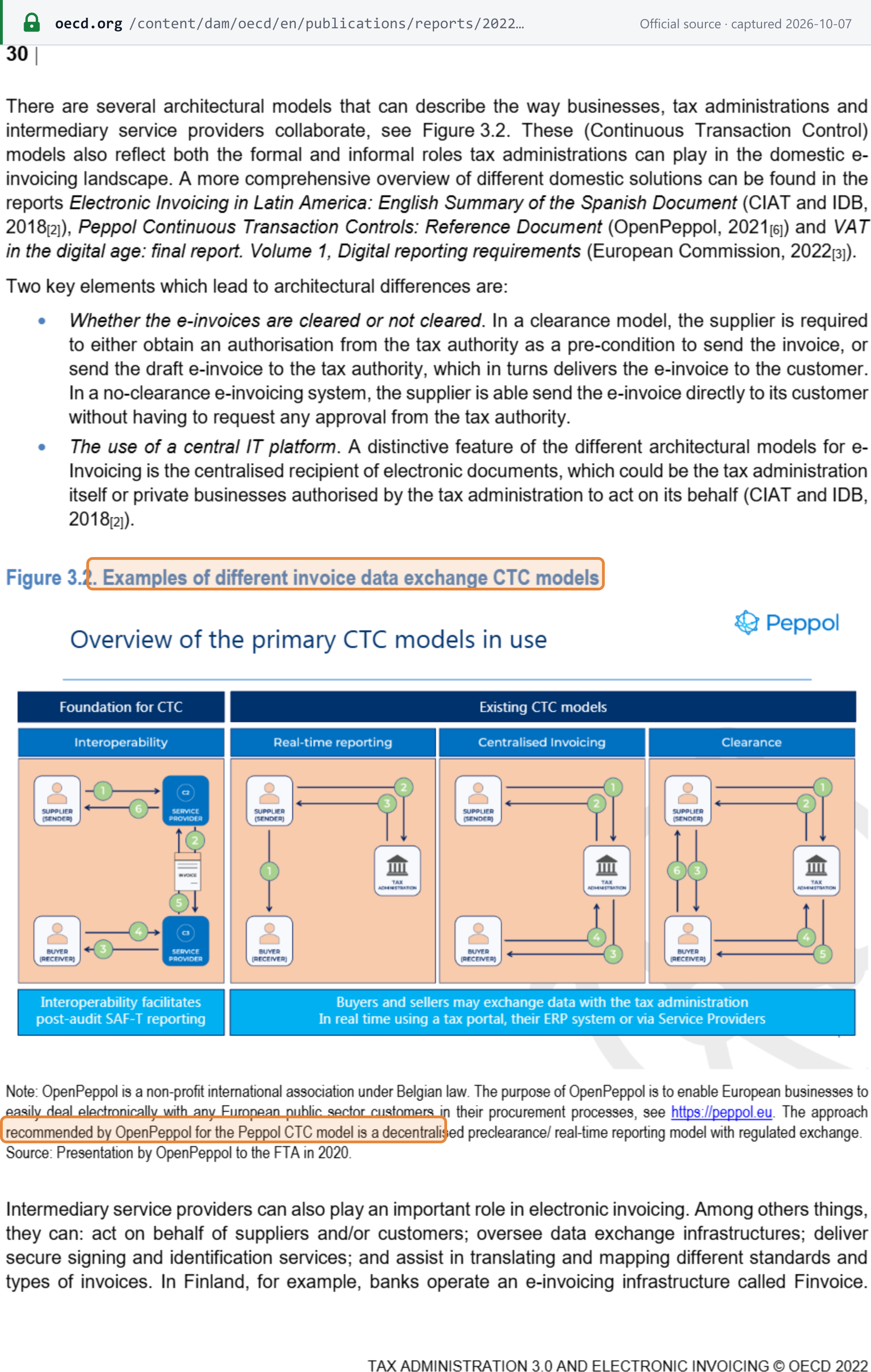
The OECD report reproduces OpenPeppol's overview diagram as Figure 3.2, "Examples of different invoice data exchange CTC models". It shows interoperability as the "Foundation for CTC" and three "Existing CTC models": real-time reporting, centralised invoicing and clearance. A note under the figure records that OpenPeppol recommends "a decentralised preclearance/ real-time reporting model with regulated exchange" for Peppol.
 Source snapshot captured 2026-10-07 — original
The practical question for a business is always the same: is my invoice legally valid before the tax authority (or its delegate) has seen it? If not, the system is a clearance system. If yes, and the authority only receives data, it is a reporting system.
Clearance — centralised
The authority's own platform sits in the middle of every invoice. It checks the document and either delivers it to the buyer or stamps it with an identifier that makes it valid.
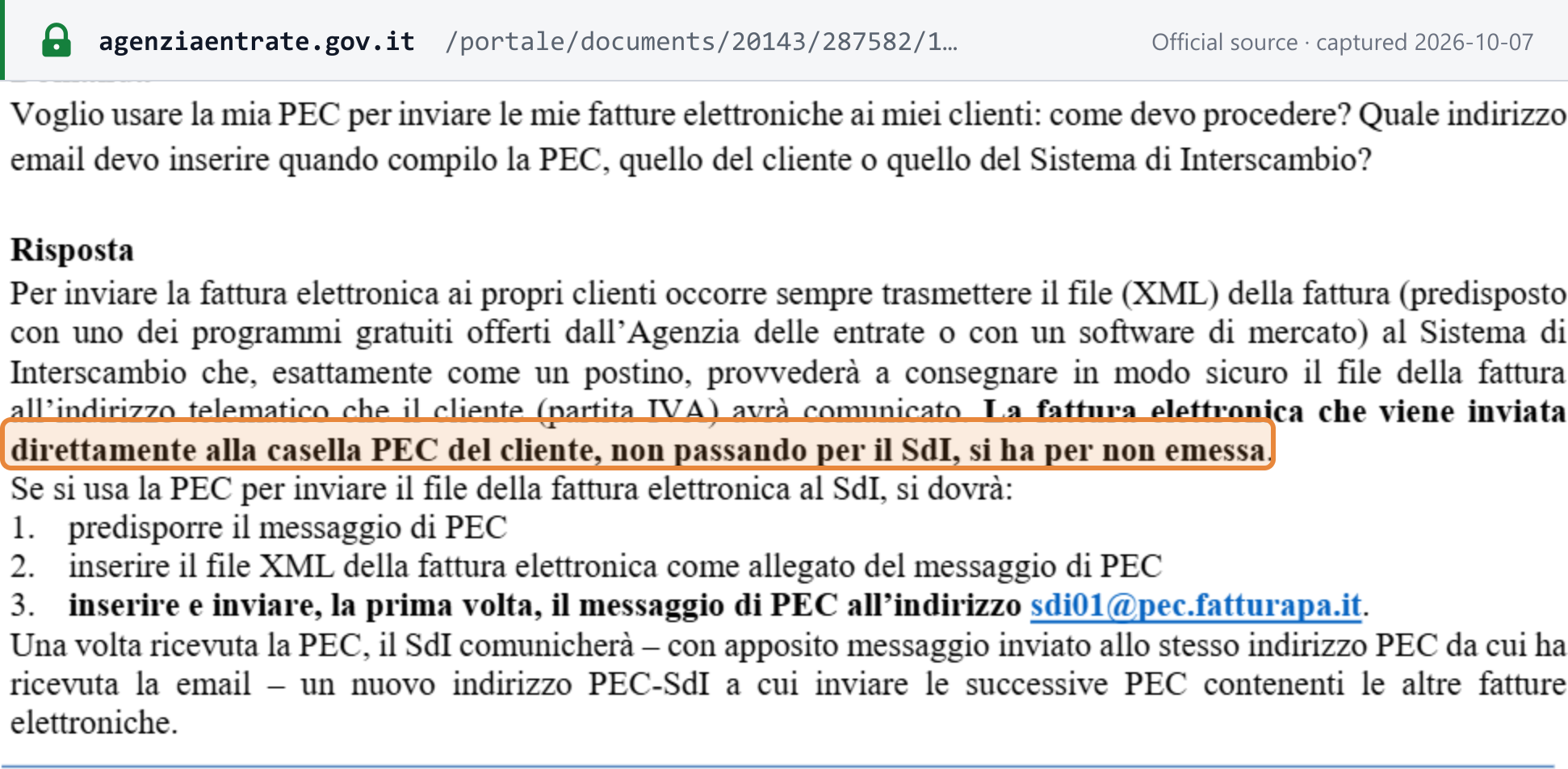
- Italy (SdI). The Sistema di Interscambio, run by the Agenzia delle Entrate, receives FatturaPA files, checks them and forwards them to public bodies or to private B2B and B2C customers (fatturapa.gov.it). The obligation applies to invoices issued from 1 January 2019 (art. 1(916), Law 205/2017). An e-invoice sent straight to the customer's certified mailbox (PEC) without passing through SdI "si ha per non emessa", meaning it is treated as never issued (Agenzia delle Entrate consolidated FAQ, n. 44). An invoice that SdI rejects is also treated as not issued (Circolare 14/E of 17 June 2019).
 Source snapshot captured 2026-10-07 — original
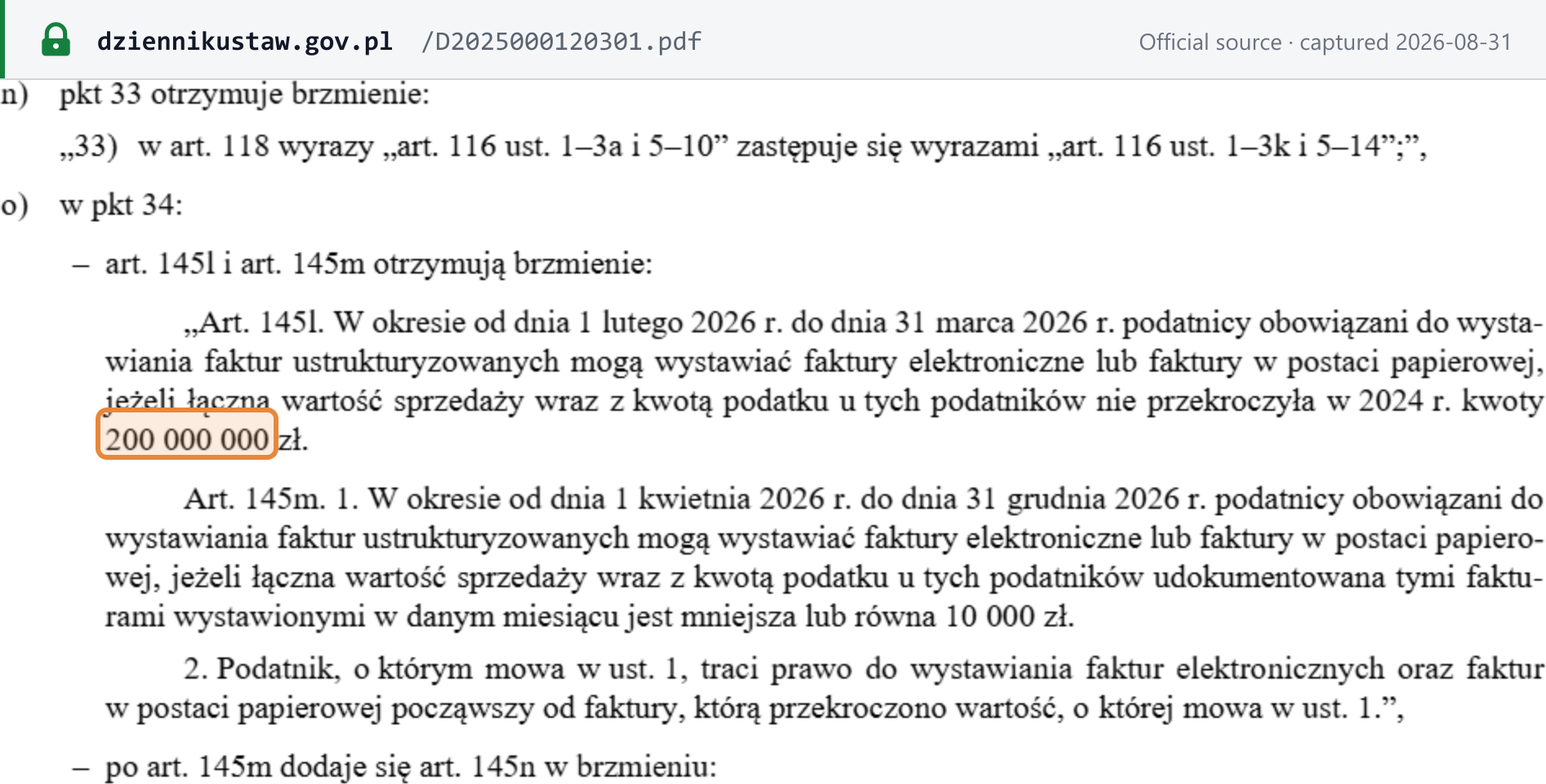
- Poland (KSeF). Under Article 106na of the VAT Act, a structured invoice is deemed issued on the day it is sent to the Krajowy System e-Faktur, and deemed received on the day KSeF assigns it an identifying number (consolidated VAT Act, checked 2026-10-07). The obligation started on 1 February 2026 for taxpayers whose 2024 sales including VAT exceeded PLN 200,000,000, and on 1 April 2026 for the rest (transitional rules in Arts 145l and 145m).
 Source snapshot captured 2026-08-31 — original
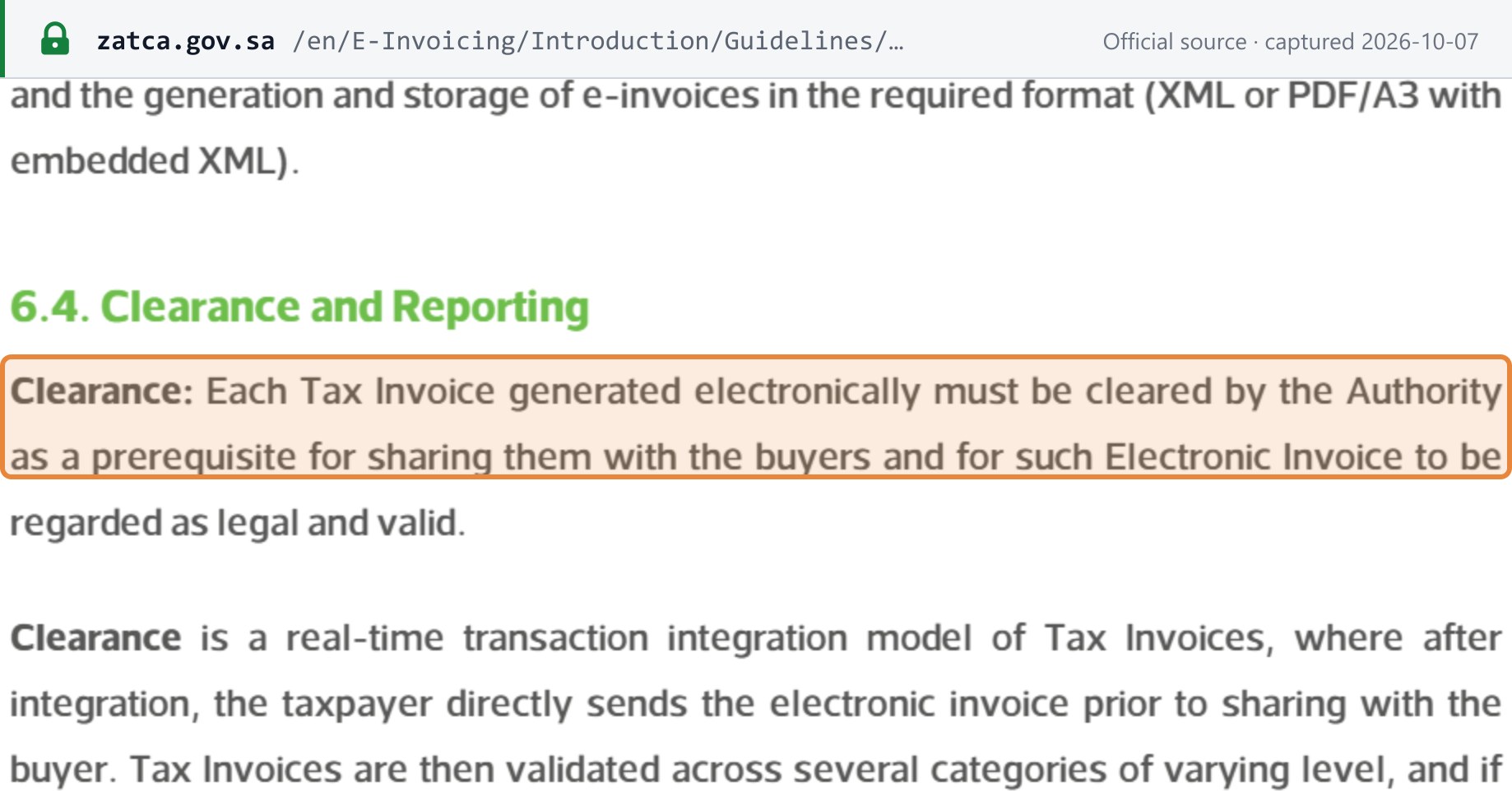
- Saudi Arabia (FATOORA). One system runs two models. In Phase 2 ("Integration"), applied in waves since 1 January 2023, each standard tax invoice (B2B and B2G) "must be cleared by the Authority as a prerequisite for sharing them with the buyers and for such Electronic Invoice to be regarded as legal and valid". Simplified tax invoices (mostly B2C) are not cleared: they are reported to FATOORA within 24 hours of issuance (ZATCA Detailed Guidelines for E-Invoicing, v2, §6.4 and §2.15; roll-out phases, checked 2026-10-07).
 Source snapshot captured 2026-10-07 — original
Clearance — through authorised providers
Some clearance systems delegate the checking to private, state-authorised providers. OpenPeppol calls this decentralised clearance, and also separates pre-clearance ("hard" clearance, before the invoice is exchanged) from post-clearance ("soft" clearance, shortly after) (Peppol CTC Reference Document, p. 14).
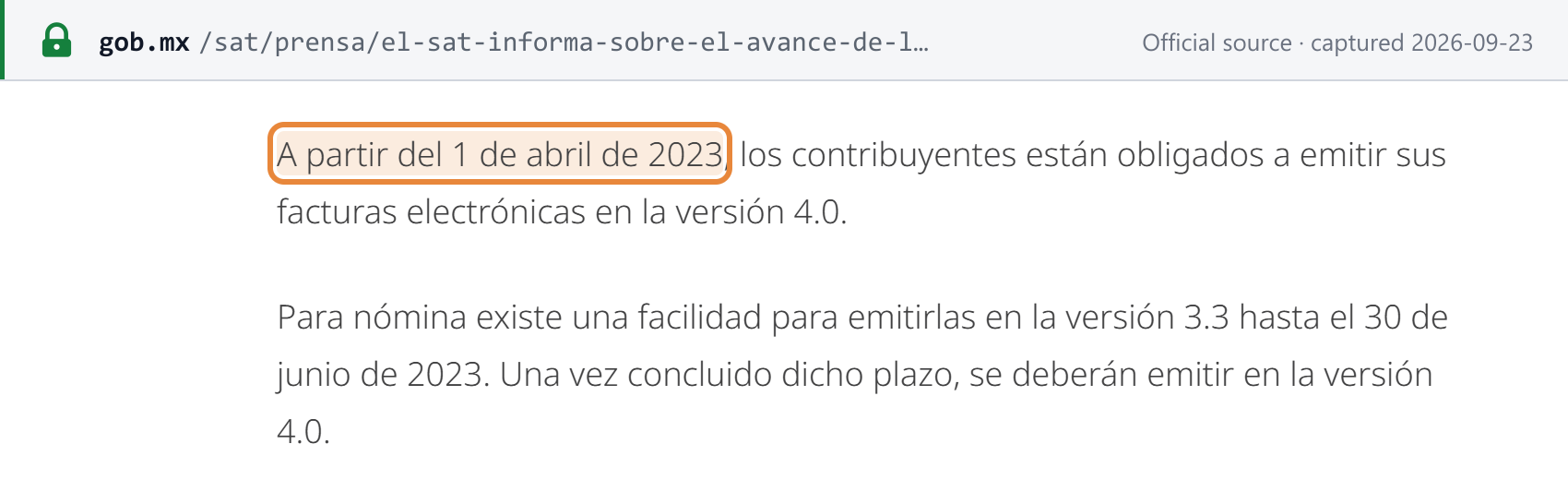
- Mexico (CFDI) appears in OpenPeppol's 2021 Reference Document as a pre-clearance example: the electronic invoice (CFDI) must be certified before it is valid, through providers that the tax administration (SAT) authorises. The current CFDI standard, version 4.0, has been mandatory since 1 April 2023 (SAT).
 Source snapshot captured 2026-09-23 — original
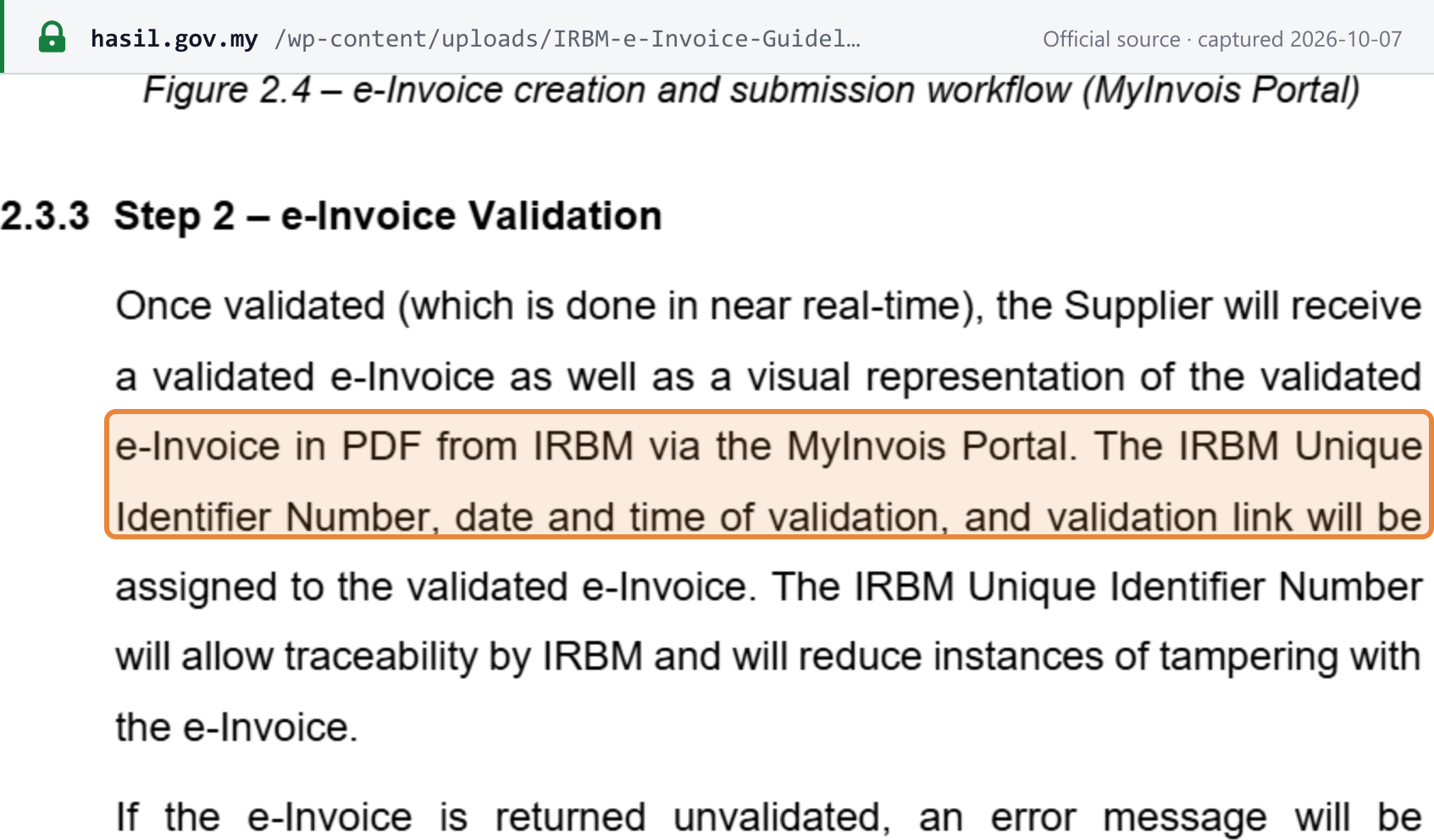
- Malaysia (MyInvois) works in a clearance style. The supplier submits each e-invoice to the Inland Revenue Board (IRBM) for validation "immediately". Validation happens "in near real-time", and the validated invoice receives an IRBM Unique Identifier Number, a validation timestamp and a validation link. The buyer can request rejection within 72 hours of validation. Implementation is phased by taxpayer group from 1 August 2024 (Table 1.1) (IRBM e-Invoice Guideline v4.8, §2.3, checked 2026-10-07). The IRBM Unique Identifier Number is assigned on validation:
 Source snapshot captured 2026-10-07 — original
Real-time and near-real-time reporting
The invoice is exchanged between the parties as before, in any lawful form, and its data go to the authority within a short time limit. No approval step comes first.
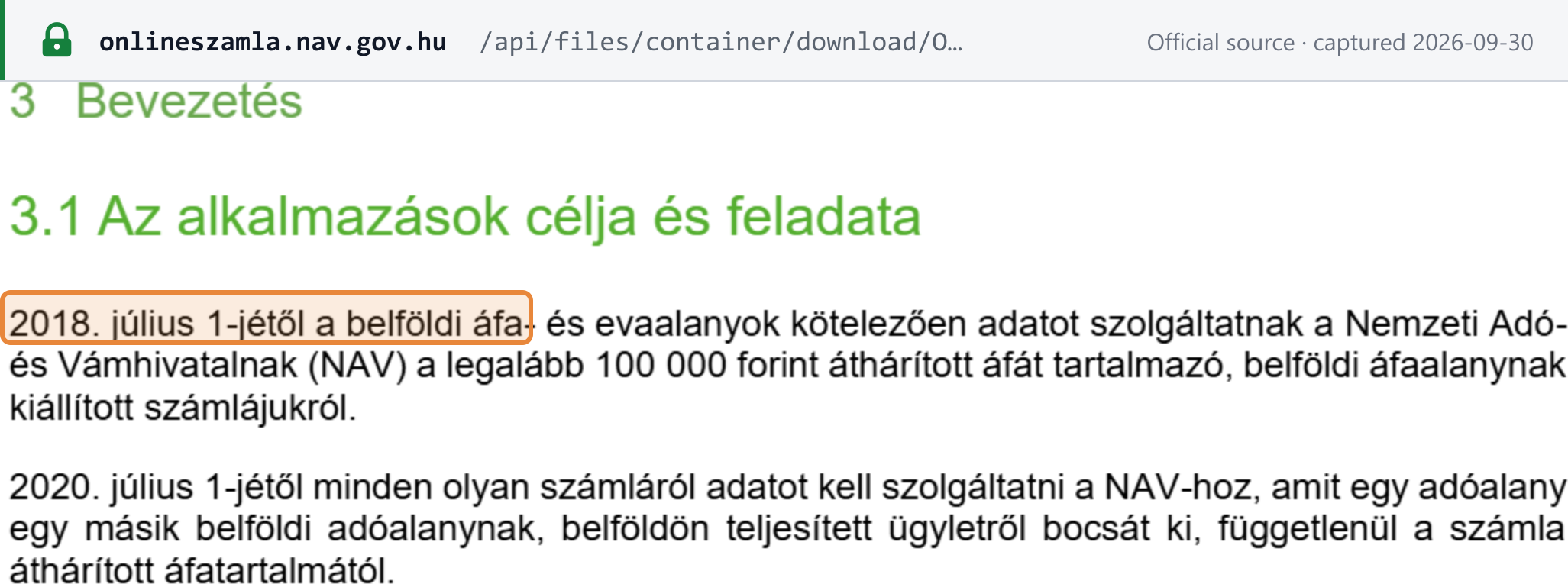
- Hungary (Online Számla). Data on issued invoices reach the tax authority (NAV) in real time. Reporting began on 1 July 2018 for invoices to domestic VAT payers with at least HUF 100,000 of VAT, extended to all domestic B2B invoices on 1 July 2020, and since 4 January 2021 covers every invoice under the VAT Act's invoicing rules, including invoices to non-VAT-payers and foreign buyers (NAV Online Számla user manual, §3.1, checked 2026-10-07).
 Source snapshot captured 2026-09-30 — original
- Spain (SII). The Suministro Inmediato de Información keeps a business's VAT ledgers on the Agencia Tributaria's e-office through the "suministro cuasi inmediato de los registros de facturación". The AEAT says plainly "no se trata de remitir las facturas concretas" (it is not about sending the actual invoices): records are sent, not invoices (AEAT, checked 2026-10-07). It is mandatory for monthly VAT filers, including large businesses with turnover above EUR 6 million and REDEME registrants, and optional for others. Spain's planned B2B e-invoicing (Royal Decree 238/2026) and Veri*factu are separate layers on top of SII. SII records are due within four days, excluding Saturdays, Sundays and national holidays.
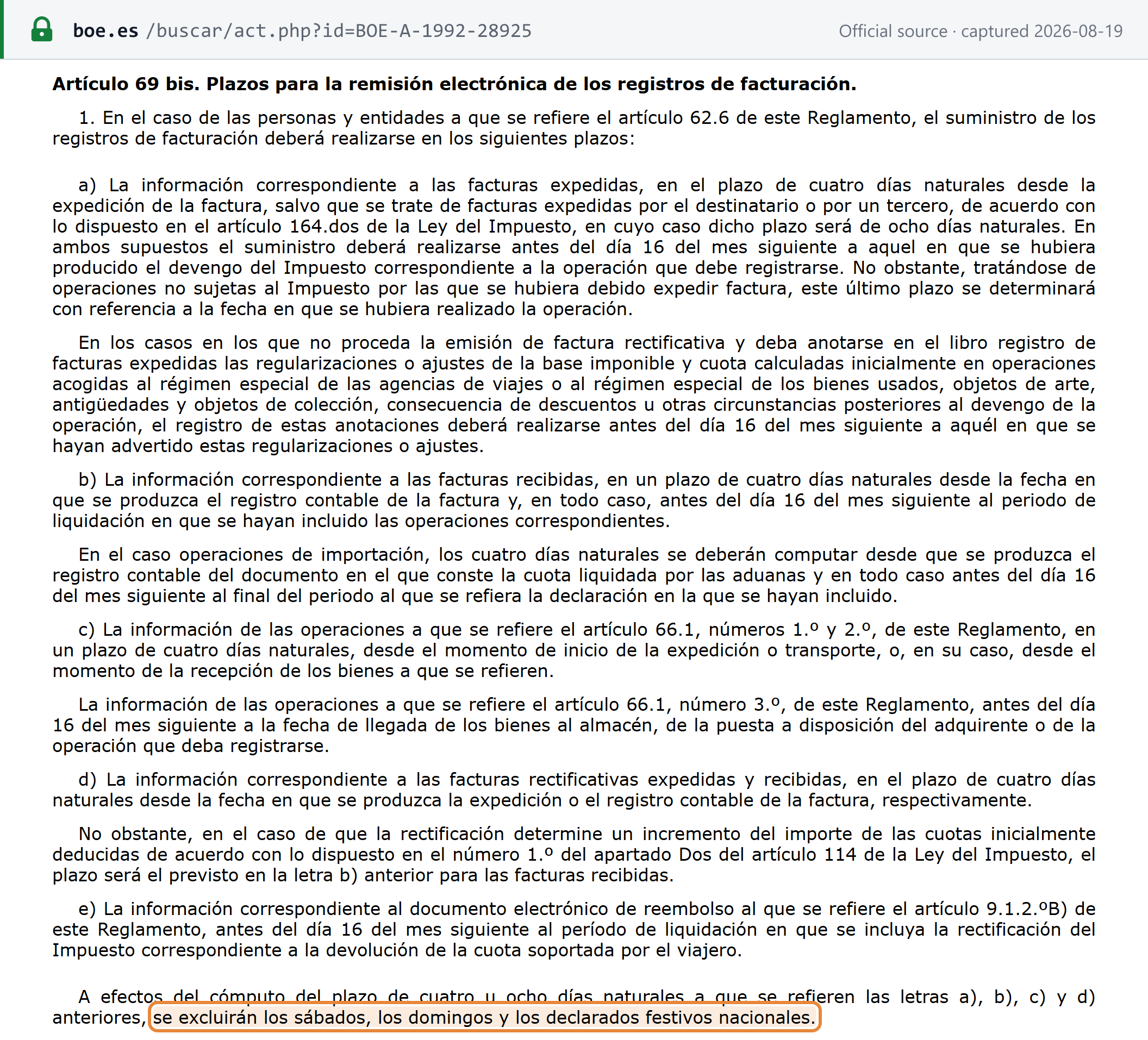 Source snapshot captured 2026-08-19 — original
- Greece (myDATA) began as electronic transmission of invoice data to AADE under Article 15A of the Tax Procedure Code (Joint Decision A.1138/2020). It is now becoming provider-based e-invoicing. Decision A.1197/2026 (ΦΕΚ Β΄ 5905/30.09.2026) moved phase 2 to 2 November 2026, with a transition period from 2 November 2026 to 31 January 2027 (Diavgeia). Phase 1 of mandatory B2B e-invoicing started on 2 March 2026 under Joint Decision A.1044/2026 (Diavgeia).
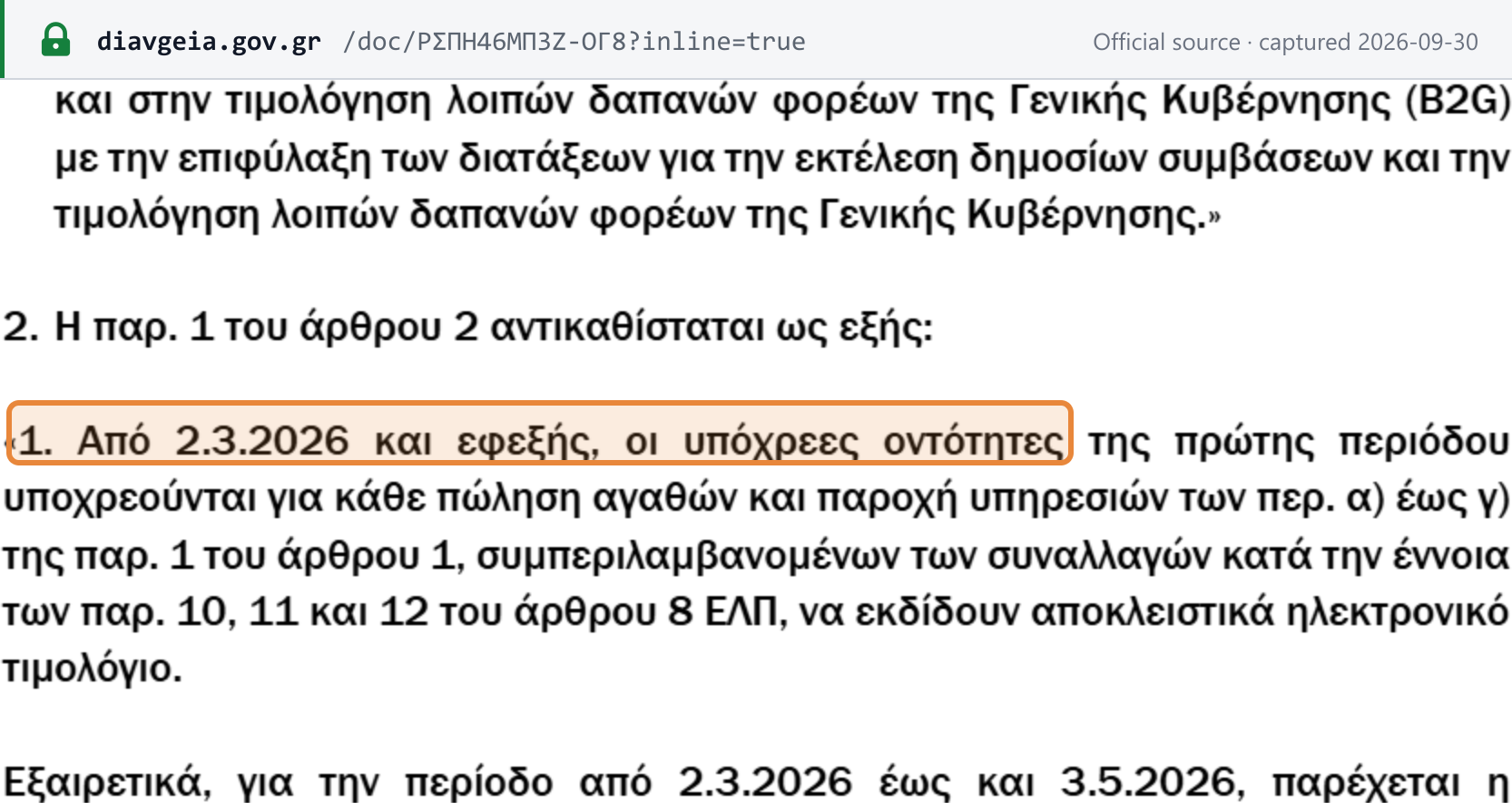 Source snapshot captured 2026-09-30 — original
Decentralised CTC: the 5-corner model
Here the invoice travels between the two businesses' accredited providers, as on an interoperability network, and the providers also send the tax data to the authority as part of the same process. OpenPeppol describes its version as "a decentralised CTC model with regulated document exchange": the supplier's provider (corner 2) validates the invoice, reports the full document or a Tax Data Document (TDD) to the corner the tax authority designates (corner 5), and delivers the invoice to the buyer's provider (corner 3), which validates it and reports too (Peppol CTC Reference Document, p. 18).
- United Arab Emirates. The Ministry of Finance calls its model "Decentralized Continuous Transaction Control and Exchange - DCTCE". The supplier (corner 1) submits invoice data in the PINT AE format to its Accredited Service Provider (corner 2). Corner 2 transmits the e-invoice to the buyer's provider (corner 3) and, in parallel, reports the Tax Data Document to corner 5 (MoF eInvoicing hub, checked 2026-10-07). The MoF's Electronic Invoicing Guidelines V1.1 (1 June 2026) define the "5 Corner model" with the Federal Tax Authority as corner 5. Businesses with revenue of AED 50,000,000 or more must appoint a provider by 30 October 2026 and go live on 1 January 2027 (Ministerial Decision No. 244 of 2025, Art. 5(1)(a), as amended by Ministerial Decision No. 66 of 2026; consolidated text). Corner 5 receives the Tax Data Document:
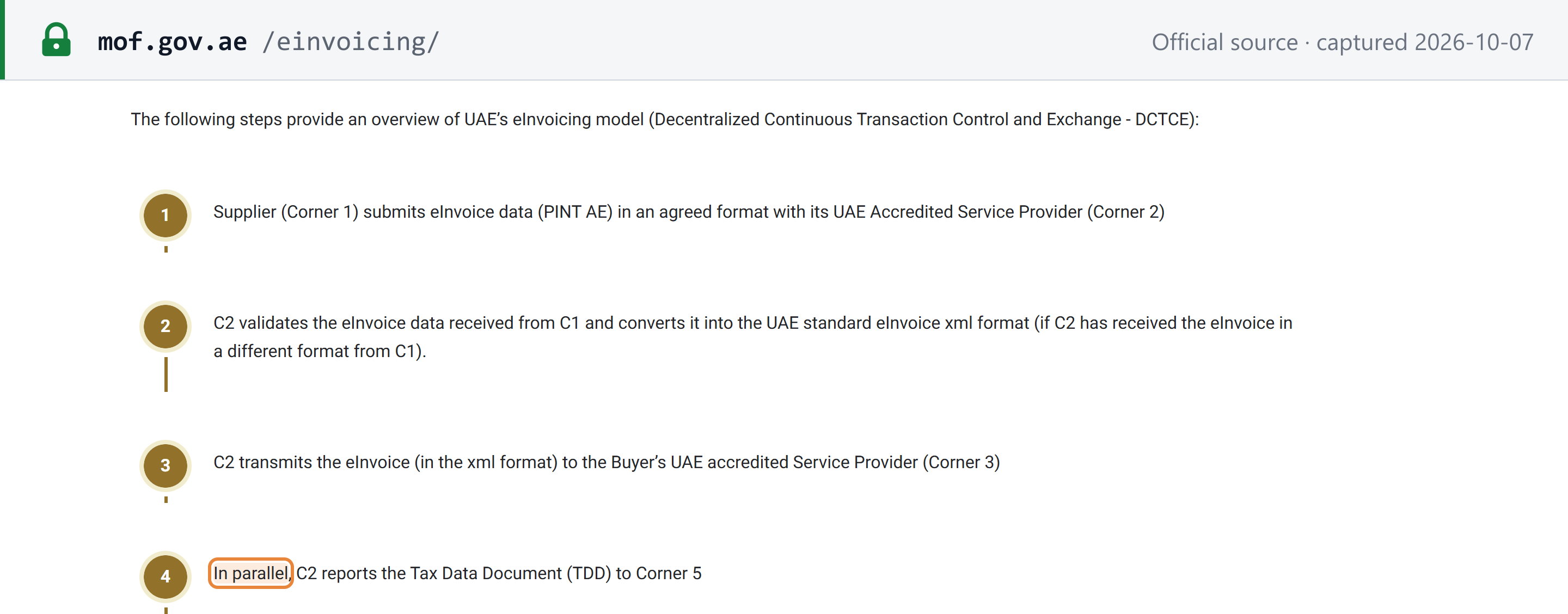 Source snapshot captured 2026-10-07 — original
- Singapore (InvoiceNow). InvoiceNow is Singapore's Peppol-based network. Under the GST InvoiceNow Requirement, IRAS connects to it via the Access Point to receive copies of invoice data, "through the introduction of a 5th corner to the 4-corner model". For Peppol invoices, the copy reaches IRAS "on a real-time / near real-time basis" once the invoice reaches the customer's Access Point (IRAS e-Tax Guide, 2nd edition, 9 March 2026, paras 5.3 and 8.1). The requirement started on 1 November 2025 for newly incorporated companies that register voluntarily for GST, and on 1 April 2026 for all new voluntary registrants (para 2.3(a)). IRAS describes its role as a 5th corner:
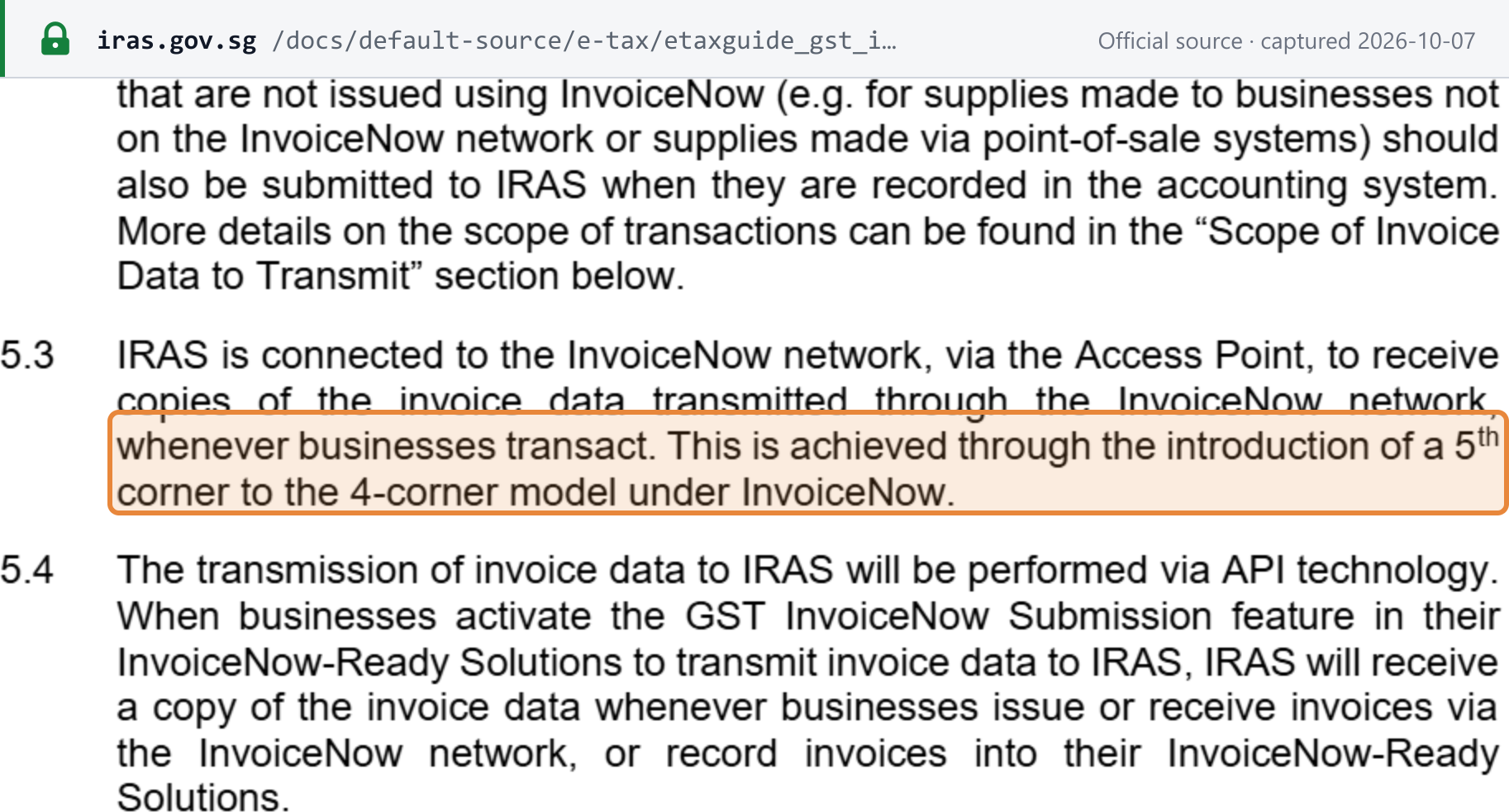 Source snapshot captured 2026-10-07 — original
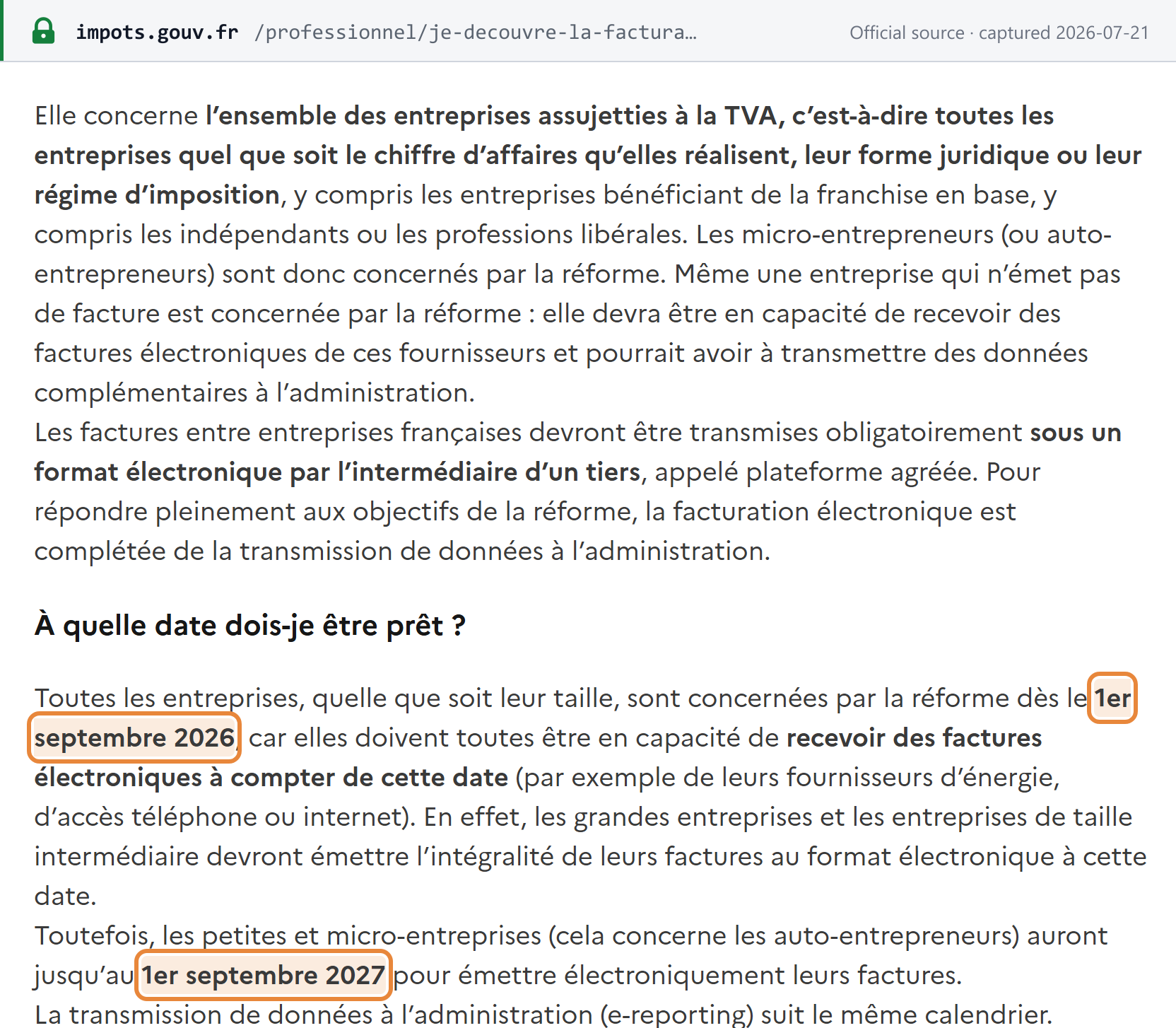
- France is decentralised but platform-based rather than Peppol-based. Invoices between French businesses must pass "par l'intermédiaire d'un tiers, appelé plateforme agréée" (a private company registered by the State), and the platform sends the data to the administration. Since Décret 2026-677 the public platform is no longer an exchange channel; it keeps the central directory and the data transmission to the administration. Supplier and buyer may use different platforms. Transactions outside the e-invoice flow (B2C, cross-border) and certain payment data are covered by e-reporting (impots.gouv.fr, checked 2026-10-07). E-invoicing and e-reporting follow the same calendar.
 Source snapshot captured 2026-07-21 — original
Interchange only: the Peppol 4-corner model
An interoperability network is not a tax control by itself. In Peppol's 4-corner model, buyers and suppliers "connect via any Peppol-accredited Service Provider", where earlier networks were closed "three-corner" networks that required both sides to use the same provider (OpenPeppol). The tax authority is not a corner. The Peppol guide covers the mechanics: Access Points, Peppol IDs, sign-up and delivery.
- Belgium is the clearest current case. Since 1 January 2026, structured B2B e-invoices "are exchanged directly between the two enterprises' software systems" over "a decentralised network called Peppol" (FPS Finance). The FPS Finance FAQ states that in this first phase no invoice information is sent to the government. Near-real-time e-reporting is in the 2025–2029 federal coalition agreement for 2028, must still be enacted, and will replace the annual client listing (efactuur.belgium.be FAQ, checked 2026-10-07). The Council of Ministers approved a preliminary draft for 1 January 2028 on 18 July 2026; it is proposed, not law.
 Source snapshot captured 2026-09-24 — original
The EU model under ViDA: transaction-level reporting on EN 16931 invoices
The EU's VAT in the Digital Age package (Council Directive (EU) 2025/516) sets a reporting model for the EU, built on structured e-invoices:
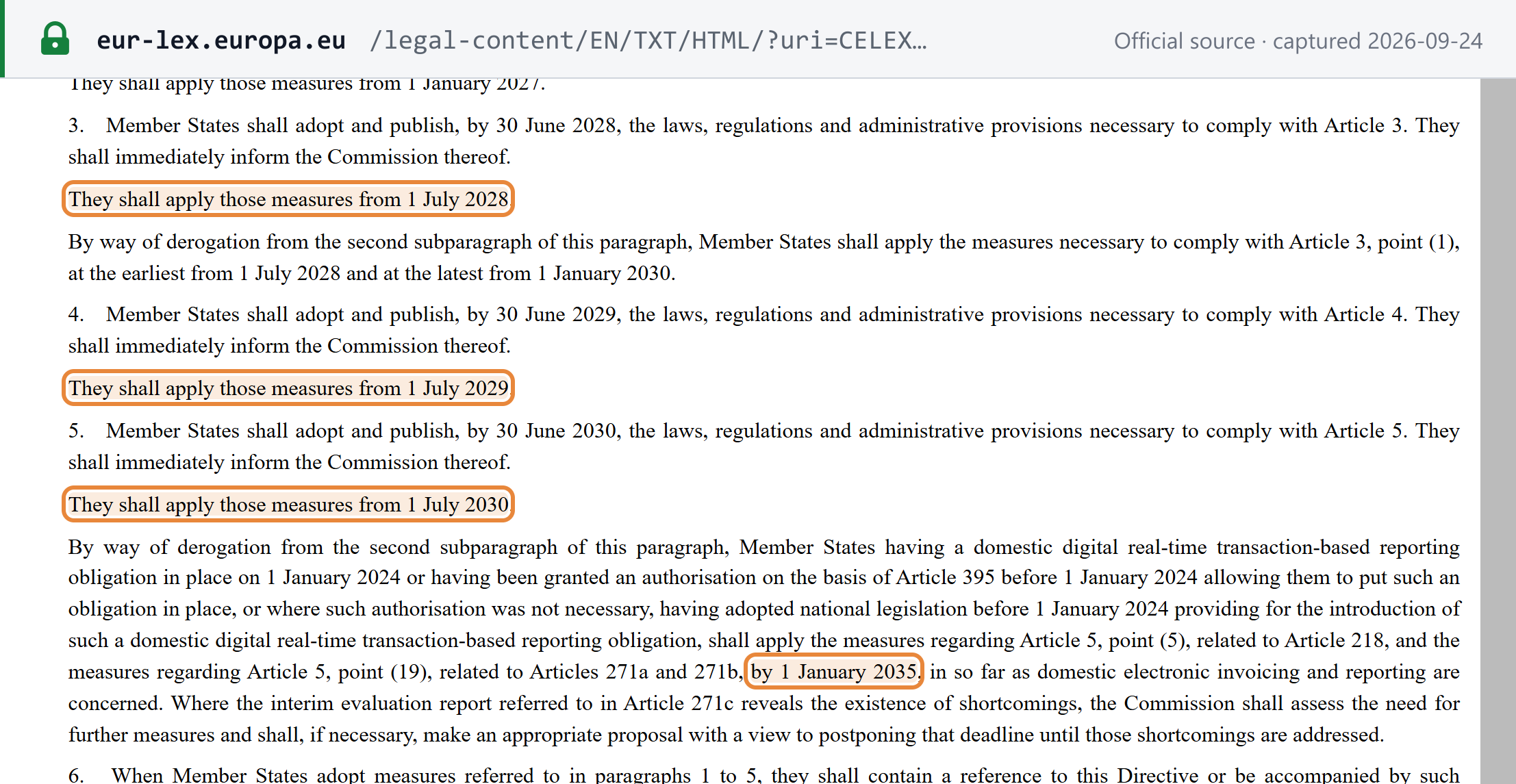
- Intra-EU B2B, from 1 July 2030. Invoices "shall be issued as electronic invoices" (recast Art. 218(2)) following the European standard EN 16931. The supplier transmits data for each intra-EU transaction "at the time when the invoice is issued or should have been issued" (recast Art. 263(1)), and the recapitulative statements of Articles 265 to 271 are deleted (Art. 5(18); application date in Art. 6(5)).
- Domestic reporting is optional. Member States "may require" domestic transaction reporting (Art. 271a(1)), and must accept data from EN 16931 e-invoices (Art. 271b(3)). Recital 20 allows data to be sent by the taxpayer directly or by a third party. Since 14 April 2025, a Member State may mandate domestic e-invoicing without an Article 395 derogation.
- Convergence by 1 January 2035. Member States with a domestic real-time reporting obligation in place on 1 January 2024 (or authorised or legislated before that date) must align it by 1 January 2035. The Commission's interim evaluation is due by 31 March 2033 (Art. 271c). If it finds shortcomings, the Commission assesses the need for further measures and may propose postponing the deadline (Directive (EU) 2025/516, checked 2026-10-07).
 Source snapshot captured 2026-09-24 — original
The English text of Directive (EU) 2025/516 does not use the word "clearance". The Directive prescribes data reporting at or after issuance; whether existing national clearance systems fit that frame is part of the 2035 convergence and the Article 271c evaluation.
Worked example: one domestic B2B invoice under five models
A supplier sells goods to a business customer in the same country.
| Model | What the supplier does | When the invoice is valid | What the authority receives |
|---|---|---|---|
| Centralised clearance (Italy) | Sends the XML file to SdI, which checks it and delivers it | Only once it passes through SdI; a PEC copy that bypasses SdI is treated as not issued | The full invoice, before the buyer gets it |
| Clearance (Saudi Arabia, B2B) | Submits the tax invoice to FATOORA before sharing it | Once ZATCA has cleared it | The full invoice, before the buyer gets it |
| Real-time reporting (Hungary) | Sends the invoice to the customer and reports its data to NAV | When issued; reporting is a separate obligation | Invoice data, in real time |
| 5-corner (UAE) | Passes the data to its accredited provider | Through the provider chain; corner 2 reports the TDD to corner 5 in parallel with delivery | A Tax Data Document from the providers |
| 4-corner only (Belgium, 2026) | Sends the invoice over Peppol through its provider | Under the general invoicing rules | Nothing from the e-invoice in this phase |
Who it affects
The model never sets the scope; each jurisdiction does. Scope as at 2026-10-07, from the sources above:
- Italy: invoices between parties resident or established in Italy, issued from 1 January 2019.
- Poland: every taxpayer obliged to issue structured invoices, with transitional limits of PLN 200,000,000 (2024 sales, Art. 145l) and PLN 10,000 a month (Art. 145m).
- Saudi Arabia: waves by VAT-taxable revenue; Wave 25 covers taxpayers whose revenue exceeded SAR 187,500 in any of 2022–2025, with integration due by 1 February 2027.
- Hungary: every invoice under the VAT Act since 4 January 2021, including invoices issued to non-VAT persons and to foreign VAT payers.
- Spain (SII): monthly VAT filers (turnover above EUR 6 million, REDEME registrants), plus voluntary opt-ins.
- France: every French-established VAT payer must be able to receive e-invoices from 1 September 2026.
- United Arab Emirates: revenue of AED 50,000,000 or more first (provider by 30 October 2026, live 1 January 2027).
- Singapore: newly incorporated voluntary GST registrants since 1 November 2025 and all new voluntary GST registrants since 1 April 2026; all GST-registered businesses phased in by 1 April 2031.
- Belgium: all Belgian VAT payers, B2B, since 1 January 2026.
- EU: every supplier of intra-EU B2B goods and services from 1 July 2030.
Cross-border treatment is also set per country: Hungary's reporting, for example, expressly covers invoices issued to foreign VAT payers. Each country guide gives the detail.
Current status and dates
As at 2026-10-07. Each row is cited in the sections above.
| Date | Event | Model | Status |
|---|---|---|---|
| 1 Jul 2018 | Hungary: Online Számla reporting starts (at least HUF 100,000 VAT, domestic B2B) | Real-time reporting | In force since |
| 1 Jan 2019 | Italy: B2B and B2C e-invoicing through SdI | Centralised clearance | In force since |
| 4 Jan 2021 | Hungary: reporting extends to all invoices | Real-time reporting | In force since |
| 1 Jan 2023 | Saudi Arabia: Phase 2 (Integration) waves begin | B2B clearance, B2C reporting | In force since |
| 1 Apr 2023 | Mexico: CFDI 4.0 mandatory | Clearance | In force since |
| 14 Apr 2025 | EU: Member States may mandate domestic e-invoicing without a derogation | EU enabling rule | In force since |
| 1 Jan 2026 | Belgium: B2B e-invoicing over Peppol | 4-corner interchange | In force since |
| 1 Feb / 1 Apr 2026 | Poland: KSeF mandatory | Centralised clearance | In force since |
| 2 Mar 2026 | Greece: B2B e-invoicing phase 1 through providers | Reporting moving to provider e-invoicing | In force since |
| 1 Nov 2025 / 1 Apr 2026 | Singapore: InvoiceNow Requirement for newly incorporated voluntary GST registrants, then all new voluntary registrants | Decentralised (5th corner) | In force since |
| 1 Sep 2026 | France: all businesses receive; large and mid-sized businesses issue and e-report | Decentralised (approved platforms) | In force since |
| 2 Nov 2026 | Greece: B2B e-invoicing phase 2, transition to 31 Jan 2027 (A.1197/2026) | Provider e-invoicing | Enacted |
| 1 Jan 2027 | UAE: go-live for revenue of AED 50,000,000 or more (provider by 30 Oct 2026) | Decentralised 5-corner (DCTCE) | Enacted |
| 1 Feb 2027 | Saudi Arabia: Wave 25 integration deadline | Clearance | Enacted |
| 1 Sep 2027 | France: small and micro-enterprises issue and e-report | Decentralised (approved platforms) | Enacted |
| 1 Jan 2028 | Belgium: e-reporting (preliminary draft) | 4-corner plus reporting | Proposed |
| 1 Jul 2030 | EU: intra-EU transaction reporting; e-invoices the default | EU DRR | Enacted (EU law) |
| 1 Apr 2031 | Singapore: all GST-registered businesses (phased from 2028) | Decentralised (5th corner) | Announced; IRAS says the legislative amendments "will be enacted at a later date" |
| 1 Jan 2035 | EU: pre-2024 domestic real-time systems must align | EU convergence | Enacted (EU law); the Commission may propose a postponement after the Art. 271c review |
Model exemplars by jurisdiction
A curated set of examples per model, not a full country list. For every jurisdiction's e-invoicing status and network, see the generated e-invoicing status and networks table.
| Jurisdiction | Model | System | Scope / date | Source | Last confirmed |
|---|---|---|---|---|---|
| Italy | Clearance, centralised exchange: SdI routes every invoice; one that bypasses SdI is treated as not issued | SdI (Agenzia delle Entrate) | Domestic B2B/B2C, invoices issued from 1 Jan 2019 | fatturapa.gov.it; AdE FAQ | 2026-10-07 |
| Poland | Clearance, centralised: issued on sending to KSeF, received when KSeF assigns its number | KSeF (Ministry of Finance) | 1 Feb 2026 (2024 sales above PLN 200m) / 1 Apr 2026 | VAT Act Arts 106na, 145l | 2026-10-07 |
| Saudi Arabia | Clearance (B2B/B2G tax invoices) plus reporting within 24 hours (simplified, mostly B2C, invoices) | FATOORA, Phase 2 Integration | Waves since 1 Jan 2023; Wave 25 by 1 Feb 2027 | ZATCA Detailed Guidelines §6.4; roll-out phases | 2026-10-07 |
| Mexico | Pre-clearance (OpenPeppol 2021 example) | CFDI 4.0 | CFDI 4.0 mandatory since 1 Apr 2023 | SAT; Peppol CTC Reference Document | 2026-10-07 |
| Malaysia | Clearance-style validation: IRBM Unique Identifier Number; 72-hour rejection window | MyInvois | Phased from 1 Aug 2024 (Table 1.1) | IRBM e-Invoice Guideline v4.8 §2.3 | 2026-10-07 |
| Hungary | Real-time invoice reporting, no clearance | Online Számla (NAV) | Phased 2018–2021; all invoices since 4 Jan 2021 | NAV Online Számla manual §3.1 | 2026-10-07 |
| Spain | Near-real-time ledger reporting (records, not invoices) | SII (AEAT) | Monthly filers (above EUR 6m, REDEME); 4 days | AEAT SII | 2026-10-07 |
| Greece | Reporting (myDATA) moving to provider-based e-invoicing | myDATA plus certified providers | Phase 1 2 Mar 2026; phase 2 2 Nov 2026 | A.1044/2026; A.1197/2026 | 2026-10-07 |
| France | Decentralised: platform-to-platform exchange; the platform transmits the data; e-reporting | Plateformes agréées (DGFiP) | All receive from 1 Sep 2026; SMEs issue from 1 Sep 2027 | impots.gouv.fr | 2026-10-07 |
| United Arab Emirates | Decentralised 5-corner (DCTCE); the FTA is corner 5 | Electronic Invoicing System, PINT AE through accredited providers | Revenue of AED 50m or more: provider by 30 Oct 2026, live 1 Jan 2027 | MoF eInvoicing hub; Guidelines V1.1; MD 244/2025 (consolidated) | 2026-10-07 |
| Singapore | Decentralised: IRAS as a 5th corner on Peppol | InvoiceNow (IRAS and IMDA) | Newly incorporated voluntary registrants since 1 Nov 2025; all new voluntary registrants since 1 Apr 2026; all by 1 Apr 2031 | IRAS e-Tax Guide §§2.3, 5.3 | 2026-10-07 |
| Belgium | Interchange: Peppol 4-corner, no invoice data to government yet | Peppol | B2B since 1 Jan 2026; e-reporting 2028 proposed | einvoice.belgium.be; efactuur FAQ | 2026-10-07 |
| European Union | Transaction-level reporting on EN 16931 e-invoices; domestic reporting optional | ViDA, Directive (EU) 2025/516 | Intra-EU from 1 Jul 2030; legacy systems align by 1 Jan 2035 | Directive (EU) 2025/516 Arts 6, 218, 263, 271a–271b | 2026-10-07 |
Related changes from the feed
- 2026-09-30 — Greece moved phase 2 of mandatory B2B e-invoicing to 2 November 2026, with a parallel-systems window to 31 January 2027. (Diavgeia, A.1197/2026) — see event
- 2026-09-30 — France published its BOFiP commentary on e-reporting (ACTU-2026-00145). (BOFiP) — see event
- 2026-07-28 — France's Décret 2026-677 removed the public platform as an exchange channel. (Légifrance) — see event
- 2026-07-24 — Saudi Arabia set Wave 25 at VAT-taxable revenue above SAR 187,500, with integration due by 1 February 2027. (ZATCA) — see event
- 2026-07-18 — Belgium's Council of Ministers approved a preliminary draft for e-reporting from 1 January 2028. Status: proposed. (news.belgium.be) — see event
- 2026-06-01 — Israel's invoice allocation-number (clearance) threshold fell to NIS 5,000. (Israel Tax Authority) — see event
- 2026-03-09 — Singapore's IRAS published the second edition of its GST InvoiceNow Requirement guide; new voluntary GST registrants are in scope from 1 April 2026. (IRAS) — see event
The UAE's deadline for large businesses to appoint an accredited provider (30 October 2026, under Ministerial Decision No. 66 of 2026) is also tracked as an event.
Frequently asked questions
What is the difference between clearance and real-time reporting?
Under clearance, the tax authority, or a provider it authorises, must validate or stamp the invoice before it is validly issued or delivered. In Italy an invoice that bypasses SdI is treated as not issued; in Saudi Arabia clearance is a prerequisite for sharing a B2B tax invoice with the buyer. Under reporting, the invoice moves freely and its data reach the authority shortly afterwards: in real time in Hungary, within four days in Spain's SII, and within 24 hours for Saudi simplified (mostly B2C) invoices. (OECD FTA 2022, p. 30; Agenzia delle Entrate FAQ n. 44; ZATCA Detailed Guidelines §6.4; NAV; AEAT)
What is the 5-corner (DCTCE) model?
It is Peppol's 4-corner exchange (supplier, supplier's provider, buyer's provider, buyer) plus a fifth corner, the tax authority, which receives a Tax Data Document from the providers in parallel with delivery. OpenPeppol's 2021 CTC Reference Document describes the 5-corner model. The UAE Ministry of Finance calls its model Decentralized Continuous Transaction Control and Exchange (DCTCE), and Singapore's IRAS describes InvoiceNow as adding a 5th corner to the 4-corner model. (OpenPeppol CTC Reference Document, September 2021; MoF eInvoicing hub; IRAS e-Tax Guide para 5.3)
Is Peppol itself a CTC system?
Not on its own. Peppol is the interoperability (4-corner) layer, which OpenPeppol's overview labels the foundation for CTC. It becomes a CTC system when an authority adds a reporting corner, as in the UAE and Singapore, or legislates reporting on top of it, as Belgium proposes for 2028. Belgium's FPS Finance says no invoice information goes to the government in the first phase from 1 January 2026. (OECD FTA 2022, Figure 3.2; efactuur.belgium.be FAQ)
Does ViDA force EU countries to adopt clearance?
No. Directive (EU) 2025/516 prescribes transaction-level reporting at invoice issuance for intra-EU B2B supplies from 1 July 2030 and makes domestic reporting optional (Art. 271a). Member States must accept data from EN 16931 e-invoices (Art. 271b(3)), and domestic real-time systems in place before 1 January 2024 must align by 1 January 2035. The English text of the Directive does not use the word clearance. (Directive (EU) 2025/516, Arts 6, 263, 271a–271c)
Is there an official, legal taxonomy of CTC models?
No binding one. The OECD Forum on Tax Administration (2022) documents the models, reproducing the European Commission's 2022 classification of digital reporting requirements and OpenPeppol's four-model overview. The labels are convention; national laws use their own terms, such as the KSeF identifying number in Poland, Clearance and Reporting in Saudi Arabia, and DCTCE in the UAE. (OECD FTA 2022, Box 1.2 and Figure 3.2)
Can one country run more than one model?
Yes. Saudi Arabia clears B2B tax invoices and has simplified (mostly B2C) invoices reported within 24 hours. France combines platform-based e-invoicing with e-reporting for B2C, cross-border and payment data. Greece is layering provider-based e-invoicing on top of myDATA reporting. (ZATCA Detailed Guidelines §6.4 and §2.15; impots.gouv.fr; Joint Decision A.1044/2026)
Related resources
- Peppol e-invoicing — the 4-corner network, Access Points and Peppol IDs
- Peppol requirements by country
- E-invoicing status and networks worldwide — the generated table for every jurisdiction
- ViDA — VAT in the Digital Age — the full EU package, beyond digital reporting
- SAF-T reporting and VAT listings — the periodic reporting forms in the EU classification
- E-invoicing guides: Italy (SdI), Poland (KSeF), Saudi Arabia (FATOORA), Hungary (Online Számla), Spain, France, Belgium, United Arab Emirates
- Country guides: Mexico, Malaysia, Greece, Singapore
- Tax-change chronologies: EU, Greece, France, Saudi Arabia, United Arab Emirates, Singapore, Belgium
Reference links
- OECD FTA — Tax Administration 3.0 and Electronic Invoicing: Initial Findings (2022)
- OpenPeppol — CTC documentation — Reference Document (2021) and Addendum (2023)
- Council Directive (EU) 2025/516 — ViDA
- UAE Ministry of Finance — eInvoicing
- IRAS — GST InvoiceNow Requirement e-Tax Guide
- ZATCA — Detailed Guidelines for E-Invoicing