Mexico VAT (IVA) guidelines
| FACTSHEET | |
|---|---|
| Country code | MX |
| Tax name | Impuesto al Valor Agregado (IVA) |
| Tax Authority | Servicio de Administración Tributaria (SAT) |
Overview
Mexico levies value added tax as the Impuesto al Valor Agregado (IVA) under the Ley del Impuesto al Valor Agregado (LIVA). Article 1 makes liable «las personas físicas y las morales que, en territorio nacional» — individuals and companies that, in Mexican territory — sell goods, provide independent services, grant the temporary use of goods, or import goods or services. The Cámara de Diputados' consolidated text records the last reform of the LIVA as published in the Diario Oficial de la Federación (DOF) on 12 November 2021. [1]
Authority. IVA is administered by the Servicio de Administración Tributaria (SAT), a decentralised body of the Secretaría de Hacienda y Crédito Público. The SAT issues the annual Resolución Miscelánea Fiscal (RMF), the rulebook that implements the tax laws; the RMF for 2026 was published in the DOF on 28 December 2025. The procedural rules — registration, invoicing, penalties — sit in the Código Fiscal de la Federación (CFF) and its Reglamento (RCFF). [5] [2]
Currency. All amounts in this guide are in Mexican pesos (MXN). CFF article 20: «Las contribuciones y sus accesorios se causarán y pagarán en moneda nacional» — taxes and their accessories arise and are paid in national currency. An invoice may still be issued in a foreign currency — see Currency and language. [2]
Tax period. IVA is calculated per calendar month (LIVA article 5o.-D), except for small landlords on the quarterly income-tax option, who then also calculate IVA quarterly (article 5o.-F) and one-off transactions (article 33). Where tax laws work by fiscal year, the year is the calendar year (CFF article 11). [1] [2]
Layering. IVA is a single federal tax; there is no state IVA. Under LIVA article 41, states that join the Sistema Nacional de Coordinación Fiscal agree not to keep local or municipal taxes on activities subject to IVA, with an exception for lodging services (hospedaje), campsites, trailer parks and timeshare, which states may tax. [1]
Registration
Who should register
Registration for IVA is registration in the Registro Federal de Contribuyentes (RFC), Mexico's single taxpayer register — there is no separate VAT number. CFF article 27, section A.I requires individuals and companies to register when they must file periodic returns or must issue CFDI e-invoices «por los actos o actividades que realicen o por los ingresos que perciban» — for the acts or activities they carry out or the income they receive. Because LIVA article 1 taxes every person carrying out the listed acts in Mexico, anyone making taxable supplies in Mexico registers from the first taxable act. [2] [1]
Registration threshold
Not applicable — there is no threshold. The LIVA and the CFF set no turnover threshold for IVA liability or RFC registration. This applies to residents and non-residents alike.
| Trigger | Threshold | Deadline | Source |
|---|---|---|---|
| Taxable acts in Mexico (residents and non-residents) | None — the first taxable act | Companies incorporated before a notary: at signing of the incorporation deed. Others: within the month following the event that triggers the obligation | LIVA art. 1; RCFF art. 23 |
| Non-resident digital services to recipients in Mexico | None — the first supply | Within 30 calendar days of the first supply | LIVA art. 18-D, section I |
Non-resident registration
How a non-resident is caught depends on what it sells and to whom — see Foreign companies selling into Mexico:
- Digital services to recipients in Mexico. Register in the RFC within 30 calendar days of the first supply (LIVA article 18-D). There is no threshold.
- Other non-residents. The Reglamento del CFF provides separate RFC registration categories for companies (article 22, section VI) and individuals (section IX) resident abroad without a permanent establishment in Mexico. [3]
- Services supplied from abroad to Mexican businesses. The non-resident does not register; the Mexican recipient pays the IVA on the import of services.
Tax identification number
The RFC is 12 characters for a company (persona moral) and 13 for an individual (persona física). The SAT's CFDI data-type schema defines it as three letters (companies) or four (individuals), a six-digit date in YYMMDD form, and a three-character homoclave whose last character is a digit or the letter A — schema pattern [A-Z&Ñ]{3,4}[0-9]{2}(0[1-9]|1[012])(0[1-9]|[12][0-9]|3[01])[A-Z0-9]{2}[0-9A]. The SAT documents cited here do not publish the homoclave checksum algorithm. [8]
Two generic RFCs are used on invoices where the customer has no RFC: XAXX010101000 for the general public (público en general) and XEXX010101000 for foreign residents — see Document types. [6]
For the RFC's structure in detail, see Lookuptax's Mexico tax ID (RFC) guide, and check a number's format with the Mexico RFC validator.
How to register
- Companies incorporated in Mexico are registered at incorporation: RCFF article 23 requires the application to be filed «en el momento en el que se firme su acta o documento constitutivo, a través del fedatario público» — when the incorporation deed is signed, through the notary who records it. Companies not incorporated before a notary apply within the month following signature. [3]
- Everyone else applies within the month following the day the obligation to file periodic returns first arises (RCFF article 23). [3]
- Portal. The SAT runs RFC registration procedures for companies and individuals on its portal.
Voluntary registration
Not applicable. With no threshold (LIVA article 1), there is no below-threshold position to opt out of. Separately, CFF article 27 requires every adult individual to register: «Las personas físicas mayores de edad deberán solicitar su inscripción al Registro Federal de Contribuyentes» — adult individuals must apply for RFC registration. Those without economic activity register in a special category («Inscripción de personas físicas sin actividad económica») that carries no obligation to file returns or pay taxes, and so no IVA obligations. [2]
Deregistration
Changes to an RFC registration are made by filing notices (avisos) under RCFF article 29, which include suspension of activities (section V) and cancellation of the RFC registration on total cessation of operations (section XV), as well as cancellation on liquidation, merger or death. The general deadline is within the month following the event. Notices under sections IV, X, XIV, XV and XVII — including cancellation on total cessation of operations — are instead filed under the separate rules of RCFF article 30. [3]
Group registration
Not available. The LIVA contains no grouping provision. The right to credit input IVA is personal: article 4o. says «El derecho al acreditamiento es personal … y no podrá ser trasmitido por acto entre vivos, excepto tratándose de fusión» — it cannot be transferred except on a merger. The nearest mechanism works within one taxpayer: a taxpayer with several establishments files one payment return for all of them (article 32, section IV). [1]
Rates
| Rate | Applies to | Legal basis |
|---|---|---|
| 16% — standard rate | All taxable sales, services, temporary use of goods and imports not listed elsewhere | LIVA art. 1; rate paragraph last amended by the reform published in the DOF on 7 December 2009 [1] |
| 0% (tasa cero) | Listed food, medicines and agricultural goods and services, and exports — see below | LIVA arts. 2o.-A and 29 [1] |
| 8% effective — decree incentive, not a statutory rate | Taxpayers in the designated northern or southern border regions that meet the decrees' conditions: a fiscal credit of 50% of the IVA applied to the 16% rate | Border-region stimulus decrees; renewed for 2026 by DOF 31 December 2025 [10] [11] |
| Exempt (no IVA, no input credit) | See Exemptions | LIVA arts. 9, 15 and 25 |
Standard rate: 16%. Article 1: «El impuesto se calculará aplicando a los valores que señala esta Ley, la tasa del 16%. El impuesto al valor agregado en ningún caso se considerará que forma parte de dichos valores» — the tax is calculated by applying 16% to the values the law sets, and IVA is never part of those values. The consolidated text annotates this paragraph as last amended by the reform published in the DOF on 7 December 2009; it records the publication date, not an in-force date. [1]
Zero rate (article 2o.-A). 0% applies to: [1]
- Goods: unprocessed animals and plants (except rubber — «salvo el hule» — and pets); patent medicines and food for human and animal consumption — except beverages other than milk (juices included), syrups and concentrates, caviar, smoked salmon, eels, flavourings and additives, chewing gum, and processed pet food; ice and non-carbonated water (except in containers under 10 litres); ixtle, palma and lechuguilla; listed agricultural machinery; fertilisers and agricultural pesticides; hydroponic greenhouses; gold and jewellery of at least 80% gold not sold at retail; books, newspapers and magazines sold by their publishers; and menstrual products — «toallas sanitarias, tampones y copas, para la gestión menstrual» (sanitary pads, tampons and menstrual cups), added by the reform published in the DOF on 12 November 2021.
- Prepared food is taxed at 16%. Food prepared for consumption on the premises, or for take-away or home delivery, is excluded from the zero rate.
- Services: listed agricultural services, milling of corn and wheat, milk pasteurisation, reinsurance, and domestic water supply.
- Exports of goods and of listed services (article 29) — see Imports and exports.
Reduced rates. Not applicable — the LIVA sets two rates, 16% and 0%, and no reduced positive rate. The 8% below is a tax credit granted by decree.
The 8% border-region incentive. Presidential decrees give taxpayers with their tax domicile, branch, agency or establishment in the designated northern border region a fiscal credit of 50% of the IVA. The SAT's description: «Consiste en un crédito fiscal de 50 % del impuesto al valor agregado, el cual se aplicará en forma directa sobre la tasa de 16 %, a fin de que la tasa disminuida que resulte sea de 8 %» — a 50% tax credit applied directly to the 16% rate, so that the reduced rate is 8%. The SAT lists the covered municipalities in Baja California, Sonora, Chihuahua, Coahuila, Nuevo León and Tamaulipas — among them Tijuana, Mexicali, Juárez, Piedras Negras, Nuevo Laredo, Reynosa and Matamoros. A parallel decree covers the southern border region. [10] [11]
- Not automatic. The credit applies only to taxpayers who meet the decrees' conditions, including the location requirement above.
- Renewed by decree. A decree published in the DOF evening edition of 31 December 2025 modified the northern and southern border-region decrees and renewed the incentive for 2026. Check for a further renewal before relying on the 8% in a later year. [11]
Announced future rates. None enacted. The federal government presented its 2027 economic package to Congress on 8 September 2026; it remains a set of proposals until Congress passes it. [12]
For Mexico alongside other jurisdictions, see Lookuptax's worldwide tax rates table and VAT registration thresholds table.
Cross-border rules
Imports and exports
- Imports of goods. Importing goods is a taxable act (LIVA article 24, section I). The base is the customs value plus import duty and other amounts payable on import (article 27). Article 28: the IVA is paid provisionally «conjuntamente con el del impuesto general de importación» — together with import duty — and no input credit can be set against it at the border; goods cannot leave customs until it is paid. Import IVA is then creditable under the normal rules. Article 25 lists exempt imports, including luggage and household goods and goods whose domestic sale is exempt or zero-rated. [1]
- IMMEX and bonded regimes. Companies importing temporarily under the IMMEX (maquila), bonded-warehouse or strategic-bonded-zone regimes can obtain a tax credit equal to 100% of the import IVA if they hold a SAT certification (article 28-A): «un crédito fiscal consistente en una cantidad equivalente al 100% del impuesto al valor agregado que deba pagarse por la importación». [1]
- Exports: 0%. Article 29: resident companies apply the 0% rate to goods and services «cuando unos u otros se exporten» — when they are exported. Exports include definitive customs exports, intangibles transferred to non-residents, and a closed list of services used abroad, among them technical assistance, maquila, advertising, commissions, insurance, financing, filming, call centres and specified information-technology services. [1]
- Services not on the list are not automatically zero-rated. A service carried out in Mexico by a Mexican resident is supplied in Mexico (article 16) and is taxed at 16% unless article 29 covers it.
- Imported services: the recipient pays. Article 24, section V treats «el aprovechamiento en territorio nacional» — the use in Mexico — of services provided by non-residents as an import. The tax arises «en el momento en el que se pague efectivamente la contraprestación» — when the consideration is actually paid (article 26, section IV), on the value a domestic supply would have (article 27). The recipient pays it and credits it under the normal rules. A recipient that is a taxpayer only because of the import pays within 15 days, with no credits (article 33). [1]
- Goods sold or rented by non-residents. A Mexican person who acquires or rents tangible goods from a non-resident without a permanent establishment must withhold the IVA (article 1o.-A, section III) and pay it with its monthly return, by the 17th of the following month at the latest. [1]
Digital products and services
The LIVA has specific rules for digital services supplied by non-residents without an establishment in Mexico to recipients located in Mexico. [1]
- What is caught (article 18-B). (I) Downloads of, or access to, images, films, text, video, audio, music, games (including gambling) and other multimedia content — excluding e-books, e-newspapers and e-magazines; (II) intermediation between third parties (platforms and marketplaces); (III) online clubs and dating sites; (IV) distance learning, tests and exercises.
- Where the recipient is (article 18-C). A recipient is in Mexico if any one of these applies: it gave the provider an address in Mexico; it pays through an intermediary located in Mexico; its device's IP address is in Mexico's range; or it gave a phone number with Mexico's country code.
- Threshold. None. Article 18-D, section I: registration «se realizará dentro de los 30 días naturales siguientes contados a partir de la fecha en que se proporcionen por primera vez los servicios digitales» — within 30 calendar days of first supplying the digital services.
- Obligations (article 18-D). Register in the RFC; charge 16% IVA separately; file monthly information returns and pay monthly by the 17th of the following month; issue receipts on request; appoint a legal representative and an address in Mexico; and obtain an e.firma (advanced electronic signature). The SAT publishes the list of registered providers.
- Unregistered providers (article 18-I). If a provider is not on the SAT's list, recipients in Mexico treat the service as an import and pay the IVA themselves.
- Blocking (article 18-H BIS). Failing to register, appoint a representative or obtain an e.firma, or failing to file or pay for three consecutive months, can lead to temporary blocking of the service «por conducto de los concesionarios de una red pública de telecomunicaciones en México» — through Mexican public telecommunications network operators — and cancellation of the RFC registration.
- Online access for the SAT (CFF article 30-B). Added by the CFF reform published in the DOF on 7 November 2025 and applicable from 1 April 2026, it requires digital-service providers to give the tax authorities permanent online, real-time access to the information in their systems that shows compliance. [2] [14]
- Monthly information return (RMF rule 12.1.9). The information return under article 18-D, section III is delivered together with the monthly IVA payment return for digital services and, where applicable, the IEPS return. The first amendment to the RMF 2026, published in the DOF on 9 July 2026, renamed the IEPS return in that rule to the return for IEPS on games with bets and draws («IEPS por Juegos con Apuestas y/o Sorteos…») and cross-refers to rule 12.1.11, under which that IEPS is paid by the 17th. [13]
Foreign companies selling into Mexico — B2B and B2C
The answer depends on what is sold and to whom: [1] [4]
- Services to Mexican businesses (B2B). The non-resident does not register. The Mexican business pays IVA on the import of services when it pays the consideration (articles 24 V and 26 IV) and credits it under the normal rules.
- Tangible goods shipped in (B2B or B2C). Import IVA is paid at customs by the importer (article 28). Where a non-resident without a permanent establishment sells or rents tangible goods to a Mexican person, the buyer withholds the IVA (article 1o.-A, section III).
- Digital services to consumers (B2C). The non-resident registers from the first supply — within 30 calendar days, with no threshold (article 18-D).
- Goods sold to consumers through a platform. The platform withholds IVA from the seller — 100% for non-resident sellers of goods located in Mexico in 2026 (see below).
Marketplace / platform deemed-supplier liability
Mexico uses withholding by the platform, not a deemed-supplier rule. Intermediation platforms — resident or non-resident — that collect the price must, under LIVA articles 1o.-A BIS and 18-J (article 18-J addresses non-resident platforms; article 1o.-A BIS brings in resident ones): [1]
- publish prices with the IVA shown separately, or marked as including IVA;
- withhold 50% of the IVA charged by individual sellers — «Retener a las personas físicas que enajenen bienes, presten servicios o concedan el uso o goce temporal de bienes, el 50% del impuesto al valor agregado cobrado» — and 100% where the seller has not given the platform its RFC;
- pay the withheld tax by the 17th of the following month, issue withholding CFDIs (CFDI de Retenciones) to the sellers, and report seller data to the SAT monthly by the 10th (article 18-J, section III).
For 2026, the Ley de Ingresos de la Federación 2026 (article 25, section IX) extends the withholding: [4]
- 50% from company sellers (personas morales), at the rate of the first paragraph of LIVA article 18-J, section II a) — section IX a);
- 100% from non-residents without an establishment in Mexico who sell goods in Mexico (goods located in Mexico under LIVA article 10) — section IX b);
- 100% from sellers «cuando depositen los montos de las operaciones realizadas en cuentas bancarias o de depósito ubicadas en el extranjero» — when the proceeds are deposited in bank or deposit accounts located abroad — section IX c).
The LIF is an annual law, in force for 2026 from 1 January 2026. The 2027 draft repeats the platform rules but has not been enacted. [12]
Place of supply
- Goods (article 10). Sold in Mexico if the goods are there when shipped to the buyer or, with no shipment, if the seller delivers them physically in Mexico. Intangibles are sold in Mexico only «cuando el adquirente y el enajenante residan en el mismo» — when buyer and seller both reside there.
- Services (article 16). Supplied in Mexico when carried out there, in whole or in part, by a Mexican resident. For international air transport, «únicamente se presta el 25% del servicio en territorio nacional» — only 25% of the service is treated as supplied in Mexico.
- Digital services follow the recipient's location (article 18-C, above).
Invoice requirements
In Mexico every invoice is a CFDI (Comprobante Fiscal Digital por Internet): an XML document validated and sealed by the SAT, or by a SAT-authorised certification provider (PAC, proveedor de certificación), before it counts as issued. CFF article 29 requires the issuer to hold a valid e.firma and a digital-seal certificate (CSD, certificado de sello digital), and to send each CFDI «antes de su expedición» — before issuing it — so that the SAT or PAC can: [2]
- validate it against the requirements of article 29-A;
- assign the folio fiscal (the unique invoice number, stored as a UUID); and
- add the SAT's digital seal.
Only then is the XML delivered to the customer. The printed or PDF version «únicamente presume la existencia de dicho comprobante fiscal» — only presumes that the CFDI exists (article 29, section V). The XML is the invoice.
Mandatory content
CFF article 29-A opens: «Los comprobantes fiscales digitales a que se refiere el artículo 29 de este Código, deberán contener los siguientes requisitos» — the CFDIs referred to in article 29 must contain the following. The right-hand column maps each requirement to the CFDI 4.0 XML schema (cfdv40.xsd); the mapping is Lookuptax's. [2] [7]
| # | Required content | Legal cite | CFDI 4.0 field |
|---|---|---|---|
| 1 | Issuer's RFC, name or company name, and tax regime under the income-tax law; the issuing establishment's address where there are several | CFF art. 29-A, I | Emisor/@Rfc, @Nombre, @RegimenFiscal |
| 2 | Folio number and SAT digital seal, plus the issuer's digital seal | CFF art. 29-A, II | TimbreFiscalDigital/@UUID; @Sello, @NoCertificado |
| 3 | Place and date of issue | CFF art. 29-A, III | @LugarExpedicion (postal code), @Fecha |
| 4 | Recipient's RFC, name, tax-domicile postal code and the use the recipient will make of the CFDI; a generic RFC where the recipient has none | CFF art. 29-A, IV | Receptor/@Rfc, @Nombre, @DomicilioFiscalReceptor, @RegimenFiscalReceptor, @UsoCFDI |
| 5 | Quantity, unit of measure and class of goods, or description of the service, using the SAT's catalogues; sector extras — vehicle identification number, property-tax account for rentals, CNE (energy regulator) permit number for fuel sellers | CFF art. 29-A, V | Concepto/@ClaveProdServ, @Cantidad, @ClaveUnidad, @Descripcion |
| 6 | Unit value | CFF art. 29-A, VI | Concepto/@ValorUnitario |
| 7 | Total amount; taxes charged, broken down by rate; taxes withheld; and the form of payment | CFF art. 29-A, VII | @SubTotal, @Total, Impuestos/Traslados, @FormaPago, @MetodoPago |
| 8 | For imported goods sold first-hand, the customs document number and date | CFF art. 29-A, VIII | InformacionAduanera/@NumeroPedimento |
| 9 | Must cover real, existing operations — a CFDI that does not is treated as false (added by the reform published in the DOF on 7 November 2025) | CFF art. 29-A, IX | — |
| 10 | Any other requirement the SAT sets by general rule | CFF art. 29-A, X | Schema and catalogues (Anexo 20) |
The schema marks these attributes as required on every CFDI: on the document — Version ("4.0"), Fecha, Sello, NoCertificado, Certificado, SubTotal, Moneda, Total, TipoDeComprobante, Exportacion, LugarExpedicion; on the issuer — Rfc, Nombre, RegimenFiscal; on the recipient — Rfc, Nombre, DomicilioFiscalReceptor, RegimenFiscalReceptor, UsoCFDI; on each line — ClaveProdServ, Cantidad, ClaveUnidad, Descripcion, ValorUnitario, Importe, ObjetoImp. Serie, Folio, FormaPago, MetodoPago and TipoCambio are optional in the schema. [7]
Consequence of a defective CFDI. Article 29-A: amounts on a CFDI that fails any requirement of articles 29 or 29-A, or whose data are shown differently from what the rules require, «no podrán deducirse o acreditarse fiscalmente» — cannot be deducted or credited. The IVA must also be shown separately on the CFDI for the buyer to credit it (LIVA article 5o., section II). [2] [1]
Issuance deadline
- 24 hours. RCFF article 39 requires the CFDI to be sent to the SAT or a PAC «a más tardar dentro de las veinticuatro horas siguientes a que haya tenido lugar la operación» — no later than 24 hours after the transaction that gives rise to it. [3]
- 72-hour certification window. Under the RMF 2026 as published in the DOF on 28 December 2025, a PAC must check that the time between the document's generation and the attempted certification does not exceed 72 hours (and is not negative), using the time zone of the postal code in
LugarExpedicion. A CFDI outside the window is not certified. [5]
Numbering and sequencing
The legal identifier is the folio fiscal assigned by the SAT or PAC (CFF article 29, section IV b), stored as the UUID in the SAT's digital-stamp element. The issuer's own Serie and Folio are optional: the SAT's Anexo 20 fill-in guide describes Serie as «el número de serie que utiliza el contribuyente para control interno» — the series the taxpayer uses for internal control — of 1 to 25 alphanumeric characters, and Folio as an internal control number of 1 to 40. The CFF, the RCFF and the Anexo 20 guide set no rule requiring the issuer's own series to be sequential or gap-free. [2] [6]
Credit and debit notes
- Credit notes are CFDI de Egreso. The Anexo 20 guide: the Egreso CFDI covers «devoluciones, descuentos y bonificaciones» — returns, discounts and rebates — and «es conocido como nota de crédito» (is known as a credit note). It can also reduce the amounts on an Ingreso CFDI, for example to apply an advance payment. [6]
- Content. LIVA article 7: the refund of IVA must be documented showing, expressly and separately, the consideration and the IVA refunded, «así como los datos de identificación del comprobante fiscal de la operación original» — and the identifying details of the original CFDI. [1]
- Debit notes. The Anexo 20 guide lists no separate debit-note type; an additional charge is invoiced on a new Ingreso CFDI.
- Cancellation. CFF article 29-A: a CFDI can be cancelled «a más tardar en el mes en el cual se deba presentar la declaración anual del impuesto sobre la renta» for the year it was issued — by the month the annual income-tax return for that year is due — and only if the recipient accepts the cancellation. [2]
Currency and language
- Currency. A CFDI may be issued in a foreign currency. The
Monedafield takes an ISO 4217 code ("MXN" for pesos). The Anexo 20 guide saysTipoCambiois «requerido cuando la clave de moneda es distinta de "MXN"» — required when the currency is not MXN (or "XXX", no currency) — and the Banco de México FIX rate may be used. [6] - Conversion for tax. Tax is paid in pesos. CFF article 20 uses the rate at which the foreign currency was acquired; with no acquisition, «el tipo de cambio que el Banco de México publique en el Diario Oficial de la Federación el día anterior a aquél en que se causen las contribuciones» — the Banco de México rate published in the DOF on the day before the tax arises. [2]
- Language. Field values come from SAT catalogues. CFF articles 29 and 29-A set no separate language rule.
Document types
The CFDI's TipoDeComprobante gives five types. The Anexo 20 guide describes them: [6]
| Type | Name | Used for |
|---|---|---|
| I | Ingreso | Sales invoice — sales, services, rentals, fees, donations received |
| E | Egreso | Credit note — returns, discounts, rebates |
| T | Traslado | Covers the transport and lawful possession of goods in transit in Mexico |
| N | Nómina | Payroll |
| P | Pago | Payment receipt carrying the payment complement (Complemento para recepción de Pagos) |
A separate CFDI de Retenciones standard documents tax withheld, for example by platforms (LIVA article 18-J).
- No simplified invoice. There is no reduced-particulars invoice: every CFDI carries the article 29-A content.
- Customers without an RFC. Sales to the general public use the generic RFC XAXX010101000; the Anexo 20 guide's own example shows the recipient name «PUBLICO EN GENERAL» with the RFC XAXX010101000. Foreign customers not registered in the RFC use XEXX010101000, with recipient tax regime 616 («Sin obligaciones fiscales», no tax obligations) and CFDI use S01 («Sin efectos fiscales», no tax effects). [6]
Self-billing
Not provided for as a general mechanism. CFF article 29 puts the duty to issue the CFDI on the person carrying out the act, and the CFF provides no general self-billing (autofacturación) facility. The nearest analogue is for withholding: under LIVA article 32, section V, a company that withholds IVA from an individual's professional services or rentals may skip issuing a withholding CFDI if the individual issues a CFDI that meets articles 29 and 29-A «y en el comprobante se señale expresamente el monto del impuesto retenido» — and expressly states the tax withheld. [2] [1]
Retention and audit trail
- Retention: 5 years. CFF article 30: accounting records and supporting documentation «deberán conservarse durante un plazo de cinco años, contado a partir de la fecha en la que se presentaron o debieron haberse presentado las declaraciones con ellas relacionadas» — for five years from when the related returns were, or should have been, filed. Longer periods apply to items with continuing effects and to disputed items. [2]
- Electronic accounting. Accounting records are kept electronically, and taxpayers upload their accounting information to the SAT monthly (CFF article 28, sections III and IV). [2]
- Audit trail. Each CFDI carries the issuer's seal and the SAT's seal. Anyone receiving a CFDI can check on the SAT website whether its folio was authorised for the issuer and whether the issuer's seal certificate was valid and registered when it was issued (CFF article 29). [2]
Technical format
CFDI version 4.0, an XML format defined by the SAT in Anexo 20 of the RMF, schema namespace http://www.sat.gob.mx/cfd/4. Mexico has no Peppol network; see E-invoicing status. [7]
A specimen of a compliant invoice
The SAT does not publish an official annotated specimen invoice. The Anexo 20 guide teaches the fields one by one with example values, which it describes as «ficticios para efectos didácticos» (fictitious, for teaching purposes).
What the SAT does prescribe is the printed representation of a CFDI. Under the RMF 2026 rule «Requisitos de las representaciones impresas del CFDI», as published on 28 December 2025, the printed or PDF version must carry all the article 29-A content plus: [5]
- a barcode generated under Anexo 20, or the folio fiscal;
- the serial numbers of the issuer's CSD and of the SAT's certificate;
- the legend «Este documento es una representación impresa de un CFDI» — "This document is a printed representation of a CFDI";
- the date and time of issue and of certification; and
- the original string of the SAT's certification complement (cadena original del complemento de certificación digital del SAT).
The layout below is Lookuptax's own illustration of those particulars, with English labels. Every name, RFC, number and amount in it is fictional:
Factura — CFDI 4.0, tipo I (Ingreso)
| Product/service codeCFF 29-A, V | QtyCFF 29-A, V | Unit codeCFF 29-A, V | DescriptionCFF 29-A, V | Unit valueCFF 29-A, VI | Amount |
|---|---|---|---|---|---|
| [SAT code] | 20 | [SAT code] | Office desks | MXN 2,500.00 | MXN 50,000.00 |
- SubtotalCFF 29-A, VII
- MXN 50,000.00
- IVA charged at 16%CFF 29-A, VII; LIVA art. 1
- MXN 8,000.00
- TotalCFF 29-A, VII
- MXN 58,000.00
- Folio fiscal (UUID): SPECIMEN-UUID-0000 — assigned by the SAT or PAC on certification, not by the issuer — CFF 29, IV b); CFF 29-A, II.
- Serial numbers of the issuer CSD and of the SAT certificate: [not reproduced] — RMF 2026 printed-representation rule, II.
- Date and time of certification: 15 October 2026, 10:31 — RMF 2026 printed-representation rule, IV.
- Issuer digital seal and SAT digital seal: [not reproduced] — CFF 29-A, II.
- Original string of the SAT certification complement: [not reproduced] — RMF 2026 printed-representation rule, V.
- Barcode or folio fiscal — RMF 2026 printed-representation rule, I.
- "Este documento es una representación impresa de un CFDI" — RMF 2026 printed-representation rule, III.
- IVA is shown separately on the CFDI, which the buyer needs in order to credit it — LIVA art. 5o., II.
E-invoicing status
Status (as of 2026-09-23): mandatory for all taxpayers — B2B, B2C and B2G alike — with real-time clearance. Every taxpayer that must issue a receipt must issue a CFDI (CFF article 29), and the CFDI has no validity until the SAT or an authorised PAC has validated it, assigned its folio fiscal and sealed it. [2]
- System. The SAT's CFDI system. Certification runs through the SAT or through PACs, private providers the SAT authorises (CFF article 29 Bis), whose list the SAT publishes. Mexico is not part of the Peppol network.
- Format. XML CFDI version 4.0 under Anexo 20 (namespace
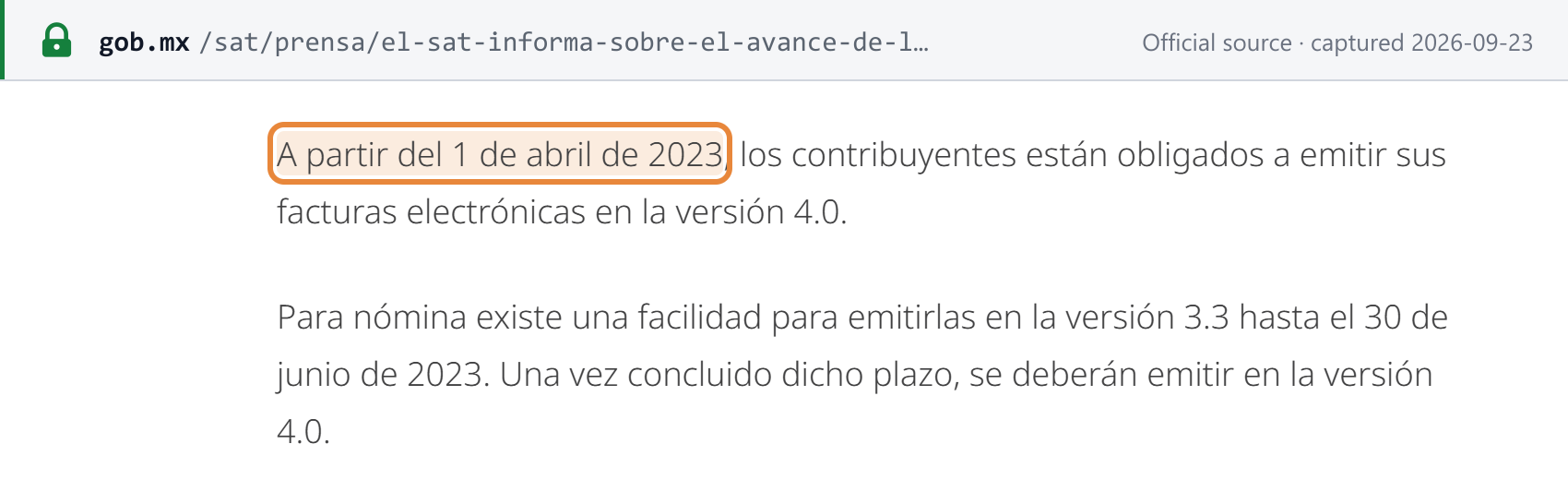
http://www.sat.gob.mx/cfd/4), with SAT complements for particular transactions, such as the payment complement. - CFDI 4.0 only since 1 April 2023. The SAT's press release of 5 April 2023: «A partir del 1 de abril de 2023, los contribuyentes están obligados a emitir sus facturas electrónicas en la versión 4.0» — from 1 April 2023 taxpayers must issue their e-invoices in version 4.0. Payroll CFDIs had until 30 June 2023. [9]
- Phases and thresholds. Not applicable — the obligation is universal, with no phasing by taxpayer size.
- Fuel invoices. CFDIs for fuel sales must carry the seller's CNE (energy regulator) permit number (CFF article 29-A, section V). [2]
For Mexico alongside other mandates, see Lookuptax's e-invoicing status and networks table.
Filing and payment
Filing frequency
Monthly for every IVA taxpayer, with no turnover bands (LIVA article 5o.-D). Exceptions: [1]
- Small landlords — individuals whose only income is rent of no more than ten monthly minimum wages and who take the quarterly income-tax option — must then also calculate and pay IVA quarterly (article 5o.-F); the IVA period follows the income-tax option rather than being a separate IVA choice.
- One-off (accidental) transactions are paid within 15 days, with no credits (article 33).
Return due date
Article 5o.-D: «Los contribuyentes efectuarán el pago del impuesto mediante declaración que presentarán ante las oficinas autorizadas a más tardar el día 17 del mes siguiente al que corresponda el pago» — taxpayers pay by return filed no later than the 17th of the following month. The amount due is the month's output IVA less creditable input IVA and less IVA withheld from the taxpayer. A taxpayer with several establishments files one return for all of them (article 32, section IV). [1]
Payment due date and method
Payment is due with the return, by the 17th. Import IVA is not in the monthly return — it is paid at customs (article 28). CFF article 20 provides for payment by electronic funds transfer; individuals below the income bands it sets may also pay in cash. [1] [2]
Additional listings
- DIOT (Declaración Informativa de Operaciones con Terceros). Monthly information on IVA paid, withheld, credited and charged in transactions with suppliers, broken down by rate, «a más tardar el día 17 del mes inmediato posterior» — by the 17th of the following month (LIVA article 32, section VIII).
- Withholding agents. Issue withholding CFDIs and report the persons withheld from monthly by the 17th (article 32, section V).
- Platforms. Seller data by the 10th of the following month (article 18-J, section III).
- Non-resident digital-service providers. Monthly information return by the 17th (article 18-D, section III).
- Electronic accounting. Monthly upload of accounting information to the SAT (CFF article 28, section IV).
- Annual IVA return. Not applicable — the LIVA provides no annual IVA return; the monthly payment is the final calculation.
Input-tax recovery and blocked items
Input IVA is creditable under LIVA article 5o. when: [1]
- it relates to purchases strictly indispensable for activities taxed at 16% or 0% — which, for IVA purposes, means deductible for income tax (section I);
- the IVA was charged expressly and shown separately on a CFDI (section II); and
- it was actually paid in the month (section III).
The blocking mechanism is income-tax deductibility. Where an expense is only partly deductible for income tax, IVA is creditable only «en la proporción en la que dichas erogaciones sean deducibles para los fines del impuesto sobre la renta» — in the proportion in which it is deductible. Non-deductible expenses carry no credit. The specific deduction limits — and so the blocked items — are set in the income-tax law (Ley del Impuesto sobre la Renta). Article 4o. separately makes IVA on prohibited labour subcontracting (CFF article 15-D) non-creditable. Businesses with both taxable and exempt activities apportion (article 5o., section V).
Refunds
- Credit balance. Article 6: a credit balance is carried forward against later months «hasta agotarlo» (until used up), or refunded — and a refund must be for the whole balance. [1]
- Refund timing. CFF article 22: within 40 days of a complete application. [2]
- Bad debts. IVA arises when the consideration is actually collected (LIVA articles 1o.-B, 11 and 17), so no IVA is due on an unpaid invoice. The LIVA has no separate bad-debt-relief article. [1]
- Tourists. Foreign tourists leaving Mexico by air or sea can reclaim IVA on goods they take with them, with a minimum of MXN 1,200 per establishment on the CFDI (article 31). [1]
- Non-resident businesses. The LIVA has no refund scheme for foreign businesses.
Exemptions
Exempt supplies
Exempt supplies carry no IVA. Examples: [1]
- Goods (article 9): land; residential buildings — «Los hoteles no quedan comprendidos en esta fracción» (hotels are not included); books, newspapers and magazines sold by their author; used movable goods, except those sold by businesses; lottery tickets and prizes; national and foreign currency and gold and silver coins; shares and receivables; gold ingots of at least 99% purity sold at retail; and goods sold by authorised donees.
- Services (article 15): mortgage-loan commissions for housing; pension-fund (AFORE) commissions; free services; education by public bodies or officially recognised schools; urban public land transport; international maritime freight by non-residents; certain insurance, including life insurance; many categories of interest; derivatives; member services of unions, chambers and political parties; public shows, with exceptions; medical services by licensed physicians who are individuals; and public-hospital services.
- Imports (article 25): see Imports and exports.
Exempt is not zero-rated
A zero-rated supply keeps full input credit: article 2o.-A says 0% acts «producirán los mismos efectos legales que aquellos por los que se deba pagar el impuesto» — have the same legal effects as taxed acts — so input IVA on them is creditable and refundable. An exempt supply gives no input credit, because article 5o., section I allows credit only for purchases used in activities taxed at 16% or 0%. Businesses with both kinds of supply apportion (article 5o., section V). [1]
Special regimes
- Border-region incentive (8% effective). See Rates.
- IMMEX, maquila and bonded regimes. A 100% tax credit against import IVA for SAT-certified companies (LIVA article 28-A). [1]
- Tourist refunds. LIVA article 31 — see Refunds.
- Small landlords. Quarterly IVA for landlords on the quarterly income-tax option (article 5o.-F).
- RESICO (Régimen Simplificado de Confianza) is an income-tax regime, not an IVA regime — see the Mexico tax ID guide.
- Margin scheme, cash accounting and flat-rate schemes. Not applicable — the LIVA provides none. IVA is already on a cash-collection basis for everyone (articles 1o.-B, 11 and 17).
Offences and penalties
Offences
Criminal offences under the CFF are separate from the administrative fines below: [2]
| CFF article | Conduct | Punishment |
|---|---|---|
| 108 — tax fraud (defraudación fiscal) | Omitting tax or obtaining an undue benefit «con uso de engaños o aprovechamiento de errores» (by deceit or by exploiting errors). Aggravating factors include false documents, repeated failure to issue invoices, and omitting withheld or charged taxes | 3 months–2 years up to MXN 2,531,920 defrauded; 2–5 years up to MXN 3,797,870; 3–9 years above that; 3 months–6 years where the amount cannot be determined |
| 113 Bis — false invoices | Issuing, selling, buying or acquiring CFDIs covering non-existent, false or simulated operations; since the reform published in the DOF on 7 November 2025, also giving tax effect to false CFDIs | 2–9 years |
| 110 — RFC offences | Failing to register for more than a year after the obligation arose; giving false RFC data; using more than one RFC | 3 months–3 years |
Article 113 Bis: «Se impondrá sanción de dos a nueve años de prisión, al que por sí o por interpósita persona, expida, enajene, compre o adquiera comprobantes fiscales que amparen operaciones inexistentes, falsas o actos jurídicos simulados» — two to nine years for anyone who, directly or through another person, issues, sells, buys or acquires invoices covering non-existent, false or simulated operations. The fraud amounts in article 108 are the updated figures annotated in the consolidated CFF as of DOF 28 December 2025. [2]
Administrative infractions include failing to register (CFF article 79, section I), failing to file returns (article 81, section I), and failing to issue a CFDI: article 83, section VII — «No expedir, no entregar o no poner a disposición de los clientes los comprobantes fiscales digitales por Internet … o expedirlos sin que cumplan los requisitos» — not issuing, delivering or making CFDIs available to customers, or issuing them without meeting the requirements. [2]
Penalties
Amounts as updated in the consolidated CFF as of DOF 28 December 2025: [2]
| Default | Penalty | Source |
|---|---|---|
| Tax omitted, detected in an audit | 55%–75% of the omitted tax (reduced if paid during the audit) | CFF art. 76 |
| Late filing or non-filing of a return | MXN 2,050–25,360 per undeclared obligation; MXN 2,050–50,710 when filed late after a SAT request | CFF art. 82, I a) and b) |
| Late RFC registration or failure to register | MXN 5,070–15,200 | CFF art. 80, I |
| Failure to issue, deliver or make available a compliant CFDI | MXN 22,300–127,530; for repeat offences, possible preventive closure of the establishment for 3 to 15 days. RESICO taxpayers (and legacy RIF taxpayers): MXN 1,910–3,800 | CFF art. 84, IV a) and b) |
| Buzón tributario (tax mailbox) not enabled | MXN 3,850–11,540 | CFF art. 86-D |
Other sanctions. The SAT can leave a taxpayer's CSD without effect or restrict its use, which stops it issuing CFDIs (CFF articles 17-H and 17-H Bis), and non-resident digital services can be blocked (LIVA article 18-H BIS). [2] [1]
Late payment. Unpaid tax is inflation-adjusted (actualización) and carries recargos (surcharges) for each month of delay, for up to five years (CFF article 21). Two rules set the rate:
- CFF article 21: «La tasa de recargos para cada uno de los meses de mora será la que resulte de incrementar en 50% a la que mediante Ley fije anualmente el Congreso de la Unión» — the late-payment rate is the rate Congress fixes each year by law, increased by 50%.
- Ley de Ingresos de la Federación 2026, article 11, section I: the rate Congress fixed for 2026 is 1.38% per month on outstanding balances, for payments deferred by extension (prórroga).
So 1.38% is not the late-payment rate: under article 21 the late-payment surcharge is that rate increased by 50%, which works out at 2.07% per month (the result of the two provisions together).
[2] [4]Frequently asked questions
Is there an IVA registration threshold in Mexico?
No. Article 1 of the Ley del IVA makes every individual and company that sells goods, provides independent services, grants the temporary use of goods or imports goods or services in Mexico liable to IVA, and neither the Ley del IVA nor the Código Fiscal de la Federación sets a turnover floor. Registration in the Registro Federal de Contribuyentes (RFC) follows from the first taxable act. Non-residents supplying digital services to recipients in Mexico must register within 30 calendar days of their first supply, whatever their sales. [1] [2]
We sell streaming or software subscriptions from abroad to consumers in Mexico. Do we have to register for IVA?
Yes, if the service is one of the digital services listed in article 18-B of the Ley del IVA and the customer is located in Mexico. Article 18-D requires a non-resident without an establishment in Mexico to register in the RFC within 30 calendar days of first supplying the service, charge 16% IVA separately, file and pay monthly by the 17th of the following month, appoint a legal representative with an address in Mexico, and obtain an e.firma (advanced electronic signature). There is no threshold. If you are not on the SAT's list of registered providers, Mexican customers must treat the service as an import and pay the IVA themselves (article 18-I), and persistent non-compliance can lead to your service being temporarily blocked in Mexico (article 18-H BIS). [1]
Why did the marketplace withhold all of the IVA on my sales?
Intermediation platforms that collect the price must withhold IVA from sellers (articles 1o.-A BIS and 18-J of the Ley del IVA). They withhold 50% of the IVA from individual sellers, and 100% if the seller has not given the platform its RFC. For 2026, article 25, section IX of the Ley de Ingresos de la Federación 2026 extends this: platforms also withhold 50% of the IVA from company sellers, and 100% from non-residents without an establishment in Mexico who sell goods located in Mexico and from sellers whose sales proceeds are deposited in bank accounts located outside Mexico. The platform pays the withheld tax to the SAT by the 17th of the following month. [1] [4]
Is the 8% border-region IVA rate a legal rate, and does it apply automatically?
No on both counts. The Ley del IVA has only two rates, 16% and 0%. The 8% comes from presidential decrees that grant a fiscal credit of 50% of the IVA to taxpayers with their tax domicile, branch, agency or establishment in the designated northern border region, and a parallel decree covers the southern border region. The credit is applied directly to the 16% rate, which leaves 8%. Taxpayers must meet the decrees' conditions to use it. The decrees were renewed for 2026 by a decree published in the Diario Oficial de la Federación on 31 December 2025; check for a further renewal before relying on them in a later year. [10] [11]
How soon must a CFDI be issued, and why was ours rejected?
Article 39 of the Reglamento del Código Fiscal de la Federación requires the CFDI to be sent to the SAT or an authorised certification provider (PAC) no later than 24 hours after the transaction. Under the Resolución Miscelánea Fiscal 2026 as published on 28 December 2025, a PAC must refuse to certify a CFDI if more than 72 hours have passed since the document's generation time, measured in the time zone of the postal code in the LugarExpedicion field. A PAC also validates the document against the requirements of article 29-A of the Código Fiscal de la Federación before it assigns the folio fiscal. [3] [5] [2]
How do we invoice a foreign customer that has no Mexican RFC?
Issue the CFDI with the SAT's generic RFC for foreign residents, XEXX010101000. The SAT's Anexo 20 fill-in guide says that with this RFC the recipient's tax regime is entered as code 616 (Sin obligaciones fiscales, no tax obligations) and the CFDI use as S01 (Sin efectos fiscales, no tax effects). Whether the supply is taxed at 0% as an export is a separate question: goods must be exported, and services qualify only if they are on the closed list in article 29 of the Ley del IVA. [6] [1]
Can a CFDI be cancelled after it has been issued?
Yes, within limits. Article 29-A of the Código Fiscal de la Federación allows a CFDI to be cancelled no later than the month in which the annual income-tax return is due for the year in which it was issued, and only if the person it was issued to accepts the cancellation. Returns, discounts and rebates are documented separately with a CFDI de Egreso (credit note) rather than by cancelling the original. [2] [6]
Important websites
| Site | Purpose |
|---|---|
| SAT — procedures and services | The SAT's portal for all procedures |
| RFC registration — companies · individuals | Registering in the RFC |
| Returns and payments — companies · individuals | Filing monthly returns and paying |
| Factura electrónica | Issuing, cancelling and checking CFDIs |
| Authorised PAC list | The certification providers the SAT has authorised |
| Refunds and offsets | Claiming IVA refunds |
| Anexo 20 — CFDI technical standard | The CFDI 4.0 schema and fill-in guide |
| Border-region IVA incentive | The SAT's minisite on the northern and southern border incentives (its index page still shows an out-of-date validity note) |
| Cámara de Diputados — federal laws | Consolidated texts of the LIVA, CFF and LIF |
| Diario Oficial de la Federación | The official gazette |
For the RFC itself, see Lookuptax's Mexico tax ID guide and RFC validator. For individuals' CURP — a separate personal identifier, not the RFC — see how to verify a CURP.
Recent changes
- 2026-07-09 — The first amendment to the RMF 2026 (Primera Resolución de Modificaciones) was published in the DOF. In rule 12.1.9 — the monthly information return of non-resident digital-service providers under LIVA article 18-D, delivered with the IVA and, where applicable, IEPS returns — it renames the IEPS return to the one for games with bets and draws and cross-refers to rule 12.1.11. It also updates the CFDI-restriction rules 2.7.3.1–2.7.3.5 and 2.7.3.7–2.7.3.9 to reflect the grounds for leaving a CSD without effect and for restricting CFDI issuance that were added to the CFF by the reform published on 7 November 2025 (CFF articles 17-H and 17-H Bis), not by the RMF. (DOF / SAT) — see issue
- 2026-01-01 — The Ley de Ingresos de la Federación 2026 took effect: platforms withhold 50% of the IVA from company sellers and 100% from non-resident sellers of goods in Mexico and from sellers paid into foreign bank accounts (article 25, section IX), and the 2026 extension surcharge rate is 1.38% a month (article 11). (Cámara de Diputados)
- 2025-12-31 — A decree in the DOF evening edition renewed the northern and southern border-region incentives for 2026, keeping the 50% IVA credit (8% effective rate) for eligible taxpayers. (DOF)
- 2025-12-28 — The RMF 2026 was published in the DOF. (SAT)
- 2025-11-07 — A CFF reform was published in the DOF: a CFDI that does not cover a real operation is false (article 29-A, section IX); giving tax effect to false CFDIs became a crime (article 113 Bis); digital-service providers must give the SAT online real-time access (article 30-B); and new grounds were added for leaving a CSD without effect or restricting CFDI issuance (articles 17-H and 17-H Bis). The reform took effect on 1 January 2026; article 30-B applies from 1 April 2026. (Cámara de Diputados)
- 2023-04-01 — CFDI 4.0 became the only valid invoice version; payroll CFDIs had until 30 June 2023. (SAT)
Ahead — the 2027 economic package, presented to Congress on 8 September 2026, is still a proposal; the Ley de Ingresos is re-enacted every year. For the full chronology, see Mexico tax changes on Lookuptax.
Reference links
- Ley del Impuesto al Valor Agregado — consolidated text (Cámara de Diputados, PDF)
- Código Fiscal de la Federación — consolidated text (Cámara de Diputados, PDF)
- Decree reforming the Código Fiscal de la Federación, DOF 7 November 2025, with transitory articles (Cámara de Diputados, PDF)
- Reglamento del Código Fiscal de la Federación (Cámara de Diputados, PDF)
- Ley de Ingresos de la Federación para el Ejercicio Fiscal de 2026 (Cámara de Diputados, PDF)
- Resolución Miscelánea Fiscal para 2026, DOF 28 December 2025 (SAT, PDF)
- Anexo 20 — CFDI fill-in guide (SAT, PDF)
- CFDI 4.0 XML schema, cfdv40.xsd (SAT)
- CFDI data-type schema, tdCFDI.xsd — RFC format (SAT)
- SAT press release 012/2023 — CFDI 4.0 mandatory from 1 April 2023
- SAT — northern border region IVA incentive, "En qué consiste"
- DOF, 31 December 2025 (evening edition) — decree modifying the northern and southern border-region stimulus decrees
- DOF, 9 July 2026 — Primera Resolución de Modificaciones a la RMF 2026
- Gaceta Parlamentaria, 8 September 2026 — Ley de Ingresos de la Federación 2027 initiative (PDF)
- Lookuptax — Mexico tax ID (RFC) guide
- Lookuptax — How to verify a CURP in Mexico
- Lookuptax — Worldwide tax rates
- Lookuptax — VAT registration thresholds worldwide
- Lookuptax — E-invoicing status and the networks worldwide