Bangladesh VAT guidelines
| FACTSHEET | |
|---|---|
| Country code | BD |
| Tax name | Value Added Tax (VAT) |
| Tax Authority | National Board of Revenue (NBR) |
Overview
Bangladesh levies Value Added Tax under the Value Added Tax and Supplementary Duty Act 2012, administered by the National Board of Revenue (NBR). VAT is charged on taxable supplies of goods and services made by registered or enlisted persons, on imports, and — since 1 July 2026 — on a widened base of imported services collected by reverse charge. [1]
The standard VAT rate is 15%. [1] The Finance Act, 2026 (Act No. 96 of 2026), gazetted 30 June 2026 and in force from 1 July 2026 (the start of FY2026-27), made three structural changes to the VAT Act: it added a new precondition tying a Business Identification Number (BIN) to everyday banking and business activity (new section 4(3)); it substituted section 20 to bring all imported services into a 15% reverse-charge VAT net; and it substituted section 64 to move VAT return filing from monthly to quarterly. [2]
Separately, three Statutory Regulatory Orders (SROs) sit outside the Finance Act. Two took effect on 11 June 2026 — cutting VAT at the local manufacturing stage for refrigerators, freezers, air conditioners and compressors, and exempting duty and VAT on inputs used to manufacture approved pesticides. A third, SRO No. 147-Ain/2026/352-Mushak, gazetted 7 June 2026 and effective 1 July 2026, exempts NBR-registered startup establishments from VAT on local supplies, imported services and premises rent — see Exemptions below. [3] [4] [5]
Tax ID and VAT registration (BIN)
Bangladesh identifies taxpayers with two distinct numbers:
- e-TIN — a 12-digit Taxpayer Identification Number issued by the NBR for income tax purposes.
- e-BIN (Business Identification Number) — a 13-digit number issued on VAT registration or Turnover Tax enlistment through the NBR's VAT Online Project portal at
vat.gov.bd. The BIN (or a listing certificate, for Turnover Tax enlistees) is the identifier that VAT counterparties, banks and other agencies check. [1]
Registration is now a precondition for ordinary business life, not just a VAT-compliance step. With effect from 1 July 2026, the Finance Act, 2026 inserted a new sub-section (3) into section 4 of the VAT Act, making a BIN or listing certificate mandatory before: opening or operating a current or STD account with a bank or NBFI; taking a bank or NBFI loan; renewing a trade licence; opening a Mobile Financial Services (MFS) merchant account; obtaining or renewing trade-body membership; obtaining an electricity or gas connection; and registering a vehicle in a business name with the Bangladesh Road Transport Authority (BRTA). [2] This mirrors NBR's broader push — reported at the time in the national business press — to have Bangladesh Bank require proof of BIN registration across the banking system as a way of widening the VAT net. [3]
 Source snapshot captured 2026-08-03 — original
To check a Bangladeshi Business Identification Number, use our Bangladesh BIN validator. For the BIN and e-TIN formats themselves, see our Bangladesh TIN and BIN number guide; for how to verify a BIN on the NBR search portal, see How to verify a BIN Number in Bangladesh.
Registration thresholds
| Trigger | Threshold | Notes |
|---|---|---|
| Mandatory VAT registration | Turnover of economic activities exceeds BDT 5,000,000 in any 12-month period | Registrant charges the standard 15% rate and issues Mushak-6.3 tax invoices. The threshold fell from BDT 30,000,000 with effect from 9 January 2025. [1] |
| Turnover Tax enlistment | Turnover between BDT 3,000,000 and BDT 5,000,000 | Enlisted persons pay Turnover Tax instead of the standard VAT rate. Since 1 July 2026 the rate is 4% of turnover, pending a Gazette notification setting a fixed sector-specific amount capped at BDT 200,000. [6] |
| Below the enlistment floor | Turnover under BDT 3,000,000 | Neither VAT registration nor Turnover Tax enlistment is required. [1] |
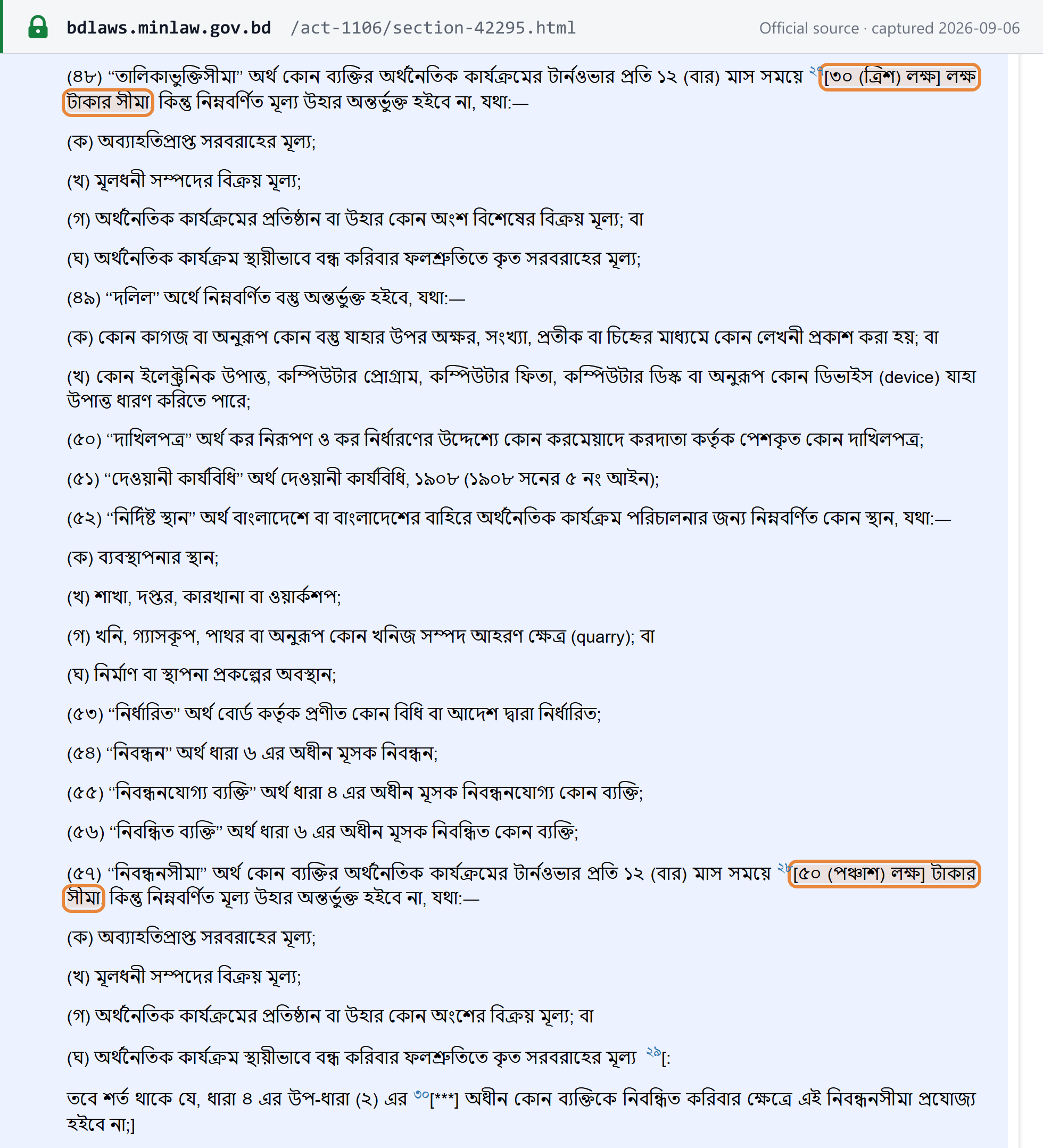
 Source snapshots captured 2026-09-06 — original
BIN as a gateway, not just a threshold test. Because a BIN or listing certificate is now a precondition for routine banking, licensing and utility transactions (see above), businesses at or near these thresholds have an incentive to register earlier than the turnover test alone would require. [2]
Rates
| Rate | Applies to |
|---|---|
| 15% (standard) | Most taxable supplies of goods and services, imports, and — from 1 July 2026 — imported services taxed by reverse charge under substituted section 20. [1] [2] |
| 0% (zero-rated) | Exports. [1] |
| Truncated/reduced rates: 1.5%, 2%, 2.4%, 4.5%, 5%, 7.5%, 10% | A range of specific goods and services taxed on a truncated base under SRO-based rules rather than the 15% standard rate; the applicable rate depends on the specific good/service and the governing SRO. [1] |
| 4% | Turnover Tax, for enlisted persons with turnover between BDT 3,000,000 and BDT 5,000,000, applying until the Government notifies a fixed sector amount capped at BDT 200,000 (see Registration thresholds). [6] |
| Capped at 7.5% at the local manufacturing stage | Refrigerators, freezers, air conditioners and compressors (HS headings 84.14, 84.15 and 84.18), under SRO No. 146-Ain/2026/351-Mushak, effective 11 June 2026, valid to 30 June 2030. Raw materials and spare parts used to manufacture these goods are fully VAT-exempt. Conditional on BIDA registration, minimum in-house machinery, and a minimum 30% value-addition test. [3] |
 Source snapshot captured 2026-08-03 — original
Exemptions
Startup establishments — VAT exemption on local supplies, imported services and premises rent. Under SRO No. 147-Ain/2026/352-Mushak, gazetted 7 June 2026 by the Ministry of Finance under section 126(1) of the Value Added Tax and Supplementary Duty Act 2012, the Government exempted registered startup establishments from VAT on:
- all VAT chargeable at the local level on the startup's supplies;
- all VAT chargeable on the startup's import of any service; and
- all VAT chargeable on the startup's renting of space and premises.
[7] The SRO took effect 1 July 2026 and remains in force until 30 June 2035.
Who qualifies. "Startup" means a startup establishment as defined in Part 2 of the Eighth Schedule of the Income Tax Act 2023 — the enterprise must additionally register as a startup with the National Board of Revenue itself; ordinary BIN/VAT registration is a separate step and is not replaced by this exemption. [7]
Recordkeeping and withholding mechanics. A registered startup may keep its tax-related documents and accounts through an Enterprise Resource Planning (ERP) system or NBR-specified Mushak software, under section 107(2A) of the Act, and may present such securely retained records electronically to the VAT authority. Where a registered startup supplies to a withholding entity, that entity must not deduct VAT at source from the payment. [7]
This is a narrower exemption than a blanket VAT holiday: it covers the three items listed above, not a startup's full range of taxable activity, and — unlike the zero-rating that applies to exports (see Rates) — the SRO does not itself address input-tax recovery on the exempted supplies.
Group registration. Not addressed in the VAT and Supplementary Duty Act 2012 or its Rules — this guide found no group-registration provision for Bangladeshi VAT. (Not applicable.)
VAT on imported services (reverse charge)
With effect from 1 July 2026, the Finance Act, 2026 substituted section 20 of the VAT Act. All services imported into Bangladesh — except those exempted under the First Schedule — are now taxable supplies at 15% VAT, collected by reverse charge rather than by self-assessment from the importer. [1]
Mechanics. The bank, non-bank financial institution (NBFI) or authorised foreign-exchange dealer that settles the outbound payment to the foreign service provider must deposit the 15% VAT to the government treasury, against the importer's own circle code, before releasing the payment. The resulting treasury challan — not an invoice from the foreign supplier — serves as the importer's tax invoice for VAT purposes. Where the imported service is used as an input to a further taxable supply, the importer may claim input tax credit for the VAT so deposited. [1]
Practical effect. Any business paying a foreign vendor for services — software subscriptions, consulting, digital advertising, cloud hosting and similar cross-border service purchases — should expect its settlement bank or authorised dealer to withhold and deposit the 15% VAT before funds are released abroad, and should retain the treasury challan for its own VAT records and any input credit claim.
Returns and filing (quarterly)
With effect from 1 July 2026, the Finance Act, 2026 substituted section 64 of the VAT Act, moving the VAT return (dakhilpatra) from monthly to quarterly filing: [1]
- Every registered, enlisted, registrable or enlistable person must submit a return within 15 days of the end of every three tax periods (a tax period is one calendar month) — i.e., quarterly.
- Government and semi-government bodies, autonomous bodies, banks, insurers and nil-return filers instead have 20 days.
- Voluntary more-frequent filing is still permitted, and the NBR may mandate electronic filing.
- Online submission is mandatory for listed taxpayers. NBR General Order No. 12/Mushak/2026 (20 September 2026) requires the VAT return to be submitted online through the NBR eVAT portal by producers of cigarettes, mobile phones, MS products, medicine, beverages, cement, tiles, and paints and varnishes, and by suppliers of insurance, banking and non-banking, and mobile banking services; it also applies to a registered person who supplies both listed and other goods or services. Earlier orders on mandatory online return submission are cancelled, and the NBR may add or remove items from the lists. [3]
VAT returns are filed on Form Mushak-9.1. Online filing is through the NBR's eVAT system, the VAT Online Portal (vat.gov.bd); it is mandatory for the taxpayers listed above. [2]
Invoice requirements
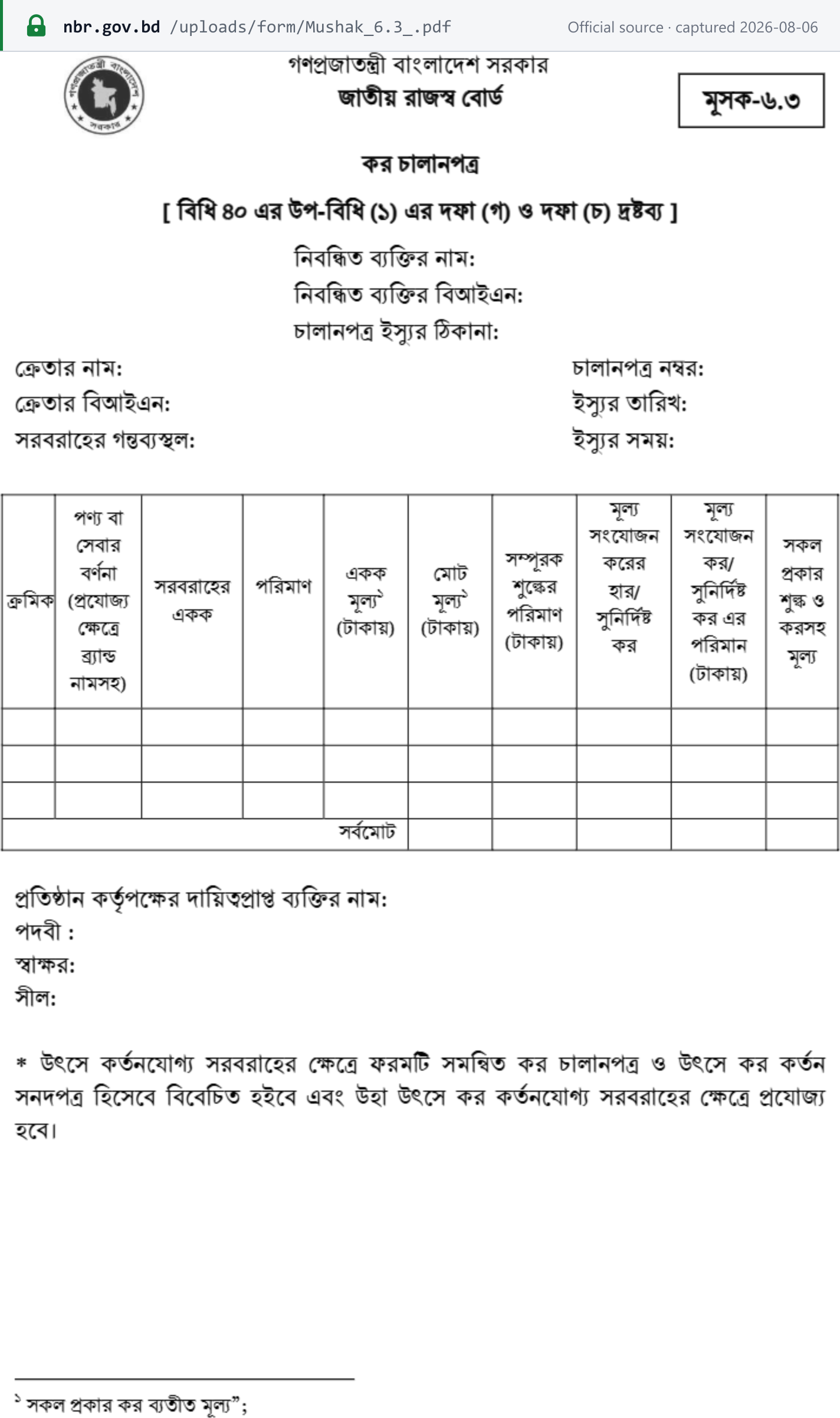
Every VAT-registered person must issue a tax invoice on the prescribed Mushak-6.3 form for a taxable supply, on or before the date VAT becomes payable. [1] The core rules sit in section 51 of the Value Added Tax and Supplementary Duty Act, 2012 (Act No. 47 of 2012) and rule 40 of the Value Added Tax and Supplementary Duty Rules, 2016 — the Board's own rule-making power over invoice content, form and preservation comes from section 54 of the Act. [3] [4]
Mandatory content
| Required particular | Notes |
|---|---|
| Form Mushak-6.3 ("VAT-6.3" in the Rules' English text) | The prescribed tax invoice format, against each taxable supply. [1] [4] |
| Date and time of issue | Actual date and time the invoice is issued. [3] |
| Supplier's name, address and Business Identification Number (BIN) | Always required. [3] |
| Purchaser's name, address and BIN | Required only where the value of the supply is more than Taka 25,000 — this is a value threshold, not a registration-status test, and no input tax credit is admissible against an invoice missing it where required. [3] [4] |
| Description, quantity, date/time and nature of the goods or services supplied | Including transport particulars where goods are moved. [4] |
| Value of the supply (exclusive of VAT), the applicable VAT rate, the amount of VAT payable, and the combined total | [3] |
| Any other particular the Board prescribes | Catch-all in both the Act and the Rules. [3] [4] |
 Source snapshot captured 2026-08-03 — original
The form itself cross-references its own legal basis — it is headed "মূসক-৬.৩" (Mushak-6.3) and captioned "[see rule 40, sub-rule (1), clause (গ)/(c) and clause (চ)/(e)]" — and carries a note that, for a supply subject to tax deduction at source, the same Mushak-6.3 also serves as the combined tax invoice and withholding-tax-deduction certificate, matching section 53 of the Act. [3] A tax invoice must be issued in a minimum of 2 copies: the original goes to the purchaser (and must accompany the goods in transit), and the registered person preserves the other. [4]
For imported services taxed by reverse charge under substituted section 20, the treasury challan issued when the settling bank, NBFI or authorised foreign-exchange dealer deposits the 15% VAT stands in as the importer's tax invoice, rather than a Mushak-6.3 from the (non-resident, non-registered) foreign supplier. [2]
Issuance deadline and numbering
A registered supplier must issue the tax invoice on or before the date VAT becomes payable on the supply — that is, no later than the time of supply itself; the Act does not allow deferring issuance to a later date. [3]
Every tax invoice must be serially numbered on a fiscal-year basis. Where a registered person supplies from more than one place, a separate numerical series may be run for each place, with the place's name, address and invoice number stated on each invoice. The same fiscal-year serial-numbering rule applies to the related VAT-6.4 (contractual manufacturing transfer), VAT-6.5 (inter-branch transfer) and VAT-6.9 (turnover tax invoice) documents. [4]
Any VAT or turnover-tax invoice worth more than Taka 2 lakh (200,000) must additionally be reported, invoice-by-invoice, to the NBR's VAT Computer System in Form VAT-6.10, before or after the tax-period return is filed — unless the same purchase/sale data already reaches the VAT Computer System automatically through an enlisted software system, POS, ECR or other sale machine, in which case the separate VAT-6.10 submission is not required. [4]
Credit and debit notes
| Form | Used when |
|---|---|
| Credit note — Form Mushak-6.7 ("VAT-6.7") | The VAT calculated on an earlier tax invoice turns out to be more than the VAT actually payable (e.g. a price reduction or return after issue) — the supplier issues a credit note and may make a decreasing adjustment. |
| Debit note — Form Mushak-6.8 ("VAT-6.8") | The VAT calculated on an earlier tax invoice turns out to be less than the VAT actually payable — the supplier issues a debit note and must make an increasing adjustment. |
[4] Both documents must show, among other particulars, their own serial number and date/time of issue, the supplier's name/address/BIN, the serial number and date/time of the original tax invoice they relate to, the nature and VAT effect of the adjustment, and — where the VAT on the underlying supply exceeds Taka 5,000 — the recipient's name, address and BIN; a credit note missing that last item cannot be used to support a decreasing adjustment. [3] A registered recipient's matching increasing adjustment (against a received debit note) or decreasing adjustment (against a received credit note) follows the same tax period/two-following-periods timing rules as the supplier's own adjustment. [4]
Only one original tax invoice, credit note or debit note may be issued for a given supply or adjustment; if a registered recipient reports losing the original, the issuer may provide a copy clearly marked "Duplicate." [4]
Currency and language
Values throughout the Act and the Rules — including the Taka 25,000 buyer-detail threshold and the Taka 5,000 credit-note threshold above — are denominated in Taka (BDT), and this guide found no general rule permitting an ordinary domestic tax invoice to be issued in a different currency. [3] [4] The Rules do provide a narrow, separate mechanism for foreign-currency-settled deemed exports — supplies against an international-tender letter of credit, or against an internal back-to-back letter of credit to a bona fide exporter — where the registered supplier keeps a bank-attested Proceeds Realisation Certificate, or a certificate of receipt of value in foreign currency, alongside the ordinary VAT invoice/goods declaration, rather than issuing a foreign-currency-denominated tax invoice as such. [4]
Neither the Act nor the Rules state a mandatory invoice language. The Rules do let a registered person keep the prescribed forms "in his own format," provided the form's name and every prescribed particular are still present and the minimum number of copies is issued — flexibility that in practice supports bilingual or English-language invoicing alongside the official Bengali-language Mushak-6.3 template shown above. [4] This guide could not find a specific statutory invoice-language rule and does not assert one rather than guess.
Simplified / retail invoices
This guide could not find a reduced-content "retail" or "cash memo" invoice category, or a de-minimis sale value below which a Mushak-6.3 is not required, anywhere in the Act or the Rules — unlike, for example, Bolivia's Bs5/Bs1,000 thresholds or Kenya's simplified-invoice references. Every taxable supply, at any value, requires a full Mushak-6.3 under section 51 of the Act and rule 40 of the Rules; the only value-triggered variation is the Taka 25,000 buyer-detail threshold described in Mandatory content above. [3] [4]
In practice, NBR's point-of-sale answer for high-volume retail settings is the sector-by-sector Electronic Fiscal Device (EFD) / Sales Data Controller (SDC) rollout described in E-invoicing status below: the fiscal device itself prints the tax invoice at the till and stores the transaction for NBR inspection, rather than the business separately hand-completing a Mushak-6.3 for each sale. [5]
Retention
Every taxpayer must keep, for a period of 5 (five) years, all accounts, documents and other records of its economic activities so as to facilitate assessment of tax liability. Section 107(1) of the Act spells out what this must include: all purchase and sale statements; all tax invoices, credit notes, debit notes, and integrated tax invoices/withholding certificates issued and received; customs documentation for imports and exports; pricing and input-output-coefficient records; treasury challans evidencing tax deposits (or other documentary evidence where tax was paid another way); every tax-period return; and any other document the Board prescribes. [3] The Rules echo the same 5-year period for specific documents — for example, the withholding entity's own copy of a Form VAT-6.6 deduction certificate. [4]
Technical format
The Board may determine the format of any form, notice, return or other document under section 108 of the Act, and a registered person may keep the prescribed books/invoices in its own format provided the form's name, every prescribed particular, and the minimum copy count are preserved — the Board can also declare a business's own-format invoice or bill to be a tax invoice by gazette order. [3] [4] Since 1 July 2025, a registered person's purchase and sale ledgers (Forms VAT-6.1, VAT-6.2 and, where applicable, VAT-6.2.1) must specifically be preserved in an Enterprise Resource Planning (ERP) Software System, rather than in any free-form digital or paper record. [4] Separately, invoices above the Taka 2 lakh reporting threshold flow to the VAT Computer System through Form VAT-6.10 — see Issuance deadline and numbering above — and EFD/SDC devices transmit fiscalised sales data in their own technical format; see E-invoicing status below. [4]
Digital record-keeping
Businesses are permitted to maintain VAT accounts and records entirely in digital form, without a parallel paper archive. [1] That general permission now sits alongside the specific ERP mandate for the VAT-6.1/6.2/6.2.1 purchase-sale ledgers described in Technical format above. [4]
E-invoicing status
Bangladesh does not operate a universal, nationwide continuous transaction control (CTC) e-invoicing mandate covering all VAT-registered businesses. Instead, the NBR runs a sector-by-sector Electronic Fiscal Device (EFD) / Sales Data Controller (SDC) rollout through its VAT Online Project: an EFD is a fiscal device that records each sale, prints a VAT invoice and stores the transaction for NBR inspection, while an SDC is the equivalent module for a business that already runs its own billing software or point-of-sale system. [1]
Coverage has expanded sector by sector rather than all at once — the NBR has, for example, made EFD/SDC installation mandatory at hotels and restaurants located on highways, after complaints that highway eateries were not issuing electronic VAT invoices. [2] Outside EFD/SDC-mandated sectors, VAT-registered businesses generally issue the standard Mushak-6.3 tax invoice (paper or digital, see Invoice requirements above) and file returns online via the VAT Online Portal. [3]
Recent changes
- 2026-09-20 — NBR General Order No. 12/Mushak/2026 makes online VAT return submission through the NBR eVAT portal mandatory for producers of listed goods (cigarettes, mobile phones, MS products, medicine, beverages, cement, tiles, paints and varnishes) and suppliers of listed services (insurance, banking and non-banking services, mobile banking), and for registered persons supplying both listed and other goods or services; earlier orders on mandatory online submission are cancelled. See Returns and filing. (National Board of Revenue) — see event
- 2026-07-01 — SRO No. 147-Ain/2026/352-Mushak, gazetted 7 June 2026 under section 126(1) of the VAT and Supplementary Duty Act 2012, exempts NBR-registered startup establishments from VAT on local supplies, imported services and premises rent; effective 1 July 2026, in force until 30 June 2035. See Exemptions. (National Board of Revenue) — see issue
- 2026-07-01 — The Finance Act, 2026 (Act No. 96 of 2026) inserted a new section 4(3) into the VAT Act making a Business Identification Number (BIN) or listing certificate mandatory before opening/operating a bank or NBFI current or STD account, taking a bank/NBFI loan, renewing a trade licence, opening an MFS merchant account, trade-body membership, obtaining an electricity/gas connection, or BRTA vehicle registration in a business name. (National Board of Revenue) — see issue
- 2026-07-01 — The Finance Act, 2026 substituted section 20 of the VAT Act: all imported services except those exempted in the First Schedule are now taxable at 15% VAT by reverse charge, withheld and deposited by the settling bank, NBFI or authorised foreign-exchange dealer, with the treasury challan standing as the importer's tax invoice. (National Board of Revenue) — see issue
- 2026-07-01 — The Finance Act, 2026 substituted section 64 of the VAT Act, moving VAT returns from monthly to quarterly: 15 days after the end of every three tax periods generally, or 20 days for government/semi-government/autonomous bodies, banks, insurers and nil-return filers. (National Board of Revenue) — see issue
- 2026-06-11 — SRO No. 146-Ain/2026/351-Mushak capped VAT at 7.5% at the local production stage for refrigerators, freezers, air conditioners and compressors (HS 84.14/84.15/84.18), with full VAT exemption on their raw materials and spare parts, subject to BIDA registration, minimum in-house machinery and a 30% value-addition test; valid to 30 June 2030. (National Board of Revenue)
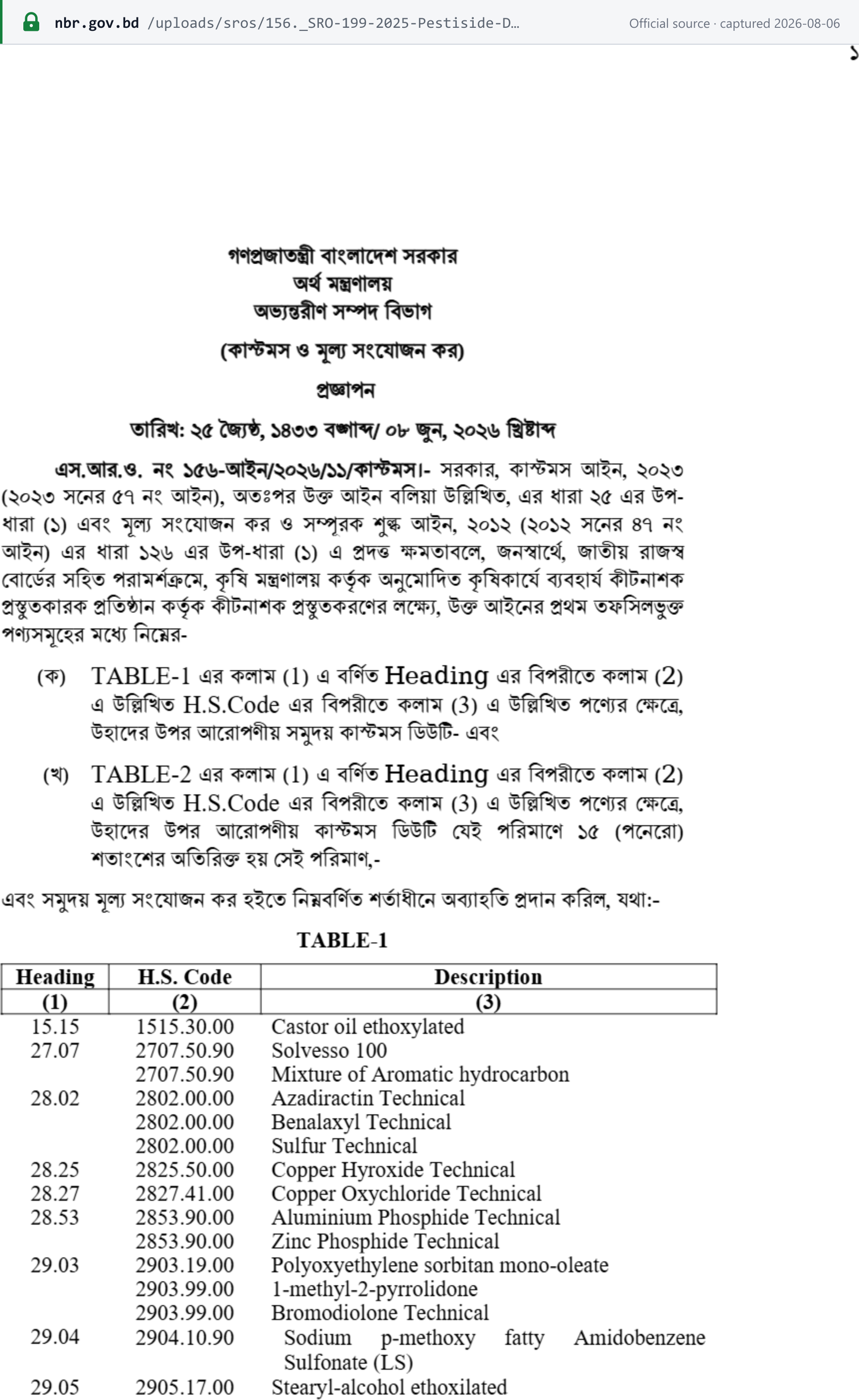
- 2026-06-11 — SRO No. 156-Ain/2026/11/Customs granted full customs duty and VAT exemption on roughly 111 technical-grade pesticide active ingredients for Ministry-of-Agriculture-approved manufacturers, and exempted VAT plus duty above 15% on roughly 36 formulation-aid chemicals; replaces SRO No. 199-Ain/2025/21/Customs; valid to 30 June 2030. (National Board of Revenue)
 Source snapshot captured 2026-08-03 — original
Reference links
- National Board of Revenue — VAT FAQ
- Finance Act, 2026 (Act No. 96 of 2026) — Bangladesh Gazette Extraordinary
- National Board of Revenue — SRO No. 146-Ain/2026/351-Mushak (VAT exemption, refrigerator/freezer/AC/compressor manufacture)
- National Board of Revenue — SRO No. 156-Ain/2026/11/Customs (pesticide raw-material exemption)
- National Board of Revenue — SRO No. 147-Ain/2026/352-Mushak (startup VAT exemption)
- National Board of Revenue — VAT SRO list
- National Board of Revenue — EFD/SDC registered-business search
- The Business Standard — BIN made mandatory for business bank accounts, loans
- The Business Standard — Installation of Electronic Fiscal Device mandatory at hotels, restaurants located on highways
- LookupTax — Bangladesh TIN and BIN number guide
- LookupTax — How to verify a BIN Number in Bangladesh
Frequently Asked Questions
What is the standard VAT rate in Bangladesh, and is a BIN now required to open a bank account?
The standard VAT rate in Bangladesh is 15%, charged under the Value Added Tax and Supplementary Duty Act 2012. And yes — the Finance Act, 2026 (Act No. 96 of 2026, gazetted 30 June 2026) inserted a new sub-section (3) into section 4 of the VAT Act, effective 1 July 2026, making a Business Identification Number (BIN) or listing certificate a mandatory precondition for opening or operating a current or STD bank or NBFI account, taking a bank or NBFI loan, renewing a trade licence, opening a Mobile Financial Services merchant account, admission to or renewal of trade-body membership, obtaining an electricity or gas connection, and registering a vehicle with the BRTA in a business name. [1] [2]
How is VAT now charged on services imported into Bangladesh?
Under section 20 of the VAT Act, as substituted by the Finance Act, 2026 with effect from 1 July 2026, all services imported into Bangladesh — except those exempted in the First Schedule — are taxable supplies at 15% VAT, collected by reverse charge. The bank, NBFI or authorised foreign-exchange dealer that settles payment to the foreign service provider must deposit the 15% VAT to the government treasury against the importer's circle code before releasing payment, and the resulting treasury challan serves as the importer's tax invoice. Input credit is available where the imported service is used as an input to a taxable supply. [1]
Are Bangladesh VAT returns now filed monthly or quarterly?
Quarterly, for most registered persons. The Finance Act, 2026 substituted section 64 of the VAT Act, effective 1 July 2026: every registered, enlisted, registrable or enlistable person must submit a return (dakhilpatra) within 15 days of the end of every three tax periods, where a tax period is one calendar month. Government and semi-government bodies, autonomous bodies, banks, insurers and nil-return filers instead have 20 days. Voluntary more-frequent filing is still permitted. Online submission through the NBR eVAT portal is mandatory for producers of listed goods (cigarettes, mobile phones, MS products, medicine, beverages, cement, tiles, paints and varnishes) and suppliers of listed services (insurance, banking and non-banking services, mobile banking) under NBR General Order No. 12/Mushak/2026 of 20 September 2026. [1] [2]
What are the VAT registration and turnover tax thresholds in Bangladesh?
A person whose turnover of economic activities exceeds BDT 5,000,000 in any 12-month period must register for VAT and charge the standard 15% rate. That threshold fell from BDT 30,000,000 with effect from 9 January 2025, and NBR's older VAT FAQ page still prints the original 2012 figure of BDT 8,000,000. A person with turnover between BDT 3,000,000 and BDT 5,000,000 instead enlists and pays Turnover Tax in lieu of VAT. The Finance Act, 2026 substituted section 63(1) of the VAT Act with effect from 1 July 2026: the Government may set a fixed, sector-specific Turnover Tax amount by Gazette notification, capped at BDT 200,000, and until it does so an enlisted person pays 4% of turnover. Below BDT 3,000,000, neither VAT registration nor Turnover Tax enlistment is required. [6]
NBR's published VAT FAQ still states a 3% Turnover Tax rate. That page predates the Finance Act, 2026 and has not been updated; the rate stated here is read from the Act itself.
Is e-invoicing mandatory in Bangladesh?
Not universally. There is no nationwide continuous transaction control (CTC) e-invoicing mandate covering every VAT-registered business. Bangladesh instead runs a sector-by-sector Electronic Fiscal Device (EFD) / Sales Data Controller (SDC) rollout through the NBR's VAT Online Project — mandatory, for example, at hotels and restaurants located on highways — alongside the standard Mushak-6.3 tax invoice used generally, and the treasury challan that serves as the tax invoice for reverse-charged imported services. [1] [2]
Are NBR-registered startups exempt from VAT in Bangladesh?
Yes, on three specific items. SRO No. 147-Ain/2026/352-Mushak, gazetted 7 June 2026 under section 126(1) of the VAT and Supplementary Duty Act 2012, exempts an NBR-registered startup establishment — defined by reference to Part 2 of the Eighth Schedule of the Income Tax Act 2023, and separately registered as a startup with the NBR — from VAT on: (a) all VAT chargeable on its local supplies, (b) all VAT chargeable on the import of any service, and (c) all VAT chargeable on renting space or premises. The exemption took effect 1 July 2026 and remains in force until 30 June 2035. It does not exempt a startup's other taxable activity, and it does not replace the startup's separate BIN/VAT registration obligations. [7]