Ireland VAT guidelines
| FACTSHEET | |
|---|---|
| Country code | IE |
| Tax name | Value-Added Tax (VAT) |
| Tax Authority | Office of the Revenue Commissioners (Revenue) |
Overview
Ireland levies Value-Added Tax (VAT) under the Value-Added Tax Consolidation Act 2010 (No. 31 of 2010, "VATCA 2010"). The Value-Added Tax Regulations 2010 (S.I. No. 639 of 2010), made by the Revenue Commissioners under s.120 of the Act, fill in the detail. They came into operation on 1 January 2011. The tax is administered by the Office of the Revenue Commissioners ("Revenue"). [1]
Language. Revenue publishes its VAT pages in English only. Their Irish-language toggle returns "This section of the site is currently only available in English" (checked 2026-09-23).
Currency. All amounts in this guide are in euro (€).
Tax periods. VAT returns are made for two-month taxable periods starting on 1 January, 1 March, 1 May, 1 July, 1 September and 1 November. Revenue can authorise other periods — see Filing and payment.
Layering. VAT is a national tax. There is no regional or municipal VAT layer.
Taxable person and accountable person. Irish law uses two terms, and every obligation in this guide attaches to the second. Revenue: "A taxable person is any person who independently carries out a business in the European Union (EU) or elsewhere. It includes persons who are exempt from Value-Added Tax (VAT) as well as flat-rate (unregistered) farmers." An accountable person is a taxable person who "supplies taxable goods or services in the State and is registered or required to register for VAT". [2]
Registration
Who should register
Registration is compulsory once turnover exceeds the relevant threshold. Below it, a business established in Ireland may choose to register. Revenue: "Value-Added Tax (VAT) registration is obligatory when your annual turnover exceeds the VAT thresholds. If your turnover is less than a threshold limit, you may elect to register for VAT." [4]
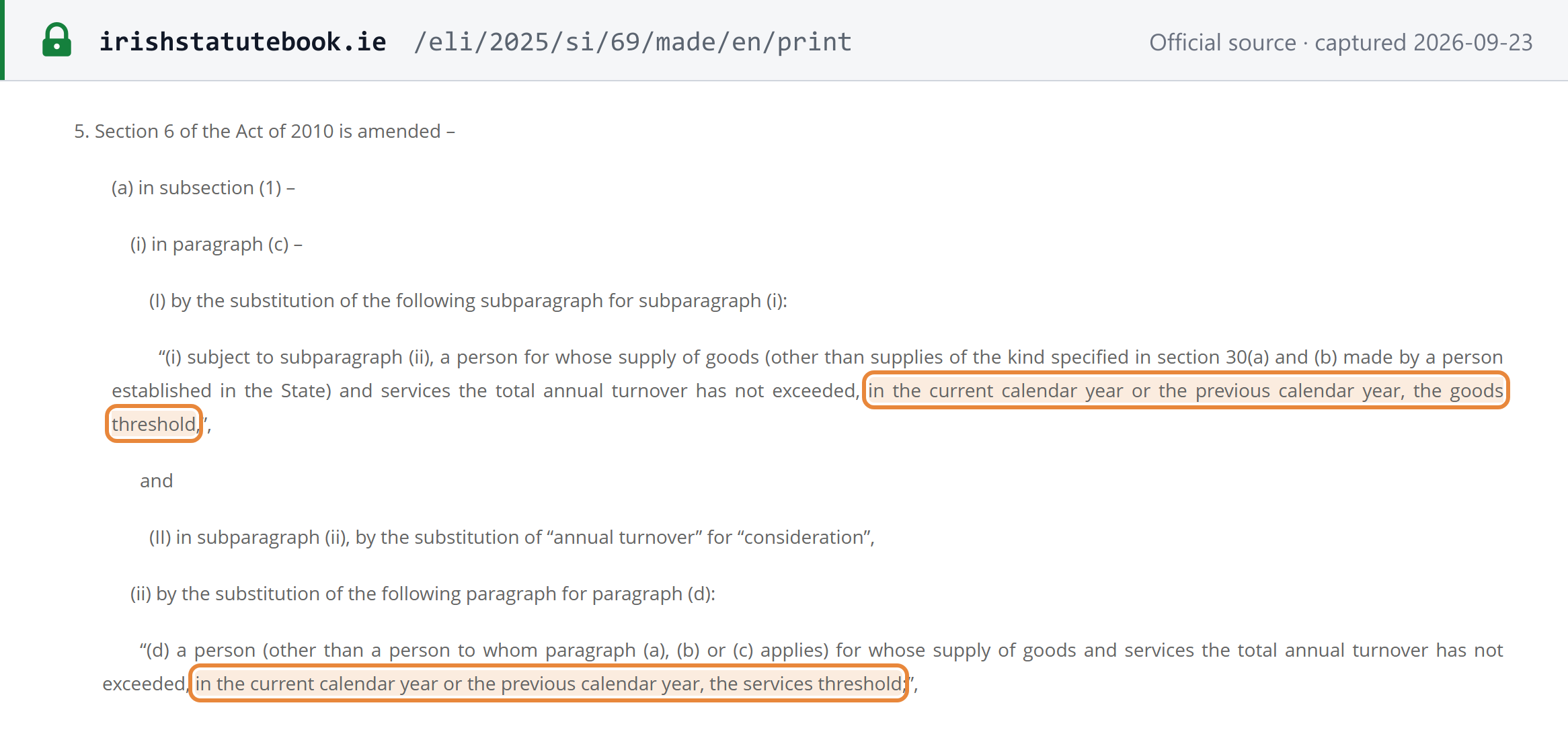
The law works the other way round. VATCA 2010 s.5(1)(a) makes a taxable person who supplies taxable goods or services in the State an accountable person, and s.6(1) then takes out those whose turnover "has not exceeded, in the current calendar year or the previous calendar year" the goods or services threshold — unless they elect to register. [3]
A business that makes only exempt supplies cannot register, with exceptions. Revenue: "A person carrying out only exempt activities or non taxable activities may not register for VAT. However, a person carrying on exempt activities or non taxable activities may have to register for VAT in certain situations, for example: acquiring goods from other Member States or receiving services from abroad." [11]
Registration threshold
As of 2026-09-23:
| Threshold | Who it applies to | Measurement period |
|---|---|---|
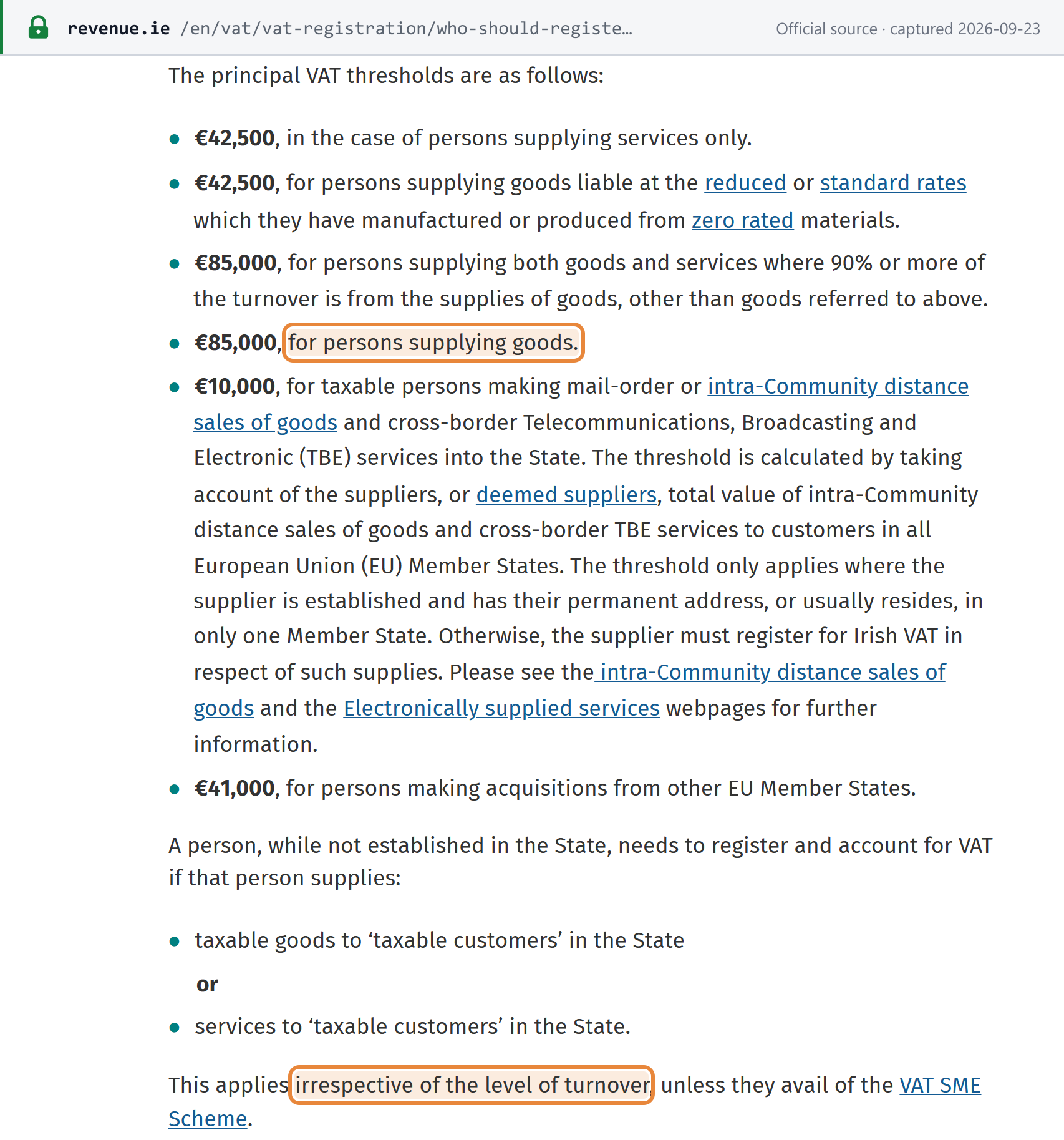
| €85,000 (goods threshold) | Businesses supplying goods; and businesses supplying goods and services where 90% or more of turnover comes from goods | Current calendar year or previous calendar year |
| €42,500 (services threshold) | Businesses supplying services only; businesses supplying reduced- or standard-rated goods they made from zero-rated materials; and mixed businesses that fail the 90% test | Current calendar year or previous calendar year |
| €41,000 | Exempt and certain non-taxable persons buying goods from other EU Member States | "any 12 month period" |
| €10,000 (EU-wide) | Intra-Community distance sales of goods plus cross-border telecommunications, broadcasting and electronic (TBE) services, counted across all EU Member States, for a supplier established in only one Member State | See Cross-border rules |
| None | Businesses not established in Ireland | — |
The €85,000 and €42,500 thresholds are measured by calendar year, not over a rolling 12 months. Section 6(1)(c) and (d), as substituted on 6 March 2025 by S.I. No. 69 of 2025, test turnover "in the current calendar year or the previous calendar year". Revenue tells businesses to add up turnover "in a calendar year". The €41,000 acquisitions threshold is different: Revenue still states it as "any 12 month period". [3] [4] [31]
The statute defines the two main thresholds in s.2(1): "goods threshold means €85,000" and "services threshold means €42,500". Both were set by Finance Act 2024 s.78 with effect from 1 January 2025. [5]
What counts as turnover. Revenue lists the VAT-exclusive value of taxable goods and services, supplies of immovable goods, certain financial transactions, and insurance and reinsurance services. Occasional disposals of business assets such as buildings, vehicles or machines are left out. [4]
Non-resident registration
There is no registration threshold for a business not established in Ireland. VATCA 2010 s.6(3)(b): "Subject to section 92D(1), paragraphs (c) and (d) of subsection (1) shall not apply to a person who is not established in the State." S.I. No. 69 of 2025 substituted s.6(3) with effect from 6 March 2025. [3]
Revenue: "A person, while not established in the State, needs to register and account for VAT if that person supplies: taxable goods to taxable customers in the State or services to taxable customers in the State. This applies irrespective of the level of turnover, unless they avail of the VAT SME Scheme." [4]
The s.92D(1) exception is the EU VAT SME Scheme. A small business established in another Member State can use Ireland's thresholds instead of registering here — see Special regimes. Revenue also states: "There is no registration threshold for received services." [6]
Tax identification number
Revenue issues a VAT registration number on registration. For the format of Irish VAT numbers, see Lookuptax's Ireland Tax ID guide. Check a number with the Ireland VAT number validator. For cross-border supplies, see how to verify an EU VAT number on VIES.
Two-tier registration. Revenue: "Since June 2019, customers must specify whether they wish to apply for a Domestic-only or Intra-EU Value-Added Tax (VAT) registration." An approved Intra-EU registration is placed on VIES automatically. Revenue: "Domestic VAT registration is sufficient for trading within the State and with non-EU countries." A domestic-only Irish number may therefore not validate on VIES even though it is valid. A domestic-only business can apply for Intra-EU status at any time with evidence of trade, or intention to trade, with other Member States. [9]
How to register
- Businesses established in Ireland register online through the Revenue Online Service (ROS), using Form TR1 (individuals, sole traders, trusts and partnerships) or TR2 (limited companies). Revenue: "All paper applications received which could otherwise be completed online, will be returned to you or your tax agent."
- Businesses not established in Ireland file a paper Form TR1(FT) or TR2(FT). Revenue gives the address as Business Registration, Office of The Revenue Commissioners, PO Box 1, Wexford.
- Deadline. VATCA 2010 s.65(3)(a) requires the registration particulars "within the period of 30 days beginning on the day on which the person first becomes an accountable person". Changes to your details must be notified within 30 days.
- Effective date. Registration "will generally take effect from the date stated on your registration form". It can be backdated in some cases by agreement with your Revenue office.
- Processing time. Revenue publishes no processing-time standard for VAT registration on its how-to-register, non-established trader and two-tier registration pages (checked 2026-09-23).
Once registered, "you must submit tax returns and payments electronically." [7] [8] [34]
Voluntary registration
Available to businesses established in Ireland. Revenue: "The following taxable persons established in the State may elect to register for Value-Added Tax (VAT): Farmers; Fishers; Businesses who do not exceed the VAT thresholds." An election cannot be backdated: "You can only elect to register for VAT from a current date." Once registered, the obligations are the same as for compulsory registration. [10]
Why register early. Revenue: a business that has not yet started supplying "may reclaim VAT on your start-up costs. However, to do so you are required to register for VAT." [11]
Deregistration
- When. Revenue: registration can be cancelled if "you have ceased to trade; your turnover has fallen below the appropriate turnover threshold; you have been registered in error; or the nature of your business has changed so that you are no longer making taxable supplies." [12]
- Deadline. VAT Regulations 2010 reg. 19(3): a registered person who stops making taxable supplies and intra-Community acquisitions must notify Revenue in writing "by the end of the taxable period following that in which the cessation occurred". Revenue may also cancel a registration by written notice (reg. 19(4)). [1]
- Procedure. Contact your Revenue office. Revenue warns that if you do not, "return forms and demands for estimated VAT liability will continue to issue automatically."
- Cancelling an election. Separate rules apply, and cancellation "may result in a recovery by Revenue of any VAT repaid to you". [12]
Group registration
Available. Revenue: "A Value-Added Tax (VAT) group is a group of persons established in the State which is treated as a single accountable person." Members must be closely bound by financial, economic and organisational links. At least one member must be an accountable person, and holding companies may join. Grouping removes the need for VAT invoices between members, except for certain property transactions. [13]
One member acts as group remitter and files the returns and payments. The remitter submits Form VAT52; the other members submit Form VAT53. Revenue must approve the group. Revenue: "Where VAT compliance is not achieved, each person or company in the group will be jointly and severally liable for any liabilities arising." [13]
Rates
Revenue's pages describing each rate band print no percentages; its Current VAT rates table lists the current figures (checked 2026-09-23). [14]
| Rate | Applies to (Revenue examples) | Effective |
|---|---|---|
| 23% (standard) | "most goods and services", for example "solicitor services; furniture; batteries; motor vehicles; consultancy services; and tyres" [15] | Since 1 March 2021 (21% from 1 September 2020 to 28 February 2021) |
| 13.5% (reduced) | Hotel lettings, guesthouses, caravan parks and camping sites; admission to cinemas, theatres, museums and exhibitions; certain fuels; certain building services; repair services; cleaning and maintenance services (generally); tour guide services; short-term hire [16] | 13.5% in every row of Revenue's table back to 1 January 2020 |
| 9% (second reduced) | Periodicals and certain e-periodicals; sports facilities; electricity and gas; qualifying apartments; restaurant and catering food and drink, hot takeaway food, hot tea and coffee; hairdressing [17] | Varies by item — see below |
| 4.8% (livestock) | "livestock in general", and horses normally intended for food production or agriculture [18] | Unchanged in every row of the table |
| 0% (zero) | Exports; intra-Community supplies of goods to VAT-registered customers; certain food and drink; certain oral medicine; certain books, e-books and newspapers; children's clothing and footwear for under-11s; solar panels on private dwellings and recognised schools [19] | — |
| 4.5% flat-rate addition (not a VAT rate) | Added by unregistered flat-rate farmers to sales to VAT-registered businesses — see Special regimes | Since 1 January 2026 (was 5.1%) |
| Exempt (no VAT, no input-tax recovery) | See Exemptions | — |
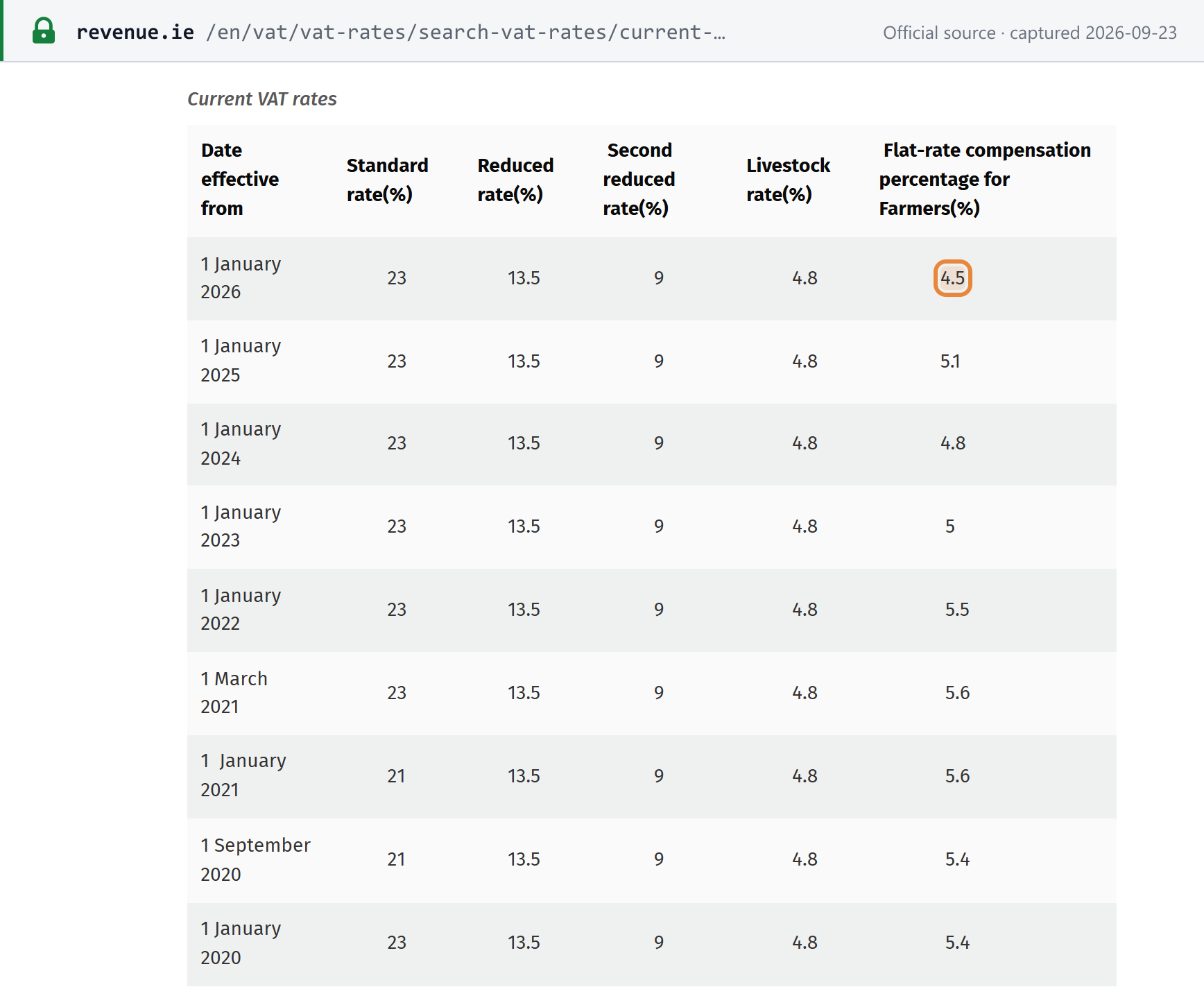
The flat-rate addition is 4.5%, not 5.1%. Finance Act 2025 s.73: "Section 86(1) of the Principal Act is amended, with effect from 1 January 2026, by the substitution of 4.5 per cent for 5.1 per cent." Revenue's Historical VAT rates page has not been updated for the 1 January 2026 change and still shows 5.1% (checked 2026-09-23). The current figure is 4.5%, as the Current VAT rates table and the Act both state. [22] [14]
The 9% rate on restaurants, catering and hairdressing (in force since 1 July 2026)
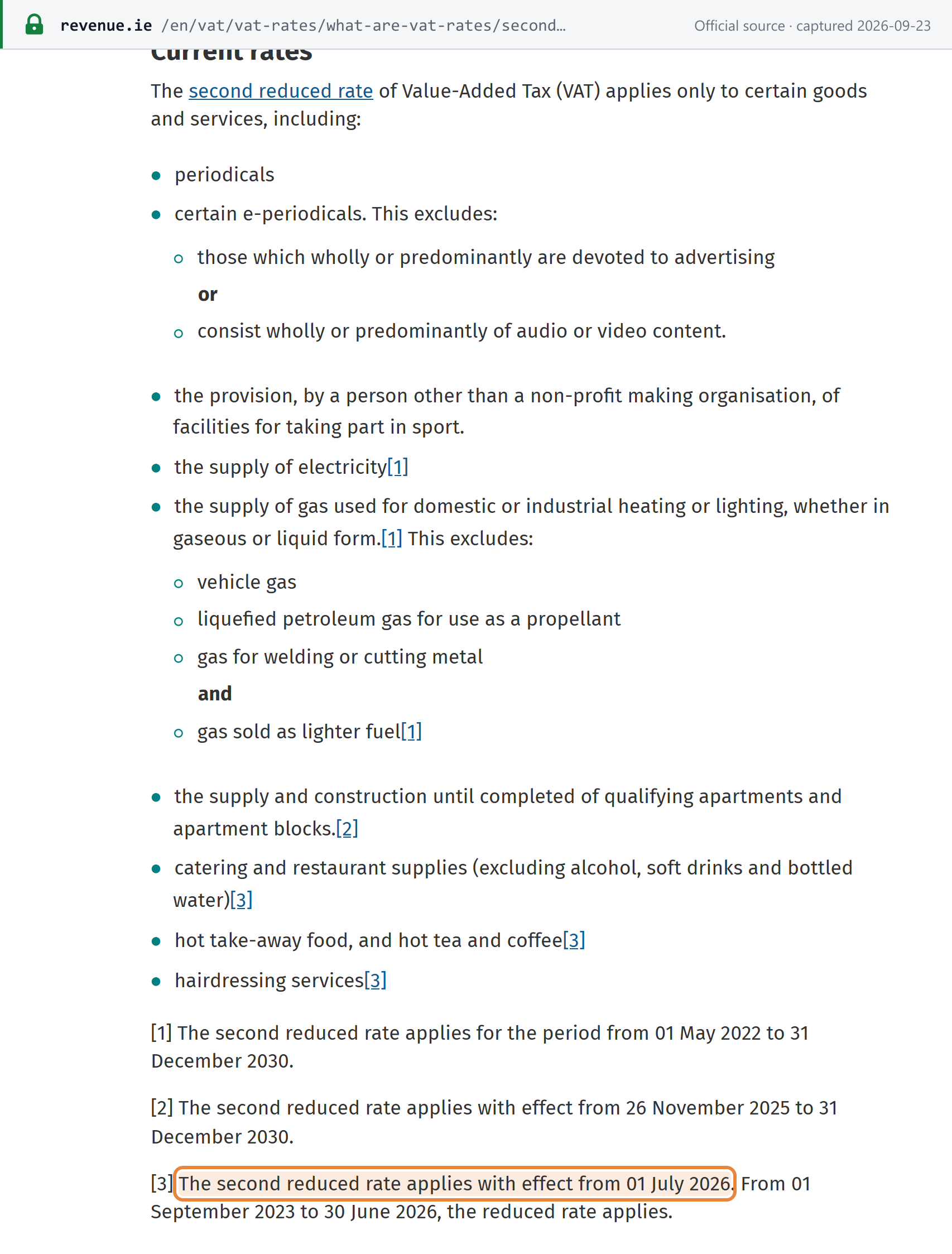
Finance Act 2025 s.71 amended VATCA 2010 s.46(1)(cb) "with effect from 1 July 2026" to apply the 9% rate to the goods and services in paragraphs 3(1), 3(3) and 13(3) of Schedule 3. Revenue explains the scope: [20] [21]
- Included: hairdressing services, and food and drink for human consumption supplied as part of a restaurant, catering or hot takeaway service — "It includes hot teas and coffees and fruit juices".
- Excluded, so still 23%: "alcoholic beverages, bottled waters, sports drinks, soft drinks and vegetable juices".
- Not moved: hotel and holiday accommodation and the admissions categories stay at 13.5%.
Revenue's second-reduced-rate page adds that from 1 September 2023 to 30 June 2026 these supplies were taxed at the 13.5% reduced rate. [17]
Other Finance Act 2025 rate changes
- Hotel rooms hired for non-accommodation use — standard rate from 1 January 2026. Finance Act 2025 s.72 narrows paragraph 11 of Schedule 3 to VATCA 2010 (the reduced-rate entry for hotel lettings). Revenue's Notes for Guidance explain that this is "to ensure that supplies of the hire of rooms in hotels and guesthouses for use other than as accommodation are taxable at the standard rate of VAT". Revenue's examples: "rooms hired for conferences, wedding fairs, trade events, etc." Holiday and guest accommodation, including a place in a caravan or camping site, stays at 13.5%. [21]
- Electricity and gas — 9% extended to 31 December 2030. Finance Act 2025 s.69 replaced the 31 October 2025 end date with 31 December 2030, with effect from 8 October 2025. [23]
- Qualifying apartments — 9% since 8 October 2025, to 31 December 2030. Finance Act 2025 s.70 applied the 9% rate first to the supply of qualifying apartments, under s.46(1)(cab): "during the period from 8 October 2025 to 25 November 2025, 9 per cent in relation to goods of a kind specified in paragraph 9A". From 26 November 2025 to 31 December 2030, s.46(1)(cac) covers both the supply and the construction of qualifying apartments and apartment blocks. Revenue defines an apartment block as "a multi-storey residential property that comprises, or will comprise, not less than 3 apartments with grouped or common access". [24] [21]
Announced future rates
None in law as of 2026-09-23. Revenue's rate pages, its Finance Act 2025 VAT Notes for Guidance, Finance Act 2025 ss.67–77, and Finance Act 2026 (No. 24 of 2026, 15 July 2026, which contains excise provisions only) carry no Irish VAT rate change that starts after today (checked 2026-09-23). The dates ahead are expiry dates: the 9% rates on electricity and gas and on qualifying apartments both run to 31 December 2030. A rate change announced in a future Budget is not law until the Finance Act passes. Finance Act 2025 was passed on 23 December 2025. [21]
Mixed supplies — the two-thirds rule
When goods are supplied as part of a service, the rate depends on the cost of the goods. Revenue: "If the cost of the goods used in carrying out the work exceeds two-thirds of the total price, the rate which applies to the goods then applies to the entire transaction." Otherwise the service rate applies to the whole transaction. Revenue's worked example is a €300 guitar repair with €220 of materials, where "VAT chargeable is €69 (€300 @ 23%)". [71]
The rule does not apply to repair and maintenance of motor vehicles and agricultural machinery, or to construction services under the principal-contractor reverse charge or between connected parties. [71]
For Ireland alongside other jurisdictions, see Lookuptax's worldwide tax rates table and VAT registration thresholds table.
Cross-border rules
Imports and exports
- Imports. Revenue: "Value-Added Tax (VAT) is payable at the point of importation into the State. Imported goods are liable to VAT at the same rate as applies to similar goods sold within the State." Most traders have a deferred payment account debited "until the 15th of the month following importation". The VAT value is the customs value plus duties and transport, handling and insurance costs to the place of final destination. [25]
- Postponed accounting. Revenue: "Postponed accounting for Value-Added Tax (VAT) on imports is available to all traders that are registered for VAT and Customs and Excise." It covers all imports from third countries, including Great Britain but excluding Northern Ireland, and "it is not compulsory". The trader accounts for the import VAT on its VAT3 return, reports in box PA1 the customs value of the goods imported under postponed accounting plus Customs Duty, and can reclaim the VAT on the same return, subject to the normal deduction rules. It has been available since 23:00 on 31 December 2020. [26] [9]
- Import de minimis. Not covered in this guide. The €150 figure under marketplaces is the deemed-supplier ceiling, not a VAT exemption.
- Exports. Goods sent outside the EU VAT area are zero-rated. Revenue: "The supplier of exported goods must ensure the goods have left the EU." Evidence includes "the export notification message (IE599) that was issued to the exporter". Intra-Community supplies of goods to VAT-registered customers in other Member States are also zero-rated. [27] [19]
- Reverse charge on imported services. A VAT-registered recipient accounts for Irish VAT on the invoiced amount in its own return and "may be entitled to reclaim the VAT in the same VAT return". Revenue lists the reverse-charge cases. They include intra-Community acquisitions of goods, services received from abroad, construction services from a sub-contractor to a principal contractor, greenhouse gas emission allowances, scrap metal dealing, and construction work between connected persons. [6] [30]
- Exempt businesses buying services from abroad. Revenue: "VAT-exempt businesses who receive taxable services for business purposes from outside the State must register and account for Irish VAT. Examples of VAT-exempt businesses include bookmakers, banks and insurance companies." There is no threshold, and an exempt business cannot reclaim that VAT. [6] [31]
Construction services and Relevant Contracts Tax
Where a principal contractor receives construction operations from a sub-contractor, the principal accounts for the VAT and the sub-contractor does not (VATCA 2010 s.16(3)(b)). The sub-contractor still issues a document. Under s.66(4)(a) it states that the principal is liable, with the other invoice particulars "but excluding the rate at which tax is chargeable and the amount of tax payable". Revenue's list of invoice particulars notes that the usual "reverse charge applies" notation does not apply to construction services subject to Relevant Contracts Tax. [32] [33] [38]
Digital products and services
- EU-established sellers. The €10,000 threshold covers intra-Community distance sales of goods and cross-border TBE services together, across all EU Member States. It applies only where the supplier is established in one Member State. Above it, the supplier registers in each Member State or uses the One Stop Shop (OSS) Union scheme, which lets it "declare and pay EU VAT due on supplies made under the scheme in a single electronic quarterly return". Irish-established suppliers register for the Union scheme through ROS. [4] [35]
- Sellers outside the EU. Revenue lists "the supply of electronic services from outside the EU to a private individual whose usual place of residence is the State" among the cases where a non-established trader must register regardless of turnover. [34]
Foreign companies selling into Ireland — B2B and B2C
The answer depends on the customer. Both halves come from Revenue's page for non-established traders: [34]
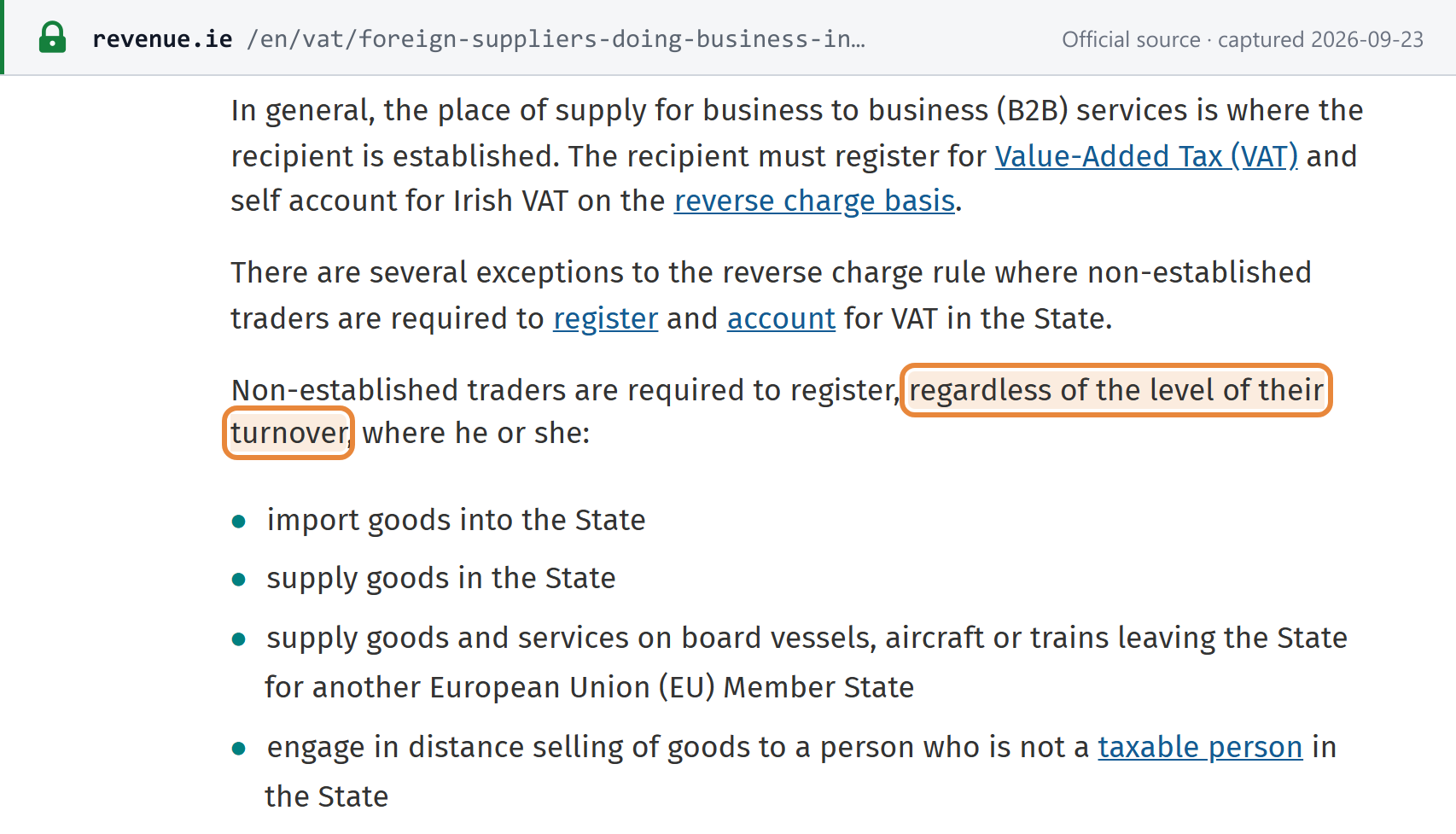
- B2B services — the customer self-accounts. "In general, the place of supply for business to business (B2B) services is where the recipient is established. The recipient must register for Value-Added Tax (VAT) and self account for Irish VAT on the reverse charge basis."
- B2C, goods and listed services — the seller registers from its first euro. "Non-established traders are required to register, regardless of the level of their turnover, where he or she:" imports goods into Ireland; supplies goods in Ireland; supplies goods or services on board vessels, aircraft or trains leaving Ireland for another Member State; distance-sells goods to non-taxable persons in Ireland; supplies services connected with Irish property; supplies certain transport, cultural, sporting, entertainment, valuation or catering services in Ireland; hires movable goods for use in Ireland from outside the EU; or supplies telecoms, broadcasting or electronic services from outside the EU to private individuals in Ireland.
A small business established in another EU Member State may be able to use the EU VAT SME Scheme instead of registering — see Special regimes.
Marketplace / platform deemed-supplier liability
Applies. Revenue: an electronic interface facilitating supplies of goods "is a deemed supplier, in specific circumstances", with the supplier's full VAT obligations, including collecting and paying the VAT. It covers two cases: [36]
- distance sales of goods imported from outside the EU in consignments with an intrinsic value not exceeding €150, wherever the underlying supplier is established;
- supplies of goods within the EU to a non-taxable person where the underlying supplier is established outside the EU, whatever the value.
Platform services from July 2028. Revenue: "From July 2028, online platforms will be treated as the actual service provider for VAT purposes if they facilitate the supply of: short-term accommodation or road passenger transport services." Member States may delay this to January 2030 and may exclude SME-scheme suppliers. Revenue: "Ireland is currently considering its position on these issues." (Checked 2026-09-23.) [37]
Place of supply
- Goods. Revenue: "The general rule is that supplies of goods in the State are subject to Irish VAT." Goods that are not transported are supplied "where the goods are at the time of their supply"; installed or assembled goods where they are installed; goods on board vessels, aircraft and trains where the transport begins. Gas and electricity supplied to a consumer are supplied where they are used — "Effectively this is the place where the meter is located." [28]
- Services, B2B. "The place where the business receiving the services is established. This applies whether the business customer is in the European Union (EU) or not." The business customer then self-accounts in its own State.
- Services, B2C. The place where the supplier has established its business or has a fixed establishment, subject to exceptions. Revenue notes that for certain specified services the place of supply is outside Ireland if the customer is outside the EU. [29]
For the Northern Ireland position under postponed accounting, see Lookuptax's Northern Ireland TIN guide and the United Kingdom VAT guide.
Invoice requirements
Who must issue a VAT invoice: Revenue lists supplies to another accountable person, a Department of State, a local authority, a statutory body, a person carrying on an exempt activity, a business customer in another Member State, and a person in another Member State where the reverse charge applies. An invoice is also needed for intra-Community distance sales of goods, unless the supplier uses the Union OSS scheme. [40]
Mandatory content
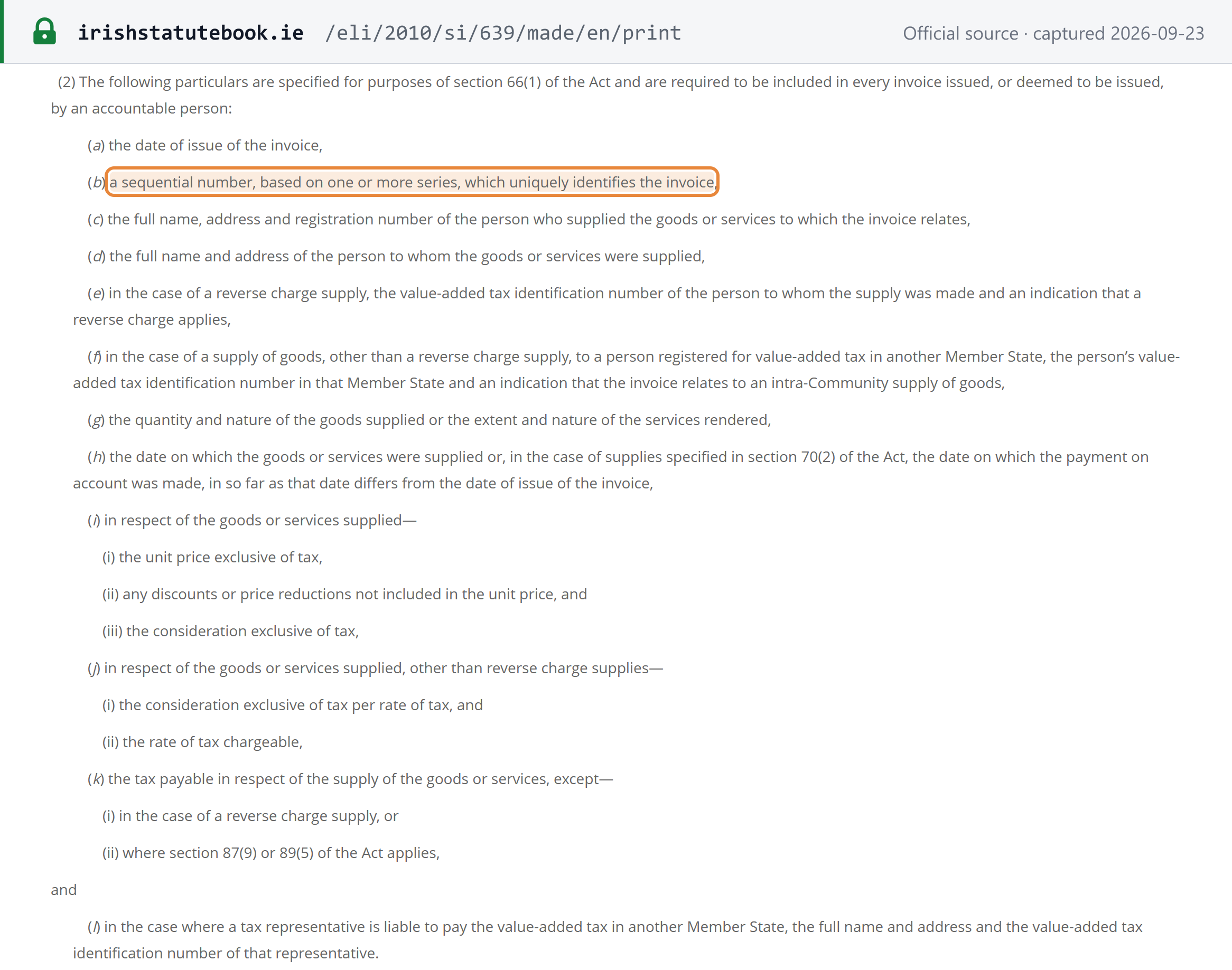
VAT Regulations 2010 reg. 20(2), made under VATCA 2010 s.66(1), lists the particulars "required to be included in every invoice issued, or deemed to be issued, by an accountable person": [1]
| # | Required field | Legal cite |
|---|---|---|
| 1 | Date of issue | reg. 20(2)(a) |
| 2 | "A sequential number, based on one or more series, which uniquely identifies the invoice" | reg. 20(2)(b) |
| 3 | Supplier's full name, address and VAT registration number | reg. 20(2)(c) |
| 4 | Customer's full name and address | reg. 20(2)(d) |
| 5 | Reverse-charge supply: customer's VAT number and an indication that the reverse charge applies | reg. 20(2)(e) |
| 6 | Intra-Community supply of goods: customer's VAT number in the other Member State and an indication that it is an intra-Community supply | reg. 20(2)(f) |
| 7 | Quantity and nature of goods, or extent and nature of services | reg. 20(2)(g) |
| 8 | Date of supply (or of a payment on account), where it differs from the date of issue | reg. 20(2)(h) |
| 9 | Unit price excluding VAT; discounts not in the unit price; consideration excluding VAT | reg. 20(2)(i) |
| 10 | Consideration excluding VAT per rate, and the rate (not for reverse-charge supplies) | reg. 20(2)(j) |
| 11 | VAT payable (not for reverse-charge supplies or margin and auction schemes) | reg. 20(2)(k) |
| 12 | Where a tax representative is liable in another Member State: its name, address and VAT number | reg. 20(2)(l) |
Two extra particulars:
- Triangulation. Revenue's guidance (not reg. 20(2)) adds "an explicit reference to EC triangulation simplification and an indication that the person in receipt of the goods is liable to account for the VAT due on the supply". [38]
- New means of transport. Reg. 20(3) requires the details needed to identify the goods as a new means of transport on an intra-Community supply. [1]
Issuance deadline
Within 15 days after the end of the month of supply — not 15 days after the supply. Reg. 23(a): "within the 15 days following the end of the month during which the goods or services were supplied". A supply on 3 March can therefore be invoiced up to 15 April. The same month-end rule applies to construction services under the principal-contractor reverse charge (reg. 23(c)) and to payments received before a supply (reg. 23(g)). [1] [39]
Numbering and sequencing
Each invoice carries "a sequential number, based on one or more series, which uniquely identifies the invoice" (reg. 20(2)(b)). More than one series is allowed. Credit notes need only "a number which uniquely identifies the note" (reg. 20(5)), which does not have to be sequential. [1]
Credit and debit notes
- When a credit note is needed. When the price falls through an allowance, discount or similar adjustment, or the VAT rate on the invoice was wrong. Revenue: "Where you agree a reduction in the VAT exclusive price with your customer, there is no obligation to issue a credit note as long as the VAT payable is unchanged." [41]
- Deadline. Reg. 23(f): for a discount, "within the 15 days of the date of receipt of the money to which the discount relates"; otherwise "within the 15 days of the day on which the decrease in consideration is agreed between the parties". [1]
- Contents. Revenue lists the date, a unique number, both parties' names, addresses and VAT numbers, the reason for the note, a cross-reference to the original invoice, the amended consideration, the rates in force when the invoice was issued, and the VAT at each rate. [83]
- Correcting VAT. Revenue: if the invoice shows too much VAT, "you are still liable for the VAT shown on the invoice", and you issue a credit note and a revised invoice. If it shows too little, "you must issue a credit note for the full value of the invoice" and then a revised invoice. A price increase needs a supplementary invoice cross-referenced to the original. [84]
- Debit notes. A customer's debit note can act as a credit note if issued first and accepted by the supplier: "The supplier must accept the debit note in order for it to be valid." [85]
Currency and language
- Currency. Revenue: "If you issue an invoice in a foreign currency, it must also show the corresponding figures in Euro. You should use the selling rate recorded by the Central Bank at the time the invoice is due to be issued." Revenue can agree another exchange-rate method, but it must then be used for all your foreign-currency transactions. [38]
- Tax amount in euro. Reg. 20(8): "The amount of tax included on an invoice or other document ... is required to be expressed in euro." [1]
- Language. The VAT Regulations 2010 prescribe the currency of the tax amount and publish no language requirement for invoices (checked 2026-09-23). [1]
Document types
| Document | When it is used | Cite |
|---|---|---|
| Full VAT invoice | Default | reg. 20(2) |
| Simplified invoice | Invoices of €100 or less, or where sector practices make full invoicing difficult. Must still carry a sequential number that uniquely identifies the invoice. Not for intra-Community supplies of goods or services | VATCA s.66(1)(b); reg. 20(2A); Revenue |
| Simplified arrangements under Article 238 of the VAT Directive | Authorised by Revenue per sector; details published in Iris Oifigiúil | reg. 20(9) |
| Summary invoice | Several supplies to the same customer in the same calendar month | Revenue |
| Batch invoices | Electronic batches to one customer, with common details recorded once per transmission | Revenue |
| Margin scheme and auction invoices | No VAT amount shown. Endorsed "Margin scheme – Second-hand goods", "Margin scheme – Works of Art" or "Margin scheme – Collectors' items and antiques" (reg. 20(6A)); "Margin scheme — auction goods" for the auctioneer scheme (Revenue); "margin scheme — travel agents" (reg. 20(7)) | reg. 20(6), (6A), (7) |
| Flat-rate farmer invoice | Prepared by the VAT-registered buyer; shows the flat-rate addition | Revenue |
A simplified invoice "should include the following: the date of issue; the full name, address and registration number of the supplier; a description of the goods or services supplied; and the tax payable or the price exclusive of tax." Reg. 20(2A)(b), inserted by S.I. No. 458 of 2012, also requires "a sequential number" that uniquely identifies the invoice. [87] [42] [33] [1] [86]
Self-billing
Permitted. Revenue lists four conditions: prior agreement with the supplier; all content and issue rules are met; agreed procedures for the supplier to accept the invoice; and "you endorse the invoice with the words self-billing" — the endorsement VAT Regulations 2010 reg. 20(6B) requires. The supplier is treated as having issued the invoice when it accepts it, and the supplier remains liable for the VAT. [43] [87]
Retention and audit trail
- Retention. VATCA 2010 s.84(3): records are kept "for a period of 6 years from the date of the latest transaction to which the records ... relate". Revenue lists longer periods where a claim, appeal or investigation is open ("six years or until the matter at issue is finalised") and for certain property interests. Keeping records for a shorter period needs written permission from Revenue. [44] [45]
- Paper and location. Revenue: "Store paper issued invoices in paper form. Keep paper records within the State. Exceptions to this require Revenue agreement and are subject to conditions." [45]
- Electronic invoices today. Electronic invoicing is allowed by agreement between both parties (VATCA s.66(2)). VAT Regulations 2010 reg. 21(2), as substituted by S.I. No. 458 of 2012 from 1 January 2013, requires the electronic system to produce, keep and store the records; reproduce them on paper or electronically; and keep them retrievable by the name of the person issuing or receiving the message, its date, or its unique number. Authenticity of origin, integrity of content and the audit trail are covered by s.66(2A), below. [42] [87]
- Audit trail. VATCA 2010 s.66(2A) requires an accountable person who issues or receives an invoice to "apply business controls" ensuring "the authenticity of the origin", "the integrity of the content" and "that there is a reliable audit trail for that invoice or other document and the supply of goods or services as described therein". The person must provide evidence of those controls. Revenue: "If Revenue inspect your records, they must be able to verify the accuracy of each transaction." [33] [46]
A specimen of a compliant invoice
Revenue publishes the mandatory particulars in prose and in reg. 20(2). Its VAT invoice, credit-note and records pages publish no annotated specimen invoice (checked 2026-09-23). The layout below is Lookuptax's own illustration of the reg. 20(2) particulars. Every name, number and amount in it is fictional:
VAT Invoice
| Descriptionreg. 20(2)(g) | Quantityreg. 20(2)(g) | Unit price (excl. VAT)reg. 20(2)(i)(i) | VAT ratereg. 20(2)(j)(ii) | Value (excl. VAT)reg. 20(2)(i)(iii) |
|---|---|---|---|---|
| Management consultancy (hours) | 10 | €150.00 | 23% | €1,500.00 |
| Office cleaning (visits) | 4 | €200.00 | 13.5% | €800.00 |
- Discounts not in the unit pricereg. 20(2)(i)(ii)
- €0.00
- Consideration excl. VAT at 23%reg. 20(2)(j)(i)
- €1,500.00
- Consideration excl. VAT at 13.5%reg. 20(2)(j)(i)
- €800.00
- VAT at 23%reg. 20(2)(k)
- €345.00
- VAT at 13.5%reg. 20(2)(k)
- €108.00
- Total VAT payablereg. 20(2)(k)
- €453.00
- Total including VAT
- €2,753.00
- Issued by 15 September 2026: within 15 days after the end of the month of supply — reg. 23(a).
- For a reverse-charge supply, add the customer’s VAT number and a statement that the reverse charge applies, and show no rate or VAT amount — reg. 20(2)(e), (j), (k).
- For an intra-Community supply of goods, add the customer’s VAT number in its Member State and a statement that it is an intra-Community supply — reg. 20(2)(f).
- The VAT amount must be expressed in euro — reg. 20(8). For a foreign-currency invoice, Revenue’s guidance also asks for the corresponding figures in euro.
- Where a tax representative is liable in another Member State, add its name, address and VAT number — reg. 20(2)(l).
E-invoicing status
Status (as of 2026-09-23): no e-invoicing or digital-reporting mandate is in law. Electronic invoicing is voluntary and needs the agreement of both parties. VATCA 2010 s.66(2) treats an electronic invoice as issued only if it "is issued and received by prior agreement" and the system meets the specifications in the Regulations (reg. 21 — see Retention and audit trail). Revenue's VAT Modernisation pages describe the mandate in the future tense and publish no obligation starting before November 2028. Finance Act 2025 (ss.67–77) contains no e-invoicing provision (checked 2026-09-23). [33]
The one e-invoicing obligation in force binds public bodies, not suppliers. S.I. No. 258 of 2019, reg. 4: "A contracting authority or a contracting entity shall, where an electronic invoice complies with the European standard on electronic invoicing established under the Directive, receive and process the electronic invoice." Sub-central authorities were brought in from 18 April 2020. The Regulations implement Directive 2014/55/EU. They oblige public bodies to receive compliant e-invoices, not suppliers to send them. [52]
Revenue's announced programme — not yet legislated
Revenue announced VAT Modernisation in a paper published on 8 October 2025, in line with the Budget 2026 speech. The paper states that Revenue "has started detailed analysis and technical work on the legislative changes, strategic and operational processes, and IT systems required for successful implementation". Revenue says it will publish detailed guidance and technical specifications before each phase. [49]
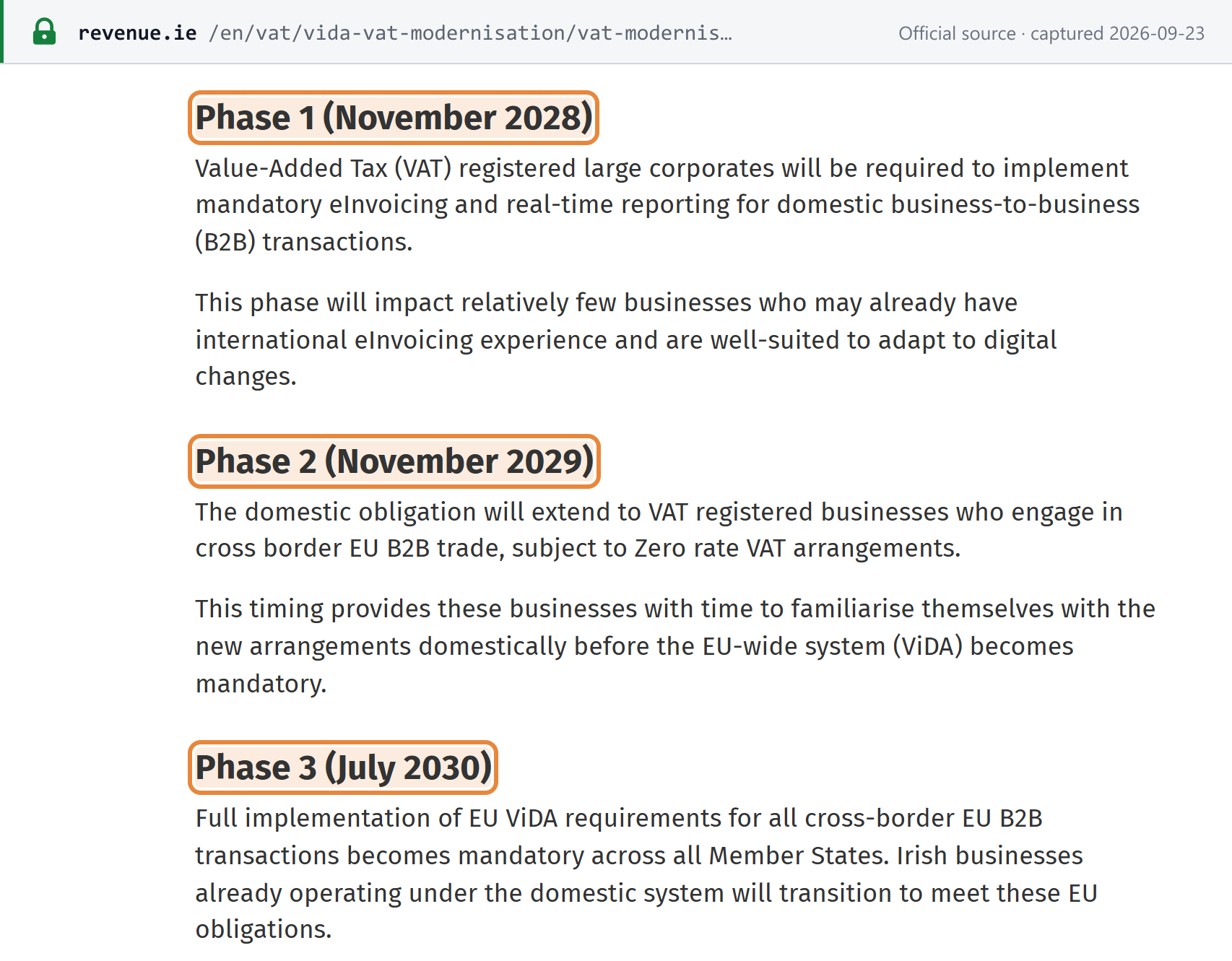
Revenue's VAT Modernisation timeline (published 20 July 2026) sets three phases. It adds: "For all phases businesses must ensure they can receive and process eInvoices from any supplier mandated to issue them." [47]
| Phase (Revenue) | Who | Scope |
|---|---|---|
| Phase 1 — 1 November 2028 | VAT-registered large corporates | Issue e-invoices for domestic B2B and report a subset of the data to Revenue. All businesses in Ireland must be able to receive structured e-invoices |
| Phase 2 — November 2029 | VAT-registered businesses engaged in cross-border EU B2B trade subject to zero-rate arrangements | The domestic obligation extends to them |
| Phase 3 — July 2030 | All cross-border EU B2B | Full EU VAT in the Digital Age (ViDA) requirements |
Phase 1 detail. Revenue's Phase 1 page (published 20 July 2026) gives the day: "Ireland will begin Phase One of the implementation of eInvoicing on 1 November 2028." A business counts as a large corporate if it is "a VAT-registered business whose tax affairs are managed by Large Corporates Division in Revenue and established, or have a fixed establishment, in Ireland". Revenue "will write to large corporates to notify them of their inclusion in Phase One." [48]
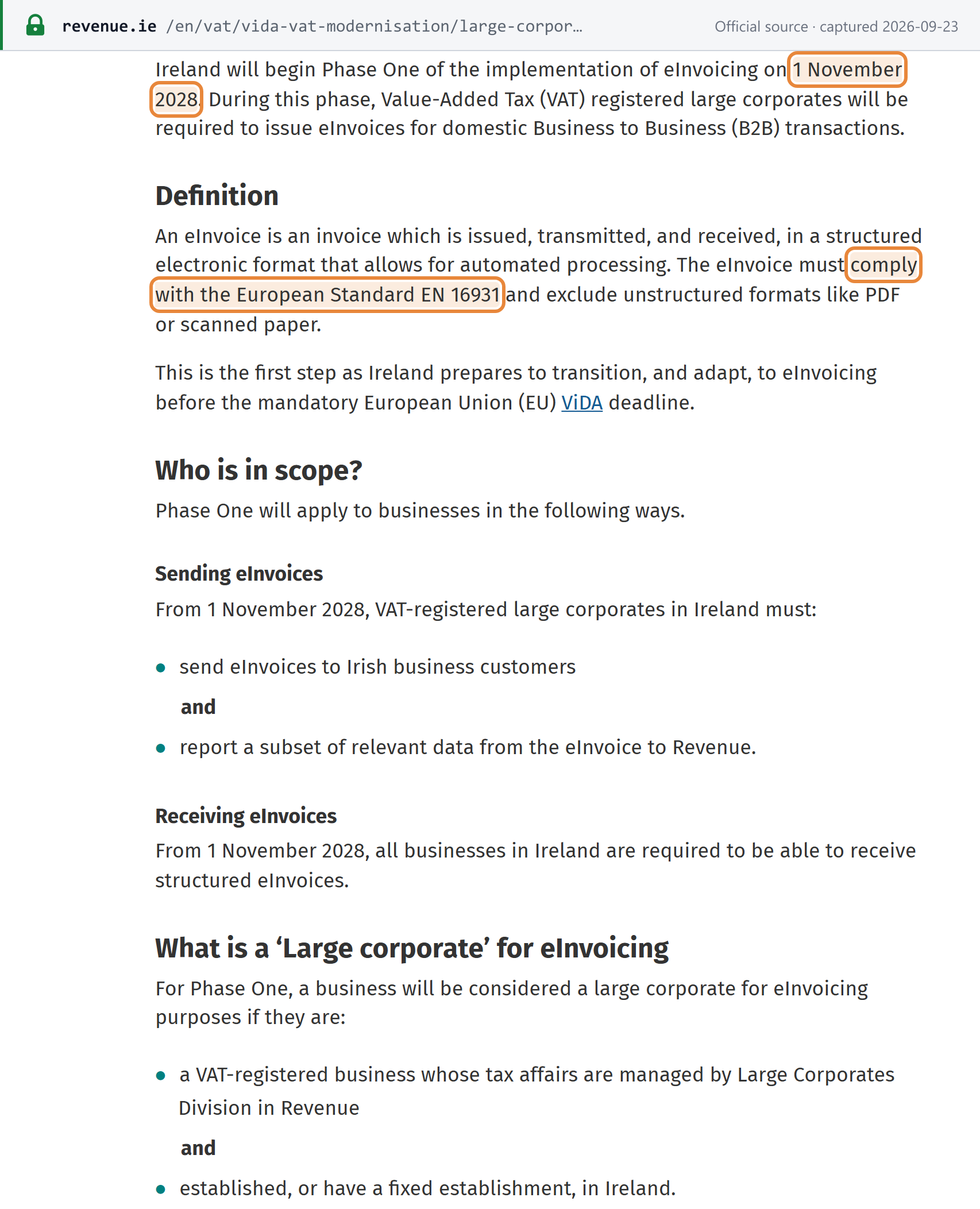
Format. Revenue: "The eInvoice must comply with the European Standard EN 16931 and exclude unstructured formats like PDF or scanned paper." [48]
Network. Revenue has not named a single channel. Its October 2025 paper says: "The new system will utilise various existing technical infrastructures, including the Pan-European Public Procurement Online (PEPPOL) framework, already used by some Irish public sector bodies for eInvoicing since 2019, for business-to-government (B2G) transactions." It says Revenue is working with the Office of Government Procurement, "Ireland's PEPPOL authority". See Lookuptax's Peppol guide for the network. [49]
Scope by channel.
- B2B: announced from 1 November 2028 (Phase 1), as above. Not in law.
- B2G: public bodies must receive EN-compliant e-invoices under S.I. No. 258 of 2019. Suppliers are not obliged to send them. B2G e-invoices travel over Peppol: the Office of Government Procurement (OGP) has been Ireland's Peppol Authority since 18 January 2018. [91]
- B2C: Ireland's announced phases cover B2B only. Revenue's ViDA timeline notes only that Member States may introduce domestic B2B and B2C e-invoicing from April 2025. [53]
Still open. Revenue: "Revenue is engaging with the European Commission and tax authorities in other European Union (EU) Member States in order to finalise an approach to the changes introduced by ViDA." The paper also says the new system "will eliminate the reporting requirement of the monthly VIES returns". [51] [49]
Contact. Revenue: "If you have enquiries about ViDA and VAT modernisation, please email [email protected]." [48]
For the full picture — legal basis, phases, scope, format and penalties — see Lookuptax's Ireland e-invoicing guide. For Ireland alongside other mandates, see Lookuptax's e-invoicing status and networks table.
Filing and payment
Filing frequency
The default taxable period is two months, which Revenue calls "bi-monthly". Periods begin on 1 January, 1 March, 1 May, 1 July, 1 September and 1 November. The Collector-General may authorise other periods (checked 2026-09-23): [54]
| Period | Condition |
|---|---|
| Two-monthly (default) | All accountable persons unless authorised otherwise |
| Four-monthly | Annual VAT liability of €3,001 to €14,400 |
| Six-monthly | Annual VAT liability of €1 to €3,000 |
| Monthly | On request, generally for businesses in a constant repayment position |
| Annual | A 12-month accounting period under VATCA 2010 s.77 |
Revenue's own terms can mislead: "bi-monthly" means every two months, while its calendar calls the six-monthly period "Bi-Annual".
Return due date
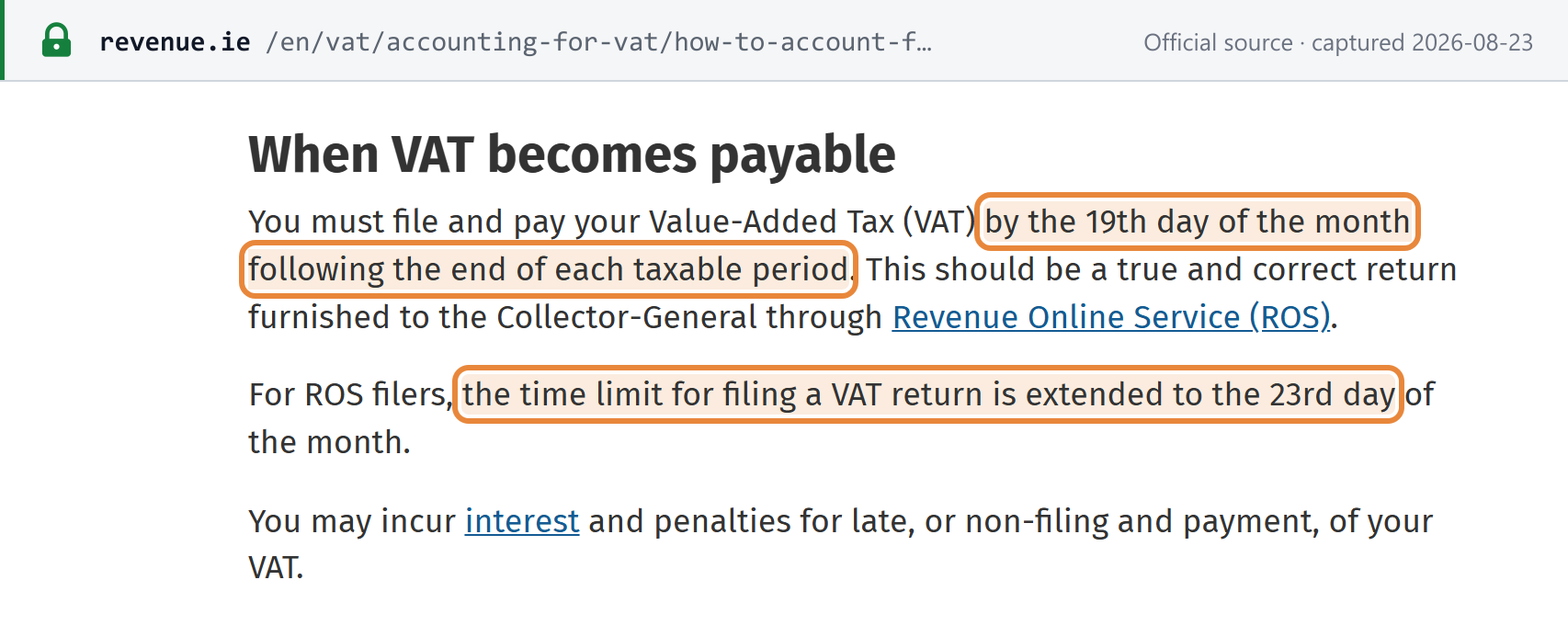
Revenue: "You must file and pay your Value-Added Tax (VAT) by the 19th day of the month following the end of each taxable period." For ROS filers "the time limit for filing a VAT return is extended to the 23rd day of the month." [54]
The 23rd is conditional. Under VATCA 2010 s.78(2) the extension applies only where the return and any payment due are both made electronically within the extended period. Section 78(3) removes it if either is late: "this Act shall apply and have effect without regard to the other provisions of this section." A ROS filer who pays on the 24th is late from the 19th, and interest runs from the 19th. [55]
Weekends. Revenue's tax calendar lists the VAT3 for the period ending August 2026 as due on 19 September 2026, which is a Saturday — Revenue does not move the date for a weekend (checked 2026-09-23). [90]
The return is the VAT3, filed on ROS. Main boxes: T1 VAT on sales, T2 VAT on purchases, T3 VAT payable, T4 VAT repayable, E1/E2 intra-EU goods, ES1/ES2 intra-EU services, PA1 postponed accounting. A period with nothing due must be returned "marked zero at T1, T2 T3 and T4". [56]
Payment due date and method
Payment is due on the same date as the return. Revenue accepts payment through ROS and myAccount by ROS Debit Instruction, Single Debit Instruction, Direct Debit set up through ROS, or credit and debit card. Cards are only for customers managed by Revenue's Personal and Business Divisions, and "Revenue does not accept payment from commercial cards." [60]
Direct debit is changing. Revenue is replacing the Fixed Direct Debit option for VAT with Variable Direct Debit. The move "necessitates a change in filing frequency from an annual to a bi-monthly basis" for affected businesses, with letters issued on a rolling basis up to April 2026 (checked 2026-09-23). Annual accounting under s.77 remains in the Act. [61]
Additional listings
- Return of Trading Details (RTD). An annual return of total purchases and sales for the year, broken down by VAT rate. It appears in the ROS inbox. Revenue's Tax and Duty Manual gives ROS filers 23 days after the end of their accounting year, and 19 days to filers exempt from mandatory electronic filing (checked 2026-09-23). [54] [57]
- VIES statements. For goods, monthly by the 23rd by default, with a quarterly option only while supplies stay under €50,000 in the quarter and in each of the previous four quarters (VATCA s.82). For services, quarterly by the 23rd by default, with a monthly option (s.83). The €50,000 figure applies to goods only. A business that makes no intra-Community supplies of services, and whose intra-Community supplies of goods stay within any limit set by regulations, may be authorised by Revenue, on written request, to lodge an annual goods statement by 23 January after the calendar year (s.82(4)) (checked 2026-09-23). [58] [82]
- Intrastat. Arrivals and dispatches thresholds are both €750,000 from 1 January 2025, each tested separately. Returns are due on the 23rd of the following month, and nil returns are required (checked 2026-09-23). [59]
- OSS and IOSS returns. Union and non-Union OSS returns are quarterly, IOSS monthly. All are due by the end of the month following the period, not the 19th or 23rd. Revenue: "They must submit a quarterly Union scheme VAT return electronically by the end of the month following the end of the tax period." [62]
Input-tax recovery and blocked items
Input VAT goes in box T2 to the extent it relates to taxable supplies and qualifying activities. Mixed-use costs are apportioned. Revenue: "The time limit for claiming a repayment of VAT is four years." You need "a valid VAT invoice or relevant Customs receipt". [63]
Blocked even for a fully taxable business (Revenue): [63]
- food, drink or other personal services for you, your agents or employees, unless part of a taxable supply;
- accommodation, except qualifying accommodation for attending a qualifying conference;
- food, drink, accommodation or entertainment forming part of the cost of advertising services;
- entertainment;
- passenger motor vehicles, except qualifying vehicles or stock in trade;
- petrol, unless stock in trade;
- contract work involving the handing over of goods when such goods are themselves not deductible;
- goods bought under a margin scheme;
- property acquired or developed for a non-business purpose.
Refunds
- Repayments to registered businesses. Claimed through the VAT3 (box T4). Revenue: "VAT repayments are made directly to an account in a financial institution. The Collector-General may withhold your repayments if you have outstanding tax returns." [88]
- Bad-debt relief. Available where you accounted for VAT on a supply and the customer defaults. Revenue: "You cannot claim bad debt relief if you are accounting for VAT on the moneys received basis." [64]
- Cross-border refunds. Not covered in this guide — neither claims by Irish-registered traders for VAT paid in other Member States nor claims by unregistered non-established businesses. See Revenue's page on reclaiming VAT from other EU Member States (checked 2026-09-23).
Exemptions
Exempt supplies
Exempt activities are listed in Schedule 1 of VATCA 2010. As enacted, the headline categories include public postal services; hospital and medical care; children's and young people's education, school and university education, and vocational training; financial services; insurance and reinsurance; investment gold; betting subject to excise duty; letting of immovable goods; and, by derogation, funeral undertaking, supply of water by local authorities, passenger transport and admission of spectators to sporting events. [66]
Schedule 1 has been amended since 2010. For example, Finance Act 2025 s.77 added "the managing of the Automatic Enrolment Retirement Savings System" to the financial services exemption from 23 December 2025. Check the current text before relying on a specific paragraph. [21]
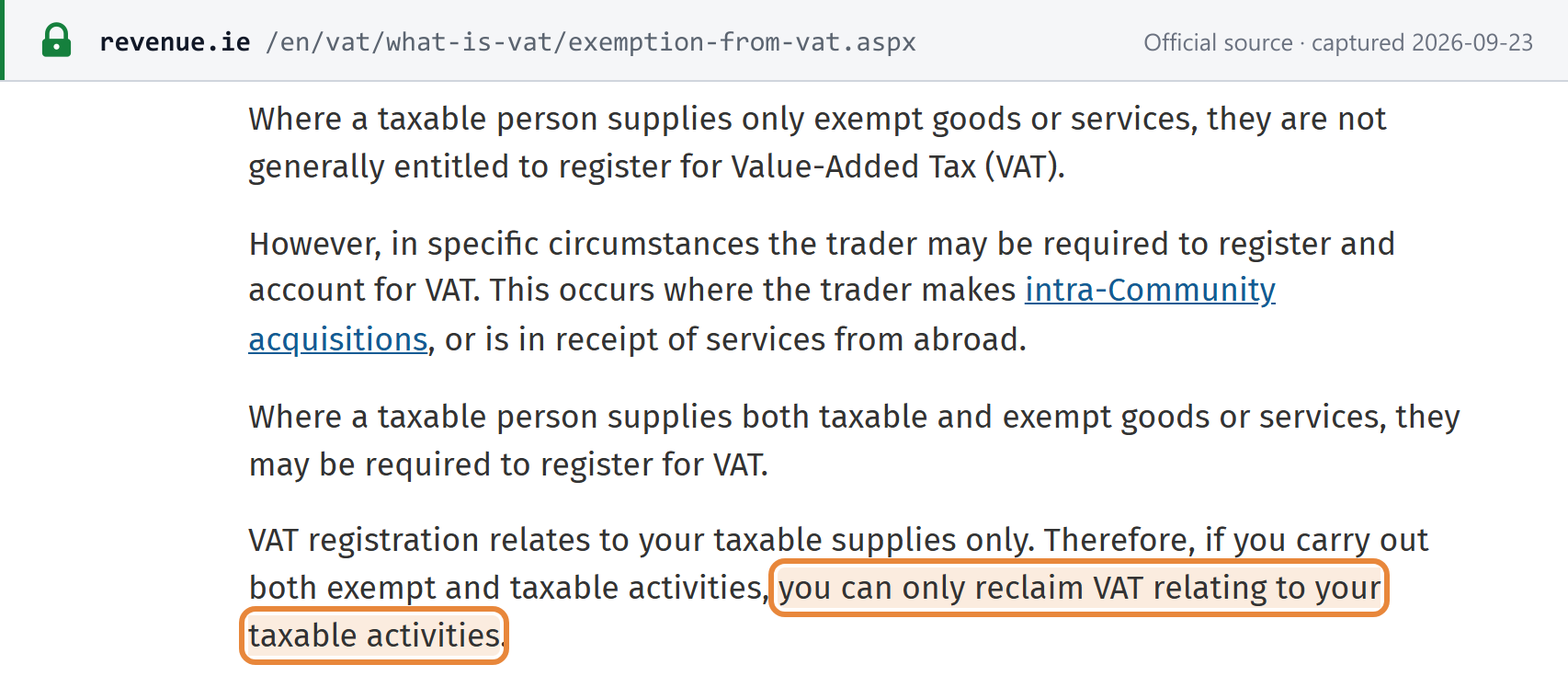
Exempt is not the same as zero-rated. A zero-rated supply is a taxable supply at 0%, so the supplier recovers its input VAT in full — exports and intra-Community supplies of goods are the common examples. An exempt supply carries no VAT and no input-VAT recovery. Revenue: "VAT registration relates to your taxable supplies only. Therefore, if you carry out both exempt and taxable activities, you can only reclaim VAT relating to your taxable activities." [65]
Special regimes
- Flat-rate scheme for farmers. Unregistered farmers add a 4.5% flat-rate addition (from 1 January 2026) to sales of agricultural produce and services to VAT-registered businesses. The buyer deducts it as input VAT. The addition "is not payable to a flat-rate farmer in respect of supplies of goods or services to another flat-rate farmer". Stock minding, rearing and fattening of broiler chickens were excluded by Ministerial Order from 1 September 2025. [67] [89] [22]
- Margin scheme. Optional. VAT is paid on the difference between the sale price and the purchase price of certain second-hand goods, works of art, antiques and collector's items, and second-hand vehicles and agricultural machinery bought as stock on or after 1 January 2010. Separate auctioneer and travel agent margin schemes exist. [68]
- Moneys-received (cash) basis. Optional, on application, for a business "whose turnover does not exceed, or is not likely to exceed, €2,000,000 in any continuous period of 12 months", or at least 90% of whose supplies go to customers who cannot fully deduct VAT or are unregistered. VAT is then due when payment is received. "The normal invoicing requirements still apply." It cannot be used for transactions with a connected person, construction services from a sub-contractor to a principal contractor, the creation of long leases before 1 July 2008, intra-Community acquisitions, or imports (checked 2026-09-23). [69]
- EU VAT SME Scheme. From 1 January 2025, an Irish-established small business can use other Member States' domestic thresholds instead of registering there. It must be established for VAT in Ireland only, stay under the other State's threshold and the €100,000 Union turnover threshold, register in Ireland for the scheme, and "file quarterly reports, once registered". The scheme is optional. Businesses established elsewhere in the EU can use it to trade under Ireland's thresholds. [70]
- Not covered in this guide (checked 2026-09-23): the Capital Goods Scheme for property, transfer-of-business relief, the retail export scheme, the auctioneers, scrap metal and retailers schemes, and the deposit return scheme. See Revenue's VAT pages for these.
Offences and penalties
Offences
VAT offences are Revenue offences under Taxes Consolidation Act 1997 s.1078. Revenue's Notes for Guidance (Finance Act 2025 edition) list the conduct. It includes failing without reasonable excuse to file returns or to keep, retain or produce records; knowingly or wilfully destroying, falsifying or concealing records; failing "to remit PAYE or VAT within the statutory time limits"; and obstructing a Revenue officer. [72]
| Conviction | Punishment (offences on or after 14 March 2008) |
|---|---|
| Summary | A fine not exceeding €5,000 (which may be mitigated to not less than one-fourth), or imprisonment up to 12 months, or both |
| On indictment | A fine not exceeding €126,970, or imprisonment up to 5 years, or both |
A court can also order the person to comply, and failing to do so is a further offence. [72]
- Power of arrest. A specially authorised Revenue officer or a member of An Garda Síochána may arrest a person where there are reasonable grounds to believe a tax offence has been committed by "a person who is not established in the State or a person whom they believe is likely to leave the State". [73]
- Refusing inspection. Revenue: "It is an offence if you or your employees fail to co-operate with Revenue." [45]
- Invoicing while unregistered. Revenue: "A trader not registered for Value-Added Tax (VAT) should not issue an invoice showing an amount of VAT. Any trader who does so will be liable for the VAT shown on the invoice." Flat-rate farmers issuing invoices under their scheme are excepted. [74]
- Seizure of goods. Not covered in this guide — see Revenue's page on seizure.
Penalties
As of 2026-09-23. Revenue: "A penalty can be agreed between you and Revenue or decided by the courts." [75]
| Default | Penalty | Source |
|---|---|---|
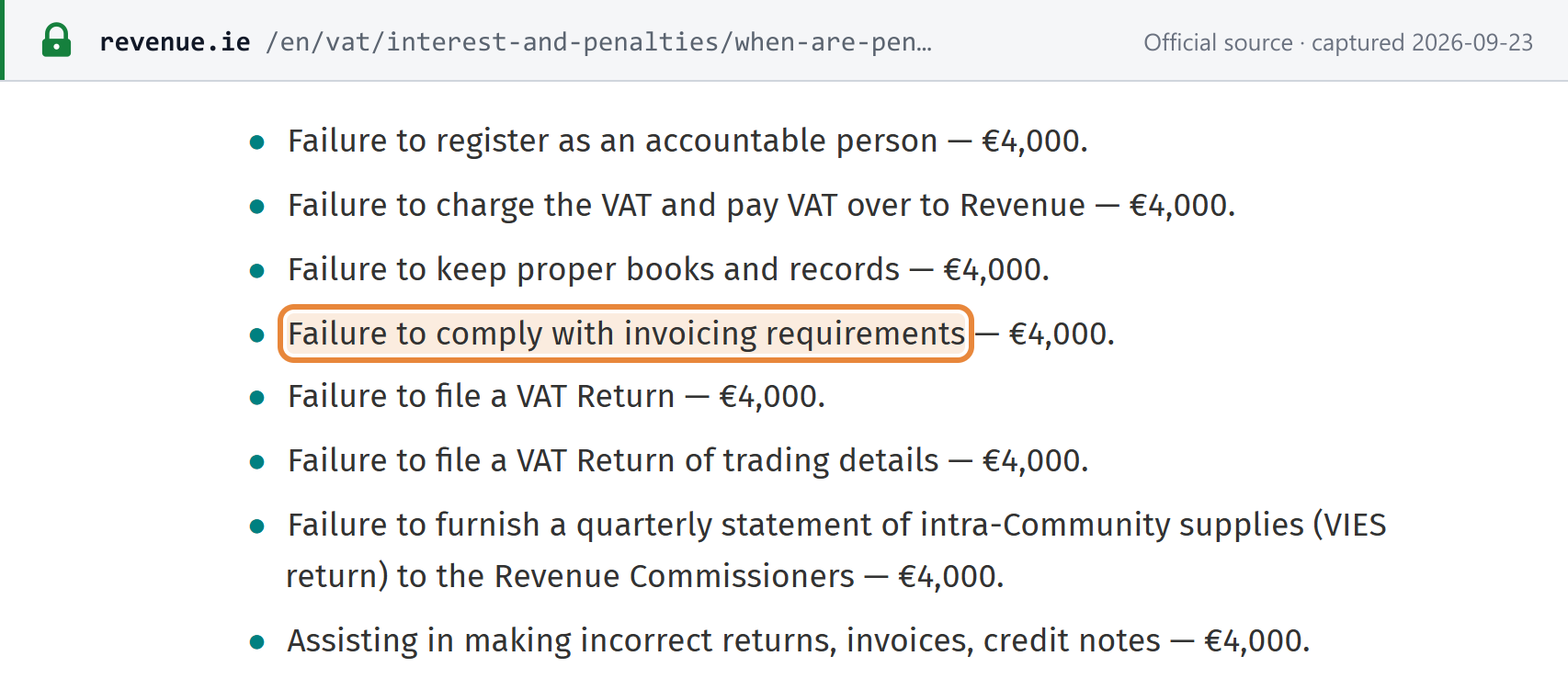
| Failure to register; failure to charge and pay over VAT; failure to keep proper records; failure to comply with invoicing requirements; failure to file a VAT return, an RTD or a VIES return; issuing a VAT invoice while not registered; obstructing an officer; OSS return and payment failures | €4,000 each (fixed) | VATCA 2010 s.115; Revenue [75] |
| Where a body of persons commits one of those failures | A separate €4,000 penalty on its secretary | Revenue [75] |
| Payment service providers failing to keep or make available payment records | €4,000, plus €4,000 for each further quarter of non-compliance | Finance Act 2025 s.76 (s.115(1C)(d)), from 1 January 2026; Revenue [80] [75] |
| Using an incorrect invoice, registration number, credit note, record or other document | €3,000 careless; €5,000 deliberate | Revenue [77] |
| Incorrect return or claim, or failure to file, through deliberate or careless behaviour | Tax-geared, based on the tax difference; a company secretary may face a separate €1,500, or €3,000 for deliberate behaviour | Revenue [76] |
| Importing goods without VAT, or using an invalid VAT number to buy goods from another Member State at 0% | €4,000, plus the VAT due | Revenue [78] |
| Issuing an invoice including VAT while not registered, including under a self-billing arrangement | Liable for the VAT shown; may face a €4,000 fixed penalty | Revenue [43] |
Interest on late payment. Revenue: "The rate of interest is 0.0274% per day, or part of a day." It runs daily from the due date until payment, and from the date of receipt on an over-claimed refund. For direct-debit payers, interest on a balance left at year end runs from the due date of the annual return if 80% or more was paid. If less than 80% was paid, "Revenue will backdate the interest to a date which is six months prior to the final date for filing your annual VAT Return." (Checked 2026-09-23.) [79]
Frequently asked questions
Which Irish VAT registration threshold applies to us — €85,000 or €42,500?
It depends on what you supply. The €85,000 goods threshold applies to a business that supplies goods, or goods and services where at least 90% of turnover comes from supplies of goods. The €42,500 services threshold applies to a business that supplies services only, to a mixed business that fails the 90% test, and to a business supplying goods it has made from zero-rated materials. Both thresholds are measured on turnover in the current calendar year or the previous calendar year, not over a rolling 12 months (VAT Consolidation Act 2010 s.6(1)(c) and (d), as substituted by S.I. No. 69 of 2025). Both figures have applied since 1 January 2025 (checked 23 September 2026). [3] [4]
We are not established in Ireland. Do the Irish registration thresholds apply to us?
No. Section 6(3)(b) of the VAT Consolidation Act 2010 disapplies both thresholds for a person not established in the State. Revenue states that a non-established person supplying taxable goods or services to taxable customers in Ireland must register irrespective of the level of turnover, unless it uses the EU VAT SME Scheme. If you sell services only to Irish VAT-registered businesses, those customers normally self-account under the reverse charge and you do not register. You must register from the first euro in the cases Revenue lists, which include supplying goods in Ireland, distance selling goods to private individuals, and services connected with Irish property. [3] [34]
Is our Irish VAT return due on the 19th or the 23rd?
The rule is the 19th day of the month after the end of the taxable period, for filing and payment together. Revenue extends the time limit to the 23rd for filers on the Revenue Online Service (ROS). Under s.78 of the VAT Consolidation Act 2010 the extension applies only if both the return and any payment due are made electronically within the extended period. If either is late, the extension falls away and the deadline is treated as the 19th, so interest runs from the 19th. Due dates do not move when they fall on a weekend. [54] [55]
What VAT rate applies to restaurant meals in Ireland — 13.5% or 9%?
9% since 1 July 2026. Finance Act 2025 s.71 applies the 9% second reduced rate to food and drink supplied as part of a restaurant, catering or hot takeaway service, and to hairdressing. Revenue says this includes hot teas, coffees and fruit juices, but excludes alcoholic drinks, bottled water, sports drinks, soft drinks and vegetable juices, which stay at 23%. Hotel and holiday accommodation was not moved and stays at 13.5%. From 1 September 2023 to 30 June 2026 the 13.5% rate applied. [20] [21] [17]
Our hotel charged 23% VAT for a conference room. Is that right?
Yes, from 1 January 2026. Finance Act 2025 s.72 moved the hire of rooms in hotels and guesthouses for use other than as accommodation to the standard rate. Revenue gives rooms hired for conferences, wedding fairs and trade events as examples. Holiday and guest accommodation, including a place in a caravan or camping site, stays at the 13.5% reduced rate. [21]
Is there an Irish e-invoicing mandate we must comply with now?
No. As of 23 September 2026 no Irish law requires businesses to issue e-invoices, and electronic invoicing still needs the agreement of both parties under s.66(2) of the VAT Consolidation Act 2010. Revenue has announced a programme. From 1 November 2028, VAT-registered large corporates managed by Revenue's Large Corporates Division would issue EN 16931 e-invoices for domestic B2B supplies and report data to Revenue, and all businesses in Ireland would have to be able to receive them. Revenue says it is still working on the legislative changes. The only obligation in force today is on public bodies, which must receive and process compliant e-invoices under S.I. No. 258 of 2019. [48] [49] [52]
Important websites
Checked live 2026-09-23.
| Site | Purpose |
|---|---|
| Revenue Online Service (ROS) | File the VAT3 and RTD, pay VAT, register for VAT OSS |
| Manage your tax registrations on ROS | Add or cancel a VAT registration; register for the EU VAT SME Scheme |
| How to register for VAT | Which form to use — TR1/TR2 online, TR1(FT)/TR2(FT) on paper for non-established businesses |
| myAccount | Revenue's portal for individuals; also a payment route |
| Ways to make an online payment | Debit instructions, direct debit and card payments |
| VAT rates database | Search the rate for a specific good or service |
| Current VAT rates | Revenue's table of the current rate percentages |
| EU VIES | Validate an IE VAT number for cross-border supplies (domestic-only registrations do not appear) |
| VAT Modernisation and ViDA | Revenue's e-invoicing programme, phase dates and scope |
| Phase One — large corporates | Who is in scope from 1 November 2028, and the EN 16931 requirement |
| Tax and Duty Manuals | Revenue's detailed guidance, including RTD and OSS deadlines |
| Revenue tax calendar | Published due dates for the VAT3 and RTD |
The rates database carries its own caveat: "Do not view it as a statement of law or as a substitute for consulting the legislation." [81]
Also see Lookuptax's own Ireland VAT number validator.
Recent changes
- 2026-09-25 — Guidance, not a change in law. Revenue eBrief No. 140/26 announces a new Tax and Duty Manual, "VAT Treatment of Waste Disposal Services": accepting waste material for disposal, including waste removal and treatment (bin or skip provision, household waste collection, dumping, shredding, incineration or burial, disposal of dead animals), is taxable at the reduced rate; treatment, storage or recycling of waste that remains the producer's property, and disposal of electronic records, are taxable at the standard rate; sales of waste or recycled products are taxed at the rate for the product; local authorities supplying these services are taxable persons. (Revenue eBrief; Revenue Tax and Duty Manual) — see event record
- 2026-07-20 — Revenue published its VAT Modernisation timeline and Phase One page: e-invoicing and real-time reporting for large corporates on domestic B2B from 1 November 2028, extending in November 2029 and July 2030. This is an announced programme, not yet law. (Revenue) — see event record
- 2026-07-01 — The 9% second reduced rate took effect for restaurant, catering and hot-takeaway food and drink and for hairdressing (Finance Act 2025 s.71, amending VATCA 2010 s.46(1)(cb)). Alcohol, bottled water, soft and sports drinks and vegetable juices stay at 23%. (Irish Statute Book) — see event record
- 2026-01-01 — The farmers' flat-rate addition fell from 5.1% to 4.5% (Finance Act 2025 s.73). (Irish Statute Book)
- 2026-01-01 — Hire of hotel and guesthouse rooms for use other than accommodation, such as conferences and trade events, moved to the 23% standard rate (Finance Act 2025 s.72). (Revenue)
- 2025-11-26 — The 9% rate on qualifying apartments widened from their supply to their supply and construction, running to 31 December 2030 (Finance Act 2025 s.70, VATCA 2010 s.46(1)(cac)). (Irish Statute Book)
- 2025-10-08 — The 9% rate on electricity and gas was extended from 31 October 2025 to 31 December 2030 (Finance Act 2025 s.69), and the supply of qualifying apartments moved to 9% (Finance Act 2025 s.70, s.46(1)(cab)). (Irish Statute Book) (Irish Statute Book — s.70)
- 2025-03-06 — S.I. No. 69 of 2025 moved the registration thresholds to a calendar-year test, restated the nil threshold for non-established businesses (s.6(3)(b)) and inserted the EU VAT SME Scheme provisions. (Law Reform Commission)
- 2025-01-01 — The registration thresholds rose to €85,000 for goods and €42,500 for services (Finance Act 2024 s.78). (Law Reform Commission)
Ahead — no Irish VAT rate change with a future start date is in law (checked 2026-09-23). The 9% rates on electricity and gas and on qualifying apartments are due to end on 31 December 2030. Revenue's e-invoicing dates are announced but not legislated; see E-invoicing status. For the full chronology, see Ireland tax changes on Lookuptax.
Reference links
Legislation
- Law Reform Commission — Value-Added Tax Consolidation Act 2010, revised text
- Irish Statute Book — Value-Added Tax Regulations 2010 (S.I. No. 639 of 2010)
- Irish Statute Book — VATCA 2010 Schedule 1, exempt activities (as enacted)
- Irish Statute Book — Finance Act 2025 (No. 18 of 2025)
- Irish Statute Book — European Union (Electronic Invoicing in Public Procurement) Regulations 2019 (S.I. No. 258 of 2019)
Revenue guidance
- Revenue — Current VAT rates
- Revenue — What are VAT rates?
- Revenue — VAT thresholds
- Revenue — How do you register for VAT?
- Revenue — Two-tier VAT registration
- Revenue — VAT registration for groups
- Revenue — Cancelling your VAT registration
- Revenue — EU VAT SME Scheme
- Revenue — Non-established traders supplying goods and services
- Revenue — General place of supply rules for services
- Revenue — Reverse charge (self-accounting)
- Revenue — Postponed accounting
- Revenue — Deemed supplier
- Revenue — Information required on a VAT invoice
- Revenue — Other types of VAT invoices
- Revenue — Self-billing
- Revenue — How long must records be kept?
- Revenue — When VAT becomes payable
- Revenue — Completing a VAT3 return
- Revenue — Who can reclaim VAT?
- Revenue — Exemption from VAT
- Revenue — Moneys received basis
- Revenue — Fixed penalties
- Revenue — When is interest applied?
- Revenue — VAT Modernisation timeline
- Revenue — VAT Modernisation Phase One, large corporates
Revenue documents
- Revenue — VAT Modernisation: Implementation of eInvoicing in Ireland, 8 October 2025 (PDF)
- Revenue — Finance Act 2025 VAT Notes for Guidance, 24 December 2025 (PDF)
- Revenue — Notes for Guidance, Taxes Consolidation Act 1997 Part 47, Finance Act 2025 edition (PDF)
- Revenue — Tax and Duty Manual, Return of Trading Details (PDF)
- Revenue — Tax and Duty Manual, Union scheme One Stop Shop (PDF)
- Revenue — Intrastat Traders Manual (PDF)
- Office of Government Procurement — Irish Peppol Authority
Lookuptax
- Lookuptax — Ireland e-invoicing guide
- Lookuptax — Ireland Tax ID guide
- Lookuptax — How to verify an EU VAT number on VIES
- Lookuptax — Ireland VAT number validator
- Lookuptax — Ireland tax changes
- Lookuptax — Peppol e-invoicing guide
- Lookuptax — E-invoicing status and the networks worldwide
- Lookuptax — VAT registration thresholds worldwide
- Lookuptax — Worldwide tax rates