Spain VAT guidelines
| FACTSHEET | |
|---|---|
| Country code | ES |
| Tax name | Impuesto sobre el Valor Añadido(IVA) aka VAT |
| Tax Authority | Agencia Estatal de Administración Trubutaria (AEAT) |
Overview
In Spain, sales taxes are known as value-added tax (VAT) and are levied on most goods and services sold in the country. VAT is a consumption tax, which means that it is paid by the end consumer and is generally included in the price of the goods or services. The current VAT rates in Spain are as follows:
- General rate: 21%
- Reduced rate: 10%
- Super reduced rate: 4%
Conditional 10% rate on energy, November and December 2026. Real Decreto-ley 25/2026 of 29 September 2026 (BOE no. 241, 30 September 2026, BOE-A-2026-20265; in force 1 October 2026) provides a 10% VAT rate for November and December 2026 only if a CPI test is met. If the September 2026 CPI for subclass 04.5.1.0 Electricity is more than 15% above September 2025 (per INE's October release), 10% applies in November 2026 to supplies, imports and intra-EU acquisitions of electricity for holders of contracts with contracted power up to 10 kW and for severely vulnerable bono social recipients. The same test on subclass 04.5.2.1 Natural gas triggers 10% for natural gas, biomass briquettes and pellets, and firewood. Article 19 repeats the mechanism for December 2026, based on October 2026 CPI. Until a trigger is met the rates above apply, and the decree-law still needs validation (convalidación) by the Congreso de los Diputados. INE publishes the September CPI subclass data in October; as of 5 October 2026 neither that release nor a Congress validation had been published. (Boletín Oficial del Estado)
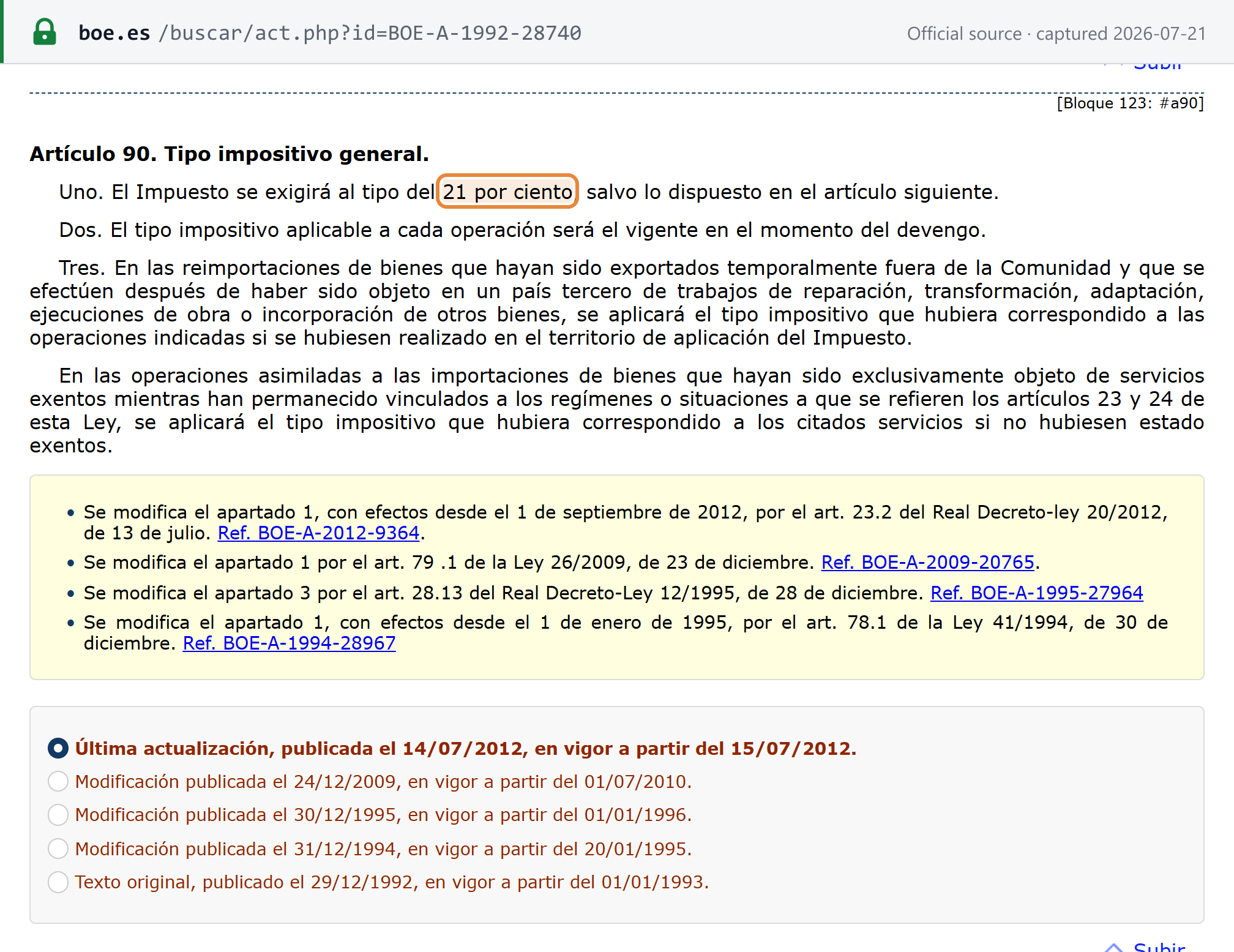 Source snapshot captured 2026-07-21 — original
The general rate applies to most goods and services, including clothing and electronics. The reduced rate applies to certain goods and services, such as passenger transport, hospitality and most foodstuffs (Ley 37/1992, Art. 91.Uno). The super reduced rate applies to a limited range of goods and services, including books, newspapers and magazines, basic food products such as bread, milk, eggs, fruit and vegetables, and certain medicines (Art. 91.Dos). [6] Businesses registered for VAT in Spain are required to charge VAT on the goods and services they sell and to collect the tax on behalf of the government. They are also required to file VAT returns on a regular basis and to pay the VAT they have collected to the tax authorities. One of the key features of the Spanish VAT system is the concept of intra-Community supplies, which refers to the supply of goods and services between businesses in different EU member states. Intra-Community supplies are generally exempt from VAT in the country of supply, but the business making the supply is required to pay VAT in its own country. This is intended to prevent double taxation and to promote trade within the EU. Another important aspect of the Spanish VAT system is the option for small businesses to use the simplified VAT scheme (régimen simplificado, or módulos). It applies only to specified activities and is subject to income limits: a business is excluded once its annual income from business activities exceeds €250,000 (the statutory €150,000 limit has been raised to €250,000 for the years 2016 to 2026). Instead of accounting for VAT on individual transactions, participants pay amounts calculated from activity-specific modules. [7]
Invoice requirements
Spain's invoicing obligations sit in the Reglamento de facturación, approved by Real Decreto 1619/2012 of 30 November 2012, which implements article 29.2.e) of Ley 58/2003 (General Tributaria) and article 164 of the Ley del IVA. Real Decreto 238/2026 amends this same Reglamento as it builds the mandatory B2B e-invoicing system — so the content rules below are the foundation the e-invoicing mandate is layered on top of, not a separate regime. [1] [2]
Factura completa — mandatory content
Every invoice and its copies must carry: [1]
| Required particular | Notes |
|---|---|
| Número y, en su caso, serie | Numbering within each series must be correlative. Separate series are compulsory for invoices issued by the recipient or by third parties (a distinct series per issuer) and for facturas rectificativas |
| Fecha de expedición, and the fecha de operación where different | Two distinct dates |
| Full name / razón social and address of both issuer and recipient | — |
| NIF / VAT identification number of both parties | — |
| Description of the goods delivered or services rendered, including unit prices and any discounts | — |
| Tipo impositivo (VAT rate) applied, and the cuota tributaria shown separately | The tax must be stated as its own figure |
| Specific mentions where applicable | Operación exenta, inversión del sujeto pasivo (reverse charge), facturación por el destinatario, régimen especial de agencias de viajes, régimen especial de bienes usados |
Veri*factu deadlines for invoicing software
Real Decreto-ley 15/2025 of 2 December 2025 extended the deadline for adapting invoicing software systems (Sistemas Informáticos de Facturación, the Veri*factu regime under Real Decreto 1007/2023) to 1 January 2027 for taxpayers filing Corporate Income Tax (Article 3.1.a) and to 1 July 2027 for all other obliged taxpayers. The AEAT states that the period before those dates is a testing period during which test records need not be sent and other invoicing systems may be used. (Boletín Oficial del Estado; Agencia Tributaria)
What a compliant invoice looks like
The AEAT publishes a rendered factura imprimible con QR produced by its own free VERI*FACTU application: the tax QR block and VERI*FACTU mark top-left, an EMISOR block (NIF, name, address), the Factura Ordinaria header with fecha de operación, fecha de emisión and Nº Serie-Factura, a DESTINATARIO block, the regime statement, a line-item table (descripción, tipo, uds., precio unitario, importe bruto con descuentos), then IMPUESTOS (base imponible, tipo impositivo, cuota repercutida) and IMPORTES (down to total a pagar), and a payment block. [4]
Unusually, Spain does prescribe part of the layout. The QR must sit at the head of the invoice, before the content generated by the invoicing software, and must be clearly separated and prominent; it must measure between 30x30 and 40x40 mm; and it must be preceded, immediately above it, by the text «QR tributario:». [5]
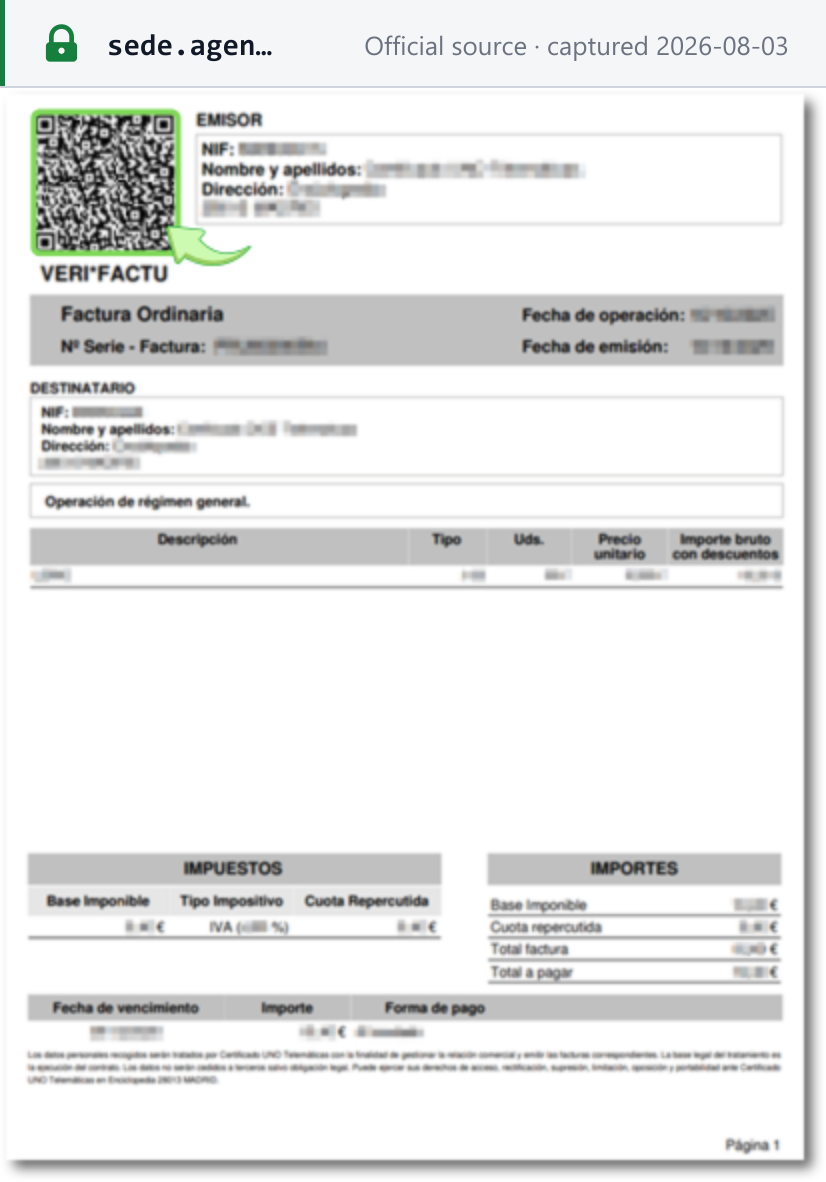 Source snapshot captured 2026-08-03 — original. AEAT pixelates the field values in its own screenshot; the field labels and structure are what this shot evidences.
Factura simplificada — reduced content
A simplified invoice may be issued where the amount does not exceed €400, VAT included — or up to €3,000, VAT included, for the categories that were traditionally allowed to issue tiques in place of invoices (retail sales to consumers, restaurants and bars, hairdressing, vehicle parking and similar). Rectifying invoices may also take simplified form. [3]
It must contain: número y, en su caso, serie; fecha de expedición; fecha de operación if different; NIF and name of the issuer only; identification of the goods or services; tipo impositivo, optionally with the words "IVA incluido"; contraprestación total; on rectifying invoices, the reference to the invoice being corrected; and a mention of any of the special circumstances listed above. [1]
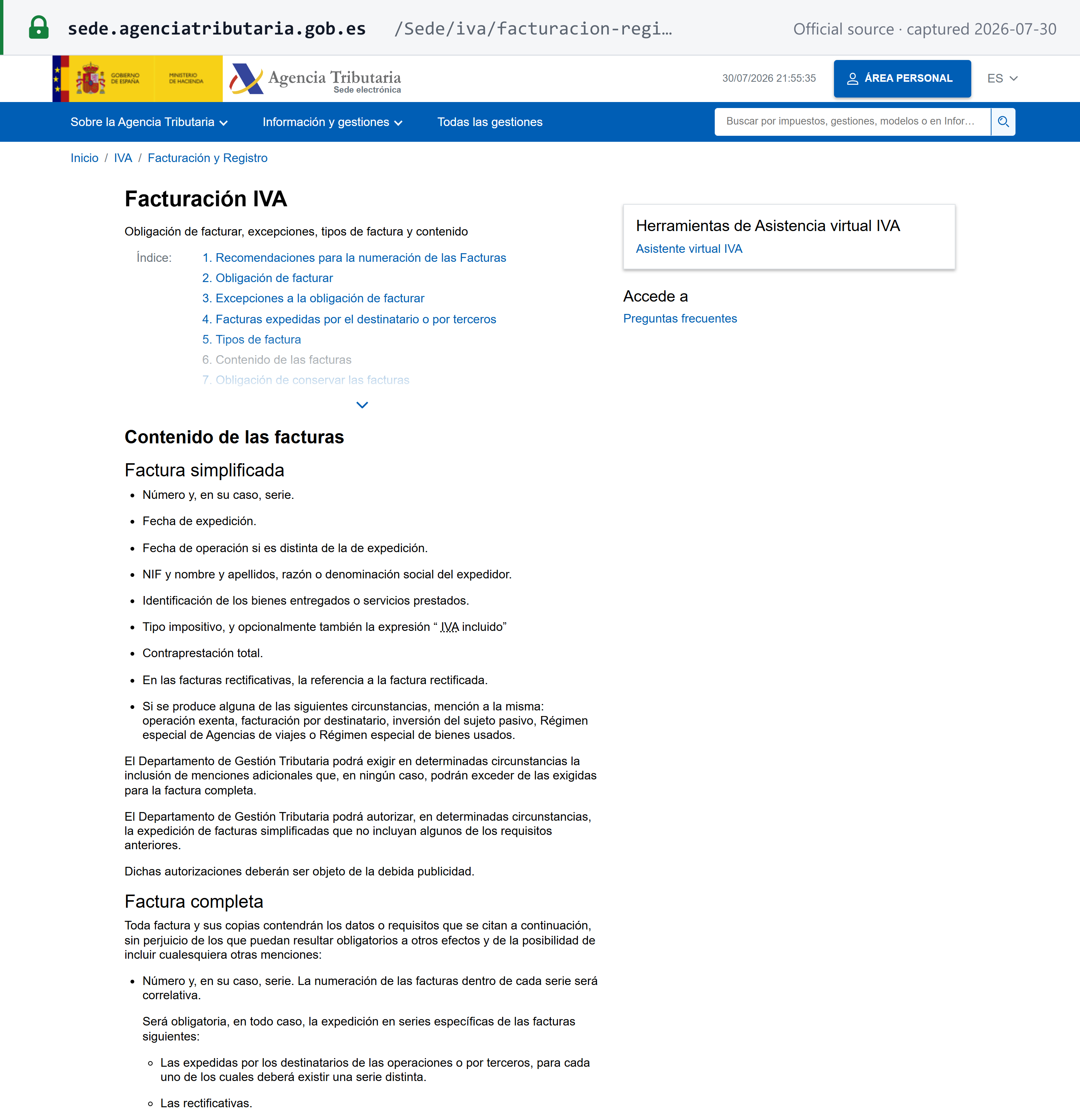 Source snapshot captured 2026-07-30 — original
The Departamento de Gestión Tributaria may require additional mentions on simplified invoices in particular circumstances — though never more than a factura completa demands — and may conversely authorise simplified invoices that omit some of the above. Such authorisations must be publicly published. [1]
The defining gap is the recipient's NIF and address: a factura simplificada identifies only the issuer. A business customer that needs to deduct input IVA must ask for a factura completa, or for the simplified invoice to be extended with the recipient's identifying data. Under the €400 threshold the choice is the supplier's — so B2B buyers should ask at the point of sale, not afterwards.
Recent changes
Dated, officially-sourced changes to Spanish VAT, newest first. The full history is in our worldwide tax-updates feed.
- 2026-10-01 — Real Decreto-ley 25/2026 (in force 1 October 2026) provides a conditional 10% VAT rate for November and December 2026 on electricity (contracted power up to 10 kW and severely vulnerable bono social recipients) and on natural gas, biomass briquettes and pellets, and firewood, if the CPI trigger tests are met; it still needs validation by the Congreso de los Diputados. (Boletín Oficial del Estado) — see event record
- 2026-07-01 — The temporary reduced 10% VAT rate on motor fuels (petrol/diesel), set by Real Decreto-ley 7/2026, expired; motor fuel VAT reverted to the standard 21% rate. A separate, phased Impuesto sobre Hidrocarburos (Hydrocarbon Tax, an excise duty distinct from VAT) discount — €0.15/litre in July 2026, €0.10/litre in August 2026, €0.05/litre in September 2026, with CPI-linked escalation clauses — was introduced by Real Decreto-ley 18/2026 to cushion the reversion at the pump. (Boletín Oficial del Estado) — see issue
 Source snapshot captured 2026-07-21 — original
Ahead — scheduled changes that have not yet taken effect:
- 2027-01-01 (scheduled) — Deadline to adapt invoicing software systems (Veri*factu regime) for taxpayers filing Corporate Income Tax; 2027-07-01 for all other obliged taxpayers (Real Decreto-ley 15/2025). (Agencia Tributaria) — see event record
Frequently Asked Questions
Does Spain have a VAT registration threshold — do small businesses need to register immediately?
Spain has no VAT registration threshold for resident businesses. Any Spanish-established business or autónomo (self-employed) making taxable supplies must register for IVA with AEAT from the moment they begin economic activity — regardless of turnover. A simplified "módulos" regime exists for certain small traders, but it is a filing simplification, not an IVA exemption. [1]
What is the SII and which businesses must use it?
SII (Suministro Inmediato de Información) is Spain's near-real-time VAT reporting system (introduced 2017). Businesses must submit invoice details to AEAT within 4 calendar days of issue/receipt. Mandatory for: (1) large businesses (turnover > €6 million); (2) VAT groups; (3) companies in the monthly refund regime (REDEME). Businesses under SII are exempt from traditional VAT summary forms (Modelo 340). Voluntary opt-in is available. [1]
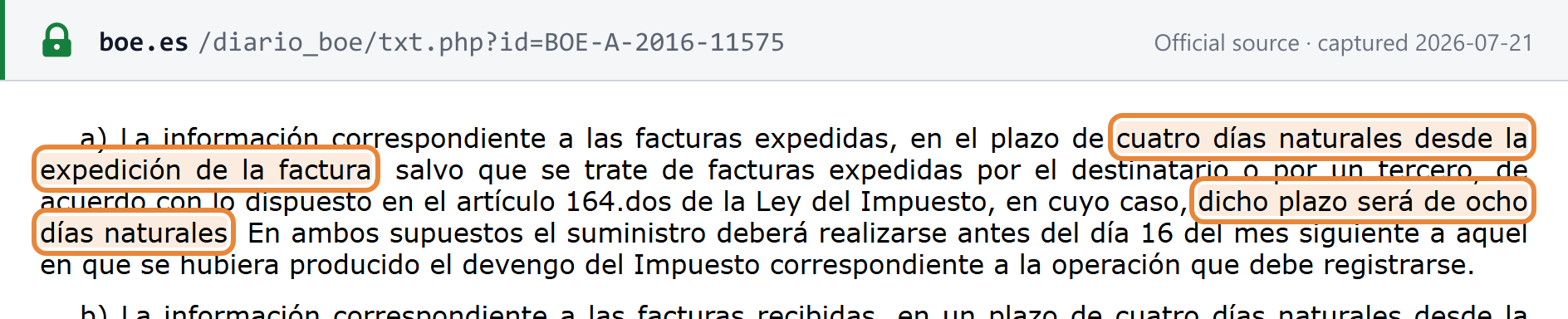 Source snapshot captured 2026-07-21 — original
What is the Recargo de Equivalencia and who is affected?
Recargo de equivalencia is a simplified IVA scheme for Spanish retailers selling goods to end consumers without transformation. Retailers don't submit IVA returns — their suppliers charge an additional surcharge on top of standard IVA: 5.2% additional on 21% IVA; 1.4% on 10% IVA; 0.5% on 4% IVA. Retailers under this regime cannot deduct input IVA. Suppliers must identify whether the buyer is subject to this regime to apply correct rates. [1]
My Spanish customer can't provide their NIF — can I still zero-rate an intra-EU supply?
No. For an intra-EU supply (entrega intracomunitaria) to be zero-rated, the buyer's VAT number must appear on the invoice and must be verifiable on VIES. If a Spanish buyer cannot provide their NIF-IVA (format: ES + NIF/CIF), you must charge standard IVA at the applicable rate — you cannot retrospectively apply zero-rating once the supply is made. Always verify via VIES. [1]
Does IVA or AJD (stamp duty) apply to Spanish real estate transactions?
In Spain, property transactions are subject to either IVA or ITP/AJD (transfer tax/stamp duty) — not both (with limited exceptions). IVA applies to: first transfer of new buildings (10% residential, 21% commercial) and first transfer of urban land. AJD is charged simultaneously when IVA applies (0.5%–2% depending on region). ITP applies to: second+ transfers between private persons (not subject to IVA). [1]
To verify a Spanish VAT number, see our EU VAT verification guide.