Botswana VAT guidelines
| FACTSHEET | |
|---|---|
| Country code | BW |
| Tax name | Value Added Tax (VAT) |
| Tax Authority | Botswana Unified Revenue Service (BURS) |
Overview
Botswana levies Value Added Tax on the supply of goods and services consumed within the country, and on imports. VAT was introduced with effect from 1 July 2002 and is administered by the Botswana Unified Revenue Service (BURS). [1]
The standard VAT rate is 14%. [2] A Value Added Tax (VAT) Act, 2026 commenced on 1 July 2026; BURS has so far confirmed this in connection with a revised zero-rated foodstuffs list (public notice of 9 July 2026), and this guide will be updated as further official detail on the new Act becomes available. [2]
Two other significant reforms are in play: the VAT (Amendment) Act, 2025 (Act No. 16 of 2025) (published in the Government Extraordinary Gazette on 31 October 2025) extended VAT to remote (digital) services supplied by non-residents, with BURS implementation from 1 June 2026; the same Act had set private medical services to become taxable from 1 August 2026. That medical-services change did not take effect as scheduled: a BURS public notice dated 30 July 2026 — two days before commencement — suspended the charging of VAT on medical services pending stakeholder and public consultation, with no end date given. The notice suspends charging only; it says nothing about the Act's other limbs (prescription-drug zero-rating, the input-VAT claim period, reverse charging), which remain unaffected, and no statutory instrument giving the suspension itself legal effect has been published. See Recent changes below. (Advisory commentary also credits the 2025 Act with a mandatory "Electronic Fiscal Device (EFD)" regime; that term appears in none of the 2026 VAT and tax-administration instruments, where the statutory obligation is to invoice through an approved electronic billing system [6] — see E-invoicing status.) [3] [8]
Tax-ID / VAT registration
- Businesses first register for Income Tax with BURS (form BURS 1), which issues a Taxpayer Identification Number (TIN); the Income Tax TIN is then used to apply for a separate VAT registration. [1]
- VAT registration is a distinct application from Income Tax registration, and the Commissioner General issues a VAT registration number on approval. [1] [2]
- Registration and returns are administered through BURS's e-services; the eTax platform is used for electronic filing and payment. [1]
Registration thresholds
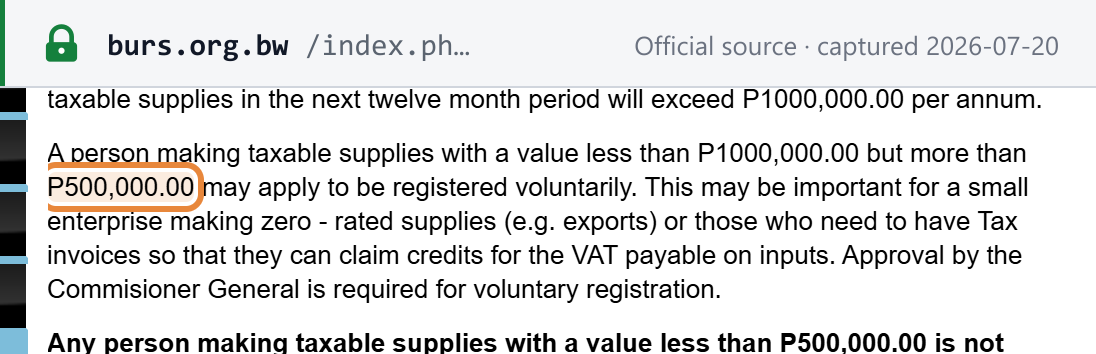
- Mandatory registration applies to any person making taxable supplies with a value of more than BWP 1,000,000 per annum. [1]
 Source snapshot captured 2026-07-20 — original
- Voluntary registration is available to a person making taxable supplies of more than BWP 500,000 but less than BWP 1,000,000 per annum, subject to the Commissioner General's approval. [1]
- A person making taxable supplies of less than BWP 500,000 per annum is not required to register. [1]
- For non-resident suppliers of remote (digital) services, see the dedicated section below — the Amendment Act's remote-services regime uses its own registration trigger and timeline rather than the general thresholds above. [2]
Rates
| Rate | Applies to |
|---|---|
| 14% (standard) | Most taxable supplies of goods and services [1] |
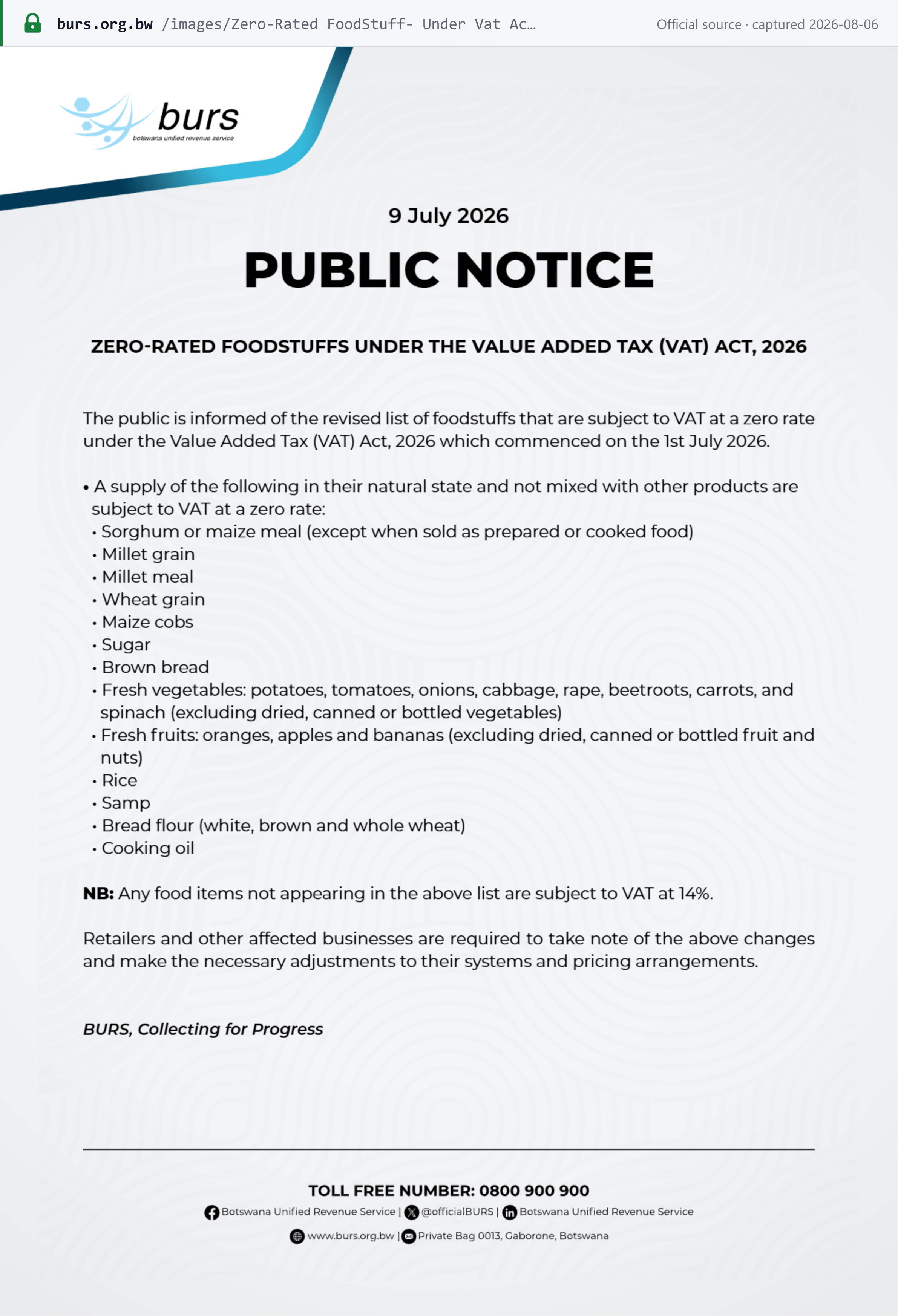
| 0% (zero-rated) | Exports; and, under the Act, 2026 revised list (from 1 July 2026): sorghum/maize meal, millet grain and meal, wheat grain, maize cobs, sugar, brown bread, specified fresh vegetables (potatoes, tomatoes, onions, cabbage, rape, beetroots, carrots, spinach) and fresh fruits (oranges, apples, bananas), rice, samp, bread flour, and cooking oil, all in their natural state and not mixed with other products. [1] |
| Exempt | Supplies not counted as part of a person's taxable turnover and not subject to VAT (no input VAT recovery). Private medical services were due to become taxable from 1 August 2026 under the VAT (Amendment) Act, 2025 (Act No. 16 of 2025), but a BURS public notice of 30 July 2026 suspended the charging of VAT on medical services two days before that commencement, pending stakeholder consultation and with no end date given — so medical services are, in practice, still untaxed. The suspension does not touch prescription-drug zero-rating, the input-VAT claim period, or reverse charging under the same Act. No statutory instrument giving the suspension legal effect has been published. [8] |
NB: any food item not on the revised zero-rated list is taxed at the standard 14% rate. [1]
 Source snapshot captured 2026-07-20 — original
VAT on non-resident remote/digital services
The VAT (Amendment) Act, 2025 widened Botswana's VAT base to include remote services supplied by non-residents. The operating rules, however, are no longer the ones most commentary still describes.
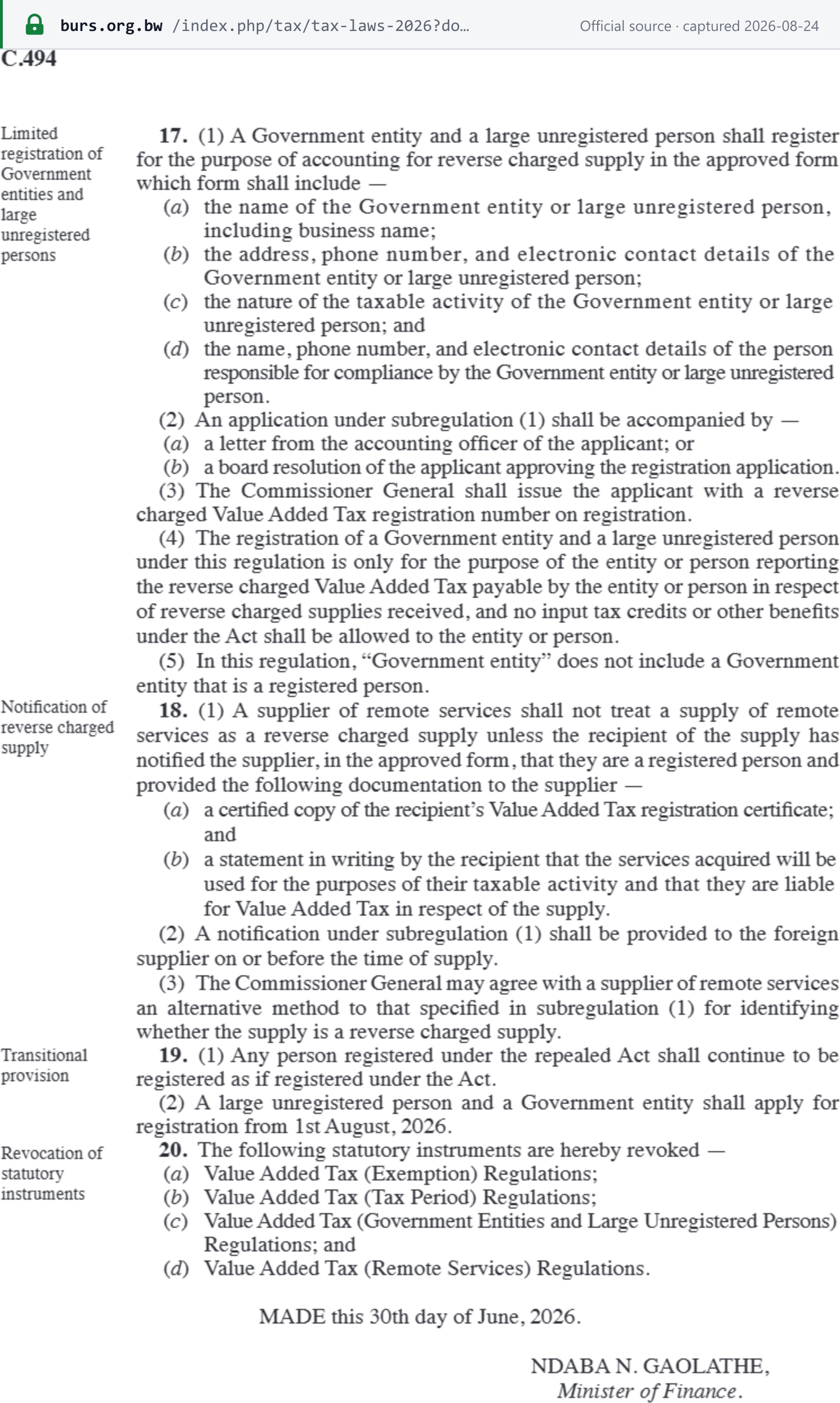
Regulation 20 of the Value Added Tax Regulations, 2026 (Statutory Instrument No. 94 of 2026), made and published 30 June 2026 and in operation 1 July 2026, revoked four earlier instruments — including both of the ones this section used to rely on: [6]
- The following statutory instruments are hereby revoked — (a) Value Added Tax (Exemption) Regulations; (b) Value Added Tax (Tax Period) Regulations; (c) Value Added Tax (Government Entities and Large Unregistered Persons) Regulations; and (d) Value Added Tax (Remote Services) Regulations.
 Source snapshot captured 2026-08-24 — original
Anything sourced to S.I. No. 74 of 2026 (Remote Services) or S.I. No. 73 of 2026 (Government Entities and Large Unregistered Persons) has not been law since 1 July 2026. The rules below come from SI 94 and from the Act itself.
Who must register
A supplier of remote services required to apply for registration under section 13 of the Act applies through an online lodgement of the approved form (SI 94 reg. 15(1)). A supplier is not required to register if it solely and exclusively makes supplies that are reverse charged (reg. 15(2)). Registration takes effect from the beginning of the second tax period following eligibility — that rule now sits in the Act at section 15(5)(a), not in a regulation. [6]
The application must give the supplier's name and trading name; address, phone and electronic contact details; the name, phone and electronic contact details of the individual responsible for Botswana VAT compliance; the website or URL through which the taxable activity is carried on; and — new in SI 94 — the national tax identification number issued to the supplier in its country of tax residence (reg. 15(3)). Certified copies of the certificate of incorporation or registration and the home-country tax certificate must accompany it, translated into English where applicable (reg. 15(4)–(5)). [6]
What a remote-services supplier must issue
Regulation 16 requires an invoice or receipt — note that, unlike the revoked reg. 10 of SI 74, it is not described as electronic — showing: [6]
- an invoice number and the date of issue;
- the name, address and Taxpayer Identification Number of the supplier;
- the name and address of the recipient;
- a description of the remote services supplied;
- the value of the supply, the VAT charged, and the total inclusive of VAT; and
- the Taxpayer Identification Number for registered persons receiving the supply — a TIN, not a VAT registration number.
Government entities and large unregistered persons
Regulation 17 provides a limited registration so these bodies can account for reverse-charged supplies. The registration is for that purpose only: regulation 17(4) states that no input tax credits or other benefits under the Act are allowed to an entity registered this way, and regulation 17(5) excludes a Government entity that is already a registered person. The application needs the entity's name and business name, contact details, the nature of its taxable activity and its compliance contact, accompanied by a letter from its accounting officer or a board resolution. The Commissioner General issues a reverse charged VAT registration number. [6]
Under the transitional provision, regulation 19(2), a large unregistered person and a Government entity "shall apply for registration from 1st August, 2026". [6]
Reverse-charge notification
A supplier of remote services may not treat a supply as reverse charged unless the recipient has notified it, in the approved form, that it is a registered person — supplying a certified copy of the recipient's VAT registration certificate and a written statement that the services will be used for the purposes of its taxable activity (reg. 18(1)). [6]
Reporting reverse-charged supplies (BURS Guidance Note, September 2026)
BURS's Guidance Note on reporting VAT on reverse-charged supplies applies to VAT-registered persons, Government entities and large unregistered persons (annual supplies above P 1,000,000 who are not ordinarily registered), including remote services bought from suppliers outside Botswana. [7]
- Recipient-created tax invoice: the registered recipient must prepare a recipient-created tax invoice (section 59(4) of the VAT Act, 2026); see Recipient-created tax invoices.
- Written notice to the supplier: the recipient must notify a non-resident remote-services supplier in writing of its registration (section 64).
- Reporting months: Category A and C registrants report from August 2026, with payment due by 28 October 2026; Category B registrants report from September 2026, with payment due by 28 November 2026. Government entities and large unregistered persons take their start date from their registration approval letter, not from these categories.
- Earlier supplies: supplies received before those months are reported on Form VAT.017.1.
The following appeared in SI 74 and have no counterpart in SI 94. Do not rely on them: the four-month-after-registration grace before charging VAT; the 25th-day-of-the-month return and remittance date; the appointment of a representative; the inbound-tourism carve-out; the five-year record-retention period; and the 75% / 20% / BWP 10,000 / BWP 5,000 penalty scale.
The inbound-tourism point in particular was never really a regulation-level carve-out. It is a commencement exception: S.I. No. 95 of 2026 is a part commencement order, and its paragraph 3 excepts section 26(2)(d), Schedule 1 Part II paragraph 2(e) as applied to facilitation of inbound tour operations, section 32(4) for inbound-tourism suppliers, and section 27 for gig and share-economy platform operators — the last commencing only on a later Gazette notice.
Invoice requirements
Botswana's VAT runs on an invoice basis: output tax is declared and payable on the basis of invoices issued, not payments received, and liability arises when the invoice is issued or payment is received, whichever is earlier. The invoice therefore drives the tax point, not just the paperwork. [5]
Section 59(1) of the VAT Act, 2026 requires a registered person making a taxable supply to provide the recipient with the original tax invoice at the time of the supply — not only where the customer is registered. The single general exception is section 59(2): no tax invoice is required where the total consideration is in cash and does not exceed the Schedule 5 paragraph 7 amount of P20. Without a compliant invoice the recipient cannot deduct the input tax credit. [6]
Schedule 4 paragraph 2 then relaxes the content — not the obligation — for a supply to a non-registered person: such an invoice may omit the whole of paragraph 1(c), that is the recipient's name, address and VAT registration number, not merely the number.
Mandatory content
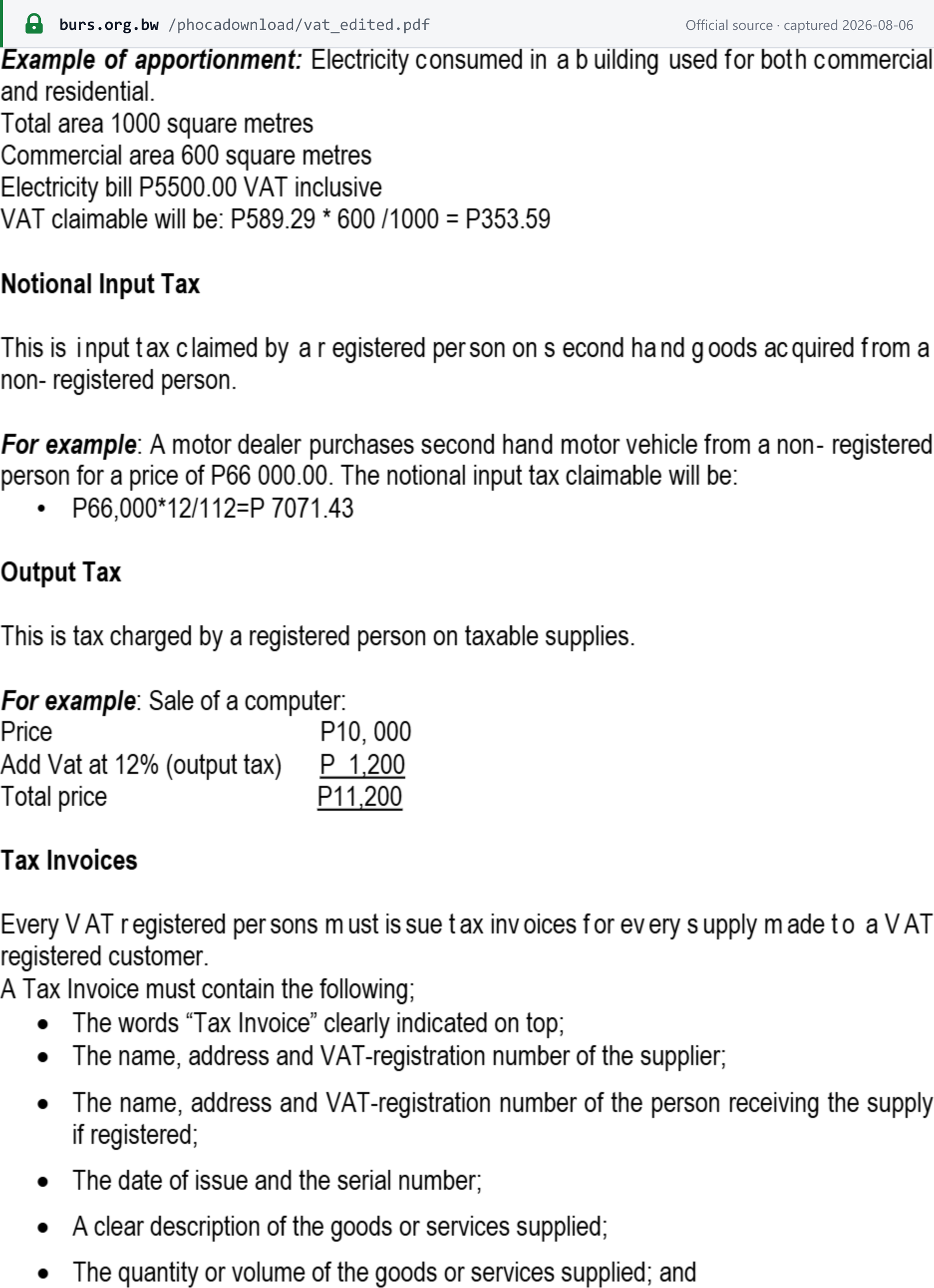
The particulars below come from BURS's long-standing VAT guidance, which predates the current Act. Schedule 4 of the Value Added Tax Act, 2026 (in force 1 July 2026) now prescribes the list, and one requirement is worded differently from the old guidance: the invoice must carry the words "original tax invoice" in a prominent place, not simply "Tax Invoice" on top. Section 59(7) gives the Schedule its operative force and section 60(3) applies the same particulars to credit and debit notes. [6]
Except as the Commissioner General may otherwise allow, a tax invoice required to be provided by a registered person under section 59, shall contain the following particulars — (a) the words 'original tax invoice' in a prominent place; (b) the name, address, and VAT registration number of the registered person making the supply; (c) the name, address, and VAT registration number of the registered person receiving the supply; (d) the individualised serial number and the date on which the tax invoice is issued; (e) a description of the goods or services supplied; (f) the quantity or volume of the goods or services supplied; and (g) the total amount of the VAT charged, the consideration for the supply, and the consideration including VAT.
If your templates still print "Tax Invoice" alone, that is the field to change. See the event record for Botswana's Schedule 4 invoice particulars.
| Required particular | Notes |
|---|---|
| The words "original tax invoice" | Schedule 4(a): must appear in a prominent place. Older BURS guidance says "Tax Invoice" on top — the Act's wording governs |
| Name, address and VAT registration number of the supplier | — |
| Name, address and VAT registration number of the person receiving the supply | The recipient's VAT number is required only if registered |
| Date of issue and the serial number | — |
| Clear description of the goods or services supplied | — |
| Quantity or volume supplied | — |
| The consideration for the supply, the VAT due, and the consideration including the VAT due | All three figures |
BURS accepts a VAT-inclusive total instead, but only where the invoice clearly states that the price shown is inclusive of VAT. Beyond these mandatory details, the style and layout of the invoice are for the registered person to determine. [5]
 Source snapshot captured 2026-07-30 — original
The VAT Description guidance above illustrates the VAT-inclusive note with "Vat at 12%". That figure is out of date — Botswana's standard rate is 14%, as confirmed by the BURS zero-rated foodstuffs notice issued under the VAT Act of 2026 and cited in Rates above. Use 14% on invoices; the field list itself is unaffected. [1]
There is no prescribed layout
BURS publishes no specimen invoice, and says plainly that it does not need to. Its VAT guide states, immediately after the list of required particulars: [2]
"The style and the layout of the invoice is to be determined by the registered person but they must include the details specified above."
No general invoice form is gazetted, so an ordinary tax invoice is compliant on its content, in any design the vendor chooses. Two qualifications now apply, though. The VAT Regulations, 2026 do prescribe content for one class of supplier — regulation 16 sets the particulars of the invoice or receipt a registered remote-services supplier must issue. And Botswana now does have a system specification regime: the Tax Administration Act, 2026 defines the electronic billing system as one "approved by the Revenue Service" (s.2), empowers regulations on its use (s.127(1)(d)), and penalises misuse (ss.100 and 112). [6] [7]
Note that the BURS guide quoted above is out of date on rates — it still shows VAT at 12%. Rely on it for the layout-freedom rule, not for the rate; the current rate is in Rates above.
What a compliant invoice looks like
Because BURS publishes no specimen, the sheet below is one we built from the particulars listed above, to show where each one lands on a page. It is an illustration of the content rule, not a template you must follow — any design carrying the same particulars is equally compliant.
Original tax invoice
| Description | Quantity | Consideration (excl. VAT) |
|---|---|---|
| Borehole pump servicing | 3 units | BWP 18,000.00 |
- Consideration for the supply
- BWP 18,000.00
- VAT at 14%
- BWP 2,520.00
- Consideration including VAT
- BWP 20,520.00
- Schedule 4(a) of the VAT Act, 2026 requires the words "original tax invoice" in a prominent place — which is why they head the sheet. Older BURS guidance said "Tax Invoice" on top; the Act governs.
- All three money figures are shown, because BURS requires the consideration, the VAT due and the VAT-inclusive consideration. A VAT-inclusive total alone is accepted only where the invoice states plainly that the price shown includes VAT.
- The recipient's VAT registration number appears only where the recipient is registered.
Recipient-created tax invoices are a different list
Schedule 4 presents more than one particulars list, and the guide's table above is only paragraph 1. Paragraph 3 sets a separate list for a recipient-created tax invoice issued under section 59(4) or (5): the words "recipient-created tax invoice" in a prominent place; the name, address and TIN — not the VAT registration number — of the recipient; the individualised serial number and date of issue; the description of the goods or services and the date the supply was made; and the consideration and the amount of VAT charged. A template built from paragraph 1 will not satisfy paragraph 3. [6]
Paragraph 4 in turn requires a tax credit note to carry the words "original tax credit note" in a prominent place.
Tax debit and credit notes
Tax debit and credit notes must be issued, clearly designated as such, and carry much the same detail as a tax invoice, whenever a supplementary charge is made or a reduction in the amount charged or due is agreed between seller and buyer. [5]
Language, location and retention
Section 14(1) of the Tax Administration Act, 2026 governs, and it is stricter than the pre-2026 BURS guidance most summaries still quote. Records must be maintained in English or Setswana, in Botswana, in Pula unless a tax law permits a foreign currency, in a manner that lets the taxpayer's liability be readily ascertained, and retained for eight years after the end of the tax period to which they relate. [7]
Section 14(2) extends that where, at the end of the eight years, the records relate to an assessment still inside the section 22 amendment period, to an assessed loss not yet fully offset, or to a tax audit or Tribunal or Court proceeding that began before the eight years ran out — in which case they are kept until that ends. Section 14(3) caps the extension. The commonly cited "7 years" comes from the pre-2026 BURS VAT guide and is out of date.
Filing and payment
Tax periods are set by section 54 of the VAT Act, 2026, which puts every registered person into one of three categories: [6]
| Category | Tax period | Ends on |
|---|---|---|
| Category A | Two months | Last day of January, March, May, July, September, November |
| Category B | Two months | Last day of February, April, June, August, October, December |
| Category C | One month | Last day of each calendar month |
The Commissioner General allocates registered persons between Categories A and B so that roughly equal numbers fall into each, and may move a person between them by written notice, effective from the date the notice specifies (s.54(2)). Category C is the monthly category, and it applies where the total value of taxable supplies exceeds the Schedule 5 paragraph 5 amount of P12,000,000 (s.54(3)). [6]
Section 55 sets the VAT payable by a registered person for a tax period. Interest on late refunds runs at 1 per cent per month or part thereof, compounded monthly (Schedule 5 paragraph 6, for section 58(1) and (2)). [6]
Not covered here: the return-lodgement and payment due dates for ordinary domestic registrants are set administratively rather than in the sections read for this guide. The 25th-of-the-month date widely quoted for remote-services suppliers came from the now-revoked SI 74 and should not be applied generally. (Checked 2026-08-24.)
E-invoicing status
A universal electronic-issuance mandate is enacted, but it is not yet operative. Section 59(8) of the Value Added Tax Act, 2026 (Act No. 15 of 2026) — which commenced 1 July 2026 and repealed and replaced Cap. 50:03 — requires tax invoices to be issued electronically through the electronic billing system: [6]
Subject to section 15 of the Tax Administration Act, a registered person shall issue tax invoices electronically under the electronic billing system.
Section 60(4) extends the same obligation to tax credit notes and tax debit notes. Note what the provision does not say: there is no taxpayer segment and no turnover band. The duty is on registered persons generally.
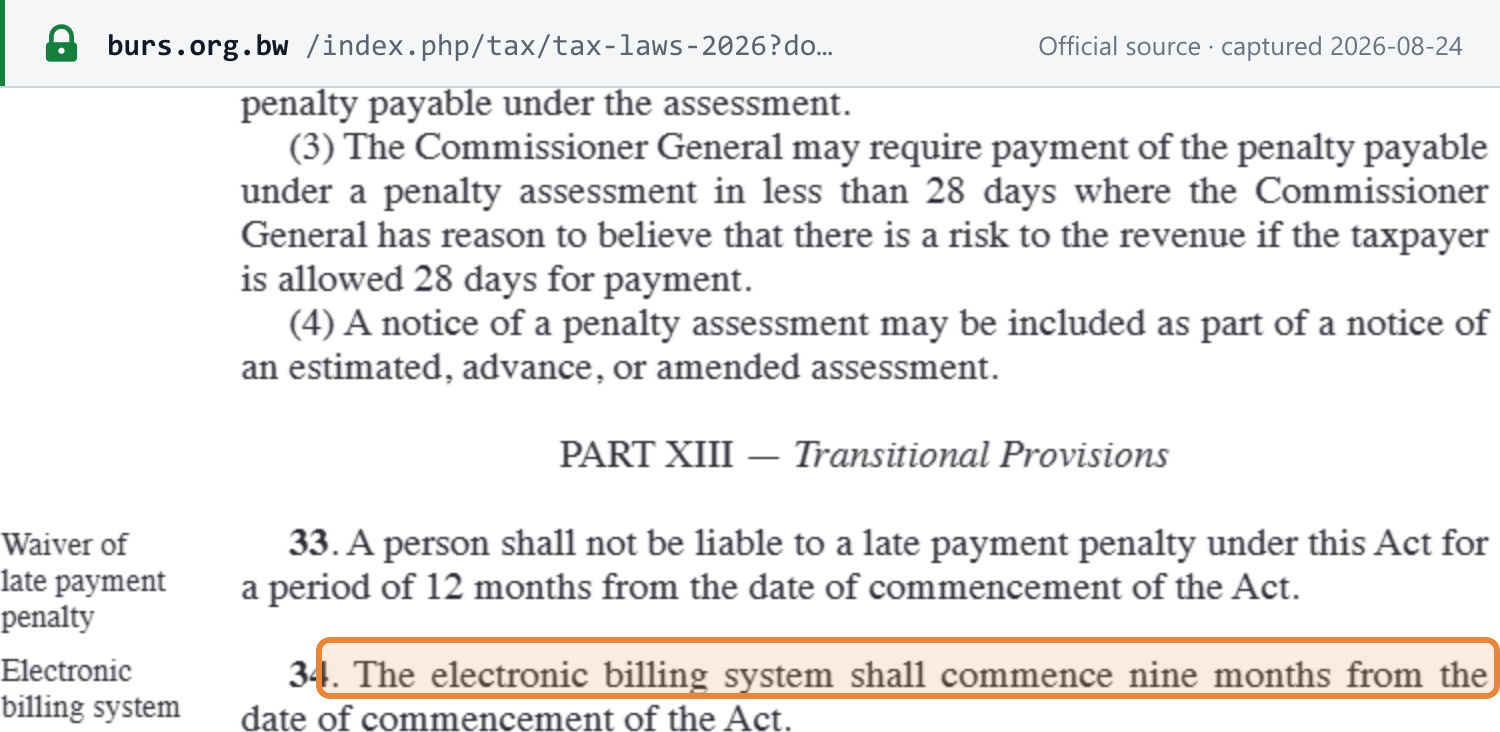
The date is the part that catches people out. Both subsections open "Subject to section 15 of the Tax Administration Act", and section 15 of that Act requires the electronic invoice to be issued using an electronic billing system — defined in TAA section 2 as "a billing system approved by the Revenue Service". Regulation 34 of the Tax Administration Regulations, 2026 (Statutory Instrument No. 90 of 2026), in Part XIII — Transitional Provisions, defers that system: [7]
The electronic billing system shall commence nine months from the date of commencement of the Act.
The Tax Administration Act commenced 1 July 2026 (S.I. No. 91 of 2026), so the electronic billing system commences around 1 April 2027, once BURS has approved billing systems. TAA section 100(1) confirms the sequencing: the P10,000-per-month penalty runs "for the period commencing on the date that the person was required to use the electronic billing system". So: enacted and universal now, operative from roughly April 2027. See the event record for Botswana's electronic invoicing mandate.
 Source snapshot captured 2026-08-24 — original
A note on terminology. Advisory commentary describes a Botswana "Electronic Fiscal Device (EFD)" regime introduced by the VAT (Amendment) Act, 2025. That phrase appears nowhere in the VAT Act, 2026, the Tax Administration Act, 2026, the VAT Regulations, 2026 (SI 94), the Tax Administration Regulations, 2026 (SI 90) or BURS's own VAT guide. Botswana's statutory term is the electronic billing system, and that is what this guide uses.
For remote-services suppliers specifically, the obligation is now regulation 16 of SI 94 — an invoice or receipt carrying the particulars set out under VAT on non-resident remote/digital services. It is not described as electronic, and the revoked SI 74 regulation 10 that required an electronic tax invoice showing the recipient's VAT registration number no longer applies. [6]
Recent changes
- 2026-08-01 — BURS Guidance Note (September 2026) on reporting VAT on reverse-charged supplies: registered recipients, Government entities and large unregistered persons prepare a recipient-created tax invoice (s.59(4)) and notify non-resident remote-services suppliers of their registration (s.64); Category A and C registrants report from August 2026 (payment due 28 October 2026), Category B from September 2026 (due 28 November 2026); earlier supplies go on Form VAT.017.1. See Reporting reverse-charged supplies. (Botswana Unified Revenue Service) — see event
- 2026-07-30 — BURS Public Notice suspended the charging of VAT on medical services, two days before the 1 August 2026 commencement of that measure under the VAT (Amendment) Act, 2025 (Act No. 16 of 2025), to allow consultation with stakeholders and the public; the notice gives no end date and does not affect prescription-drug zero-rating, the input-VAT claim period, or reverse charging under the same Act, and no statutory instrument gives the suspension itself legal effect. (updated from the previously reported 1 August 2026 commencement, which did not take effect as scheduled) (Botswana Unified Revenue Service) — see issue
- 2026-07-09 — BURS Public Notice revised the list of zero-rated foodstuffs under the Value Added Tax (VAT) Act, 2026 (which commenced 1 July 2026): sorghum/maize meal, millet grain/meal, wheat grain, maize cobs, sugar, brown bread, specified fresh vegetables and fruit, rice, samp, bread flour and cooking oil are zero-rated; all other foodstuffs remain at the 14% standard rate. (Botswana Unified Revenue Service) — see issue
- 2026-07-01 — Schedule 4 of the same Act prescribes the mandatory particulars of a tax invoice, including the words "original tax invoice" in a prominent place — a change of wording from the older BURS guidance. (Botswana Unified Revenue Service / Government of Botswana) — see the event record and the issue
- 2026-07-01 — Regulation 20 of the Value Added Tax Regulations, 2026 (S.I. No. 94 of 2026) revoked four instruments, including the Value Added Tax (Remote Services) Regulations (S.I. No. 74 of 2026) and the Value Added Tax (Government Entities and Large Unregistered Persons) Regulations (S.I. No. 73 of 2026), both made 29 May 2026. Their replacements are regulations 15 to 19 of SI 94: online registration lodgement including the supplier's home-country TIN; an invoice or receipt carrying TINs rather than VAT numbers; limited reverse-charge registration for Government entities and large unregistered persons, which confers no input tax credit; and a transitional rule that those bodies apply for registration from 1 August 2026. The four-month charging grace, the 25th-day return date, the representative rule, the inbound-tourism carve-out, the five-year retention and the 75%/20% penalty scale have no counterpart in SI 94. (Botswana Government Extraordinary Gazette / BURS) (Botswana Government Extraordinary Gazette / BURS) — see the event record and the issue
- 2026-06-01 — BURS began implementation of VAT on remote (digital) services supplied by non-residents under the VAT (Amendment) Act, 2025. Under the Value Added Tax Act, 2026 (in force 1 July 2026), a supplier of remote services must apply to register once its taxable supplies exceed P500,000 in a 12-month period (s.13(1)–(2), Schedule 5 para 3). (BURS)
Ahead — scheduled changes that have not yet taken effect:
- 2027-04-01 (scheduled) — The Value Added Tax Act, 2026 (Act No. 15 of 2026), published in the Botswana Government Extraordinary Gazette (Supplement A) on 1 July 2026, repealed and replaced Cap. 50:03. Section 59(8) requires every registered person to issue tax invoices electronically through the electronic billing system, and section 60(4) extends that to credit and debit notes — but both are subject to section 15 of the Tax Administration Act, 2026, and regulation 34 of S.I. No. 90 of 2026 defers the electronic billing system to nine months after that Act commenced on 1 July 2026, i.e. around 1 April 2027. (Botswana Unified Revenue Service / Government of Botswana) — see the event record and the issue
Reference links
- BURS — Value Added Tax (VAT) overview
- BURS — Tax registration (Income Tax TIN and VAT thresholds)
- BURS — Public Notice: Zero-Rated Foodstuffs Under the VAT Act, 2026 (9 July 2026)
- Value Added Tax Act, 2026 (Act No. 15 of 2026) — Botswana Government Extraordinary Gazette, Supplement A, 1 July 2026
- BURS — VAT Description (tax invoice particulars, debit/credit notes, record keeping) (predates the 2026 Act — see the Schedule 4 note above)
- Value Added Tax Regulations, 2026 — Statutory Instrument No. 94 of 2026 (in the VAT Act gazette bundle) (revoked S.I. Nos. 73 and 74 of 2026 with effect from 1 July 2026)
- Tax Administration Act, 2026 and Tax Administration Regulations, 2026 (S.I. No. 90 of 2026)
- Grant Thornton Botswana — Botswana introduces VAT on remote services and mandatory use of EFDs
- KPMG — Botswana: Legislative package of tax and customs reforms
- BURS — Public Notice: Value Added Tax on Medical Services (30 July 2026, suspending the charging of VAT on medical services)
Frequently Asked Questions
What is the standard VAT rate in Botswana, and which foodstuffs are zero-rated?
The standard rate is 14%. A BURS Public Notice of 9 July 2026 revised the zero-rated foodstuffs list under the Value Added Tax (VAT) Act, 2026 (commenced 1 July 2026): sorghum/maize meal, millet grain, millet meal, wheat grain, maize cobs, sugar, brown bread, specified fresh vegetables and fruit, rice, samp, bread flour, and cooking oil, all in their natural state. Any food item not on the list is taxed at 14%. [1]
What are the VAT registration thresholds in Botswana?
Mandatory registration applies once taxable supplies exceed BWP 1,000,000 per annum. Voluntary registration is available between BWP 500,000 and BWP 1,000,000, with the Commissioner General's approval. Below BWP 500,000, registration is not required. Income Tax registration (and TIN) must be completed before a business can apply for VAT registration. [1]
Do foreign providers of remote/digital services have to register for VAT in Botswana?
Yes. The VAT (Amendment) Act, 2025 (Gazette, 31 October 2025) extended VAT to non-resident remote services — digital content, cloud/hosting, webinars, website design, inbound tourism, remote professional services, and electronic-marketplace supplies — with BURS implementation from 1 June 2026. The registration mechanics are now in regulation 15 of the Value Added Tax Regulations, 2026 (S.I. No. 94 of 2026), which revoked the earlier Remote Services Regulations on 1 July 2026: application by online lodgement, giving the supplier's contact and compliance details, the website or URL through which it trades, and the national TIN issued in its country of tax residence, with certified incorporation and home-country tax certificates translated into English. A supplier making only reverse-charged supplies is not required to register (reg. 15(2)). [6]
When must a registered remote-services supplier start charging Botswana VAT?
Immediately. Registration takes effect from the start of the second tax period after the supplier became eligible — a rule that now sits in section 15(5)(a) of the Act, not in a regulation. The four-month grace period, the 25th-day return date and the electronic-tax-invoice requirement were all in S.I. No. 74 of 2026, which was revoked on 1 July 2026, and none has a counterpart in S.I. No. 94. What replaces the invoicing rule is regulation 16: an invoice or receipt showing the invoice number and date, the supplier's name, address and TIN, the recipient's name and address, a description of the services, the value, VAT and VAT-inclusive total, and the recipient's TIN where registered. [6]
Is VAT charged on private medical services in Botswana?
No, not currently. The VAT (Amendment) Act, 2025 (Act No. 16 of 2025) set private medical services to become taxable from 1 August 2026. Two days before that date, a BURS Public Notice dated 30 July 2026 suspended the charging of VAT on medical services to allow consultation with key stakeholders and the general public; the notice gives no end date. The suspension covers only the charging of VAT on medical services — it does not make medical services exempt by law, and it does not touch the Act's other limbs: prescription drugs remain zero-rated, the input-VAT claim period is unchanged, and reverse charging is unaffected. No statutory instrument giving the suspension itself legal effect has been published. [8]
Is e-invoicing mandatory in Botswana?
Enacted, but not yet operative — and it will apply to registered persons generally rather than to a segment. Section 59(8) of the Value Added Tax Act, 2026 requires a registered person to issue tax invoices electronically under the electronic billing system, and section 60(4) extends that to tax credit and debit notes. Both are expressly subject to section 15 of the Tax Administration Act, 2026, and regulation 34 of the Tax Administration Regulations, 2026 (S.I. No. 90 of 2026) defers the electronic billing system to nine months after that Act commenced on 1 July 2026 — so it goes live around 1 April 2027, once BURS has approved billing systems. [6]
The "Electronic Fiscal Device (EFD)" framing used in advisory commentary on the VAT (Amendment) Act, 2025 appears in none of the 2026 VAT and tax-administration instruments — Botswana's statutory term is the electronic billing system. Remote-services suppliers are no longer under a separate electronic-invoice rule either: regulation 10 of the Value Added Tax (Remote Services) Regulations, 2026, which had required an electronic tax invoice showing the recipient's VAT registration number, was revoked with effect from 1 July 2026, and its replacement, regulation 16 of the Value Added Tax Regulations, 2026 (S.I. No. 94 of 2026), requires an invoice or receipt showing, among other particulars, the supplier's Taxpayer Identification Number and the Taxpayer Identification Number of a registered recipient. [6]