South Africa VAT guidelines
| FACTSHEET | |
|---|---|
| Country code | ZA |
| Tax name | Value-Added Tax (VAT) |
| Tax Authority | South African Revenue Service (SARS) |
Overview
South Africa levies Value-Added Tax under the Value-Added Tax Act 89 of 1991, administered by the South African Revenue Service (SARS). VAT is charged on the supply of goods and services by registered vendors and on imports. [1]
The standard rate is 15%. The increases announced in 2025 (to 15.5% from 1 May 2025 and 16% from 1 April 2026) were reversed by clause 13 of the Rates Bill introduced on 24 April 2025, and the Budget of 25 February 2026 did not change the rate. [1]
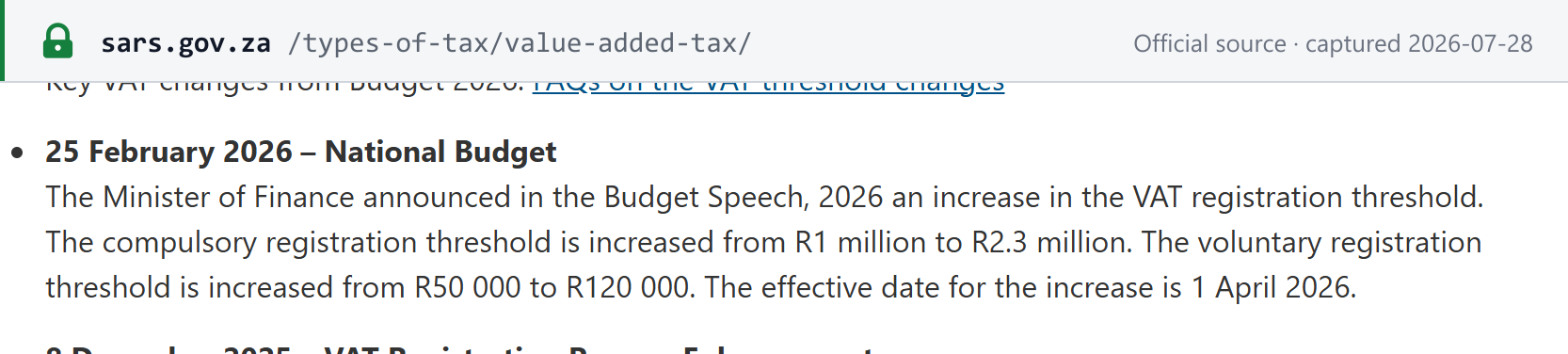
The single most consequential 2026 change is not the rate but the registration threshold: the compulsory threshold moves from R1 million to R2.3 million and the voluntary threshold from R50,000 to R120,000, both applied by SARS from 1 April 2026 — while the bill carrying them is still a draft published for public comment and has not been introduced in Parliament. See Registration thresholds for the exact legal position. [2]
VAT registration and the VAT number
- A person may only register for VAT if it carries on an "enterprise" as defined in the VAT Act — any activity carried on continuously or regularly in or partly in South Africa where goods or services are supplied for a consideration. The definition specifically includes intermediaries and non-resident suppliers of electronic services. [1]
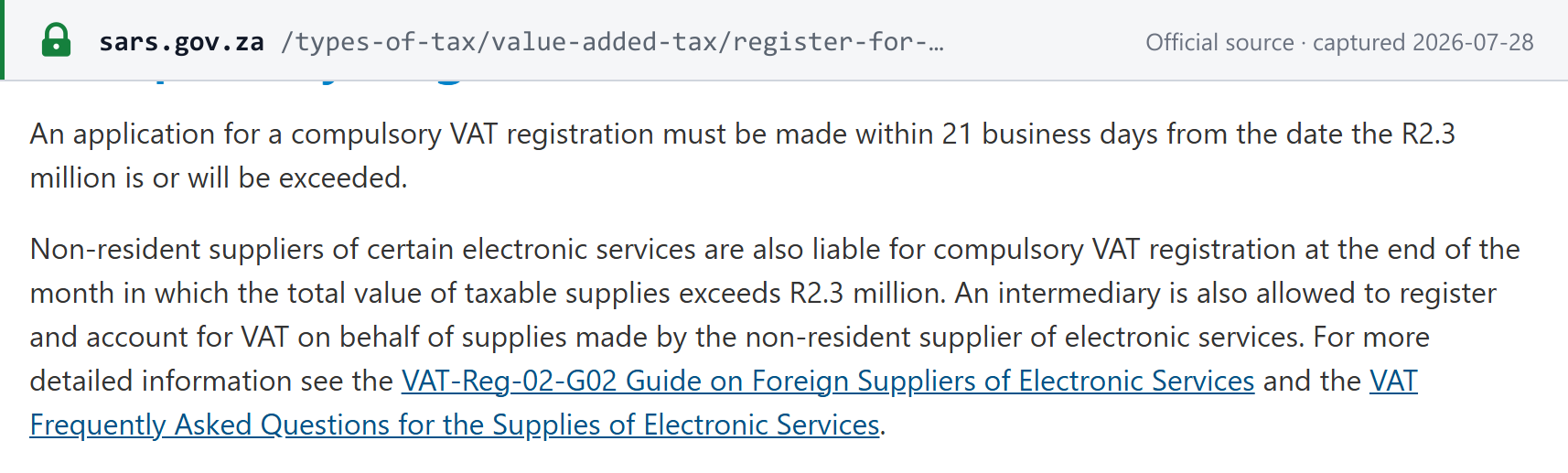
- An application for compulsory registration must be made within 21 business days from the date the R2.3 million threshold is or will be exceeded. [1]
- Applications are made through eFiling or a virtual appointment via SARS eBooking. Where no risk is identified, SARS issues the VAT reference number immediately on application. Compulsory registrations can be backdated through eFiling (RAV01) by at most 6 months from the date the threshold was exceeded; anything longer requires a branch appointment with supporting documents. Voluntary registrations cannot be backdated without supporting justification. [1]
- Non-resident electronic services suppliers do not use the ordinary channel: they email a completed VAT101 form with supporting documents to
[email protected]. [2]
VAT number format and how it is verified
A South African VAT registration number is a 10-digit number beginning with the digit 4. There is no alphabetic country prefix (regex ^4\d{9}$), and the 10th digit is a check digit: SARS publishes a modulus-10 (Luhn) rule for income tax and VAT reference numbers in its technical specifications, so a mistyped digit can be caught offline. The illustrative numbers in SARS's VAT 404 Guide for Vendors show the shape only — several of them do not pass the check digit, so do not use them as test numbers. [1] [13] The check digit is explained in the South Africa tax number guide.
A passing check digit shows only that a number is well-formed; the authoritative test of registration is the SARS eFiling VAT Vendor Search, which is free, needs no login, and accepts either the VAT number or the trading name. Two practical cautions from SARS's own terms page: the database is updated weekly, so a newly registered vendor may not appear yet, and SARS disclaims responsibility for errors or omissions. [2]
For the step-by-step lookup, expected result fields and input-tax implications, see our How to verify a VAT number in South Africa guide.
Registration thresholds
| Threshold | Amount applied from 1 April 2026 | Previous amount |
|---|---|---|
| Compulsory — taxable supplies in any consecutive 12-month period (VAT Act s.23(1)(a)) | R2,300,000 [1] | R1,000,000 |
| Compulsory — non-resident electronic services suppliers and intermediaries (VAT Act s.23(1A)) | R2,300,000 [1] [7] | R1,000,000 |
| Voluntary — taxable supplies in the preceding 12 months (VAT Act s.23(3)(b)) | R120,000 [1] | R50,000 |
| Commercial accommodation — below this value the activity is not an "enterprise". Long-standing: unchanged since 1 April 2017, not part of the 2026 package | R120,000 [6] | R60,000 (before 1 April 2017) |
Compulsory registration is also triggered where, under a written contractual obligation, the value of taxable supplies to be made in a 12-month period will exceed R2.3 million. [1]
 Source snapshot captured 2026-07-28 — original
Legal status — read this before you act
Be careful how you describe these figures. They are being applied, but are not yet enacted law:
- The Minister of Finance announced the increase in the Budget Speech of 25 February 2026; SARS states "The compulsory registration threshold is increased from R1 million to R2.3 million. The voluntary registration threshold is increased from R50 000 to R120 000. The effective date for the increase is 1 April 2026." [1]
- The amendment is clause 20 of the 2026 Draft Rates and Monetary Amounts and Amendment of Revenue Laws Bill, which substitutes "R2,3 million" for "[R1 million]" in section 23(1)(a) and section 23(1A), and "R120 000" for "[R50 000]" in section 23(3)(b), and is expressed to be "deemed to have come into operation on 1 April 2026". Every page of that document is watermarked DRAFT. [2]
- National Treasury and SARS were still inviting written public comment on the 2026 draft Rates Bill in a media statement issued on 4 June 2026, with comments due by close of business on 26 June 2026. [3]
- SARS itself flags the position at the top of its Budget 2026 VAT FAQs: they are "issued based on the Minister's Budget announcement on 25 February 2026 and subject to Parliament's legislative process." [4]
 Source snapshot captured 2026-07-28 — original
SARS has nonetheless already updated its operational artefacts: the Register for VAT page quotes R2.3 million and R120,000 throughout, and the VAT101 registration application form (version FV V2026.00.03) offers registration options tested against R120 000 rather than R50 000. [1] [5]
SARS's dedicated guide for foreign suppliers is the most explicit official statement of the electronic-services position: "Effective from 1 April 2026, the compulsory registration threshold, in section 23(1A) of the VAT Act, was increased to R2,3 million." [7]
If you now fall below the threshold
Registration is not cancelled automatically when your taxable supplies sit between R120,000 and R2.3 million — you may choose to cancel, using a VAT123e form. Where taxable supplies in the preceding 12 months are below R120,000, SARS will notify you of its intention to cancel, and you have 80 business days to object on an ADR1 form. Cancellation triggers deemed exit VAT: output tax on trading stock and capital goods on hand, valued at the lesser of cost or open market value and declared in fields 1A and 4A of the final VAT201. The liability may be paid in six equal monthly instalments. [4]
Rates
| Rate | Applies to |
|---|---|
| 15% (standard) | Most taxable supplies of goods and services by registered vendors, including electronic services supplied by non-residents [1] |
| 0% (zero-rated) | Exports, and certain basic foodstuffs listed in Part B of Schedule 2 read with section 11(1)(j) — brown bread, dried mealies and mealie rice, brown bread flour (excluding wheaten bran), samp, hen's eggs, fresh vegetables and fruit, dried beans, lentils, maize meal, rice, pilchards in tins or cans, vegetable cooking oil (excluding olive oil), milk, cultured milk, milk powder and dairy powder blend, and edible legumes and pulses of leguminous plants [2] |
| Exempt | Listed in section 12 — certain financial services, rental of accommodation in a "dwelling" (including employee housing), certain educational services, services of employee organisations, certain sectional-title/share-block/old-age-scheme levy services, public road and railway transport of fare-paying passengers and their luggage, childcare in a crèche or after-school centre, and certain donated-goods supplies by an association not for gain. A person making only exempt supplies may not register and may not recover input tax [2] |
Tax invoices. A full tax invoice is required where the consideration exceeds R5,000 (including tax); an abridged tax invoice may be issued below R5,000 except for a zero-rated supply; and no tax invoice is required where the consideration is less than R50. [2]
Schools — the whole output is exempt from 1 January 2026
The Taxation Laws Amendment Act 5 of 2026 (Government Gazette 54448, 1 April 2026) inserted section 12(h)(iv), exempting the supply of any goods or services by a school registered or provisionally registered under the South African Schools Act, 1996 — not merely its educational services. The same amendment removed schools from the educational-services exemption in s.12(h)(i)(aa) and struck "school" and "school fees" from s.12(h)(ii). One carve-out survives: supplies made in respect of welfare activities carried on by a welfare organisation, confirmed in a ruling under section 41B. A school conducting qualifying welfare activities may therefore stay registered, but had to apply for that ruling by 30 September 2026. [8]
 Source snapshot captured 2026-08-24 — original
Deregistering is not costless. Assets held are deemed supplied, measured at 31 December 2025, with the exit VAT payable from 1 January 2027 in 12 equal monthly instalments without penalties or interest; goods on which input tax was denied (entertainment, motor cars) and donated or nil-consideration assets are excluded. See Recent changes.
Imported goods — the item 412.09 relief narrowed on 14 August 2026
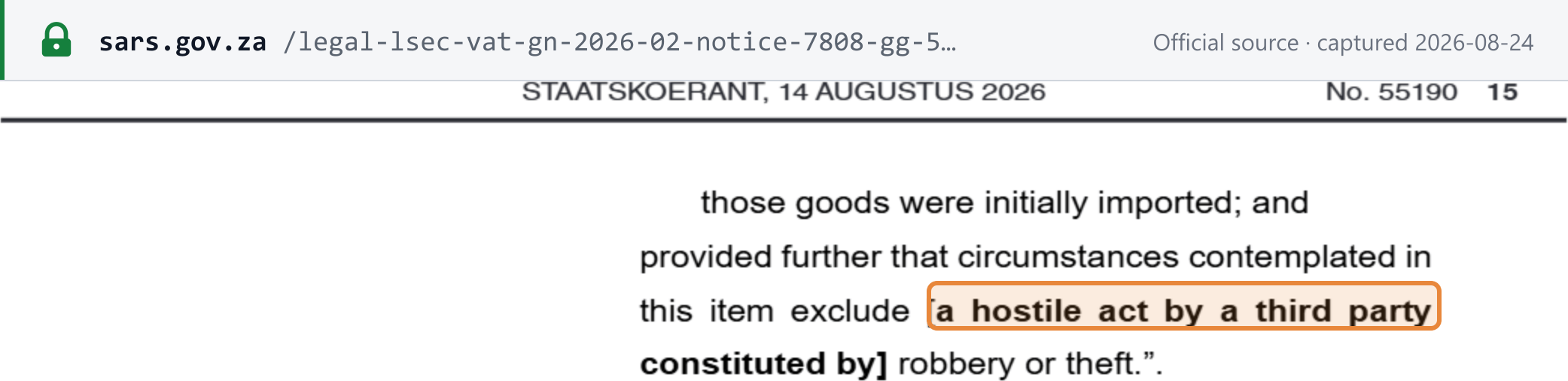
Notice R. 7808, published in Government Gazette No. 55190 (Vol. 734), amends item 412.09/00.00/01.00 in paragraph 8 of Schedule 1 to the VAT Act, aligning its further proviso with the corresponding rebate item in Part 1 of Schedule 4 to the Customs and Excise Act 91 of 1964. The words "a hostile act by a third party constituted by" are deleted from in front of "robbery or theft", so the excluded circumstances now cover robbery or theft outright rather than only the hostile-act variety. The exclusion widens, and the relief therefore narrows. [9]
 Source snapshot captured 2026-08-24 — original
Imports from Botswana, eSwatini, Lesotho and Namibia — R500 and R100 relief deleted by TLAA 2026 (commencement date pending)
Section 48 of the Taxation Laws Amendment Act 5 of 2026 (Government Gazette 54448, 1 April 2026) amends Schedule 1 to the VAT Act by deleting paragraph 2 and subparagraph (v) of paragraph 1. That removes the VAT exemption on the importation of goods with a customs value of R500 or less on which no customs duty is payable, and of certain printed matter imported by post not exceeding R100, that applied to goods from Botswana, eSwatini, Lesotho and Namibia. [10]
Under section 48(2) the amendment takes effect on a date to be determined by the Minister by notice in the Government Gazette. SARS VAT Connect Issue 21 (September 2026) describes the exemption as now deleted; as at 5 October 2026 no commencement notice had been located. [11]
Traveller and crew allowances — item 407 doubled on 14 August 2026
A separate notice, in the same gazette as R.7808 above but not to be conflated with it. Government Notice R.7811, also published in Government Gazette No. 55190 (14 August 2026) and issued by the Minister of Finance under section 74(3)(a) of the VAT Act, amends note 5 of item 407.00 and items 407.02/00.00/01.00 and 407.02/00.00/02.00 in paragraph 8 of Schedule 1 — "as a consequence of the amendment of rebate items 407.00, 407.02/00.00/01.00 and 407.02/00.00/02.00 in Part 1 of Schedule No. 4 to the Customs and Excise Act, 1964". Every amount in the item doubled: [10]
| Allowance | Previous | From 14 August 2026 |
|---|---|---|
| Ship/aircraft crew member — note 5(a), the item 407.02/00.00/01.00 ceiling | R700 | R1,400 |
| Ship/aircraft crew member — note 5(b), the item 407.02/00.00/02.00 ceiling | R2,000 | R4,000 |
| General traveller — item 407.02/00.00/01.00 (new/used goods, total value) | R5,000 | R10,000 |
| General traveller — item 407.02/00.00/02.00 (additional new/used goods) | R20,000 | R40,000 |
The same two item numbers, 407.02/00.00/01.00 and 407.02/00.00/02.00, carry two different figures at once: note 5 sets the lower, crew-specific ceiling that a member of a ship's or aircraft's crew (including the master or pilot) is limited to, while the item entries themselves set the higher general-traveller ceiling everyone else uses. Both the crew figures and the general figures were doubled by the same notice, with no gap in commencement — the notice carries no separate coming-into-force clause of its own, so it applies from the gazette date. [10]
Exports via licensed port terminal operators — zero-rating extended, deemed effective 1 April 2026
The Minister of Finance amended regulation 8(2)(e)(ii) of the VAT export regulations (Government Notice R.316 of 2 May 2014, made under section 74(1) of the VAT Act), published by National Treasury on 25 August 2026: goods delivered to a terminal operator operating under a licence of the port authority under sections 57 and 65 of the National Ports Act, No. 12 of 2005, now qualify for export zero-rating on the same basis as delivery to the port authority itself. The amendment is deemed to have come into operation on 1 April 2026. [11]
Exporters who deliver goods to a licensed terminal operator, rather than directly to the port authority, should keep the same delivery documentation the export regulations already require, to support zero-rating back to 1 April 2026. [12]
Filing and payment
Vendors are allocated one of five tax-period categories: A and B (two-monthly, ending in alternating months), C (monthly — mandatory where taxable supplies exceed or are likely to exceed R30 million in any consecutive 12 months), D (six-monthly, mainly farming with taxable supplies under R1.5 million), and E (annual, for qualifying property-letting and management companies and trusts). [1]
A VAT201 return must be submitted, and payment made, on or before the 25th day of the month following the end of the tax period — or the last business day of that month where the return is filed and paid through eFiling or EFT. Where the 25th is not a business day, the deadline moves to the preceding business day. Records must be retained for 5 years. [2]
VAT on non-resident electronic services
South Africa has taxed cross-border electronic services since 1 June 2014. The current regime rests on regulations issued under the definition of "electronic services" in section 1 of the VAT Act: [1]
- Original Regulations — Government Notice R.221 in Government Gazette 37489 of 28 March 2014.
- Updated Regulations — Government Notice 429 in Government Gazette 42316 of 18 March 2019, effective 1 April 2019. These substantially widened the scope so that essentially all services supplied for a consideration by means of an electronic agent, electronic communication or the internet are electronic services, subject to a few exceptions.
- 2025 Regulations — Government Notice 5993 in Government Gazette 52293 of 14 March 2025, effective 1 April 2025, introducing the B2B exclusion described below.
Who has to register. A foreign supplier of electronic services is carrying on an enterprise in South Africa if the services are supplied from a place in an export country and any two of three circumstances are present — (1) the recipient is a resident of South Africa; (2) payment originates from a bank registered under the Banks Act 94 of 1990; (3) the recipient has a business, residential or postal address in South Africa. SARS calls this the "2 out of 3" test. A supplier that meets the test and exceeds the section 23(1A) threshold must register and account for VAT only on its electronic services supplied to South African customers; other supplies are ignored both for the threshold test and in the VAT return. [1]
What counts as electronic services. Examples given by SARS include distance-teaching programmes, educational webcasts, courses and webinars; content such as signals, writing, images, sounds or information transmitted by way of a telecommunications service; electronic games, interactive games and electronic betting or wagering; auction services; online advertising or the provision of advertising space; online shopping portals; and web-based broadcasting. The definition has no regard to the degree of human intervention involved. [1]
What is excluded. Telecommunications services; educational services supplied from an export country that are regulated by an education authority under the laws of that country; certain supplies between members of the same group of companies; and — from 1 April 2025 — supplies by a foreign supplier that makes supplies solely to VAT-registered vendors (the B2B exclusion). [1]
Operating obligations. The rate is the standard 15%. Registered foreign suppliers are generally placed on two-monthly Category A or B tax periods, moving to monthly Category C if taxable supplies exceed R30 million in any consecutive 12 months. Tax invoices must contain the particulars prescribed in VAT Notice 1594, published in Government Gazette 45624 on 10 December 2021, and a SARS Binding General Ruling on "Electronic Services" sets the minimum information required on a credit or debit note under section 21(5), the exchange rate to be used to express VAT in the currency of the Republic, and the manner in which prices must be advertised or quoted. Deregistration requests go to [email protected], and only where taxable supplies for the preceding 12 months are below the compulsory threshold and that situation is likely to continue. [1]
Note on the SARS electronic-services FAQ. SARS's FAQs: Supplies of Electronic Services is at Issue 4, dated 2 April 2025, and still quotes the old R1 million threshold throughout. The R2.3 million figure comes from the later Budget 2026 measure and SARS's updated Register for VAT page. Where the two conflict on the threshold, the newer SARS guidance and clause 20 of the 2026 draft Rates Bill are the current position. [1] [2]
Invoice requirements
Without a valid tax invoice a vendor cannot deduct input tax — SARS treats the document, not the payment, as the proof. The VAT Act prescribes both the particulars and the deadline. [1]
Which document you must issue
| Consideration for the supply | Document required |
|---|---|
| More than R5 000 | Full tax invoice |
| R5 000 or less | Abridged tax invoice permitted |
| R50 or less | No tax invoice required — but a till slip or sales docket showing the VAT charged is needed to verify the input tax deducted |
Mandatory content
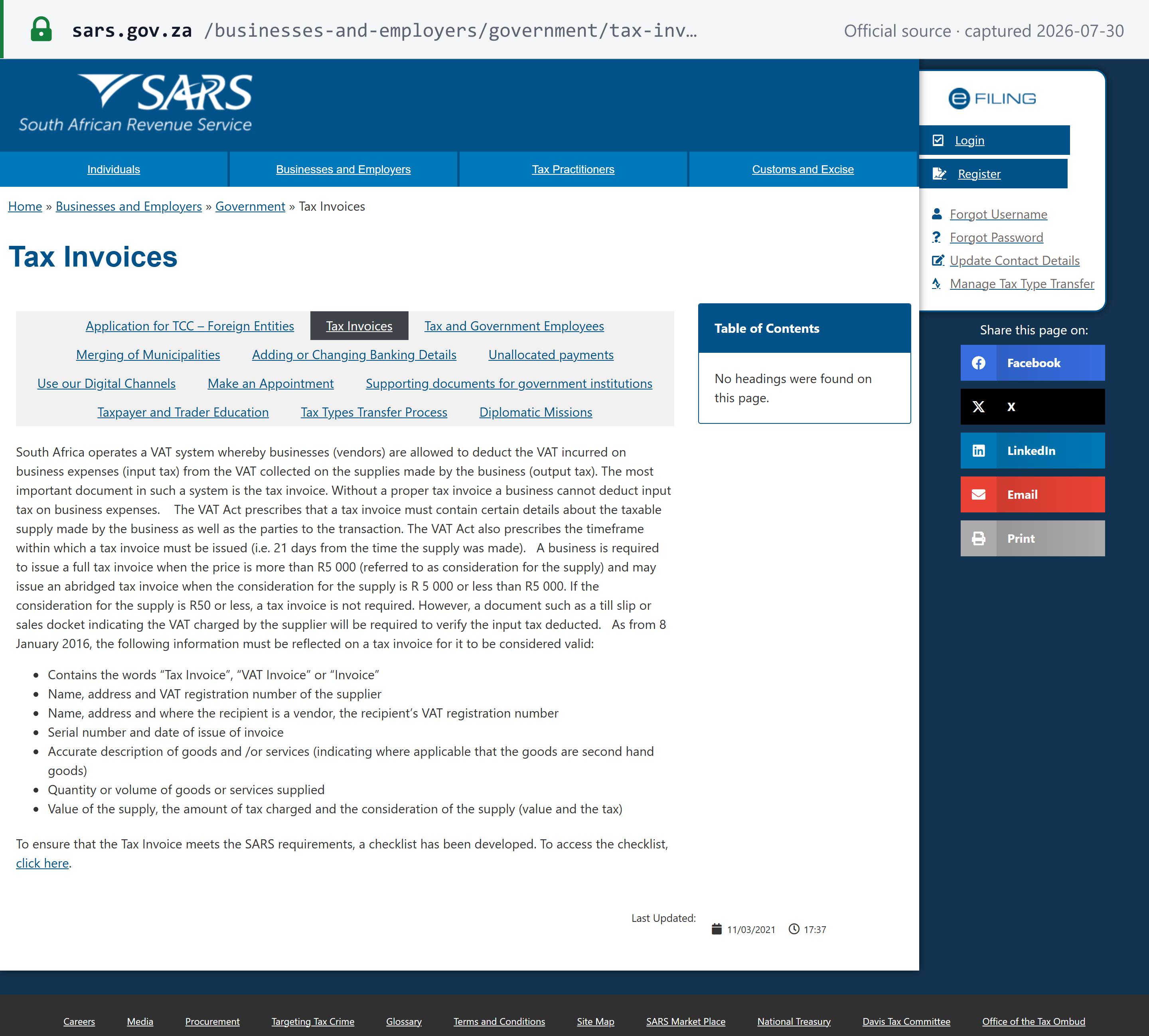
As from 8 January 2016, the following must be reflected on a tax invoice for it to be valid: [1]
| Required particular | Notes |
|---|---|
| The words "Tax Invoice", "VAT Invoice" or "Invoice" | Any one of the three satisfies the requirement |
| Name, address and VAT registration number of the supplier | — |
| Name, address of the recipient, and where the recipient is a vendor, the recipient's VAT registration number | The recipient's VAT number is required only where the recipient is a vendor |
| Serial number and date of issue | — |
| Accurate description of the goods and/or services | Must indicate where applicable that the goods are second-hand goods |
| Quantity or volume of the goods or services supplied | — |
| Value of the supply, the amount of tax charged and the consideration | i.e. the value and the tax must both be shown |
 Source snapshot captured 2026-07-30 — original
SARS also publishes a tax invoice checklist linked from the same page for confirming a document meets these requirements.
What a compliant invoice looks like
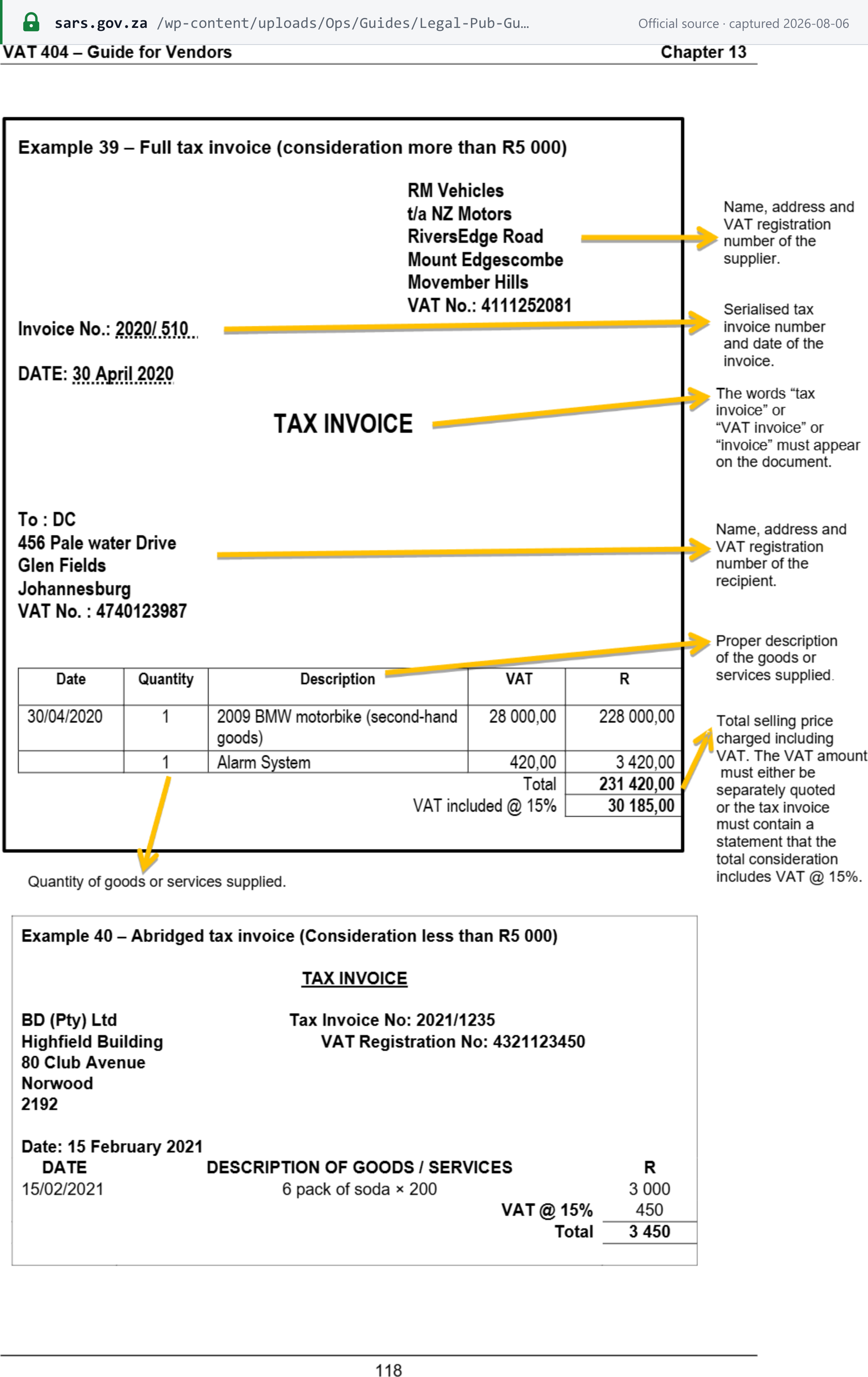
SARS publishes annotated worked examples in the VAT 404 Guide for Vendors. Example 39 is a full tax invoice for consideration above R5 000, with leader arrows into margin callouts naming each requirement — that the words "tax invoice", "VAT invoice" or "invoice" must appear on the document, the serialised invoice number and date, the name, address and VAT registration number of both supplier and recipient, a proper description of what was supplied, the quantity, and the total including VAT with the VAT either quoted separately or covered by a statement that the total includes VAT at 15%. Example 40 immediately below shows the abridged form for consideration under R5 000, and Example 41 covers mixed supplies. [1]
 Source snapshot captured 2026-08-03 — original
Issuance deadline
A tax invoice must be issued within 21 days from the time the supply was made, whether or not the recipient has asked for one. [1]
Credit and debit notes
Corrections are made under section 21 of the VAT Act. For non-resident suppliers of electronic services, a SARS Binding General Ruling on "Electronic Services" sets the minimum information required on a credit or debit note under section 21(5), together with the exchange rate to be used to express VAT in the currency of the Republic and the manner in which prices must be advertised or quoted. [2]
Non-resident electronic services suppliers — a different particulars list
Registered foreign suppliers of electronic services do not use the section 20(4) list above. Their tax invoices must contain the particulars prescribed in VAT Notice 1594, published in Government Gazette 45624 on 10 December 2021. See VAT on non-resident electronic services above. [2]
Zero-rated going-concern disposals — documentary proof (Interpretation Note 31)
Zero-rating under section 11(1) and (2) is conditional on section 11(3): a vendor must obtain and retain the documentary proof acceptable to the Commissioner, or the supply cannot be zero-rated. SARS sets that proof out in Interpretation Note 31 (Issue 5), dated 17 July 2026, "Documentary proof required for the zero-rating of goods or services" — Issue 5 supersedes the previous issue and updates Tables A and B in full. [4]
For the disposal of an enterprise, or part of an enterprise, as a going concern under section 11(1)(e) (Table A, Item G) — the scenario most relevant to a business sale — a vendor must hold:
| Document | What it must show |
|---|---|
| Sale contract | Confirms in writing that the enterprise (or part) is disposed of as a going concern; will be an income-earning activity on the date of transfer; that the assets necessary for carrying on the enterprise are disposed of to the purchaser; and that the consideration includes VAT at the zero rate |
| Tax invoice | — |
| Recipient's VAT Notice of Registration | Confirms the purchaser is itself a registered vendor |
Use our South Africa VAT validator to confirm a recipient's VAT registration status before relying on a Notice of Registration it has supplied.
Retention
Records — including tax invoices — must be retained for 5 years. [3]
E-invoicing status
There is no mandatory B2B e-invoicing or clearance mandate in force in South Africa. What exists is an enabling framework and a voluntary system yet to be switched on.
The Tax Administration Laws Amendment Act 4 of 2026, published in Government Gazette 54447 on 1 April 2026, amends the VAT Act to: [1]
- insert definitions into section 1 of "e-invoice" (a tax invoice that is issued, transmitted and received in a structured electronic format allowing its automatic and electronic processing, and that complies with such further requirements as the Minister may prescribe by regulation), "e-debit note", "e-credit note", "e-reporting" (electronically submitting tax data extracted from an e-invoice, e-debit note or e-credit note to SARS, to a supplier or its service provider, and to a recipient or its service provider, within the interoperability framework), and "interoperability framework" (a network of service providers where decentralised exchange of e-invoices, e-debit notes and e-credit notes occurs, and that can facilitate clearance and interoperability between supplier and recipient); and
- insert section 74(1B), empowering the Minister to make regulations prescribing the requirements for participation by a vendor in a voluntary e-reporting system.
So the statutory vocabulary and the regulation-making power now exist, but the technical requirements, the interoperability framework and any onboarding dates all have to be prescribed by regulation, and participation as enacted is voluntary. Nothing in Act 4 of 2026 obliges a vendor to issue e-invoices.
Separately, SARS has published a Discussion Paper on Value-Added Tax Modernisation proposing that digital transmission of VAT data be implemented in phases, beginning with the segment of the vendor base contributing about 80% of total VAT revenue — monthly Category C vendors, Large Business and International vendors, vendors transacting with government (B2G), high-risk segments, and any vendor volunteering — with micro, small and medium vendors in later phases. The paper carries an explicit SARS disclaimer that it is for discussion and does not represent the official view of SARS or its Commissioner; treat it as direction of travel, not a timetable. [2]
VAT Modernisation Consultation Paper (17 August 2026) — SARS names a Digital VAT Model
On 17 August 2026, SARS released its VAT Modernisation Consultation Paper for public consultation and comment — the first time SARS has put a named model on the table rather than a general discussion document. The paper proposes a Digital VAT Model built from three components: e-Invoicing, an Interoperability Framework, and e-Reporting, aiming to move VAT compliance "from a system that is still too dependent on manual processes and retrospective verification, to one where VAT compliance becomes part of the systems businesses already use every day." It follows on from — and is more concrete than — the 2023 VAT Modernisation Discussion Paper referenced above. [3]
This is a consultation paper, not a mandate. No legal instrument has been enacted implementing it, there is no effective date, and no e-invoicing obligation is created. SARS is inviting written comment, with the comment period running to 16 October 2026. Treat this as South Africa's first declared direction toward a continuous-transaction-control e-invoicing system — the eventual phasing, thresholds and formats are exactly what the consultation is meant to settle — but it does not change the position stated above: e-invoicing in South Africa remains voluntary and unmandated as of this guide's last update. [3]
Recent changes
- 2026-04-01 (deemed effective; published 2026-08-25) — National Treasury amended regulation 8(2)(e)(ii) of the VAT export regulations (GN R.316 of 2 May 2014, under section 74(1) of the VAT Act) so that goods delivered to a licensed port terminal operator (National Ports Act, No. 12 of 2005, ss.57 and 65) qualify for export zero-rating on the same basis as delivery to the port authority — deemed to have come into operation 1 April 2026. (National Treasury) — see the event record and the issue
- 2026-04-01 (enacted; commencement pending) — Taxation Laws Amendment Act 5 of 2026 (Government Gazette 54448), section 48, deletes the VAT exemption on importation of goods with a customs value of R500 or less (no customs duty payable), and of certain printed matter imported by post not exceeding R100, that applied to goods from Botswana, eSwatini, Lesotho and Namibia; the amendment takes effect on a date to be set by the Minister by Government Gazette notice (none located as at 5 October 2026). See Imported goods. (South African Revenue Service) — see event
- 2026-08-17 — SARS releases its VAT Modernisation Consultation Paper, proposing a Digital VAT Model with three components — e-Invoicing, an Interoperability Framework and e-Reporting — for public comment until 16 October 2026. This is South Africa's first declared e-invoicing/CTC direction; no legal instrument has been enacted and there is no effective date. (South African Revenue Service) — see issue
- 2026-08-14 — Notice R. 7808, published in Government Gazette No. 55190 (Vol. 734), amends item 412.09/00.00/01.00 in paragraph 8 of Schedule 1 to the VAT Act, aligning its further proviso with the corresponding rebate item in Part 1 of Schedule 4 to the Customs and Excise Act 91 of 1964. The words "a hostile act by a third party constituted by" are deleted before "robbery or theft", so the exclusion now reads simply that the circumstances contemplated exclude robbery or theft — a widening of the exclusion and therefore a narrowing of the relief. (Minister of Finance, via SARS / South African Government Gazette) — see the event record and the issue
- 2026-08-14 — Notice R. 7811, published in the same Government Gazette No. 55190 as R.7808 but a separate, unrelated notice, doubles the VAT-exempt traveller and ship/aircraft-crew allowances under note 5 and items 407.02/00.00/01.00 and 407.02/00.00/02.00 of Schedule 1: the crew ceilings rise from R700 to R1,400 and from R2,000 to R4,000, and the general-traveller ceilings rise from R5,000 to R10,000 and from R20,000 to R40,000, consequent on a matching amendment to Part 1 of Schedule 4 to the Customs and Excise Act, 1964. (Minister of Finance, via SARS / South African Government Gazette) — see issue
- 2026-08-07 — SARS calls on VAT-registered schools to apply to cancel their registrations, following the Taxation Laws Amendment Act 5 of 2026 (Government Gazette 54448, 1 April 2026), which inserted a new section 12(h)(iv) exempting the supply of any goods or services by a school registered or provisionally registered under the South African Schools Act, 1996 — excluding supplies made in respect of welfare activities carried on by a welfare organisation, as confirmed in a ruling under section 41B — with effect from 1 January 2026. The same section removed schools from the educational-services exemption in s.12(h)(i)(aa) and struck "school" and "school fees" from s.12(h)(ii), so a school's entire output is now exempt rather than only its educational services. Schools conducting qualifying welfare activities may stay registered but must apply for a s.41B ruling by 30 September 2026. Deregistration is not costless: assets held are deemed supplied, measured at 31 December 2025, with the exit VAT payable from 1 January 2027 in 12 equal monthly instalments, without penalties or interest; goods on which input tax was denied (entertainment, motor cars) and donated or nil-consideration assets are excluded. (Taxation Laws Amendment Act 5 of 2026; SARS media release) — see the event record and the issue
- 2026-07-30 — SARS and National Treasury publish the Draft Taxation Laws Amendment Bill, 2026 for public comment. This is a draft bill, not enacted law. It would substitute section 7(4) of the Value-Added Tax Act, 1991, so that where the Minister announces in the national annual Budget that the VAT rate is to be altered, that alteration is effective from a date the Minister determines in the announcement and continues to apply for 12 months from that date, subject to Parliament passing confirming legislation within that period. (South African Revenue Service / National Treasury) — see issue
- 2026-07-17 — SARS issues Interpretation Note 31 (Issue 5), updating the documentary proof required for zero-rated supplies under section 11(3). For disposal of an enterprise as a going concern (Table A, Item G), a vendor must hold the sale contract, a tax invoice and the recipient's VAT Notice of Registration; Issue 5 supersedes the prior issue. (South African Revenue Service) — see issue
- 2026-04-01 — SARS applies increased VAT registration thresholds: compulsory R1 million → R2.3 million (VAT Act s.23(1)(a) and, for non-resident electronic-services suppliers and intermediaries, s.23(1A)) and voluntary R50,000 → R120,000. Announced in the Budget on 25 February 2026 and carried in clause 20 of the 2026 Draft Rates and Monetary Amounts and Amendment of Revenue Laws Bill; SARS notes the change is "subject to Parliament's legislative process". (South African Revenue Service) — see issue
- 2026-04-01 — Tax Administration Laws Amendment Act 4 of 2026 (Government Gazette 54447) inserts e-invoice, e-debit note, e-credit note, e-reporting and interoperability-framework definitions into the VAT Act and gives the Minister power (s.74(1B)) to prescribe requirements for a voluntary e-reporting system. No mandatory e-invoicing obligation is created. (South African Revenue Service / National Treasury) — see issue
- 2025-04-01 — The 2025 Regulations (Government Notice 5993, Government Gazette 52293 of 14 March 2025) introduce a B2B exclusion: supplies by a foreign supplier that supplies solely to VAT-registered vendors fall outside paragraph (b)(vi) of the "enterprise" definition and therefore outside the electronic-services registration requirement. (South African Revenue Service)
Reference links
- SARS — Value-Added Tax overview
- SARS — Register for VAT (thresholds, 21 business days, electronic services)
- SARS — Budget 2026 Frequently Asked Questions
- SARS — Obligations of a VAT vendor (VAT201 due dates)
- SARS — Tax periods for VAT (Categories A–E)
- SARS — VAT 404 Guide for Vendors
- SARS — FAQs: Supplies of Electronic Services (Issue 4, 2 April 2025)
- SARS — VAT-REG-02-G02: Supply of Electronic Services by Foreign Suppliers and Foreign Intermediaries
- SARS — Tax Administration Laws Amendment Act 4 of 2026 (GG 54447, 1 April 2026)
- SARS — Discussion Paper on Value-Added Tax Modernisation
- SARS — VAT Modernisation Consultation Paper media release (17 August 2026)
- SARS — Interpretation Note 31 (Issue 5, 17 July 2026): Documentary proof required for the zero-rating of goods or services
- SARS eFiling — VAT Vendor Search
- National Treasury — 2026 Draft Rates and Monetary Amounts and Amendment of Revenue Laws Bill (25 February 2026)
- National Treasury — Media statement: Publication of the 2026 Draft Rates Bill (4 June 2026)
- SARS media release — SARS urges schools to apply for VAT deregistration
- SARS — Notice R. 7808 (GG 55190, 14 August 2026): amendment of item 412 in paragraph 8 of Schedule 1
- SARS — Notice R. 7811 (GG 55190, 14 August 2026): traveller and crew allowances, note 5 and item 407 of Schedule 1
- National Treasury — Amendments to the VAT export regulations (reg. 8(2)(e)(ii), terminal operators), 25 August 2026
- SARS — Legal Counsel: Preparation of Legislation, Explanatory Memoranda 2026
Frequently Asked Questions
Has South Africa's compulsory VAT registration threshold really risen to R2.3 million, and is it law yet?
SARS applies the new thresholds from 1 April 2026: compulsory registration once taxable supplies exceed R2.3 million in any consecutive 12-month period (up from R1 million), and voluntary registration from R120,000 (up from R50,000). [1]
The legal status is unusual and worth stating plainly. The increase was announced in the Budget on 25 February 2026 and is carried in clause 20 of the 2026 Draft Rates and Monetary Amounts and Amendment of Revenue Laws Bill, which is expressed to be "deemed to have come into operation on 1 April 2026". [2] That Bill was still a draft out for public comment when National Treasury and SARS reissued it on 4 June 2026 with comments due 26 June 2026, [3] and SARS's Budget 2026 FAQs state they are "issued based on the Minister's Budget announcement on 25 February 2026 and subject to Parliament's legislative process." [4] In short: SARS is administering R2.3 million and R120,000 now; parliamentary passage of the Rates Bill is still outstanding.
I am a non-resident supplier of electronic services to South Africa — did my threshold move to R2.3 million too?
Yes. Clause 20(1)(b) of the 2026 draft Rates Bill substitutes R2,3 million for R1 million in section 23(1A) of the VAT Act — the registration trigger for persons carrying on an enterprise under paragraph (b)(vi) and (vii) of the "enterprise" definition, i.e. non-resident electronic-services suppliers and intermediaries. [1] SARS's Register for VAT page now states that "Non-resident suppliers of certain electronic services are also liable for compulsory VAT registration at the end of the month in which the total value of taxable supplies exceeds R2.3 million." [2]
 Source snapshot captured 2026-07-28 — original
The proviso is unchanged: no liability arises where the threshold is exceeded solely as a consequence of abnormal circumstances of a temporary nature. [1] A supplier registered only because it passed R1 million may now sit below the compulsory threshold — but deregistration is not automatic, requires the position to be likely to continue, and triggers deemed exit VAT on assets on hand. [3]
Do I need a South African bank account to register as a foreign electronic services supplier?
Generally no, but the rule tightened on 24 December 2024. A foreign electronic services supplier or non-resident intermediary is not required to open a South African bank account provided it is resident in a country with which South Africa has a double taxation agreement in force under the Income Tax Act, or a tax agreement under the VAT Act, and it either (a) is an external company under the Companies Act 71 of 2008 without a fixed or permanent place in South Africa, (b) is a natural person physically present in South Africa for less than an accumulated six months in any 12-month period, or (c) is an enterprise solely as a result of supplying electronic services and meeting the 2-out-of-3 test. Once a supplier no longer falls within those exclusions, it must open a South African bank account. Registration is by emailing a completed VAT101 and supporting documents to [email protected]. [1]
All of my South African customers are VAT-registered businesses — must I still register for VAT?
Not if you supply solely to VAT-registered vendors. The 2025 Regulations (Government Notice 5993 in Government Gazette 52293 of 14 March 2025), effective 1 April 2025, introduced a form of B2B exclusion: supplies by a foreign supplier that makes supplies only to VAT-registered vendors do not fall under paragraph (b)(vi) of the "enterprise" definition in section 1 of the VAT Act. Before 1 April 2025 there was no B2B/B2C distinction and such supplies were standard-rated. The exclusion is all-or-nothing on the customer base — one unregistered South African customer takes you outside it. Telecommunications services, educational services regulated by an education authority in the export country, and certain intra-group supplies were already excluded from "electronic services". [1]
Is e-invoicing mandatory in South Africa?
No. There is no mandatory B2B e-invoicing or clearance mandate in force. The Tax Administration Laws Amendment Act 4 of 2026 (Government Gazette 54447, 1 April 2026) inserts definitions of "e-invoice", "e-debit note", "e-credit note", "e-reporting" and "interoperability framework" into section 1 of the VAT Act, and inserts section 74(1B), empowering the Minister to make regulations prescribing requirements for participation by a vendor in a voluntary e-reporting system. An "e-invoice" is a tax invoice issued, transmitted and received in a structured electronic format allowing automatic and electronic processing, and complying with such further requirements as the Minister may prescribe by regulation. Technical requirements and any onboarding dates must still come by regulation. [1]
SARS's Discussion Paper on Value-Added Tax Modernisation proposes phased digital transmission of VAT data, starting with the vendor segment contributing roughly 80% of total VAT revenue (monthly Category C vendors, Large Business and International vendors, B2G suppliers, high-risk segments and volunteers), but it carries an explicit disclaimer that it does not represent the official view of SARS. [2]
On 17 August 2026 SARS took the next, more concrete step: its VAT Modernisation Consultation Paper proposes a Digital VAT Model with three named components — e-Invoicing, an Interoperability Framework, and e-Reporting — and is open for public comment until 16 October 2026. This remains a consultation paper, not a mandate: no legal instrument has been enacted implementing it and there is no effective date. It is South Africa's first declared direction toward a continuous-transaction-control e-invoicing system, but the position above is unchanged — e-invoicing stays voluntary and unmandated for now. [3]
What documentary proof must I hold when I dispose of my business as a going concern, to justify zero-rating the sale?
SARS's Interpretation Note 31 (Issue 5), dated 17 July 2026, sets out the documentary proof acceptable to the Commissioner under section 11(3) for supplies zero-rated under section 11(1) and (2); Issue 5 supersedes the previous issue. For the disposal of an enterprise or part of an enterprise as a going concern under section 11(1)(e) (Table A, Item G), a vendor must obtain and retain: (a) a copy of the sale contract confirming in writing that the enterprise or part is disposed of as a going concern, will be an income-earning activity on the date of transfer, that the assets necessary for carrying on the enterprise are disposed of to the purchaser, and that the consideration includes VAT at the zero rate; (b) a tax invoice; and (c) the recipient's VAT Notice of Registration. [1] You can confirm a recipient's registration status with our South Africa VAT validator.
Did South Africa double the VAT-exempt allowance for travellers and ship/aircraft crew, and is it the same notice as the item 412 robbery-and-theft change?
It doubled, and no — it is a different notice published in the same gazette. Government Notice R.7811, in Government Gazette No. 55190 of 14 August 2026, issued by the Minister of Finance under section 74(3)(a) of the VAT Act, amends note 5 of item 407.00 and items 407.02/00.00/01.00 and 407.02/00.00/02.00 in paragraph 8 of Schedule 1, as a consequence of a matching amendment to the corresponding rebate items in Part 1 of Schedule 4 to the Customs and Excise Act, 1964. The ship/aircraft crew allowance under note 5 rises from R700 to R1,400 and from R2,000 to R4,000; the general traveller allowance carried by the same two item numbers rises from R5,000 to R10,000 and from R20,000 to R40,000. This is Notice R.7811, not Notice R.7808 — the separate notice in the same gazette that narrows the item 412.09 robbery-and-theft exclusion (see above). The two must not be conflated: different item, different Schedule 1 provision, different rand amounts. Neither notice carries its own delayed commencement clause, so both apply from the gazette date. [10]