Ukraine VAT guidelines
| FACTSHEET | |
|---|---|
| Country code | UA |
| Tax name | Value added tax (VAT) — податок на додану вартість (ПДВ) |
| Tax Authority | State Tax Service of Ukraine (ДПС) |
Overview
Ukraine levies value added tax (VAT) — податок на додану вартість (ПДВ) — under Section V (articles 180–212) of the Tax Code of Ukraine (Law No. 2755-VI). This page is current as at 2026-10-13 and reflects the consolidated text as amended to 17 September 2026 (by Law No. 4967-IX). [1]
Authority. VAT is administered by the State Tax Service of Ukraine (ДПС). VAT on imported goods is collected at customs when the goods are cleared (Tax Code arts. 180.1 and 191). [1]
Currency. Amounts are in Ukrainian hryvnia (UAH). The one exception is the non-resident electronic-services regime, where VAT is calculated and paid in euros or US dollars (art. 208-1). [1]
Tax period. The calendar month: "Звітним (податковим) періодом є один календарний місяць" (art. 202.1). Non-resident suppliers of electronic services use a quarter (see Filing and payment). [1]
Layering. None. VAT is a single national tax; there is no regional or local VAT.
Martial law. Several rules on this page are temporary and tied to martial law. They are set out in the Tax Code's transitional provisions (section XX) and apply during martial law and, for the tax-invoice deadlines and penalties, for six months after the month in which martial law ends. Each one is marked where it appears.
Registration
Who should register
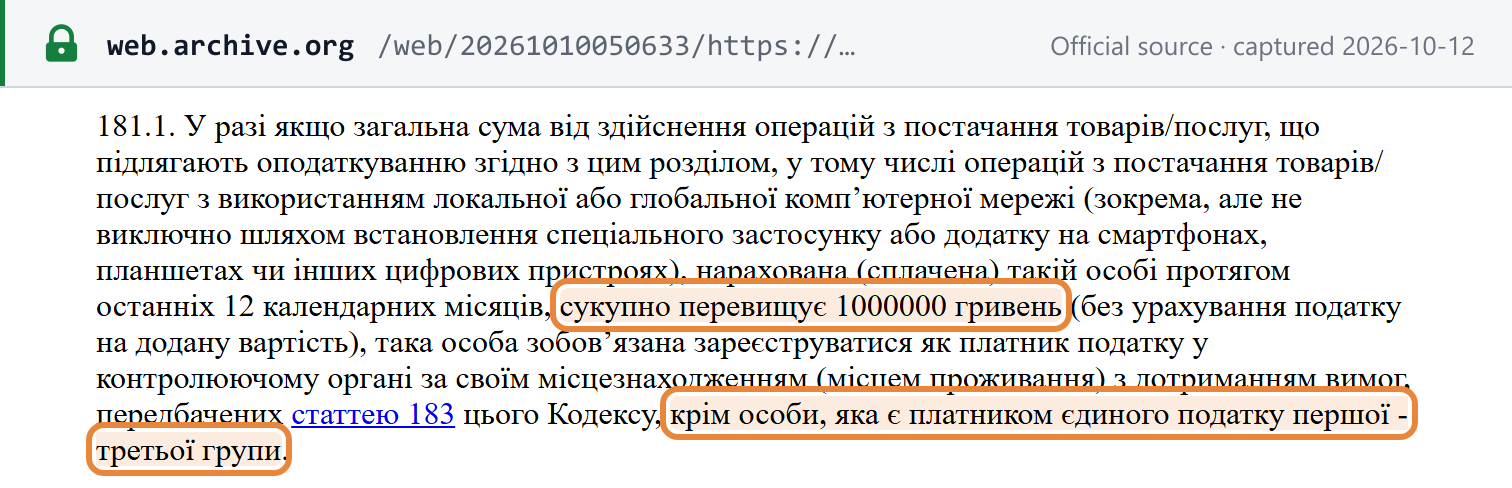
A business must register as a VAT payer once its taxable supplies over the last 12 calendar months add up to more than UAH 1,000,000, excluding VAT. Supplies made through websites, apps and other digital channels count toward the total. Payers of the single tax in groups 1 to 3 are excluded from this obligation (art. 181.1). [1]
A business that should have registered but did not still owes VAT as if it were registered, but with no input credit and no right to a refund (art. 183.10). [1]
Registration threshold
- Amount: UAH 1,000,000 of taxable supplies, excluding VAT (the wording was set by Law No. 1914-IX of 30 November 2021).
- Measurement: a rolling period of the last 12 calendar months, counting supplies as they are accrued or paid.
- Deadline: the registration application is due by the 10th of the month after the month in which the threshold is first reached (art. 183.2).
- Effective date: registration takes effect on the day the entry is made in the register of VAT payers. The State Tax Service has 3 working days to make it (art. 183.9). [1]
Single-tax (simplified) payers
- Groups 1 and 2 cannot be VAT payers.
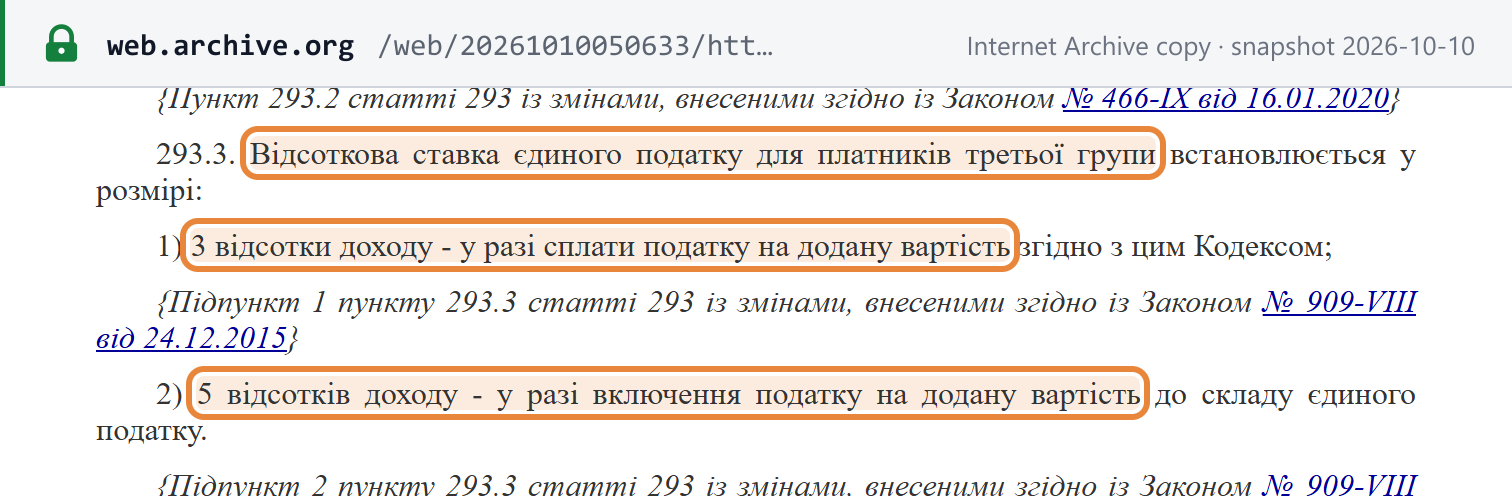
- Group 3 chooses between two single-tax rates: 3% of income plus VAT, which means registering for VAT, or 5% of income with VAT included (art. 293.3). The group 3 income limit is 1,167 times the minimum wage in force on 1 January of the year (art. 291.4).
- To move from 5% to 3%, the VAT registration application is due at least 10 days before the month in which the new rate applies (art. 183.4). Moving to a single-tax rate without VAT cancels VAT registration automatically (art. 184).
- E-residents use the 5% rate. [1]
No change to the single-tax carve-out has been enacted.
Non-resident registration
A non-resident with no permanent establishment in Ukraine cannot register under the domestic rules. Its one registration route is the electronic-services regime in art. 208-1, which is compulsory above the threshold and voluntary below it. Otherwise its sales are taxed in the following ways: [1]
| What the non-resident sells | Who accounts for the VAT | Threshold |
|---|---|---|
| Goods imported into Ukraine | The importer, at customs (arts. 180.1, 181.2) | None |
| Services to Ukrainian businesses (B2B) | The Ukrainian recipient, under the reverse charge (arts. 180.2, 208) | None |
| Electronic services to individuals (B2C) | The non-resident, after registering under art. 208-1 | More than the equivalent of UAH 1,000,000 in the previous calendar year |
A permanent establishment of a non-resident in Ukraine is a VAT person in its own right and registers under the domestic rules (art. 14.1.139). [1]
For the electronic-services regime, supplies to individuals in the previous calendar year are converted at the National Bank of Ukraine rate at the start of 1 January, and the application is due by 31 March (art. 208-1.2). The UAH figure matches the resident threshold, but it is measured over a calendar year, not a rolling 12 months. A non-resident below the threshold may register voluntarily by applying at least 10 calendar days before the tax period from which it wants to be registered (art. 208-1.2). [1] [2]

Tax identification number
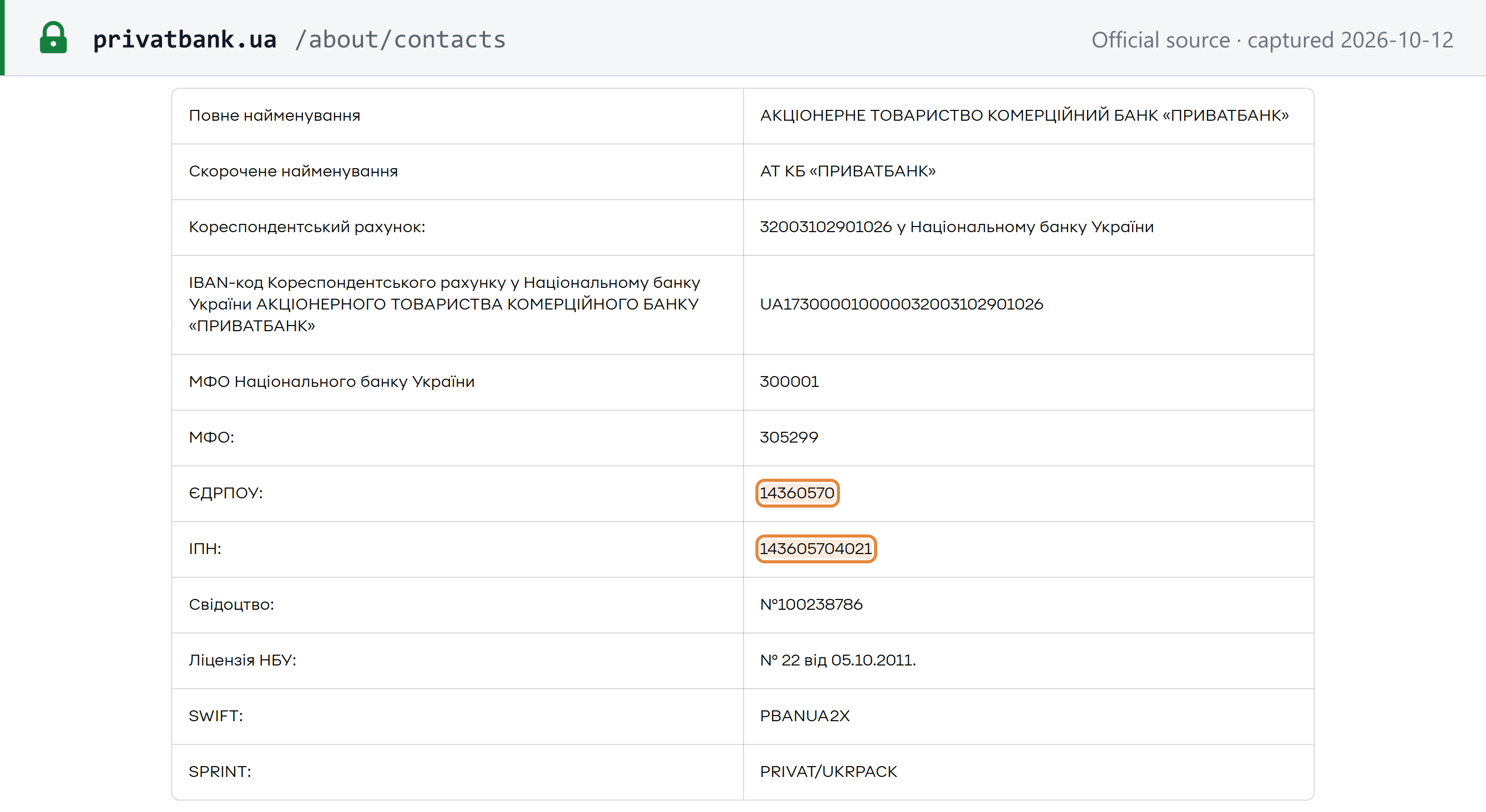
A VAT payer is given an individual tax number (ІПН) on registration (art. 183.18). [1] Its structure is set by Ministry of Finance Order No. 1130: [6]
- Legal entity: 12 digits — the first 7 digits of the EDRPOU code, a 2-digit region code, a 2-digit district code and a check digit. For example, PrivatBank's EDRPOU code
14360570corresponds to its VAT number143605704021. - Individual entrepreneur (ФОП): 12 digits — the 10-digit RNOKPP followed by 2 check digits.
- Non-resident registered for electronic services: 9 digits.
Ukrainian VAT numbers carry no UA prefix and are not in VIES. For the full format, the EDRPOU and RNOKPP, and how to check a number, see the Ukraine tax ID guide, or check an EDRPOU code with the EDRPOU validator.
How to register
- File form No. 1-ПДВ (the VAT registration application) electronically, in practice through the State Tax Service's Electronic Cabinet. A newly formed business can instead opt for VAT registration on its state-registration application (art. 183.7).
- The State Tax Service enters the registration within 3 working days (art. 183.9). An extract from the register of VAT payers is issued free of charge (art. 183.11).
- Once registered, a VAT account in the electronic VAT administration system (СЕА ПДВ) is opened automatically (art. 200-1.2). [1] [7]
Non-resident suppliers of electronic services register through the State Tax Service's separate electronic channel for non-residents (see Important websites).
Voluntary registration
Available: a business below the threshold may register "за її заявою" — on its own application (art. 182.1). Apply at least 10 calendar days before the tax period from which you want to be registered (art. 183.3). Registration takes effect from the date you ask for; if you give none, from the 1st of the month after the 10 days have passed (art. 183.9). [1]
The main reason to register is that only registered VAT payers may charge VAT, issue tax invoices and claim input credit (art. 201.8) — buyers who are VAT payers need a registered tax invoice to recover VAT on what they buy from you. [1]
Deregistration
Registration is cancelled: [1]
- on your application, if taxable supplies over the last 12 calendar months were below the registration threshold, provided your liabilities are paid (art. 184.1(а));
- on other grounds, including liquidation, a move to a single-tax rate without VAT, and failing for 12 consecutive tax months to file VAT returns or filing only returns that show no supplies or purchases (art. 184.1(б)–(з), 184.2).
The State Tax Service must give a reasoned refusal within 10 days if it refuses (art. 184.4). The final tax period ends on the date of cancellation (art. 184.6). VAT must be charged, at the ordinary price, on goods and assets whose input VAT was credited but which were never used in taxable supplies (art. 184.7). After cancellation you may not claim input credit or issue tax invoices (art. 184.5).
Group registration
Ukraine has no VAT grouping. A joint-activity agreement without a legal entity is treated as a separate VAT person (art. 180.1), and a branch adds its own branch number on tax invoices (art. 201.1(г)). [1] For how grouping works elsewhere, see VAT grouping explained.
Rates
"Податок становить 20 відсотків, 7 і 14 відсотків бази оподаткування та додається до ціни товарів/послуг" — VAT is 20%, 7% and 14% of the taxable base, added to the price (art. 194.1.1). [1]
| Rate | Applies to |
|---|---|
| 20% | Standard rate on most goods and services, and on imports |
| 14% | Supply and import of agricultural products under UKT ZED headings 1001 (wheat), 1003 (barley), 1005 (maize), 1201 (soya), 1205 (rapeseed) and 1206 00 (sunflower seeds) (art. 193.1(г), added by Law No. 1115-IX of 17 December 2020) |
| 7% | Registered medicines and medical devices (supply and import); products used in clinical trials; theatre, concert and other cultural performances; museum, zoo and nature-reserve visits; films adapted for people with impaired sight or hearing; hotel and similar accommodation (KVED class 55.10); tickets to national and international sports events (art. 193.1(в)) |
| 0% | Exports of goods and the other operations in art. 195 (see Imports and exports) |

Announced future rates. No rate change has been enacted.
Cross-border rules
Imports and exports
Imports. Importing goods is a taxable operation (art. 185.1). An importer that is not registered for VAT still pays it at customs (art. 181.2). The taxable base is the contract value, but not less than the customs value, plus customs duty and excise (art. 190.1). A registered importer claims the import VAT as input credit on the strength of the customs declaration (art. 201.12). [1]
De minimis and parcels. Goods in unaccompanied baggage with a total invoice value up to the equivalent of EUR 150 are outside the scope of VAT (art. 196.1.17). For international postal and express parcels, the postal or express operator that files the parcel register pays the VAT due (art. 180.2-1). [1] Under the current rules, goods in such parcels up to EUR 150 are not subject to VAT; the Ministry of Finance has described this as the position the parcel bills would change (see Marketplace / platform deemed-supplier liability). [4]
Exports. Goods exported under the customs export regime are taxed at 0%, proven by the customs declaration (art. 195.1.1). Other zero-rated operations include international carriage under a single international transport document, processing of imported goods that are then re-exported, and servicing aircraft on international flights (art. 195.1.3). [1]
Services to foreign customers are not zero-rated — many of them are simply outside Ukrainian VAT because their place of supply is abroad (see Place of supply).
Reverse charge on services from non-residents
When a non-resident supplies services whose place of supply is in Ukraine, "Особою, відповідальною за нарахування та сплату податку до бюджету … є отримувач послуг" — the recipient is liable for the VAT, except in the cases covered by art. 208-1 (art. 180.2). [1]
- A VAT-registered recipient charges VAT at 20% (or 7% for the cultural services in art. 193.1(в)), issues a tax invoice to itself and registers it. That invoice supports its input credit (arts. 208.2, 201.12).
- A business recipient that is not VAT-registered pays the VAT on a separate calculation, with no tax invoice (art. 208.4).
- The foreign supplier does not register. [1]

Digital products and services
An electronic service is one supplied over the internet, automatically and essentially without human involvement, including through apps (art. 14.1.56-5). The list includes: [1]
- electronic copies of texts, images and media, and access to them;
- databases and search;
- games, and video or audio on demand;
- access to information and entertainment resources;
- automated distance learning;
- cloud computing;
- software and updates, including remote maintenance;
- online advertising.
Goods and services ordered online but delivered offline are not electronic services. For how other countries tax these supplies, see VAT on digital services by non-resident suppliers.
Foreign companies selling into Ukraine — B2B and B2C
- Selling services to businesses (B2B): do not charge Ukrainian VAT and do not register. The Ukrainian business recipient accounts for the VAT under the reverse charge described above (arts. 180.2, 208). [1] For electronic services, a customer who gives you a Ukrainian VAT number (ІПН) is treated as a business. If the contract does not show that the customer is a business, the service is treated as supplied to an individual, including an individual entrepreneur (ФОП) who is not VAT-registered, so the sale falls under art. 208-1 and counts toward the UAH 1,000,000 threshold (art. 186.3-1).
- Selling electronic services to consumers (B2C): register under art. 208-1 once supplies to individuals in the previous calendar year exceeded the equivalent of UAH 1,000,000, by 31 March. You then: [1] [2]
- file a return for each quarter (art. 208-1.4), within 40 calendar days of its end (art. 208-1.8);
- pay the VAT "в іноземній валюті (євро або долар США)" — in euros or US dollars — within 30 calendar days after the filing deadline (art. 208-1.9);
- issue no tax invoices and claim no input VAT (art. 208-1.7).
- Selling goods to consumers (B2C): VAT is collected at import (see Imports and exports).

Marketplace / platform deemed-supplier liability
- Electronic services. A non-resident supplying electronic services through an electronic interface is itself treated as the VAT person for those services (art. 14.1.139). Intermediaries that name the actual supplier on the receipt, and pure payment processors, are excluded. [1]
- Goods. No marketplace deemed-supplier rule for goods is in force. Draft laws No. 16051-1 and No. 15460 would make marketplaces charge and pay 20% VAT on goods in international postal and express parcels from EUR 0, with a non-resident marketplace appointing an intermediary in Ukraine, and would take effect no earlier than July 2027. On 6 October 2026 the Verkhovna Rada's finance, tax and customs committee recommended them for second reading. They are not law. [4]

See marketplace deemed-supplier rules and IOSS explained for how other countries handle this.
Place of supply
- Goods: taxed where they are supplied in Ukraine, and on import at customs (arts. 185, 191). [1]
- Services — default rule: the place where the supplier is registered (art. 186.4).
- Services — recipient's location (art. 186.3): intellectual property, advertising, consulting, engineering, legal and accounting services, software development and data processing, supply of staff, leasing of movable property other than vehicles, and telecoms and broadcasting. When a Ukrainian business sells these services to a foreign customer, they fall outside Ukrainian VAT.
- Electronic services to consumers (art. 186.3-1): "Місцем постачання електронних послуг вважається місцезнаходження отримувача послуг" — the recipient's location. It is shown by the fixed-line location, the SIM-card country code, or the IP address or access-card country, together with one corroborating item such as a billing address or bank account. Unless the contract shows the customer is a business, the service is treated as supplied to an individual, including a sole proprietor (ФОП) not registered for VAT. [1]
Invoice requirements
Every VAT payer must issue a tax invoice (податкова накладна) for every taxable supply, including supplies to consumers and exempt supplies, and for every prepayment received (art. 201.7). It is issued electronically, with a qualified or advanced electronic signature, dated on the day the tax liability arises, and registered in the Unified Register of Tax Invoices (ЄРПН) run by the State Tax Service (art. 201.1). [1] The tax point is the earlier of payment and shipment of the goods or, for services, the document evidencing the supply (art. 187.1).
Mandatory content
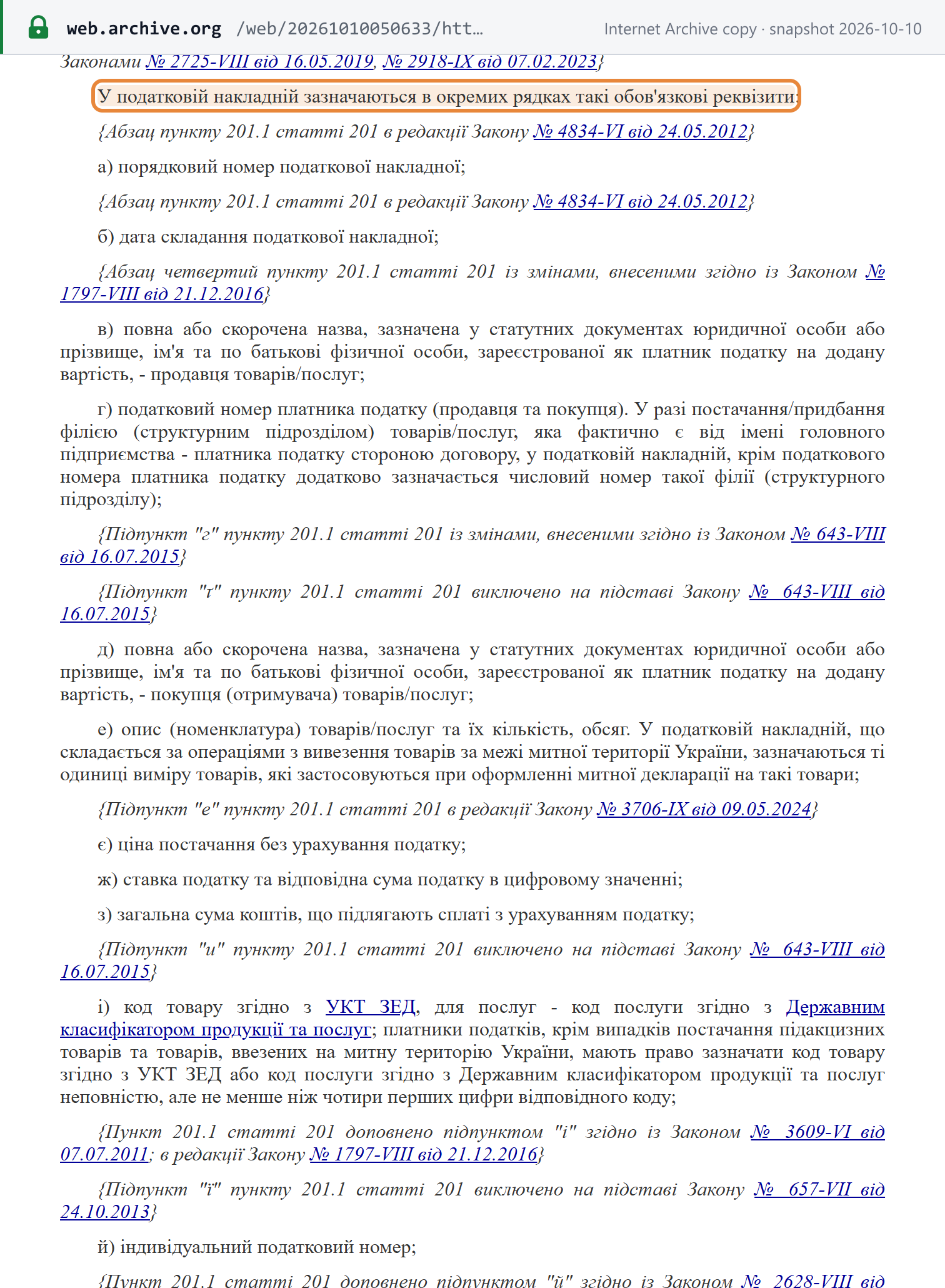
Each of the following must appear on its own line (art. 201.1): [1]
| Clause | Field |
|---|---|
| (а) | Sequential number of the tax invoice |
| (б) | Date of the tax invoice |
| (в) | Seller's full or short name (or the full name of an individual seller) |
| (г) | Tax numbers of the seller and the buyer; plus the branch number where a branch makes or receives the supply |
| (д) | Buyer's full or short name |
| (е) | Description and quantity of the goods or services (for exports, in the units used on the customs declaration) |
| (є) | Price excluding VAT |
| (ж) | VAT rate and VAT amount |
| (з) | Total payable including VAT |
| (і) | UKT ZED goods code or DKPP services code — at least the first 4 digits; the full code for excisable and imported goods |
| (й) | Individual tax number (ІПН) |
| (к), (л) | Exports only: date and number of the customs declaration, and of the contract |
An exempt supply is marked "Без ПДВ" with the legal basis for the exemption (art. 201.3), and taxable and exempt supplies go on separate invoices (art. 201.5). The form of the invoice is set by the Ministry of Finance (art. 201.2; Order No. 1307). [1] [9]
Issuance deadline
The invoice is made out on the date the tax liability arises and must then be registered in the ЄРПН within a deadline: [1]
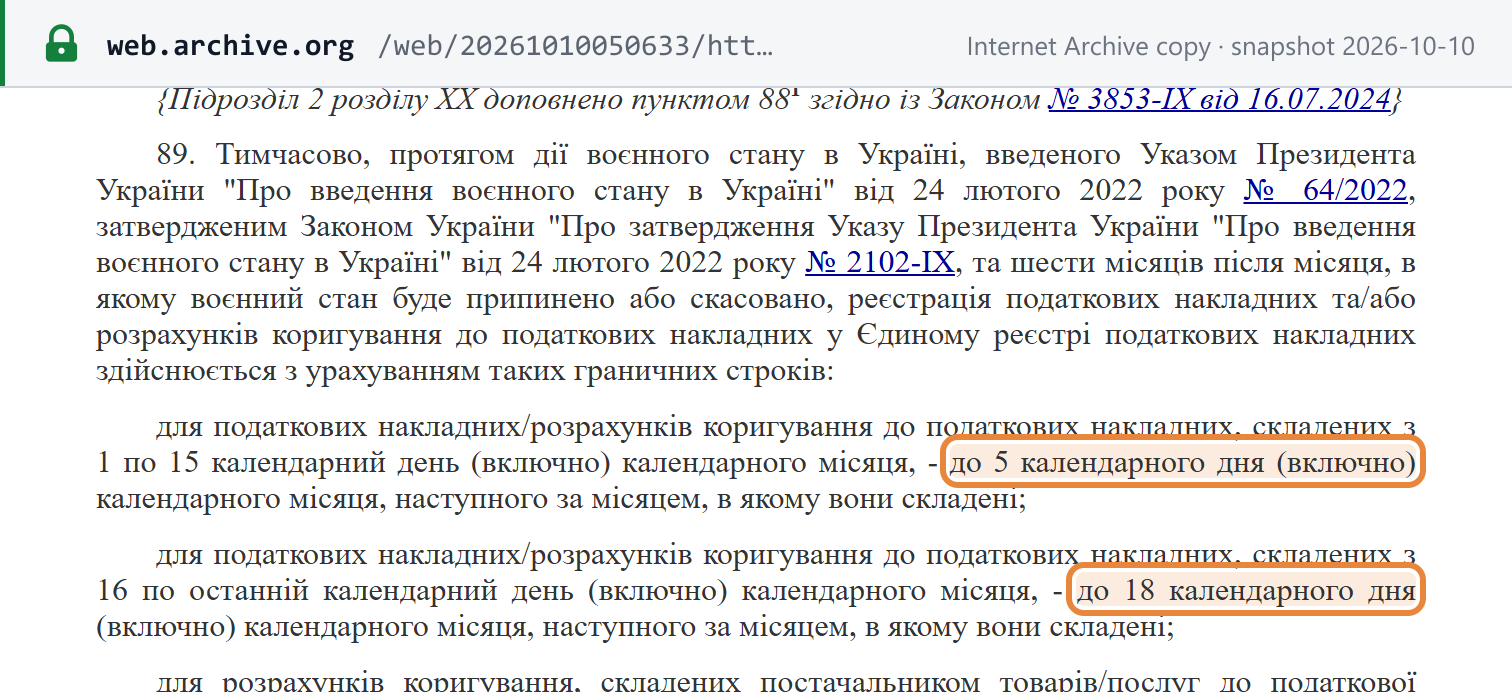
| Invoice dated | Temporary rule — during martial law and for six months after the month in which martial law ends (section XX, subsection 2, item 89) | Permanent rule (art. 201.10) |
|---|---|---|
| 1st to 15th of the month | By the 5th of the following month | By the last day of the same month |
| 16th to end of the month | By the 18th of the following month | By the 15th of the following month |
| Downward adjustment registered by the buyer | Within 18 days of receipt | Within 15 days of receipt |
The temporary deadlines were introduced by Law No. 2876-IX of 12 January 2023. Consolidated invoices under arts. 198.5 and 199.1 are registered within 20 days of month-end under the permanent rule. The ЄРПН sends a receipt within the operating day; if it sends none that day, the invoice counts as registered (art. 201.10). The amount of VAT you can register is capped by your electronic VAT account balance (art. 200-1.3). [1]
Numbering and sequencing
Each tax invoice carries a sequential number (art. 201.1(а)). Detailed numbering rules are set in the Ministry of Finance's form order (Order No. 1307). [1] [9]
Credit and debit notes
A change to the price or quantity after the supply is made with an adjustment calculation (розрахунок коригування) to the original tax invoice. It is prepared the same way as a tax invoice and registered in the ЄРПН (art. 192.1). Where the adjustment reduces the amount and the buyer is a VAT payer, the buyer registers it (art. 201.10). [1]
Currency and language
The VAT section of the Tax Code sets no currency or exchange-rate rule for domestic tax invoices; the invoice is the Ministry of Finance's fixed electronic form (art. 201.2; Order No. 1307). Statutory conversion rules exist for imports, which use the National Bank of Ukraine rate (arts. 39-1 and 190.1), and for the non-resident electronic-services return, which is filed in euros or US dollars. [1]
Document types
- Tax invoice — the standard document for every supply.
- Consolidated tax invoice — one invoice a month per buyer for supplies of a continuous or rhythmic nature (безперервний або ритмічний характер), and one on daily totals for cash retail sales, tickets, hotel bills, utility bills and till receipts (art. 201.4).
- Documents that support input credit without a tax invoice — transport tickets, hotel bills and utility bills that show the VAT and the supplier's tax number, and till receipts up to UAH 200 a day excluding VAT (art. 201.11). [1]
Self-billing
The Tax Code provides no buyer-issued domestic tax invoice. The only invoice a buyer issues to itself is the reverse-charge invoice for services bought from a non-resident (art. 208.2). [1]
Retention and audit trail
- Retention (art. 44.3): 1,095 days for most documents; 1,825 days for primary documents, registers and statements of corporate-profit-tax payers and of legal entities on the simplified system; 2,555 days for transfer-pricing documents. [1]
- Assessment period: the State Tax Service can assess tax for 1,095 days (2,555 days for transfer pricing) (art. 102.1).
- Electronic archive: tax invoices exist only in electronic form, in the ЄРПН; the buyer obtains them from the register (art. 201.10). Documents obtained from the ЄРПН are excluded from the duty to hand over originals to the tax authority (art. 121.1).
- Penalty for not keeping records: UAH 1,020; UAH 2,040 for a repeat within a year (art. 121.1).

A specimen of a compliant invoice
The State Tax Service publishes no annotated specimen. Below, Lookuptax lays out the fields of art. 201.1 for a domestic B2B sale between two VAT payers. Every name, number and amount is fictional:
Податкова накладна — tax invoice (illustrative layout)
| Description and quantityart. 201.1(е) | UKT ZED / DKPP codeart. 201.1(і) — at least 4 digits | Price excl. VATart. 201.1(є) | VAT rateart. 201.1(ж) |
|---|---|---|---|
| Office chairs, 10 pcs | 9401 | UAH 20,000.00 | 20% |
| Assembly service | 3312 | UAH 5,000.00 | 20% |
- Total excluding VAT
- UAH 25,000.00
- VAT at 20%art. 201.1(ж)
- UAH 5,000.00
- Total payable including VATart. 201.1(з)
- UAH 30,000.00
- Issued electronically with a qualified or advanced electronic signature, then registered in the ЄРПН; the register returns a receipt within the operating day (art. 201.10).
- Register by the 5th of the following month for invoices dated the 1st to 15th, and by the 18th for those dated the 16th onwards, during martial law and for six months after the month in which it ends (section XX, subsection 2, item 89).
- An exempt supply goes on a separate invoice marked "Без ПДВ" with the legal basis for the exemption (arts. 201.3, 201.5).
- For an export, add the date and number of the customs declaration and of the contract (art. 201.1(к), (л)).
E-invoicing status
Status: mandatory, register-based clearance for all VAT payers. Every tax invoice is issued electronically and registered in the State Tax Service's Unified Register of Tax Invoices (ЄРПН) (art. 201.1). For invoices made out and registered after 1 July 2017, a registered invoice is on its own enough to support the buyer's input credit (art. 201.10). [1]
- System. The ЄРПН, operated by the State Tax Service and reached through the Electronic Cabinet.
- Scope. All supplies by VAT payers — B2B, B2C and exempt supplies alike. There is no phase-in by taxpayer size.
- Format. The Ministry of Finance's electronic tax-invoice form (Order No. 1307). [9]
- Suspension (blocking). Registration "може бути зупинена в порядку та на підставах, визначених Кабінетом Міністрів України" — can be suspended on grounds set by the Cabinet of Ministers (art. 201.16), under Cabinet Resolution No. 1165 of 11 December 2019. [10] While an invoice is suspended, late-registration penalties do not run (art. 120-1.1) and the buyer's 365-day input-credit period is paused (art. 198.6). [1]
- Other networks. Ukraine has no Peppol mandate and no separate structured commercial e-invoicing mandate.
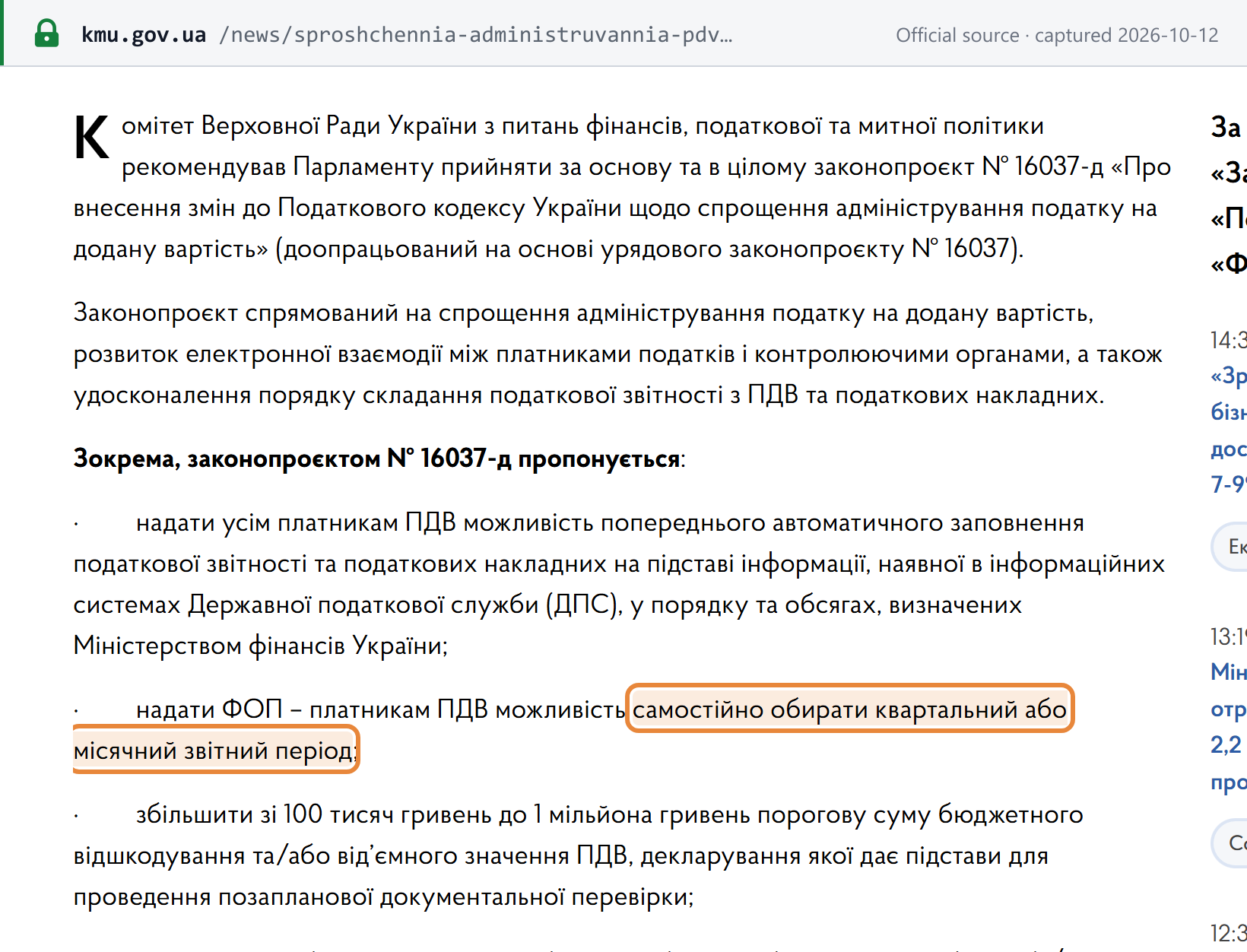
- Pending. Draft law No. 16037-д would allow pre-filled VAT returns and tax invoices from State Tax Service data; it is not law (see Recent changes). [5]

For how a register-based system compares with other models, see CTC e-invoicing models and the e-invoicing status and networks table.
Filing and payment
Filing frequency
| Who | Frequency |
|---|---|
| Every resident VAT payer | Monthly (art. 202.1) |
| Non-resident registered for electronic services | Quarterly (art. 208-1.4) |
The frequency does not depend on turnover. A quarterly option for VAT-registered individual entrepreneurs exists only in draft law No. 16037-д, which is not law. [1] [5]
Return due date
The monthly return is due "протягом 20 календарних днів, що настають за останнім календарним днем звітного (податкового) місяця" — within 20 calendar days after the last day of the month (art. 203.1). Non-resident electronic-services suppliers file within 40 calendar days after the end of the quarter (art. 208-1.8). [1]

Payment due date and method
- Due date: within 10 calendar days after the filing deadline (art. 203.2) — in practice, by the 30th of the following month.
- Method: VAT is paid through your account in the electronic VAT administration system (СЕА ПДВ), which is opened automatically on registration (art. 200-1).
- Non-residents (art. 208-1): in euros or US dollars, within 30 calendar days after the quarterly filing deadline. [1]
Additional listings
There is no separate annual VAT return or sales and purchase listing; the ЄРПН already holds every registered invoice.
Input-tax recovery and blocked items
- What supports a claim: a registered tax invoice or adjustment calculation, a customs declaration, or one of the documents in art. 201.11 (art. 198.6).
- Time limit: 365 calendar days from the date of the invoice. An invoice registered late is credited in the month it is registered, within those 365 days (art. 198.6).
- If the seller does not register the invoice: attach a complaint about the seller to your VAT return. The deadline is 365 calendar days after the filing deadline of the return for the period in which the invoice was not provided or registered (art. 201.10). This runs from the return deadline, not from the invoice date, and is separate from the 365-day input-credit limit above.
- Blocked items: there is no category list of blocked items (such as cars or entertainment). Instead, VAT must be charged on goods and services used for exempt, out-of-scope or non-business purposes (art. 198.5), and input VAT on mixed-use purchases is apportioned (art. 199). [1]
Refunds
- Negative VAT is set off against tax debt, refunded on application, or carried forward. A refund is limited to VAT actually paid and capped by the amount in art. 200-1.3 (art. 200.4).
- Timeline: a desk audit within 20 calendar days after the return's filing deadline (art. 200.10, second paragraph, as amended by Law No. 3603-IX); an optional field audit within 40 days (art. 200.11); the Treasury pays within 5 operating days after the amount is agreed (art. 200.13).
- Late refunds are treated as a budget debt and carry interest at 120% of the NBU discount rate (art. 200.23).
- No refunds for sanctioned persons (art. 200.4-1) or on first supplies of housing (art. 200.4-2). [1]
- Non-residents and bad debts: there is no refund scheme for unregistered non-residents and no bad-debt relief.
Exemptions
Exempt supplies
Exempt operations under art. 197.1 include, for example: [1]
- baby food and goods for infants;
- education;
- licensed medical services, and rehabilitation;
- urban public transport (not taxis);
- religious and funeral services;
- housing, except its first supply (art. 197.1.14);
- land plots (art. 197.1.21);
- charitable aid;
- research funded from the state budget;
- periodicals and books (art. 197.1.25).
Outside the scope of VAT (art. 196) — a separate category from exempt — are, among others, dealings in securities, insurance and currency; payments of wages and similar sums, including royalties (art. 196.1.6); and reorganisations.
Software is no longer exempt. The temporary exemption for supplies of software products applied only "з 1 січня 2013 року до 1 січня 2023 року" — from 1 January 2013 to 1 January 2023 (section XX, subsection 2, item 26-1). Software is now taxed at 20%, unless the payment is a royalty. [1]

Temporary exemptions tied to martial law and defence
The transitional provisions (section XX, subsection 2) contain temporary exemptions, including: [1]
- imports of the goods listed in item 9-24 of the Customs Code, no later than 1 January 2027 (item 92);
- defence software services (item 93);
- imports of components of aerial, ground and water unmanned systems, fibre-optic cable coils, active means of countering technical reconnaissance, mechanised demining machines, and remote-controlled weapon systems and ammunition used with unmanned systems (item 95);
- domestic supply of ground unmanned systems, weapons and ammunition under defence contracts (item 99-1, added by Law No. 4894-IX of 28 May 2026 and amended by Law No. 4967-IX of 3 September 2026);
- import and domestic supply of all-terrain vehicles (UKT ZED 8703/8704) for defence (item 32, as amended by Law No. 4967-IX);
- imports of inputs for weapons production (art. 197.23, as amended by Law No. 4967-IX).
Exempt is not zero-rated
- Zero-rated supplies, such as exports, keep the full input credit and the right to a refund.
- Exempt and out-of-scope supplies do not: input VAT already credited on purchases used for them must be charged back (art. 198.5(а)–(б)). [1]
- An exempt good that is exported becomes zero-rated (art. 195.2).
Special regimes
- Single tax for small businesses (see Single-tax payers).
- Tour operators — special taxable base (art. 207).
- Margin scheme for works of art, collectors' items and antiques (art. 210).
- Agricultural special regime (art. 209) — ended on 1 January 2017. [1]
Offences and penalties
Offences
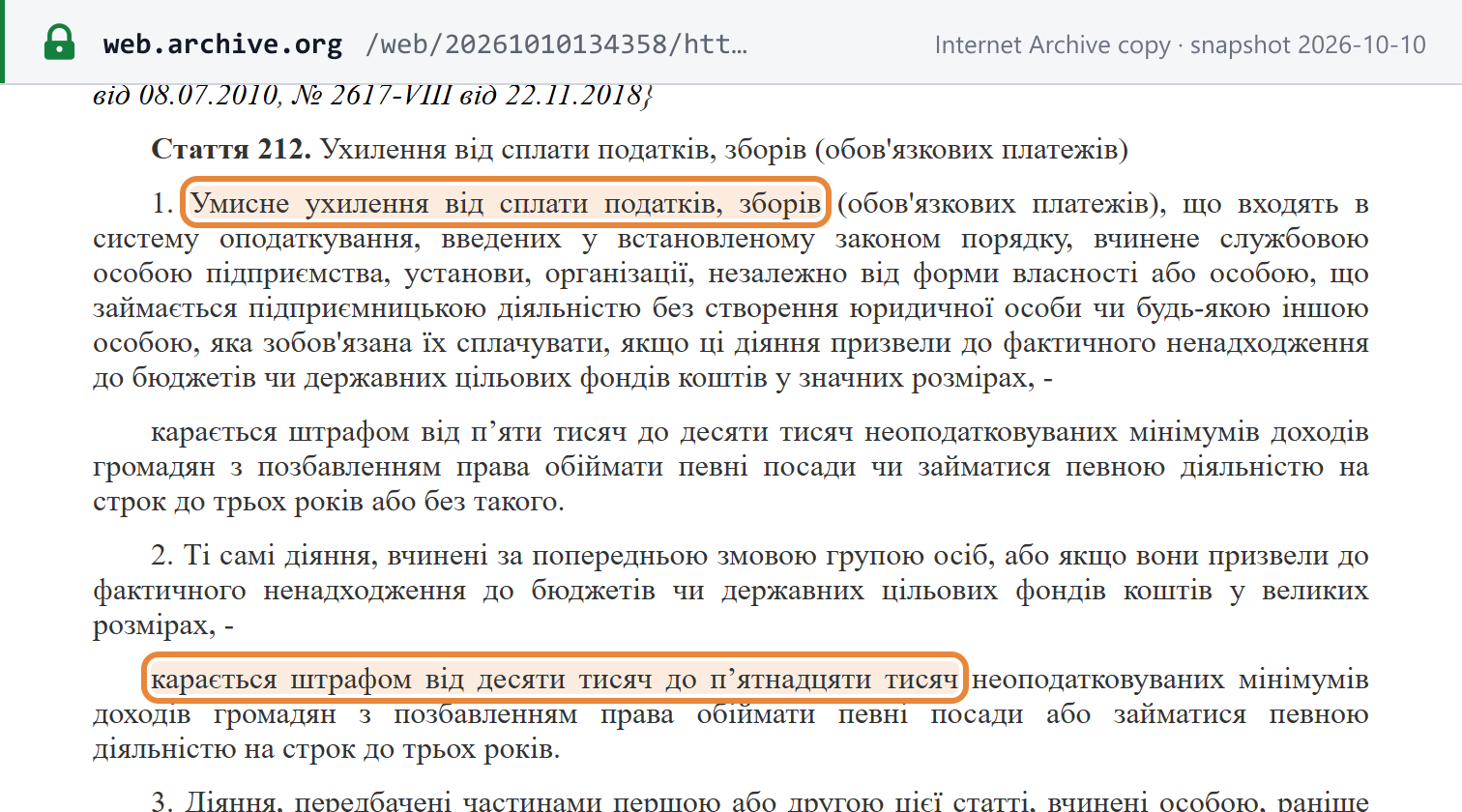
Tax evasion is a crime under art. 212 of the Criminal Code of Ukraine ("ухилення від сплати податків"). It applies to the wilful evasion of taxes that causes the budget a loss of at least a set multiple of the untaxed minimum income of citizens (НМДГ). It is punished by fines, not imprisonment: [3]
| Conduct | Fine |
|---|---|
| "Significant" loss (at least 3,000 × НМДГ) | 5,000–10,000 × НМДГ, with or without a ban on holding certain posts for up to 3 years |
| By a group, or a "large" loss (at least 5,000 × НМДГ) | 10,000–15,000 × НМДГ, with a ban on holding certain posts or carrying on certain activities for up to 3 years |
| Repeat offence, or an "especially large" loss (at least 7,000 × НМДГ) | 15,000–25,000 × НМДГ, plus a ban and confiscation of property |
A person is released from criminal liability if the amounts due are paid in full before prosecution (art. 212.4). [3]
Failure to register for VAT is not a separate fined offence; the business owes VAT as if registered, without input credit (art. 183.10). [1]
Penalties
Late registration of a tax invoice in the ЄРПН is penalised as a percentage of the VAT on the invoice, by days late. Two scales exist: [1]
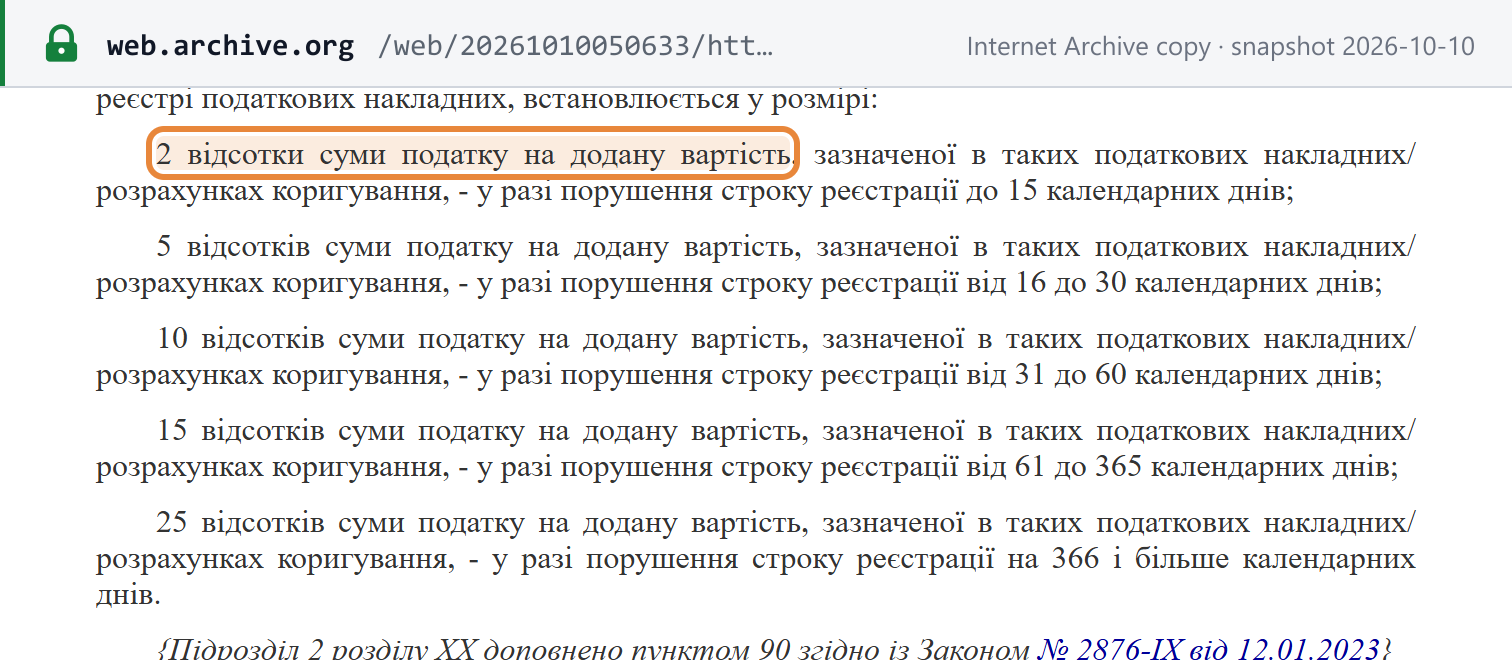
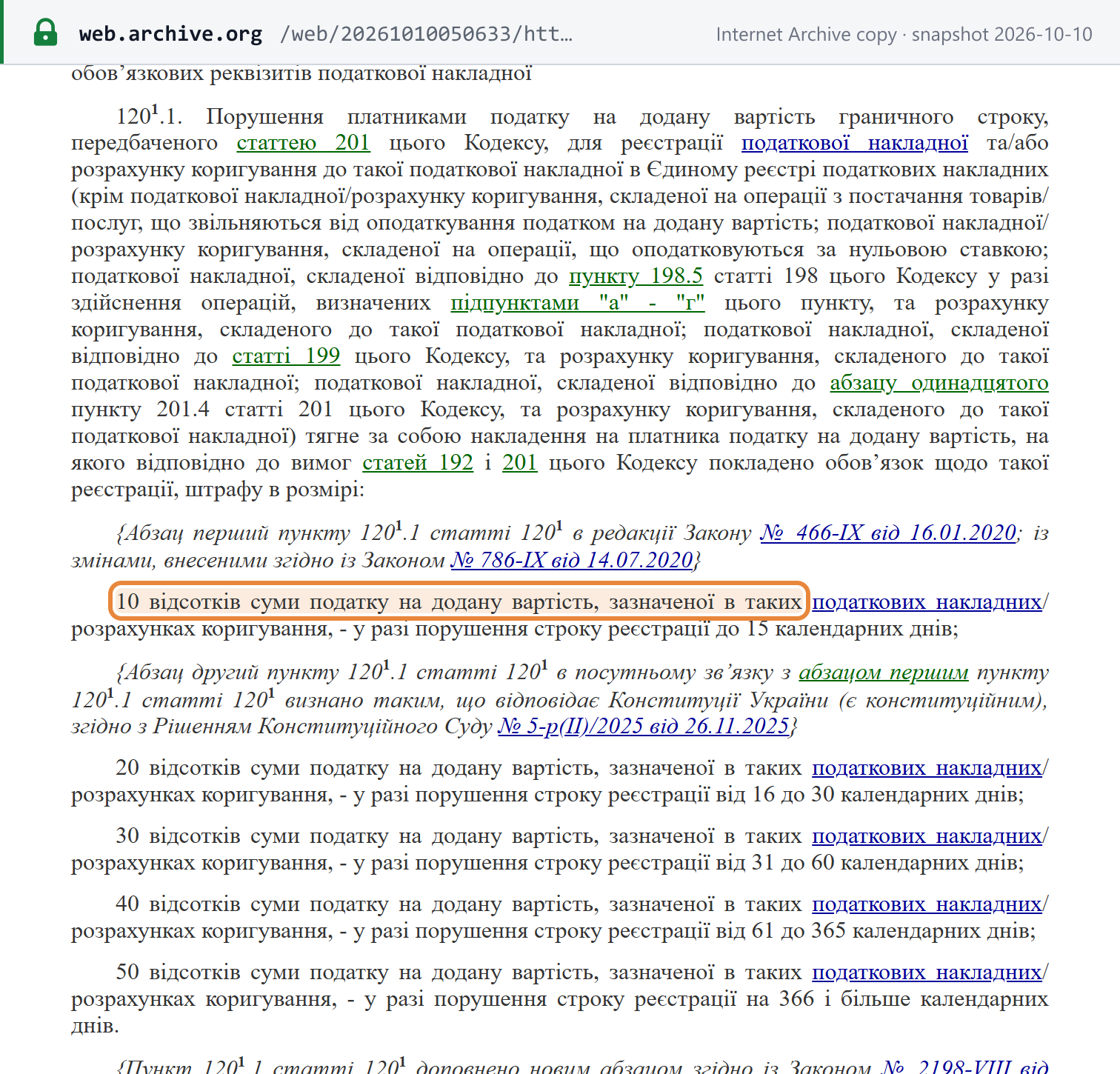
| Days late | Temporary scale — during martial law and for six months after the month in which it ends (section XX, subsection 2, item 90) | Permanent scale (art. 120-1.1) |
|---|---|---|
| Up to 15 | 2% | 10% |
| 16–30 | 5% | 20% |
| 31–60 | 10% | 30% |
| 61–365 | 15% | 40% |
| 366 or more | 25% | 50% |
Under the permanent scale, zero-rated and exempt invoices carry 2% of the supply value instead. No penalty runs while registration is suspended. An invoice still not registered 10 days after a tax notice carries a penalty of 50% of the VAT; registering it within those 10 days waives both penalties (art. 120-1.2).
| Penalty | Amount |
|---|---|
| Late or missing return | UAH 340; UAH 1,020 for a repeat within a year (art. 120.1) |
| Errors in mandatory invoice particulars (found on a buyer's complaint) | UAH 170, then 10%–100% of the VAT if not corrected (art. 120-1.3) |
| Understatement of tax | 10% of the understated amount; 25% if intentional (arts. 123.1–123.2) |
| Late payment | 5% if paid within 30 days of the due date; 10% if paid later (art. 124.1); 25% if the non-payment is intentional (art. 124.2); 50% only where intentional non-payment is repeated within 1,095 days or the tax is more than 90 days late (art. 124.3) |
| Late-payment interest (пеня) | Self-assessed tax paid late: 100% of the NBU discount rate, from the 91st day; tax assessed by the State Tax Service: 120% of the NBU discount rate (art. 129.4) |
| Failure to keep records | UAH 1,020; UAH 2,040 for a repeat within a year (art. 121.1) |
Martial-law relief (temporary). Payers who cannot meet a tax obligation on time during martial law are relieved of liability, provided they meet it within six months after martial law ends (section XX, subsection 10, item 69.1). From 1 August 2023 until martial law ends, voluntarily correcting your own errors carries no penalties or interest (item 69.38). [1]
Frequently asked questions
We are a foreign SaaS provider selling to consumers in Ukraine. When do we have to register for VAT?
When your supplies of electronic services to individuals in Ukraine in the previous calendar year exceeded the equivalent of UAH 1,000,000, converted at the National Bank of Ukraine rate at the start of 1 January. The registration application is due by 31 March of the following year. You then file a return every quarter, within 40 calendar days of the quarter end, and pay the VAT in euros or US dollars within 30 calendar days after the filing deadline. You do not issue tax invoices and cannot claim input VAT (Tax Code art. 208-1).
Our Ukrainian client is a business. Do we charge Ukrainian VAT?
No. When a non-resident supplies services whose place of supply is in Ukraine, the Ukrainian recipient charges the VAT itself under the reverse charge (Tax Code arts. 180.2 and 208). For many business services, such as consulting, legal, accounting, advertising, software development, data processing and the licensing of intellectual property, the place of supply is where the recipient is registered (art. 186.3), so these are the services your client accounts for.
Can I deduct VAT on an invoice my supplier has not registered in the ЄРПН?
No. Input VAT is supported by a tax invoice registered in the Unified Register of Tax Invoices (ЄРПН). If the seller does not register it, you can attach a complaint about the seller to your VAT return. The deadline for the complaint is 365 calendar days after the filing deadline of the return for the period in which the seller failed to provide or register the invoice (Tax Code art. 201.10). This is separate from the time limit for the input-credit claim itself, which is 365 calendar days from the invoice date (art. 198.6).
My tax invoice was blocked. What happens now?
The State Tax Service can suspend registration of a tax invoice on grounds set by the Cabinet of Ministers (Tax Code art. 201.16). While registration is suspended, late-registration penalties do not run against the seller (art. 120-1.1), and the 365-day period in which the buyer may claim input VAT is paused (art. 198.6).
Do I file VAT returns monthly or quarterly?
Monthly, if you are a resident VAT payer. The return is due within 20 calendar days after the end of the month, and the VAT within 10 calendar days after that filing deadline (Tax Code arts. 202.1 and 203). As at 2026-10-13 a quarterly option for VAT-registered sole proprietors existed only in draft law No. 16037-д, which is not law. Non-resident suppliers of electronic services file quarterly.
Is software exempt from VAT in Ukraine?
No longer. The temporary exemption for supplies of software products applied only from 1 January 2013 to 1 January 2023 (Tax Code section XX, subsection 2, item 26-1). Software is now taxed at the standard 20% rate. Royalty payments remain outside the scope of VAT (art. 196.1.6).
I am a group 3 single-tax sole proprietor. Must I register for VAT above UAH 1 million?
Not under current law. The UAH 1,000,000 registration rule excludes payers of the single tax of groups 1 to 3 (Tax Code art. 181.1). A group 3 payer can choose to register and pay single tax at 3% of income plus VAT, or stay at 5% of income with VAT included (art. 293.3). No change to the single-tax carve-out had been enacted as at 2026-10-13.
By when must a tax invoice be registered in the ЄРПН?
Under a temporary rule that applies during martial law and for six months after the month in which martial law ends, an invoice dated the 1st to the 15th of a month must be registered by the 5th of the following month, and one dated the 16th or later by the 18th of the following month (Tax Code section XX, subsection 2, item 89). After that period the permanent deadlines in art. 201.10 apply again: the last day of the same month, and the 15th of the following month.
Important websites
| Site | Purpose |
|---|---|
| Electronic Cabinet (Електронний кабінет) | Register for VAT (form 1-ПДВ), file returns, register tax invoices in the ЄРПН, view your VAT account |
| Electronic Cabinet — registers | Look up the register of VAT payers |
| State Tax Service — for non-resident providers of e-services | Registration and guidance under art. 208-1 for non-resident suppliers |
| State Tax Service | Guidance, forms and news |
| Unified State Register (ЄДР) search | Check a company's registration and EDRPOU code |
| EDRPOU validator | Check the format of an EDRPOU code |
| Tax Code of Ukraine | The current consolidated text of the law |
Recent changes
- 2026-10-06 — The Ministry of Finance reported that the Rada's finance, tax and customs committee recommended adopting draft law No. 16037-д on simplifying VAT administration. It would let VAT-registered individual entrepreneurs choose quarterly or monthly reporting, allow pre-filled returns and tax invoices, and raise the threshold for an unscheduled audit of refund claims from UAH 100,000 to UAH 1 million. Not law. (Ministry of Finance) — see event
- 2026-10-06 — The Rada committee recommended draft laws No. 16051-1 and No. 15460 for second reading. They would charge VAT from EUR 0 on goods in international parcels, collected by marketplaces, no earlier than July 2027. Not law. (Ministry of Finance) — see event
- 2026-09-03 — Law No. 4967-IX extended the defence-related VAT exemptions (art. 197.23 and transitional items 32 and 99-1); in the consolidated Tax Code from 17 September 2026. (Verkhovna Rada)
- 2026-05-28 — Law No. 4894-IX exempted domestic supplies of ground unmanned systems, weapons and ammunition under defence contracts (transitional item 99-1). (Verkhovna Rada)
For the full chronology, see Ukraine tax changes on Lookuptax.
Reference links
- Verkhovna Rada — Tax Code of Ukraine, Law No. 2755-VI (consolidated text as amended to 17 September 2026)
- State Tax Service — information for non-resident providers of electronic services
- Verkhovna Rada — Criminal Code of Ukraine, art. 212
- Cabinet of Ministers / Ministry of Finance — Rada committee recommends the parcel taxation bills (October 2026)
- Cabinet of Ministers / Ministry of Finance — Rada committee recommends draft law No. 16037-д on VAT administration
- Verkhovna Rada — Ministry of Finance Order No. 1130 (VAT payer registration)
- State Tax Service — information card No. 76: VAT payer registration (PDF)
- State Tax Service — section for non-resident providers of electronic services
- Verkhovna Rada — Ministry of Finance Order No. 1307 (tax invoice form and procedure)
- Verkhovna Rada — Cabinet of Ministers Resolution No. 1165 of 11 December 2019 (suspension of tax invoice registration)
Related on Lookuptax:
- Ukraine tax ID guide (EDRPOU, RNOKPP and VAT number)
- EDRPOU validator
- VAT registration thresholds worldwide
- Worldwide tax rates
- E-invoicing status and networks worldwide
- CTC e-invoicing models — clearance, reporting and interchange
- VAT on digital services by non-resident suppliers
- Marketplace deemed-supplier rules
- Reverse charge explained
- Neighbouring country guides: Poland, Romania, Moldova