VAT grouping — when several companies count as one taxable person
VAT grouping is an option that lets a country treat several legally independent persons established on its territory as a single taxable person for VAT, where they are closely bound by financial, economic and organisational links. In a full VAT group (a single taxable person), the group files one return, supplies between its members fall outside the scope of VAT, and purchases from outsiders are made to the group. Some national regimes differ: Spain, Romania and Portugal consolidate the members' VAT positions instead, and in Latvia members keep their own VAT numbers for dealings with outsiders (see the jurisdiction table).
In the EU the legal basis is Article 11 of the VAT Directive (Council Directive 2006/112/EC): "After consulting the advisory committee on value added tax (hereafter, the 'VAT Committee'), each Member State may regard as a single taxable person any persons established in the territory of that Member State who, while legally independent, are closely bound to one another by financial, economic and organisational links." Its second paragraph adds that a Member State using the option "may adopt any measures needed to prevent tax evasion or avoidance through the use of this provision." The rule is set by the Council of the EU and is optional: each Member State decides whether to offer grouping and on what terms, in its national VAT law. Its predecessor was Article 4(4), second subparagraph, of the Sixth Directive 77/388/EEC, which several of the judgments below interpret. (VAT Directive, consolidated version of 14.04.2025, checked 2026-10-07)
 Source snapshot captured 2026-10-07 — original (Publications Office of the EU, consolidated text of 14.04.2025)
Outside the EU, similar regimes exist under national law: VAT groups in the UK, fellesregistrering in Norway and GST group registration in Singapore (see the jurisdiction table).
How it works
The three links, and the territorial limit
Article 11 asks for all three links (financial, economic and organisational), and only persons established in the territory of that Member State can be grouped. National law turns the links into concrete tests, usually a capital or voting threshold for the financial link. Some examples from the national texts: more than 50% of capital or votes in Spain, at least 75% of capital plus more than 50% of votes in Portugal, and at least 85% of capital in Norway (sources in the jurisdiction table).
The territorial limit has a sharp consequence for branches. A company's head office and its branch are one legal person, but where the head office sits in a VAT group in one Member State and the branch is in another, the Court of Justice held in Danske Bank (C-812/19, 11 March 2021) that they "must be regarded as separate taxable persons where that principal establishment provides that branch with services and imputes the costs thereof to the branch." The Court noted that, "having regard to the territorial limits resulting from the first paragraph of Article 11 of the VAT Directive, the Swedish branch of Danske Bank cannot be regarded as forming part of the Danish VAT group in question." (C-812/19, EUR-Lex, checked 2026-10-07)
 Source snapshot captured 2026-10-07 — original (Publications Office of the EU, judgment C-812/19)
What changes once a group exists
-
One taxable person, one VAT number, one return. In Ampliscientifica and Amplifin (C-162/07, 22 May 2008) the Court held that grouped persons are "no longer to be treated as separate taxable persons for the purposes of value added tax in order to be treated as a single taxable person to whom a single value added tax identification number is allocated and, accordingly, the sole person entitled to submit value added tax declarations." In Skandia (C-7/13, 17 September 2014, para 29) it added that grouping "precludes the members of the VAT group from continuing to submit VAT declarations separately and from continuing to be identified, within and outside their group, as individual taxable persons." (C-162/07; C-7/13, EUR-Lex, checked 2026-10-07)
-
Supplies between members are outside the scope of VAT. In Finanzamt T II (C-184/23, 11 July 2024) the Court ruled that services provided for consideration between members of a group designated as a single taxable person "are not subject to value added tax (VAT), even where the VAT due or paid by the recipient of those services cannot be subject to an input deduction." The reason given: "within the framework of a VAT group, the right to deduct input VAT due or paid is conferred on the group itself and not on its members." (C-184/23, EUR-Lex, checked 2026-10-07)
-
Purchases from outsiders are made to the group. "The supplies of services made by a third party to a member of a VAT group must be considered, for VAT purposes, to have been made not to that member but to the actual VAT group to which that member belongs" (Skandia, para 29).
-
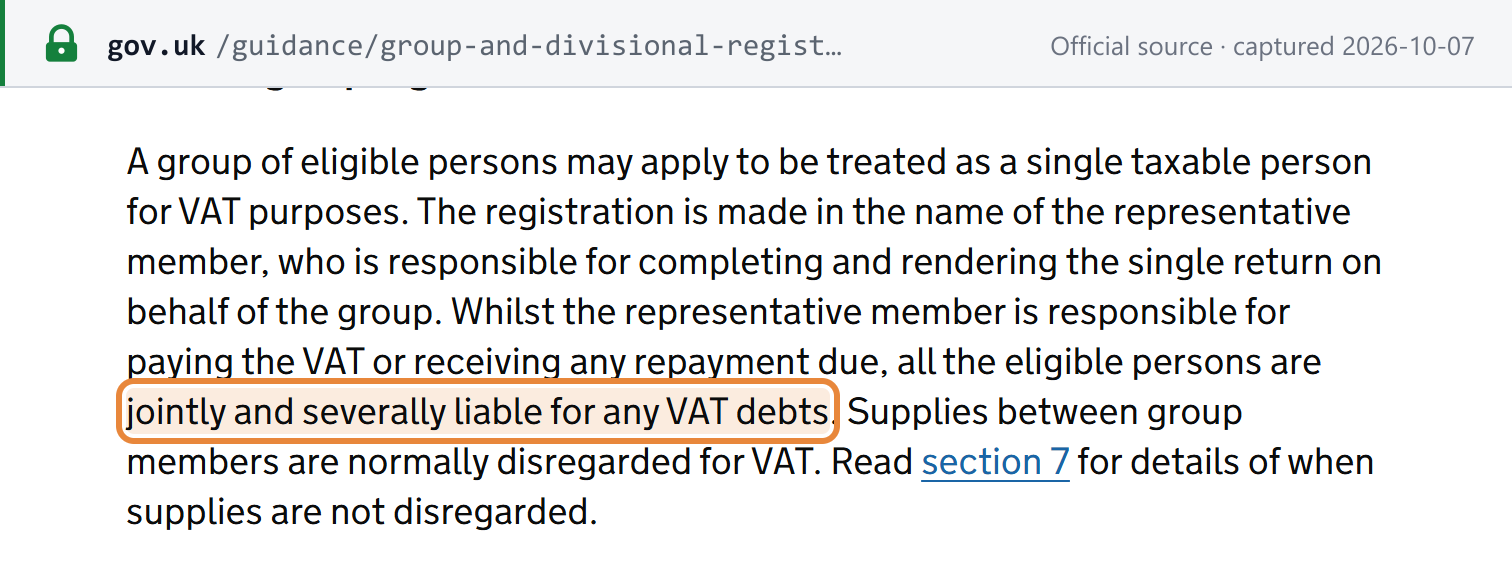
Liability for the group's VAT is a matter of national law. Article 11 does not say who pays if the group defaults; the national rules do, and the ones quoted here make the members jointly and severally liable:
- UK: "Whilst the representative member is responsible for paying the VAT or receiving any repayment due, all the eligible persons are jointly and severally liable for any VAT debts." (HMRC, VAT Notice 700/2)
- Ireland: "Where VAT compliance is not achieved, each person or company in the group will be jointly and severally liable for any liabilities arising." (Revenue)
- Spain: "Las entidades que apliquen el régimen especial del grupo de entidades responderán solidariamente del pago de la deuda tributaria derivada de este régimen especial." (Ley 37/1992 del IVA, BOE)
- Portugal: payment "cabe à entidade dominante, sendo as entidades dominadas solidariamente responsáveis com a primeira por esse pagamento." (Lei n.º 62/2025, Portal das Finanças)
- Singapore: "All members of the group are jointly and severally liable for any tax due from the representative member." (IRAS, group registration)
- Norway: "Alle deltakende selskaper i en fellesregistrering er solidarisk ansvarlig for betaling av merverdiavgift." (All participating companies in a joint registration are jointly and severally liable for payment of VAT.) (merverdiavgiftsloven § 2-2(3), Lovdata)
(All checked 2026-10-07.)
 Source snapshot captured 2026-10-07 — original (Publications Office of the EU, judgment C-184/23)
 Source snapshot captured 2026-10-07 — original
Some national regimes consolidate the members' VAT balances rather than replacing the members with a single taxable person. Portugal's regime de grupos de IVA is described in the Diário da República as "a consolidação dos saldos do IVA a pagar ou recuperar por parte dos membros"; Spain's grupo de entidades (Ley del IVA, arts 163 quinquies to nonies) and Romania's grup fiscal unic (Fiscal Code art 269(9)) are also consolidation schemes. In these regimes, the C-184/23 rule that intra-group supplies are outside the scope of VAT cannot be assumed: the treatment of supplies between members is set by the national provisions and, in Spain, by the level of the regime the group applies. Check the Portugal, Spain and Romania guides.
 Source snapshot captured 2026-08-07 — original
Branches of non-EU companies
In Skandia (C-7/13) a US company supplied IT services to its Swedish branch, which belonged to a Swedish VAT group. The Court held that "supplies of services from a main establishment in a third country to its branch in a Member State constitute taxable transactions when the branch belongs to a group of persons whom it is possible to regard as a single taxable person for value added tax purposes," and that the group, "as the purchaser of those services, becomes liable for the value added tax payable" under the reverse charge. (C-7/13, EUR-Lex, checked 2026-10-07; see the reverse charge explainer)
 Source snapshot captured 2026-10-07 — original (Publications Office of the EU, judgment C-7/13)
What Member States may and may not require
- Restricting grouping to fight avoidance is allowed. In Commission v Sweden (C-480/10, 25 April 2013) the Court said "it is permissible for Member States to restrict the application of the scheme provided for under Article 11 to combat tax evasion or avoidance," and found that the Commission had not shown that limiting the scheme "to undertakings in the financial and insurance sector was contrary to European Union law." (C-480/10)
- Non-taxable persons may be members. In Commission v Ireland (C-85/11, Grand Chamber, 9 April 2013) the Court found that "it is not apparent from the wording of Article 11 of the VAT Directive that non-taxable persons cannot be included in a VAT group" and dismissed the action; it dismissed the parallel action against the UK (C-86/11, 25 April 2013). (C-85/11; C-86/11)
- Legal personality and subordination may be required only as anti-abuse measures. In Larentia + Minerva and Marenave (C-108/14 and C-109/14, 16 July 2015) the Court ruled against national legislation reserving grouping "solely to entities with legal personality and linked to the controlling company of that group in a relationship of subordination, except where those two requirements constitute measures which are appropriate and necessary" to prevent abuse or combat evasion or avoidance. It also held that the Sixth Directive provision "may not be considered to have direct effect", so taxpayers cannot invoke it directly against national law. (C-108/14, EUR-Lex)
- The controlling company may be the single taxable person, but a voting-majority test on top of a capital majority goes too far. In Norddeutsche Gesellschaft für Diakonie (C-141/20) and Finanzamt T (C-269/20), both of 1 December 2022, the Court accepted that a Member State may designate "the controlling company of that group" as the single taxable person, "where that controlling company is in a position to impose its will on the other entities forming part of that group and provided that that designation does not entail a risk of tax losses." C-141/20 held that a condition of "a majority of the voting rights in addition to a majority holding in the share capital" is precluded. (C-141/20; C-269/20)
Judgment texts are from the EU Publications Office (EUR-Lex / Cellar), checked 2026-10-07.
 Source snapshot captured 2026-10-07 — original (Publications Office of the EU, judgment C-141/20)
Joining a group: an example of national procedure
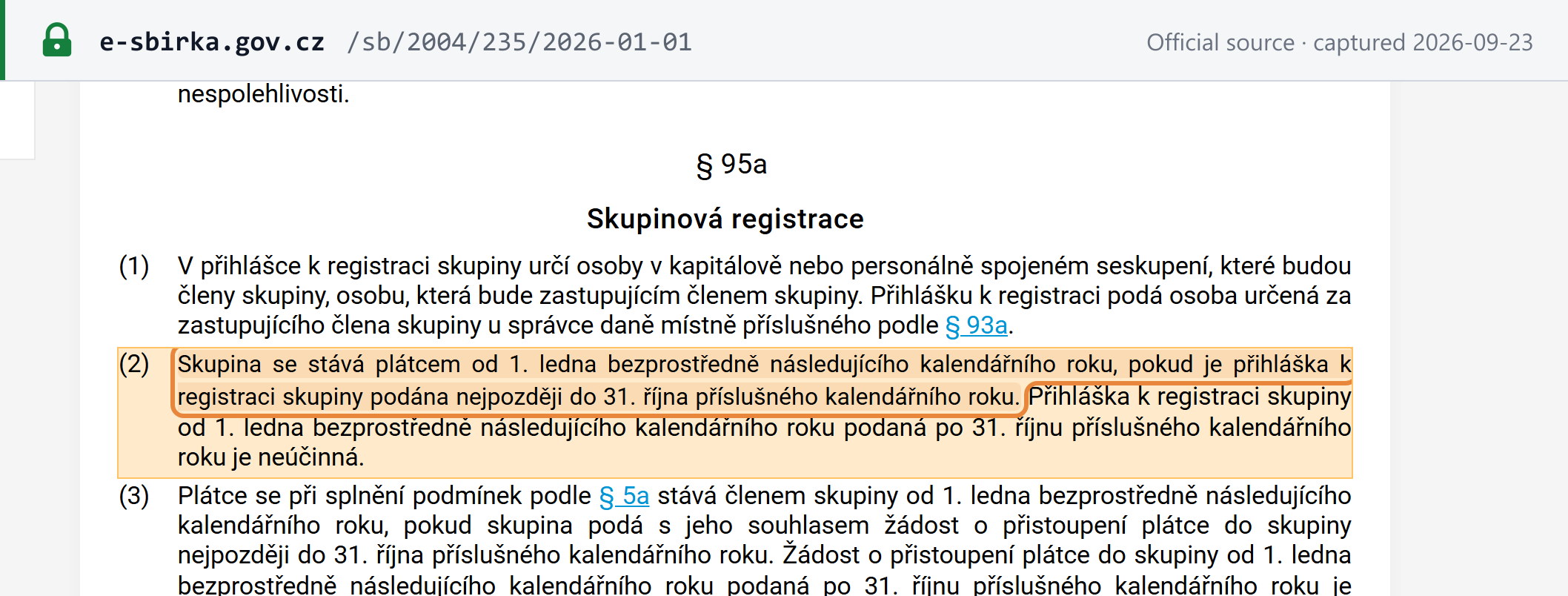
Admission is set by national procedure, not by the Directive. In the Czech Republic, for example, § 95a(2) of the VAT Act (Act No. 235/2004 Coll.) provides that a group becomes a VAT payer from 1 January of the following calendar year if its registration application is filed by 31 October of the current year; an application filed after 31 October has no effect for the following 1 January (see the Czech Republic guide).
 Source snapshot captured 2026-09-23 — original
Worked example: a German Organschaft with a partly exempt insurer
Holding GmbH is an insurer whose supplies are largely VAT-exempt, so it can deduct little input VAT. It owns 100% of Service GmbH, which is financially, economically and organisationally integrated into it, so the two form an Organschaft under § 2(2) Nr. 2 UStG with Holding as the Organträger.
- The intra-group charge. Service GmbH charges Holding EUR 100,000 for IT services. Inside the group this is a non-taxable internal supply, even though Holding could not have deducted the VAT (C-184/23; BMF letter of 1 April 2026, para 4).
- Without the group. The same charge would carry German VAT at the 19% standard rate (Germany guide), EUR 19,000, most of which Holding could not recover.
- Purchases from outsiders. Software services that a third-party supplier provides to Service GmbH are treated as supplied to the group (Skandia, para 29). The Organträger files the group's return and deducts input VAT on the group's overall position.
- A branch of a non-EU company inside the group. Suppose a US company's German branch were part of the group. Under Skandia, services the US head office supplies to that branch are taxable transactions, and the group, as purchaser, accounts for the VAT under the reverse charge (operative part 2).
- A branch in another Member State. If Service GmbH had a branch in Austria and charged it for services, the German group and the Austrian branch would be separate taxable persons, and the charge would be a taxable cross-border supply (Danske Bank).
Who it affects
- Groups with partly exempt members. Banks, insurers, healthcare and education providers gain most, because intra-group charges that would otherwise carry irrecoverable VAT fall outside the scope of VAT (C-184/23). Some Member States limit grouping to these sectors: the Court accepted Sweden's restriction to the financial and insurance sector (C-480/10).
- Corporate groups meeting the national control tests. Each regime sets its own financial-link threshold and eligible legal forms (for example, at least one bv, cv, stichting or vereniging in the Netherlands; under Germany's current § 2(2) Nr. 2 UStG the statute names legal persons, while case law also admits partnerships).
- Multinationals with branches. Only establishments in the grouping Member State can be members; cross-border head office–branch charges are taxable (Danske Bank; Skandia).
- Holding companies. Non-taxable persons may be included where national law allows it (C-85/11; C-86/11).
- Every member, for the group's VAT debts, where national law imposes joint and several liability (as in the UK, Ireland, Spain, Portugal, Norway and Singapore).
- Suppliers and customers of group members, who invoice and validate the group's VAT number rather than the member's own where the regime allocates a single number (C-162/07; C-7/13).
Current status and dates
As at 2026-10-07, the EU framework (Article 11) is unchanged. The live developments are national: Germany's administrative change in force since 1 April 2026 and its draft legislation for 2030, Portugal's new regime from 1 July 2026, and procedural changes in the UK, the UAE and Switzerland.
Germany: Organschaft today
Under § 2(2) Nr. 2 UStG, a legal person is not an independent business "wenn eine juristische Person nach dem Gesamtbild der tatsächlichen Verhältnisse finanziell, wirtschaftlich und organisatorisch in das Unternehmen des Organträgers eingegliedert ist (Organschaft)." The effects are limited to internal supplies between the parts of the business located in Germany, which are treated as one business; if the Organträger is managed from abroad, the economically most significant part in Germany is treated as the business. The statute names legal persons, but case law also admits partnerships as controlled companies (see the draft § 2c below). The Organschaft arises automatically when the conditions are met; there is no application. (§ 2 UStG, gesetze-im-internet.de, checked 2026-10-07)
 Source snapshot captured 2026-10-07 — original
Germany: BMF letter of 1 April 2026 (in force)
The Federal Ministry of Finance letter of 1 April 2026 (GZ III C 2 - S 7105/00035/008/056) implements the Federal Fiscal Court judgment V R 14/24 of 29 August 2024, which followed C-141/20, C-269/20 and C-184/23. The letter summarises the judgment in paragraph 4: "Liegen die Voraussetzungen einer umsatzsteuerlichen Organschaft vor, sind entgeltliche Leistungen zwischen den Beteiligten eines Organkreises nicht steuerbar. Dies ist selbst dann der Fall, wenn die vom Empfänger dieser Leistungen geschuldete oder entrichtete Mehrwertsteuer nicht als Vorsteuer abgezogen werden darf."
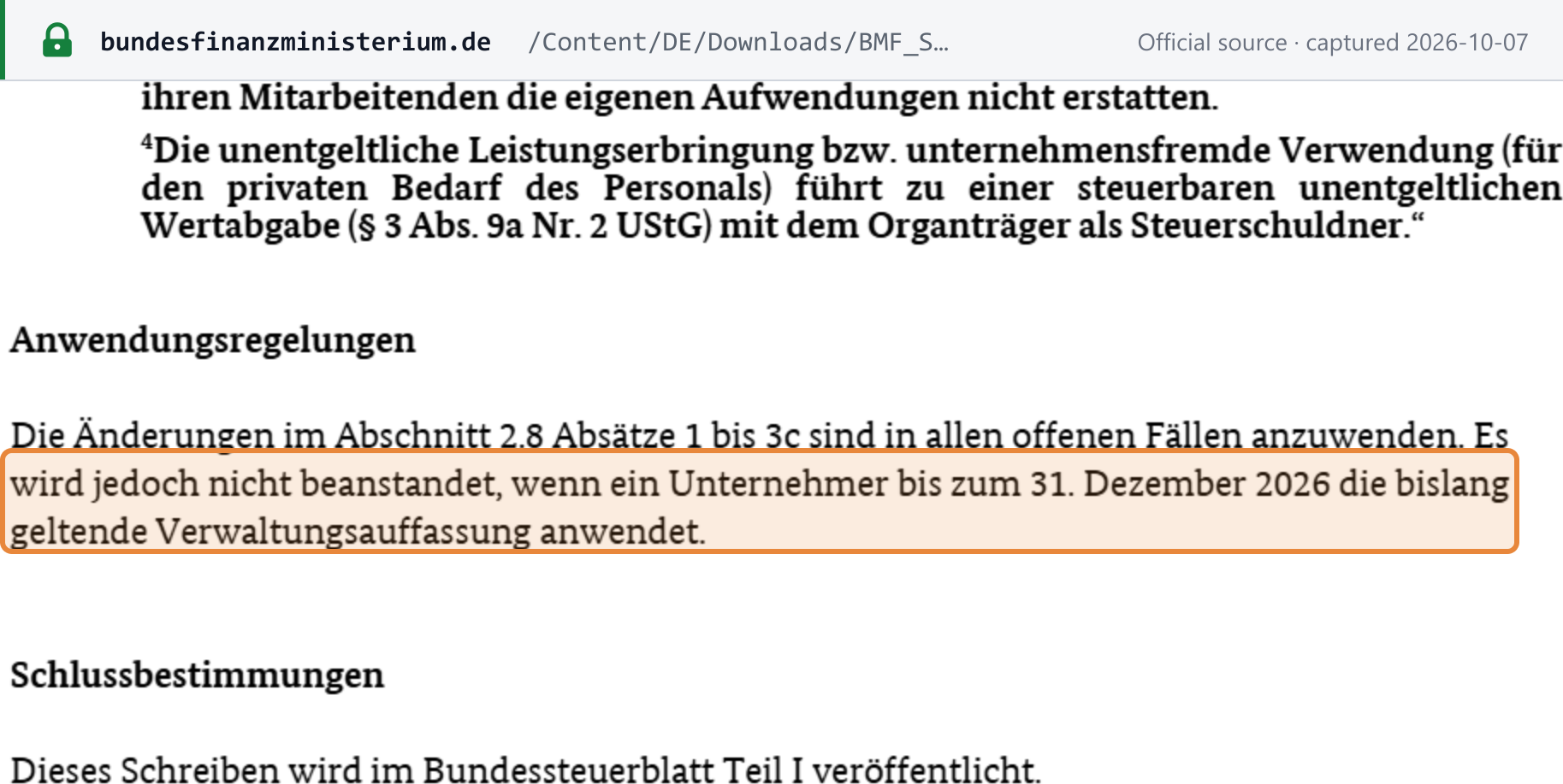
The non-taxability of internal supplies within an Organschaft is not new. The BMF says it "kann dem Grunde nach unverändert fortgesetzt werden" (paragraph 7). The change is the scope. New paragraphs (3a) to (3c) of section 2.8 of the VAT Application Decree extend non-taxability to intra-group supplies used for non-economic activities in the narrow sense (nichtwirtschaftliche Tätigkeiten i. e. S.). Under (3a), "sowohl entgeltliche als auch unentgeltliche Leistungen einer Organgesellschaft an ihren Organträger und umgekehrt" are not taxable even where they are used for such activities. Under (3b), that use is not a taxable free supply, and there is no input VAT deduction on the related purchases. The changes apply in all open cases, with a transition: "Es wird jedoch nicht beanstandet, wenn ein Unternehmer bis zum 31. Dezember 2026 die bislang geltende Verwaltungsauffassung anwendet." (BMF, 1 April 2026, checked 2026-10-07)
 Source snapshot captured 2026-10-07 — original
Germany: draft § 2c UStG (proposed, not enacted)
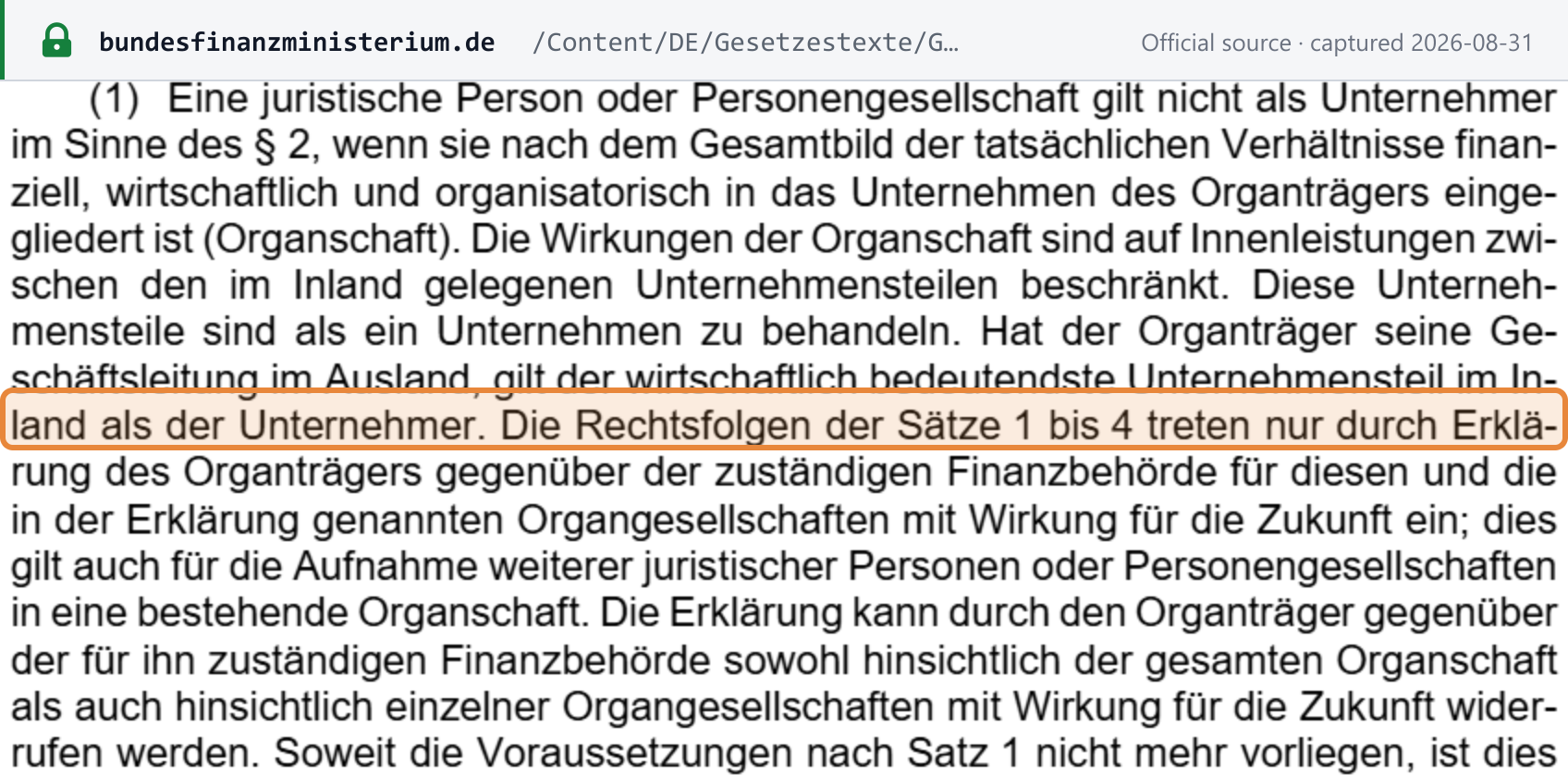
The government draft of the Jahressteuergesetz 2026, transmitted to the Bundesrat as Bundesrat-Drucksache 447/26, would move the Organschaft into a new § 2c UStG. Draft § 2c(1) names a "juristische Person oder Personengesellschaft" as a controlled company. Today's § 2(2) Nr. 2 says "juristische Person", but case law already admits partnerships as controlled companies. The draft's explanatory memorandum presents the change as codifying that case law (C-108/14, C-109/14 and BFH XI R 17/11). The group would no longer arise automatically: "Die Rechtsfolgen der Sätze 1 bis 4 treten nur durch Erklärung des Organträgers gegenüber der zuständigen Finanzbehörde für diesen und die in der Erklärung genannten Organgesellschaften mit Wirkung für die Zukunft ein"; the declaration can be revoked for the whole group or for individual members, with effect for the future.
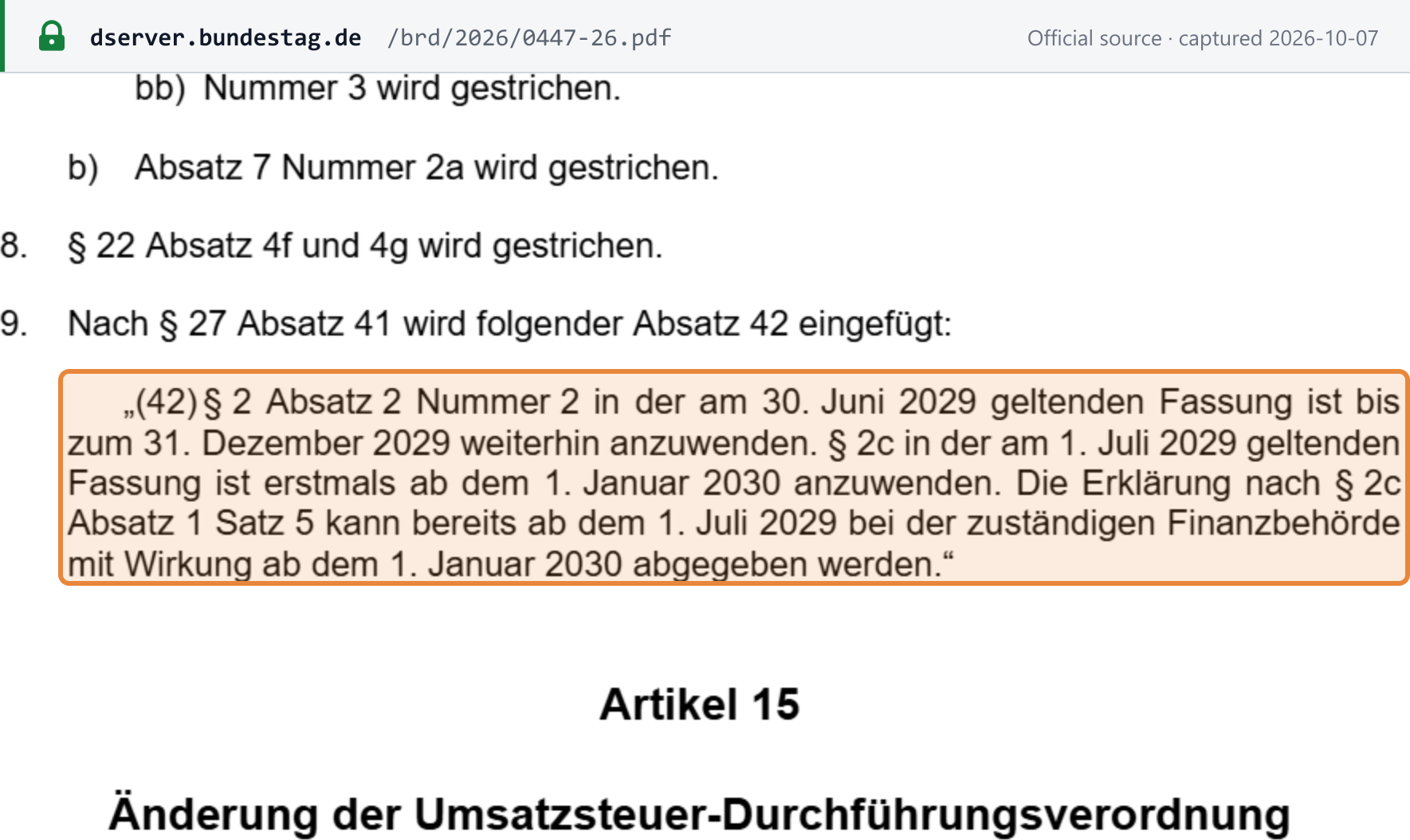
Timing in the draft: the amending article would enter into force on 1 July 2029 (Art 32(7)), and draft § 27(42) provides that § 2c "ist erstmals ab dem 1. Januar 2030 anzuwenden", that the current § 2(2) Nr. 2 continues to apply until 31 December 2029, and that the declaration can be filed from 1 July 2029 with effect from 1 January 2030. As at 2026-10-07 this is a bill, not law: it would apply from 1 January 2030 only if enacted in this form. (Bundesrat-Drucksache 447/26, checked 2026-10-07)
 Source snapshot captured 2026-10-07 — original
 Source snapshot captured 2026-08-31 — original (BMF, government draft)
Portugal: regime de grupos de IVA (in force)
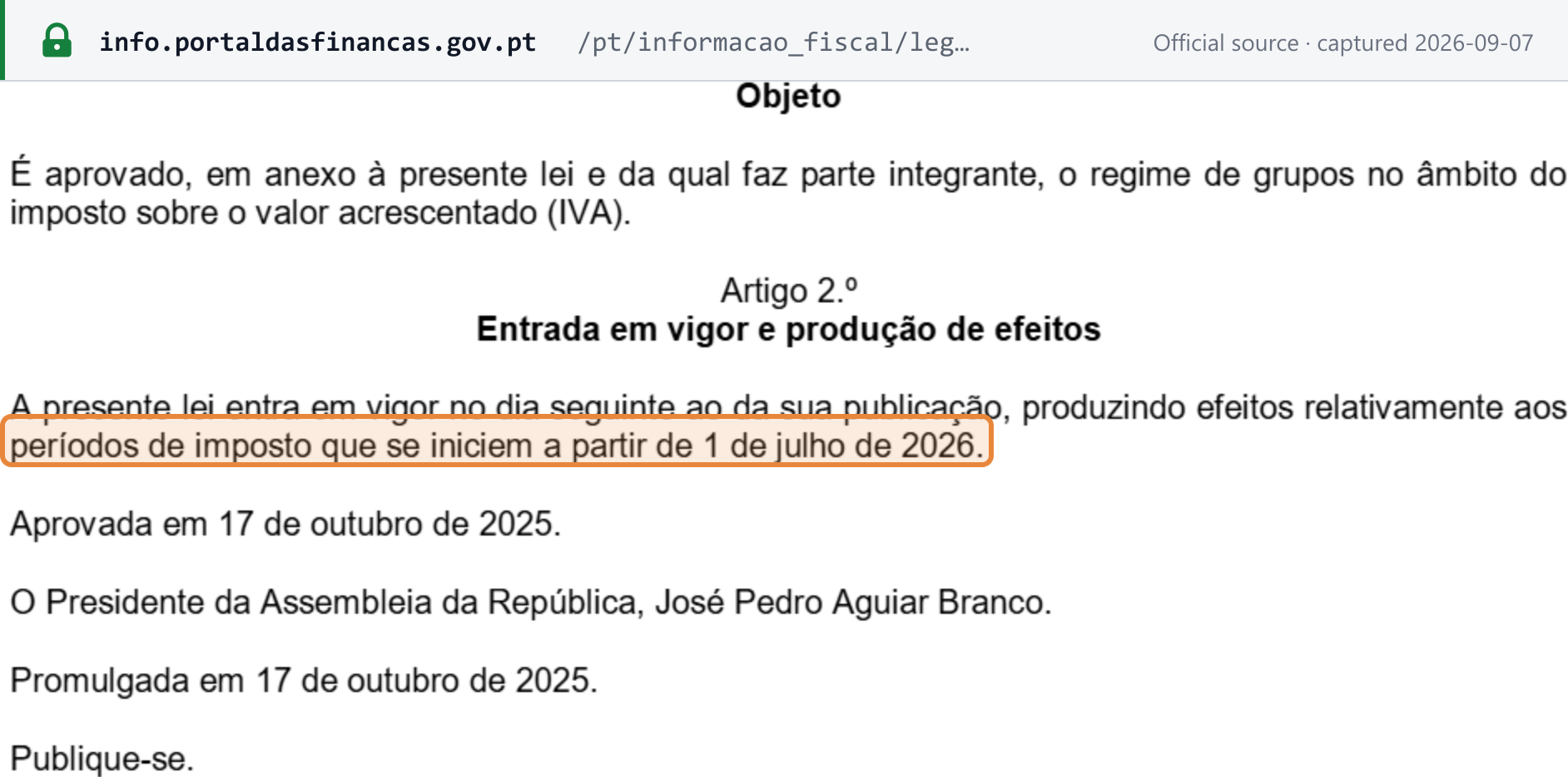
Lei n.º 62/2025 of 27 October 2025 introduces Portugal's VAT group regime, "produzindo efeitos relativamente aos períodos de imposto que se iniciem a partir de 1 de julho de 2026." The dominant entity must hold "uma participação, direta ou indireta, de pelo menos 75 % do capital de outra ou de outras entidades ditas dominadas, desde que tal participação lhe confira mais de 50 % dos direitos de voto." The regime consolidates the members' VAT balances (see the caution box above), and the dominated entities are jointly liable with the dominant entity for payment. (Lei n.º 62/2025, Portal das Finanças, checked 2026-10-07; see the Portugal guide)
 Source snapshot captured 2026-09-07 — original
Timeline
| Date | What changed | Status (as at 2026-10-07) | Source |
|---|---|---|---|
| 2006 | VAT Directive Art 11: optional single taxable person for closely bound persons established in one Member State | In force | EUR-Lex, consolidated VAT Directive |
| 22 May 2008 | Ampliscientifica (C-162/07): one taxable person, one VAT number, only the group files | Case law | EUR-Lex |
| 9 and 25 Apr 2013 | Commission v Ireland (C-85/11), v UK (C-86/11): non-taxable persons may be members. Commission v Sweden (C-480/10): restrictions against avoidance allowed | Case law | C-85/11, C-480/10 |
| 17 Sep 2014 | Skandia (C-7/13): third-country head office to branch in a VAT group is taxable | Case law | EUR-Lex |
| 16 Jul 2015 | Larentia + Minerva (C-108/14, C-109/14): legal-personality and subordination tests only as anti-abuse measures | Case law | EUR-Lex |
| 11 Mar 2021 | Danske Bank (C-812/19): head office in a group and branch in another Member State are separate taxable persons | Case law | EUR-Lex |
| 1 Dec 2022 | C-141/20 and C-269/20: controlling company may be the single taxable person; voting-majority add-on precluded | Case law | C-141/20, C-269/20 |
| 11 Jul 2024 | Finanzamt T II (C-184/23): intra-group services not subject to VAT, even where the recipient cannot deduct | Case law | EUR-Lex |
| 1 Apr 2026 | Germany: BMF letter extends the non-taxability of internal supplies to supplies used for non-economic activities in the narrow sense (UStAE 2.8(3a)–(3c)); previous view tolerated until 31 Dec 2026 | In force | BMF |
| 1 Jul 2026 | Portugal: VAT group regime, tax periods starting on or after this date | In force | Lei n.º 62/2025 |
| 31 Dec 2026 | Germany: end of the BMF transition period for UStAE 2.8(3a)–(3c) | Scheduled | BMF |
| 1 Jan 2030 | Germany: declaration-based Organschaft under draft § 2c UStG would first apply (declaration from 1 Jul 2029) | Proposed, not enacted | BR-Drs. 447/26 |
Where it applies: jurisdiction table
The table lists the regimes whose official texts were checked for this page on 2026-10-07. It is not a complete list of countries that offer grouping; for a jurisdiction not shown, see the VAT grouping section of that country's guide, which carries its own last-updated date.
| Jurisdiction | Regime and key scope point | Last confirmed | Source |
|---|---|---|---|
| Germany | Organschaft, § 2(2) Nr. 2 UStG: automatic once a legal person is financially, economically and organisationally integrated into the Organträger (case law also admits partnerships); effects limited to the parts of the business in Germany. Draft § 2c (declaration-based, codifying the admission of partnerships) proposed from 1 Jan 2030, not enacted as at 2026-10-07. Germany guide | 2026-10-07 | gesetze-im-internet.de, § 2 UStG |
| Spain | Grupo de entidades, Ley 37/1992 arts 163 quinquies to nonies: a dominant entity and dependants "firmemente vinculadas entre sí en los órdenes financiero, económico y de organización", holding "más del 50 por ciento, en el capital o en los derechos de voto"; all members established in Spain; members jointly liable. A consolidation regime (see the caution box). Spain guide | 2026-10-07 | BOE |
| Ireland | VAT group: "a group of persons established in the State which is treated as a single accountable person"; members jointly and severally liable. Ireland guide | 2026-10-07 | Revenue |
| Italy | Gruppo IVA, DPR 633/1972 art 70-bis and following: linked persons established in Italy "possono divenire un unico soggetto passivo". Italy guide | 2026-10-07 | Normattiva, art 70-bis |
| Luxembourg | Groupe TVA, art 60ter VAT law: legal persons established in Luxembourg and closely linked "peuvent opter pour être considérées comme un assujetti unique". Luxembourg guide | 2026-10-07 | Guichet.lu |
| Latvia | PVN grupa, VAT Law s.11(1): where registered domestic taxpayers are group members, the economic activity of one member is treated as carried out by the whole group. Under s.64(2), members use their own registration numbers in all dealings with non-members; the group's number is used only for the group's VAT return and payment. Latvia guide | 2026-10-07 | Likumi.lv |
| Malta | Single taxable person, VAT Act art 5(6) and S.L. 406.21: available where at least one member is a taxable person licensed or recognised under the Acts listed in the regulations; supplies between members disregarded. Malta guide | 2026-10-07 | MTCA |
| Netherlands | Fiscale eenheid: financial link where "meer dan 50% van de aandelen, inclusief de zeggenschap daarover" is in the same hands; at least one bv, cv, stichting or vereniging must be a member. Netherlands guide | 2026-10-07 | Belastingdienst |
| Poland | Grupa VAT, VAT Act art 15a: a group of financially, economically and organisationally linked entities "które zawrą umowę o utworzeniu grupy VAT" (by group agreement). Poland guide | 2026-10-07 | Sejm, consolidated VAT Act (Dz.U. 2026 poz. 1263) |
| Portugal | Grupos de IVA, Lei n.º 62/2025: dominant entity with at least 75% of capital conferring more than 50% of votes; tax periods from 1 Jul 2026; consolidation of VAT balances; dominated entities jointly liable. Portugal guide | 2026-10-07 | Portal das Finanças |
| Romania | Grup fiscal unic, Fiscal Code art 269(9): taxable persons established in Romania that, while legally independent, are closely linked organisationally, financially and economically. A consolidation regime (see the caution box). Romania guide | 2026-10-07 | ANAF, Fiscal Code |
| Sweden | Mervärdesskattegrupp, Mervärdesskattelag (2023:200) ch. 4 § 8: limited to the groupings listed in that section, which the CJEU accepted as a restriction to the financial and insurance sector (C-480/10). Sweden guide | 2026-10-07 | Riksdagen, SFS 2023:200 |
| Slovenia | Skupina za DDV, ZDDV-1 art 5.a (inserted by ZDDV-1O): VAT groups available from 1 Jan 2026. Slovenia guide | 2026-10-07 | Uradni list RS 2024-01-3310 |
| United Kingdom | VAT group, VATA 1994 s.43 and Notice 700/2: "a facilitation measure by which 2 or more eligible persons can be treated as a single taxable person"; membership turns on common control; members jointly and severally liable; supplies between members normally disregarded. UK guide | 2026-10-07 | HMRC, VAT Notice 700/2 |
| Norway | Fellesregistrering, merverdiavgiftsloven § 2-2(3): two or more cooperating companies may be registered as one taxable person where at least 85% of the capital in each is owned by one or more of them; all participating companies are jointly and severally liable. Norway guide | 2026-10-07 | Lovdata, § 2-2 |
| Singapore | GST group registration: a representative member accounts for the group; "All members of the group are jointly and severally liable for any tax due from the representative member." Singapore guide | 2026-10-07 | IRAS, group registration |
 Source snapshot captured 2026-10-07 — original
Related changes
- 2027-01-01 — Switzerland: the portal obligation (Portalpflicht) for VAT group taxation, the flat-rate and lump-sum tax-rate methods and deregistration, which the Federal Council set to apply later than the rest of the VAT Act revision, will be introduced on 1 January 2027. (ESTV) — see event
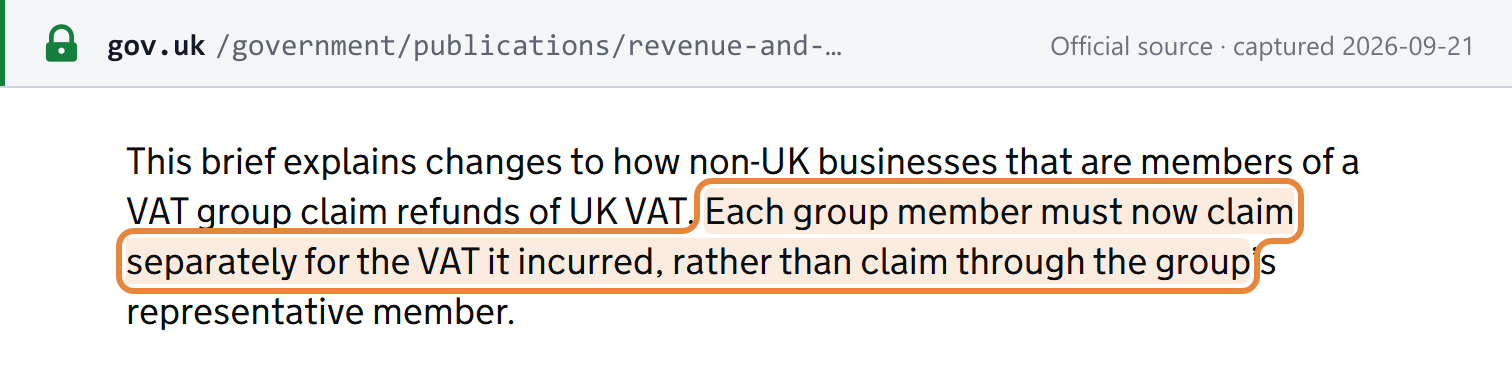
- 2026-09-08 — United Kingdom: Revenue and Customs Brief 8 (2026) says each non-UK member of a VAT group must now claim UK VAT refunds separately for the VAT it incurred, rather than through the group's representative member, with transitional arrangements for the 1 July 2025 to 30 June 2026 prescribed year. (HMRC) — see event
 Source snapshot captured 2026-09-21 — original
- 2026-08-12 — Germany: the Federal Cabinet approved the Jahressteuergesetz 2026 government draft (Bundesrat-Drucksache 447/26), which would replace the automatic Organschaft with a declaration-based one under a new § 2c UStG, applying from 1 January 2030. Proposed, not enacted. (Bundesrat-Drucksache 447/26) — see event
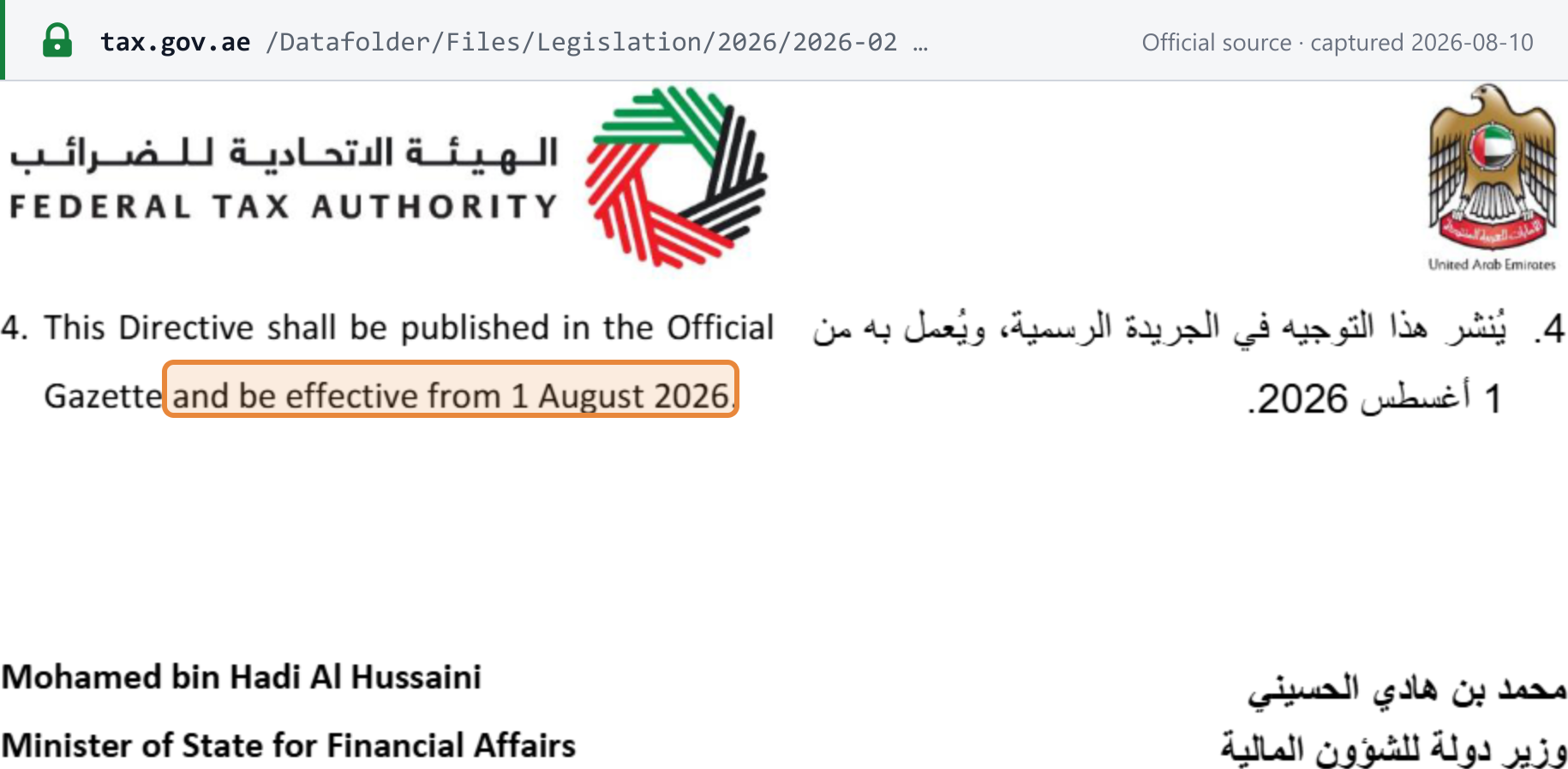
- 2026-08-01 — United Arab Emirates: FTA Directive on Tax Transactions No. 2 of 2026, issued 8 July 2026 and effective from 1 August 2026, requires a person that leaves a VAT Tax Group but remains a VAT Registrant to make adjustments in its own returns for supplies made or expenses incurred before leaving. (Federal Tax Authority) — see event
 Source snapshot captured 2026-08-10 — original
- 2026-07-16 — Portugal: Portaria n.º 298/2026/1 approves new periodic VAT return models. From the tax period beginning 1 July 2026 the return adds fields identifying VAT-group members and the dominant entity's NIF; most other new fields apply from 1 July 2027. (Diário da República) — see event
- 2026-07-01 — Portugal: the VAT group regime under Lei n.º 62/2025 takes effect for tax periods beginning on or after 1 July 2026 (dominant entity with at least 75% of capital and more than 50% of votes). (Diário da República) — see event
Frequently asked questions
Are supplies between members of a VAT group subject to VAT?
Not where the members form a single taxable person under Article 11 of the VAT Directive. In Finanzamt T II (C-184/23, 11 July 2024) the Court of Justice held that services provided for consideration between members of such a group are not subject to VAT, even where the recipient cannot deduct the VAT. Germany already treats internal supplies within an Organschaft as non-taxable; its BMF letter of 1 April 2026 extends this to supplies used for non-economic activities in the narrow sense, with a transition to 31 December 2026. Regimes that only consolidate VAT balances, such as Portugal's, Spain's and Romania's, follow their own national rules on intra-group supplies. (CJEU C-184/23; BMF, 1 April 2026, checked 2026-10-07)
Can a branch of a foreign company be part of a VAT group?
Only a branch established in the Member State that grants the grouping. If a non-EU head office supplies services to its EU branch and the branch belongs to a VAT group, the supplies are taxable and the group accounts for the VAT under the reverse charge (Skandia, C-7/13). If a head office in a VAT group in one Member State charges its branch in another Member State, the two are separate taxable persons (Danske Bank, C-812/19). (CJEU C-7/13 and C-812/19, checked 2026-10-07)
Who is liable for a VAT group's VAT?
The group pays through its representative member or controlling entity, but liability if it defaults is set by national law, not by Article 11. In the UK, Ireland, Spain, Portugal, Norway and Singapore the members are jointly and severally liable: HMRC VAT Notice 700/2, for example, says all the eligible persons are jointly and severally liable for any VAT debts. (HMRC Notice 700/2; Revenue; BOE; Lei n.º 62/2025; Lovdata; IRAS, checked 2026-10-07)
What is changing for the German Organschaft?
Today the Organschaft under § 2(2) Nr. 2 UStG arises automatically when a controlled company is integrated financially, economically and organisationally into the Organträger; the statute names legal persons, and case law also admits partnerships. Internal supplies within the group are non-taxable, and the BMF letter of 1 April 2026 extends this to supplies used for non-economic activities in the narrow sense; the previous administrative view may be applied until 31 December 2026. The Jahressteuergesetz 2026 draft (Bundesrat-Drucksache 447/26) would make the Organschaft depend on a declaration by the Organträger and write partnerships into the statute, under a new § 2c UStG applying from 1 January 2030. As at 7 October 2026 that draft is not enacted. (§ 2 UStG; BMF, 1 April 2026; BR-Drs. 447/26, checked 2026-10-07)
Can a non-taxable holding company join a VAT group?
EU law allows it: in Commission v Ireland (C-85/11) the Court of Justice found nothing in Article 11 that prevents non-taxable persons from being included in a VAT group, and it dismissed the parallel case against the UK (C-86/11). Whether a holding company can join in practice depends on each Member State's national rules, which may restrict grouping to combat avoidance (Commission v Sweden, C-480/10). (CJEU C-85/11, C-86/11 and C-480/10, checked 2026-10-07)
Related resources
- Reverse charge — how a VAT group accounts for head-office supplies to its branch (Skandia)
- ViDA — VAT in the Digital Age and VAT listings explained
- Free VAT number checks by country and EU VIES verification — check the group's VAT number, not the member's
- Country guides: Germany, Spain, Ireland, Italy, Luxembourg, Latvia, Malta, Netherlands, Poland, Portugal, Romania, Sweden, Slovenia, Czech Republic, United Kingdom, Norway, Singapore, United Arab Emirates
- Tax-change chronologies: Germany, Portugal, United Kingdom, United Arab Emirates, Switzerland
Reference links
- VAT Directive 2006/112/EC, consolidated version of 14.04.2025 — Art 11 (EUR-Lex)
- CJEU judgments (EUR-Lex): C-162/07, C-480/10, C-85/11, C-86/11, C-7/13, C-108/14, C-812/19, C-141/20, C-269/20, C-184/23
- § 2 UStG, BMF letter of 1 April 2026 and Bundesrat-Drucksache 447/26 (Germany)
- Lei n.º 62/2025 (Portugal, Diário da República)
- HMRC VAT Notice 700/2 (UK)