Sweden VAT guidelines
| FACTSHEET | |
|---|---|
| Country code | SE |
| Tax name | Value Added Tax (mervärdesskatt, "moms") |
| Tax Authority | Skatteverket (Swedish Tax Agency) |
Overview
Sweden levies Value Added Tax — mervärdesskatt, known everywhere as moms — under the Mervärdesskattelag (2023:200) ("ML"). Chapter 1, section 1 sets out what the tax is: «Mervärdesskatt är en transaktionsbaserad, indirekt och allmän skatt på konsumtion. Skatten ska betalas till staten i enlighet med denna lag.» ("Value added tax is a transaction-based, indirect and general tax on consumption. The tax is payable to the State in accordance with this Act.") [1]
Authority. The tax is administered by Skatteverket (the Swedish Tax Agency). Procedure — registration, returns, payment, surcharges and interest — sits in a separate act, the Skatteförfarandelag (2011:1244) ("SFL"). [2]
How to read the citations. "ML 9 kap. 2 §" means chapter 9, section 2 of the VAT Act. This guide cites ML (2023:200) as consolidated on riksdagen.se up to SFS 2026:1025. ML (2023:200) replaced the Mervärdesskattelag (1994:200), so older sources use the superseded 1994 Act's numbering — for example chapter 7 for the rates and chapter 11 for invoicing. Those section numbers no longer point to the same rules. The repealed Act still governs earlier events: «Den upphävda mervärdesskattelagen gäller i övrigt för förhållanden som hänför sig till tiden före ikraftträdandet.» ("The repealed VAT Act otherwise continues to apply to circumstances relating to the period before entry into force.") [1]
Currency. All amounts in this guide are in Swedish kronor (SEK) unless marked as euro.
Tax period basis. VAT is reported per redovisningsperiod (reporting period): a calendar month, a calendar quarter or the beskattningsår (tax year). The tax year normally follows the business's financial year (räkenskapsår). Which period applies depends on the size of the business — see Filing and payment.
Layering. Moms is a national tax, payable to the State (ML 1 kap. 1 §). ML provides no regional or municipal VAT. [1]
Swedish statute and guidance are quoted in the original, with an English rendering in brackets. The English renderings are Lookuptax's own; only the Swedish text is authoritative.
Registration
Who should register
Registration is compulsory for anyone liable to pay VAT under ML. SFL 7 kap. 1 § also requires Skatteverket to register persons with a right to deduct or be refunded input VAT, persons making exempt intra-EU acquisitions, and Swedish-established businesses supplying services taxed in another EU country under Article 196 of the VAT Directive. [2]
The duty is prospective. You notify Skatteverket before the business starts. SFL 7 kap. 2 §: «Den som avser att bedriva näringsverksamhet och som ska registreras ska anmäla sig för registrering hos Skatteverket innan näringsverksamheten påbörjas eller övertas.» ("A person who intends to carry on business activity and who is to be registered shall notify the Swedish Tax Agency for registration before the business activity is commenced or taken over.") Neither SFL nor ML sets a "register within N days of crossing the threshold" rule. [2]
Skatteverket puts the test in two limbs. You must register if you carry on, or intend to carry on, an economic activity in which you continuously sell goods or services subject to VAT, and your annual turnover exceeds SEK 120,000 in the calendar year in question. You must also be able to show your intent with objective circumstances — for example contracts, invoices or drawings of premises. [3]
Registration threshold
The resident threshold is SEK 120,000 of domestic annual turnover, excluding VAT, measured per calendar year (ML 18 kap. 2 §). ML 18 kap. 4 §: [1]
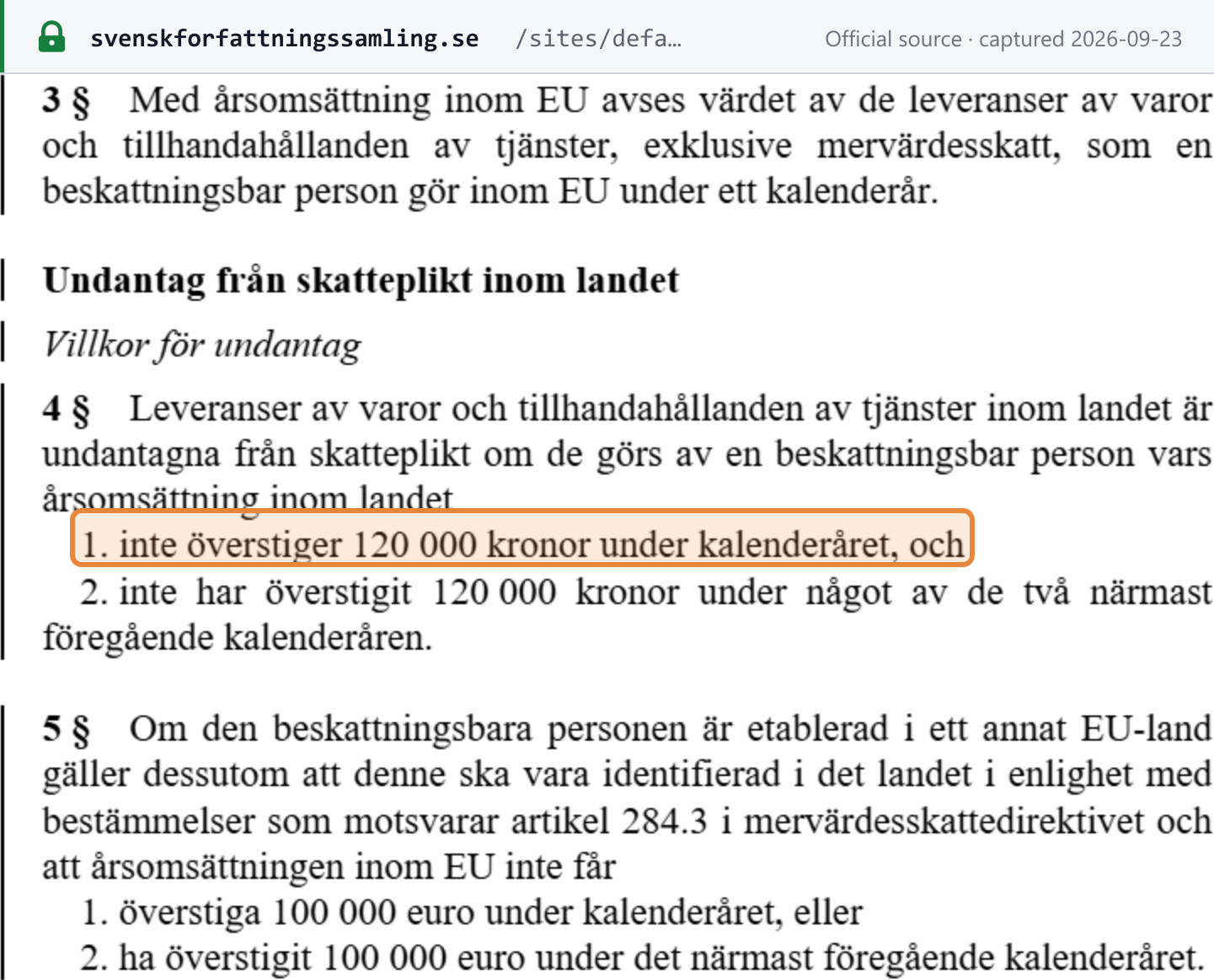
«Leveranser av varor och tillhandahållanden av tjänster inom landet är undantagna från skatteplikt om de görs av en beskattningsbar person vars årsomsättning inom landet 1. inte överstiger 120 000 kronor under kalenderåret, och 2. inte har överstigit 120 000 kronor under något av de två närmast föregående kalenderåren.»
In English: supplies within Sweden are exempt if the taxable person's domestic annual turnover does not exceed SEK 120,000 in the current calendar year and did not exceed it in either of the two preceding calendar years. This text was inserted by Lag (2024:942) and has applied since 1 January 2025. The threshold was lower before that date. [31]
Crossing it. There is no notification countdown. ML 18 kap. 11 §: «Om årsomsättningen inom landet överstiger 120 000 kronor under kalenderåret, upphör undantaget att gälla från den tidpunkten.» ("If the domestic annual turnover exceeds SEK 120,000 during the calendar year, the exemption ceases to apply from that point.") [1]
| Trigger | Amount | Measurement | Source |
|---|---|---|---|
| Domestic registration (established businesses) | SEK 120,000 | Current calendar year, and neither of the two preceding years | ML 18 kap. 4 § |
| Businesses not established in any EU country | Nil | — | ML 18 kap. 6 § 1 |
| Businesses established in another EU country using Sweden's exemption | EU-wide turnover up to EUR 100,000, and domestic turnover up to SEK 120,000 | Current and preceding calendar year | ML 18 kap. 5 § |
| Intra-EU acquisitions of goods by an otherwise unregistered person | More than SEK 90,000 in a year | Per year | Skatteverket [3] |
| Swedish seller's distance sales of goods and telecom, broadcasting and electronic services to consumers in other EU countries — taxed in Sweden up to | SEK 99,680 | Current and preceding calendar year | ML 6 kap. 62 § 3 |
Sweden writes the EU-wide EUR 10,000 distance-selling threshold into law as a fixed kronor amount, SEK 99,680 (ML 6 kap. 62 § 3). A seller under it may elect to tax in the customer's country, and that election binds until the end of the second calendar year after the decision (6 kap. 64–65 §§). [1]
Non-resident registration
The threshold for a business not established in any EU country is nil. The resident threshold is SEK 120,000; the non-established threshold is zero. ML 18 kap. 6 § says the exemption does not apply to supplies by taxable persons who «1. inte är etablerade i något EU-land» ("1. are not established in any EU country"). The same section also excludes taxable sales of works of art, property letting under voluntary taxation, and investment gold under voluntary taxation. So a non-EU business is liable from its first taxable Swedish supply. [1]
A business established in another EU country may use the Swedish exemption only if it is identified for the cross-border scheme in its own country (under rules corresponding to Article 284.3 of the VAT Directive) and its EU-wide annual turnover does not exceed EUR 100,000 in the current or the preceding calendar year. These conditions apply in addition to the SEK 120,000 domestic limit (ML 18 kap. 5 §). [1]
Representative. SFL 6 kap. 2 §: «En beskattningsbar person som inte är etablerad i Sverige och som är skyldig att betala mervärdesskatt enligt mervärdesskattelagen (2023:200) ska företrädas av ett ombud som är godkänt av Skatteverket.» ("A taxable person not established in Sweden and liable to pay VAT under the VAT Act (2023:200) shall be represented by a representative approved by the Swedish Tax Agency.") The records for checking the accounts must be available at the representative. SFL 6 kap. 3 § lifts the duty where Sweden has a special agreement on mutual assistance for the recovery of tax claims and the exchange of tax information with the country where the business has its seat. [2]
Skatteverket's guidance for foreign businesses states the requirement flatly for non-EU businesses: «Det är obligatoriskt för företag från länder utanför EU som ska betala moms i Sverige att anlita ett ombud i Sverige eller EES.» ("It is mandatory for businesses from countries outside the EU that are to pay VAT in Sweden to engage a representative in Sweden or the EEA.") The representative files the VAT return, including nil returns. [7]
A deklarationsombud (filing agent, SFL 6 kap. 4–8 §§, form SKV 4809) is a narrower role. It may file and see tax-account data, but it may not represent a non-established person in VAT matters where the 6 kap. 2 § representative duty applies (6 kap. 5 §). [2]
VAT registration number
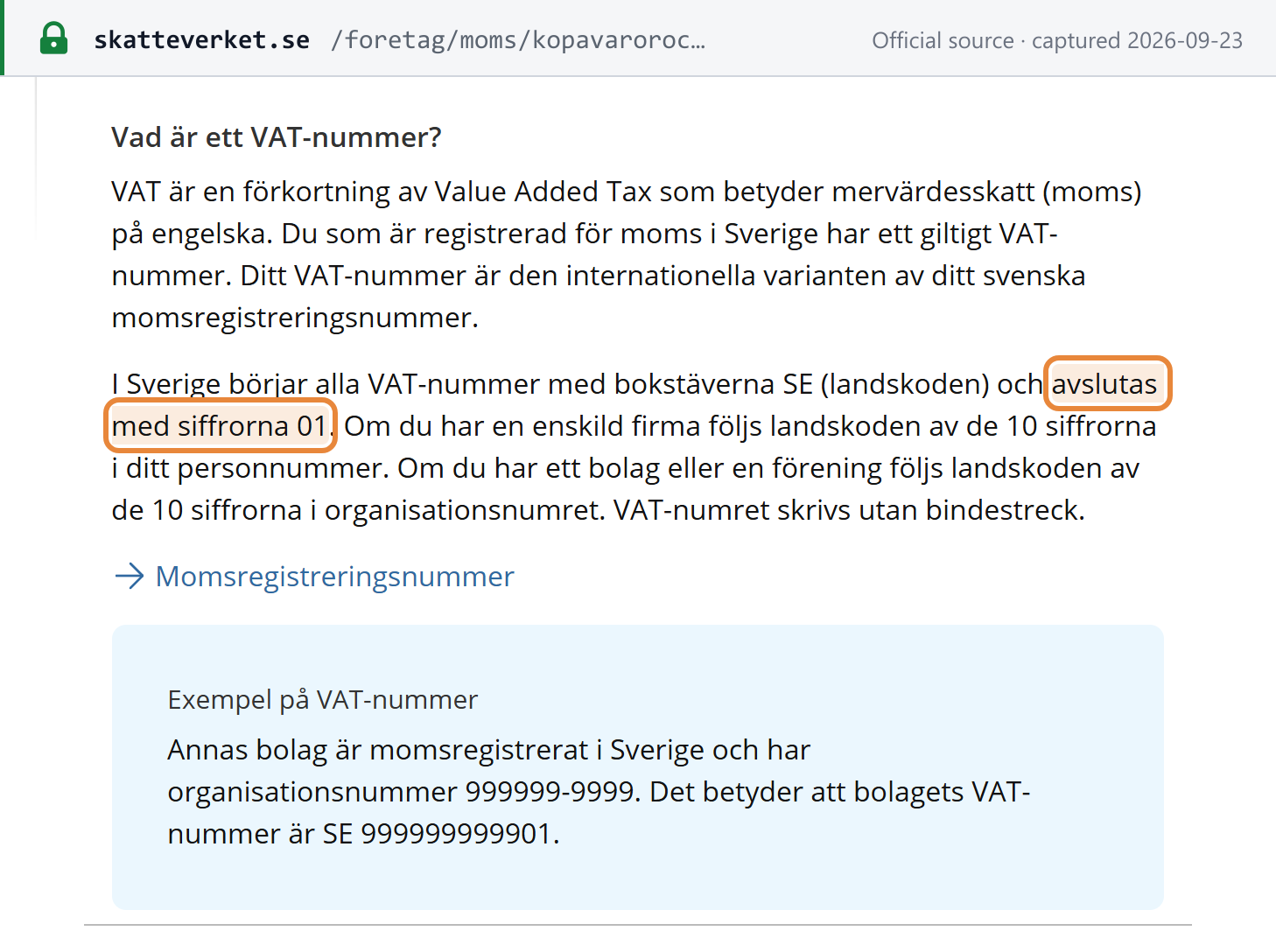
The Swedish VAT number (momsregistreringsnummer, "VAT-nummer") is SE followed by 12 digits. Skatteverket's EU format table gives the Swedish row as «Sverige | SE 999999999999 | 12 siffror» with the footnote «De två sista siffrorna är alltid 01.» ("The last two digits are always 01.") [5]
- Structure. The first ten of the twelve digits are the holder's organisationsnummer — or, for a sole trader, the personnummer — followed by 01. [43]
- The organisationsnummer. Lag (1974:174) om identitetsbeteckning för juridiska personer m.fl., 4 §: «Organisationsnummer består av tio siffror av vilka den sista är kontrollsiffra» ("An organisationsnummer consists of ten digits, of which the last is a check digit"). [42] Bolagsverket assigns it to limited companies, partnerships, economic associations, housing co-operatives and foreign branches. Skatteverket assigns it to non-profit associations, foundations, estates and foreign legal persons, among others. [38]
- Check digit. The law does not set out how the check digit is calculated; organisation numbers pass the same modulus-10 (Luhn) calculation Skatteverket documents for personal identity numbers — see the Sweden tax ID guide.
- Illustration. Skatteverket's own example company with organisationsnummer 999999-9999 has the VAT number SE999999999901. [43]
- Where it comes from. On registration Skatteverket sends a registerutdrag (registration extract) with the VAT number. The extract also states how often the business must file and which accounting method it is registered for. [3]
Verifying a Swedish VAT number. Skatteverket accepts only the European Commission's VIES service as evidence; its free Hämta företagsinformation service shows whether a company is VAT-registered, but is not evidence for intra-EU purposes: «Använd endast Europeiska kommissionens VIES-tjänst för att kontrollera VAT-nummer. Det förekommer även andra tjänster på webben, men Skatteverket kan inte godta svar från en annan tjänst som bevis på att din köpare var momsregistrerad om uppgiften senare visar sig vara felaktig.» ("Use only the European Commission's VIES service to check VAT numbers. Other services also exist on the web, but the Swedish Tax Agency cannot accept an answer from another service as proof that your buyer was VAT-registered if the information later turns out to be incorrect.") Numbers can also be checked by telephone with Skatteupplysningen on 0771-567 567. [6]
Since 1 July 2026, Skatteverket may itself have a Swedish VAT number shown as invalid in VIES on fraud-risk grounds (SFL 7 kap. 12 §, below). An "invalid" answer for a Swedish counterparty is therefore not only a typing problem. See Lookuptax's guide on how to verify an EU VAT number on VIES, the official VAT-number lookup links by country, or check the format with Lookuptax's Sweden VAT number validator.
How to register
- Swedish businesses register through the e-service on verksamt.se, the joint portal of Skatteverket, Bolagsverket and Tillväxtverket, or on paper with form Företagsregistrering (SKV 4620). [3]
- Foreign businesses register through Skatteverket's e-service Registrera utländsk verksamhet i Sverige — «Du behöver inte ha svensk e-legitimation för att använda tjänsten» ("You do not need a Swedish e-ID to use the service") — or on paper with form Skatteanmälan – begränsad skattskyldighet i Sverige (SKV 4632), printed, signed and posted in original. [8]
- Documents for a foreign company. A current registration certificate from the home country, no more than three months old, showing who may sign for the company, its unique identifier, its activity and its address. A sole trader attaches a colour copy of a valid passport or national ID card (both sides of an ID card). [8]
- Timeline. «Handläggningstiden är ungefär två till åtta veckor beroende på Skatteverkets utredning.» ("Processing time is approximately two to eight weeks depending on the Swedish Tax Agency's investigation.") This assumes the forms are complete, and it can take longer. [7]
- Changes. A change to any detail behind the registration must be notified within two weeks of the change (SFL 7 kap. 4 §). [2]
For the general process across countries, see Lookuptax's guide on how to register for VAT, sales tax and GST.
Registration controls from 1 July 2026
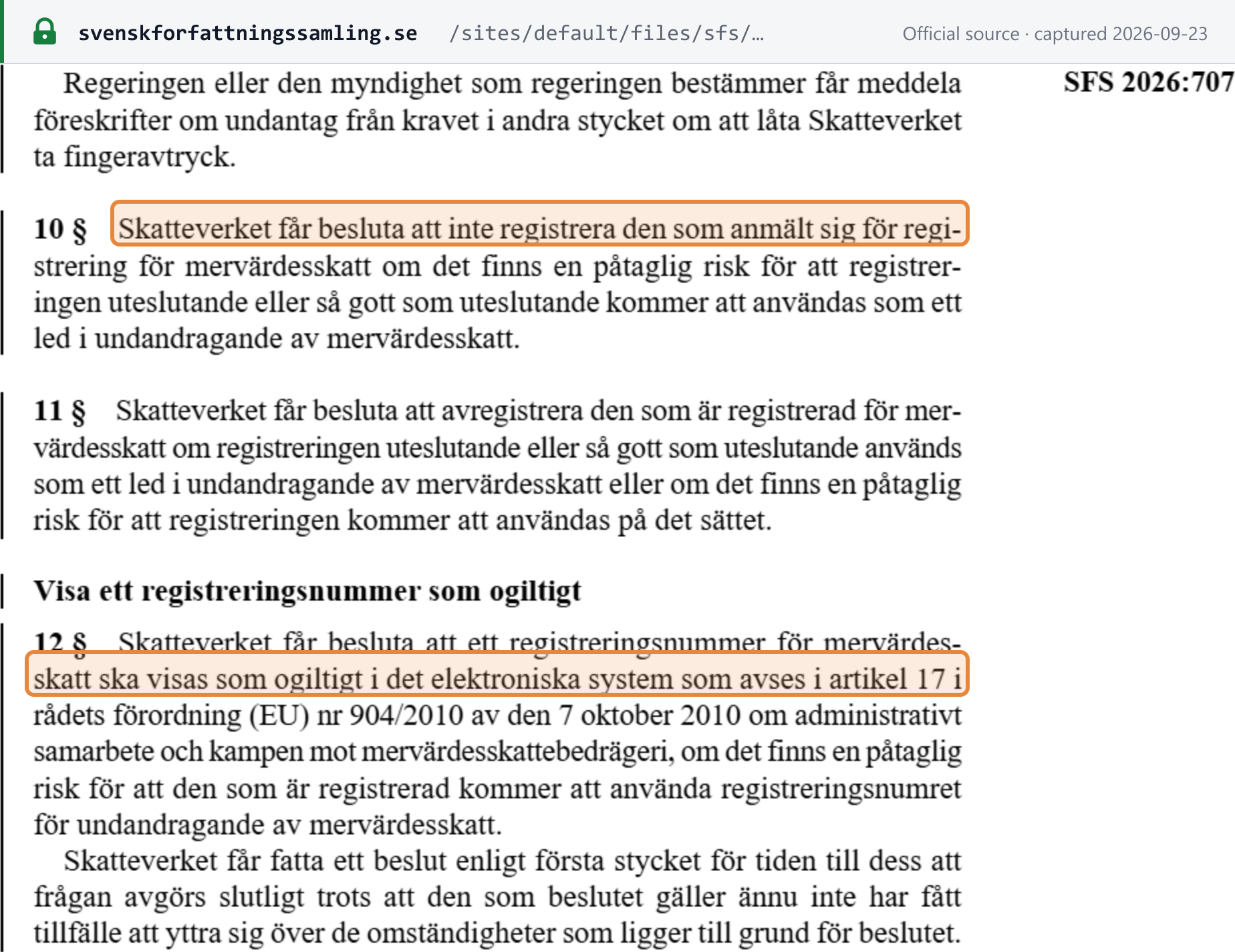
Lag (2026:707) gave Skatteverket new powers over VAT registration from 1 July 2026. Under SFL 7 kap. 6–12 §§ Skatteverket may: [2] [33]
- require details of representatives and owners, both from applicants and from existing registrants;
- summon a representative, or the person the registration concerns, to appear in person to check identity or authority (SFL 7 kap. 7 §: «en företrädare eller den som anmälan avser» — "a representative or the person the notification concerns"). The person must hand over a passport or ID document on request and let Skatteverket take fingerprints and a facial image to compare with it. SFL 7 kap. 8 §: «När en kontroll enligt andra stycket har genomförts ska fingeravtryck och ansiktsbilder samt de biometriska uppgifter som har tagits fram omedelbart förstöras.» ("Once a check under the second paragraph has been carried out, the fingerprints and facial images and the biometric data produced shall be destroyed immediately.");
- refuse a VAT registration where there is a tangible risk it will be used wholly or almost wholly as part of VAT evasion (7 kap. 10 §);
- deregister a business on the same grounds (7 kap. 11 §);
- have a VAT number shown as invalid in VIES where there is a tangible risk the holder will use it for evasion, even before the holder has been heard (7 kap. 12 §).
The same act added SFL 63 a kap., which lets Skatteverket withhold a credit of excess input VAT of a significant amount while a return is under control — see Refunds. The Riksdag approved the measures on 6 May 2026 (Skatteutskottet report SkU22).
Voluntary registration
Available. A business at or below SEK 120,000 may apply to be taxed (ML 18 kap. 15 §). Skatteverket: «Du kan ha rätt till avdrag och bli betalningsskyldig för moms bakåt i tiden, dock tidigast från 1 januari året före det år som du skickar in din ansökan.» ("You may be entitled to deductions and become liable for VAT retroactively, but no earlier than 1 January of the year before the year in which you submit your application.") [3]
The fördröjningsregeln (delay rule). Once Skatteverket has decided, on the business's application, to tax it, the business can return to the exemption, and so be deregistered on turnover grounds, no earlier than 1 January of the third calendar year after the year of the decision to tax (ML 18 kap. 9 §). Skatteverket's registration page describes it as the earliest deregistration date: «Du kan bli avregistrerad först från den 1 januari det tredje kalenderåret efter det år som Skatteverket fattade beslutet om registrering. Det kallas för fördröjningsregeln.» ("You can be deregistered only from 1 January of the third calendar year after the year in which the Swedish Tax Agency made the registration decision. This is called the delay rule.") Skatteverket's example: a business registered from 21 March 2025 can be exempt again from 1 January 2028 at the earliest. [1] [3]
Why register below the threshold. An exempt small business cannot deduct input VAT while exempt (ML 18 kap. 14 §). And a business exempt because of low turnover may still have to be VAT-registered when it buys construction services under the reverse charge. [3]
Artists. A separate rule applies to an artist selling their own works. The sales are exempt while the taxable amount for the tax year is under SEK 300,000. Above that, VAT is due on all such sales for the year «från första kronan» ("from the first krona"), at 12%. [4]
Deregistration
- Rule. Skatteverket may deregister a person who should no longer be registered, and must do so on request (SFL 7 kap. 9 §). If the business has stopped trading, Skatteverket may keep the registration until the winding-up is complete. [2]
- No backdating. «Du kan inte avregistrera ditt företag för moms bakåt i tiden.» ("You cannot deregister your business for VAT retroactively.") Registration ends no earlier than the date of Skatteverket's decision.
- Final return. Returns are due for every period up to and including the deregistration date. VAT on outstanding receivables and payables goes in the last return, whichever accounting method the business uses. With nothing to report, enter 0 in box 49.
- Procedure. Through the e-service on verksamt.se or form Ändringsanmälan (SKV 4639).
- Deadline. Neither SFL 7 kap. 9 § nor Skatteverket's deregistration page sets a time limit for applying.
Group registration
Available, but only for two narrow groups (ML 4 kap. 8 §). [1]
- Businesses supervised by Finansinspektionen that make insurance or banking and financial services exempt under ML 10 kap. 32 or 33 §, plus businesses whose main activity is supplying goods or services to them.
- Kommissionärsföretag and kommittentföretag in a commission relationship under chapter 36 of the Income Tax Act (1999:1229).
Only Swedish fixed establishments may be members (4 kap. 9 §), and members must be closely bound financially, economically and organisationally (4 kap. 10 §). The group exists from the date of Skatteverket's decision, which names the grupphuvudman (group representative) (4 kap. 11 §). Changes must be notified within two weeks (4 kap. 14 §). An ordinary trading group cannot register as one taxable person.
Rates
Sweden has three rates: 25%, 12% and 6%. Skatteverket: «Det är 25 procent moms på nästan alla varor och tjänster, men i vissa fall är det 12 procent eller 6 procent som gäller.» ("There is 25 per cent VAT on almost all goods and services, but in certain cases 12 per cent or 6 per cent applies.") [4]
| Rate | Applies to (examples) | ML (2023:200) |
|---|---|---|
| 25% (standard) | Everything not covered by a reduced rate or an exemption — including freight transport, music streaming and downloads, products wholly or mainly devoted to advertising, posters, postcards, almanacs and notebooks | 9 kap. 2 § |
| 12% | Hotel rooms and camping pitches; restaurant and catering services, except the part relating to spirits, wine and strong beer; works of art in the cases listed; repair of bicycles, shoes, leather goods, clothing and household linen | 9 kap. 4–7 §§ |
| 6% | Passenger transport; books, newspapers, periodicals, sheet music and maps, and their electronic equivalents (e-books, e-newspapers); admission to concerts, circus, theatre, opera, ballet, dance events (from 1 July 2026), zoos and nature areas; library and museum services not otherwise exempt; certain copyrights; sporting services not otherwise exempt | 9 kap. 8–18 §§ |
| 6% (temporary) | Foodstuffs, from 1 April 2026 to 31 December 2027 | 9 kap. 19 § (Lag 2026:118) |
| 12% (enacted, from 1 January 2028) | Foodstuffs | 9 kap. 3 § (Lag 2026:119) |
| Exempt (no VAT, no input-tax recovery) | See Exemptions | 10 kap. |
Standard rate. ML 9 kap. 2 §: «Skatt enligt denna lag tas ut med 25 procent av beskattningsunderlaget om inte annat följer av 4-19 §§.» ("Tax under this Act is levied at 25 per cent of the taxable amount unless otherwise provided in sections 4–19.") The consolidated text marks this section Upphör att gälla U:2028-01-01 ("ceases to apply 1 January 2028"). That is only because its cross-reference changes from "4-19 §§" to "3-18 §§" when the food provision is renumbered. The 25% rate does not change, and the consolidated Act contains no amendment to it. [1]
Passenger transport and freight. ML 9 kap. 8 § taxes passenger transport at 6%, «med undantag för sådan transport där resemomentet är av underordnad betydelse» ("except transport where the travel element is of subordinate importance"). Skatteverket gives train, air, bus and taxi journeys within Sweden as 6% examples, and adds: «Du ska däremot ta ut 25 procent moms på godstransporter.» ("You must, however, charge 25 per cent VAT on freight transport.") [1] [4]
No zero rate. Skatteverket's rate page publishes only three rates — 25%, 12% and 6% — plus supplies that are momsfria (exempt). It lists no zero-rated band. Exports and intra-EU supplies are instead exempt with a right to recover input VAT — Skatteverket calls them kvalificerat undantagna. See Exemptions. [4] [7]
Food at 6% until 31 December 2027
From 1 April 2026, foodstuffs within Article 2 of the EU Food Regulation (EC) 178/2002 are taxed at 6% — excluding drinking water within Article 6 of the Drinking Water Directive, and spirits, wine and strong beer. Water bottled or packed in containers for sale is also 6% (ML 9 kap. 19 §, Lag 2026:118). [1]

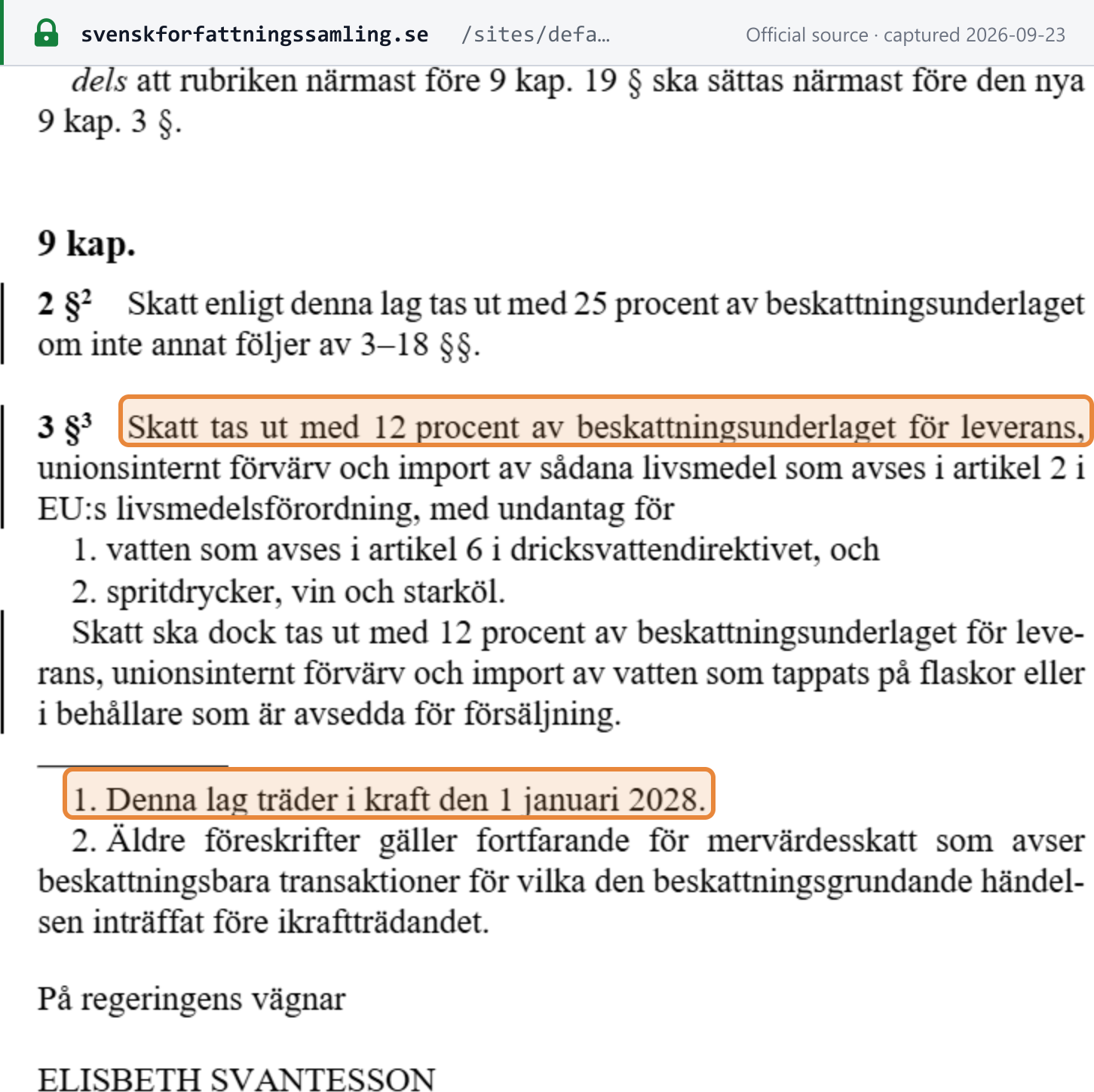
The reversion to 12% is already law. Lag (2026:119) renumbers the provision as ML 9 kap. 3 § and sets it at 12%: «Skatt tas ut med 12 procent av beskattningsunderlaget för leverans, unionsinternt förvärv och import av sådana livsmedel …» ("Tax is levied at 12 per cent of the taxable amount on the supply, intra-Union acquisition and import of such foodstuffs …"). Its commencement clause reads «Denna lag träder i kraft den 1 januari 2028.» ("This Act enters into force on 1 January 2028.") Skatteverket's rate page shows the 6% rate with no end date, but its news item on the cut says «Sänkningen gäller fram till och med den 31 december 2027.» ("The reduction applies up to and including 31 December 2027."), and the return to 12% is set by ML 9 kap. 3 § (Lag 2026:119). The measure was proposed in Prop. 2025/26:55, Tillfälligt sänkt mervärdesskatt på livsmedel, and adopted by the Riksdag on 25 February 2026 (Skatteutskottet report 2025/26:SkU9). [32] [40]
Eat-in versus takeaway. Restaurant and catering services stay at 12%: «Momssatsen kommer inte ändras för restaurangtjänster – den är fortsatt 12 procent.» ("The rate for restaurant services will not change — it remains 12 per cent.") The dividing line is support services: «Du ska också ta ut 6 procent moms när du säljer färdiglagad mat, så länge försäljningen inte också innehåller några stödtjänster. Exempel på stödtjänster är dukning, servering och diskning.» ("You must also charge 6 per cent VAT when you sell ready-cooked food, as long as the sale does not also contain any support services. Examples of support services are table-setting, serving and washing up.") Skatteverket's guidance also says: [4]
- tap water, spirits, wine and beer stronger than folköl remain at 25%;
- a lunch voucher usable only for takeaway is taxed at 6%, one usable only for eating in at 12%, and one usable for both is taxed when it is redeemed;
- packaging, and delivery by the restaurant itself, follow the food rate — but delivery by a third party is a separate transport service at 25%;
- optional disposable cutlery is a separate supply of goods at 25%.
Dance events at 6% from 1 July 2026
Admission to danstillställningar (dance events) moved from 25% to 6% on 1 July 2026. ML 9 kap. 14 § now reads: «Skatt tas ut med 6 procent av beskattningsunderlaget för 1. tillträde till konserter, cirkus-, teater-, opera- eller balettföreställningar eller andra liknande föreställningar, 2. tillträde till danstillställningar, och 3. tillträde till och förevisning av djurparker …» ("Tax is levied at 6 per cent of the taxable amount for 1. admission to concerts, circus, theatre, opera or ballet performances or other similar performances, 2. admission to dance events, and 3. admission to and display of zoos …"). The amending act is Lag (2026:841), and the old rate still applies where the chargeable event occurred before 1 July 2026. [1]
Skatteverket separates two things that are easy to confuse. An artist's own fee for performing live is exempt: «Den ersättning du får som artist för ditt framträdande inför publik är momsfri.» ("The fee you receive as an artist for your performance before an audience is VAT-free.") The organiser's admission charge is taxed at 6%. And a buyer who resells the performance charges 25%. [4]
Announced future rates
- 1 January 2028 — food returns to 12% (ML 9 kap. 3 §, Lag 2026:119). Enacted.
- No 2027 budget bill has been tabled. As at 2026-10-05, the Riksdag's document list for the 2026/27 session contains no government bills. In an election year, Riksdagsordningen (2014:801) tilläggsbestämmelse 9.5.1 sets the budget bill's deadline by reference to when the new government is formed. In any case it may not be submitted «senare än den 15 november under år då den dagen infaller måndag-torsdag och i andra fall inte senare än den torsdag som infaller närmast före den 15 november» ("later than 15 November in years when that day falls on Monday to Thursday, and otherwise not later than the Thursday falling closest before 15 November"). 15 November 2026 is a Sunday, so the latest date is Thursday 12 November 2026. No rate change for 2027 has been proposed in a bill. [35] [36]
- Prop. 2025/26:278, adopted by the Government on 4 June 2026 and submitted to the Riksdag on 9 June 2026, is before the Riksdag's Committee on Taxation. It would amend ML from 1 January 2027 to implement the second step of the EU's VAT in the Digital Age package. It changes no rates. See Recent changes. [21]
For Sweden alongside other jurisdictions, see Lookuptax's worldwide tax rates table, VAT registration thresholds table and VAT names by country.
Cross-border rules
Imports and exports
- Imports — through the VAT return, not at the border. Tullagen (2016:253) 2 kap. 2 § takes import VAT out of the customs procedure where the declarant (or the principal behind a customs agent) is registered for VAT in Sweden when the customs decision is made and imports as a taxable person, or is a non-taxable legal person. The VAT is then handled under SFL, in the VAT return. [22]
- The return boxes. Skatteverket: «Fält 50 - Beskattningsunderlag vid import.» ("Field 50 — Taxable amount at import.") The taxable amount is the customs value in kronor plus duty and other State charges plus incidental costs such as commission, packaging, transport and insurance to the destination. Output VAT goes in field 60, 61 or 62 (25%, 12% or 6%), and the deductible input VAT in field 48. For a fully taxable importer the entries cancel out. [23]
- Low-value imports. ML 23 kap. sets a special scheme for consignments with a real value up to EUR 150, where IOSS is not used and the goods are not excise goods. The person declaring the goods to Tullverket (Swedish Customs) collects the VAT from the recipient and reports and pays it to Tullverket monthly. [1]
- Exports. Exempt with a right to recover input VAT (ML 10 kap. 64 §): the seller delivers the goods outside the EU, a forwarder or carrier takes them directly out, or a non-established taxable person collects them for its business abroad. A sale to a traveller resident outside the EU is exempt only where the price is at least SEK 200 and the seller can show the goods left the EU before the end of the third month after the month of supply (10 kap. 65 §). For a buyer resident in Norway or Åland the minimum is SEK 1,000 net of Swedish VAT, and the seller must be able to show that the buyer brought the goods into Norway or Åland and paid tax there under a customs invoice or similar document (10 kap. 65 §, second paragraph). [1]
- Intra-EU supplies of goods. Exempt under ML 10 kap. 42 § if the customer acts as a taxable person (or non-taxable legal person) in another EU country, has given the seller its VAT number from that country, and the seller has filed a correct periodisk sammanställning (EC sales list) or can explain why not (10 kap. 43 §). [1]
Customs formalities beyond Tullagen 2 kap. 2 § and ML 23 kap. are a matter for Tullverket (Swedish Customs) and are outside the scope of this guide.
Digital products and services
Telecommunications, broadcasting and electronically supplied services to consumers are taxed where the consumer is, subject to a small-seller rule. Sweden states that rule's threshold as SEK 99,680 (ML 6 kap. 62 § 3): the combined value of such services and intra-EU distance sales of goods must not exceed SEK 99,680 in the current or the preceding calendar year. ML 6 kap. 63 §: «Om det belopp som avses i 62 § 3 överskrids, är tillhandahållandena av tjänsterna och leveranserna av varorna gjorda utomlands.» ("If the amount referred to in section 62 point 3 is exceeded, the services and the goods are supplied abroad.") The rule is therefore written for a seller established in Sweden. For a seller established in another EU country, whether its distance sales into Sweden are taxed here depends on its home state's EUR 10,000 threshold (ML 6 kap. 56 §, second paragraph; for goods, 6 kap. 7 §, second paragraph). A seller established outside the EU has no threshold for Swedish sales at all (ML 18 kap. 6 § 1). In practice EU sellers account for VAT on these sales through the Union OSS in their own member state, and non-EU sellers through the non-Union OSS. [1]
E-books and e-newspapers are 6%; music streaming and downloads are 25% (Skatteverket rate page). [4]
Foreign companies selling into Sweden — B2B and B2C
The answer depends on who the customer is.
B2B — the Swedish customer usually pays, so the seller does not register. Where a supplier not established in Sweden sells to a Swedish business, ML 16 kap. shifts the liability to the customer in these cases: [1]
| Situation | Who pays | ML |
|---|---|---|
| Goods or services connected with immovable property in Sweden, to a customer registered for VAT here | Customer | 16 kap. 6 § |
| General-rule services (Article 44 of the VAT Directive) to a taxable person or a VAT-registered non-taxable legal person | Customer | 16 kap. 9 § |
| Electricity, gas, heating or cooling to a customer registered here | Customer | 16 kap. 8 § |
| The final supply in a simplified triangular chain | Recipient | 16 kap. 10 § |
The non-established supplier may instead opt to be liable itself under 16 kap. 7 §, and the choice then covers all such supplies. Skatteverket's required invoice wording in these cases is «Omvänd betalningsskyldighet» or «Reverse charge». Where a non-established EU seller makes a reverse-charge supply, Swedish invoicing rules do not apply unless the customer self-bills (ML 17 kap. 5 §). [16]
B2C — the seller accounts for Swedish VAT itself. A seller not established in any EU country cannot use the SEK 120,000 exemption, so there is no B2C threshold (ML 18 kap. 6 § 1). For a seller established in another EU country, whether its distance sales into Sweden are taxed here depends on its home state's EUR 10,000 threshold (ML 6 kap. 7 § and 56 §, second paragraphs). Where a foreign seller's distance sales of goods or electronic services to Swedish consumers are taxable in Sweden, the usual route is the Union OSS (EU sellers), the non-Union OSS (non-EU sellers of services) or IOSS (imported goods up to EUR 150). Where no scheme applies, the seller registers in Sweden and, unless the mutual-assistance exception in SFL 6 kap. 3 § applies, appoints a Skatteverket-approved representative — see Non-resident registration. [1] [2]
Domestic reverse charge
ML 16 kap. also shifts VAT to the Swedish buyer between businesses registered here in six cases. The invoice must say «Omvänd betalningsskyldighet» or «Reverse charge» (ML 17 kap. 24 § 14). [1]
| Supply | Condition | ML |
|---|---|---|
| Construction services on property — groundwork, building and civil-engineering work, building installations, finishing, hire of plant with operator; construction cleaning; staffing for those | The buyer supplies such services other than occasionally, or supplies them to such a business | 16 kap. 13 § |
| Investment gold under an option to tax | Both parties registered, or required to be | 16 kap. 11 § |
| Gold material or semi-manufactured gold of at least 325 thousandths | Both parties registered, or required to be | 16 kap. 12 § |
| Scrap and waste of base metals, remelting ingots, and waste cells, batteries and accumulators | Both parties registered, or required to be | 16 kap. 14 § |
| Greenhouse-gas emission allowances and similar units | Both parties registered, or required to be | 16 kap. 15 § |
| Mobile phones, integrated circuit devices, games consoles, tablets and laptops | Both registered here, and the taxable amount for such goods on one invoice exceeds SEK 100,000 | 16 kap. 16 § |
For construction, Skatteverket's shorthand is: «Vid försäljning av byggtjänster mellan företag inom byggsektorn gäller omvänd betalningsskyldighet. Det innebär att säljaren inte ska ta ut moms på sina fakturor.» ("For sales of construction services between businesses in the construction sector, reverse charge applies. This means the seller must not charge VAT on its invoices.") Otherwise, construction services are taxed at 25%. [29]
Worked example from Skatteverket. Fatimas Snickeri AB sold construction services to Johannes Bygg under the reverse charge, but wrongly invoiced SEK 10,000 plus VAT of SEK 2,500. Fatimas Snickeri AB must report and pay the wrongly charged SEK 2,500. Johannes Bygg reports output VAT of SEK 3,125 (12,500 × 25%) and may deduct the same amount as input VAT. [16]
For the mechanism in general, see Lookuptax's reverse charge explainer.
Marketplace / platform deemed-supplier liability
An elektroniskt gränssnitt — «en marknadsplats, en plattform, en portal eller motsvarande» ("a marketplace, a platform, a portal or equivalent") — is treated as having bought and supplied the goods itself in two cases (ML 5 kap. 4–6 §§): [1]
- distance sales of goods imported from outside the EU in consignments with a real value up to EUR 150 (5 kap. 5 §);
- supplies of goods within the EU by a seller not established in the EU to a non-taxable person (5 kap. 6 §). The underlying supply to the platform is exempt (10 kap. 97 §).
A platform that facilitates supplies of goods or services to non-taxable persons must also keep records detailed enough for Skatteverket to check the VAT. It must make them available electronically on request, and keep them for ten years after the end of the year of the transaction (ML 17 kap. 36–37 §§). [1]
Prop. 2025/26:278 proposes extending 5 kap. 6 § to supplies to certain taxable persons and non-taxable legal persons from 1 January 2027. It is a bill, not law. [21]
Place of supply
The rules sit in ML 6 kap. and differ for goods and for services. [1]
Goods. Without transport, goods are supplied where they are when the supply takes place (6 kap. 4 §). With transport, they are supplied where the transport begins (6 kap. 5 §). Intra-EU distance sales are supplied where the transport ends (6 kap. 7 §), unless the small-seller rule in 6 kap. 62 § keeps them at origin. Installed or assembled goods are supplied where they are installed (6 kap. 13–14 §§). In a chain, the transport is attributed to the supply made to the intermediary (6 kap. 15 §). Imports take place in Sweden if the goods are here when they enter the EU (6 kap. 66 §).
Services. Business-to-business services follow the general rule in 6 kap. 33 § (Article 44 of the VAT Directive) — the provision the 16 kap. 9 § reverse charge attaches to. Telecom, broadcasting and electronic services to consumers are taxed at destination, subject to the small-seller rule in 6 kap. 62 §. Services connected with Swedish property are supplied in Sweden.
Invoice requirements
Invoicing rules sit in ML 17 kap. (the superseded 1994 Act had them in chapter 11). Skatteverket's invoicing guidance also stresses that the document's name does not matter: «Det spelar alltså ingen roll om den exempelvis kallas faktura, kvitto eller inköpsnota.» ("It therefore makes no difference whether it is called, for example, an invoice, a receipt or a purchase note.") What matters is the content. [16]
When an invoice is required
An invoice is required for every supply to another taxable person or a non-taxable legal person, whatever the value, and for prepayments on such supplies (ML 17 kap. 10 §). It is also required, even to a private individual, for new means of transport, intra-EU distance sales into Sweden, and construction and civil-engineering services with goods supplied with them (17 kap. 11 §). ML 17 kap. 12 § removes the duty for a list of exempt supplies, including healthcare, education, insurance, financial services and immovable property. [1]
Mandatory content
A full invoice (fullständig faktura) must contain, under ML 17 kap. 24 §: [1]
| # | Required field | ML 17 kap. 24 § |
|---|---|---|
| 1 | Date of issue | point 1 |
| 2 | A sequential number, based on one or more series, that uniquely identifies the invoice | point 2 |
| 3 | Supplier's VAT registration number | point 3 |
| 4 | Customer's VAT number, where the customer is liable for the VAT or the supply is an exempt intra-EU supply | point 4 |
| 5 | Supplier's full name and address | point 5 |
| 6 | Customer's full name and address | point 6 |
| 7 | Quantity and nature of the goods, or extent and nature of the services | point 7 |
| 8 | Date of supply or completion, or of a prepayment, where it can be determined and differs from the issue date | point 8 |
| 9 | Taxable amount per rate or exemption, unit price excluding VAT, and any discount not in the unit price | point 9 |
| 10 | The VAT rate applied | point 10 |
| 11 | The VAT amount payable | point 11 |
| 12 | «självfakturering» where the customer issued the invoice | point 12 |
| 13 | On an exempt supply, a reference to the ML provision or the VAT Directive, or another statement that the supply is exempt | point 13 |
| 14 | «omvänd betalningsskyldighet» where the customer is liable | point 14 |
| 15 | For a new means of transport sent to another EU country, the particulars in ML 2 kap. 16 § | point 15 |
| 16 | «vinstmarginalbeskattning för resebyråer» under the travel-agent scheme | point 16 |
| 17 | «vinstmarginalbeskattning för begagnade varor», «… för konstverk» or «… för samlarföremål och antikviteter» as relevant | point 17 |
Where the customer is liable for the VAT, points 9–11 may be left out, and the invoice instead shows the taxable amount by reference to the point-7 particulars (17 kap. 25 §). For a VAT group, the VAT number shown is the group representative's (17 kap. 3 §). [1]
Two points from Skatteverket's guidance. A seller exempt under the SEK 120,000 rule shows no VAT, but must write on the invoice that the sale is exempt. And descriptions must be specific: «En generell beskrivning av en vara eller tjänst kan innebära att fakturan inte är fullständig.» ("A general description of goods or services may mean that the invoice is not complete.") Skatteverket accepts the plain wording «undantag från momsplikt» on an exempt supply, without naming the provision. The exemption and reverse-charge wording may be given «på svenska, engelska eller på något av de andra officiella språken inom EU» ("in Swedish, English or any of the other official EU languages"). [16]
Issuance deadline
No general deadline in days. Neither the VAT Act nor Skatteverket's invoicing guidance sets a general number of days within which a Swedish invoice must be issued. Skatteverket states the standard as god affärssed (good business practice): «Den som säljer varor eller tjänster ska normalt fakturera inom den tid som gäller enligt god affärssed. Vad som är god affärssed bestäms exempelvis av vad som gäller inom branschen.» ("A person who sells goods or services must normally invoice within the time that applies according to good business practice. What is good business practice is determined, for example, by what applies within the sector.") Three supplies carry a fixed deadline: [16] [1]
| Supply | Invoice due by | ML |
|---|---|---|
| Construction or civil-engineering services, and goods supplied with them | End of the second calendar month after the month of supply | 17 kap. 16 § |
| Exempt intra-EU supply of goods | 15th of the month after the month of the chargeable event | 17 kap. 17 § |
| Services to be reported in an EC sales list | 15th of the month after the month of the chargeable event | 17 kap. 18 § |
A summary invoice (samlingsfaktura) may cover several supplies, but must respect those time limits (17 kap. 19 §).
Numbering and sequencing
The number must be sequential, «baserat på en eller flera serier» ("based on one or more series"), and must identify the invoice uniquely (ML 17 kap. 24 § 2). Several series are allowed. [1]
Credit and debit notes
Any document or message that amends the original invoice and refers to it specifically and unambiguously counts as an invoice (ML 17 kap. 22 §). A change document — in practice a kreditfaktura — must be issued on a price reduction after supply, on a discount not shown on the earlier invoice, and on any other customer credit (17 kap. 23 §). Skatteverket adds: [1] [16]
- «Datumet på ändringsfakturan ska vara samma dag som den ställs ut till köparen.» ("The date on the change invoice must be the same day as it is issued to the buyer.")
- The reference to the original invoice should normally be its sequential number.
- Seller and buyer may agree not to adjust the VAT, and then no change document is issued.
- Which period it lands in depends on the accounting method. Under the invoice method, the seller reduces output VAT in the period in which the change invoice is, or should have been, booked. Under the cash method, it is the period in which the refund is made. The buyer mirrors it.
Wrongly charged VAT is owed anyway. ML 16 kap. 23 §: «Den som felaktigt debiterar mervärdesskatt på en faktura eller liknande handling är betalningsskyldig till staten för beloppet.» ("A person who wrongly charges VAT on an invoice or similar document is liable to pay the amount to the State.") This applies whether or not the issuer is registered. A person who is not, and need not be, registered reports it on a special return (SKV 4702) due the 26th of the month after the month of the wrong charge. The buyer cannot deduct it. [1] [16]
Currency and language
- Currency. Any currency may be used, but ML 17 kap. 29 § requires the VAT amount also to be shown in Swedish kronor where the VAT is payable to Sweden — or in euro, if the issuer keeps its accounts in euro. [1]
- Exchange rate. ML 8 kap. 21 § allows either the latest average rate set on the most representative currency market in Sweden, or the latest rate published by the European Central Bank, in both cases at the time of the chargeable event. On the Swedish-market option, Skatteverket's invoicing page names «Nasdaq OMX Stockholm ABs fastställda mittkurs» ("the mid rate set by Nasdaq OMX Stockholm AB"), while its guidance for foreign businesses names «den mittkurs som publiceras på Riksbankens webbplats» ("the mid rate published on the Riksbank's website"). The ECB rate is the unambiguous alternative. [1] [16] [7]
- Language. ML 17 kap. contains no requirement that the invoice be in Swedish, and Skatteverket accepts the exemption and reverse-charge wording in Swedish, English or another official EU language. [16]
Document types
| Document | When it is used | ML |
|---|---|---|
| Full invoice (fullständig faktura) | Default | 17 kap. 24 § |
| Simplified invoice (förenklad faktura) | Any one of: total at most SEK 4,000 including VAT; trade custom or technical conditions make a full invoice difficult (Skatteverket's examples are petrol sold from an automatic pump and train or bus tickets); the document is a change document; or the seller is exempt under the SEK 120,000 rule | 17 kap. 26 § |
| Change document (credit note) | Amends an earlier invoice | 17 kap. 22–23 §§ |
| Self-billed invoice | Issued by the buyer under a prior agreement | 17 kap. 15 § |
A simplified invoice carries at least the date of issue, the supplier's identity, the type of goods or services, the VAT payable (or details allowing it to be calculated), a reference to the original invoice for a change document, and a note of the exemption for a small-business seller (17 kap. 28 §). It may not be used for intra-EU distance sales into Sweden, exempt intra-EU supplies, supplies in another EU country under 17 kap. 7 §, or supplies where the customer is liable and the supplier is not established here. [1]
The deduction trap. «Du har nämligen inte rätt att dra av momsen i en förenklad faktura om totalbeloppet i den överstiger 4 000 kronor inklusive moms.» ("You are in fact not entitled to deduct the VAT on a simplified invoice if its total amount exceeds SEK 4,000 including VAT.") For a larger business purchase, get a full invoice. [16]
Self-billing
Permitted (ML 17 kap. 15 §) where there is a prior agreement between supplier and customer and a procedure for the supplier to accept each invoice. Skatteverket: «Det finns inga formkrav för avtalet vilket betyder att även ett muntligt avtal kan räcka.» ("There are no formal requirements for the agreement, which means that even an oral agreement may suffice.") Acceptance can be as simple as the seller not objecting. The invoice must say «Självfakturering», and the buyer must keep a separate sequential number series for each seller. A third party such as a factoring company may also invoice in the seller's name. Either way, the seller remains responsible for a correct invoice. [1] [16]
Retention and audit trail
Two separate duties apply, and they have different sources.
| Obligation | Who | How long | Source |
|---|---|---|---|
| Keep a copy of every invoice issued and received | Anyone who must ensure an invoice is issued, and taxable persons receiving invoices | ML sets no period | ML 17 kap. 31–32 §§ |
| Preserve accounting records, invoices included | Anyone required to keep accounts | Up to and including the seventh year after the end of the calendar year in which the financial year ended | Bokföringslagen (1999:1078) 7 kap. 2 § |
| Records of supplies through an electronic interface | Platform operators | Ten years after the end of the transaction year | ML 17 kap. 37 § |
| Records under the low-value import scheme | The person declaring to Tullverket | Seven years after the end of the transaction year | ML 23 kap. 5 § |
- Electronic-only archiving is allowed. Bokföringslagen 7 kap. 1 §, as amended by Lag (2024:342), lets records be kept on paper or electronically, in the form and with the content they had when received or compiled. Records must be durable, easily accessible and kept in Sweden (7 kap. 2 §). [17]
- Storage in another EU country is possible under 7 kap. 3 a § if Skatteverket (or Finansinspektionen for supervised firms) is told the location and every change of it, Skatteverket and Tullverket have immediate electronic access throughout the retention period, and the records can be printed in Sweden.
- Audit trail. From issue and throughout storage, the person keeping the invoice must ensure «ursprungets äkthet» (authenticity of origin), «innehållets integritet» (integrity of content) and legibility (ML 17 kap. 30 §). Skatteverket: a seller can show origin by recording the invoice in its accounts, and «För elektroniska fakturor är kraven uppfyllda om fakturan kan tillhandahållas inom rimlig tid och utan fördröjning i läsbar form på en skärm eller genom utskrift på papper.» ("For electronic invoices the requirements are met if the invoice can be provided within a reasonable time and without delay in legible form on a screen or by printout on paper.") Neither ML 17 kap. 30 § nor Skatteverket's invoicing guidance sets any digital-signature, hash, QR-code or cryptographic-stamp requirement. [1] [16]
- Cross-border access. A competent authority of another EU country may demand immediate electronic access to an electronically stored invoice for control purposes where the VAT on it is payable there (ML 17 kap. 34 §).
A specimen of a compliant invoice
Skatteverket publishes its own annotated example under the heading «Exempel på faktura» on its invoicing page. It is a fictional invoice from "Rusningstider AB" with nine numbered callouts. The caption reads: «Bilden visar vilka uppgifter fakturan ska innehålla: 1) Datum för utfärdande av faktura. 2) Ett unikt löpnummer. 3) Köparens namn och adress. 4) Varornas mängd och art. 5) Beskattningsunderlag och enhetspris. 6) Tillämpad skattesats. 7) Det momsbelopp som ska betalas. 8) Säljarens namn och adress. 9) Säljarens momsregistreringsnummer.» ("The image shows which particulars the invoice must contain: 1) Date of issue. 2) A unique sequential number. 3) The buyer's name and address. 4) The quantity and nature of the goods. 5) Taxable amount and unit price. 6) Rate applied. 7) The VAT amount payable. 8) The seller's name and address. 9) The seller's VAT registration number.") [16]
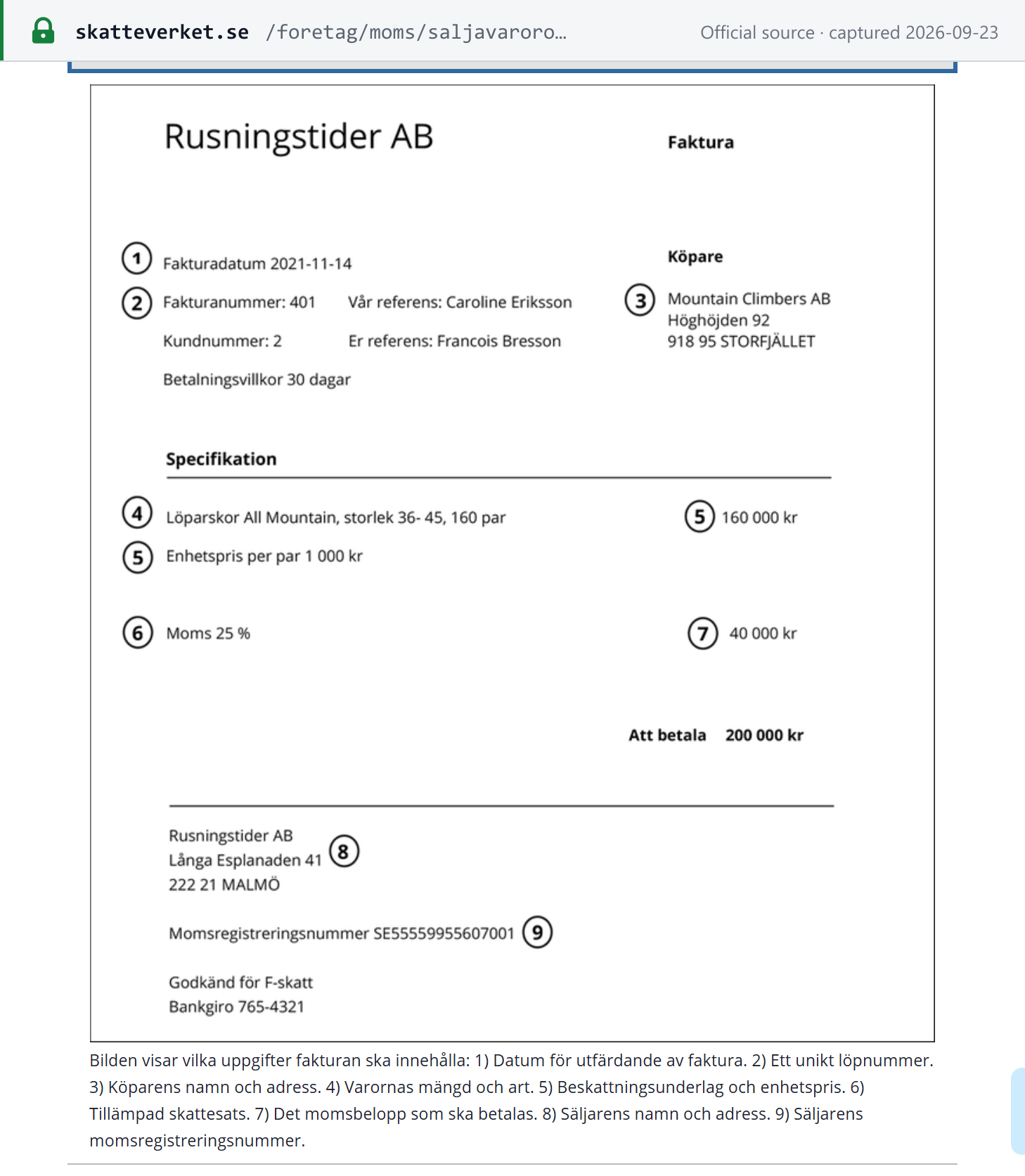
Below, the same nine labels are laid out as text, each mapped to the ML 17 kap. 24 § point it comes from. Every party, number and amount is fictional.
Faktura (invoice)
| 4) Quantity and nature of the goodsML 17 kap. 24 § 7 | 5) Unit price excl. VATML 17 kap. 24 § 9 | 5) Taxable amountML 17 kap. 24 § 9 |
|---|---|---|
| Hiking boots, sizes 36–45, 100 pairs | SEK 900 | SEK 90,000 |
- 5) Taxable amount at 25%ML 17 kap. 24 § 9
- SEK 90,000
- 6) VAT rate appliedML 17 kap. 24 § 10
- 25%
- 7) VAT payableML 17 kap. 24 § 11
- SEK 22,500
- Total to pay
- SEK 112,500
- Where the date of supply can be determined and differs from the date of issue, it must also be shown — ML 17 kap. 24 § 8.
- Where the buyer pays the VAT, add the buyer's VAT number (24 § 4) and the words "Omvänd betalningsskyldighet" or "Reverse charge" (24 § 14); points 9–11 may then be replaced by the taxable amount (17 kap. 25 §).
- On an exempt supply, state that it is exempt, for example "undantag från momsplikt" (24 § 13).
- Whatever the invoice currency, the VAT amount must also be shown in SEK where the VAT is payable to Sweden — ML 17 kap. 29 §.
- At or below SEK 4,000 including VAT a simplified invoice is possible (17 kap. 26 §), but a buyer cannot deduct the VAT on a simplified invoice above that amount.
E-invoicing status
Status (as of 2026-09-23): mandatory for B2G since 1 April 2019; voluntary for B2B and B2C, with no B2B mandate legislated.
| Scope | Status | Basis |
|---|---|---|
| B2G | Mandatory since 1 April 2019 for invoices arising from public procurement | Lag (2018:1277) |
| B2B | Voluntary — an e-invoice needs the recipient's consent | ML 17 kap. 20 § |
| B2C | Voluntary — and in most B2C sales no invoice is required at all | ML 17 kap. 10–11 §§ |
B2G — the mandate
The lag (2018:1277) om elektroniska fakturor till följd av offentlig upphandling requires a supplier's invoices to a contracting authority or entity to be electronic invoices that conform to the European e-invoicing standard. Section 4: «De fakturor som en leverantör utfärdar till en upphandlande myndighet eller enhet ska vara elektroniska fakturor som överensstämmer med den europeiska standard för elektronisk fakturering som Europeiska kommissionen har hänvisat till i Europeiska unionens officiella tidning.» ("The invoices that a supplier issues to a contracting authority or entity must be electronic invoices that comply with the European standard for electronic invoicing to which the European Commission has referred in the Official Journal of the European Union.") The parties may agree by contract on a different e-invoice standard. [18]
- Start date. «Denna lag träder i kraft den 1 april 2019.» ("This Act enters into force on 1 April 2019.") It does not apply to invoices from procurements started before that date.
- Receiving side. Contracting authorities must be able to receive and process invoices that conform to the standard (section 5).
- What counts. Section 2 defines an electronic invoice as one «som utfärdas, översänds och tas emot i ett strukturerat elektroniskt format som gör det möjligt att behandla dem automatiskt och elektroniskt» ("issued, transmitted and received in a structured electronic format that allows them to be processed automatically and electronically"). An invoice that is only an image or a PDF does not meet that definition.
- Scope. Invoices arising from procurement under LOU, LUF, LUFS or LUK — direct awards included — whatever country the supplier is in.
- Exclusions. The Act does not apply where an electronic invoice would risk disclosing classified information or harm security-sensitive activity (section 3). Upphandlingsmyndigheten's guidance adds cash and payment-card purchases.
- Format and network. EN 16931 e-invoices can be exchanged in two XML formats, UBL and CII. Contracting authorities must accept both; suppliers may choose one, and UBL is by far the most common. Upphandlingsmyndigheten recommends Peppol BIS Billing 3, a UBL-based implementation of EN 16931, sent over the Peppol network: «Upphandlingsmyndigheten rekommenderar att e-fakturaformatet Peppol BIS Billing 3 används» ("Upphandlingsmyndigheten recommends that the Peppol BIS Billing 3 e-invoice format is used"). [20]
For the full rules — exclusions, Peppol IDs, testing, retention and enforcement — see Lookuptax's Sweden e-invoicing guide. For the network itself, see the Peppol guide and country requirements for Peppol.
Who supervises it — changed on 1 July 2026
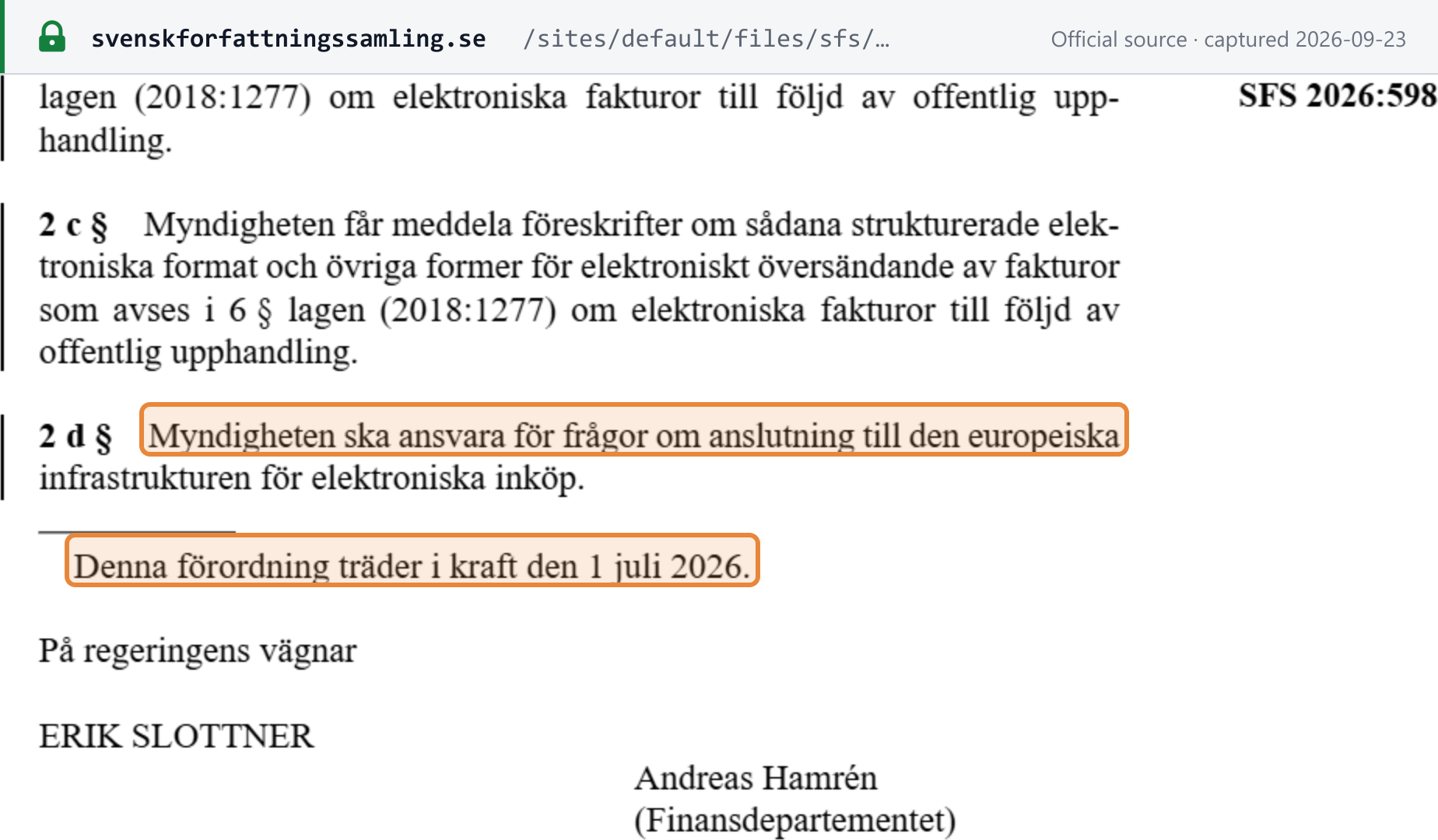
Until 30 June 2026, DIGG (Myndigheten för digital förvaltning) supported suppliers and could issue orders under section 7 of the e-invoicing Act. Förordning (2026:598) moved those tasks to Upphandlingsmyndigheten (the National Agency for Public Procurement) from 1 July 2026. It was issued on 13 May 2026 and published on 20 May 2026. It inserts sections 2 b–2 d into the Agency's instructions: [19]
- 2 b § — support and information for private suppliers on e-invoices in public procurement, and decisions on orders (förelägganden) under section 7 of lag (2018:1277);
- 2 c § — power to issue regulations on structured electronic formats and other forms of electronic transmission of invoices;
- 2 d § — «Myndigheten ska ansvara för frågor om anslutning till den europeiska infrastrukturen för elektroniska inköp.» ("The Agency shall be responsible for matters relating to connection to the European infrastructure for electronic procurement.") — the Peppol role.
Supplier-facing material that still names DIGG as the enforcer is out of date. On the same day, SFS 2026:599 repealed 5 § and 21 § of DIGG's own instruction, including its power to issue regulations. DIGG is also being wound up: SFS 2026:1769, published on 8 September 2026, repeals DIGG's instruction from 1 January 2027, when the new Digitaliseringsmyndigheten starts. (Svensk författningssamling — SFS 2026:1769, checked 2026-09-30)
Enforcement. Upphandlingsmyndigheten: «Om en leverantör inte skickar e-fakturor, eller skickar felaktiga e-fakturor, kan leverantören anmälas till Upphandlingsmyndigheten. Upphandlingsmyndigheten har då en skyldighet att utreda ärendet.» ("If a supplier does not send e-invoices, or sends incorrect e-invoices, the supplier can be reported to the National Agency for Public Procurement. The Agency then has a duty to investigate the matter.") An order can carry a vite (conditional fine), and it can be appealed to the general administrative courts (lag 2018:1277, sections 7–8). The Act sets no fixed monetary penalty. [20]
Rules for State agencies. Upphandlingsmyndigheten's page describes the regulations issued by DIGG in its MDFFS series, for which Upphandlingsmyndigheten has been responsible since 1 July 2026 — MDFFS 2019:1 (Peppol registration, amended by MDFFS 2026:1), MDFFS 2021:1 and MDFFS 2026:2. Under them, all State agencies must be registered in Peppol to receive e-invoices and able to send them through Peppol, must offer suppliers a portal for invoices, and must invoice each other electronically. Agencies with more than 50 employees must also offer a portal for catalogues and orders. [20]
B2B — no mandate
As at 2026-09-23 no Swedish instrument requires B2B e-invoicing. ML 17 kap. 20 §: «Elektronisk faktura får utfärdas bara om mottagaren godkänner det.» ("An electronic invoice may be issued only if the recipient accepts it.") [1]
Two official documents set out the Government's position.
- The inquiry — Dir. 2026:9, Moderniserad och brottsförebyggande hantering av mervärdesskatt, appointed in February 2026. It asks for an analysis of the legislative changes needed to implement the EU's digital reporting based on e-invoicing for cross-border B2B transactions, and whether to extend it domestically. «Uppdraget ska redovisas senast den 30 november 2027.» ("The assignment shall be reported no later than 30 November 2027.") This is a remit, not a rule. [39]
- The timetable — Prop. 2025/26:278, submitted to the Riksdag on 9 June 2026, sets out the five steps of the EU's VAT in the Digital Age (ViDA) package. Step two applies from 1 January 2027 and is the only step this bill implements; the bill has been referred to the Tax Committee (Skatteutskottet) and the Riksdag has not yet decided it. Steps three, four and five apply from 1 July 2028, 1 July 2029 and 1 July 2030, and «De ändringar som behöver genomföras i svensk rätt med anledning av dessa steg kommer att behandlas i framtida lagstiftningsprodukter.» ("The amendments that need to be made in Swedish law as a result of these steps will be dealt with in future legislative products.") [21]
So the mandatory e-invoicing and digital reporting steps have not been legislated in Sweden, and no Swedish authority has named a date for a domestic B2B mandate. For the EU timetable, see Lookuptax's ViDA explainer. For Sweden alongside other countries, see the e-invoicing status and networks table.
Filing and payment
Filing frequency
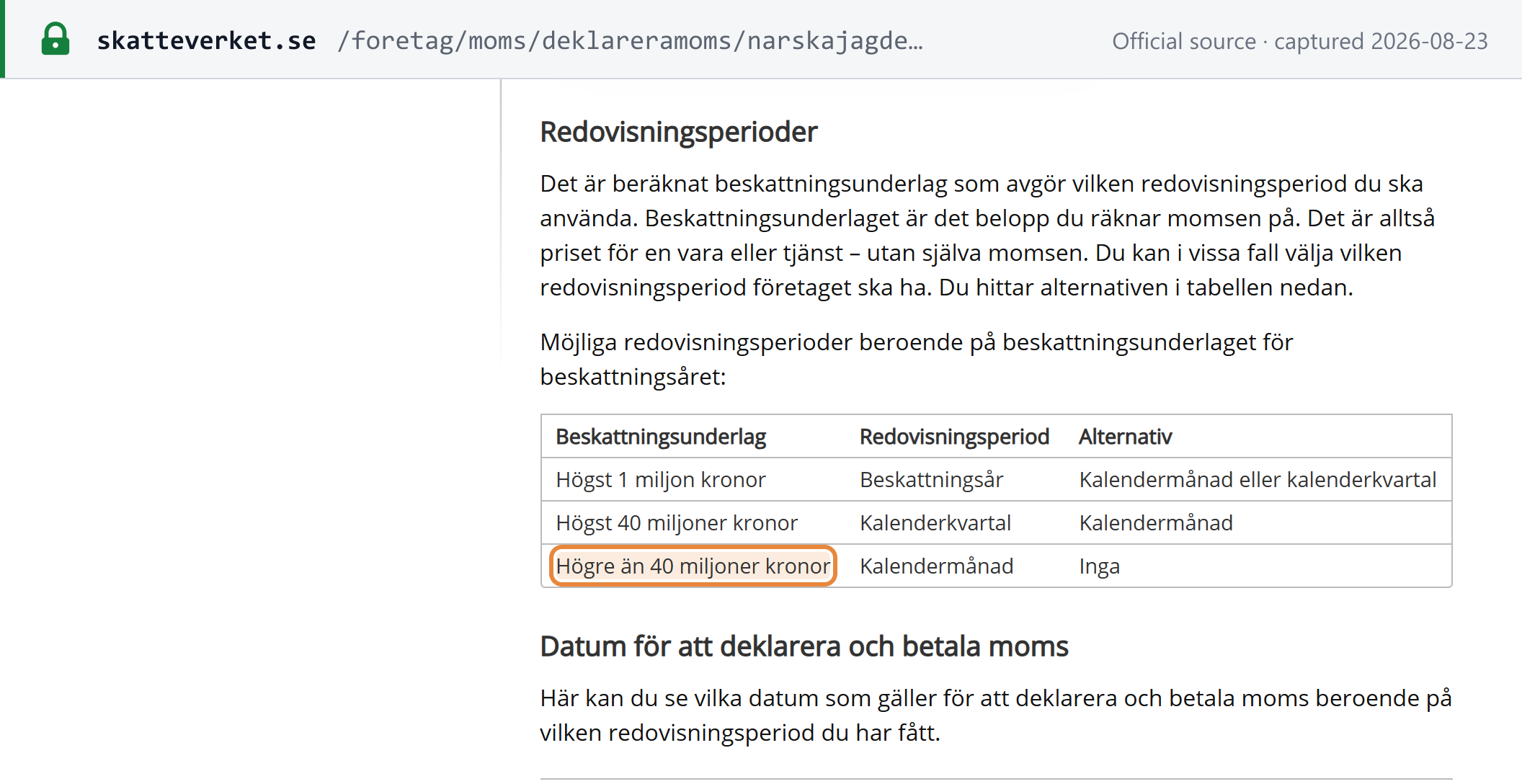
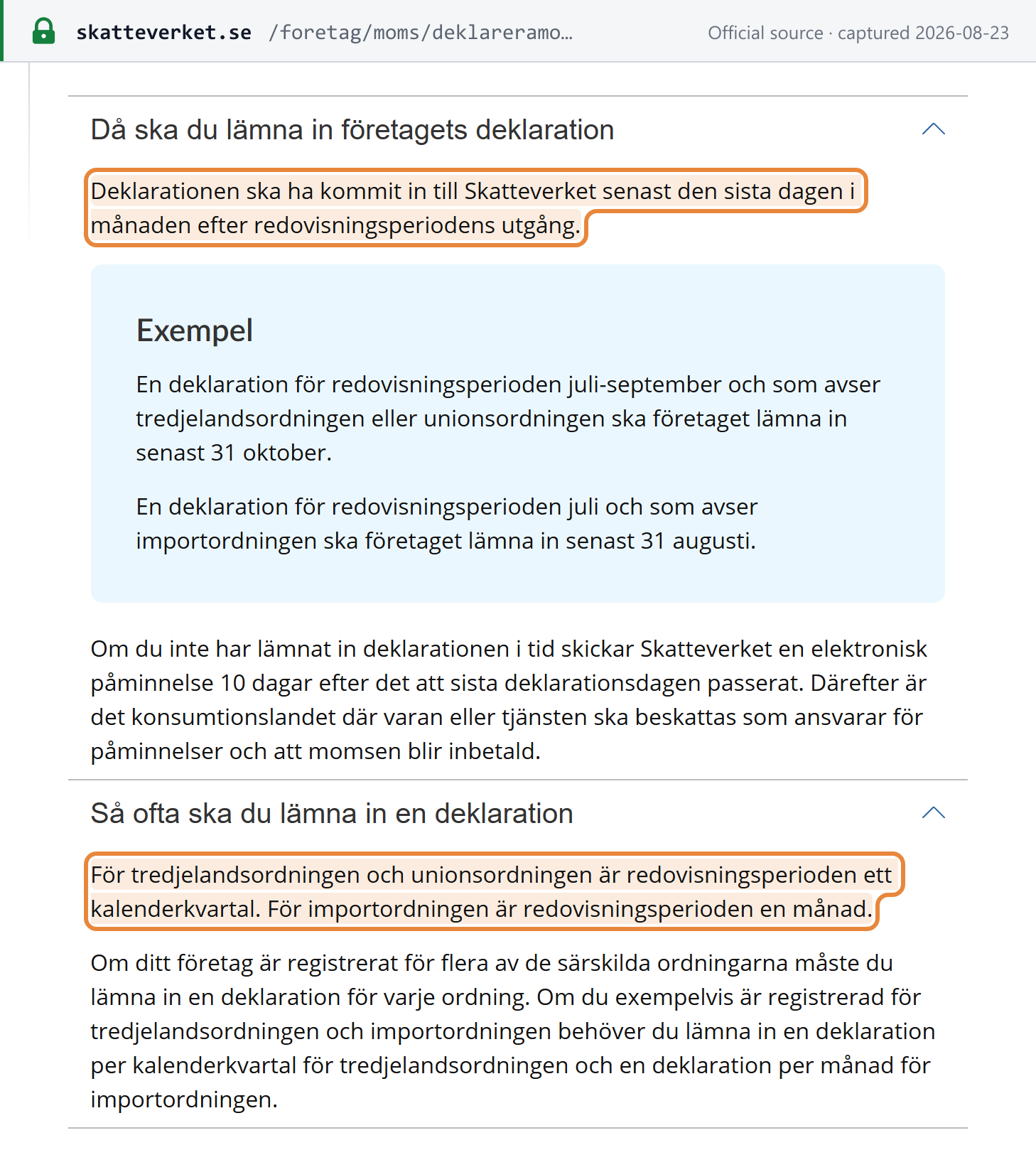
The reporting period depends on the estimated taxable amount (beskattningsunderlag) for the tax year, excluding intra-EU acquisitions and imports — not on turnover (SFL 26 kap. 11 §). Bands as at 2026-09-23: [10] [2]
| Taxable amount for the year | Default period | Alternative on request |
|---|---|---|
| At most SEK 1,000,000 | Tax year (annual) | Calendar month or calendar quarter |
| At most SEK 40,000,000 | Calendar quarter | Calendar month |
| Above SEK 40,000,000 | Calendar month | None |
A request-based decision to file monthly binds for at least 24 consecutive calendar months (SFL 26 kap. 13 §). Skatteverket's page for foreign businesses describes the same bands in terms of omsättning (turnover). The statute measures the taxable amount excluding intra-EU acquisitions and imports, and that is the test that applies.
Return due dates
The band sets the deadline as well as the frequency. Two monthly filers can be about two to three weeks apart for the same period. [10]
| Period | Filer | Return and payment due |
|---|---|---|
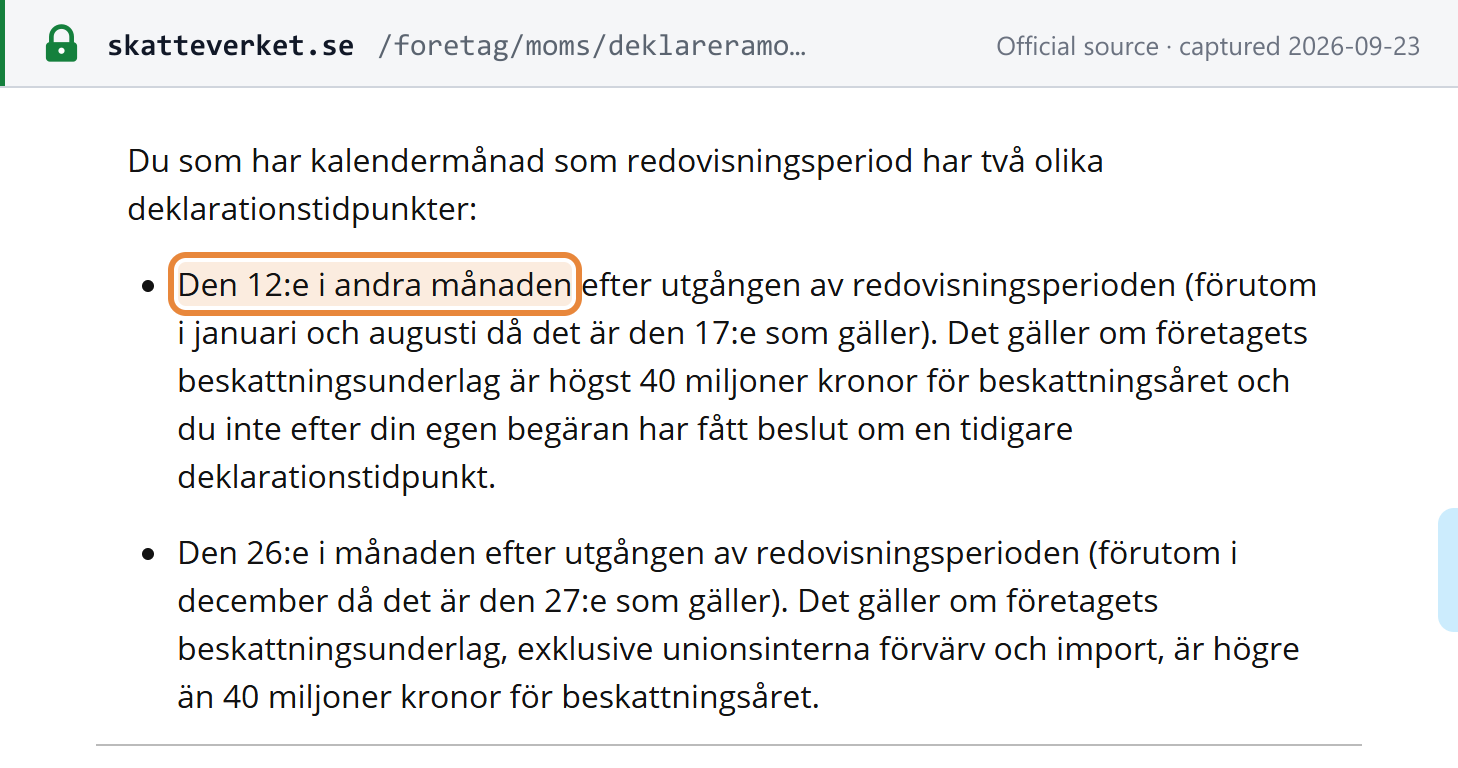
| Calendar month | Taxable amount at most SEK 40 million | 12th of the second month after the period; the 17th when that deadline falls in January or August |
| Calendar month | Taxable amount above SEK 40 million | 26th of the month after the period; the 27th in December |
| Calendar quarter | Any | 12th of the second month after the quarter; the 17th in August |
| Tax year | Sole trader or estate filing an income-tax return, with no EU trade | 12 May of the following year |
| Tax year | With EU trade or not filing an income-tax return; and all partnerships, VAT groups and certain others | 26th of the second month after the period; the 27th in December |
| Tax year | Company or economic association filing an income-tax return, with no EU trade | Keyed to the end of the financial year and to paper or electronic filing |
Skatteverket, for the at-most-SEK-40-million monthly filer: «Den 12:e i andra månaden efter utgången av redovisningsperioden (förutom i januari och augusti då det är den 17:e som gäller).» ("The 12th of the second month after the end of the reporting period (except in January and August, when the 17th applies).") And above SEK 40 million: «Den 26:e i månaden efter utgången av redovisningsperioden (förutom i december då det är den 27:e som gäller).» ("The 26th of the month after the end of the reporting period (except in December, when the 27th applies).") So for a January period, the larger filer is due on 26 February and the smaller on 12 March. A filer at or below SEK 40 million can ask to move to the 26th schedule (SFL 26 kap. 28 §). The statutory tables are in SFL 26 kap. 26–33 b §§. [10] [2]
Weekends and holidays. «Observera att om ett datum för redovisning och inbetalning för moms- och arbetsgivaravgifter infaller på en lördag, söndag, allmän helgdag, midsommarafton, julafton eller nyårsafton gäller i stället påföljande vardag.» ("Note that if a date for reporting and payment of VAT and employer contributions falls on a Saturday, Sunday, public holiday, Midsummer Eve, Christmas Eve or New Year's Eve, the following working day applies instead.") [37]
Payment due date and method
There is no separate payment deadline. «Momsen ska vara betald och finnas på Skatteverkets konto senast den sista inlämningsdagen för din momsdeklaration.» ("The VAT must be paid and be in the Swedish Tax Agency's account no later than the final submission day for your VAT return.") Payment counts on the day it is booked on the account (SFL 62 kap. 2 §), so a transfer started on the deadline is late. [11] [2]
- Tax account. VAT, payroll taxes and preliminary tax all run through the business's skattekonto (tax account).
- Channel. Pay to Skatteverket's bankgiro 5050-1055, quoting the business's OCR number, which appears in the e-service for filing the VAT return. From a foreign bank account, pay to Skatteverket's international account number instead. [11]
For what the OCR reference is and how it is built, see Lookuptax's explainer on the OCR number in Sweden.
Accounting methods
- Invoice method (faktureringsmetoden) — compulsory for a business required to keep accounts with annual turnover above SEK 3 million.
- Cash method (bokslutsmetoden) — available at SEK 3 million or less. Transactions are booked when paid, and all unpaid receivables and payables are brought in at the year end.
The method decides the period in which a transaction, or a credit note, is reported. [30]
Additional listings
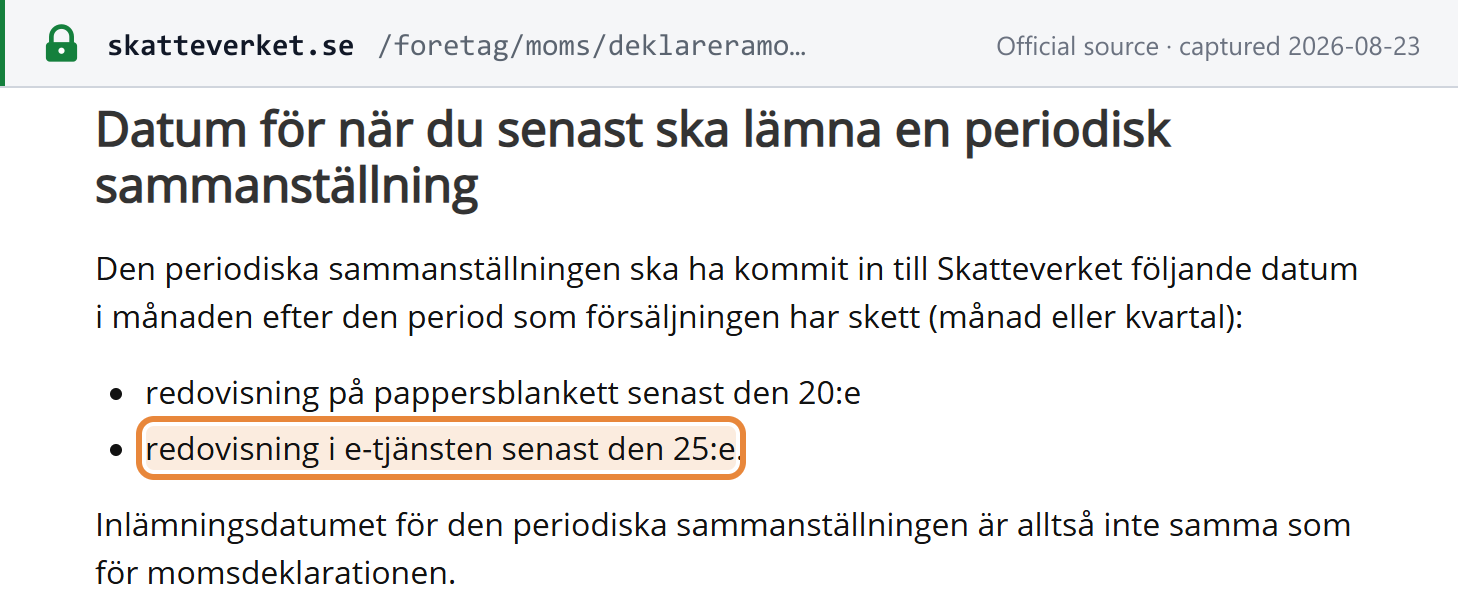
- EC sales list (periodisk sammanställning). Due the 20th of the month after the period on paper, or the 25th through the e-service or file transfer (SFL 35 kap. 9 §). «Inlämningsdatumet för den periodiska sammanställningen är alltså inte samma som för momsdeklarationen.» ("The submission date for the EC sales list is therefore not the same as for the VAT return.") The period depends on what you sell: goods mean monthly, services only mean quarterly, and both mean monthly. Quarterly reporting for goods is available on application where intra-EU goods supplies did not exceed SEK 500,000 in the current or any of the four preceding quarters (SFL 35 kap. 4 §). No nil list is filed for a period without reportable sales. [12]
- OSS and IOSS. The Union and non-Union schemes report per calendar quarter, and the import scheme (IOSS) per month. The return is due by the last day of the month after the period. Payment is made in euro to Skatteverket's account at Danske Bank (IBAN SE0512000000012810112134, BIC DABASESX), not to the tax account: «Om du gör din inbetalning till fel konto kan betalningen anses ha kommit in för sent.» ("If you make your payment to the wrong account the payment may be regarded as having been received late.") [13]
- Intrastat. Run by SCB (Statistics Sweden), not Skatteverket, as a monthly survey. SCB decides who must report, using the VAT return: a rolling 12-month value of SEK 15,000,000 or more of goods received from the EU (box 20) triggers arrivals reporting, and SEK 12,000,000 or more of goods sent to the EU (box 35) triggers dispatches reporting. Nil reports are required. The 2026 deadlines are 13 February, 13 March, 16 April, 18 May, 12 June, 14 July, 14 August, 14 September, 14 October, 13 November and 14 December, and 18 January 2027 for December. The thresholds are those in SCB's 2026 Intrastat handbook. [14] [15]
Input-tax recovery and blocked items
Input VAT on purchases for the taxable business is deductible. It must be backed by an invoice for goods, services and intra-EU acquisitions (ML 13 kap. 31–32 §§). The main restrictions: [1]
| Item | Treatment | ML 13 kap. |
|---|---|---|
| Buying or importing a passenger car or motorcycle | No deduction, unless for resale, hire, taxi transport, transport of the deceased or taxable driving instruction | 20 § |
| Hiring a passenger car or motorcycle | No deduction, with the same exceptions | 21 § |
| Hiring a car used more than negligibly in the taxable business | 50% of the VAT on the hire | 22 § |
| Running costs of a car used in the business | Fully deductible | 23 § |
| Entertainment not deductible for income tax | No deduction | 24 § |
| Meals within entertainment | Deductible up to the VAT on SEK 300 per person per occasion, if directly connected with the business and reasonable | 25 § |
| Permanent dwelling (stadigvarande bostad) | No deduction | 26 § |
| Mixed taxable and exempt use | Apportion on a reasonable basis | 29 § |
| Mostly taxable use | Full deduction where the purchase is more than 95% for deductible activity, or the VAT is at most SEK 1,000 and more than 95% of the business's consideration is from deductible activity | 30 § |
No VAT is deductible on purchases for the exempt part of a business. See Exemptions.
Refunds
- Residents. Excess input VAT is credited to the tax account. It is paid out automatically if a payout account is registered and nothing prevents it; otherwise it stays on the tax account. A refund can come early, before the ordinary reporting date, once all VAT, employer and excise returns due that month have been filed. Excess VAT can also be set against employer contributions, withheld tax and preliminary tax. [11]
- Withholding during a control (from 1 July 2026). SFL 63 a kap. 1 §: where Skatteverket has started a control of a VAT return and there is a risk of evasion, it may decide that a significant amount of excess input VAT is not credited until the control ends, without first hearing the business (Lag 2026:707). [2]
- Bad debts. ML 8 kap. 16 §: «Om en förlust uppkommer på leverantörens eller tillhandahållarens fordran som avser ersättning för en vara eller en tjänst (kundförlust), får denne minska beskattningsunderlaget med förlusten.» ("If a loss arises on the supplier's claim for consideration for goods or a service (customer loss), the supplier may reduce the taxable amount by the loss.") [1]
- Non-residents not registered in Sweden. ML 14 kap. governs refunds. EU businesses use the EU refund procedure. For businesses established outside the EU the rules are in ML 14 kap. 33–48 §§. The application goes to Skatteverket on its prescribed form (40 §) and must arrive within six calendar months after the end of the calendar year (43 §). [1]
- Corrections. A filed return is corrected by filing a new return for the period or by written request. Skatteverket treats it as a reconsideration (omprövning), due «senast i slutet av det kalenderår som infaller sex år efter beskattningsåret» ("no later than the end of the calendar year falling six years after the tax year"). [7]
Exemptions
Exempt supplies
ML 10 kap. makes everything taxable (2 §) and then lists the exemptions. The chapter indexes itself: [1]
| Area | ML 10 kap. |
|---|---|
| Postal services within the universal service, and stamps at face value | 4–5 §§ |
| Healthcare and dental care, including prescription medicines | 6–13 §§ |
| Social care | 14 § |
| Education | 15–18 §§ |
| Services within independent groups (cost-sharing) | 19 § |
| Certain mass media, including membership periodicals and public-service broadcasting | 20–27 §§ |
| Sport | 28–29 §§ |
| Culture, including publicly run or supported libraries and museums | 30–31 §§ |
| Insurance and reinsurance, including broking | 32 § |
| Banking, financing and securities — but not notarial services, debt collection, factoring administration or letting of safe-deposit space | 33 § |
| Legal-tender notes and coins, lotteries and betting, grave maintenance, gold to the Riksbank | 34 § |
| Immovable property — sales, and leases, tenancies, bostadsrätter, site leaseholds and easements | 35–36 §§ |
| Intra-EU supplies, imports, exports, ships and aircraft | 42–96 §§ |
The property exemption has long taxable carve-outs (10 kap. 36 §): permanently installed machinery; standing timber and crops sold apart from the land; hotel rooms and camping; parking; storage lockers; advertising space; buildings or land for animals; roads, bridges, tunnels and track; short-term letting of premises for sport; bus and rail terminal facilities let to operators; and mast and antenna sites let to mobile operators.
Exempt is not zero-rated
The two work in opposite ways for input VAT.
- Exempt (momsfri) — no VAT is charged and no input VAT is deductible on related purchases. Skatteverket: «Du får inte dra av någon moms för inköp till den del av verksamheten som är momsfri.» ("You may not deduct any VAT on purchases for the part of the business that is VAT-free.") [7]
- Qualified exemption (kvalificerat undantag) — exports and intra-EU supplies. No VAT is charged, but input VAT is recovered: «Då debiterar du ingen moms i fakturan på den försäljningen och redovisar inte utgående moms till skatteverket, men du har ändå rätt att få tillbaka momsen på inköp för de varor och tjänster som du har sålt utan moms.» ("You then charge no VAT on the invoice for that sale and do not report output VAT to the Swedish Tax Agency, but you are still entitled to recover the VAT on purchases for the goods and services you sold without VAT.") [7]
Voluntary taxation of commercial lettings (frivillig beskattning)
Letting property is exempt, but a landlord may opt to tax a letting for continuous use in a business whose transactions carry a right to deduct or a refund (ML 12 kap. 5 §). It cannot be used for a stadigvarande bostad (permanent dwelling), and it applies only to property in Sweden. Skatteverket: «Om du väljer frivillig beskattning ska du lägga på 25 procent moms på hyran. Då får du också dra av momsen på de kostnader som hör till uthyrningen.» ("If you choose voluntary taxation you must add 25 per cent VAT to the rent. You may then also deduct the VAT on the costs that relate to the letting.") The tenant deducts the VAT on the rent under the ordinary rules. [27]
The invoice is the election. The usual route in is simply to show VAT on an invoice for the letting (ML 12 kap. 8 §). No application is needed. That invoice must be issued within six months of the first day of the period it covers. A credit note cancelling all the VAT undoes the election only if it is issued within four months of the invoice (12 kap. 11 §). A second route is an application to Skatteverket during construction or major conversion, before letting starts (12 kap. 12–13 §§). An election ends when use changes, or when the property can no longer be let because of fire, another cause beyond the owner's control, or demolition (12 kap. 16 §). On a sale it passes to the buyer unless the parties agree otherwise in writing before handover (12 kap. 15 and 19 §§). Input-tax adjustment follows under 12 kap. 27–31 §§ and 15 kap. [1]
Special regimes
| Regime | What it does | ML |
|---|---|---|
| Small-business exemption | SEK 120,000 domestic exemption; EUR 100,000 EU cross-border scheme; no input-tax deduction while exempt | 18 kap. |
| Second-hand goods, art, collectors' items and antiques (VMB) | Tax on the margin, optional sale by sale; the customer gets no deduction | 20 kap. |
| Travel agents | Margin taxation; the invoice must say «vinstmarginalbeskattning för resebyråer» | 19 kap. |
| Investment gold | Exempt, with an option to tax and a reverse charge on opted-in supplies | 21 kap. |
| OSS and IOSS | Union, non-Union and import schemes | 22 kap. |
| Low-value imports | Consignments up to EUR 150, reported and paid monthly to Tullverket | 23 kap. |
| Cash accounting | Bokslutsmetoden, for annual turnover up to SEK 3 million | See Accounting methods |
| Free zones | Not a VAT regime in Sweden. ML provides only for skatteupplag (tax warehouses) for specified goods (11 kap.); ML 2 kap. 24 § treats free zones and customs warehouses as customs concepts | 11 kap. |
The margin scheme in practice. Skatteverket: «För att få använda VMB måste du ha köpt den begagnade varan, konstverket, samlarföremålet eller antikviteten från någon som inte hade rätt att dra av moms vid sitt inköp av varan.» ("To use the margin scheme you must have bought the second-hand item, work of art, collectors' item or antique from someone who had no right to deduct VAT on their purchase of it.") Antiques are goods more than 100 years old that are not works of art or collectors' items. Where individual prices are unknown — a stamp collection or a box of books — a simplified global margin per period may be used, but not for motor vehicles. Skatteverket's example: purchases of SEK 8,000 and sales of SEK 10,000 in a month give a margin of SEK 2,000, a taxable amount of SEK 1,600 and VAT of SEK 400. [28]
Pending, not law. On 2 July 2026 the Government referred to the Council on Legislation a proposal for a simpler margin scheme for second-hand goods bought for up to SEK 10,000, and a VAT exemption for food donations to charities, proposed to start on 1 January 2028. As at 2026-09-23 no bill on it was before the Riksdag. [41]
Outside the scope of this guide: the detail of the travel-agent scheme (ML 19 kap.) and investment gold (ML 21 kap.), capital-goods adjustment under ML 15 kap., the cash-register (kassaregister) rule for retailers in SFL 39 kap., and excise duties.
Offences and penalties
Offences
Criminal tax offences are in the Skattebrottslag (1971:69) ("SBL"), cited as consolidated up to SFS 2026:1531. Several sections were amended in 2026 (Lag 2026:109 and Lag 2026:1320); the table describes them as they now read. [24]
| Offence | Conduct | Sentence | SBL |
|---|---|---|---|
| Skattebrott (tax offence) | Intentionally giving an authority incorrect information, or failing to file a return or other prescribed information, so creating a risk that tax is evaded or wrongly credited or refunded | Imprisonment up to 2 years | 2 § |
| Skatteförseelse | The same, where minor | Fine | 3 § |
| Grovt skattebrott (aggravated) | The same, involving very large amounts, false documents or misleading bookkeeping, systematic or large-scale conduct, or otherwise exceptionally dangerous | Imprisonment 1 to 6 years | 4 § |
| Vårdslös skatteuppgift | Giving incorrect information through gross negligence, creating a risk of evasion | Fine or imprisonment up to 1 year | 5 § |
| Skatteredovisningsbrott | Intentionally giving incorrect information relevant to someone's tax outside 2 § | Fine or imprisonment up to 6 months | 7 § |
| Försvårande av skattekontroll | Intentionally or through gross negligence failing to keep accounts or preserve records, so creating a risk that tax control is seriously obstructed | Fine or imprisonment up to 2 years; if aggravated 6 months to 4 years | 10 § |
SBL 2 §: «Den som uppsåtligen lämnar oriktig uppgift till en myndighet eller låter bli att till en myndighet lämna deklaration, kontrolluppgift eller annan föreskriven uppgift och därigenom ger upphov till fara för att skatt undandras det allmänna eller felaktigt tillgodoräknas eller återbetalas till personen själv eller annan, döms för skattebrott till fängelse i högst två år.» ("A person who intentionally gives incorrect information to an authority, or fails to give an authority a return, statement or other prescribed information, and so creates a risk that tax is evaded or is wrongly credited or refunded to that person or another, is sentenced for tax offence to imprisonment for at most two years.")
- Voluntary correction is a defence to 2–8 §§ (SBL 12 §). It does not count as voluntary where Skatteverket has announced a general control, the correction relates to it, and it comes more than two months after the end of the month of the announcement.
- One sanction, not two. Once Skatteverket has decided on a tax surcharge against a natural person, the prosecutor may not charge the same act (SBL 13 b §). Skatteverket in turn may not impose a surcharge on the same natural person once a criminal report, preliminary investigation or prosecution concerns the same act (SFL 49 kap. 10 a–10 b §§).
- Small amounts. Charges under 2, 5 and 6 §§ need special reasons where the amount at stake is below two prisbasbelopp (price base amounts) and a tax surcharge could be imposed instead (SBL 13 §).
Penalties
| Default | Penalty (as at 2026-09-23) | Source |
|---|---|---|
| Late VAT return (skattedeklaration) | SEK 625 late-filing charge (förseningsavgift); SEK 1,250 if filed only after a formal order (föreläggande) | SFL 48 kap. 6 § |
| Several returns late at once | One charge only | SFL 48 kap. 5 § |
| Late EC sales list | SEK 1,250 | SFL 48 kap. 6 § |
| Incorrect information on a VAT return | Tax surcharge (skattetillägg) of 20% of the tax at stake | SFL 49 kap. 11 § |
| Amount put in the wrong period | 2% where the reporting period is at most three months and the error is within four months either side; otherwise 5% | SFL 49 kap. 13 § |
| Assessment by estimate (skönsbeskattning) | 20% | SFL 49 kap. |
| Late payment | Cost interest at the base rate plus 15 percentage points (17.5% as at 2026-09-23) | SFL 65 kap. 13 § |
The late-filing charge does not escalate for a VAT return. SFL 48 kap. 7 § adds a second and third charge after three and a further two months — but only for income returns, top-up tax returns and reports, and special information. The skattedeklaration is not on that list. For a late VAT return, the cost of staying late comes from interest. [2]
Tax surcharge. Skatteverket: «När det gäller annan skatt än slutlig skatt – till exempel mervärdesskatt, arbetsgivaravgifter eller när du ansöker om återbetalning av punktskatt – är skattetillägget 20 procent av den skatt som inte skulle ha bestämts eller felaktigt tillgodoräknats dig om Skatteverket godtagit din oriktiga uppgift.» ("For tax other than final tax — for example VAT, employer contributions or when you apply for a refund of excise duty — the surcharge is 20 per cent of the tax that would not have been assessed, or would wrongly have been credited to you, had the Swedish Tax Agency accepted your incorrect information.") [25]
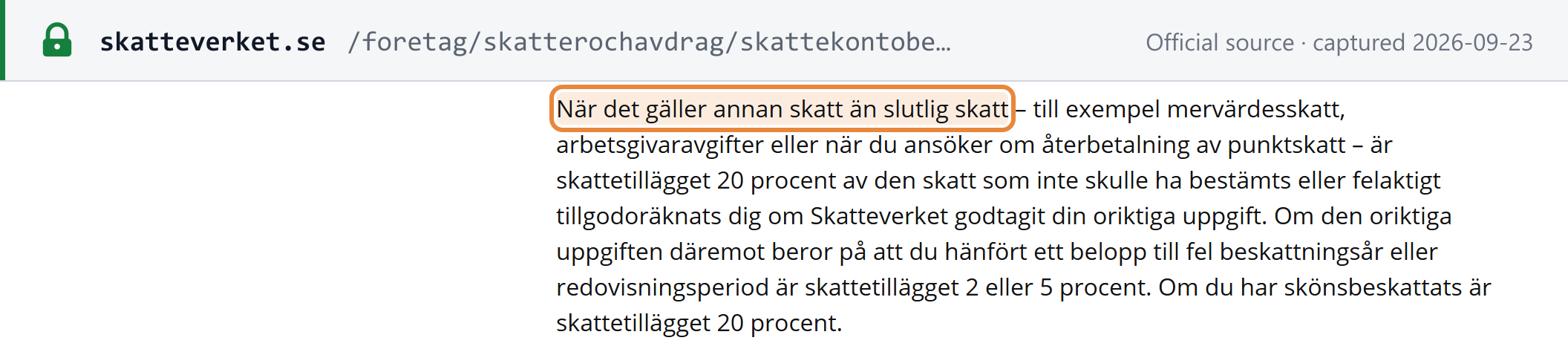
- Knowing participation in fraud. Since Lag 2026:110, incorrect information under SFL 49 kap. 5 § also covers VAT information about a transaction that was part of VAT evasion where the person knew or should have known.
- No surcharge where the error is clear from reconciliation data available to Skatteverket, where the business corrected it on its own initiative, or where the amount is negligible (SFL 49 kap. 10 §).
- Not twice for the same person. No surcharge is imposed on «samma fysiska person» ("the same natural person") once a criminal report, preliminary investigation or prosecution concerns the same act (SFL 49 kap. 10 a–10 b §§). A surcharge on the company is not barred.
- File and it falls away. A surcharge imposed because no VAT return was filed is cancelled if the return is filed within two months of the end of the month in which the decision was notified (SFL 49 kap. 7 §).
- Relief. Full or partial relief is possible where the full charge would be unreasonable or disproportionate. Partial relief is normally a half or a quarter of the full surcharge (SFL 51 kap. 1 §). [25]
Interest. Interest is calculated daily on the tax-account balance and posted monthly (SFL 65 kap. 2 §). It is tied to a base rate (basränta): 125% of the average rate on six-month Treasury bills, with a floor of 1.25% (65 kap. 3 §). As at 2026-09-23 Skatteverket gives a base rate of 2.5% from 1 December 2024, low cost interest 2.5%, high cost interest 17.5%, and revenue interest 1.125% on a credit balance. The high rate — base rate plus 15 percentage points — runs on late payments until a debt is passed to the Enforcement Authority (Kronofogdemyndigheten); after that the base rate applies. Skatteverket must waive cost interest where there are exceptional reasons (65 kap. 15 §). [26] [2]
Penalties under other laws. These come from different acts and different authorities.
- B2G e-invoicing — an order with a conditional fine from Upphandlingsmyndigheten (lag 2018:1277, sections 7–8). See E-invoicing status.
- Intrastat — persistent failure to report can lead to an order with a conditional fine from SCB, under section 20 of lagen (2001:99) om den officiella statistiken. [15]
Frequently asked questions
I run a café in Sweden. Is a cinnamon bun taxed at 6% or 12%?
It depends on how it is sold. Since 1 April 2026 foodstuffs are taxed at 6%, but restaurant and catering services stay at 12% (ML 9 kap. 5 §). Skatteverket draws the line at support services such as table-setting, serving and washing up. Ready-cooked food sold without them is taxed at 6%. Food served with them is a restaurant service at 12%. So a bun eaten at the café's table is taxed at 12% and a loaf taken home is taxed at 6%, even when both are bought together. A lunch voucher usable only for takeaway is taxed at 6%, one usable only for eating in is taxed at 12%, and one usable for both is taxed when it is redeemed. [4]
Is the 6% VAT rate on food in Sweden permanent?
No. The reduction is temporary by law. ML 9 kap. 19 § sets 6% on foodstuffs from 1 April 2026 (Lag 2026:118). Lag 2026:119, already published, renumbers the provision as 9 kap. 3 § and sets the rate back to 12% from 1 January 2028. Skatteverket's rate page shows the 6% rate with no end date, but its news item on the cut states that the reduction applies up to and including 31 December 2027. Spirits, wine, beer stronger than folköl and tap water are outside the food rate and stay at 25%. [1] [32]
We file VAT monthly in Sweden. Is our return due on the 12th or the 26th?
It depends on your taxable amount (beskattningsunderlag) for the tax year, not on the fact that you file monthly. At most SEK 40 million: a monthly return is due on the 12th of the second month after the period, or the 17th when that deadline falls in January or August. Above SEK 40 million: the return is due on the 26th of the month after the period, or the 27th in December. A filer at or below SEK 40 million can ask to move to the 26th schedule (SFL 26 kap. 28 §). Payment is due on the same day, and it counts only when it is booked on your tax account. [10] [2]
We are a non-EU company. Do we need a Swedish representative to register for VAT?
Normally yes. SFL 6 kap. 2 § requires a taxable person not established in Sweden that must pay Swedish VAT to be represented by a representative (ombud) approved by Skatteverket. SFL 6 kap. 3 § lifts the requirement where Sweden has a special agreement on mutual assistance for the recovery of tax claims and the exchange of tax information with the country where the business has its seat. Skatteverket's guidance for foreign businesses states the requirement for non-EU businesses without that qualification. Skatteverket gives the processing time for a registration as about two to eight weeks. [2] [7]
A Swedish supplier gave us a simplified invoice for SEK 6,000. Can we deduct the VAT?
No. A simplified invoice may be issued where, among other cases, its total does not exceed SEK 4,000 including VAT (ML 17 kap. 26 §). Skatteverket states that a buyer is not entitled to deduct the VAT on a simplified invoice whose total exceeds SEK 4,000 including VAT. For a purchase above that amount, ask the seller for a full invoice. [16]
VIES says our Swedish customer's VAT number is invalid. What does that mean?
Check the number in the European Commission's VIES service, which is the only check Skatteverket accepts as proof that your buyer was VAT-registered. Since 1 July 2026 an invalid result can also be deliberate. Under SFL 7 kap. 12 § Skatteverket may decide that a Swedish VAT number is to be shown as invalid in VIES where there is a tangible risk that the holder will use it for VAT evasion, and it may do so before the holder has been heard. A Swedish VAT number is SE followed by 12 digits, and the last two digits are always 01. [6] [33] [5]
Do we pay import VAT to Swedish Customs?
Not if you are VAT-registered in Sweden when the customs decision is made and you import as a taxable person. Tullagen 2 kap. 2 § then takes the import VAT out of the customs procedure and puts it in the tax procedure. You report the taxable amount at import in field 50 of your VAT return, the output VAT in field 60, 61 or 62 (25%, 12% or 6%), and your deduction in field 48. For a fully taxable importer the entries cancel out. [22] [23]
Our group has several Swedish companies. Can we register as one VAT group?
Probably not. ML 4 kap. 8 § allows a VAT group for only two populations. The first is businesses supervised by Finansinspektionen that make exempt insurance or financial services, plus businesses whose main activity is supplying them. The second is commission-agent and principal companies in a commission relationship under chapter 36 of the Income Tax Act. Only Swedish fixed establishments can be members, and the members must be closely bound financially, economically and organisationally. An ordinary trading group cannot register as one taxable person. [1]
Important websites
Checked live 2026-09-23.
| Site | Purpose |
|---|---|
| verksamt.se | Register a Swedish business for VAT (joint e-service of Skatteverket, Bolagsverket and Tillväxtverket) |
| Registrera utländsk verksamhet i Sverige | Register a foreign business in Sweden — no Swedish e-ID needed |
| Registrera ditt företag för moms | VAT registration rules and forms SKV 4620 and SKV 4632 |
| Avregistrera ditt företag för moms | Deregistration rules and form SKV 4639 |
| E-tjänster och blanketter | File the VAT return; all of Skatteverket's e-services and forms |
| När ska jag deklarera moms? | Reporting periods and filing and payment deadlines |
| Viktiga datum | Skatteverket's published date list and the weekend and holiday rule |
| Betala och få tillbaka moms | Pay VAT — bankgiro 5050-1055, OCR number, international account |
| Skattekonto | The tax account — balances, statements and interest |
| Momssatser och undantag från moms | Rate lookup by type of supply |
| VIES | Verify a VAT number — the only route Skatteverket accepts |
| Momsregistreringsnummer i EU | VAT-number formats by member state |
| One Stop Shop (OSS) | Apply for, file and pay under OSS and IOSS |
| Periodisk sammanställning | File the EC sales list |
| SCB Intrastat | Intrastat thresholds, deadlines and login |
| Upphandlingsmyndigheten — e-handel och e-faktura | B2G e-invoicing rules, Peppol and supplier portals |
| Upphandlingsmyndigheten — Peppol | Peppol connection and service providers |
| Skatteupplysningen, 0771-567 567 | Skatteverket's telephone information service, including VAT-number checks |
Also see Lookuptax's Sweden VAT number validator.
Recent changes
- 2026-07-01 — Admission to dance events moved from 25% to 6% VAT, alongside concerts, theatre and ballet (ML 9 kap. 14 § 2, Lag 2026:841). (Sveriges riksdag) — see event record
- 2026-07-01 — New anti-fraud powers: Skatteverket may refuse or cancel a VAT registration on fraud-risk grounds, call representatives, applicants or registered persons in for identity checks with fingerprints and a facial image, have a VAT number shown as invalid in VIES, and withhold significant excess input VAT during a control (SFL 7 kap. 6–12 §§ and 63 a kap., Lag 2026:707). (Svensk författningssamling) — see event record
- 2026-07-01 — B2G e-invoicing support, orders under lag (2018:1277) and the Peppol connection role moved from DIGG to Upphandlingsmyndigheten (SFS 2026:598). (Svensk författningssamling) — see event record
- 2026-06-09 — Prop. 2025/26:278 submitted to the Riksdag (adopted by the Government on 4 June 2026): technical amendments to ML for step two of the EU's VAT in the Digital Age package, proposed to apply from 1 January 2027 if adopted. It covers the cross-border trade rules, the chargeable event and the time VAT becomes due; Lagrådet raised no objection. It contains no rate change and no e-invoicing mandate. The bill has been referred to the Tax Committee (Skatteutskottet) and the Riksdag has not yet decided it. (Sveriges riksdag) — see event record
- 2026-04-01 — VAT on food cut from 12% to 6% until 31 December 2027; restaurant and catering services stay at 12%. The return to 12% on 1 January 2028 is already enacted (Lag 2026:118 and Lag 2026:119). (Skatteverket) — see event record
- 2025-01-01 — Registration threshold of SEK 120,000, tested over the current and two preceding calendar years, and the EU cross-border small-business scheme (ML 18 kap., Lag 2024:942). (Svensk författningssamling)
Ahead — the 2027 budget bill, due no later than Thursday 12 November 2026; 1 January 2027, if Prop. 2025/26:278 is adopted; and 1 January 2028, when food returns to 12%. For the full chronology, see Sweden tax changes on Lookuptax.
Reference links
- Sveriges riksdag — Mervärdesskattelag (2023:200), consolidated
- Sveriges riksdag — Skatteförfarandelag (2011:1244), consolidated
- Sveriges riksdag — Skattebrottslag (1971:69), consolidated
- Sveriges riksdag — Bokföringslag (1999:1078), consolidated
- Sveriges riksdag — Lag (1974:174) om identitetsbeteckning för juridiska personer m.fl.
- Sveriges riksdag — Tullag (2016:253), consolidated
- Sveriges riksdag — Lag (2018:1277) om elektroniska fakturor till följd av offentlig upphandling
- Sveriges riksdag — Riksdagsordning (2014:801)
- Sveriges riksdag — government bills in the 2026/27 session (open data)
- Sveriges riksdag — Prop. 2025/26:55, Tillfälligt sänkt mervärdesskatt på livsmedel
- Sveriges riksdag — Prop. 2025/26:278, Teknisk översyn av mervärdesskattereglerna vid gränsöverskridande handel
- Svensk författningssamling — SFS 2024:942 (PDF)
- Svensk författningssamling — SFS 2026:119 (PDF)
- Svensk författningssamling — SFS 2026:707 (PDF)
- Svensk författningssamling — SFS 2026:598 (PDF)
- Regeringen — Dir. 2026:9, Moderniserad och brottsförebyggande hantering av mervärdesskatt
- Regeringen — press release, 2 July 2026: simpler VAT rules for second-hand goods and food donations
- Skatteverket — Momssatser och undantag från moms
- Skatteverket — Livsmedelsmomsen sänks till 6 procent (news)
- Skatteverket — Registrera ditt företag för moms
- Skatteverket — Avregistrera ditt företag för moms
- Skatteverket — Momsregistreringsnummer (VAT-nummer) i EU
- Skatteverket — Kontrollera momsregistreringsnummer
- Skatteverket — Köpa varor från andra EU-länder (VAT-nummer)
- Skatteverket — Organisationsnummer
- Skatteverket — Utländska företag i Sverige: frågor och svar
- Skatteverket — Registrera utländsk verksamhet
- Skatteverket — Utländska företag: deklarera moms
- Skatteverket — När ska jag deklarera moms?
- Skatteverket — Viktiga datum
- Skatteverket — Betala och få tillbaka moms
- Skatteverket — Fylla i momsdeklarationen
- Skatteverket — Periodisk sammanställning för varor och tjänster
- Skatteverket — Deklarera och betala moms i One Stop Shop
- Skatteverket — Momslagens regler om fakturering
- Skatteverket — Byggverksamhet
- Skatteverket — Uthyrning av fastighet och frivillig beskattning
- Skatteverket — Vinstmarginalbeskattning av begagnade varor med mera
- Skatteverket — Skattetillägg för företag
- Skatteverket — Ränta på skattekontot
- Upphandlingsmyndigheten — Regler för e-handel och e-faktura
- Upphandlingsmyndigheten — Peppol
- SCB — Intrastat
- SCB — Intrastat handbook 2026 (PDF)
- European Commission — VIES VAT number validation
- EUR-Lex — Council Directive 2006/112/EC (VAT Directive)
- EUR-Lex — Council Directive (EU) 2025/516 (VAT in the Digital Age)
- Lookuptax — How to verify an EU VAT number on VIES
- Lookuptax — Official links to check a VAT number
- Lookuptax — OCR number in Sweden explained
- Lookuptax — What is reverse charge?
- Lookuptax — ViDA, VAT in the Digital Age, explained
- Lookuptax — How to register for VAT, sales tax and GST
- Lookuptax — Peppol e-invoicing guide
- Lookuptax — Country requirements for Peppol
- Lookuptax — E-invoicing status and networks worldwide
- Lookuptax — VAT registration thresholds worldwide
- Lookuptax — Worldwide tax rates
- Lookuptax — VAT names by country