Switzerland VAT guidelines
| FACTSHEET | |
|---|---|
| Country code | CH |
| Tax name | Mehrwertsteuer (MWST) / taxe sur la valeur ajoutée (TVA) / imposta sul valore aggiunto (IVA) |
| Tax Authority | Federal Tax Administration (ESTV / AFC); import VAT: Federal Office for Customs and Border Security (BAZG) |
Overview
Switzerland levies one federal value added tax with three official names: Mehrwertsteuer (MWST), taxe sur la valeur ajoutée (TVA) and imposta sul valore aggiunto (IVA). The Federal VAT Act (MWSTG, SR 641.20) describes it as a general consumption tax "nach dem System der Netto-Allphasensteuer mit Vorsteuerabzug" — a multi-stage tax with input-tax deduction. It has three parts: [1]
- Inlandsteuer — tax on supplies made in Switzerland by taxable persons;
- Bezugsteuer — reverse-charge tax on services bought from businesses abroad (and, since 2025, on emission rights);
- Einfuhrsteuer — import VAT on goods.
Authorities. The Federal Tax Administration (ESTV / AFC), Main Division VAT in Bern, administers domestic VAT and the reverse charge. Import VAT is collected by the Federal Office for Customs and Border Security (BAZG); the person liable is the customs debtor (Art. 51 MWSTG). [1]
Currency. Swiss francs (CHF): "Die Abrechnung der Mehrwertsteuer erfolgt für alle Entgelte in Schweizer Franken." [24]
Tax period. The calendar year (Art. 34 Abs. 2 MWSTG). The provision allowing the business year to be used instead is not yet in force. Returns are filed for shorter reporting periods — see Filing and payment. [1]
Layering. None. There is no cantonal or municipal VAT; cantons and municipalities may levy only ticket taxes and real-estate transfer taxes, which are not treated as VAT-like taxes (Art. 2 MWSTG). [1]
Territory and Liechtenstein. For VAT, "Swiss territory" and "domestic" mean the territory of the Swiss Confederation, the Principality of Liechtenstein, the German municipality of Büsingen and the Swiss sector of EuroAirport Basel-Mulhouse-Freiburg (Art. 3 lit. a MWSTG). Samnaun and Sampuoir are outside the customs territory: goods supplied there are treated as abroad, services as domestic (Art. 4 MWSTG). [3] [1]
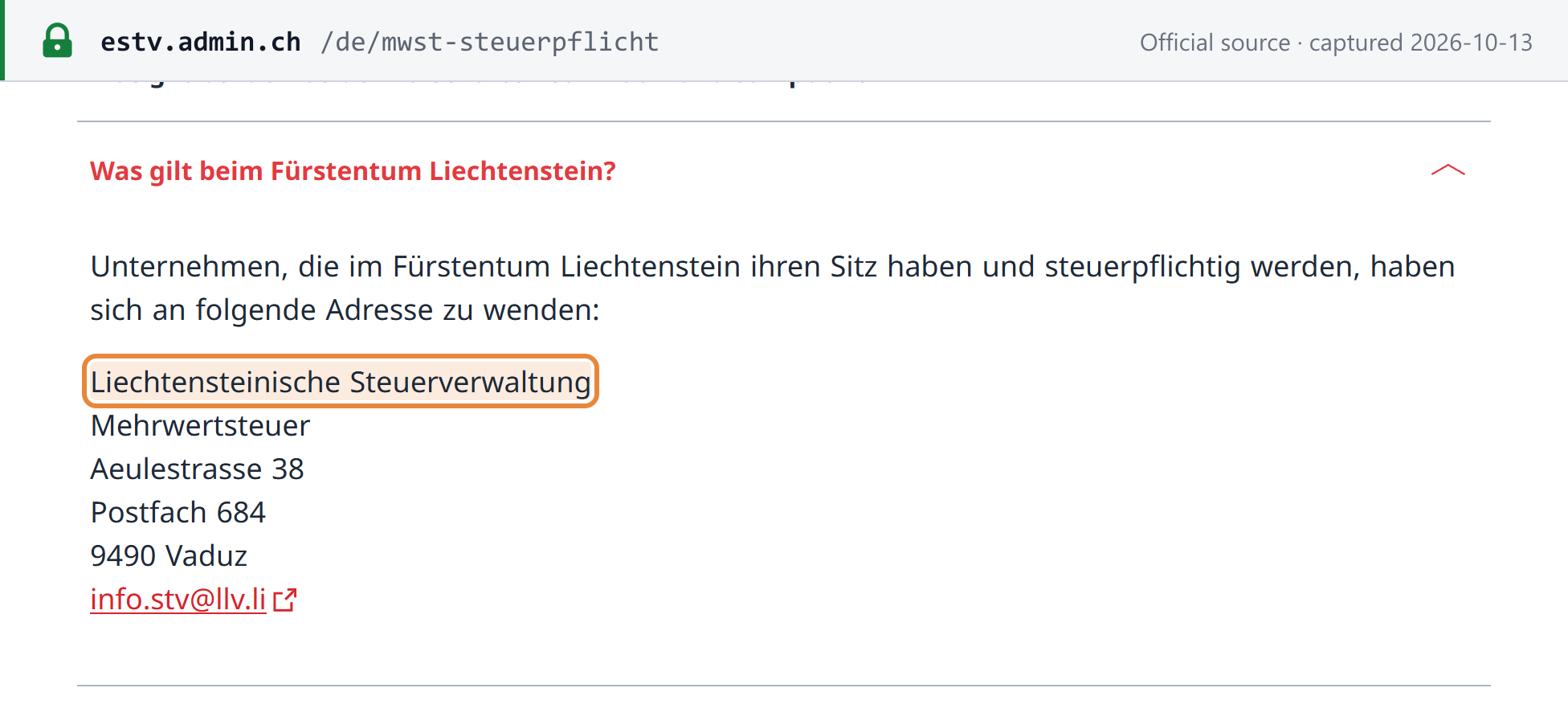
Liechtenstein adopted Swiss VAT law in parallel under the Switzerland–Liechtenstein treaty of 28 October 1994 (SR 0.641.295.142, effective 1 January 1995). It has its own VAT Act (LGBl. 2009 Nr. 330) with the same rates — "Die Steuer beträgt 8,1 % (Normalsatz)" — and its own administration, the Liechtensteinische Steuerverwaltung, with which Liechtenstein-seated businesses register. Swiss customs collects import VAT for both countries. Refunds to foreign businesses are claimed separately in each country (see Refunds). [33] [34] [5] [31]
Registration
Who should register
Anyone who carries on a business is liable to Swiss VAT if it makes supplies in Switzerland, or has its seat, domicile or a permanent establishment there — unless an exemption applies (Art. 10 MWSTG). The main exemption is turnover: a business is exempt if it "innerhalb eines Jahres im In- und Ausland weniger als 100 000 Franken Umsatz aus Leistungen erzielt", counting supplies that are not exempt without credit (Art. 10 Abs. 2 lit. a). [1]
Registration threshold
- Amount: CHF 100,000 of turnover a year.
- What counts: supplies in Switzerland and abroad (worldwide turnover), measured at the agreed consideration excluding VAT, leaving out supplies that are exempt without credit.
- Non-profit sports and cultural associations and charities: CHF 250,000, for volunteer-run, non-profit sports or cultural associations and charitable organisations (Art. 10 Abs. 2 lit. c). [1]
- When liability starts:
- a new or expanding Swiss business is liable from the start of the activity if it expects to reach the threshold within 12 months;
- an exempt business that reaches the threshold becomes liable after the end of the business year in which it did so;
- a foreign business is liable from its first supply in Switzerland, unless at that point it can assume it will not reach the threshold within the next 12 months (Art. 9a MWSTV). [2]
- Deadline: register with the ESTV "innert 30 Tagen nach Beginn ihrer Steuerpflicht" — within 30 days of liability starting (Art. 66 Abs. 1 MWSTG). [1]
Non-resident registration
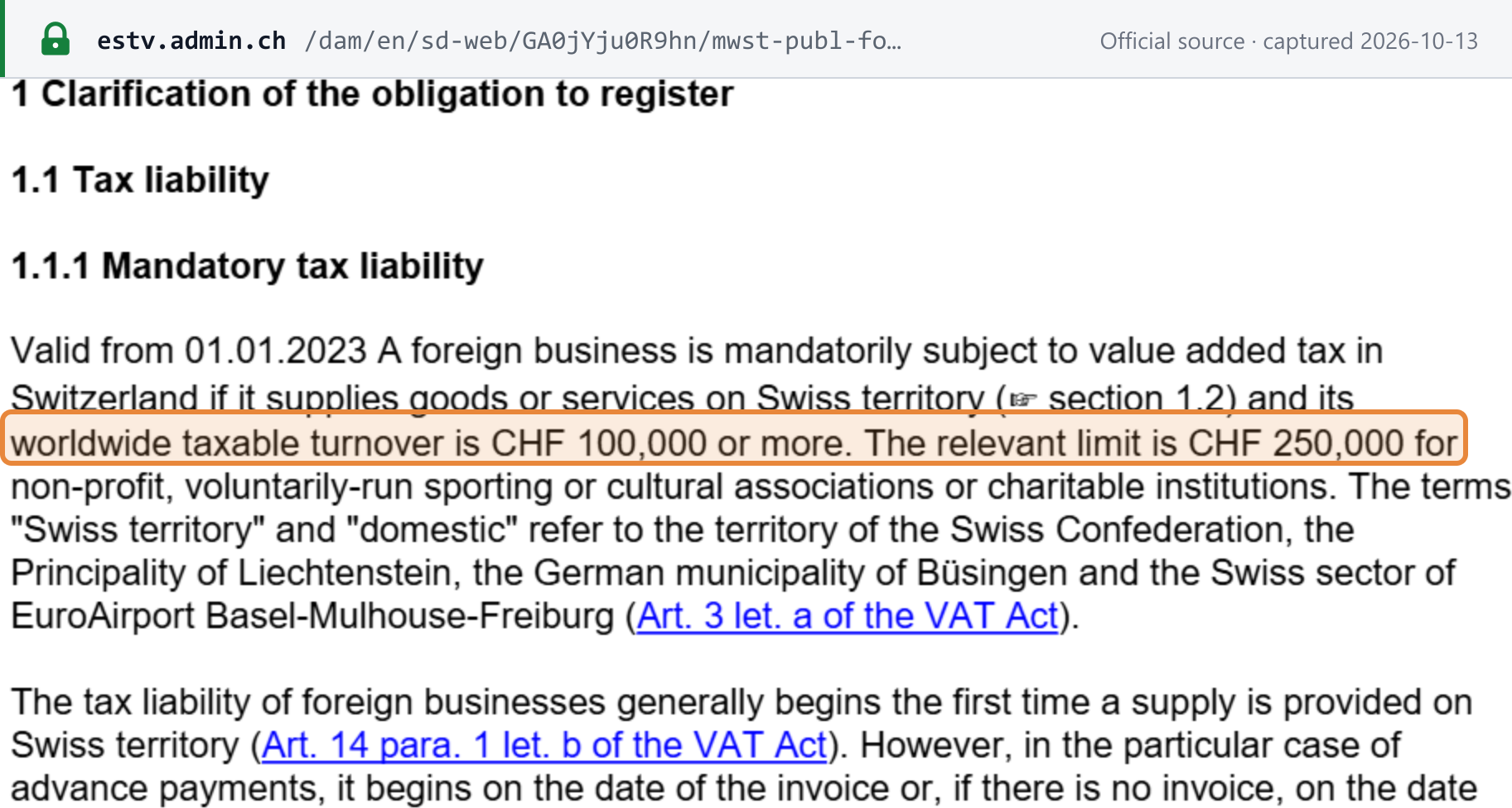
There is no separate threshold for foreign businesses, but the test is worldwide. "A foreign business is mandatorily subject to value added tax in Switzerland if it supplies goods or services on Swiss territory … and its worldwide taxable turnover is CHF 100,000 or more." This has applied since 1 January 2018. [3]
A foreign business that makes only the following supplies in Switzerland is exempt from registration, whatever its turnover (Art. 10 Abs. 2 lit. b MWSTG): [1]
- zero-rated (exempt with credit) supplies;
- supplies that are exempt without credit (since 2025);
- services whose place of supply is Switzerland under the recipient rule of Art. 8 Abs. 1 — the Swiss business customer accounts for the reverse charge;
- grid electricity, gas through the gas network and district heating supplied to Swiss taxable persons.
Telecommunications and electronic services to non-taxable customers (B2C) are carved out of this exemption. "Those who provide telecommunication or electronic services to recipients who are not liable to tax (e.g. private individuals) are not exempt from tax liability." Once registered, such a provider "must pay tax at the corresponding rate on all taxable goods and services supplied on Swiss territory." [3]
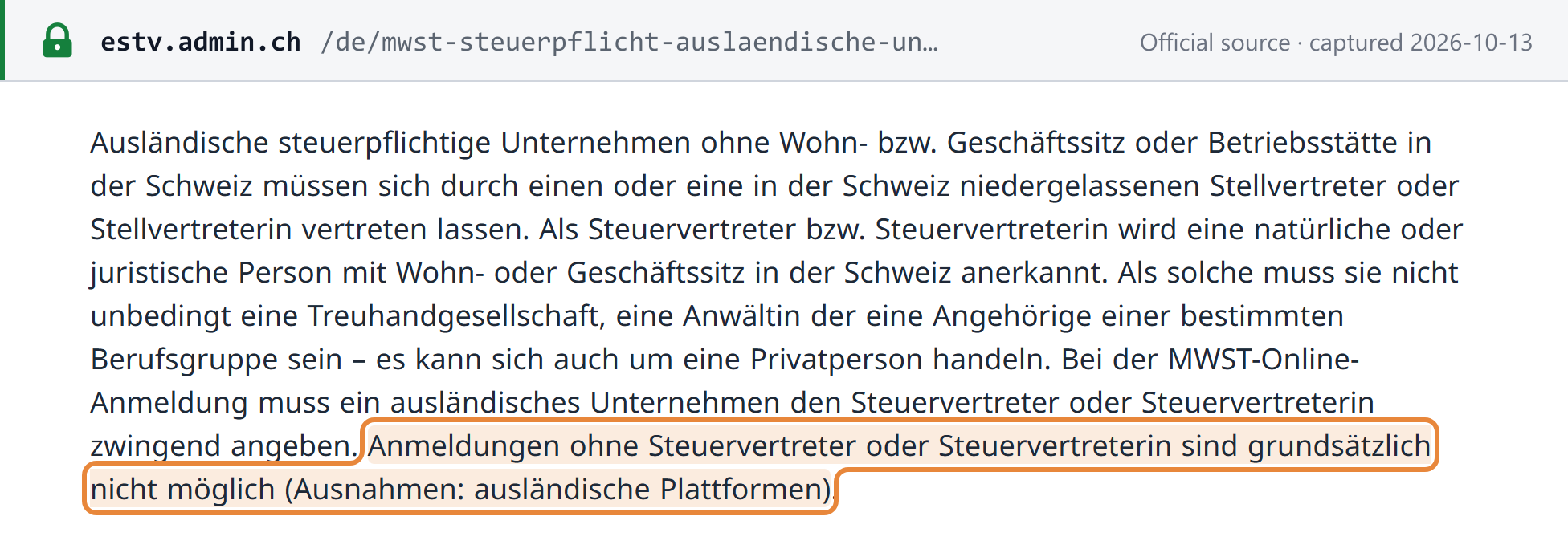
Tax representative. "Steuerpflichtige Personen ohne Wohn- oder Geschäftssitz im Inland haben für die Erfüllung ihrer Verfahrenspflichten eine Vertretung zu bestimmen, die ihren Wohn- oder Geschäftssitz in der Schweiz hat" (Art. 67 Abs. 1 MWSTG). Since 2025 the ESTV may waive this where the procedural obligations and the swift enforcement of the Act are ensured in another way (Abs. 1bis). In practice the ESTV states that registrations without a tax representative are "grundsätzlich nicht möglich (Ausnahmen: ausländische Plattformen)". A VAT group also needs a representative in Switzerland (Abs. 2). [1] [6] The ESTV's VAT Info 22 adds: "Subject to the provisions of criminal law, the tax representative is not jointly and severally liable for the tax claim." [3]
Tax identification number
On registration the ESTV assigns a non-transferable number under the federal UID Act (Art. 66 Abs. 1 MWSTG). The Swiss VAT number is the company's UID — CHE- followed by nine digits, the last a check digit — with the suffix MWST, TVA or IVA. The ESTV's own specimen invoice prints it as CHE-123.456.789 MWST (see the specimen). [1] [20]
The format, check-digit calculation and worked examples are on the Switzerland tax ID guide (UID). To check whether a number is registered for VAT, see how to verify a Swiss UID or use the Switzerland UID validator. For Liechtenstein numbers, see the Liechtenstein tax ID guide.
How to register
- Where: online at mwstanmelden.estv.admin.ch. Registration through the ePortal is mandatory (Art. 123 Abs. 2 lit. e MWSTV). [7] [2]
- Documents:
- commercial-register extract and UID;
- AHV number for sole proprietorships, simple partnerships, associations and foundations;
- a turnover forecast for the first business year, or accounts for past years;
- foreign businesses: the tax representative's details and the signed form Steuervertretung für ausländische Unternehmen in der Schweiz (form 0620). [7]
- Timeline: "Ihre Anmeldung wird rasch geprüft. Sie erhalten innerhalb weniger Tage eine schriftliche Antwort von uns." [7]
Voluntary registration
Available. A business exempt under the turnover test may waive the exemption (Art. 11 MWSTG), for at least one tax period. "Bei ausländischen Unternehmen gilt dies nur, sofern sie Leistungen im Inland erbringen", and voluntary liability can start at the earliest at the beginning of the current tax period. Registering lets a business recover input tax. [1] [5]
Deregistration
- Business ceases: deregister in writing within 30 days (Art. 66 Abs. 2 MWSTG).
- Foreign businesses: liability ends at the end of the calendar year in which the business last made a supply in Switzerland (Art. 14 Abs. 2 lit. b MWSTG); it must then deregister in writing within 30 days.
- Turnover below the threshold and expected to stay below it: deregistration is possible at the earliest at the end of the tax period in which the threshold was not reached. "Eine Abmeldung muss innert 60 Tagen nach Ende der Steuerperiode eingereicht werden, spätestens bis Ende Februar des Folgejahrs." Not deregistering counts as a voluntary waiver of the exemption (Art. 14 Abs. 5).
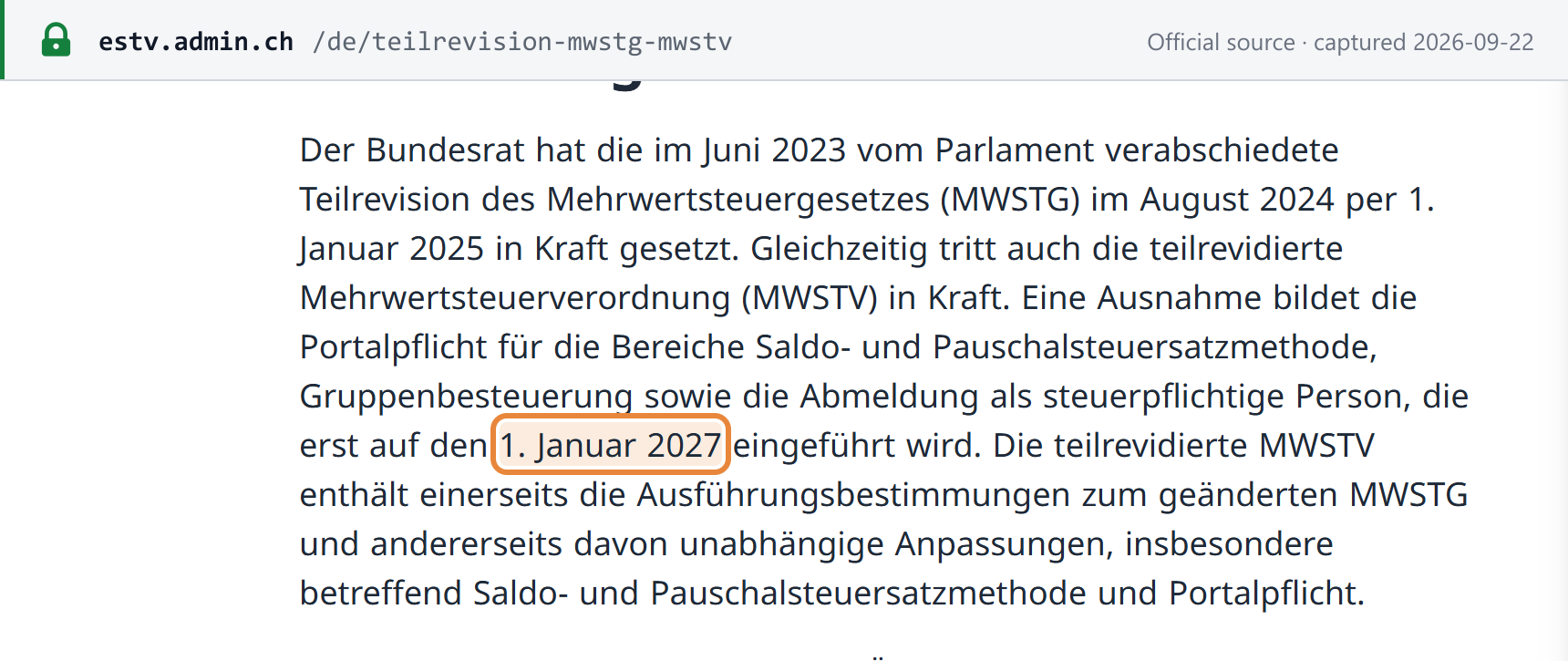
- From 1 January 2027 deregistration must be done through the ESTV ePortal (Art. 123 Abs. 2 lit. f MWSTV). [1] [8] [19]
Group registration
Available. Entities with a seat, domicile or permanent establishment in Switzerland that are under common control ("einheitliche Leitung" — by majority of votes, contract or otherwise) may apply to form a single taxable person, a Mehrwertsteuergruppe. Since 2025, entities that do not carry on a business and natural persons may also be included. Members are jointly and severally liable, the group needs a representative in Switzerland, and documents for intra-group transactions must not refer to VAT. From 1 January 2027, group taxation is handled only through the ePortal. [1] [2] [21] For how grouping works generally, see VAT grouping explained.
Rates
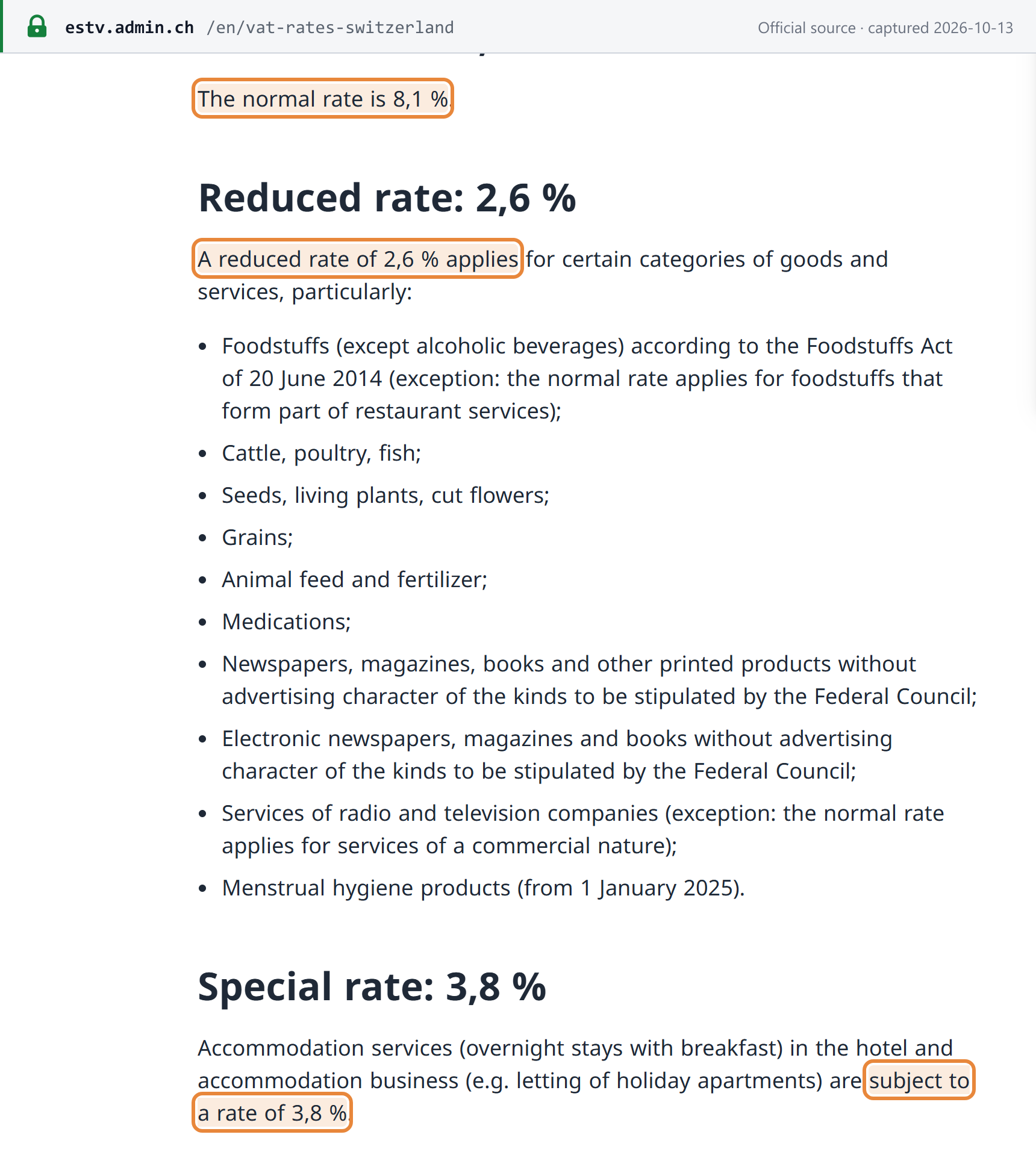
The current rates apply since 1 January 2024 ("Per 1. Januar 2024 gelten die neuen Mehrwertsteuersätze"). [4] [1]
| Rate | Applies to |
|---|---|
| 8.1% (Normalsatz) | Most goods and services, including food and drink served in restaurants |
| 2.6% (reduced) | Piped water; foodstuffs except alcoholic drinks; cattle, poultry, fish; grains; seeds, living plants and cut flowers; animal feed and fertiliser; medicines; printed and electronic newspapers, magazines and books without advertising character; radio and TV services (non-commercial); menstrual hygiene products (from 1 January 2025); certain agricultural services; cultural and sports supplies opted for taxation |
| 3.8% (Sondersatz) | Accommodation including breakfast, in hotels and similar businesses, including letting of holiday apartments |
| 0% (zero-rated, "befreit") | Exports and the other supplies listed in Art. 23 MWSTG — see Cross-border rules |
Take-away food is taxed at 2.6% where the business separates it properly from restaurant service (Art. 25 Abs. 3). Import VAT uses the same rates (Art. 55). [1] [4]
Announced and proposed changes
Status as at 13 October 2026:
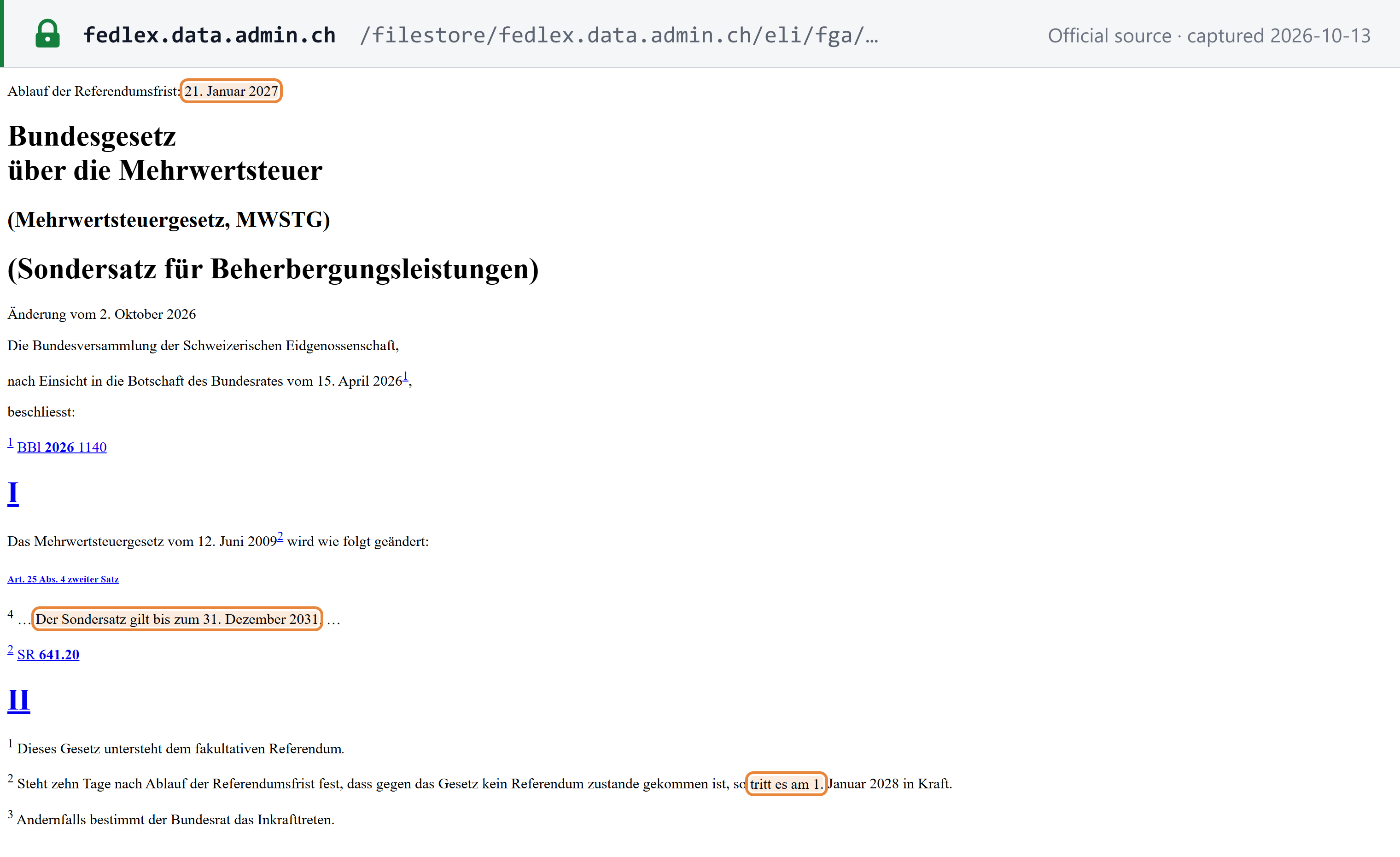
- Accommodation rate extended to 2031 — adopted, referendum period running. Under current law the 3.8% special rate applies until 31 December 2027 at the latest (Art. 25 Abs. 4 MWSTG). On 2 October 2026 both chambers of Parliament adopted, in the final vote, an amendment that reads "Der Sondersatz gilt bis zum 31. Dezember 2031" (BBl 2026 2723, published 13 October 2026). It is subject to an optional referendum; the referendum deadline is 21 January 2027. If no referendum is called, the amendment enters into force on 1 January 2028; otherwise the Federal Council sets the date. [9]
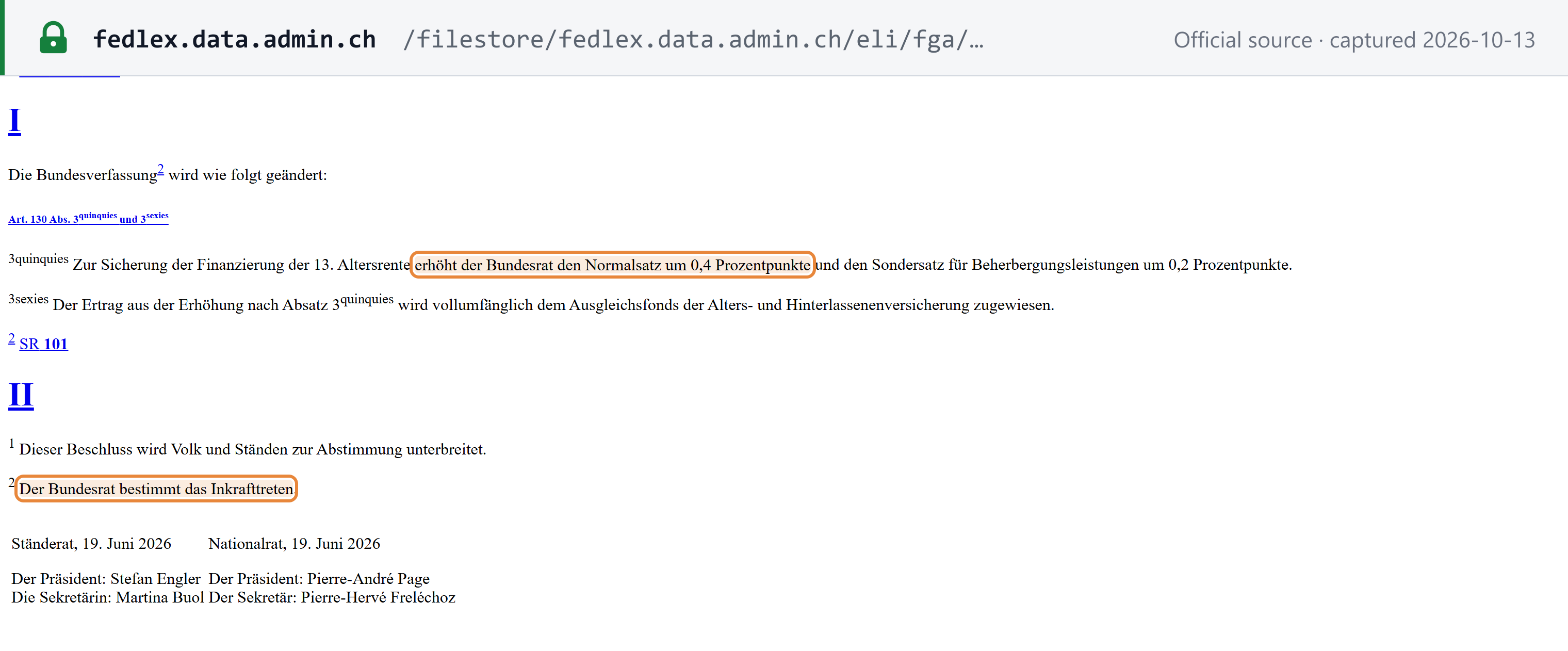
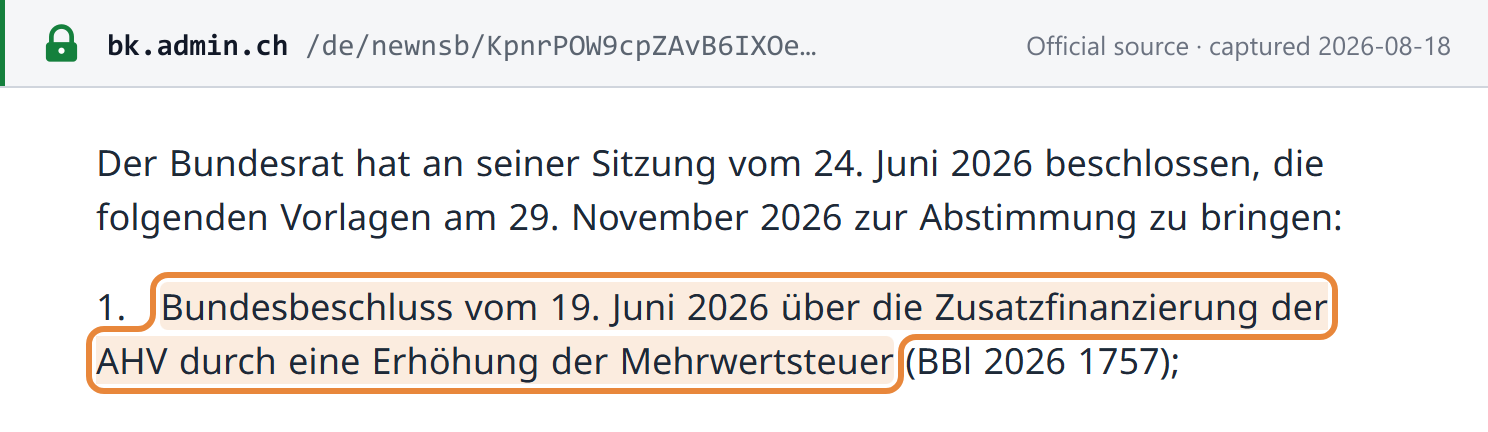
- AHV financing increase — vote on 29 November 2026. The Federal Decree of 19 June 2026 (BBl 2026 1757) amends the Federal Constitution so that, to finance the 13th old-age pension, the Federal Council raises the standard rate by 0.4 percentage points (to 8.5%) and the accommodation rate by 0.2 points (to 4.0%). The reduced rate is not changed. The decree goes to a mandatory vote of the people and cantons on 29 November 2026. It sets no date: "Der Bundesrat bestimmt das Inkrafttreten." [10] [11] See the event record.
- Security (armament) contribution — proposal in Parliament (business 26.051). The Federal Council's message of 12 August 2026 (BBl 2026 2354) proposes a temporary increase: "Der Normalsatz soll befristet um 0,5 Prozentpunkte und der Sondersatz um 0,3 Prozentpunkte steigen", for 12 years from 2028, with the reduced rate unchanged. On 21 September 2026 the Council of States, as first chamber, voted for smaller increases: +0.2 points (standard) and +0.1 point (accommodation), from 1 January 2029 to 31 December 2045, as its finance committee had proposed. As at 13 October 2026 the bill was with the National Council's committee. It requires a constitutional amendment and a mandatory vote. Nothing is settled. [12] [13] [37]
Cross-border rules
Imports and exports
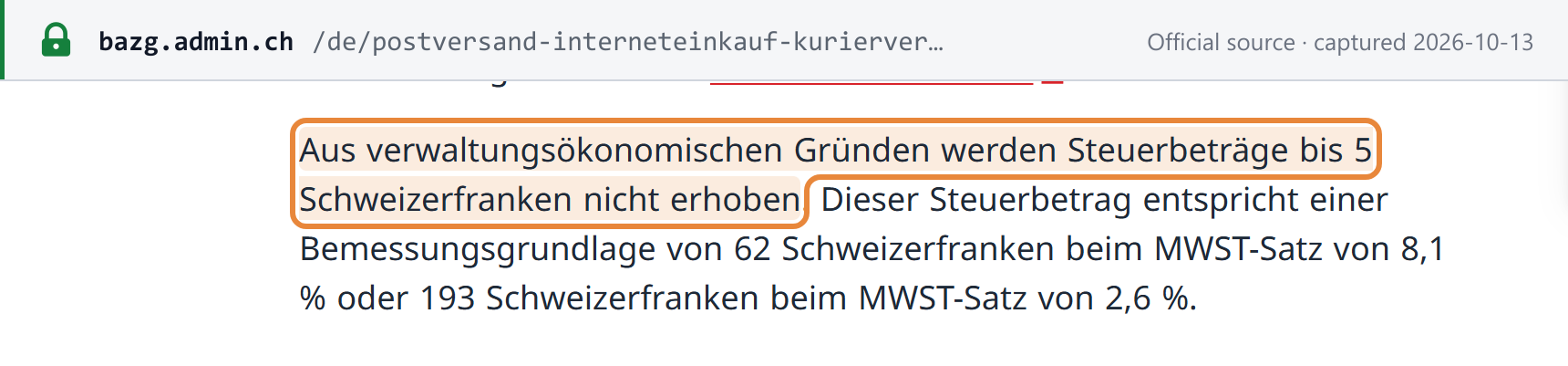
Imports. The BAZG collects import VAT at 8.1% or 2.6%. "Aus verwaltungsökonomischen Gründen werden Steuerbeträge bis 5 Schweizerfranken nicht erhoben" — import VAT of CHF 5 or less per assessment is not collected, which corresponds to goods worth CHF 62 at 8.1% or CHF 193 at 2.6% (SR 641.204 Art. 1 lit. d). Holders of a central customs-settlement account (ZAZ) have 60 days from the invoice date to pay import VAT (Art. 56 Abs. 2 MWSTG). A registered importer deducts import VAT as input tax (Art. 28 Abs. 1 lit. c). [14] [15] [1]
Exports. Goods sent directly abroad are "von der Steuer befreit" — zero-rated: no Swiss VAT is due and the input tax remains recoverable. Art. 23 Abs. 2 MWSTG also zero-rates supplies under customs supervision and in free warehouses, export-related transport and logistics, international air transport, investment gold, and the seller's supply to a registered platform (see Marketplace / platform deemed-supplier liability). [1]
Reverse charge on imported services (Bezugsteuer)
The Swiss recipient accounts for VAT on: [1] [16]
- services taxed in Switzerland under the recipient rule (Art. 8 Abs. 1) and supplied by businesses abroad that are not in the Swiss register — except telecom and electronic services to non-taxable customers, where the foreign supplier must register;
- imported data carriers without market value;
- supplies of immovable property by unregistered foreign businesses, and grid energy;
- since 2025, emission rights and similar rights, including those bought from Swiss sellers.
Who is liable: a registered business, and also an unregistered recipient that buys more than CHF 10,000 of such services in a calendar year (Art. 45 Abs. 2). Such a recipient must register within 60 days after the end of the year (Art. 66 Abs. 3). Registered businesses deduct the reverse-charge tax as input tax, within their normal entitlement (Art. 28 Abs. 1 lit. b). See reverse charge explained.

Digital products and services
Electronic services include radio and TV services, network access and data capacity, websites and hosting, software and updates, images, texts and databases, and music, films and games including gambling (Art. 10 Abs. 1 MWSTV). For B2C customers there is no Swiss-sales threshold: a foreign supplier registers once its worldwide turnover reaches CHF 100,000 (see Non-resident registration). [2] [3] See VAT on digital services by non-resident suppliers.
Foreign companies selling into Switzerland — B2B and B2C
- Selling services to businesses (B2B): no registration, whatever your turnover, if your only Swiss supplies are services taxed under the recipient rule (Art. 8 Abs. 1) — to any customer, except telecom or electronic services to unregistered recipients (Art. 10 Abs. 2 lit. b Ziff. 2). The Swiss customer accounts for the reverse charge if it is registered or buys more than CHF 10,000 of such services in a year (Art. 45). Services under the Art. 8 Abs. 2 exceptions — for example services performed on site, services connected with Swiss immovable property, or cultural, sports and similar events in Switzerland — are taxed where performed and can require you to register. [1]
- Selling goods to businesses (B2B): for goods shipped from abroad, the Swiss importer pays import VAT to the BAZG and deducts it as input tax. The foreign seller registers only if it makes supplies in Switzerland, for example from Swiss stock, or imports in its own name under a declaration of subjection. [1] [3]
- Selling telecom or electronic services to consumers (B2C): register once your worldwide turnover is CHF 100,000 or more. You then charge Swiss VAT on all your taxable Swiss supplies. [3]
- Selling goods to consumers (B2C, mail order): while your annual sales of small consignments — parcels whose import VAT is CHF 5 or less — stay below CHF 100,000, the place of supply is abroad and the buyer pays any import VAT above CHF 5. Once you reach CHF 100,000, all your deliveries from abroad are treated as Swiss supplies from the following month. You must register, import in your own name and charge Swiss VAT on every parcel (Art. 7 Abs. 3 lit. b MWSTG; Art. 4a MWSTV). [3] [2]
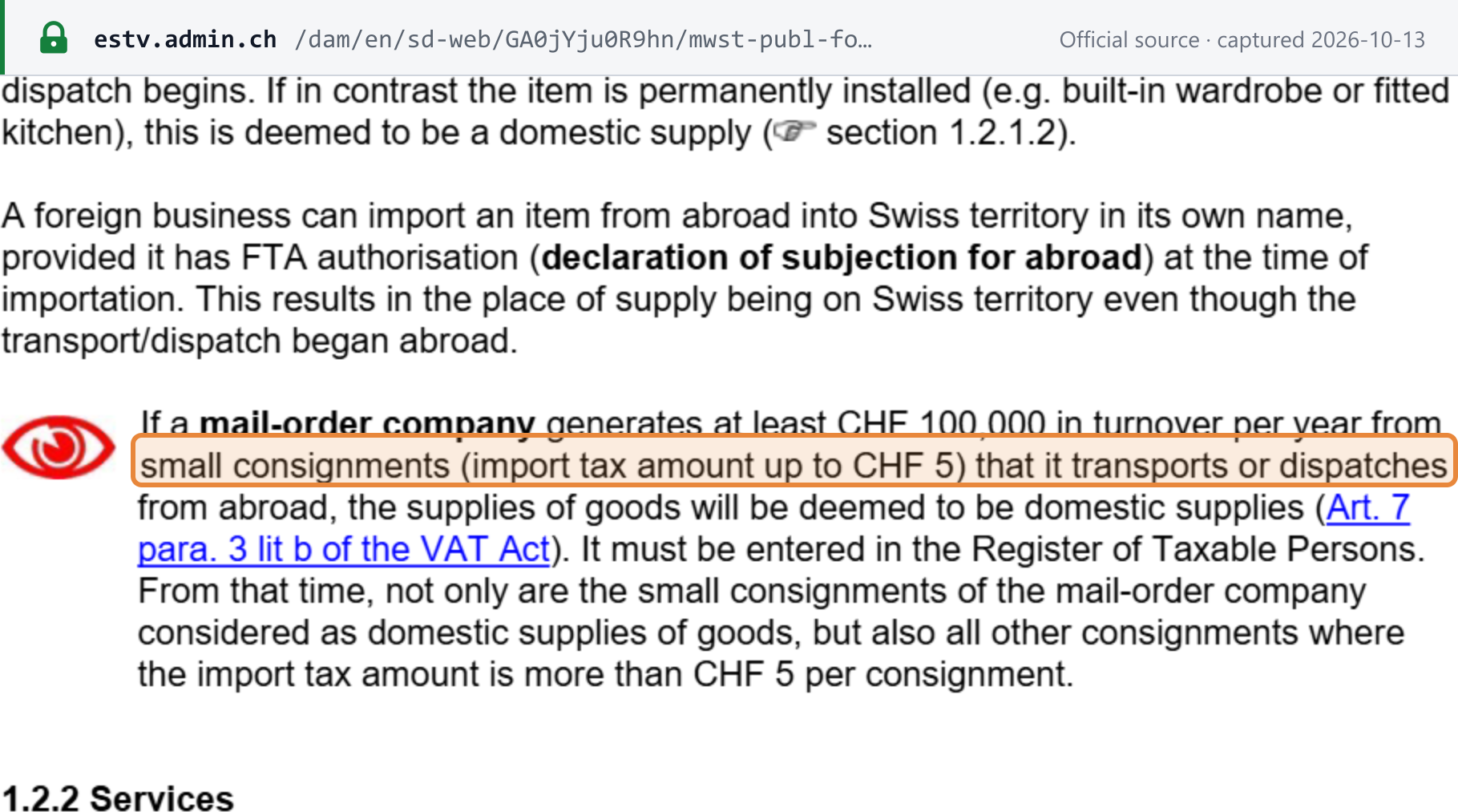
Registered mail-order sellers should join the ESTV's list of registered mail-order sellers and platforms so that customs brokers do not charge the buyer, put their name and VAT number on the parcel with a VAT invoice or pro-forma invoice, and consider a ZAZ account. The net tax rate method is not available to sellers under the mail-order rule. [17]
A foreign business can also import goods in its own name and make Swiss supplies by holding an ESTV declaration of subjection (Unterstellungserklärung). [3]
Marketplace / platform deemed-supplier liability
In force since 1 January 2025: "Am 1. Januar 2025 traten die Bestimmungen zur Plattformbesteuerung (insbesondere Art. 20a MWSTG) in Kraft." [18]
- Who: anyone who, through an electronic platform, enables a sale of goods by bringing sellers and buyers together to contract on the platform is treated as the supplier to the buyer. There are then two supplies: seller to platform and platform to buyer (Art. 20a Abs. 1 MWSTG). Services are not covered.
- Seller-to-platform leg: zero-rated if the platform is registered (Art. 23 Abs. 2 Ziff. 13). With the platform's consent, the seller may tax it instead (Art. 43a MWSTV).
- Not caught: platforms that take no part in ordering, earn no transaction-linked revenue, or only process payments, list or advertise, or redirect (Art. 20a Abs. 2).
- Sellers remain subsidiarily liable for the tax (Art. 15 Abs. 4bis).
- Enforcement: the ESTV can impose import bans, destroy goods and publish the names of non-compliant platforms, and can require platforms to report their sellers. [1] [17]

See marketplace deemed-supplier rules for how this compares with other countries.
Place of supply
- Goods (Art. 7 MWSTG): where the goods are when the power of disposal passes, or where transport or dispatch to the customer begins. An import becomes a Swiss supply where the supplier holds a declaration of subjection or falls under the mail-order rule.
- Services (Art. 8 MWSTG): the general rule is the recipient's seat, permanent establishment or residence — for both B2B and B2C. Exceptions (Art. 8 Abs. 2) include services to physically present persons (where the supplier is), travel agency services (where the agency is), culture, sport, education and entertainment and restaurant services (where performed), passenger transport (by distance), and services connected with immovable property including accommodation (where the property is). [1]
Invoice requirements
Mandatory content
An invoice must clearly identify the supplier, the recipient and the type of supply and must, "in der Regel" (as a rule), contain (Art. 26 Abs. 2 MWSTG): [1]
| Art. 26 Abs. 2 | Field |
|---|---|
| lit. a | Supplier's name and location as used in business, a note that it is in the register of taxable persons, and its VAT number |
| lit. b | Recipient's name and location as used in business |
| lit. c | Date or period of supply, where it differs from the invoice date |
| lit. d | Nature, object and extent of the supply |
| lit. e | Consideration |
| lit. f | Applicable rate and the tax amount; if the price includes tax, the rate alone is enough |
"In der Regel" is deliberate. The MWSTG applies the principle of free assessment of evidence: "Es ist unzulässig, Nachweise ausschliesslich vom Vorliegen bestimmter Beweismittel abhängig zu machen" (Art. 81 Abs. 3). The list is therefore the normal content of an invoice rather than a set of formal conditions that alone decide whether input tax can be proved. "Invoice" means any settlement document, whatever it is called (Art. 3 lit. k). Paper, electronic and digital invoices — "z. B. PDF-Rechnung oder gescannte Papierrechnung" — are treated equally. [1] [20]
Who must not show VAT: persons not in the register, supplies under the notification procedure (Meldeverfahren, Art. 38), and transactions within a VAT group (Art. 27 Abs. 1 MWSTG; MWST-Info 16 Ziff. 2.3). VAT shown on an invoice is owed even if it was not due or was too high, unless the invoice is corrected or no loss of revenue arises (Art. 27 Abs. 2). [1] [21]
Issuance deadline
The supplier issues an invoice "auf Verlangen" — on the recipient's request (Art. 26 Abs. 1 MWSTG). The MWSTG and MWSTV set no deadline for issuing it. [1] [20]
Numbering and sequencing
The MWSTG and MWSTV contain no rule requiring invoice numbers or sequential numbering. The audit-trail rule means each document must be traceable through the books. [1] [2]
Credit and debit notes
An invoice is corrected afterwards, within what commercial law allows, by "ein empfangsbedürftiges Dokument …, das auf die ursprüngliche Rechnung verweist und diese widerruft" — a document that must be delivered to the recipient, refers to the original invoice and revokes it (Art. 27 Abs. 4 MWSTG). [1]
Currency and language
- Currency. Invoices may be issued in a foreign currency, but VAT is declared in CHF. Convert at the time the tax claim arises, using the ESTV's published rate — "wahlweise der Monatsmittelkurs oder der Tageskurs für den Verkauf von Devisen" — or, for members of a group, the group rate. "Das gewählte Vorgehen … ist während mindestens einer Steuerperiode beizubehalten" (Art. 45 MWSTV). Without an ESTV rate, use a Swiss bank's daily selling rate. A document showing items and total in CHF, or in two columns with CHF and the foreign currency, counts as a CHF document. [2] [24]
- Language. The MWSTG and MWSTV prescribe no invoice language.
Document types
- Full invoice with the Art. 26 Abs. 2 content.
- Till receipts up to CHF 400 (including tax) need not show the recipient. "Solche Kassenzettel berechtigen nicht zu einer Steuerrückerstattung im Vergütungsverfahren" — they cannot support a foreign-business refund claim (Art. 57 MWSTV). The same applies to cash-register coupons. [2] [21]
Self-billing
Permitted. A credit note (Gutschrift) issued by the recipient instead of an invoice must name the supplier with all the required details. If the supplier does not object in writing to VAT shown on it, the supplier owes that VAT (Art. 27 Abs. 3 MWSTG). [1] [21]
Retention and audit trail
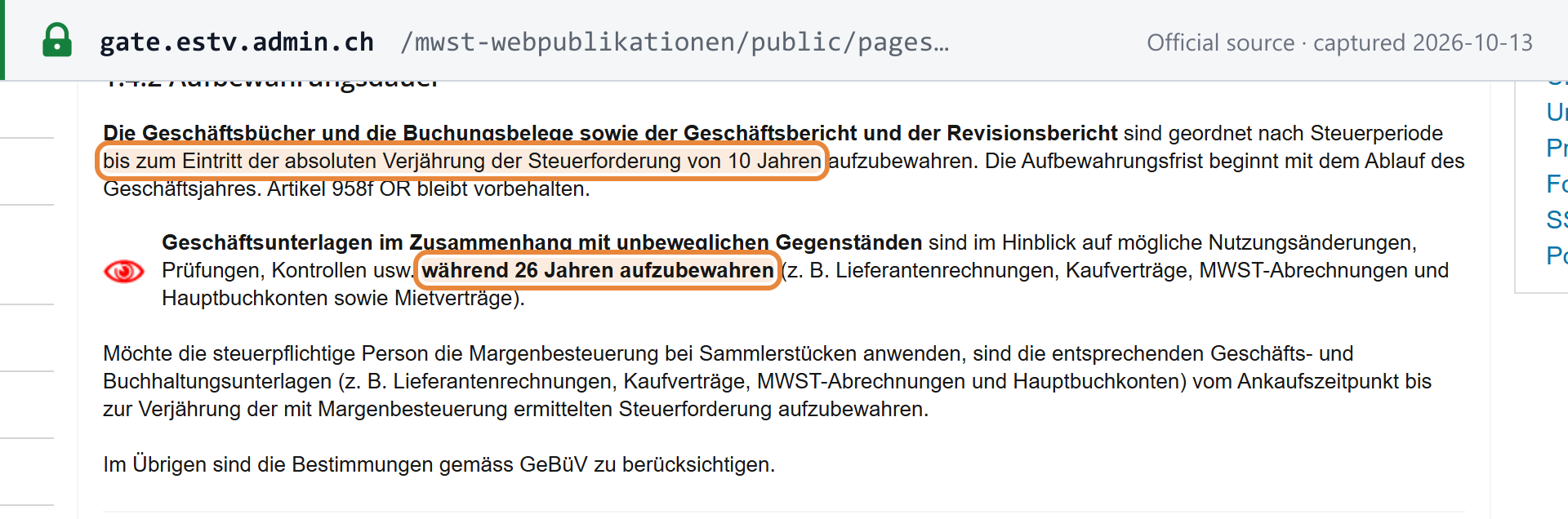
- Statute: 10 years. Records must be kept "bis zum Eintritt der absoluten Verjährung der Steuerforderung" (Art. 70 Abs. 2 MWSTG), which is ten years after the end of the tax period (Art. 42 Abs. 6). [1]
- Real estate: 20 years by statute, 26 years in ESTV guidance. Records needed for adjustments on immovable property must be kept for 20 years (Art. 70 Abs. 3 MWSTG). The ESTV's practice publication says such records "sind … während 26 Jahren aufzubewahren", in view of possible changes of use, audits and checks (MWST-Info 16 Ziff. 1.4.2). [1] [22]
- Electronic-only archiving is allowed under the Code of Obligations (Art. 957–958f) and the Business Records Ordinance (GeBüV) (Art. 122 MWSTV). Records must be kept so that "sie nicht geändert werden können, ohne dass sich dies feststellen lässt (Art. 3 GeBüV)", remain verifiable for the whole period and can be made readable on request. Paper, scanned and electronic invoices have equal standing. [2] [23] [35]
- Audit trail (Prüfspur). Each transaction must be traceable from the individual document through the accounts to the VAT return and back: "Diese Prüfspur muss ohne Zeitverlust jederzeit gewährleistet sein." [23]
A specimen of a compliant invoice
The ESTV publishes an official annotated specimen in MWST-Info 16 Buchführung und Rechnungsstellung, Ziff. 2.2, reproduced below. It is a one-rate invoice from the fictional "L. HAEFELI Bürosysteme" in Olten, VAT number CHE-123.456.789 MWST, to "F. Gruber & Co" in Schönenwerd, for one photocopier: CHF 5,500.00 + 8.1% MWST CHF 445.50 = CHF 5,945.50. Each element carries a letter from (a) to (g). The ESTV's list introducing the specimen covers invoices and other settlement documents for taxable recipients and for customers domiciled abroad who are entitled to a VAT refund, which "sollten i. d. R. folgende Angaben enthalten". [20]
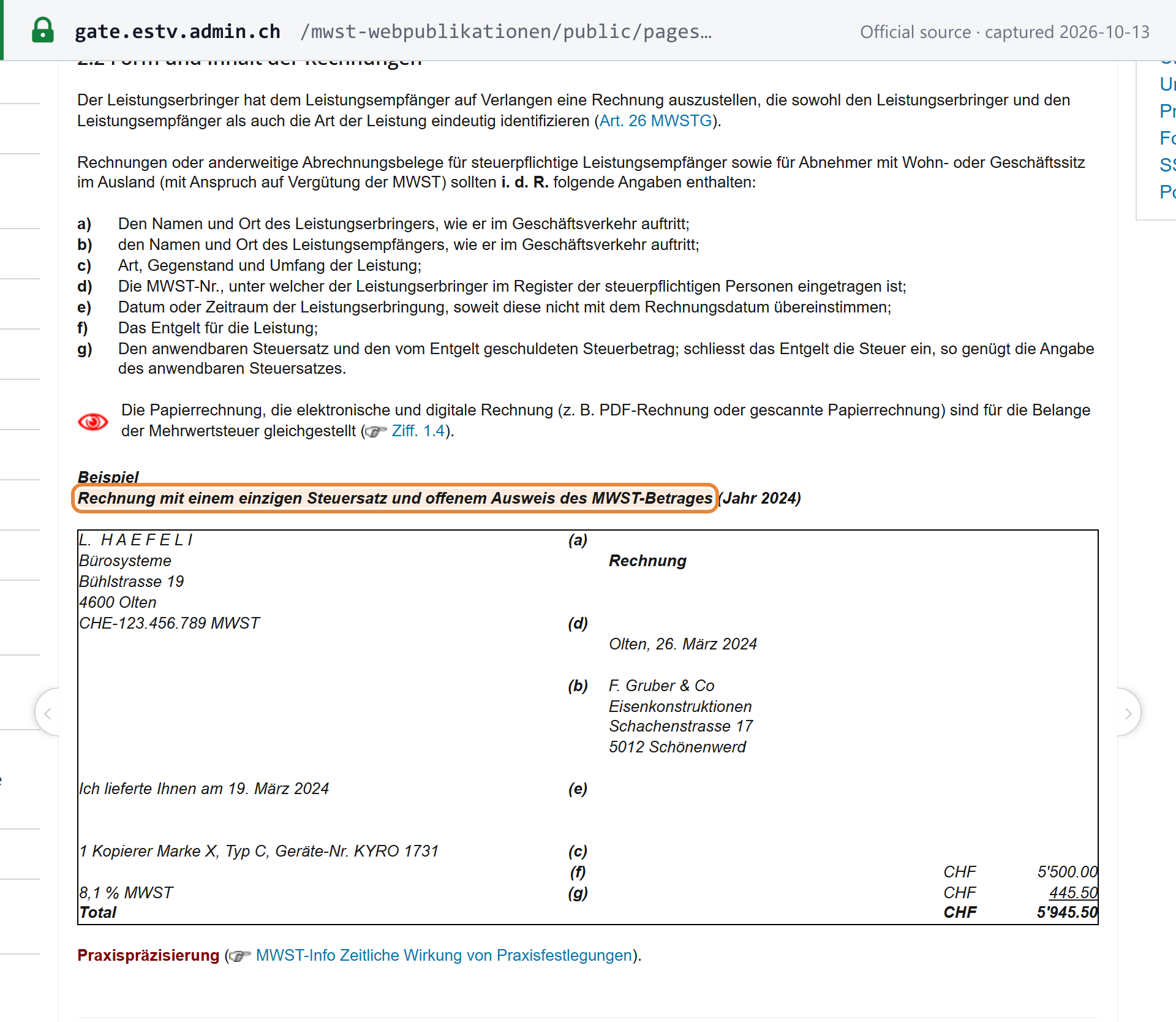
The ESTV's letters follow its own list, not the order of Art. 26 Abs. 2. They map like this:
| ESTV label | On the specimen | Art. 26 Abs. 2 MWSTG |
|---|---|---|
| (a) | Supplier's name and location — L. Haefeli Bürosysteme, Olten | lit. a |
| (b) | Recipient's name and location — F. Gruber & Co, Schönenwerd | lit. b |
| (c) | Nature, object and extent — 1 photocopier, brand, type and serial number | lit. d |
| (d) | VAT number — CHE-123.456.789 MWST | lit. a (registration note and number) |
| (e) | Date of supply — "Ich lieferte Ihnen am 19. März 2024", which differs from the invoice date of 26 March 2024 | lit. c |
| (f) | Consideration — CHF 5,500.00 | lit. e |
| (g) | Rate and tax amount — 8.1% MWST, CHF 445.50 | lit. f |
The same publication shows a tax-inclusive variant ("inkl. 8,1 % MWST", labelled (f+g); Ziff. 2.4.1) and a two-column CHF/EUR hotel bill (Ziff. 2.4.5). For the QR-bill payment slip that often accompanies Swiss invoices — a payment standard, not a VAT requirement — see the Swiss QR-bill explainer.
E-invoicing status
Status (as at 13 October 2026): no B2B or B2C mandate; e-invoices required for suppliers to the federal administration. The ESTV publishes no e-invoicing or real-time reporting obligation for businesses, and it treats paper and electronic invoices equally. [20]
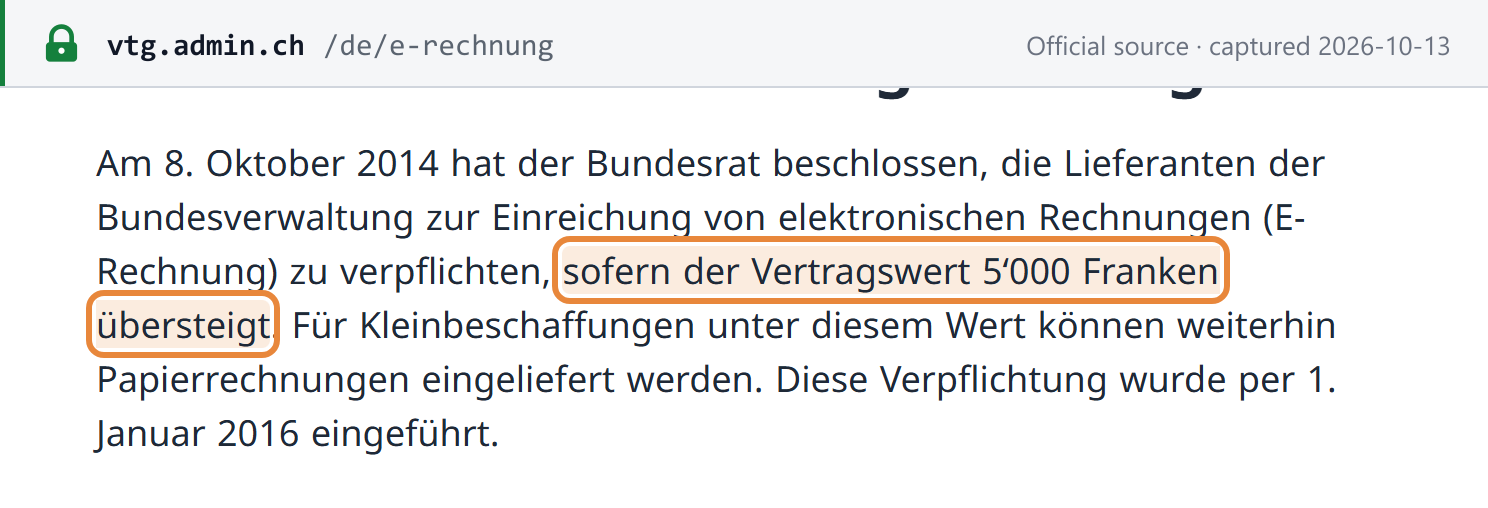
- B2G (federal): since 1 January 2016, suppliers to the federal administration must submit e-invoices where the contract value exceeds CHF 5,000; smaller purchases may still be invoiced on paper. [26] [25]
- Channels (Federal Finance Administration): structured e-invoices from accounting software through PostFinance or Swisscom, or through providers connected to them; manual entry on a provider portal; or a PDF by email. PDFs are no longer accepted through service providers since 30 June 2023. [25]
- Scope: the obligation applies to suppliers of the federal administration.
For Switzerland alongside other countries, see the e-invoicing status and networks table.
Filing and payment
Filing frequency
"Innerhalb der Steuerperiode erfolgt die Abrechnung der Steuer vierteljährlich. Bei der Abrechnung nach Saldosteuersätzen … erfolgt die Abrechnung halbjährlich" (Art. 35 Abs. 1 MWSTG). [1]
| Frequency | Who |
|---|---|
| Quarterly | The default (effective method) |
| Semi-annual | Businesses using the net tax rate method (Saldosteuersatz) |
| Monthly | On request, where input tax regularly exceeds output tax |
| Annual | On request (since 1 January 2025), for taxable turnover of no more than CHF 5,005,000 a year |

Annual reporting. It needs a clean three-year record of filing and payment, and an application in the ePortal within 60 days of the start of the period. The ESTV invoices instalments due 30 May, 30 August and 30 November under the effective and flat-rate methods, or 30 August under the net tax rate method. "Die jährliche Abrechnung muss jeweils bis Ende Februar des folgenden Jahres eingereicht und bezahlt werden." [29] [1]
Return due date
File within 60 days after the end of the reporting period — for example, 31 May for the first quarter (Art. 71 Abs. 1 MWSTG). Returns are filed online only through the ESTV ePortal since 1 January 2025; since 11 May 2026, only MWST-Abrechnung pro is available, with an AGOV login, and XML upload (eCH-0217) is supported. Filing extensions are requested through the portal. Errors found when closing the annual accounts must be corrected at the latest in the return for the period that includes the 180th day after the end of the business year (Art. 72 Abs. 1). [1] [27] [36]
From 1 January 2027 the ePortal also becomes mandatory for group taxation, the net tax rate and flat-rate methods, and deregistration (Art. 123 Abs. 2 MWSTV, as in force from that date). [2] [19] See the event record.
Payment due date and method
Payment is due within the same 60 days (Art. 86 Abs. 1 MWSTG). "Die Abrechnung muss jeweils innert 60 Tagen nach Ablauf der entsprechenden Abrechnungsperiode unaufgefordert eingereicht … und bezahlt werden." Pay to the ESTV's PostFinance account, IBAN CH60 0900 0000 3000 0037 5 (BIC POFICHBEXXX). Payment deadlines can be extended online by up to three months. [28] [36]

Flat-rate methods. Businesses with taxable turnover of no more than CHF 5,024,000 a year and tax at their net tax rate of no more than CHF 108,000 may use the net tax rate method (Saldosteuersatz): tax is the gross turnover times an ESTV-approved sector rate, with no input-tax calculation (Art. 37 Abs. 1 MWSTG). Invoices still show the statutory rate: "In den Rechnungen weist der Architekt nicht den SSS, sondern den gesetzlichen Steuersatz von 8,1 % aus." The flat-rate method (Pauschalsteuersatz) is for public bodies and related institutions, associations and foundations. [1] [30]
Additional listings
There are none. The MWSTG's reporting rules (Art. 35, 71 and 72) provide for the periodic return and its corrections, with no sales or purchase listing; Switzerland is not in the EU, so there is no EC sales list. [1]
Input-tax recovery and blocked items
- Deductible: VAT invoiced by Swiss suppliers, reverse-charge tax declared, and import VAT (Art. 28 Abs. 1 MWSTG) — provided the business can show it paid the input tax (Abs. 3). A notional 2.6% applies to purchases from unregistered farmers, and a fictitious input tax applies to second-hand movable goods bought without VAT (Art. 28 Abs. 2, Art. 28a).
- Blocked: input tax on purchases used to make supplies that are exempt without credit and not opted for taxation (Art. 29 Abs. 1).
- Mixed use is apportioned (Art. 30); input tax is reduced for subsidies (Art. 33).
- No list of blocked expense types: Art. 28–33 contain no specific block on entertainment or passenger cars. Private use is corrected through the own-use rules (Art. 31). [1]
Refunds
- Swiss-registered businesses. "Die Auszahlung des Guthabens erfolgt 60 Tage nach Eintreffen der Abrechnung bei der ESTV" — a credit balance is paid 60 days after the return reaches the ESTV. Example: a first-quarter return received on 15 May is refunded on 14 July. [28]
- Foreign businesses not registered in Switzerland (Vergütungsverfahren). [31] [2]
- Eligibility: seat, domicile or permanent establishment abroad; no Swiss registration; no Swiss supplies other than those that leave a foreign business exempt from registration; proof of business status from the home tax authority; and reciprocity from the claimant's country.
- Minimum: "Rückzahlbare Steuern werden nur vergütet, wenn deren Betrag in einem Kalenderjahr mindestens 500 Franken erreicht" (Art. 153 Abs. 3 MWSTV). "Der Mindestbetrag von 500 Franken an rückzahlbaren Steuern gilt für jedes Land separat."
- Deadline: the claim period is the calendar year; file between 1 January and 30 June of the following year. "Die gesetzliche Einreichefrist ist nicht verlängerbar." The postmark date counts.
- How: forms 1222 and 1223, with invoices that meet Art. 26 Abs. 2 and are addressed to the claimant, or BAZG import assessments. Till receipts are not accepted. One claim per year.
- Representative: required, with a domicile or seat in Switzerland (Art. 155 Abs. 3 MWSTV); a Liechtenstein representative for Liechtenstein claims.
- Liechtenstein: "Die Mehrwertsteuer auf in der Schweiz oder in Liechtenstein bezogenen Leistungen wird von jenem Staat vergütet, in dem die jeweiligen Leistungen bezogen wurden."

Exemptions
Exempt supplies
Switzerland distinguishes two kinds of exemption:
- "Von der Steuer ausgenommen" — exempt without credit (Art. 21 MWSTG). No VAT is charged, and input tax on related costs cannot be recovered: "Kein Anspruch auf Vorsteuerabzug besteht bei Leistungen und bei der Einfuhr von Gegenständen, die für die Erbringung von Leistungen, die von der Steuer ausgenommen sind und für deren Versteuerung nicht optiert wurde, verwendet werden" (Art. 29 Abs. 1). Examples: health care; social care; education and childcare; admissions to cultural and sports events; insurance; most financial services; transfers and residential letting of immovable property; the reserved postal service; gambling; farmers' sales of their own produce; and, since 2025, resold travel services. [1] [19]
- "Von der Steuer befreit" — zero-rated, with credit (Art. 23 MWSTG). "Ist eine Leistung nach diesem Artikel von der Steuer befreit, so ist auf dieser Leistung keine Inlandsteuer geschuldet" — and input tax remains recoverable. Exports and the other supplies under Imports and exports fall here. [1]
Exempt is not zero-rated. A business making zero-rated exports recovers the VAT on its costs; a business making exempt-without-credit supplies such as insurance or residential letting does not.

Option to tax (Art. 22 MWSTG). A taxable person may tax most exempt-without-credit supplies "durch offenen Ausweis der Steuer oder durch Deklaration in der Abrechnung". The option is not available for insurance (Art. 21 Abs. 2 Ziff. 18), financial services (Ziff. 19), gambling (Ziff. 23), or immovable property used exclusively for residential purposes; nor, per the ESTV, for businesses using the net tax rate or flat-rate methods. [1] [5]
Special regimes
- Margin taxation for collectors' items (Art. 24a MWSTG) and fictitious input tax on second-hand goods (Art. 28a).
- Notification procedure (Meldeverfahren): transfers of a business or part of one, where the tax would exceed CHF 10,000 or the buyer is closely related, are settled by notification rather than payment of tax (Art. 38).
- Cash accounting (on consideration received) on application (Art. 39 Abs. 2).
- Net tax rate and flat-rate methods (see Payment due date and method).
- Customs warehouses and free warehouses: supplies under these procedures are zero-rated (Art. 23 Abs. 2 Ziff. 3 and 3bis). [1]
Offences and penalties
Offences
The criminal provisions are in Art. 96–102 MWSTG: [1]
- Tax evasion (Art. 96 MWSTG) — intentionally or negligently reducing the tax due, including obtaining an unlawful refund or unjustified remission.
- Aggravated evasion (Art. 97 Abs. 2) — for example, enlisting others or acting on a commercial basis. "Bei erschwerenden Umständen wird das Höchstmass der angedrohten Busse um die Hälfte erhöht. Zugleich kann auf eine Freiheitsstrafe von bis zu zwei Jahren erkannt werden" — imprisonment of up to two years is possible.
- Procedural offences (Art. 98), intentional or negligent, including:
- failing to register as a taxable person;
- not filing a return on time despite a reminder;
- keeping books or records improperly;
- showing VAT on invoices that is not owed, or not owed in that amount;
- faking a registration by quoting a register number;
- obstructing an ESTV audit.
- Receiving goods on which import VAT was evaded (Art. 99).
- An attempt is punishable. Voluntary disclosure avoids prosecution under the conditions of Art. 102; a correction under Art. 72 Abs. 2 counts as a voluntary disclosure.
Penalties
| Penalty | Amount |
|---|---|
| Tax evasion | Fine up to CHF 400,000 (Art. 96 Abs. 1). Up to CHF 800,000 where the evaded tax is passed on in a form that entitles to input-tax deduction (Abs. 2), and in the import and audit cases set out in the Act. Where the advantage is greater, an intentional offence can be fined up to twice the tax advantage (Art. 97 Abs. 1). [1] |
| Aggravated evasion | Maximum fine increased by half; imprisonment up to 2 years (Art. 97 Abs. 2). [1] |
| Procedural offences (late registration, not filing after a reminder, false invoicing) | A fine (Busse) under Art. 98; the article states no amount. [1] |
| Not filing | Besides the fine, the ESTV estimates the tax due (Art. 79). [1] |
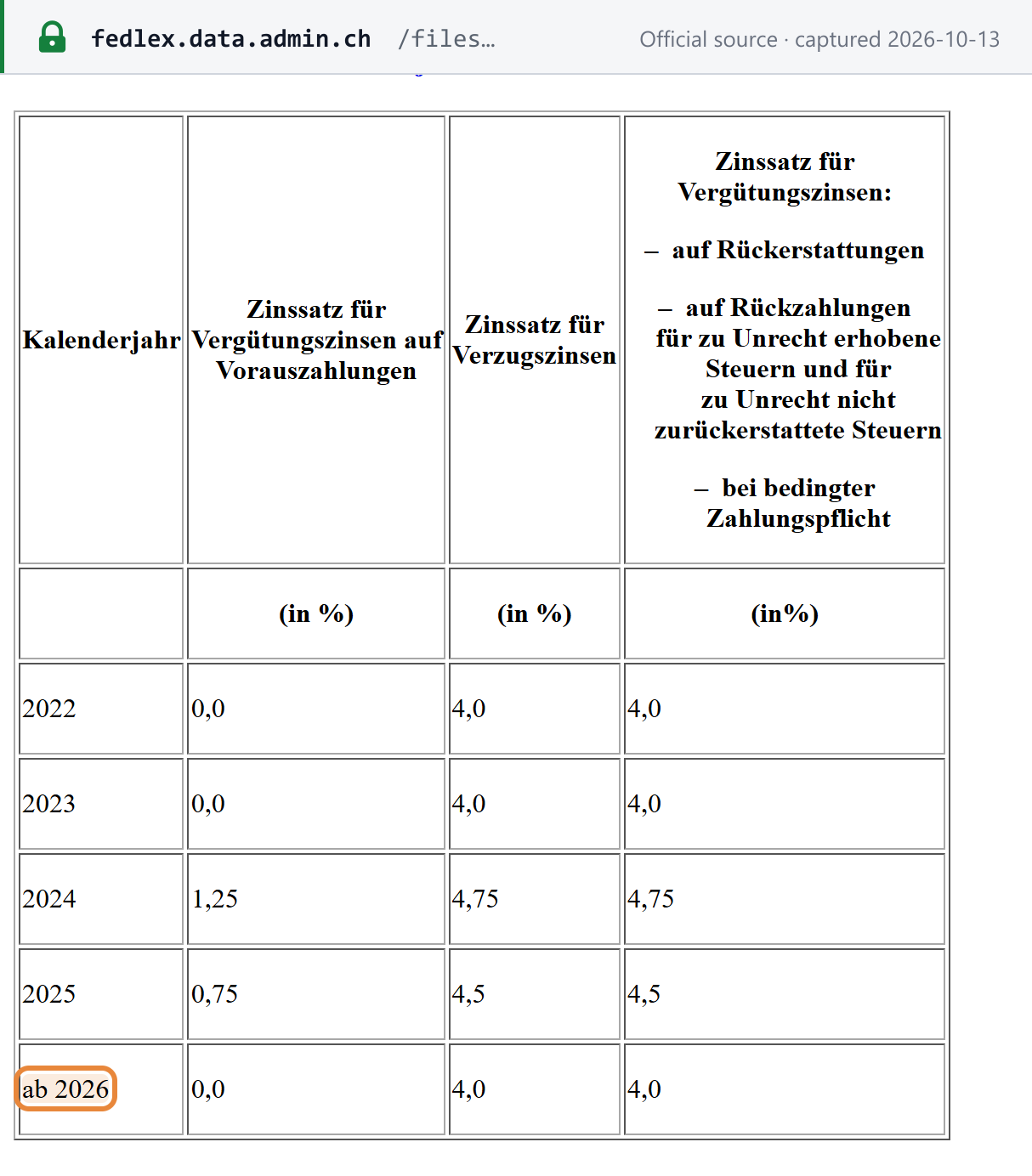
| Late payment | Late-payment interest (Verzugszins) is due without a reminder (Art. 87). The rate is 4.0% a year from 2026 (4.5% in 2025, 4.75% in 2024). Interest under CHF 100 is not charged. [32] |
| Collection | Since 1 January 2025, debt collection against debtors in the commercial register proceeds by way of bankruptcy. [28] |
Frequently asked questions
We are a US software company with no Swiss office. Do we have to register for Swiss VAT, and is there a Swiss-sales threshold?
If you sell electronic services to Swiss consumers, yes, once your worldwide turnover reaches CHF 100,000 a year. There is no separate Swiss-sales threshold: the test counts supplies in Switzerland and abroad, and once registered you charge Swiss VAT on all your Swiss supplies. If your only Swiss supplies are services taxed where the customer is (the general rule) and none of them are telecom or electronic services to unregistered customers, you do not need to register, whatever your turnover; your Swiss customer accounts for the VAT under the reverse charge (Bezugsteuer) if it is VAT-registered or buys more than CHF 10,000 of such services a year. Services taxed where they are performed, such as on-site work, services connected with Swiss property or events in Switzerland, can require you to register.
Do we need a Swiss tax representative, and is the representative liable for our VAT?
In general, yes. A taxable person without a domicile or place of business in Switzerland must appoint a representative who has one, and the ESTV says online registration without a Swiss tax representative is not possible, with foreign platforms as the exception. Since 2025 the ESTV may waive the requirement where the obligations are otherwise ensured. Subject to criminal law, the representative is not jointly and severally liable for the tax.
We ship low-value parcels to Swiss consumers. Does the CHF 5 rule mean no VAT?
Only below the limit. Import VAT of CHF 5 or less per assessment is not collected, which corresponds to goods worth CHF 62 at 8.1% or CHF 193 at 2.6%. Once your sales of such small consignments reach CHF 100,000 a year, all your deliveries from abroad count as Swiss supplies from the following month: you must register, import in your own name and charge Swiss VAT on every parcel. Since 1 January 2025, an electronic platform that brings sellers and buyers together to contract on the platform can be treated as the supplier instead.
We are not registered in Switzerland but paid Swiss VAT on trade-fair and hotel costs. Can we reclaim it?
Yes, if your country grants Switzerland reciprocity and you have at least CHF 500 a year to reclaim. Claim per calendar year on forms 1222 and 1223 with invoices that meet the Swiss invoice requirements and are addressed to you (till receipts are not accepted), through a representative in Switzerland, between 1 January and 30 June of the following year; the deadline cannot be extended. VAT paid in Liechtenstein is refunded by Liechtenstein, separately and with its own CHF 500 minimum.
Can I invoice Swiss customers in euros?
Yes. Invoices may be in a foreign currency, but VAT is declared in Swiss francs. Convert at the time the tax claim arises using the ESTV's published monthly average rate or daily selling rate, or, if you are part of a group, the group rate, and keep the chosen method for at least one tax period.
Is a customer in Liechtenstein treated as Swiss for VAT?
Yes. Liechtenstein is part of the Swiss VAT territory, so a supply there is a domestic supply, not an export, and the rates are the same. Liechtenstein has its own VAT law and administration: a business seated in Liechtenstein registers with the Liechtenstein tax administration. Swiss customs collects import VAT for both countries. Refunds to foreign businesses are claimed separately in each country.
Important websites
| Site | Purpose |
|---|---|
| ESTV VAT registration | Register for Swiss VAT online |
| ESTV — Deregistration | Deregister from VAT |
| ESTV ePortal | File returns (MWST-Abrechnung pro, AGOV login), request extensions, apply for annual reporting |
| ESTV — Paying VAT | Payment details (IBAN CH60 0900 0000 3000 0037 5) and refund timing |
| UID register | Look up a UID and its VAT status — see also how to verify a Swiss UID |
| ESTV — VAT rates | Current rates and what they apply to |
| ESTV — Foreign-currency rates | Monthly average and daily rates for converting invoices to CHF |
| ESTV — Refunds to foreign businesses | Forms, reciprocity list and deadlines for the refund procedure |
| BAZG — Import VAT for postal, online and courier shipments | Import VAT and the CHF 5 rule |
| EFV — Submitting e-invoices | E-invoicing channels for suppliers to the federal administration |
| ESTV practice publications (MWST-Info) | The ESTV's official VAT practice, including MWST-Info 16 on invoicing |
| Liechtenstein tax administration — VAT | Registration and VAT administration for Liechtenstein-seated businesses |
Recent changes
- 2027-01-01 (upcoming) — ePortal becomes mandatory also for group taxation, the net tax rate and flat-rate methods, and deregistration. (ESTV) — see the event record
- 2026-10-02 — Parliament adopts the extension of the 3.8% accommodation rate to 31 December 2031 (BBl 2026 2723, published 13 October 2026). Referendum deadline 21 January 2027; in force 1 January 2028 if no referendum is called. (Fedlex)
- 2026-09-21 — The Council of States votes for +0.2 points (standard) and +0.1 point (accommodation) from 2029 to 2045 in the security-contribution VAT bill (26.051), instead of the Federal Council's +0.5 and +0.3 points for 12 years. The bill is now with the National Council's committee. (Swiss Parliament)
- 2026-06-30 — The Federal Chancellery announces the 29 November 2026 vote on the AHV VAT increase (+0.4 points standard, +0.2 points accommodation; BBl 2026 1757). (Federal Chancellery) — see the event record
- 2026-05-11 — MWST-Abrechnung easy withdrawn; returns are filed only through MWST-Abrechnung pro with an AGOV login. (ESTV)
- 2026-01-01 — Late-payment interest falls to 4.0% (from 4.5%). (Fedlex)
- 2025-01-01 — Partial revision in force: platform deemed-supplier rule, optional annual reporting, 2.6% for menstrual hygiene products, new exemptions, waivable tax representative, reverse charge on emission rights, and mandatory online filing. (ESTV)
For the full chronology, see Switzerland tax changes on Lookuptax.
Reference links
- Fedlex — Federal VAT Act (MWSTG), SR 641.20
- Fedlex — VAT Ordinance (MWSTV), SR 641.201
- ESTV — VAT Info 22 Foreign businesses (PDF, English)
- ESTV — VAT rates in Switzerland · Mehrwertsteuersätze Schweiz
- ESTV — Steuerpflicht (tax liability)
- ESTV — Steuerpflicht ausländische Unternehmen · VAT liability of foreign companies
- ESTV — MWST anmelden (registration)
- ESTV — MWST abmelden (deregistration)
- Fedlex — BBl 2026 2723, MWSTG amendment of 2 October 2026 (Sondersatz für Beherbergungsleistungen)
- Fedlex — BBl 2026 1757, Federal Decree of 19 June 2026 on additional AHV financing through a VAT increase
- Federal Chancellery — Votes of 29 November 2026 (30 June 2026)
- Federal Council — Message on the security contribution (12 August 2026)
- Swiss Parliament — Finance Committee of the Council of States, press release of 25 August 2026
- BAZG — Postversand, Interneteinkauf, Kurierverkehr: Einfuhr für Firmen
- Fedlex — EFD Ordinance on import tax exemption for small amounts, SR 641.204
- ESTV — Steuerpflicht Bezugsteuer
- ESTV — Versandhandel und Plattformbesteuerung
- ESTV — Anmeldung Plattformbesteuerung
- ESTV — Teilrevision MWSTG und MWSTV (partial revision 2025)
- ESTV — MWST-Info 16, Ziff. 2.2 Form und Inhalt der Rechnungen (specimen invoice)
- ESTV — MWST-Info 16, Ziff. 2.3
- ESTV — MWST-Info 16, Ziff. 1.4.2 Aufbewahrungsdauer
- ESTV — MWST-Info 16, Ziff. 1.4.1 · Ziff. 1.5 Prüfspur
- ESTV — Fremdwährungskurse (foreign-currency rates)
- Federal Finance Administration — E-Rechnungen zustellen · Federal Council decision of 8 October 2014
- Swiss Armed Forces (VBS) — E-Rechnung
- ESTV — MWST online abrechnen
- ESTV — MWST bezahlen
- ESTV — Jährliche Abrechnung
- ESTV — Saldosteuersätze und Pauschalsteuersätze
- ESTV — VAT refund: Rückerstattung an Unternehmen im Ausland
- Fedlex — Zinssatzverordnung EFD, SR 631.014
- Fedlex — Treaty between Switzerland and Liechtenstein on VAT, SR 0.641.295.142
- Lilex — Liechtenstein VAT Act (MWSTG), LGBl. 2009 Nr. 330
- ESTV — Elektronischer Geschäftsverkehr
- ESTV — Fristverlängerung Einreichung Abrechnung
- Swiss Parliament — Business 26.051 (Curia Vista)
Related on Lookuptax:
- Switzerland tax ID guide (UID)
- How to verify a Swiss UID
- Switzerland UID validator
- Liechtenstein tax ID guide
- Swiss QR-bill explained
- VAT registration thresholds worldwide
- Worldwide tax rates
- E-invoicing status and networks worldwide
- Marketplace deemed-supplier rules
- VAT on digital services by non-resident suppliers
- Reverse charge explained