Belgium VAT guidelines
| FACTSHEET | |
|---|---|
| Country code | BE |
| Tax name | Value Added Tax (VAT) — TVA (taxe sur la valeur ajoutée) / btw (belasting over de toegevoegde waarde) |
| Tax Authority | SPF Finances / FOD Financiën (Federal Public Service Finance) |
Overview
Belgium levies value added tax. In French it is the taxe sur la valeur ajoutée (TVA); in Dutch, the belasting over de toegevoegde waarde (btw). The statute is the Code de la taxe sur la valeur ajoutée / Wetboek van de belasting over de toegevoegde waarde, created by the Law of 3 July 1969 (Royal Decree No. 20, art. 2: "la loi du 3 juillet 1969 créant le Code de la taxe sur la valeur ajoutée" — "the law of 3 July 1969 creating the VAT Code"). It is administered by the Federal Public Service Finance — SPF Finances / FOD Financiën. [1] [13]
Legal texts. Statute quotes are from SPF Finances' consolidated texts on Fisconetplus, current to the Moniteur belge of 31 August 2026. The Moniteur belge is the authentic text. Quotes are in French with an English rendering.
Currency. All amounts are in euro (EUR). Royal Decree No. 1 requires the total VAT on an invoice to be expressed in the national currency: "Le montant total des taxes à payer ou à régulariser doit être exprimé dans la monnaie nationale de l'Etat membre qui détermine les règles applicables à l'émission des factures" ("the total amount of tax payable or to be adjusted must be expressed in the national currency of the Member State whose rules govern the issue of invoices", art. 5 § 1er, 9°). [14]
Tax periods. Returns are filed for a calendar month or a calendar quarter — see Filing and payment.
Layering. VAT is a federal tax with no regional or municipal rate. The King sets the rates by royal decree deliberated in the Council of Ministers: "Par arrêté délibéré en Conseil des Ministres, le Roi fixe les taux et arrête la répartition des biens et des services entre ces taux" ("by decree deliberated in the Council of Ministers, the King sets the rates and allocates goods and services between them", VAT Code art. 37 § 1er). [2]
Rate decrees must be confirmed by law. Under art. 37 § 2, a rate decree is treated as never having taken effect unless a law confirms it within twelve months of its publication in the Moniteur belge: "Lesdits arrêtés sont censés n'avoir jamais produit leurs effets s'ils n'ont pas été confirmés par la loi dans les douze mois de la date de leur publication au Moniteur belge." This matters for the rate changes of 1 March 2026 (see Rates). [2]
Registration
Who should register
The liability rule is the definition of a taxable person (assujetti) in VAT Code art. 4 § 1er: "Est un assujetti quiconque effectue, dans l'exercice d'une activité économique, d'une manière habituelle et indépendante, à titre principal ou à titre d'appoint, avec ou sans esprit de lucre, des livraisons de biens ou des prestations de services visées par le présent Code, quel que soit le lieu où s'exerce l'activité économique." In English: anyone who, in the course of an economic activity, habitually and independently, as a main or secondary activity, with or without a profit motive, supplies goods or services covered by the Code, wherever that activity is carried on. [3]
VAT Code art. 50 § 1er then says who receives a VAT number "comprenant les lettres BE" ("containing the letters BE"): [4]
- 1° every taxable person established in Belgium, except those making only supplies exempt under art. 44 with no right to deduct, persons taxable under arts 8 and 8bis, and users of the EU cross-border small-business scheme;
- 2° non-taxable legal persons and exempt-only persons whose intra-EU acquisitions of goods exceed EUR 11,200 ("le seuil de 11.200 euros visé à l'article 25ter, § 1er, alinéa 2, 2°"), or who opt in;
- 3° every taxable person not established in Belgium that is liable for Belgian VAT on operations giving a right to deduct — see Non-resident registration.
Registration threshold
Belgium has no VAT registration threshold. A taxable person established in Belgium applies for VAT identification before it starts trading, whatever its turnover. One narrow exception: art. 50 § 4 gives no VAT number to a natural person under the franchise whose only supplies are services through an approved platform. [4]
The EUR 25,000 figure that is often called the Belgian threshold is something else: the small-business franchise (régime de la franchise de taxe / vrijstellingsregeling). It is optional. It exempts the business's supplies from VAT; it does not excuse the business from identifying. VAT Code art. 56ter § 1er: "Les assujettis établis en Belgique dont le chiffre d'affaires annuel réalisé en Belgique ne dépasse pas 25.000 euros, peuvent bénéficier du régime de la franchise de taxe pour les livraisons de biens et les prestations de services qu'ils effectuent en Belgique." In English: taxable persons established in Belgium whose annual turnover in Belgium does not exceed EUR 25,000 may use the franchise for the supplies they make in Belgium. [5]
Proposed change (not yet law). Bill DOC 56 1593, adopted by the Chamber of Representatives on 17 September 2026, would in article 26 raise this ceiling to EUR 26,000 for 2027, EUR 27,000 for 2028, EUR 28,000 for 2029, EUR 29,000 for 2030 and EUR 30,000 for 2031 and later years, from 1 January 2027. The same schedule would apply to the Belgian-turnover cap for businesses established in another EU state (art. 56ter § 2). As at 5 October 2026 it had not been published in the Moniteur belge, so the EUR 25,000 ceilings stated here are the ones in force. (Chamber of Representatives)
| Item | Rule | Source |
|---|---|---|
| Registration threshold (established businesses) | None — identify before starting the activity | VAT Code arts 4, 50 § 1er; SPF Finances [4] [11] |
| Registration threshold (non-established businesses) | None — identify once liable for Belgian VAT on an operation with a right to deduct, unless only the non-Union OSS or the IOSS is used | VAT Code art. 50 § 1er, 3° [4] |
| Small-business franchise (optional exemption) | Annual Belgian turnover ≤ EUR 25,000 excl. VAT, per calendar year; reduced pro rata to the days from 1 January to the start of activity in the first year | VAT Code art. 56ter § 1er (text from 1 March 2026) [5] |
| Franchise for businesses established in another EU state | EU turnover ≤ EUR 100,000 ("le chiffre d'affaires annuel dans l'Union de l'assujetti ne dépasse pas 100.000 euros") and Belgian turnover ≤ EUR 25,000 (bill DOC 56 1593 would raise this cap in step with § 1 from 2027; not yet law), after prior notification to its Member State of establishment (it is identified with an EX-suffixed number) | VAT Code art. 56ter § 2 [5] |
| Intra-EU acquisitions by non-taxable legal persons and exempt-only persons | Identification above EUR 11,200 | VAT Code art. 50 § 1er, 2° [4] |
The franchise has a cost and exclusions. A franchise user cannot deduct input VAT: "Les assujettis qui bénéficient de la franchise de taxe ne peuvent pas déduire la taxe ayant grevé les biens et les services qu'ils utilisent pour effectuer leurs opérations en franchise de taxe" (VAT Code art. 56bis § 4). Under art. 56bis § 2 (text from 2 March 2026), it is not available to VAT units, to businesses that habitually carry out construction work (travail immobilier), to businesses required to issue a cash-register receipt (ticket de caisse, for example in hotels and restaurants), or to businesses that habitually supply scrap and waste. [6]
Entry windows. A business that qualifies can enter the franchise on 1 January, 1 April, 1 July or 1 October of the following calendar year. It applies before 15 December, 15 March, 15 June or 15 September respectively (Royal Decree No. 19 of 15 December 2024, art. 3 § 2: "…à compter du 1er janvier, du 1er avril, du 1er juillet ou du 1er octobre de l'année civile qui suit… avant le 15 décembre de l'année civile en cours ou avant le 15 mars, le 15 juin ou le 15 septembre de l'année civile qui suit"). [7]
Returning after opting out. A business that leaves the franchise for the normal regime is locked out for a period. Royal Decree No. 19, art. 5 § 5, second paragraph: "L'assujetti ne peut revenir au régime de la franchise de taxe avant le 1er janvier de la deuxième année qui suit celle au cours de laquelle l'option visée à l'alinéa 1er a pris cours" — it cannot return before 1 January of the second year following the year in which its option took effect. [7]
Non-resident registration
There is no threshold for businesses not established in Belgium. VAT Code art. 50 § 1er, 3° (from 1 January 2025) gives a VAT number to "tout assujetti non établi en Belgique qui : a) effectue des opérations visées par le Code lui ouvrant un droit à déduction pour lesquelles il est redevable de la taxe en Belgique en vertu des articles 51 et 52, à l'exception des assujettis qui n'effectuent que des opérations pour lesquelles ils se prévalent du régime particulier visé au titre XII, chapitre 6, section 2 ou 4, de la directive 2006/112/CE". In English: every taxable person not established in Belgium that makes operations giving it a right to deduct, for which it is liable for the tax in Belgium, except those that make only operations under the non-Union OSS or the IOSS. The trigger is liability, not an amount. [4]
Representatives — required for most non-EU sellers, not all. VAT Code art. 55 § 1er (text from 11 December 2023) requires a taxable person not established in the EU to have a responsible representative (représentant responsable) established in Belgium approved before its first taxable operation in Belgium. The duty has three exceptions written into the article: [8]
- operations for which the Belgian customer owes the VAT under art. 51 § 2, first paragraph, 1°, 2°, 5° and 6° (the reverse charge);
- operations under the special schemes of arts 58ter and 58quinquies (the non-Union OSS and the IOSS);
- a seller whose seat or fixed establishment is in a country with which there is a legal instrument on mutual assistance "ayant une portée similaire à celle prévue par la directive 2010/24/UE et par le règlement (UE) n° 904/2010" — of similar scope to Directive 2010/24/EU and Regulation (EU) No 904/2010.
The Union OSS (art. 58quater) is not on that list: a non-EU seller that uses the Union OSS and makes no other taxable operation in Belgium except reverse-charged ones must still appoint a representative (art. 55 § 1er, second paragraph: "autre que celles pour lesquelles le cocontractant est redevable"). A business established in another EU state may appoint a representative but is not required to (art. 55 § 2). Besides an individually appointed representative, art. 55 § 3 provides for a pre-approved global representative. [8] SPF Finances' e-invoicing FAQ (question 25) notes that a globally liable representative uses "the specific VAT identification number allocated for this purpose with initials BE0796.5 or BE0796.6". [15]
Security. Royal Decree No. 31 of 2 April 2002, art. 3 §§ 2–3 (text from 1 October 2021): "Le montant de la sûreté visée au paragraphe 2 est fixé à dix p.c. du solde des taxes dues, pour une période de douze mois civils" … "ne peut être ni inférieur à 7.500 euros ni supérieur à un million d'euros." In English: the security is 10% of the balance of VAT due over twelve calendar months, with a minimum of EUR 7,500 and a maximum of EUR 1,000,000. The same article also governs IOSS intermediaries. [9]
Tax identification number
A Belgian VAT number is BE followed by the ten-digit enterprise number from the Crossroads Bank for Enterprises (BCE / KBO). The same enterprise number is how Belgian businesses are addressed on Peppol for mandatory e-invoicing. The Business Expert Group's minimal-invoice specimen states: "we use the Crossroads Bank for Enterprises (CBE) number as mandatory unique identification for a Belgian company (0208). Other identifications (e.g. Belgian VAT number as 9925) are possible if they are declared on the Peppol network". [20]
The number's format, check digits and the personal numéro national are covered on Lookuptax's Belgium tax ID guide. To check a counterparty, see how to verify a Belgian VAT number and how to verify a Belgian enterprise number, or use Lookuptax's Belgian VAT number validator.
How to register
Registration has two steps. The business is first entered in the Crossroads Bank for Enterprises (BCE / KBO). It then files a VAT identification request (form 604A). SPF Finances said: "Introduisez votre demande d'identification à la TVA minimum deux jours après l'inscription de votre entreprise dans la BCE, mais avant de débuter votre activité économique" — file the VAT identification request at least two days after the business is entered in the BCE, but before starting the economic activity. Changes are notified "dans un délai d'un mois en rentrant une déclaration modificative d'une identification à la TVA (formulaire 604B)" — within one month, on form 604B (SPF Finances, as read on 23 August 2026). [11]
Voluntary registration
Available. VAT Code art. 50 § 3: "Un numéro d'identification à la T.V.A. peut également être attribué à d'autres assujettis" — a VAT number may also be given to other taxable persons. A franchise user that wants to recover input VAT can opt into the normal regime, subject to the lock-out period described above. [4]
Deregistration
- Cessation. SPF Finances: "Complétez dans le mois la déclaration de cessation d'activité (formulaire 604C)" — file the cessation form 604C within the month (SPF Finances, as read on 23 August 2026). [11]
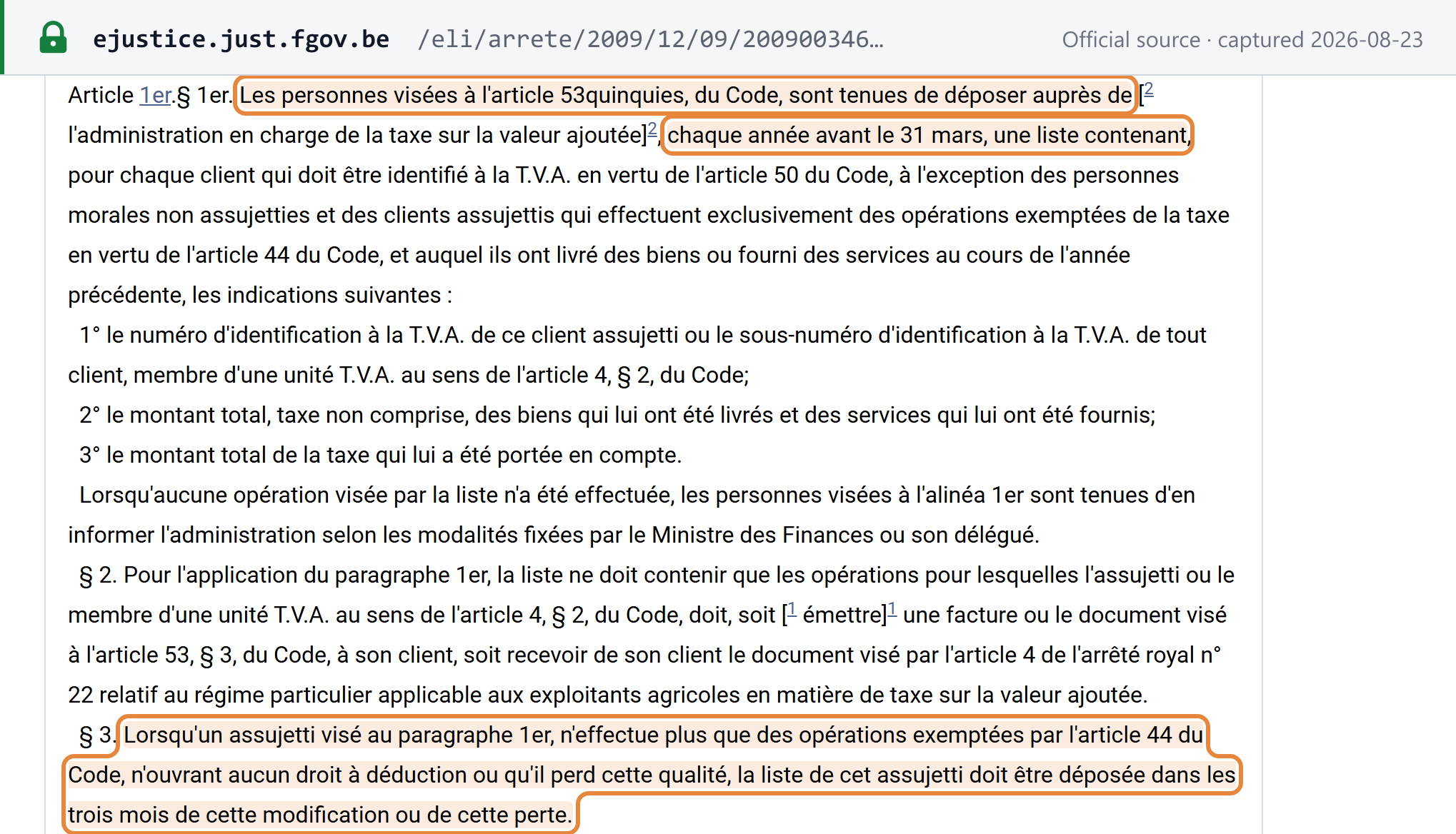
- Final client listing. A business that loses its taxable status, or comes to make only art. 44 exempt supplies, files its client listing "dans les trois mois de cette modification ou de cette perte" — within three months of the change (Royal Decree No. 23, art. 1er § 3). [12]
- Threshold for deregistration. Not applicable — there is no registration threshold to fall below. A business that qualifies for the franchise can enter it in one of the windows above instead.
Group registration
Available as a VAT unit (unité TVA / btw-eenheid), for persons established in Belgium that are closely linked financially, economically and organisationally (VAT Code art. 4 § 2; Royal Decree No. 55 of 9 March 2007). Art. 1 § 1er of the decree opens: "Dans la mesure où ils sont établis en Belgique, peuvent être considérés comme un seul assujetti … les assujettis … qui remplissent les conditions cumulatives suivantes : 1° ils sont étroitement liés sur le plan financier." The unit receives a BE number and each member a sub-number (VAT Code art. 50 § 1er, 6°). VAT units cannot use the small-business franchise. [10] [4]
Rates
Royal Decree No. 20 of 20 July 1970, art. 1er, sets four rates: "Le taux normal de la taxe sur la valeur ajoutée applicable aux biens et services visés par le Code est fixé à 21 p.c.. Par dérogation à l'alinéa 1er, la taxe est perçue au taux réduit de : a) 6 p.c. en ce qui concerne les biens et services énumérés au tableau A … b) 12 p.c. en ce qui concerne les biens et services énumérés au tableau B … c) 0 p.c. en ce qui concerne les biens et services énumérés au tableau C de l'annexe au présent arrêté." In English: the standard rate is 21%; goods and services listed in Tables A, B and C of the annex are taxed at 6%, 12% and 0%. Anything not listed in a table is taxed at 21%. [13]
| Rate | Examples (headings of the annex to Royal Decree No. 20) | Effective |
|---|---|---|
| 21% (standard) | All goods and services not listed in Tables A, B or C — including, since 1 March 2026, plant-protection products, and since 29 July 2025, coal and other solid fuels | In force (as at 23 September 2026) |
| 12% (Table B) | Restaurant and catering services, excluding drinks ("Les services de restaurant et de restauration, à l'exclusion de la fourniture de boissons"); hotels and campsites; margarine; certain agricultural tyres; social-policy housing | In force; hotels and campsites at 12% from 1 March 2026 |
| 6% (Table A) | Live animals; meat; milk, dairy, eggs and honey; other foodstuffs; water supply; electricity, natural gas used as fuel and heat through heating networks, under residential contracts only since 1 July 2023 ("dans le cadre du contrat de consommation non-professionnelle"); medicines and medical devices; newspapers, periodicals and books; works of art, collectors' items and antiques; transport; maintenance and repair; copyright and concert and show performances; renovation, repair and maintenance of private dwellings first occupied at least ten years before the first invoice (heading XXXI: "la transformation, la rénovation, la réhabilitation, l'amélioration, la réparation ou l'entretien"; new builds are not covered); demolition and rebuilding of homes; small repair services | In force |
| 6% (temporary) | Supply and installation of heat pumps for heating in or next to residential buildings, supplied and invoiced to a final consumer, in a private dwelling first occupied less than ten years before the first invoice ("bâtiment d'habitation dont la première occupation a eu lieu au cours d'une année civile qui précède de moins de dix ans la première facture"); the pump must meet the EU emissions and energy-label criteria (art. 1quater/1 § 2) | 1 January 2026 to 31 December 2030 |
| 0% (Table C) | Qualifying printed news periodicals ("Publications périodiques") for the general public, not mainly advertising, produced by a professional editorial staff of journalists and published at least 48 times a year ("au minimum quarante-huit fois par an"); § 3 extends it to qualifying digital publications | Since 1 April 2019 (Royal Decree of 13 April 2019, M.B. 26 April 2019) |
The 0% rate is a true zero rate. It is a rate in art. 1er, so the supplier charges 0% and keeps its right to deduct. That is different from an exempt supply under VAT Code art. 44 — see Exemptions.
Changes of 1 March 2026
A royal decree of 14 February 2026 (Numac 2026001322), made "dans le cadre de l'accord budgétaire pluriannuel" (under the multi-year budget agreement), amended the annex from 1 March 2026. The consolidated decree records it as "Modifie à partir du 01.03.2026" and names four headings: Table A, headings XII and XXX; Table B, headings III and IV. [13]
| Supply | Before 1 March 2026 | From 1 March 2026 | Decree text |
|---|---|---|---|
| Hotels and campsites — furnished accommodation with or without breakfast; campsite pitches | 6% (Table A, XXX) | 12% (Table B, IV) | Table A: "XXX. Hôtels, camping. Abrogé à partir du 01.03.2026". Table B: "IV. Hôtels, camping / Rétabli à partir du 01.03.2026 / 1. La fourniture de logements meublés, avec ou sans petit-déjeuner. 2. La mise à disposition d'emplacements pour le camping." |
| Plant-protection products (phytopharmacie) | 12% (Table B, III) | 21% | "III. Phytopharmacie. Abrogé à partir du 01.03.2026". Fertilisers stay at 6%, "à l'exclusion de ceux qui sont mélangés à des produits phytopharmaceutiques" — except those mixed with plant-protection products (Table A, XII, 8°). |
Under VAT Code art. 37 § 2, this decree must be confirmed by law within twelve months of its publication in the Moniteur belge, or it is treated as never having taken effect (see Overview).
Other dated changes
- Coal and solid fuels: 12% → 21% from 29 July 2025. Table B, heading VIII "Combustibles" was repealed by art. 54 of the Law of 18 July 2025 (M.B. 29 July 2025, Numac 2025005578) "à partir du 29.07.2025". [13]
- Heat pumps: 6% from 1 January 2026 to 31 December 2030. Art. 1quater/1 (royal decree of 18 December 2025): "à partir du 1er janvier 2026 jusqu'au 31 décembre 2030, sont soumis au taux réduit de six p.c., les travaux immobiliers ayant pour objet la livraison avec installation de pompes à chaleur destinées au chauffage … dans, sur ou à proximité immédiate de bâtiments d'habitation". Hybrid systems combined with a non-electric heater on the same hydronic circuit are excluded (§ 1er). § 2 sets the conditions on the customer, the dwelling and the pump listed in the table above. [13]
Announced future rates. The only dated future change in Royal Decree No. 20 is the end of the heat-pump rate after 31 December 2030 (as at 23 September 2026).
For Belgium alongside other jurisdictions, see Lookuptax's worldwide tax rates table and VAT registration thresholds table.
Cross-border rules
Imports and exports
- Imports of goods. Import VAT is declared on the import document. An import document with inaccurate details of the nature or quantity of the goods or of the price draws "une amende égale à deux fois le montant de cette taxe, avec un minimum de 50 EUR" — a fine of twice the tax, minimum EUR 50 (VAT Code art. 70 § 3). [17]
- Exports and intra-EU supplies are exempt with the right to deduct: VAT Code art. 45 § 1er allows deduction for "des opérations exonérées en vertu des articles 39 à 42" (exports, intra-EU supplies, international transport and related services). [28]
Digital products and services
A business not established in Belgium that sells services, including electronically supplied services, or distance sales of goods to Belgian consumers can use the EU One-Stop Shop (OSS) or Import One-Stop Shop (IOSS). A business that uses only the non-Union OSS or the IOSS is excluded from Belgian identification by VAT Code art. 50 § 1er, 3° (quoted above). [4]
Proposed ViDA changes (not yet law). Bill DOC 56 1718, adopted by the Chamber's Finance and Budget Committee on 23 September 2026 (11 in favour, 2 abstentions; committee report and adopted text published 2 October 2026), would apply VAT in the Digital Age rules from 1 January 2027 and 1 July 2029. According to the committee documents, it would end the call-off stock simplification for transfers after 30 June 2028 (transitional rules ending 30 June 2029), extend the deemed-supplier rule for electronic platforms to further categories of buyers, and exclude small-business-franchise users from the import scheme (IOSS, VAT Code art. 58quinquies). As at 5 October 2026 no plenary vote had taken place. (Chamber of Representatives)
Where Belgium is the Member State of identification, the Dutch-language OSS page said: "De aangiften worden per kwartaal ingediend. De kwartaalaangifte moet worden ingediend vóór het einde van de maand die volgt op dat kwartaal (april, juli, oktober, januari)" — OSS returns are quarterly and due before the end of the month after the quarter (April, July, October, January) (FOD Financiën, as read on 23 August 2026). IOSS returns are monthly. [18]
Foreign companies selling into Belgium — B2B and B2C
- B2B services — the Belgian customer usually accounts for the VAT, and the foreign supplier does not register. Which invoicing rules apply depends on where the supplier is. Under VAT Code art. 53decies § 1er, second paragraph, 1°, where a supplier not established in Belgium makes a supply for which the Belgian customer owes the VAT, the invoice follows the rules of the supplier's Member State, unless the customer issues the invoice itself (self-billing). [40] Where an invoice is subject to Belgian rules and the customer owes the VAT, Royal Decree No. 1, art. 5 § 1er requires the customer's VAT number for B2B services (4° a): "le numéro par lequel le preneur est identifié à la T.V.A. et sous lequel le service lui a été rendu") and the mention "Autoliquidation" in place of the rate and VAT amount (9°bis: "la mention " Autoliquidation " en lieu et place de l'indication des taux et du montant total des taxes dues lorsque la taxe est due par le cocontractant"). [14]
- B2B goods located in Belgium — different. A non-established seller that is itself liable for Belgian VAT on the supply must be identified (VAT Code art. 50 § 1er, 3°), and, if established outside the EU, usually needs a representative (art. 55 § 1er). See Non-resident registration. [4] [8]
- B2C — OSS or IOSS, otherwise Belgian identification. The seller accounts for the VAT itself, through OSS/IOSS or, where it is liable outside those schemes, through a Belgian VAT number (VAT Code art. 50 § 1er, 3°). A business established in another EU state with EU turnover of no more than EUR 100,000 and Belgian turnover of no more than EUR 25,000 can instead use the Belgian franchise, after prior notification to its Member State of establishment (it is identified with an EX-suffixed number) (VAT Code art. 56ter § 2). [5]
Domestic reverse charge on construction work
Royal Decree No. 1, art. 20 § 1er: "le cocontractant de l'assujetti établi en Belgique qui effectue une des opérations indiquées au paragraphe 2, acquitte la taxe due en raison de cette opération lorsqu'il est lui-même un assujetti tenu au dépôt de la déclaration visée à l'article 53, § 1er, alinéa 1er, 2°, du Code." § 2: "Est visé tout travail immobilier au sens de l'article 19 § 2, du Code." In English: for construction work supplied by a taxable person established in Belgium, the customer pays the VAT when it is itself a taxable person that files periodic VAT returns. Paragraph 4 of the article was replaced from 1 January 2024. [14]
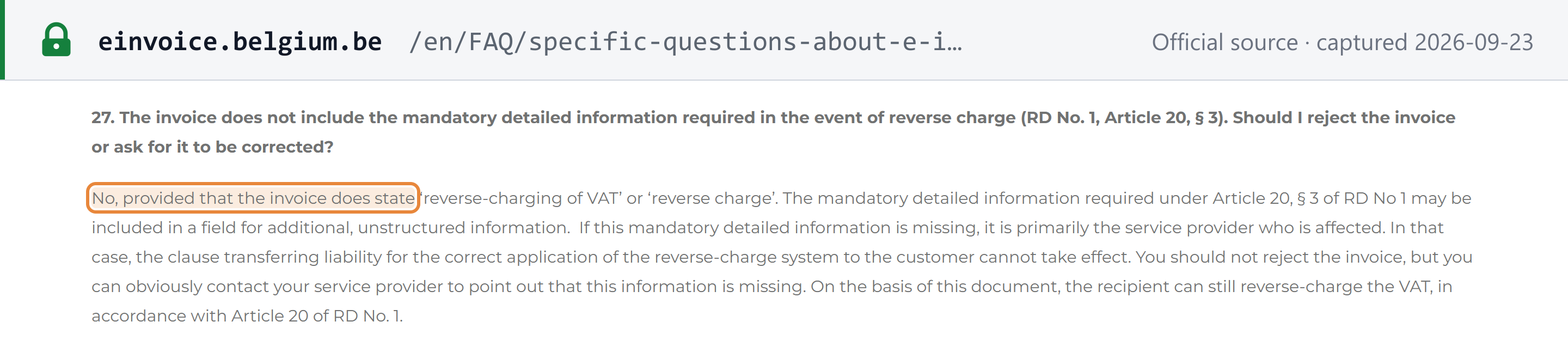
On wording, SPF Finances' e-invoicing FAQ (question 27) says a customer need not reject an invoice that lacks the full art. 20 § 3 text, "provided that the invoice does state 'reverse-charging of VAT' or 'reverse charge'". The detailed wording can sit in a free-text field. [15]
Marketplace / platform deemed-supplier liability
Applies, as in the EU rules. VAT Code art. 13bis (from 1 July 2021): [16]
- § 1er — a taxable person that facilitates, through an electronic interface such as a marketplace, platform or portal, distance sales of goods imported from third territories or countries "contenus dans des envois d'une valeur intrinsèque ne dépassant pas 150 euros" (in consignments of an intrinsic value of no more than EUR 150) "est réputé avoir reçu et livré ces biens lui-même" (is deemed to have received and supplied the goods itself).
- § 2 — the same applies where the interface facilitates the supply of goods within the EU by a taxable person not established in the EU to a non-taxable person.
Place of supply
The place-of-supply rules for goods and for services are set out in the VAT Code. [1]
Invoice requirements
The invoicing rules sit in Royal Decree No. 1, mainly arts 1 to 13quater. Art. 5 § 1er opens: "La facture et le document visé à l'article 2 portent les mentions suivantes :" — the invoice must carry the following particulars. Business-to-business invoices between Belgian VAT-liable businesses must also be structured e-invoices since 1 January 2026 — see E-invoicing status. [14]
Mandatory content
Royal Decree No. 1, art. 5 § 1er (current text, including point 10°quater added from 1 January 2025): [14]
| Point | Required field | Wording of the decree |
|---|---|---|
| 1° | Issue date and a unique sequential number | "la date à laquelle ils sont respectivement émis ou établi et un numéro séquentiel, basé sur une ou plusieurs séries qui identifie ces documents de façon unique" |
| 2° | Supplier's name, registered or administrative office address, and VAT number | "le nom ou la dénomination sociale du fournisseur de biens ou du prestataire de services, l'adresse de son siège administratif ou social et son numéro d'identification à la T.V.A." |
| 2°bis | For a non-established supplier: its Belgian representative | "l'identité et l'adresse de ce représentant responsable et l'indication de sa qualité" |
| 3° | Customer's name, address and VAT number | "le nom ou la dénomination sociale, l'adresse et le numéro d'identification à la T.V.A. … du cocontractant" |
| 3°bis | For a liable non-established customer: its Belgian representative | as 2°bis |
| 4° | Customer's VAT number for B2B services, intra-EU supplies and triangulation | "le numéro par lequel le preneur est identifié à la T.V.A. et sous lequel le service lui a été rendu" |
| 5° | Tax-point or payment date, if different from the issue date | "dans la mesure où une telle date est déterminée et différente de la date de l'émission de la facture" |
| 6° | Description and quantity | "la dénomination usuelle des biens livrés et des services fournis et leur quantité ainsi que l'objet des services" |
| 7° | For means of transport: vehicle data | "la marque, le modèle, la cylindrée, la puissance du moteur et le numéro de châssis" |
| 8° | Per rate or exemption: taxable amount, unit price, discounts | "pour chaque taux ou exemption, la base d'imposition, le prix unitaire hors taxe, ainsi que les escomptes, rabais ou ristournes éventuels" |
| 9° | Rates and total VAT (total VAT in euro) | "l'indication des taux de la taxe et le montant total des taxes à payer ou à régulariser" |
| 9°bis | Reverse charge | the mention "Autoliquidation" in place of the rates and total VAT |
| 9°ter | Self-billing | the mention "Autofacturation" when the customer issues the invoice for the supplier |
| 10° | Ground for exemption | "l'indication de la disposition pertinente de la directive ou de la disposition nationale correspondante" |
| 10°bis | Travel agents | "Régime particulier - Agences de voyages" |
| 10°ter | Margin schemes | "Régime particulier - Biens d'occasion", "Régime particulier - Objets d'art", "Régime particulier - Objets de collection et d'antiquité" |
| 10°quater | Small-business franchise | "Régime particulier de la franchise de taxe" |
| 11° | Reference to earlier documents | "une référence à la pièce ou aux pièces antérieures" |
| 12° | Any other mention required under the Code | "toutes autres mentions prescrites en exécution du Code" |
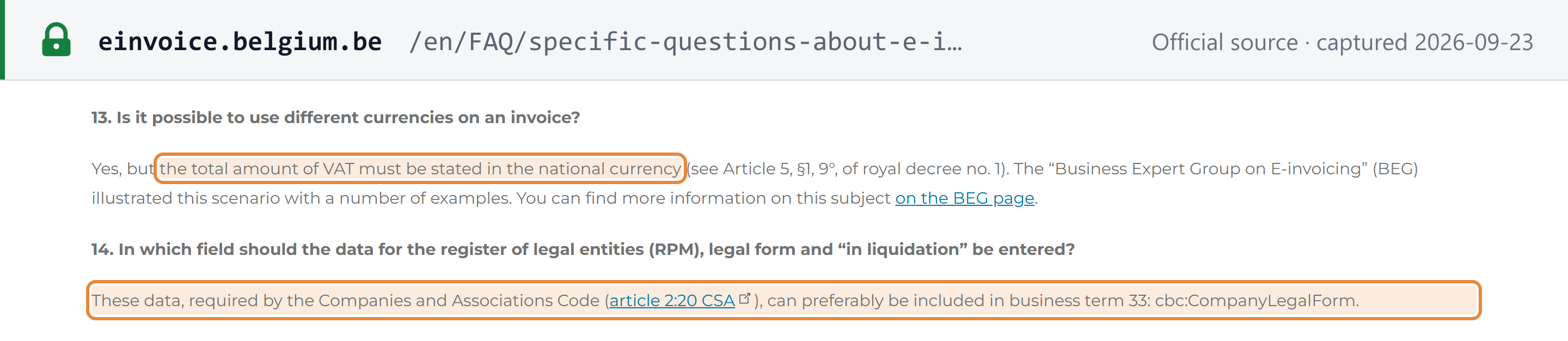
Company-law particulars. Belgian company and economic law add further particulars. The Business Expert Group's minimal-invoice specimen (below) maps the seller's name, registered address, enterprise number, legal form, register of legal entities (RPM / RPR) and contact details to art. 2:20 of the Companies and Associations Code (CSA / WVV) and art. III.25 of the Code of Economic Law (CDE / WER). It explains: "The table contains mandatory elements based on Belgian legislation (Royal Decree 1, Economic law and Society law)." SPF Finances' e-invoicing FAQ (question 14) adds that the RPM, legal form and "in liquidation" data, "required by the Companies and Associations Code (article 2:20 CSA), can preferably be included in business term 33: cbc:CompanyLegalForm." [20] [15]
Issuance deadline
By the 15th of the month after the tax point. Royal Decree No. 1, art. 4 § 1er (from 1 January 2016): "La facture et le document visé à l'article 3, sont respectivement émis ou établis au plus tard le quinzième jour du mois qui suit celui au cours duquel est intervenu le fait générateur de la taxe conformément aux articles 16 et 22 du Code." The same deadline applies to exempt intra-EU supplies (§ 2) and to successive statements (§ 3). [14]
Invoices to private individuals are required only in the cases listed in art. 1er of the decree, for example new means of transport and building work.
Numbering and sequencing
A unique sequential number, "basé sur une ou plusieurs séries" — based on one or more series (art. 5 § 1er, 1°). Simplified invoices also carry a sequential number (art. 13). [14]
Credit and debit notes
Corrections are made with a corrective document (document rectificatif). Royal Decree No. 1, art. 12 (text from 1 January 2026): "Un document rectificatif au sens de l'article 53, § 2, alinéa 3 ou § 2bis, alinéa 3, du Code, doit être émis ou établi lorsque, après leur émission ou établissement, la facture ou un des documents visés … doivent être corrigés." § 3: "Le document rectificatif visé aux paragraphes 1er et 2 porte une référence à la facture ou au document à rectifier" — it must refer to the invoice it corrects. [14]
A correction to a structured e-invoice is itself a structured e-invoice. SPF Finances' FAQ (question 23) allows a 2026 credit note on a 2025 PDF invoice to stay in PDF "as long as the customer accepts this (Art. 56, § 2 (4) of the VAT Code)". [15]
Currency and language
- Currency. Any currency may be used, but the total VAT must be in euro. SPF Finances' FAQ (question 13): "Yes, but the total amount of VAT must be stated in the national currency (see Article 5, §1, 9°, of royal decree no. 1)." The Business Expert Group publishes worked examples (test cases 10 and 11, "Invoice in USD and EUR vat"). [15] [21]
- Exchange rate. VAT Code art. 27 § 2 (current text from 1 July 2021) converts foreign-currency amounts at "le dernier cours indicatif de l'euro publié par la Banque centrale européenne" — the latest euro reference rate published by the European Central Bank. For currencies the ECB does not quote, the National Bank of Belgium's latest rate applies. A rate agreed by the parties, or shown in the contract or on the invoice, applies instead if the price is actually paid at that rate. For OSS and IOSS returns, art. 27 § 3 uses the ECB rate on the last day of the return period. Art. 27 was replaced from 1 January 2013; § 3 was last amended from 1 July 2021. [45]
- Language. The legal mentions must be in the language of the supplier's region. The Business Expert Group's specimen states: "In Belgium, all legal wording is supposed to be expressed in the language of the region where the operating location of the supplier or service provider is located (article 52 of RD of 18/07/1966 holding the usage of languages in administrative matters)." [20]
Document types
| Document | When it is used | Source |
|---|---|---|
| Full invoice | Default for supplies to taxable persons | Royal Decree No. 1, art. 5 |
| Simplified invoice | Invoice of EUR 100 or less excluding VAT; a document treated as an invoice; a franchise user's invoice. Not for intra-EU supplies, distance sales, triangulation or reverse-charge supplies | Royal Decree No. 1, art. 13 |
| Corrective document | Credit and debit adjustments | Royal Decree No. 1, art. 12 |
| Self-billed invoice | Issued by the customer, with the mention "Autofacturation" | Royal Decree No. 1, art. 5 § 1er, 9°ter |
| Cash-register receipt (ticket de caisse) | Hotels and restaurants using a registered cash system, under a separate royal decree of 30 December 2009 | Royal decree of 30 December 2009 |
Simplified invoice, Royal Decree No. 1, art. 13 (from 1 January 2025): "Les assujettis sont autorisés à émettre une facture simplifiée dans les cas suivants : 1° lorsque le montant de la facture n'est pas supérieur à 100 euros, hors taxe sur la valeur ajoutée; … 4° lorsque l'assujetti bénéficie du régime de la franchise de taxe". It must still show the date and sequential number; the supplier's name, address and VAT number; the customer's VAT number or name and address; "l'identification du type de biens livrés ou des services prestés"; and "l'indication, par taux, de la base d'imposition et le montant total des taxes dues". Between Belgian VAT-liable businesses, a simplified invoice also goes "(at least) via the Peppol-BIS format" (FAQ question 18). [14] [15]
Self-billing
Permitted, with a prior agreement and acceptance of each self-billed invoice, and the mention "Autofacturation" (art. 5 § 1er, 9°ter). Over Peppol, SPF Finances' FAQ (question 22) says: "Peppol provides a separate document type (self-billing invoice/self-billing credit note) … Please note: A prior agreement is still required, as is acceptance of each self-billing invoice or self-billing credit note." [14] [15]
Retention and audit trail
Invoices are kept for seven years — not ten. VAT Code art. 60 § 3: "Les factures et copies de factures visées au paragraphe 1er doivent être conservées pendant sept ans à compter du 1er janvier de l'année qui suit leur date d'émission" — seven years from 1 January of the year after the invoice date. [19]
The period changed twice:
- The Law of 20 November 2022 (art. 103, M.B. 30 November 2022) raised it to ten years ("pendant dix ans") from 1 January 2023.
- Art. 97 of the Law of 18 December 2025 (M.B. 30 December 2025, Numac 2025009647) restored seven years retroactively from 1 January 2023. The current text of art. 60 applies retroactively from 1 January 2023; its amendment history reads "Art. 60, à partir du 01.01.2023 *rétroactif (Art. 97, L 18.12.2025, M.B. 30.12.2025, Numac: 2025009647)".
Many guides written between 2023 and 2025 still say ten years. [19]
- Where. Belgian-established taxable persons keep copies of issued invoices and all invoices received in Belgium, unless they are stored electronically with full online access from Belgium: "…doivent être conservées sur le territoire belge, lorsque cette conservation n'est pas effectuée sous un format électronique garantissant en Belgique un accès complet et en ligne aux données concernées" (art. 60 § 2). Paper or electronic storage is allowed.
- Audit trail. Art. 60 § 5: "L'authenticité de l'origine, l'intégrité du contenu et la lisibilité d'une facture, que celle-ci se présente sur papier ou sous format électronique, doivent être assurées à compter du moment de son émission et jusqu'à la fin de sa période de conservation." Each taxable person chooses how: "Tout contrôle de gestion qui établit une piste d'audit fiable entre une facture et une livraison de biens ou une prestation de services, est de nature à donner cette assurance" — any business control that creates a reliable audit trail between an invoice and a supply is enough. The VAT Code and Royal Decree No. 1 set no hash, signature or QR-code requirement for B2B invoices (as at 23 September 2026). [19]
A specimen of a compliant invoice
The Business Expert Group on E-invoicing (BEG) publishes an annotated specimen, Scenario 1 — "Minimal legal + technical invoice", on the government e-invoicing portal. The BEG was launched in 2016 on the initiative of the FEB; its steering committee brings together business federations with FPS Finance, FPS BOSA and FPS Economy. The specimen is a three-line invoice (one line at 6%, one at 21%, one exempt) set out as a table. For each field it gives the EN 16931 business term and ID (for example BT-1 invoice number, BT-2 issue date, BT-7 tax point date, BT-5 currency, BT-31 seller VAT number, BT-34 seller endpoint, BT-30 legal registration ID, BT-33 legal form), whether the field is mandatory, the Belgian legal basis ("RD1", "Art.2:20 … WVV", "WER Art. III.25") and the Peppol UBL element. An XML version is published alongside it. [20] [21]
Its stated purpose: "This scenario holds a simple invoice containing the legal required elements. This means it contains the minimum set of the mandatory legal elements described in KB/AR 1 article 5 + 13ter, WER, WVV and the mandatory elements of the Peppol BIS v3 Billing standard which is based on the European Norm 16931." And: "The main goal of this document is to provide clarity where to include information that is required by Belgian regulation." The layout below is Lookuptax's rendering of that specimen's field set, with the legal basis printed next to each field. Every name, number and amount is fictional:
Facture / Factuur / Invoice
| DescriptionRD 1 art. 5 § 1er, 6° | QuantityRD 1 art. 5 § 1er, 6° | Unit price (excl. VAT)RD 1 art. 5 § 1er, 8° | VAT rateRD 1 art. 5 § 1er, 9° | Amount (excl. VAT) |
|---|---|---|---|---|
| Printed books | 10 | EUR 20.00 | 6% | EUR 200.00 |
| Office chairs | 4 | EUR 150.00 | 21% | EUR 600.00 |
| Exempt service | 1 | EUR 300.00 | Exempt | EUR 300.00 |
- Taxable amount at 6%RD 1 art. 5 § 1er, 8°
- EUR 200.00
- VAT at 6%RD 1 art. 5 § 1er, 9°
- EUR 12.00
- Taxable amount at 21%RD 1 art. 5 § 1er, 8°
- EUR 600.00
- VAT at 21%RD 1 art. 5 § 1er, 9°
- EUR 126.00
- Exempt amountRD 1 art. 5 § 1er, 8°
- EUR 300.00
- Total VAT (in EUR)RD 1 art. 5 § 1er, 9°
- EUR 138.00
- Total including VAT
- EUR 1,238.00
- Exempt line: the invoice cites the exemption provision of the VAT Directive or the Belgian VAT Code that applies — RD 1 art. 5 § 1er, 10°. The provision is left generic here.
- Reverse-charge supplies show "Autoliquidation" instead of the rate and VAT — RD 1 art. 5 § 1er, 9°bis. A franchise user shows "Régime particulier de la franchise de taxe" instead of the VAT — 10°quater.
- Between Belgian VAT-liable businesses this invoice is sent as a Peppol BIS (UBL) structured e-invoice over Peppol; the Business Expert Group publishes the XML for Scenario 1.
E-invoicing status
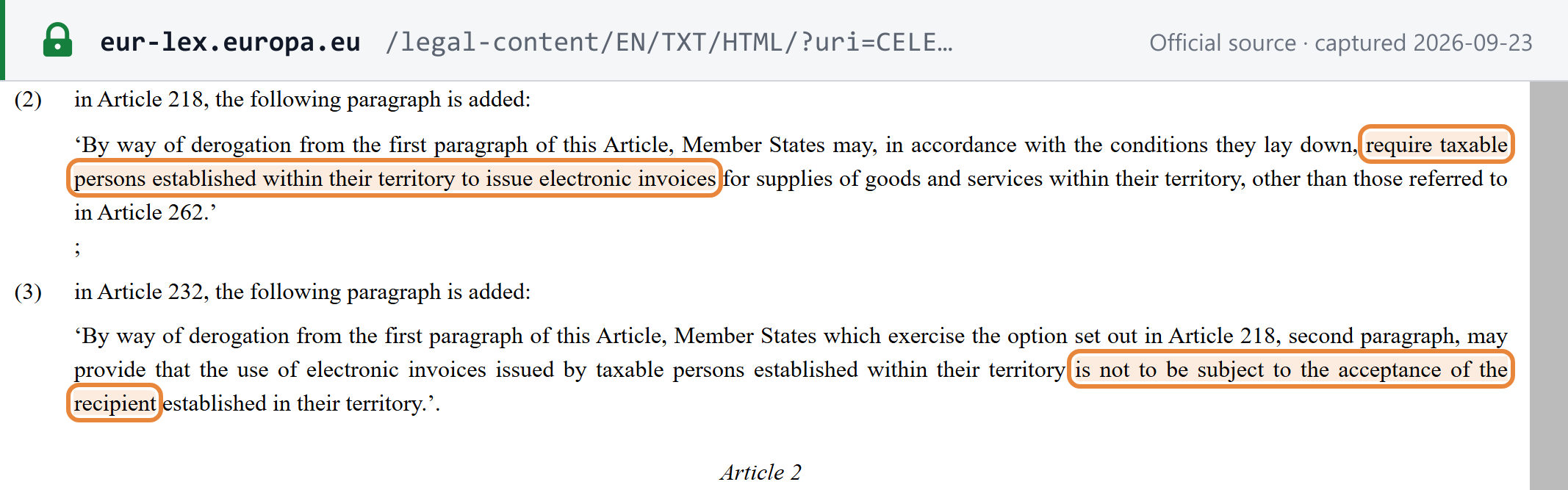
Status (as of 2026-09-23): B2B structured e-invoicing mandatory since 1 January 2026; e-reporting is at draft-law stage. Since 1 January 2026, Belgian VAT-liable businesses must issue and receive structured electronic invoices for domestic B2B supplies, in Peppol BIS (UBL) over the Peppol network. Another format that complies with EN 16931 is allowed only by agreement between the parties (Royal Decree No. 1, art. 13ter: "1° en conformité avec la norme européenne sur la facturation électronique … concrétisées dans le format Peppol BIS dans la version UBL ; 2° via le réseau de transmission Peppol"). [14] [37] On 18 July 2026 the Council of Ministers approved a preliminary draft law introducing electronic reporting and abolishing the annual client listing; it is not yet law (see the event record). [38] At EU level, Council Directive (EU) 2025/516 (ViDA) added paragraphs to Articles 218 and 232 of the VAT Directive, so a Member State can now require e-invoices from businesses established in its territory, without the recipient's acceptance, and no longer needs a special derogation to do so. [22] Scope, exclusions, onboarding and the fine scale are covered in Lookuptax's guide to e-invoicing in Belgium.
For Belgium alongside other mandates, see Lookuptax's e-invoicing status and networks table and Peppol guide.
Filing and payment
Filing frequency
Monthly by default; quarterly for smaller businesses. Royal Decree No. 1, art. 17 § 2 (text in force from 10 January 2026, as amended by the royal decree of 17 December 2025, M.B. 31 December 2025) allows a quarterly return where annual turnover excluding VAT is no more than EUR 2,500,000: "… déclaration trimestrielle … lorsque le chiffre d'affaires annuel, hors taxe sur la valeur ajoutée, n'excède pas 2.500.000 euros pour l'ensemble de son activité économique." [23]
A business that must file a monthly intra-EU listing cannot use the quarterly regime. A quarterly filer that stops meeting the conditions moves to monthly returns at the end of that quarter and must report the change by the 10th of the following month (art. 17 § 3).
Return due date
| Filer | Due | Weekends and public holidays |
|---|---|---|
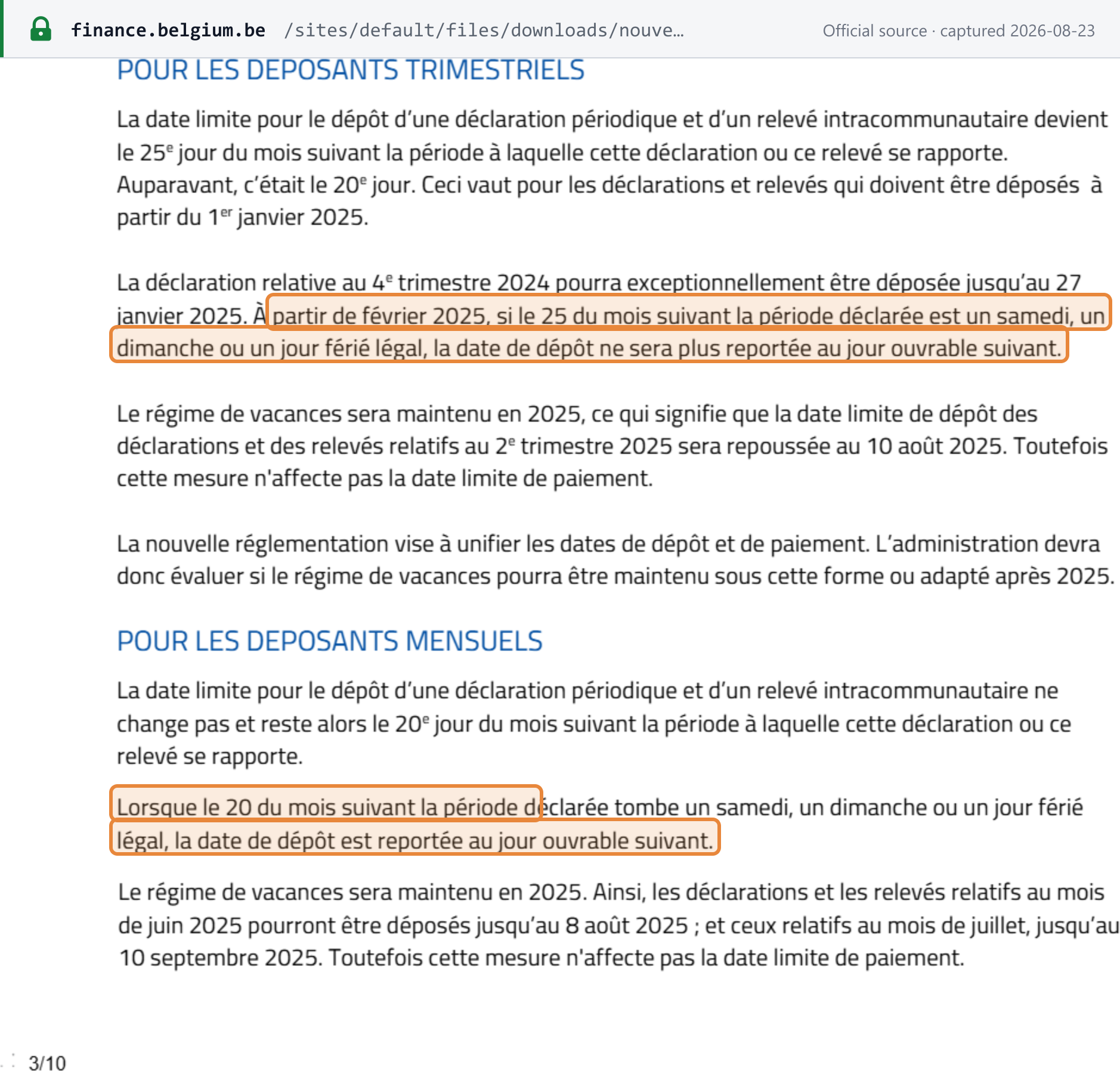
| Monthly | "au plus tard le vingtième jour qui suit le mois auquel elle se rapporte" — by the 20th of the following month | Moves to the next working day |
| Quarterly | "au plus tard le vingt-cinquième jour du mois qui suit chaque trimestre civil" — by the 25th of the month after the quarter | Does not move |
The quarterly date moved from the 20th to the 25th for returns due from 1 January 2025 (art. 17 § 2). The weekend rule is split between the two dates, as SPF Finances' guidance note on the new VAT chain explains. [23] [39]
No advance payments are due any more. The quarterly advances were abolished from 1 April 2017 and the December advance from 10 April 2021. [23]
Payment due date and method
The same dates as the return. SPF Finances: "Ces dates correspondent au moment où le montant doit être arrivé sur le compte bancaire BTW-TVA BE41 6792 0036 4210" — the money must have arrived in the VAT account BE41 6792 0036 4210 by that date (SPF Finances, as read on 23 August 2026). [24]
The VAT provision account. VAT Code art. 83bis sets up the Compte-provisions T.V.A. (provision account / provisierekening), in force from 1 February 2025. VAT credits that are not refunded go to it (see Refunds). SPF Finances made it visible in MyMinfin on 1 May 2026 (SPF Finances, as read on 23 August 2026) — see the event record. [43] [25]
The substitute return
If a periodic return is not filed, the administration can estimate the VAT. VAT Code art. 53 § 1erter: [26]
- When. The administration sends "une proposition de déclaration de substitution en cas de non-dépôt dans le délai requis de la déclaration … à l'expiration d'un délai de trois mois suivant la période de déclaration" — a proposed substitute return, three months after the end of the return period.
- How much. It "reprend le montant de taxe dû le plus élevé indiqué dans les déclarations … relatives aux douze mois qui précèdent" — the highest VAT due shown in the returns for the previous twelve months. Otherwise "la proposition de déclaration de substitution … fixe le montant de taxe dû à 2.100 euros" — a minimum of EUR 2,100.
- Notice. It "est notifiée par pli simple … et produit ses effets le troisième jour ouvrable suivant le jour de la remise de ce pli au prestataire du service postal universel" — sent by ordinary post, effective on the third working day after posting.
- How to stop it. File the missing return "dans un délai d'un mois à compter de la date d'effet de la notification"; "Le dépôt de cette déclaration met fin à la procédure de déclaration de substitution" — filing within one month ends the procedure.
- Objection. Once the substitute return is final, the taxable person "est autorisé à introduire une réclamation à l'encontre de cette déclaration dans un délai de six mois" — may object within six months (Royal Decree No. 1, art. 17bis § 1er, text from 10 January 2026). [14]
Additional listings
- Annual client listing (form 725). Royal Decree No. 23, art. 1er § 1er: taxpayers file "chaque année avant le 31 mars, une liste" — before 31 March each year — listing each customer identified for Belgian VAT that they supplied in the previous year. On cessation, the listing is due within three months (§ 3). A preliminary draft law approved by the Council of Ministers on 18 July 2026 would abolish the listing; it is not yet law. [12]
- Intra-EU listing (relevé intracommunautaire). Monthly, by the 20th; or quarterly, by the 25th, where intra-EU supplies of goods are no more than EUR 50,000 in the quarter and in each of the four previous quarters. No nil listing is filed (Royal Decree No. 50 of 11 December 2019). [44]
- Franchise turnover report. A franchise user reports its Belgian turnover for the previous calendar year: "L'assujetti visé à l'alinéa 1er communique ces informations au plus tard le 31 mars qui suit l'année civile visée à l'alinéa 1er" — by 31 March (VAT Code art. 56quinquies § 2). [27]
- EU cross-border small-business scheme — quarterly report. A Belgian business using the franchise in other Member States reports "dans un délai d'un mois à compter de la fin du trimestre civil" — within one month of the end of each quarter. Crossing the EUR 100,000 EU turnover limit must be notified "dans un délai de quinze jours ouvrables" — within fifteen working days (VAT Code art. 56quinquies § 1er, from 1 January 2025). [27]
Input-tax recovery and blocked items
VAT Code art. 45 (text from 1 January 2025): [28]
- Recoverable. "Tout assujetti peut déduire de la taxe dont il est redevable, les taxes ayant grevé les biens et les services qui lui ont été fournis … dans la mesure où il les utilise pour effectuer : 1° des opérations taxées ; 2° des opérations exonérées en vertu des articles 39 à 42" — VAT on inputs used for taxed supplies and for exports, intra-EU supplies and international transport (§ 1er).
- Cars — capped at 50%. "…la déduction ne peut dépasser en aucun cas 50 p.c. des taxes qui ont été acquittées" (§ 2). The cap does not apply to, among others, vehicles over 3,500 kg, light vans (camionnettes), motorcycles, vehicles held for resale or for hire to the public, and taxis.
- Blocked. "Ne sont pas déductibles, les taxes ayant grevé : 1° les livraisons et les acquisitions intracommunautaires de tabacs manufacturés; 2° … boissons spiritueuses autres que celles qui sont destinées à être revendues …; 3° les frais de logement, de nourriture et de boissons … 4° les frais de réception" — manufactured tobacco; spirits not for resale; accommodation, food and drink; and entertainment costs (§ 3).
Deduction requires a regular invoice — for supplies in scope of the mandate, a structured e-invoice — though SPF Finances' FAQ (question 24) says the right to deduct is not denied where the material conditions are met. [15]
Refunds
- Resident credit. VAT Code art. 76 § 1er (text from 20 February 2026): an excess is refunded "au plus tard à la fin du troisième mois suivant la période de déclaration … lorsque l'assujetti ou son représentant responsable … en fait la demande expresse" — by the end of the third month after the return period, on express request. It is refunded only where the returns for the previous six months and the current period were filed on time. Otherwise, or without a request, the credit goes to the provision account: "Lorsque l'excédent visé à l'alinéa 1er ne fait pas l'objet d'une demande de restitution, ou lorsque les conditions de la restitution ne sont pas en tout ou en partie remplies, celui-ci est inscrit sur le Compte-provisions T.V.A. de l'assujetti". [29]
Exemptions
Exempt supplies
VAT Code art. 44 (text from 3 November 2022) exempts, among others: [30]
- personal-care services by listed health professionals ("Sont exemptées de la taxe, les prestations de soins à la personne effectuées dans le cadre de leur profession ou pratique par les personnes suivantes :", § 1er);
- supplies of immovable property ("les livraisons de biens immeubles par nature", § 3), except new buildings supplied by the end of the second year after first occupation, which are taxed;
- the letting of immovable property, with taxed carve-outs in art. 44 § 3, 2°: non-residential lets of six months or less; parking and storage spaces; campsite pitches; hotel-type furnished accommodation for less than three months; port and airport premises; fixed equipment; property leasing; safes; and business lettings where the parties opt in;
- financial and insurance services.
Exempt is not zero-rated
The two carry opposite input-tax results in Belgium:
- Exempt under art. 44 — as a rule, no deduction. Art. 44 supplies generally carry no right to deduct. The exception is art. 44 § 3, 4° to 10° (mainly financial and insurance services) where the customer is established outside the EU or the service is directly linked to goods exported from the EU (art. 45 § 1er, 4° and 5°: "4° des opérations visées à l'article 44, § 3, 4° à 10°, à condition que le cocontractant soit établi en dehors de la Communauté"). A business making only art. 44 supplies does not even receive a VAT number: art. 50 § 1er, 1° excludes "assujettis qui n'effectuent que des livraisons de biens ou des prestations de services qui sont exemptées en vertu de l'article 44 et qui ne leur ouvrent aucun droit à déduction". [28] [4]
- Exempt under arts 39 to 42, or zero-rated — deduction kept. Exports and intra-EU supplies are exempt with deduction. Qualifying news periodicals are taxed at 0% under Table C, so their publisher also keeps its deduction (see Rates).
Businesses that make both taxed and art. 44 supplies apportion their input VAT.
Special regimes
- Small-business franchise — EUR 25,000; no input-tax deduction; invoice mention "Régime particulier de la franchise de taxe". See Registration threshold.
- Margin scheme for second-hand goods, works of art, collectors' items and antiques — Royal Decree No. 53 of 23 December 1994, under VAT Code art. 58. Art. 1 defines second-hand goods as "les biens meubles corporels susceptibles de remploi, en l'état ou après réparation, autres que des objets d'art, de collection ou d'antiquité, et autres que des métaux précieux, des pierres précieuses et des perles". The reseller cannot deduct VAT on goods under the scheme (VAT Code art. 45 § 5), and the invoice carries the mention in art. 5 § 1er, 10°ter. [31]
- Flat-rate scheme (régime du forfait) — Royal Decree No. 2 of 19 December 2018. The flat rates for café owners are in Royal Decree No. 2bis of 7 December 2025 (M.B. 19 December 2025). It replaced the 2022 decree that the Council of State annulled on 18 October 2024 and was amended by a royal decree of 7 May 2026. Its flat bases apply to operations "à partir du 1er janvier 2020 jusqu'au 31 décembre 2026" — from 1 January 2020 to 31 December 2026 (art. 31). [41]
- Agricultural scheme — VAT Code art. 57.
- Travel agents — a margin scheme with the invoice mention "Régime particulier - Agences de voyages" (art. 5 § 1er, 10°bis). [14]
- Cash accounting — not applicable. Neither the VAT Code nor its royal decrees provide a general cash-accounting scheme (as at 23 September 2026). [32]
Offences and penalties
Belgian VAT has two separate exposures. Criminal offences are prosecuted before the courts. Administrative fines (amendes fiscales) are imposed by SPF Finances. VAT Code art. 72: "A l'exception de celles qui figurent aux articles 73, 73bis et 73quater, toutes les amendes prévues dans le présent Code sont des amendes fiscales" — every fine in the Code is administrative except those in arts 73, 73bis and 73quater. [34]
Offences
Criminal VAT fraud — VAT Code art. 73, rewritten from 1 September 2026. Art. 15 of the Law of 16 May 2024 (M.B. 21 June 2024, Numac 2024005238) replaced art. 73 to align it with the new Penal Code. The new text reads: "Sera puni d'une peine d'emprisonnement de niveau 2 telle que prévue à l'article 36 du Code pénal celui qui, dans une intention frauduleuse ou à dessein de nuire, contrevient aux dispositions du présent Code ou des arrêtés pris pour son exécution. Par dérogation aux articles 38 et 52, § 1er, du Code pénal, le juge peut prononcer une amende de 2.000 euros à 4.000.000 euros comme peine accessoire." [33]
In English:
- Conduct. Breaching the VAT Code or its implementing decrees with fraudulent intent or intent to harm.
- Punishment. Imprisonment at level 2 under art. 36 of the Penal Code, and the court may add a fine of EUR 2,000 to EUR 4,000,000.
- Serious fraud. Imprisonment at level 3, whether organised or not. Fraud is always serious where it is linked to at least two Member States and causes a loss of at least EUR 10,000,000: "La fraude fiscale est en tout cas considérée grave lorsque les infractions visées à l'alinéa 1er sont en lien avec le territoire d'au moins deux Etats membres et entraînent un préjudice d'un montant total d'au moins 10.000.000 euros."
- Start date. "La date d'entrée en vigueur initialement prévue, à savoir le 8 avril 2026, a été reportée au 1er septembre 2026 par l'article 252 de la loi du 30 mars 2026 (M.B. du 2 avril 2026, NUMAC 2026002492)" — moved from 8 April 2026 to 1 September 2026.
The length of imprisonment at each level is set by art. 36 of the new Penal Code. The same law also rewrote arts 73bis to 73decies (false documents and related offences).
Administrative offences. The conduct that draws an administrative fine includes: not paying the tax, or paying it late; deducting VAT that was not deductible; not issuing an invoice, or issuing one with wrong particulars (the fine is owed by both supplier and customer); inaccurate import documents; overstated export documents; and any other breach of the Code (VAT Code arts 70 and 71). [17]
Penalties
Proportional fines (VAT Code art. 70, text from 11 December 2023). The Code sets the maximum; Royal Decree No. 41 scales it down by the circumstances. [17] [35]
| Default | Maximum in the Code | Applied scale |
|---|---|---|
| Non-payment or late payment | "une amende égale à deux fois la taxe éludée ou payée tardivement" — twice the tax (art. 70 § 1er) | Reduced by the Royal Decree No. 41 scale |
| Undue deduction | "une amende égale au double du montant de cette taxe" — twice the tax (§ 1bis) | Reduced by the Royal Decree No. 41 scale |
| Invoice not issued, or inaccurate in the parties' VAT identification number, name or address ("des parties intéressées à l'opération"), the nature or quantity of the goods or services, or the price | "une amende égale à deux fois la taxe due sur l'opération, avec un minimum de 50 euros" — twice the tax, minimum EUR 50, owed by supplier and customer each; waived for purely accidental irregularities (§ 2). Other missing particulars fall under the fixed fines below | Royal Decree No. 41, Table C: invoice not issued, 60% of the tax where the VAT was not yet chargeable, 100% where it was; missing or wrong particulars, 100% |
| Inaccurate import document | Twice the tax, minimum EUR 50 (§ 3) | — |
Fixed fines (VAT Code art. 70 § 4). Other breaches carry "une amende fiscale non proportionnelle de 50 euros à 5.000 euros par infraction", graduated by royal decree. The scale is in the annex to Royal Decree No. 44 of 9 July 2012 (text amended from 10 January 2026): [17] [36]
| Default | Fine |
|---|---|
| Periodic return not filed | EUR 500 per return (first infringement), EUR 1,250 (second), EUR 2,500 (third), EUR 5,000 (subsequent) |
| Periodic return filed late — up to five months, or filed in time to end a substitute-return procedure | "100 EUR par déclaration et par mois … de retard avec un maximum de 500 EUR" — EUR 100 per return per month, up to EUR 500; any part of a month counts as a whole month |
| Incorrect periodic return | EUR 80 if purely accidental; otherwise EUR 500 |
| Wrong filing frequency / wrong filing procedure | EUR 250 / EUR 400 |
| OSS or IOSS return, special return, small-business scheme reports | Not filed: EUR 1,000. Late: EUR 100 per month, up to EUR 1,000 |
| Annual client listing | "Non-dépôt 3.000 EUR par liste" — EUR 3,000 if not filed. Late by up to 3 months: EUR 50 for a nil listing, otherwise "25 EUR par client à reprendre avec un minimum de 75 EUR et un maximum de 1.500 EUR". Late by up to 9 months: EUR 150 for a nil listing, otherwise EUR 75 per client (min. EUR 225, max. EUR 2,250). Over 9 months: EUR 3,000 |
| Intra-EU listing | Not filed: EUR 3,000 (part 1), EUR 1,500 (part 2). Late by up to 2 months: EUR 25 per customer (part 1), min. EUR 75, max. EUR 1,500 |
| Invoice not issued on time (section 2, I.A), or other invoicing obligations (I.B) | EUR 50 per invoice up to EUR 500 (first infringement); EUR 125 up to EUR 1,250 (second); EUR 250 up to EUR 5,000 (subsequent). For other invoicing obligations (I.B) only: EUR 25 per invoice (minimum EUR 50, maximum EUR 250) for a first infringement that is purely accidental or causes no loss to the Treasury |
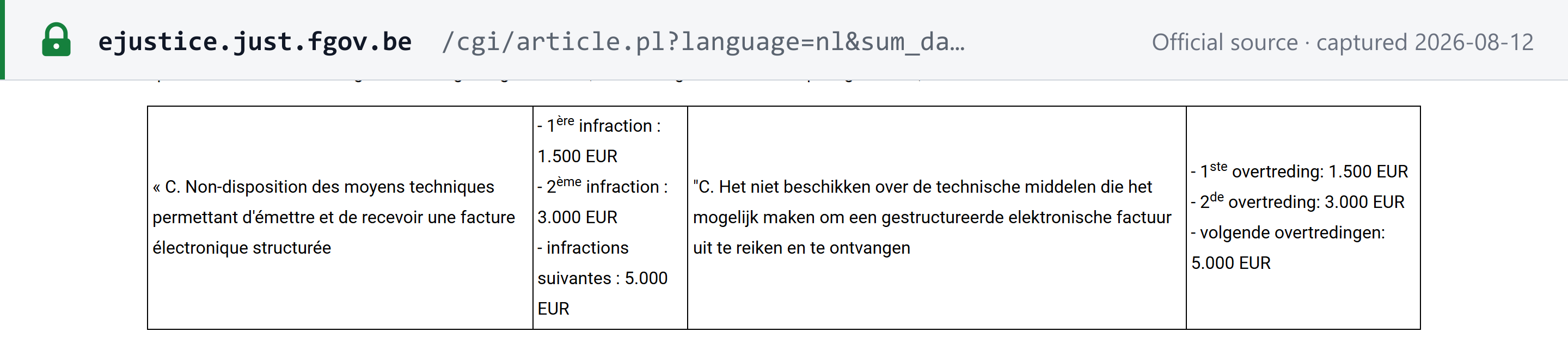
| No technical means to send and receive structured e-invoices | EUR 1,500 (first), EUR 3,000 (second), EUR 5,000 (subsequent); a second or later infringement counts only if found at least three months after the previous one |
Two rules apply across the scale. Where the breach was committed to evade tax, "le montant de l'amende la plus élevée prévu pour cette infraction est doublé sans pouvoir dépasser 5.000 euros par infraction" — the highest fine for that breach is doubled, up to EUR 5,000 (art. 2). Earlier infringements count for four years ("pendant une période de quatre années", art. 3). [36]
Late-payment interest. VAT Code art. 91 § 1er (text from 9 March 2026) sets the rate as the rate under art. 2 § 2/1, first paragraph, 1° of the law of 5 May 1865 "augmenté de 4 points" — plus 4 percentage points — and "toute fraction de mois est comptée pour un mois entier": any part of a month counts as a whole month. [42]
Frequently asked questions
Is there a VAT registration threshold in Belgium?
No. A business established in Belgium applies for VAT identification before it starts trading, and a business established abroad must be identified as soon as it owes Belgian VAT on an operation that gives a right to deduct, unless it only uses the non-Union OSS or the IOSS. The EUR 25,000 figure is the optional small-business franchise, which exempts a business's supplies but does not excuse it from identifying.
How long must invoices be kept in Belgium — seven years or ten?
Seven years from 1 January of the year after the invoice date (VAT Code art. 60 § 3). A law of 20 November 2022 had raised the period to ten years from 1 January 2023, but article 97 of the Law of 18 December 2025 restored seven years retroactively from that date.
See Retention and audit trail.
What VAT rate applies to hotel stays in Belgium?
12% since 1 March 2026, up from 6%, under a royal decree of 14 February 2026. Restaurant and catering services are also at 12%. The supply of drinks is excluded from that heading.
We are a company established outside the EU selling goods in Belgium. Do we need a fiscal representative?
Usually. A taxable person established outside the EU must have a responsible representative approved before its first taxable operation in Belgium (VAT Code art. 55 § 1er), unless its operations are reverse-charged to the customer or declared under the non-Union OSS or the IOSS (arts 58ter and 58quinquies), or it operates from a country with a legal instrument on mutual assistance of similar scope to Directive 2010/24/EU and Regulation (EU) No 904/2010. The security is 10% of the balance of VAT due over twelve calendar months, with a minimum of EUR 7,500 and a maximum of EUR 1,000,000.
See Non-resident registration.
Can we invoice a Belgian customer in US dollars?
Yes. The invoice may be in another currency, but the total amount of VAT must be stated in euro (Royal Decree No. 1, art. 5 § 1er, 9°). The conversion uses the latest euro reference rate published by the European Central Bank, or the National Bank of Belgium's rate for currencies the ECB does not quote, unless a rate was agreed between the parties or shown in the contract or invoice, and the price is actually paid at that rate (VAT Code art. 27 § 2).
We missed a Belgian VAT return. What happens?
A return filed no more than five months late, or in time to end a substitute-return procedure, costs EUR 100 per month of delay, up to EUR 500; a return never filed costs EUR 500 for a first infringement, rising to EUR 5,000 for later ones. Three months after the period ends, the administration can propose a substitute return at the highest VAT due in the previous twelve months, with a minimum of EUR 2,100. Filing the missing return within one month of that notice ends the procedure.
Does a small business under the EUR 25,000 franchise still have VAT obligations?
Yes. It reports its previous year's Belgian turnover by 31 March, marks its invoices Régime particulier de la franchise de taxe instead of showing VAT, and cannot deduct the VAT on its costs. It is also within the B2B structured e-invoicing obligation that applies since 1 January 2026.
When is the quarterly Belgian VAT return due?
By the 25th of the month after the quarter; monthly returns are due by the 20th of the following month (Royal Decree No. 1, art. 17). SPF Finances guidance says a 20th that falls on a Saturday, Sunday or public holiday moves to the next working day, but the 25th does not.
See Return due date.
Important websites
| Site | Purpose |
|---|---|
| SPF Finances — start, change or end of activity | VAT identification (form 604A), changes (604B) and cessation (604C) |
| Intervat | Filing VAT returns, listings and OSS returns |
| SPF Finances — VAT payment | Paying VAT to account BE41 6792 0036 4210 (SPF Finances, as read on 23 August 2026) |
| SPF Finances — VAT provision account | The provision account shown in MyMinfin |
| VIES VAT number validation | Checking a Belgian or other EU VAT number |
| CBE Public Search | Checking an enterprise number in the Crossroads Bank for Enterprises |
| Fisconetplus | SPF Finances' legal database: the VAT Code, royal decrees and rates |
| E-invoicing portal and scope self-check | The B2B e-invoicing obligation and whether it applies to you |
| Business Expert Group | Invoice specimens and Peppol field mappings |
Also see Lookuptax's own Belgian VAT number validator.
Recent changes
- 2026-10-02 — The Chamber of Representatives published the committee report and adopted text of bill DOC 56 1718, which its Finance and Budget Committee adopted on 23 September 2026 (11 in favour, 2 abstentions). The bill amends the VAT Code to apply the VAT in the Digital Age rules from 1 January 2027 and 1 July 2029 (partial transposition of Directive (EU) 2025/516), including the phase-out of the call-off stock simplification (transfers after 30 June 2028 no longer qualify; transitional rules end 30 June 2029). Not yet law: as at 5 October 2026 no plenary vote had taken place. (Belgian Chamber of Representatives) — see event record
- 2026-09-17 — The Chamber of Representatives plenary adopts bill DOC 56 1593 ("lagere kosten II en diverse bepalingen"), whose article 26 would raise the small-business franchise ceiling in VAT Code art. 56ter from EUR 25,000 to EUR 26,000 for 2027, rising by EUR 1,000 a year to EUR 30,000 for 2031 and later years, from 1 January 2027; the same schedule would apply to the Belgian-turnover cap for EU-established franchise users (art. 56ter § 2). Not yet law: the bill had been submitted for royal assent and, as at 5 October 2026, was not yet published in the Moniteur belge, so EUR 25,000 remains the ceiling in force. (Belgian Chamber of Representatives) — see event record
- 2026-09-01 — The criminal VAT offence in VAT Code art. 73 is replaced: imprisonment at Penal Code level 2 (level 3 for serious fraud) and an optional fine of EUR 2,000 to EUR 4,000,000. The start date was moved from 8 April 2026 by the Law of 30 March 2026. (SPF Finances — Fisconetplus)
- 2026-07-18 — The Council of Ministers approves a preliminary draft law introducing electronic reporting and abolishing the annual client listing. Not yet law. (Belgian federal government news) — see event record
- 2026-05-01 — The VAT provision account becomes visible in MyMinfin (SPF Finances, as read on 23 August 2026). (SPF Finances) — see event record
- 2026-03-01 — Royal decree of 14 February 2026: hotels and campsites move from 6% to 12%; plant-protection products move from 12% to 21%. (SPF Finances — Fisconetplus)
- 2026-01-10 — Quarterly VAT filing is available wherever annual turnover excluding VAT does not exceed EUR 2,500,000 for the whole business; the former additional EUR 250,000 ceiling on supplies of energy products, mobile phones, computers and registrable motor vehicles is removed (Arrêté royal of 17 December 2025 amending Royal Decree No. 1, art. 17 § 2). (SPF Finances — Fisconetplus) — see event · issue
- 2026-01-01 — Structured B2B e-invoicing over Peppol becomes mandatory between Belgian VAT-liable businesses. The same day, a temporary 6% rate for heat pumps in homes starts; it runs to 31 December 2030. (SPF Finances e-invoicing portal; Fisconetplus)
- 2025-12-30 — The Law of 18 December 2025 is published. Its art. 97 restores the seven-year invoice retention period, retroactively from 1 January 2023. (SPF Finances — Fisconetplus)
- 2025-07-29 — Coal and other solid fuels move from 12% to 21% (Law of 18 July 2025, art. 54). (SPF Finances — Fisconetplus)
Ahead: 31 December 2026, the end of the café owners' flat bases under Royal Decree No. 2bis; 31 December 2030, the end of the heat-pump rate. For the full chronology, see Belgium tax changes on Lookuptax.
Reference links
Fisconetplus documents are SPF Finances' consolidated texts, current to the Moniteur belge of 31 August 2026.
- VAT Code — table of contents (Fisconetplus)
- VAT Code, art. 37 — rates set by royal decree (Fisconetplus)
- VAT Code, art. 4 — taxable persons (Fisconetplus)
- VAT Code, art. 50 — VAT identification (Fisconetplus)
- VAT Code, art. 56ter — small-business franchise (Fisconetplus)
- VAT Code, art. 56bis — franchise exclusions and no deduction (Fisconetplus)
- Royal Decree No. 19 of 15 December 2024 — franchise procedure (Fisconetplus)
- VAT Code, art. 55 — representatives of non-established taxable persons (Fisconetplus)
- Royal Decree No. 31 of 2 April 2002 — representative security (Fisconetplus)
- Royal Decree No. 55 of 9 March 2007 — VAT units (Fisconetplus)
- SPF Finances — start, change or end of activity (forms 604A, 604B, 604C)
- Royal Decree No. 23 of 9 December 2009 — annual client listing (Fisconetplus)
- Royal Decree No. 20 of 20 July 1970 — VAT rates and Tables A, B, C (Fisconetplus)
- Royal Decree No. 1 — invoices, returns, reverse charge, e-invoicing format (Fisconetplus)
- SPF Finances — e-invoicing FAQ, specific questions
- VAT Code, art. 13bis — electronic interfaces (Fisconetplus)
- VAT Code, art. 70 — proportional and fixed fines (Fisconetplus)
- FOD Financiën — OSS (Intervat)
- VAT Code, art. 60 — retention of invoices (Fisconetplus)
- Business Expert Group — Scenario 1, Minimal legal + technical invoice (DOCX) and its XML
- Business Expert Group — overview of test cases and scenarios
- Council Directive (EU) 2025/516 (ViDA) — EUR-Lex
- Royal Decree No. 1, art. 17 — return deadlines and quarterly filing (Fisconetplus)
- SPF Finances — VAT payment and late-payment interest
- SPF Finances — VAT provision account
- VAT Code, art. 53 — returns and the substitute return (Fisconetplus)
- VAT Code, art. 56quinquies — franchise reporting (Fisconetplus)
- VAT Code, art. 45 — right to deduct (Fisconetplus)
- VAT Code, art. 76 — refund of VAT credits (Fisconetplus)
- VAT Code, art. 44 — exempt supplies (Fisconetplus)
- Royal Decree No. 53 of 23 December 1994 — margin scheme (Fisconetplus)
- VAT royal decrees — table of contents (Fisconetplus)
- VAT Code, art. 73 — criminal offence, text from 1 September 2026 (Fisconetplus)
- VAT Code, art. 72 — administrative and criminal fines (Fisconetplus)
- Royal Decree No. 41 — scale of proportional fines (Fisconetplus)
- Royal Decree No. 44 of 9 July 2012 — scale of fixed fines (Fisconetplus)
- SPF Finances — e-invoicing portal
- Council of Ministers of 18 July 2026 (Belgian federal government news)
- SPF Finances — guidance note on the new VAT chain, 31 January 2025 (PDF)
- VAT Code, art. 53decies — which Member State's invoicing rules apply (Fisconetplus)
- Royal Decree No. 2bis of 7 December 2025 — flat rates for café owners (Fisconetplus)
- VAT Code, art. 91 — late-payment interest (Fisconetplus)
- VAT Code, art. 83bis — VAT provision account (Fisconetplus)
- Royal Decree No. 50 of 11 December 2019 — intra-EU listing (Fisconetplus)
- VAT Code, art. 27 — exchange rates (Fisconetplus)
Lookuptax pages for Belgium and the wider picture:
- Lookuptax — Belgium tax ID guide
- Lookuptax — How to verify a Belgian VAT number
- Lookuptax — How to verify a Belgian enterprise number
- Lookuptax — E-invoicing in Belgium
- Lookuptax — Peppol e-invoicing guide
- Lookuptax — E-invoicing status and the networks worldwide
- Lookuptax — VAT registration thresholds worldwide
- Lookuptax — Worldwide tax rates
- Lookuptax — Belgium tax changes