E-invoicing in Belgium: the Peppol B2B mandate
Overview
Since 1 January 2026, all Belgian enterprises liable to VAT must use structured electronic invoices in their transactions with each other — paper and PDF invoices no longer count as valid invoices between Belgian VAT-liable businesses. The official portal states it plainly: "Since 1 January 2026, all Belgian enterprises liable to VAT will have to use structured electronic invoices in their transactions with each other." (FPS Finance — einvoice.belgium.be, checked 2026-08-12)
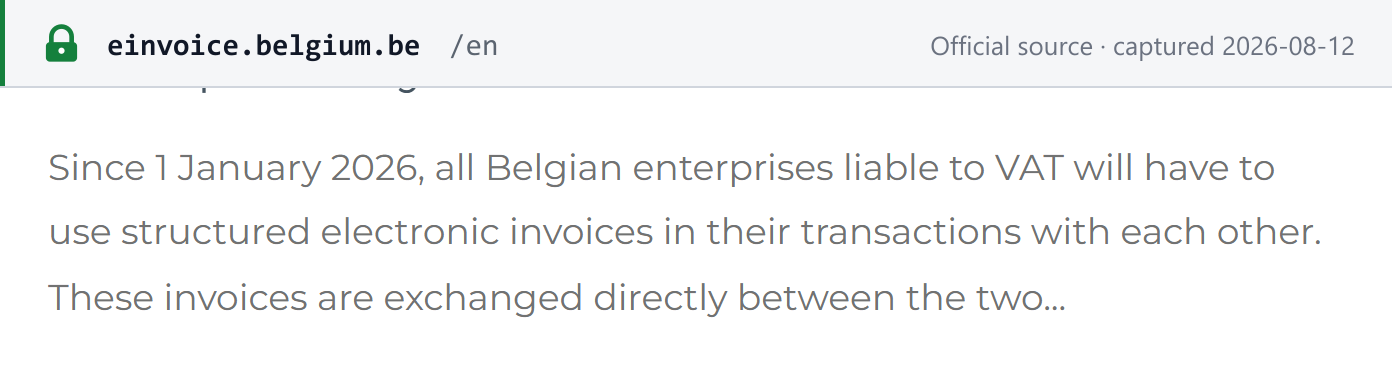 Source snapshot captured 2026-08-12 — original
Two authorities share the system: FPS Finance (FOD Financiën / SPF Finances) administers the mandate and runs the official guidance portal, while FPS BOSA has been the Belgian Peppol Authority since 1 January 2016 and operates the Mercurius platform for invoicing the public sector. (FPS Finance FAQ, checked 2026-08-12)
Belgium's model is decentralised interchange, not clearance: invoices travel directly between the parties' access points over the Peppol network. No government platform validates, stamps, or clears domestic B2B invoices, and the official portal publishes no QR-code, hash, or cryptographic-stamp requirement — those concepts are not applicable to the Belgian system.
Mandate status & timeline
| Phase | Who / what | Mandatory from | Legal basis |
|---|---|---|---|
| B2G — large contracts | Suppliers on public contracts ≥ the EU procurement threshold (EUR 215,000 at the time) | Tenders published on/after 1 November 2022 | Royal Decree of 9 March 2022 [1] |
| B2G — medium contracts | Public contracts ≥ EUR 30,000 | Tenders published on/after 1 May 2023 | Royal Decree of 9 March 2022 [1] |
| B2G — small contracts | Public contracts < EUR 30,000 (contracts ≤ EUR 3,000 excl. VAT stay exempt) | 1 March 2024 (postponed from 1 November 2023) | Royal Decree of 9 March 2022, as amended [1] |
| B2B — domestic | All Belgian VAT-liable enterprises, sending and receiving | 1 January 2026 | Law of 6 February 2024 [2] |
| B2B — enforcement | Conditional penalty tolerance for the first three months of 2026 only (see below); the window closes 31 March 2026 | tolerance ends 31 March 2026 | FPS Finance tolerance notice [3] |
| Self-billing tolerance | Self-billed invoices may be drawn up flexibly where the software vendor is still implementing the functionality | until 30 June 2026 | FPS Finance FAQ [4] |
| E-reporting (proposed) | Near-real-time transactional reporting between Belgian VAT-liable businesses; replaces the annual client listing | 1 January 2028 (draft law approved by the Council of Ministers 18 July 2026 — not yet enacted) | FPS Finance FAQ [5] · Council of Ministers, 18 July 2026 |
The Q1 2026 tolerance was conditional, not a postponement: FPS Finance stated it would "show tolerance during the first three months of 2026" for enterprises lacking the technical means, provided they could show steps taken "in a timely and reasonable manner" — and "under no circumstances will we grant a general postponement." (tolerance notice, checked 2026-08-12)
Legal basis
- Law of 6 February 2024 (Belgisch Staatsblad 20 February 2024, numac 2024001635) — inserts art. 53 §2bis into the VAT Code and defines the structured electronic invoice by reference to EN 16931-1 and CEN/TS 16931-2: "an electronic invoice drawn up, sent and received in a structured electronic form enabling its automatic and electronic processing". [2]
- Royal Decree of 8 July 2025 (BS 14 July 2025, numac 2025005169) — inserts the technical requirements on semantics, syntax and transmission into Royal Decree No. 1 (new art. 13ter) and the fine scale into Royal Decree No. 44; in force 1 January 2026. [6]
- Law of 10 February 2026 (diverse VAT provisions) — fine-tunes the e-invoicing scope, including the art. 53 §2bis references for non-established taxable persons; FPS Finance commentary in Circulaire 2026/C/43. (Instrument identified; the Fisconetplus permalink is search-driven — search "2026/C/43" on Fisconetplus.)
- B2G: Royal Decree of 9 March 2022 (BS 31 March 2022, numac 2022020506). [1]
The Law of 6 February 2024 made the mandate's entry into force subject to EU Council authorisation under art. 395 of the VAT Directive; the mandate is in force, but the implementing decision's number is not stated on the FPS portal — cite the law itself as the operative basis.
Retention of structured e-invoices. A structured e-invoice is still an invoice for VAT Code art. 60 §3 purposes: it must be kept for seven years from 1 January of the year after issue. Art. 97 of the Law of 18 December 2025 (BS 30 December 2025, numac 2025009647) restored this seven-year period retroactively from 1 January 2023, reversing the ten-year period the Law of 20 November 2022 had set. See Lookuptax's Belgium country guide, Retention and audit trail for the full rule.
Scope
Must issue AND receive structured electronic invoices from 1 January 2026: every enterprise with an active Belgian VAT number transacting domestically with another Belgian VAT-liable business — expressly including:
- businesses in the small-enterprise exemption scheme (annual turnover ≤ EUR 25,000): "The obligation applies if you make use of the exemption scheme for small businesses" (FPS Finance FAQ, checked 2026-08-12);
- taxable persons under the special agricultural scheme — "at least for receiving B2B invoices" (same FAQ).
Excluded from issuing: bankrupt taxable persons; businesses performing only art. 44 VAT Code exempt transactions; taxable persons not established in Belgium without a fixed establishment; flat-rate-scheme taxpayers (art. 56 VAT Code). (FPS Finance, checked 2026-08-12)
Excluded from receiving: only art. 44-exempt-only businesses and non-established taxable persons without a fixed establishment (same source).
B2C is out of scope — the obligation does not apply to invoices to private customers. Credit and debit notes are in scope: any document amending a structured e-invoice is itself a structured e-invoice and travels via Peppol, and simplified invoices must also go "(at minimum) via the Peppol BIS format". (FPS Finance FAQ, checked 2026-08-12)
Format & network
- Network: "Structured electronic invoices will be sent via a decentralised network called Peppol." (FPS Finance, checked 2026-08-12) — a 4-corner interchange between the parties' access points; no central clearance.
- Format: participants must at minimum be able to receive Peppol BIS — "an application of the standard EN 16931" (Peppol FAQ); the profile is Peppol BIS Billing 3.0 (corroborated by the European Commission country factsheet).
- Alternative formats: parties may agree on another structured format instead of Peppol BIS, but only by mutual agreement and only if it complies with the European semantic standard (EN 16931-1 / CEN/TS 16931-2 per the law's definition).
- B2G: the public sector receives via Mercurius, FPS BOSA's central "mailroom", fully Peppol-aligned, with a web portal for manual submission and track-and-trace. (FPS BOSA, checked 2026-08-12)
- Peppol participant IDs for Belgian businesses use the KBO/BCE enterprise number — see how to verify a Belgian enterprise number.
Onboarding: how to comply
- Check whether you're in scope with the official self-check tool at einvoice.belgium.be/en/tool.
- Pick compliant software or a Peppol service provider. FPS Finance publishes a guide list of compliant software — send-only, send + receive, and full-processing tiers — on the software solutions page; the certified access-point register lives on peppol.org. There is no government registration step for B2B — connecting via a Peppol access point is the whole onboarding.
- Claim the tax incentive if you qualify: small SMEs and the self-employed using subscription invoicing packages may deduct 120% of those costs for the 2024–2027 taxable periods (art. 64ter WIB92; FPS commentary in Circulaire 2026/C/46). (FPS Finance, checked 2026-08-12)
BOSA's transitional Hermes bridge (which converted Peppol invoices to PDF-by-email for unequipped receivers) has been wound down in favour of market solutions; its official pages are no longer online, so rely on the software list above rather than Hermes.
Penalties
Royal Decree of 8 July 2025 inserted a non-proportional fine scale into Royal Decree No. 44 for not possessing the technical means to issue and receive structured electronic invoices, applicable from 1 January 2026 (enforced from 1 April 2026 after the Q1 tolerance):
| Infringement | Fine |
|---|---|
| First | EUR 1,500 |
| Second | EUR 3,000 |
| Third and subsequent | EUR 5,000 |
An infringement only counts as a second or subsequent one when it is established at least three months after the previous one — verbatim from the decree: "een inbreuk slechts als een tweede of volgende inbreuk kan worden beschouwd, wanneer deze inbreuk door de administratie is vastgesteld ten vroegste drie maanden nadat de vorige inbreuk [werd vastgesteld]". [6] Whether ordinary proportional VAT fines can stack on top for related invoicing offences is not stated in the fine-scale text itself — check the amended Royal Decree No. 44 annex before relying on the fixed scale being the only exposure.
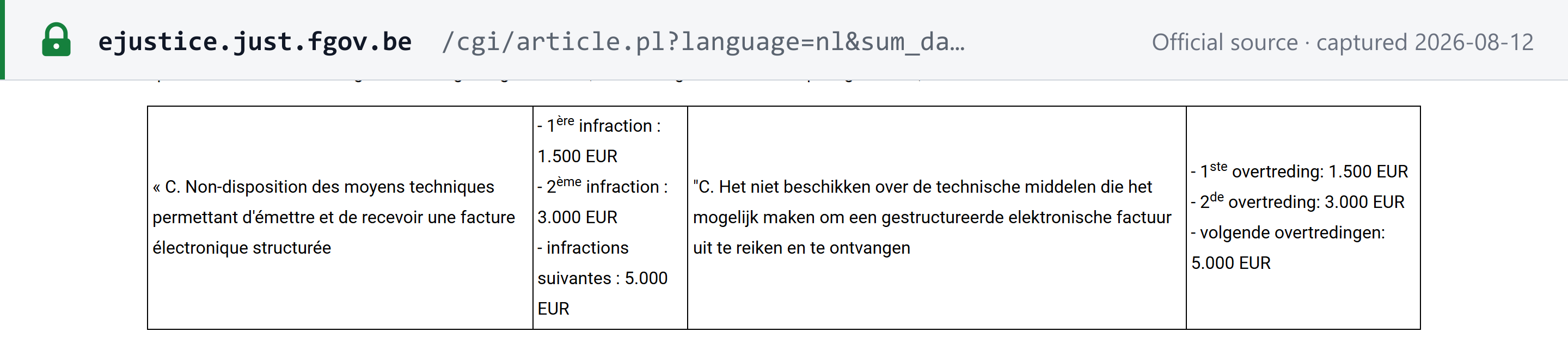 Source snapshot captured 2026-08-12 — original
Frequently asked questions
Does the Belgian B2B e-invoicing mandate apply to small businesses under the VAT exemption scheme?
Yes. Businesses using the small-enterprise exemption scheme (annual turnover up to EUR 25,000) are expressly in scope — the FPS Finance FAQ states "the obligation applies if you make use of the exemption scheme for small businesses". Only bankrupt businesses, art. 44-exempt-only businesses, non-established businesses without a Belgian fixed establishment, and flat-rate (art. 56) taxpayers are excluded from issuing. (FPS Finance, checked 2026-08-12)
Can we keep exchanging PDF invoices if both parties agree?
No. Between Belgian VAT-liable businesses, only a structured electronic invoice is a valid invoice from 1 January 2026. Parties may agree on a structured format other than Peppol BIS, but it must comply with the European semantic standard (EN 16931) — a PDF does not qualify. (FPS Finance, checked 2026-08-12)
What fines apply if we cannot send or receive structured e-invoices?
EUR 1,500 for the first established infringement, EUR 3,000 for the second, and EUR 5,000 for the third and subsequent ones, with a minimum of three months between established infringements (Royal Decree of 8 July 2025, in force 1 January 2026; enforced from 1 April 2026 after the Q1 tolerance window). (Belgisch Staatsblad numac 2025005169, checked 2026-08-12)
What is changing in 2028?
A preliminary draft law approved by the Council of Ministers on 18 July 2026 would add mandatory near-real-time electronic reporting of invoice data between Belgian VAT-liable businesses from 1 January 2028 and abolish the annual client listing. It is a draft — it still has to be enacted — and the reporting architecture has not been officially specified yet. (FPS Finance e-reporting FAQ; Belgian Council of Ministers, 18 July 2026)
Recent changes
- 2025-12-30 — The Law of 18 December 2025 (art. 97) restores the seven-year invoice retention period (VAT Code art. 60 §3), retroactively from 1 January 2023, reversing the ten-year period set by the Law of 20 November 2022; this also governs how long a structured e-invoice must be kept. (SPF Finances — Fisconetplus) — see event · issue
- 2026-07-18 — Council of Ministers approved a preliminary draft law introducing mandatory near-real-time e-reporting of invoice data from 1 January 2028, replacing the annual client listing. (Belgian Federal Government) — see issue
- 2026-01-01 — Mandatory structured B2B e-invoicing via Peppol in force for all Belgian VAT-liable enterprises; Q1 2026 penalty tolerance ended 31 March 2026. (FPS Finance)
Related resources
- E-invoicing status and networks worldwide — Belgium row in global context
- Peppol network explainer
- Belgium tax identification numbers
- How to verify a Belgian VAT number
- How to verify a Belgian enterprise number (KBO/BCE)
- Belgium tax-change chronology — every tracked Belgian change, dated and sourced
- Validate a Belgian VAT number
Important websites
- einvoice.belgium.be — official FPS Finance e-invoicing portal (scope tool, software list, news)
- efactuur.belgium.be FAQ — the authoritative FAQ set (NL/FR)
- Mercurius (FPS BOSA) — B2G invoicing platform
- Peppol-certified service providers — OpenPeppol register