E-invoicing in Bolivia: SIN's Sistema de Facturación and the online modalities
Overview
In Bolivia the tax authority itself validates each online invoice in real time, under the Sistema de Facturación, rather than routing invoices through an exchange network. Which taxpayers must invoice online is decided by resolution, group by group, and the last four groups' deadlines were withdrawn on 30 September 2026.
Bolivia's invoicing regime is the Sistema de Facturación (Invoicing System). It is regulated by Resolución Normativa de Directorio (RND) N° 102100000011 of 11 August 2021, in force from 1 December 2021. It applies to "todos los Sujetos Pasivos del IVA y/o sus Terceros Responsables" (all IVA taxpayers and their responsible third parties). It replaced the 2016 Sistema de Facturación Virtual (SFV, RND 10-0021-16), which it abrogated. (SIN — RND 102100000011, arts. 1–2 and final provisions, checked 2026-10-07)
Who runs it. The Servicio de Impuestos Nacionales (SIN), the national tax service. Taxpayers work through SIAT (SIAT en línea), SIN's online tax system, and SIN publishes the technical rules in its Anexo Técnico at siatinfo.impuestos.gob.bo.
Legal basis in one line. Article 13 of Ley 843 lets the tax administration regulate how invoices are issued, and SIN issues its RNDs under article 64 of the Código Tributario (Ley 2492). The instrument list is under Legal basis.
Six modalities, three of them online. RND 102100000011 defines six ways to issue a fiscal document. The three online ones send every document to SIN for validation.
| Modality | Article | How the document is authenticated |
|---|---|---|
| Electrónica en Línea | art. 7 | XML with a digital signature, from an authorised own or provider invoicing system. SIN also provides a single-version desktop system, which may not be used for mass issuance |
| Computarizada en Línea | art. 8 | XML with a hash ("huella digital") and the taxpayer's credentials, from an authorised own, provider or SIN-provided system |
| Portal Web en Línea | art. 9 | SIN's own web portal, open to every IVA taxpayer by subscription; also usable exceptionally as a contingency channel for the other online modalities |
| Manual | art. 4 | Pre-printed by an authorised printer and completed by hand |
| Prevalorada | art. 5 | Price pre-printed, for mass-consumption and fixed-price sales; pre-printed or issued online through an online system |
| Computarizada (SFV) | art. 6 | Transitional modality carried over from the SFV. SIN no longer assigns it to new users |
(SIN — RND 102100000011, arts. 4–9; SIN Anexo Técnico — Computarizada SFV, checked 2026-10-07)
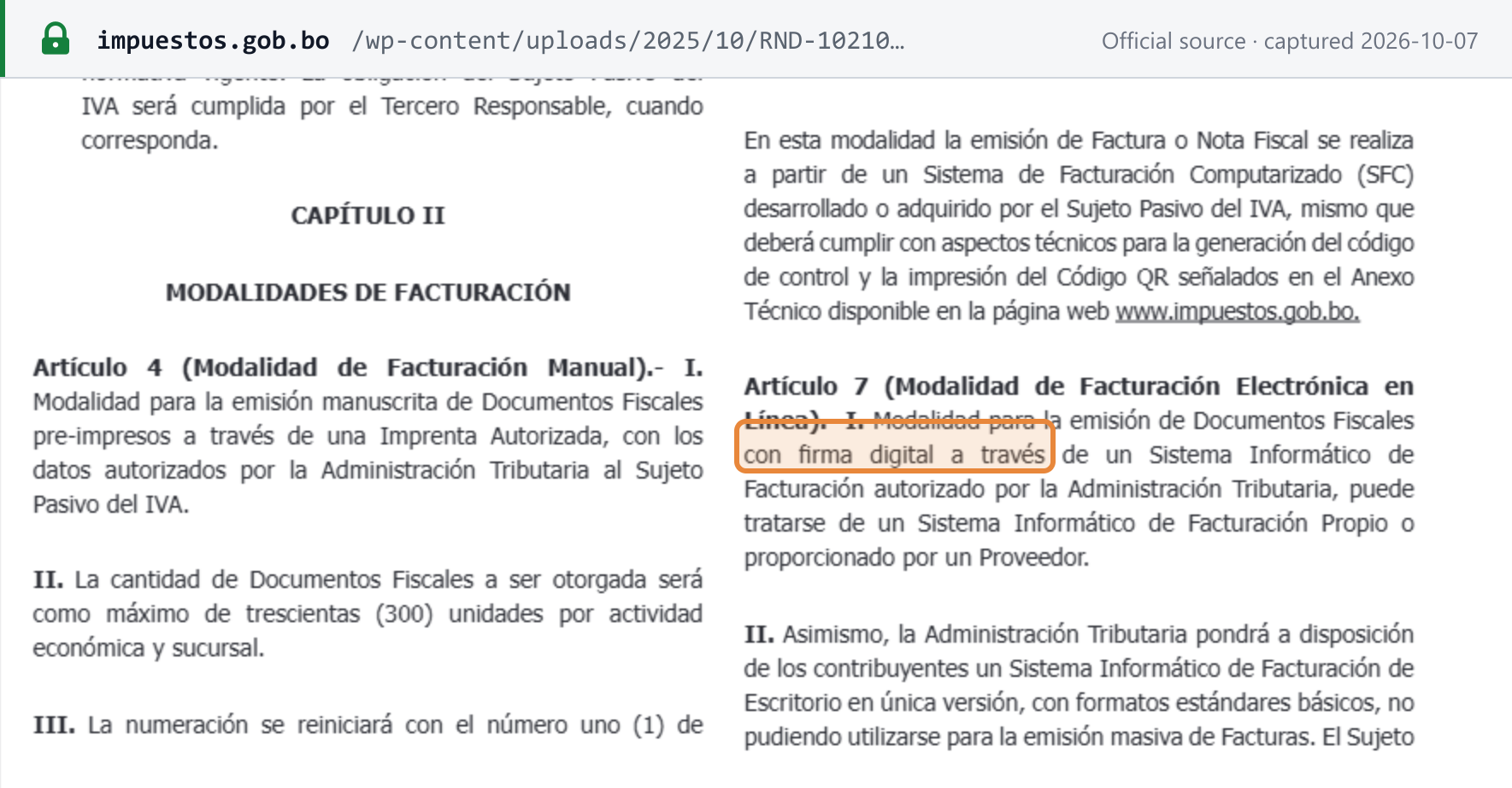 Source snapshot captured 2026-10-07 — original
| Bolivia | |
|---|---|
| Status | Online invoicing is mandatory for each taxpayer SIN designates by RND. Groups 1–8 were designated from 1 December 2021 to 1 October 2024. The Group 9–12 designations were abrogated on 30 September 2026; SIN will assign online modalities periodically (as at 2026-10-07, no new assignment calendar has been published) |
| B2B / B2C / B2G | Not separated. Every sale by an IVA taxpayer is invoiced in the modality that taxpayer is assigned |
| Non-residents | An authorised invoicing system requires a fiscal domicile in Bolivia. Foreign buyers without a NIT are invoiced to NIT/CI 99001 |
| Format | National XML schema per documento sector (sector document), not UBL or CII |
| Network | SIN real-time validation over SOAP web services, or the Portal Web provided by SIN. Not Peppol-based |
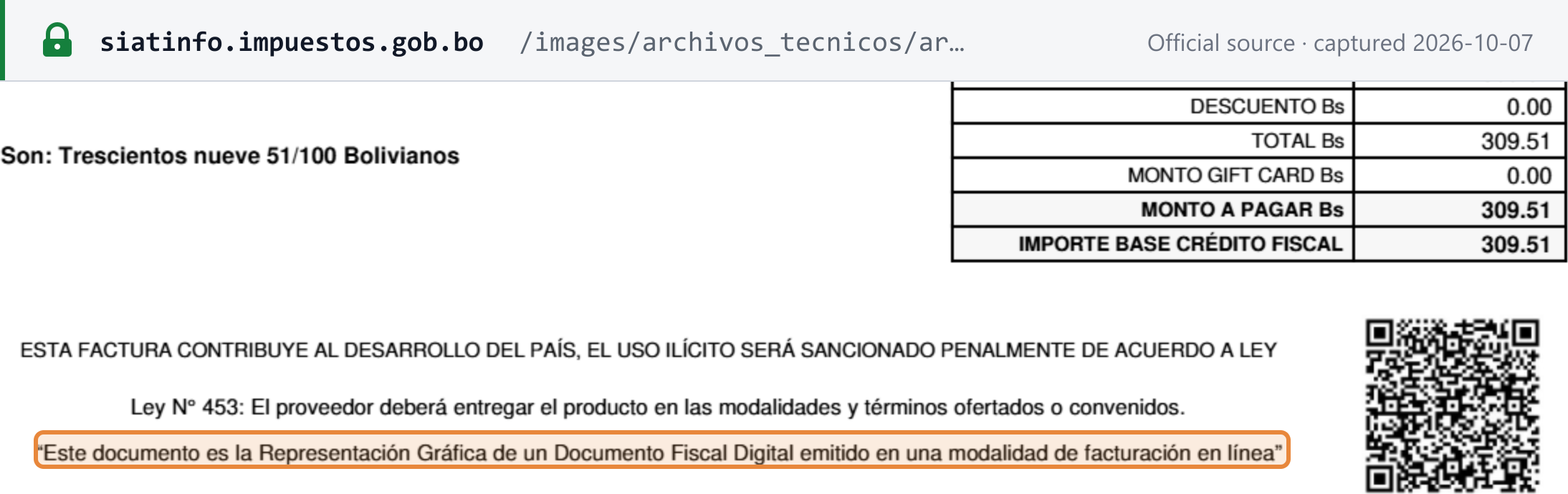
| Integrity | Digital signature (Electrónica en Línea) or hash (Computarizada en Línea); CUF per invoice; QR code on the graphic representation |
| Next dates | Product homologation with RNC activities due 30 October 2026; Ley 1733 pilot testing and re-authorisation of invoicing systems: window opened 1 October 2026 and runs until 16 November 2026 |
| Authority | Servicio de Impuestos Nacionales (SIN) · SIAT |
| Legislation | Ley 843 art. 13; Ley 2492 (Código Tributario); RND 102100000011 as amended; RND 102600000038; RND 102600000034 |
Mandate status & timeline
How the obligation works: designation by resolution, not a turnover threshold
Article 10.I of RND 102100000011 says SIN "establecerá periódicamente, mediante Resolución Normativa de Directorio, la obligatoriedad de uso de las modalidades de facturación en línea" (will periodically establish, by RND, the obligation to use the online modalities). Its criteria are economic activity, number of activities, invoicing volume, tax-compliance behaviour, total invoiced amount, and e-commerce and related services. The instrument sets no turnover threshold. SIN designated taxpayers by name and NIT in an annex to each designation RND.
Two rules in the same article:
- A transitional paragraph, written for the regime's entry into force in 2021, let taxpayers stay in their current authorised modality "hasta que la Administración Tributaria les asigne expresamente una nueva modalidad de facturación" (until the tax administration expressly assigns them a new one).
- A taxpayer that has passed the test stages may move to an online modality voluntarily (art. 10.III).
Issuing in a modality other than the one you are obliged to use is a listed breach (art. 67, item 9). See Penalties. (SIN — RND 102100000011, arts. 10 and 67, checked 2026-10-07)
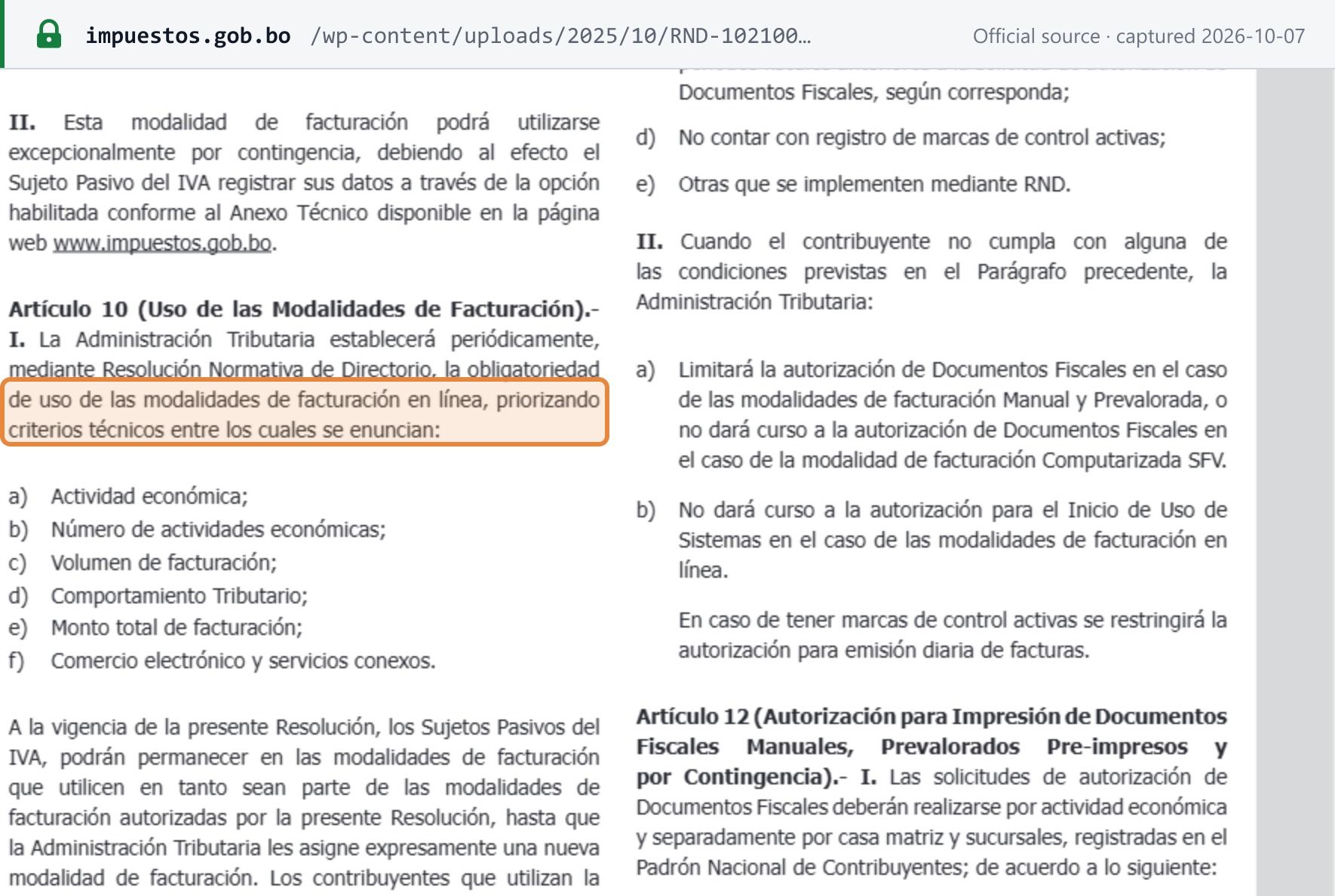 Source snapshot captured 2026-10-07 — original
To see which online modality, if any, SIN has assigned to a NIT, use SIN's Consulta Modalidad en Línea Asignada.
The designated groups
Each designation RND names its taxpayers in an annex and sets the date from which they must issue Documentos Fiscales Digitales in their assigned online modality. The dates below are those set in each designation RND. SIN later issued transitional RNDs for most groups that relaxed the first months of implementation.
| Group | Designation RND | Date of RND | Start date set in the RND | Status at 2026-10-07 |
|---|---|---|---|---|
| 1st | RND 102100000012 [1] | 11 Aug 2021 | 1 Dec 2021 | Passed |
| Gaming operators (Electrónica en Línea) | RND 102100000013 [2] | 27 Aug 2021 | 1 Dec 2021 | Passed |
| 2nd | RND 102100000019 [3] | 14 Oct 2021 | 1 Apr 2022 | Passed |
| 3rd | RND 102200000010 [4] | 18 May 2022 | 1 Oct 2022 | Passed |
| 4th | RND 102200000024 [5] | 10 Nov 2022 | 1 Apr 2023 | Passed |
| 5th | RND 102300000019 [6] | 27 Jun 2023 | 1 Aug 2023 | Passed |
| 6th | RND 102300000020 [7] | 30 Jun 2023 | 1 Sep 2023 | Passed |
| 7th | RND 102400000002 [8] | 5 Jan 2024 | 1 Jul 2024 | Passed |
| 8th | RND 102400000003 [9] | 9 Jan 2024 | 1 Oct 2024 | Passed |
| 9th | RND 102400000004 [10] | 9 Jan 2024 | 1 Dec 2024 | Designation abrogated 30 Sep 2026 |
| 10th | RND 102400000005 [11] | 9 Jan 2024 | 1 Feb 2025 | Designation abrogated 30 Sep 2026 |
| 11th | RND 102400000012 [12] | 19 Apr 2024 | 1 Feb 2025 (definitive date per taxpayer in the annex on SIAT) | Designation abrogated 30 Sep 2026 |
| 12th | RND 102400000025 [13] | 11 Oct 2024 | 1 Mar 2025 (definitive date per taxpayer in the annex on SIAT) | Designation abrogated 30 Sep 2026 |
RND dates as listed on SIN's RND index pages (2021, 2022, 2023, 2024; checked 2026-10-07). Group 1–8 designations are untouched by the 2026 abrogation.
The first group's rule reads: "deberán adecuar e implementar sus Sistemas Informáticos de Facturación a efecto que desde el 1 de diciembre de 2021 emitan Documentos Fiscales Digitales a través de la modalidad de facturación en línea asignada." (They must adapt and implement their invoicing systems so that from 1 December 2021 they issue digital fiscal documents through the assigned online modality.) For the first month, RND 102100000023 let those 2021 designees keep issuing in the SFV or Manual modality they used before. (RND 102100000012; RND 102100000023, checked 2026-10-07)
Groups 9 to 12: extended twice, then abrogated
Groups 9–12 never reached an online-only date:
| Instrument | Date | What it did |
|---|---|---|
| RND 102500000036 | 11 Sep 2025 | Let Groups 9–12 issue in the assigned online modality "y/o" (and/or) their existing modality until 31 March 2026 |
| RND 102600000007 | 23 Mar 2026 | Extended that dual window to 30 September 2026, with online-only issuance from 1 October 2026 |
| RND 102600000038 | 30 Sep 2026 (published the same day) | Abrogated the four Group 9–12 designation RNDs "y sus modificaciones" (and their amendments), so the 1 October 2026 online-only date never applied |
(RND 102500000036; RND 102600000007; RND 102600000038; dates from the SIN 2026 RND index, checked 2026-10-07)
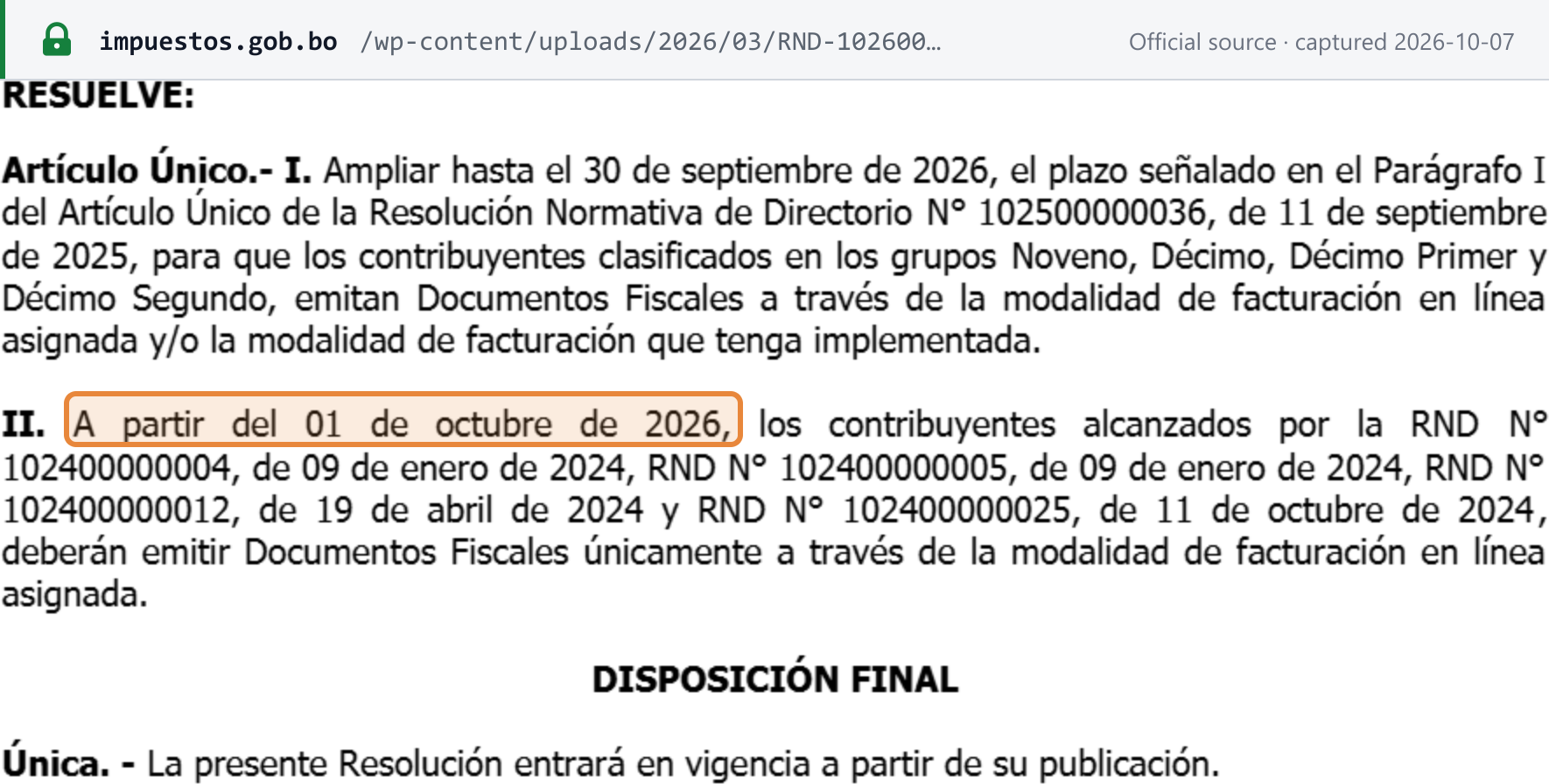 Source snapshot captured 2026-10-07 — original
The current rule. RND 102600000038 replaces the group calendar with a general statement: SIN "asignará periódicamente una modalidad de facturación en línea a aquellos contribuyentes sujetos pasivos del IVA que, a la fecha de publicación de la presente Resolución Normativa de Directorio, aún no hayan implementado ninguna modalidad en línea." (will periodically assign an online invoicing modality to IVA taxpayers that, at the date of publication of this RND, have not yet implemented any online modality.) Its stated reason is to apply Ley 1733, which computes IVA on the net price and shows it separately on the invoice, in an automated, uniform and verifiable way. The RND sets no new date or criteria beyond those in article 10 of RND 102100000011. As at 2026-10-07, the SIN 2026 RND index lists no later invoicing resolution. (SIN — RND 102600000038, checked 2026-10-07)
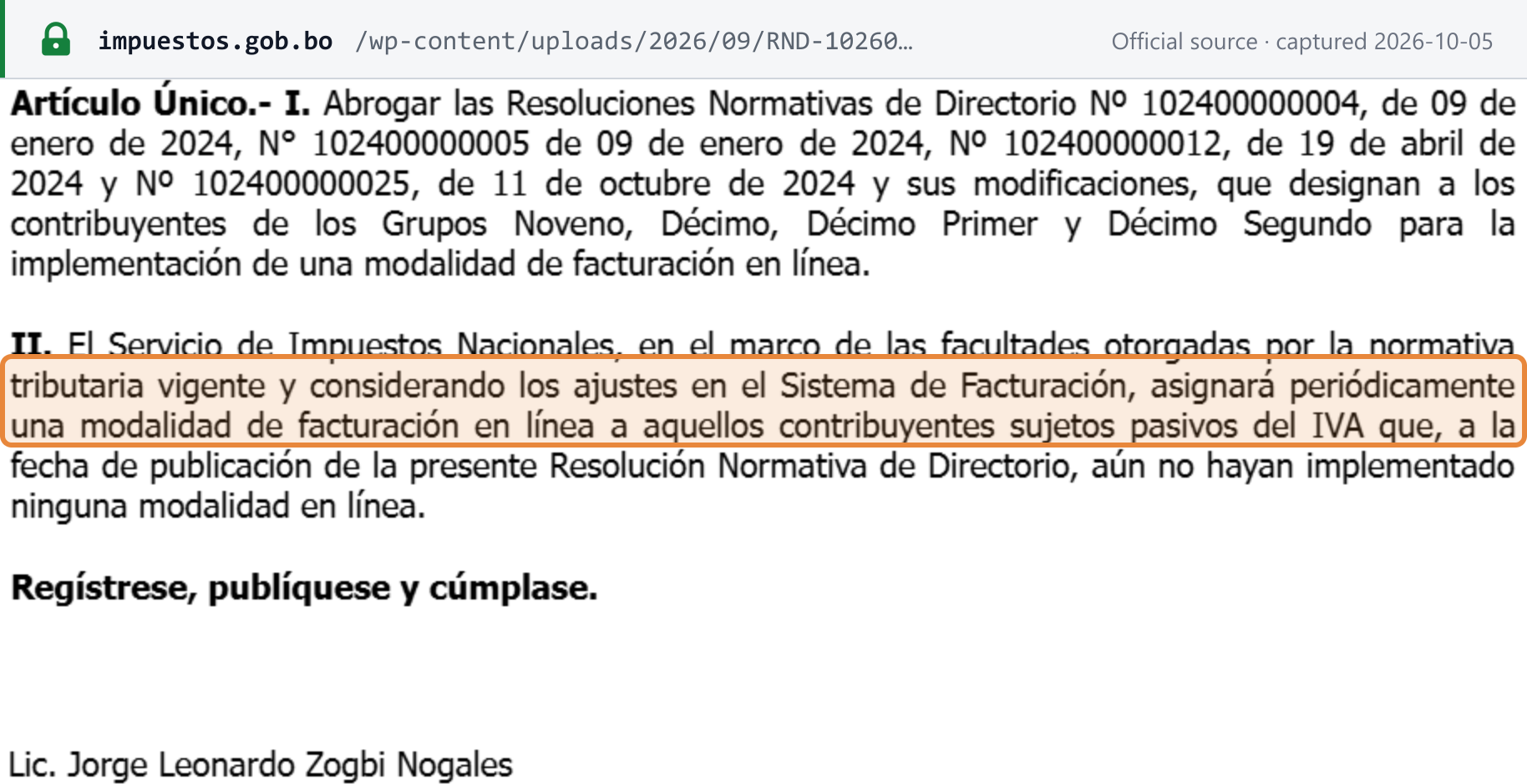 Source snapshot captured 2026-10-05 — original
What this means if you are not yet online
- You were in Groups 9–12 and had not moved online. Your designation no longer exists, so the 1 October 2026 online-only date does not apply. RND 102600000038 does not say which modality these taxpayers use in the meantime; it says only that SIN will assign an online modality periodically. Article 10 of RND 102100000011 describes the same pattern for 2021: taxpayers kept their authorised modality until SIN expressly assigned a new one.
- You were in Groups 9–12 and already issue online. Nothing in RND 102600000038 sends you back. RND 102600000038 targets only taxpayers that "aún no hayan implementado ninguna modalidad en línea" (have not yet implemented any online modality).
- You were in Groups 1–8. Your designation stands.
- Check your assignment on SIN's Consulta Modalidad en Línea Asignada before planning around any date.
Whatever your modality, the Ley 1733 re-authorisation window below applies to every own or provider invoicing system.
Ley 1733: re-authorisation of invoicing systems, 1 October – 16 November 2026
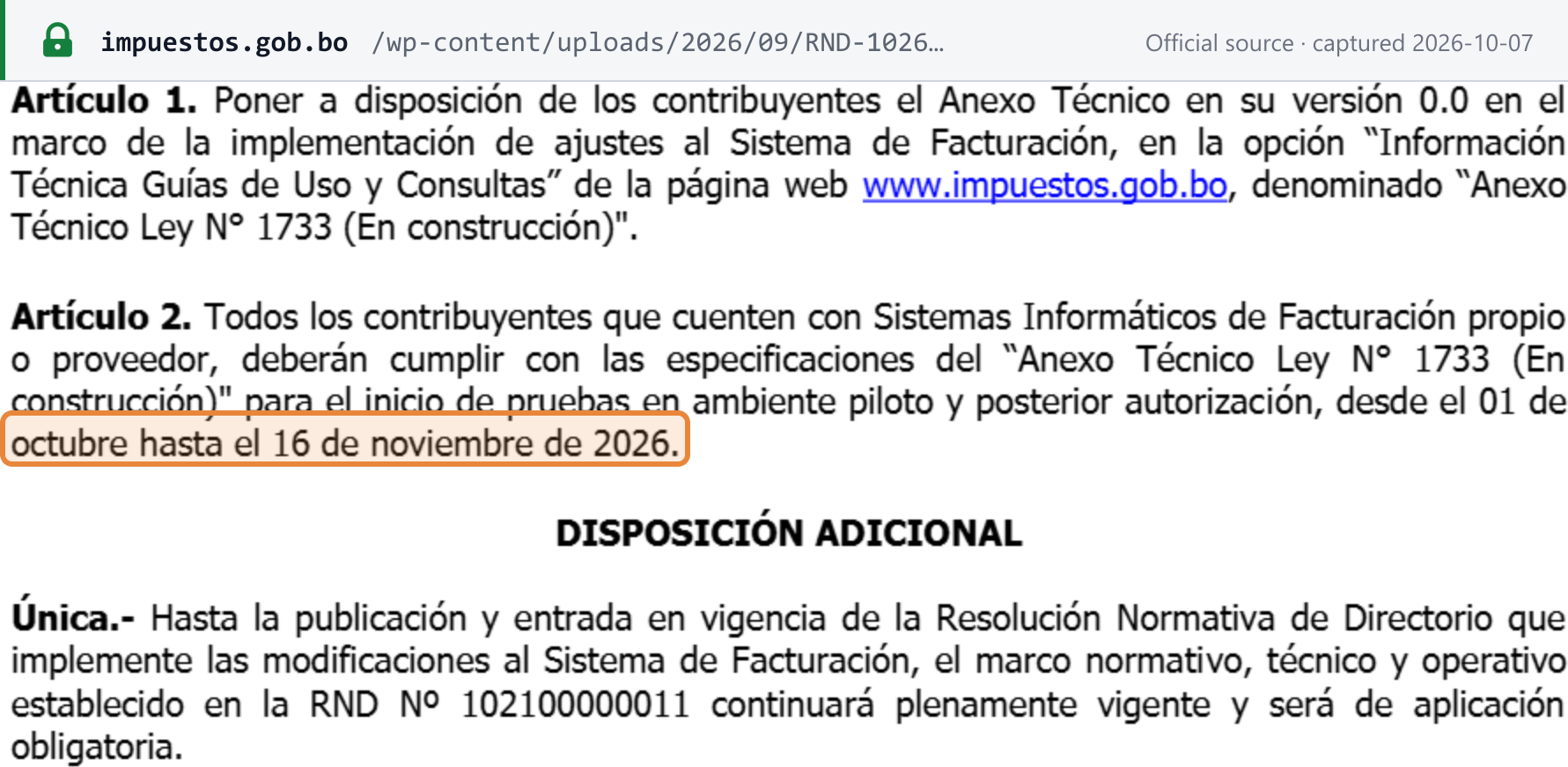
RND 102600000034, dated 1 September 2026 and published 2 September 2026, publishes the Anexo Técnico Ley N° 1733 (En construcción), version 0.0. Its article 2 reads: "Todos los contribuyentes que cuenten con Sistemas Informáticos de Facturación propio o proveedor, deberán cumplir con las especificaciones del 'Anexo Técnico Ley N° 1733 (En construcción)' para el inicio de pruebas en ambiente piloto y posterior autorización, desde el 01 de octubre hasta el 16 de noviembre de 2026." (All taxpayers with an own or provider invoicing system must meet the Anexo Técnico Ley 1733 for pilot testing and later authorisation, from 1 October to 16 November 2026.)
Until the RND that implements the changes is published and in force, RND 102100000011 "continuará plenamente vigente y será de aplicación obligatoria" (remains fully in force and mandatory). The recitals say SIN is preparing new sector formats by type of activity and changes to the authorisation process for own and provider systems. (SIN — RND 102600000034, checked 2026-10-07)
 Source snapshot captured 2026-10-07 — original
The IVA por fuera calculation itself (13% added to the net price) is not yet in force: Ley 1733 makes it effective from the first day of the month after its implementing Decreto Supremo is published. No Decreto Supremo regulating Ley 1733 had been located as at 2026-10-07. See New IVA fields below and the country guide.
Product homologation with RNC activities: due 30 October 2026
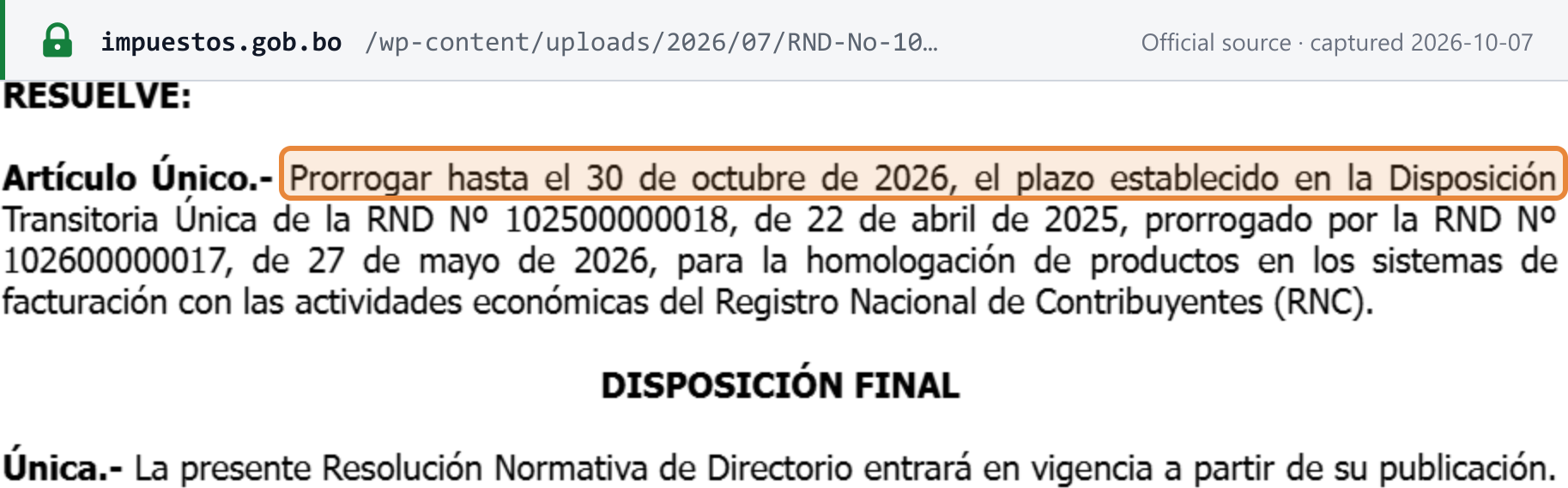
RND 102500000018 (22 April 2025, in force 5 May 2025) approved the RNC classifier of economic activities. Its transitional provision requires IVA taxpayers to update the homologation of the products in their invoicing systems with their activities in the Registro Nacional de Contribuyentes (RNC). Homologation maps each internal product code to a SIN generic product code, which then goes in the XML. Keeping it current is a condition of continued authorisation to generate fiscal documents (RND 102100000011, art. 11).
| Deadline | Set by |
|---|---|
| 31 Oct 2025 | RND 102500000018 |
| 27 Feb 2026 | RND 102500000042 (22 Oct 2025), as recited in RND 102600000004 |
| 29 May 2026 | RND 102600000004 (23 Feb 2026) |
| 31 Jul 2026 | RND 102600000017, art. 1 (27 May 2026) |
| 30 Oct 2026 | RND 102600000028, dated 29 July 2026, published and in force 30 July 2026 |
(RND 102600000028; RND 102600000004; RND 102500000018; SIN Anexo — homologación, checked 2026-10-07)
 Source snapshot captured 2026-10-07 — original
Sector rule: goods transported near borders (from 4 May 2026)
RND 102600000006 (10 March 2026, in force 4 May 2026): purchase invoices shown at border-adjacent inspection points, as support for the internal, interprovincial or interdepartmental transport of goods bought in Bolivia, "deberán estar obligatoriamente emitidas mediante las modalidades de Facturación Electrónica en Línea, Computarizada en Línea o Portal Web en Línea" (must be issued in one of the three online modalities) and registered with SIN. (SIN — RND 102600000006, checked 2026-10-07)
Legal basis
Dates are from each instrument's header and the SIN RND index pages (checked 2026-10-07). SIN's own consolidation list for the regime is RND 102100000011, 102100000017, 102100000021 and 102300000034 (SIN Anexo — Base legal).
| Instrument | Date | In force | Role |
|---|---|---|---|
| Ley 843, arts. 4 and 13 | — | — | Invoice obligation; power to regulate invoicing |
| Ley 2492, Código Tributario, arts. 64, 162, 164, 170 | 2 Aug 2003 | — | RND power; formal-duty fines; closure for non-issuance |
| RND 102100000011 — Sistema de Facturación, with its Anexo Técnico | 11 Aug 2021 | 1 Dec 2021 | Core regime |
| RND 102100000017 | 27 Sep 2021 | — | Amends RND 11 deadlines ("día diez" → "quinto día hábil") |
| RND 102100000021 | 17 Nov 2021 | — | Amends RND 11 deadlines again, to "día nueve (9)" of the following month |
| RND 102300000034 | 1 Dec 2023 | — | Amends art. 38 (reversal of annulment; goods-transport invoices cannot be annulled) |
| RND 102600000012 | 13 Apr 2026 | — | Fuel purchases: 100% of the amount as base for fiscal credit |
| RND 102600000025 | 13 Jul 2026 | On publication, 15 Jul 2026 | Late annulment procedure (art. 38.II) |
| RND 102600000026 | 15 Jul 2026 | On publication, 16 Jul 2026 | Foreign currency: official exchange rate (replaces art. 25.IX) |
| RND 102600000034 | 1 Sep 2026 (published 2 Sep) | — | Anexo Técnico Ley 1733; pilot and re-authorisation window |
| RND 102600000038 | 30 Sep 2026 (published 30 Sep) | — | Abrogates the Group 9–12 designations |
| Ley 1733 (Ley de Alivio Tributario) | 27 May 2026 | IVA por fuera pending its Decreto Supremo | IVA on net price; 4-year prescription; condonation of formal-duty fines |
| Sanctions annex to RND 10-0033-16, as amended by RND 102100000030 (29 Dec 2021) | — | — | Fine schedule for formal duties |
| RND 102500000018 | 22 Apr 2025 | 5 May 2025 | RNC activity classifier; product homologation |
The group designation and extension RNDs are listed under Mandate status & timeline. RND 10-0021-16 (the SFV, 1 July 2016) is abrogated. The Anexo Técnico on siatinfo binds through RND 102100000011, which refers to it throughout.
Scope
B2B, B2C and B2G. RND 102100000011 applies to all IVA taxpayers (art. 2), and article 25 requires a fiscal document for every taxable event. The rules draw no line by buyer type, so B2B, B2C and B2G sales all follow the modality the seller was assigned. Neither RND 102100000011 nor the SIN Anexo Técnico describes a separate public-procurement invoicing channel (checked 2026-10-07). Sales under Bs 5 need no document unless the buyer asks (art. 25).
No separate sales ledger for online issuers. Taxpayers issuing in Electrónica en Línea, Computarizada en Línea or Portal Web en Línea "no tienen la obligación de registrar sus ventas en el 'Registro de Compras y Ventas'" (need not record their sales in the purchases and sales register), because the validated XML already is the record. (SIN — RND 102100000011, checked 2026-10-07)
Residents vs non-established businesses.
- To own or provide an authorised online invoicing system, a person must be in the Régimen General and "debidamente establecido con Domicilio Fiscal en el país" (duly established with a fiscal domicile in Bolivia) (art. 19).
- RND 102100000011 sets out no regime under which a supplier without a Bolivian establishment issues Bolivian fiscal documents (checked 2026-10-07).
- Sales to foreign non-residents, embassies, international organisations and similar buyers not required to register carry NIT/CI 99001 (art. 25.IV).
Exports, free zones and other special cases. Article 35 assigns special sector documents to exports ("Facturas Comerciales de Exportación sin Derecho a Crédito Fiscal"), tourism exports, free zones (zona franca), tasa cero (zero-rated) sales, duty-free, foreign-exchange dealers and national artists. Each sector document has its own XSD; the SIN Anexo Técnico lists 50, including Compra-Venta, Alquiler, Exportación, Zona Franca, Hoteles, Hospitales, Telecomunicaciones, Nota Crédito-Débito and Boleto Aéreo. (SIN — RND 102100000011, art. 35; SIN Anexo Técnico, checked 2026-10-07)
For mandatory invoice content (the Bs 1,000 buyer-identification rule and others), see the country guide's invoice requirements.
Format & network
CTC model: real-time validation by SIN
Bolivia's online modalities are a clearance-style model run by SIN itself. The issuer's system:
- generates the Documento Fiscal Digital in XML;
- sends it to SIN "al momento de la realización de la transacción" (at the moment of the transaction), or in packages for mass issuance, offline issuance and contingency;
- sends the XML and a graphic representation to the buyer's e-mail or another private electronic channel.
SIN validates each document and returns a reception code or a list of errors. "En caso de rechazo del archivo XML, el archivo rechazado no quedará almacenado en la base de datos de la Administración Tributaria." (A rejected XML is not stored in SIN's database.) The XML registered in SIN's database is the document with legal and evidential validity (art. 53). In the Portal Web modality, SIN generates and stores the XML itself. (SIN — RND 102100000011; SIN Anexo — factura electrónica; Portal Web, checked 2026-10-07)
Transport and schema. "Las facturas electrónicas son enviadas a la Administración Tributaria consumiendo servicios SOAP." (E-invoices are sent to SIN through SOAP services.) Connection is over the internet, a dedicated MPLS line or point-to-point fibre. The schema is national, one XSD per sector document, downloadable from the Anexo; the Compra-Venta package is CompraVentaXML.zip. Neither RND 102100000011 nor the SIN Anexo Técnico refers to Peppol, UBL or EN 16931 (checked 2026-10-07). (SIN Anexo — esquemas de conexión, checked 2026-10-07)
Authorisation codes: CUIS, CUFD and CUF
| Code | What it is | Validity |
|---|---|---|
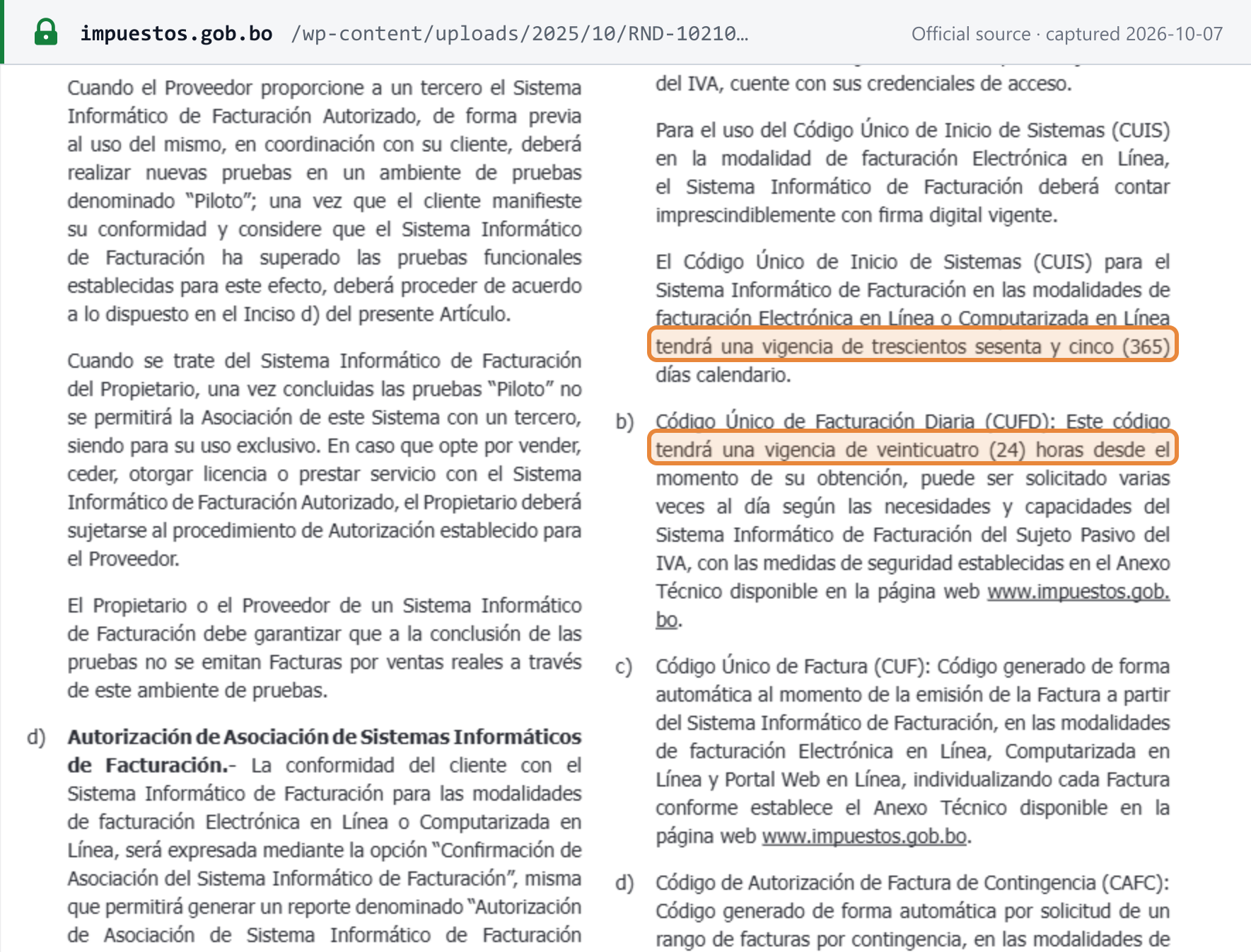
| CUIS — Código Único de Inicio de Sistemas | Ties the invoicing system, credentials, taxpayer, branch and optionally point of sale. Electrónica en Línea needs a valid digital signature to use it | 365 calendar days |
| CUFD — Código Único de Facturación Diaria | Daily code; can be requested several times a day | 24 hours from issue |
| CUF — Código Único de Factura | Generated by the issuer's system for each invoice in the three online modalities | Per invoice |
| CAFC | Range code for contingency invoices | — |
| CAED | Code for pre-printed Manual and Prevalorada documents | — |
(SIN — RND 102100000011, art. 21; SIN Anexo — códigos de autorización, checked 2026-10-07)
 Source snapshot captured 2026-10-07 — original
How the CUF is built. The Anexo concatenates NIT (13 digits), date-time yyyyMMddHHmmssSSS
(17), branch (4), modality (1), emission type (1 = online, 2 = offline, 3 = mass), invoice type
(1), sector document (2), invoice number (10) and point of sale (4), giving 53 digits. A Módulo 11
check digit is added, the string is Base16-encoded, and the CUFD's control code is appended.
(SIN Anexo — generación del CUF, checked 2026-10-07)
Integrity: digital signature vs hash, and the QR code
- Electrónica en Línea — digital signature. Article 52 requires "un certificado digital otorgado y firmado digitalmente por la autoridad competente" (a digital certificate issued by the competent authority). The Anexo names AGETIC and Digicert SRL as certifying entities and requires Base64, canonicalisation, SHA-256 and RSA-SHA256. If the signature is revoked or suspended, the system must not issue signed documents.
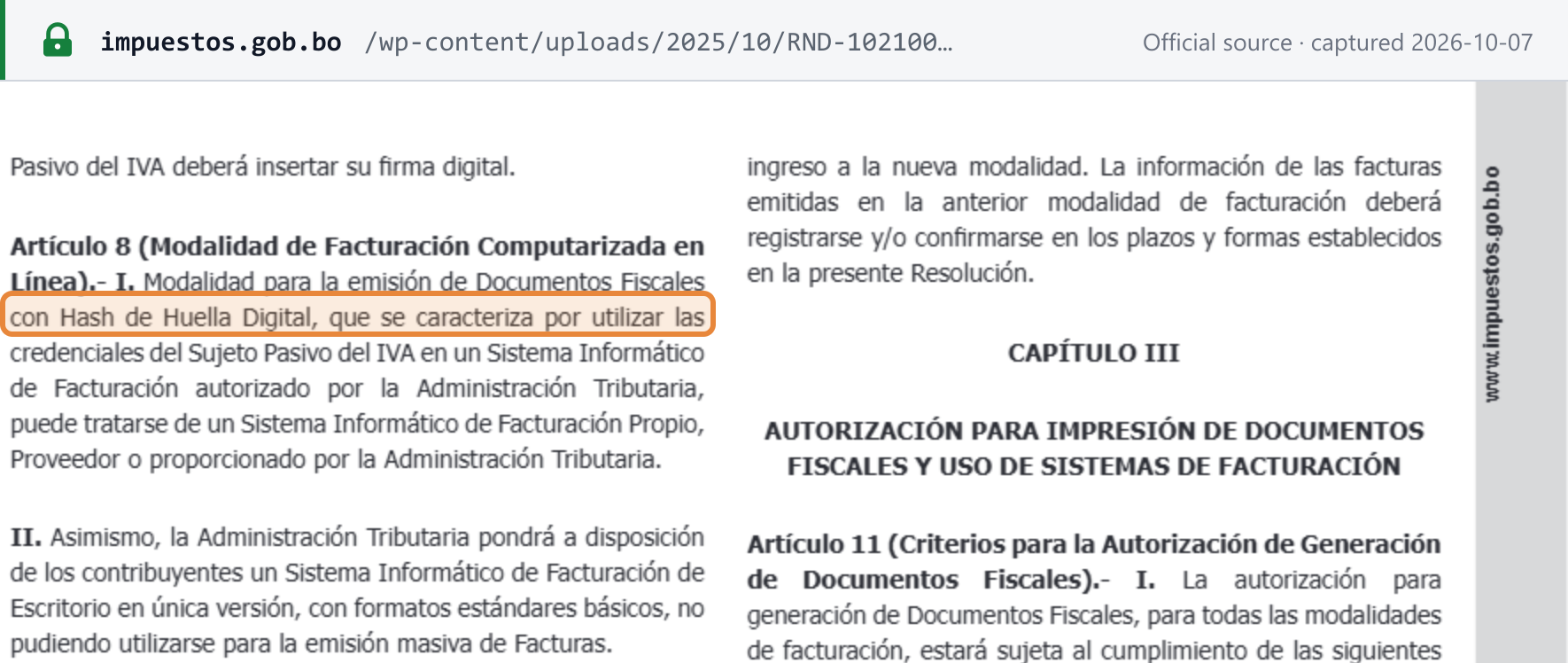
- Computarizada en Línea — hash. Documents carry the XML's huella digital instead of a signature, authenticated with the taxpayer's credentials.
 Source snapshot captured 2026-10-07 — original
- Graphic representation. It must carry the legend "Este documento es la Representación Gráfica de un Documento Fiscal Digital emitido en una modalidad de facturación en línea" and a QR code that links to SIN's verification query (with the NIT, CUF and invoice number). SIN recommends a QR of at least 3 × 3 cm.
- QR sticker. SIN provides online issuers with an "Emite Factura en Línea" QR sticker to display.
(SIN — RND 102100000011, arts. 52 and others; SIN Anexo — firma digital; SIN Anexo — código QR, checked 2026-10-07)
 Source snapshot captured 2026-10-07 — original
Ley 1733 schema changes: IVA shown separately
The Anexo Técnico Ley 1733 describes itself as covering "IVA Transparente". Its Compra-Venta schema
adds header fields subtotalNeto, totalPrecioNeto, iva ("Monto que se obtiene de aplicar el 13%
al Total Precio Neto", the amount obtained by applying 13% to the total net price) and
montoaPagar. The current schema uses montoTotal and montoTotalSujetoIva. The annex is
marked "En construcción" (under construction).
(SIN — Anexo Técnico Ley 1733; Factura de Compra y Venta, checked 2026-10-07)
Offline issuance and contingency
Article 29 lists seven eventos significativos (significant events) and what to do in each:
| Event | What to do |
|---|---|
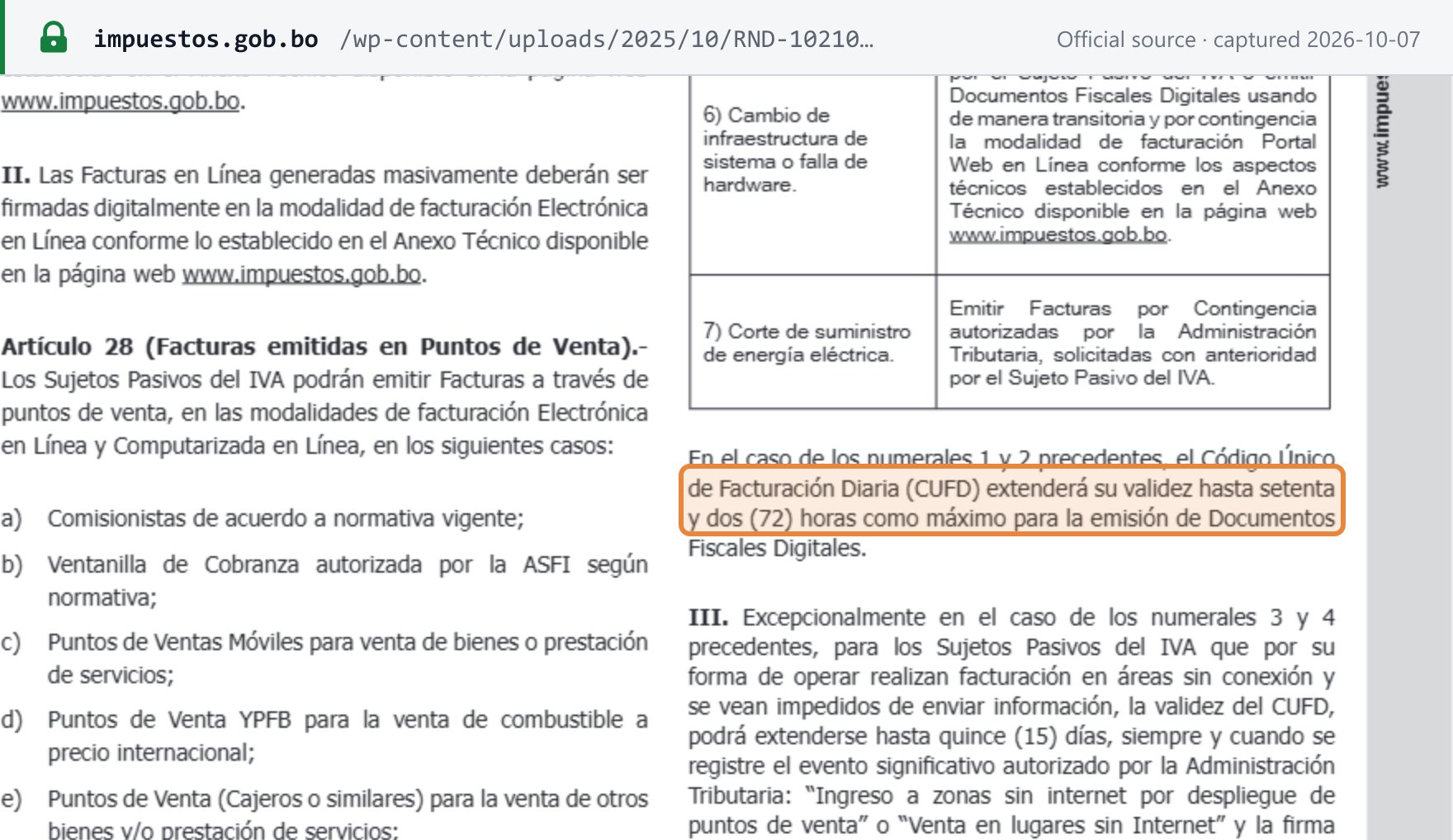
| 1. Internet outage · 2. SIN web service unreachable | Issue digital documents offline. The CUFD stays valid up to 72 hours |
| 3. Mobile points of sale in areas without internet · 4. Sales where there is no internet | Issue offline. With the event authorised by SIN (and, for Electrónica en Línea, a signature that is not revoked), the CUFD can stay valid up to 15 days |
| 5. Virus or software failure · 6. Infrastructure change or hardware failure | Use pre-authorised contingency invoices, or the Portal Web as contingency |
| 7. Power cut | Use pre-authorised contingency invoices only |
Time limits:
- Register the event within 48 hours after the contingency ends.
- Send offline invoices within 48 hours of reconnection.
- Register contingency invoices for online modalities within 72 hours of reconnection.
An offline document goes to the buyer as XML plus graphic representation, or printed, with the legend "Este documento es la Representación Gráfica de un Documento Fiscal Digital emitido fuera de línea, verifique su envío con su proveedor o en la página web www.impuestos.gob.bo". The stock of contingency invoices cannot exceed 10% of the invoices issued in the last reported period. (SIN — RND 102100000011, arts. 29–31; SIN Anexo — contingencia y eventos significativos, checked 2026-10-07)
 Source snapshot captured 2026-10-07 — original
Annulment, foreign currency and fuel purchases
The current rules, as amended:
- Annulment. A registered online document can be annulled up to day 9 of the following month, only where the operation did not take place. RND 102100000011 originally said day 10; RND 102100000017 changed it to the fifth working day and RND 102100000021 to "día nueve (9)". (RND 102100000021, checked 2026-10-07)
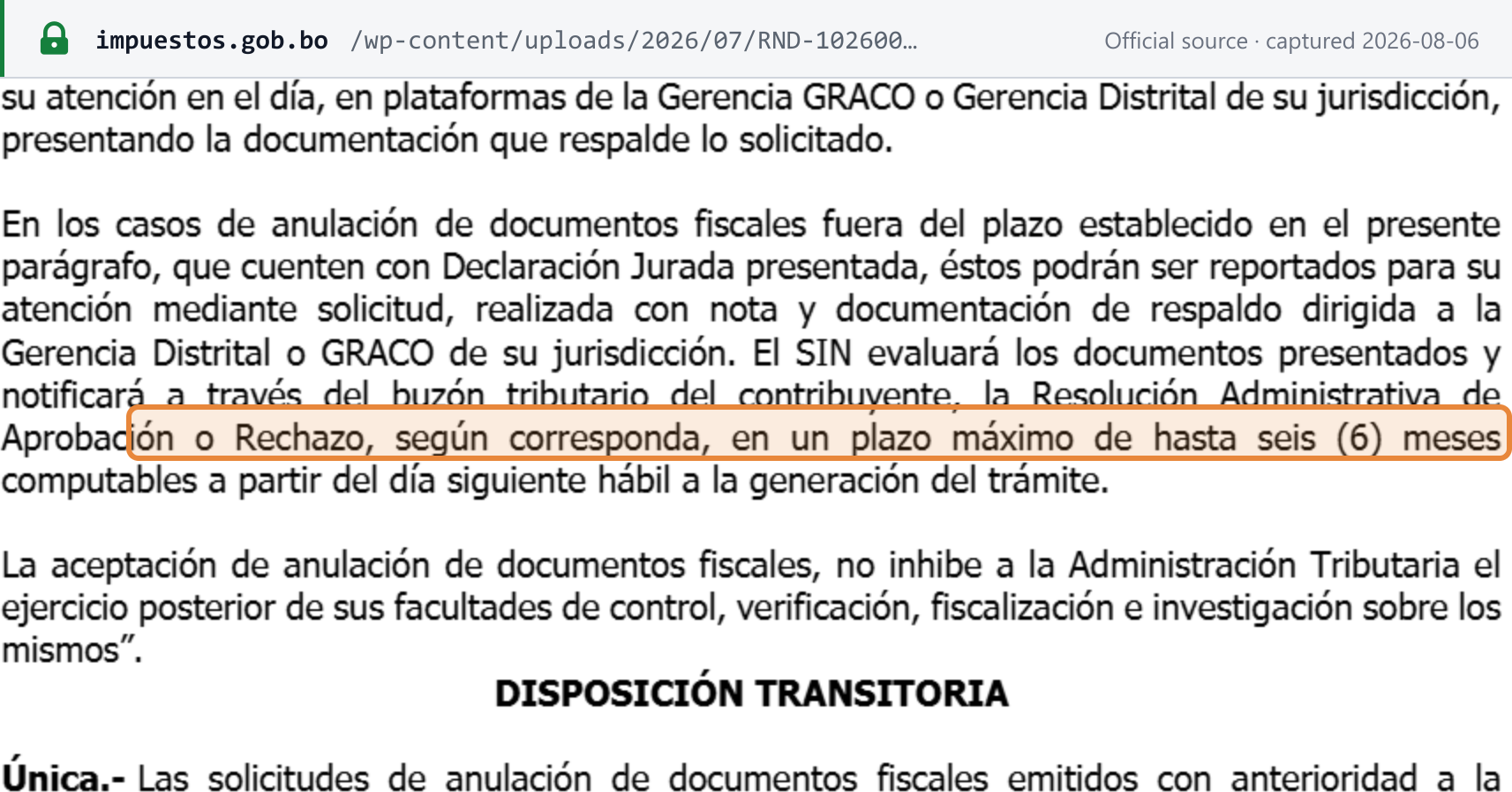
- Late annulment. Since 15 July 2026 (RND 102600000025, dated 13 July, in force on publication), a taxpayer can ask SIN to annul a document after that deadline. Where the document has already been included in a filed tax return (DDJJ), SIN resolves "en un plazo máximo de hasta seis (6) meses" (within six months at most); otherwise the request is dealt with the same day at the taxpayer's GRACO or district office. Documents issued earlier can use the procedure until 30 November 2026. (RND 102600000025, checked 2026-10-07)
 Source snapshot captured 2026-08-06 — original
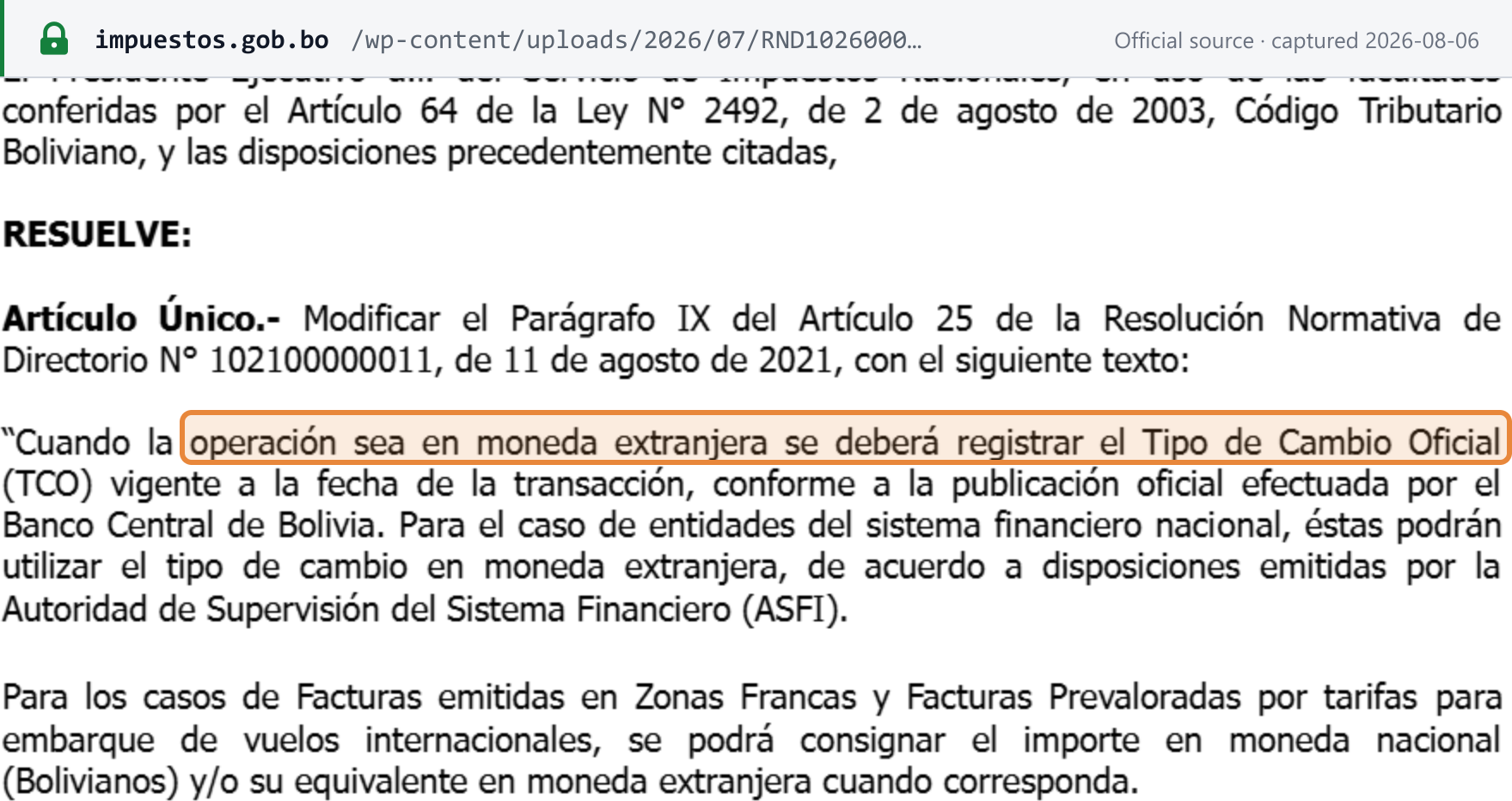
- Foreign currency. Since 16 July 2026 (RND 102600000026, dated 15 July, in force on publication), article 25.IX reads that a foreign-currency operation "se deberá registrar el Tipo de Cambio Oficial (TCO) vigente a la fecha de la transacción" published by the Banco Central de Bolivia (must record the official exchange rate at the transaction date). (RND 102600000026, checked 2026-10-07)
 Source snapshot captured 2026-08-06 — original
- Fuel purchases. RND 102600000012 (13 April 2026) has buyers record 100% of the amount in "Total de la Compra" and "Importe base para Crédito Fiscal", replacing the 70% rule in the 2021 text. (RND 102600000012, checked 2026-10-07)
Retention
Annulled documents must be kept "por el tiempo de la prescripción" (for the prescription period; art. 38.I), manual issuers keep a physical copy for the same period, and systems issuing online prevalorada documents keep a digital copy. Ley 1733 rewrote article 59 of the Código Tributario: SIN's powers now prescribe in four years, extended by two years where a taxpayer failed to register or registered in the wrong regime. RND 102100000011 sets no separate storage format or location for online documents, whose legally valid copy is the XML registered with SIN. (SIN — RND 102100000011; Ley 1733, checked 2026-10-07)
Onboarding: how to comply
Choose a connection mode
| Mode | Who it suits |
|---|---|
| Portal Web en Línea | Provided by SIN; any IVA taxpayer by subscription; low volumes |
| SIN desktop system (Electrónica en Línea) | Provided by SIN in a single version with basic formats; not for mass issuance |
| Own or provider system over SOAP | Everyone else. Minimum bandwidth 1 Mbps (urban) or 512 Kbps (rural); point-to-point fibre or MPLS for high-volume sectors |
(SIN Anexo — esquemas de conexión, checked 2026-10-07)
Authorisation of invoicing systems
Own (propio) or provider systems for Electrónica or Computarizada en Línea must be authorised by SIN (arts. 17–20). The owner must be in the Régimen General, domiciled in Bolivia, and have no active control marks.
- Tests.
- Functionality inspection.
- Pilot tests (functional and load), in the pilot environment at
pilotosiat.impuestos.gob.bo, requested in production SIAT under "Gestión de Autorización de Sistemas (PILOTO)". They cover catalogue synchronisation, online issuance, annulment, reversal, significant events, offline packages, manual-contingency transcription and mass packages of up to 1,000 invoices. The pilot is mandatory, and starting operations "se constituye en una declaración jurada" (counts as a sworn declaration).
Then file the Solicitud de Inicio de Facturación to start issuing.
- Deadlines. SIN cancels a request not completed within 90 days, extendable once by 60 days.
- Validity. An authorisation lasts three years from issue. Any change to the system needs new tests.
- Provider systems. A provider may offer its authorised system to third parties "a condición de que los mismos superen las Pruebas Piloto por cada cliente" (provided each client passes the pilot tests), and the client then confirms the provider–client association.
- Ley 1733. Every own or provider system must also pass pilot testing against the Anexo Técnico Ley 1733 between 1 October and 16 November 2026 (see above).
(SIN — RND 102100000011, arts. 17–21; SIN Anexo — proceso de autorización; Fase III — pruebas piloto, checked 2026-10-07)
Providers
SIN publishes a public Listado Proveedores de Sistemas de Facturación with each system's NIT, version, modalities, sector documents and authorisation end date. It showed 1,028 records as at 2026-10-07 (the list includes systems whose authorisation end date has passed). (SIN — Listado Proveedores de Sistemas de Facturación, checked 2026-10-07)
 Source snapshot captured 2026-10-07 — original
 Source snapshot captured 2026-10-07 — original
Penalties
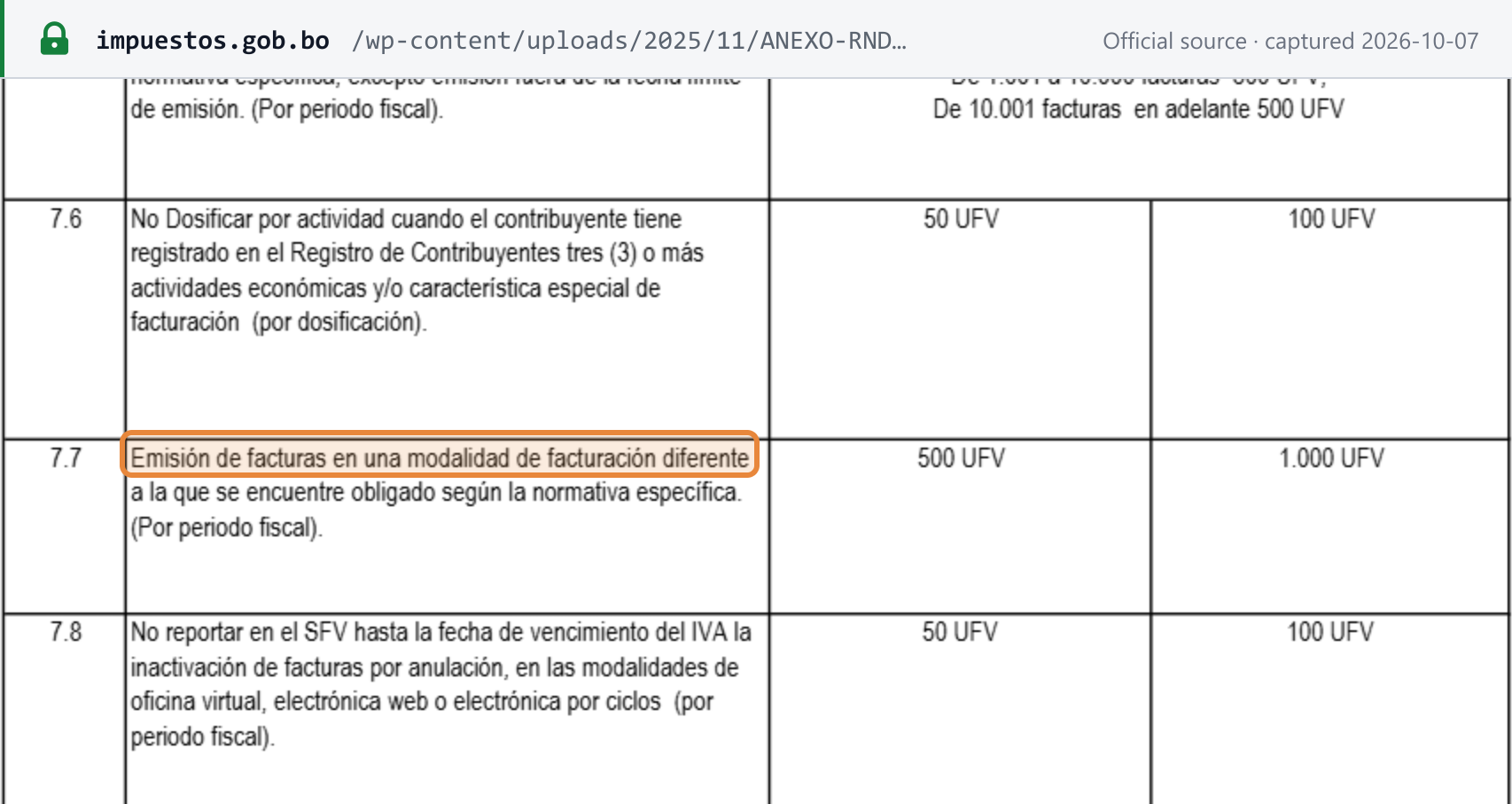
Breaches of RND 102100000011 are Incumplimiento de Deberes Formales (breach of formal duties) under article 162 of the Código Tributario (RND 102100000011, art. 67). Fines are set in UFV (Unidades de Fomento de Vivienda, an inflation-indexed unit whose value in bolivianos changes daily), in the sanctions annex to RND 10-0033-16.
| Item | Breach | Natural persons, sole-proprietor businesses and undivided estates | Legal persons |
|---|---|---|---|
| 7.1 | Not issuing an invoice, fiscal note or equivalent document on time | Closure of the establishment where the breach was committed, under arts. 164 and 170 of the Código Tributario | Same |
| 7.7 | "Emisión de facturas en una modalidad de facturación diferente a la que se encuentre obligado según la normativa específica" (issuing in a modality other than the one you are obliged to use), per tax period | 500 UFV | 1,000 UFV |
(SIN — sanctions annex to RND 10-0033-16, items 7.1 and 7.7, checked 2026-10-07)
 Source snapshot captured 2026-10-07 — original
- Reduction. For items 7.13 and 10.1, RND 102100000030 cuts the fine by 50% "si el contribuyente registra y/o envía la información hasta los 20 días siguientes de notificado" (if the taxpayer registers or sends the information within 20 days of being notified). (RND 102100000030, checked 2026-10-07)
- Ley 1733 condonation. Article 3.VI condones fines for article 162 contraventions not linked to tax-determination proceedings and committed up to 31 December 2025. (Ley 1733, checked 2026-10-07)
Frequently asked questions
We were in Groups 9–12 and did not move online by 1 October 2026. Are we in breach?
No. RND 102600000038 abrogated the four Group 9–12 designation RNDs and their amendments on 30 September 2026, so the 1 October 2026 online-only date set by RND 102600000007 never applied. RND 102600000038 does not say which modality those taxpayers use in the meantime; it says SIN will assign online modalities periodically, and as at 2026-10-07 no calendar has been published. When the regime started in 2021, article 10 of RND 102100000011 let taxpayers keep their authorised modality until SIN assigned a new one. (SIN, checked 2026-10-07)
Is there a turnover threshold that makes online invoicing mandatory?
No. Article 10 of RND 102100000011 lets SIN make the online modalities mandatory by resolution, using criteria such as economic activity, invoicing volume, tax-compliance behaviour, total invoiced amount and e-commerce. SIN designated taxpayers by name and NIT in annexes to each group's RND. Check your NIT on SIN's Consulta Modalidad en Línea Asignada. (SIN, checked 2026-10-07)
Does our invoicing system have to be re-authorised for Ley 1733?
Yes. RND 102600000034 requires every taxpayer with an own or provider invoicing system to meet the Anexo Técnico Ley 1733 for pilot testing and later authorisation between 1 October and 16 November 2026. Until the implementing RND is in force, RND 102100000011 stays fully in force. (SIN, checked 2026-10-07)
What is due on 30 October 2026?
The homologation of the products in your invoicing system with your RNC economic activities. RND 102600000028, dated 29 July 2026 and in force on its publication on 30 July 2026, extended the deadline to 30 October 2026. It is the fourth extension of the original 31 October 2025 deadline. (SIN, checked 2026-10-07)
What do we do when SIN's service or the internet is down?
If your system still works, switch to offline issuance: the CUFD stays valid up to 72 hours (up to 15 days for SIN-authorised no-internet events). Register the significant event within 48 hours after it ends and send the offline invoices within 48 hours of reconnection. For software or hardware failure use pre-authorised contingency invoices or the Portal Web; for a power cut, use contingency invoices, registered within 72 hours of reconnection. (RND 102100000011 art. 29, checked 2026-10-07)
How long are the CUIS and CUFD valid?
The CUIS is valid for 365 calendar days; the CUFD for 24 hours from when it is obtained, and it can be requested several times a day. The CUF is generated for each invoice. (RND 102100000011 art. 21, checked 2026-10-07)
Do we need a digital certificate?
Only for Electrónica en Línea, where each XML is digitally signed with a certificate from an accredited certifying entity. Computarizada en Línea uses a hash and the taxpayer's credentials instead, and the Portal Web en Línea is run by SIN. (RND 102100000011 arts. 7, 8 and 52, checked 2026-10-07)
Until when can we annul an online invoice?
Until day 9 of the following month, and only if the operation did not take place (RND 102100000011 art. 38.II as amended by RND 102100000021). After that, since 15 July 2026 you can request a late annulment under RND 102600000025: SIN resolves within six months where the document is already in a filed tax return, and otherwise the same day at your GRACO or district office. (SIN, checked 2026-10-07)
Recent changes
- 2026-09-30 — RND 102600000038 abrogated the Group 9–12 designation RNDs and their amendments, removing the 1 October 2026 online-only date; SIN will assign online modalities periodically to taxpayers not yet online. (SIN) — see event
- 2026-09-02 — RND 102600000034 published the Anexo Técnico Ley 1733 v0.0; own and provider invoicing systems must pass pilot testing and re-authorisation between 1 October and 16 November 2026. (SIN) — see issue
- 2026-07-30 — RND 102600000028 (dated 29 July 2026) extended the product-homologation deadline to 30 October 2026. (SIN) — see issue
- 2026-07-16 — RND 102600000026 in force: foreign-currency documents record the Banco Central de Bolivia official exchange rate. (SIN) — see issue
- 2026-07-15 — RND 102600000025 in force: late-annulment procedure after the day-9 deadline. (SIN) — see issue
- 2026-03-23 — RND 102600000007 extended the Group 9–12 dual-modality window to 30 September 2026 (since abrogated by RND 102600000038). (SIN)
Related resources
- Bolivia VAT (IVA) country guide — IVA rate, the pending por fuera reform, NIT registration and invoice content
- Bolivia tax identification number (NIT) — the NIT every fiscal document carries
- E-invoicing status and networks worldwide — Bolivia in global context
- E-invoicing in Peru · Argentina · Brazil — other Latin American clearance models
- Bolivia tax-change chronology — every tracked Bolivian change, dated and sourced
- Validate a Bolivian NIT
Important websites
- SIAT en línea — SIN's taxpayer system (authorisation requests, Portal Web)
- SIN Anexo Técnico — technical rules, XSDs, algorithms, web services
- Anexo Técnico Ley 1733 — the new IVA-transparent formats (under construction)
- Consulta Modalidad en Línea Asignada — which online modality SIN has assigned to a NIT
- Listado Proveedores de Sistemas de Facturación — SIN's public provider list
- SIN RND index 2026 — new resolutions as they are published