E-invoicing in Greece: myDATA, licensed providers and the B2G Peppol route
Overview
Checked against the official sources cited in this section as at 2026-10-07.
Greece runs two e-invoicing systems that meet at myDATA.
- The tax-side mandate. Law 5222/2025 (art. 239) amended art. 14 of Law 4308/2014, the Greek Accounting Standards (ΕΛΠ), so that in-scope invoices are issued exclusively electronically. Joint Decision A.1128/2025 sets the scope and timetable. Domestic B2B invoices, B2B invoices to customers outside the EU and B2G invoices must be issued through an AADE-licensed e-invoicing provider (Πάροχος) or AADE's free timologio (web) and myDATAapp (mobile) applications. Every invoice is transmitted in real time to myDATA, AADE's electronic-books platform, which returns the MARK (Μοναδικός Αριθμός Καταχώρισης) that the invoice must carry.
- The procurement-side B2G system. Invoices to Greek contracting authorities follow EN 16931 in the Greek CIUS of PEPPOL BIS 3.0. They are delivered over Peppol to the National Interoperability Centre (ΚΕΔ) of the General Secretariat of Information Systems (GSIS), which routes them to the public body.
The tax-side system is run by the Independent Authority for Public Revenue (AADE). AADE summarises it in English: "You now issue all your invoices exclusively in digital form, through a Provider or through the free applications timologio and myDATAapp of the Independent Authority for Public Revenue (IAPR). Each of your transactions is transmitted automatically and in real time to the IAPR's myDATA." (AADE — Mandatory Electronic Invoicing; A.1128/2025 art. 1)
| Greece | |
|---|---|
| B2B (domestic) | Mandatory: issue only through a licensed provider or timologio/myDATAapp. Phase 1 (2023 gross revenue above EUR 1,000,000) from 2 March 2026; Phase 2 (all others) from 2 November 2026, moved from 1 October 2026 |
| B2B with non-EU customers | Same mandate and dates as domestic B2B (retail excepted) |
| Intra-EU B2B | Not in A.1128/2025's scope |
| B2G | Same tax-side mandate, plus the procurement rule: EN 16931 e-invoices to contracting authorities, phased in from 12 September 2023 to 1 January 2025 (KYA 52445 ΕΞ 2023) |
| B2C | Out of scope: retail documents are unchanged (AADE, 22 September 2026) |
| Receivers | Every Law 4308/2014 entity must accept e-invoices for domestic B2B and B2G since 2 March 2026 |
| Parallel use | ERP or manual issue with myDATA transmission allowed to 31 January 2027 for Phase 2; from 1 February 2027 provider or AADE apps only |
| Format | B2B: AADE's myDATA XML (API v2.0.2). B2G: EN 16931, Greek CIUS of PEPPOL BIS 3.0 (UBL 2.1) |
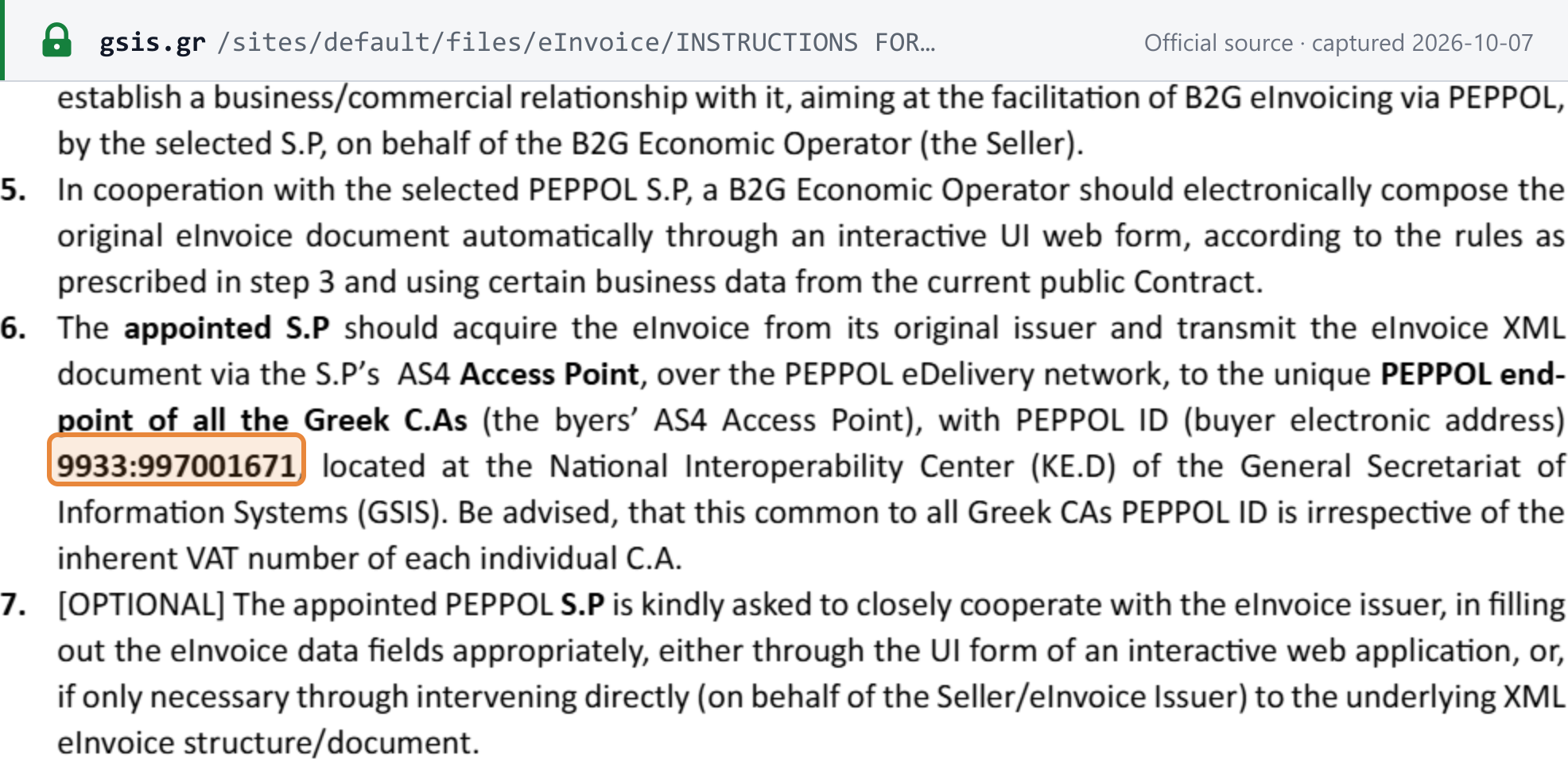
| Network | B2B: myDATA plus provider-to-provider delivery; not Peppol-based. B2G: Peppol to ΚΕΔ, endpoint 9933:997001671 |
| Integrity | MARK, SHA-1 authentication string, document identifier and URL-type QR code on every provider invoice |
| Authority | AADE (tax side); GSIS / ΓΓΠΣΨΔ (B2G routing, Peppol Authority) |
| Legislation | Law 4308/2014 arts. 8, 14, 15 (as amended by Law 5222/2025); Law 5104/2024 art. 16; A.1128/2025, A.1044/2026, A.1197/2026; A.1112/2025; KYA 52445 ΕΞ 2023 |
Mandate status & timeline
Status is as at 2026-10-07.
| Phase / flow | Scope | What becomes mandatory | Date | Legal instrument | Status |
|---|---|---|---|---|---|
| B2G wave α | Named ministries and bodies (Infrastructure & Transport, Digital Governance, Migration; City of Athens, ΕΚΑΠΥ, Attiko Metro, ΕΥΔΑΠ, Egnatia Odos) | Suppliers submit EN 16931 e-invoices | Procedures started 5 months after the KYA's publication (GSIS gives 12 September 2023) | KYA 52445 ΕΞ 2023 art. 1(2)(α) [1] | passed |
| B2G wave β | Rest of central administration | Same | Procedures started after 1 January 2024 | KYA 52445 art. 1(2)(β) [1] | passed |
| B2G wave γ | Other contracting authorities | Same | Procedures started after 1 June 2024 | KYA 52445 art. 1(2)(γ) [1] | passed |
| B2G wave δ | Other General Government expenses (above EUR 2,500) | Same | Invoiced from 1 January 2025 | KYA 52445 art. 1(2)(δ), 2(3) [1] | passed |
| Phase 1 issuers | Gross revenue above EUR 1,000,000 in the 2023 income-tax return | Issue domestic B2B, non-EU B2B and B2G invoices only through a provider or timologio | 2 March 2026 (was 2 February 2026); parallel use to 3 May 2026 (was 31 March 2026) | A.1128/2025 art. 2(1), as replaced by A.1044/2026 [2] | passed; parallel use ended |
| All recipients | Every Law 4308/2014 entity, whatever its own phase | Accept e-invoices for domestic B2B and B2G | 2 March 2026 | A.1128/2025 art. 2(3), as replaced by A.1044/2026 [2] | in force |
| Phase 2 issuers | All other Law 4308/2014 entities | As Phase 1 | 2 November 2026 (was 1 October 2026); parallel use to 31 January 2027 (was 31 December 2026) | A.1128/2025 art. 2(2), as replaced by A.1197/2026 (ΦΕΚ Β΄ 5905/30.09.2026) [3] | upcoming |
| End of ERP-direct transmission | All in-scope invoices | Issue and transmit only through a provider or timologio/myDATAapp | 1 February 2027 | AADE and Ministry press release, 30 September 2026 (follows from the A.1197 window end) [4] | upcoming |
Phase 1 covers entities whose gross revenue in the income-tax return for tax year 2023 exceeded EUR 1,000,000. Where the tax year did not end on 31 December 2023, the return for the tax year that began in 2023 is used. Everyone else subject to Law 4308/2014 falls in Phase 2. (A.1128/2025 art. 1(3))
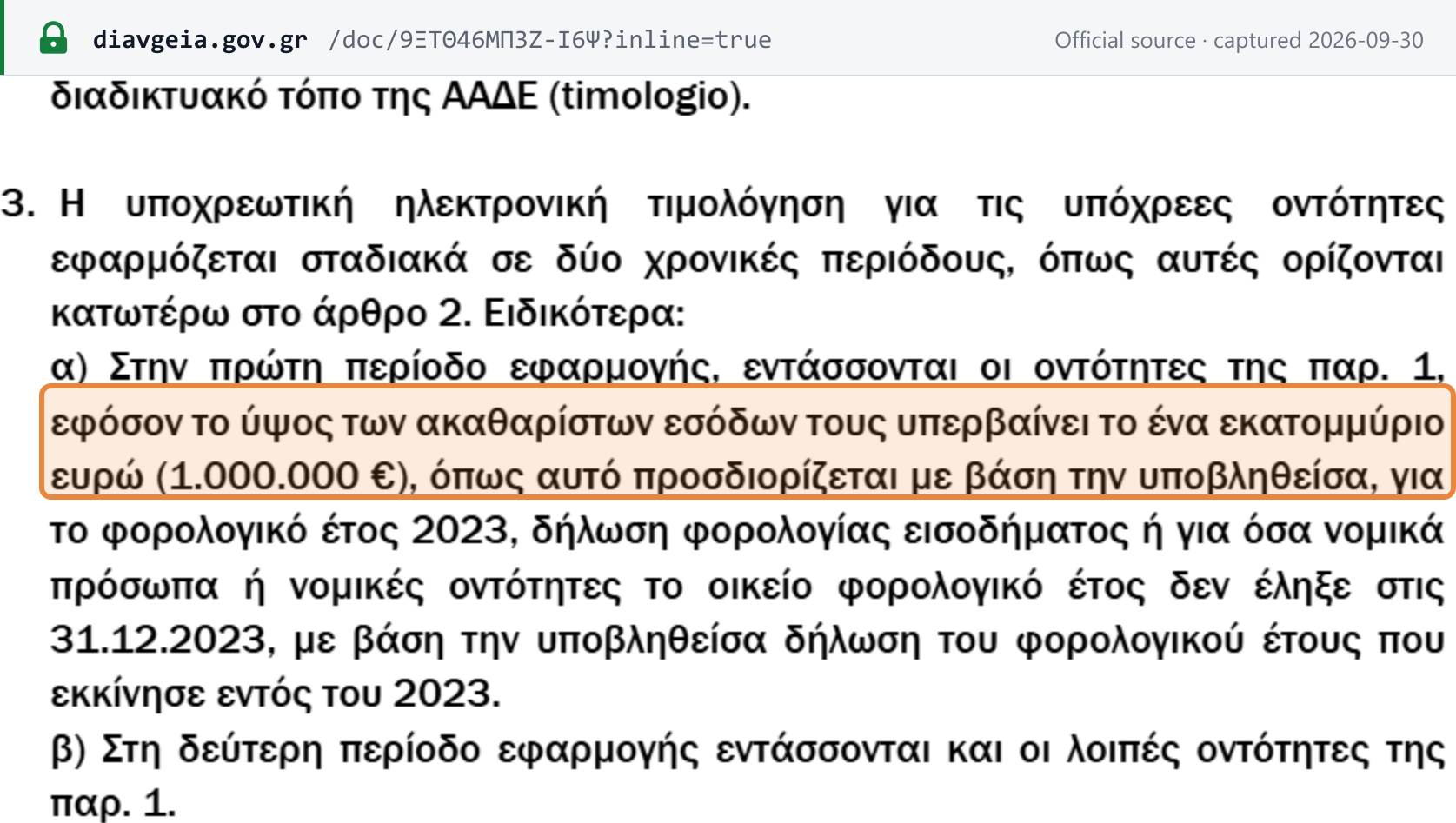 Source snapshot captured 2026-09-30 — original
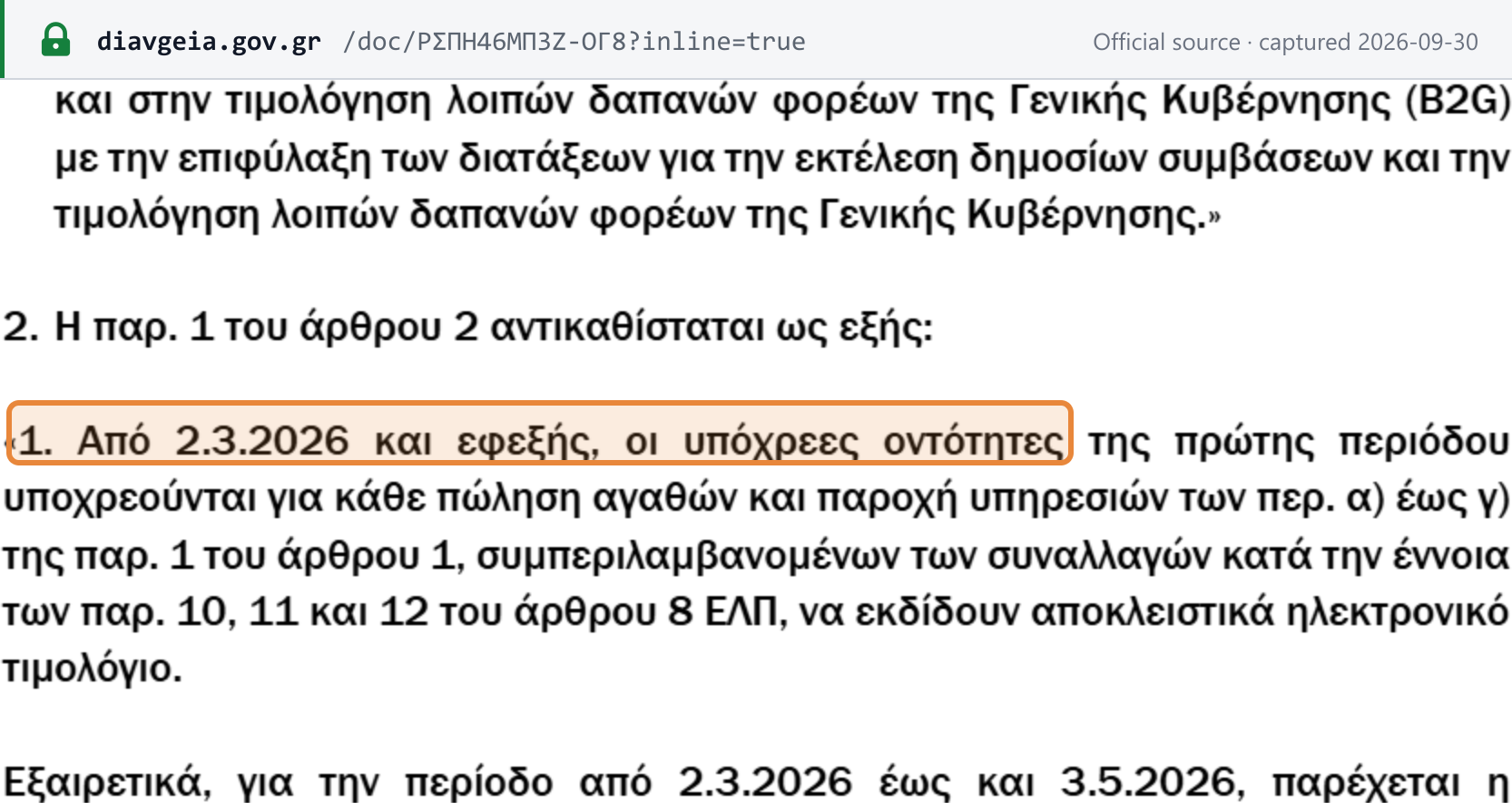 Source snapshot captured 2026-09-30 — original
The latest phase: Phase 2 from 2 November 2026
Joint Decision A.1197/2026, signed on 30 September 2026 by the Deputy Minister of National Economy and Finance and the AADE Governor and published in ΦΕΚ Β΄ 5905/30.09.2026, replaces art. 2(2) of A.1128/2025. Second-period entities must issue exclusively electronic invoices "Από 2.11.2026 και εφεξής" (from 2.11.2026 onwards). For 2 November 2026 to 31 January 2027 they may still use the other methods in parallel: issue and transmission from an ERP, or manual issue with the myDATA special entry form. Parallel use depends on a timely start declaration (Δήλωση Έναρξης Ηλεκτρονικής Έκδοσης Στοιχείων) or a timologio usage declaration, with a start date no later than 2 November 2026. A.1197 applies from publication. (A.1197/2026)
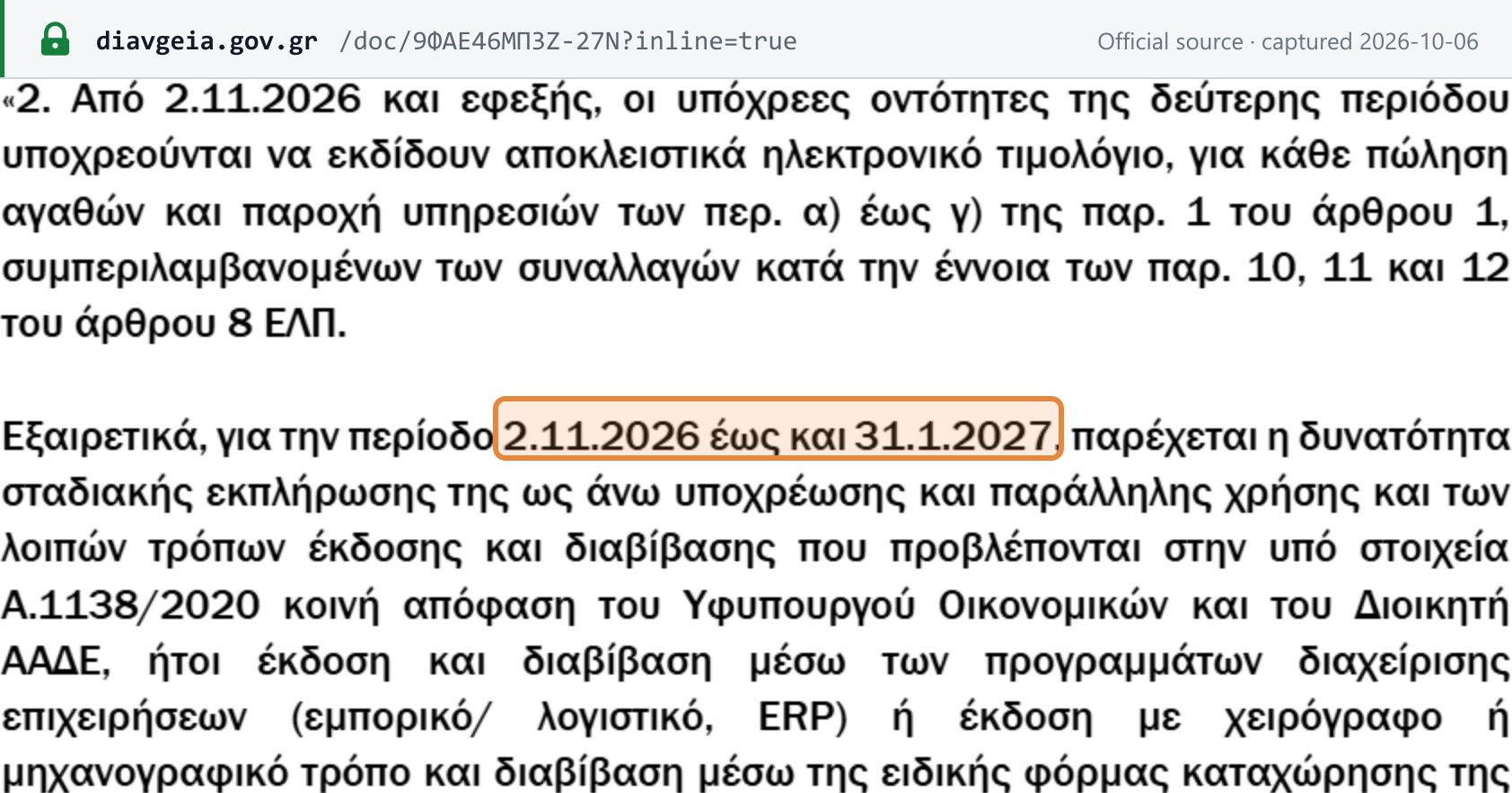 Source snapshot captured 2026-10-06 — original
The joint press release of the Ministry and AADE of 30 September 2026 adds three points:
- a business using a provider files the start declaration with an effective date of 2 November 2026;
- a business that issues only through timologio or myDATAapp from 2 November 2026, and does not want the gradual window, need not file it;
- from 1 February 2027, domestic B2B, non-EU B2B and B2G invoices, and their transmission to myDATA, go only through a provider or the AADE applications. Transmitting them to myDATA any other way, "για παράδειγμα μέσω ERP" (for example via ERP), will no longer be possible.
The release also says that about 655,000 businesses, almost 70% of potential second-period obligors, already used a provider or the AADE applications (as at 30 September 2026). No further phase is set by A.1197 or announced in AADE's 30 September 2026 release (as at 2026-10-07). (AADE press release, 30 September 2026)
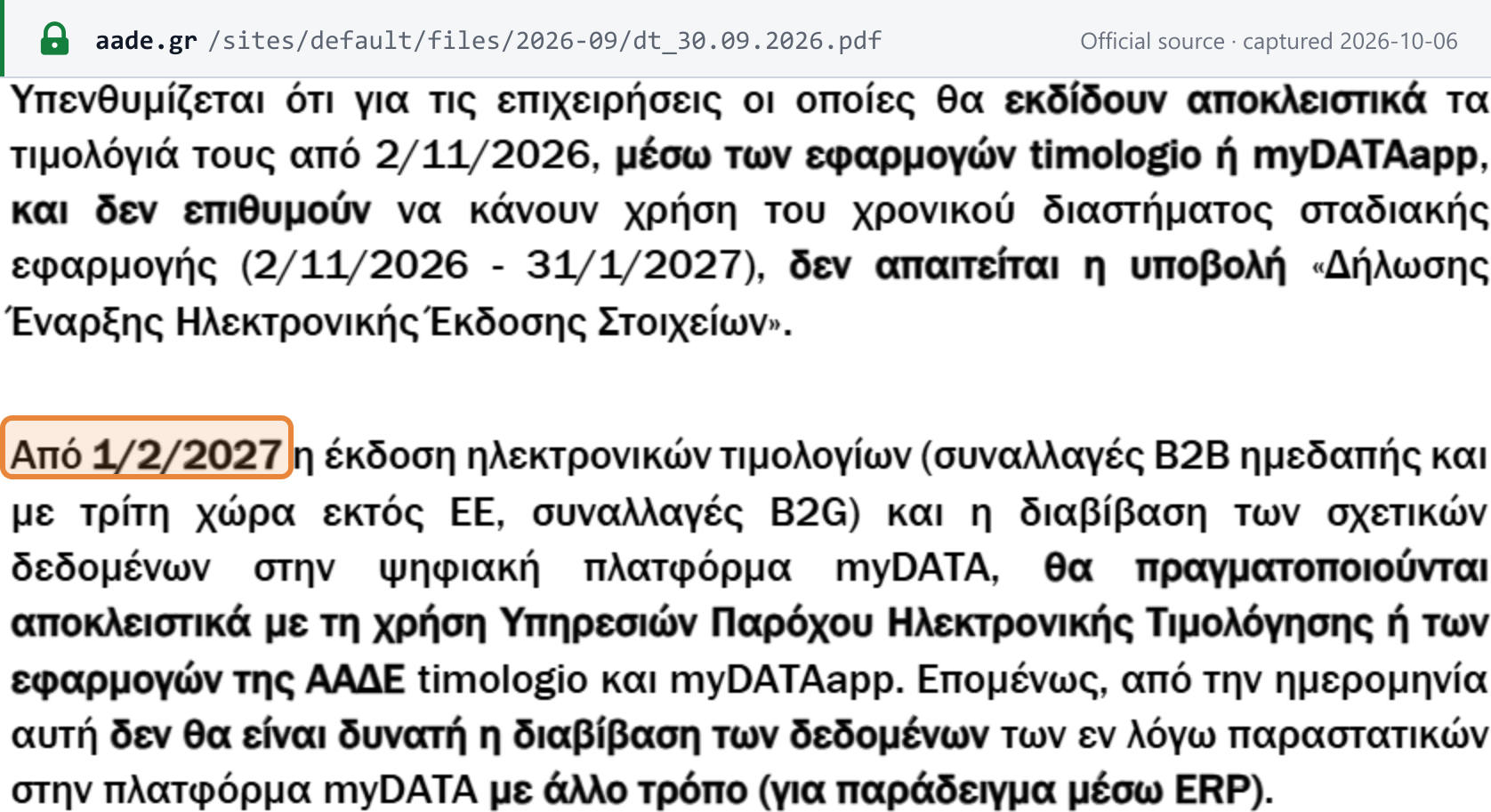 Source snapshot captured 2026-10-06 — original
Postponements
Both phases have been moved once. For readers who planned against the original calendar: the dates moved, and the scope stayed substantively the same (A.1044 added a reservation for the public-procurement rules to art. 1(1)). The channels and the parallel-use mechanism are unchanged.
| Phase | Original start | New start | Original parallel-use end | New parallel-use end | Instrument that moved it |
|---|---|---|---|---|---|
| Phase 1 | 2 February 2026 | 2 March 2026 | 31 March 2026 | 3 May 2026 | A.1044/2026 (ΦΕΚ Β΄ 880/17.02.2026) |
| Phase 2 | 1 October 2026 | 2 November 2026 | 31 December 2026 | 31 January 2027 | A.1197/2026 (ΦΕΚ Β΄ 5905/30.09.2026) |
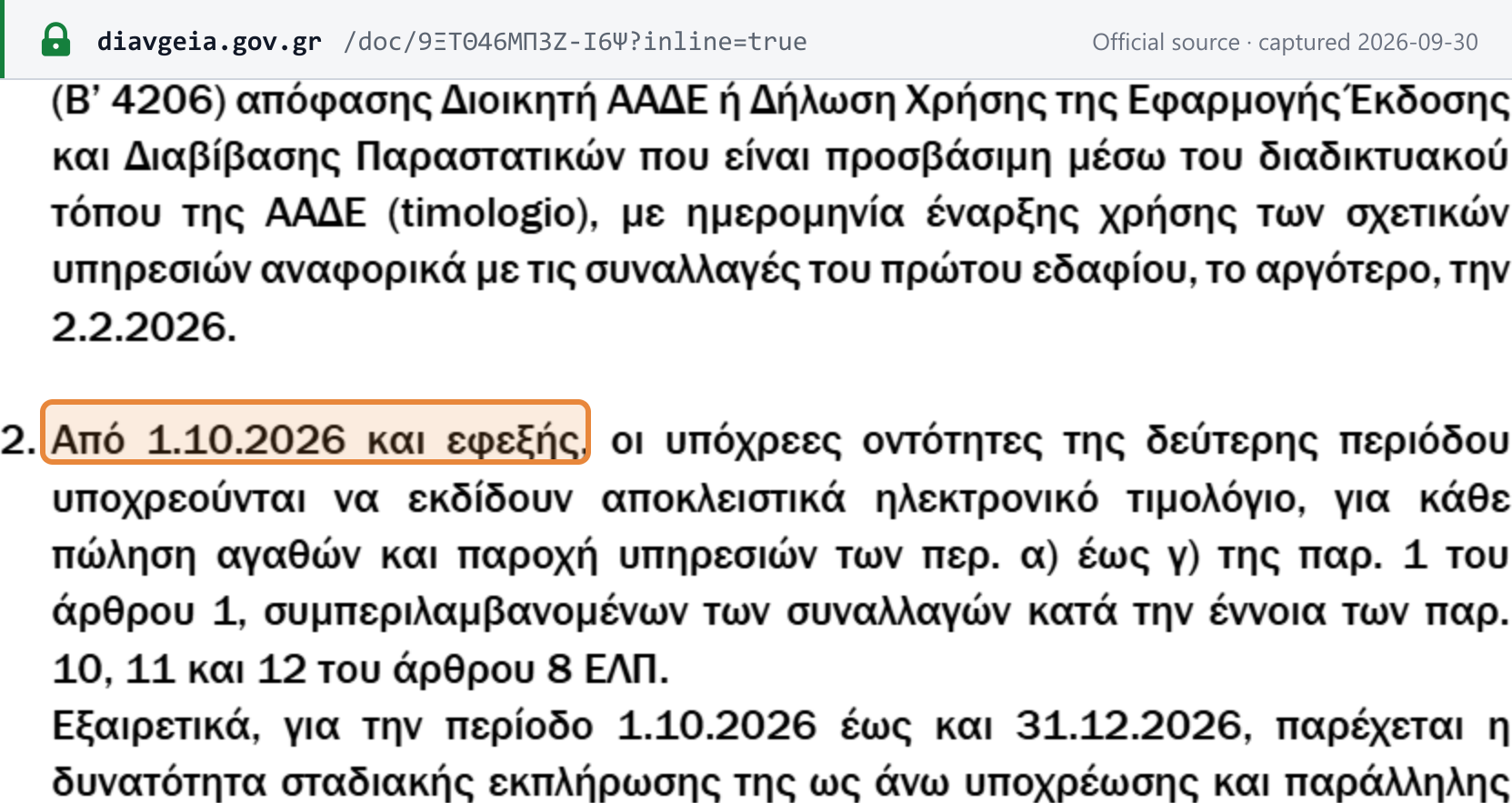 Source snapshot captured 2026-09-30, showing the text as originally adopted — original
Early-adoption incentives (historical). A.1129/2025 gave a 100% uplift on the cost of e-invoicing equipment and software, and on the first 12 months of e-invoicing costs, to businesses that e-invoiced exclusively at least two months before their mandatory start. The deadlines it states are 1 December 2025 (Phase 1) and 3 August 2026 (Phase 2), computed against the original start dates. A.1197 amends only A.1128 art. 2(2), not A.1129. (A.1129/2025)
Legal basis
Checked against the official sources cited in this section as at 2026-10-07.
| Instrument | What it does | Link |
|---|---|---|
| Law 4308/2014 (Greek Accounting Standards, ΦΕΚ Α΄ 251/24.11.2014), arts. 8, 14, 15 | Invoicing rules; art. 14 par. 6, added by Law 5222/2025 art. 239 (ΦΕΚ Α΄ 134/2025), empowers the decisions that make e-invoicing exclusive | ΦΕΚ Α΄ 251/2014 |
| Law 5104/2024 (Tax Procedure Code, ΚΦΔ, ΦΕΚ Α΄ 58/19.04.2024) | Art. 16: electronic transmission of accounting data to AADE (myDATA's statutory basis); art. 13: retention; arts. 57, 58, 67: penalties | ΦΕΚ Α΄ 58/2024 |
| A.1138/2020 (ΦΕΚ Β΄ 2470) | The myDATA transmission decision, including the ERP and special-form routes used during parallel use | cited in A.1197 |
| A.1112/01.08.2025 (ΦΕΚ Β΄ 4206) | Provider licensing and obligations; invoice integrity fields; outage rules. Replaces A.1035/2020 | Diavgeia |
| A.1128/15.09.2025 (ΦΕΚ Β΄ 4937) | Scope (art. 1) and timetable (art. 2) of mandatory e-invoicing | Diavgeia |
| A.1129/16.09.2025 (ΦΕΚ Β΄ 4938) | Usage declarations and early-adoption incentives | AADE |
| A.1044/17.02.2026 (ΦΕΚ Β΄ 880) | Moves Phase 1 to 2 March 2026; replaces the recipient-acceptance rule | Diavgeia |
| A.1197/30.09.2026 (ΦΕΚ Β΄ 5905/30.09.2026) | Moves Phase 2 to 2 November 2026, parallel use to 31 January 2027; in force on publication | Diavgeia · ΦΕΚ print |
| E.2004/13.02.2026 | AADE circular: an in-scope invoice issued another way counts as not issued | Diavgeia |
| KYA 52445 ΕΞ 2023 (ΦΕΚ Β΄ 2385/12.04.2023) | B2G phase-in of supplier e-invoicing to contracting authorities; exclusions | GSIS |
| Law 4601/2019 | Transposes Directive 2014/55/EU on B2G e-invoicing; KYA 52445 and A.1112 cite its art. 148 | cited in KYA 52445 |
| Greek CIUS of PEPPOL BIS 3.0, guide v8.2 (15/12/2025, GSIS) | The B2G technical format published by GSIS | GSIS |
| myDATA REST API documentation for providers v2.0.2 (AADE, official, September 2026) | Binding B2B transmission format and endpoints | AADE |
A.1197 recites its legal basis as art. 14 par. 6 of Law 4308/2014, "όπως αυτή προστέθηκε με το άρθρο 239 του ν.5222/2025" (as added by art. 239 of Law 5222/2025), together with arts. 8, 14 and 15 of the Greek Accounting Standards and art. 16 of Law 5104/2024. (A.1197/2026)
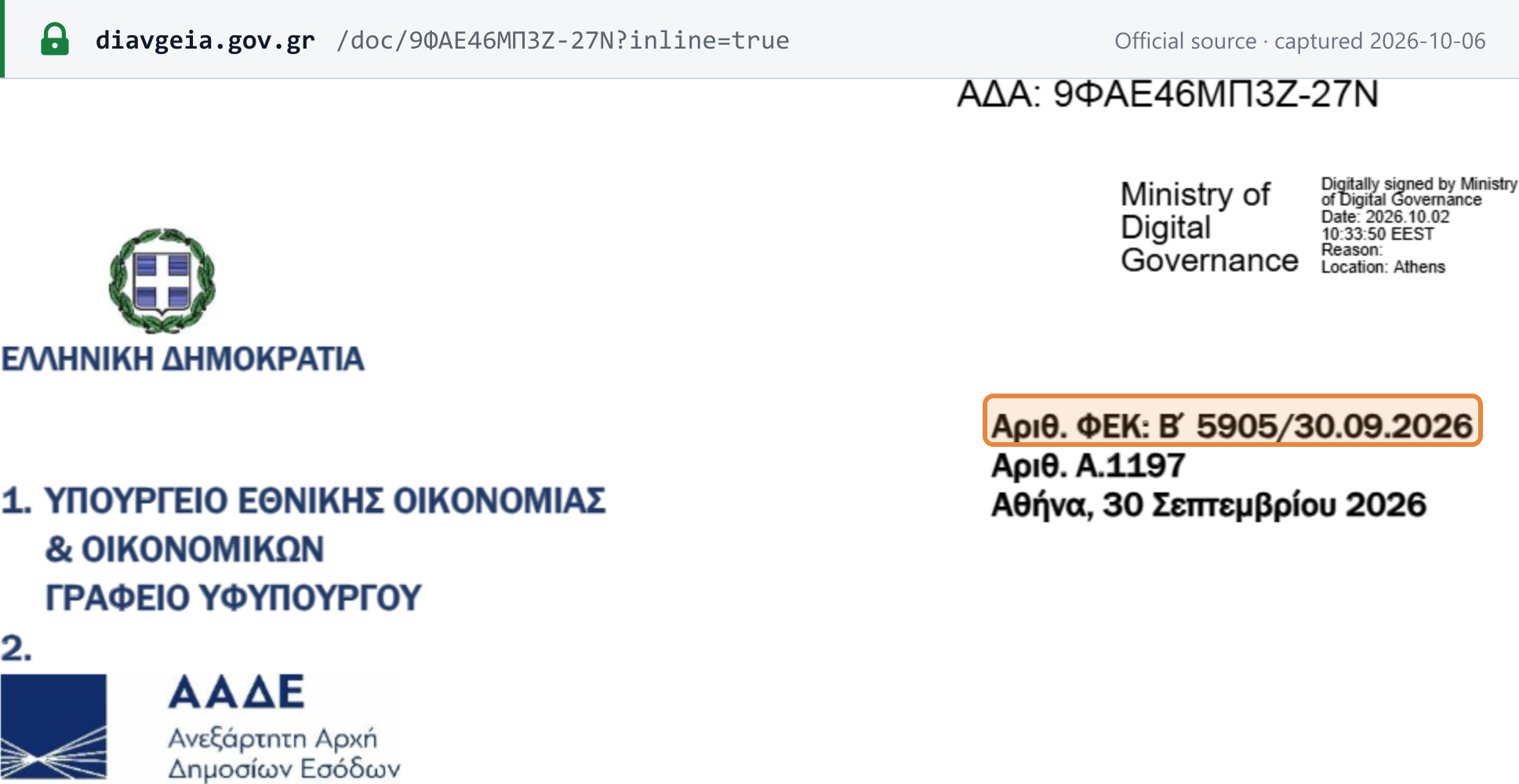 Source snapshot captured 2026-10-06 — original
Scope
Checked against the official sources cited in this section as at 2026-10-07.
B2B
A.1128/2025 art. 1(1) requires an invoice to be issued exclusively electronically in three flows:
- (α) domestic B2B, to an entity subject to Law 4308/2014;
- (β) B2B to a foreign entity in a country outside the EU, retail transactions excepted;
- (γ) B2G: public contracts and the invoicing of other General Government expenses.
The only allowed channels are a provider's e-invoicing services or AADE's timologio application (art. 1(2)). Intra-EU B2B is not listed in art. 1(1). (A.1128/2025)
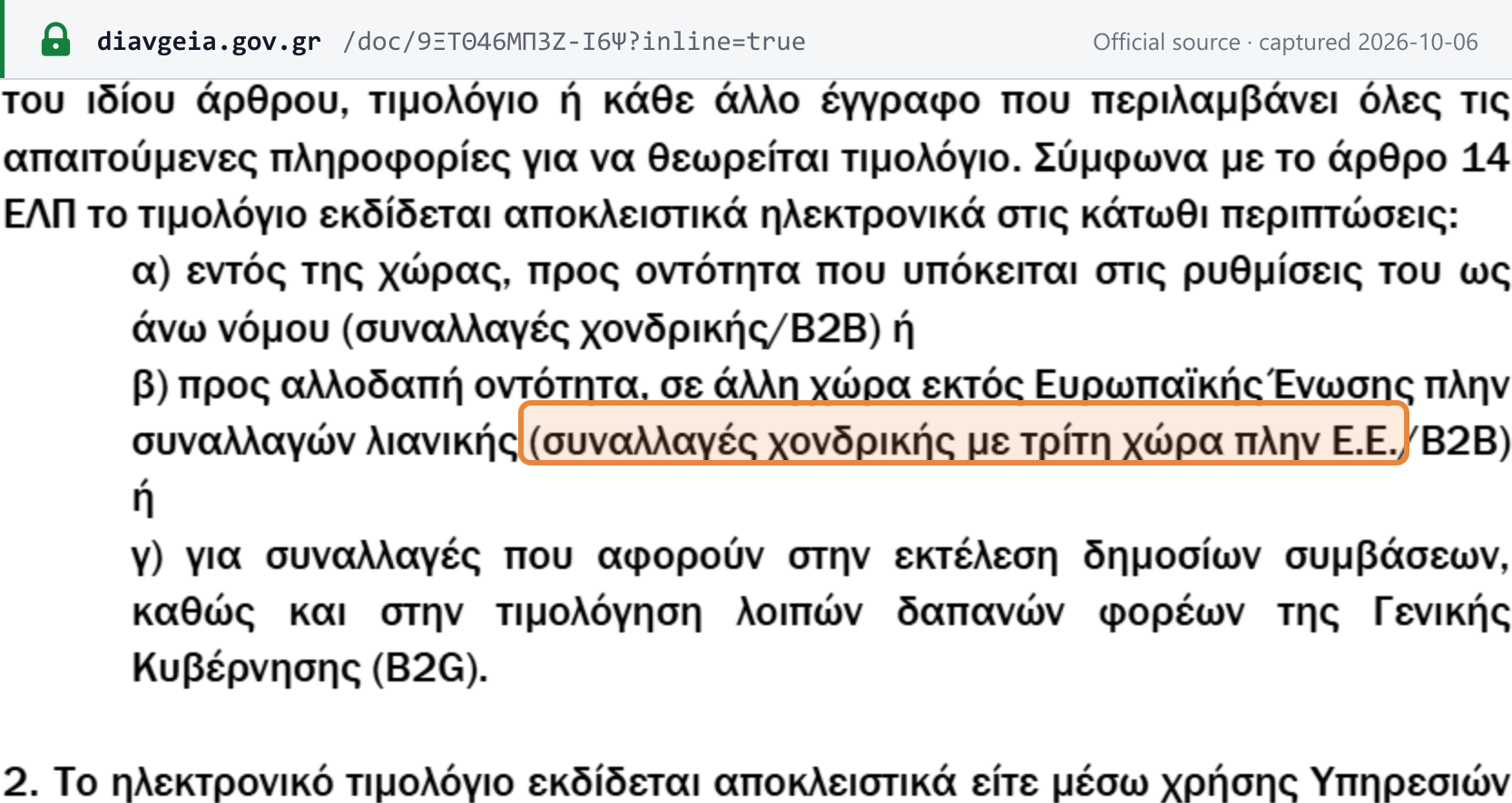 Source snapshot captured 2026-10-06 — original
Receivers. Since 2 March 2026, every entity subject to Law 4308/2014 that is invoiced must accept e-invoices for domestic B2B and B2G transactions, "υποχρεωτικά αποδεκτή" (compulsorily accepted), whatever its own issuing phase. A.1197 did not change this. (A.1044/2026, new A.1128 art. 2(3))
B2G
B2G invoices sit under both systems. On the tax side they are flow (γ) of A.1128 and follow its phases. On the procurement side, KYA 52445 ΕΞ 2023 obliges contracting authorities to receive and process e-invoices that comply with the European standard, and suppliers to submit them, in the four waves shown in the timeline. The procurement rule excludes:
- low-value contracts under Law 4412/2016 arts. 117Α and 327Α;
- contracts between public bodies;
- other expenses of up to EUR 2,500.
B2C
Out of scope. AADE states that mandatory e-invoicing "δεν επιφέρει καμία αλλαγή" (brings no change) to the obligations and method of issuing documents to final consumers, that is, retail transactions. B2C stays on the existing retail regime (fiscal devices / POS, or provider-issued retail documents). (AADE press release, 22 September 2026)
Non-established businesses
- B2B mandate: unknown. A.1128 covers the entities of art. 1 of Law 4308/2014. None of A.1128, A.1197, A.1129, A.1112, E.2004 or AADE's e-invoicing FAQ addresses whether a foreign business that is only VAT-registered in Greece must issue B2B invoices through a provider (as at 2026-10-07).
- B2G: in scope. GSIS's instructions for foreign suppliers say that invoicing Greek contracting authorities "is solely carried out by means of electronic invoicing (eInvoicing), through the PEPPOL electronic, integrated ITC platform". A foreign seller must use a Peppol-certified service provider, in Greece or elsewhere, and send to the shared endpoint 9933:997001671. (GSIS — instructions for foreign B2G providers, February 2026)
VAT registration for non-residents is covered in the Greece VAT guide.
Simplified invoices
Unknown. The AADE sources cited on this page state no simplified-invoice regime or value threshold that lifts the exclusive e-invoicing duty for in-scope B2B or B2G flows. Retail documents are outside the mandate (see B2C).
Format & network
Checked against the official sources cited in this section as at 2026-10-07.
CTC model: real-time transmission to myDATA, which validates and returns the MARK
The provider transmits each invoice to myDATA "σε πραγματικό χρόνο, και αυτόματα, με την έκδοση των παραστατικών" (in real time, and automatically, when the documents are issued). Invoices to be issued pass basic checks on the myDATA platform and are marked with the MARK, which must accompany every invoice issued by licensed software. Anyone can check an invoice's authenticity on the provider's website through its mandatory QR code. (AADE — e-invoicing providers)
 Source snapshot captured 2026-10-06 — original
This is real-time reporting with platform validation, plus an AADE identifier that the final
invoice must carry. AADE does not call it "clearance" on the pages and decisions cited here. The provider API also has a /SendUnsignedInvoices method for invoices still
being issued.
Delivery to the buyer (B2B). The issuer's provider sends the invoice directly to the buyer, who chooses how to receive it, if the buyer has no provider. If the buyer has one, the invoice goes through the buyer's provider (A.1112/2025 art. 7(7)). (A.1112/2025)
Format (B2B): AADE's myDATA XML
- Interface. Providers use an AADE REST API on Microsoft Azure and send XML documents that conform to AADE's schema.
- Current version. v2.0.2 (as at 2026-10-07). AADE posted the official documentation and XSDs in September 2026.
- Endpoints. Production
https://mydatapi.aade.gr/myDataProvider/SendInvoices; testhttps://mydataapidev.aade.gr/myDataProvider/SendInvoices. - No EN 16931, Peppol or UBL for B2B. A.1112, A.1128, A.1044 and A.1197 contain no occurrence of "16931", "Peppol" or "UBL".
(AADE — myDATA API documentation for providers v2.0.2; AADE — myDATA technical specifications)
Format (B2G): EN 16931 and the Greek CIUS of PEPPOL BIS 3.0
B2G e-invoices follow ΕΛΟΤ EN 16931-1 through the Greek CIUS of PEPPOL BIS 3.0, using the
UBL 2.1 syntax binding. GSIS's guide is version 8.2, dated 15 December 2025, and is "βασισμένος
στο πρότυπο ΕΛΟΤ EN 16931-1, PEPPOL BIS 3.0" (based on ΕΛΟΤ EN 16931-1 and PEPPOL BIS 3.0). Business rule GR-R-004-1 reads "When Supplier is Greek,
there must be one MARK Number". The MARK goes in BT-122, with BT-123 set to ##M.AR.K##. A Greek
supplier's B2G invoice therefore carries the myDATA MARK as well.
(GSIS — Greek CIUS guide v8.2)
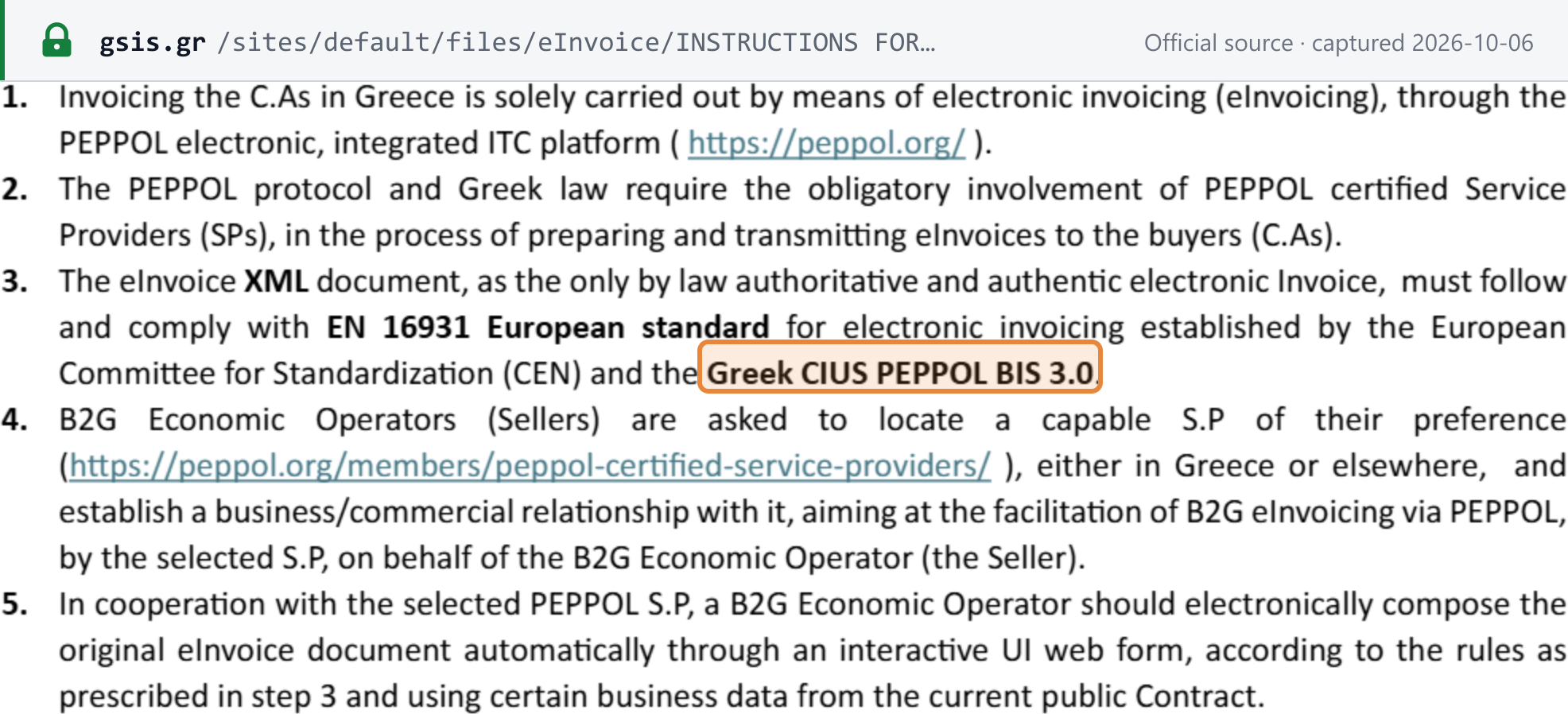 Source snapshot captured 2026-10-06 — original
Network
- B2B: not Peppol-based. Invoices go from the provider to myDATA and from provider to buyer or buyer's provider, as above.
- B2G: Peppol to ΚΕΔ. Under A.1112 art. 7(7), B2G invoices reach the public body through the National Interoperability Centre (ΚΕΔ) of the General Secretariat of Information Systems and Digital Governance, which routes them to the competent bodies' systems. All Greek contracting authorities share one Peppol ID, 9933:997001671, at ΚΕΔ. A provider whose recipient is a contracting authority must implement a Peppol access point. AADE tells provider users to send invoices to the Greek State "μέσω του δικτύου peppol και του Κέντρου Διαλειτουργικότητας της ΓΓΠΣΔΔ" (via the Peppol network and the GSIS Interoperability Centre).
- Peppol Authority. GSIS is Greece's Peppol Authority under Law 4623/2019 art. 4. Its remit, as GSIS describes it, covers B2G and B2B transactions within Peppol. That is a remit, not a B2B Peppol mandate.
(A.1112/2025; GSIS — e-invoice; AADE — e-invoicing providers; GSIS foreign-supplier instructions)
 Source snapshot captured 2026-10-07 — original
Integrity: MARK, SHA-1, document identifier and QR code
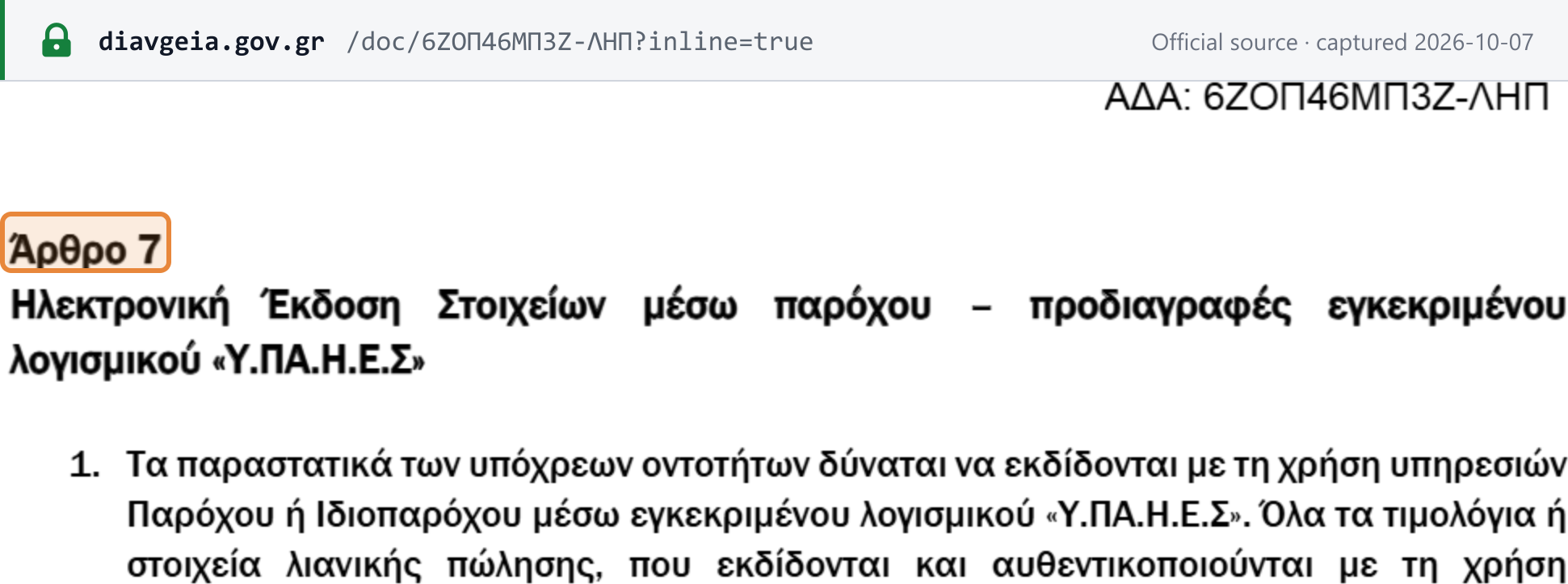
On top of the Law 4308/2014 art. 9 particulars, every document issued through a provider or self-provider must carry (A.1112/2025 art. 7(5)–(6)):
- the provider's name and website;
- an authentication string, built with the SHA-1 algorithm;
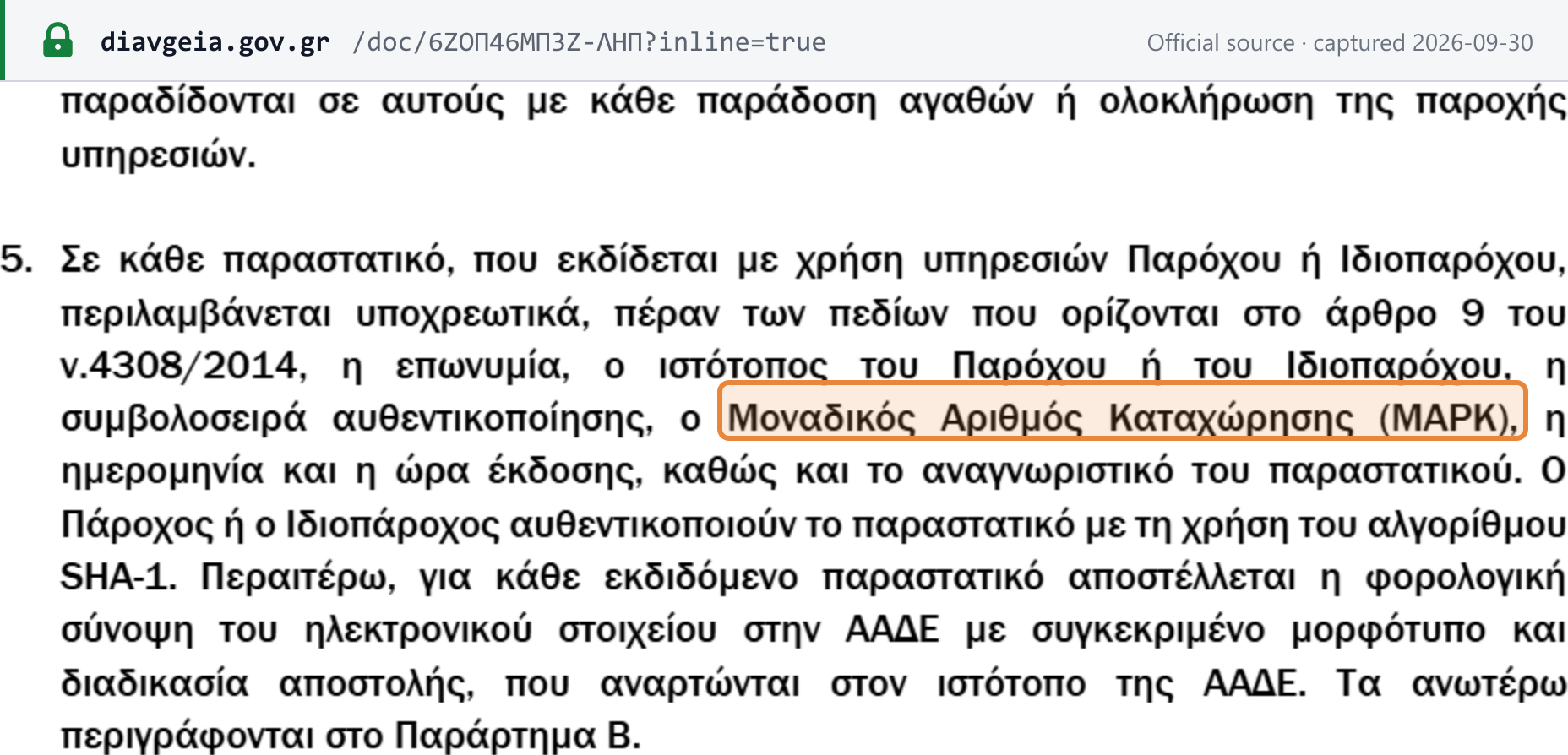
- the MARK;
- the date and time of issue;
- the document identifier;
- a URL-type QR code built from the text myDATA returns on successful transmission, which must include the MARK.
 Source snapshot captured 2026-10-07 — original
 Source snapshot captured 2026-09-30 — original
Outages
- Provider-to-AADE link down. The business keeps issuing through the provider, which sends the documents to myDATA and to the recipients within one day of issue (A.1112 art. 7(2)(β)).
- Power or internet outage at the business. Invoices may be issued by hand or other means and transmitted through the A.1138/2020 routes. This loss-of-connection case is the only exception E.2004 makes to the rule that such invoices count as not issued.
E-reporting alongside e-invoicing
myDATA is also Greece's electronic-books platform. Under Law 5104/2024 art. 16, entities transmit data of the accounting documents they issue to AADE, whatever the issuing method. For in-scope e-invoices, the provider's real-time transmission meets that duty. (Law 5104/2024)
Archiving
- The business keeps its records for at least 5 years from the end of the tax year in which a return is due, or until the right to assess is time-barred, or until any dispute is final (Law 5104/2024 art. 13(2)).
- The provider must keep its clients' invoice and authentication data for the same period. This "δεν απαλλάσσει την υπόχρεη οντότητα" (does not relieve the obliged entity) of its own duty to keep its records (A.1112 art. 5(10)).
Onboarding: how to comply
Checked against the official sources cited in this section as at 2026-10-07.
Choose a channel
| Channel | Who it suits | Notes |
|---|---|---|
| AADE-licensed provider (ΥΠΑΗΕΣ) | Most businesses; anyone issuing from an ERP, which can feed a provider | The provider transmits to myDATA and, for B2G, sends over Peppol |
| timologio (web, free) | Small businesses with low volumes | "χωρίς κόστος και χωρίς ανάγκη σύμβασης" (no cost, no contract with a provider); can also issue B2G invoices |
| myDATAapp (mobile, free) | Sole traders and mobile issuers | Same as timologio |
| Self-provider (Ιδιοπάροχος) | Large groups | Requires gross revenue of at least EUR 50,000,000; wholesale documents only (A.1112) |
AADE's FAQ is explicit that business-management software (commercial / accounting, ERP) on its own "ΔΕΝ αποτελούν αποδεκτό τρόπο έκδοσης τιμολογίων" (is NOT an accepted way of issuing invoices). More than one provider may be used, alongside the AADE applications. (AADE — e-invoicing FAQ; A.1112/2025)
Steps for a business
- Pick a provider from AADE's official list, or decide to use timologio or myDATAapp.
- Start declaration. The provider files the Δήλωση Έναρξης Ηλεκτρονικής Έκδοσης Στοιχείων in myAADE within 10 days of the contract taking effect. The business then has 10 days to accept or reject it; if it does neither, the declaration is deemed accepted. If the provider misses its 10 days, the business files within the following 10 days. The myAADE path is Εφαρμογές > Φορολογικές Υπηρεσίες > myDATA > Δήλωση ηλεκτρονικής έκδοσης στοιχείων μέσω Παρόχου, ΙδιοΠαρόχου ή της εφαρμογής timologio.
- For Phase 2 parallel use, make sure the declaration's start date is 2 November 2026 or earlier (A.1197). A business issuing only through timologio or myDATAapp from that date need not file it.
- Plan the ERP cut-over. ERP-direct transmission to myDATA for in-scope invoices ends on 1 February 2027.
- Selling to the public sector? Confirm the provider can send B2G invoices over Peppol (AADE's provider list has a column for it).
(AADE — e-invoicing FAQ; A.1197/2026; AADE press release, 30 September 2026)
Accreditation of providers
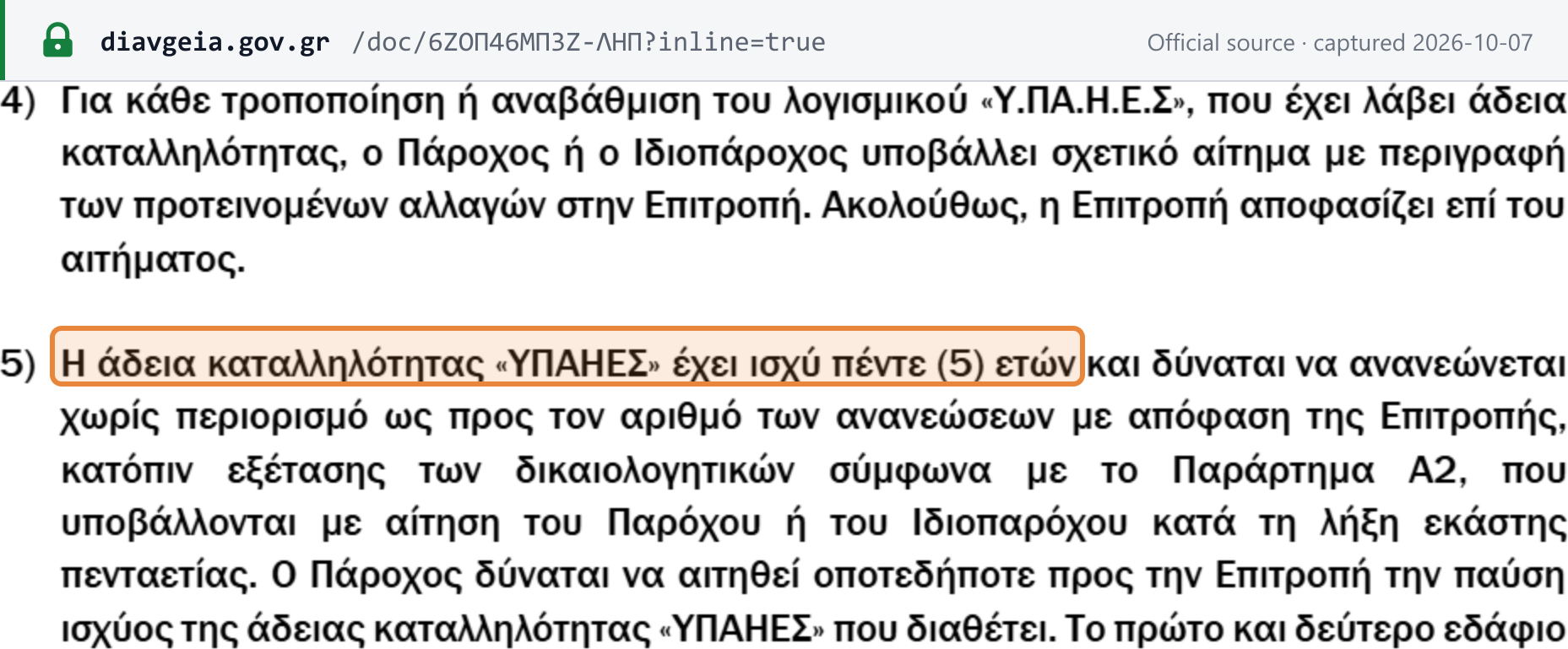
- Licence. Provider software needs an AADE suitability licence (άδεια καταλληλότητας ΥΠΑΗΕΣ), granted by a standing five-member committee. It lasts 5 years and can be renewed without limit (A.1112 art. 4(5)). Licences granted under the old A.1035/2020 are covered.
- Spec updates. Providers must comply within 15 days of each new myDATA version going live (art. 4(6)).
- Official list. AADE publishes the licensed software. It held 40 entries as at 2026-10-07.
- Loss of licence. Penalty points trigger a warning at 75 and automatic revocation at 100 (art. 11(2)); points expire after 5 calendar years. After revocation, users may not use the software once the deadline in the revocation decision passes, and it can no longer be sold in Greece (art. 12(3)). A provider that stops on its own must give clients at least 2 months' written notice (art. 5(7)). On exit it hands the retained invoices to the client, or to the new provider with the client's agreement; on final shutdown or revocation, the data go to AADE.
(A.1112/2025; AADE — licensed provider software)
 Source snapshot captured 2026-10-07 — original
Testing and connection modes
- Test environment. Register at
https://mydata-dev-register.azurewebsites.net; the test API base ishttps://mydataapidev.aade.gr/. - Production registration is through AADE's myDATA application (TAXISnet login).
- Authentication. Each call sends a username and a subscription key in the HTTP headers.
- Channels AADE lists: providers, timologio, ERP (for in-scope invoices only until the transitional window closes on 31 January 2027; ERP-direct transmission ends from 1 February 2027), the special manual-entry form, and fiscal devices for retail.
(AADE — myDATA test environment; AADE — myDATA API documentation v2.0.2)
Penalties
Checked against the official sources cited in this section as at 2026-10-07.
AADE circular E.2004/2026 treats an in-scope invoice issued any way other than the prescribed channels, for example by hand or "εμπορικό/λογιστικό πρόγραμμα ERP", as not issued. The only exception is loss of connection through a power or internet outage. The fines of art. 57(5) and (6) of the Tax Procedure Code (Law 5104/2024) then apply. Figures as at 2026-10-07, from the April 2024 text of the Code:
| Breach | Fine | Law 5104/2024 |
|---|---|---|
| Invoice not issued, VAT-able transaction (includes an in-scope e-invoice issued outside a provider or timologio) | 50% of the VAT on the unissued document; minimum per audit EUR 250 (single-entry books) or EUR 500 (double-entry) | art. 57(6) |
| Invoice not issued, non-VAT transaction | EUR 500 (single-entry) or EUR 1,000 (double-entry) per audit | art. 57(5) |
| Issuer fails to transmit invoice data to myDATA | 10% of the net value of each document, capped at EUR 250 a day | art. 58(3)(α) |
| Late transmission to myDATA | 50% of the non-transmission fine | art. 58(5) |
| Repeat offences | Fine doubled, then quadrupled | art. 67 |
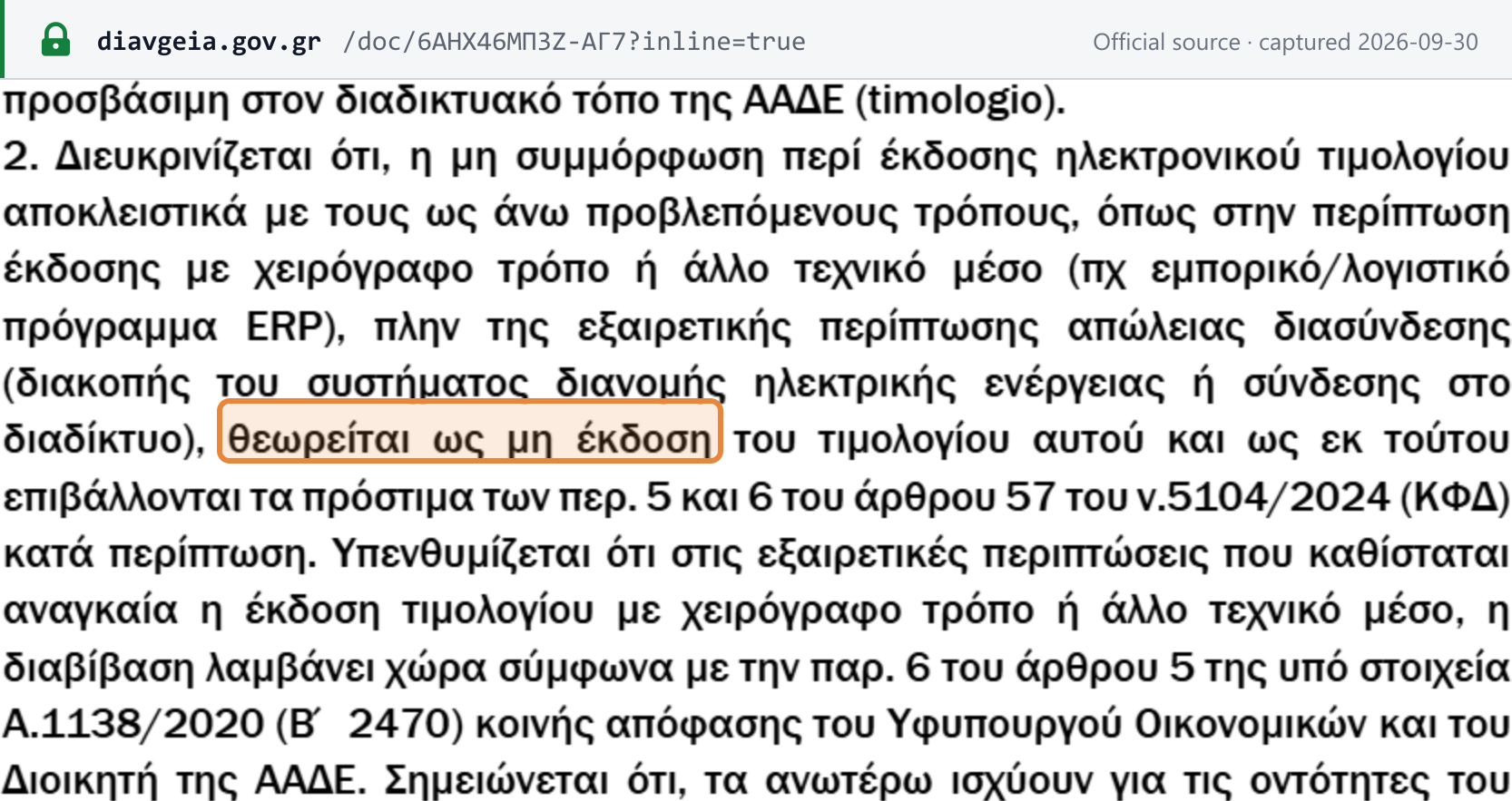 Source snapshot captured 2026-09-30 — original
Enforcement posture. The fines apply from each entity's start date under A.1128, outside its parallel-use window. E.2004 and the decisions setting the phases (A.1128, A.1044, A.1197) state no separate penalty start date or grace period. Providers face their own penalty-point regime (see Accreditation).
Frequently asked questions
We are under EUR 1 million. When do we start, and can we keep our ERP?
You start on 2 November 2026, moved from 1 October 2026 by Joint Decision A.1197/2026. Until 31 January 2027 you may keep issuing from your ERP, or by hand with the myDATA special form, in parallel, if your start declaration is dated no later than 2 November 2026. From 1 February 2027, in-scope invoices and their myDATA transmission go only through a provider or timologio/myDATAapp. An ERP can still feed a provider, but it cannot transmit directly. (A.1197/2026; AADE press release, 30 September 2026)
Is Greek B2B e-invoicing based on Peppol or EN 16931?
Not for B2B. AADE's decisions prescribe issuing through a licensed provider or timologio, with transmission to myDATA in AADE's own XML (API v2.0.2). None of A.1112, A.1128, A.1044 or A.1197 mentions EN 16931, Peppol or UBL. B2G invoices are different: they follow EN 16931 and the Greek CIUS of PEPPOL BIS 3.0, sent over Peppol to the GSIS Interoperability Centre. (AADE myDATA API v2.0.2; GSIS Greek CIUS guide v8.2)
Do we have to e-invoice our business customers in other EU countries?
No. A.1128/2025 covers domestic B2B, B2B with customers outside the EU and B2G. Intra-EU B2B is not listed. (A.1128/2025 art. 1(1))
Do sales to consumers change?
No. AADE states that mandatory e-invoicing brings no change to the documents issued to final consumers; retail stays on the existing regime. (AADE press release, 22 September 2026)
Must we accept e-invoices even if our own start date is 2 November 2026?
Yes. Since 2 March 2026 every entity subject to Law 4308/2014 must accept e-invoices for domestic B2B and B2G transactions, whatever its own issuing phase. (A.1044/2026, new art. 2(3) of A.1128)
What if our provider loses its licence?
AADE revokes a licence automatically at 100 penalty points. After revocation you may not use the software once the deadline in the revocation decision passes. The provider hands your retained invoices back to you, or to your new provider if you agree, and you move to another licensed provider or to timologio. A provider leaving voluntarily must give at least 2 months' written notice. (A.1112/2025 arts. 5, 11, 12)
What is the penalty for a paper or ERP invoice after our start date?
Outside the parallel-use window, AADE treats it as not issued (circular E.2004/2026). For a VAT-able transaction the fine is 50% of the VAT on the invoice, with a minimum per audit of EUR 250 (single-entry books) or EUR 500 (double-entry). The only exception is loss of connection through a power or internet outage. (E.2004/2026; Law 5104/2024 art. 57(6))
We are a foreign company selling to a Greek ministry. What do we do?
Use a Peppol-certified service provider, in Greece or elsewhere, and send an EN 16931 invoice in the Greek CIUS of PEPPOL BIS 3.0 to the shared Peppol endpoint 9933:997001671 at the National Interoperability Centre. None of A.1128, A.1197, A.1129, A.1112, E.2004 or AADE's e-invoicing FAQ addresses whether a foreign business that is only VAT-registered in Greece must issue B2B invoices through a provider (as at 2026-10-07). (GSIS instructions for foreign B2G providers, February 2026)
Recent changes
- 2026-09-30 — Joint Decision A.1197/2026 (ΦΕΚ Β΄ 5905/30.09.2026) moved Phase 2 from 1 October to 2 November 2026, with parallel use to 31 January 2027; from 1 February 2027 in-scope invoices go only through a provider or the AADE applications. (Diavgeia — A.1197/2026) — see event · issue
- 2026-05-03 — Phase 1 parallel use ended; Phase 1 invoices go only through a provider or timologio. (Diavgeia — A.1044/2026)
- 2026-03-02 — Phase 1 started for entities with 2023 gross revenue above EUR 1,000,000, moved from 2 February 2026; every Law 4308/2014 entity must accept e-invoices for domestic B2B and B2G. (Diavgeia — A.1044/2026)
- 2026-02-13 — AADE circular E.2004/2026: an in-scope invoice issued outside a provider or timologio counts as not issued and attracts art. 57 fines. (Diavgeia — E.2004/2026)
Ahead — scheduled changes that have not yet taken effect:
- 2026-11-02 — Phase 2: all remaining Law 4308/2014 entities must e-invoice through a provider or timologio/myDATAapp. (Diavgeia — A.1197/2026) — see event
- 2027-02-01 — ERP-direct transmission to myDATA ends for in-scope invoices. (AADE press release)
For the full chronology, see Greece tax changes on Lookuptax.
Related resources
- Greece VAT guide — rates, registration, invoice content, retention and the e-invoicing summary
- Greece tax identification numbers — the AFM that identifies issuer and buyer
- Validate a Greek VAT number
- Greece tax-change chronology — every tracked Greek change, dated and sourced
- E-invoicing status and networks worldwide — Greece's row in global context
- Peppol network explainer and Peppol requirements by country
- ViDA — VAT in the Digital Age — the EU framework for intra-EU e-invoicing, outside today's Greek mandate
- How to verify an EU VAT number (VIES)
- Other EU mandates: Poland (KSeF), Croatia (Fiskalizacija), Bulgaria, Hungary (Online Számla)
Important websites
- AADE — myDATA — the electronic-books platform and provider information
- AADE — timologio and myDATAapp — AADE's free issuing applications
- AADE — licensed e-invoicing provider software
- AADE — myDATA test environment and technical specifications
- AADE — start declaration (myAADE login)
- AADE — mandatory e-invoicing FAQ
- GSIS — B2G e-invoicing, invoice tools and invoice trace
Reference links
- GSIS — KYA 52445 ΕΞ 2023 (ΦΕΚ Β΄ 2385/12.04.2023), B2G e-invoicing phase-in
- Diavgeia — Joint Decision A.1044/17.02.2026 (ΦΕΚ Β΄ 880)
- Diavgeia — Joint Decision A.1197/30.09.2026 (ΦΕΚ Β΄ 5905/30.09.2026)
- AADE and Ministry of National Economy and Finance — press release of 30 September 2026
- Diavgeia — Joint Decision A.1128/15.09.2025 (ΦΕΚ Β΄ 4937)
- Diavgeia — Decision A.1112/01.08.2025 (ΦΕΚ Β΄ 4206)
- Diavgeia — Circular E.2004/13.02.2026
- AADE — Decision A.1129/16.09.2025 (ΦΕΚ Β΄ 4938)
- Εθνικό Τυπογραφείο — Law 5104/2024, Tax Procedure Code (ΦΕΚ Α΄ 58/2024)
- AADE — myDATA REST API documentation for providers v2.0.2
- GSIS — Greek CIUS of PEPPOL BIS 3.0, guide v8.2
- GSIS — instructions for foreign B2G providers (February 2026)
- AADE — e-invoicing providers
- AADE — Mandatory Electronic Invoicing & Digital Goods Movement Documents (English)