E-invoicing in Vietnam: hóa đơn điện tử under Decree 254 and Circular 91
Overview
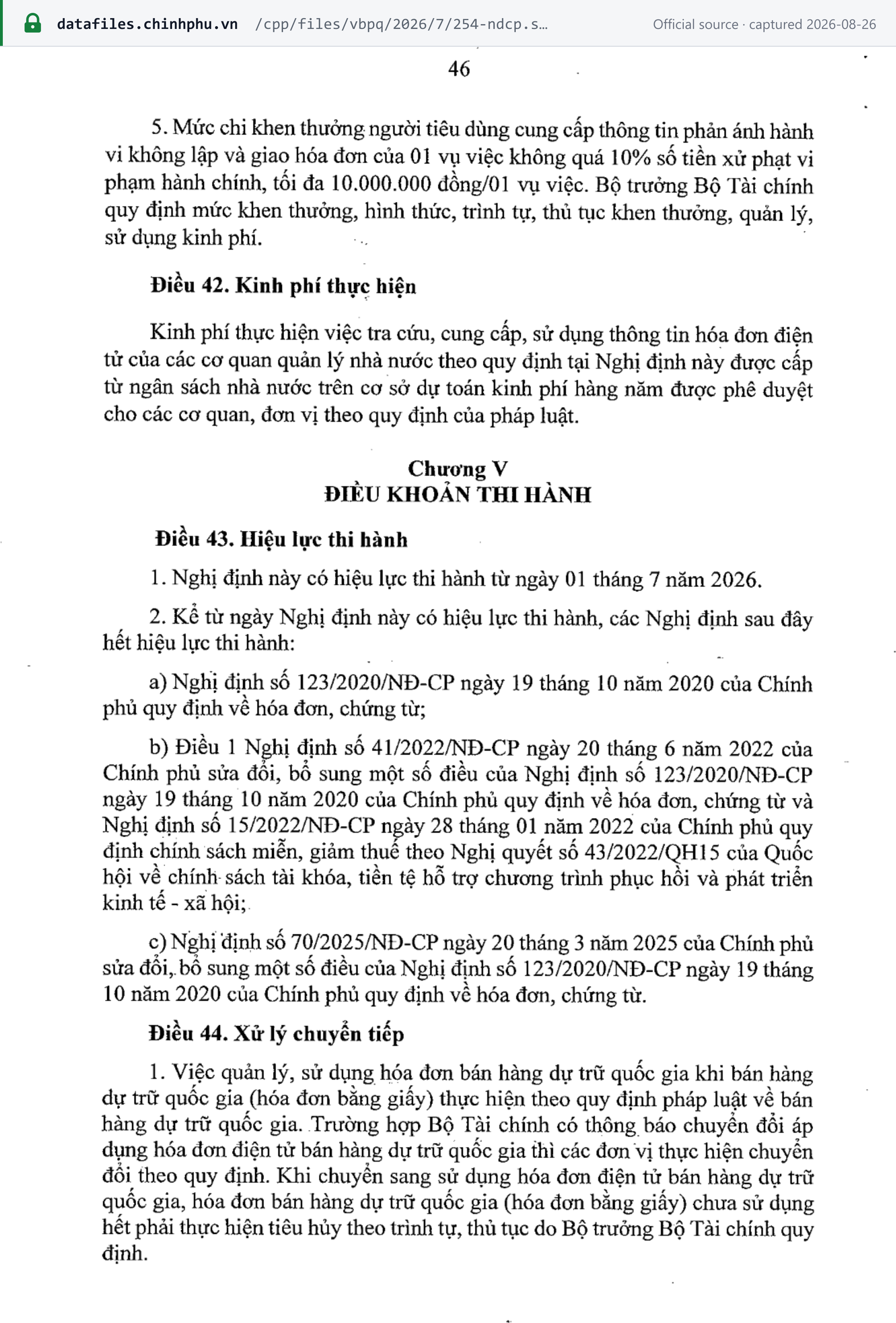
Vietnam's e-invoice is the hóa đơn điện tử. Every seller of goods and services issues one, and has done since the nationwide switch on 1 July 2022. The rules were rebuilt on 1 July 2026. Tax Administration Law No. 108/2025/QH15 now carries the e-invoice chapter (Chương III, Điều 26–27). Decree No. 254/2026/NĐ-CP and Circular No. 91/2026/TT-BTC implement it. Together they replaced Decree 123/2020/NĐ-CP, Decree 70/2025/NĐ-CP and Circular 32/2025/TT-BTC. (Decree 254/2026, Article 43; Circular 91/2026, Article 25(2), checked 2026-09-24)
The law recognises three forms of e-invoice:
- Coded (hóa đơn điện tử có mã của cơ quan thuế). The tax authority puts its code on the invoice before the seller sends it to the buyer. This is a clearance model.
- Non-coded (hóa đơn điện tử không có mã của cơ quan thuế). The seller sends it to the buyer without a code and transmits the data to the tax authority afterwards.
- Cash-register (hóa đơn điện tử khởi tạo từ máy tính tiền có kết nối dữ liệu điện tử với cơ quan thuế). It is issued from a point-of-sale system connected to the tax authority. It may be coded, non-coded, or bare electronic data from which the buyer retrieves the invoice.
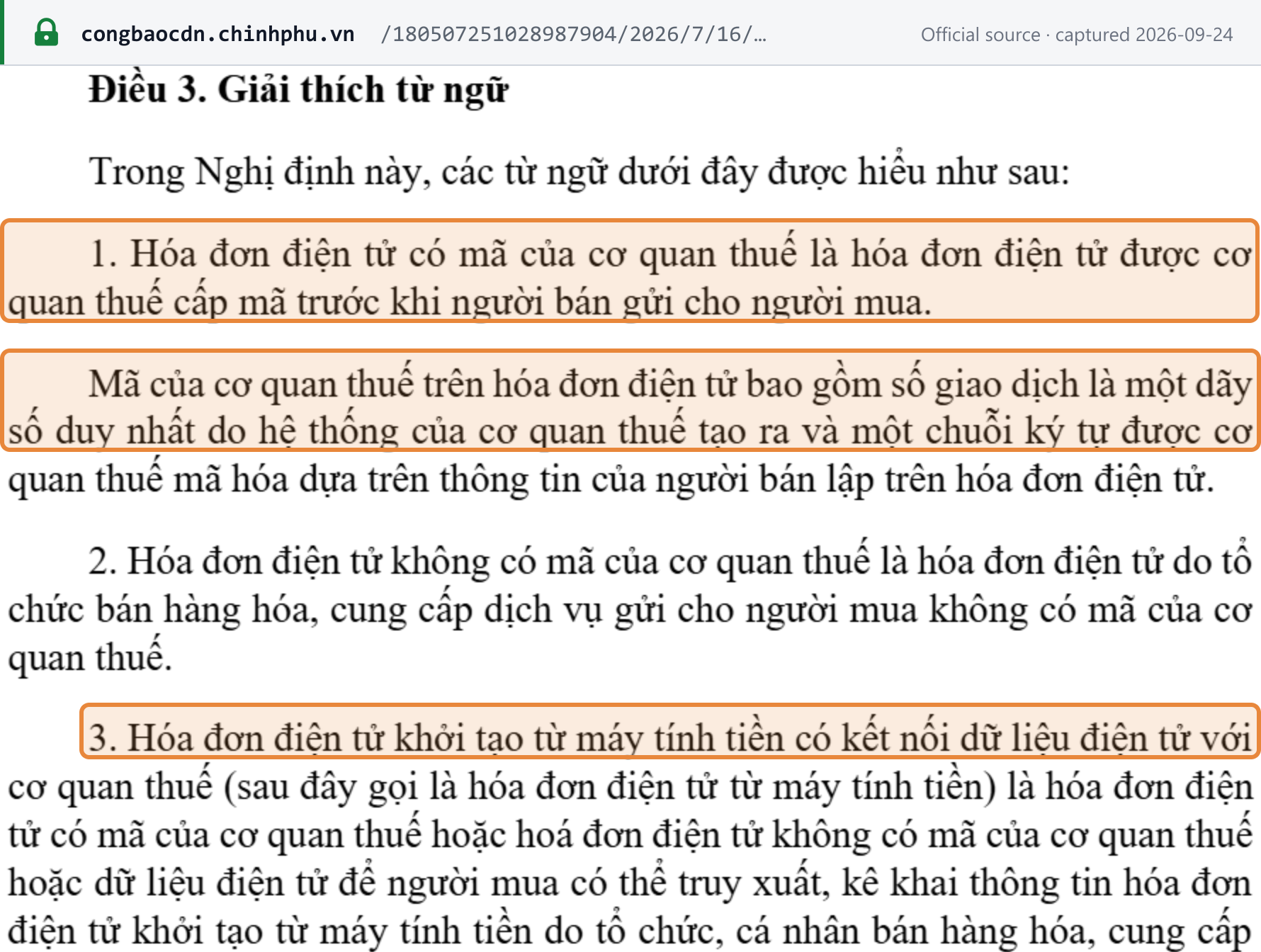
Decree 254 defines the code itself. Article 3(1) reads: "Hóa đơn điện tử có mã của cơ quan thuế là hóa đơn điện tử được cơ quan thuế cấp mã trước khi người bán gửi cho người mua." (A tax-authority-coded e-invoice is one the tax authority codes before the seller sends it to the buyer.) The code is "số giao dịch là một dãy số duy nhất do hệ thống của cơ quan thuế tạo ra và một chuỗi ký tự được cơ quan thuế mã hóa dựa trên thông tin của người bán lập trên hóa đơn điện tử" (a transaction number, a unique string of digits generated by the tax authority's system, and a character string the tax authority encrypts from the information the seller entered on the e-invoice). (Decree 254/2026, Article 3, checked 2026-09-24)
 Source snapshot captured 2026-09-24 — original
Who runs it. The Cục Thuế (Tax Department) under the Ministry of Finance runs the system. Circular 91 records the rename: "Cục Thuế (trước ngày 01 tháng 3 năm 2025 là Tổng cục Thuế)" (the Tax Department, before 1 March 2025 the General Department of Taxation). Invoices are coded and received on the Hệ thống thông tin quản lý thuế (tax-management information system). The Cục Thuế's coding system codes invoices automatically and returns the result to the sender. (Circular 91/2026, Article 24(1); Decree 254/2026, Article 12(2)(b), checked 2026-09-24)
Legal basis in one line. Law 108/2025 Article 26 is the statute. Decree 254 details Article 26(6), which covers types, users, content, timing and exclusions. Circular 91 details Article 26(4) and (7), which cover registration, format, symbols, corrections and the consumer reward. The full list is under Legal basis.
For VAT rates, invoice content and the rest of Vietnam's indirect-tax rules, see the Vietnam VAT guide.
| Vietnam | |
|---|---|
| Status | Mandatory for every seller of goods and services since 1 July 2022. Current regime: Law 108/2025/QH15, Decree 254/2026/NĐ-CP and Circular 91/2026/TT-BTC, in force 1 July 2026 |
| B2B | Mandatory. Tax-authority-coded invoices by default; non-coded invoices for named sectors and IT-capable enterprises |
| B2G | No separate channel. Suppliers to State bodies issue the ordinary e-invoice, and the buyer field accepts a budget-relation unit code |
| B2C | Mandatory. Sellers in the direct-to-consumer sectors listed in Decree 254 Article 6(1)(c) use cash-register e-invoices unless already registered for coded or non-coded invoices; household and individual businesses with annual revenue above VND 1 billion use coded or cash-register e-invoices |
| Non-residents | Foreign e-commerce and digital-platform suppliers may register voluntarily (Decree 254 Article 2(1)(đ); Circular 91 Article 6(1)). No e-invoice obligation is imposed on them |
| Format | XML, national schema built and published by the Cục Thuế (Circular 91 Article 3). Not Peppol, not UBL |
| Network | The Cục Thuế tax-management information system, reached through a licensed e-invoice service provider. Direct connection is open to enterprises averaging at least 1,000,000 invoices a month and to parent companies with a central invoice-data system |
| Integrity | Seller's digital signature; tax-authority code (unique transaction number + encrypted string) on coded invoices; link or QR code for buyer lookup |
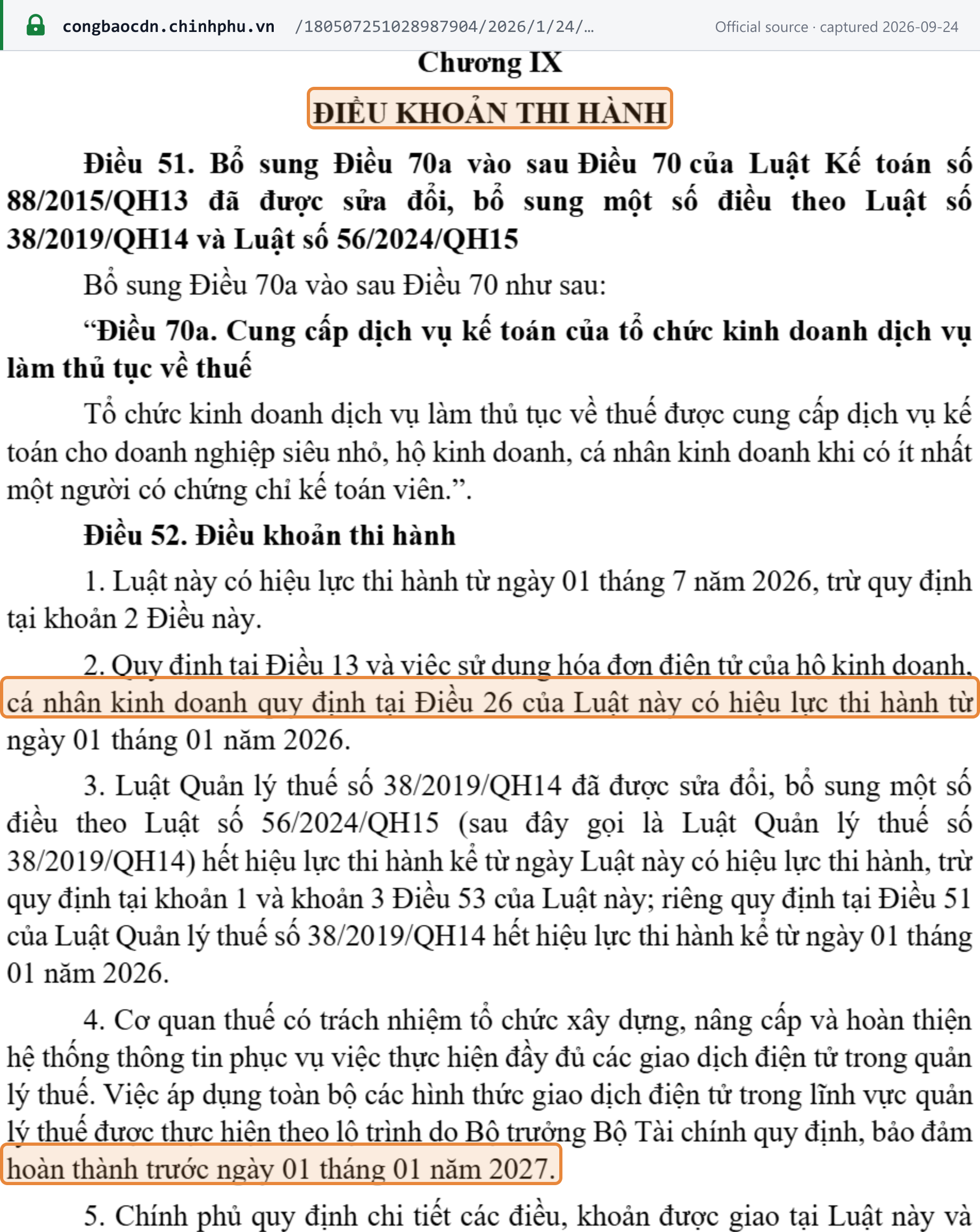
| Key dates | 2022-07-01 nationwide e-invoicing · 2026-01-01 household/individual-business e-invoice use under Law 108 · 2026-07-01 Decree 254 and Circular 91 in force · 2026-12-31 last day for paper receipts |
| Authority | Cục Thuế (Tax Department), Ministry of Finance (the General Department of Taxation until 1 March 2025) |
| Legislation | Law 108/2025/QH15 Articles 26–27; Decree 254/2026/NĐ-CP; Circular 91/2026/TT-BTC; penalties in Decree 125/2020/NĐ-CP as amended |
Mandate status & timeline
| Phase | Scope | What applies | Date | Instrument | Status |
|---|---|---|---|---|---|
| Nationwide switch | All sellers | E-invoices replace paper invoices | 1 July 2022 | Decree 123/2020/NĐ-CP, Article 59(1) [1] | Passed. Decree 123/2020 repealed from 1 July 2026 |
| Amending decree | All sellers | Decree 70/2025/NĐ-CP amends Decree 123/2020 | 1 June 2025 | Decree 70/2025/NĐ-CP [2] | Passed. Repealed from 1 July 2026 |
| Early commencement | Household and individual businesses | E-invoice use under Law 108 Article 26 | 1 January 2026 | Law 108/2025/QH15, Article 52(2) [3] | Passed |
| Current regime | All sellers | Decree 254 and Circular 91 replace Decree 123/2020, Decree 70/2025 and Circular 32/2025 | 1 July 2026 | Decree 254/2026, Article 43; Circular 91/2026, Article 25 [4] | In force (hard date) |
| Paper receipts end | Issuers of tax, fee and charge receipts | Unused paper receipts may be used until 31 December 2026, then destroyed; e-receipts from 1 January 2027 | 31 December 2026 | Decree 254/2026, Article 44(2) [4] | Upcoming |
| Tax administration roadmap | The tax authority | All forms of electronic transaction in tax administration in place | before 1 January 2027 | Law 108/2025/QH15, Article 52(4) [3] | Roadmap (Minister of Finance sets the steps) |
The latest change is the 1 July 2026 reset. It is a hard date with no transition window for the core rules. Three transitional points survive it:
- Paper receipts. Unused self-printed or ordered paper receipts (biên lai giấy) under Decree 123/2020 may be used until 31 December 2026. From 1 January 2027 every unused one must be destroyed and the issuer must switch to e-receipts. (Decree 254, Article 44(2))
- Tax-authority printed invoices. "Kể từ ngày Nghị định này có hiệu lực thi hành, hóa đơn đặt in của cơ quan thuế hết giá trị sử dụng." (From the date this Decree takes effect, invoices printed to the tax authority's order cease to be valid.) That date was 1 July 2026. (Decree 254, Article 44(3))
- Service-provider contracts. A provider already under a data-transmission contract with the Cục Thuế keeps working under that contract. (Circular 91, Article 24(1))
Invoices issued under Decree 123/2020, Decree 70/2025 and Circular 32/2025 are corrected under the new rules (Circular 91, Article 24(2)). No instrument in force postpones any of these dates. (Checked 2026-09-24.)
 Source snapshot captured 2026-09-24 — original
 Source snapshot captured 2026-08-26 — original
A schema change is also running. It rests on a Cục Thuế decision whose official copy we could not read. See Format & network.
Legal basis
- Luật Quản lý thuế số 108/2025/QH15 (Tax Administration Law). Passed by the National Assembly on 10 December 2025 and published in Công Báo No. 38 of 22 January 2026. In force 1 July 2026, with household and individual-business e-invoice use from 1 January 2026. Chương III, Articles 26 (e-invoices) and 27 (e-documents), is the statutory base. It repeals Law 38/2019/QH14 from 1 July 2026. (Công Báo record; PDF, Article 52)
- Nghị định số 254/2026/NĐ-CP (Decree 254). Signed 30 June 2026, published in Công Báo No. 402 of 16 July 2026, in force 1 July 2026. It details Law 108 Article 26(6) and Article 27(4): users and types of e-invoice, content, timing, exclusions, the coding process, service providers, information use and the consumer reward. It repeals Decree 123/2020/NĐ-CP, Article 1 of Decree 41/2022/NĐ-CP, and Decree 70/2025/NĐ-CP. (Công Báo record; PDF)
- Thông tư số 91/2026/TT-BTC (Circular 91, Ministry of Finance). Signed 30 June 2026, published in Công Báo No. 464 of 8 August 2026, in force 1 July 2026. It details Law 108 Article 26(4) and (7) and Article 27(3) and (5): the XML format, invoice symbols, registration, delegation, corrections, high-risk criteria, provider criteria and the consumer-reward procedure. It repeals Circular 32/2025/TT-BTC. Annexes I–IV are binding; Annex V (display templates) is for reference only: "các phụ lục từ Phụ lục I đến Phụ lục IV có tính bắt buộc, Phụ lục V có tính chất tham khảo (không bắt buộc)". (Công Báo record; PDF, Article 25)
- Nghị định số 125/2020/NĐ-CP (Decree 125), penalties for tax and invoice offences, Chương III (Articles 22–31 as amended; Decree 310/2025 repealed Articles 20, 21 and 23). Amended by Decree 102/2021/NĐ-CP, Decree 310/2025/NĐ-CP (in force 16 January 2026) and Decree 291/2026/NĐ-CP (21 July 2026). Decree 252/2026/NĐ-CP Article 74(4) keeps it in force after 1 July 2026 until it is replaced. See Penalties.
- The Cục Thuế's technical publication. Circular 91 Article 3(3) requires the Cục Thuế to build and publish the business-data component of the XML and the transmission method. The current decision is reported as Quyết định 1233/QĐ-CT. Its official text could not be read; see Format & network.
Repealed and historical: Decree 123/2020/NĐ-CP (in force 1 July 2022 to 30 June 2026), Decree 70/2025/NĐ-CP (1 June 2025 to 30 June 2026), and Circular 32/2025/TT-BTC.
Scope
Who issues which kind of invoice
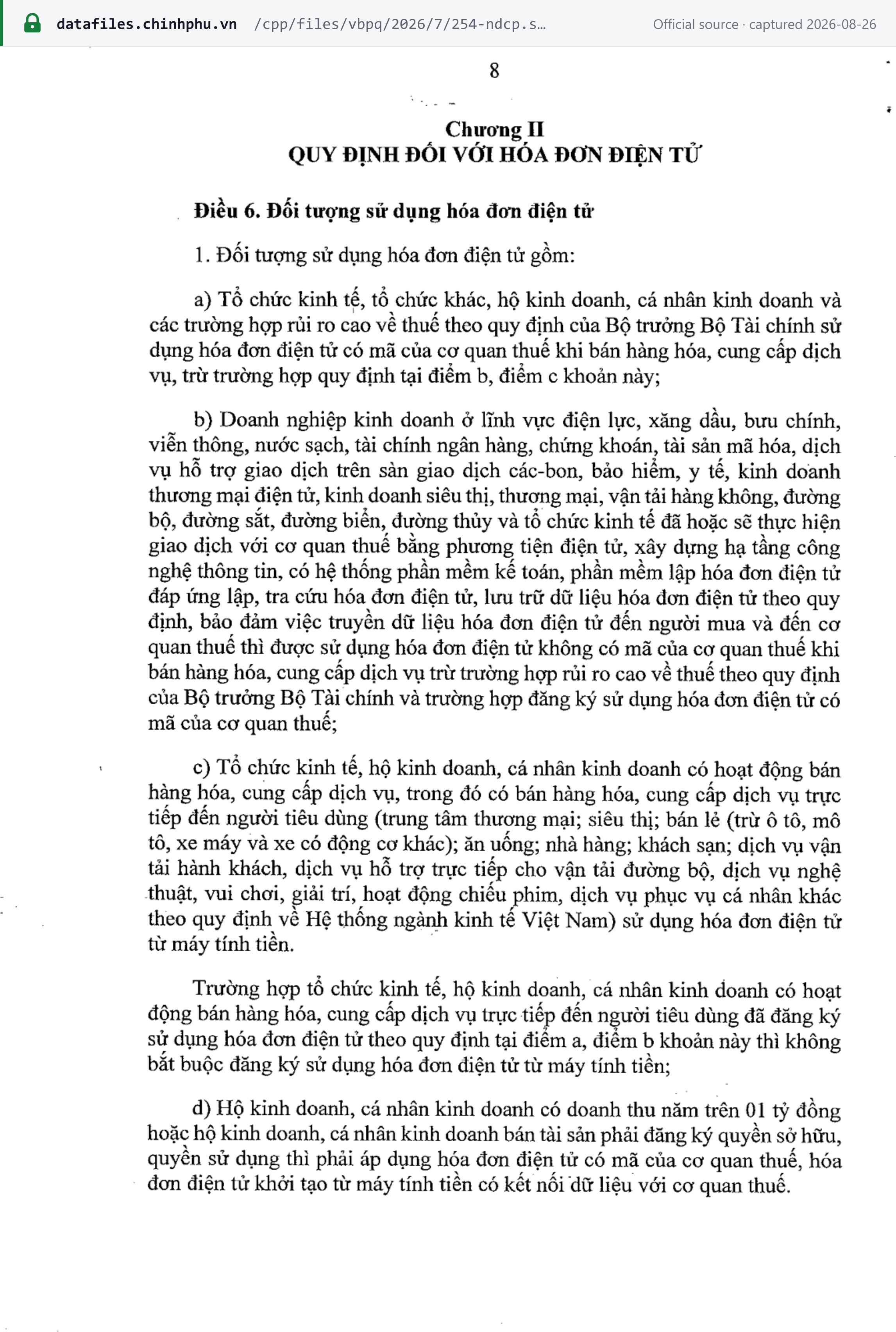
Decree 254 Article 6(1) sets out who issues which kind:
- (a) Coded, by default. Economic organisations, other organisations, household and individual businesses, and anyone the Minister of Finance classes as high tax risk use coded e-invoices, unless (b) or (c) applies.
- (b) Non-coded, by sector or capability. Enterprises in the listed sectors may use non-coded invoices. The sectors are electricity, petroleum, post, telecoms, clean water, banking and finance, securities, crypto assets, carbon-exchange support services, insurance, health, e-commerce, supermarkets, commerce, and air, road, rail, sea and waterway transport. So may any economic organisation that transacts with the tax authority electronically and has compliant accounting and invoicing software. Both lose the right if they are assessed as high-risk or register for coded invoices.
- (c) Cash-register e-invoices for direct-to-consumer sales. This covers shopping centres, supermarkets, retail (except cars, motorcycles, mopeds and other motor vehicles), food and drink, restaurants, hotels, passenger transport, road-transport support services, arts, entertainment, cinemas and other personal services. A seller already registered under (a) or (b) is not required to add cash-register invoices.
- (d) Household and individual businesses above VND 1 billion. These sellers must use coded or cash-register e-invoices if their annual revenue is above VND 1 billion, or if they sell assets that need ownership or use-right registration. The text reads "doanh thu năm trên 01 tỷ đồng", meaning strictly above VND 1 billion. (Decree 254/2026, Article 6, checked 2026-09-24)
 Source snapshot captured 2026-08-26 — original
A non-coded user flagged as high-risk must switch to coded invoices within 10 working days of the tax office's notice (Mẫu 01/TB-KTT). It may apply to switch back after 12 months. (Circular 91/2026, Article 11(2), checked 2026-09-24)
B2B
B2B invoicing is mandatory. The same e-invoice serves domestic B2B, B2C and export. The CTC model depends on which kind the seller uses: clearance for coded, post-issue reporting for non-coded. See Format & network. The buyer is identified by name, address and tax code (mã số thuế), or by a budget-relation unit code or personal identification number. (Decree 254/2026, Article 10(1)(d)). For the format of the Vietnamese tax code, see the Vietnam tax ID guide.
B2G
No separate B2G system. Decree 254, Circular 91 and Law 108 set up no dedicated public-procurement invoicing channel or portal (checked 2026-09-24). A supplier to a State body issues the ordinary e-invoice. The mandatory buyer field accepts "mã số thuế hoặc mã số đơn vị có quan hệ với ngân sách hoặc số định danh cá nhân" (a tax code, a budget-relation unit code or a personal identification number) (Decree 254, Article 10(1)(d)). Sales of public assets have their own invoice type (form digit 3).
B2C
B2C invoicing is mandatory. Sellers in the direct-to-consumer sectors listed in Decree 254 Article 6(1)(c) use cash-register e-invoices unless already registered for coded or non-coded invoices; household and individual businesses with annual revenue above VND 1 billion use coded or cash-register e-invoices. Cash-register invoices do not require a digital signature ("Không bắt buộc có chữ ký số", Decree 254, Article 8(9)(b)) and carry a reduced field set: seller details; buyer details only on request; goods, quantity, price and amount; the time; and the tax code or lookup data (Article 10(4)). The seller may deliver the invoice electronically or give the buyer "đường dẫn hoặc mã QR" (a link or QR code) to look it up and download it. A coded seller sends cash-register invoice data to the tax authority at the end of each day (Article 15(3)).
If the consumer gives no name, address or ID, the invoice is marked "Bán cho người tiêu dùng" (sold to a consumer). Such an invoice, or one with no buyer details, "không có giá trị để tổ chức kinh tế, cơ quan, tổ chức khác, hộ kinh doanh, cá nhân kinh doanh sử dụng vào mục đích hạch toán chi phí hoặc quyết toán thuế" (has no value for economic organisations, agencies, other organisations, household or individual businesses to use for booking costs or for tax finalisation). (Decree 254/2026, Annex item 4, checked 2026-09-24)
This activity-based regime is Vietnam's equivalent of a simplified invoice. It is tied to the seller's activity, not to a value threshold.
Non-established businesses: voluntary, not mandatory
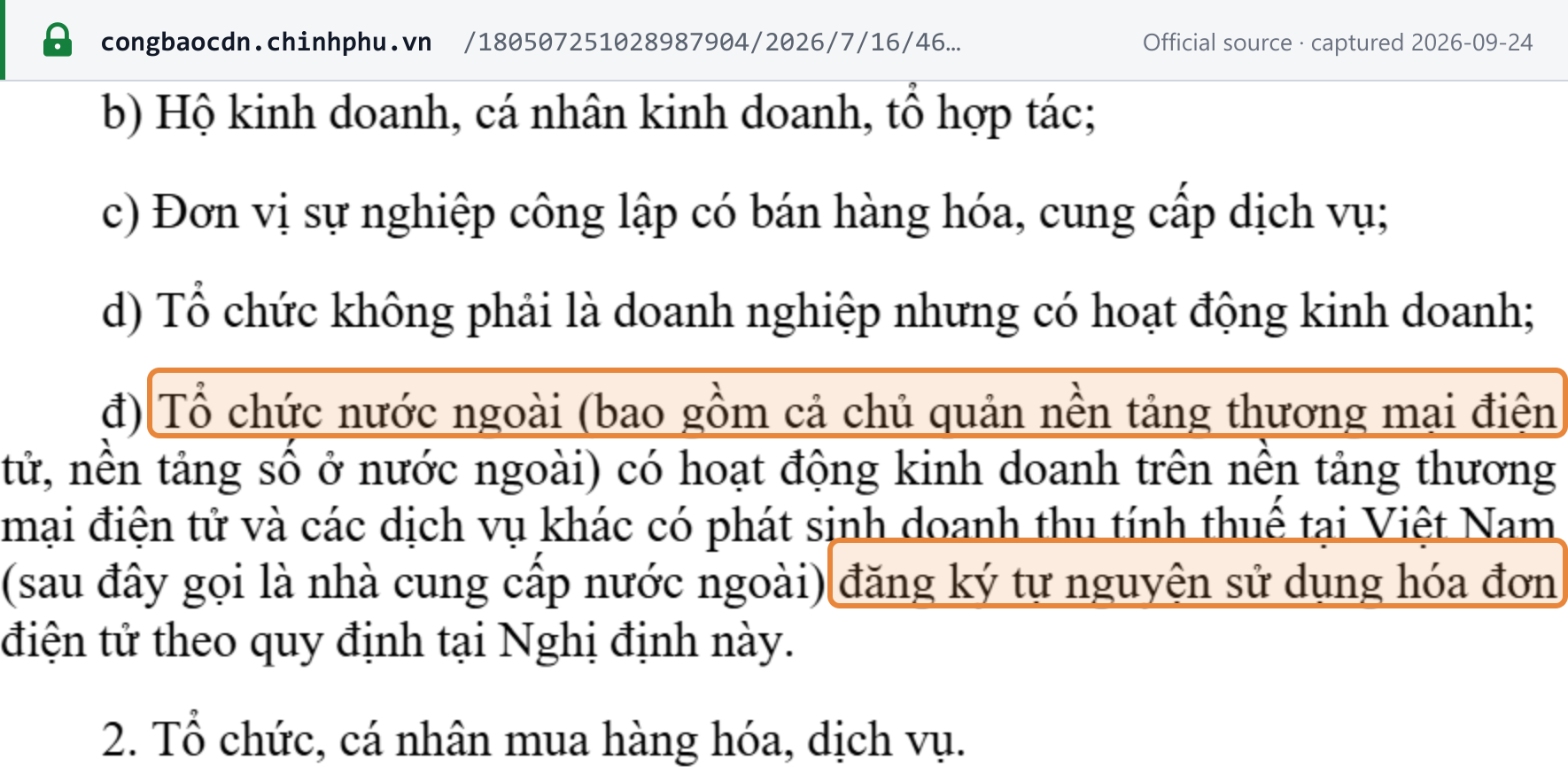
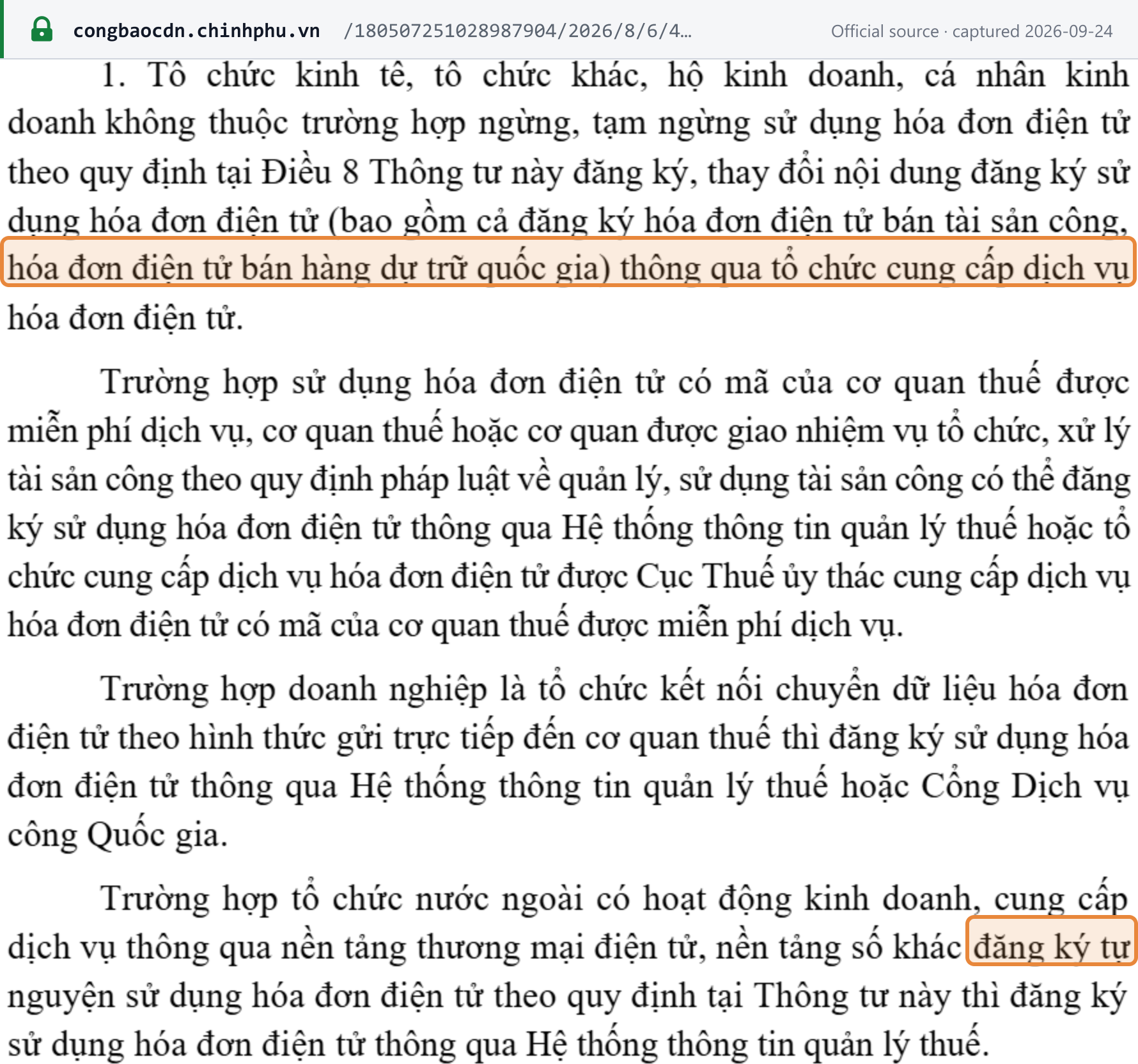
Foreign e-commerce and digital-platform suppliers are voluntary registrants. Nothing obliges them to issue Vietnamese e-invoices. Decree 254 Article 2(1)(đ) covers "Tổ chức nước ngoài (bao gồm cả chủ quản nền tảng thương mại điện tử, nền tảng số ở nước ngoài)" (foreign organisations, including overseas e-commerce and digital-platform operators) with taxable revenue in Vietnam, and only where they "đăng ký tự nguyện sử dụng hóa đơn điện tử theo quy định tại Nghị định này" (register voluntarily to use e-invoices under this Decree). Decree 254 calls them nhà cung cấp nước ngoài (foreign suppliers). (Decree 254/2026, Article 2(1)(đ), checked 2026-09-24)
 Source snapshot captured 2026-09-24 — original
Circular 91 Article 6(1) repeats it: "Trường hợp tổ chức nước ngoài có hoạt động kinh doanh, cung cấp dịch vụ thông qua nền tảng thương mại điện tử, nền tảng số khác đăng ký tự nguyện sử dụng hóa đơn điện tử theo quy định tại Thông tư này thì đăng ký sử dụng hóa đơn điện tử thông qua Hệ thống thông tin quản lý thuế." (Where a foreign organisation doing business or supplying services through an e-commerce or other digital platform registers voluntarily to use e-invoices under this Circular, it registers through the tax-management information system.)
Law 108 Article 26(5)(a) requires every organisation selling goods or services to issue e-invoices, "trừ trường hợp không phải sử dụng hóa đơn điện tử theo quy định của Chính phủ" (except where the Government provides that e-invoices need not be used), and Article 26(3)(a) and 26(6) leave who uses which e-invoice to the Government. Decree 254 brings foreign suppliers in only if they register voluntarily; neither the Law nor the Decree obliges a non-resident to e-invoice. (Law 108/2025, Article 26, checked 2026-09-24)
The Law's separate non-resident rule is in Article 12(2): foreign platform businesses must "trực tiếp hoặc ủy quyền thực hiện việc khai, nộp thuế, khoản thu khác tại Việt Nam" (declare and pay tax and other revenues in Vietnam directly or through an authorised party). That tax obligation is separate from e-invoicing. (Law 108/2025, Article 12, checked 2026-09-24)
A foreign supplier that opts in follows these rules:
- It registers through the tax system itself. Form 01/ĐKTĐ-HĐĐT has a tick box for "Hóa đơn nhà cung cấp ở nước ngoài không có cơ sở thường trú tại Việt Nam" (invoice of a foreign supplier with no permanent establishment in Vietnam).
- It uses the VAT-invoice type for e-commerce and digital-platform business (Decree 254, Article 8(1)(đ)).
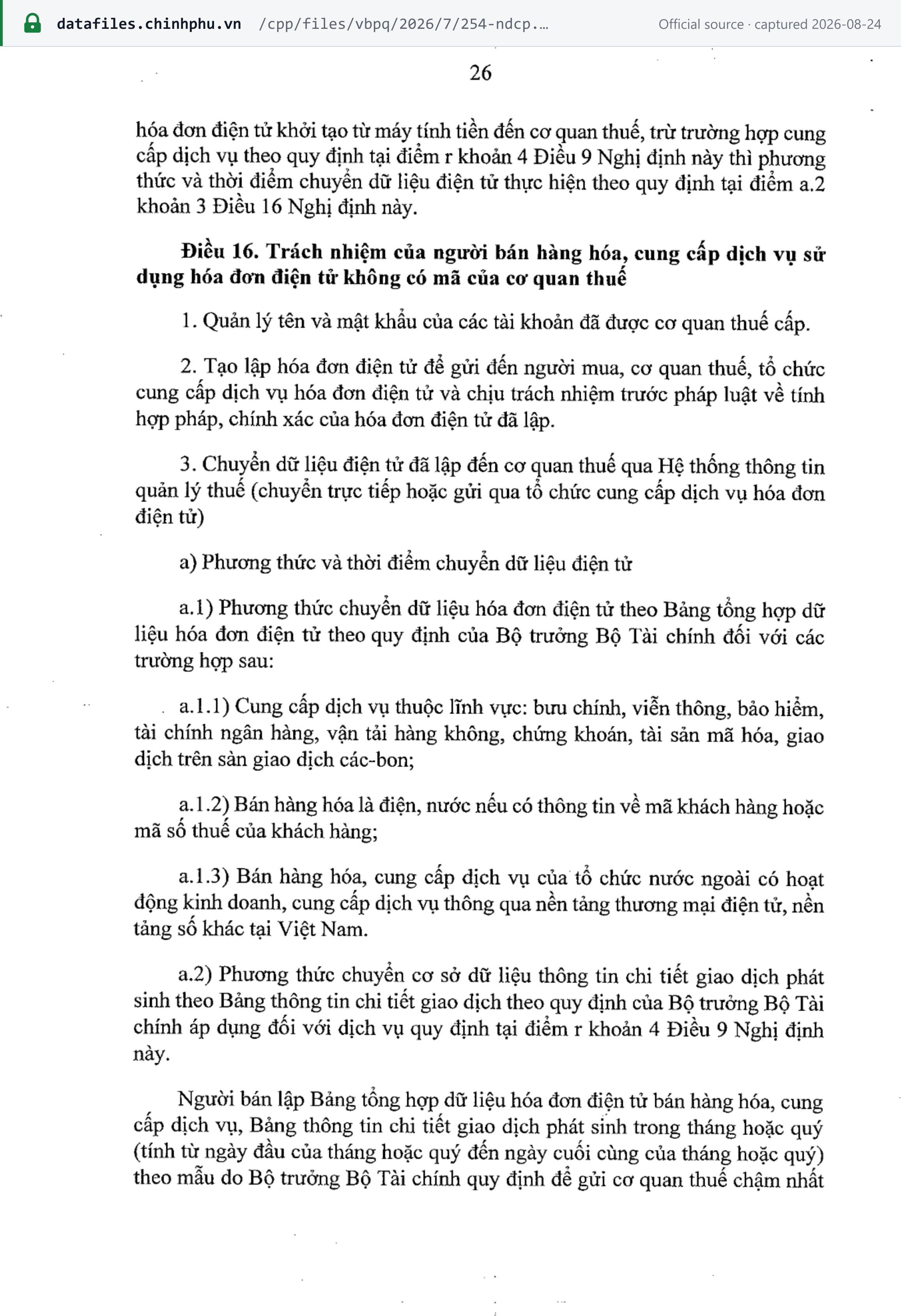
- It transmits by summary table (Decree 254, Article 16(3)(a.1.3)).
- It signs with an electronic signature under e-transactions law, not a Vietnamese digital signature (Decree 254, Annex item 6).
Branches and representative offices of foreign enterprises operating in Vietnam are not foreign suppliers. Decree 254 Article 2(1)(a) counts them as tổ chức kinh tế (economic organisations), and they follow the domestic rules.
Exports and imports
- Exports. An exporter that transmits commercial-invoice data electronically to the tax authority issues a hóa đơn thương mại điện tử (commercial e-invoice; form digit 7, letter X). Otherwise it issues an electronic VAT or sales invoice. The exporter chooses when to issue, but no later than the next working day after the goods clear customs. (Decree 254/2026, Articles 8(3) and 9(1), checked 2026-09-24)
- Imports. Decree 254 contains no import-invoice rule; customs documents the import. The one import case it covers is a consignment import: the consignee invoices the principal if it paid the import VAT, and otherwise uses an internal despatch note (Article 6(3)(a)). (Checked 2026-09-24.)
Excluded transactions
Decree 254 Article 7, "Trường hợp không phải sử dụng hóa đơn điện tử" (cases where e-invoices need not be used), lists these exclusions:
- Household and individual businesses covered by a purchase listing (bảng kê thu mua) under CIT law, unless they register to use e-invoices.
- Household and individual businesses earning real-estate rental income, or supplying digital entertainment, games, film, photo, music or advertising content to overseas customers.
- Lottery, insurance and multi-level-marketing agents whose principal has withheld the tax.
- Reinsurance fees and receipts, deposit-taking, primary issues of deposit certificates, securities and valuable papers, debt sales, and foreign-exchange and derivative trades. For FX sales a month-end detailed summary is kept and produced on request.
- Capital contributions in kind.
- Internal asset transfers between a parent and its dependent units, and transfers on a split, merger or conversion.
- Machinery lent free of charge for processing.
- Goods and services moved internally or used by the business itself to continue production, and receipts unrelated to a sale such as compensation, bonuses and collections on behalf of others (Decree 181/2025, Article 6(1)(a)–(b) and Article 14(1)(b)).
(Decree 254/2026, Article 7, checked 2026-09-24)
Free-of-charge e-invoices
Some users get 12 months of free e-invoice service from first use: SMEs, co-operatives, co-operative unions, and household and individual businesses in areas with difficult or especially difficult socio-economic conditions. The Cục Thuế supplies the service itself or entrusts a provider to do so. Everyone else pays their provider under contract. Each month the tax office reviews free users and tells those who must move to a paid provider (Mẫu 01/TB-KTT). (Decree 254/2026, Article 11; Circular 91/2026, Article 6(5), checked 2026-09-24)
Per-transaction invoices from the tax office
The tax office itself issues a coded invoice for each transaction (letter L in the symbol) in three cases:
- A non-business organisation makes a taxable sale.
- A seller has ceased or suspended business, is under an invoice-suspension enforcement measure, is in court-supervised bankruptcy, or is in an explanation period.
- A State body auctions assets at a published VAT-inclusive price.
The seller requests the invoice on Mẫu 06/ĐN-PSĐT. (Decree 254/2026, Article 6(2); Circular 91/2026, Article 15, checked 2026-09-24)
Format & network
CTC model: clearance for coded invoices, reporting for non-coded
Vietnam runs two models side by side, both on the Cục Thuế's own platform:
- Coded invoices are cleared. The seller creates and digitally signs the invoice, either on the tax system or through a service provider, and sends it for coding. The Cục Thuế system checks four things: the invoice has the full Article 10 content, it uses the Ministry's format, it matches the seller's registration, and the seller is not suspended. The system then codes the invoice automatically and returns it. Only then does the seller send it to the buyer. (Decree 254/2026, Article 12, checked 2026-09-24)
- Non-coded invoices are reported after issue. The seller signs the invoice and sends it to the
buyer, then transmits the data in one of three ways (Decree 254, Article 16(3)(a)):
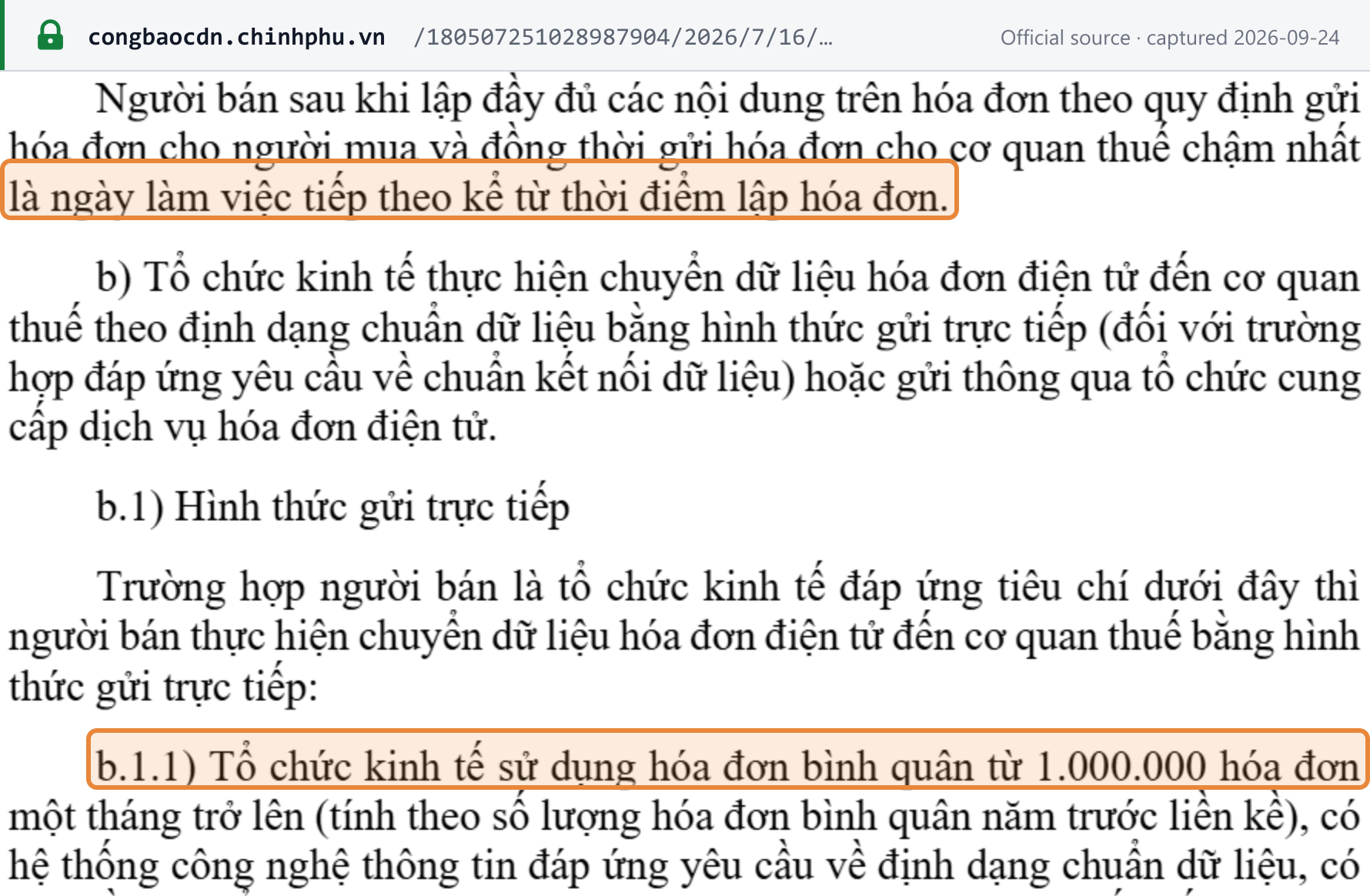
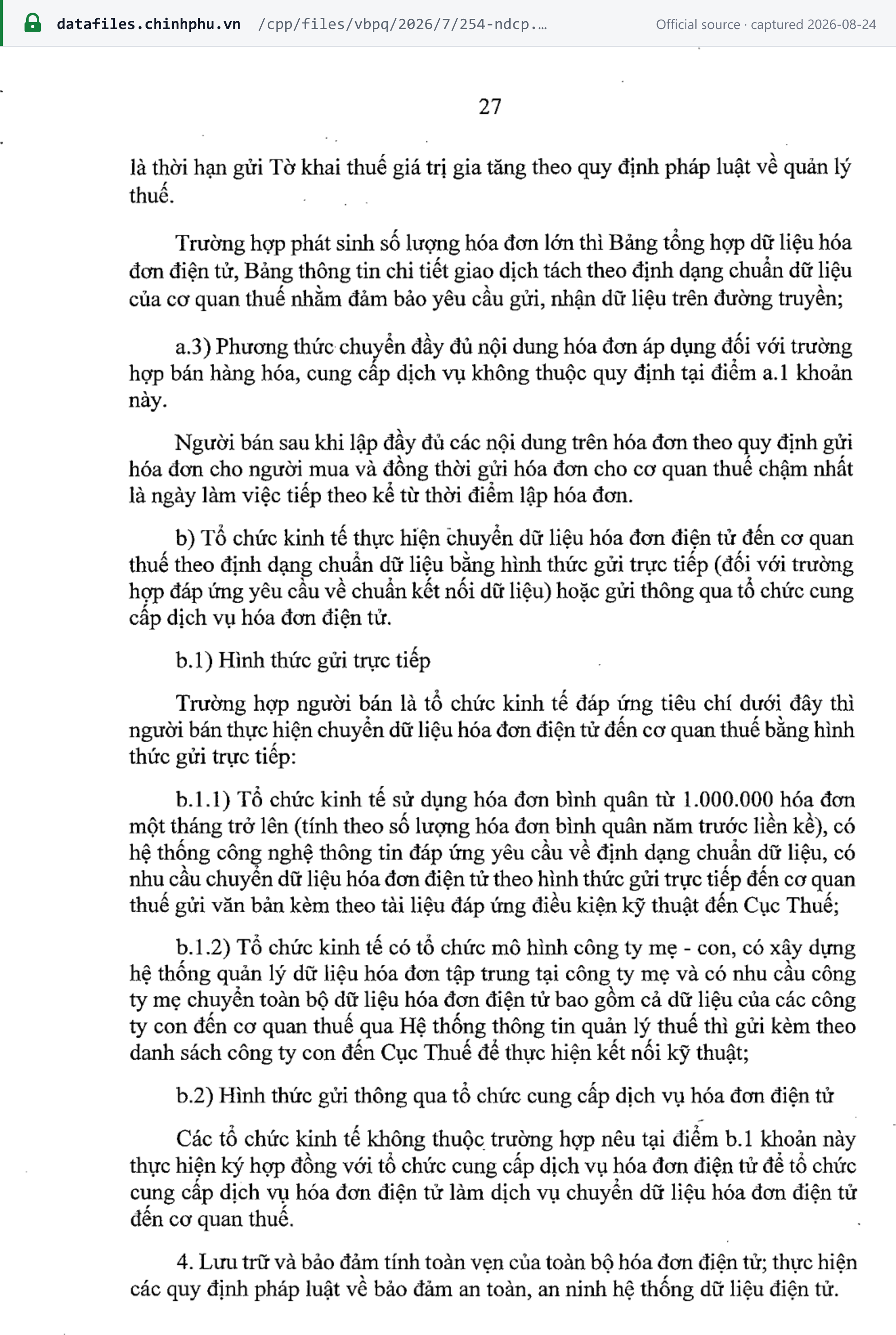
- (a.3) Full invoice content, by the next working day. This is the default. "Người bán sau khi lập đầy đủ các nội dung trên hóa đơn theo quy định gửi hóa đơn cho người mua và đồng thời gửi hóa đơn cho cơ quan thuế chậm nhất là ngày làm việc tiếp theo kể từ thời điểm lập hóa đơn." (After completing all the required content, the seller sends the invoice to the buyer and at the same time to the tax authority, no later than the next working day after the invoice time.)
- (a.1) A summary table (Bảng tổng hợp dữ liệu hóa đơn điện tử, Mẫu 01/TH-HĐĐT), filed monthly or quarterly by the VAT-return deadline. This route is for post, telecoms, insurance, banking and finance, air transport, securities, crypto assets and carbon-exchange trades; for electricity and water; and for foreign platform suppliers.
- (a.2) A detailed-transaction table (Mẫu 01/TTGD) for the consumer services listed in Article 9(4)(r).
 Source snapshot captured 2026-09-24 — original
 Source snapshot captured 2026-08-24 — original
 Source snapshot captured 2026-08-24 — original
The summary and detailed-transaction tables are Vietnam's e-reporting layer. There is no separate transaction-reporting regime on top of them.
XML format
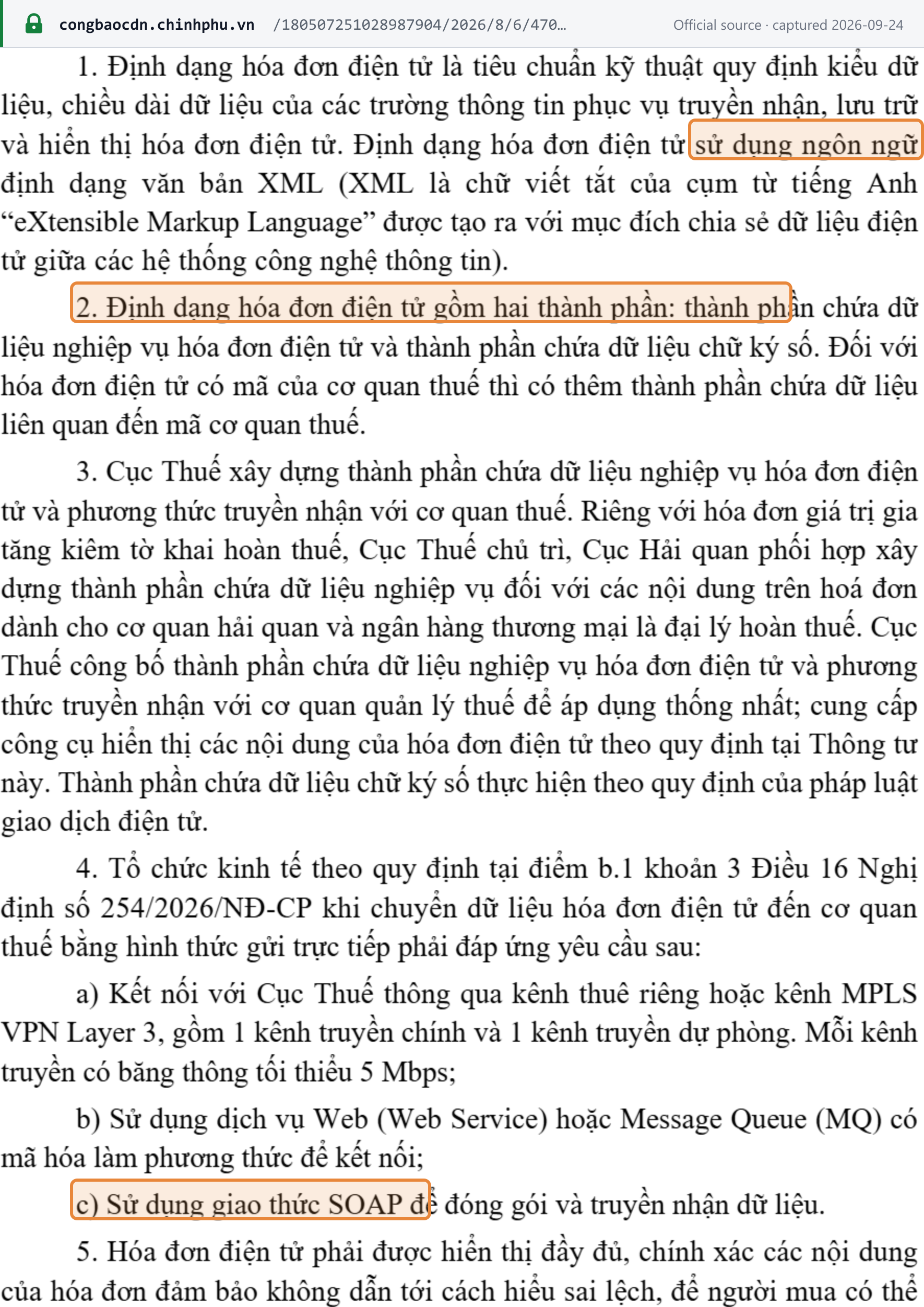
The e-invoice is XML. Circular 91 Article 3(2) reads: "Định dạng hóa đơn điện tử gồm hai thành phần: thành phần chứa dữ liệu nghiệp vụ hóa đơn điện tử và thành phần chứa dữ liệu chữ ký số. Đối với hóa đơn điện tử có mã của cơ quan thuế thì có thêm thành phần chứa dữ liệu liên quan đến mã cơ quan thuế." (The e-invoice format has two components, one for the invoice business data and one for the digital-signature data. A coded e-invoice has a third component carrying the tax-authority code data.)
- The Cục Thuế builds and publishes the business-data component and the transmission method, and provides a display tool. The signature component follows e-transactions law.
- The XML must display in full and accurately so that the buyer can read it electronically. (Circular 91/2026, Article 3, checked 2026-09-24)
 Source snapshot captured 2026-09-24 — original
The published schema is reported to have changed on 27 August 2026, under Quyết định 1233/QĐ-CT of the Cục Thuế. That decision reportedly replaces Quyết định 1306/QĐ-CT of 13 June 2025 and sets these transitions:
- XML message version 2.1.1 becomes the current version, and 2.1.0 is accepted only until 31 December 2026.
- The signature standard moves from DSig, accepted until 9 April 2027, to XAdES.
We identified the instrument, and two independent Vietnamese sources give the same dates and versions: a software vendor (FAST) and the LuatVietnam legal database. But the Cục Thuế's own site (gdt.gov.vn) could not be reached when checked on 2026-09-24, so the official copy and its XSD package could not be read. Confirm the versions with your service provider or on the Cục Thuế site before planning a migration around these dates.
Not Peppol-based
Vietnam runs a domestic clearance and reporting platform on a national XML schema. The texts of Decree 254, Circular 91 and Law 108 contain no reference to "Peppol", "UBL" or "EN 16931" (checked 2026-09-24). The network is the Cục Thuế tax-management information system, reached through licensed service providers or by direct connection (see Onboarding).
Integrity: signatures, the tax-authority code, timing and QR lookup
- The seller's digital signature is mandatory. Organisations sign with their own signature, and individuals with their own or an authorised person's. A foreign supplier uses an electronic signature: "Trường hợp là nhà cung cấp ở nước ngoài là chữ ký điện tử theo quy định của pháp luật về giao dịch điện tử." The buyer's signature is optional unless the parties agree otherwise (Decree 254, Annex item 6).
- The signing time is its own mandatory field (Article 10(1)(h)). If it differs from the invoice time, the seller must sign and send the invoice for coding, or transmit the non-coded data, no later than the next working day after the invoice time. The seller declares tax on the invoice time. The buyer declares on receiving a compliant invoice (Annex item 7).
- The tax-authority code on a coded invoice is a unique transaction number plus an encrypted string (Article 3(1), above).
- Cash-register invoices do not require a digital signature (Decree 254, Article 8(9)(b)). They carry the code or lookup data and reach the buyer by link or QR code. (Decree 254/2026, Annex items 6–7, checked 2026-09-24)
Invoice form number and symbol ("1C26TAA")
Circular 91 Annex I, which is binding, sets the grammar printed at the top right of every invoice.
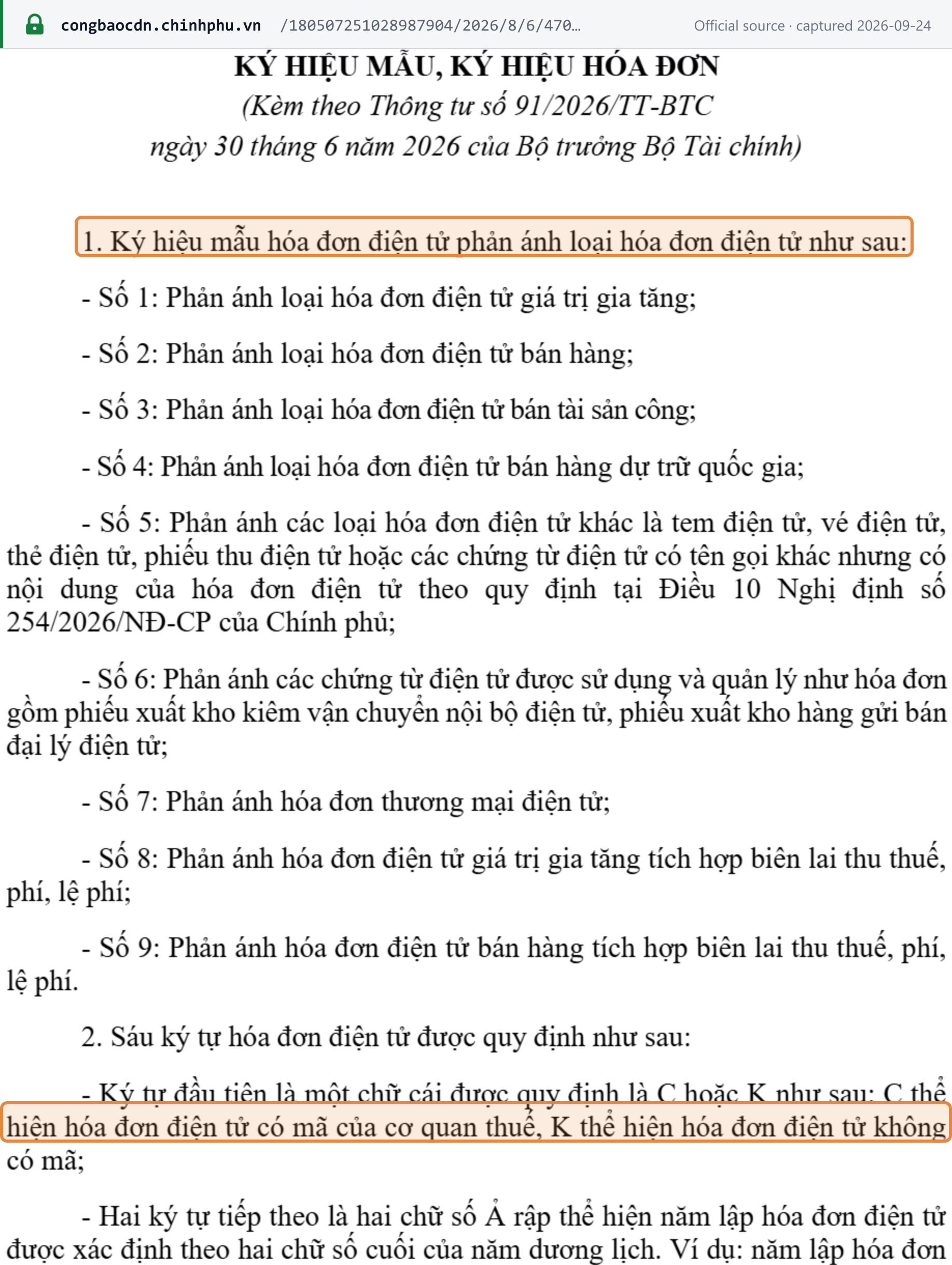
Form number (ký hiệu mẫu): one digit, 1–9.
| Digit | Invoice type |
|---|---|
| 1 | VAT invoice (hóa đơn giá trị gia tăng) |
| 2 | Sales invoice (hóa đơn bán hàng) |
| 3 | Sale of public assets |
| 4 | Sale of national-reserve goods |
| 5 | Other: e-stamps, e-tickets, e-cards, e-receipts and similar documents with invoice content |
| 6 | Despatch notes managed as invoices (internal transfer; consignment to agents) |
| 7 | Commercial e-invoice (hóa đơn thương mại điện tử) |
| 8 | VAT invoice integrated with a tax, fee or charge receipt |
| 9 | Sales invoice integrated with a tax, fee or charge receipt |
Invoice symbol (ký hiệu hóa đơn): six characters.
- C or K: "C thể hiện hóa đơn điện tử có mã của cơ quan thuế, K thể hiện hóa đơn điện tử không có mã" (C marks a coded e-invoice, K a non-coded one).
- Two digits for the year, for example 26 for 2026 (characters 2–3).
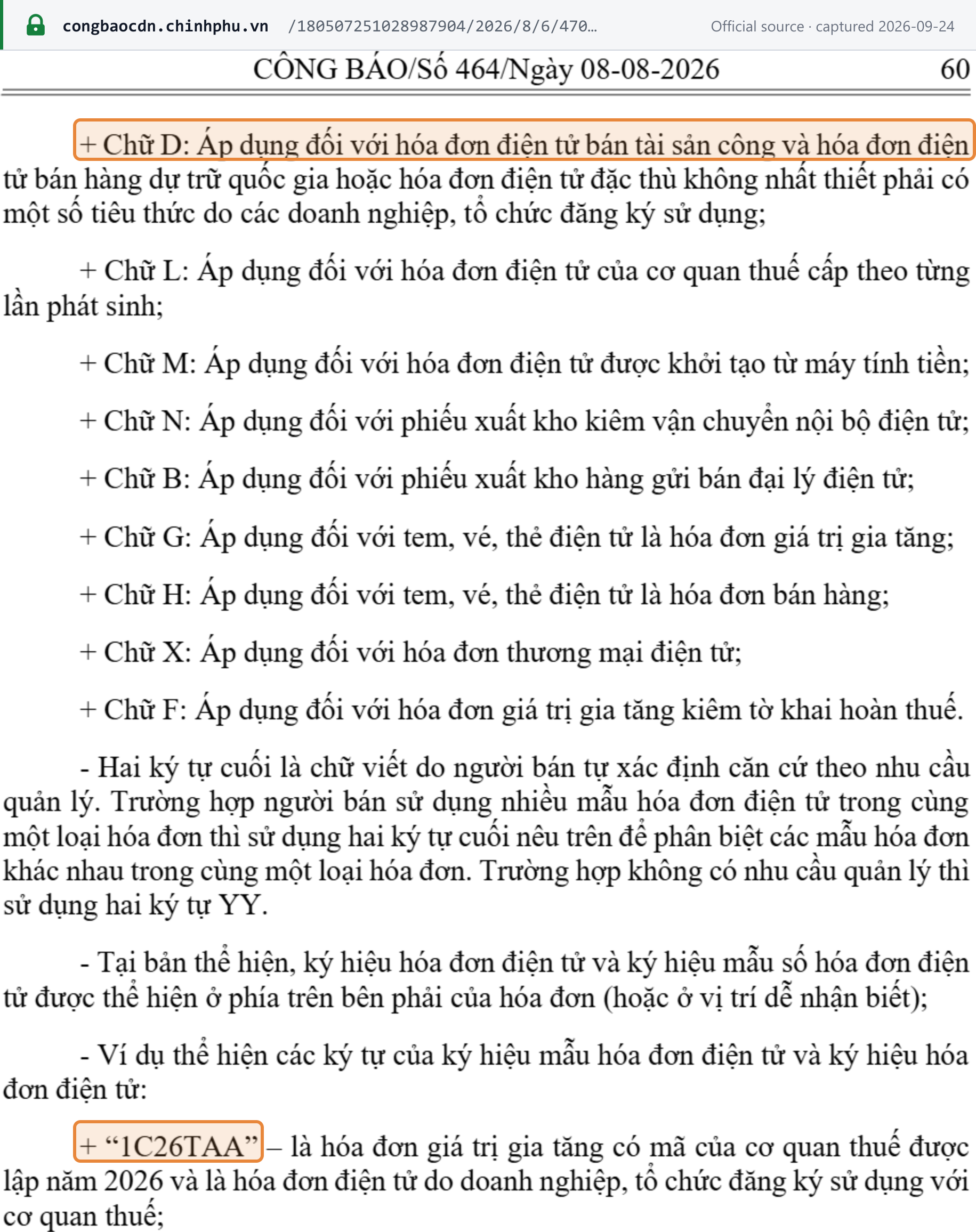
- One type letter (character 4):
- T registered by the business
- D public assets, national reserve, or special invoices that may omit some fields
- L issued by the tax office per transaction
- M cash register
- N internal-transfer despatch note
- B consignment despatch note
- G and H e-stamps, tickets and cards serving as a VAT or sales invoice
- X commercial e-invoice
- F VAT invoice combined with a tax-refund declaration
- Two letters chosen by the seller to tell templates apart, or YY if not needed (characters 5–6).
So 1C26TAA is a coded VAT invoice issued in 2026 under the business's own registration. 1K26TYY is the non-coded equivalent. 7K26XAB is a commercial e-invoice. (Circular 91/2026, Annex I, checked 2026-09-24)
 Source snapshot captured 2026-09-24 — original
 Source snapshot captured 2026-09-24 — original
Numbering. Invoice numbers use Arabic numerals, at most 8 digits. They start at 1 on 1 January, or on the first day of use, and run to 31 December, up to 99,999,999. Numbers run in sequence within each form number and symbol pair. A multi-outlet system numbers by signing time. (Decree 254/2026, Annex item 2, checked 2026-09-24)
Content, language and currency. Decree 254 Article 10(1) lists the mandatory fields. Invoices are written in Vietnamese, in dong with the symbol "đ", and show the exchange rate on foreign-currency sales. The Vietnam VAT guide covers each field, with source snapshots.
Corrections: adjust or replace, no credit notes
Vietnam has no credit-note instrument. Circular 91 Article 10 sets the routes:
- A cosmetic error needs only a notice on Mẫu 04/SS-HĐĐT.
- For a substantive error, the seller chooses between two routes:
- an adjustment invoice, marked with the words "Điều chỉnh cho hóa đơn Mẫu số" (adjustment for invoice form no.) followed by the original's symbol, number and date
- a replacement invoice, marked "Thay thế cho hóa đơn Mẫu số" (replacement for invoice form no.) followed by the same details
- Cash-register invoices and invoices for registrable assets can only be replaced.
- Once a route is used for an invoice, later corrections to it follow the same route. Increases are shown as positive amounts and decreases as negative.
(Circular 91/2026, Article 10, checked 2026-09-24)
When the system is down
- Coding system down. If the coding system fails, the Cục Thuế switches to a backup and posts the scope and timing on its website. It may also authorise a provider to issue codes.
- Non-coded data cannot be received. Sellers transmit the held data within 2 working days of the Cục Thuế's all-clear notice.
- Force majeure. The seller issues and sends within 3 working days of the problem being fixed.
Lateness for these reasons counts as force majeure. (Decree 254/2026, Article 14, checked 2026-09-24)
Onboarding: how to comply
1. Choose a licensed e-invoice service provider
Registration and transmission both run through an e-invoice service provider by default. Decree 254 Article 3(9) defines two classes of provider. The market still calls them "T-VAN", but the instruments do not use that term. Circular 91 Article 12 sets their criteria:
- Solution providers serve sellers and buyers. Each must be established in Vietnam, publish its service on its website, employ at least 5 IT graduates, and pass a technical test with a data-transmission provider.
- Data receiving, transmission and storage providers connect directly to the Cục Thuế. Each
needs:
- at least 5 years in IT
- a bank deposit or guarantee of at least VND 5 billion
- at least 20 IT graduates
- primary and backup data centres at least 20 km apart
- 1 primary + 2 backup transmission channels, each at least 20 Mbps
Both classes must give 30 days' notice before stopping or suspending service (Decree 254, Article 20). (Circular 91/2026, Article 12, checked 2026-09-24)
The Cục Thuế posts the providers that meet the criteria on its website. That list is unverified here (see Important websites). Ask a prospective provider for its Cục Thuế acceptance before signing.
2. Register on Form 01/ĐKTĐ-HĐĐT
Every seller registers before first use (Decree 254, Article 4(3)). Circular 91 Article 6 sets the channel:
- Default: organisations, households and individual businesses register "thông qua tổ chức cung cấp dịch vụ hóa đơn điện tử" (through an e-invoice service provider).
- Free-of-charge coded users may register via the tax system or through a provider the Cục Thuế has entrusted.
- Direct-connection enterprises register via the tax system or the National Public Service Portal (Cổng Dịch vụ công Quốc gia).
- Voluntary foreign suppliers register via the tax-management information system.
 Source snapshot captured 2026-09-24 — original
The form is Mẫu 01/ĐKTĐ-HĐĐT in Annex III. It asks for:
- the legal representative's details: date of birth, ID or passport number, phone and email
- the invoice form: coded, cash-register coded, cash-register non-coded, or non-coded
- the sending route: free coded, direct, via a provider, or foreign platform supplier
- the transmission method: full content, 01/TH-DT, 01/TH-HĐĐT or 01/TTGD
- the invoice types used
- the list of digital certificates
What happens next:
- The system acknowledges receipt on Mẫu 01/TB-TNĐT.
- Within 1 working day the system cross-checks the legal representative's details against the business and tax registers and the national population database: "Trong thời gian 01 ngày làm việc kể từ ngày tiếp nhận đăng ký, Hệ thống thông tin quản lý thuế tự động đối chiếu thông tin (bao gồm thông tin sinh trắc học theo quy định về định danh và xác thực điện tử của Chính phủ)" (within 1 working day of receiving the registration, the system automatically cross-checks the information, including biometric information under the Government's e-identification rules).
- If the details match, a confirmation request goes to the representative's registered email or phone. The taxpayer must confirm the same working day or the next. If they do not, the registration is refused on Mẫu 01/TB-ĐKĐT.
- If there are no risk flags, the tax office accepts no later than the next working day, on Mẫu 01/TB-ĐKĐT.
- If a risk flag applies, the tax office sends Mẫu 01/TB-BSTT-NNT within 1 working day asking for an explanation, or checks the address on site; the taxpayer has 3 working days to respond (Circular 91, Article 6(2)(c)).
Circular 91 Article 7 lists five risk flags:
- an owner or representative linked to a concluded invoice-fraud case
- a person on the anti-money-laundering suspicious-transaction list
- a head office with no specific address, or in an apartment not permitted for business use (individual businesses excepted)
- links to non-operating or violating taxpayers
- other risks under Circular 94/2026/TT-BTC
(Circular 91/2026, Articles 6–7, checked 2026-09-24)
Do not invoice before acceptance. Issuing e-invoices before the tax authority's acceptance notice is a separate offence, fined VND 4–8 million (see Penalties). Changes, delegations and suspensions are filed on the same Form 01/ĐKTĐ-HĐĐT.
3. Direct connection (large issuers only)
Only two kinds of organisation may transmit directly to the Cục Thuế:
- an organisation averaging at least 1,000,000 invoices a month, measured on the previous year's average and with conforming IT
- a parent company with a central invoice-data system that sends its subsidiaries' data
Everyone else must contract a service provider. (Decree 254, Article 16(3)(b))
The line specification is in Circular 91 Article 3(4):
- a leased line or MPLS VPN Layer 3, with 1 primary and 1 backup channel, each at least 5 Mbps
- Web Service or encrypted Message Queue
- SOAP
After the acceptance notice the enterprise has 5 working days to prepare its infrastructure and notify the Cục Thuế. Connection testing then takes 10 working days. If the enterprise misses the 5 days or fails the test, it must register again to transmit through a provider. (Circular 91/2026, Article 6(3), checked 2026-09-24)
4. Testing
Neither Decree 254 nor Circular 91 creates a public sandbox. The instruments name only two test regimes:
- the 10-working-day connection test for direct-connection enterprises
- the technical test a solution provider must pass with a data-transmission provider
Whether the Cục Thuế runs a public test portal is unverified (see Important websites). In practice, test through your provider.
5. Delegated invoicing (ủy nhiệm)
A seller may delegate invoicing to any third party that can itself use e-invoices. The delegation must meet four conditions:
- The delegate must itself be eligible to use e-invoices, and neither party may be in a stopped or suspended state (Circular 91, Article 9(1)(a)).
- It is in writing.
- It is notified on Form 01/ĐKTĐ-HĐĐT, because the Circular treats it as a change of registration.
- It is published on both parties' websites or platform storefronts.
The delegate signs the invoice, and the invoice also shows the delegate's name, address and tax code. E-commerce platform operators must give sellers the buyer and order data they need to invoice (Decree 254, Article 19(2)). (Circular 91/2026, Article 9, checked 2026-09-24)
Penalties
Invoice penalties sit in Decree 125/2020/NĐ-CP, Chương III (Articles 22–31 as amended; Decree 310/2025 repealed Articles 20, 21 and 23). Decree 102/2021 and Decree 310/2025 amended it, and Decree 310/2025's rewrite took effect on 16 January 2026. Decree 252/2026/NĐ-CP Article 74(4) keeps Decree 125 in force after 1 July 2026 until it is replaced. (Decree 310/2025; Decree 252/2026, Article 74, checked 2026-09-24)
A third amending decree, Decree 291/2026/NĐ-CP of 21 July 2026, took effect on signature. It adds Article 19a, which sets fines for late, inaccurate or missing data supplied for international tax information exchange. It does not amend any invoice article in Chương III. (Government document database record; signed PDF, checked 2026-09-24)
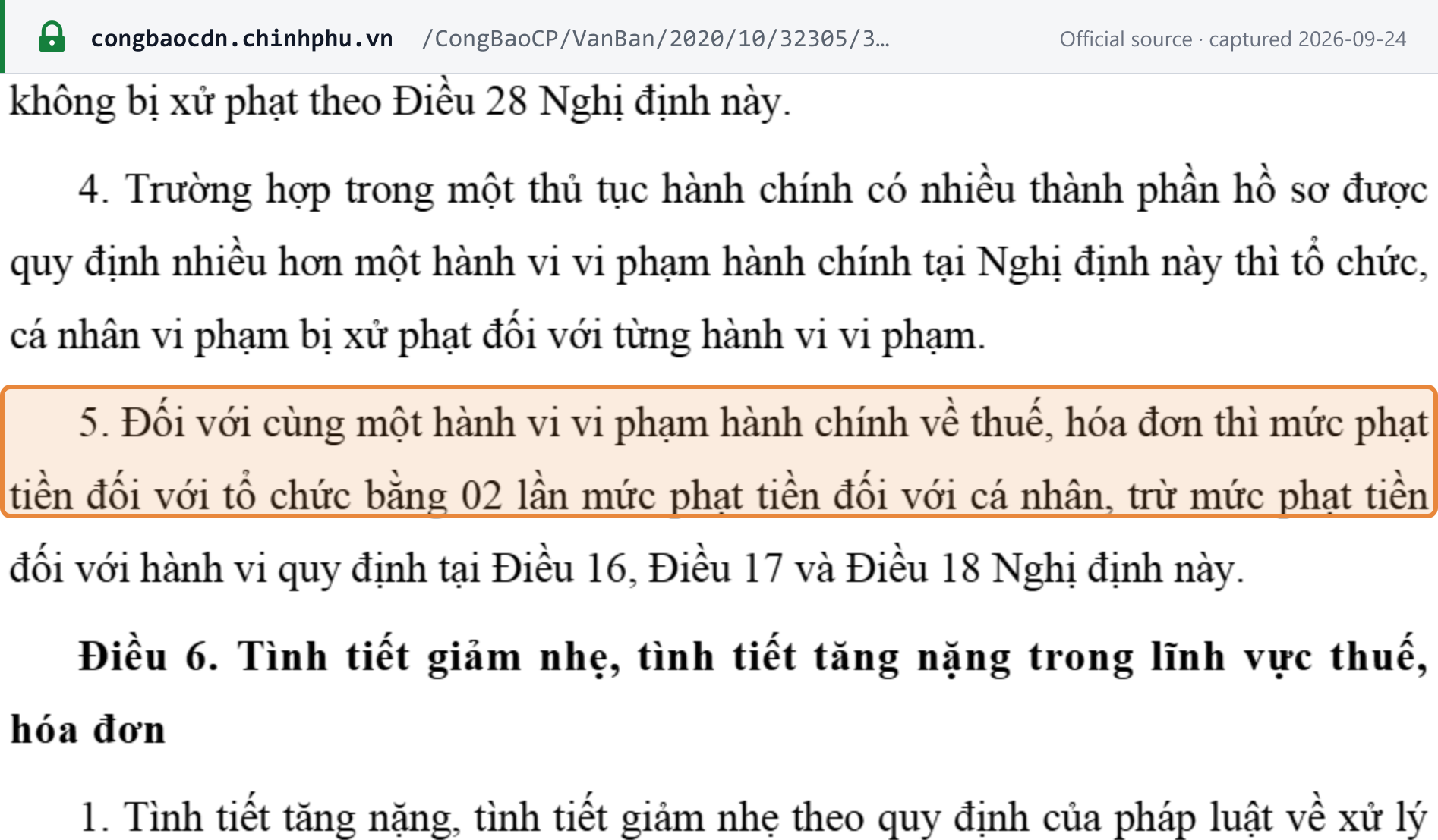
All amounts below are organisation amounts. Households and individuals pay half. Decree 125 Article 5(5) reads: "Đối với cùng một hành vi vi phạm hành chính về thuế, hóa đơn thì mức phạt tiền đối với tổ chức bằng 02 lần mức phạt tiền đối với cá nhân" (for the same tax or invoice violation, an organisation's fine is twice an individual's). Article 7(4)(a) confirms that Chương III prints organisation amounts, and that household businesses are fined as individuals. (Decree 125/2020, Articles 5 and 7, checked 2026-09-24)
 Source snapshot captured 2026-09-24 — original
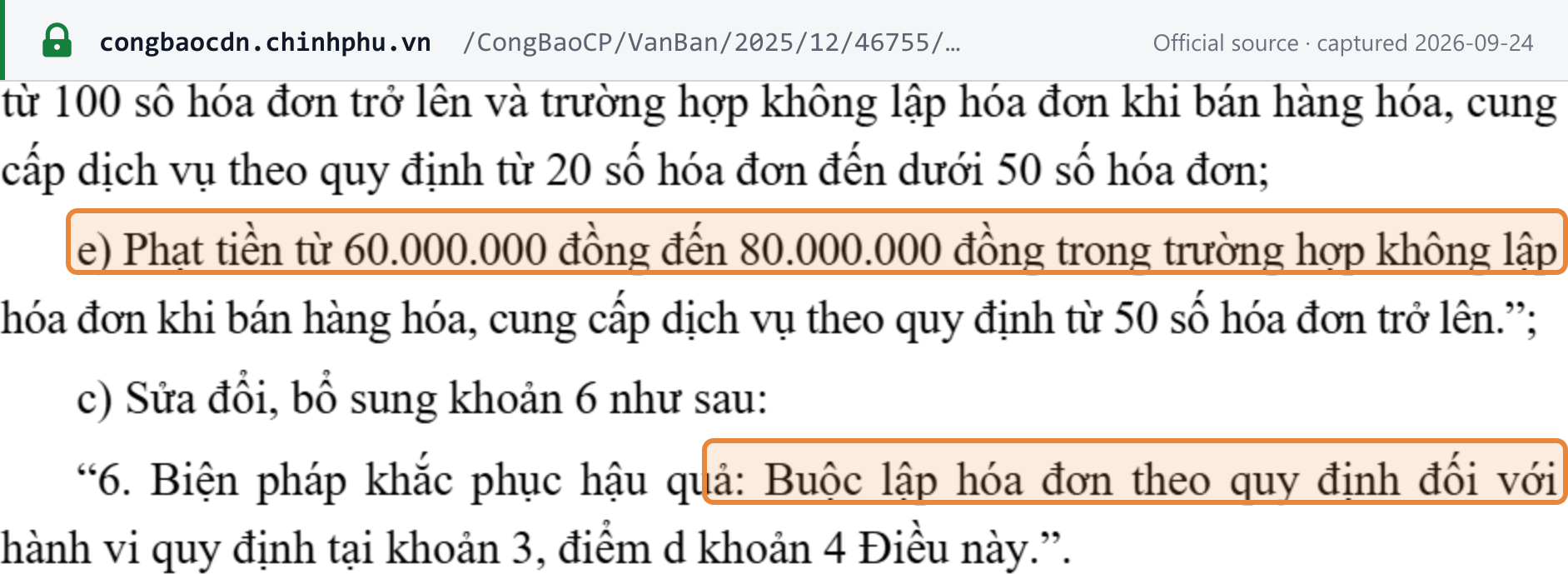
Not issuing an invoice (Article 24(3), as rewritten by Decree 310/2025)
The fine depends on how many invoices were not issued, and there are two limbs. The sale limb covers ordinary sales. The internal/gift limb covers promotions, samples, gifts, wages paid in kind, internal consumption, and goods lent or returned.
| Fine (VND) | Sale limb | Internal/gift limb |
|---|---|---|
| Warning | — | 1 invoice |
| 1,000,000 – 2,000,000 | 1 invoice | 2 to under 10 |
| 2,000,000 – 10,000,000 | 2 to under 10 | 10 to under 50 |
| 10,000,000 – 30,000,000 | 10 to under 20 | 50 to under 100 |
| 30,000,000 – 50,000,000 | 20 to under 50 | 100 or more |
| 60,000,000 – 80,000,000 | 50 or more | — |
The rewritten Article 24(6) also compels the seller to issue the missing invoices. The old condition that the buyer must first ask has gone.
 Source snapshot captured 2026-09-24 — original
Issuing at the wrong time (Article 24(2), as rewritten) uses the same count-based bands. The top band is VND 50,000,000 – 70,000,000 for 100 or more invoices on sales. (Decree 310/2025, Article 1 item 14, checked 2026-09-24)
One case, one fine, banded on the total count. Decree 310/2025 added Article 5(3)(đ) and (e). Several wrong-time invoices, or several failures to issue, that are sanctioned in one case count as one violation, fined on the band for the number of invoices. Point (e), for failures to issue, reads as printed: "chỉ bị xử phạt về một hành vi không lập hóa đơn có khung tiền phạt tương ứng với số lượng hóa đơn đã lập không đúng thời điểm theo quy định tại khoản 3 Điều 24 Nghị định này" (penalised for only one act of not issuing invoices, at the band corresponding to the number of invoices issued at the wrong time under Article 24(3)). The words "issued at the wrong time" appear in the text even though the point governs failures to issue. (Decree 310/2025, Article 1 item 3, checked 2026-09-24)
E-invoice process offences (Article 24(4)): VND 4–8 million
Article 24(4) fines VND 4,000,000 – 8,000,000 for, among other things:
- (đ) issuing e-invoices before the tax authority's acceptance notice
- (g) issuing cash-register e-invoices from a register not connected to the tax authority
- (h) leaving out mandatory content, a point added by Decree 102/2021
- (b) numbering out of sequence
Decree 310/2025 repealed point (a) and left the rest in place. (Decree 125/2020, Article 24(4); Decree 102/2021, checked 2026-09-24)
Late or missing data transmission (Article 30)
Article 30 enforces the next-working-day rule and the summary-table deadlines. Decree 102/2021, Decree 310/2025 and Decree 291/2026 left it unchanged.
| Offence | Fine (VND) |
|---|---|
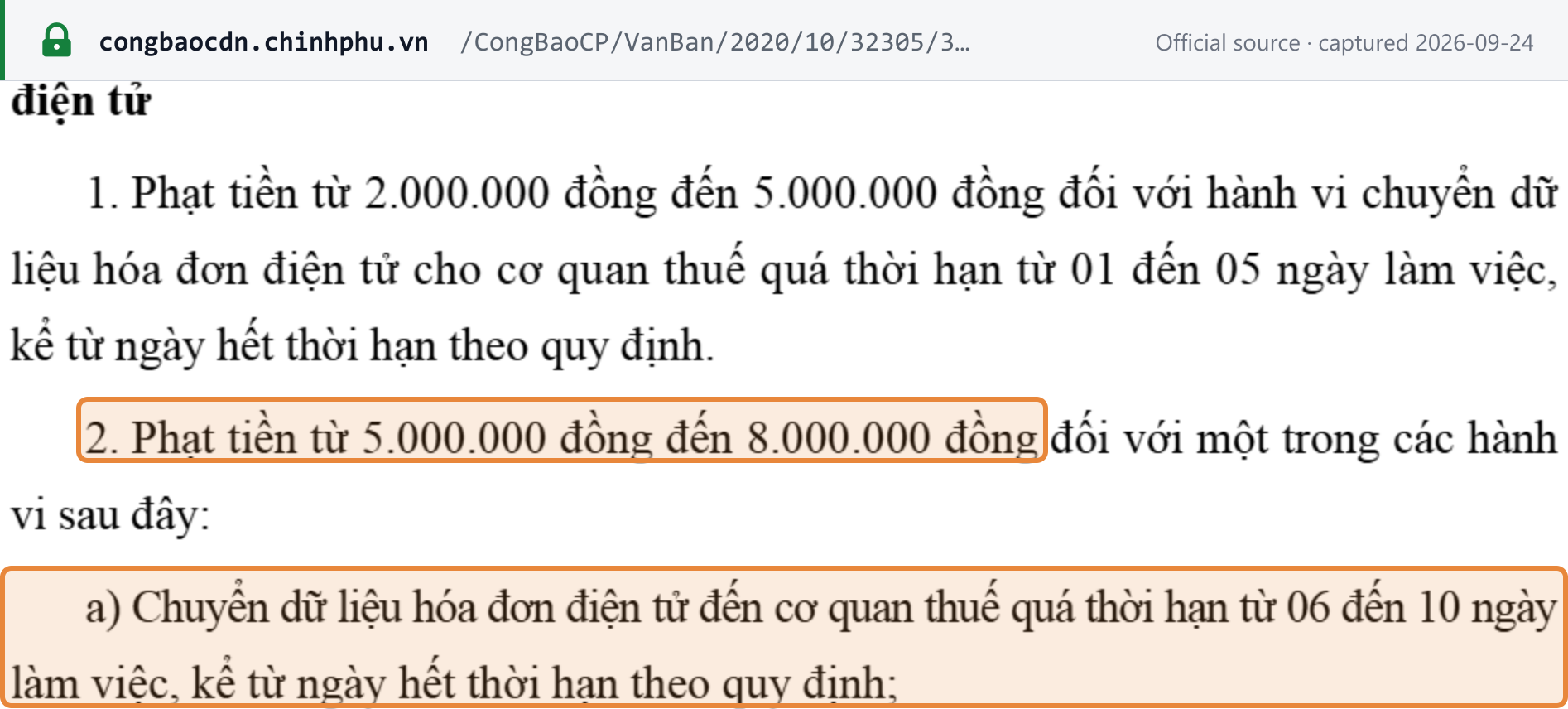
| E-invoice data sent 1–5 working days late | 2,000,000 – 5,000,000 |
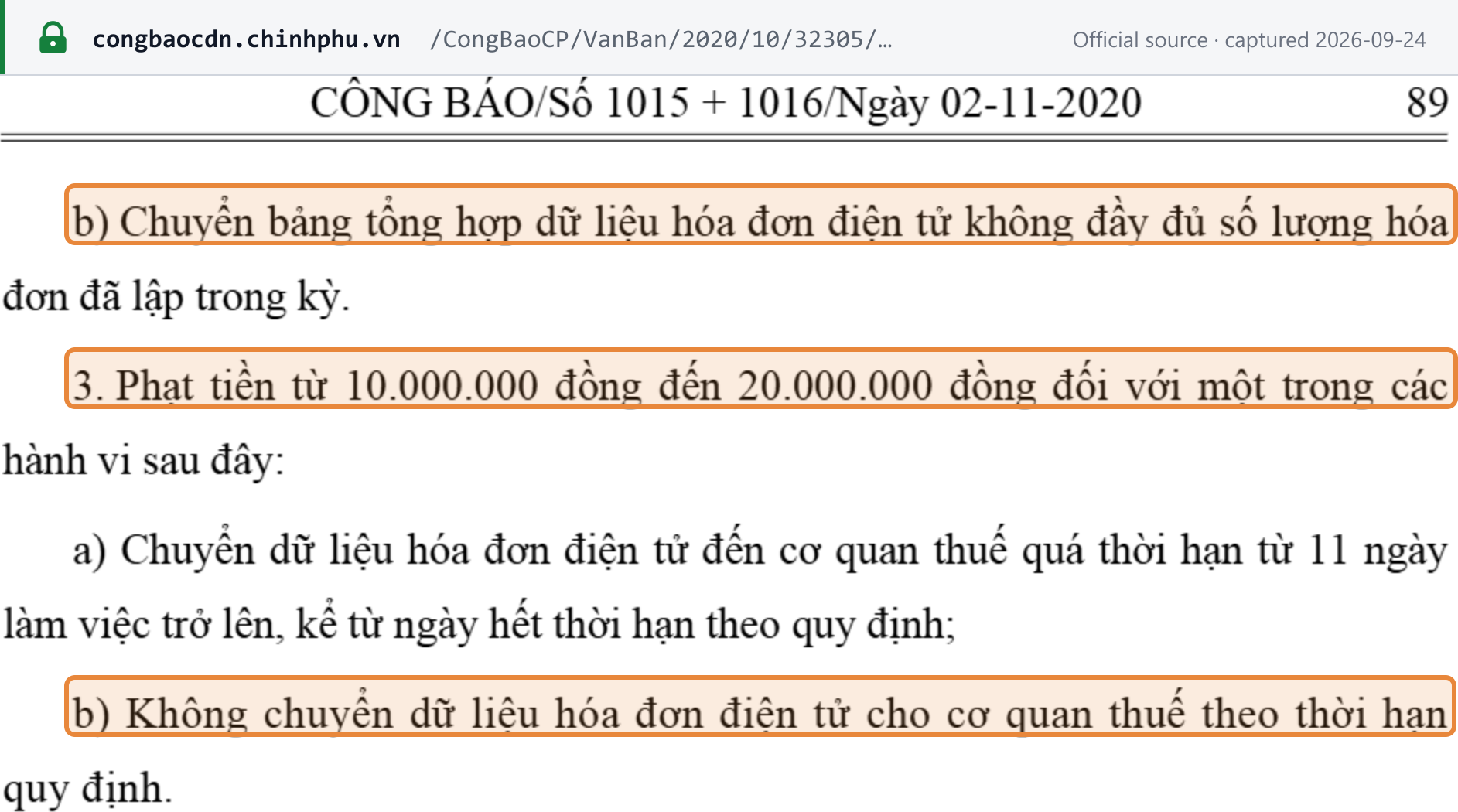
| 6–10 working days late, or a summary table missing invoices issued in the period | 5,000,000 – 8,000,000 |
| 11 or more working days late, or not sent at all | 10,000,000 – 20,000,000 |
The remedy is compelled transmission. Article 30(1) reads: "Phạt tiền từ 2.000.000 đồng đến 5.000.000 đồng đối với hành vi chuyển dữ liệu hóa đơn điện tử cho cơ quan thuế quá thời hạn từ 01 đến 05 ngày làm việc, kể từ ngày hết thời hạn theo quy định." Delays caused by a Cục Thuế outage or force majeure are excused under Decree 254 Article 14 (see When the system is down). (Decree 125/2020, Article 30, checked 2026-09-24)
 Source snapshot captured 2026-09-24 — original
 Source snapshot captured 2026-09-24 — original
Other invoice offences
- Late or wrong invoice notices and reports (Article 29), such as the Mẫu 04/SS-HĐĐT error notice. The fine is VND 1–3 million for 1–10 days late or for wrong content. There is no fine if the seller corrects it before an audit decision. It rises to VND 2–4 million at 11–20 days, VND 4–8 million at 21–90 days, and VND 5–15 million at 91 days or more, or if never filed.
- Using illegal invoices, or using invoices illegally (Article 28): VND 20–50 million.
- Providers whose solutions breach invoice-law principles (Article 31, as rewritten by Decree 310/2025): VND 4–8 million. This applies to the service provider, not the seller.
(Decree 125/2020, Articles 28–29; Decree 310/2025, item 18, checked 2026-09-24)
Enforcement posture: consumers are paid to report
Decree 254 Article 41(5) creates a reward for a consumer who reports a seller for not issuing or delivering an e-invoice. It is capped at "không quá 10% số tiền xử phạt vi phạm hành chính, tối đa 10.000.000 đồng/01 vụ việc" (no more than 10% of the fine, and at most VND 10,000,000 per case), and is paid only after a penalty decision. Circular 91 Article 13 also funds monthly and year-end "hóa đơn may mắn" (lucky-invoice) draws for consumer e-invoices. Their budget is capped at VND 150 billion a year. (Decree 254/2026, Article 41; Circular 91/2026, Article 13, checked 2026-09-24)
For the criminal side (Penal Code Article 200) and the non-invoice penalty scales, see the Vietnam VAT guide.
Frequently asked questions
We are a foreign SaaS or platform business with no Vietnamese entity. Must we issue Vietnamese e-invoices?
No. Law 108/2025 leaves e-invoice users to the Government, and Decree 254/2026 and Circular 91/2026 bring foreign e-commerce and digital-platform suppliers in only if they register voluntarily ("đăng ký tự nguyện", Decree 254 Article 2(1)(đ); Circular 91 Article 6(1)). Registration is filed through the tax-management information system. If you opt in, you transmit by summary table and sign with an electronic signature. Declaring and paying Vietnamese tax is a separate obligation under Law 108 Article 12(2), directly or through an authorised party. (Checked 2026-09-24)
Coded or non-coded: can we choose?
Only within limits. Coded e-invoices are the default for every seller. Non-coded invoices are open to enterprises in the listed sectors (such as electricity, telecoms, banking, e-commerce, supermarkets and transport) and to organisations with compliant IT and invoicing software. A non-coded user that the tax office flags as high-risk must switch to coded invoices within 10 working days and may apply to switch back after 12 months (Decree 254 Article 6(1); Circular 91 Article 11(2)).
How fast must non-coded invoice data reach the tax authority, and what does lateness cost?
By default, no later than the next working day after the invoice time (Decree 254 Article 16(3)(a.3)). Summary-table sectors report monthly or quarterly by the VAT-return deadline. Late transmission is fined VND 2–5 million at 1–5 working days, VND 5–8 million at 6–10 working days, and VND 10–20 million at 11 or more working days or if the data is never sent (Decree 125/2020 Article 30; organisation amounts, halved for individuals).
Does our ERP need a licensed e-invoice service provider?
Yes, unless you average at least 1,000,000 invoices a month or are a parent company sending your subsidiaries' data from a central system. Only those two cases may connect directly, over a leased line or MPLS VPN Layer 3 with SOAP (Decree 254 Article 16(3)(b); Circular 91 Article 3(4)). Registration on Form 01/ĐKTĐ-HĐĐT also runs through a provider by default (Circular 91 Article 6(1)).
Our invoicing software still produces XML version 2.1.0 with DSig signatures. Is that a problem?
Reportedly, yes, from 1 January 2027 for the XML version and from 10 April 2027 for the signature. Cục Thuế Quyết định 1233/QĐ-CT of 27 August 2026 is reported to accept version 2.1.0 only until 31 December 2026 and DSig only until 9 April 2027, moving to version 2.1.1 and XAdES. Two independent Vietnamese sources agree on these dates, but the official decision could not be read because the Cục Thuế's site was unreachable when checked on 2026-09-24. Confirm with your provider.
Can we issue a credit note to correct an e-invoice?
No. Vietnam has no credit-note instrument. For a substantive error you issue either an adjustment invoice (marked "Điều chỉnh cho hóa đơn Mẫu số") or a replacement invoice (marked "Thay thế cho hóa đơn Mẫu số"); a cosmetic error needs only a notice on Mẫu 04/SS-HĐĐT. Cash-register invoices and invoices for registrable assets can only be replaced (Circular 91 Article 10).
A supplier gave us a cash-register e-invoice marked "Bán cho người tiêu dùng" with no company details. Can we book the cost?
No. Under Decree 254 Annex item 4, an invoice with no buyer details, or one issued to a consumer and marked "Bán cho người tiêu dùng", cannot be used by a business to book a cost or in its tax finalisation. Ask the seller for an invoice showing your company name, address and tax code.
Recent changes
- 2026-07-01 — Decree 254/2026/NĐ-CP takes effect as the implementing decree for e-invoices and e-documents under Law 108/2025/QH15, repealing Decree 123/2020/NĐ-CP, Article 1 of Decree 41/2022/NĐ-CP and Decree 70/2025/NĐ-CP. (Công Báo) — see event record
- 2026-07-01 — Circular 91/2026/TT-BTC takes effect, replacing Circular 32/2025/TT-BTC; it sets the XML format, invoice symbols, registration on Form 01/ĐKTĐ-HĐĐT, provider criteria and the reward procedure for consumers who report sellers that fail to issue e-invoices. (Công Báo) — see event record
- 2026-01-16 — Decree 310/2025/NĐ-CP takes effect, rewriting the Decree 125/2020 Article 24 invoice penalties into bands by invoice count, up to VND 60–80 million for 50 or more unissued invoices. (Công Báo) — see Vietnam chronology
- 2026-01-01 — E-invoice use by household and individual businesses under Law 108/2025/QH15 Article 26 takes effect, six months ahead of the rest of the Law (Article 52(2)). (Công Báo) — see event record
- 2025-12-10 — The National Assembly passes Tax Administration Law 108/2025/QH15; its Chương III (Articles 26–27) becomes the statutory base for e-invoices and e-documents from 1 July 2026. The Law leaves who uses e-invoices to the Government; under Decree 254 non-resident platform suppliers register voluntarily. (Công Báo) — see event record
Related resources
- Vietnam VAT guide — rates, registration, invoice content, filing and the full penalty picture
- Vietnam tax identification numbers (MST) — the tax code that appears on every e-invoice
- E-invoicing status and networks worldwide — Vietnam in global context
- Vietnam tax-change chronology — every tracked Vietnamese change, dated and sourced
- Validate a Vietnamese tax code (MST)
Important websites
- Công Báo (Official Gazette) — the published texts of Law 108/2025, Decree 254/2026 and Circular 91/2026
- Government document database, Circular 91/2026 — the Government's record of the Circular
- Ministry of Finance — the Cục Thuế's parent ministry
- Cục Thuế e-invoice portal. The portal is widely reported to be at hoadondientu.gdt.gov.vn.
Note: the Cục Thuế portals (gdt.gov.vn and hoadondientu.gdt.gov.vn) were unreachable when checked on 2026-09-24, so the portal address, the accredited-provider list and any public test environment are unverified on this page.