E-invoicing in Türkiye: e-Fatura and e-Arşiv Fatura
Overview
Türkiye's e-invoicing is part of the e-Belge (electronic document) family run by the Revenue Administration (Gelir İdaresi Başkanlığı, GİB). There are two invoice types:
- e-Fatura — used only between two registered e-Fatura users. It is a UBL-TR XML document, sealed with a fiscal seal (Mali Mühür) and sent from seller to buyer through GİB's central platform. A document not sent through the system is not an e-Fatura.
- e-Arşiv Fatura — used for every other invoice: to consumers, and to businesses not registered for e-Fatura. It is created electronically, delivered on paper or electronically, and reported to GİB.
e-Fatura has been in use since 5 March 2010. It is not a new kind of document: it has the same legal standing as a paper invoice. [1]
Legal basis in one line. VUK General Communiqué No. 509 (Vergi Usul Kanunu Genel Tebliği Sıra No: 509), made under the power over electronic documents in Article 242 bis (mükerrer 242) of the Tax Procedure Law (VUK), sets who must use e-Fatura and e-Arşiv and how. [2]
| Türkiye | |
|---|---|
| System | e-Fatura through GİB's central platform (between registered users); e-Arşiv Fatura with daily reporting to GİB (everyone else) |
| B2B | e-Fatura mandatory from gross sales of TRY 3 million (2022 onwards), TRY 500,000 for online sellers, and for listed sectors |
| B2C | e-Arşiv Fatura. For taxpayers not in e-Arşiv: every invoice must be e-Arşiv from 1 Jan 2026 (1 Jan 2027 for simplified-method and business-account taxpayers) |
| B2G | Governed by the Accounting Directorate's public financial management system; a KAMU profile exists in UBL-TR |
| Non-residents | Communiqué 509 sets no e-Fatura or e-Arşiv rule specific to non-residents; systems and primary archives must be in Türkiye |
| Format | UBL-TR (based on UBL 2.0) in an SBDH envelope; not Peppol; not EN 16931 |
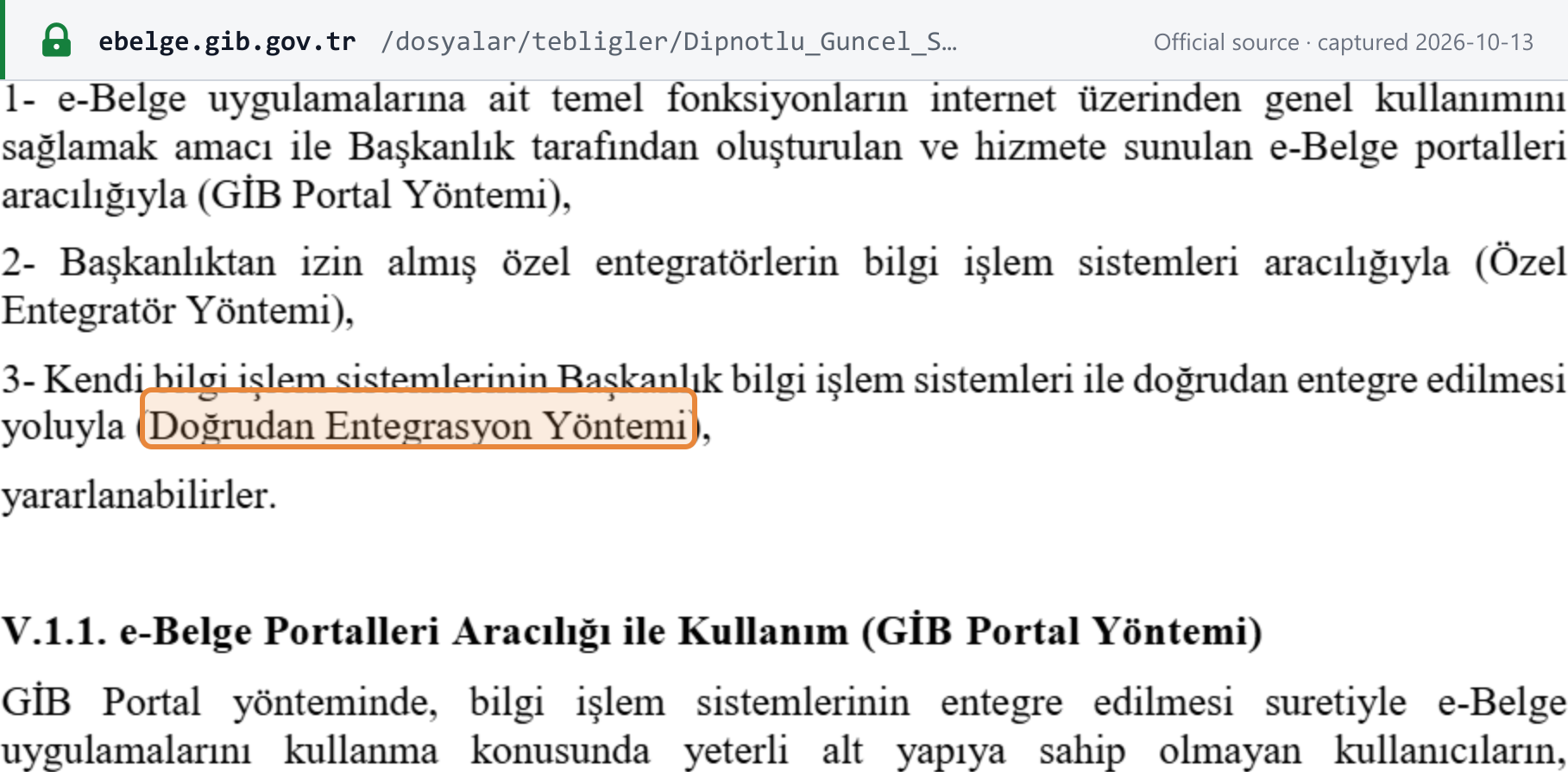
| Access | GİB Portal (free), a GİB-licensed private integrator, or direct integration |
| Authority | Gelir İdaresi Başkanlığı (GİB) |
| Legislation | VUK Art 242 bis (mükerrer 242); VUK General Communiqué No. 509 as amended by Nos. 515, 526, 535, 550, 573 and 589 |
For VAT (KDV) rates and registration, see the Türkiye VAT guide.
Mandate status & timeline
Who must use e-Fatura (Communiqué 509 §IV.1.4):
- taxpayers with gross sales of TRY 3 million or more for 2022 or any later year (TRY 5 million for 2018–2020, TRY 4 million for 2021);
- businesses selling goods or services online, and real-estate and motor-vehicle traders, with gross sales of TRY 500,000 or more from 2022;
- regardless of turnover: online intermediary platforms, classified-ad sites and internet-advertising intermediaries, fuel licensees and ÖTV List (III) makers and importers, fruit and vegetable traders, healthcare providers contracted with the Social Security Institution, licensed hotels, and EV charging-network operators;
- anyone GİB requires to join because it judges them risky, on at least 3 months' written notice.
Taxpayers below the thresholds may join voluntarily. The thresholds are "and above", not "above". [2]
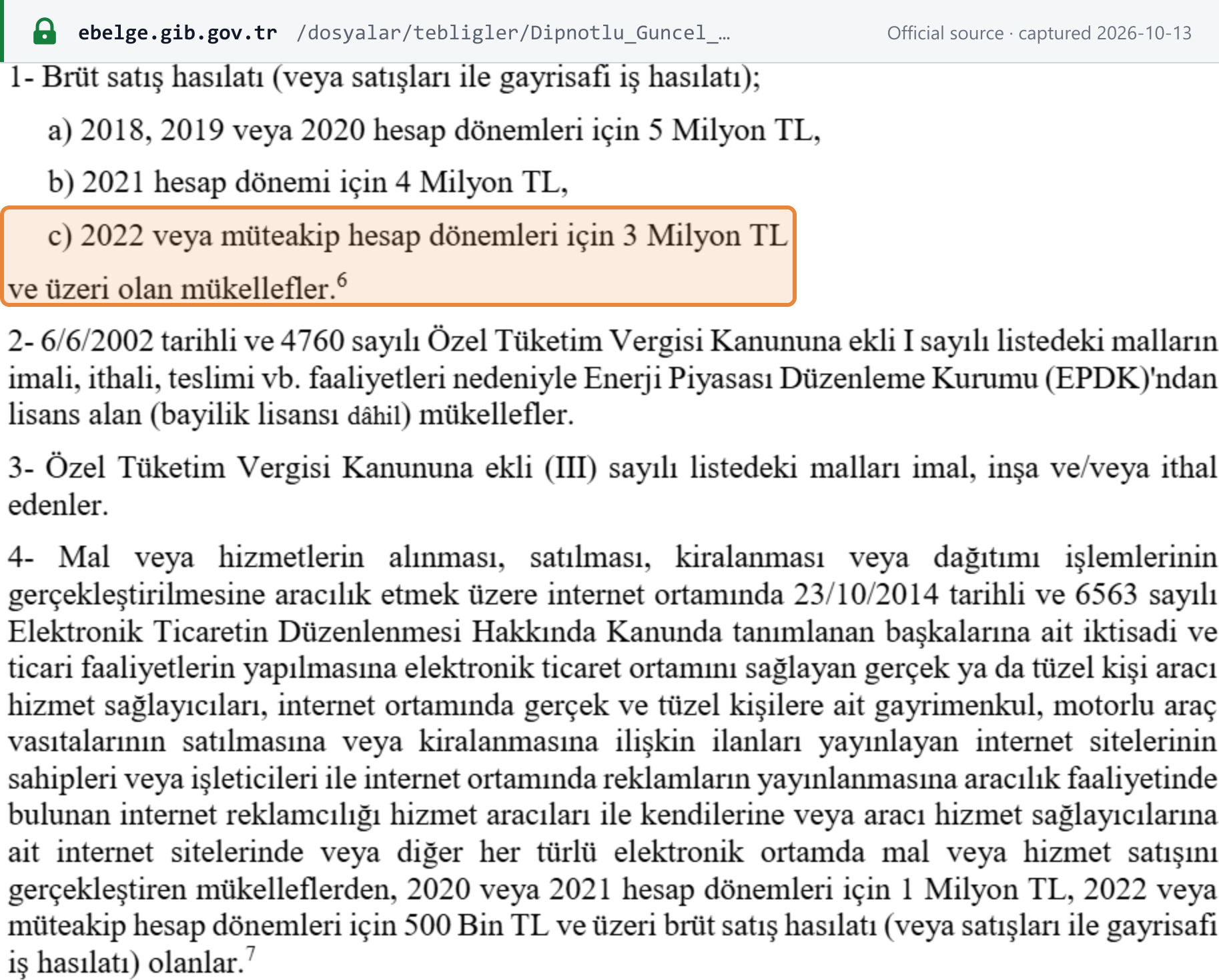
When a threshold-crosser starts. A taxpayer that meets the turnover test in a year must be on e-Fatura from the start of the seventh month of the following year — so a business whose 2025 gross sales reached TRY 3 million must be on from 1 July 2026. Joining e-Fatura also means joining e-Arşiv in the same period, and taxpayers obliged to join e-Fatura must also keep electronic ledgers (e-Defter). [2] [3]
The end of paper for everyone else. A taxpayer not in e-Arşiv must still issue its invoices as e-Arşiv Fatura once they pass an amount limit, through the GİB portal or an integrator:
| Period | Invoices that must be e-Arşiv | Instrument |
|---|---|---|
| 1 Jan 2020 – 28 Feb 2022 | Above TRY 30,000 including tax (TRY 5,000 to taxpayers) | Communiqué 509 |
| 1 Mar 2022 – 31 Dec 2024 | Above TRY 5,000 (to taxpayers: the VUK Art 232 invoicing amount for the year) | Communiqué 535 |
| 1 Jan – 31 Dec 2025 | Above TRY 3,000 including tax | Communiqué 573 |
| From 1 Jan 2026 | Every invoice, whatever the amount | Communiqué 573 |
| Simplified-method (basit usul) and business-account (işletme hesabı) taxpayers | Above TRY 3,000 until 31 Dec 2026; every invoice from 1 Jan 2027 | Communiqué 589 |
Issuing a paper invoice instead draws the VUK Article 353 penalty for each paper invoice, against the issuer and any buyer that is a taxpayer. [2]
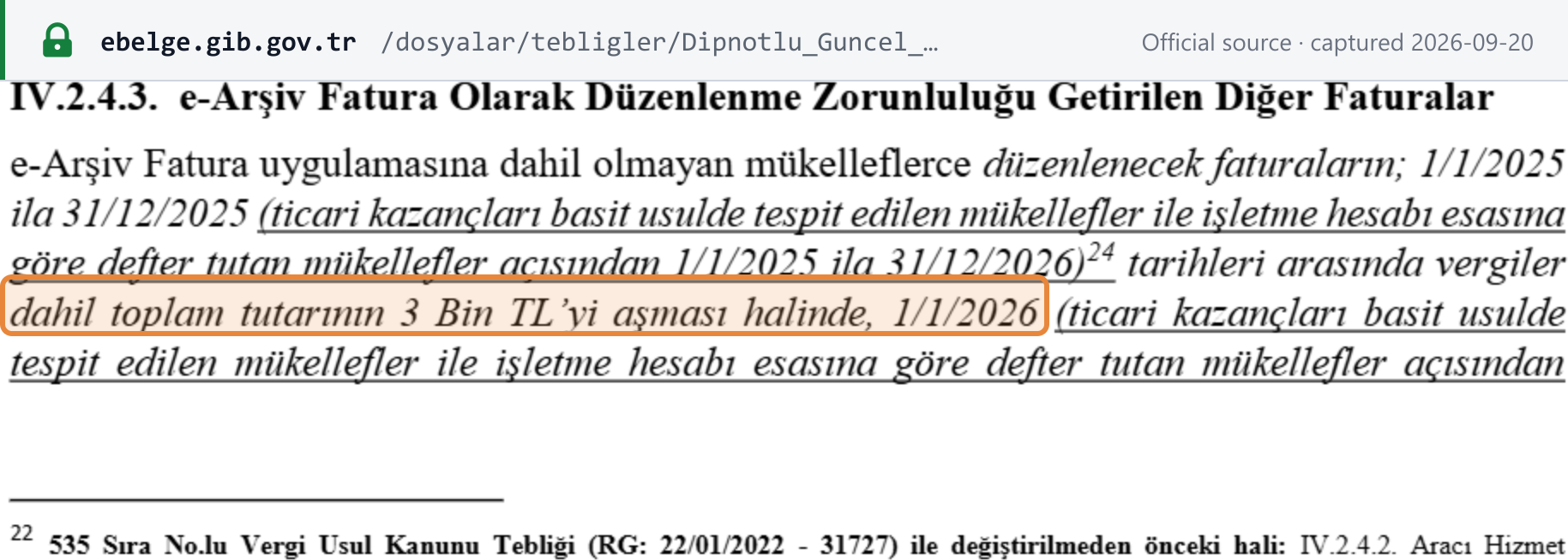
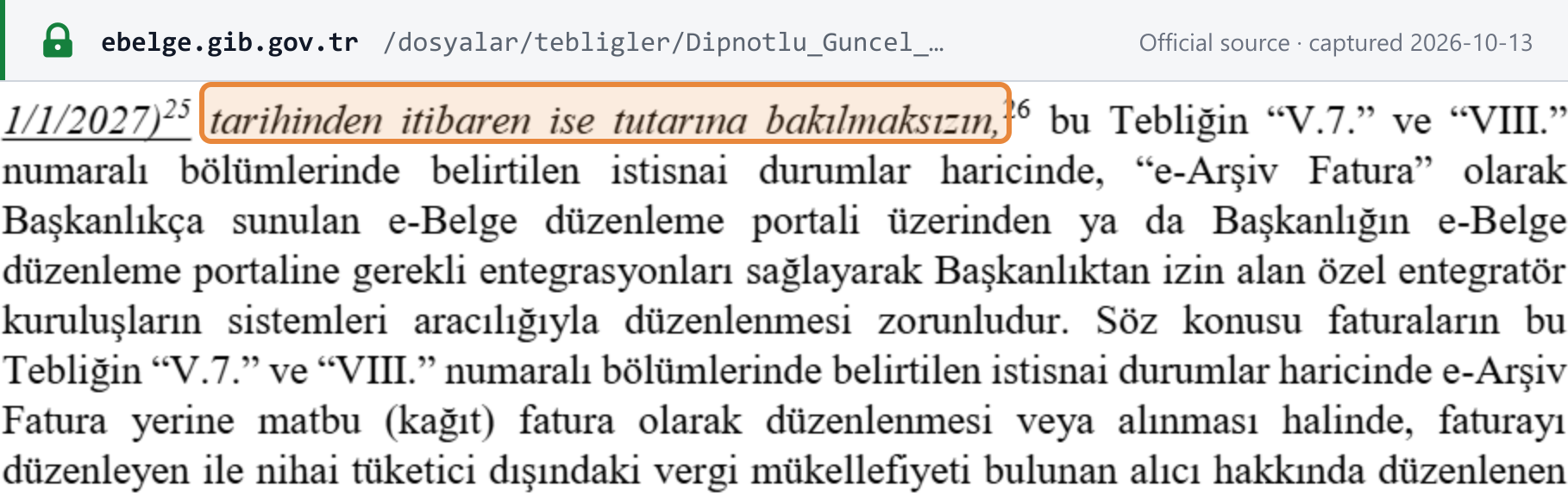
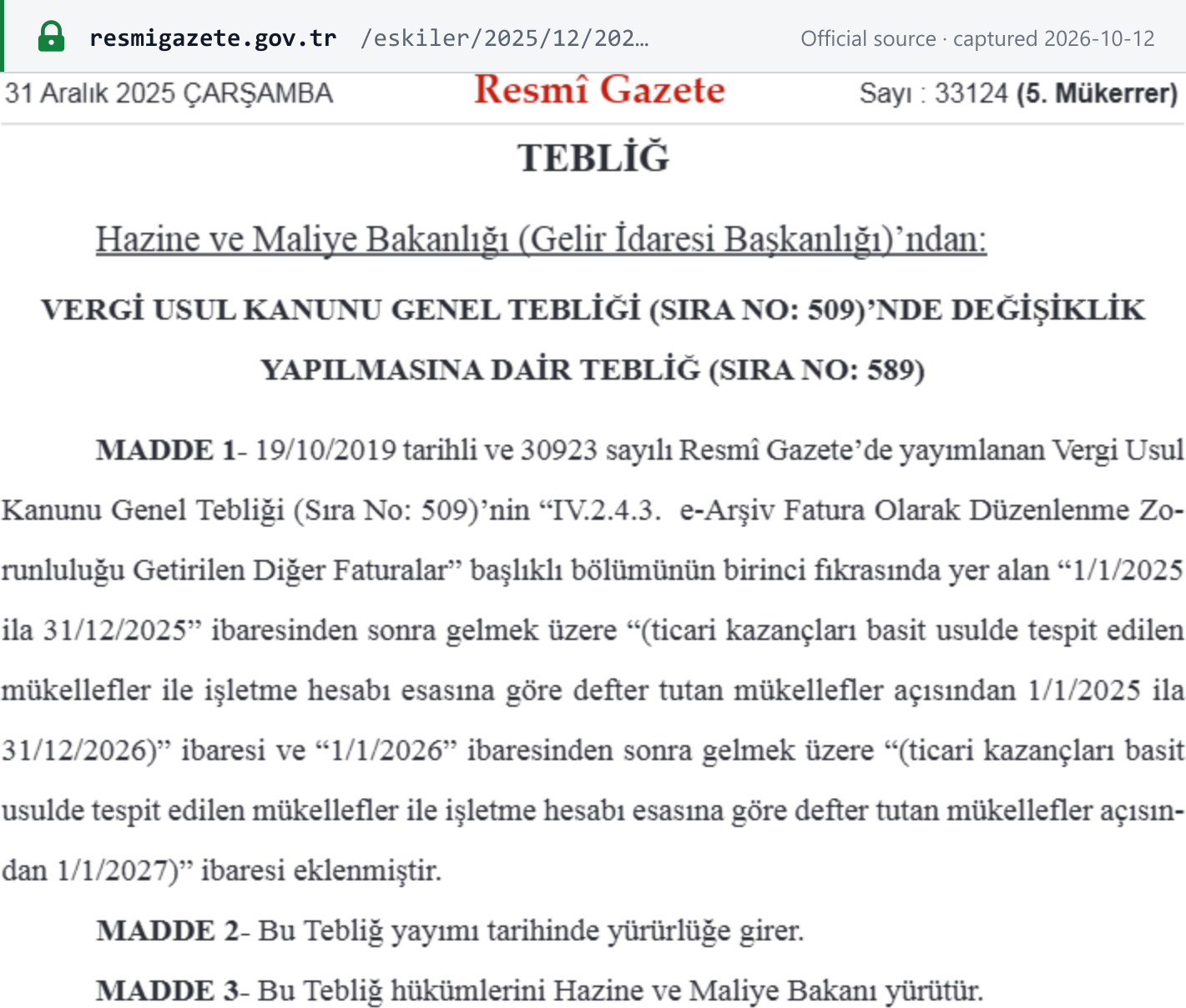
Postponement. Communiqué 589 moved the switchover for simplified-method and business-account taxpayers from 1 January 2026 to 1 January 2027. GİB has announced no further cuts to the e-Fatura thresholds (checked 13 October 2026).
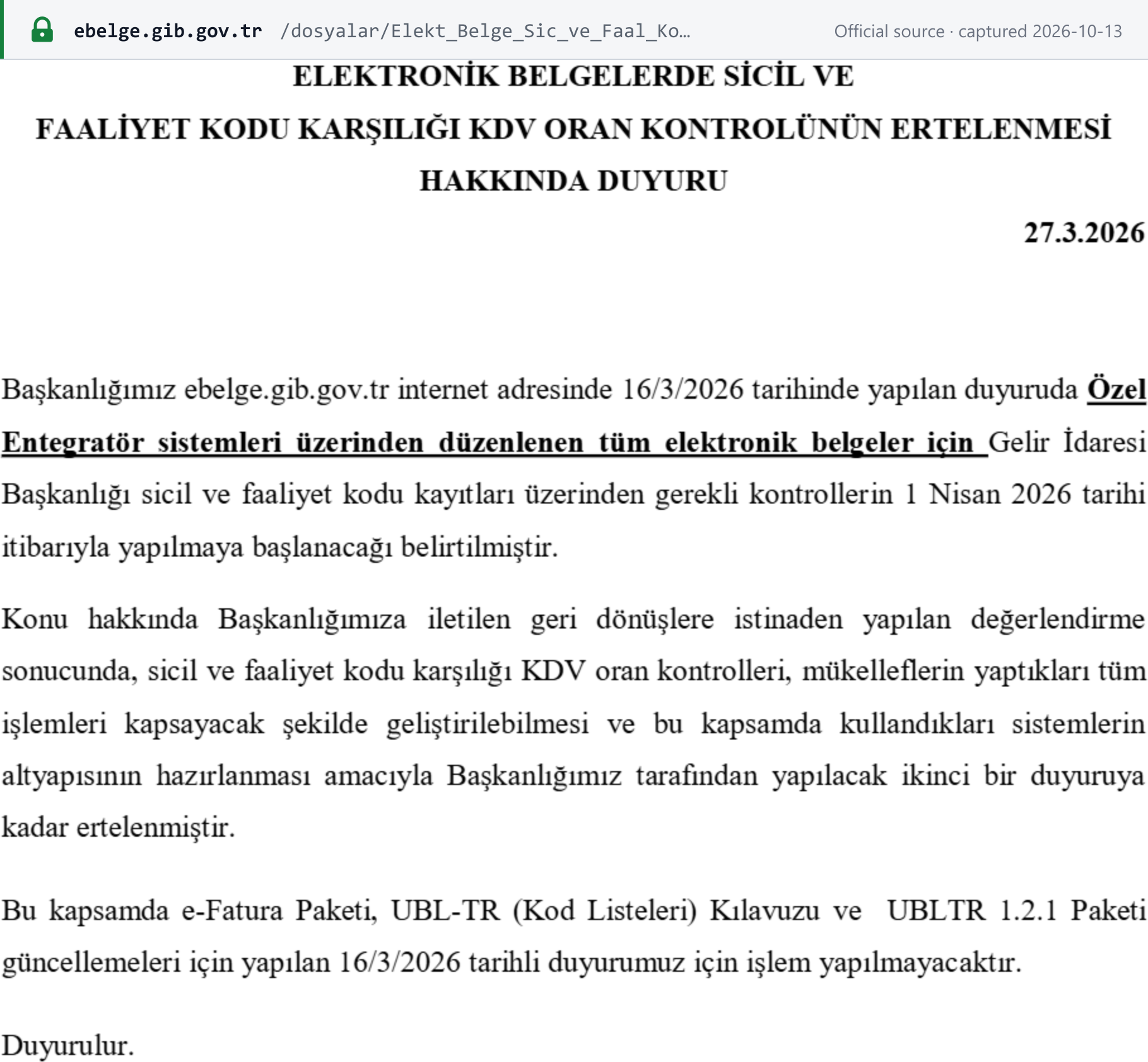
Deferred check. GİB announced on 16 March 2026 that from 1 April 2026 it would check the VAT (KDV) rate on integrator-issued documents against the taxpayer's registered activity codes. On 27 March 2026 it postponed that check until a further announcement; no new date had been set by 13 October 2026. [4]
Legal basis
| Instrument | Official Gazette | What it does |
|---|---|---|
| Tax Procedure Law (VUK) No. 213, Art 242 bis (mükerrer 242) | — | Defines electronic documents; empowers the Ministry to set the rules |
| VUK General Communiqué No. 509 | 19 Oct 2019, No. 30923 | e-Fatura, e-Arşiv, e-İrsaliye and other e-documents: scope, routes, format, storage |
| Communiqué No. 535 | 22 Jan 2022, No. 31727 | TRY 3 million and TRY 500,000 thresholds; TRY 5,000 e-Arşiv limit from 1 Mar 2022 |
| Communiqué No. 573 | 12 Nov 2024, No. 32720 | TRY 3,000 e-Arşiv limit for 2025 and no limit from 2026; direct-integration criteria |
| Communiqué No. 589 | 31 Dec 2025, No. 33124 (5th repeat) | 2027 date for simplified-method and business-account taxpayers |
Communiqué 509 was also amended by Nos. 515 (2020), 526 (2021) and 550 (2023). GİB's legislation page listed No. 589 as the latest amendment on 13 October 2026. [2] [5]
Scope
B2B. Two registered e-Fatura users must send each other every invoice as an e-Fatura. A registered user invoicing a business that is not registered issues an e-Arşiv Fatura. You can check whether a customer is registered on GİB's registered-user list. [2]
B2C. Covered by e-Arşiv Fatura (see the table above). Some retailers on e-Fatura and e-Arşiv may issue an e-Arşiv invoice naming the customer only as "NİHAİ TÜKETİCİ" (final consumer) for sales up to the VUK Article 232 invoicing limit for the year; such an invoice counts as a retail receipt. Online-sale e-Arşiv invoices must be delivered electronically and state "Bu satış internet üzerinden yapılmıştır" (this sale was made over the internet). [2]
B2G. Communiqué 509 leaves public bodies' e-Fatura obligations to the Accounting Directorate General's integrated public financial management system. UBL-TR has a KAMU (public) invoice profile.
Exports. e-Fatura users must issue export invoices — including suitcase-trade sales to non-residents and passenger-luggage (tax-free) sales — as e-Fatura. [2]
Foreign businesses. Communiqué 509 sets no e-Fatura or e-Arşiv rule specific to non-residents. What it does say:
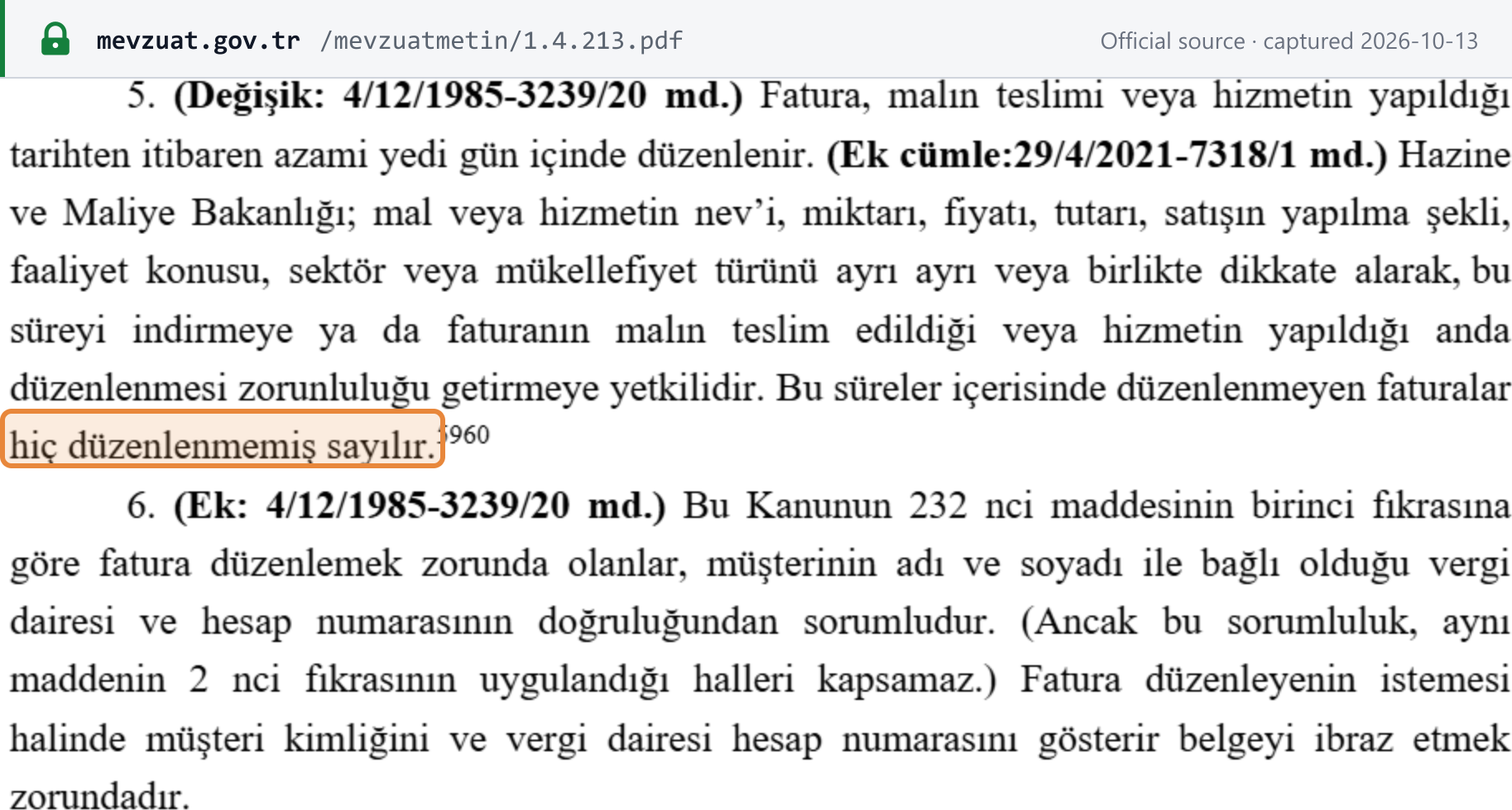
- a taxpayer whose IT system is managed from abroad may apply to GİB to use direct integration, and GİB decides case by case;
- the hardware and software used to send and receive e-documents must be in Türkiye;
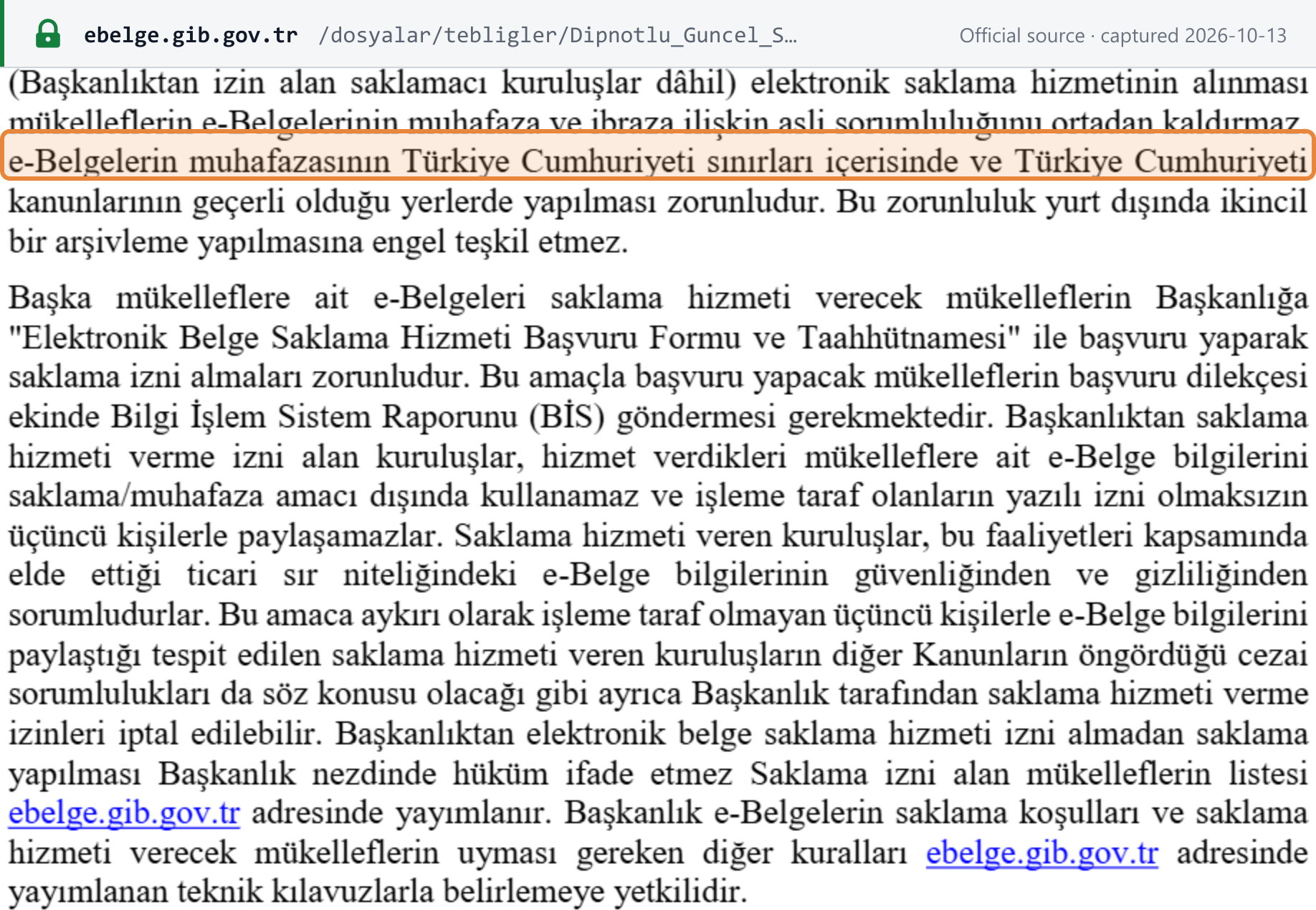
- e-documents must be stored in Türkiye, though a secondary archive abroad is allowed.
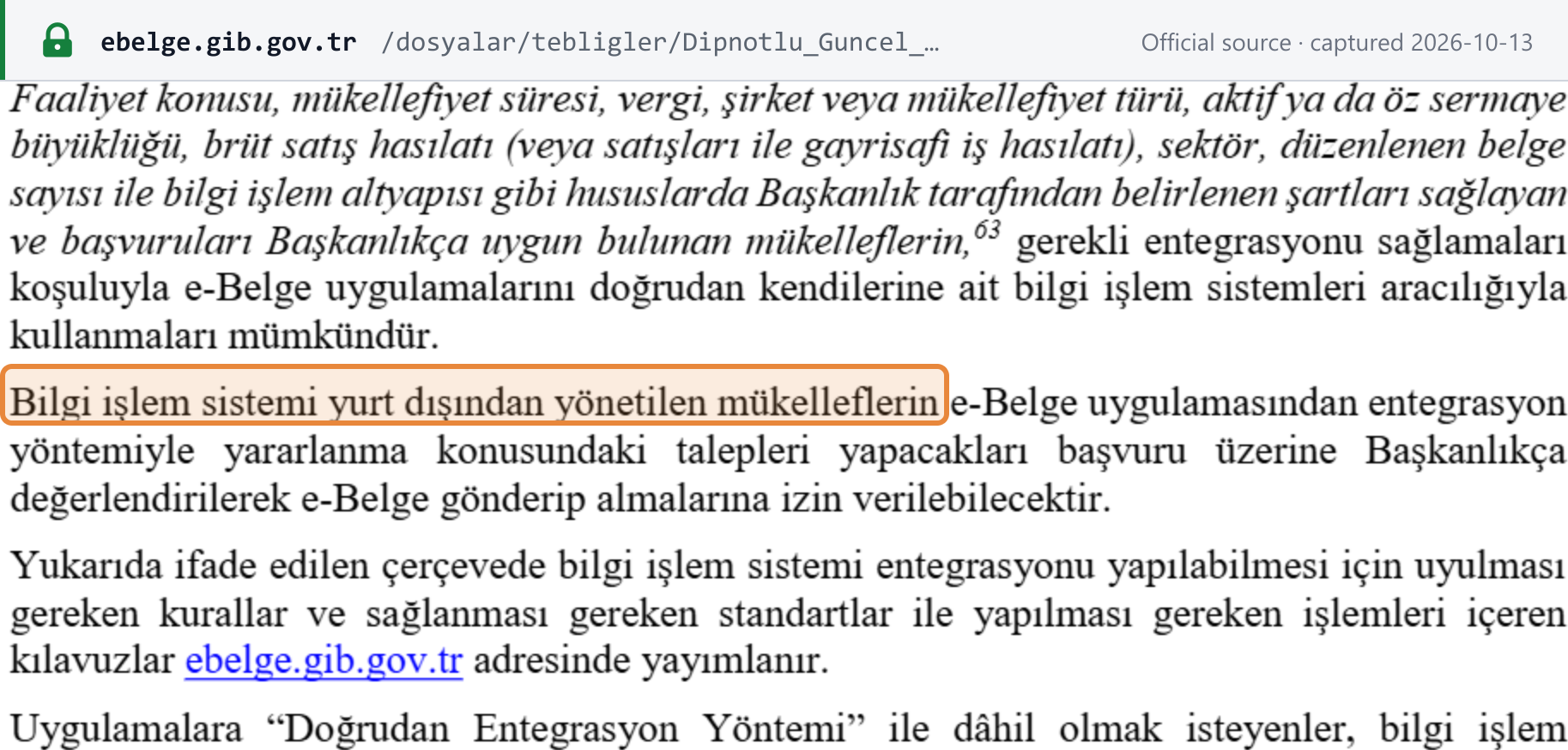
Timing. An invoice, including an e-Fatura, must be issued within 7 days of delivery or performance. An invoice not issued in time is deemed never issued (VUK Art 231/5). A business that has just joined may still issue paper invoices until the end of the 7th day of the month it joins. [6] [2]
Related documents. e-Fatura users with gross sales of TRY 10 million or more (2021 onwards) must also issue electronic dispatch notes (e-İrsaliye). [2]
Format & network
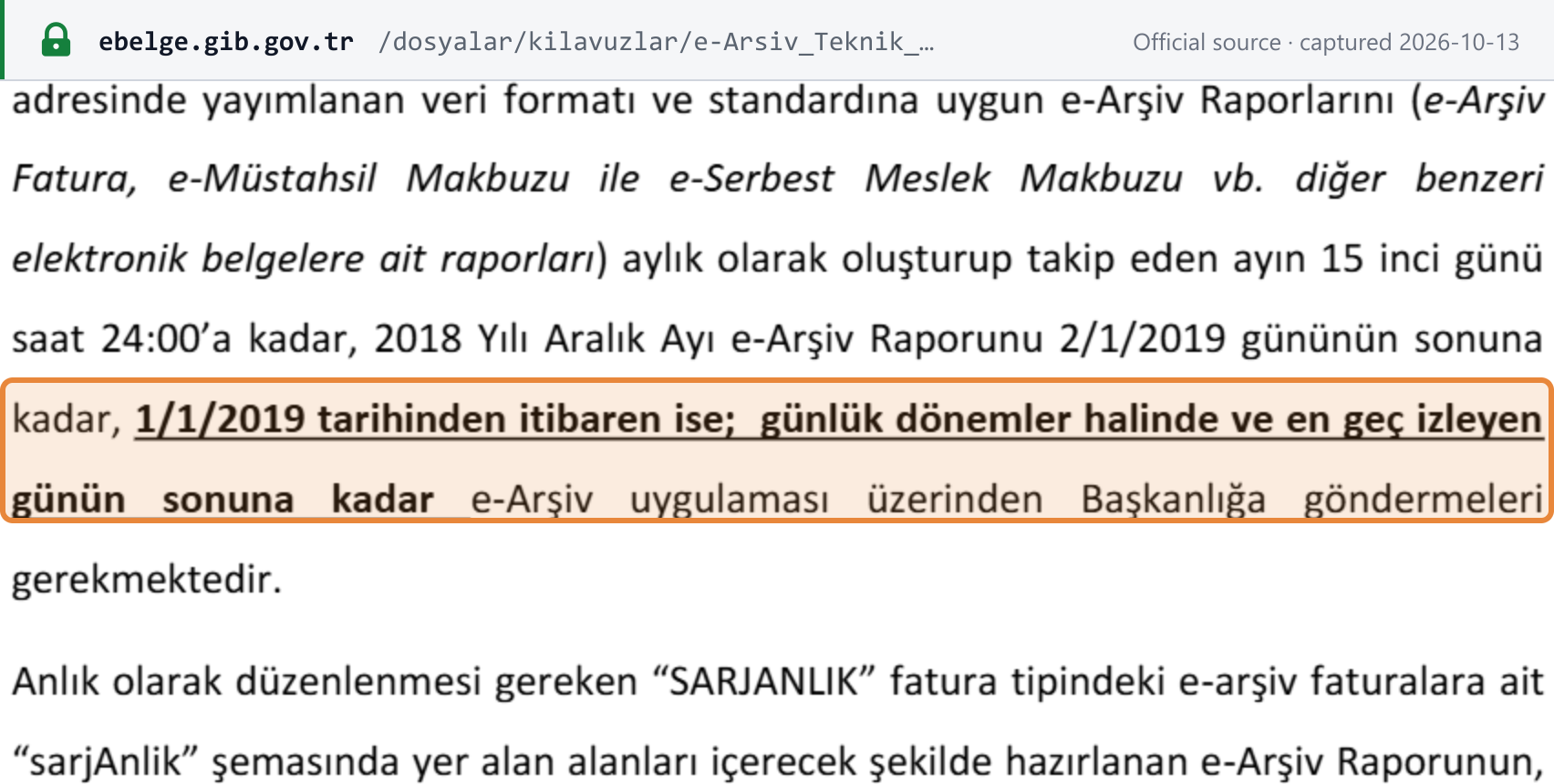
The model. e-Fatura is a centralised exchange: every document travels through GİB's platform, and GİB may stop delivery of documents it judges risky. e-Arşiv is post-issuance reporting: integrator and direct-integration users send GİB a signed e-Arşiv report daily, by the end of the following day (instant EV-charging invoices are reported immediately); GİB Portal users have no reporting duty. See CTC e-invoicing models. [2] [7]
XML format. The format is UBL-TR, GİB's customisation of UBL 2.0; the current package is UBL-TR 1.2.1. Messages travel in an SBDH (GS1 Standard Business Document Header) envelope. Using the format published on ebelge.gib.gov.tr is mandatory. GİB's code-list guide v1.43 (27 July 2026) went live on 14 September 2026. The ProfileID element sets the scenario, for example TEMELFATURA (basic), TICARIFATURA (commercial, where the buyer accepts or rejects in the system), EARSIVFATURA, IHRACAT (export) and KAMU (public sector). [5] [8]
Peppol and EN 16931. Not used. GİB's documentation describes a GİB-centred UBL-TR exchange and publishes no Peppol participant scheme or EN 16931 reference (checked 13 October 2026).
Seals and numbering. Legal persons seal invoices with their Mali Mühür (fiscal seal); individuals use a Mali Mühür or a qualified electronic certificate. The invoice number is a 3-character unit code plus a 13-character sequence (year and a 9-digit serial restarting each year). e-Arşiv invoices must show the time of issue. [2]
Onboarding: how to comply
Choose a route (Communiqué 509 §V.1):
- GİB Portal — free, for businesses without their own integration. Invoices are keyed in or uploaded.
- Private integrator (özel entegratör) — a GİB-licensed provider creates, seals, time-stamps and transmits documents and reports for you. GİB's list of licensed integrators had 93 entries on 13 October 2026.
- Direct integration — your own system connects to GİB's. Only taxpayers meeting GİB's criteria on activity, capital, turnover, volume and IT capacity qualify, and integration must be finished within one year of applying.
Apply and get a seal. Applications are made electronically at ebelgebasvuru.gib.gov.tr, signed with a Mali Mühür (legal persons) or a qualified electronic certificate or Mali Mühür (individuals). [9] The fiscal seal is issued by TÜBİTAK BİLGEM's public certification centre (Kamu SM). [2] A test portal is available.
If GİB requires you to join and you do nothing, GİB may open a GİB Portal account for you on its own initiative. [2]
When systems fail. Paper invoices may be issued without penalty, as long as the legal issue deadline is met, when GİB's systems or your own or your integrator's systems have a proven outage, or your seal device fails or is stolen. Notify GİB in writing before using paper. [2]
Archiving. Keep e-documents electronically, with their seal or signature; printing them is not retention. The primary archive must be in Türkiye. The retention period is the VUK period of 5 years from the start of the year after the one the document relates to. [2]
Penalties
VUK Article 353(1) applies when an invoice is not issued or received, or is issued on paper where an e-document was required:
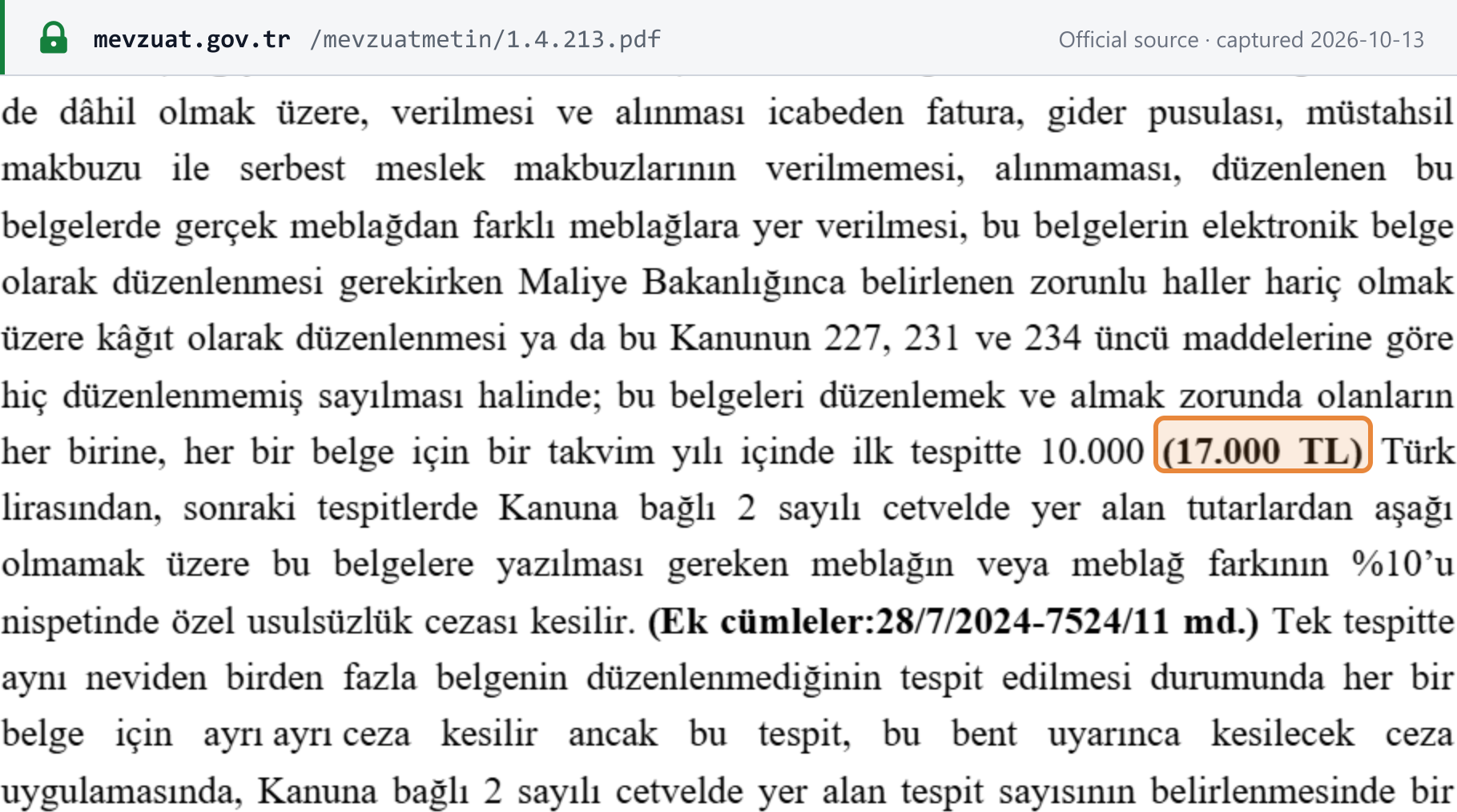
- 10% of the amount that should have been invoiced, with a minimum of TRY 17,000 per document for the first finding in a calendar year (2026 figure; higher minimums for later findings);
- an annual cap of TRY 17 million per document type;
- if the buyer reports the issuer within 5 working days, the buyer is not fined and the issuer's fine is tripled.
Breaches involving dispatch notes (e-İrsaliye) fall under Article 353(2): TRY 14,000 per document on first finding in 2026. [6]
Frequently asked questions
Our 2025 gross sales were TRY 3.2 million. When must we be on e-Fatura?
From 1 July 2026, the start of the seventh month of the year after the threshold was met. You must join e-Arşiv in the same period. Taxpayers obliged to use e-Fatura must also keep e-Defter ledgers; a business that joins e-Fatura mid-year starts e-Defter at the beginning of the following year, here 1 January 2027.
We are below the e-Fatura threshold. Can we still issue paper invoices in 2026?
Generally no: from 1 January 2026, a taxpayer not in e-Arşiv must issue every invoice as an e-Arşiv Fatura, whatever the amount. The exception is simplified-method (basit usul) and business-account (işletme hesabı) taxpayers, who keep the TRY 3,000 limit until 31 December 2026 and must issue every invoice as e-Arşiv from 1 January 2027.
Our customer is not registered for e-Fatura. What do we send?
An e-Arşiv Fatura. Between two registered e-Fatura users every invoice must be an e-Fatura; to anyone else, it is an e-Arşiv Fatura.
Can our group's foreign ERP issue Turkish e-invoices?
It depends on the route. If your ERP sends invoices through a licensed Turkish private integrator, the integrator's system issues and transmits them. Connecting an IT system managed from abroad directly to GİB needs GİB's permission, which it decides case by case. Integrators' systems must be located in Türkiye, and e-documents must be archived in Türkiye.
What does a paper invoice cost if an e-invoice was required?
10% of the amount, with a minimum of TRY 17,000 per document for the first finding in 2026, capped at TRY 17 million a year per document type.
Recent changes
- 2026-09-30 — GİB updated its UserList guide to v1.1; integrators must complete the changes by 16 November 2026. (GİB)
- 2026-09-14 — Updated e-Fatura and e-Arşiv packages and the UBL-TR code-list guide v1.43 went live. (GİB)
- 2026-03-27 — GİB postponed the KDV-rate check against activity codes, due 1 April 2026, until a further announcement. (GİB)
- 2026-01-01 — Taxpayers not in e-Arşiv must issue every invoice as e-Arşiv Fatura, whatever the amount (Communiqué 573); simplified-method and business-account taxpayers follow on 1 January 2027 (Communiqué 589). (Communiqué 509, consolidated) — see event
Related resources
- Türkiye VAT guide
- Türkiye tax ID guide and the Turkish VKN validator
- E-invoicing status and networks by country
- CTC e-invoicing models
- Türkiye tax changes on Lookuptax