E-invoicing in Oman: Fawtara and the 2027 mandate
Overview
Oman's e-invoicing system is called Fawtara (فوترة). It is run by the Oman Tax Authority (OTA), which is also Oman's Peppol Authority, through the Fawtara portal. Invoices travel between businesses over the Peppol network through Accredited Service Providers (ASPs), and the providers report the invoice's tax data to the OTA. [1]
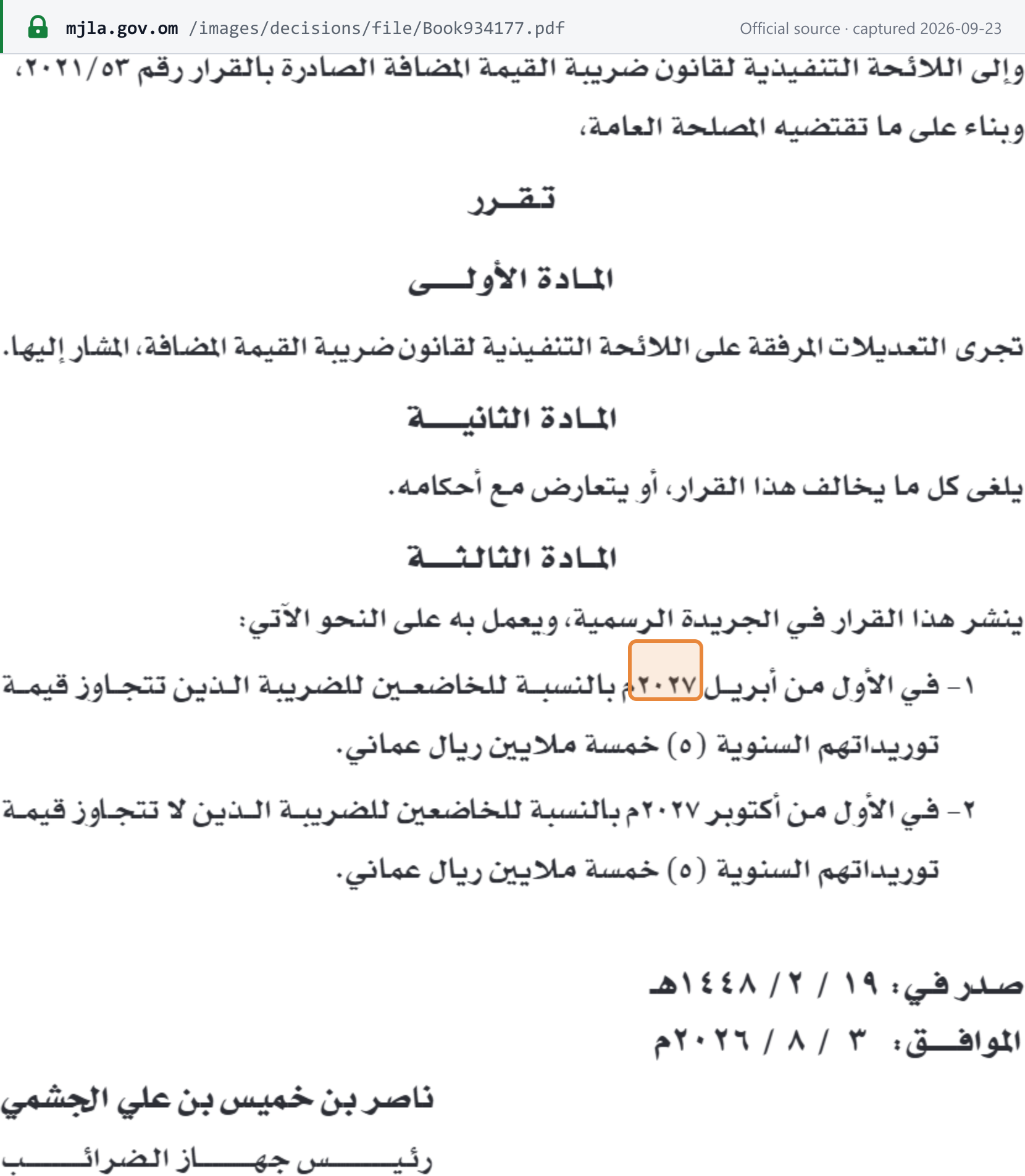
Legal basis in one line. Decision No. 189/2026 amended the Executive Regulations of the VAT Law so that tax invoices must be issued in an approved, secured electronic format, and set two start dates: 1 April 2027 for taxable persons whose annual supplies exceed OMR 5 million, and 1 October 2027 for those whose supplies do not. [2]
| Oman | |
|---|---|
| System | Fawtara — a decentralised Peppol 5-corner model with tax-data reporting to the OTA; not central clearance |
| B2B | Mandatory from 1 Apr 2027 (annual supplies above OMR 5m) or 1 Oct 2027 (all other taxable persons) |
| B2C | Same dates as B2B. The OTA says B2C "will be implemented at the same time as B2B and B2G" |
| B2G | The OTA's FAQ implies the same dates as B2B, but no instrument dates B2G (checked 13 Oct 2026) |
| Non-residents | In scope. Only supplies made in Oman count toward the OMR 5m test |
| Pilot / voluntary | Early issuing is encouraged; no pilot dates published |
| Format | XML in UBL syntax to the PINT OM specification; QR code on the human-readable copy for B2C and for buyers not registered for VAT |
| Network | Peppol, through OTA-Accredited Service Providers only; participant ID = scheme 0248 + VATIN |
| Authority | Oman Tax Authority (Peppol Authority; runs the central SMP) |
| Legislation | VAT Law (Royal Decree No. 121/2020); Executive Regulations (Decision No. 53/2021), amended by decisions including No. 456/2022 and No. 189/2026 |
For VAT rates, registration and the invoice fields the Regulations require, see the Oman VAT guide.
Mandate status & timeline
| Phase | Who | Date | Status (at 13 Oct 2026) | Legal basis |
|---|---|---|---|---|
| 1 | Taxable persons with annual supplies above OMR 5,000,000 | 1 April 2027 | Upcoming | Decision No. 189/2026, Art. 3(1) |
| 2 | Taxable persons with annual supplies of OMR 5,000,000 or less | 1 October 2027 | Upcoming | Decision No. 189/2026, Art. 3(2) |
The Decision was issued on 3 August 2026 and published in Official Gazette issue 1660; the Ministry of Justice and Legal Affairs portal lists it under 9 August 2026. Its Article 2 repeals anything that conflicts with it. [2] [3]
Which date applies to you: the OMR 5 million test
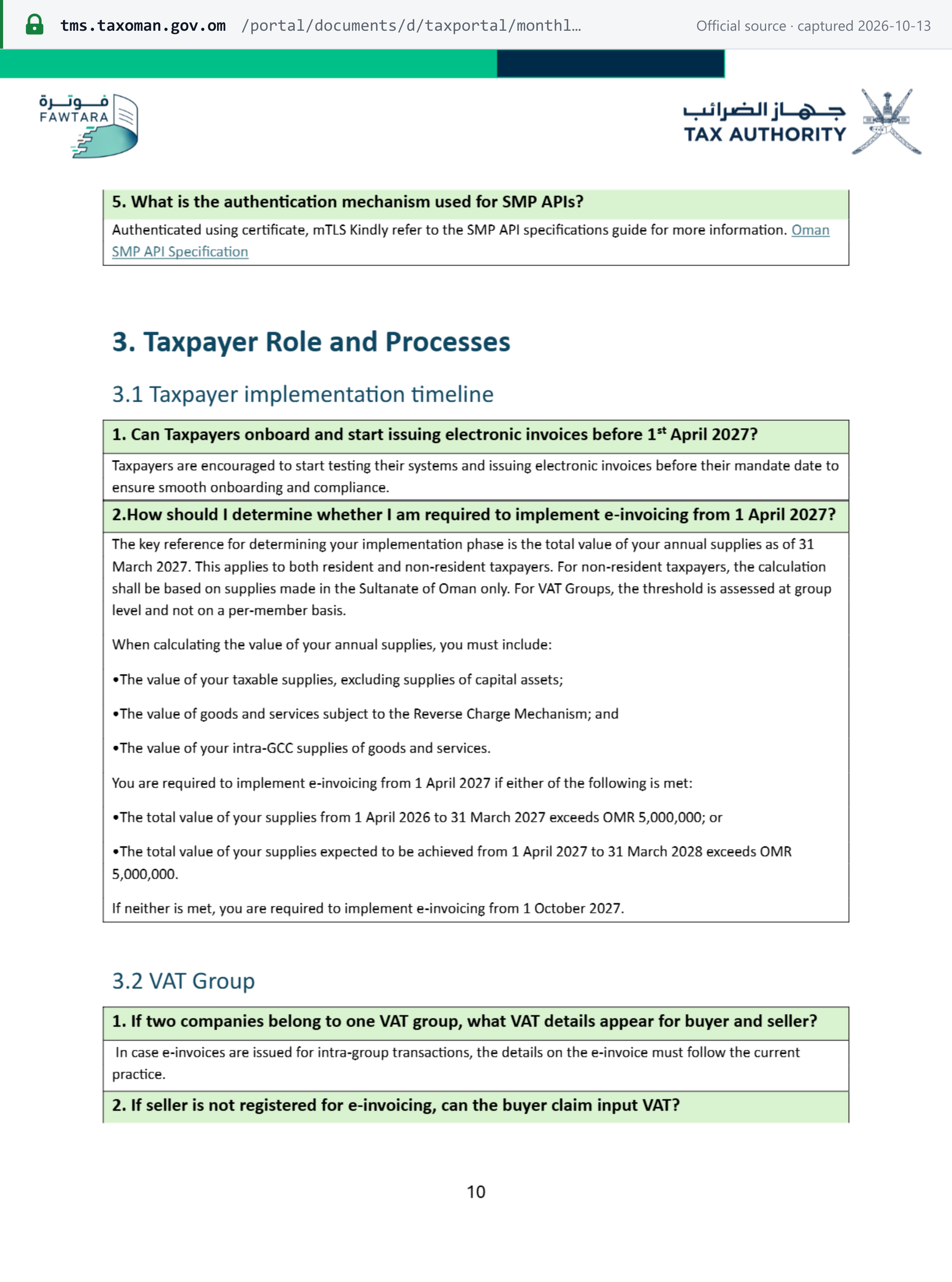
The Decision itself does not say which period the OMR 5 million is measured over. The OTA's FAQ of 30 September 2026 answers it: the reference point is total annual supplies as of 31 March 2027. You must start on 1 April 2027 if either
- your supplies from 1 April 2026 to 31 March 2027 exceed OMR 5,000,000, or
- your supplies expected from 1 April 2027 to 31 March 2028 exceed OMR 5,000,000.
If neither is met, you start on 1 October 2027. The supplies counted are taxable supplies excluding capital assets, plus supplies under the reverse charge and intra-GCC supplies. The same answer says this applies to residents and non-residents alike, that a non-resident counts only supplies made in Oman, and that a VAT group is tested at group level, not member by member. [1]
The OTA also runs a Potential Rollout Checking tool: you enter your VATIN and your current and expected supply bands, and it shows a potential start date. The OTA describes it as being for awareness and readiness only.
The earlier four-phase plan has been replaced
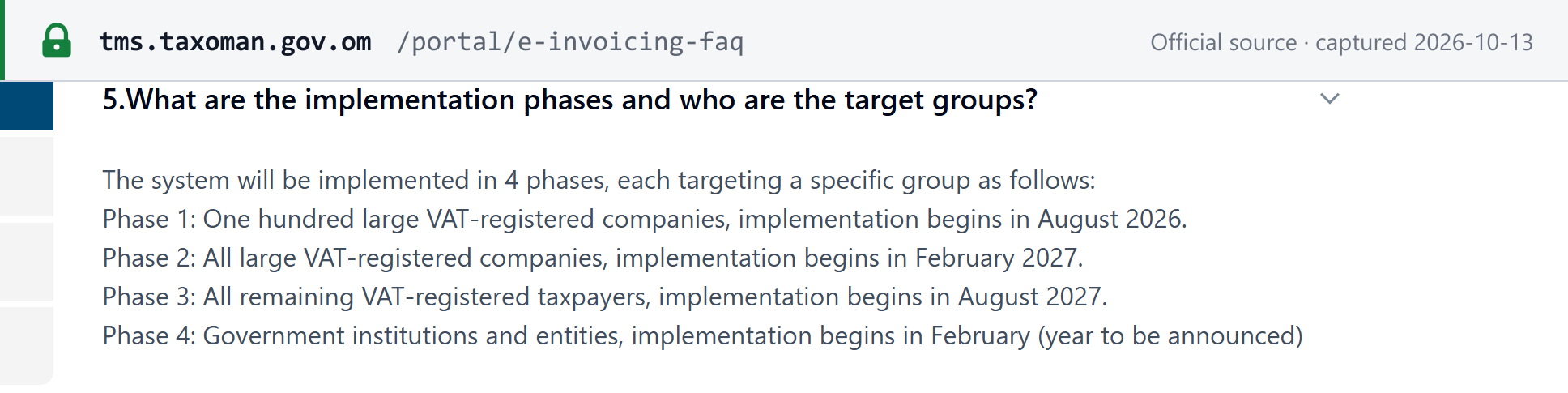
Before Decision 189/2026, the OTA published a four-phase plan: 100 large VAT-registered companies from August 2026, all large companies from February 2027, all remaining VAT-registered taxpayers from August 2027, and government entities from "February (year to be announced)". The Decision's two dates replace it. As of 13 October 2026, the OTA's FAQ web page still shows the old plan, although it links the 30 September 2026 FAQ, which follows the Decision. [4]
| Old plan (OTA FAQ web page) | Now | Instrument |
|---|---|---|
| August 2026 (100 large companies) and February 2027 (all large companies) | 1 April 2027 for annual supplies above OMR 5m | Decision No. 189/2026 |
| August 2027 (all remaining VAT-registered taxpayers) | 1 October 2027 for everyone else | Decision No. 189/2026 |
We found no instrument that made the August 2026 phase mandatory. Decision 189/2026 sets the legal start dates, so if you planned against the old dates, your obligation now starts on one of the two Decision dates.
Pilot and early adoption
The OTA encourages taxpayers to start testing and issuing e-invoices before their mandate date, and to take part in "the Pilot", but has published no pilot window (checked 13 October 2026). At the OTA's Tax Conference 2026, the OTA reported the launch of the "Rafid" electronic tax system "alongside the issuance of the first electronic tax invoice"; it does not say how Rafid relates to Fawtara. [1] [5]
Legal basis
| Instrument | Date | What it does |
|---|---|---|
| VAT Law, Royal Decree No. 121/2020 | 2020 | Invoicing duties, record retention (Art. 70), offences (Art. 100) |
| Executive Regulations, Decision No. 53/2021 | 2021 | Invoice content (Arts 144, 147), administrative fines (Art. 202) |
| Decision No. 456/2022 | 13 Oct 2022 (Gazette 1463) | Defines the "electronic tax invoice"; adds a fine for not issuing invoices to the e-invoice requirements; in force the day after publication |
| Decision No. 189/2026 | 3 Aug 2026 (Gazette 1660) | Makes the electronic format mandatory (new Art. 143 and Arts 143 bis to 143 bis 2) and sets the 2027 start dates |
The e-invoice definition. Decision 456/2022 added to the Regulations a definition of an electronic tax invoice: a tax invoice issued in a structured electronic format through an electronic means, containing at least the information the Regulations specify and any other information the OTA specifies. [6]
What Decision 189/2026 changed. The new Article 143 requires a taxable person to issue the tax invoice in an approved and secured electronic format that ensures its integrity, and to store it with a unique number for each invoice. The duty applies to supplies, including supplies to a person not subject to tax, to deemed supplies, and to consideration received before the supply. The invoice must be issued within 15 days, and its origin, content and legibility must stay verifiable until the end of the retention period. A simplified tax invoice must be issued within the same deadlines (Art. 146, second paragraph). [2]

The Decision also adds:
- Art. 143 bis — the OTA announces which companies are licensed to provide e-invoicing services.
- Art. 143 bis (1) — the taxpayer must issue e-invoices securely through an electronic system, meet the OTA's technical security specifications, plan for faults and emergencies, and be able to recover lost data.
- Art. 143 bis (2) — the OTA Chairman may, on an application with supporting documents, exempt a taxpayer from e-invoicing for a period the OTA sets, provided the taxpayer files its returns and pays its tax on time. No application form or procedure had been published as of 13 October 2026.
- Art. 147 item 11 — simplified invoices must also carry any other data the OTA specifies.

Scope
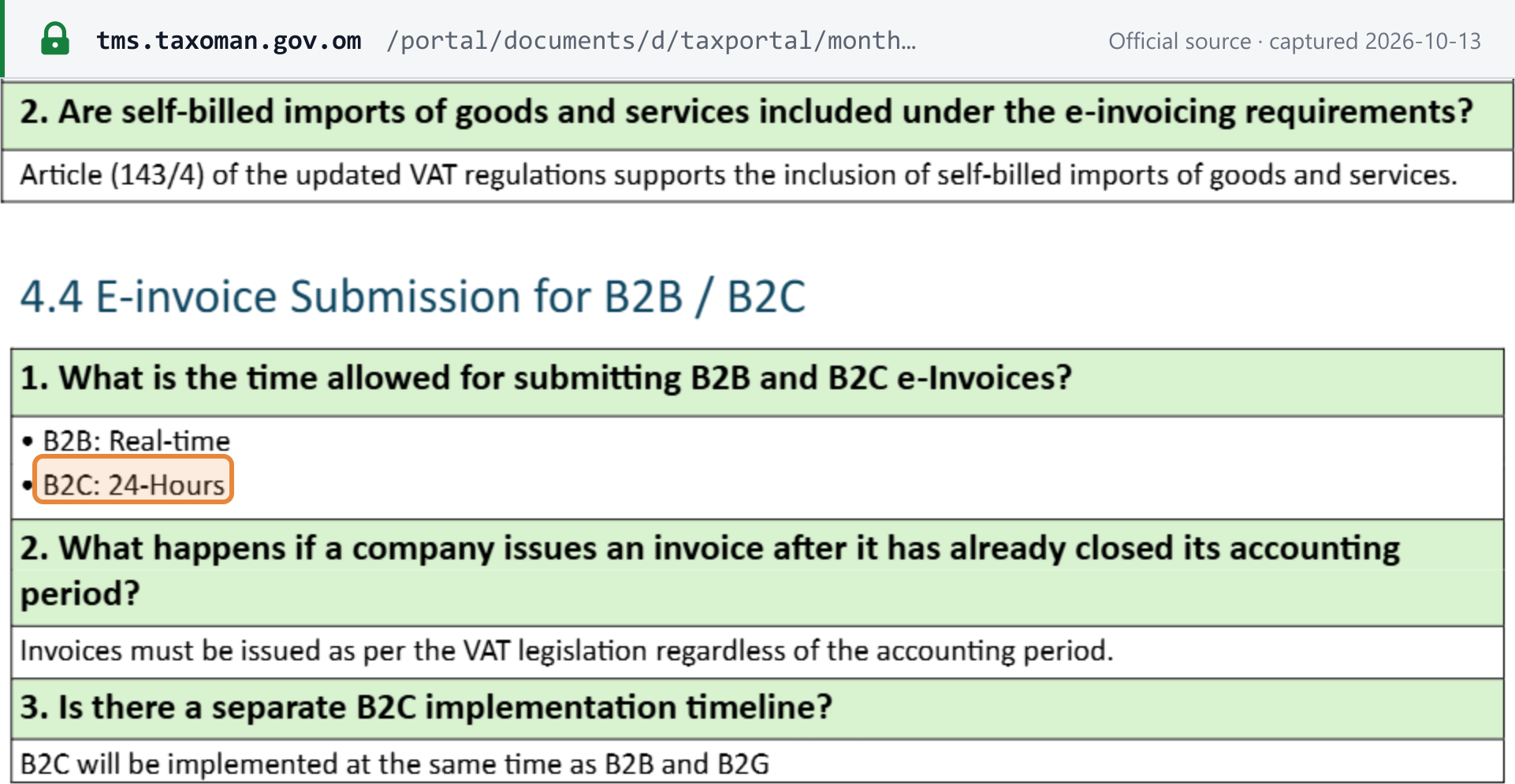
B2B and B2C. Both are in scope from your mandate date. The OTA's FAQ says B2C "will be implemented at the same time as B2B and B2G", and the new Article 143 expressly covers supplies to persons not subject to tax. Its timing answer is: "B2B: Real-time; B2C: 24-Hours". [1]
B2G. The OTA's FAQ implies that B2G runs alongside B2B and B2C, but no instrument dates it: Decision 189/2026 binds taxable persons and says nothing separately about government bodies, and the old four-phase plan put government entities last, with the year to be announced (checked 13 October 2026).
Non-residents. In scope. The OTA's FAQ applies the timeline to "both resident and non-resident taxpayers" and counts only a non-resident's supplies made in Oman. [1]
Which transactions. According to the OTA's FAQ:
- an e-invoice is needed wherever the VAT legislation requires an invoice, and there are no industry exceptions;
- for exports, the supplier gives the foreign customer an invoice as today, and the tax data is still reported to the OTA through the supplier's provider;
- imports of goods and services are reported as self-billed invoices, which the FAQ links to amended Article 143(4);
- invoices issued before your mandate date are not resubmitted.
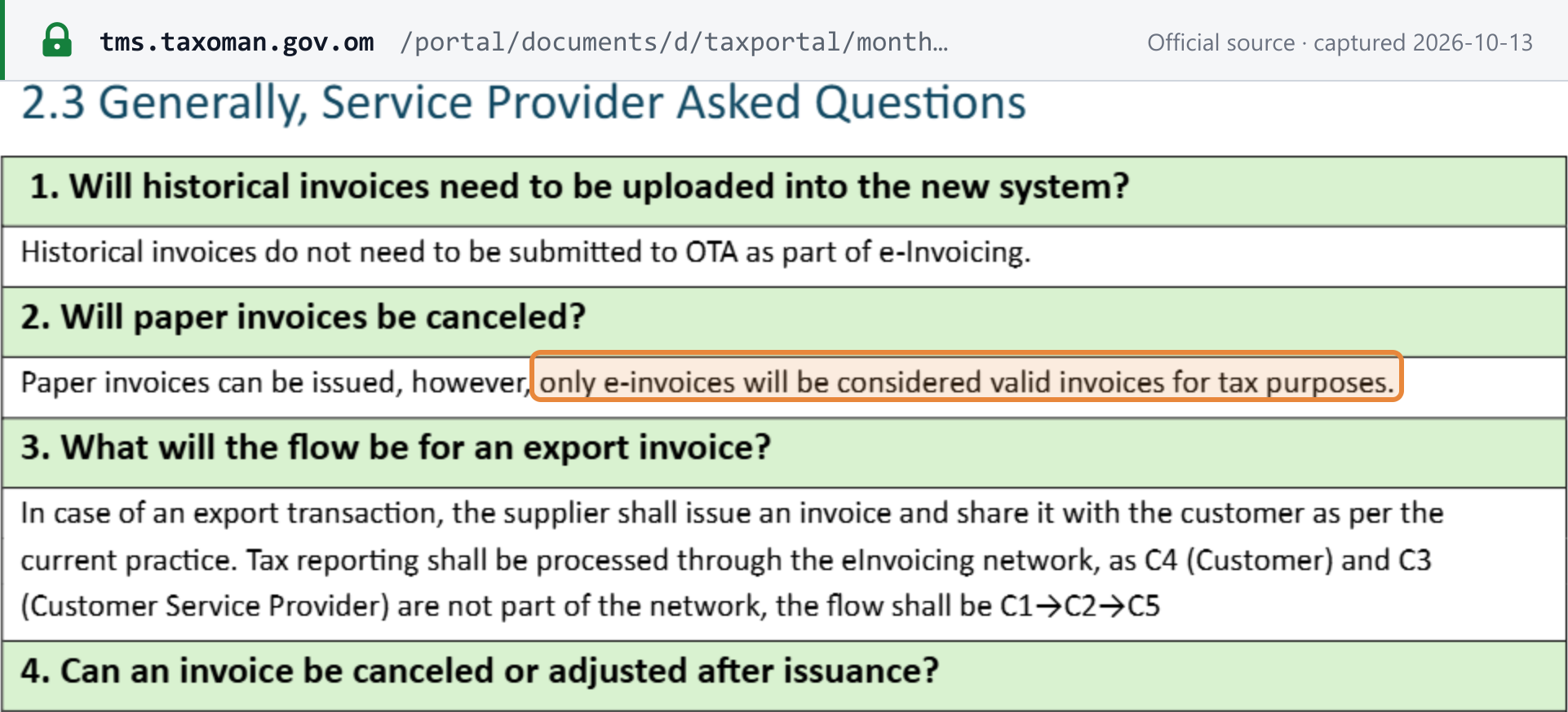
Paper invoices. The 30 September 2026 FAQ says: "Paper invoices can be issued, however, only e-invoices will be considered valid invoices for tax purposes." The OTA's June 2026 FAQ had said that only B2C invoices could still be issued on paper. [1] [13]
Counterparties on different dates. If the seller is not yet in a rollout, it keeps issuing invoices that comply with the VAT rules, and the buyer claims input VAT as now. If the buyer is not yet in scope, the supplier still sends the invoice to its provider, which reports the tax data to the OTA, and the buyer receives its copy in the usual way. [1]
Simplified invoices. These are still allowed and follow the Article 143 deadlines. For the OMR 500 ceiling and the fields a simplified invoice needs, see the Oman VAT guide.
Format & network
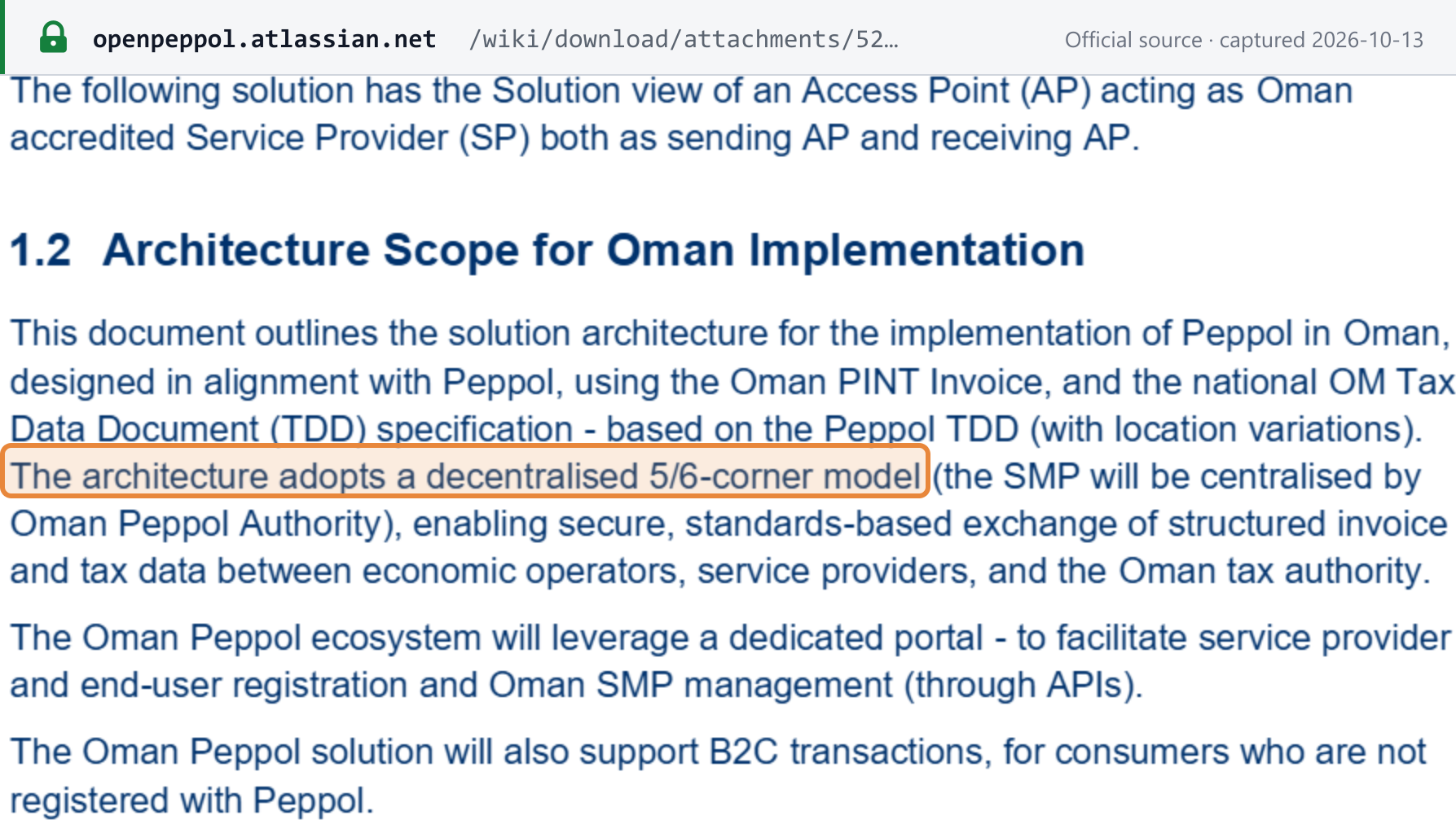
The model. Fawtara is a decentralised 5-corner Peppol model with tax-data reporting, not central clearance. OpenPeppol's Oman Solution Reference Architecture describes "a decentralised 5/6-corner model (the SMP will be centralised by Oman Peppol Authority)". The supplier (corner 1) sends the invoice through its provider (corner 2) to the buyer's provider (corner 3) and the buyer (corner 4). Both providers report a Tax Data Document to the OTA (corner 5). The supplier's provider validates the invoice against the Oman Schematron rules. The invoice reaches the buyer over Peppol, not through the OTA; the OTA receives the tax data and returns a status message for each Tax Data Document. [7] [1]
XML format. Invoices must be XML. The specification is PINT OM, Oman's customisation of Peppol International (PINT) in UBL syntax, published by OpenPeppol:
CustomizationID:urn:peppol:pint:billing-1@om-1withProfileIDurn:peppol:bis:billingfor invoices and credit notes; self-billing usesurn:peppol:pint:selfbilling-1@om-1withurn:peppol:bis:selfbilling.- Document types: tax invoice (380), credit note (381), self-billing invoice (389) and self-billing credit note (261).
- Each invoice carries a 20-character transaction-type code (full or simplified invoice, self-billed, export, deemed supply, import under reverse charge and so on) and a version 5 UUID.
- OpenPeppol's Oman index lists PINT OM Billing v1.0.1, PINT OM Self-Billing v1.0.1 and the Oman Tax Data Document v1.0.1, with PDK 1.4.4 released on 29 July 2026.
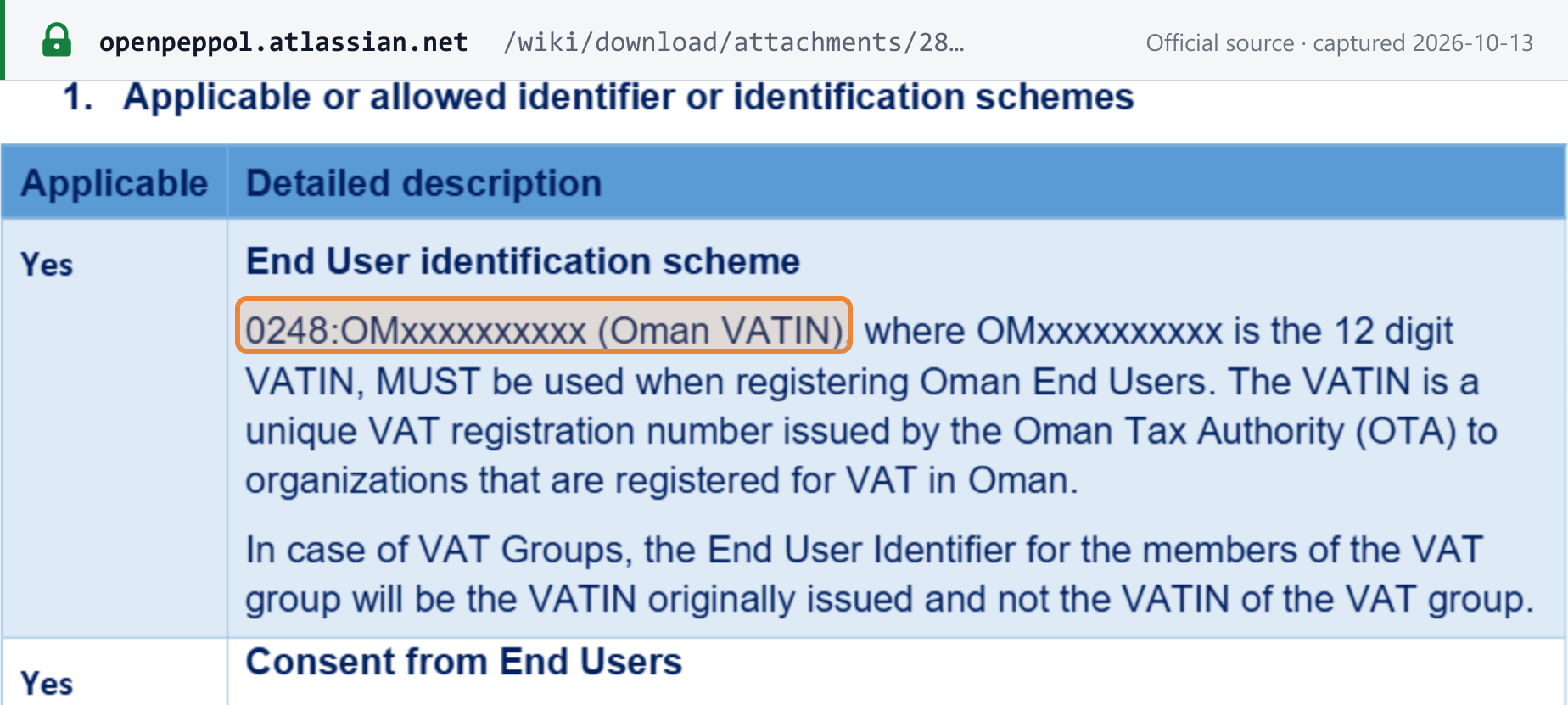
Participant identifier. Omani end users are registered on Peppol as 0248: followed by their VATIN. Members of a VAT group use the VATIN originally issued to them, not the group's VATIN. To check a VATIN, see how to verify an Oman VATIN. [10]
Provider reporting deadlines. Under the Peppol Authority Specific Requirements, the supplier's provider must send the Tax Data Document to the OTA within 15 minutes of validation for B2B and G2B invoices, and within 30 minutes for B2C and G2C; the buyer's provider has 15 minutes from receipt. These are deadlines for the providers. They are separate from the FAQ's "B2B: Real-time; B2C: 24-Hours", and the OTA has not said how the two fit together. [10]
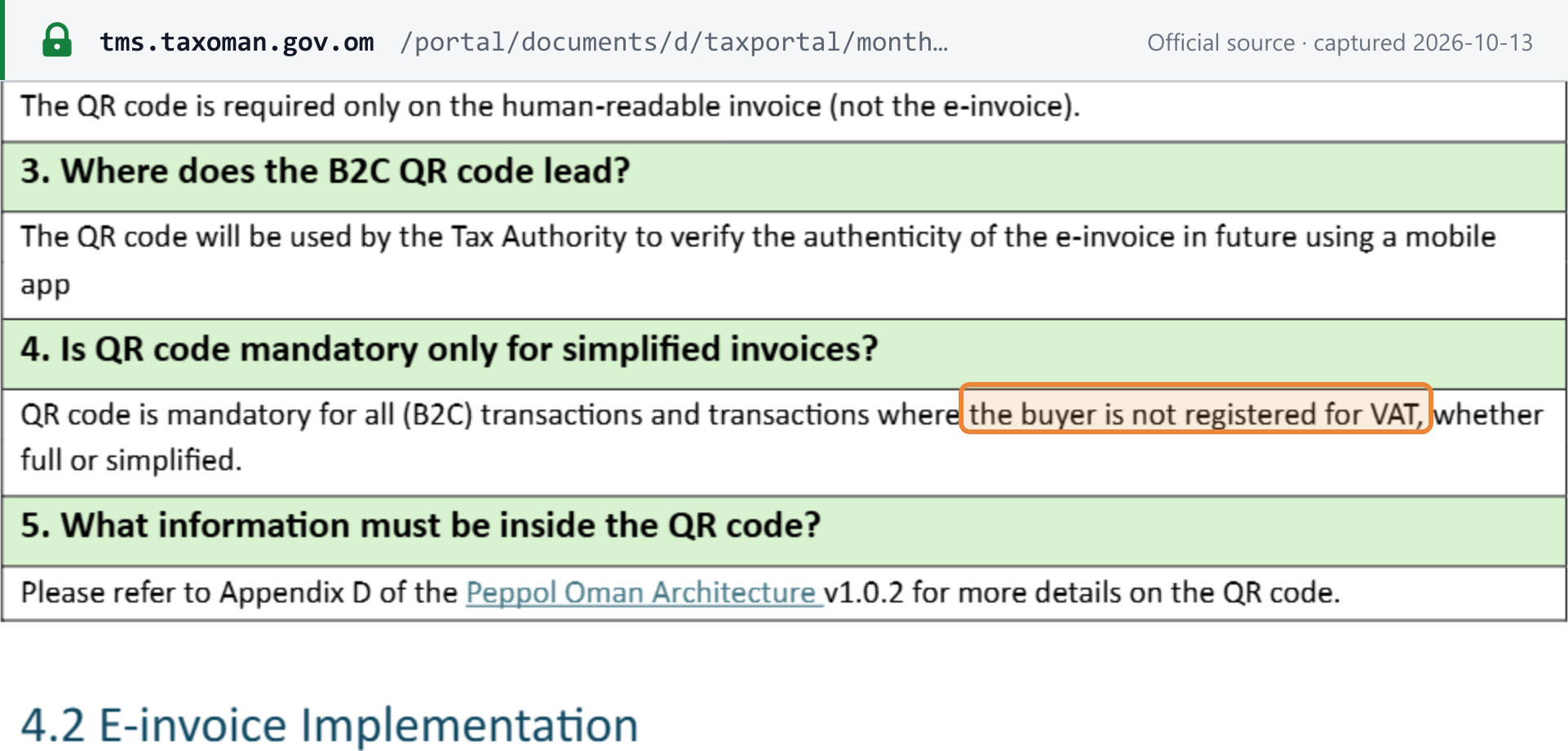
QR code. A QR code is mandatory for all B2C transactions and for transactions where the buyer is not registered for VAT, whether the invoice is full or simplified. It goes on the human-readable invoice only, not in the XML, and the supplier generates it. The Architecture document lists its contents, including the invoice number, seller name and VATIN, date and time, total including VAT, and VAT total. [1] [7]
Certificates. A digital certificate is required and is provided by OpenPeppol; providers authenticate to the OTA's SMP with certificates (mTLS). [1]
Onboarding: how to comply
- Pick an Accredited Service Provider. The official list is on the Fawtara portal. A business can also be accredited as its own provider.
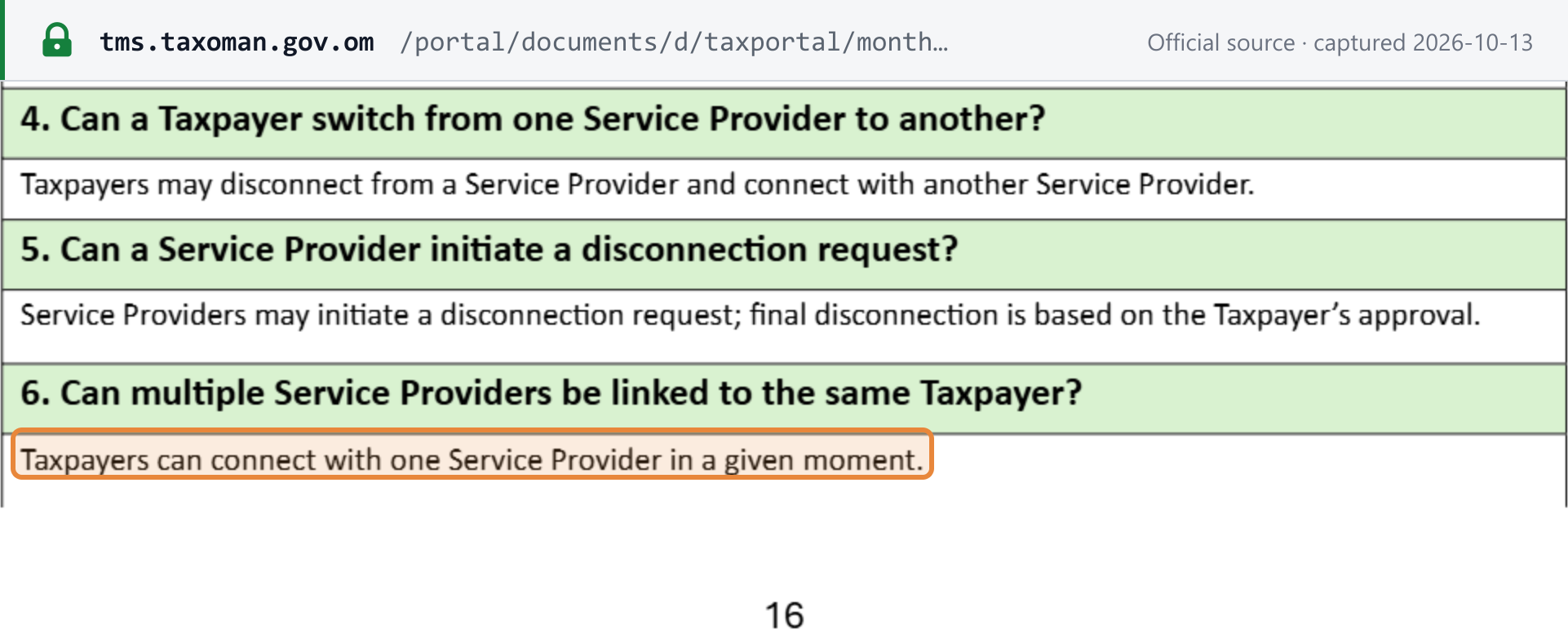
- Link to the provider on the Fawtara portal. You can be linked to one provider at a time and may switch. The provider must register you on the OTA's central SMP within 3 Omani working days. [1] [10]
- Connect your billing system. You can keep your ERP; the provider handles validation, delivery and reporting. The OTA charges no fees and does not require providers to charge any.
- Be live by your date — 1 April or 1 October 2027.
Becoming an Accredited Service Provider. The OTA's criteria include a mainland Oman commercial registration with a relevant IT activity, paid-up capital of at least OMR 6,000, at least 2 years of operation (1 year for Riyada card holders), a declaration of no bankruptcy, insolvency or criminal proceedings, no tax-debt collection process, and security evidence including ISO/IEC 27001. Applicants must pass the Peppol eDelivery and PINT OM test suites on the Peppol Testbed; the OTA aims to respond within 30 days. Foreign providers need a local presence: a subsidiary, a branch, or a local distributor. Providers must use the OTA's central SMP and may not run their own. [11] [1]

Archiving. Storing and archiving e-invoices is the taxpayer's job, and the OTA will not supply copies. VAT Law Article 70 requires tax invoices and records to be kept by secure and reliable means for 10 years after the end of the tax year in which the return is filed, and 15 years for real-estate records. No official text says whether the XML is the legal original or whether data must be stored in Oman (checked 13 October 2026). [1] [12]
Support. Raise a ticket on the Fawtara portal, email [email protected], or call 1020.
Penalties
- Administrative fine of OMR 500 to OMR 5,000. Article 202 of the Executive Regulations lets the OTA Chairman impose this fine; item 4, added by Decision 456/2022, covers failing to issue the tax invoice in line with the Regulations and any OTA requirements for electronic tax invoices. [6]
- Criminal penalty for deliberately not issuing a tax invoice. VAT Law Article 100 provides for imprisonment of 2 months to 1 year and/or a fine of OMR 1,000 to OMR 10,000. [12]
- No grace period announced. The OTA says "Penalties will apply according to VAT legislation after the mandate begins", and that responsibility for invoice compliance stays with the taxpayer, not the provider. [1]

Frequently asked questions
Do I start in April or October 2027?
April 2027 if your supplies from 1 April 2026 to 31 March 2027, or your expected supplies from 1 April 2027 to 31 March 2028, exceed OMR 5,000,000; otherwise 1 October 2027. Supplies counted are taxable supplies excluding capital assets, plus reverse-charge and intra-GCC supplies. VAT groups are tested as a whole group, and non-residents count only supplies made in Oman. This test comes from the OTA's FAQ of 30 September 2026; Decision 189/2026 itself only sets the OMR 5 million threshold and the two dates. [1] [2]
Was Oman's e-invoicing mandatory from August 2026?
Not as far as we can find. The OTA's earlier plan had a first phase of 100 large companies from August 2026, but we found no instrument making that phase mandatory, and Decision 189/2026 set the legal start dates at 1 April 2027 and 1 October 2027. The OTA's FAQ web page still showed the old phases on 13 October 2026. [2] [4]
Can I still give customers a paper or PDF invoice?
You can hand one over, but after your mandate date only the e-invoice issued to the Oman specifications counts as a valid invoice for tax purposes. B2C and non-VAT-registered buyers' copies must also carry a QR code. [1]
Is Fawtara clearance like Saudi Arabia's FATOORA?
No. Invoices travel between the parties' Accredited Service Providers over Peppol, not through the OTA; the providers report tax data to the OTA, which returns a status message. Saudi Arabia's FATOORA clears B2B invoices centrally; Oman's model is closer to the UAE's. [7]
Do foreign businesses registered for Omani VAT have to comply?
Yes. The OTA applies the timeline to non-resident taxpayers too and tests them on their supplies made in Oman only. A foreign company that wants to act as a service provider needs a local subsidiary, branch or distributor. [1]
Recent changes
- 2026-09-30 — The OTA's new Fawtara FAQ defines the OMR 5 million test (supplies 1 April 2026 to 31 March 2027, or expected 1 April 2027 to 31 March 2028), puts non-residents in scope on their Oman supplies, tests VAT groups at group level, and says only e-invoices are valid for tax purposes. (OTA FAQ)
- 2026-08-03 — Decision No. 189/2026 makes e-invoicing mandatory from 1 April 2027 (annual supplies above OMR 5 million) and 1 October 2027 (all other taxable persons), replacing the OTA's four-phase plan. (Official Gazette 1660) — see event
Related resources
- Oman VAT guide — rates, registration, invoice fields
- How to verify an Oman VATIN
- E-invoicing status and networks by country
- Peppol guide
- UAE e-invoicing and Saudi Arabia e-invoicing
- Oman tax changes on Lookuptax
Important websites
- Fawtara portal — provider linking and the official ASP list
- OTA e-invoicing FAQ page
- Potential Rollout Checking tool
- PINT OM specifications (OpenPeppol)