E-invoicing in Chile: the SII's DTE system
Overview
Chile's e-invoicing system is the Documentos Tributarios Electrónicos (DTE) system run by the Servicio de Impuestos Internos (SII), the tax authority. The SII defines a DTE as an electronic document "generado y firmado electrónicamente por un emisor electrónico, que produce efectos tributarios y cuyo formato está establecido por el SII" (generated and signed electronically by an authorised electronic issuer, with tax effects, in a format the SII sets). (Res. Ex. SII 45/2003, Primero h)
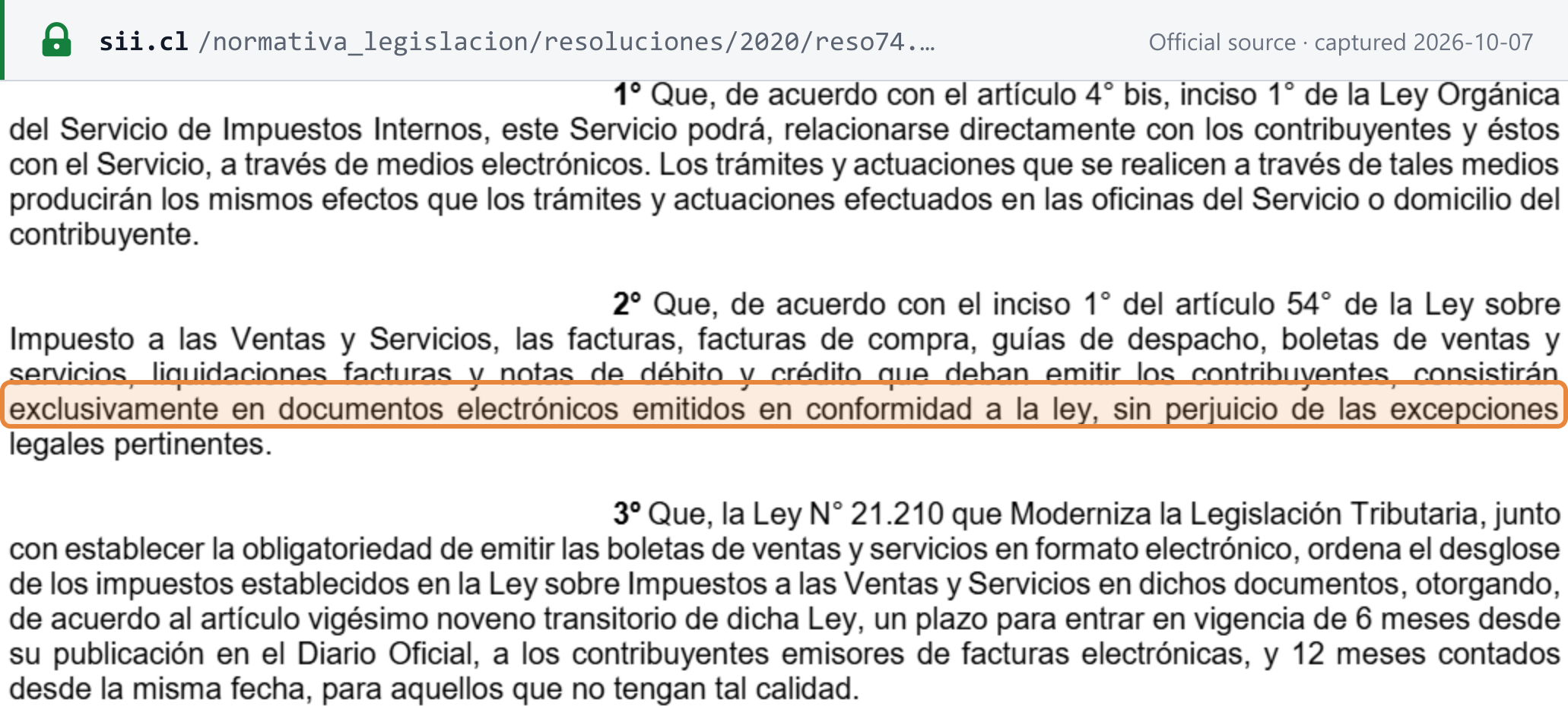
Legal basis in one line. Article 54 of the VAT law (Decreto Ley 825 of 1974), as rewritten by Ley 20.727 and extended by Leyes 21.131 and 21.210, says that facturas, facturas de compra, guías de despacho, boletas, liquidaciones facturas and debit and credit notes "consistirán exclusivamente en documentos electrónicos emitidos en conformidad a la ley, sin perjuicio de las excepciones legales pertinentes" (shall consist exclusively of electronic documents issued under the law, subject to the relevant legal exceptions). (DL 825 art. 54; restated in Res. Ex. SII 74/2020, considerando 2°)
 Source snapshot captured 2026-10-07 — original
| Chile | |
|---|---|
| Status | Live national mandate. Facturas phased in 1 November 2014 – 1 February 2018 (all passed); guías de despacho from 16 January 2020; boletas from 1 January 2021 (existing e-invoicers) and 1 March 2021 (everyone else) |
| B2B | Mandatory electronic factura (DTE 33/34) and notes, with paper exceptions under DL 825 art. 54 inc. 2 |
| B2G | Same DTE system; the SII's e-invoicing pages describe no separate government-invoicing channel (as at 2026-10-07) |
| B2C | Mandatory electronic boleta (DTE 39/41), sent to the SII |
| Non-residents | Suppliers under the simplified IVA Digital regime (DL 825 Párrafo 7° bis) are released from issuing tax documents (art. 35 C) |
| Model | Clearance-style: each DTE goes to the SII before transport, delivery or hand-over; the SII validates it |
| Format | SII national XML schema (EnvioDTE / DTE / SiiTypes / xmldsignature v1.0); field specification Formato Documentos Tributarios Electrónicos v2.5 (February 2026) |
| Network | SII DTE (national, direct to the SII). Not Peppol-based |
| Integrity | XML digital signature; SII-authorised folio ranges (CAF); Timbre Electrónico (TED) printed as a PDF417 barcode |
| Latest change | Res. Ex. SII 121/2026 (new validations; three reception results), in force from its Diario Oficial extract on 22 September 2026; validation phases not yet scheduled as at 2026-10-07 |
| Authority | SII — Factura electrónica |
| Legislation | DL 825 arts. 54–56; Ley 20.727; Ley 19.983; Ley 21.131; Ley 21.210; Res. Ex. SII 45/2003 |
Sources in this section checked 2026-10-07.
Mandate status & timeline
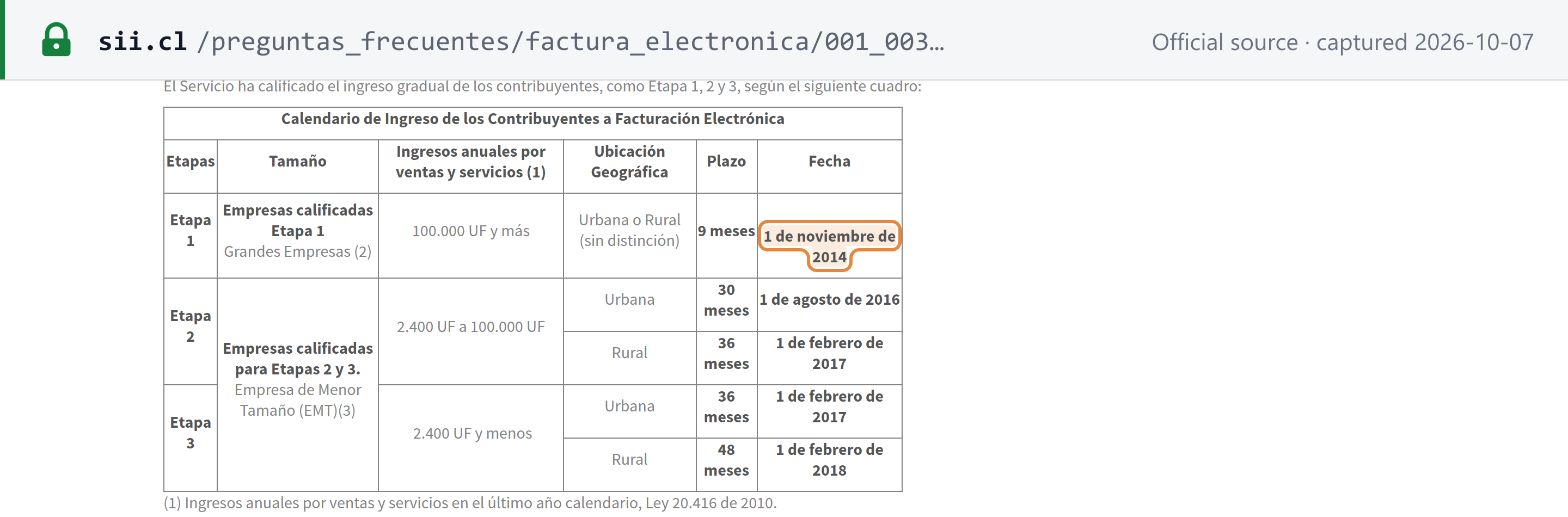
Ley 20.727 was published in the Diario Oficial on 31 January 2014. Its first transitional article starts the obligation to issue facturas and the other art. 54 documents electronically "luego de nueve meses de publicada esta ley en el Diario Oficial" (nine months after publication), with longer periods for smaller firms. (Ley 20.727) Ley 20.780 (Diario Oficial 29 September 2014) changed the periods for smaller firms to 30, 36 and 48 months, as the SII's calendar footnote notes.
| Phase | Who (annual sales income, last calendar year) | Location | Period | Mandatory from | Status |
|---|---|---|---|---|---|
| Etapa 1 | Large companies, 100,000 UF and more | Urban or rural | 9 months | 1 November 2014 | Passed |
| Etapa 2 | Smaller firms (EMT), 2,400–100,000 UF | Urban | 30 months | 1 August 2016 | Passed |
| Etapa 2 | Smaller firms (EMT), 2,400–100,000 UF | Rural | 36 months | 1 February 2017 | Passed |
| Etapa 3 | Micro firms, 2,400 UF and less | Urban | 36 months | 1 February 2017 | Passed |
| Etapa 3 | Micro firms, 2,400 UF and less | Rural | 48 months | 1 February 2018 | Passed |
| Guía de despacho | Every issuer of dispatch notes (paper still optional for farming/forestry, artisanal fishing, small mining) | — | One year after Ley 21.131 (DO 16 January 2019) | 16 January 2020 | Passed |
| Boleta electrónica | Taxpayers already issuing electronic facturas | — | 10 months after Ley 21.210 entered into force (1 March 2020), as amended by Ley 21.256 | 1 January 2021 | Passed |
| Boleta electrónica | Everyone else issuing boletas | — | 12 months after the same date | 1 March 2021 | Passed |
(SII FAQ 001.003.6505.004 — Calendario de Ingreso, updated 30 June 2025)
 Source snapshot captured 2026-10-07 — original
On 1 February 2018 the SII announced the end of the phase-in: "todas las empresas del país deben emitir sus facturas en formato electrónico" (every company in the country must issue its facturas electronically), with rural micro-enterprises the last group to join. (SII news, 1 February 2018)
Boleta dates. Res. Ex. SII 74/2020 originally set earlier boleta dates. Ley 21.256 (Diario Oficial 2 September 2020) replaced them, and the SII's current FAQ gives "1° de enero del 2021 para los que ya son facturadores electrónicos, y 1° de marzo 2021 para los que no son facturadores electrónicos". (SII FAQ 001.380.7662.005, updated 20 July 2026)
 Source snapshot captured 2026-10-07 — original
Other milestones.
- August 2017 — Registro de Compras y Ventas (RCV). Res. Ex. SII 61/2017 created the RCV, which the SII builds from the DTEs it receives, and released e-invoicing taxpayers from keeping the purchase and sales ledger of DL 825 art. 59, from the August 2017 tax period. (Res. Ex. SII 61/2017)
- 1 August 2022 — daily boleta summary abolished. Res. Ex. SII 53/2022 removed the obligation to send the Resumen de Ventas Diarias (formerly Reporte de Consumo de Folios), for every system. (Res. Ex. SII 53/2022; SII news, 4 August 2022)
Latest: Res. Ex. 121/2026 validations, in force since 22 September 2026
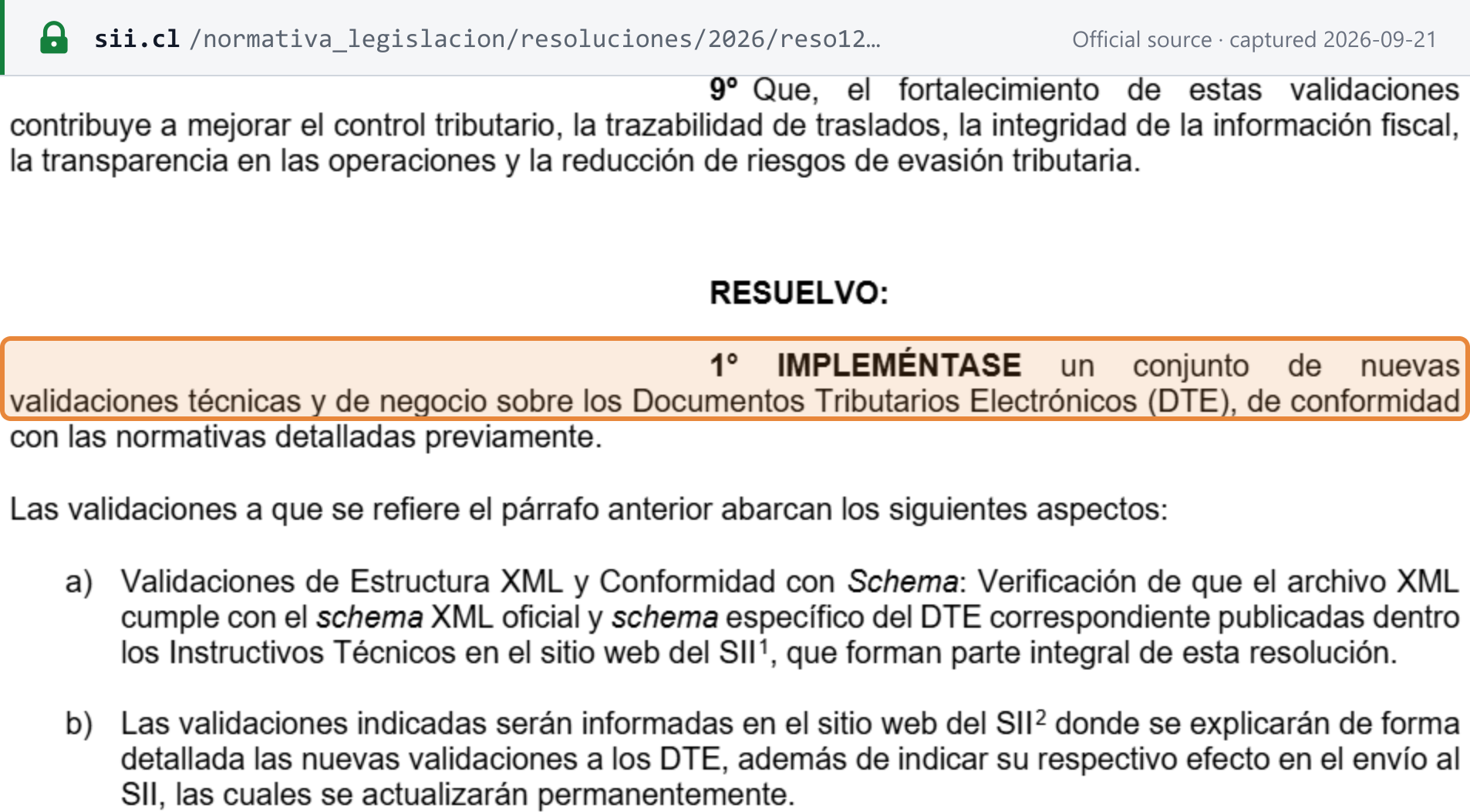
Res. Ex. SII 121 of 4 September 2026 adds "un conjunto de nuevas validaciones técnicas y de negocio" over DTE XML files: conformity with the official XML schema, plus further checks the SII lists on an instructivo page that it will "update permanently". (Res. Ex. SII 121/2026)
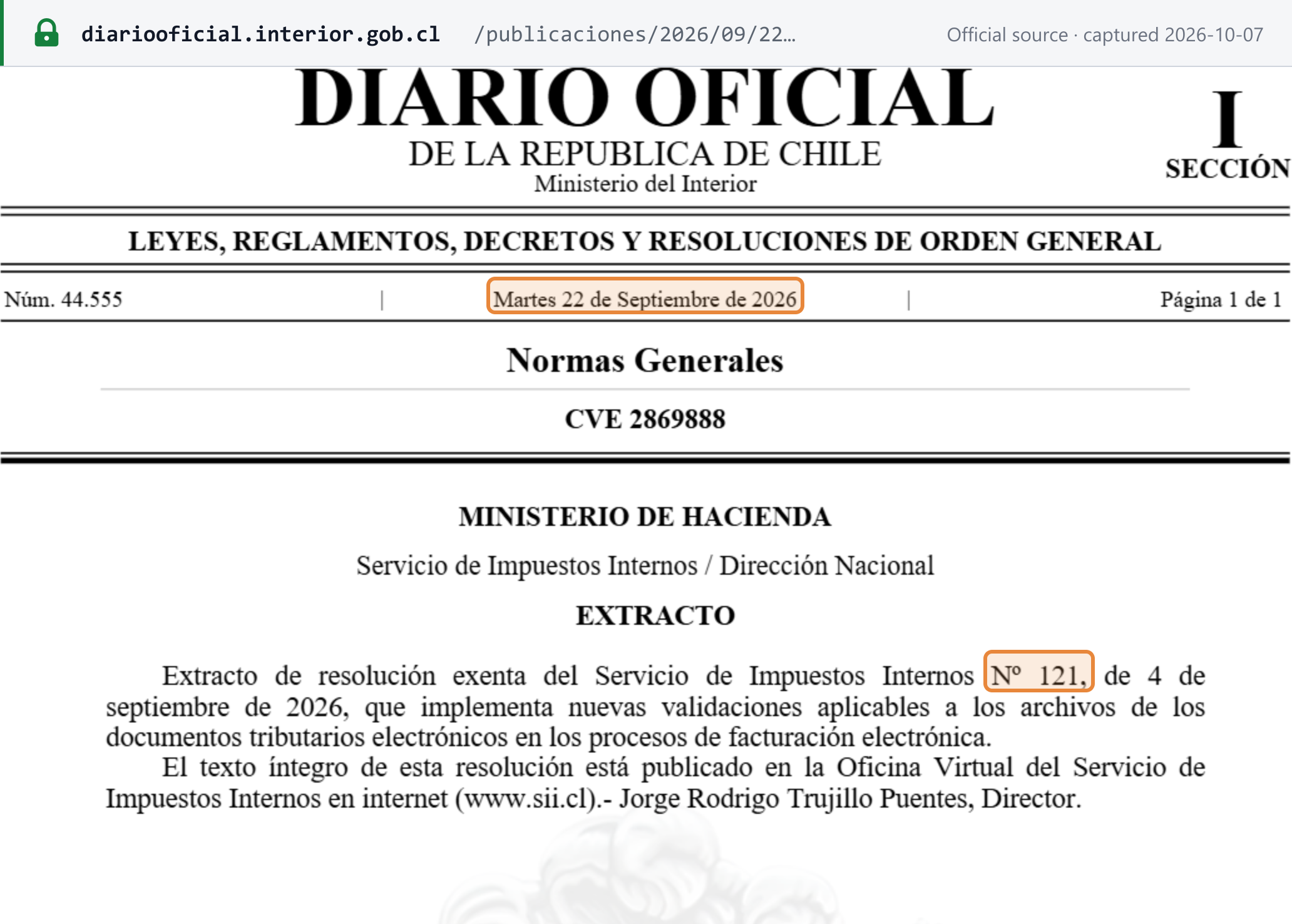
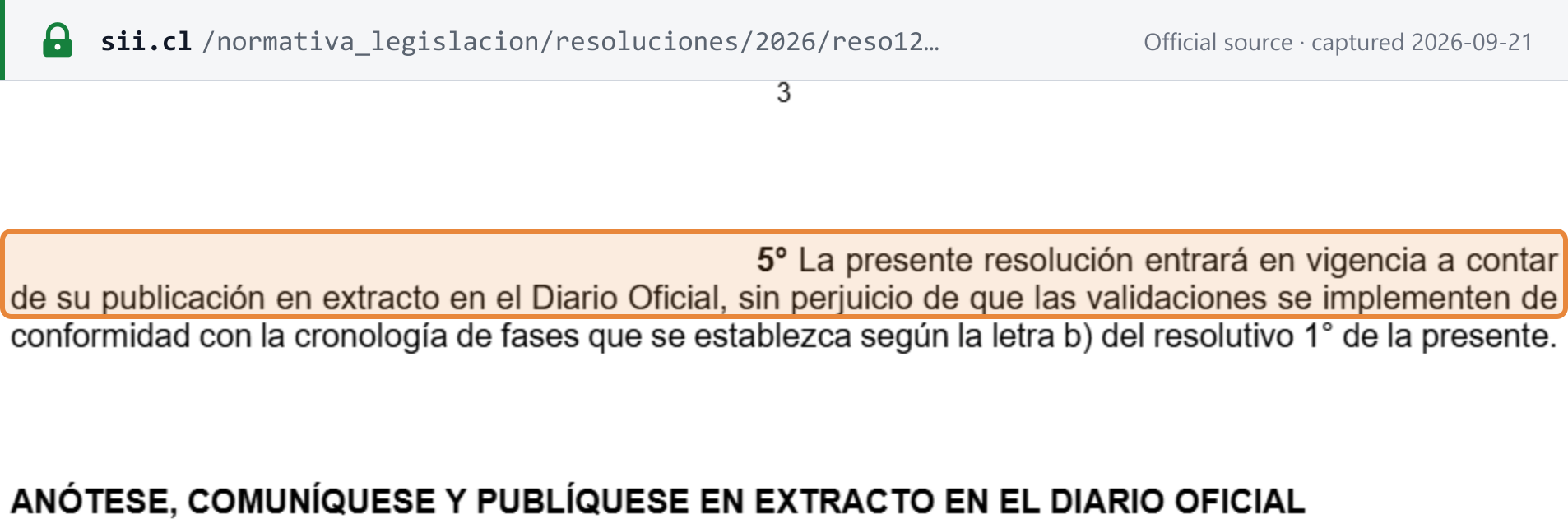
- In force: resolutivo 5° makes it effective "a contar de su publicación en extracto en el Diario Oficial". The extract appeared in Diario Oficial Núm. 44.555 on Tuesday 22 September 2026 (CVE 2869888). (Diario Oficial extract)
- Phases: the validations apply "de conformidad con la cronología de fases que se establezca". No phase dates had been published on the resolution or on the SII's Instructivo sobre Validaciones de DTE (Versión Junio de 2026) as at 2026-10-07. The instructivo describes a "Primera Etapa" adding schema fields and validations for IEC fuel taxes, ILA/IABA and additional taxes, without a date.
 Source snapshot captured 2026-10-07 — original
 Source snapshot captured 2026-09-21 — original
Sources in this section checked 2026-10-07.
Legal basis
| Instrument | Date / Diario Oficial | What it does |
|---|---|---|
| D.L. 825 (1974), arts. 54–56 | Consolidated text | Makes the listed documents electronic-only; paper exceptions; SII powers |
| Ley 19.983 | DO 15 December 2004 | 8-day acceptance window, electronic acuse de recibo, factoring registry, payment terms |
| Ley 20.727 | Promulgated 20 January 2014; DO 31 January 2014 | Makes the e-factura universal; phase-in; free SII platform; VAT-credit timing (art. 23 N°7) |
| Ley 20.780 | DO 29 September 2014 | Changes the smaller-firm periods to 30/36/48 months (per the SII calendar FAQ footnote) |
| Ley 21.131 | DO 16 January 2019 | Makes the guía de despacho electronic-only, one year after publication |
| Ley 21.210 | DO 24 February 2020 | Makes the boleta electronic-only with VAT shown separately; creates the non-resident regime (Párrafo 7° bis) |
| Ley 21.256 | DO 2 September 2020 | Moves the boleta start to 10/12 months after 1 March 2020 |
| Código Tributario (D.L. 830), arts. 17, 97 N°10, 200 | Consolidated text | Retention, penalties, review periods |
| Res. Ex. SII 45/2003 | 1 September 2003 | DTE operating rules: definitions, CAF, TED, send-before-delivery, storage |
| Res. Ex. SII 80/2014 | 22 August 2014 | Passing the mandatory certification registers the taxpayer as emisor electrónico |
| Res. Ex. SII 61/2017 | 12 July 2017; from the August 2017 period | Creates the Registro de Compras y Ventas |
| Res. Ex. SII 74/2020 | 2 July 2020 | Electronic boleta procedure |
| Res. Ex. SII 53/2022 | 9 June 2022; from 1 August 2022 | Abolishes the Resumen de Ventas Diarias |
| Res. Ex. SII 99/2026 | 27 July 2026; DO 30 July 2026 (CVE 2847325) | Paper documents allowed in ten disaster-zone regions |
| Res. Ex. SII 121/2026 | 4 September 2026; DO 22 September 2026 (CVE 2869888) | New DTE validations; Aceptado / Aceptado con reparos / Rechazado |
| Res. Ex. SII 134/2026 | 30 September 2026; effective on its DO extract | Couriers may use the Air Waybill instead of a guía de despacho for imports |
| Formato Documentos Tributarios Electrónicos v2.5 + schema_dte.zip | February 2026 | Field and schema specification; binding because Res. 45/2003 defines a DTE's format as "establecido por el SII" |
Sources in this section checked 2026-10-07.
Scope
B2B
Every factura, factura de compra, liquidación factura and debit or credit note must be a DTE (DL 825 art. 54 inc. 1). Paper is allowed (art. 54 inc. 2) for taxpayers operating where there is no mobile or fixed data coverage or no electricity, or in a zone declared a disaster area under Ley 16.282; such taxpayers "no estarán obligados a emitir los documentos señalados en el inciso primero en formato electrónico, pudiendo siempre optar por emitirlos en papel". The SII designates them by resolution; a request it has not resolved within 30 days counts as accepted, and for earthquake or flood zones the SII must act on its own within 5 working days of the disaster decree's publication. (DL 825 art. 54)
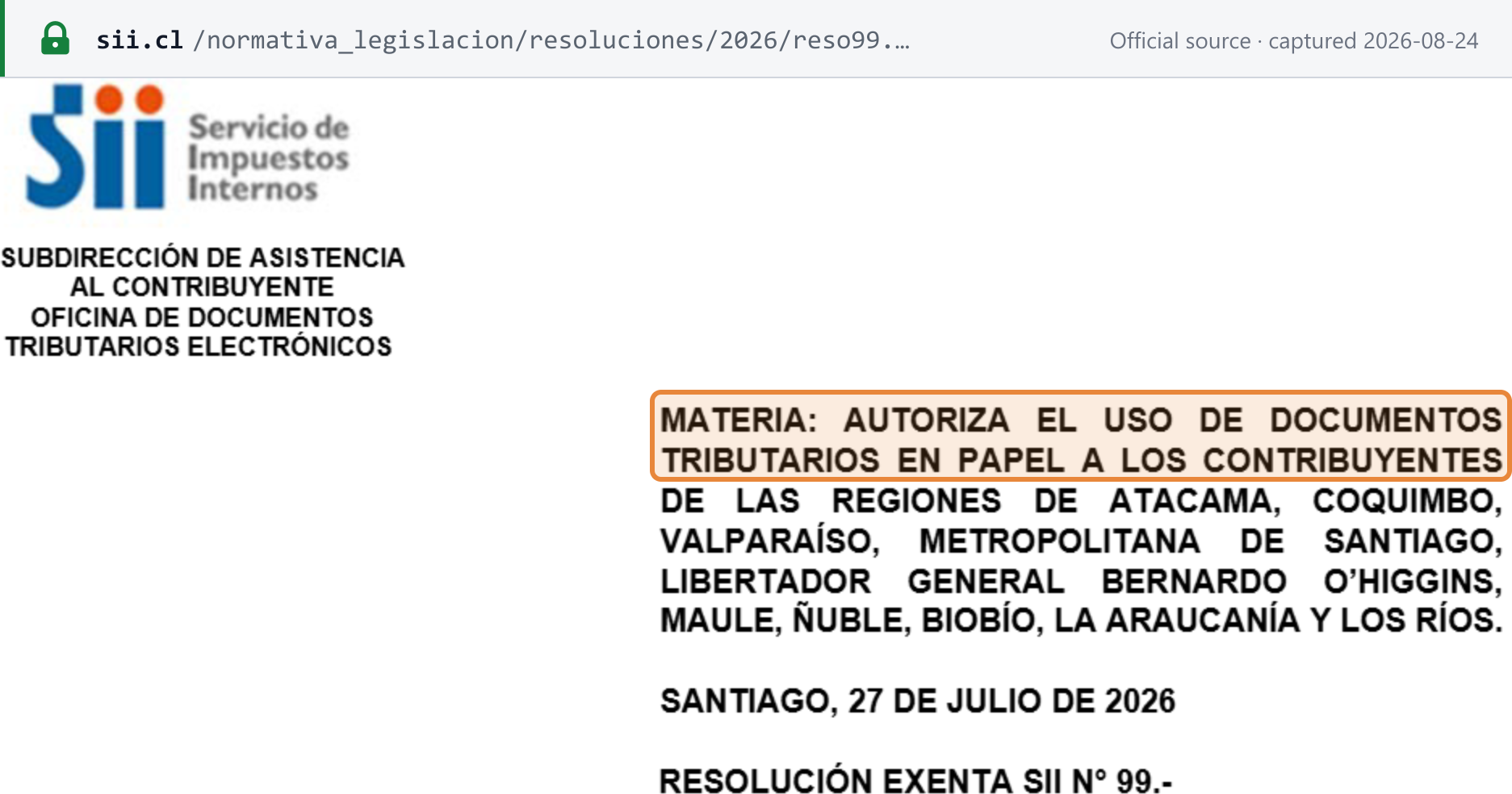
Res. Ex. 99/2026 is the current instance. After Interior Ministry Decree 113 (Diario Oficial 21 July 2026) declared ten regions disaster zones — Atacama, Coquimbo, Valparaíso, Metropolitana, O'Higgins, Maule, Ñuble, Biobío, La Araucanía and Los Ríos — the SII authorised taxpayers there to use paper tax documents. The resolution is in force from its Diario Oficial extract of 30 July 2026 (Núm. 44.512, CVE 2847325); the authorisation lasts "doce meses contados desde la fecha de la catástrofe" (12 months from the date of the catastrophe, art. 19 Ley 16.282). Taxpayers who can keep issuing electronically may do so. (Res. Ex. SII 99/2026; Diario Oficial extract)
 Source snapshot captured 2026-08-24 — original
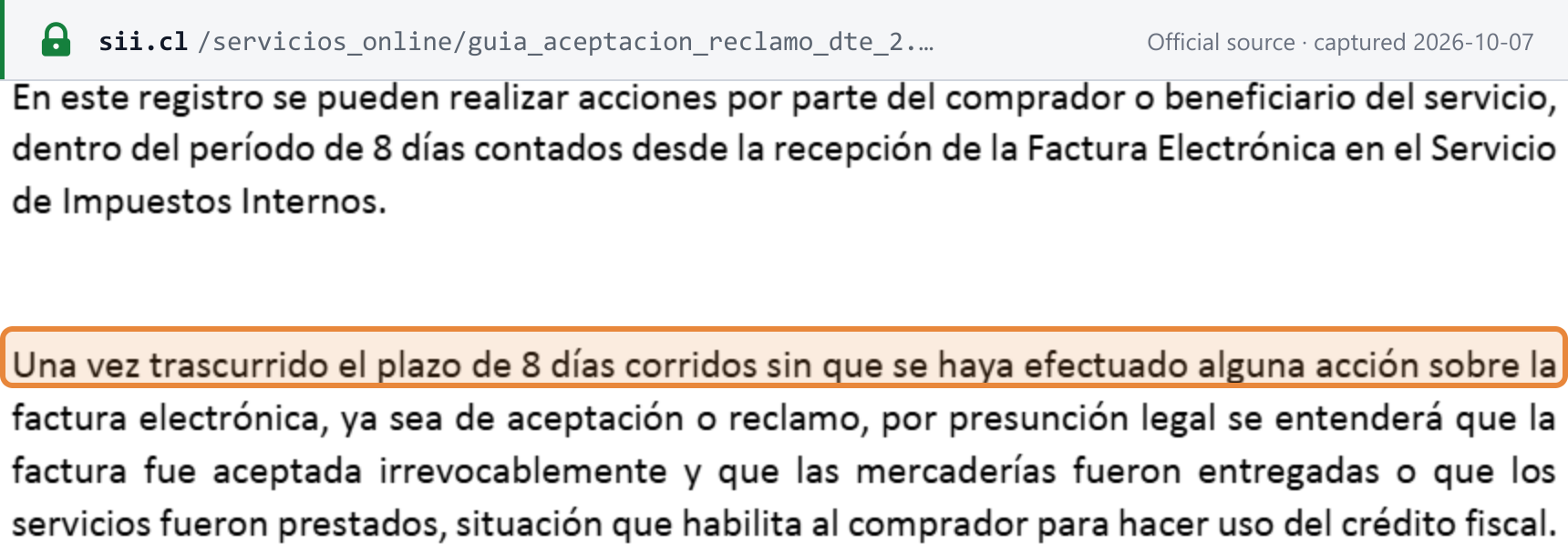
Acceptance and the 8-day window. Under Ley 19.983 art. 3, a factura is irrevocably accepted unless the buyer claims against its content, or against total or partial non-delivery, "dentro de los ocho días corridos siguientes a su recepción" (within 8 calendar days of receipt); art. 9 extends this to electronic facturas and lets the receiver's electronic acuse de recibo evidence receipt. (Ley 19.983) The SII runs this through the Registro de Aceptación o Reclamo de un DTE and counts the 8 days from the factura's receipt at the SII, and if nothing is done the factura is deemed accepted and the buyer may use the VAT credit. (SII — Guía sobre el Registro de Aceptación o Reclamo de un DTE 2.0) VAT on an electronic factura gives the buyer credit in the period of the acuse de recibo (DL 825 art. 23 N°7, added by Ley 20.727); this timing rule does not apply to services, or where art. 55 requires the factura to be issued before delivery. Ley 19.983 art. 2 also sets a maximum payment term of 30 calendar days from receipt of the factura.
 Source snapshot captured 2026-10-07 — original
B2G
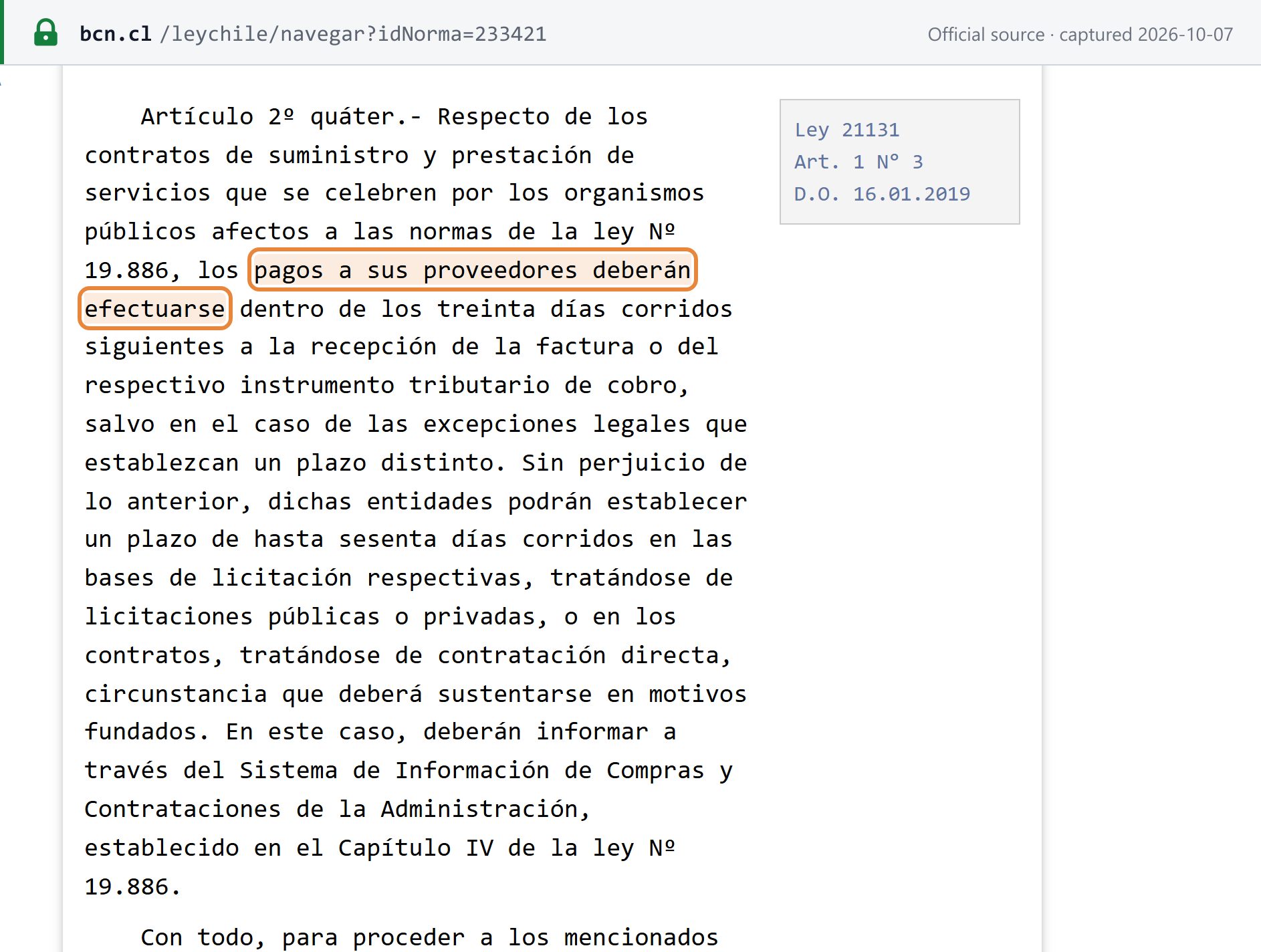
Public bodies receive DTEs like any other receiver; the SII's e-invoicing pages and resolutions cited on this page describe no separate government-invoicing channel (as at 2026-10-07). Ley 19.983 art. 2 quáter requires public bodies buying under Ley 19.886 to pay "dentro de los treinta días corridos siguientes a la recepción de la factura" (within 30 calendar days of receiving the factura), with up to 60 days where the tender rules justify it. (Ley 19.983)
 Source snapshot captured 2026-10-07 — original
B2C
Boletas de ventas y servicios must be electronic (art. 54 inc. 1, after Ley 21.210; dates under Mandate status). Res. Ex. SII 74/2020 requires issuers to "Enviar al SII en formato digital todas las boletas electrónicas emitidas" (send every electronic boleta to the SII). A receipt generated in a transaction paid by electronic means counts as a boleta, in the form and conditions the SII sets by resolution (DL 825 art. 54). (Res. Ex. SII 74/2020)
Non-established businesses
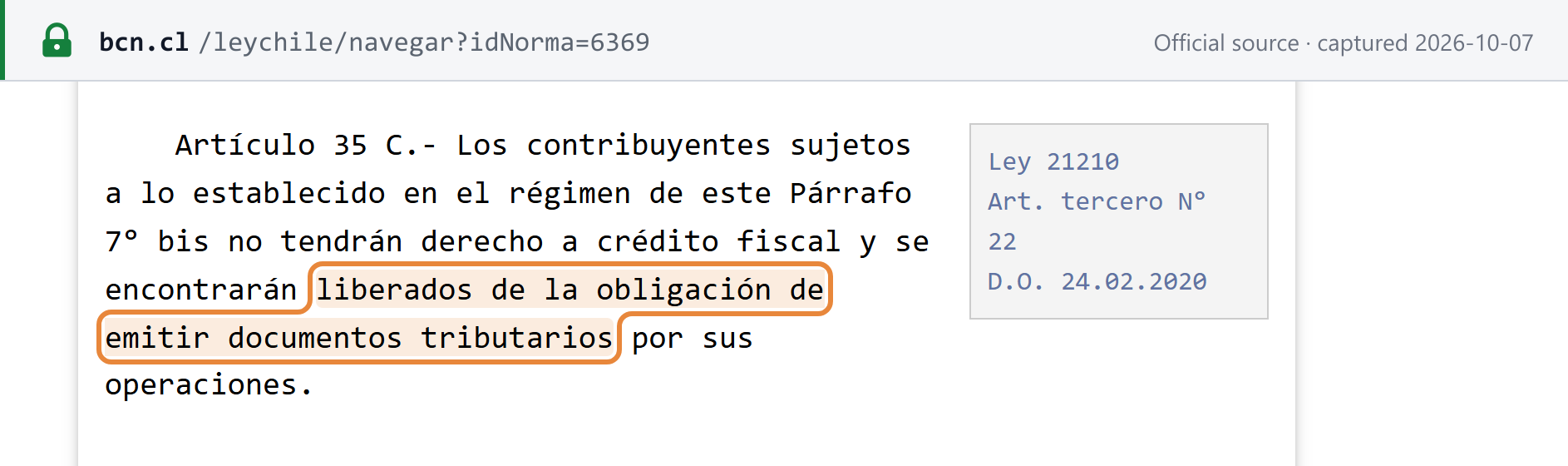
Non-resident suppliers selling services or goods to people in Chile who are not VAT taxpayers fall under the simplified regime of DL 825 Párrafo 7° bis (IVA Digital). Article 35 C says they "no tendrán derecho a crédito fiscal y se encontrarán liberados de la obligación de emitir documentos tributarios por sus operaciones" (have no VAT credit and are released from issuing tax documents). They therefore issue no DTEs for those sales. (DL 825 arts. 35 A, 35 C)
 Source snapshot captured 2026-10-07 — original
See VAT on digital services from non-resident suppliers
for the registration side.
Source snapshot captured 2026-10-07 — original
See VAT on digital services from non-resident suppliers
for the registration side.
Special flows and exclusions
- Exports use their own DTE types: 110 (factura de exportación), 111 and 112 (export debit and credit notes).
- Factura de compra (DTE 46) is issued by the buyer, in cases where the buyer withholds the VAT.
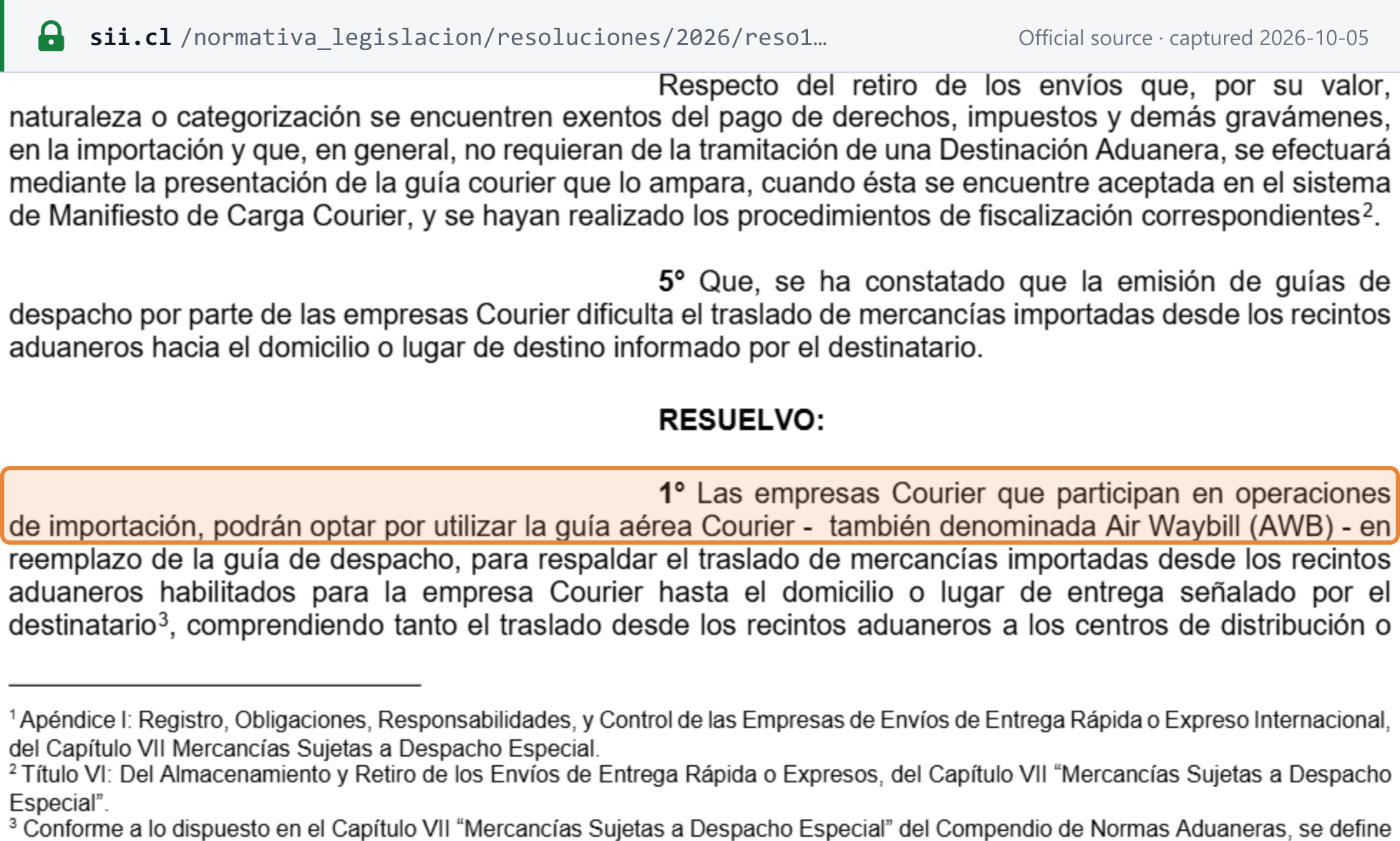
- Courier imports. Res. Ex. SII 134 of 30 September 2026 lets courier companies use the courier Air Waybill (AWB) instead of a guía de despacho to move imported goods from customs premises to the recipient's address. Conditions: the AWB is reported to Customs and shows the AWB number, courier ID, origin country, recipient, delivery address, description and total value; the courier is on the Customs courier register, notifies the SII's Subdirección de Fiscalización, and sends Master AirWaybill data to the SII each month within the first 15 days. The resolution takes effect "a contar de la fecha de su publicación en extracto en el Diario Oficial" (it takes effect on publication of its extract in the Diario Oficial). (Res. Ex. SII 134/2026)
 Source snapshot captured 2026-10-05 — original
Sources in this section checked 2026-10-07.
Format & network
CTC model: clearance before delivery
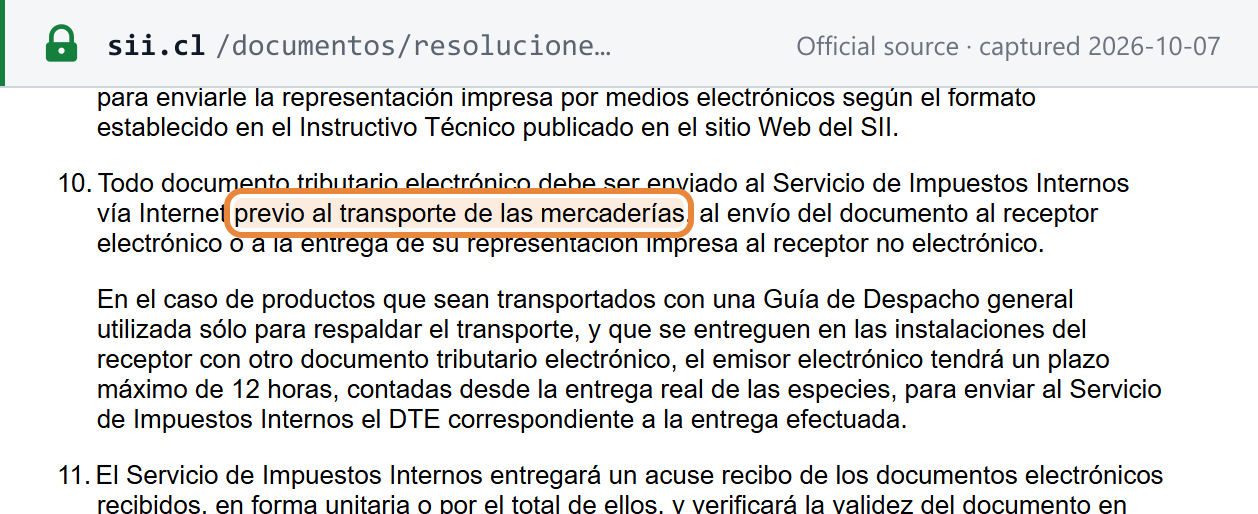
"Todo documento tributario electrónico debe ser enviado al Servicio de Impuestos Internos vía Internet previo al transporte de las mercaderías, al envío del documento al receptor electrónico o a la entrega de su representación impresa al receptor no electrónico." (Every DTE must be sent to the SII over the internet before the goods are transported, before it is sent to an electronic receiver, or before its printed version is handed to a non-electronic receiver.) Where goods travel under a general guía used only for transport and are delivered with a different DTE, the issuer has up to 12 hours after physical delivery to send that DTE. (Res. Ex. SII 45/2003, Cuarto 10) The SII checks each document "en tiempo real" — structure, integrity, folio validity, signature, timbre and substantive data (Res. 121/2026, considerando 2°).
 Source snapshot captured 2026-10-07 — original
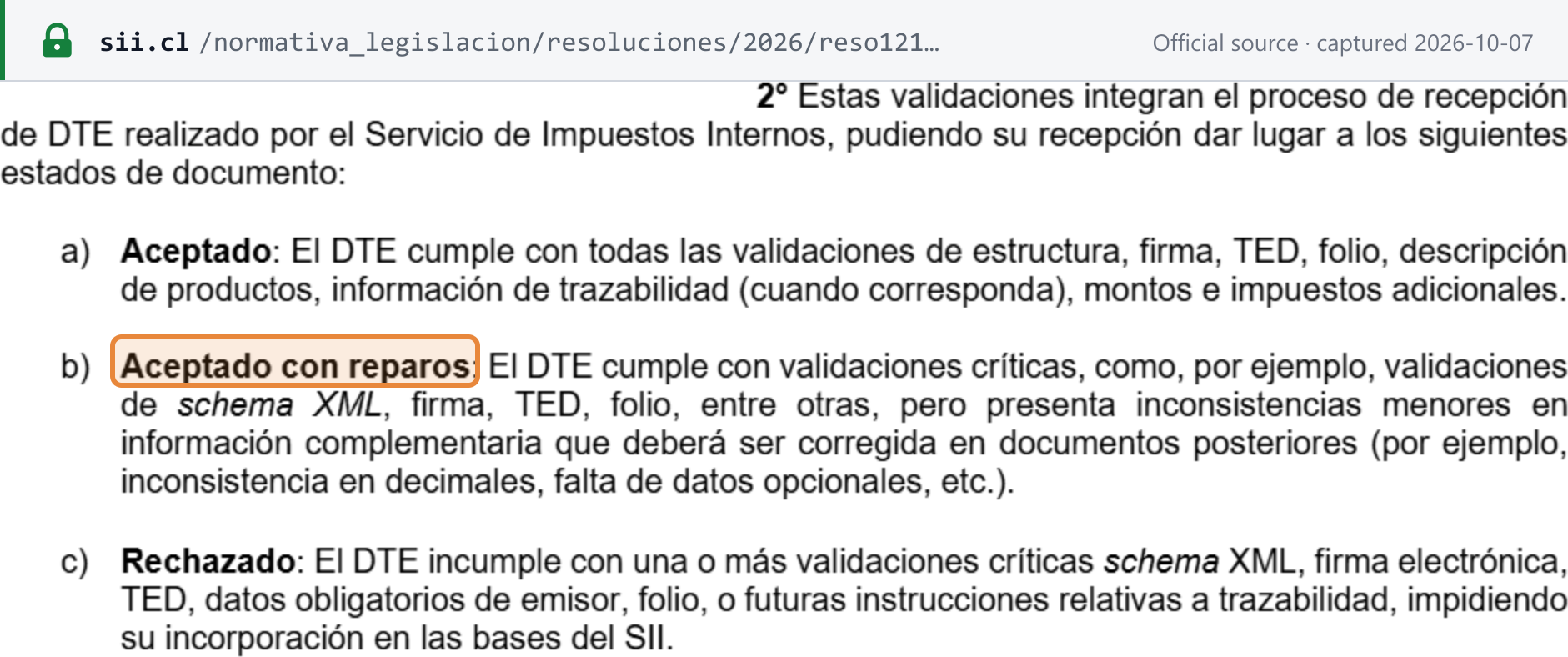
Reception results under Res. Ex. 121/2026
| Result | Meaning |
|---|---|
| Aceptado | Passes every validation: structure, signature, TED, folio, product description, traceability data where applicable, amounts and additional taxes |
| Aceptado con reparos | Passes the critical validations (XML schema, signature, TED, folio and others) but has minor inconsistencies in complementary data, to be corrected in later documents |
| Rechazado | Fails one or more critical validations — XML schema, electronic signature, TED, mandatory issuer data, folio, or future traceability rules — and is not incorporated into SII databases |
(Res. Ex. SII 121/2026, resolutivo 2°)
 Source snapshot captured 2026-10-07 — original
 Source snapshot captured 2026-09-21 — original
XML standard: the SII's own schema
The SII "ha decidido que el formato en que se generarán los documentos tributarios electrónicos sea
XML", using its own schema package. EnvioDTE_v10.xsd is the main envelope and includes
DTE_v10.xsd, SiiTypes_v10.xsd and xmldsignature_v10.xsd; the files in the current
schema_dte.zip are dated
19 February 2026 (as at 2026-10-07). Separate schemas cover boletas, receipt of goods under
Ley 19.983, inter-taxpayer exchange and SII responses.
(SII — Formato XML de Documentos Electrónicos)
 Source snapshot captured 2026-10-07 — original
The field specification is Formato Documentos Tributarios Electrónicos, Versión 2.5 (2026-02); its 16 February 2026 changes add transport fields (Res. Ex. 154/2025) and forestry georeference fields (Res. Ex. 75/2024). (Formato DTE v2.5)
Not UBL, not Peppol. Chile uses its own SII XML schema; the SII's format documents do not use UBL or Peppol.
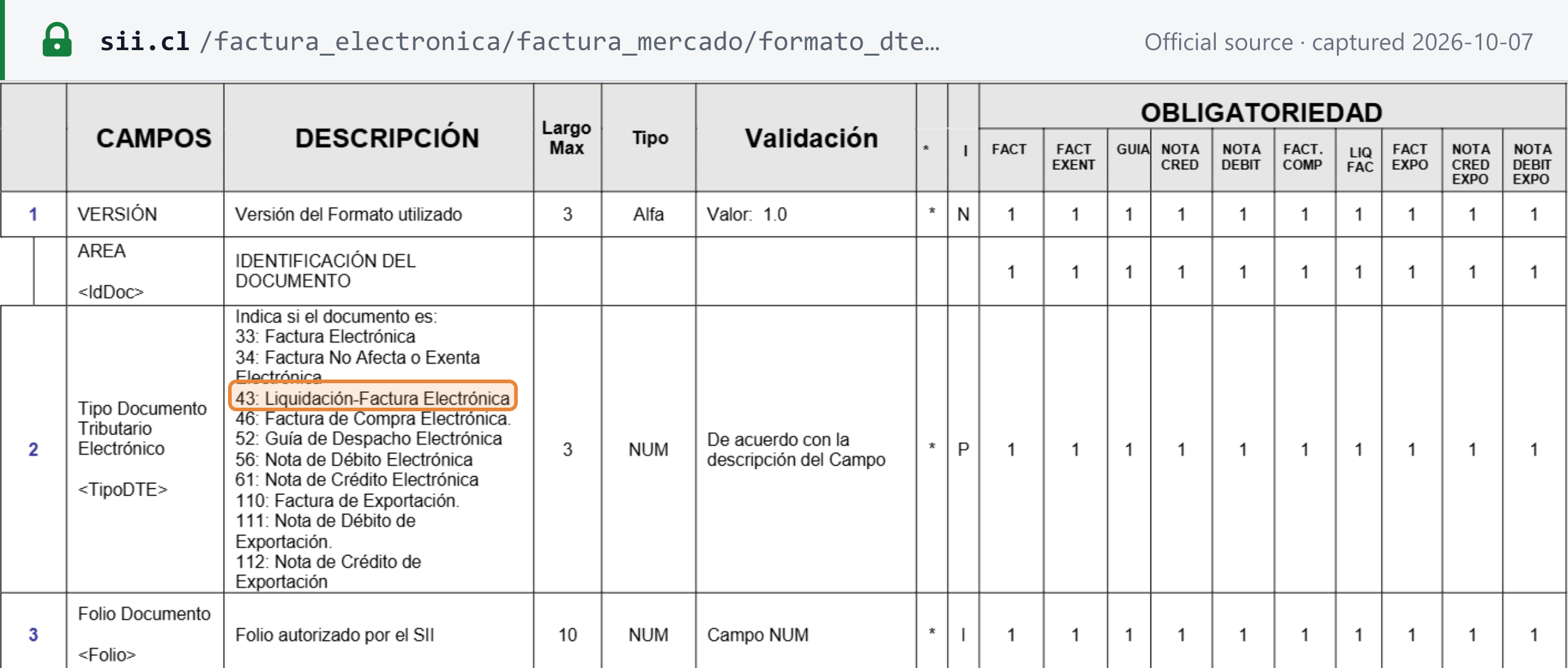
Document-type codes (TipoDTE)
| Code | Document |
|---|---|
| 33 | Factura Electrónica |
| 34 | Factura No Afecta o Exenta Electrónica |
| 39 | Boleta Electrónica |
| 41 | Boleta No Afecta o Exenta Electrónica |
| 43 | Liquidación-Factura Electrónica |
| 46 | Factura de Compra Electrónica |
| 52 | Guía de Despacho Electrónica |
| 56 | Nota de Débito Electrónica |
| 61 | Nota de Crédito Electrónica |
| 110 | Factura de Exportación Electrónica |
| 111 | Nota de Débito de Exportación |
| 112 | Nota de Crédito de Exportación |
Codes 39 and 41 come from the boleta format (Formato Boleta Electrónica v4.2, 8 September 2025); the others from field 2 of the DTE format (Formato DTE v2.5, p. 12).
 Source snapshot captured 2026-10-07 — original
Integrity: signature, CAF folios and the timbre electrónico
- Firma electrónica. "Todo documento tributario electrónico que se emita debe contener una firma electrónica digital" (every DTE must carry a digital signature) over the whole document (Formato DTE v2.5, p. 8). The signer needs a certificado digital para uso tributario from a certification provider accredited before the SII or the Subsecretaría de Economía (Res. 45/2003, Primero f). The SII's emission instructivo (version of 28 October 2021) lists SHA1withRSA and SHA1withDSA as the supported algorithms. (Instructivo de Emisión)
- CAF (Código de Autorización de Folios). The SII authorises folio ranges per document type and delivers the CAF with a key pair used to generate and verify the timbre; the CAF is incorporated in the timbre (Res. 45/2003, Primero q) "sin modificación alguna respecto al entregado por el SII" (without any change from what the SII delivered) (Instructivo de Emisión, 28 October 2021, Anexo 2 A.2.2 a)).
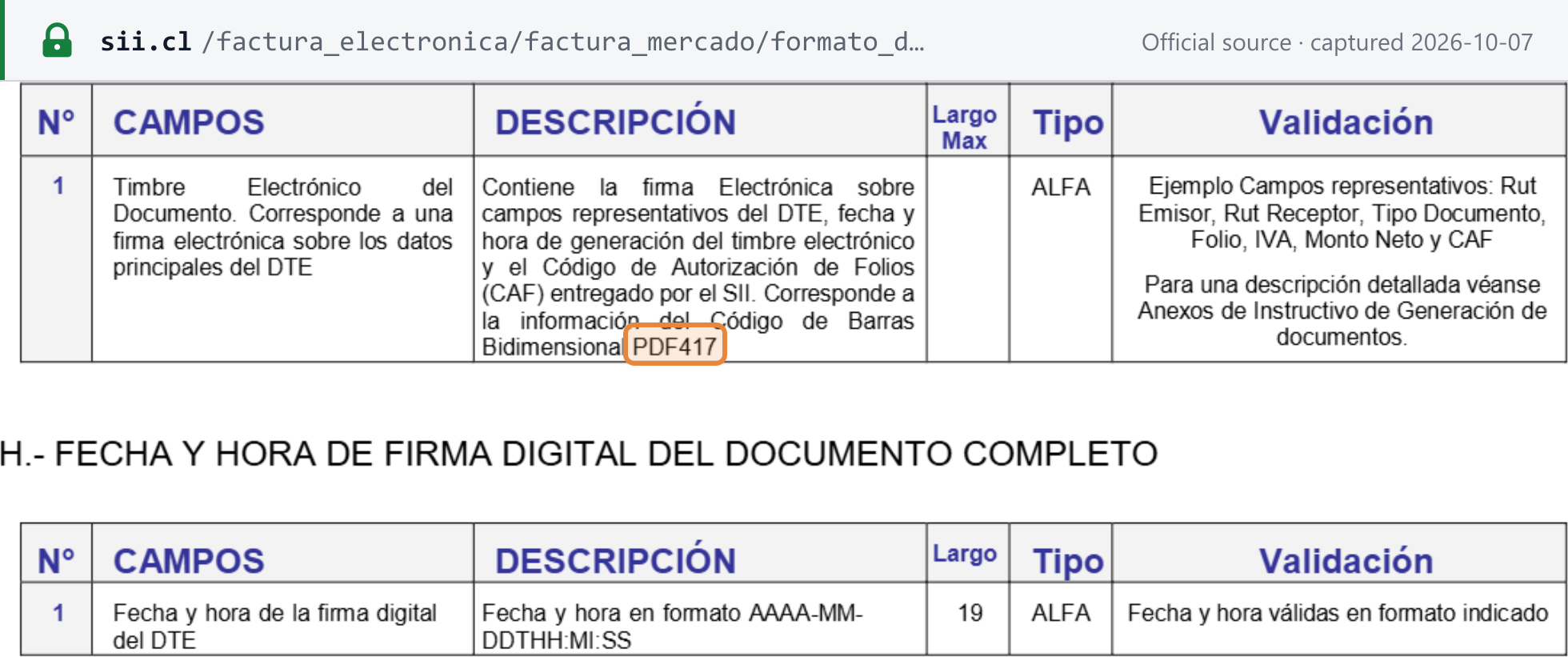
- Timbre Electrónico (TED). A signature over the DTE's key data — issuer and receiver RUT, document type, folio, VAT, net amount — and the CAF, printed "en código de barras de dos dimensiones" as a PDF417 barcode so a printed document can be checked offline. The instructivo requires a printer of at least 300 DPI for the PDF417 timbre electrónico.
 Source snapshot captured 2026-10-07 — original
E-reporting alongside: the Registro de Compras y Ventas
There is no separate e-reporting mandate: the SII builds the RCV from the DTEs it receives, and taxpayers complement it (for example with paper documents) within the deadline for the monthly Form 29 return (Res. 61/2017, resolutivo 6°). Supplier facturas can enter a period's RCV up to day 10 of the following period. (SII FAQ 001.003.6977.004)
Archiving
Electronic issuers must "Almacenar y conservar en forma electrónica los documentos tributarios electrónicos emitidos y recibidos" (store and keep issued and received DTEs electronically) to back up their accounting, and must be able to show the current period's and the two prior periods' documents immediately; older periods within 10 working days (Res. 45/2003, Tercero 6 and Décimo).
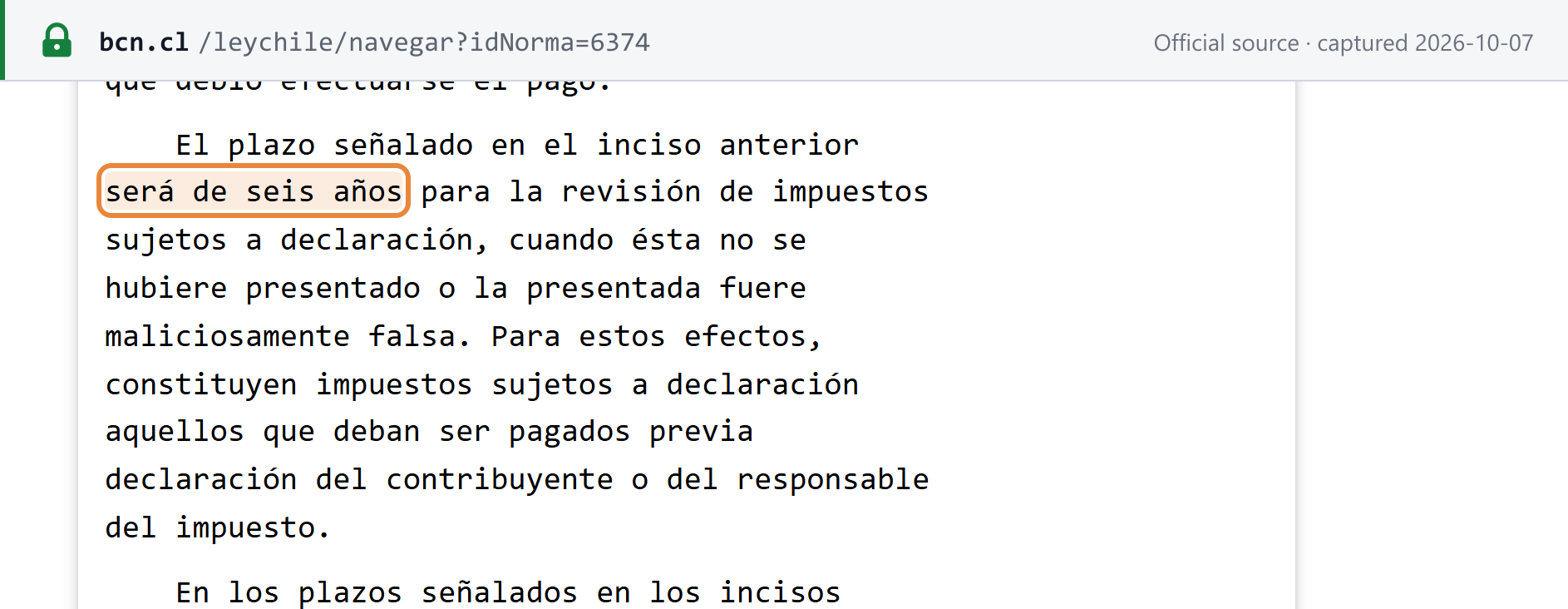
The retention period is tied to the SII's review period, not a fixed number of years. Código Tributario art. 17 requires books and supporting documents to be kept "mientras esté pendiente el plazo que tiene el Servicio para la revisión de las declaraciones". Article 200 sets that period at 3 years from the payment deadline, extended to 6 years where a required return was not filed or was maliciously false. (Código Tributario arts. 17, 200)
 Source snapshot captured 2026-10-07 — original
Sources in this section checked 2026-10-07.
Onboarding: how to comply
Choose an issuing route
- SII free system (Sistema de facturación gratuito). Ley 20.727 art. 3 requires the SII to run a web platform for smaller and hard-to-audit taxpayers to issue and receive the art. 54 documents. Eligibility per the SII: an inicio de actividades in force and first-category taxpayer status (LIR art. 20). (SII FAQ 001.003.3588.013)
- Market or in-house software (sistema de facturación de mercado). A taxpayer using bought software has the provider implement and certify it before the SII; a taxpayer building its own follows the SII's Instructivo Técnico. (SII — elegir sistema)
The SII certifies the taxpayer, not the software. The SII's provider list says: "Cabe señalar que el SII no certifica el software de estas empresas; solo publica esta nómina como mera información" (the SII does not certify these companies' software; it publishes the list for information only). (SII provider list) Under Res. Ex. 80/2014, a taxpayer that passes the mandatory certification process is registered as an Emisor Electrónico. (Res. Ex. SII 80/2014)
 Source snapshot captured 2026-10-07 — original
Certification and the test environment
Once the application is accepted, the applicant gets access to the SII's ambiente de certificación
(per the SII certification manual, maullin.sii.cl) and completes six steps:
- Set de prueba, on test data the SII generates for the applicant.
- Set de simulación.
- Intercambio de información: acknowledge receipt and accept or reject DTEs the SII sends.
- Printed samples, each with the PDF417 timbre.
- Declaración de cumplimiento de requisitos.
- Registration as emisor electrónico (Res. Ex. 80/2014).
The SII removes applicants with no activity in the certification environment in the last 6 months. (SII — Proceso de certificación)
 Source snapshot captured 2026-10-07 — original
Production web-service endpoints are listed in the SII's Instructivo Técnico.
Source snapshot captured 2026-10-07 — original
Production web-service endpoints are listed in the SII's Instructivo Técnico.
Sources in this section checked 2026-10-07.
Penalties
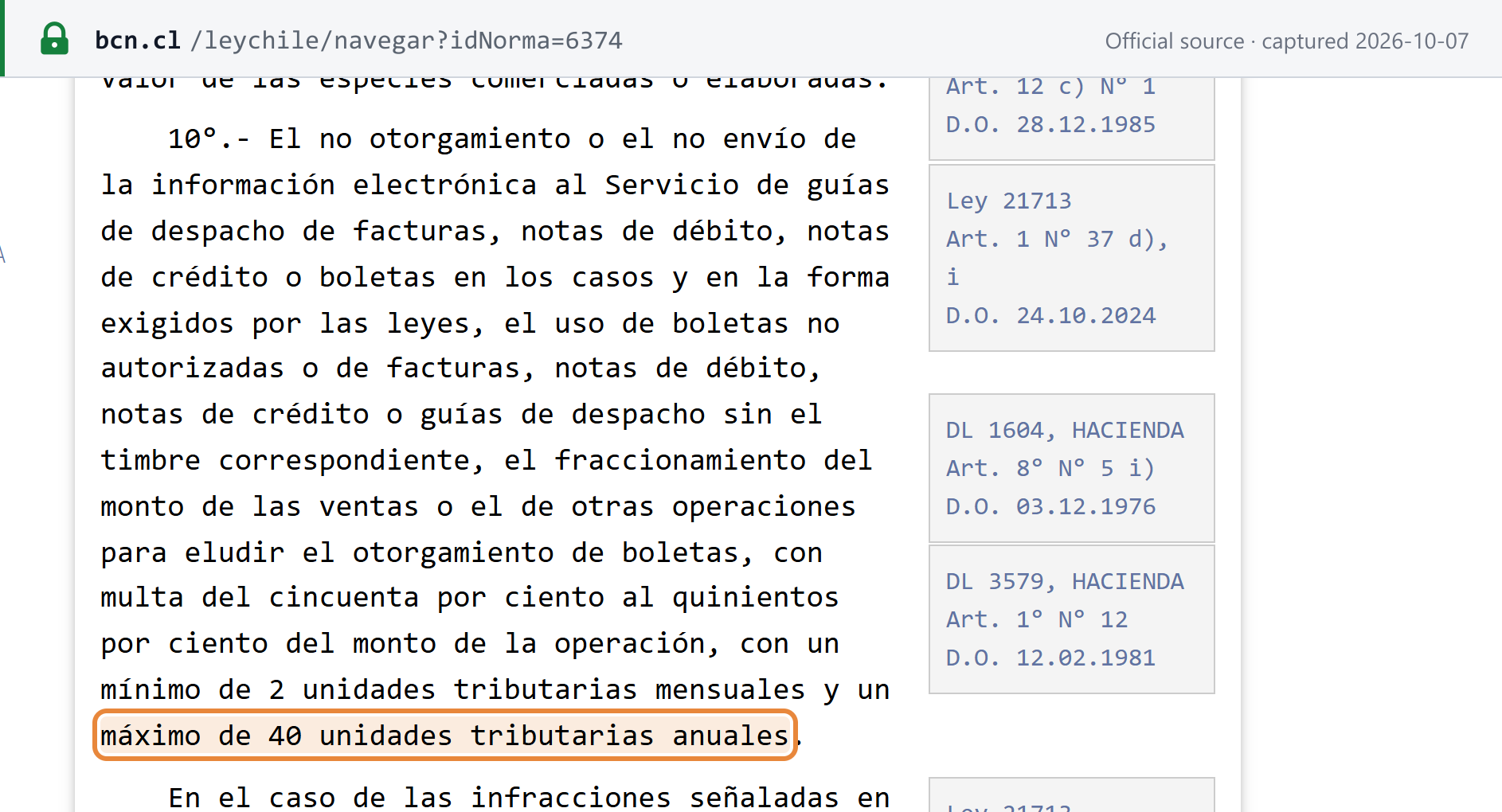
Código Tributario art. 97 N°10 sanctions "el no otorgamiento o el no envío de la información electrónica al Servicio" of guías de despacho, facturas, debit and credit notes or boletas "en los casos y en la forma exigidos por las leyes":
- a fine of 50% to 500% of the amount of the operation, with a minimum of 2 UTM and a maximum of 40 UTA;
- closure of up to 20 days of the office, establishment or similar where the breach occurred (since Ley 21.713, DO 24 October 2024, this can include a website or platform storefront);
- repeat offences (two or more within 3 years) add criminal penalties (presidio o relegación menor en su grado máximo).
(Código Tributario art. 97 N°10)
 Source snapshot captured 2026-10-07 — original
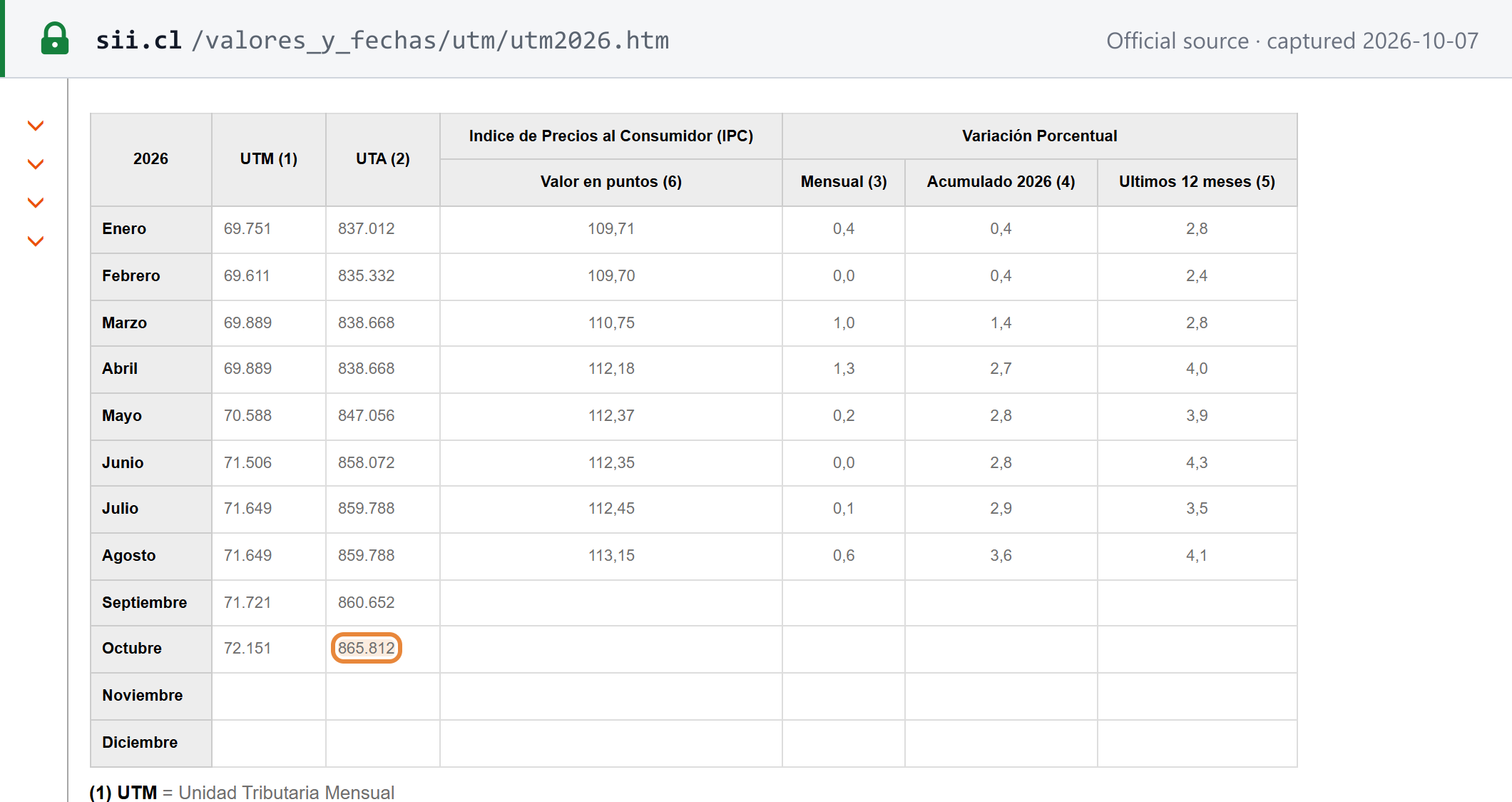
At October 2026 values, 1 UTM is CLP 72,151 and 1 UTA is CLP 865,812, so the floor is CLP 144,302 and the ceiling CLP 34,632,480 (as at 2026-10-07; both units are inflation-indexed and change monthly). (SII — UTM/UTA 2026)
 Source snapshot captured 2026-10-07 — original
Related sanctions: breaching the Res. 121/2026 validations is sanctioned under art. 97 N°10 or art. 109 (Res. 121/2026, resolutivo 4°); failing to operate the RCV under art. 97 N°6 inc. 3 (Res. 61/2017, resolutivo 8°).
Sources in this section checked 2026-10-07.
Frequently asked questions
Is my factura valid if the SII returns "Aceptado con reparos"?
Yes. Under Res. Ex. SII 121/2026, "Aceptado con reparos" means the DTE passed the critical validations (XML schema, signature, TED, folio and others) but has minor inconsistencies in complementary data, which must be corrected in later documents. A "Rechazado" DTE fails a critical validation and is not incorporated into SII databases. Res. 121 has been in force since its Diario Oficial extract of 22 September 2026; the SII had not published dates for the validation phases as at 2026-10-07.
How long does a buyer have to reject an electronic factura?
8 calendar days from receipt (Ley 19.983 art. 3); the SII counts the period from the factura's receipt at the SII (SII acceptance/claim guide). The buyer can accept or claim through the SII's Registro de Aceptación o Reclamo de un DTE. If nothing is done within the 8 days, the factura is legally presumed irrevocably accepted and the buyer may use the VAT credit.
Do I still have to send the daily boleta summary (RCOF / Resumen de Ventas Diarias)?
No. Res. Ex. SII 53/2022 removed that obligation from 1 August 2022, for every issuing system. The SII feeds the sales register directly from the electronic boletas it receives. Each electronic boleta must still be sent to the SII (Res. Ex. SII 74/2020).
Does a foreign SaaS or digital-services provider have to issue Chilean DTEs?
Not for sales to non-taxpayers in Chile under the simplified IVA Digital regime. DL 825 art. 35 C releases suppliers in that regime from the obligation to issue tax documents and gives them no VAT credit.
Does the SII certify e-invoicing software?
No. The SII certifies the taxpayer: passing its certification process registers the taxpayer as an emisor electrónico (Res. Ex. SII 80/2014). Its provider list states that the SII does not certify the software of the companies listed and publishes the list for information only.
Can I issue paper invoices in a disaster zone?
Yes, where the SII authorises it under DL 825 art. 54 inc. 2. Res. Ex. SII 99/2026, in force from its Diario Oficial extract of 30 July 2026, allows paper tax documents in Atacama, Coquimbo, Valparaíso, Metropolitana, O'Higgins, Maule, Ñuble, Biobío, La Araucanía and Los Ríos for 12 months from the date of the catastrophe (Decree 113 of 21 July 2026). Taxpayers who can keep issuing electronically may do so.
How long must I keep DTEs?
For as long as the SII can still review the related returns (Código Tributario art. 17): 3 years from the payment deadline, or 6 years where a required return was not filed or was maliciously false (art. 200). DTEs must be stored electronically, and the current and two prior periods must be producible immediately (Res. Ex. SII 45/2003).
Recent changes
- 2026-09-30 — SII Res. Ex. 134/2026 lets courier companies use the courier Air Waybill instead of a guía de despacho for imported goods; effective on its Diario Oficial extract. (SII) — see event record
- 2026-09-22 — SII Res. Ex. 121/2026 in force on its Diario Oficial extract (CVE 2869888): new DTE validations and the Aceptado / Aceptado con reparos / Rechazado results; validation phases to be scheduled. (Diario Oficial) — see event record
- 2026-07-30 — SII Res. Ex. 99/2026 in force on its Diario Oficial extract (CVE 2847325): paper tax documents allowed in ten disaster-zone regions for 12 months from the catastrophe. (SII) — see event record
- 2026-02-16 — SII published Formato Documentos Tributarios Electrónicos v2.5, adding transport (Res. Ex. 154/2025) and forestry georeference (Res. Ex. 75/2024) fields. (SII)
Related resources
- E-invoicing status and networks worldwide — Chile row in global context
- Chile VAT (IVA) country guide — rates, registration, invoice rules, IVA Digital and filing
- Chile tax identification number (RUT) — the RUT every DTE issuer and receiver carries
- How to verify a Chilean RUT — SII lookup, including authorised document types
- E-invoicing in Peru and E-invoicing in Argentina — neighbouring Latin American systems
- Chile tax-change chronology — every tracked Chilean change, dated and sourced
- Validate a Chilean RUT
Important websites
- SII — Factura electrónica — entry to the DTE services
- Formato XML de Documentos Electrónicos — schemas and format specifications
- Instructivo Técnico — technical documentation for market and in-house systems
- Proceso de certificación — the six certification steps
- Provider list — informational list of e-invoicing providers
- Instructivo sobre Validaciones de DTE — Res. 121/2026 validations
- Ley 20.727 FAQ