E-invoicing in Malaysia: MyInvois
Overview
Malaysia's e-invoice system is MyInvois (e-Invois in Malay). It is run by the Inland Revenue Board of Malaysia (IRBM, also called LHDN or HASiL), and it is an income-tax obligation issued under the Income Tax Act 1967, not part of the Sales and Service Tax (SST) run by the Royal Malaysian Customs Department (RMCD). IRBM's e-Invoice Guideline is "issued under section 134A of the Income Tax Act 1967", and the obligation itself rests on the Income Tax (Issuance of Electronic Invoice) Rules 2024, P.U. (A) 265, which IRBM says took effect on 1 October 2024. (IRBM e-Invoice Guideline v4.8, p.1; IRBM General FAQs, Q11, checked 2026-10-06)
MyInvois is a near-real-time validation model, close to clearance. The supplier sends each invoice, credit note, debit note or refund note to IRBM through the free MyInvois Portal or by API. IRBM validates it, "generally in less than two (2) seconds" (FAQ Q42), and assigns an IRBM Unique Identifier Number, the date and time of validation and a validation link. Only then does the supplier share the validated e-invoice, or its visual representation with a QR code, with the buyer. (Guideline v4.8 ¶2.3.3, checked 2026-10-06)
| Malaysia (as at 2026-10-06) | |
|---|---|
| System | MyInvois (MyInvois Portal and MyInvois System API) |
| Authority | Inland Revenue Board of Malaysia (IRBM / LHDN / HASiL) |
| CTC model | Near-real-time validation: IRBM validates and returns a Unique Identifier Number before the invoice is shared |
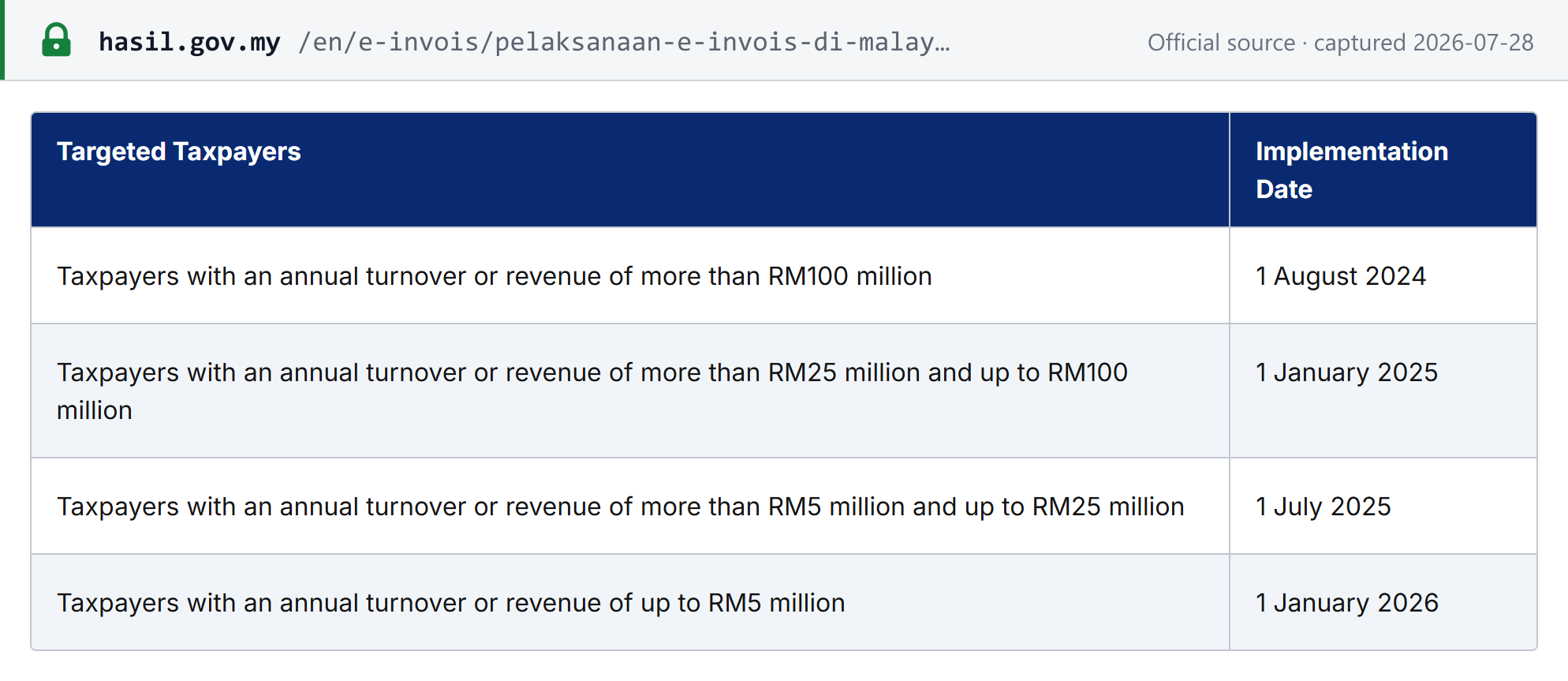
| B2B | Mandatory, phased by FY2022 turnover: 1 Aug 2024, 1 Jan 2025, 1 Jul 2025, 1 Jan 2026 |
| B2C | Same mandate; buyers who need no e-invoice are covered by a monthly consolidated e-invoice |
| B2G | Same flow as B2B (Guideline ¶1.3); statutory bodies, local authorities and international organisations issue from 1 Jul 2025 |
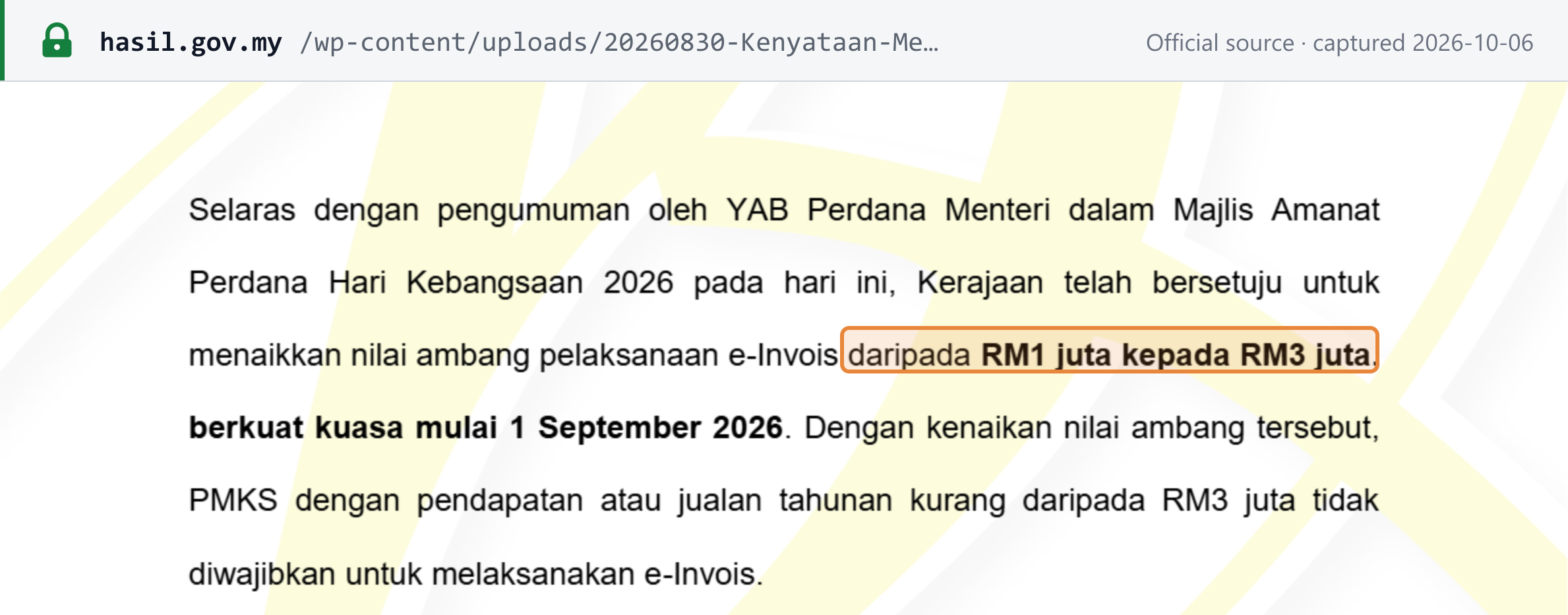
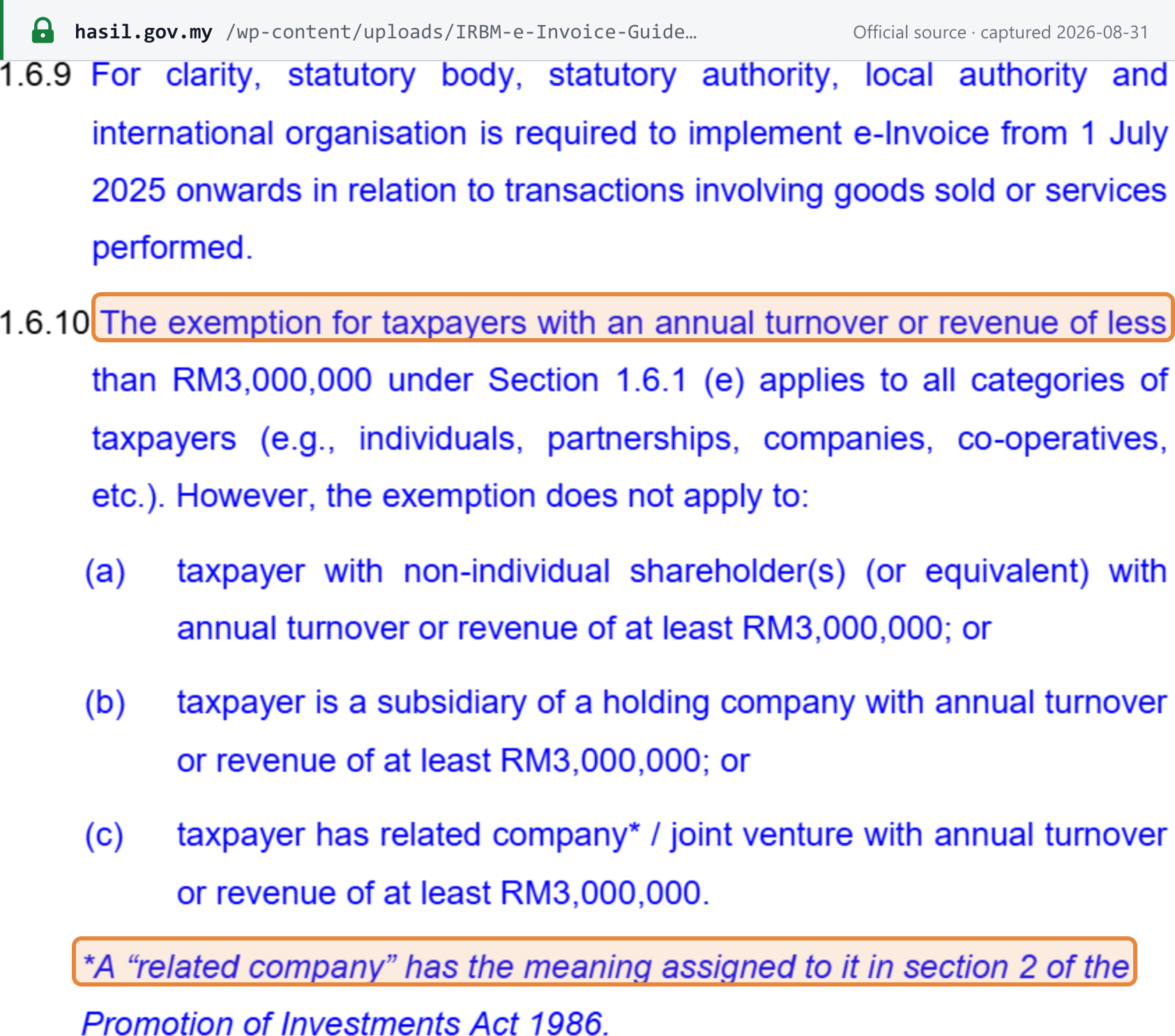
| Exemption | Annual turnover or revenue below RM3,000,000, from 1 Sep 2026, unless the group test in ¶1.6.10 applies |
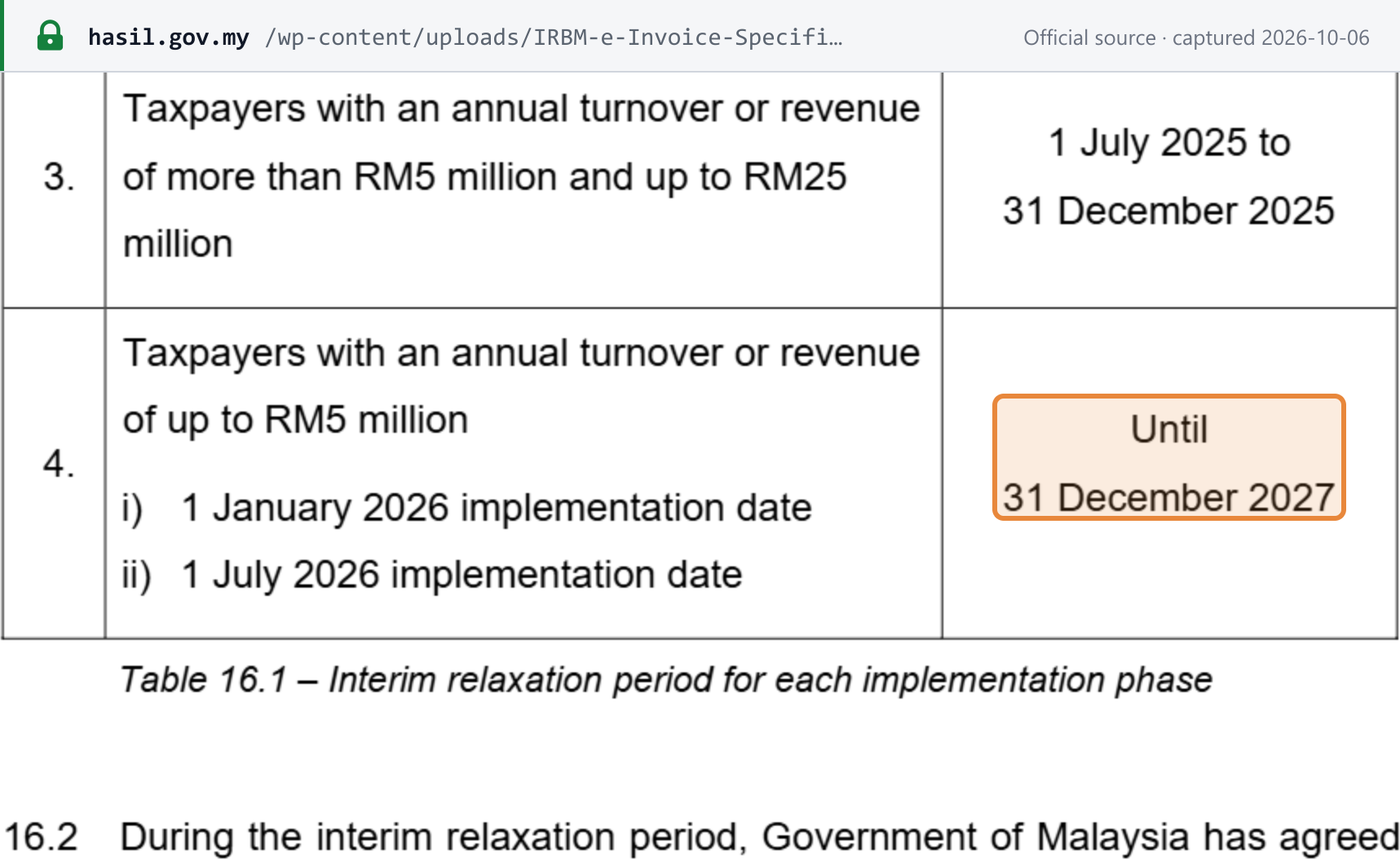
| Relaxation | Taxpayers up to RM5 million: interim relaxation until 31 Dec 2027 |
| Non-residents | Foreign suppliers are "not mandated"; the Malaysian buyer issues a self-billed e-invoice |
| Format | UBL 2.1, in XML or JSON; 55 data fields; document versions 1.0 and 1.1 (signed) |
| Network | MyInvois is not a Peppol network; Peppol and non-Peppol service providers may transmit to it by API |
| Legislation | Income Tax Act 1967 (s.82C, s.120(1)(d), s.134A); Income Tax (Issuance of Electronic Invoice) Rules 2024, P.U. (A) 265 |
 Source snapshot captured 2026-07-28 — original
Mandate status & timeline
The calendar below is IRBM's calendar in the e-Invoice Guideline (Table 1.1 and ¶1.5). IRBM says the penalty start for the first phase was 1 October 2024, when the 2024 Rules took effect, and that the Guideline's mandatory dates "remain unchanged" (FAQ Q11).
| Annual turnover or revenue (FY2022) | Mandatory from | Interim relaxation | Status (as at 2026-10-06) |
|---|---|---|---|
| More than RM100 million | 1 August 2024 | 1 Aug 2024 – 31 Jan 2025 | passed; relaxation ended |
| More than RM25 million, up to RM100 million | 1 January 2025 | 1 Jan 2025 – 30 Jun 2025 | passed; relaxation ended |
| More than RM5 million, up to RM25 million | 1 July 2025 | 1 Jul 2025 – 31 Dec 2025 | passed; relaxation ended |
| At least RM3,000,000 and up to RM5 million | 1 January 2026 | until 31 December 2027 | in force; relaxation running |
| Concessionary date: FY2022 turnover up to RM3m but caught by the group test | 1 July 2026 | until 31 December 2027 | in force; relaxation running |
| New businesses commencing 2023–2025 with turnover of at least RM3,000,000 | 1 July 2026 | until 31 December 2027 where within the up-to-RM5m band | in force |
| New businesses commencing from 2026 | 1 July 2026 or the commencement date; if first-year turnover is expected to be under RM3m, 1 January of the second year after turnover reaches RM3m | — | in force |
| Statutory bodies, statutory authorities, local authorities, international organisations | 1 July 2025 | — | in force |
Sources: Guideline v4.8 ¶1.5, Table 1.1, ¶1.6.9, pp.12–17; Specific Guideline v4.9 Table 16.1, p.123; FAQ Q12(b), checked 2026-10-06.
Turnover for the phased bands is measured once. For the RM3,000,000-and-above bands, the figure comes from the statement of comprehensive income in the audited financial statements for FY2022, or the YA2022 tax return where there are no audited accounts. "Once the taxpayer's e-Invoice implementation timeline has been determined, any changes to the taxpayer's annual turnover or revenue in subsequent years will not change the taxpayer's obligations" (Guideline ¶1.5). Voluntary early adoption is allowed.
Below RM3,000,000 the position can change later. For a taxpayer in operation in YA2022 that is exempt because its turnover was under RM3,000,000: if its annual turnover or revenue reached or exceeded RM3 million in YA2023, YA2024 or YA2025, it implements from 1 July 2026 (FAQ Q12(a); in IRBM's example, Mountain Jump Sdn Bhd, with RM3.1 million in YA2024, starts on 1 July 2026). If it reaches RM3 million in YA2026 or later, it implements from 1 January of the second year following that year of assessment (FAQ Q12(a), Q20). A taxpayer under RM3,000,000 that is caught by the group test starts on the 1 July 2026 concessionary date instead (FAQ Q12(b)). (IRBM General FAQs, Q12 and Q20, checked 2026-10-07)
The RM3,000,000 exemption (from 1 September 2026)
Under Guideline v4.8 ¶1.6.1(e), taxpayers "with an annual turnover or revenue of less than RM3,000,000" are exempt from issuing e-invoices, including self-billed e-invoices. The Government raised the threshold from RM1 million to RM3 million effective 1 September 2026; it was announced in the Prime Minister's National Day address on 30 August 2026, the same day IRBM published Guideline v4.8 (HASiL media statement HASiL/2026/08/30-44, checked 2026-10-06).
 Source snapshot captured 2026-10-06 — original
The group test. ¶1.6.10 disapplies the exemption where the taxpayer has (a) a non-individual shareholder, (b) a holding company, or (c) a related company or joint venture, with annual turnover or revenue of at least RM3,000,000. "Related company" takes its meaning from section 2 of the Promotion of Investments Act 1986. A taxpayer caught by the group test implements from the 1 July 2026 "concessionary e-Invoice implementation date" (FAQ Q12(b)).
 Source snapshot captured 2026-08-31 — original
What an exempt taxpayer does. Nothing has to be filed: "No separate application or prior approval from IRBM is required" (FAQ Q17), and an exempt company "may discontinue issuing e-Invoices immediately". No e-invoice compliance actions or penalties are imposed on it (Q15), and it does not need the voluntary disclosure programme (Q19). Its suppliers must still issue e-invoices to it (Guideline ¶1.6.3). (FAQ, updated 4 September 2026, pp.10–12, checked 2026-10-06)
The interim relaxation (until 31 December 2027 for taxpayers up to RM5 million)
On 26 July 2024 the Government agreed a six-month interim relaxation from each phase's mandatory date. For taxpayers with turnover up to RM5 million, on both the 1 January 2026 and the 1 July 2026 dates, Specific Guideline v4.9 Table 16.1 runs it until 31 December 2027. During relaxation a taxpayer may:
- issue consolidated e-invoices for all transactions, including the activities listed in Table 3.6 and all self-billed transactions;
- put any description in the "Description of Product or Service" field;
- decline a buyer's request for an individual e-invoice.
IRBM "will not undertake any prosecution action under Section 120 of the Income Tax Act 1967 during the interim relaxation period", provided the taxpayer meets the ¶16.2 conditions (¶16.3). Consolidated e-invoices still have to be issued monthly, within 7 days of month end (FAQ Q116). (Specific Guideline v4.9 §16, pp.123–124; FAQ Q113–Q122, checked 2026-10-06)
 Source snapshot captured 2026-10-06 — original
Postponements and superseded dates
Readers who planned against an older calendar should know what changed:
- 5 June 2025. HASiL announced Ministry of Finance decisions: taxpayers under RM500,000 exempt "for now"; the >RM1m–RM5m phase postponed to 1 January 2026; the up-to-RM1m phase postponed to 1 July 2026; the six-month relaxation extended to those phases; and, from 1 January 2026, any single transaction above RM10,000 needs its own e-invoice and may not be consolidated. (HASiL media statement HASiL/2025/06/05-49, checked 2026-10-06)
- RM500,000, then RM1 million, then RM3 million. The exemption was later raised to RM1 million and, from 1 September 2026, to RM3 million. RM500,000 and RM1 million are history.
- 1 July 2026 survives only as the concessionary date for taxpayers caught by the group test and as the date for new businesses.
- Relaxation end. Relaxation for taxpayers up to RM5 million did not end on 30 June 2026: Table 16.1 runs it to 31 December 2027.
Neither Guideline v4.8 nor Specific Guideline v4.9 sets further turnover phases (checked 2026-10-07).
Legal basis
| Instrument | What it does | Link |
|---|---|---|
| Income Tax Act 1967 s.82C | The e-invoice obligation; s.82C(11) disapplies the Personal Data Protection Act 2010 to e-invoice data sent to the Director General (as described in FAQ Q144) | IRBM FAQ |
| Income Tax (Issuance of Electronic Invoice) Rules 2024, P.U. (A) 265, gazetted 30 September 2024, effective 1 October 2024 | Prescribes who must issue e-invoices and the particulars they carry; IRBM reads 1 October 2024 as the first date penalties could apply | FAQ Q11 |
| Income Tax Act 1967 s.120(1)(d) | Offence of failing to issue an e-invoice (see Penalties) | FAQ Q41 |
| Income Tax Act 1967 para 138(4)(aa) | E-invoice data in MyInvois is shared with RMCD | Guideline ¶2.6.2 |
| e-Invoice Guideline v4.8, 30 August 2026 (replaces v4.7 of 7 July 2026) | Issued under ITA s.134A: scope, timeline, exemptions, transmission models, data fields | |
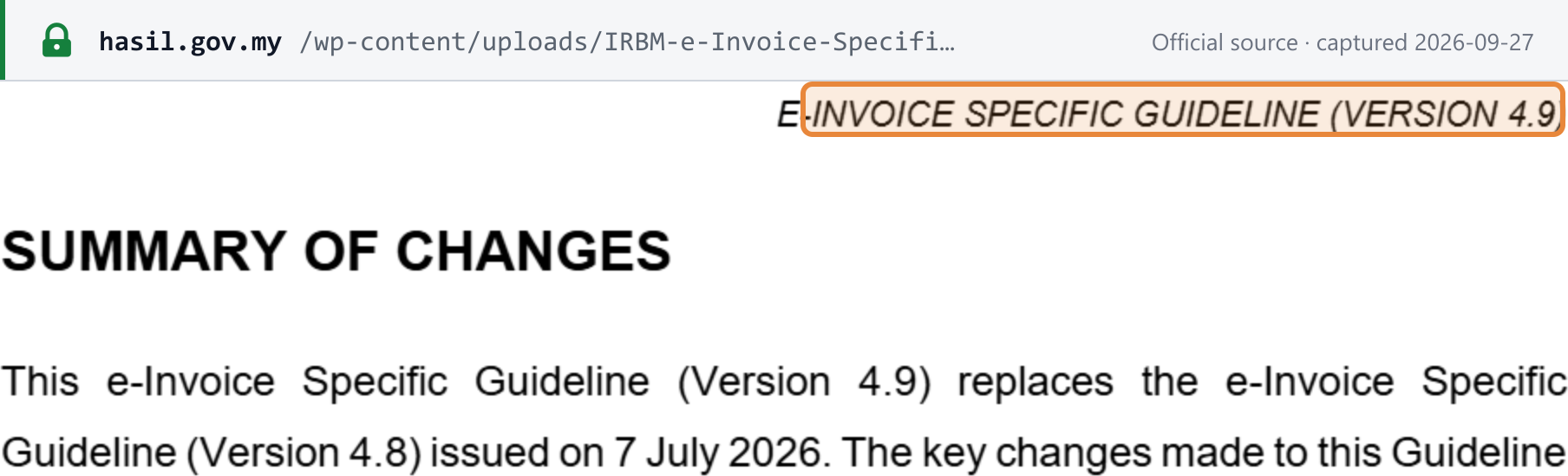
| e-Invoice Specific Guideline v4.9, 7 September 2026 (replaces Specific Guideline v4.8 of 7 July 2026) | Buyer identification, consolidation, self-billing, industry rules, relaxation (§16), SVDP (§17), general TINs (Appendix 1) | |
| MyInvois SDK (published 9 February 2024) | Technical specification for API submission: UBL 2.1 schema, document versions, validation rules | sdk.myinvois.hasil.gov.my |
 Source snapshot captured 2026-09-27 — original
Scope
"e-Invoice covers typical transaction types such as B2B, B2C, and B2G. For B2G transactions, the e-Invoice flow will be similar to B2B. e-Invoice applies to all persons in Malaysia" (Guideline ¶1.3). IRBM says no industry is exempt (FAQ Q7).
B2B
In scope from the taxpayer's phase date, subject to the RM3,000,000 exemption and the group test. The supplier issues; in self-billing cases (below) the buyer issues.
B2C and consolidated e-invoices
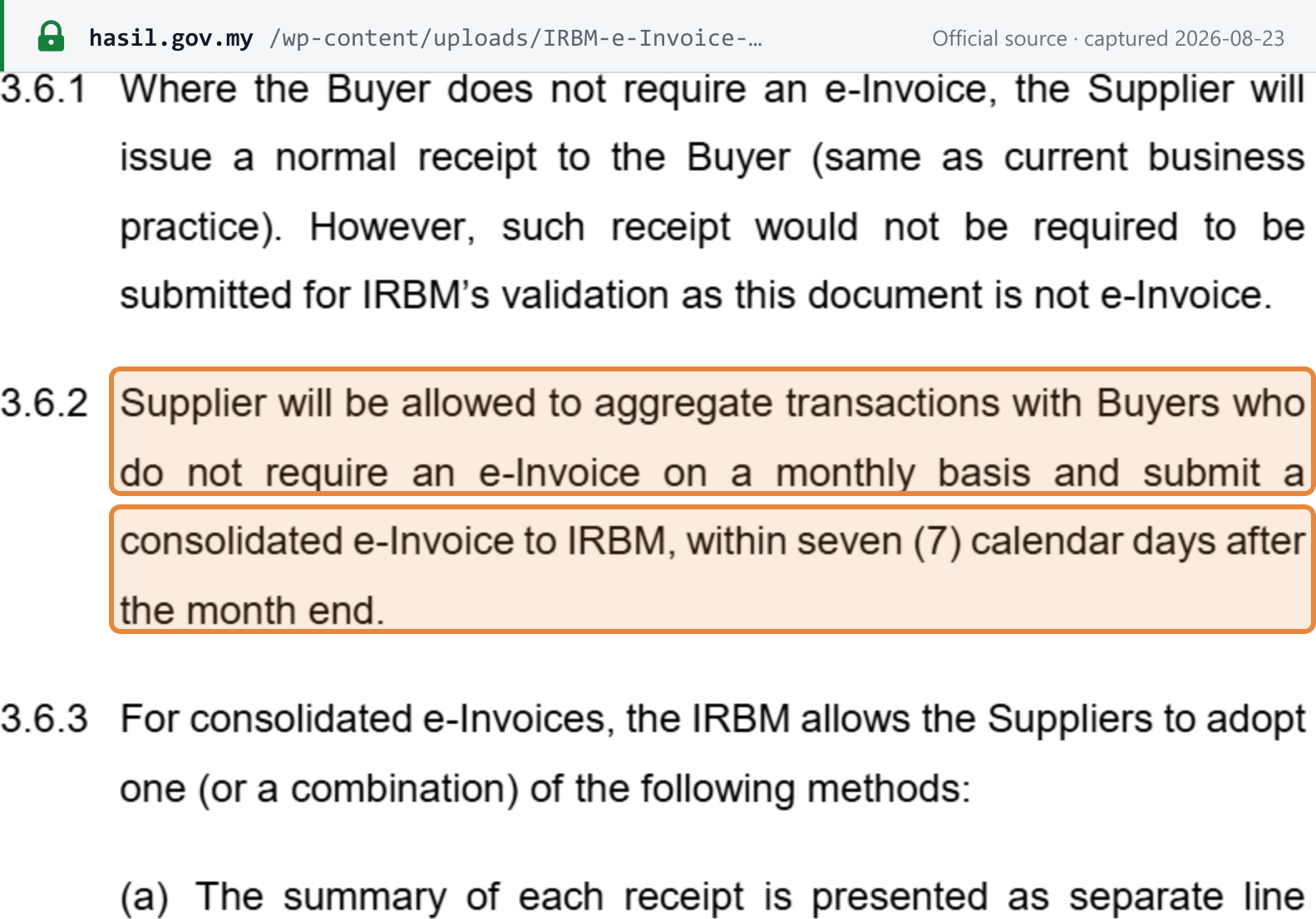
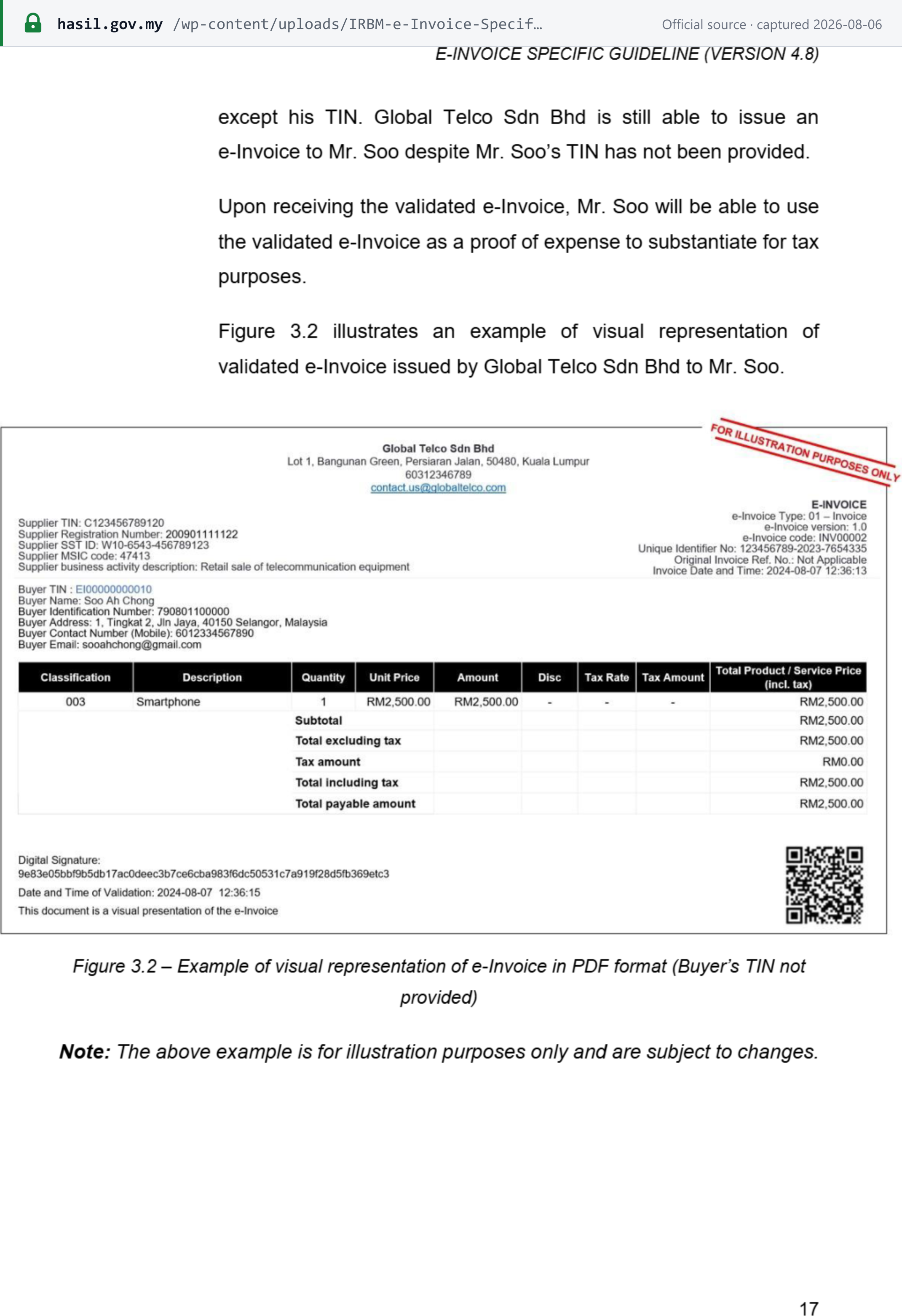
Where the buyer does not need an e-invoice, the supplier gives a normal receipt and submits a consolidated e-invoice to IRBM "within seven (7) calendar days after the month end" (Specific Guideline ¶3.6.2). The buyer is "General Public", with general TIN EI00000000010. A submission may hold at most 100 e-invoices and 5 MB, and each e-invoice at most 300 KB (¶3.6.4).
 Source snapshot captured 2026-08-23 — original
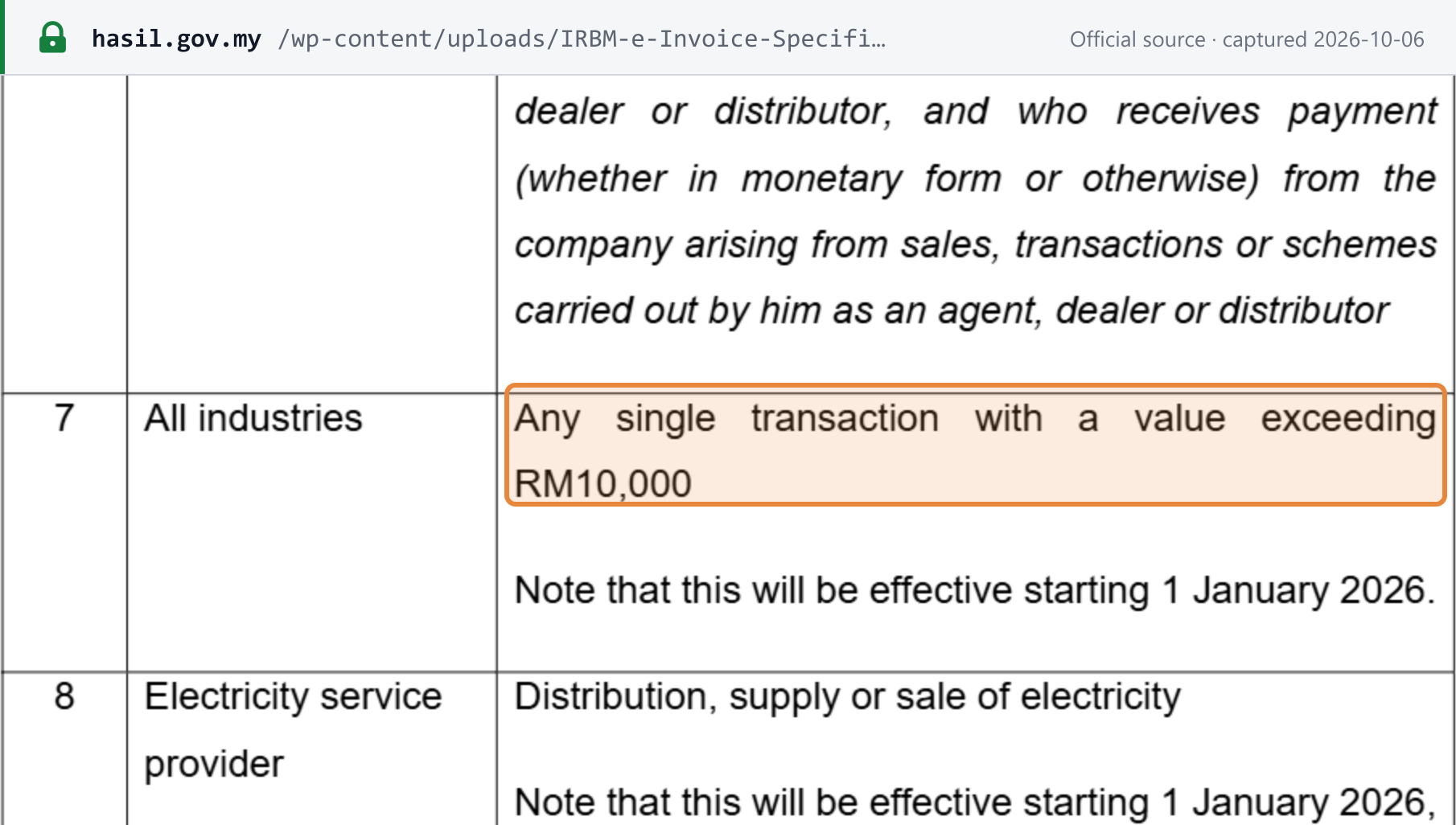
Once relaxation ends, some activities may never be consolidated (Table 3.6), including motor vehicle sales, flight tickets, construction contracts, payments to agents, dealers and distributors, and, from 1 January 2026, any single transaction above RM10,000, electricity supply and telco postpaid, internet and device sales. During relaxation (to 31 December 2027 for taxpayers up to RM5 million) consolidation is allowed for everything. (Specific Guideline v4.9 Table 3.6, pp.32–34, checked 2026-10-06)
 Source snapshot captured 2026-10-06 — original
Simplified invoices. IRBM publishes no simplified e-invoice; consolidation is the B2C route (Guideline v4.8 and Specific Guideline v4.9, checked 2026-10-06).
B2G
The flow is the same as B2B (¶1.3). Where a government buyer has no TIN, the supplier uses the general TIN EI00000000040 (Specific Guideline Appendix 1). Statutory bodies, statutory authorities, local authorities and international organisations must themselves issue e-invoices from 1 July 2025 for goods sold or services performed (Guideline ¶1.6.9). IRBM publishes no separate B2G channel (Guideline ¶1.3, checked 2026-10-06).
Foreign suppliers, foreign buyers and self-billing
Foreign suppliers. "Given that the Foreign Seller is not mandated to implement Malaysia's e-Invoice, the Malaysian Purchaser is required to issue a self-billed e-Invoice" (Specific Guideline ¶10.4.3). Deadlines:
- imported goods: by the end of the second month after the month customs clearance is obtained (¶10.4.8);
- imported services: by the end of the month after the earlier of payment or receipt of the foreign supplier's invoice (¶10.4.9); service tax on imported taxable services must be shown on the self-billed e-invoice (¶10.4.7).
Duties and taxes levied by RMCD are not included in the self-billed e-invoice for imported goods (FAQ Q77), and each import needs its own self-billed e-invoice (Q76).
Other self-billing cases include payments to agents, dealers and distributors, profit distributions, e-commerce, betting and gaming pay-outs, payments to individuals not in business, and interest payments (Specific Guideline §8). (Specific Guideline v4.9 pp.63–64, 86–88, checked 2026-10-06)
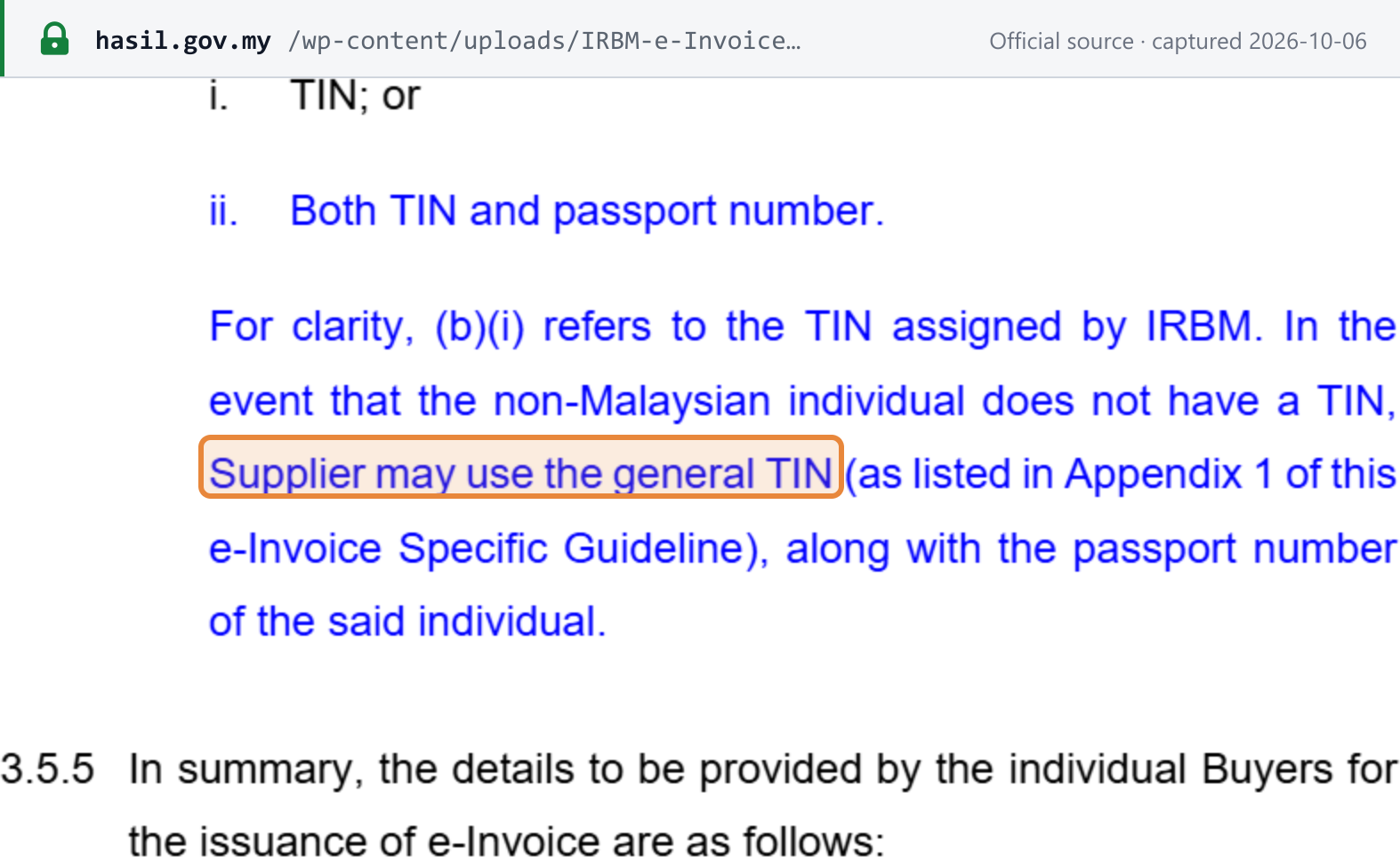
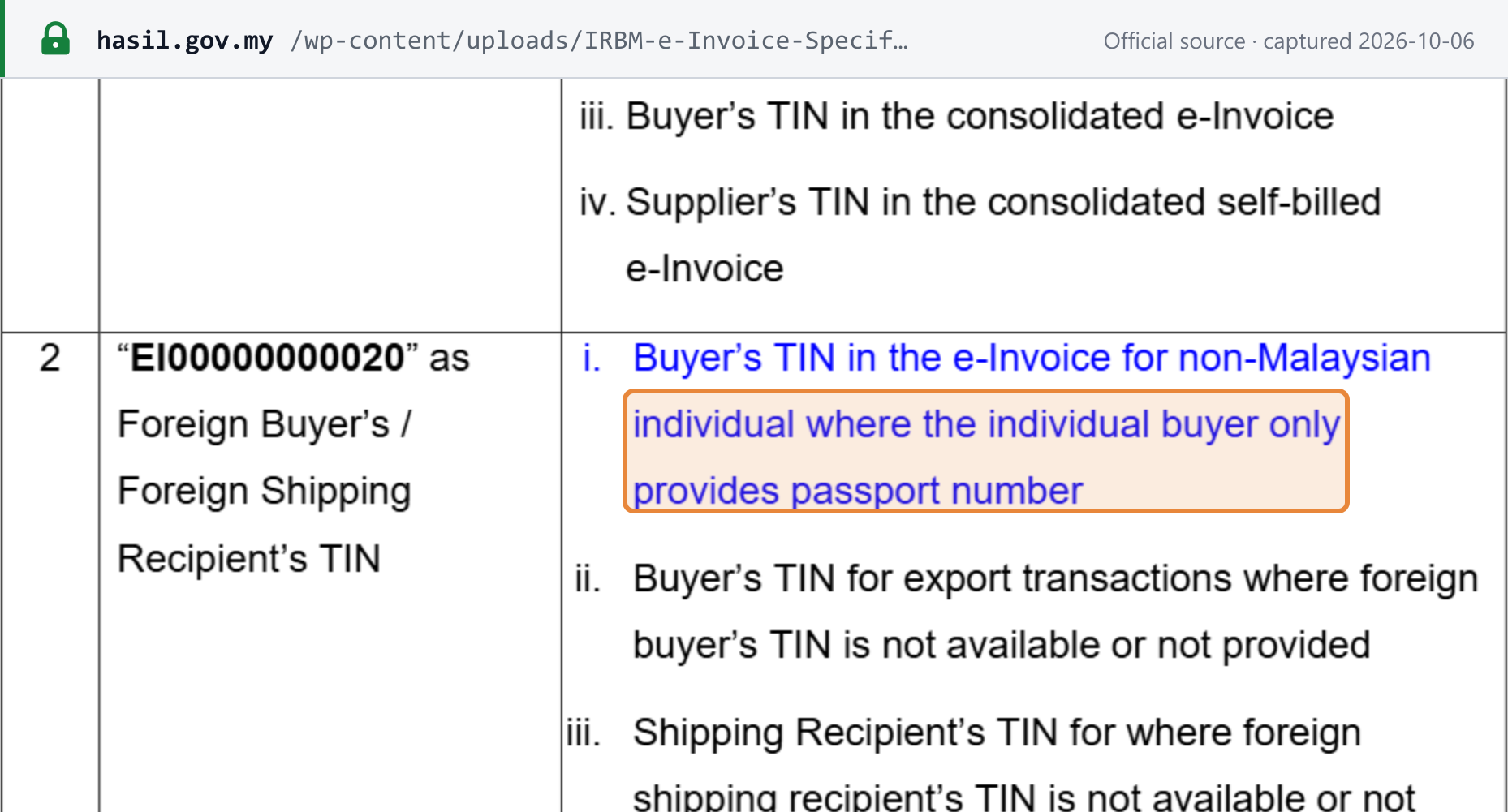
Foreign individual buyers (Specific Guideline v4.9, 7 September 2026). A non-Malaysian individual other than a MyPR or MyKAS holder provides either an IRBM TIN, or both the TIN and passport number. "In the event that the non-Malaysian individual does not have a TIN, Supplier may use the general TIN … along with the passport number" (¶3.5.4(b)). Appendix 1 assigns that case to EI00000000020, the Foreign Buyer's TIN. A buyer who gives only a passport can still be invoiced: put EI00000000020 in the TIN field and the passport number in the identification field. The same concession applies to individual suppliers on self-billed e-invoices, with EI00000000030.
 Source snapshot captured 2026-10-06 — original
General TINs (Specific Guideline Appendix 1)
| General TIN | Used for |
|---|---|
| EI00000000010 — General Public | Individuals who give only a MyKad, MyTentera, MyPR or MyKAS number; the buyer on a consolidated e-invoice; the supplier on a consolidated self-billed e-invoice |
| EI00000000020 — Foreign Buyer / Foreign Shipping Recipient | A non-Malaysian individual buyer who gives only a passport number; export buyers and shipping recipients with no TIN |
| EI00000000030 — Foreign Supplier | A non-Malaysian individual supplier who gives only a passport (self-billed); import suppliers with no TIN |
| EI00000000040 — Buyer's TIN | Government, state government and authorities, local authorities, statutory bodies, and exempt institutions with no TIN |
Check with the foreign party whether it holds an IRBM TIN before defaulting to a general TIN; IRBM puts that responsibility on the taxpayer (FAQ Q35). (Specific Guideline v4.9 Appendix 1, pp.129–130, checked 2026-10-06) To check a Malaysian TIN, use the Malaysia TIN guide.
 Source snapshot captured 2026-10-06 — original
Exempt persons and excluded transactions
Besides the RM3,000,000 exemption, ¶1.6.1 exempts foreign diplomatic offices, individuals not conducting business, statutory bodies for their statutory collections, and international organisations for supplies before 1 July 2025. No e-invoice, including a self-billed one, is needed for employment income, pensions, alimony, certain dividends, zakat, and the contract value of listed securities and derivatives, among others (¶1.6.7). (Guideline v4.8 pp.15–16, checked 2026-10-06)
Format & network
CTC model: near-real-time validation
The supplier submits; MyInvois runs seven validators (structure, core fields, signature, taxpayer, referenced documents, code and duplicate; Guideline Table 2.2) and gives the document a status: Submitted, Valid, Invalid or Cancelled (¶2.5.2). A valid document gets the IRBM Unique Identifier Number, the validation date and time and a validation link. The visual representation carries a QR code that resolves the e-invoice's existence and status on the MyInvois Portal (¶2.3.5). Until further notice, IRBM lets the supplier share either the validated e-invoice or its visual representation. (Guideline v4.8 ¶2.3.3–2.3.5, pp.23–25, checked 2026-10-06)
 Source snapshot captured 2026-08-06 — original
The 72-hour window: rejection and cancellation share one clock
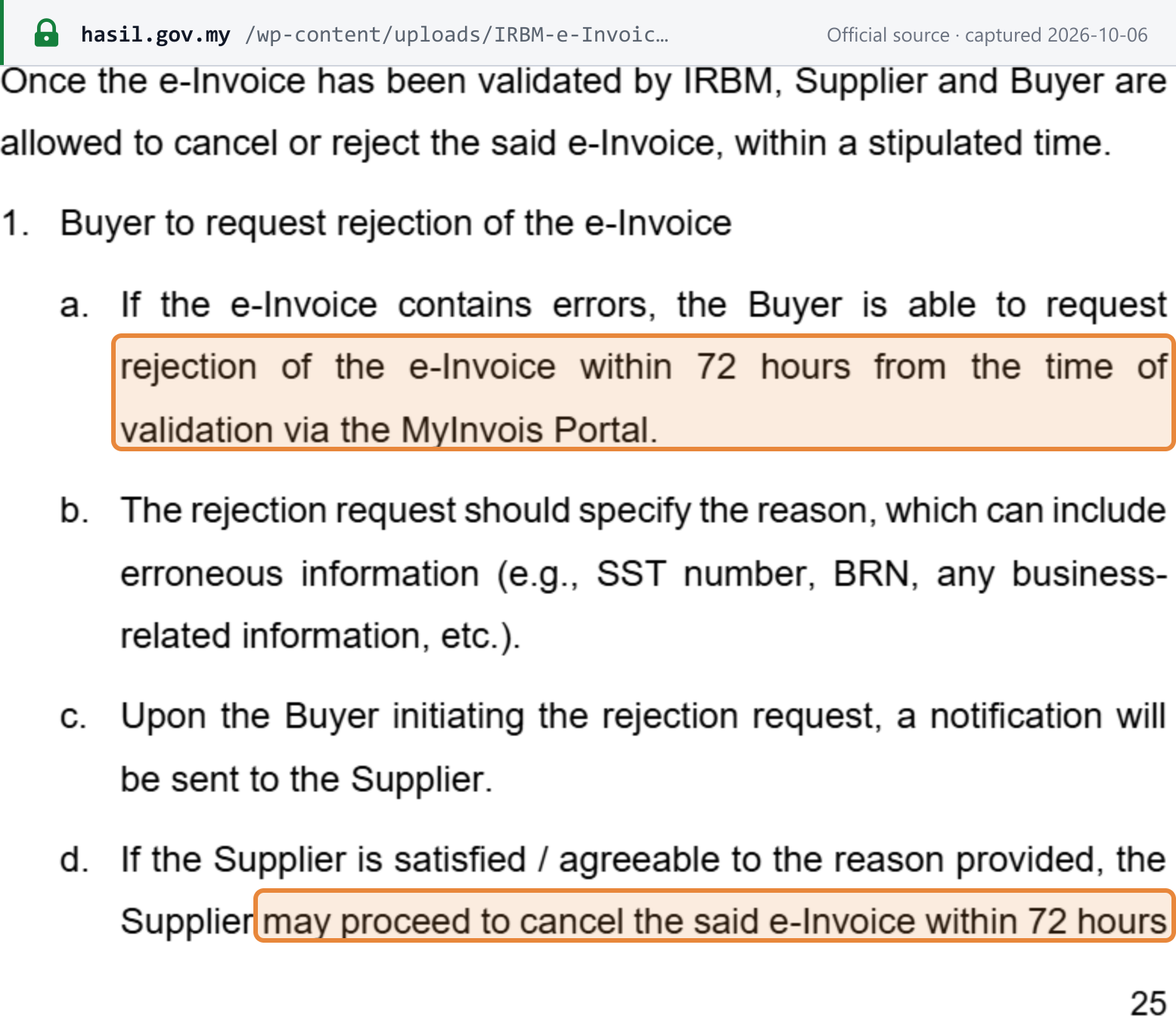
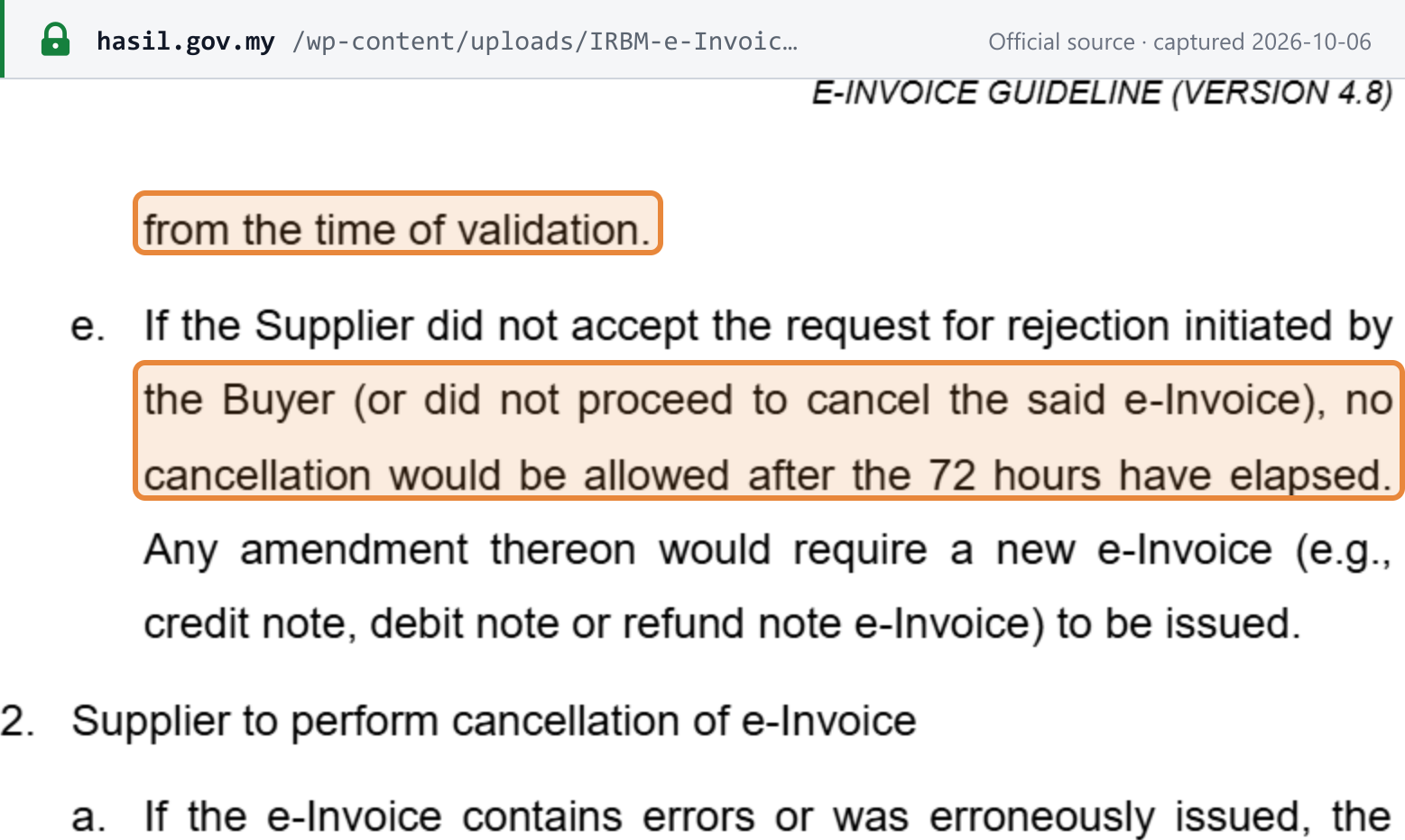
After validation, the buyer may request rejection "within 72 hours from the time of validation" and the supplier may cancel "within 72 hours from the time of validation" (Guideline ¶2.3.6). These are one shared window, not two consecutive ones: a supplier answering a buyer's rejection request at hour 70 has two hours left to cancel. A document can be rejected only once. After 72 hours no cancellation is allowed, and any correction is made with a credit, debit or refund note, for which IRBM sets no time limit (FAQ Q52). (Guideline v4.8 pp.25–26; SDK — Reject document; SDK — Cancel document, checked 2026-10-06)
 Source snapshot captured 2026-10-06 — original
Cancellation must also happen within 72 hours from the time of validation; after that no cancellation is allowed.
 Source snapshot captured 2026-10-06 — original
Two other 72-hour rules are separate. The API rejects a document whose issuance date and time is more than 72 hours before submission (SDK FAQ). After a MyInvois outage, suppliers have 72 hours from the system's return to issue (FAQ Q143).
Format: UBL 2.1, XML or JSON
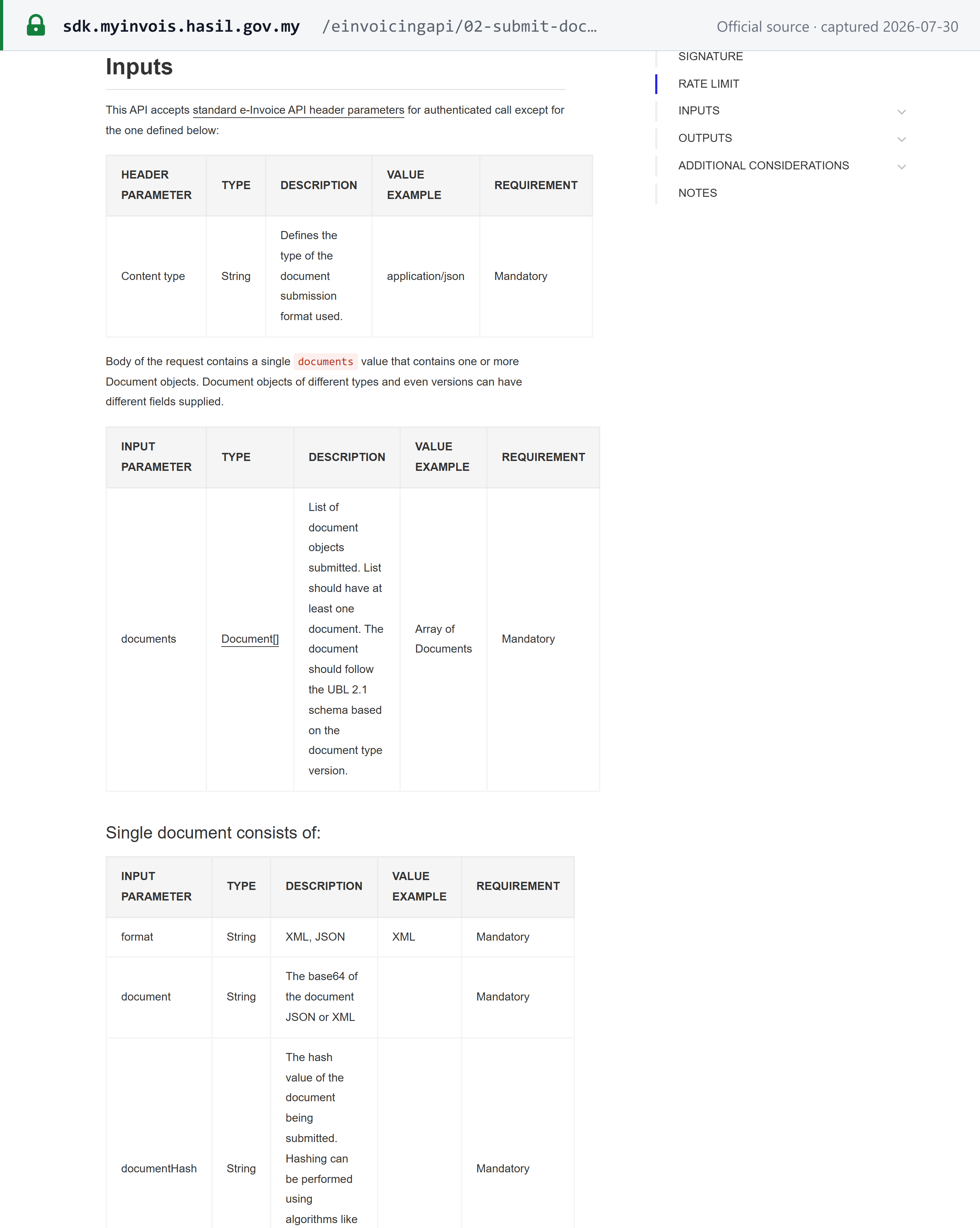
Submissions follow UBL 2.1, serialised as XML or JSON, with 55 data fields in eight categories (Guideline ¶2.4). API submission needs an organisation digital certificate (.cer or .pfx). Document version 1.0 has no signature validation and, as at 2026-10-06, the SDK FAQ says it stays usable until IRBM issues an official notice retiring it; IRBM "strongly recommended" version 1.1, which validates the signature. (Guideline v4.8 pp.29–31; SDK FAQ, checked 2026-10-06)
 Source snapshot captured 2026-07-30 — original
Network: not Peppol-based
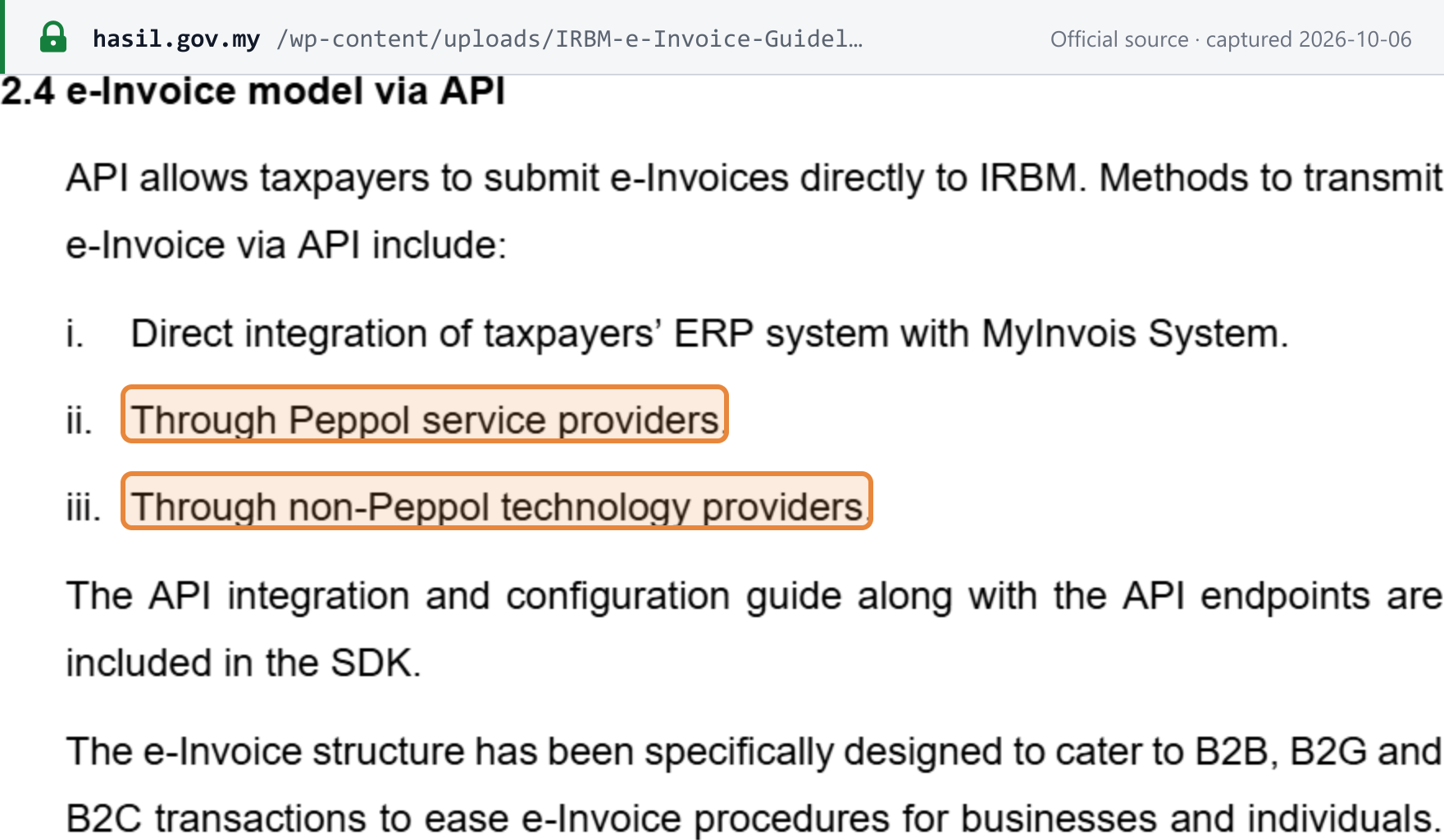
IRBM offers two transmission mechanisms, the MyInvois Portal and the API (Guideline ¶2.2). The API can be reached by direct ERP integration, "through Peppol service providers" or "through non-Peppol technology providers" (¶2.4). The clearance platform is IRBM's own MyInvois System: Peppol is a permitted route to it, not the network itself. IRBM refers Peppol questions to MDEC (FAQ Q137). See the Peppol explainer for how the network works elsewhere.
 Source snapshot captured 2026-10-06 — original
E-reporting and SST
E-reporting. IRBM publishes no separate e-reporting or listing obligation alongside MyInvois (Guideline v4.8, Specific Guideline v4.9 and FAQ, checked 2026-10-06).
SST. MyInvois data is shared with RMCD (ITA para 138(4)(aa)). A service-tax-registered taxpayer whose visual representation carries the particulars required by the Service Tax Regulations 2018 may use it as its service tax invoice (Guideline ¶2.6.4). SST registration itself is a separate RMCD process: see how to register for SST.
Onboarding: how to comply
Steps for a business
- Confirm the obligation. Check the FY2022 turnover band, the RM3,000,000 exemption and the group test, and whether the relaxation to 31 December 2027 applies.
- Get the TIN. Check it on the MyTax portal; if it cannot be retrieved there, register through e-Daftar (Guideline ¶2.3.1).
- Choose a mechanism. The MyInvois Portal is free (FAQ Q140) and suits low volumes: single entry or spreadsheet batch upload, with access through a MyTax login. The API suits high volumes, directly from an ERP or through a service provider. Both may be used together, with reconciliation (FAQ Q134).
- For API users: obtain the organisation digital certificate, register the ERP system in the MyInvois Portal to get a Client ID and Client Secret, and test in the sandbox.
Accreditation of providers
IRBM does not accredit or register technology providers (as at 2026-10-07): it says "There is no registration requirement at this juncture" for technology providers, and no certification either, adding that "this may change in the future" (FAQ Q138–Q139). Intermediaries submitting for taxpayers use their own Client ID and Client Secret (SDK FAQ).
Testing
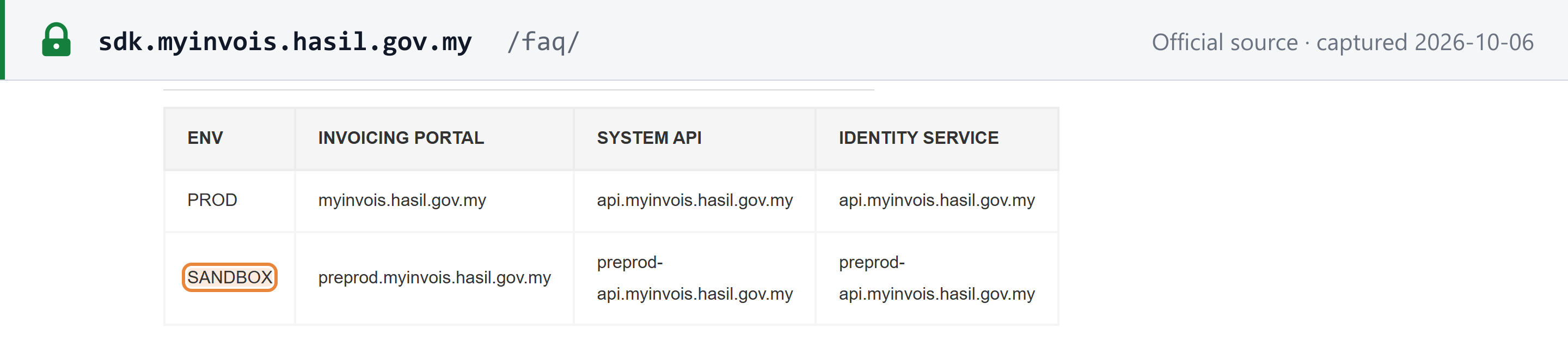
| Environment | Portal | System API and identity service |
|---|---|---|
| Production | myinvois.hasil.gov.my | api.myinvois.hasil.gov.my |
| Sandbox | preprod.myinvois.hasil.gov.my | preprod-api.myinvois.hasil.gov.my |
Production credentials do not work in the sandbox: register the company in the pre-production portal first, then the ERP (SDK FAQ, checked 2026-10-06).
 Source snapshot captured 2026-10-06 — original
Tax incentives for implementation costs
The FAQ (Q24) lists, as at 2026-10-07: a deduction of up to RM50,000 per year of assessment for YA2024 to YA2027 for ESG-related expenditure incurred by MSMEs, which includes consultation fees for developing customised e-invoice software, under the Income Tax (Deduction for Expenditure in relation to Environmental Preservation, Social and Governance) Rules 2025, P.U. (A) 193; an accelerated capital allowance over 2 years for ICT equipment and software for YA2024 to YA2027, and a 1-year accelerated allowance for YA2026 and YA2027 that is "pending issuance of gazette order". (FAQ pp.14–15, checked 2026-10-06)
Penalties
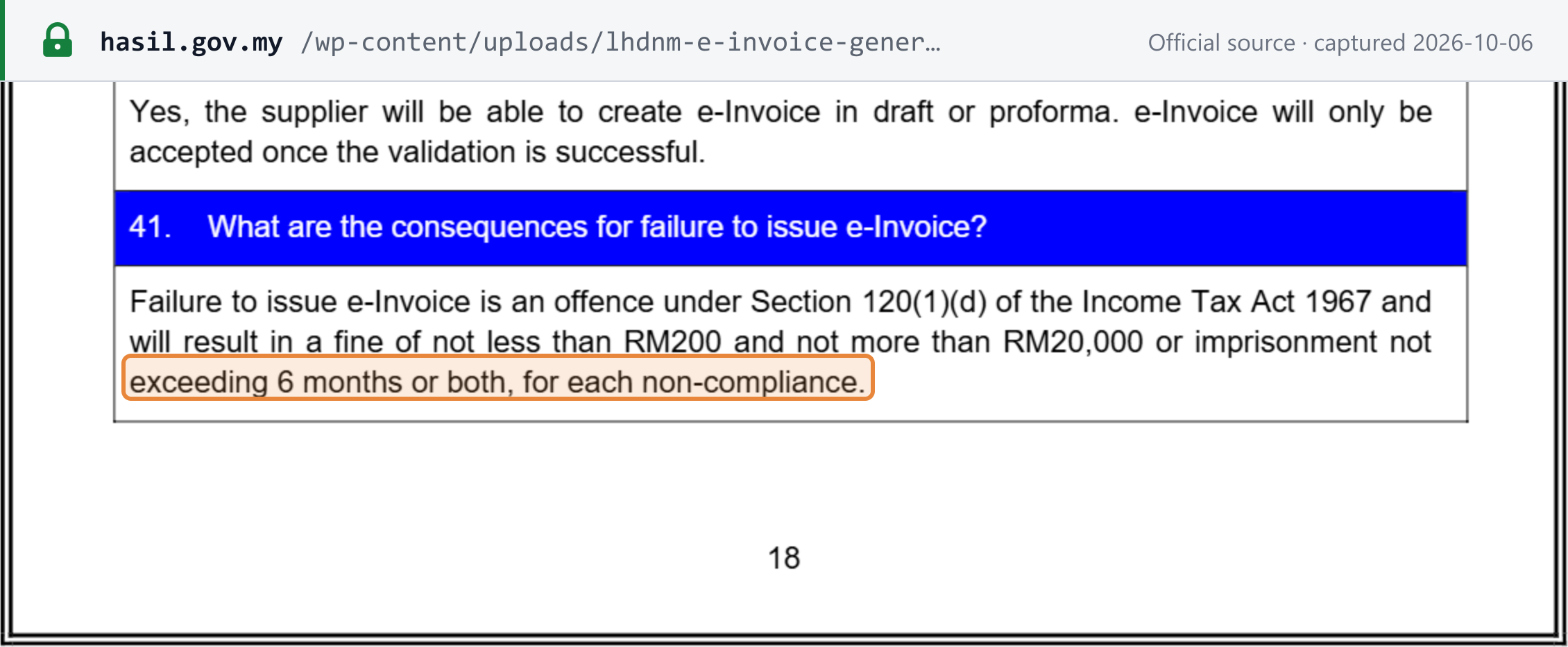
"Failure to issue e-Invoice is an offence under Section 120(1)(d) of the Income Tax Act 1967 and will result in a fine of not less than RM200 and not more than RM20,000 or imprisonment not exceeding 6 months or both, for each non-compliance" (FAQ Q41). Using a service provider does not shift liability: for a company, the responsibility rests with its directors (FAQ Q30). (IRBM General FAQs Q41 on failure to issue e-Invoice, updated 4 September 2026, checked 2026-10-06)
 Source snapshot captured 2026-10-06 — original
Enforcement posture, as at 2026-10-06:
- Relaxation. No s.120 prosecution during the interim relaxation, provided the ¶16.2 conditions are met; for taxpayers up to RM5 million, until 31 December 2027.
- Exempt taxpayers. No compliance action or penalty for taxpayers under the RM3,000,000 threshold (FAQ Q15).
- Outages. Where MyInvois is unavailable, the Director General reviews justifications and takes no action if they are valid (Guideline ¶2.5.4).
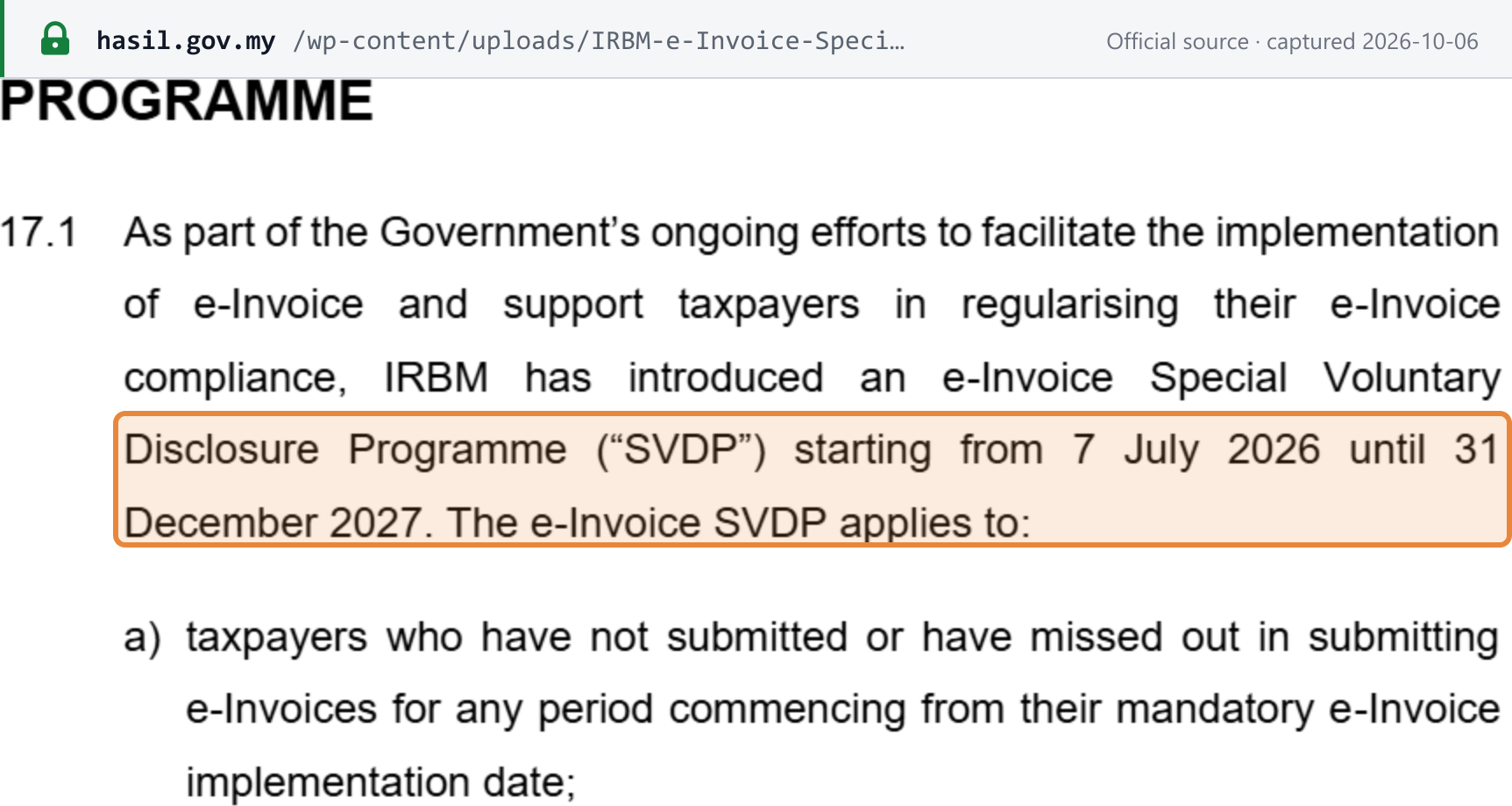
- Voluntary disclosure (SVDP). From 7 July 2026 to 31 December 2027, taxpayers who missed submissions, submitted with errors or never submitted can disclose through MyInvois. IRBM will not review, penalise or prosecute for the disclosed e-invoices, except for non-compliant disclosures and cases of fraud, wilful default or negligence. Disclosures use document version "SVDP 1.2" (unsigned) or "SVDP 1.3" (signed), consolidated month by month. (Specific Guideline v4.9 §17, pp.125–128, checked 2026-10-06)
 Source snapshot captured 2026-10-06 — original
Frequently asked questions
Our turnover is below RM3 million. Can we stop issuing e-invoices?
Yes, from 1 September 2026, unless the group test applies. A taxpayer with annual turnover or revenue below RM3,000,000 is exempt, needs no application or approval, and may stop issuing e-invoices immediately. The exemption does not apply if a non-individual shareholder, a holding company, or a related company or joint venture has turnover of at least RM3,000,000; such a taxpayer implements from the 1 July 2026 concessionary date. Your suppliers must still issue e-invoices to you. (Guideline v4.8 ¶1.6.1(e), ¶1.6.10; FAQ Q12, Q17)
Does the relaxation period end on 30 June 2026?
No. For taxpayers with turnover up to RM5 million, on both the 1 January 2026 and the 1 July 2026 implementation dates, the interim relaxation runs until 31 December 2027. During it you may consolidate all transactions, and IRBM will not prosecute under section 120 provided you meet the conditions, but consolidated e-invoices must still be issued monthly. (Specific Guideline v4.9 Table 16.1, ¶16.3; FAQ Q113, Q116)
A tourist gives us only a passport. Can we still issue an e-invoice?
Yes. Since Specific Guideline v4.9 of 7 September 2026, a non-Malaysian individual provides a TIN, or a TIN and passport number. Where the individual has no TIN, the supplier uses the general TIN EI00000000020, the Foreign Buyer's TIN, together with the passport number. If the buyer does not need an e-invoice at all, the sale can go into the monthly consolidated e-invoice, unless it exceeds RM10,000 after relaxation ends. (Specific Guideline v4.9 ¶3.5.4(b), Appendix 1, Table 3.6)
The buyer rejected our e-invoice. How long do we have to cancel it?
Only what is left of the original 72 hours. Rejection and cancellation both run within 72 hours from the time of validation; the supplier does not get a fresh 72 hours after the buyer's request. After the window closes, correct the invoice with a credit, debit or refund note. (Guideline v4.8 ¶2.3.6; FAQ Q52)
Is MyInvois part of Peppol? Do we need a Peppol access point?
No. MyInvois is IRBM's own validation platform, not a Peppol network. You can submit through the free MyInvois Portal, by direct API integration from your ERP, or through a Peppol or non-Peppol service provider that meets IRBM's API requirements. (Guideline v4.8 ¶2.2, ¶2.4; FAQ Q137)
We buy services from a foreign supplier. Who issues the e-invoice?
You do. A foreign seller is not mandated to use MyInvois, so the Malaysian purchaser issues a self-billed e-invoice: for imported services by the end of the month after the earlier of payment or receipt of the supplier's invoice, and for imported goods by the end of the second month after the month of customs clearance. Where no foreign TIN is available, use the general TIN EI00000000030. (Specific Guideline v4.9 ¶10.4.3, ¶10.4.8, ¶10.4.9, Appendix 1)
What is the penalty for not issuing an e-invoice?
Failure to issue an e-invoice is an offence under section 120(1)(d) of the Income Tax Act 1967: a fine of RM200 to RM20,000, or imprisonment of up to 6 months, or both, for each non-compliance. The e-Invoice Special Voluntary Disclosure Programme, open from 7 July 2026 to 31 December 2027, lets taxpayers correct missed or wrong submissions without penalty. (FAQ Q41; Specific Guideline v4.9 §17)
Recent changes
- 2026-09-07 — IRBM published e-Invoice Specific Guideline v4.9, replacing Specific Guideline v4.8 of 7 July 2026: a non-Malaysian individual buyer provides a TIN, or a TIN and passport number, and where there is no TIN the supplier uses general TIN EI00000000020 with the passport number. (Inland Revenue Board of Malaysia) — see event · issue
- 2026-09-04 — IRBM updated its General FAQs: exempt taxpayers need no application and may stop issuing e-invoices immediately; the relaxation questions are renumbered Q113 onwards. (Inland Revenue Board of Malaysia)
- 2026-09-01 — The e-invoice exemption threshold rose from RM1 million to RM3,000,000 annual turnover or revenue (announced 30 August 2026, with Guideline v4.8 and its ¶1.6.10 group test). (HASiL) — see event · issue
- 2026-07-07 — The e-Invoice Special Voluntary Disclosure Programme opened, running to 31 December 2027. (HASiL) — see event · issue
- 2026-05-05 — IRBM's General FAQ (then Q104, now Q113) put the interim relaxation for taxpayers up to RM5 million at 31 December 2027, on both the 1 January 2026 and 1 July 2026 dates; it does not end on 30 June 2026. (Inland Revenue Board of Malaysia) — see event · issue
- 2026-01-01 — Any single transaction above RM10,000 needs its own e-invoice and may not be consolidated once relaxation ends; electricity supply and telco postpaid, internet and device sales joined the no-consolidation list. (Inland Revenue Board of Malaysia)
Related resources
- Malaysia SST guide — sales tax, service tax, registration and the SST side of invoicing
- Malaysia tax identification numbers — the TIN on every e-invoice
- How to verify a Malaysian registration number
- How to register for SST in Malaysia
- Malaysia tax-change chronology — every tracked Malaysian change, dated and sourced
- E-invoicing status and networks worldwide — the global comparison table
- Peppol network explainer
- Other validation-model guides: Vietnam and Saudi Arabia
Important websites
- HASiL e-Invois microsite — IRBM's e-invoice hub: guidelines, FAQs, media statements
- MyInvois Portal — production portal (login through MyTax)
- MyInvois sandbox portal — pre-production testing; separate registration
- MyInvois SDK — API specification, document types, validation rules, FAQ
- MyTax — TIN retrieval and the gateway to the MyInvois Portal
- IRBM e-Invoice Guideline v4.8 and Specific Guideline v4.9
- IRBM e-Invoice General FAQs