Malaysia raises the e-Invoice exemption threshold from RM1 million to RM3 million
This page records one dated change. For the rules in Malaysia as they stand today, see the Malaysia guide →
- Jurisdiction
- Malaysia
- Tax
- e-Invoice
- Change type
- Threshold
- Status
- In force
- Impact
- Action required
- Announced
- 30 August 2026
- Effective
- 30 August 2026
- Instrument
- MY-EINV-GUIDE-4-8
- Authority
- Inland Revenue Board of Malaysia (LHDN)
- Systems
- ERP, Invoicing
- Verified
- Fetched from official source · high confidence
Malaysian taxpayers with annual turnover or revenue under RM3,000,000, up from the previous RM1,000,000 line. The exemption is switched off entirely — regardless of the reporting entity's own turnover — where it has a non-individual shareholder, holding company, related company or joint venture with annual turnover or revenue of RM3,000,000 or more, so a group with any related entity above that figure must keep e-Invoicing live.
Re-test your Malaysian e-Invoice obligation against the new RM3,000,000 turnover threshold. The exemption does not apply if a non-individual shareholder, holding company, related company or joint venture has annual turnover of at least RM3,000,000, so check the group before standing any implementation down.
ERPInvoicing
The Inland Revenue Board of Malaysia published e-Invoice Guideline version 4.8, dated 30 August 2026, replacing version 4.7 of 7 July 2026. Section 1.6.1(e) exempts taxpayers with annual turnover or revenue of less than RM3,000,000 from issuing e-Invoices, including self-billed e-Invoices, raising the exemption threshold from RM1,000,000. A new section 1.6.10 provides that the exemption does not apply where the taxpayer has a non-individual shareholder, a holding company, or a related company or joint venture with annual turnover or revenue of at least RM3,000,000. The same version also amends section 1.5, raising to RM3,000,000 the annual turnover trigger at which a business commencing operations between 2023 and 2025 must implement e-Invoicing from 1 July 2026, and adds a rule for businesses commencing from 2026 onwards: the implementation date is 1 July 2026 or the commencement date, but where first-year turnover is expected to be below RM3,000,000 it becomes 1 January in the second year following the year turnover reached RM3,000,000.
What changed in detail
The Inland Revenue Board of Malaysia published e-Invoice Guideline version 4.8, dated 30 August 2026, replacing version 4.7 of 7 July 2026. Section 1.6.1(e) exempts taxpayers with annual turnover or revenue of less than RM3,000,000 from issuing e-Invoices, including self-billed e-Invoices, raising the exemption threshold from RM1,000,000. The exemption does not apply where the taxpayer has a non-individual shareholder, holding company, related company or joint venture with annual turnover or revenue of at least RM3,000,000.
What it means
The headline number matters less than the group test attached to it. A small entity below RM3 million can still be pulled back into mandatory e-Invoicing purely because of who owns it or who it is affiliated with — a holding company, a related company, or a joint-venture partner at or above RM3 million switches the exemption off regardless of the reporting entity’s own turnover. That makes this a group-level question, not an entity-level one: a business that reads only its own accounts and stands down its e-Invoicing implementation on the strength of the higher threshold can be wrong if a shareholder or related company clears RM3 million. Groups need to re-check the whole structure against the new figure, not just the entity that files.
Proof
This e-Invoice Guideline (Version 4.8) replaces the e-Invoice Guideline (Version 4.7) issued on 7 July 2026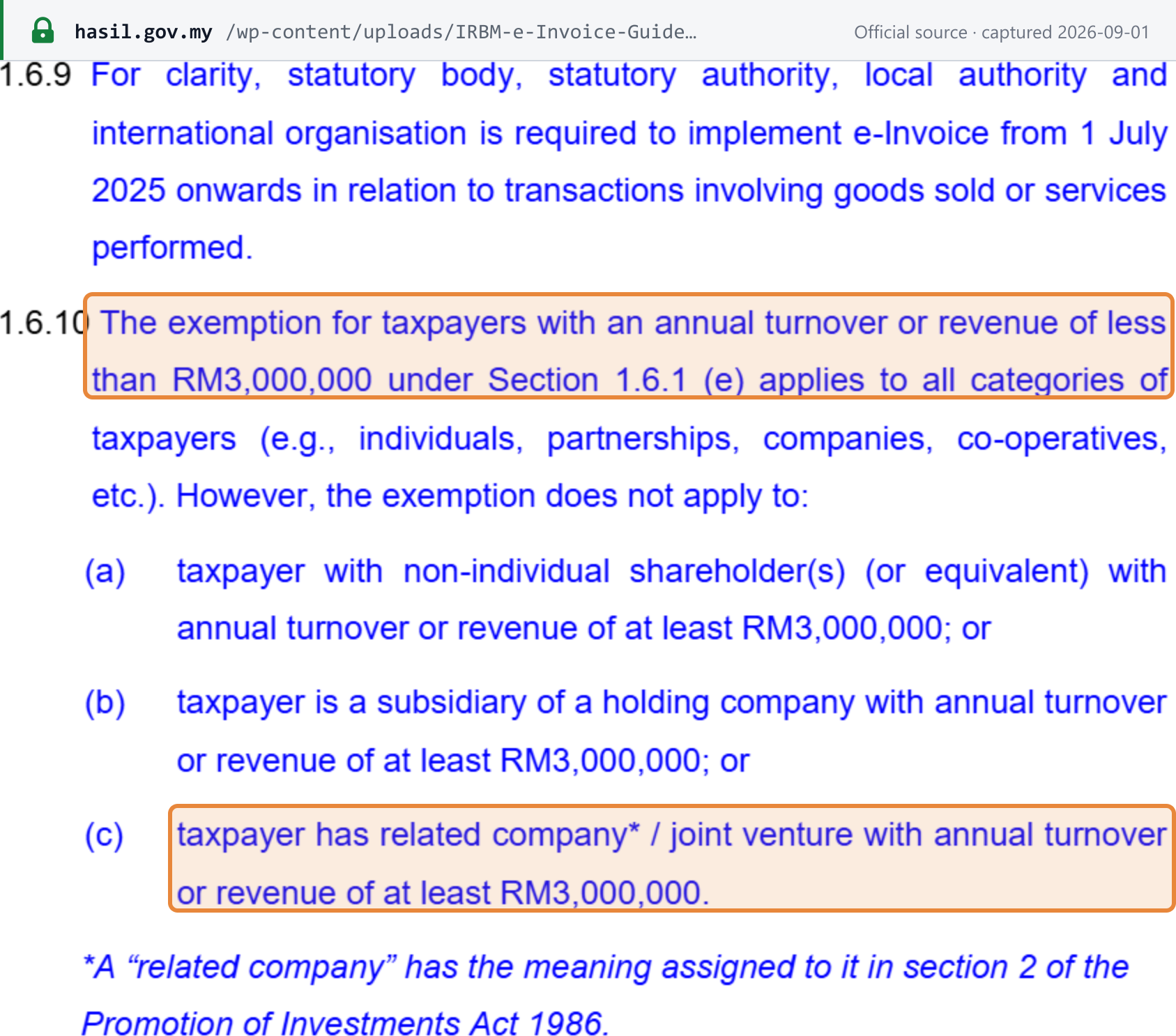 Source snapshot of the official page. Open full size ↗
Archived from the official distribution · www.hasil.gov.my