Malaysia e-Invoice Guideline v4.9 requires a TIN for non-Malaysian individual buyers
This page records one dated change. For the rules in Malaysia as they stand today, see the Malaysia guide →
- Jurisdiction
- Malaysia
- Tax
- Income Tax
- Change type
- Invoice rules
- Status
- In force
- Impact
- Action required
- Announced
- 7 September 2026
- Effective
- 7 September 2026
- Authority
- Inland Revenue Board of Malaysia (LHDN)
- Systems
- Invoicing, ERP
- Verified
- Fetched from official source · high confidence
Suppliers issuing e-Invoices to buyers who are non-Malaysian individuals (other than MyPR and MyKAS holders), and suppliers issuing self-billed e-Invoices for individual suppliers in that position.
Capture a TIN (or the general TIN plus passport number) for non-Malaysian individual buyers on MyInvois e-invoices.
InvoicingERP
Malaysia's Inland Revenue Board published version 4.9 of the e-Invoice Specific Guideline on 7 September 2026, replacing version 4.8 of 7 July 2026. For buyers who are non-Malaysian individuals (other than MyPR and MyKAS holders), an e-invoice must carry either the buyer's TIN or both the TIN and passport number; a passport number alone is no longer accepted. Where the individual has no TIN, the supplier may use the general TIN with the passport number. The same rule applies to self-billed e-invoices for individual suppliers.
What changed in detail
Malaysia’s Inland Revenue Board (LHDN/IRBM) published version 4.9 of the e-Invoice Specific Guideline on 7 September 2026, replacing version 4.8 of 7 July 2026. For buyers who are non-Malaysian individuals — other than MyPR and MyKAS holders — an e-invoice must now carry either the buyer’s Tax Identification Number (TIN), or both the TIN and passport number. A passport number alone is no longer accepted. Where the individual has no TIN, the supplier may use the general TIN together with the passport number. The same rule applies to self-billed e-invoices issued for individual suppliers in the same position.
What it means
Any MyInvois integration that captures only a passport number for a foreign individual buyer needs a TIN field added before the next e-invoice is issued to that buyer type — the old passport-only path is no longer valid input, not merely deprecated. Where the buyer genuinely has no Malaysian TIN, the general TIN plus passport number is the fallback, so systems should be able to populate both fields rather than reject the transaction. This is a validation-rule change with immediate effect from the guideline’s publication date; there is no separate grace period called out for the foreign-buyer TIN requirement itself.
Proof
This e-Invoice Specific Guideline (Version 4.9) replaces the e-Invoice Specific Guideline (Version 4.8) issued on 7 July 2026.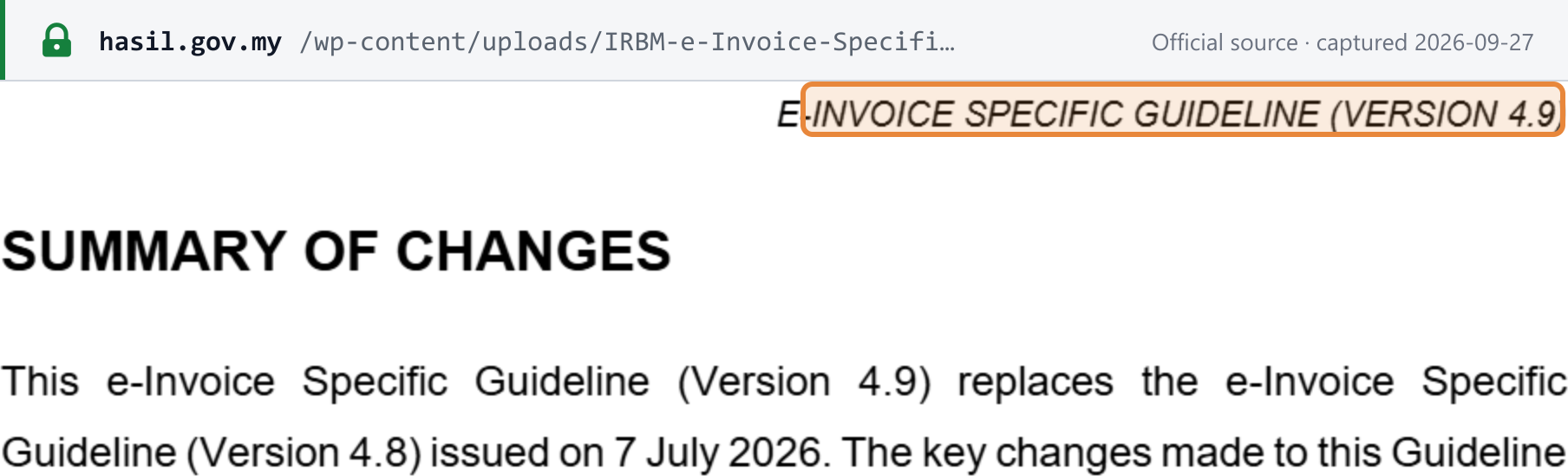 Source snapshot of the official page. Open full size ↗