Malaysia SST guidelines
| FACTSHEET | |
|---|---|
| Country code | MY |
| Tax name | Sales Tax and Service Tax (SST) — not a VAT |
| Tax Authority | Royal Malaysian Customs Department (RMCD / JKDM) |
| E-invoicing authority | Inland Revenue Board of Malaysia (IRBM / LHDN) — MyInvois |
Overview
Malaysia does not operate a VAT. It runs SST — Sales Tax and Service Tax — two separate taxes administered by the Royal Malaysian Customs Department (RMCD, or JKDM) through the MySST portal at mysst.customs.gov.my. Getting this framing right matters, because SST behaves very differently from the VAT and GST regimes elsewhere in ASEAN:
- Sales tax is a single-stage tax levied on imported and locally manufactured goods, charged either at the time of importation or at the time the goods are sold by the registered manufacturer. [1]
- Service tax is charged and levied on prescribed taxable services provided by a taxable person in Malaysia, and on imported taxable services. The taxable services are listed by group in the First Schedule to the Service Tax Regulations 2018. [1]
- There is no input tax credit mechanism. SST charged by a supplier is a cost to the recipient, not a recoverable input. Relief comes instead from targeted devices — sales tax exemption schedules, business-to-business (B2B) exemptions, group relief, and Ministerial exemptions granted under section 34 of the Service Tax Act 2018. [1] [2]
The Service Tax Act 2018 took effect on 1 September 2018, replacing GST. [2] A major scope expansion took effect on 1 July 2025, broadening the sales tax base (Sales Tax (Rate of Sales Tax) (Amendment) Order 2025, P.U.(A) 199/2025, published 1 July 2025) and widening the taxable service groups — Group H was renamed from credit and charge card services to financial services, and rental or leasing services (Group K) and construction work services (Group L) were prescribed as taxable. [3] [5] [6]
Because much of the expansion was rolled out ahead of the subsidiary legislation, RMCD governs the detail through numbered Service Tax Policies published on the MySST portal — several of which were amended in June and July 2026. See Recent changes.
Tax IDs and SST registration
Malaysian businesses deal with two different administrations and two different identifiers:
- Tax Identification Number (TIN) — issued by the Inland Revenue Board of Malaysia (IRBM/LHDN), and mandatory on every e-invoice. Businesses can retrieve their TIN through the MyTax portal at mytax.hasil.gov.my; if no TIN can be retrieved, they register through the e-Daftar option in MyTax to obtain one. [1]
- SST registration number — issued by RMCD on approval of a sales tax or service tax registration made through the MySST portal at mysst.customs.gov.my. A registered person's number and status can be checked through the RMCD enquiry service at esemakan.customs.gov.my. [2]
Key registration mechanics:
- Sales tax: a taxable person is a person who manufactures taxable goods and is liable to be registered once annual turnover exceeds the RM500,000 threshold. Voluntary registration is available to manufacturers of taxable goods below the threshold. [3]
- Service tax: any person providing taxable services is liable to be registered once the total value of taxable services provided in 12 months exceeds the threshold prescribed for that group. [4] Thresholds are set per taxable service group, not per business — see Registration thresholds.
- Existing registrants adding a new group: a service provider already registered must update its registration details in the MySST portal to add the new service type and begin charging service tax from the effective date. [2]
- Returns: the standard taxable period is bimonthly (every two months) for both sales tax and service tax. [4] A registered person files the SST-02 return no later than the last day of the month following the end of the taxable period. [2]
- Forms, statements and payment methods across the Tourism Tax Act 2017, Sales Tax Act 2018 and Service Tax Act 2018 — including the SST-02/SST-02A returns, TTx-03/TTx-03A, DST-02, LVG-02 and the ADM payment forms, plus registration, refund, drawback, customs-ruling and review applications — are prescribed by General Ruling (Ketetapan Umum) No. 6/2026, in force from 21 September 2026, which revokes and replaces General Ruling No. 1/2025 (issued 18 August 2025). Where subsidiary legislation under TTx, ACJ or ACP later conflicts with this Ruling, the legislation prevails. [6]
- Foreign digital service providers: a foreign service provider (FSP) supplying digital services to consumers in Malaysia is liable to register as a registered foreign person once the total value of digital services provided to consumers in Malaysia exceeds RM500,000 per year, a regime effective from 1 January 2020. [5]
To check a Malaysian tax identification number, use our Malaysia TIN validator. For the TIN format itself — the IG-prefix individual number, entity prefixes and NRIC — see our Malaysia TIN number guide; for the SSM company registration number (BRN), see How to verify a registration number in Malaysia.
Rates
| Tax | Rate | Applies to |
|---|---|---|
| Sales tax | 5%, 10%, or a specific rate | Taxable goods manufactured in or imported into Malaysia; the applicable rate depends on the goods, per the Sales Tax (Rates of Tax) orders [1] [2] |
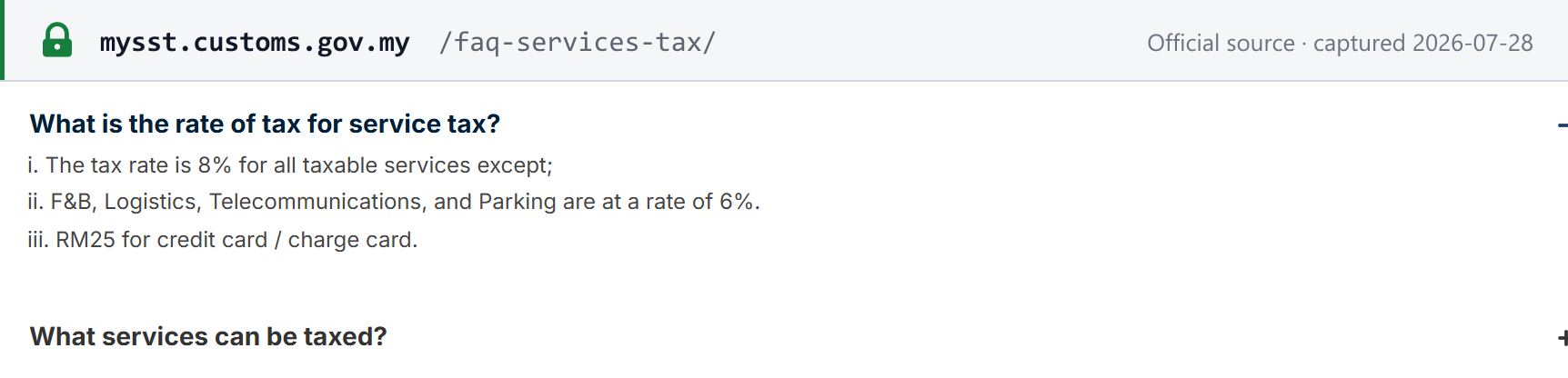
| Service tax (standard) | 8% | All taxable services except those carved out below, since 1 March 2024 [3] |
| Service tax (reduced) | 6% | Food and beverage, logistics, telecommunications and parking services [3] |
| Service tax — rental or leasing (Group K) | 8% (1 Jul – 31 Dec 2025), then 6% from 1 Jan 2026 | Rental or leasing of tangible assets; the 6% rate was fixed by P.U.(A) 125, the Service Tax (Rate of Tax) (Amendment) Order 2026, gazetted 13 March 2026 [4] [5] |
| Service tax — construction work (Group L) | 6% | Construction work services, as prescribed under the Service Tax (Rate of Tax) (Amendment) Order 2025 [6] |
| Service tax — credit and charge cards | RM25 per card | Charged on the date the card is activated and every 12 months thereafter; no registration threshold applies to this item [3] [7] |
NB: interest, profit rate, spreads and punitive charges (late payment charges, dishonoured-cheque charges, overdraft excess fees, policy surrender fees) are not subject to service tax under Group H — only the fee, commission or similar payment is. [7]
 Source snapshot captured 2026-07-28 — original
Registration thresholds
Malaysia does not use one nationwide threshold. Each tax — and each taxable service group — has its own, tested over a 12-month period.
| Registration | Threshold (12 months) |
|---|---|
| Sales tax (manufacturer of taxable goods) | Annual turnover exceeding RM500,000 [1] |
| Service tax — financial services (Group H) | RM1,000,000 per 12-month period [2] |
| Service tax — rental or leasing services (Group K) | Exceeding RM1 million per 12-month period [3] |
| Service tax — construction work services (Group L) | Exceeding RM1,500,000 per 12-month period [4] |
| Service tax — credit / charge card facilities | No threshold — the RM25 per-card charge applies regardless [2] |
| Digital services by a foreign service provider | Exceeding RM500,000 per year of digital services to consumers in Malaysia [5] |
Three counting rules catch businesses out:
- Exempted supplies still count — Group K. For Group K, the threshold calculation includes the value of rental or leasing services that the Minister of Finance has exempted under section 34(3)(a) or 34(4) of the Service Tax Act 2018. This rule is stated for Group K specifically in its own industry guide; other taxable service groups should be checked against their own group-specific industry guide rather than assumed to follow the same rule. [3]
- Excluded supplies do not count. Services that fall outside the scope of service tax — for example Group H services relating to goods, land or matters outside Malaysia — are left out of the threshold calculation entirely. [2]
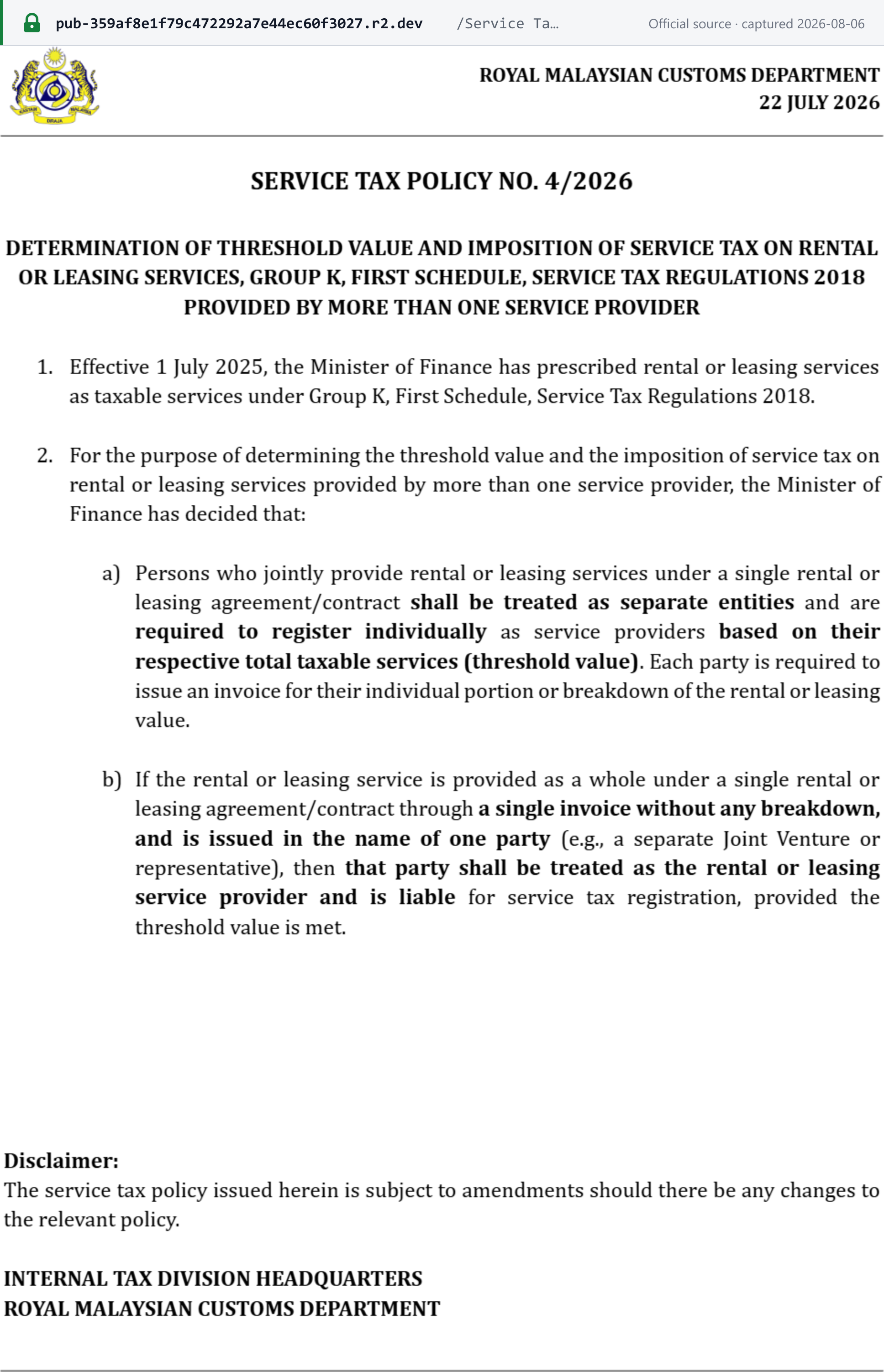
- Joint suppliers test separately. Persons who jointly provide rental or leasing services under a single agreement are treated as separate entities and register individually on their own taxable turnover, invoicing their own portion of the rental value — unless one undivided invoice is issued in a single party's name, in which case that party alone carries the obligation. This applies from 1 July 2025. [6]
 Source snapshot captured 2026-07-28 — original
Group K also carries a set of exemptions that reduce the tenant's cost without changing the lessor's threshold test: MSME tenants registered in RMCD's MyPMK system are exempt from paying service tax on rental or leasing (annual sales below RM1 million from 1 July 2025; above RM1 million and below RM1.5 million from 1 January 2026), and newly established MSMEs are exempt for one year from their SSM registration date, effective 1 January 2026. Both require paid-up ordinary share capital not exceeding RM2.5 million. [5]
Exemptions
Malaysian sales tax exemptions run through a separate Ministerial order from the one that sets rates: the Rates table above taxes goods by tariff heading under the Sales Tax (Rate of Sales Tax) Order 2025, while a companion Sales Tax (Goods Exempted From Sales Tax) Order removes specific headings from sales tax altogether. The August 2026 vessels change works through both orders at once.
Commercial vessels — moved from taxable to exempt, 1 August 2026. Two companion instruments, both made 29 July 2026 and gazetted 31 July 2026 under the Sales Tax Act 2018, took effect 1 August 2026:
- P.U.(A) 281, the Sales Tax (Rate Of Sales Tax) (Amendment) Order 2026 (made under section 10(2) of the Act), deletes tariff headings 89.01 (ships, tankers, refrigerated vessels, and other vessels for the transport of goods and/or persons), 89.05 (light-vessels, fire-floats, dredgers, floating cranes, floating docks, floating/submersible drilling or production platforms), 89.06, 89.07 (other floating structures — rafts, tanks, buoys) and 89.08 (vessels for breaking up) from the First Schedule to the Sales Tax (Rate of Sales Tax) Order 2025 [P.U.(A) 170/2025] — taking those headings out of the taxable-rate schedule entirely.
- P.U.(A) 276, the Sales Tax (Goods Exempted From Sales Tax) (Amendment) Order 2026 (made under paragraph 35(1)(a) of the Act), inserts new headings 89.04 (tugs and pusher craft), 89.05, 89.07 and 89.08 into the Schedule to the Sales Tax (Goods Exempted From Sales Tax) Order 2025 [P.U.(A) 171/2025]. Headings 89.01 and 89.06 (other vessels, including warships and lifeboats other than rowing boats) were already listed in that Schedule; for these two, the order inserts additional subheadings rather than inserting the headings themselves.
Read together, ships, tankers, refrigerated and cargo vessels, light-vessels, floating docks, other floating structures and vessels for breaking-up move out of the taxable schedule from 1 August 2026. For 89.05, 89.07 and 89.08 that is a move into the exempted-goods schedule; 89.01 and 89.06 were already listed there and only gained subheadings. [1] [2] [3]
Heading 89.03 (yachts and other pleasure/sports vessels) — position unresolved on the published orders. P.U.(A) 281 does not delete heading 89.03 from the taxable rate schedule: yachts, inflatable boats, sailboats, motorboats and other vessels for pleasure or sport remain listed in the taxable Sales Tax (Rate of Sales Tax) Order. At the same time, P.U.(A) 276 substitutes 89.03's own entry in the exempted-goods schedule with a full, refreshed set of yacht subheadings — the same order also used to insert and add subheadings for the commercial-vessel headings above. A heading appearing in both the taxable rate schedule and the goods-exempted schedule cannot be resolved from these two amendment orders alone; that requires the consolidated Sales Tax (Goods Exempted From Sales Tax) Order 2025 [P.U.(A) 171/2025], which is not published on mysst.customs.gov.my. This guide does not assert whether 89.03 is taxable or exempt from 1 August 2026 — that is unresolved pending the consolidated text. [1] [2]
Animal feed, fertilizer and pesticide manufacturing inputs — exempt from 1 September 2026. The Sales Tax (Persons Exempted From Payment Of Tax) (Amendment) (No. 2) Order 2026, P.U.(A) 303/2026, made 26 August 2026 and gazetted 28 August 2026, inserts new items 5, 6 and 7 into Schedule B of the Sales Tax (Persons Exempted From Payment Of Tax) Order 2018 [P.U.(A) 210/2018], effective 1 September 2026. A manufacturer approved by the Director General, under a manufacturing licence issued (or exempted from licensing) under the Industrial Co-ordination Act 1975, is exempt from sales tax on goods approved by the Minister of Finance and solely used in the manufacture of: item 5 — animal feed products; item 6 — fertilizer products; and item 7 — pesticide products — provided the goods are imported, purchased from a registered manufacturer, or transported from a licensed warehouse, licensed manufacturing warehouse, or free-zone facility. The certificate is signed by the manufacturer itself (Schedule B, column (5): "The manufacturer in column (2)"). [10]
Special areas — employer-provided staff accommodation excluded, from 25 September 2026. Service tax on special areas (Labuan, Langkawi and Tioman) runs on its own imposition order, the Service Tax (Imposition of Tax for Taxable Services in respect of Designated Areas and Special Areas) Order 2018 [P.U.(A) 212/2018], separate from the ordinary First Schedule taxable-service groups. P.U.(A) 337/2026, made 18 September 2026 and in operation from 25 September 2026, amends item 3 of that Order's Schedule so the taxable service in special areas becomes "the provision of accommodation premises excluding accommodation premises provided by an employer as a facility to its employees." A special-areas operator must stop charging service tax on employer-provided staff accommodation from that date; ordinary (non-staff) accommodation in a special area remains taxable under item 3. [11]
Exempt is not the same as zero-rated. Malaysian SST carries no input-tax-credit mechanism at all (see Overview), so the goods-exempted schedule is the only way a good escapes sales tax outright — there is no separate zero-rate concept for goods to confuse it with.
Other exemption mechanisms. B2B exemptions, group relief, and Ministerial exemptions under section 34 of the Service Tax Act 2018 (for service tax) are described at a general level in Overview.
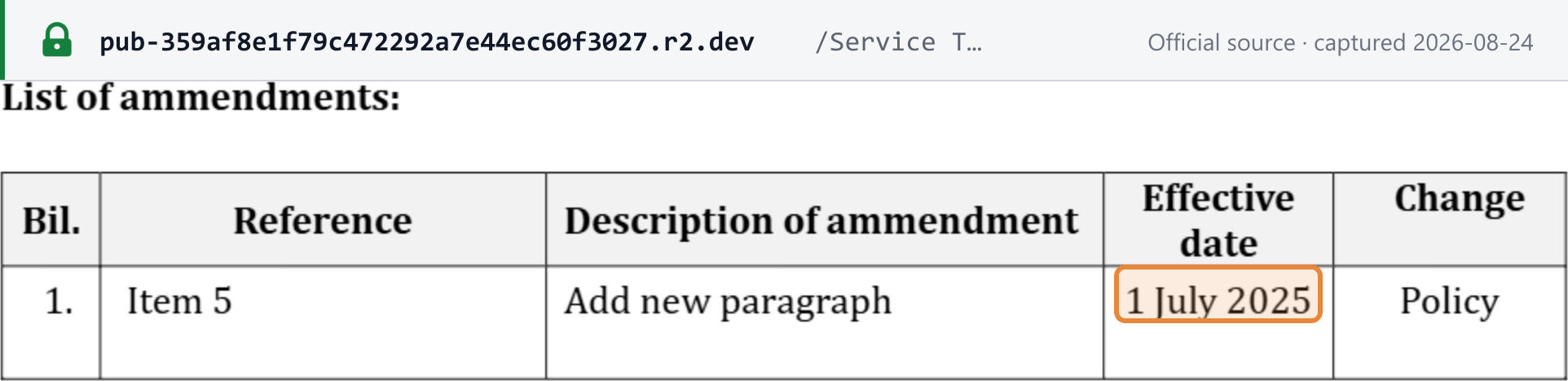
Private healthcare — newborns without citizenship status. RMCD's Service Tax Policy No. 5/2025 governs service tax on private healthcare. Amendment No. 4, dated 17 August 2026, adds a new Item 5 exempting newborns who have not yet obtained citizenship status, conditional on at least one parent being a citizen holding valid National Registration Department identification and on the documentation being produced at registration. It is effective 1 July 2025 — the SST expansion commencement date — so it covers the whole period the expanded scope has been in force. Backdating does not imply refunds: Item 2(c) of the same policy expressly denies a refund to a facility that imposed and remitted service tax during a comparable backdated exemption period, and Items 1(b) and 3(b) require service tax already collected to be remitted to RMCD regardless of the exemption. [8]
 Source snapshot captured 2026-08-24 — original
Offshore/onshore construction and ship-to-floating-structure conversion for overseas clients — retroactive to 1 July 2025. RMCD's Service Tax Policy No. 5/2026, dated 8 September 2026, exempts Group L (construction work) service tax registered persons from charging and collecting service tax on construction work services for offshore and onshore facilities and structures, and on ship-to-floating-structure conversion services, provided to a client, entity or company not established in Malaysia. The exemption runs under paragraph 34(3)(a) of the Service Tax Act 2018 (the overseas recipient is exempt from paying) and subsection 34(4) (the Malaysian provider is exempt from charging and collecting), and it applies with effect from 1 July 2025 — over a year before the policy's own publication date — until the project is completed or the contract expires. The retroactive reach is the unusual feature: a provider that charged and remitted service tax on a qualifying supply any time from 1 July 2025 onward may now stop charging it, but no refund is given for tax already paid. Conditions: each contract must be in writing, signed with the overseas client, and stamped with stamp duty by the Inland Revenue Board (LHDN); every invoice must state "Service tax exemption under paragraph 34(3)(a) and subsection 34(4) of the Service Tax Act 2018 pursuant to Service Tax Policy No. 5/2026 dated 8 September 2026"; and supporting documents must be retained for RMCD audit. [9]
Invoice requirements
Malaysia is the one country in this guide set where the invoice format is a machine schema rather than a list of printed particulars. Once a taxpayer is inside the MyInvois mandate, a compliant invoice is a structured document validated by IRBM, not a PDF that happens to carry the right fields.
Technical format
| Requirement | Specification |
|---|---|
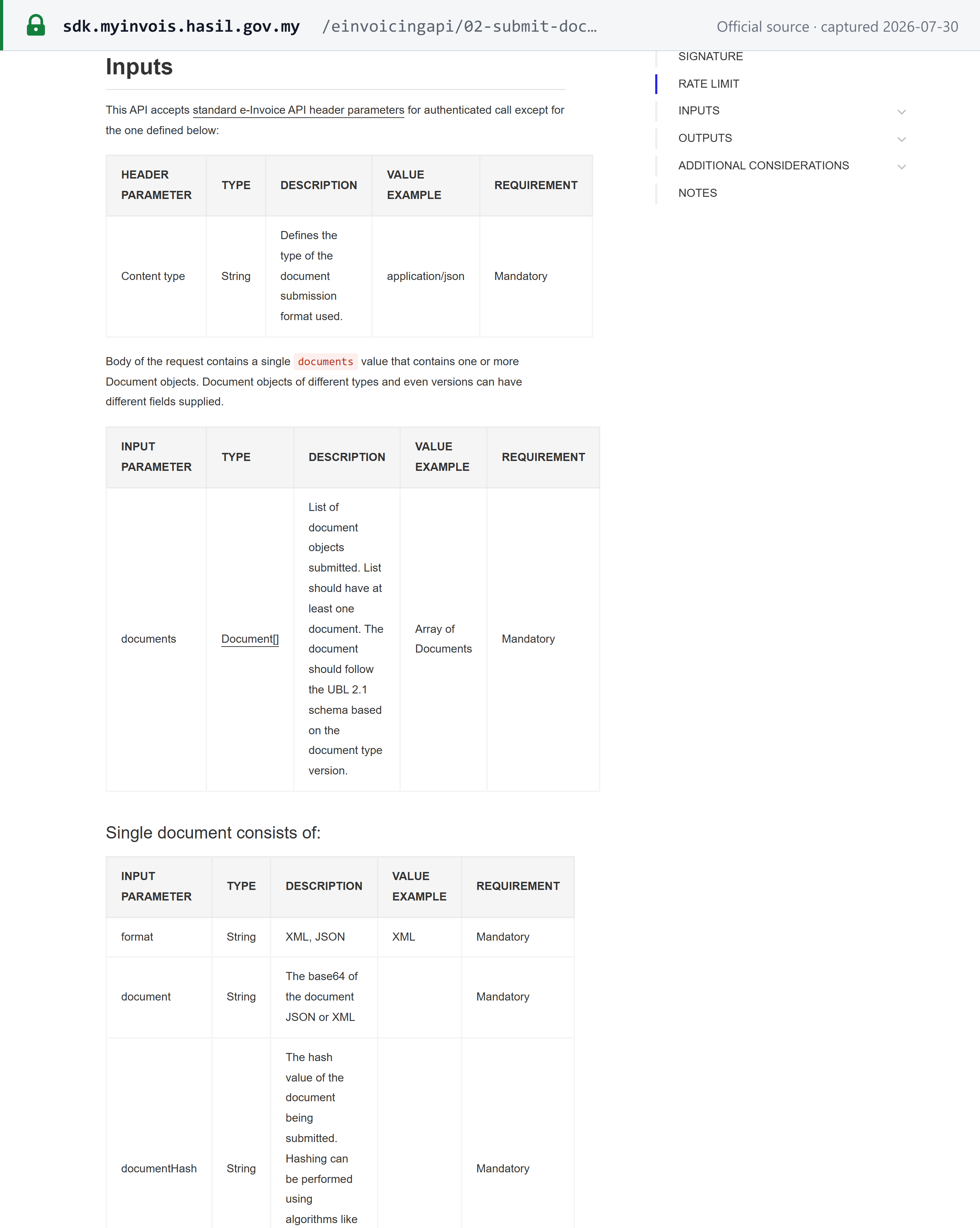
| Schema | UBL 2.1, per the document type version |
| Serialisation | XML or JSON — every document in a submission, and the submission element itself, must use the same format |
| Per-document payload | Base64-encoded document, a SHA256 documentHash, and a supplier-side codeNumber reference (e.g. INV12345) |
| Submission size | Maximum 5 MB per submission |
| Documents per submission | Maximum 100 e-invoices |
| Per e-invoice size | Maximum 300 KB — no line-count limit provided the size limits hold |
IRBM recommends minifying the XML/JSON to strip unnecessary whitespace, both to stay inside the size limits and to avoid validation errors. [3]
 Source snapshot captured 2026-07-30 — original
Data fields and document types
The IRBM e-Invoice Guideline sets out the mandatory and optional data fields in its appendices — the full set runs to 55 fields, covering supplier and buyer identification (including TIN), classification and MSIC codes, line-item detail, currency and exchange rate. Consult Appendix 1 of the e-Invoice Guideline for the authoritative list rather than relying on a summary. [1]
MyInvois covers four document types — invoice, credit note (corrections, discounts, returns), debit note (additional charges on a previously issued e-invoice), and refund note — each with a self-billed variant where the buyer issues on the supplier's behalf. [1]
Foreign individual buyers — Specific Guideline Version 4.9, 7 September 2026. Paragraph 3.5.4(b) of IRBM's e-Invoice Specific Guideline Version 4.9 (replacing Specific Guideline Version 4.8 of 7 July 2026), marked in its summary of changes as an amendment and clarification, covers a non-Malaysian individual buyer (other than a MyPR or MyKAS holder): the buyer provides either an IRBM TIN, or both the TIN and passport number. Where the buyer has no TIN and gives only a passport number, the supplier uses the general TIN EI00000000020 (the Foreign Buyer's TIN in Appendix 1) together with the passport number. The same rule applies to a self-billed e-invoice for an individual supplier. [2]
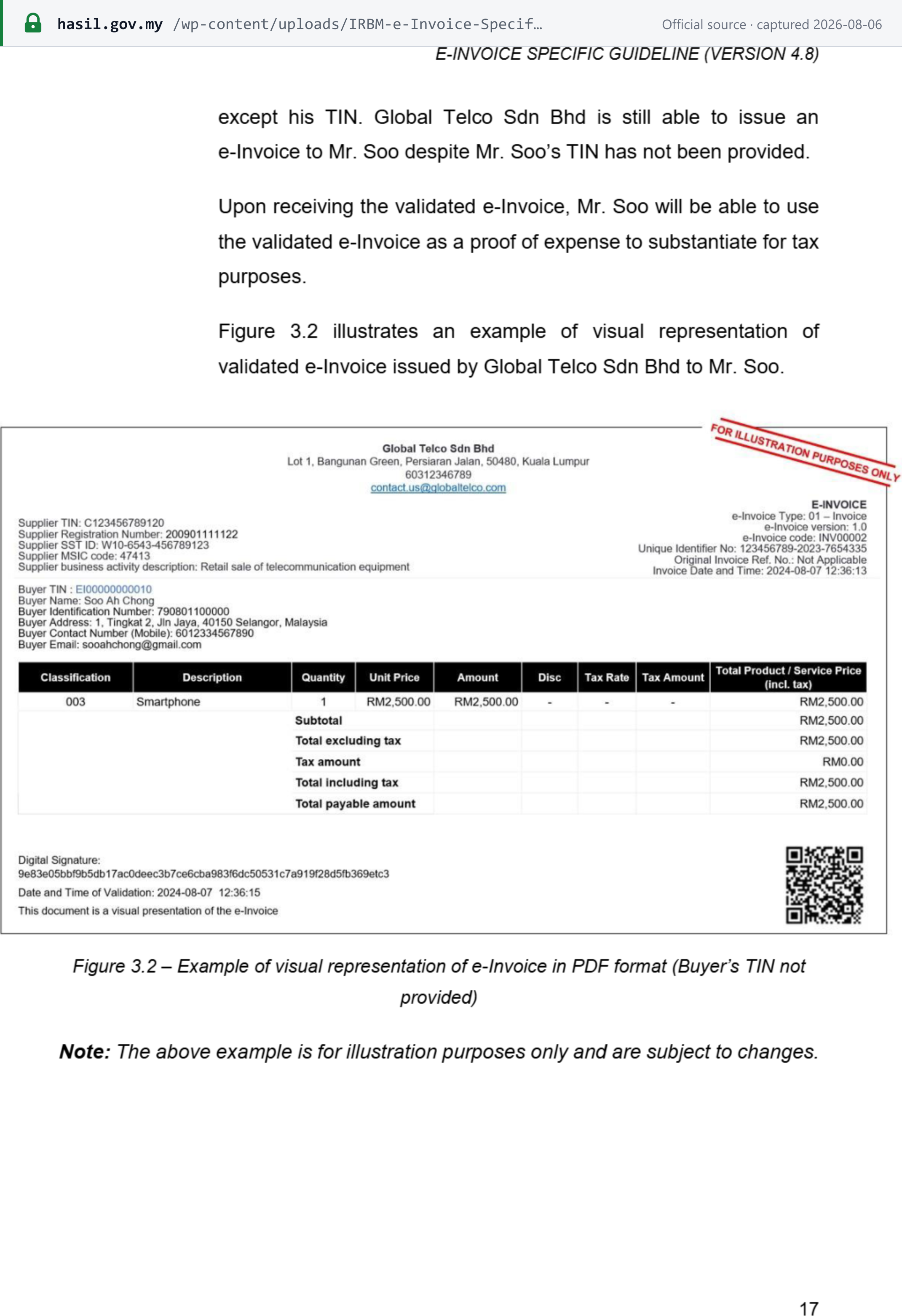
What a validated e-Invoice looks like
Once IRBM validates a submission it returns a visual representation of the validated e-Invoice as a PDF, and the IRBM e-Invoice Specific Guideline (now Version 4.9, 7 September 2026) reproduces one. It carries the supplier block (TIN, registration number, SST ID, MSIC code and business-activity description), the buyer block, the e-Invoice metadata (type, version, code, Unique Identifier No., original invoice reference, date and time), a line-item table ending in the total payable amount, and — at the foot — the digital signature, the date and time of validation, and a QR code that resolves the invoice's status on the MyInvois Portal. [2]
IRBM stamps the example "for illustration purposes only". Malaysia mandates the UBL 2.1 data structure, not a visual layout — the picture shows what the data looks like once rendered, not a form to copy. [2]
 Source snapshot captured 2026-08-06 — original
If you are outside the mandate
The RM3 million exemption and the phase-in dates in E-invoicing status below determine whether MyInvois applies to you at all. A business below the threshold, or still inside its relaxation period, is not thereby free of invoicing obligations — SST invoicing sits with RMCD under the Sales Tax Act 2018 and Service Tax Act 2018, entirely separately from IRBM's income-tax-based e-invoice mandate. Being outside MyInvois says nothing about your SST position.
IRBM's interim relaxation lets a taxpayer put any description in the "Description of Product or Service" field and issue a consolidated e-invoice for all activity. That concession ends with the relaxation period — for taxpayers up to RM5 million turnover, on 31 December 2027. Systems built against the relaxed behaviour will fail validation afterwards. [2]
E-invoicing status — MyInvois
E-invoicing in Malaysia is run by the Inland Revenue Board of Malaysia (IRBM/LHDN), not by RMCD, through the MyInvois platform at myinvois.hasil.gov.my. It is a clearance model: the supplier creates an e-invoice and submits it to IRBM for validation before it is shared with the buyer. E-invoices can be submitted through the MyInvois Portal or by API. [1] The Malaysia e-invoicing guide covers MyInvois in full: scope, general TINs, the 72-hour rejection and cancellation window, consolidation, self-billing, onboarding and penalties.
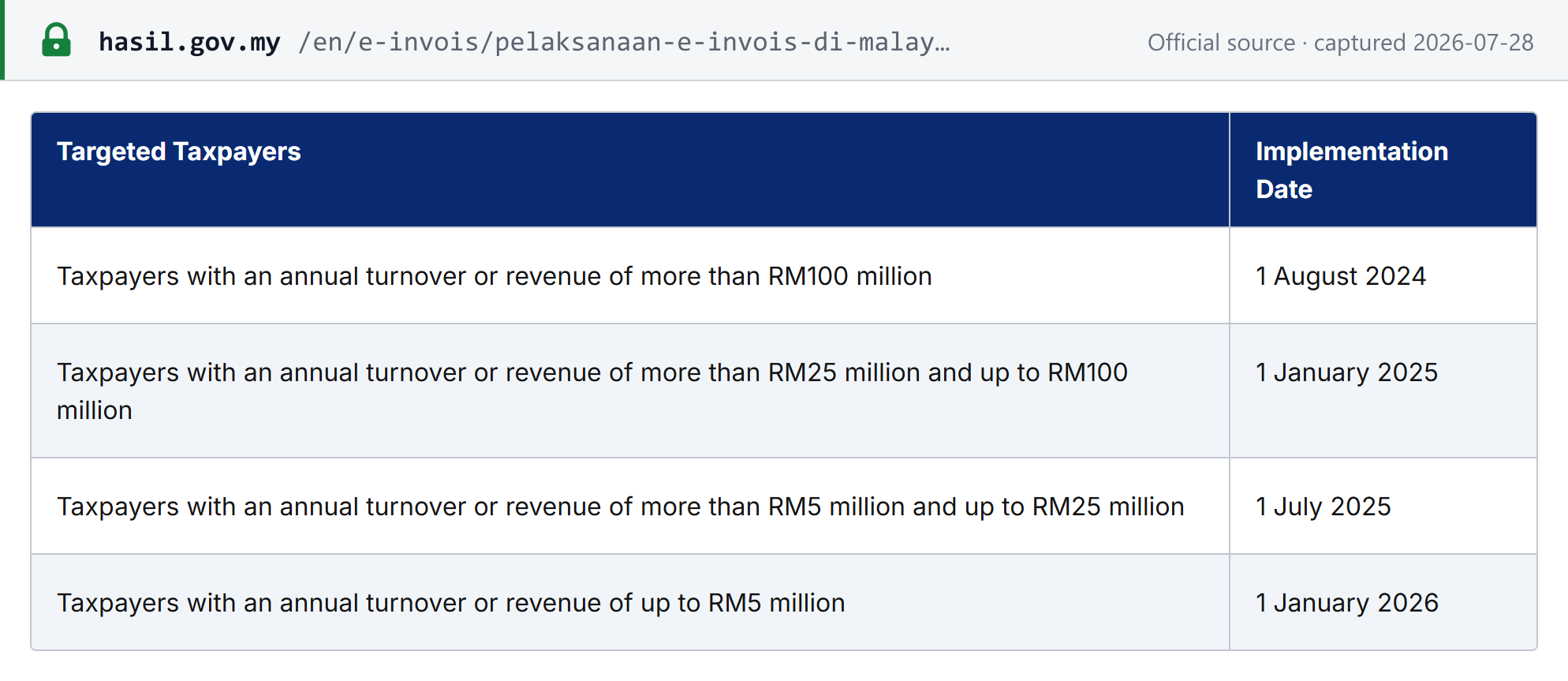
The mandatory implementation timeline is set by annual turnover or revenue, measured on the financial year 2022 audited accounts (or the year of assessment 2022 tax return where there are no audited accounts). Once a taxpayer's date is fixed, later changes in turnover do not move it. [1]
| Targeted taxpayers | Mandatory implementation date | Interim relaxation period |
|---|---|---|
| Annual turnover or revenue more than RM100 million | 1 August 2024 | 1 August 2024 to 31 January 2025 |
| More than RM25 million and up to RM100 million | 1 January 2025 | 1 January 2025 to 30 June 2025 |
| More than RM5 million and up to RM25 million | 1 July 2025 | 1 July 2025 to 31 December 2025 |
| Up to RM5 million | 1 January 2026 | Until 31 December 2027 |
| New businesses commencing 2023–2025 with annual turnover of at least RM3,000,000 (amended by Version 4.8 from RM1,000,000) | 1 July 2026 | Until 31 December 2027, but only for those within the up-to-RM5-million band — the 2023–2025 trigger itself has no upper bound |
| New businesses commencing from 2026 onwards | 1 July 2026 or upon the operation commencement date — but 1 January in the second year following the year turnover reaches RM3,000,000, if first-year turnover or revenue is expected to be less than RM3,000,000 | — |
Sources: IRBM e-Invoice Guideline Version 4.8 (Table 1.1), published 30 August 2026 and replacing Version 4.7 of 7 July 2026, and e-Invoice Specific Guideline Version 4.9 (Table 16.1), published 7 September 2026 and replacing Version 4.8 of 7 July 2026. [1] [2]
 Source snapshot captured 2026-07-28 — original
Three points do most of the work in practice:
- New businesses commencing from 2026 onwards. Paragraph 1.5 of the e-Invoice Guideline (also amended by Version 4.8) sets the implementation date for these businesses at 1 July 2026 or upon the operation commencement date — except where first-year turnover or revenue is expected to be less than RM3,000,000, in which case the date becomes 1 January in the second year following the year in which turnover reaches RM3,000,000.
- The RM3 million exemption. Under Section 1.6.1(e) of the e-Invoice Guideline (Version 4.8, published 30 August 2026, replacing Version 4.7 of 7 July 2026), taxpayers with an annual turnover or revenue of less than RM3,000,000 are exempted from issuing e-invoices, including self-billed e-invoices — raised from the previous RM1,000,000 threshold. A separate provision added by Version 4.8, Section 1.6.10, disapplies that exemption where the taxpayer has a non-individual shareholder, holding company, related company or joint venture with annual turnover or revenue of at least RM3,000,000 — the group must be checked before standing any implementation down on the strength of the exemption. "Related company" for this purpose is defined by reference to section 2 of the Promotion of Investments Act 1986. Other exempted persons are foreign diplomatic offices, individuals not conducting business, and certain statutory bodies and international organisations for transactions before 1 July 2025. Suppliers to exempted persons must still issue e-invoices themselves. [1]
- The relaxation period is not a deferral of the mandate. During the interim relaxation period a taxpayer may issue a consolidated e-invoice (and consolidated self-billed e-invoice) for all activities, may put any description in the "Description of Product or Service" field, and may decline a buyer's request for an individual e-invoice. IRBM will not take prosecution action under section 120 of the Income Tax Act 1967 for e-invoice non-compliance during the period, provided the consolidated-invoice conditions are met. For taxpayers with turnover up to RM5 million this runs until 31 December 2027. [2]
Note the split of authority: MyInvois is an income tax obligation issued under section 134A of the Income Tax Act 1967, while SST registration, rates and returns sit with RMCD. Being outside the MyInvois mandate says nothing about SST liability, and vice versa. [1]
e-Invoice Special Voluntary Disclosure Programme (PKPS e-Invois)
HASiL launched the e-Invoice Special Voluntary Disclosure Programme (Program Khas Pengakuan Sukarela e-Invois, "PKPS e-Invois"), effective 7 July 2026 to 31 December 2027. [3] It is open to taxpayers who:
- implemented e-Invoice on their mandated timeline but did not fully submit e-Invoices for certain transactions;
- submitted e-Invoices containing errors or information that does not comply with the prescribed specifications and requirements;
- have not submitted any e-Invoices for any period or transaction since their mandatory implementation date; or
- are currently undergoing, or have been notified they will undergo, an e-Invoice compliance review. [2]
Voluntary correction or disclosure made in good faith through MyInvois inside the window carries no penalty: IRBM will not undertake compliance-review or enforcement action — including imposing penalties or prosecution — in relation to e-Invoices disclosed under the SVDP, unless the disclosure itself fails to meet the prescribed specifications or involves fraud, wilful default or negligence. Participating taxpayers must submit under the dedicated "SVDP 1.2" (no digital signature) or "SVDP 1.3" (digital signature) e-Invoice versions, and consolidated e-Invoices must be submitted by the actual month of transaction rather than aggregated across multiple months. [2]
As an incentive for full e-Invoice compliance, the government also agreed to allow accelerated capital allowance claims — a full claim within one year — for ICT equipment and software development or modification costs incurred for e-Invoice implementation. [3]
The programme is documented in the HASiL media statement of 7 July 2026 and, in full procedural detail, in section 17 of the e-Invoice Specific Guideline, now Version 4.9 (published 7 September 2026, replacing Version 4.8 of 7 July 2026 — see Invoice requirements — Data fields and document types for what else Version 4.9 changed). Note this is a separate document from the general e-Invoice Guideline, which was itself updated to Version 4.8 on 30 August 2026 (see E-invoicing status). [3] [2]
To check the TIN of a counterparty before relying on its SVDP submissions, use our Malaysia TIN validator.
Recent changes
- 2026-09-25 — P.U.(A) 337/2026, made 18 September 2026, amends item 3 of the Schedule to the Service Tax (Imposition of Tax for Taxable Services in respect of Designated Areas and Special Areas) Order 2018 [P.U.(A) 212/2018] so that the taxable service in special areas (Labuan, Langkawi, Tioman) is the provision of accommodation premises excluding accommodation provided by an employer as a facility to its employees — see Exemptions. (Royal Malaysian Customs Department) — see the event record and the issue
- 2026-09-07 — IRBM published e-Invoice Specific Guideline Version 4.9, replacing Version 4.8 of 7 July 2026: for a buyer who is a non-Malaysian individual (other than a MyPR or MyKAS holder), the buyer provides either an IRBM TIN, or both TIN and passport number; where only a passport is given, the supplier uses EI00000000020 with the passport number — an amendment and clarification in Specific Guideline v4.9; the same rule applies to self-billed e-invoices for individual suppliers — see Invoice requirements. (Inland Revenue Board of Malaysia) — see the event record and the issue
- 2026-09-21 — RMCD's General Ruling (Ketetapan Umum) No. 6/2026 takes effect, prescribing the forms, statements, registration/refund/drawback applications and payment methods under the Tourism Tax Act 2017, Sales Tax Act 2018 and Service Tax Act 2018, and revoking and replacing General Ruling No. 1/2025 (18 August 2025) — see Tax IDs and SST registration. (Jabatan Kastam Diraja Malaysia) — see issue
- 2026-09-01 — P.U.(A) 303/2026, gazetted 28 August 2026, inserts new items 5, 6 and 7 into Schedule B of the Sales Tax (Persons Exempted From Payment Of Tax) Order 2018, exempting manufacturers approved by the Director General from sales tax on Minister-approved goods solely used in the manufacture of animal feed, fertilizer and pesticide products; the exemption certificate is signed by the manufacturer itself (corrects an earlier report that had the Director General and Minister of Finance roles reversed) — see Exemptions. (Attorney General's Chambers, Malaysia) — see the event record and the issue
- 2026-09-08 — RMCD Service Tax Policy No. 5/2026 exempts Group L (construction work) service tax registrants from charging and collecting service tax on construction work services for offshore and onshore facilities and ship-to-floating-structure conversion services provided to clients outside Malaysia, with effect from 1 July 2025 until the project is completed or the contract expires; no refund for service tax already paid. (Royal Malaysian Customs Department) — see the event record and the issue
- 2026-08-30 — IRBM published e-Invoice Guideline Version 4.8, replacing Version 4.7 of 7 July 2026. Section 1.6.1(e) raises the e-Invoice exemption threshold from RM1,000,000 to RM3,000,000 annual turnover or revenue; a new Section 1.6.10 disapplies that exemption where a non-individual shareholder, holding company, related company or joint venture has annual turnover or revenue of at least RM3,000,000. Version 4.8 also amended paragraph 1.5: new businesses commencing 2023–2025 now use the RM3,000,000 (not RM1,000,000) trigger for the 1 July 2026 implementation date, and a new arm sets the date for businesses commencing from 2026 onwards. (Inland Revenue Board of Malaysia) — see the event record and the issue
- 2026-08-18 — RMCD Service Tax Policy No. 5/2025 (Amendment No. 4), dated 17 August 2026 and published on the MySST portal, adds a new Item 5 to the Private Healthcare Services policy: service tax exemption for newborns who have not yet obtained citizenship status, conditional on at least one parent being a citizen with valid National Registration Department identification and on documentation being produced at registration. The amendment is effective 1 July 2025, the SST expansion commencement date, so it applies to the whole period the expanded scope has been in force. Note that refunds are not implied: Item 2(c) of the same policy expressly denies refunds to a private healthcare facility that imposed and remitted service tax during a comparable backdated exemption period, and Items 1(b) and 3(b) require any service tax already collected to be remitted to RMCD regardless of the exemption. (Royal Malaysian Customs Department) — see the event record and the issue
- 2026-08-01 — P.U.(A) 281, gazetted 31 July 2026, deleted tariff headings 89.01, 89.05, 89.06, 89.07 and 89.08 (ships, tankers, refrigerated and cargo vessels, light-vessels, floating docks and other floating structures) from the taxable Sales Tax (Rate of Sales Tax) Order 2025. The companion P.U.(A) 276, gazetted the same day, inserted new headings 89.04 (tugs and pusher craft), 89.05, 89.07 and 89.08 into the Sales Tax (Goods Exempted From Sales Tax) Order 2025, and added subheadings for 89.01 and 89.06, which were already listed there. Heading 89.03 (yachts/pleasure craft) was not deleted from the rate schedule, but P.U.(A) 276 substituted its entry in the exempted-goods schedule — the net position for 89.03 is unresolved pending the consolidated order; see Exemptions. (Royal Malaysian Customs Department, via MySST) — see issue
- 2026-07-22 — RMCD Service Tax Policy No. 2/2025 (Amendment No. 5) revokes and replaces Amendments No. 1–4 and confirms the service tax rate on rental or leasing services (Group K) is 6% from 1 January 2026, following the gazetting of P.U.(A) 125, the Service Tax (Rate of Tax) (Amendment) Order 2026, on 13 March 2026, which revoked the interim 2% rate exemption; Appendix B sets the refund route for overpaid tax, and a new Item 9 exempts newly established MSME tenants for one year from their SSM registration date. (Royal Malaysian Customs Department) — see issue
- 2026-07-22 — RMCD Service Tax Policy No. 4/2026 provides that persons jointly supplying rental or leasing services under a single agreement are treated as separate entities, register individually on their own threshold value and invoice their own portion; where one undivided invoice is issued in a single party's name, that party carries the registration obligation. Effective 1 July 2025. (Royal Malaysian Customs Department) — see issue
- 2026-07-07 — HASiL launches the e-Invoice Special Voluntary Disclosure Programme (PKPS e-Invois), effective 7 July 2026 to 31 December 2027, allowing taxpayers to correct or disclose missed, incomplete or non-compliant e-Invoices through MyInvois with no penalty; the government also agreed to accelerated capital allowance claims (full claim within one year) for ICT equipment and e-Invoice software costs. (Inland Revenue Board of Malaysia) — see issue
- 2026-07-01 — RMCD Service Tax Policy No. 1/2025 (Amendment No. 5) adds Item 14 exempting fees and commissions on Transactional Investment Account-i (TIA-i) operations from 1 June 2026 (no refund for 1 July 2025 to 31 May 2026), and confirms the non-reviewable-contract exemption for Group H financial services ran only to 30 June 2026 — services provided on or after 1 July 2026 are taxable. (Royal Malaysian Customs Department) — see issue
- 2026-06-24 — RMCD Service Tax Policy No. 3/2026 provides that maintenance charges and sinking fund contributions charged by a Joint Management Body (JMB) or Management Corporation (MC) to property owners are not subject to service tax, for both residential and non-residential buildings; for non-residential premises this is granted as a section 34(3)(a) exemption effective 1 July 2026 until the Service Tax Regulations 2018 amendment is gazetted, with no exemption for periods before that date. (Royal Malaysian Customs Department) — see issue
- 2026-06-18 — RMCD Service Tax Policy No. 2/2026 exempts construction work services carried out on completed residential buildings (Group L) from service tax with effect from 1 July 2025, subject to documentary conditions; providers that had charged and remitted the tax could claim a refund if the claim was submitted on or before 30 June 2026. (Royal Malaysian Customs Department) — see issue
Reference links
- MySST — Royal Malaysian Customs Department SST portal
- RMCD — Understanding SST
- RMCD — Service Tax FAQ (rates)
- RMCD — Sales Tax FAQ (rates and threshold)
- RMCD — SST Orders (P.U.(A) instruments)
- P.U.(A) 281 — Sales Tax (Rate Of Sales Tax) (Amendment) Order 2026, via MySST's official R2 distribution
- P.U.(A) 276 — Sales Tax (Goods Exempted From Sales Tax) (Amendment) Order 2026, via MySST's official R2 distribution
- RMCD — Service Tax Policies index
- RMCD — Guide on Financial Services (Version 2, 24 October 2025)
- RMCD — Guide on Construction Work Services (17 March 2026)
- IRBM — e-Invoice Guideline (Version 4.8, 30 August 2026)
- IRBM — e-Invoice Specific Guideline (Version 4.9, 7 September 2026, replacing Version 4.8 of 7 July 2026)
- IRBM — e-Invoice general FAQs
- HASiL — Media statement: e-Invoice Special Voluntary Disclosure Programme (PKPS e-Invois), 7 July 2026
- RMCD — Service Tax Policy No. 5/2025 (Private Healthcare) (Amendment No. 4), 17 August 2026
- RMCD — Service Tax Policy No. 5/2026 (Offshore/Onshore Construction and Ship Conversion), 8 September 2026
- JKDM — General Ruling (Ketetapan Umum) No. 6/2026, effective 21 September 2026
- Attorney General's Chambers, Malaysia — P.U.(A) 303/2026, Sales Tax (Persons Exempted From Payment Of Tax) (Amendment) (No. 2) Order 2026
- Royal Malaysian Customs Department — P.U.(A) 337/2026, Service Tax (Imposition of Tax for Taxable Services in respect of Designated Areas and Special Areas) (Amendment) Order 2026
Frequently Asked Questions
Is Malaysia's SST a VAT? Can I claim back the SST charged by my suppliers?
No. Malaysia repealed GST in 2018 and runs Sales Tax and Service Tax under the Sales Tax Act 2018 and the Service Tax Act 2018, both effective 1 September 2018. Sales tax is a single-stage tax on imported and locally manufactured goods, charged at importation or when the registered manufacturer sells the goods; service tax is charged on prescribed taxable services provided in Malaysia and on imported taxable services. Neither carries a VAT-style input tax credit — SST paid on business purchases is a cost. Relief is delivered instead through sales tax exemption schedules, B2B exemptions, group relief and Ministerial exemptions under section 34 of the Service Tax Act 2018, each with its own conditions. [1] [2]
What service tax rate applies to rental or leasing services in Malaysia, and what happened to the 2% exemption?
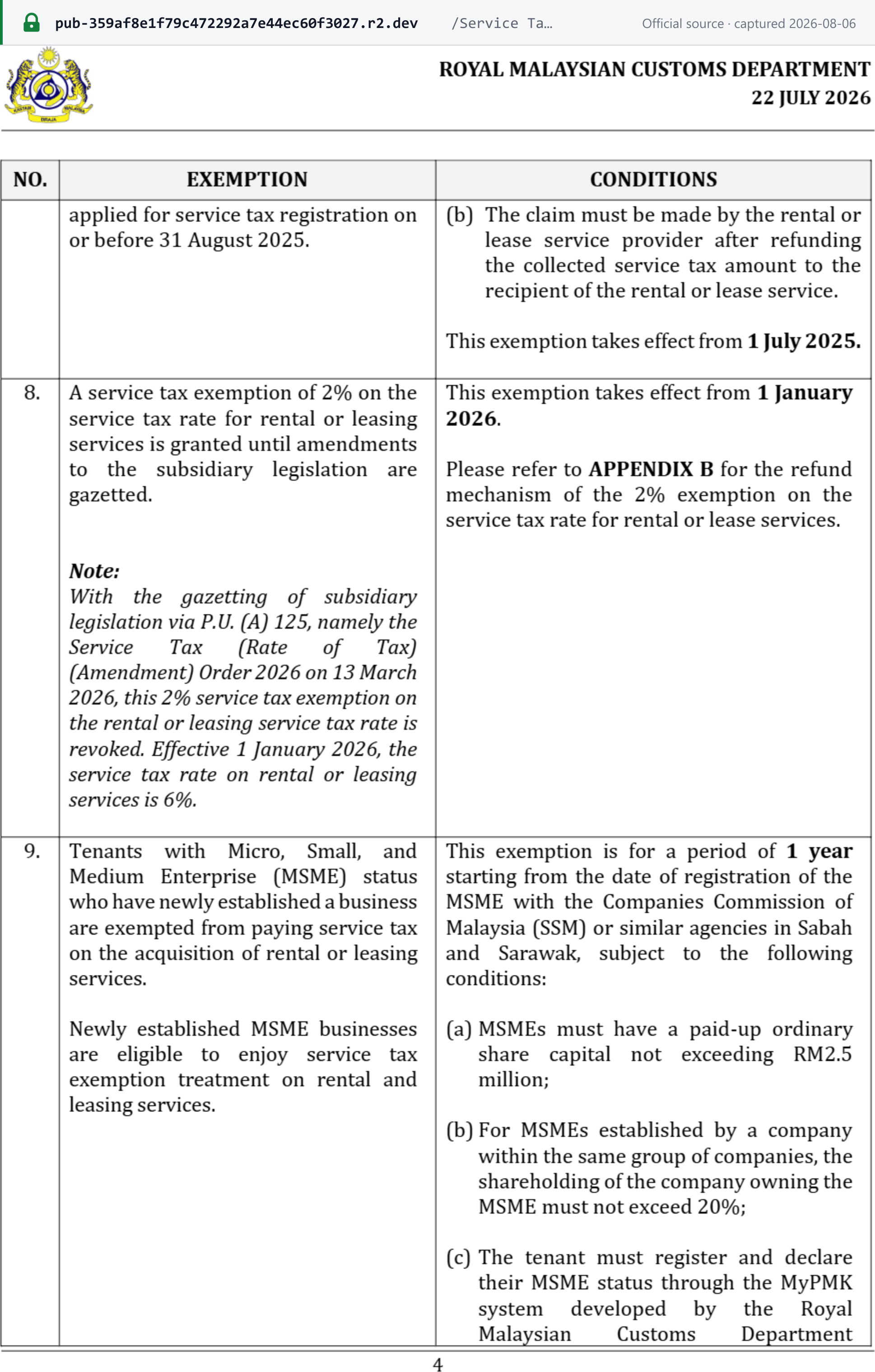
Rental or leasing services (Group K, First Schedule, Service Tax Regulations 2018) became taxable on 1 July 2025 at 8%, and the rate is 6% from 1 January 2026. An interim 2% exemption on the rate had been granted pending subsidiary legislation; the gazetting of P.U.(A) 125, the Service Tax (Rate of Tax) (Amendment) Order 2026, on 13 March 2026 revoked that exemption and fixed the rate at 6% from 1 January 2026. Providers who overpaid can claim a refund under subsection 38(1)(b) of the Service Tax Act 2018 by lodging, with the controlling station, an official application letter, RMCD Form No. 2, the SST listing for the relevant taxable period, the rental agreement showing supply on or after 1 January 2026, the invoice, and proof that the tax was refunded to the tenant. [1] [2]
 Source snapshot captured 2026-07-28 — original
Two of us jointly rent out a property under one tenancy agreement — do we test the RM1 million threshold together?
This RM1 million figure is the Group K service tax registration threshold under the Service Tax Regulations 2018, administered by RMCD — a separate, unrelated figure from the RM3 million IRBM e-invoice exemption threshold discussed below.
No. Under Service Tax Policy No. 4/2026 (22 July 2026, effective from 1 July 2025), persons who jointly provide rental or leasing services under a single agreement are treated as separate entities: each registers individually on its own total taxable services, and each issues an invoice for its own portion or breakdown of the rental value. The exception is a supply made as a whole under one agreement through a single invoice with no breakdown issued in the name of one party — for example a joint venture or a representative. That party is then treated as the rental or leasing service provider and is liable for registration once the threshold value is met. The Group K threshold is RM1 million over 12 months. [1] [2]
What changed for Malaysian financial services on 1 June and 1 July 2026?
Two things, both in Service Tax Policy No. 1/2025 (Amendment No. 5), dated 1 July 2026. First, a new Item 14 exempts fees and commissions charged on the operation of a Transactional Investment Account-i (TIA-i) from 1 June 2026 — covering cash deposits and withdrawals, payments and fund transfers, debit card issuance, basic counter and ATM transactions, and statement printing — with no refund for service tax paid for the period 1 July 2025 to 31 May 2026. Second, the non-reviewable contract exemption in Group H ran only from 1 July 2025 to 30 June 2026, so financial services provided under such contracts on or after 1 July 2026 are subject to service tax. [1]
When must a Malaysian business start issuing MyInvois e-invoices, and what if turnover is under RM3 million?
The IRBM e-Invoice Guideline (Version 4.8, published 30 August 2026, replacing Version 4.7 of 7 July 2026) sets four mandatory dates by annual turnover or revenue, measured on the FY2022 audited accounts or the YA2022 tax return: more than RM100 million from 1 August 2024; more than RM25 million and up to RM100 million from 1 January 2025; more than RM5 million and up to RM25 million from 1 July 2025; and up to RM5 million from 1 January 2026. New businesses that commenced operations between 2023 and 2025 with annual turnover of at least RM3,000,000 (amended by Version 4.8 from RM1,000,000) have an implementation date of 1 July 2026. For businesses commencing from 2026 onwards, the implementation date is 1 July 2026 or upon the operation commencement date — except where first-year turnover or revenue is expected to be less than RM3,000,000, in which case the date becomes 1 January in the second year following the year turnover reaches RM3,000,000. Under Section 1.6.1(e) of Version 4.8, taxpayers with annual turnover or revenue of less than RM3,000,000 are exempted from issuing e-invoices, including self-billed e-invoices — raised from the previous RM1,000,000 threshold. A separate provision added by Version 4.8, Section 1.6.10, disapplies that exemption where the taxpayer has a non-individual shareholder, holding company, related company (defined by reference to section 2 of the Promotion of Investments Act 1986) or joint venture with annual turnover or revenue of at least RM3,000,000 — check the group before standing any implementation down. Under Table 16.1 of the e-Invoice Specific Guideline (Version 4.9, published 7 September 2026, replacing Version 4.8 of 7 July 2026), taxpayers in the up-to-RM5-million band — both the 1 January 2026 and the 1 July 2026 dates — have an interim relaxation period until 31 December 2027, during which consolidated e-invoices are allowed and IRBM will not take prosecution action under section 120 of the Income Tax Act 1967 for e-invoice non-compliance, provided the consolidated-invoice conditions are met. [1] [2]
My e-invoice buyer is a foreign individual, not a Malaysian citizen or resident — what identifier goes on the invoice now?
IRBM's e-Invoice Specific Guideline Version 4.9, published 7 September 2026 and replacing Version 4.8 of 7 July 2026, sets this out in paragraph 3.5.4(b), which it classes as an amendment and clarification. A buyer who is a non-Malaysian individual (other than a MyPR or MyKAS holder) provides either an IRBM TIN, or both the TIN and passport number. Where the buyer has no TIN and gives only a passport number, the supplier uses the general TIN EI00000000020 (the Foreign Buyer's TIN in Appendix 1) together with the passport number. The same rule applies to a self-billed e-invoice issued for an individual supplier. [1]
I missed some MyInvois e-invoices, or submitted ones with errors — can I fix this without a penalty?
Yes, if you act during the e-Invoice Special Voluntary Disclosure Programme (Program Khas Pengakuan Sukarela e-Invois, "PKPS e-Invois"), which HASiL launched effective 7 July 2026 to 31 December 2027. It is open to taxpayers who implemented e-Invoice on their mandated timeline but did not fully submit e-Invoices for certain transactions; who submitted e-Invoices containing errors or non-compliant information; who have not submitted any e-Invoices at all since their mandatory commencement date; or who are currently undergoing, or have been notified of, an e-Invoice compliance review. Voluntary disclosures made in good faith through MyInvois during the window are accepted with no penalty — IRBM will not take compliance-review or enforcement action, including penalties or prosecution, in relation to disclosed e-Invoices, unless the disclosure itself is non-compliant or involves fraud, wilful default or negligence. Participating taxpayers submit under the dedicated "SVDP 1.2" or "SVDP 1.3" e-Invoice versions, and must submit consolidated e-Invoices by the actual month of transaction rather than lumped together. As an incentive for full compliance, the government also agreed to allow accelerated capital allowance claims — a full claim within one year — for ICT equipment and software development or modification costs incurred for e-Invoice implementation. [1] [2]
Is Malaysian service tax exempt on construction work for offshore and onshore facilities supplied to overseas clients?
Yes, under conditions, and retroactively. RMCD Service Tax Policy No. 5/2026, dated 8 September 2026, exempts Group L (construction work) service tax registrants under paragraph 34(3)(a) and subsection 34(4) of the Service Tax Act 2018 from charging and collecting service tax on construction work services for offshore and onshore facilities, and on ship-to-floating-structure conversion services, where the client is outside Malaysia. The exemption applies with effect from 1 July 2025 until the project is completed or the contract expires — more than a year before the policy's own publication date. Conditions: the provider is a Group L service tax registrant; the contract is in writing, signed with the overseas client, and stamped with stamp duty by LHDN; every invoice carries the prescribed exemption statement referencing Service Tax Policy No. 5/2026; and the recipient is a client, entity or company not established in Malaysia. No refund is given for service tax already charged and remitted before the exemption is relied on. [1]
Is sales tax now exempt on ships and other vessels in Malaysia, including yachts?
For commercial vessels, yes, from 1 August 2026. P.U.(A) 281, the Sales Tax (Rate Of Sales Tax) (Amendment) Order 2026, gazetted 31 July 2026, deletes tariff headings 89.01, 89.05, 89.06, 89.07 and 89.08 (ships, tankers, refrigerated and cargo vessels, light-vessels, floating docks, other floating structures and vessels for breaking up) from the taxable First Schedule. The companion P.U.(A) 276, gazetted the same day, inserts new headings 89.04 (tugs and pusher craft), 89.05, 89.07 and 89.08 into the Sales Tax (Goods Exempted From Sales Tax) Order 2025, and inserts additional subheadings for 89.01 and 89.06, which were already listed in that Order. Both instruments took effect 1 August 2026. Heading 89.03 — yachts and other vessels for pleasure or sport, rowing boats and canoes — was not deleted from the taxable rate schedule by P.U.(A) 281, but P.U.(A) 276 substitutes 89.03's entry in the exempted-goods schedule with a full set of yacht subheadings. Whether 89.03 is taxable or exempt from 1 August 2026 cannot be resolved from these two orders alone — that depends on the consolidated Sales Tax (Goods Exempted From Sales Tax) Order 2025 [P.U.(A) 171/2025], which is not published on mysst.customs.gov.my. See Exemptions. [1] [2]