Estonia VAT guidelines
| FACTSHEET | |
|---|---|
| Country code | EE |
| Tax name | Value Added Tax — Käibemaks |
| Tax Authority | Estonian Tax and Customs Board — Maksu- ja Tolliamet (MTA, EMTA) |
Overview
Estonia levies Value Added Tax — in Estonian käibemaks — under the Value-Added Tax Act (Käibemaksuseadus, KMS). The tax falls on supplies of goods and services in Estonia by taxable persons, on intra-Community acquisitions of goods and on imports. A VAT payer is a käibemaksukohustuslane, and its VAT number is its KMKR number. The Tax and Customs Board defines a taxable person as "a person who is engaged in business (a natural or legal person, both resident and non-resident) … and is registered or required to register as a taxable person (§ 19)". [1] [3]
Authority. VAT, including import VAT, is administered by the Estonian Tax and Customs Board (Maksu- ja Tolliamet), Lõõtsa 8a, 15176 Tallinn. Foreign businesses are registered centrally by its Tallinn service bureau; other bureaus accept their applications and forward them. Tax policy belongs to the Ministry of Finance (Rahandusministeerium). [5]
Currency. All amounts in this guide are in euros (EUR). Whatever the invoice currency, the VAT amount must be stated in euros: "The amount of value added tax is indicated in euros" (KMS § 37(7) clause 10). [1]
Tax period. "The tax period is one calendar month" (KMS § 27(1)). The Tax and Customs Board may set a longer period on a reasoned request (§ 27(4)); a Government bill now in the Riigikogu would remove that option — see Filing and payment. [1]
Layering. VAT is a single national tax under one act and one administration. There is no regional or municipal VAT; local taxes that Estonian municipalities may levy, such as advertising tax, are not turnover taxes.
Registration
Who should register
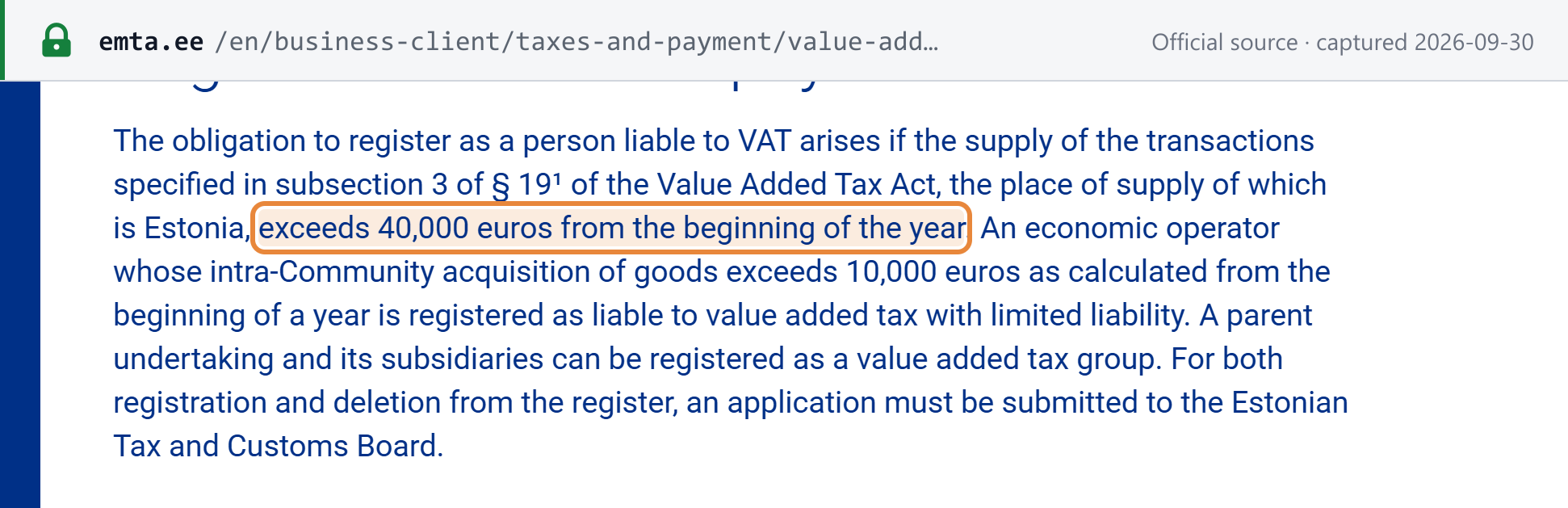
A business must register once its supply with its place of supply in Estonia exceeds EUR 40,000 since the beginning of the calendar year. The obligation arises on the day the threshold is passed, and the application is due within three working days (KMS §§ 19(1), 20(1)). [1]
"In case the supply of a person for a calendar year … where the place of supply is Estonia, exceeds 40,000 euros as of the beginning of the calendar year, an obligation arises for the person to register as a taxable person as of the day on which the specified amount of supply is created." (KMS § 19(1))
- What counts, since 1 January 2025. Taxable supplies of goods and services, including 0% supplies but excluding transfers of fixed assets, plus real-estate transactions, insurance and financial services unless they are occasional (§ 19¹(3)). Only supply whose place of supply is Estonia counts. [4]
- Exempt-only businesses. No obligation arises where all supply is exempt or 0%-rated, except intra-Community supplies of goods. The Tax and Customs Board's example: a company with EUR 42,000 of supply made only by renting out dwellings need not register; one with EUR 38,000 of dwelling rent plus EUR 2,500 of taxable training must. [4]
- Late registration. The Tax and Customs Board registers a person who fails to apply on its own initiative, from the date the obligation arose (§ 20(10)). [1]
Limited-liability registration. An Estonian business below the threshold that buys services from foreign suppliers, or whose intra-Community acquisitions of goods exceed EUR 10,000 in a calendar year, registers as a taxable person with limited liability (piiratud maksukohustuslane). It self-assesses VAT on those purchases only and files a VAT return without the invoice annex (§ 21). [3] [18]
Non-resident registration
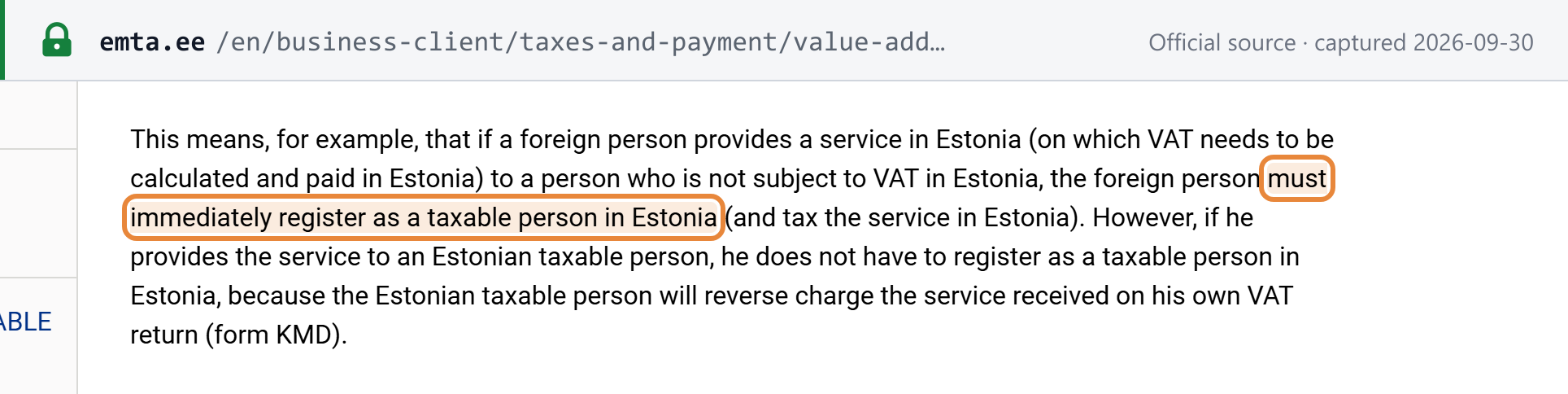
The EUR 40,000 threshold does not protect a non-established seller. A foreign business with no permanent establishment in Estonia must register from the first taxable supply in Estonia that is not taxed by an Estonian VAT-registered customer. The Tax and Customs Board:
"…if a foreign person provides a service in Estonia (on which VAT needs to be calculated and paid in Estonia) to a person who is not subject to VAT in Estonia, the foreign person must immediately register as a taxable person in Estonia (and tax the service in Estonia). However, if he provides the service to an Estonian taxable person, he does not have to register as a taxable person in Estonia, because the Estonian taxable person will reverse charge the service received on his own VAT return (form KMD)." [5]
| Where the seller is established | Registration trigger in Estonia |
|---|---|
| Outside the EU | First taxable supply not reverse-charged by an Estonian taxable customer (in practice, the first B2C sale), unless declared through the non-Union OSS or IOSS |
| Another EU member state | Same rule for local supplies; intra-Community distance sales and telecom, broadcasting and electronic services to Estonian consumers above EUR 10,000 a calendar year (EU-wide) create an obligation unless declared through the Union OSS (§ 19(4)) |
| Estonia | EUR 40,000 of Estonian supply since the start of the calendar year (§ 19(1)) |
No registration is needed where all supplies are 0%-rated (other than intra-Community supplies of goods and supplies to a deemed-supplier marketplace), or where they go through an OSS or IOSS registration in another member state. [5] [1]
EU cross-border SME scheme. Since 1 January 2025 a business established in another member state may use Estonia's small-business exemption if its EU-wide supply is not over EUR 100,000 in the current and the previous calendar year, its Estonian supply stays within EUR 40,000, and it holds a registration number with the suffix "EX" from its home authority (§ 19(1¹)). See Lookuptax's EU VAT SME scheme guide. [1]
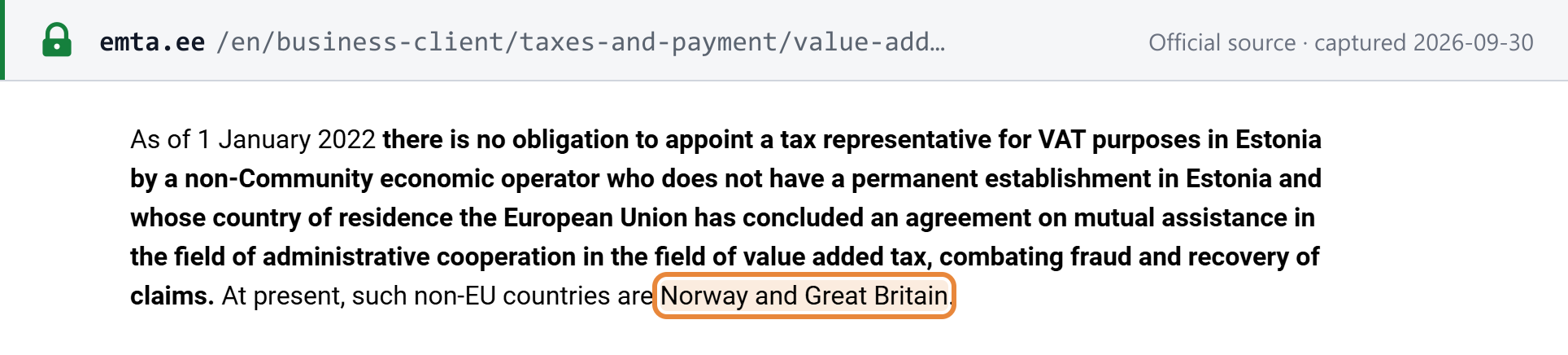
Tax representative. A business established in another EU member state may appoint an approved tax representative. A non-EU business without a permanent establishment must appoint one on registration — "A third-country person engaged in business who does not have a permanent business establishment in Estonia must, upon registration as a taxable person, appoint a tax representative specified in the Taxation Act who has been approved by the tax authority" — unless its country of residence has an EU agreement on mutual assistance in VAT; the Tax and Customs Board names those countries: "At present, such non-EU countries are Norway and Great Britain." A non-Union OSS user does not appoint one either. [5]
Tax identification number
A VAT-registered business receives a KMKR number (käibemaksukohustuslase registrinumber), which carries the EE prefix when quoted for EU trade; a legal person also holds an 8-digit registry code (registrikood) from the Commercial Register. The number's structure, and what is publicly documented about its check digit, is covered on Lookuptax's Estonia tax ID guide rather than repeated here.
To check a number, use Lookuptax's Estonia KMKR validator, the Tax and Customs Board's KMKR number search, or the EU's VIES service — see how to verify an EU VAT number in VIES and Lookuptax's VAT number checker. [3]
How to register
- Where. In the e-services environment e-MTA: "You can register as a person liable to VAT or delete yourself from the register of taxable persons in the e-services environment e-MTA." Applications can also go through the e-Business Register with a digital signature, through a notary, or to a service bureau. [3] [6]
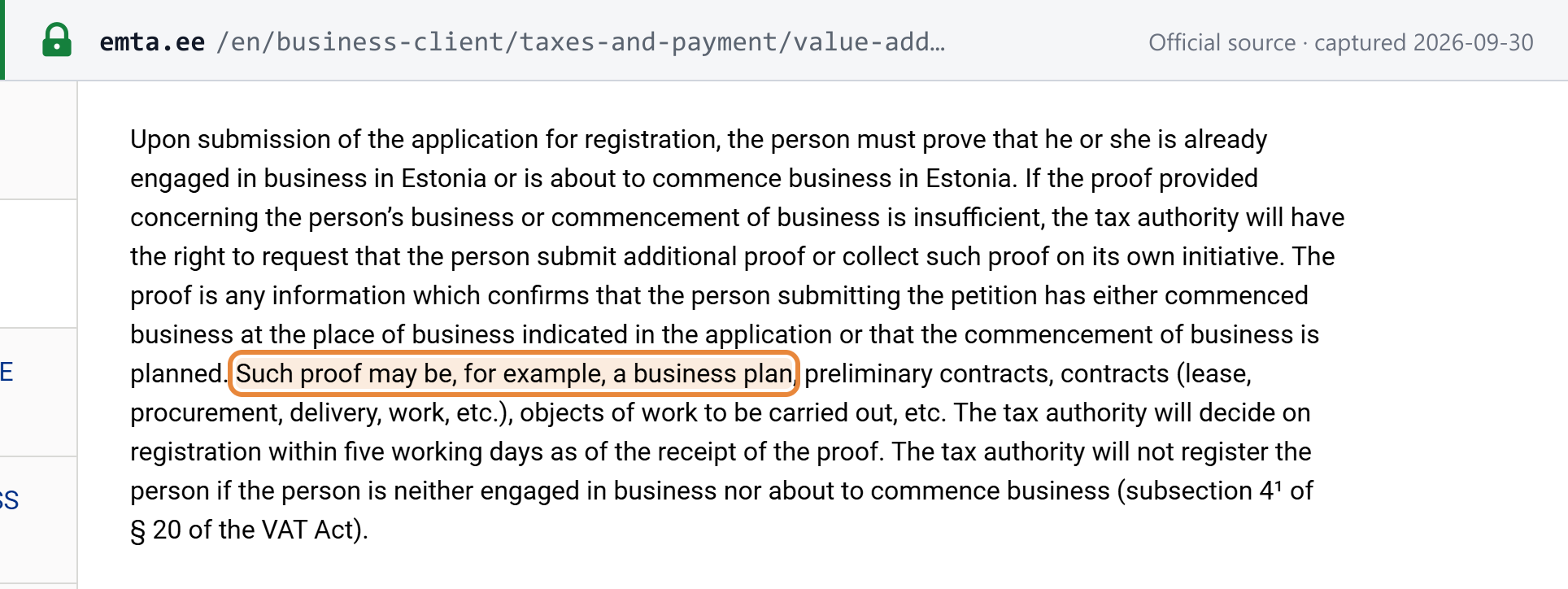
- Proof of business. "In order to be registered, the person must prove that they are engaged in business in Estonia or are about to commence business in Estonia" (KMS § 20(4¹)); the Tax and Customs Board refuses a person that is neither. It lists acceptable proof: "a business plan, preliminary contracts, contracts (lease, procurement, delivery, work, etc.), objects of work to be carried out, etc." [1] [6]
- Timeline. Registration takes effect from the date the obligation arose, and the Tax and Customs Board decides "within five working days as of the receipt of the proof" (§ 20(4¹)). [6]
Voluntary registration
Available. "A person has the option to voluntarily register as a taxable person even if his taxable supply does not exceed the threshold of 40,000 euros or if he has not yet received taxable supply", and may also apply on exempt intra-Community acquisitions or on export. Voluntary registration takes effect from the application date or a later date the applicant asks for, never earlier, and the same proof-of-business rule applies. It lets a start-up recover input VAT on its first costs. [6]
Deregistration
- Voluntary. A registered person may apply to be deleted where its Estonian supply did not exceed EUR 40,000 in the current or the previous calendar year and, by its own calculation, will not exceed it in the next twelve months (§ 22(1)). [1] [7]
- By the Tax and Customs Board. It may delete a taxable person that "has failed to submit a value added tax return for the last six consecutive tax periods" (§ 22(3)), or one that does not do business in Estonia (§ 22(3¹)). [1]
- Where. In e-MTA. [3]
Group registration
Available. A parent undertaking and its subsidiaries under the Commercial Code — or companies more than 50% owned by the same person — can be registered as one VAT group on a joint request; only Estonian taxable persons engaged in business in Estonia can join (§ 26(1)). "Transactions between persons registered as a value added tax group are not deemed to be supply" (§ 26(7)). The group files one joint return and its members are jointly and severally liable; until 31 December 2026 each member files its own invoice annex (§ 26(11)), a rule that ends when the annex folds into the return on 1 January 2027. [1] [19]
Rates
| Rate | Applies to | Effective |
|---|---|---|
| 24% (standard) | Most goods and services | Since 1 July 2025 (RT I, 02.01.2025, 2; previously 22%) [1] |
| 13% (reduced) | Accommodation, and accommodation with breakfast — not other goods or services supplied with it | Since 1 January 2025 (previously 9%) [1] |
| 9% (reduced) | Books and educational literature, printed or electronic; listed medicinal products, contraceptives, sanitary and toiletry products and medical devices for disabled persons' personal use; press publications, printed or electronic | KMS § 15(2); press back to 9% since 1 January 2025 (5% from 1 August 2022 to 31 December 2024) [1] |
| 0% | Exports of goods, intra-Community supplies of goods, international transport, services whose place of supply is outside Estonia, and other listed supplies | KMS § 15(3)–(4) [1] |
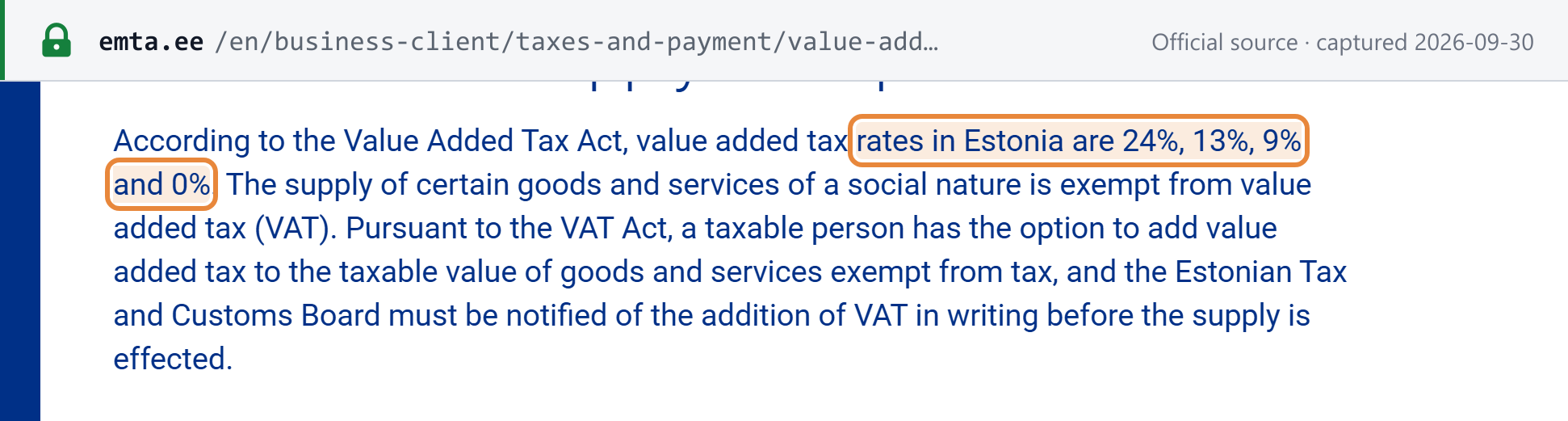
The Tax and Customs Board: "According to the Value Added Tax Act, value added tax rates in Estonia are 24%, 13%, 9% and 0%." [8]
Standard rate — 24%. KMS § 15(1): "The rate of value added tax is 24 per cent of the taxable value, except in the cases provided in subsections 1¹–4 of this section. [RT I, 02.01.2025, 2 - entry into force 01.07.2025]". The rate has moved three times since 2009: 18% until 30 June 2009, 20% from 1 July 2009, 22% from 1 January 2024, and 24% from 1 July 2025. The rate follows the time of supply, not the invoice date: "The correct tax rate must be chosen on the basis of the time of supply." [1] [27]

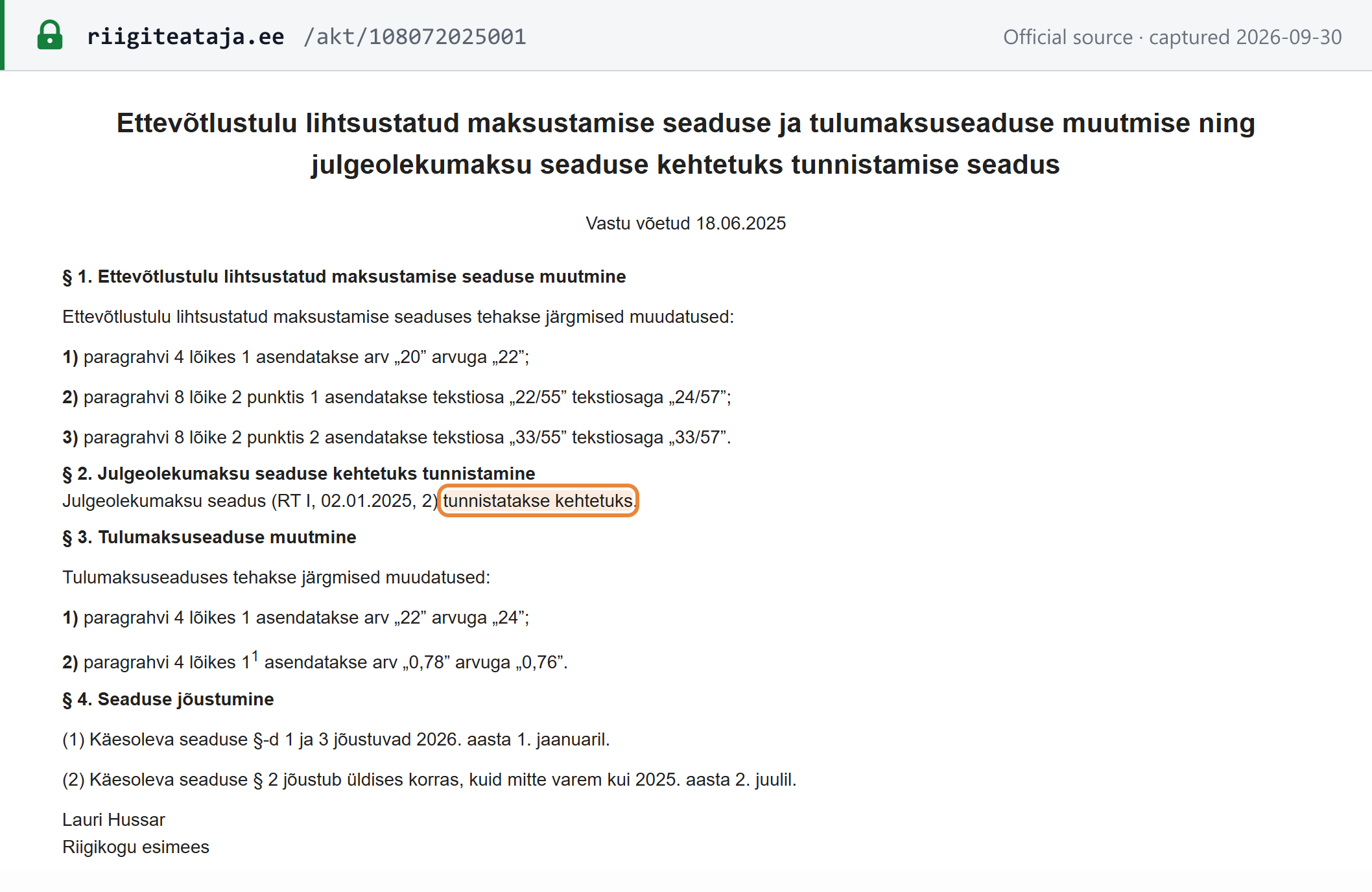
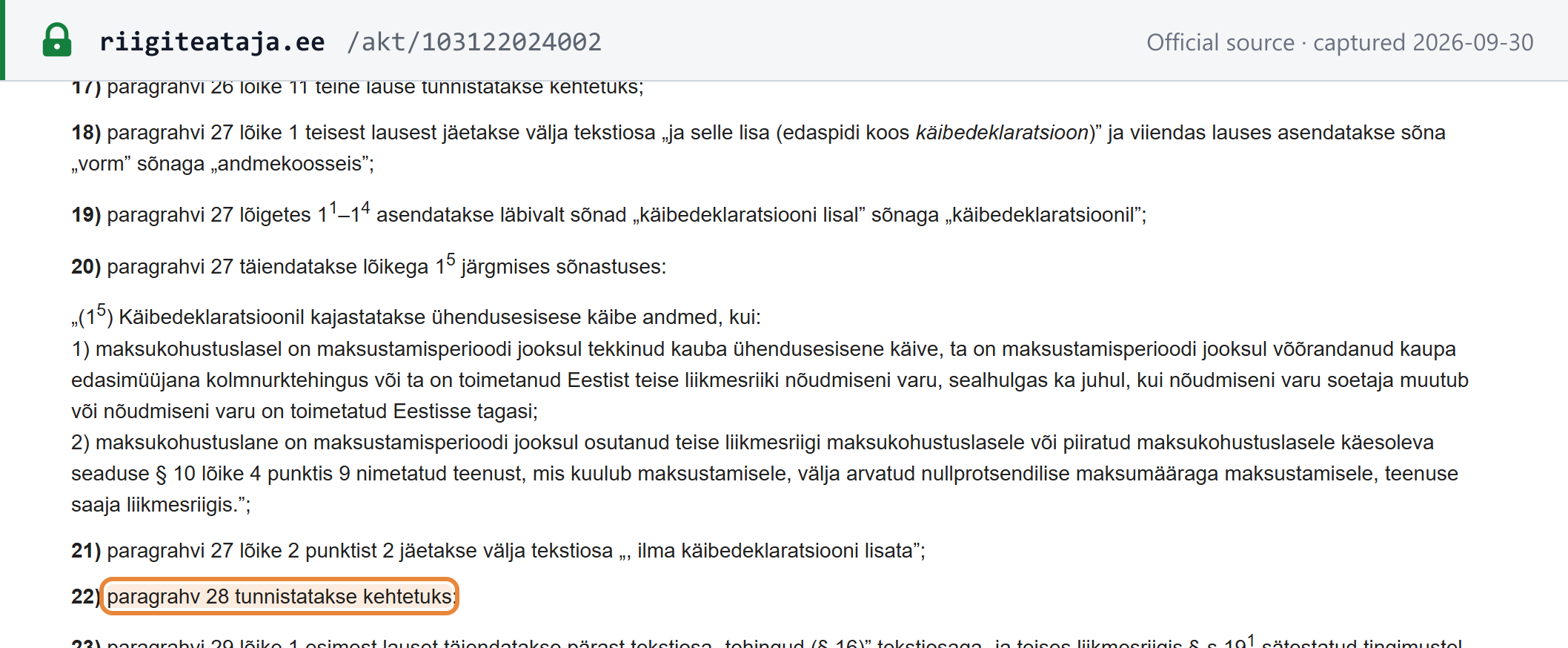
The 24% rate has no end date. The Security Tax Act (Julgeolekumaksu seadus, RT I, 02.01.2025, 2) that raised the rate also scheduled a return to 22% on 1 January 2029. That act was repealed by RT I, 08.07.2025, 1 ("Julgeolekumaksu seadus … tunnistatakse kehtetuks" — the Security Tax Act is repealed) before the 2029 step took effect, so § 15(1) now carries no reversion. [9] [10]
Reduced rate — 13%. "The rate of value added tax is 13 per cent of the taxable value of accommodation or accommodation with breakfast, except for goods or service accompanying this service" (§ 15(1¹), in force 1 January 2025). A business on cash accounting may still apply 9% until 31 December 2026 to accommodation invoiced and provided before 1 January 2025 (§ 46(26)). [1]
Reduced rate — 9%. Press publications that mainly carry advertising, private advertisements, erotic or pornographic content, or video or music content are excluded and taxed at 24% (§ 15(2) clause 5). Learning materials supplied with exempt education are exempt rather than 9%-rated. [1]
Announced future rates. None enacted as of 2026-09-30. Several opposition bills to cut rates on particular supplies — food, restaurant and catering services, district heating, fuels and natural gas — were pending in the Riigikogu on that date; none is backed by the Government, and similar bills were rejected earlier in 2026. The rates above apply unless and until a bill is passed. [29]
For Estonia alongside other jurisdictions, see Lookuptax's worldwide tax rates table and VAT registration thresholds table.
Cross-border rules
Imports and exports
- Imports of goods. Import VAT is paid under customs rules to the Tax and Customs Board, which is also the customs authority (§ 38(2)). A taxable person that has been registered for at least the preceding 12 consecutive months, has filed every return on time and has had no tax arrears in the past 12 months can be authorised to declare import VAT on its VAT return instead of paying it at the border (§ 38(2¹)); it must notify the Tax and Customs Board in advance and receive confirmation. [1] [26]
- De minimis. No low-value consignment relief for commercial goods: the former exemption was repealed on 1 July 2021. Non-commercial gifts sent between private persons remain exempt up to EUR 45 (§ 17(1) clause 10). Consignments declared under IOSS (up to EUR 150, not excise goods) are exempt at import where the IOSS number is given (§ 17(1) clause 11); see Lookuptax's IOSS guide. Travellers' allowances are EUR 300, or EUR 430 arriving by air or sea (§ 17(1) clause 8). [1]
- Exports and intra-EU supplies. Exports and intra-Community supplies of goods are 0%-rated with the right to deduct input VAT. The 0% rate for an intra-EU supply requires the customer's valid EU VAT number and reporting of the supply on the EC sales list (§ 15(3¹)) — from 1 January 2027, on the VAT return itself. [1] [19]
- Reverse charge on imported services. An Estonian taxable person — or a taxable person with limited liability — that buys services from a foreign supplier self-assesses the VAT on its own return. See Lookuptax's reverse charge explainer. [5]
- Domestic reverse charge. Between Estonian taxable persons, the buyer accounts for the VAT on immovable property where the seller opted to tax, scrap metal, investment gold opted to tax, precious metals and listed metal products (§ 41¹). [1]
Digital products and services
Telecommunications, broadcasting and electronically supplied services to Estonian consumers are supplied in Estonia (§ 10(2)). [1]
- EU sellers count these services, with intra-Community distance sales of goods, towards the EU-wide EUR 10,000 calendar-year threshold (§ 19(4)); above it, Estonian VAT applies and can be declared through the Union OSS in the seller's home state.
- Non-EU sellers have no threshold and register from the first B2C supply, or use the non-Union OSS.
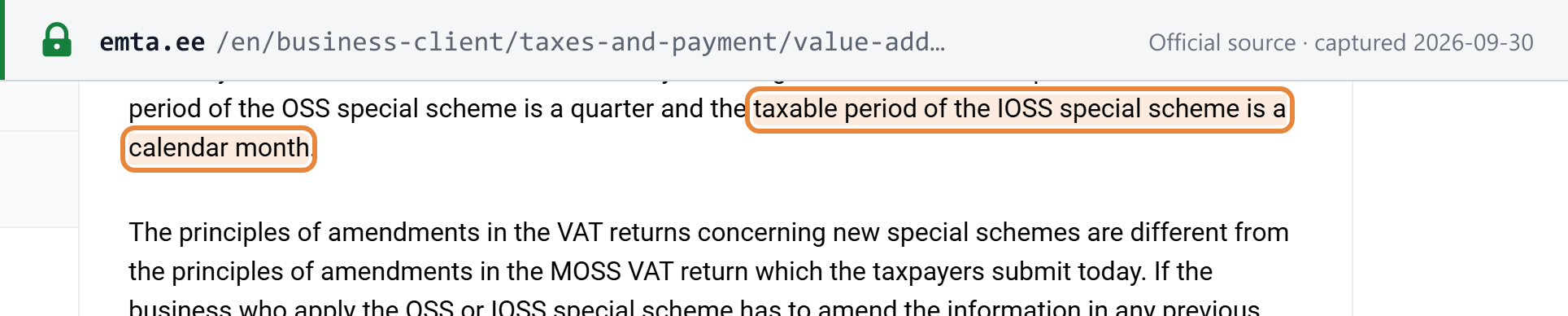
Estonia runs the Union OSS, the non-Union OSS and IOSS in e-MTA for businesses identified in Estonia. The Tax and Customs Board: "The taxable period of the OSS special scheme is a quarter and the taxable period of the IOSS special scheme is a calendar month", and the return and payment are due "by the end of the calendar month directly following the declared taxable period". Using the schemes is "voluntary, not mandatory". [11]
See Lookuptax's One-Stop Shop guide and VAT on digital services by non-resident suppliers.
Foreign companies selling into Estonia — B2B and B2C
- B2B — usually no Estonian registration. Where a foreign business with no permanent establishment supplies an Estonian taxable person (or taxable person with limited liability), the customer reverse-charges the VAT on its return and the supplier does not register. The invoice must carry the note "reverse charge" (§ 37(8) clause 2). [5] [1]
- B2C — the seller registers. Sales to consumers taxed in Estonia oblige a non-EU seller to register from the first supply, unless it declares them through the non-Union OSS (services) or IOSS (imported goods up to EUR 150). An EU seller's distance sales and electronic services fall under the EUR 10,000 EU-wide threshold and the Union OSS. Goods held in Estonia and sold locally to consumers require an Estonian registration. [5] [1]
- Tax representative. Required for most non-EU sellers that register — see Non-resident registration.
Marketplace / platform deemed-supplier liability
Applies. An online marketplace that facilitates the EU-standard cases — imported consignments up to EUR 150, and supplies within the EU by sellers not established in the EU to consumers — is treated as having bought and resold the goods (§ 4(13)). The underlying seller's supply to the marketplace is 0%-rated (§ 15(3) clause 15), and the marketplace must register from its first such supply (§ 19(1)). A non-EU marketplace that fails to register is jointly and severally liable with its seller for the VAT (§ 19(3¹)), and marketplaces keep records of facilitated B2C supplies for ten years (§ 36(1) clause 7). See Lookuptax's marketplace deemed-supplier explainer. [1]
Place of supply
- Goods. Where the goods are transferred or made available to the buyer (§ 9(1)); intra-Community distance sales follow the EU rules and the EUR 10,000 threshold. [1]
- Services, B2B. Services provided to a taxable person or taxable person with limited liability registered in Estonia are supplied in Estonia (§ 10(1)). Services provided from Estonia to a business registered in another member state or to a third-country business are supplied abroad (§ 10(4) clause 9) and 0%-rated in Estonia (§ 15(4) clause 1). [1]
- Services, B2C. Where the supplier is established. [1]
- Exceptions (§ 10(2)): services connected with immovable property, passenger transport, admission to events for consumers (virtual or streamed events are taxed where the consumer is, since 1 January 2025), and telecom, broadcasting and electronic services to consumers, among others. [1]
Invoice requirements
The invoicing rules sit in KMS § 37; retention is in § 36. The Tax and Customs Board's handbook summarises them: "the key requirements are the invoice number, date of issuance and information concerning the taxable person, the purchaser of the goods or services and the goods or services, as well as the price of the transaction, the taxable amount broken down by value-added tax rate and the amount of value-added tax payable in euros." [1] [12]
When an invoice is required. For transfers of goods and provision of services by a taxable person. An invoice meeting § 37 "need not be issued upon the transfer of goods or provision of services to a natural person for personal use, except in the case of intra-Community distance selling, the transfer of a new means of transport or treating as exports the goods transferred to a third country natural person" (§ 37(3)), nor for exempt supplies under § 16. [1]
Mandatory content
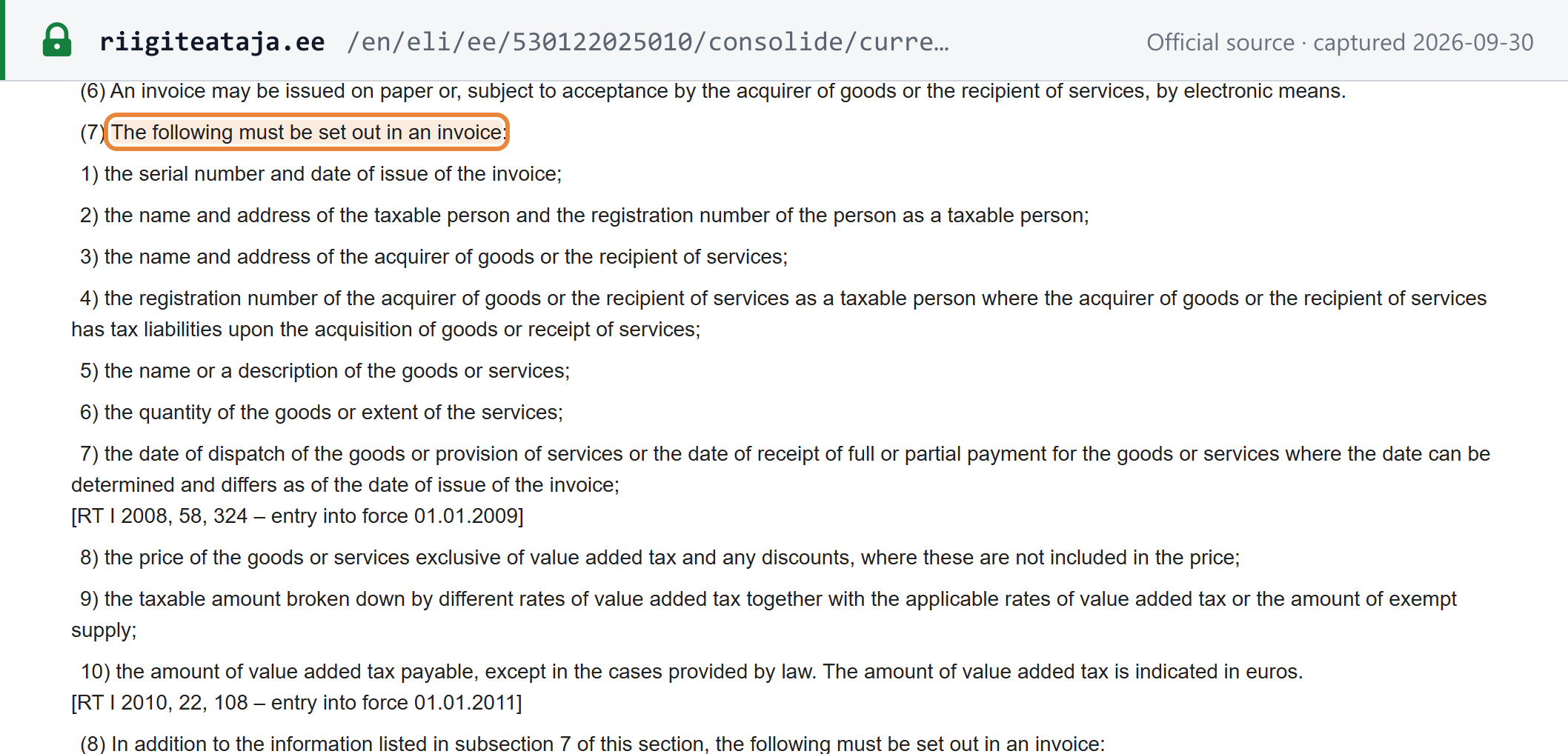
KMS § 37(7) lists the particulars; § 37(8) adds notations for particular cases: [1]
| # | Required field | Legal cite |
|---|---|---|
| 1 | Serial number and date of issue | KMS § 37(7) cl. 1 |
| 2 | Supplier's name, address and VAT (KMKR) number | § 37(7) cl. 2 |
| 3 | Customer's name and address | § 37(7) cl. 3 |
| 4 | Customer's VAT number, where the customer is liable for the tax | § 37(7) cl. 4 |
| 5 | Name or description of the goods or services | § 37(7) cl. 5 |
| 6 | Quantity of goods or extent of services | § 37(7) cl. 6 |
| 7 | Date of dispatch or supply, or of full or partial payment, where it can be determined and differs from the issue date | § 37(7) cl. 7 |
| 8 | Price excluding VAT, and discounts not included in the price | § 37(7) cl. 8 |
| 9 | Taxable amount per VAT rate with the rates, or the amount of exempt supply | § 37(7) cl. 9 |
| 10 | VAT payable, in euros | § 37(7) cl. 10 |
| 11 | Legal reference (KMS provision or VAT Directive article) for a 0%-rated or exempt supply — not needed for exports | § 37(8) |
| 12 | "reverse charge", where the customer is liable | § 37(8) cl. 2 |
| 13 | Margin-scheme note: "procedure for taxing the margin – travel agencies / second-hand goods / works of art / collectors' items and antiques" | § 37(8) |
| 14 | Tax representative's details, where one is appointed | § 37(8) |
| 15 | "self-billing", where the buyer issues the invoice | § 37(8) cl. 9 |
| 16 | "cash accounting of VAT", where the supplier uses cash accounting | § 37(8) |
A legal reference may be replaced by another clear and unambiguous notation (§ 37(8¹)). VAT shown on an invoice by a person not entitled to charge it — for example, a business that is not registered — must still be declared and paid (§ 27(2), § 38(1)). [1]
Issuance deadline
- Domestic supplies: "within seven calendar days as of the date on which the goods are dispatched or made available to the purchaser or the services are provided" (§ 37(1)), or of payment where the supply arises on payment. [1]
- Intra-Community supplies of goods and general-rule B2B services to EU customers: "by the fifteenth day of the month following the month in which the goods are dispatched or made available or the service is provided" (§ 37(2¹)). [1]
Numbering and sequencing
Each invoice must carry a serial number (§ 37(7) clause 1). Neither § 37 nor the Tax and Customs Board's invoicing handbook prescribes a numbering format or series structure (as read on 2026-09-30). [1] [12]
Credit and debit notes
"A document, including a credit invoice by which an initial invoice is amended, and which contains a reference to the initial invoice is deemed to be an invoice" (§ 37(4)). A credit or debit note therefore needs the § 37(7) particulars and a reference to the original invoice. [1]
Currency and language
- Currency and FX. An invoice may be in any currency, but the VAT must be shown in euros (§ 37(7) clause 10). Foreign-currency amounts convert at "the exchange rate of the euro as determined by the European Central Bank and applicable on the date" of supply (§ 29). [1]
- Language. The Value-Added Tax Act sets no language requirement for invoices, and the Tax and Customs Board's invoicing handbook states none (as read on 2026-09-30). Whether the Accounting Act's source-document rules require Estonian is not covered here.
- Paper or electronic. "An invoice may be issued on paper or, subject to acceptance by the acquirer of goods or the recipient of services, by electronic means" (§ 37(6)) — but see E-invoicing status for the buyer's right to demand one. [1]
Document types
| Document | When it is used | Cite |
|---|---|---|
| Full invoice | Default for every taxable supply | KMS § 37(7) |
| Simplified invoice | Only for passenger transport and invoices printed by parking meters, automated petrol stations and similar machines, up to EUR 160 excluding VAT | § 37(9) |
| Credit invoice | Amends an earlier invoice and refers to it | § 37(4) |
| Self-billed invoice | Issued by the buyer under a prior written agreement | § 37(5) |
"A simplified invoice may be issued, provided that the amount indicated on the invoice does not exceed 160 euros, exclusive of value added tax" (§ 37(9)). It needs only the date, the supplier's name and VAT number, a description, the taxable amount and the VAT; a business buyer adds its own name and VAT number. [1]
Self-billing
Permitted under a prior written agreement between supplier and buyer that includes a procedure for the supplier to accept each invoice (§ 37(5)); the invoice carries the note "self-billing". [1]
Retention and audit trail
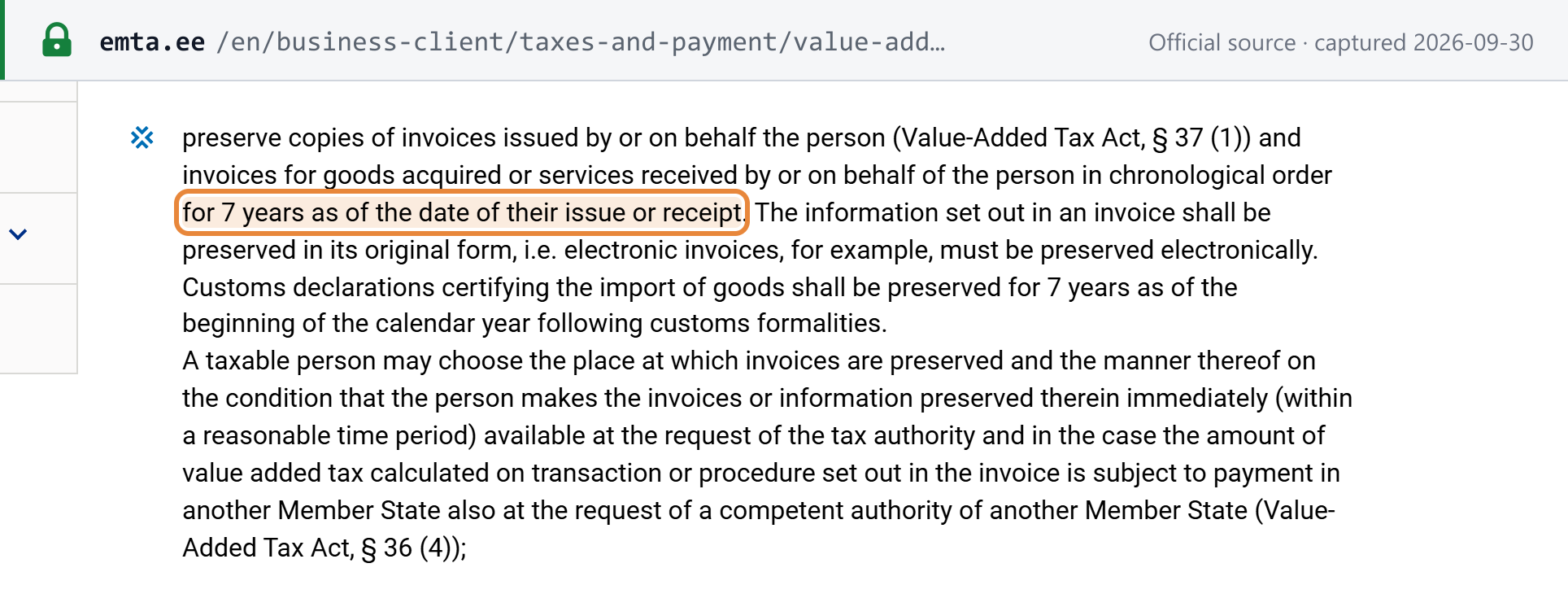
- Retention. Taxable persons "preserve copies of invoices issued … and invoices for goods acquired or services received … in chronological order for 7 years as of the date of their issue or receipt" (§ 36(1)). Customs import declarations are kept 7 years from the start of the calendar year after clearance; marketplaces keep their supply records 10 years. [12] [1]
- Original form and storage. "The information set out in an invoice shall be preserved in its original form, i.e. electronic invoices, for example, must be preserved electronically." The business may choose where and how to store invoices, provided it makes them available immediately on request — also to another member state's authority where VAT is payable there (§ 36(4)). [12]
- Audit trail. Beyond chronological, original-form retention, the Act and the Tax and Customs Board's invoicing guidance publish no tamper-evidence, hash, signature or QR-code requirement (as read on 2026-09-30). An invoice that does not meet § 37 does not support an input-VAT deduction (§ 31(1)). [1]
A specimen of a compliant invoice
The Tax and Customs Board publishes no annotated specimen invoice; the example below is ours — Lookuptax's illustration of the KMS § 37(7) particulars for a domestic B2B supply at two rates. Every name, number and amount in it is fictional:
Arve — Invoice
| DescriptionKMS § 37(7) cl. 5 | QuantityKMS § 37(7) cl. 6 | Unit price (excl. VAT)KMS § 37(7) cl. 8 | VAT rateKMS § 37(7) cl. 9 | Value (excl. VAT) |
|---|---|---|---|---|
| IT consulting (hours) | 10 | EUR 100.00 | 24% | EUR 1,000.00 |
| Printed training handbook | 5 | EUR 10.00 | 9% | EUR 50.00 |
- Taxable amount at 24%KMS § 37(7) cl. 9
- EUR 1,000.00
- VAT at 24%KMS § 37(7) cl. 10
- EUR 240.00
- Taxable amount at 9%KMS § 37(7) cl. 9
- EUR 50.00
- VAT at 9%KMS § 37(7) cl. 10
- EUR 4.50
- Total including VAT
- EUR 1,294.50
- Issued within seven calendar days of the supply — KMS § 37(1).
- The VAT amounts must be stated in euros, even if the rest of the invoice is in another currency — KMS § 37(7) cl. 10.
- Where the buyer is liable for the VAT, the invoice shows no VAT, carries the buyer's VAT number and the note "reverse charge" — KMS § 37(7) cl. 4 and § 37(8); where the buyer issues it, "self-billing".
- A buyer registered in the Commercial Register as an e-invoice recipient can require this invoice as an EN 16931-1 e-invoice — see E-invoicing status.
E-invoicing status
Status (as of 2026-09-30): no e-invoicing mandate and no clearance or real-time reporting system. B2B and B2G: since 1 July 2025, a buyer registered as an e-invoice recipient can require an e-invoice. B2C: no rule. For Estonia alongside other jurisdictions, see Lookuptax's e-invoicing status and networks table.
Since 1 July 2025, § 7¹(7) of the Accounting Act (Raamatupidamise seadus, as amended by RT I, 10.10.2024, 1) gives the rule: [13]
"Käesoleva paragrahvi lõike 3 kohaselt äriregistris e-arve vastuvõtjaks märgitud raamatupidamiskohustuslane võib soetatud kauba või teenuse eest tasumiseks nõuda müüjalt e-arve esitamist. Eeldatakse, et e-arve on vormistatud nõuetekohaselt, kui see vastab e-arveldamise Euroopa standardile EN 16931-1."
(An accounting entity marked in the Commercial Register as an e-invoice recipient may require the seller to submit an e-invoice for goods or services acquired. An e-invoice is presumed properly drawn up if it complies with the European e-invoicing standard EN 16931-1.) The parties may agree to use another standard.
| Scope | Rule | Since |
|---|---|---|
| B2B | A buyer registered as an e-invoice recipient in the Commercial Register can require an e-invoice; unless the parties agree otherwise, the seller must send one | 1 July 2025 |
| B2G | The 2019 obligation to e-invoice public-sector buyers was replaced by the same buyer's right; all public-sector units are registered as recipients, so in practice they still receive e-invoices, but may now make exceptions | 1 July 2025 |
| B2C | No rule; an e-invoice needs the recipient's acceptance (KMS § 37(6)) | — |
The Ministry of Finance: "Aastal 2019 kehtestati Eestis üldine e-arvete esitamise kohustus, kui ostjaks on mõni avaliku sektori asutus. 2025. aastal asendus see kohustus ostja õigusega valida, millises vormis ta müüjalt arvet tahab saada" — in 2019 an obligation to e-invoice public-sector buyers was introduced; in 2025 it was replaced by the buyer's right to choose the form in which it receives the invoice, and the principle was extended to the private sector. It puts the number of businesses registered as e-invoice recipients at about 18,000. [14]

- Formats and networks. Invoices are exchanged in the Estonian e-invoice standard and the European standard (Peppol) through e-invoice operators; the Ministry of Finance recommends the European standard. See Lookuptax's Peppol guide. [14]
- Registering as a recipient. Businesses register as e-invoice recipients in the Commercial Register; they can now do so themselves rather than only through an operator. [14]
Proposed, not enacted: a mandate for VAT payers. In December 2024 the Ministry of Finance circulated a legislative-intent document (VTK) proposing to abolish the EUR 1,000 threshold for the invoice listing and to "kehtestada käibemaksukohustuslastele e-arvete kohustus" — introduce an e-invoicing obligation for VAT payers — saying a bill "võiks jõustuda 2027. aastast" (could enter into force from 2027). As of 2026-09-30 no bill carries either measure: the version of the VAT Act in force from 1 January 2027 keeps the EUR 1,000 threshold, and the Government's VAT bill now in the Riigikogu (992 SE) contains no e-invoicing provision. [15] [17]
Data-based VAT return (reporting, not e-invoicing). The Tax and Customs Board is building data-based reporting, in which accounting software sends VAT transaction data in a standard format (XBRL GL) and "the declaration or report is compiled by the ETCB on the basis of the submitted basic data". It states that the data-based VAT return solution will be ready by 1 January 2027, with testing with software developers in the fourth quarter of 2026. This serves the enacted 2027 return reform described under Filing and payment; the Board's pages do not say the data-based channel becomes compulsory. [16] [28]
ViDA outlook. EU-level mandatory e-invoicing for cross-border intra-EU B2B supplies starts on 1 July 2030 under the VAT in the Digital Age package. Estonia's transposition bill 992 SE (Government bill, initiated 14 September 2026, first reading completed 28 September 2026) covers the single-VAT-registration pillar — a wider OSS and a new scheme for transfers of own goods — with commencement dates of 1 January 2027 and 1 July 2028; it contains no e-invoicing or digital-reporting obligation. It is a bill, not law. See Lookuptax's ViDA guide. [17]
Filing and payment
Filing frequency
Monthly for every VAT-registered person, with no turnover bands: "The taxable period is one calendar month." A first period of under 15 days may be combined with the next. On a reasoned request the Tax and Customs Board may set a longer period (§ 27(4)); the return is still due on the 20th of the month after that period. [18] [1]
Proposed. Point 31 of the Government's bill 992 SE would repeal § 27(4) — the longer-period option — from 1 January 2027. The bill passed its first reading on 28 September 2026 and may still change; until it is enacted, § 27(4) stands. [17]
Return due date
The VAT return (form KMD) and its invoice annex (KMD INF) are due by the 20th day of the month following the tax period. The Tax and Customs Board: "The deadline for submitting both a VAT return and a report on intra-Community supply is the 20th day of the month following the taxable period." [18]
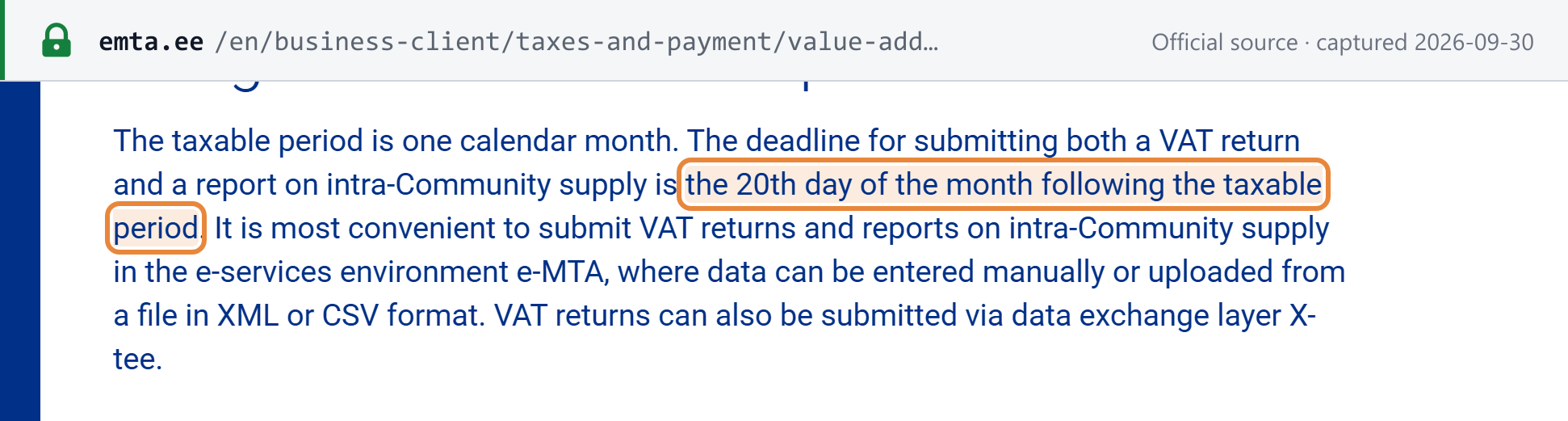
- How. In e-MTA — entered manually or uploaded as XML or CSV — or machine-to-machine through the X-tee data exchange layer. Filing must be electronic once a person has been registered for at least twelve months or lists more than five invoices on the annex (§ 27(1¹)). [18] [1]
- Who else files. A VAT group files one joint return. Taxable persons with limited liability "must file a value added tax return but do not have to submit an annex". A person that is not registered but showed VAT on an invoice must also file. [18] [1]
Payment due date and method
"A taxable person or a taxable person with limited liability pays the amount of value added tax due by the date of submission of the value added tax return" (§ 38(1)) — the 20th. Payment goes to the taxpayer's prepayment account with the Tax and Customs Board, by bank transfer to its accounts at Estonian banks or by card or bank link in e-MTA; liabilities are set off against the prepayment account on the due date. [1] [20]
Additional listings
- KMD INF — invoice listing. Part A lists sales invoices and Part B purchase invoices at 24%, 13% and 9% (and, exceptionally, older rates for transitional items and credit notes) where the invoices for one transaction partner in the period total at least EUR 1,000 excluding VAT (§ 27(1²)). Sales and purchases are counted separately, invoices are listed individually, partners are identified by their Estonian registry code, and invoices to private individuals and margin-scheme travel invoices are left out. [1] [18]

- VD — report on intra-Community supply (EC sales list). Monthly by the 20th for intra-Community supplies of goods, triangulation as intermediary, call-off stock movements and general-rule B2B services to customers in other member states (§ 28); amendments go on form VDP. "If there is no supply of goods or services mentioned above, then no report shall be submitted." [18]
- OSS and IOSS returns — see Digital products and services.
- Annual VAT return. None: the monthly returns are the whole filing cycle.
Enacted: from 1 January 2027 the KMD INF annex and the VD report fold into the return. The amending act published in RT I, 03.12.2024, 2 puts the relevant points in force on 1 January 2027 (its § 3(2)): [19]
- the words "and annex thereto" are deleted from § 27(1), and the return's "form" becomes a "data set" (andmekoosseis);
- invoice data (the at-least-EUR 1,000 per-partner threshold is kept) is reported on the VAT return itself under reworded § 27(1¹)–(1⁴) (amending act § 1 point 19), and intra-Community supply data under new § 27(1⁵) (point 20);
- § 28 — the VD report — is repealed; and
- VAT group members stop filing their own annexes.
The due date stays the 20th. The Tax and Customs Board's data-based return, described under E-invoicing status, is being built for the same date.

See Lookuptax's VAT listings explainer and VIES and Intrastat guide.
Input-tax recovery and blocked items
Input VAT is deducted on an invoice that meets § 37 (for imports, the customs declaration), in the period the supply arose — or, if the invoice arrives after that return was filed, in the period it is received. Mixed businesses apportion by the previous year's ratio, adjusted at year end (§ 32); the capital-goods adjustment period is ten years for immovable property and five years for other fixed assets (§ 32(4¹)). [1]
- Blocked: "Input value added tax on goods or services relating to the reception of guests or the provision of meals or accommodation for employees is not deducted" (§ 30(1)); accommodation on a business trip is deductible (§ 30(2)). [1]
- Passenger cars — 50%. "…fifty per cent of input value added tax is deducted" on acquiring or leasing a car and on goods and services for it (§ 30(3)); the full amount only where the car is used exclusively for business, or is acquired for resale, leasing, taxi or passenger transport or driving instruction (§ 30(4)). [1] [24]
Refunds
- Resident businesses. An excess of input VAT is refunded under the Taxation Act "within 60 days as of the date of receipt of the request", or immediately where the Tax and Customs Board has already verified the claim (Taxation Act § 106(2)). When checking the claim it may extend the term by up to 60 calendar days (KMS § 34(2)). [21] [1]
- EU businesses not registered in Estonia claim through their home portal under Directive 2008/9/EC by 30 September of the following year; the minimum is EUR 50 for a calendar year or EUR 400 for a period of at least three months (§ 35(1)). [1]
- Non-EU businesses may claim only where their country refunds VAT to Estonian residents (reciprocity), with a minimum of EUR 320 a year (§ 35(2)). [1]
- Bad debt. Output VAT on an unpaid invoice may be reduced under the conditions of § 29¹. [1]
Exemptions
Exempt supplies
"The supply of certain goods and services of a social nature is exempt from value added tax (VAT)" (§ 16), including: universal postal services; health and social services; pre-school to higher education and related learning materials; insurance and reinsurance; letting of immovable property (not accommodation, parking or safes); supply of immovable property other than new buildings and building land; lotteries and gambling; investment gold; and financial services such as deposits, lending, payment services and fund management. [8] [1]
Option to tax. Non-residential letting and sale of immovable property, certain financial services to non-EU or non-business customers, and investment gold can be taxed by choice; "the Estonian Tax and Customs Board must be notified of the addition of VAT in writing before the supply is effected", and the choice binds "within at least two years as of the first tax period" (§ 16(3)–(4)). [8] [1]
Exempt is not zero-rated. An exempt supply carries no VAT and no right to deduct the input VAT on related costs (§ 29(1)); a business with both kinds of supply deducts only partially (§ 32(1)). A 0%-rated supply — an export, an intra-Community supply of goods, a service supplied abroad — is also VAT-free, but the input VAT is deductible. Exempt real-estate, insurance and financial supplies still count towards the EUR 40,000 threshold. [1] [4]
Special regimes
- Small-business exemption. The EUR 40,000 registration threshold is Estonia's small-business exemption; the EU cross-border SME scheme applies from 1 January 2025 — see Registration. [1]
- Cash accounting. Available to a taxable person whose Estonian supply "did not exceed 200,000 euros in the previous calendar year or as of the beginning of the current calendar year" (§ 44(1)); its invoices carry the note "cash accounting of VAT". [1] [25]
- Margin schemes for travel agents (§ 40) and for second-hand goods, works of art, collectors' items and antiques (§§ 41–42), each with its invoice note. [1]
- Domestic reverse charge for listed goods (§ 41¹) — see Imports and exports.
- Customs and tax warehousing. Goods under customs warehousing, free-zone or transit procedures are 0%-rated (§ 15(3)), and a tax-warehouse regime applies to listed goods (§ 44¹). [1]
- Flat-rate farmers' scheme. Not available: the Value-Added Tax Act contains no flat-rate scheme for farmers (as read on 2026-09-30). [1]
Offences and penalties
Estonia separates misdemeanours under the Taxation Act (Maksukorralduse seadus, MKS) from criminal offences under the Penal Code (Karistusseadustik). Misdemeanour fines are set in fine units, and a fine unit has been EUR 8 since 1 January 2025: "A fine unit is the base amount of a fine and is equal to 8 euros" (Penal Code § 47(1)). [22]
Offences
| Offence | Conduct | Sanction |
|---|---|---|
| Failure to file or register (MKS § 154) | Failing to submit a tax return or other document by the due date, to register with the tax authority, to keep records as required, or to comply with the tax authority's order | Natural person: up to 300 fine units (EUR 2,400); legal person: up to EUR 3,200 |
| False information (MKS § 153¹) | Intentionally failing to submit information, or submitting false information, so that tax is reduced or a refund increased (below the criminal threshold) | Natural person: up to 300 fine units (EUR 2,400); legal person: up to EUR 32,000 |
| Tax evasion — major damage (Penal Code § 389¹(1)) | The same conduct, where tax concealed or refund increased exceeds EUR 40,000 | Pecuniary punishment or up to 5 years' imprisonment |
| Tax evasion — particularly great damage (Penal Code § 389¹(2)) | Where the amount exceeds EUR 400,000 | 1 to 7 years' imprisonment |
MKS § 154(2): "The same act, where committed by a legal person, is punishable by a fine of up to 3,200 euros." A court may impose a pecuniary punishment of EUR 4,000 to 40,000,000 on a legal person for a criminal offence (Penal Code § 44). [21] [22]
Penalties
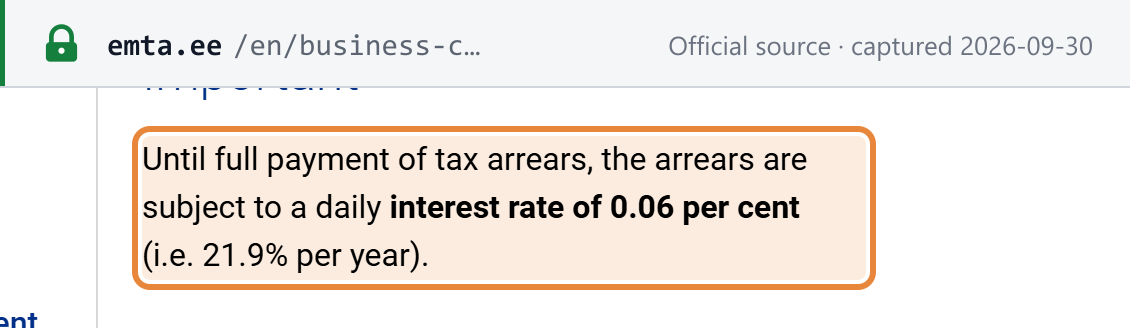
- Late payment interest. "The rate of interest provided in §§ 115 and 116 of this Act is 0.06 per cent per day" (MKS § 117(1)) — the Tax and Customs Board gives it as "21.9% per year". It runs from the day after the due date until payment or set-off, and no interest claim is issued below EUR 10. Interest may be reduced by up to half under an approved instalment schedule (MKS § 117(2)). [21] [23]
- Late filing and late registration. Fines under MKS § 154 above. A person that fails to register is registered by the Tax and Customs Board from the date the obligation arose (KMS § 20(10)), so VAT and interest run from that date. [21] [1]
- Defective invoices. The Value-Added Tax Act sets no fixed penalty for an invoice missing mandatory particulars (as read on 2026-09-30); the consequence falls on the buyer, whose input deduction requires a compliant invoice (§ 31(1)), and VAT wrongly shown on an invoice must be paid over (§ 38(1)). [1]
- Penalty payments (sunniraha) that the Tax and Customs Board can impose to enforce a precept — for example, to file a missing return — exist under the Taxation Act; their current amounts are not stated here.
Frequently asked questions
We sell software from outside the EU to Estonian businesses and consumers — is there a threshold before we must register?
Not for consumer sales. A foreign business with no permanent establishment in Estonia must register from the first taxable supply in Estonia that is not taxed by an Estonian VAT-registered customer — in practice, from the first sale to a consumer. Sales to Estonian VAT-registered businesses are reverse-charged: the customer declares the VAT on its own return (form KMD) and the foreign supplier does not register. A non-EU seller can declare its consumer sales through the non-Union One-Stop Shop instead of registering in Estonia. Estonia's EUR 40,000 threshold does not shelter a non-established seller's consumer sales (Value-Added Tax Act § 19(3)). [5] [11]
Does rent from residential property count towards Estonia's EUR 40,000 VAT threshold?
Yes, since 1 January 2025 exempt real-estate transactions, insurance and financial services count as supply for the threshold unless they are occasional, but a person whose supply is entirely exempt still has no obligation to register. The Tax and Customs Board's examples: a company earning EUR 42,000 only from renting out dwellings does not have to register; a company with EUR 38,000 of exempt dwelling rent as its main activity plus EUR 2,500 of taxable training must register from the day its total supply for the calendar year exceeds EUR 40,000. [4]
What happens to the KMD INF annex and the VD report in 2027?
Both stop being separate filings on 1 January 2027. The amending act published in RT I, 03.12.2024, 2 repeals § 28 of the Value-Added Tax Act (the VD report on intra-Community supply), deletes the annex from § 27(1) and requires invoice data and intra-Community supply data to be reported on the VAT return itself. The per-partner threshold of at least EUR 1,000 excluding VAT survives, and the return is still due on the 20th of the following month. The Tax and Customs Board is building a data-based return for the same date, fed from accounting software. [19] [16]
Can an Estonian customer insist that we send an e-invoice?
Yes, if it is registered in the Commercial Register as an e-invoice recipient. Since 1 July 2025, § 7¹(7) of the Accounting Act lets such an accounting entity require its seller to submit an e-invoice, and an e-invoice meeting the European standard EN 16931-1 is presumed properly drawn up; the parties may agree another standard. This replaced the 2019 obligation to e-invoice public-sector buyers. It is a buyer's right, not a general mandate: Estonia has no clearance or real-time invoice reporting system as of 30 September 2026. [13] [14]
How much input VAT can we deduct on a company car in Estonia?
50% by default. Under § 30(3) of the Value-Added Tax Act, half of the input VAT on acquiring or leasing a passenger car, and on goods and services bought for it, is deductible. The full amount is deductible only if the car is used exclusively for business, or is acquired for resale, leasing, taxi or passenger transport or driving instruction (§ 30(4)). VAT on guest reception (entertainment) and on meals and accommodation for employees is not deductible, except business-trip accommodation (§ 30(1)–(2)). [1]
Is Estonia's 24% VAT rate temporary?
No longer. The Security Tax Act (RT I, 02.01.2025, 2) raised the standard rate from 22% to 24% on 1 July 2025 and also scheduled a return to 22% on 1 January 2029. That act was repealed by RT I, 08.07.2025, 1 before the 2029 step took effect, so the 24% rate in § 15(1) of the Value-Added Tax Act has no end date. Several opposition bills to cut rates on particular goods and services were pending in the Riigikogu on 30 September 2026; none has been enacted. [29] [9] [10]
What does it cost to pay Estonian VAT late or not file a return?
Unpaid tax carries interest of 0.06% per day (about 21.9% a year) from the day after the due date until payment, under § 117 of the Taxation Act; no interest claim is issued below EUR 10. Failing to file a return on time or to register is a misdemeanour under § 154 of the Taxation Act: a fine of up to 300 fine units for a natural person (EUR 2,400, since the fine unit has been EUR 8 from 1 January 2025) and up to EUR 3,200 for a legal person. Intentionally submitting false information that reduces tax can cost a legal person up to EUR 32,000 (§ 153¹), and concealing tax above EUR 40,000 is a crime punishable by up to five years' imprisonment. [23] [21] [22]
Important websites
| Site | Purpose |
|---|---|
| e-MTA | VAT registration and deregistration, KMD returns with the KMD INF annex, VD reports, OSS and IOSS returns, payments |
| Tax and Customs Board — Registration as a VAT payer | Registration rules, thresholds, non-resident registration |
| Tax and Customs Board — Filing VAT returns and reports | KMD, KMD INF and VD rules and deadlines |
| Tax and Customs Board — VAT return forms and technical specifications | Forms and file formats for software |
| Tax and Customs Board — Payment of taxes | Prepayment account and bank details |
| Tax and Customs Board — VAT rates and exempt supply | Current rates and exempt supplies |
| Tax and Customs Board — OSS and IOSS | Union, non-Union and import schemes |
| KMKR number search | Check an Estonian VAT number |
| VIES | EU VAT-number check |
| e-Business Register | Company data; registering as an e-invoice recipient |
| Ministry of Finance — invoices and e-invoices | E-invoicing rules, standards and operators |
| Tax and Customs Board — Data-based reporting | The data-based VAT return being built for 2027 |
Also see Lookuptax's own Estonia KMKR validator and Estonia tax ID guide.
Recent changes
- 2026-09-28 — The Government's ViDA transposition bill 992 SE completed its first reading; it would also repeal the option of a tax period longer than one month from 1 January 2027. The deadline for amendments is 12 October 2026, and the bill adds transitional provisions for call-off stock arrangements until 30 June 2028. A bill, not law. (Riigikogu) — see event
- 2025-07-01 — The standard rate rose from 22% to 24% (RT I, 02.01.2025, 2); the scheduled 2029 return to 22% fell away when the Security Tax Act was repealed (RT I, 08.07.2025, 1). (Riigi Teataja)
- 2025-07-01 — A buyer registered as an e-invoice recipient can require an e-invoice; this replaced the 2019 B2G e-invoicing obligation (RT I, 10.10.2024, 1). (Riigi Teataja)
- 2025-01-01 — Accommodation moved from 9% to 13% and press publications from 5% back to 9%; exempt real-estate, insurance and financial supplies began counting towards the EUR 40,000 threshold; the EU cross-border SME scheme applied. (Tax and Customs Board)
- 2025-01-01 — The fine unit doubled from EUR 4 to EUR 8 (Penal Code § 47(1)). (Riigi Teataja)
- 2024-01-01 — The standard rate rose from 20% to 22%. (Riigi Teataja)
Ahead — enacted changes that have not yet taken effect:
- 2027-01-01 — The KMD INF annex and the VD report on intra-Community supply fold into the VAT return; § 28 is repealed and the EUR 1,000 per-partner threshold is kept (RT I, 03.12.2024, 2). (Riigi Teataja)
Reference links
- Riigi Teataja — Value-Added Tax Act (Käibemaksuseadus), English translation, consolidated
- Riigi Teataja — Käibemaksuseadus, Estonian consolidated text
- Riigi Teataja — Value-Added Tax Act and Taxation Act amendment, RT I, 03.12.2024, 2 (2027 return reform)
- Riigi Teataja — Security Tax Act, RT I, 02.01.2025, 2
- Riigi Teataja — Act repealing the Security Tax Act, RT I, 08.07.2025, 1
- Riigi Teataja — Accounting Act amendment, RT I, 10.10.2024, 1 (e-invoices, § 7¹)
- Riigi Teataja — Taxation Act (Maksukorralduse seadus), English translation
- Riigi Teataja — Penal Code (Karistusseadustik), English translation
- Riigikogu — Bill 992 SE amending the Value-Added Tax Act (ViDA)
- Riigikogu — Bills in proceedings (draft list)
- Tax and Customs Board — Registration as a VAT payer
- Tax and Customs Board — Threshold calculation from 1 January 2025
- Tax and Customs Board — Persons with no permanent establishment in Estonia
- Tax and Customs Board — Possibility of registering as a taxable person
- Tax and Customs Board — Deletion from the register of taxable persons
- Tax and Customs Board — VAT rates and supply exempt from tax
- Tax and Customs Board — Special schemes for e-commerce and services (OSS/IOSS)
- Tax and Customs Board — VAT accounting and invoices
- Tax and Customs Board — Filing VAT returns and reports
- Tax and Customs Board — Payment of taxes
- Tax and Customs Board — Interest
- Tax and Customs Board — Calculation and refund of VAT
- Tax and Customs Board — Cash accounting of VAT
- Tax and Customs Board — Declaring import VAT on form KMD
- Tax and Customs Board — VAT rates handbook (PDF)
- Tax and Customs Board — Data-based reporting
- Tax and Customs Board — Data-based reporting newsletter no. 2
- Ministry of Finance — Accounting source documents, invoices and e-invoices
- Ministry of Finance — Proposals to improve VAT receipts, 4 December 2024
- Lookuptax — Estonia tax ID guide
- Lookuptax — How to verify an EU VAT number in VIES
- Lookuptax — EU VAT SME scheme
- Lookuptax — VAT listings explained
- Lookuptax — E-invoicing status and networks worldwide
- Lookuptax — VAT registration thresholds worldwide
- Lookuptax — Worldwide tax rates