Malta VAT guidelines
| FACTSHEET | |
|---|---|
| Country code | MT |
| Tax name | Value Added Tax (VAT) — Taxxa fuq il-Valur Miżjud |
| Tax Authority | Commissioner for Tax and Customs — Malta Tax and Customs Administration (MTCA) |
Overview
Malta levies Value Added Tax (VAT) — Taxxa fuq il-Valur Miżjud in Maltese — under the Value Added Tax Act, Chapter 406 of the Laws of Malta (Act XXIII of 1998, in force since 1 January 1999). The Act is administered by the Commissioner for Tax and Customs, appointed under article 3(1), whose administration trades as the Malta Tax and Customs Administration (MTCA). [1]
A naming note before anything else. The authority was the Commissioner for Revenue (CFR) until it was rebranded; the Act itself now says "Commissioner for Tax and Customs", MTCA's own guidelines sign off as "CfTC", and the public website moved from cfr.gov.mt to mtca.gov.mt. Older forms, PDFs and portal URLs still carry CFR branding, and cfr.gov.mt links in third-party guidance are often stale. [1] [6]
Currency. All amounts in this guide are in euro (EUR, €). The Sixth Schedule states the point directly: "The turnover shall be denominated in euro". [1]
Tax period basis. Malta has no VAT "tax year". The operative unit is the tax period, allocated by the Commissioner to every person registered under articles 10, 11, 11A and 12; the default is three calendar months (article 17(2)), with 12-month and one-month variants prescribed by the Value Added Tax (Tax Period) Regulations — see Filing and payment. [1] [9]
Layering. Malta VAT is a single national tax. There is no regional, provincial or municipal VAT layer, and the same rules apply on Gozo and Comino as on Malta. As an EU Member State since 1 May 2004 — the Act's own defined "accession date" — Malta's VAT law implements Council Directive 2006/112/EC, so the EU place-of-supply rules, the reverse charge, VIES, the OSS/IOSS special schemes and the cross-border SME scheme all apply here. [1]
Two dated changes dominate the near term and are covered in full below: Legal Notice 86 of 2026 narrows the gambling exemption from 1 October 2026, and Act III of 2026 has already transposed the ViDA amendments to the EU VAT Directive, which take effect 1 January 2027. See Recent changes. [5] [12]
Not every member state is this far along. Malta enacted its Article 2 ViDA transposition in March 2026, nearly a year ahead of the 1 January 2027 commencement date. Poland, transposing the same Article 2 into its own VAT Act's e-commerce and OSS/IOSS rules, was still at the Council-of-Ministers-backed draft-bill stage as of September 2026, targeting the same commencement date — see Poland VAT guidelines. The directive is common; the legislative timetable to reach it is not.
Registration
The three registration types — the single most Malta-specific thing on this page
Malta does not have one VAT register. It has three (four, counting the cross-border SME option), and they confer different rights. Choosing wrongly is the most common practical error, because only one of them lets you recover input VAT and only two of them produce a number VIES will confirm. [1] [2]
| Article 10 | Article 11 | Article 12 | |
|---|---|---|---|
| What it is | The ordinary, full VAT registration | Domestic small-enterprise exemption | Registration for intra-EU acquisitions and reverse-charge services |
| Who | A taxable person making a supply for consideration in Malta other than an exempt-without-credit supply | A Malta-established taxable person whose Domestic annual turnover does not exceed the Domestic threshold | A person not registered under article 10, or a non-taxable legal person, making intra-Community acquisitions or receiving/supplying reverse-charge services |
| Threshold | None | €35,000 Domestic threshold (Sixth Schedule, Part One) | €10,000 acquisitions threshold for goods; none at all for services |
| Charges VAT? | Yes | No — supplies are exempt without credit (Fifth Schedule, Part Two, item 16(1)) | No, but self-charges VAT on acquisitions and reverse-charge services |
| Recovers input VAT? | Yes — and it is the only registration that does | No | No |
| Number format | "MT" prefix — a VAT identification number | No prefix — expressly "not … a value added tax identification number" (art. 13(3)) | "MT" prefix |
| Documents issued | Tax invoice (Twelfth Schedule) or fiscal receipt (Thirteenth Schedule) | Fiscal receipt only — never a tax invoice | — |
| Periodic filing | Tax return, generally quarterly | Annual declaration | Notice of payment / declarations under article 30A |
Two further registrations exist for the EU cross-border SME scheme, both added by Act XXXVIII of 2024 with effect from 1 January 2025: article 11A, for a Malta-established small enterprise that wants to use the exemption in other Member States (its number is the existing article 10 or 11 number with the suffix "EX"), and article 11B, under which a small enterprise established in another Member State is deemed to have applied to register in Malta once its home Member State notifies the Commissioner under Chapter Xa of Council Regulation (EU) 904/2010. [1] [13]
Article 10 and article 11 are mutually exclusive, and switching is not free-form: a person who registers under article 10 cannot qualify as a small enterprise for the first whole 12 calendar months, unless the Commissioner accepts a conversion request and the person has claimed no input tax credits in the meantime (Sixth Schedule, Part One, item 2). On switching or deregistering out of article 10 you are deemed to supply to yourself every remaining business asset on which you claimed input VAT, and must account for the output tax in your last article 10 return. [1] [2]
Who should register — the liability rule
- Article 10(1)(a) — a taxable person established in Malta who is not registered under article 10 or 11 must apply within 30 days of the date on which he makes a supply for consideration in Malta, other than an exempt-without-credit supply. There is no turnover threshold in this rule; the €35,000 figure is the gate to the article 11 exemption, not a floor below which nothing is required.
- Article 10(1)(b) — the same 30-day rule applies to a Malta-established person supplying services to another Member State on which the recipient alone is liable.
- Article 10(3) — the Commissioner may serve a notice requiring registration within 30 days.
- Article 10(5) — voluntary registration; see below.
- Article 12(1), (3) and (3a) — registration for intra-Community acquisitions above €10,000, for received services on which you are liable under article 20(2), and for services supplied to another Member State on which the recipient alone is liable. [1]
A person registered under article 11 who does any of the three things in article 11(10) — makes intra-Community acquisitions, receives reverse-charge services, or supplies services to another Member State on which the recipient alone is liable — must also register under article 12. Holding an article 11 number does not cover intra-EU activity. [1]
Thresholds
| Trigger | Threshold | Measurement | Source |
|---|---|---|---|
| Article 10 (resident) | None | Registration follows the first supply for consideration, within 30 days | Art. 10(1)(a) [1] |
| Article 11 small-enterprise exemption (Domestic threshold) | €35,000 | Domestic annual turnover during the preceding calendar year; the exemption stops on the day the threshold is exceeded within a calendar year | Sixth Schedule, Definitions item 5 and Part One items 1 and 3 [1] |
| Article 11A / 11B (Union threshold) | €100,000 | Union annual turnover during the preceding calendar year | Sixth Schedule, Definitions item 7 [1] |
| Article 12 — intra-Community acquisitions of goods | €10,000 ("acquisitions threshold") | Value of intra-Community acquisitions in Malta during the calendar year, excluding new means of transport and excise goods | Third Schedule, Part Three, items 3 and 4 [1] |
| Article 12 — services received under the reverse charge | None | Applies from the first service received | Art. 12(3); MTCA states there is "no threshold applicable to the acquisition of services" [2] |
| Non-established persons (article 10(4)) | None — nil threshold | Registration within 30 days of a taxable, or exempt-with-credit, supply taking place in Malta on which the person would be liable for the tax | Art. 10(4) [1] |
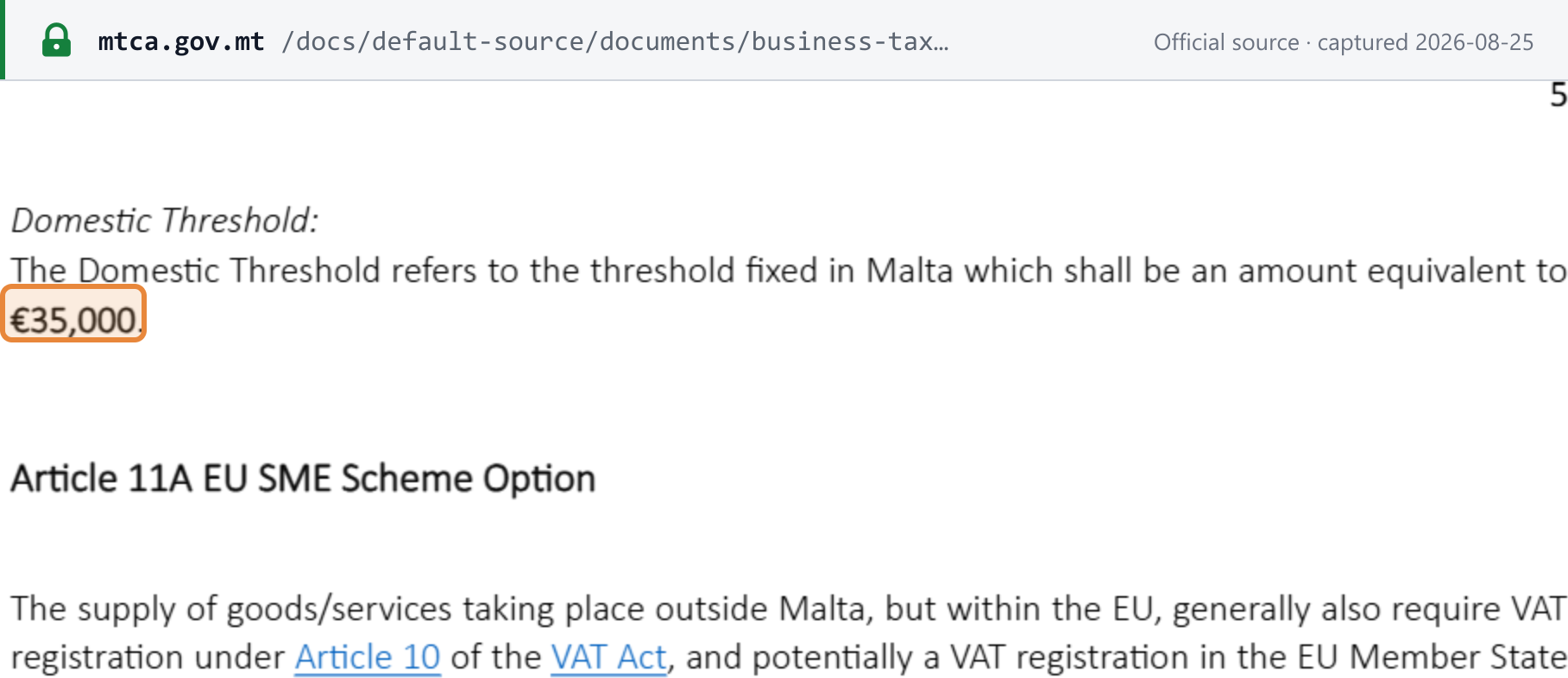 Source snapshot captured 2026-08-25 — original
The non-resident threshold is nil, and it is not the same as the resident one. Readers routinely assume a foreign seller gets the same €35,000 headroom a Maltese micro-business gets. It does not. Article 10(4) attaches to the supply, not to turnover. Two provisos in that same sub-article relieve the obligation: notifying the Commissioner within 10 days of the supply that a Chapter 6 Title XII special scheme (Union OSS, non-Union OSS or IOSS) will be used, or — for a person established in another Member State — the Commissioner approving use of the cross-border small-enterprise exemption. The €35,000 Domestic threshold is reachable by a non-established EU business only through article 11B, and only if its Union annual turnover is also under €100,000. [1]
Turnover for Sixth Schedule purposes is broader than "sales": it includes exempt-with-credit transactions under items 1, 3, 5, 6, 7 and 8(1) of Part One of the Fifth Schedule, and non-ancillary immovable-property, financial, insurance and reinsurance transactions. Disposals of capital assets are excluded. For anyone other than a physical person, item 4 of Part One aggregates the proportionate turnover of related persons — a person owning or controlling, directly or indirectly, more than 10%. [1]
Tax registration number
A Malta VAT identification number is the country code MT followed by an 8-digit numeric block (e.g. MT99999999); the Act itself prescribes only the prefix, and the digit count comes from the format walkthrough on Lookuptax's Malta tax ID guide. Article 13(2) requires the Commissioner to allocate a registration number to every person registered under articles 10, 11, 11A or 12 and to make a registration certificate available electronically; article 13(3) then splits them: numbers under articles 10 and 12 carry the "MT" prefix in accordance with ISO 3166 alpha-2, while a number under article 11 does not carry the prefix and is expressly not a VAT identification number. An article 11A number is the person's existing article 10 or 11 number with the suffix "EX". Validity is checked through the EU's VIES service, which MTCA points taxpayers to directly. For format detail and the failure modes, see the dedicated Malta tax ID guide and the Malta VAT number validator. [1] [4]
How to register
Article 13(1) requires the application — and any cancellation — to be submitted electronically through the web portal designated by the Commissioner. In practice: [1] [2]
- Registration is made online through MTCA's Register for VAT e-service, with separate entry points for sole proprietors and for company legal representatives and their tax practitioners.
- A Maltese e-ID is generally required to reach MTCA online services; MTCA publishes a separate route for persons who cannot be issued one — which is the practical hurdle for a non-established registrant.
- Documents: a copy of the ID card or passport of the applicant (or, for a limited liability company, of the authorised representative vested with legal representation), plus the Memorandum and Articles of Association for a company or registered partnership.
- Timeline: MTCA publishes no processing service standard, and none is fixed in the Act. Registration under article 11 takes effect from the first day of the month in which the application is received (or the start of the economic activity, whichever is later), or the first day of the following month if the applicant was already registered under article 10; a registration the Commissioner makes because a person was liable to apply takes effect from the date they should have been registered.
Voluntary registration
Available. Article 10(5) lets any person who carries on, or intends to carry on, an economic activity apply for article 10 registration. The Commissioner must register such an applicant under article 10(6)(b) where satisfied that the person carries on or intends to carry on an economic activity and is either likely to be entitled to input tax credits under article 22 or likely to make an intra-Community acquisition in Malta for operations carried out outside Malta. Registration takes effect from the date of application — not retrospectively. Article 12(2) provides a parallel voluntary route for a person who is not registered or liable to be registered under article 10. The usual reason to volunteer is the same as everywhere: article 10 is the only Malta registration that recovers input VAT. [1]
Deregistration
- Article 10 — a person who ceases to be required or entitled to be registered must apply for cancellation within 15 days of that event (article 10(10)). The Commissioner may also cancel of his own motion under article 10(8). A final return for the last tax period is due within 30 days of the cancellation notice (article 27(2)). Deregistration triggers the deemed self-supply of remaining business assets on which input VAT was claimed.
- Article 11 — cancellation may be requested at any time; it is mandatory within 15 days of no longer qualifying as a small enterprise, or within 15 days of ceasing the economic activity (article 11(5)). Cancellation on request takes effect from the first day of the following calendar month.
- Article 11A — cancellation on request at any time; 15 working days to apply for update or cancellation on losing eligibility in a Member State, or on exceeding the Union threshold.
- Article 12 — cancellation may be applied for after the expiry of the calendar year following registration (or two consecutive years for a voluntary article 12(2) registration) if the acquisitions threshold was not exceeded in that year or the preceding one; it takes effect on 1 January of the year the application is made.
- Cancellation does not relieve liabilities incurred before the effective date (article 13(6)), and MTCA requires all pending compliance obligations and balances to be settled before it processes a deregistration. A VAT number can later be re-activated, and MTCA reissues the same number — Malta numbers are unique to the taxpayer. [1] [2]
Group registration
Available, but narrow. Under article 5(6) of the Act and the Value Added Tax (Registration as a Single Taxable Person) Regulations (S.L. 406.21), two or more legal persons established in Malta that are bound to each other by financial, organisational and economic links may apply to be registered as a single taxable person, with supplies between members disregarded for VAT. The gate is the licensing condition: MTCA states that at least one member must be a taxable person licensed or recognised under the Acts specified in those Regulations — in practice the regulated financial-services and gaming sectors — so this is not a general commercial grouping regime. A number of persons regarded as a single taxable person under article 5(6) are registered as one person (article 13(7)). [11] [18]
Rates
The charging provision is article 19: 18% on every taxable supply and every taxable importation other than those specified in the Eighth Schedule, and the Eighth Schedule rates may be neither higher than 18% nor lower than 5%. MTCA states the structure plainly: "The reduced rates applicable in Malta are 12%, 7%, 5% or 0%." [1] [17]
| Rate | Applies to | Effective |
|---|---|---|
| 18% (standard) | Every taxable supply, intra-Community acquisition and importation not specified in the Eighth Schedule or exempted by the Fifth Schedule (art. 19(1) and (4)) | Since 1 January 2004 — Act II of 2004, Part X, art. 66 substituted "eighteen per cent" for "fifteen per cent" in article 19, and art. 65(2) deems that Part to have come into force on 1 January 2004 [14] |
| 12% (reduced) | Four items only, all in the Eighth Schedule: item 12 custody and management of securities; item 13 management of credit and credit guarantees by a person or body other than the one who granted the credit; item 14 hiring of a pleasure boat where the term, added to any previous hiring of the same or like goods to that person in the previous 12 months, does not exceed 5 weeks; item 15 services consisting of the care of the human body required to be delivered by a person exercising a profession regulated by the Health Care Professions Act (Cap. 464), including services supplied in the course of a health studio or similar business, but excluding the exempt medical care in item 11 of Part Two of the Fifth Schedule | Eighth Schedule, items 12–15 [1] [3] |
| 7% (reduced) | Item 1 letting or provision of accommodation in premises required to be licensed under the Malta Travel and Tourism Services Act, — where the price also covers non-accommodation supplies, 80% of the price is deemed to be accommodation and 20% is not; item 11 use of sporting facilities | Eighth Schedule, items 1 and 11 [1] [3] |
| 5% (reduced) | Item 2 electricity; item 3 confectionery and similar consumable goods, by CN code; item 4 medical accessories, by CN code; item 5 printed matter, by CN code — including audiobooks and books supplied on physical media or supplied electronically, excluding publications wholly or predominantly advertising, video or audible music; item 6 items for the exclusive use of the disabled; item 7 importation of works of art, collectors' items and antiques; item 8 minor repairing of bicycles, shoes and leather goods, and clothing and household linen; item 9 domestic care services such as home help and care of the young, elderly, sick or disabled; item 10 admission to museums, art exhibitions, concerts and theatres | Eighth Schedule, items 2–10 [1] [3] |
| 0% (zero-rated) | Malta's zero rate is drafted as "exemption with credit" in Part One of the Fifth Schedule: exports and like transactions; international goods traffic; intra-Community supplies; international transport and ancillary services; brokers and intermediaries; sea vessels; aircraft; gold to the Central Bank of Malta; food for human consumption other than food supplied in the course of catering; pharmaceutical goods; scheduled bus, inter-island sea, school, worker and public-lift passenger transport; goods for consumption on board cruise liners; certain transactions treated as exports; devices and aids supplied to recognised non-profit organisations; products used for female sanitary protection; and medical items essential to compensate and overcome cancer in humans | Fifth Schedule, Part One [1] [3] |
| Exempt without credit | See Exemptions | Fifth Schedule, Part Two [1] |
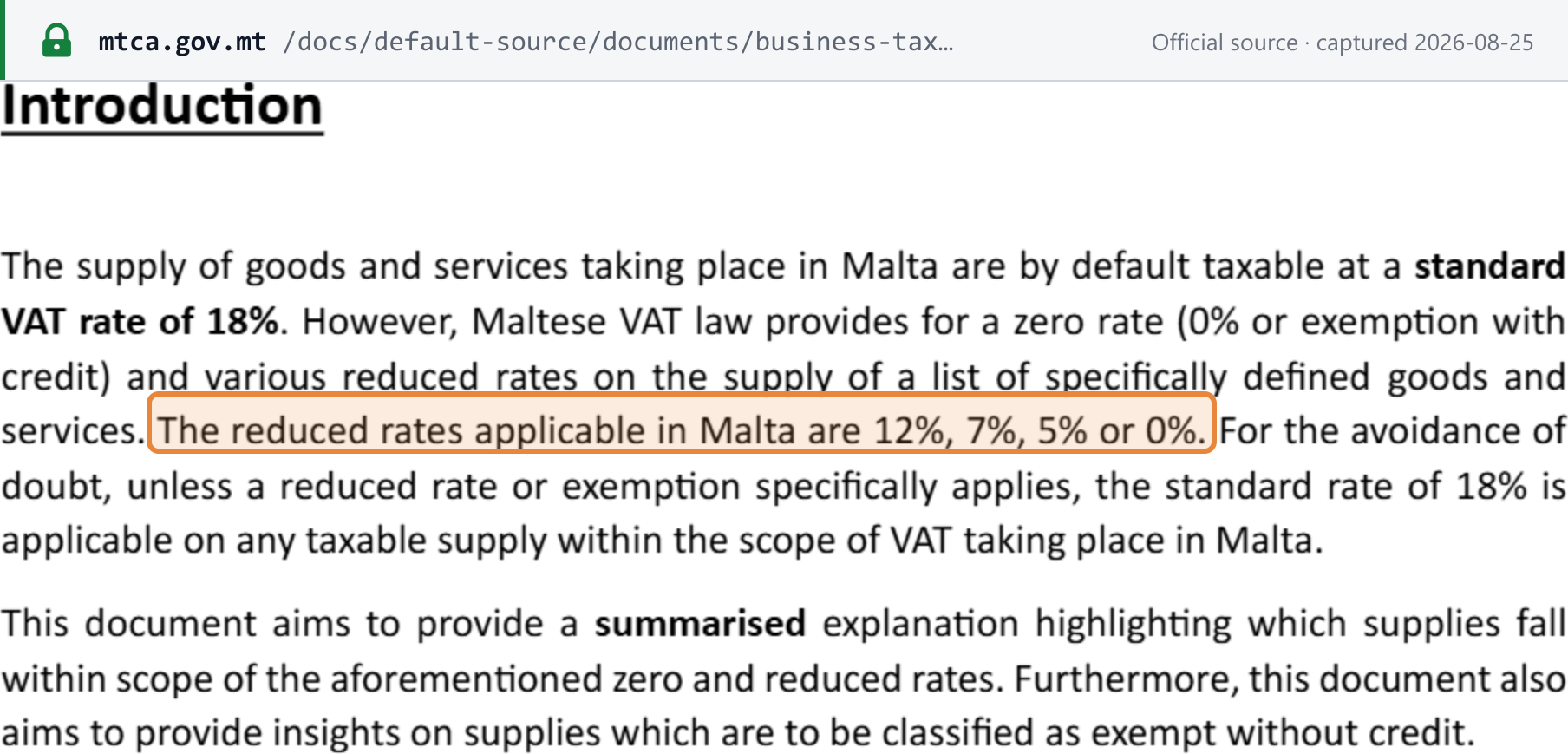 Source snapshot captured 2026-08-25 — original
Because several of the 5% items are defined by CN code rather than by description, MTCA publishes a tariff browser that returns the applicable import duty, excise duty and VAT for a queried code. That is the authoritative way to settle a borderline classification. [17]
Announced future rates. None. No change to the 18% standard rate or to any Eighth Schedule rate is in force or announced as at 24 August 2026. What is scheduled for 1 October 2026 is a change of scope, not of rate: gambling supplies outside the three approved categories move from exempt to taxable, and therefore to 18% — see Recent changes. [5]
Cross-border rules
Imports and exports
- Imports — VAT is chargeable on the importation of goods into Malta at 18%, or at the Eighth Schedule rate where the item is specified there (article 19(4) and (5)); liability sits on the importer (article 20(1)(c)). Tax on importations is payable to the Commissioner "at such place and be accompanied by such forms as the Commissioner may direct" (proviso to article 21(5)) — that is, collected at the border alongside customs formalities.
- Postponed accounting for import VAT — not provided for. The Value Added Tax Act contains no general postponed-accounting or deferment mechanism allowing import VAT to be declared on the return instead of paid at importation. (Checked against the consolidated Act, 2026-08-24.)
- De-minimis on imports — Malta applies the EU regime, under which the low-value consignment relief was abolished EU-wide; the surviving figure in Maltese law is the €150 intrinsic-value ceiling for the deemed-supplier and IOSS rules (Second Schedule, item 12A(1)).
- Exports — exempt with credit, i.e. zero-rated, under item 1 of Part One of the Fifth Schedule: goods dispatched or transported to a destination outside the Community by or on behalf of the seller, and by or on behalf of a purchaser not established in Malta (with a carve-out for goods the purchaser transports himself to equip, fuel or provision pleasure boats, private aircraft or other private-use transport).
- Intra-Community supplies — exempt with credit under item 3 of Part One, and reportable on the recapitulative statement. [1]
Place of supply
The Third Schedule carries the place-of-supply rules, and goods and services follow different logic. [1]
- Goods — Part One. An intra-Community acquisition takes place where the transport to the acquirer ends (Part Three, item 1); goods supplied to a taxable dealer of gas, electricity or heat/cooling energy are placed at the dealer's establishment, otherwise where the customer effectively uses and consumes them (Part One, item 5).
- Services — general rules (Part Two, item 2). To a taxable person acting as such, the place of supply is where that person has established his business, or the fixed establishment to which the service is provided (B2B destination rule). To a non-taxable person, the place of supply is where the supplier has established his business or the fixed establishment from which the service is provided (B2C origin rule). A taxable person who also carries out non-taxable activities counts as a taxable person for all services received, and a non-taxable legal person identified for VAT is treated as a taxable person (Part Two, item 1).
- Overrides follow for immovable property (item 4, including hotel-sector accommodation, experts, estate agents and construction coordination), intermediaries acting for non-taxable persons (item 3), and telecommunications, broadcasting and electronically supplied services to non-taxable persons (item 10).
- The €10,000 micro-business threshold applies across both intra-EU distance sales of goods (Part One, item 4(5)) and TBE services to non-taxable persons (Part Two, item 10(2)): where the supplier is established in only one Member State and the combined value of those cross-border supplies does not exceed €10,000 in the current calendar year and did not in the preceding one, the place of supply stays in the supplier's own Member State. Exceed it mid-year and the destination rule applies from that moment. A supplier may opt into the destination rule instead, by written notice, for a minimum of two calendar years, taking effect no earlier than 30 days from the notice. Act III of 2026 clarified that a taxable person registered under OSS is automatically treated as having opted into the destination rules. [1] [12] These provisions are deferred: article 55(2) of Act III brings them into force on 1 January 2027, not on publication.
Foreign companies selling into Malta — B2B and B2C answered separately
They differ, and the difference is the whole question.
B2B — the reverse charge, and no Malta registration for that transaction. Article 20(2) moves the liability for the tax onto the Maltese customer where the supply is made by a person not established in Malta and not registered under article 10, and the customer is a taxable person registered under article 10 or 12, or a non-taxable legal person identified for VAT. It covers three cases: (a) goods supplied in a triangulation chain where the supplier is VAT-identified in another Member State, has made an exempt intra-Community acquisition in Malta for that supply, and designates the customer as liable; (b) services falling under the general B2B rule in Part Two item 2(a) of the Third Schedule; and (c) any other supply of goods or services to a taxable person registered under article 10 or 12 or to a VAT-identified non-taxable legal person. A supplier with a Malta fixed establishment that does not intervene in the supply is treated as not established here for this purpose. Your invoice must carry the mention "Reverse charge" (Twelfth Schedule, item 3(n)). Note the asymmetry that catches people out: your Maltese B2B customer may itself have to register under article 12 in order to self-account, if it is not registered under article 10. [1] [2]
B2C — you register, with no threshold, or you use OSS/IOSS. Article 20(2) cannot bite, because a private consumer is not a person on whom it places the liability. Article 10(4) then requires a non-established person making a taxable supply taking place in Malta on which he would be liable for the tax to apply for article 10 registration by not later than 30 days from the date of that supply — with no threshold. The two provisos are the practical answer for most sellers: notify the Commissioner within 10 days of the supply that a Chapter 6 Title XII special scheme (Union OSS, non-Union OSS or IOSS) will be used to declare and pay the tax, and the registration obligation falls away; or, if established in another Member State, obtain the Commissioner's approval to use the cross-border small-enterprise exemption. Act III of 2026 widened article 10(4) so that non-established persons making exempt-with-credit supplies in Malta — intra-Community supplies in particular — are also required to be identified here, because otherwise those supplies never reach VIES. [1] [12]
Digital products and services
Telecommunications, radio and television broadcasting, and electronically supplied services to a non-taxable person are placed where that person is established, has his permanent address or usually resides (Third Schedule, Part Two, item 10(1)) — subject to the €10,000 micro-business threshold described above, which is a single combined threshold shared with intra-EU distance sales of goods. Above it, a non-established supplier registers under article 10 or accounts through OSS / non-Union OSS / IOSS; MTCA runs a dedicated OSS and IOSS page. Supplies to a taxable person follow the general B2B destination rule and the article 20(2) reverse charge instead. [1]
Marketplace and platform deemed-supplier liability
Malta applies the EU deemed-supplier rule through item 12A of the Second Schedule. A taxable person who facilitates, through an electronic interface such as a marketplace, platform, portal or similar means: [1]
- distance sales of goods imported from third territories or third countries in consignments of an intrinsic value not exceeding €150 — is deemed to have received and supplied those goods himself (item 12A(1)); and
- the supply of goods within the Community by a taxable person not established within the Community to a non-taxable person — is likewise deemed to have received and supplied those goods himself (item 12A(2)).
Act III of 2026 extends item 12A(2), transposing Article 2 of ViDA, so that the deemed-supplier rule also catches platform-facilitated supplies of goods within the EU made to taxable persons, or non-taxable legal persons whose intra-Community acquisitions are not subject to VAT under article 3(1) of the EU VAT Directive. That extension commences 1 January 2027. Payment service providers have a separate reporting obligation under the CESOP regime (S.L. 406.22). [12]
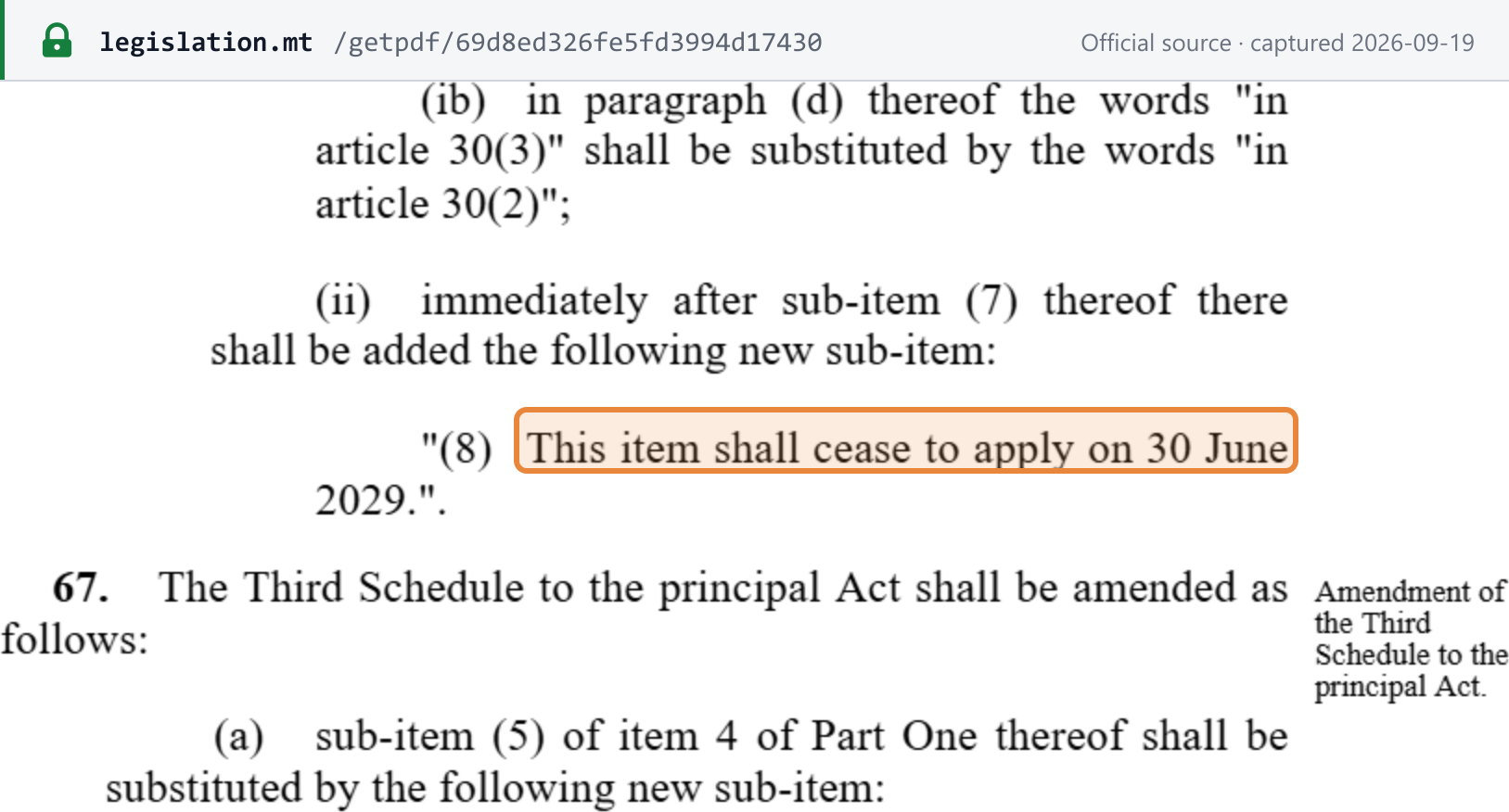
ViDA single VAT registration reaches Malta too. Commission Implementing Regulation (EU) 2026/1869 of 27 July 2026 amends Implementing Regulation (EU) 2020/194 to carry the ViDA changes into the OSS, non-Union OSS and IOSS schemes and the new transfer-of-own-goods scheme, replacing the registration, VAT-return and CCN/CSI message annexes. It entered into force on 17 August 2026; Article 2 applies from 1 January 2027 until 30 June 2028, and Articles 1 and 3 from 1 July 2028 — the same dates Malta's own call-off-stock phase-out in item 17A of the Second Schedule works to. See the event record and the issue. [22] [12] A separate sunset applies to the simplification itself: new item 17A(8), inserted by article 66(c)(ii) and likewise deferred to 1 January 2027, provides that the item shall cease to apply on 30 June 2029 — mirroring the directive's own 1 July 2029 deletion of the residual call-off-stock provisions. So 30 June 2028 is the last date goods can be dispatched and still qualify; 30 June 2029 is when the regime stops existing.
Invoice requirements
Malta runs two documents, not one, and which you must issue turns on your registration type and your customer's. A tax invoice (article 50 and the Twelfth Schedule) is required when a person registered under article 10 makes a supply, other than an exempt-without-credit supply, to a person who identifies himself for that supply by a valid VAT identification number. In every other case a fiscal receipt (article 51 and the Thirteenth Schedule) is required instead. MTCA is blunt about the boundary: if the customer's VAT number cannot be validated on VIES, "a tax invoice should not be issued. A fiscal receipt should be issued instead", and a supply by or to an article 11 person "must be covered by a fiscal receipt and never a tax invoice". [1] [4]
Mandatory content
Item 3 of the Twelfth Schedule — mappable field by field: [1]
| Clause | Required field |
|---|---|
| 3(a) | Date of issue |
| 3(b) | A sequential number, based on one or more series, uniquely identifying the invoice |
| 3(c) | Supplier's name and address, and the VAT identification number under which he made the supply |
| 3(d) | Customer's name and address, and the VAT identification number under which the customer acquired the goods or services |
| 3(e) | Quantity and nature of the goods, or extent and nature of the services |
| 3(f) | Date the supply was made or completed, or the date of a payment on account, where determinable and different from the date of issue |
| 3(g) | Taxable value per rate or exemption, the unit price exclusive of tax, and any discounts or rebates not already in the unit price |
| 3(h) | The VAT rate applied |
| 3(i) | The VAT amount payable, except where a special arrangement excludes it |
| 3(j) | Where the person liable is a tax representative in another Member State: that representative's VAT identification number, full name and address |
| 3(k) | The mention "Cash accounting" where VAT becomes chargeable on payment under Part One of the Fourteenth Schedule |
| 3(l) | The mention "Selfbilling" where the customer issues the invoice |
| 3(m) | Where no tax is chargeable: a brief reference to the relevant provision of the Act or of Directive 2006/112/EC, or another indication of why — optionally distinguishing supplies made outside Malta, exempt-with-credit supplies and exempt-without-credit supplies |
| 3(n) | The mention "Reverse charge" where the customer is liable |
| 3(o)–(p) | "Margin scheme – Travel agents", or "Margin scheme – Second-hand goods" / "Works of art" / "Collector's items and antiques" |
| 3(q) | Simplification for a supplier not established in the Member State where the tax is due, supplying a customer liable for the VAT: items (g), (h) and (i) may be omitted and replaced by the taxable amount stated by reference to quantity/extent and nature |
| 3(r) | For an intra-Community supply of a new means of transport, the particulars in the article 2 definition |
Item 4 lets the invoice additionally state the type of supply — sale, hire purchase or deferred-title supply, hire, exchange, delivery of goods made from customer materials, sale on commission, sale or return, export, or any other supply. Item 1(1) is the sanction: a document is not a tax invoice unless all the particulars required by the Schedule are properly and fully stated, or the invoicing requirements of Directive 2006/112/EC are fully complied with. [1]
Issuance deadline
A tax invoice must be issued by not later than the 15th day of the month following that in which the chargeable event occurs, or the date a payment is received, whichever is the earlier (Twelfth Schedule, item 2(1)(a)). Two carve-outs: the rule does not apply to a payment on account preceding an intra-Community supply of goods, and no tax invoice is required for a distance sale made under the IOSS scheme in Section 3 of Part Seven of the Fourteenth Schedule. A fiscal receipt, by contrast, must be issued and delivered immediately after payment is effected unless issued before payment (Thirteenth Schedule, item 2). [1]
Numbering and sequencing
Item 3(b) requires a sequential number "based on one or more series, which uniquely identifies the invoice" — multiple series are expressly permitted, so separate ranges per branch, per outlet or per document type are compliant provided each number is unique. A summary invoice may cover several supplies, provided the tax on all of them becomes chargeable in the same calendar month (item 2(3)). [1]
Credit and debit notes
Malta has no separate credit-note schedule. Item 1(2) of the Twelfth Schedule does the work: "Any document or message that amends and refers specifically and unambiguously to the initial invoice shall be treated as an invoice." Such a document also qualifies to be issued in the simplified form (item 1(3)(b)), and item 5(g) then requires it to carry a specific and unambiguous reference to the initial invoice and to state the specific details being amended. MTCA publishes a specimen credit note as Annex 3 to its Tax Invoices and Fiscal Receipts FAQs. [1] [4]
Currency and language
Amounts on the invoice may be expressed in any currency, provided the tax payable or to be adjusted is expressed in euro, using the conversion mechanism in the Seventh Schedule (Twelfth Schedule, item 7). No language is prescribed for the invoice itself, but item 8 lets the Commissioner require, for certain taxable persons or cases, translation into Maltese or English of invoices for supplies made in Malta and invoices received by taxable persons established in Malta. A separate rule governs price display: article 49, as substituted by Act III of 2026, deems an indicated price to be VAT-inclusive unless the tax cannot be determined at the time or the customer identifies himself by a valid VAT identification number, and it is specifically and unequivocally stated that the price excludes VAT. [1] [12]
Document types
| Document | When it is allowed or required | Threshold |
|---|---|---|
| Full tax invoice | Article 10 registrant supplying a customer who identifies himself by a valid VAT identification number, on anything other than an exempt-without-credit supply | — |
| Simplified invoice | (a) invoice total including tax not higher than €100; (b) any document or message amending an initial invoice; (c) a taxable person benefitting from the small-enterprise exemption in item 16 of Part Two of the Fifth Schedule. Not available for cross-border supplies, or where the supplier is not established in the Member State where the tax is due (or its establishment does not intervene) and the customer is liable for the tax | €100 incl. VAT |
| Fiscal receipt | Every supply for which a tax invoice is not required — the default document for B2C and for all article 11 supplies | — |
A simplified invoice needs only the particulars in item 5: date of issue; sequential number; the supplier's name, address and VAT identification number; the customer's VAT identification number; a description sufficient to identify what was supplied; the total tax payable or the information needed to calculate it; and, for an amending document, the reference to the initial invoice and the details being amended. [1] [4]
Fiscal receipts are a formality regime in their own right. A receipt counts as fiscal only if issued by an approved fiscal cash register (the norm for retailers and catering), on manual fiscal receipt books supplied by MTCA, by a computerised, electronic or point-of-sale system with prior MTCA approval and the issued EXO number printed on the receipt, or on approved admission tickets. If the fiscal cash register is out of order, or during a power failure, a manual fiscal receipt must be issued for every supply. Daily aggregate receipts are permitted only for four named cases: door-to-door or public-road sales of gas, milk and milk products or bread from a vehicle; fuel from pumps; food and beverages in a work or study area under written authorisation; and bread sold from the bakery that baked it. Since 13 July 2026, a fiscal receipt issued by a fiscal cash register by an article 11 supplier must carry the designation "EXP" immediately preceding the VAT registration number, and exempt-without-credit supplies under item 16(1) must be marked with the letter "E" or the word "Exempt", with the receipt clearly showing that no VAT is charged or payable. [4] [15]
Self-billing
Permitted. Item 2(4) of the Twelfth Schedule allows tax invoices to be drawn up by the customer in respect of supplies made to him by a taxable person, on two conditions: a prior agreement between the parties, and a procedure for the supplier's acceptance of each invoice. The Commissioner may require such invoices to be issued in the name and on behalf of the supplier. The invoice must carry the mention "Selfbilling" (item 3(l)). Article 50(4) separately allows a self-generated document to be treated as the invoice the supplier was required to issue. [1]
Retention and audit trail
Retention: at least six years from the end of the year to which the records relate, under article 48(4) — extended so that the six years run from the date a late return is furnished, or from the date the Commissioner receives a correction request under article 28(1). Records may be kept and stored in the manner set out in the Eleventh Schedule. [1]
Audit trail is a distinct obligation, and Malta states it explicitly. Item 6 of the Twelfth Schedule requires the authenticity of the origin (assurance of the identity of the supplier or issuer), the integrity of the content (that the required content has not been altered) and the legibility of every invoice — paper or electronic — to be ensured from the point of issue until the end of the storage period. Each taxable person determines how, and the Schedule names the default method: "any business controls which create a reliable audit trail between an invoice and a supply of goods or services", with the technologies in article 233 of Directive 2006/112/EC (advanced electronic signature, EDI) as alternatives. Use of an electronic invoice is subject to acceptance by the recipient. Where batches of electronic invoices go to the same recipient, common details need appear only once provided all information stays accessible per invoice. On the enforcement side, article 53 gives the Commissioner power to inspect and require electronic access to books, records and computerised systems, and specifically to any invoices issued or received electronically by a taxable person or VAT-identified non-taxable legal person established in Malta; article 48(5) bars a person from producing records at assessment or before the Tribunal if he failed, without reasonable excuse, to produce them within 30 days of a written request. [1]
A specimen of a compliant invoice
MTCA publishes official specimen tax invoices — a standard invoice, an exempt intra-Community supply, a reverse-charge supply under Article 44 of Directive 2006/112/EC, a cash-accounting invoice, a simplified invoice and a credit note — as Annexes 1 to 3 of its Tax Invoices and Fiscal Receipts FAQs, and those are worth opening alongside this page. [4] The sheet below shows where each Twelfth Schedule particular sits, with the governing clause printed beside it. Everything in it is fictional.
Tax invoice
| Description — quantity and nature3(e) | Unit price excl. VAT3(g) | Taxable value3(g) | Rate3(h) |
|---|---|---|---|
| Servo controller modules — 40 units | €45.00 | €1,800.00 | 18% |
| Installation and commissioning — 12 hours | €60.00 | €720.00 | 18% |
- Taxable value at 18%Twelfth Sch. 3(g)
- €2,520.00
- Discount (already reflected above)Twelfth Sch. 3(g)
- €0.00
- VAT amount payableTwelfth Sch. 3(i)
- €453.60
- Total payable
- €2,973.60
- Currency: amounts may be shown in any currency, but the VAT payable must be expressed in euro using the Seventh Schedule conversion mechanism (Twelfth Schedule, item 7).
- Conditional mentions replace nothing and add one line: "Reverse charge" where the customer is liable for the VAT (item 3(n)); "Selfbilling" where the customer issues the invoice (item 3(l)); "Cash accounting" where the tax becomes chargeable on payment (item 3(k)); and the margin-scheme wording for travel agents, second-hand goods, works of art, or collectors' items and antiques (items 3(o) and 3(p)).
- Where no tax is chargeable, item 3(m) requires a brief reference to the provision of the Act or of Directive 2006/112/EC relied on — for an intra-Community supply, MTCA's own specimen prints "VAT exempt Intra-community supply" alongside "Reverse charge".
- Deadline: issue by the 15th day of the month following the chargeable event, or the date payment is received, whichever is earlier (item 2(1)(a)).
- If the customer has no valid VAT identification number, this is the wrong document — issue a fiscal receipt under the Thirteenth Schedule instead. If the total including VAT is €100 or less, the shorter simplified invoice in item 5 is available.
E-invoicing status
Status as at 30 September 2026: no B2B, B2C or general e-invoicing mandate. A B2G receiving obligation only. Malta is one of the EU Member States that has not legislated a domestic clearance or continuous-transaction-control system. [7] [8]
- B2B and B2C — voluntary. Electronic invoicing is permitted, not required. The Twelfth Schedule defines an "electronic invoice" as one containing the required information and "issued and received in any electronic format", and item 6(2) makes its use subject to acceptance by the recipient. Act III of 2026 amended item 13 of the Thirteenth Schedule so that a fiscal cash register provides for the "issuance" of receipts and a "printed or electronic" journal; MTCA's explanatory notes say these amendments "clarify the possibility for fiscal receipts to be issued electronically". There is no clearance step, no invoice registration number and no real-time reporting obligation. [1] [20] [12]
- B2G — the public sector must receive, suppliers need not send. The Electronic Invoicing in Public Procurement Regulations (S.L. 601.10, originally Legal Notice 404 of 2018), which transpose Directive 2014/55/EU, require contracting authorities and contracting entities to receive and process e-invoices complying with the European standard EN 16931 — but only for invoices under contracts above the threshold for publication in the Official Journal of the European Union (regulation 3(1)); central bodies had to comply by 18 April 2019 and sub-central bodies by 18 April 2020. Regulation 5(2) keeps the supplier's right to choose between an EN-standard e-invoice and paper. The Ministry for Finance confirms the direction of the obligation: "There is no legal requirement for suppliers to submit invoices in electronic format to Maltese public bodies at this point in time." (Its FAQ describes the buyer's duty as covering contracts "within the EU Procurement thresholds"; the regulation's wording, "above the threshold", is the operative one.) [24] [8]
- Network and format. The Government of Malta has chosen the Peppol network and infrastructure as the channel for public administration to receive e-invoices from suppliers, and — following a public tender — contracted Pagero, a certified Peppol service provider, to provide Peppol networking and e-invoicing services for its departments, entities, regional authorities and local councils. The format is the EN 16931 European e-invoice standard; the Ministry notes that scanned images, PDFs by email and proprietary ERP or national formats do not meet the Directive's requirements. [8]
- Phase timeline by taxpayer size. None exists. There is no turnover-banded rollout in Malta, because there is no mandate to roll out. What MTCA publishes instead is a work programme: it "is actively studying the implementation of e-invoicing and real-time reporting as part of its 2023–2025 Strategic Plan", assessing the technical, legal and operational requirements so that any adoption aligns with Council Directive (EU) 2025/516 (ViDA). MTCA also records that on 5 June 2025 it hosted its first stakeholder event closing the EU-funded Technical Support Instrument project "Strengthening Tax Compliance through the Implementation of Real-Time Reporting in Malta", managed by the European Commission through SG Reform, with the stated aim of "ensuring Malta is ViDA-ready by 2030". No dates, thresholds or taxpayer bands have been published. [7]
For the full picture — B2G scope, Peppol format, fiscal receipts, retention and what MTCA has said about ViDA — see Lookuptax's Malta e-invoicing guide. For how this sits against other jurisdictions, see e-invoicing status and networks worldwide.
Filing and payment
Filing frequency, and what determines it
Article 17(1) has the Commissioner allocate a tax period to every person registered under articles 10, 11, 11A and 12. Three lengths exist, and turnover is what moves you between them: [1] [9]
| Tax period | Who gets it | Basis |
|---|---|---|
| 3 months (default) | Every article 10 registrant not caught by the rules below | Art. 17(2) |
| 12 months | A registered person whose turnover, as defined for the Sixth Schedule, does not exceed the Domestic threshold of €35,000 — unless the Commissioner decides otherwise. The Commissioner may also allocate a 12-month period to simplify administration | S.L. 406.02, reg. 3 (substituted by L.N. 353 of 2024, in force 1 January 2025) |
| 1 month | (a) On application, where the Commissioner is satisfied that a registered person's input tax credit will exceed output tax for four consecutive tax periods — the repayment-trader route; (b) imposed by the Commissioner, for the correct and regular collection of the tax or to combat VAT fraud | S.L. 406.02, regs. 4(1) and 4(4) |
A one-month notice can be revoked — reverting the person to three months — where circumstances materially change, where turnover information proves incorrect, or at the registered person's request (reg. 5). Article 11 and 11A registrants do not file tax returns at all; they file declarations under article 30(1) on the intervals set in the Sixth Schedule. The first tax period of an article 10 or 12 registrant starts on the registration date and ends when the Commissioner determines, but may not exceed one year. [1] [9]
Return due date
The rule, not an example date: by the 15th day of the second month following the month in which the tax period ends (article 27(1)). A quarter ending 31 March is due 15 May; one ending 30 June, 15 August. A return is not treated as furnished unless it is "full and complete in all material aspects" (article 27(4)). [1]
The seven-day electronic safe harbour. Article 42(1)(d) disapplies the article 38 late-filing penalty where the return (or an article 30(1) declaration) is furnished electronically through the Commissioner's web portal not later than seven days after the due date, and article 21(4A) disapplies interest where the return is furnished electronically together with payment not later than seven days after the tax becomes payable. That is why MTCA describes the working deadline as the 22nd day of the second month following the end of the tax period. The 22nd is a concession contingent on filing and paying electronically — the statutory date remains the 15th. [1] [2]
Article 11 registrants file an annual declaration for a 12-month period running 1 January to 31 December, due by the 15th day of the second month after the period ends — MTCA states this as 15 February, with no administrative penalty if submitted electronically by 22 March. Article 11A registrants file quarterly declarations, due by the last day of the month following the calendar quarter, plus an out-of-cycle declaration within 15 working days of exceeding the €100,000 Union threshold. [1] [2]
Payment due date and method
Payment of the excess of output tax over deductions is due by the same date the return is due (article 21(1)), and any excess tax credit from a previous period that has not been refunded may be set off against it. Two different dates apply to tax that is not paid through the return: tax payable under article 20(1) or (3) is due by the 15th day of the month following that in which it becomes chargeable (article 21(2)); tax payable under the reverse charge in article 20(2) is due by the 15th day of the second month following either the invoice date or the month the consignment or service is received, whichever is earlier (article 21(3)). Filing and payment are made through MTCA's online services; the seven-day electronic grace in article 21(4A) requires payment to accompany the return. [1]
Interest on unpaid tax runs at 0.6% for each month or part month the tax remains unpaid, prescribed under article 21(4) by the Value Added Tax (Rate of Interest) Regulations (S.L. 406.19); balances that became payable before 1 September 2022 continue to attract the older 0.33% rate. Interest stops accruing for a tax period once payments appropriated to that period equal or exceed the tax payable (article 21(4B)), and is suspended for any period beyond two months between the last Tribunal sitting on an appeal and the decision. [10] [1]
Additional listings
- Recapitulative statement (EC Sales List) — required under article 30 for exempt intra-Community supplies of goods, for onward supplies of goods acquired under triangulation, and for services on which the recipient is liable in another Member State. Drawn up for each calendar month and furnished by the 15th day of the following month. A quarterly option applies where the total quarterly value of goods supplies does not exceed €50,000 in the quarter concerned or in any of the previous four quarters; exceed €50,000 mid-quarter and monthly statements resume for the elapsed months. Taxable persons supplying only services may opt for quarterly. The statement must also carry the VAT identification numbers of persons for whom goods are dispatched under call-off stock arrangements, and any change to that information. [16]
- Annual declarations — article 11 (annual) and article 11A (quarterly) declarations, as above.
- Article 12 registrants file a notice of payment under article 21(5) and declarations of intra-Community acquisitions and of purchases on which they are liable under article 20(2)(b) and (c) (article 30A).
- Payment service providers report cross-border payment data under the CESOP regime (S.L. 406.22). [1]
Input-tax recovery and blocked items
Only an article 10 registration recovers input tax. Item 2 of the Tenth Schedule conditions the credit on four things together: the tax was chargeable on goods or services used, or to be used, in the course or furtherance of the economic activity; it is supported by a tax invoice (or a document of importation naming the person as importer); reverse-charge and acquisition VAT has been reported as due in the person's own return; and the supporting document is held and produced on request, with the amount properly accounted for in the records. [1]
Item 3(1) of the Tenth Schedule blocks recovery outright on: [1]
- tobacco or tobacco products;
- alcoholic beverages;
- works of art, collectors' items and antiques;
- motor vehicles, vessels or aircraft, including their supply for hire or leasing, and the goods and services used to repair, maintain, fuel and keep them;
- goods and services used to provide receptions, entertainment or hospitality, except where provided for consideration in the normal course of the person's economic activity; and
- goods and services used to provide transport or entertainment to employees or officers — with an express carve-out for transport provided on vehicles with a seating capacity of not less than seven.
Item 3(2) unblocks the first five categories where the goods are acquired for resale in the normal course of business, or where vehicles, vessels or aircraft are used to carry goods or passengers for consideration, chartered or hired out, used for hire with a driver, self-drive hire (excluding fuelling) or driving instruction, or are goods vehicles or vehicles seating nine or more. Item 4 apportions input tax where goods or services are not wholly used for the economic activity. Input tax on supplies used to make exempt-without-credit supplies is not recoverable at all — see Exemptions. [1]
Refunds
- Resident credit position. Where deductions exceed output tax for a tax period, the excess is an excess credit. To the extent it is not set off against tax due under article 21(1), it is a refund payable by not later than five months from the expiry of the time allowed for furnishing the return for that period, or from the day the return was actually furnished, whichever is later (article 24(2)). The Commissioner may extend that limit by up to 12 months by written notice for verification purposes, but interest keeps running during the extension (article 24(4)); interest on a late refund accrues at the article 21(4) rate. Two brakes: a refund is withheld while the person has failed to submit a VAT return or an income tax return that was due, and no interest accrues for that period; and the Commissioner may set off excess credit against amounts due under any of the revenue acts.
- Non-resident refunds. Article 25(2) lets a taxable person not registered or liable to be registered under article 10, established in another Member State, claim a refund of input tax (the EU refund procedure, with S.L. 406.10 for inbound claims); article 25(3) extends the same to a person established outside the Community on a reciprocity condition — a refund is available only if a Malta-established taxable person would be entitled to a comparable benefit under that country's law (S.L. 406.11). Article 26 requires such claims to be made on the prescribed form, within the prescribed time, with the prescribed documents.
- Bad-debt relief. Item 10 of the Tenth Schedule lets an article 10 registrant who shows, to the Commissioner's satisfaction, that consideration for a supply has become a bad debt during a tax period, and that output tax was paid or is payable on it, claim the corresponding output tax as a deduction by way of bad-debt relief in that period or a later one the Commissioner allows, subject to the Commissioner's directives on circumstances and evidence. Recovering the debt later is treated as a taxable supply taking place when it is recovered, to the extent recovered. [1]
Exemptions
Exempt without credit — the Fifth Schedule, Part Two
Malta's exempt supplies, with the item numbers you will need to cite on invoices under item 3(m) of the Twelfth Schedule: [1] [3]
| Item | Exempt supply | Notable carve-outs |
|---|---|---|
| 1 | Letting and transfer of immovable property | Licensed tourist accommodation, holiday camps and camping sites; designated parking premises; permanently installed equipment, machinery and safes; letting by a limited liability company to an article 10 registrant for its economic activity; letting for not more than 30 days by a taxable person (with its own sub-exceptions, including rooms let to players for poker) |
| 2 | Insurance and reinsurance by persons licensed under the Insurance Business Act or Insurance Distribution Act, and related specific and essential services | Road assistance for a fixed subscription is treated as exempt insurance |
| 3 | Credit, banking and other financial services — granting and negotiation of credit and its management by the grantor; credit guarantees; deposit and current accounts, payments, transfers, debts, cheques and negotiable instruments; currency and legal tender; shares and securities; management of collective investment schemes, retirement schemes, securitisation vehicles and authorised reinsurance SPVs | Debt collection and factoring are excluded; management and safekeeping of securities is excluded — and is taxed at 12% under Eighth Schedule item 12 (item 13 is a separate carve-out, for management of credit and credit guarantees by a person other than the grantor) |
| 4 | Religious services; Minister-approved cultural services and closely linked goods | — |
| 5 | Sport and physical recreation services supplied by non-profit organisations, as approved by the Minister | Use of sporting facilities generally is 7% (Eighth Schedule item 11) |
| 6 | Supply of staff by recognised religious and philosophical institutions; fund-raising events organised by a non-profit organisation exclusively for its own benefit | The "own benefit" limitation was tightened by Act III of 2026 |
| 7 | Services supplied by independent groups of persons to their members at exact cost, where no distortion of competition results | — |
| 8 | Services by non-profit organisations to their members for a subscription fixed by their rules | — |
| 9 | Gambling — from 1 October 2026: "Betting, lotteries and other forms of gambling, as may be approved by the Minister" | Narrowed to three approved categories — see below |
| 10 | Public postal services and incidental goods including postage stamps | Passenger transport and telecommunications excluded |
| 11 | Health and welfare — medical care by professionals regulated under the Health Care Professions, Psychology Profession, Counselling Profession or Psychotherapy Profession Acts; approved hospital and medical care; dental technicians and prostheses; welfare services; transport of sick, injured or disabled persons in specially designed vehicles; human organs, blood and milk | Care of the human body outside item 11 is 12% (Eighth Schedule item 15) |
| 12 | Education, vocational training and retraining, distance learning, private tuition and accredited arts training | Tuition in recreational, physical or sporting activities excluded |
| 13 | Supplies of goods on which the supplier never qualified for an input tax credit | — |
| 14 | Activities of public radio and television bodies | Activities of a commercial nature excluded |
| 15 | Supply of water services by a public authority | — |
| 16 | Small-enterprise exemption — supplies by persons registered and entitled to be registered under article 11 (16(1)), article 11A (16(2)) and article 11B (16(3)) | Ceases on the day the €35,000 Domestic threshold or the €100,000 Union threshold is exceeded |
Exempt is not zero-rated
Malta's drafting makes this unusually explicit and unusually easy to misread, because the Act calls both things "exemptions". Part One of the Fifth Schedule is "exemption with credit" — MTCA's own words: "in practice also referred to as 'Zero Rated' or 0%… no VAT is charged on the value of the supply whilst also entitling taxable persons registered under article 10 input VAT recovery on purchases." Part Two is "exemption without credit": "no VAT is charged on the value of the supply whilst not entitling a taxable person from recovering input VAT incurred on purchases." Item 3(1)(a) of the Tenth Schedule is the operative block. The consequences run further than the input tax: a person making only exempt-without-credit supplies is not required to register under article 10 at all (nor under article 11), and no fiscal receipt is required for an exempt-without-credit supply — except for supplies under item 16(1), where an article 11 person must issue one. [3] [1]
This is also why the 1 October 2026 gambling change is not a rate cut in disguise. Losing an exemption-without-credit is not purely a cost: MTCA and the Malta Gaming Authority say so themselves — "the delimitation of the exemption on such services will lead to a natural right of recovery of eligible input VAT costs". [19]
Special regimes
- Small enterprises — articles 11, 11A and 11B, thresholds €35,000 domestic and €100,000 Union; no input-tax recovery. See Registration.
- VAT grouping — article 5(6) and S.L. 406.21, restricted to groups with a licensed or recognised member. See Group registration.
- Cash accounting — Part One of the Fourteenth Schedule; invoices must carry the mention "Cash accounting". Act III of 2026 provides that supplies made under the Union and non-Union OSS schemes cannot be subject to cash accounting. These provisions are deferred: article 55(2) of Act III brings them into force on 1 January 2027, not on publication.
- Margin schemes — Part Two of the Fourteenth Schedule for second-hand goods, works of art, collectors' items and antiques, and a travel-agents margin scheme; each has its own compulsory invoice wording under items 3(o) and 3(p) of the Twelfth Schedule.
- Capital goods scheme — adjustments to input tax on capital goods under S.L. 406.12.
- Free zones and customs suspension — goods placed under a customs duty suspension regime are exempt with credit under item 2 of Part One of the Fifth Schedule (international goods traffic), rather than through a separate free-zone VAT regime.
- OSS, non-Union OSS and IOSS — Part Seven of the Fourteenth Schedule; no fiscal receipt is required for supplies made under OSS or IOSS (Thirteenth Schedule, item 2A). Act III of 2026 excludes exempt SMEs from using IOSS, extends the non-Union OSS to services supplied to all customers rather than only EU-established ones, and extends OSS use for gas, electricity and heat/cooling energy until 30 June 2028. [1] [12] These provisions are deferred: article 55(2) of Act III brings them into force on 1 January 2027, not on publication.
Offences and penalties
Malta keeps two entirely separate tracks. Administrative penalties sit in Part V and are due without any assessment being made (article 41). Criminal offences sit in Part X and are tried in court, with fines (multa) and, in several cases, imprisonment.
Administrative penalties
| Default | Penalty | Cap |
|---|---|---|
| Understated tax or overstated deductions in a return (art. 37(1)) | 20% of the total of the understated output tax and the overstated deductions | — |
| Same, corrected voluntarily under art. 28(1) before a provisional assessment is served (art. 37(2)) | 10% | — |
| Incomplete return by a person supplying only Part One Fifth Schedule (exempt-with-credit) supplies (art. 37(3)) | €150 flat, unless a higher penalty applies | — |
| Co-operation settlement — taxpayer co-operates during an investigation, accepts an agreement and pays tax, penalty and interest within one month of signing (art. 37(4)) | 10% of the tax due | — |
| Understated tax on an article 12 notice of payment or assessment (art. 37A) | 20% | — |
| Late VAT return (art. 38(1)) | Higher of 1% of the excess of output tax over deductions, or €20, for every month or part month | €250; or, where tax payable is under €250, the greater of the tax payable (to the nearest euro) or €50 |
| Late article 11 / 11A / 12 declaration (art. 38(2)(a)) | €10 per month or part month | €120 per declaration |
| Late recapitulative statement (art. 38(2)(b)) | €50 per month or part month | €600 per statement |
| Failure to furnish information under art. 55A (art. 38(2)(c)) | €50 per month or part month | €600 each time |
| Late article 10 registration (art. 39(1)) | Higher of 1% of the excess of output tax over deductions for the first tax period after registration, or €20, per month or part month | €250 where that excess is €2,000 or less; otherwise 20% of the excess |
| Late article 12 registration (art. 39(2)) | Higher of 1% of the tax chargeable on the acquisitions or services concerned, or €20, per month or part month | €250 where that tax is €2,000 or less; otherwise 20% of that tax |
| Failure to give a notice or information under arts. 13 or 15 (art. 39(3)) | €20 per month or part month | €250 per notice |
| Article 11 registrant who stops being eligible and does not apply to cancel (art. 40) | Higher of 10% of the excess of output tax over deductions for the first period after cancellation, or €100, per month or part month | €500 |
| Interest on unpaid tax (art. 21(4), S.L. 406.19) | 0.6% per month or part month (0.33% for balances payable before 1 September 2022) | — |
Article 42 provides real relief valves: no penalty at all where the person proves a reasonable excuse; partial remission at the Commissioner's discretion where particular circumstances merit mitigation; whole or partial remission where the default resulted from a genuine mistake; and the seven-day electronic filing grace in article 42(1)(d). [1] [10]
Criminal offences
| Provision | Conduct | On conviction |
|---|---|---|
| Art. 76 | Failure to apply for registration under article 10 or 12 at the required time and manner; failure to keep or store records, documents and accounts; failure to furnish a return, additional return, statement or information; failure to produce or give access to books, records, documents and accounts, or to pay tax or an administrative penalty when required; supplying goods or services having failed to give security requested under art. 63(5) | Fine (multa) of not less than €700 and not more than €3,500; for a failure to furnish, the court shall on the prosecution's request order compliance within up to 3 months, then €5 per day of continued default |
| Art. 77 | Knowingly failing to account for a supply or acquisition; giving a return, statement or information known to be incorrect or misleading; falsifying records or making use of false records; destroying, erasing, damaging or concealing stored information — including possessing or supplying software that does so; failing to provide a tax or other invoice under arts. 50, 51 or 52, or providing one that is materially incorrect or misleading; issuing an invoice showing tax known not to be chargeable, or overstating it; wrongly claiming or denying article 11/11A/11B status for financial gain; keeping charged VAT rather than accounting for it; dealing in goods or services knowing the VAT has been or will be evaded; supplying without a fiscal cash register or manual fiscal receipt book at the point of sale; and a reporting duty on credit and financial institutions financing construction work | Fine (multa) of €6,000 to €10,000 for falsification and evidence destruction (paras. (c) and (d)); €700 to €3,500 for the other paragraphs. In addition, where more than €100 of tax would be endangered: a further fine equal to twice the endangered tax (never less than €1,000) or imprisonment up to 6 months, or both. The court shall on request order compliance within up to one month, then €5 per day |
| Art. 78 | Recurrence — a second conviction under art. 76 or 77 within 6 months of the previous one; four convictions within 24 months | Minimum fine €1,200 for the repeat conviction; on the fourth, a fine of not less than €2,500 plus suspension of all licences, permits, warrants and authorisations for the activity for between one week and one month |
| Art. 79 | Obstruction — obstructing, hindering, impeding, molesting or assaulting the Commissioner or an authorised officer; a person in charge of premises failing to allow access under art. 53(a) | Fine (multa) of €500 to €2,500, or imprisonment up to 6 months, or both |
| Art. 80 | Offences relating to importations, applying articles 18, 60, 62 and 62A of the Customs Ordinance to VAT | Fine (multa) of three times the tax payable or €350, whichever is greater — one third of which is a civil debt due to the Commissioner — or imprisonment up to 2 years, or both |
Two procedural points worth knowing: article 54 requires a magistrate's warrant for access to premises occupied wholly or partly for habitation, and bars such access between 7pm and 7am. And Act III of 2026 deleted article 83(1), removing the requirement for the Commissioner of Police to obtain the Commissioner for Tax and Customs' sanction before prosecuting VAT offences. [1] [12]
Frequently asked questions
My Maltese supplier gave me a VAT number that VIES rejects — is it fake?
Probably not. Malta issues registration numbers under three different articles of the Value Added Tax Act (Chapter 406), and only two of them produce a VAT identification number. Article 13(3) is explicit: a registration number allocated under article 10 or article 12 carries the "MT" prefix, while a registration number allocated under article 11 — the domestic small-enterprise scheme — does not carry the prefix and "shall not be treated for any purposes of this Act as a value added tax identification number". MTCA says the same thing in its own words: an article 11 number "would not be a valid VAT number for the purposes of carrying out intra-Community trade". So a supplier registered under article 11 has a genuine registration number that VIES will never confirm. That supplier also cannot issue you a tax invoice — MTCA states that a supply by or to an article 11 person "must be covered by a fiscal receipt and never a tax invoice" — and charges you no VAT, because article 11 supplies are exempt without credit under item 16(1) of Part Two of the Fifth Schedule. Since 13 July 2026 a fiscal receipt printed by a fiscal cash register must also carry the designation "EXP" immediately before that registration number, which is the fastest way to tell an article 11 supplier apart on paper. [1] [2] [15]
I am a foreign company with no establishment in Malta — do I have to register, and does it depend on whether my customer is a business?
It depends entirely on that, and there is no turnover threshold either way. For B2B, article 20(2) shifts the payment of the tax onto your Maltese customer where you are not established in Malta and not registered under article 10, and the customer is a taxable person registered under article 10 or 12 or a non-taxable legal person identified for VAT. That covers services under the general place-of-supply rule and, in paragraph (c), goods and services generally. Where the reverse charge applies you do not register for that transaction; your invoice carries the mention "Reverse charge" under item 3(n) of the Twelfth Schedule. For B2C, there is no reverse charge, because a private consumer is not a person on whom article 20(2) can place the liability. Article 10(4) then requires you to apply for registration within 30 days of the supply — with no threshold at all, unlike the €35,000 that a Malta-established business gets. Two escape routes exist and both are in the provisos to article 10(4): you can notify the Commissioner that you will use one of the Title XII Chapter 6 special schemes (Union OSS, non-Union OSS or IOSS) within 10 days of the supply, or, if you are established in another Member State and the Commissioner approves your use of the cross-border SME exemption, you are relieved of the obligation. Note also that Act III of 2026 extended article 10(4) so that non-established persons making exempt-with-credit supplies in Malta, such as intra-Community supplies, must be identified for VAT here as well. [1] [12]
I run a gaming business in Malta — what actually changes on 1 October 2026?
The VAT exemption for gambling stops being open-ended and becomes a closed list of three categories. Legal Notice 86 of 2026 — the Value Added Tax Act (Amendment of Fifth Schedule) (Amendment No. 2) Regulations, 2026, published in the Government Gazette of Malta No. 21,615 on 1 April 2026 — substitutes item 9 of Part Two of the Fifth Schedule with a single line: "Betting, lotteries and other forms of gambling, as may be approved by the Minister." The regulations come into force on 1 October 2026. The approved list itself is set out in the Commissioner for Tax and Customs' Guidelines on Item 9 of Part Two of the Fifth Schedule dated 6 April 2026, which also apply from 1 October 2026 and which supersede any previous guidelines on the same matter. The three approved categories are:
- Low risk games as defined in the Fifth Schedule to the Gaming Authorisations Regulations (S.L. 583.05);
- Junket events required to be approved under those same Regulations and held on an occasional basis — meaning not organised on a routine basis, and requiring specific planning and organisational arrangements because of their scale and nature; and
- Facilities for gambling on the outcome of a real-life event — a sporting event or competition — where those facilities can only be physically accessed at the place where the event takes place, including bookmakers, betting exchanges and any equivalent facilities.
Anything outside those three becomes a taxable supply — which, as MTCA's joint press release with the Malta Gaming Authority points out, brings with it a right to recover eligible input VAT that an exempt operator did not have. The Malta Gaming Authority is amending the Gaming Tax Regulations (S.L. 583.10) in parallel under Legal Notice 84 of 2026, also with effect from 1 October 2026. [5] [6] [19]
My turnover is well under €35,000 — can I stay out of the VAT system entirely?
No. €35,000 is the threshold for the article 11 small-enterprise exemption, not a threshold below which VAT obligations disappear. A taxable person established in Malta who makes a supply for consideration other than an exempt-without-credit supply must register under article 10 within 30 days; the alternative is to opt into article 11, which is a registration in its own right and comes with a real cost — an article 11 person charges no VAT but recovers no input VAT on purchases either, and can never issue a tax invoice. The Domestic threshold is defined in the Sixth Schedule as €35,000, and item 4 of Part One of that Schedule aggregates in the proportionate turnover of related persons for anyone other than a physical person, so a small company owned more than 10% by a larger group is measured on more than its own sales. Separately, an article 11 registration does not answer intra-EU activity: under article 12 you must also register if your intra-Community acquisitions of goods in a calendar year exceed the €10,000 acquisitions threshold, or — with no threshold whatsoever — the moment you receive a service from abroad on which you are liable for Maltese VAT under article 20(2), or supply a service to another Member State for which the recipient is solely liable. There is no input-VAT recovery mechanism for an article 12 registration, so MTCA's own guidance suggests that anyone with a genuine recovery position should consider article 10 instead. Failing to register when required is both an administrative penalty under article 39 and a criminal offence under article 76. [1] [2]
Malta already enacted its ViDA transposition — does that mean every EU country is this far along?
No, and Malta's position is unusually advanced. Act III of 2026 — the Budget Measures Implementation Act, 2026, published in the Government Gazette of Malta No. 21,599 on 10 March 2026 — already transposes Article 2 of Council Directive (EU) 2025/516 (ViDA) into the Value Added Tax Act: the deemed-supplier extension in item 12A(2) of the Second Schedule, the call-off-stock phase-out in item 17A for goods dispatched on or before 30 June 2028, and the €10,000 OSS threshold clarification in the Third Schedule all commence on 1 January 2027, the date Article 2 of ViDA itself sets. Poland, transposing the same first tranche of ViDA into its VAT Act's e-commerce and OSS/IOSS rules, was still at the draft stage as of September 2026: its Council of Ministers backed a draft law on 2 September 2026 targeting the same 1 January 2027 commencement, but the bill had not yet reached the Sejm for a first reading — see Poland VAT guidelines. A business operating in both markets should not assume the same drafting timetable applies just because the underlying EU directive and commencement date are identical. [12] [23]
Is my Malta VAT return due on the 15th or the 22nd?
The statutory deadline is the 15th; the 22nd is a safe harbour that only works if you both file and pay electronically. Article 27(1) requires the return for a tax period to be furnished by the fifteenth day of the second month following the month in which that period ends — so a quarter ending 31 March is due 15 May. Two separate provisions then give you seven more days. Article 42(1)(d) says no article 38 late-filing penalty is due where the return is furnished electronically through the Commissioner's web portal not later than seven days after the due date, and article 21(4A) says no interest is due where the return is furnished electronically together with payment of the tax not later than seven days after the tax becomes payable. That is why MTCA describes the practical deadline as "the twenty-second (22nd) day of the second month following the month during which the relevant tax period ends". Miss the 22nd and you are back on the 15th for both counts: the late-filing penalty under article 38 is the higher of 1% of the excess of output tax over deductions or €20 for every month or part month, capped at €250 in most cases, and interest under article 21(4) runs at 0.6% for each month or part month under the Value Added Tax (Rate of Interest) Regulations (S.L. 406.19). [1] [2] [10]
Important websites
| Site | What it is for |
|---|---|
| MTCA — Register for VAT | The VAT registration e-service, with separate entry points for sole proprietors and for company legal representatives |
| MTCA online services — Access Manager | Sign-in and delegation for MTCA e-services, including appointing a registered tax representative |
| MTCA — VAT e-Services | Index of the individual VAT e-services: fiscal receipt books, cash-register transfers, EXO numbers, remission requests |
| EU VIES VAT number validation | The VAT-number check MTCA itself directs taxpayers to before issuing a tax invoice |
| MTCA — VAT Rates | The authority's own statement of the 18% standard rate and the 12%, 7%, 5% and 0% rates |
| MTCA — Tariff Browser | Rate lookup by CN code — import duty, excise duty and VAT for a given good |
| MTCA — VAT Guidelines index | Every binding guideline issued under article 75(2), including the gambling guidelines |
| MTCA — VAT FAQs and Explanatory Notes | Registrations, rates and exemptions, tax invoices and fiscal receipts, and the Budget explanatory notes |
| MTCA — OSS and IOSS | Registration for the One Stop Shop and Import One Stop Shop special schemes |
| MTCA — E-Invoicing and DRR | The authority's published position on e-invoicing and digital real-time reporting |
| Ministry for Finance — eInvoicing | The B2G Peppol channel for invoicing Maltese public bodies |
| Order VAT fiscal receipt books | Ordering the manual fiscal receipt books required when a fiscal cash register is unavailable |
| Legislation Malta — Value Added Tax Act (Cap. 406) | The consolidated Act and its Schedules |
| Legislation Malta — Legal Notices | The Legal Notices index, where VAT amending regulations are published |
Also see Lookuptax's own Malta VAT number validator and the Malta tax ID guide.
Recent changes
- 2026-10-01 (scheduled — five weeks away) — Legal Notice 86 of 2026, the Value Added Tax Act (Amendment of Fifth Schedule) (Amendment No. 2) Regulations, 2026, published in the Government Gazette of Malta No. 21,615 on 1 April 2026, substitutes item 9 of Part Two of the Fifth Schedule with "Betting, lotteries and other forms of gambling, as may be approved by the Minister", and comes into force on 1 October 2026. The Commissioner for Tax and Customs' Guidelines of 6 April 2026 name the approved supplies and narrow the exemption to three categories: low-risk games as defined in the Fifth Schedule to the Gaming Authorisations Regulations (S.L. 583.05); occasional junket events approved under those Regulations; and facilities for gambling on the outcome of a real-life sporting event that can only be accessed physically at the venue. Everything else becomes taxable at 18% — with a corresponding right to recover eligible input VAT. Companion Legal Notice 84 of 2026 amends the Gaming Tax Regulations (S.L. 583.10) on the same date. (Legislation Malta; MTCA guidelines) — see the event record and the issue
- 2027-01-01 (scheduled) — Malta's ViDA transposition takes effect. Act III of 2026 already amended the VAT Act to transpose Article 2 of Council Directive (EU) 2025/516: the deemed-supplier rule in item 12A(2) of the Second Schedule extends to platform-facilitated supplies of goods within the EU to taxable persons and to non-taxable legal persons whose intra-Community acquisitions are not subject to VAT, and the call-off-stock simplification in item 17A is phased out for goods dispatched on or before 30 June 2028. MTCA's explanatory notes state that "amendments necessary to transpose Article 2 of ViDA shall come into force on 1st January 2027" and that all other amendments came into force on the date of publication of the Act. (MTCA explanatory notes; Act III of 2026)
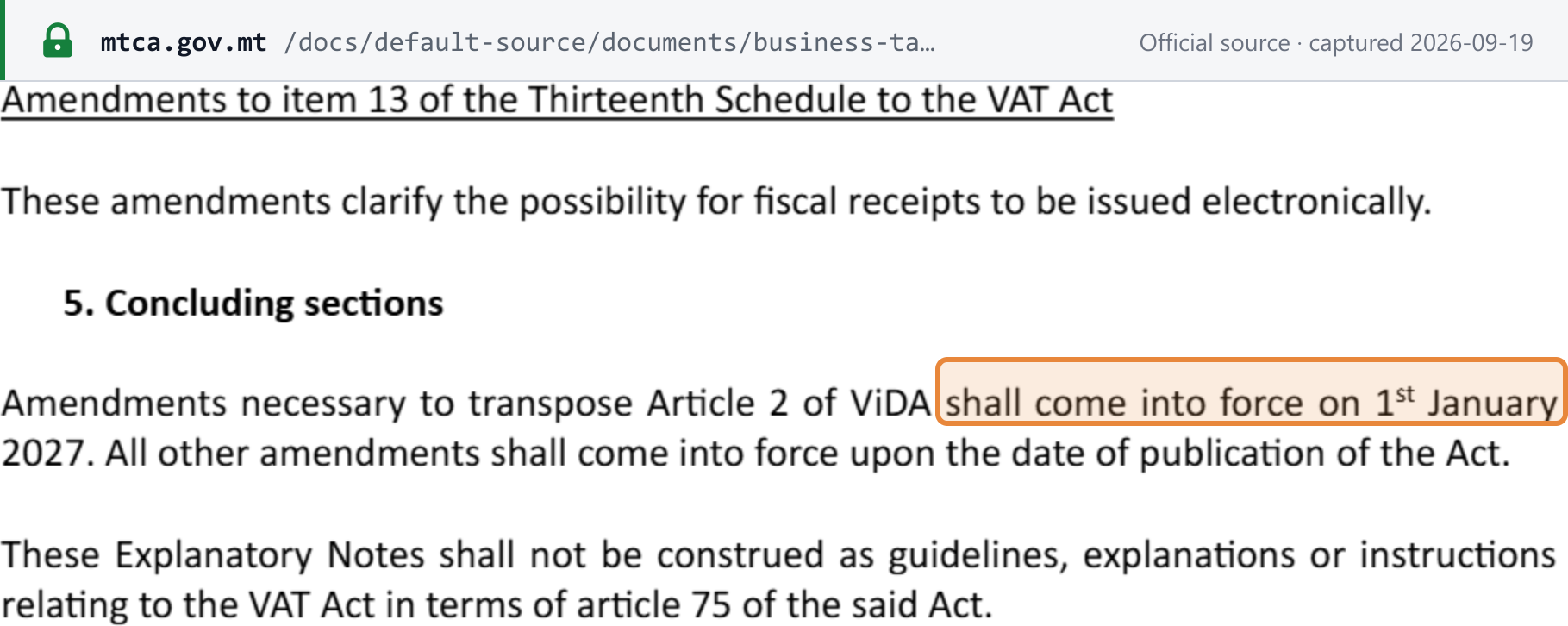
- 2027-01-01 (scheduled, EU-wide) — Commission Implementing Regulation (EU) 2026/1869 of 27 July 2026 amends Implementing Regulation (EU) 2020/194 to carry the ViDA single-VAT-registration changes into the OSS, non-Union OSS and IOSS schemes and the new transfer-of-own-goods scheme, replacing the registration, VAT-return and CCN/CSI message annexes. In force since 17 August 2026; Article 2 applies from 1 January 2027 until 30 June 2028, and Articles 1 and 3 from 1 July 2028. (Publications Office of the European Union) — see the event record and the issue
- 2026-07-13 — MTCA published Guidelines on Issuing a Fiscal Receipt using a Fiscal Cash Register as an Article 11 Exempt SME, directing that a fiscal receipt issued by a fiscal cash register must carry the designation "EXP" preceding the VAT registration number where the supplier is registered under article 11, and that exempt-without-credit supplies under sub-item 16(1) of Part Two of the Fifth Schedule be identified with the letter "E" or the word "Exempt", with the receipt clearly showing that no VAT is charged or payable. The guidelines replace any previous guidelines on the same matter. (MTCA) — see the event record and the issue
- 2026-03-27 — Legal Notice 75 of 2026, published in the Government Gazette of Malta No. 21,612, added scheduled passenger transport services by means of a public lift, recognised as such by the Commissioner, to the exempt-with-credit list in item 11 of Part One of the Fifth Schedule, with "public lift" taking its meaning from regulation 68S of the Passenger Transport Services Regulations. The regulations carry no separate commencement clause. (Legislation Malta)
- 2026-03-10 — Act III of 2026 (Budget Measures Implementation Act, 2026), published in the Government Gazette of Malta No. 21,599, was assented to. Beyond the ViDA transposition above, its non-deferred VAT amendments took effect on publication: article 10(4) extended to require non-established persons making exempt-with-credit supplies in Malta to be identified for VAT; article 49 rewritten so that indicated prices are VAT-inclusive by default; a new anti-abuse rule in item 15 of the Second Schedule taxing free-of-charge services where input VAT was claimed; a transfer-pricing rule for VAT in item 8A of the Seventh Schedule transposing Article 80 of the EU VAT Directive; refunds withheld where a VAT or income tax return is outstanding, with a new set-off power (article 24); fiscal cash registers allowed an electronic journal and "issuance" in place of "printing" (Thirteenth Schedule, item 13), which MTCA's notes say clarifies that fiscal receipts may be issued electronically; and the deletion of article 83(1), removing the need for the Commissioner's sanction before a VAT prosecution. (Legislation Malta; MTCA explanatory notes)
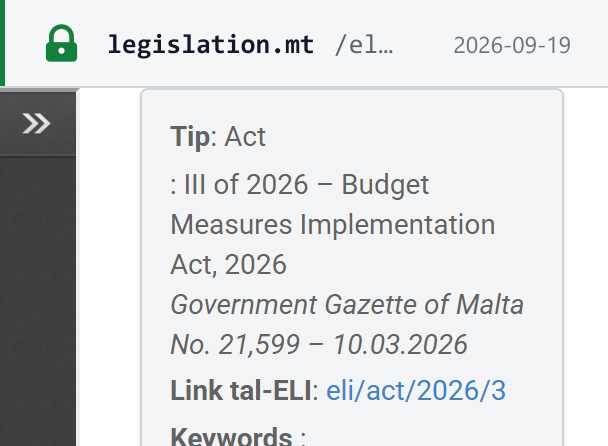
- 2025-01-01 — The EU small-enterprise scheme (Council Directive (EU) 2020/285) took effect in Malta through Act XXXVIII of 2024 and Legal Notices 344 to 353 of 2024. The Sixth Schedule was rewritten around a single Domestic threshold of €35,000 and a Union threshold of €100,000, replacing the previous economic-activity-banded thresholds; new articles 11A and 11B created the outbound and inbound cross-border SME registrations; and S.L. 406.02 regulation 3 was substituted so that a registered person under the Domestic threshold is assigned a 12-month tax period unless the Commissioner decides otherwise. (MTCA explanatory notes; S.L. 406.02)
- 2022-09-01 — The default interest rate on unpaid VAT rose to 0.6% per month or part month under the Value Added Tax (Rate of Interest) Regulations as amended by L.N. 227 of 2022; balances that became payable before that date continue to attract 0.33%. (S.L. 406.19)
- 2004-01-01 — The standard rate rose from 15% to 18%: Act II of 2004, Part X, article 66 substituted "eighteen per cent" for "fifteen per cent" in article 19 of the VAT Act, and article 65(2) deems that Part to have come into force on 1 January 2004. It has not changed since. (Legislation Malta)
Reference links
- Legislation Malta — Value Added Tax Act, Chapter 406 (consolidated) [1]
- MTCA — Registrations & De-Registrations FAQs (published 11 June 2025, last updated 20 February 2026, PDF) [2]
- MTCA — VAT Rates & Exemptions FAQs (12 June 2025, PDF) [3]
- MTCA — Tax Invoices and Fiscal Receipts FAQs (13 June 2025, PDF) [4]
- Legislation Malta — L.N. 86 of 2026, Value Added Tax Act (Amendment of Fifth Schedule) (Amendment No. 2) Regulations, 2026 [5]
- MTCA — Guidelines on Item 9 of Part Two of the Fifth Schedule to the Value Added Tax Act (6 April 2026, PDF) [6]
- MTCA — E-Invoicing and DRR [7]
- Ministry for Finance (Malta) — eInvoicing and the Government of Malta [8]
- Legislation Malta — S.L. 406.02, Value Added Tax (Tax Period) Regulations [9]
- Legislation Malta — S.L. 406.19, Value Added Tax (Rate of Interest) Regulations [10]
- Legislation Malta — S.L. 406.21, Value Added Tax (Registration as a Single Taxable Person) Regulations [11]
- MTCA — Explanatory Notes: 2026 Budget changes to the VAT Act (PDF) [12]
- MTCA — Explanatory Notes: SMEs VAT 2025 (PDF) [13]
- Legislation Malta — Act II of 2004 (Budget Measures Implementation Act, 2004) [14]
- MTCA — Guidelines on Issuing a Fiscal Receipt using a Fiscal Cash Register as an Article 11 Exempt SME (13 July 2026, PDF) [15]
- Legislation Malta — S.L. 406.14, Value Added Tax (Recapitulative Statement of Intra-Community Transactions) Regulations [16]
- MTCA — VAT Rates [17]
- MTCA — VAT Grouping [18]
- MTCA and Malta Gaming Authority — Enhancements to Malta's VAT and Gaming Tax Frameworks for the Gaming Sector (press release, PDF) [19]
- Legislation Malta — Act III of 2026 (Budget Measures Implementation Act, 2026) [20]
- Legislation Malta — L.N. 75 of 2026, Value Added Tax Act (Amendment of Fifth Schedule) (Amendment) Regulations, 2026 [21]
- Publications Office of the European Union — Commission Implementing Regulation (EU) 2026/1869 [22]
- Ministerstwo Finansów (Poland) — Rząd przyjął projekt, który usprawni funkcjonowanie pakietu VAT e-commerce (2 September 2026) [23]
- Legislation Malta — S.L. 601.10, Electronic Invoicing in Public Procurement Regulations [24]
- Lookuptax — Poland VAT guidelines
- Lookuptax — Malta e-invoicing guide
- Lookuptax — Malta tax ID guide
- Lookuptax — Official links to check VAT numbers worldwide
- Lookuptax — E-invoicing status and the networks worldwide