United Arab Emirates VAT guidelines
| FACTSHEET | |
|---|---|
| Country code | AE |
| Tax name | Value Added Tax (VAT) |
| Tax Authority | Federal Tax Authority (FTA) |
Overview
The United Arab Emirates levies Value Added Tax (VAT) at a standard rate of 5% on the supply and import of goods and services. VAT was introduced by Federal Decree-Law No. 8 of 2017, which came into effect on 1 January 2018 (Article 85); the 5% standard rate is set by Article 3 of the Decree-Law. [1] VAT is administered by the Federal Tax Authority (FTA). [2]
The UAE also introduced a federal Corporate Tax for financial years starting on or after 1 June 2023, but this guide focuses on VAT and indirect-tax compliance.
 Source snapshot captured 19 July 2026 — original (u.ae — the UAE government portal)
TRN & registration
VAT registration is completed online through the FTA's EmaraTax platform. On approval, the business is issued a Tax Registration Number (TRN), which appears in the dashboard of the taxpayer's e-Services account; the FTA's stated processing time is 20 business days from receipt of a completed application. [1]
- Mandatory registration — AED 375,000. A UAE-resident business must register if the total value of its taxable supplies and imports exceeded AED 375,000 over the previous 12 months, or is anticipated to exceed it within the next 30 days. This threshold does not apply to foreign businesses — non-residents making taxable supplies in the UAE must register regardless of value. [2]
- Voluntary registration — AED 187,500. A business may register voluntarily if its taxable supplies and imports, or its taxable expenses, exceeded AED 187,500 in the previous 12 months. [2]
 Source snapshot captured 19 July 2026 — original (Federal Tax Authority)
You can check a UAE TRN with our United Arab Emirates TRN validator.
Tax rates
- Standard rate: 5% — applies to most supplies and imports of goods and services (Article 3, Federal Decree-Law No. 8 of 2017). [1]
- Zero rate: 0% — Article 45 of the Decree-Law zero-rates, among others: direct or indirect exports outside the Implementing States; international transport of passengers and goods; supply of certain means of transport (air, sea, land) and related goods/services; investment precious metals; the first supply of residential buildings within 3 years of completion; supply or import of crude oil and natural gas; specified education services (government-owned or funded institutions); and preventive and basic healthcare services. [1]
- Exempt — Article 46 exempts: specified financial services; the supply of residential buildings (other than the zero-rated first supply); bare land; and local passenger transport. Exempt suppliers cannot recover input VAT on related costs. [1]
- Free zones and Designated Zones — a free zone is not outside UAE VAT by default. Only zones on the Cabinet's List of Designated Zones [3] that meet Article 51(1) of the Executive Regulation get special treatment, and then only for certain supplies of goods; services there are taxed at 5% as in the mainland (Executive Regulation Art 51(6)). [4] See UAE free zones and VAT Designated Zones for the Dubai list and worked examples.
Excise tax (separate from VAT)
The UAE also levies Excise Tax, a distinct tax from VAT, under Federal Decree-Law No. 7 of 2017 on Excise Tax, on tobacco products, energy drinks, carbonated drinks, sweetened drinks, and electronic smoking devices and the liquids used in them. It is administered by the FTA but has its own registration, price-floor and calculation rules — a change to an Excise Price does not touch the 5% VAT rate or the VAT registration thresholds described above.
Cabinet Decision No. 137 of 2026, issued 24 July 2026, repeals Cabinet Decision No. 55 of 2019 and sets new minimum Excise Price floors — the tax base Excise Tax is calculated on, not a change to the tax rate itself — for tobacco products and, for the first time, for liquids used in electronic smoking devices and tools. Effective 1 September 2026, the Excise Price for these goods must be not less than: [1]
- AED 0.4 per cigarette (normal or electrically-heated)
- AED 0.1 per gram of water pipe tobacco, ready-to-use tobacco and similar products
- AED 1 per 1 ml of liquid used in electronic smoking devices and tools, whether or not it contains nicotine — a newly regulated category with no prior minimum price floor
The Excise Price itself continues to be determined under Article 11 of Cabinet Decision No. 197 of 2025; Decision No. 137 only sets the floor beneath it, so a declared price cannot understate the tax base. Excise-registered importers, producers and traders of tobacco and e-liquid products should recalculate their declared Excise Price against these floors from 1 September 2026. This is unrelated to FTA Decision No. 13 of 2026 below, a separate instrument on VAT input-tax supplier verification.
FTA directives on tax transactions
Alongside the VAT Decree-Law and its Executive Regulation, the Federal Tax Authority publishes Directives on Tax Transactions on its legislation portal. Five 2026 directives have been published there, all in July 2026 — three of them (Nos. 3, 4 and 5) across mid-to-late July: [1]
| Directive | Subject | Date |
|---|---|---|
| No. 1 of 2026 | Judicial Expert Services | 10 July 2026 (portal Publish Date); issued 8 July 2026 |
| No. 2 of 2026 | Adjustments of Output Tax and Input Tax following a Registrant's exit from a Tax Group | 10 July 2026 (portal Publish Date); issued 8 July 2026; effective 1 August 2026 |
| No. 3 of 2026 | Method of Converting the Value of Digital Currencies into UAE Dirham | 17 July 2026 (portal Publish Date); issued 14 July 2026 |
| No. 4 of 2026 | Fees and Charges forming part of the Life Insurance Contract and life reinsurance contract | 14 July 2026 (signed) |
| No. 5 of 2026 | Method to Determine the Value of Deemed Supplies of Services | 20 July 2026 (signed) |
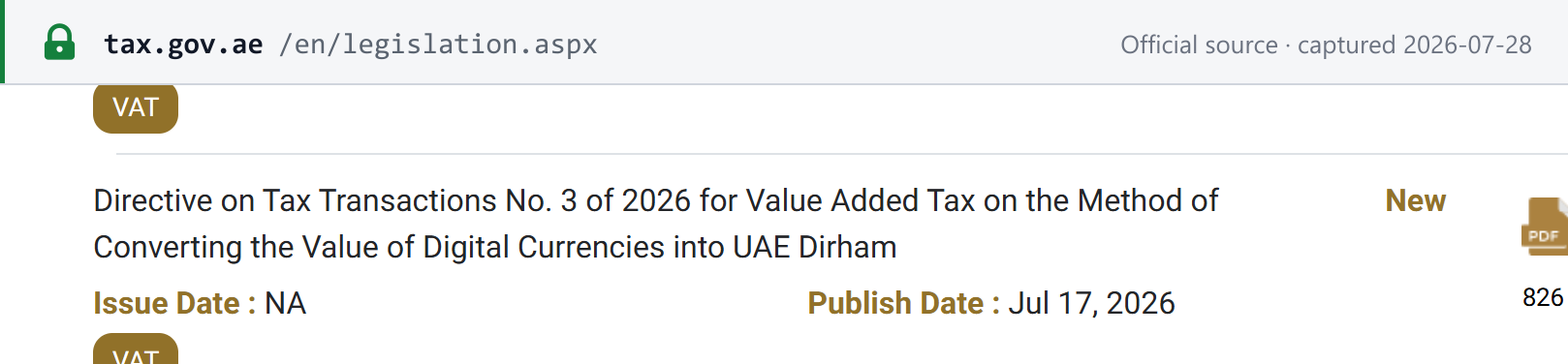 Source snapshot captured 2026-07-28 — original
The dates in the table are, for Nos. 1 and 2, the portal Issue Date; for Nos. 3, 4 and 5, the portal's own Issue Date field shows NA, so this guide instead cites the signature date printed on each directive's own closing page (given in both the Hijri and Gregorian calendars): Directive No. 3 is signed 14 July 2026 (29 Muharram 1448H), Directive No. 4 is signed 14 July 2026 (29 Muharram 1448H), and Directive No. 5 is signed 20 July 2026 (6 Safar 1448H). [1] [2] [3] [4]
Directive No. 3's own signature block reads "Issued on 29 Muharram 1448H Corresponding to 14 July 2026"; the FTA legislation portal's Publish Date of 17 July 2026 is when it was posted, not when it was issued. Nos. 1 and 2 carry a portal Issue Date of 10 July 2026 matching their publication date; their own signature blocks (each dated in the Hijri and Gregorian calendars) show 8 July 2026 in both cases — Directive No. 1 reads "Issued on 23 Muharram 1448H, Corresponding to 8 July 2026," identically formatted to No. 2's own block.
Directive No. 1 of 2026 (Judicial Expert Services), issued 8 July 2026, provides that where a natural or legal person registered in the Roster of Experts with the Ministry of Justice, a local judicial authority, or an arbitration centre (a "Judicial Expert") is appointed by a competent court to provide expert services, those services are supplied in the course of a Business in the UAE and constitute Taxable Supplies under Articles 1 and 2 of the VAT Law. Any amount the Judicial Expert receives for the services is Consideration for a supply of services under Article 1. The Judicial Expert must comply with all legally prescribed tax obligations, including registering for VAT under Article 13 of the VAT Law and Article 7 of the VAT Executive Regulation where the registration conditions are met and it is not already registered — and receiving the consideration from a government entity does not change the tax treatment of the supply. [5]
Directive No. 2 of 2026 (Adjustments of Output Tax and Input Tax following a Registrant's exit from a Tax Group), issued 8 July 2026, is effective from 1 August 2026. Where a Person ceases to be a member of a VAT Tax Group but remains a VAT Registrant, and there are adjustments relating to Taxable Supplies made or Taxable Expenses incurred by that Person before leaving the Tax Group — where those supplies or expenses were previously declared in the Tax Group's own Tax Returns — the Registrant must make those adjustments in its own Tax Returns, in accordance with the VAT Law and its Executive Regulation. Adjustments include reductions in the value of previously declared Taxable Supplies and reductions in the value of Taxable Expenses on which Input Tax was previously recovered through the Tax Group's returns. The Registrant must retain the supporting documents and records evidencing that the adjustments relate to Taxable Supplies or Taxable Expenses declared before it left the Tax Group. [4]
Directive No. 3 of 2026 (signed 14 July 2026) is the one to act on if you take consideration in digital currency. UAE VAT is accounted for in dirhams, so the conversion method you apply feeds straight into your output-tax figures, your tax-invoice amounts and your record-keeping. Read the published directive on the FTA legislation portal (tax.gov.ae) and align your conversion and documentation method to it before your next VAT return — several third-party summaries circulating since publication describe a specific conversion mechanic that the FTA's published listing does not itself state, so do not configure a tax engine from those. [1]
Directive No. 4 of 2026 (signed 14 July 2026) provides that services connected with a life insurance or life reinsurance contract are treated as forming part of the VAT-exempt supply of life insurance, provided all three conditions hold: the services are necessary for making that supply; they are directly connected with the provision or transfer of ownership of the contract; and the consideration for them forms an integral part of the total consideration payable under the contract — per Article 42 of the VAT Executive Regulation. Fees for managing, operating or executing a life insurance/reinsurance contract are the kind of charge this covers. A service that is independent in nature, or for which a separate consideration is charged, remains a distinct taxable supply. Insurers and reinsurers should test their fee and charge schedules against this bundling test rather than assuming a blanket exemption for anything billed as a life-insurance fee. [2]
Directive No. 5 of 2026 (signed 20 July 2026) sets the method for valuing a deemed supply of services under Article 37 of the VAT Law: the value is the total costs — direct and indirect — on which the taxable person incurred input tax to make that supply. The mechanism: (1) determine the open market value of the services (or of comparable services, where the deemed supply's own open market value cannot be determined); (2) strip out the profit element by dividing that open market value by (1 + the net profit margin) — using the taxable person's own margin from its preceding financial year, or the prevailing sector average where the taxable person's own margin cannot be determined; (3) calculate what percentage of the taxable person's total costs for that preceding financial year carried input tax; and (4) apply that percentage to the estimated total cost from step (2). The resulting figure is the Article 37 value of the deemed supply. [3]
FTA decisions on input tax and record-keeping
Separately from the Directives above — which interpret how VAT applies to particular supplies — the FTA issues numbered Decisions that impose procedural obligations. Three of the 2026 Decisions bear directly on VAT compliance, and two of them condition input-tax recovery itself.
Decision No. 13 of 2026 — supplier verification before deducting input tax
Issued 22 July 2026, effective 1 October 2026. It conditions input-tax recovery on documented supplier checks, setting out the measures, procedures and conditions a taxable person must fulfil to verify the validity and integrity of supplies received before deducting input tax under Article 54 bis of the VAT Law: [6]
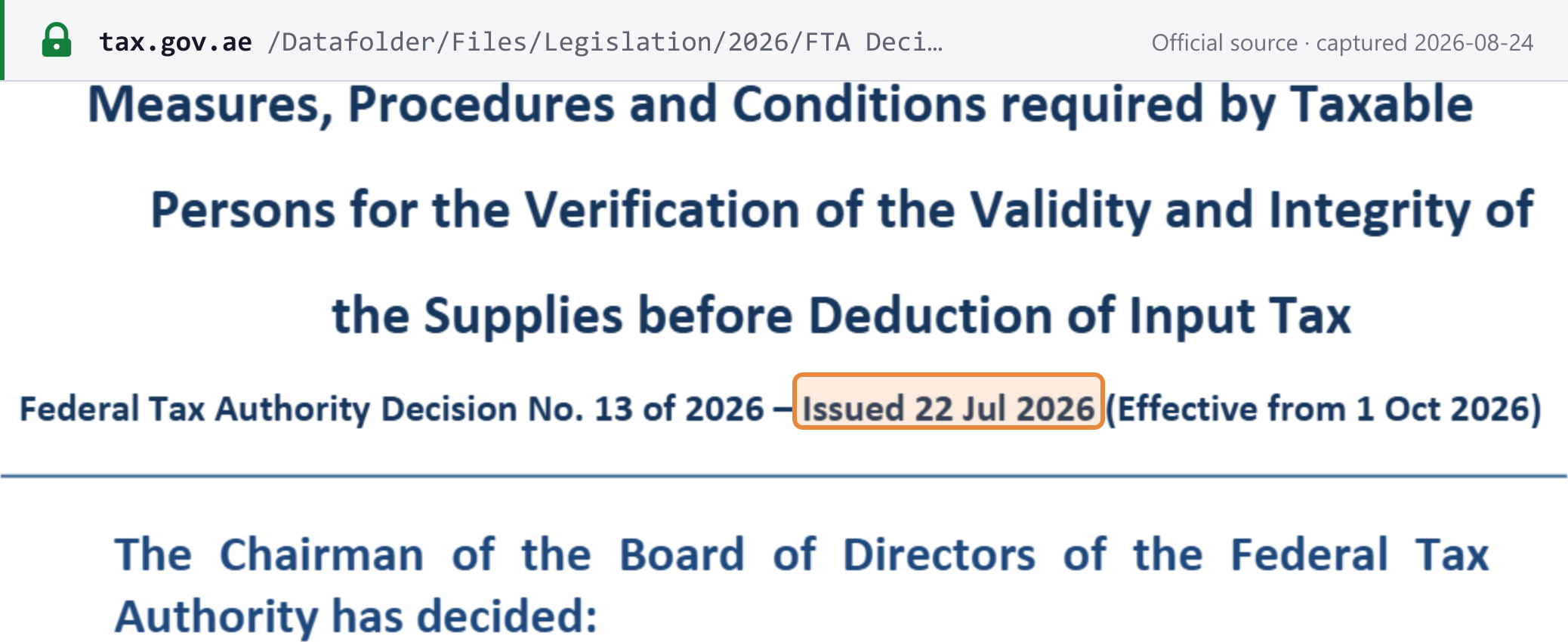 Source snapshot captured 2026-08-24 — original
Decision No. 13 applies "Article 54(bis) of the VAT Law", but the consolidated Federal Decree-Law No. 8 of 2017 PDF published on the FTA portal is consolidated only to Federal Decree-Law No. 18 of 2022 and contains no Article 54 bis. The FTA's archive separately lists an amendment effective 30 October 2024 that the live consolidation has not absorbed. The obligation stands on Decision No. 13's own text; a reader following the VAT-law link to check will not find the article there.
Article 2 – Scope of Application: For the purposes of applying the provisions of Article 54(bis) of the VAT Law, the provisions of this Decision shall apply to the Taxable Persons in relation to the verification of the validity and integrity of the supplies they receive before deduction of Input Tax.
What the verification covers:
| Check | Detail |
|---|---|
| Supplier identity — natural person | Valid proof of identity, including an Emirates ID or a passport, plus a meeting with the supplier in person or virtually before the supply is made (Art. 3(1)) |
| Supplier identity — legal person | Verify incorporation through official databases or obtain the certificate of incorporation, and separately identify the authorised director, agent or employee by Emirates ID or passport (Art. 3(1)) |
| Place of business | Verify an actual place of business by appropriate electronic means or a field visit, and that it is compatible with the supplier's activities (Art. 3(2)) |
| Risk indicators | Three, each quantified (Art. 3(3)(a)): address changed more than twice in the previous 12 months; key employees changed more than twice in the previous 12 months; transactions disproportionate to the size and history of the business. Where one applies, retain a justified explanation and produce it on request |
| Bank account | An unconditional written confirmation from an authorised bank in the State where supplies from that supplier exceed AED 375,000 over the previous 12 months or are expected to exceed it over the next 12 — together with a review of publicly available reviews and media coverage of the supplier (Art. 3(4)) |
| The supply itself | Commercial plausibility; authenticity and origin of the goods and the supplier's right to dispose of them; and consideration paid by electronic means, cash being allowed only on a documented commercial reason within the statutory thresholds (Art. 4) |
| Cadence | On first dealing, and again on recurrent dealings where the supplier has not been verified in the previous 12 months (Art. 5(1)) |
| Documentation | Every step documented and retained, under a documented policy naming the persons responsible for implementing, reviewing and supervising the checks (Art. 5(4)) |
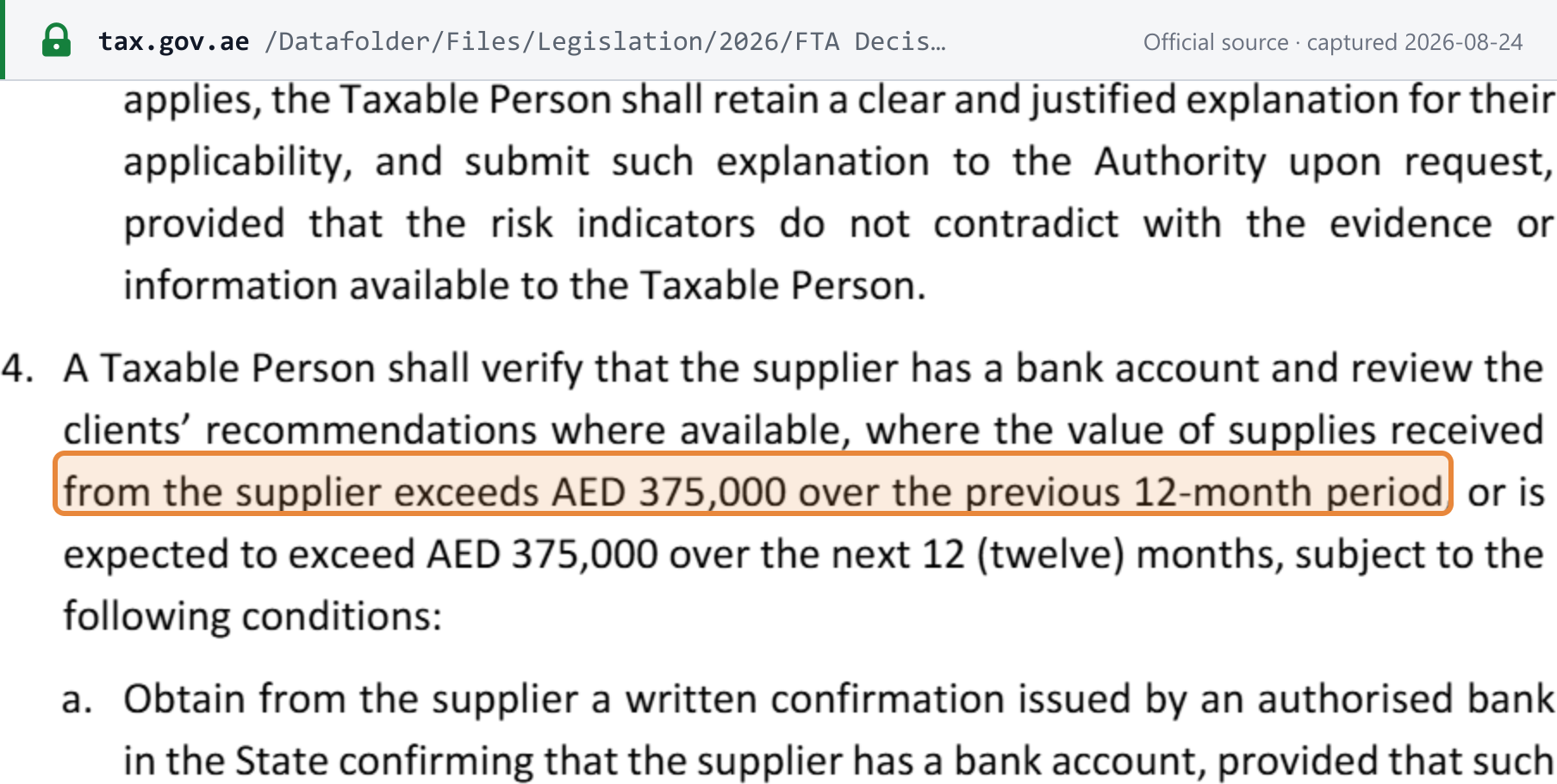 Source snapshot captured 2026-08-24 — original
The de-minimis, and the trap inside it. Article 6(1) lets a taxable person disregard these measures where the consideration for the taxable supply, excluding VAT, is less than AED 10,000. But Article 6(2) switches that exception off altogether:
The exception stipulated in Clause 1 of this Article shall not apply where the total value of supplies received from the supplier exceeds AED 100,000 over the previous 12 (twelve) months, or is expected to exceed this amount over the next 12 (twelve) months.
So the relief is per supply and capped per supplier. A buyer expecting AED 9,000 of supplies monthly from one supplier — each one under AED 10,000 — expects AED 108,000 over the next 12 months (12 × 9,000), so the exception never applies, even to the first supply; a buyer that did not foresee it loses the exception once the previous 12 months' total passes AED 100,000 — the opposite of how a per-supply threshold usually behaves, and the reason a purely invoice-level test will not implement this correctly.
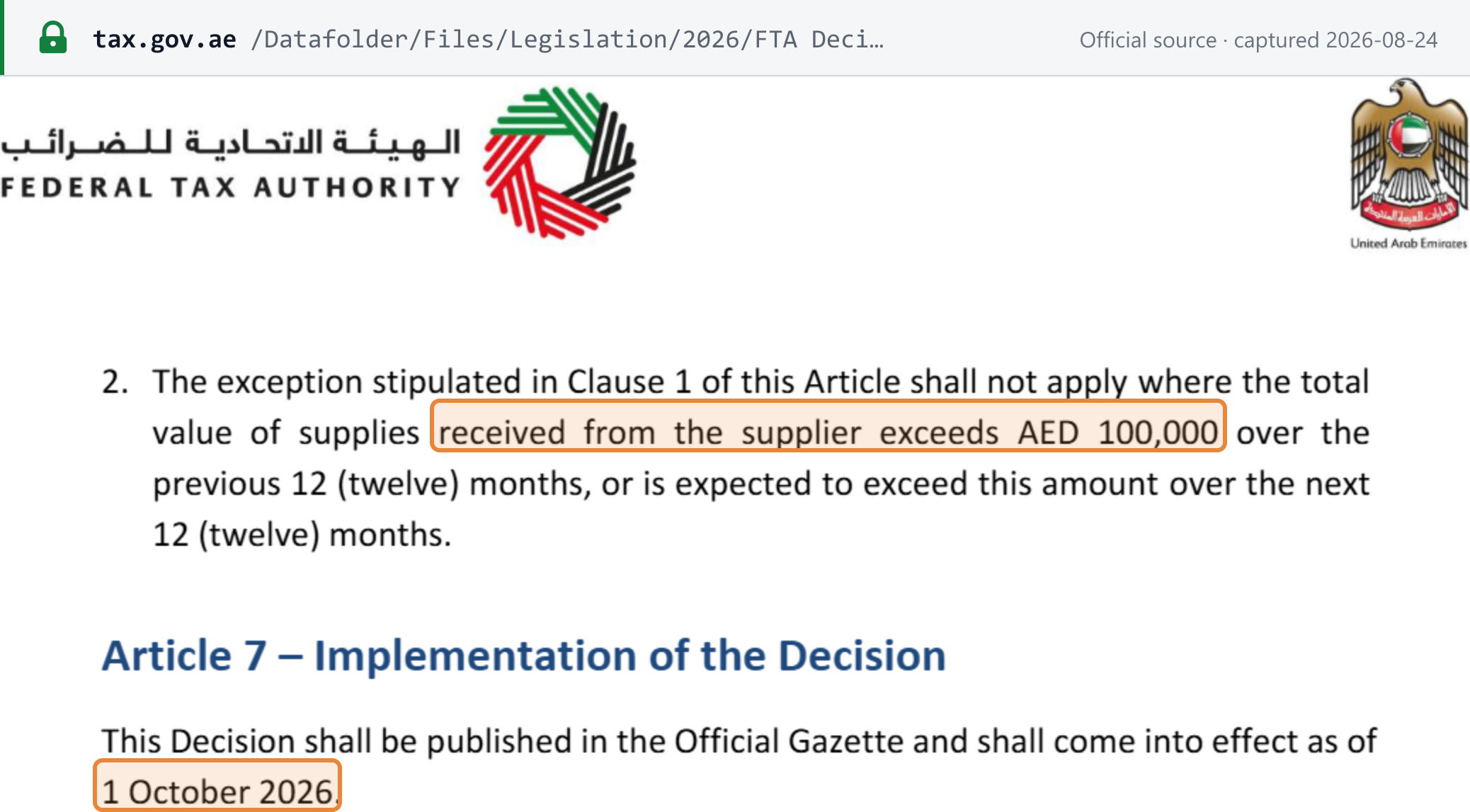 Source snapshot captured 2026-08-24 — original
The practical shift is in where the burden sits. Input tax has always required a valid tax invoice; from 1 October it also requires evidence that you examined who issued it, and that the evidence was kept. Because the decision requires each step to be documented, the check has to live in the purchase-to-pay system rather than in a buyer's judgement — and the AED 375,000 trigger is low enough to catch ordinary trading relationships rather than only unusual ones. See the event record.
Decision No. 4 of 2026 — keeping accounting records electronically
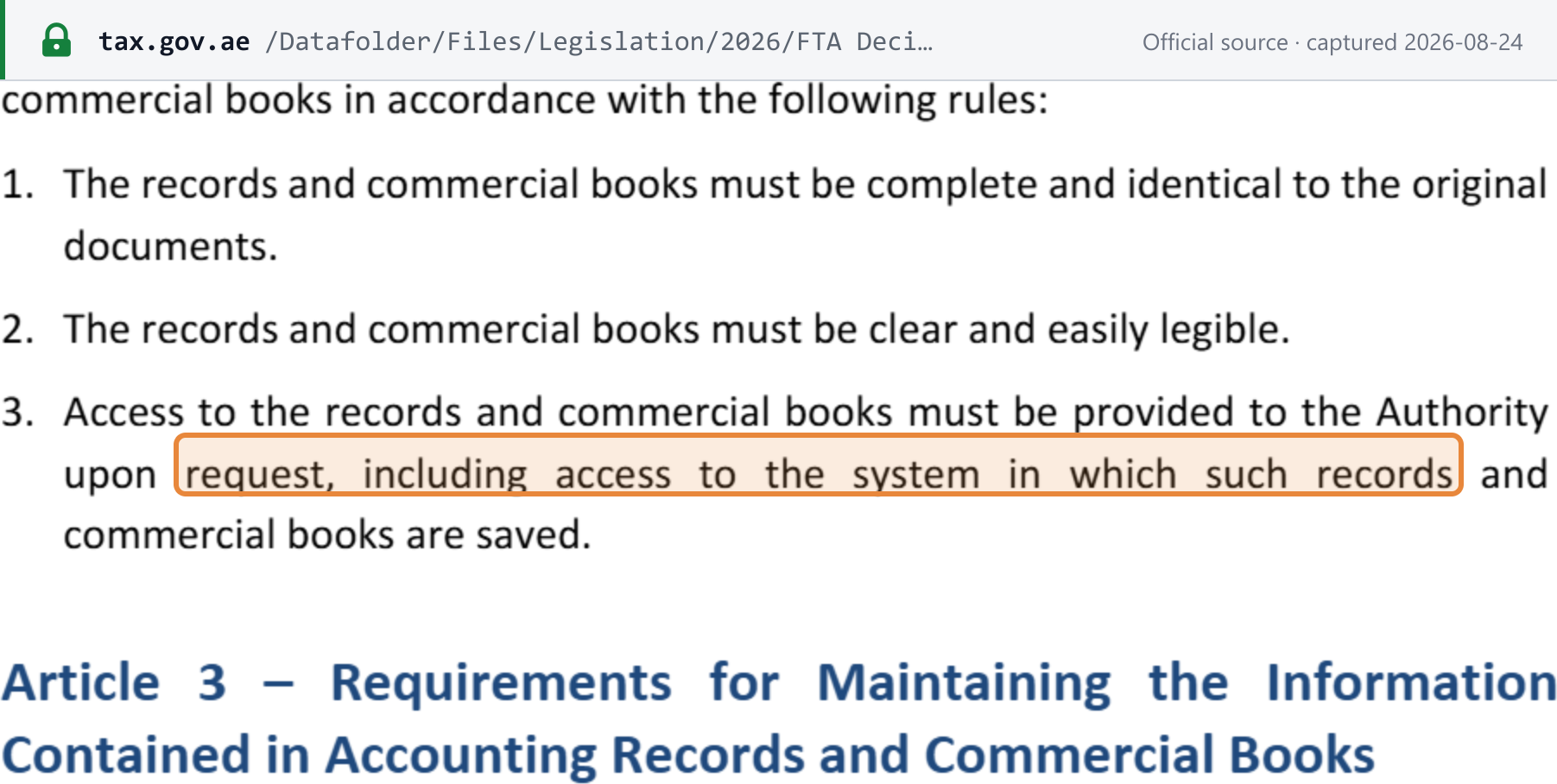
Issued 2 June 2026, effective 30 July 2026. It sets the rules for maintaining the information in accounting records and commercial books as electronic copies or photocopies rather than originals: [7]
A Person is required to maintain the information contained in accounting records and commercial books in accordance with the following rules: 1. The records and commercial books must be complete and identical to the original documents. 2. The records and commercial books must be clear and easily legible. 3. Access to the records and commercial books must be provided to the Authority upon request, including access to the system in which such records and commercial books are saved.
Third-party record-keeping is permitted, but the registrant remains legally responsible. The requirement that bites hardest is the third: a record that is complete and legible but sits behind an encryption key or password the Authority cannot obtain does not satisfy the decision, and the obligation extends to providing access to the system, not merely to exporting the files. If you use an external archive, check that your contract lets you deliver that access on demand. The decision is made under Federal Decree-Law No. 28 of 2022 on Tax Procedures, so it reaches all tax registrants, not only VAT ones. See the event record.
 Source snapshot captured 2026-08-24 — original
Decision No. 17 of 2026 — recovering input tax on employee expenses
Issued 9 September 2026, effective 1 October 2026. It sets the cases and conditions for recovering input tax on goods or services bought for employees at no charge where a contractual obligation or documented policy requires them, under Article 53(1)(c)(2) of the VAT Executive Regulation (Cabinet Decision No. 52 of 2017). Article 2 covers employee transport, food and beverages, accommodation (including temporary accommodation for new joiners), mobile and internet services and parking, each subject to listed conditions. [11]
Reverse charge on Metal Scrap (Cabinet Decision No. 153 of 2025)
FTA VAT Public Clarification VATP047 (October 2026) explains the reverse charge on supplies of Metal Scrap between VAT registrants under Cabinet Decision No. 153 of 2025, which applies to Metal Scrap supplied on or after 14 January 2026. The recipient accounts for the VAT on supplies of Metal Scrap for resale or processing, subject to the Decision's conditions, and the supplier and recipient must meet additional compliance requirements before the date of supply. Where the conditions are not met, the supplier accounts for the VAT and the recipient cannot recover the related input tax under article 54(1)(a) and (b) of the VAT Law. [12]
Cabinet Decision No. 149 of 2026 — Executive Regulation amendments
Cabinet Decision No. 149 of 2026, signed 1 September 2026, amends nine provisions of the VAT Executive Regulation (Cabinet Decision No. 52 of 2017) and adds two new ones. Article 3 sets the commencement: the Decision takes effect 1 October 2026, except the revised input-tax apportionment mechanism (Article 55, Clauses 6 and 7, and new Clause 19), which applies only from the first Tax Year commencing after 1 October 2027. [1]
Article 3: 1. This Decision shall be published in the Official Gazette and shall be effective from 1 October 2026. 2. Notwithstanding Clause 1 of this Article, the provisions of Clauses 6 and 7 of Article 55, and Clause 19 of Article 55 of this Decision, shall come into effect from the first Tax year commencing after 1 October 2027.
| Provision amended/added | Effective | What changes |
|---|---|---|
| Article 29, Clause 5 | 1 Oct 2026 | The "purchase price" used for valuing a deemed supply of goods now expressly includes any costs or fees incurred to purchase the good, where the input tax on those costs/fees is itself non-recoverable under Article 54 of the Decree-Law. |
| Article 41, Clause 4 | 1 Oct 2026 | Zero-rating for medical goods is reframed around any medical product specified in a Cabinet decision (rather than a fixed in-Regulation list), plus goods supplied in the course of zero-rated healthcare services that are necessary for that supply. |
| Article 52, Clause 2 | 1 Oct 2026 | The place-of-supply "outside the State" presence test: a person is treated as outside the UAE only if present for less than 30 days and that presence is not effectively connected with the supply. |
| Article 53, Clause 1(c)(1)–(2) | 1 Oct 2026 | Narrows when employer-provided employee accommodation is excluded from the input-tax block for mandatory employee benefits — mandatory accommodation is only carved back in where a Ministry of Human Resources and Emiratisation decision or directive specifically requires it, or under a contractual/documented policy meeting the Authority's conditions. |
| Article 55, Clauses 6 & 7 (replaced) and new Clause 19 | First Tax Year after 1 Oct 2027 | Rewrites the input-tax apportionment mechanism: input tax tied to Article 54(1)/Article 57 supplies is recoverable in full; other input tax follows the Decree-Law default; mixed-use input tax is apportioned by a percentage-of-total-supplies formula, rounded to the nearest whole number. New Clause 19 sets a separate apportionment formula for Government Entities and Charities, based on the ratio of recoverable to total (recoverable + non-recoverable) input tax for the Tax Period. |
| Article 57, Clause 1 | 1 Oct 2026 | Restates the Capital Asset Scheme threshold: a Capital Asset is a business asset costing AED 5,000,000 or more (excluding tax) with an estimated useful life of 10 years or more for a building, or 5 years or more for any other capital asset. |
| Article 60, Clause 1(a) | 1 Oct 2026 | A Tax Credit Note must now clearly display the words "Tax Credit Note" — a new express field requirement layered onto the existing credit-note rules described in Currency, rounding and corrections below. |
| New Article 4, Clause 6 | 1 Oct 2026 | Composite supply: a supply with more than one component may not be treated as multiple supplies where the components are interconnected and inseparable in nature and economic substance — it is a single composite supply, taxed according to its principal component. |
| New Article 54, Clause 3 | 1 Oct 2026 | Input tax may not be recovered on a supply above a value threshold still to be set by the Minister of Finance, where the consideration is paid or intended to be paid in cash — subject to controls the Minister's decision will specify. No threshold amount has been published yet; watch for the implementing Ministerial decision before 1 October 2026. |
Invoice requirements
A tax invoice must be issued and delivered within 14 calendar days from the date of every taxable supply. For the supplier it fixes the date of supply and the tax period in which output tax is accounted for; for the recipient it is the primary documentary evidence supporting VAT recovery. [5]
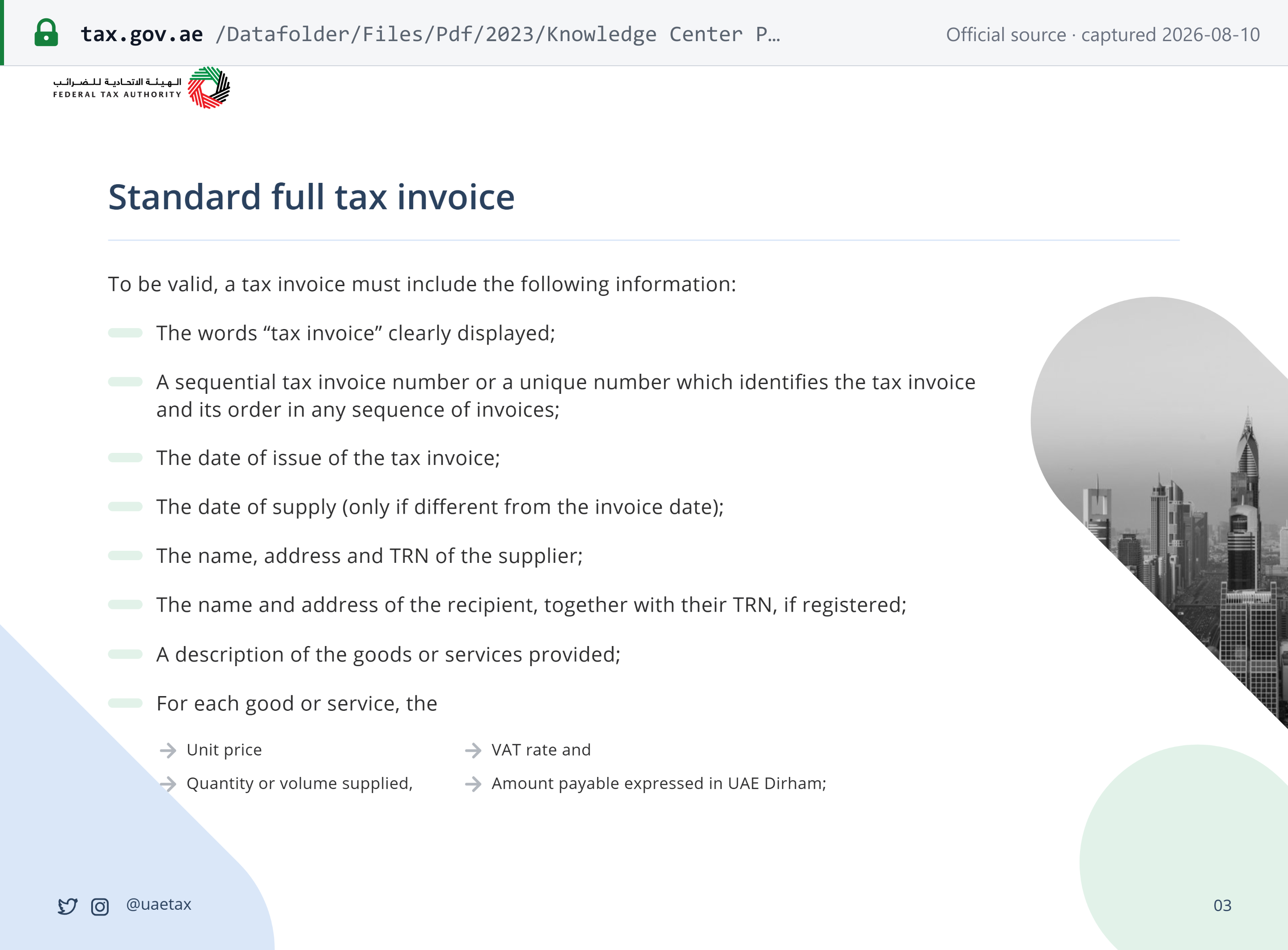
Standard full tax invoice
| Required information | Notes |
|---|---|
| The words "tax invoice" clearly displayed | — |
| A sequential tax invoice number, or a unique number identifying the invoice and its order in any sequence | — |
| Date of issue | — |
| Date of supply | Only if different from the invoice date |
| Name, address and TRN of the supplier | — |
| Name and address of the recipient, together with their TRN if registered | — |
| Description of the goods or services provided | — |
| For each good or service: unit price, quantity or volume supplied, VAT rate, and amount payable expressed in UAE Dirham | Per line item |
| Gross amount payable expressed in UAE Dirham | — |
| The amount of any discount offered | — |
| Total VAT expressed in UAE Dirham, together with the rate of exchange applied and the source of that rate | The exchange-rate source must be stated on the invoice |
| Where the domestic reverse charge applies: a statement that the customer is required to account for VAT, plus a reference to the relevant provision of the Federal VAT law | A bare "reverse charge applies" note is not enough — cite the provision |
 Source snapshot captured 2026-08-10 — original
Simplified tax invoice
A taxable person may issue a simplified tax invoice instead of a full one where either: [5]
- the recipient is not registered for VAT; or
- the recipient is registered and the consideration (VAT-inclusive price) is AED 10,000 or less.
FTA's own worked examples: an individual buying AED 40,000 of clothes → simplified invoice is fine (unregistered recipient). A registered store buying AED 10,001 of clothes → full invoice required (registered recipient, over the threshold).
A simplified tax invoice must contain at least: the term "tax invoice" in a prominent place; the name, address and TRN of the supplier; the date of issue; a description sufficient to identify the goods or services; and the total consideration and VAT charged.
Self-billing (recipient-created tax invoices)
The recipient may issue the tax invoice on the supplier's behalf, provided all of the following hold: the recipient is registered for VAT; the parties agree in writing that the supplier will not issue a tax invoice; the invoice meets every requirement of a standard full tax invoice; and it clearly displays the words "buyer-created tax invoice". [5]
Currency, rounding and corrections
- Invoices issued in a foreign currency must be converted into UAE Dirham using an exchange rate approved by the Central Bank. [5]
- Where the VAT amount is a fraction of a fils, it must be rounded to the nearest fils. [5]
- Errors are corrected via tax credit notes or additional tax invoices — not by reissuing the original. [5] From 1 October 2026, a tax credit note must also clearly display the words "Tax Credit Note" (Cabinet Decision No. 149 of 2026, amending Article 60(1)(a) of the Executive Regulation) — see Cabinet Decision No. 149 of 2026 above. [6]
Electronic invoices, summaries and exceptions
- A tax invoice may be issued electronically provided a copy is securely stored in compliance with the record-keeping requirements, and the authenticity of origin and integrity of content are guaranteed. (This is the pre-existing VAT rule; it is separate from the forthcoming mandatory e-invoicing regime described in E-invoicing below.) [5]
- A summary monthly tax invoice must be issued where the supplier makes more than one supply to the same person in the same calendar month. [5]
- No tax invoice is required for a wholly zero-rated supply where sufficient records exist to establish its details. Where issuing an invoice is genuinely impractical, a taxable person may apply to the FTA for an administrative exception. [5]
What a compliant invoice looks like
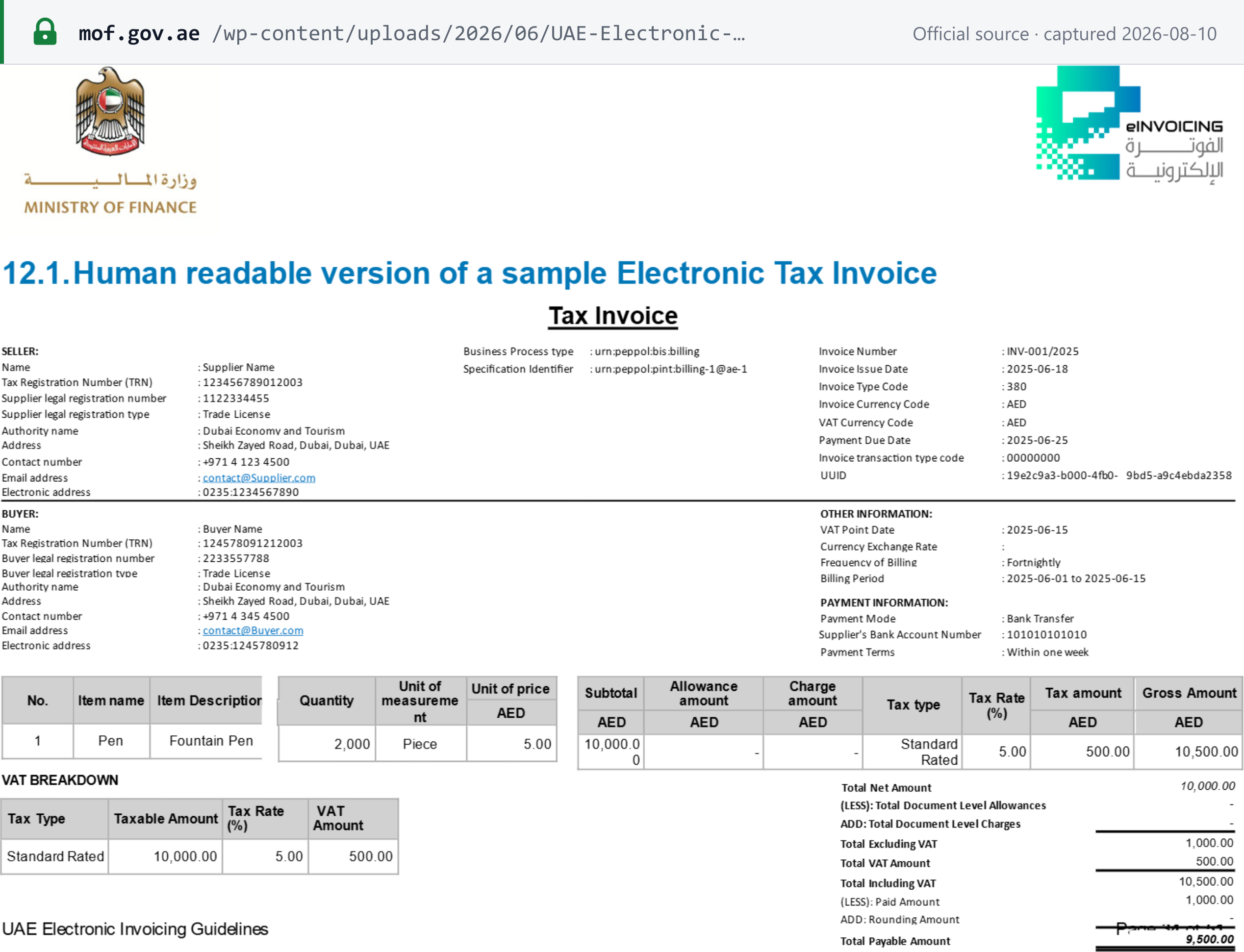
The Ministry of Finance publishes a worked sample of an Electronic Tax Invoice — the human-readable rendering of the PINT AE structured invoice — showing the seller and buyer blocks (each with TRN, legal registration number and type, authority name, address and electronic address), the Peppol business-process and specification identifiers, the invoice header, a line-item table, a VAT breakdown and the totals ladder down to the total payable amount. [8]
Treat it as an illustration of the required data, not a prescribed layout: the UAE mandates the fields and the PINT AE specification, not a visual design — and taxpayers may not add optional fields of their own into PINT AE. [8]
 Source snapshot captured 2026-08-10 — original
Further authority: FTA Decision No. 4 of 2018 on Tax Invoices, FTA Decision No. 7 of 2019 on Tax Invoices and Tax Credit Notes, and VAT Public Clarification VATP006.
E-invoicing
For the complete rollout — phases, scope and exclusions, PINT AE format, ASP onboarding and penalties — see our UAE e-invoicing guide.
The UAE is rolling out a national Electronic Invoicing System based on a Decentralised Continuous Transaction Control and Exchange (DCTCE) model — a Peppol five-corner architecture in which the supplier (Corner 1) and buyer (Corner 4) exchange invoices through Accredited Service Providers (ASPs) (Corners 2 and 3), with tax data reported to the FTA (Corner 5). Electronic invoices are exchanged as XML based on the Peppol PINT AE specification. [1]
Legal framework. The system is framed by Ministerial Decision No. 243 of 2025 (scope and obligations of the Electronic Invoicing System) and Ministerial Decision No. 244 of 2025 (implementation timeline), supported by Ministerial Decision No. 64 of 2025 (ASP accreditation) and Cabinet Decision No. 106 of 2025 (violations and penalties). In 2026 the Ministry of Finance issued targeted amendments: Ministerial Decision No. 66 of 2026 amends Decision 244, and Ministerial Decision No. 56 of 2026 amends Decision 64. [1] [2]
4-corner launch (April 2026). On 21 April 2026 the Ministry of Finance launched the optional eInvoicing 4-Corner model: businesses select an MoF-accredited Service Provider through the FTA's EmaraTax system, complete onboarding, and begin exchanging structured e-invoices between Corner 1 and Corner 4 ahead of the tax-reporting (Corner 5) go-live and the July pilot. [3]
Pilot and voluntary phase (from 1 July 2026). Electronic invoicing commenced on 1 July 2026 with a Pilot Programme for a selected group of taxpayers who agree in writing to participate; the MoF announced the pilot launch of the 5-Corner model on 26 June 2026. All businesses, regardless of revenue, may implement e-invoicing voluntarily from 1 July 2026 — administrative penalties apply only from a business's mandatory implementation date. [4] [5]
Mandatory timeline. Under Ministerial Decision No. 244 of 2025 as amended: [2] [5]
| Entity | Annual revenue | Appoint ASP by | Implement e-invoicing from |
|---|---|---|---|
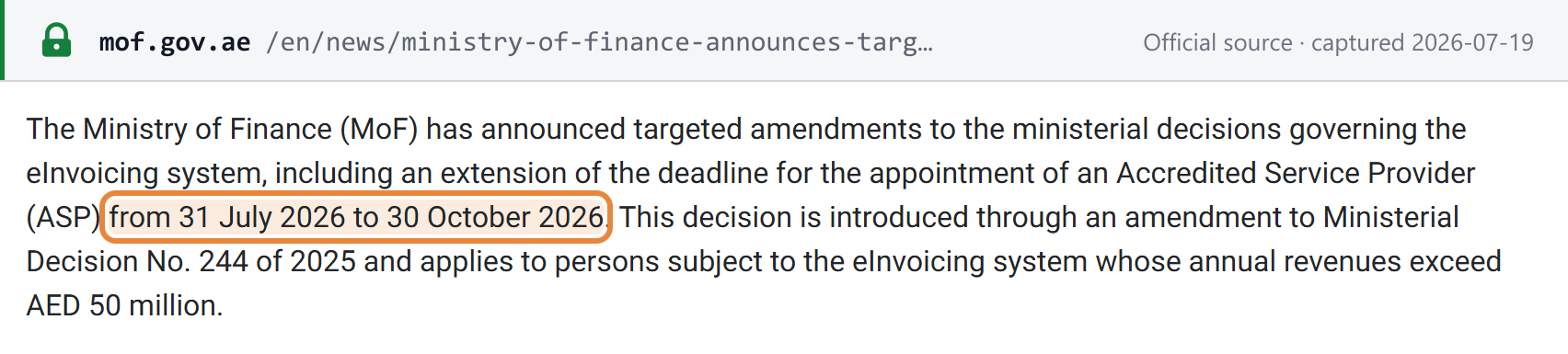
| Business | ≥ AED 50,000,000 | 30 October 2026 (extended from 31 July 2026) | 1 January 2027 |
| Business | < AED 50,000,000 | 31 March 2027 | 1 July 2027 |
| Government entity | N/A | 31 March 2027 | 1 October 2027 |
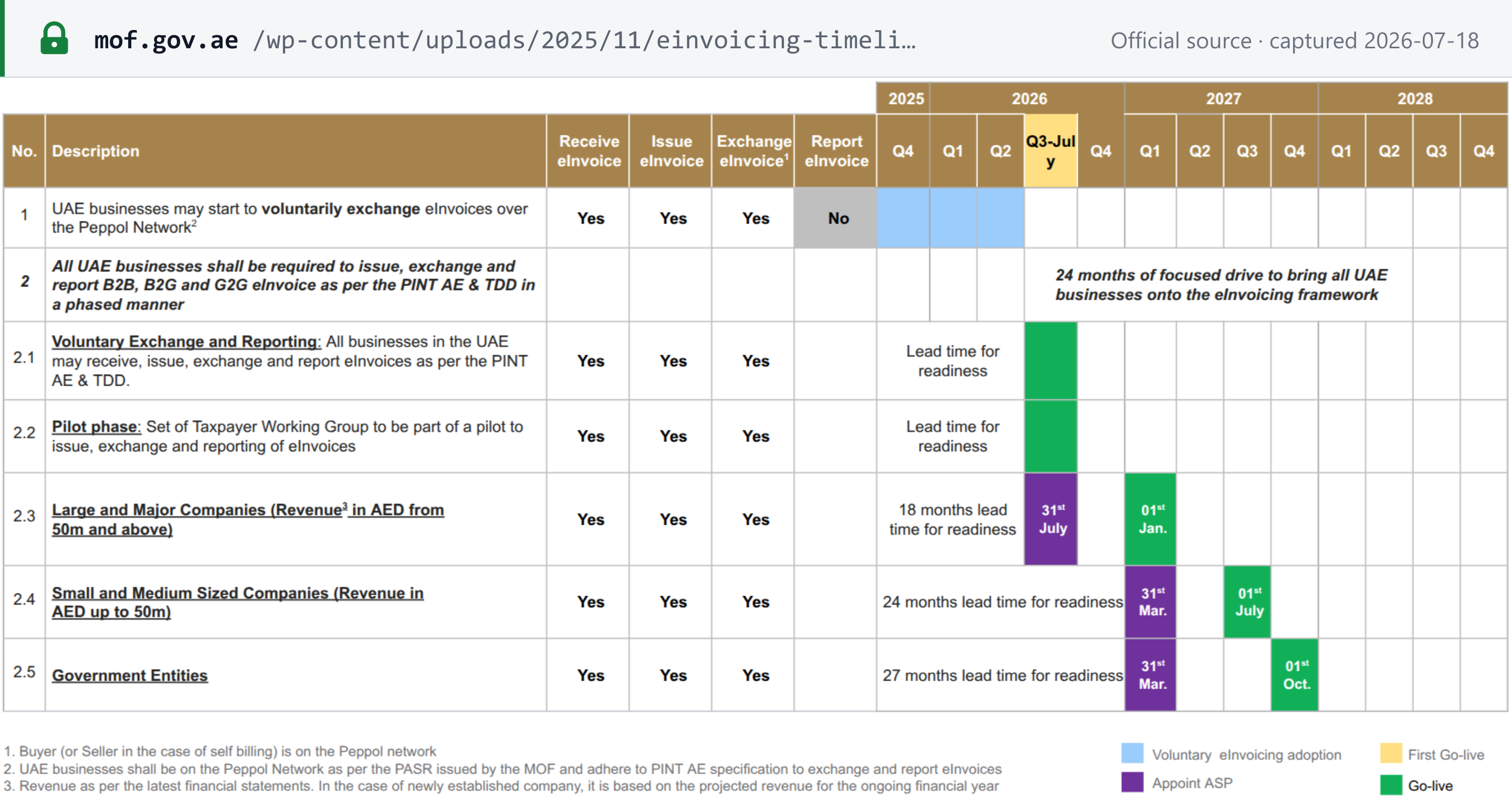 Source snapshot captured 18 July 2026 — original (UAE Ministry of Finance); the 30 October 2026 ASP extension is per the May 2026 amendments announcement:
 Source snapshot captured 19 July 2026 — original (UAE Ministry of Finance)
Re-verified 3 August 2026 directly against the legislative text: the Ministry of Finance's consolidated republication of Ministerial Decision No. 244 of 2025 carries a footnote on Article 5(1)(a) — "Paragraph amended as per Ministerial Decision No. 66 of 2026" — confirming the ≥ AED 50,000,000 threshold's ASP deadline is 30 October 2026 (with mandatory implementation from 1 January 2027) and that the sub-AED-50m and government-entity phases in the table above are unchanged. [6]
Scope. E-invoicing applies to B2B and B2G business transactions (including G2B and G2G), regardless of VAT registration status. Supplies made to consumers (B2C) are not in scope — there is no obligation to issue an electronic invoice for a supply to a consumer. Transactions between members of the same VAT group are in scope but benefit from a 24-month grace period starting 1 January 2027. A person in scope must appoint one ASP for both sending and receiving; the Peppol participant identifier issued by the FTA is 0235 followed by the person's 10-digit TIN. [5]
Recent changes
Dated, officially-sourced changes to UAE VAT and e-invoicing, newest first. The full history is in our worldwide tax-updates feed.
- 2026-10-01 — FTA Decision No. 17 of 2026 (issued 9 September 2026) takes effect, setting the cases and conditions for recovering input tax on employee expenses (transport, food and beverages, accommodation including temporary accommodation for new joiners, mobile and internet services, parking) under Cabinet Decision No. 52 of 2017, article 53(1)(c)(2). See Decision No. 17 of 2026. (UAE Federal Tax Authority) — see event
- 2026-10-01 — Cabinet Decision No. 149 of 2026 (signed 1 September 2026) takes effect, amending the VAT Executive Regulation: the deemed-supply purchase-price definition, medical-goods zero-rating, the place-of-supply "outside the State" 30-day presence test, employee-accommodation input-tax blocking, the Capital Asset Scheme threshold restatement (AED 5,000,000), a new "Tax Credit Note" display requirement, composite-supply treatment for interconnected multi-component supplies, and a still-to-be-set cash-payment input-tax restriction. The revised input-tax apportionment mechanism (Article 55, Clauses 6, 7 and new 19) is carved out to the first Tax Year commencing after 1 October 2027. (UAE Ministry of Finance) — see the issue
- 2026-10-01 — FTA Decision No. 13 of 2026 (issued 22 July 2026) makes documented supplier verification a precondition of deducting input tax under Article 54 bis of the VAT Law: identity checks that differ by supplier type, verification of an actual place of business, three quantified risk indicators, an unconditional confirmation from an authorised bank in the State where supplies from a supplier exceed AED 375,000 over the previous 12 months or are expected to over the next 12, payment by electronic means, and retention of the evidence under a documented policy. A per-supply exception applies below AED 10,000 excluding VAT — but it falls away entirely where supplies from that supplier exceed AED 100,000 over 12 months. (Federal Tax Authority) — see the event record and the issue
- 2026-10 — FTA VAT Public Clarification VATP047 (October 2026) explains the reverse charge on Metal Scrap between VAT registrants under Cabinet Decision No. 153 of 2025, applicable to supplies on or after 14 January 2026; where the conditions are not met the supplier accounts for the VAT and the recipient cannot recover the related input tax (article 54(1)(a) and (b)). See Reverse charge on Metal Scrap. (UAE Federal Tax Authority) — see event
- 2026-09-01 — Cabinet Decision No. 137 of 2026 (Excise Tax, issued 24 July 2026, repealing Cabinet Decision No. 55 of 2019) took effect: new minimum Excise Price floors for tobacco products and, for the first time, for liquids used in electronic smoking devices and tools — not less than AED 0.4 per cigarette, AED 0.1 per gram of water pipe/ready-to-use tobacco, and AED 1 per ml of e-liquid. This is an Excise Tax change, separate from VAT and from FTA Decision No. 13 of 2026 above. (UAE Federal Tax Authority / Ministry of Finance) — see issue
- 2026-08-01 — FTA Directive on Tax Transactions No. 2 of 2026 (issued 8 July 2026) takes effect: a Person who ceases to be a member of a VAT Tax Group but remains a VAT Registrant must make adjustments in its own Tax Returns for Taxable Supplies made or Taxable Expenses incurred before leaving the Tax Group, and retain the supporting documentation. (UAE Federal Tax Authority) — see issue
- 2026-07-30 — FTA Decision No. 4 of 2026 (issued 2 June 2026) sets the rules for holding accounting records and commercial books as electronic copies: complete and identical to the originals, clear and easily legible, and accessible to the Authority on request including access to the system they are stored in. Third-party maintenance is permitted but the registrant stays responsible. (Federal Tax Authority) — see the event record and the issue
- 2026-07-20 — FTA Directive on Tax Transactions No. 5 of 2026 (signed 20 July 2026) sets the Article 37 valuation method for deemed supplies of services: open market value of the services (or comparable services), less the profit margin (the taxable person's own net margin, or the sector average), scaled by the ratio of input-tax-bearing costs to total costs. (UAE Federal Tax Authority) — see issue
- 2026-07-14 — FTA Directive on Tax Transactions No. 3 of 2026 on the Method of Converting the Value of Digital Currencies into UAE Dirham is signed 14 July 2026 (29 Muharram 1448H) per its own closing signature block; the FTA legislation portal's 17 July 2026 Publish Date is when it was posted. Alongside Directive No. 4 of 2026 (signed 14 July 2026, life-insurance and life-reinsurance contract fees and charges) and Directive No. 5 of 2026 (signed 20 July 2026, valuation of deemed supplies of services); these follow Directives Nos. 1 and 2 of 2026 (both issued 8 July 2026, judicial expert services and output/input tax adjustments after a registrant exits a Tax Group) — five 2026 directives in all. (UAE Federal Tax Authority) — see the event record and the issue
- 2026-07-14 — FTA Directive on Tax Transactions No. 4 of 2026 (signed 14 July 2026) provides that fees and charges connected with a life insurance or life reinsurance contract form part of the VAT-exempt supply of life insurance where they are necessary for, and directly connected with, that supply and their consideration is an integral part of the contract's total consideration, per Article 42 of the VAT Executive Regulation; services charged independently remain separate taxable supplies. (UAE Federal Tax Authority) — see issue
- 2026-07-13 — UAE e-invoicing rulebook consolidated: Ministerial Decision No. 66 of 2026 amends MD No. 244 of 2025 (ASP appointment deadline for AED 50m+ businesses set at 30 October 2026; mandatory go-live unchanged at 1 January 2027) and MD No. 56 of 2026 amends the ASP accreditation rules, alongside the MoF's Electronic Invoicing Guidelines V1.1 (dated 1 June 2026). (UAE Ministry of Finance) — see issue
- 2026-07-08 — FTA Directive on Tax Transactions No. 1 of 2026 (portal Publish Date 10 July 2026; issued 8 July 2026 per the directive's own signature block) confirms that VAT-registered Judicial Experts appointed by a court, judicial authority or arbitration centre are making taxable supplies under Articles 1–2 of the VAT Law when providing expert services, and must register for VAT under Article 13 once the conditions are met. (UAE Federal Tax Authority) — see the event record and the issue
- 2026-07-01 — The pilot phase of the Electronic Invoicing System (5-Corner model) opened with a selected group of taxpayers; voluntary adoption is available to any business from the same date. (UAE Ministry of Finance) — see issue
- 2026-05-10 — The Ministry of Finance announced targeted amendments to the e-invoicing decisions, extending the deadline for businesses with annual revenue of AED 50 million or more to appoint an Accredited Service Provider from 31 July 2026 to 30 October 2026; mandatory go-live remains 1 January 2027. (UAE Ministry of Finance) — see issue
- 2026-04-21 — The Ministry of Finance launched the optional eInvoicing 4-Corner model: businesses can appoint an MoF-accredited Service Provider via the FTA's EmaraTax system and begin exchanging structured e-invoices. (UAE Ministry of Finance) — see issue
Reference links
- Cabinet Decision No. 149 of 2026 — Amending the VAT Executive Regulation (UAE Ministry of Finance)
- Federal Tax Authority — VAT
- FTA — Registration for VAT (thresholds)
- FTA — VAT registration service (EmaraTax)
- Federal Decree-Law No. 8 of 2017 and its amendments (FTA)
- FTA — List of Designated Zones (file dated 21 September 2021)
- FTA — consolidated VAT Executive Regulation (Cabinet Decision No. 52 of 2017, as amended)
- FTA legislation portal — Directives on Tax Transactions
- Directive on Tax Transactions No. 1 of 2026 — Judicial Expert Services (FTA)
- Directive on Tax Transactions No. 2 of 2026 — Adjustments of Output Tax and Input Tax following a Registrant's exit from a Tax Group (FTA)
- Directive on Tax Transactions No. 3 of 2026 — Method of Converting the Value of Digital Currencies into UAE Dirham (FTA)
- FTA Decision No. 13 of 2026 — Measures, Procedures and Conditions for Verification of Validity and Integrity of Supplies before Input Tax Deduction
- FTA Decision No. 4 of 2026 — Rules and Requirements for Maintaining Accounting Records and Commercial Books Electronically
- Ministerial Decision No. 244 of 2025 on the Implementation of the Electronic Invoicing System, as amended by Ministerial Decision No. 66 of 2026 (consolidated republication, FTA)
- Directive on Tax Transactions No. 4 of 2026 — Life Insurance and Life Reinsurance Contract Fees and Charges (FTA)
- Directive on Tax Transactions No. 5 of 2026 — Valuation of Deemed Supplies of Services (FTA)
- Ministry of Finance — eInvoicing Programme
- UAE Electronic Invoicing Guidelines V1.1 (June 2026)
- Cabinet Decision No. 137 of 2026 — Excise Price for Tobacco Products and Liquids used in Electronic Smoking Devices and Tools (FTA)
Frequently Asked Questions
Who must register for VAT in the UAE, and what are the thresholds?
A UAE-resident business must register once the total value of its taxable supplies and imports exceeded AED 375,000 over the previous 12 months, or is expected to exceed that within the next 30 days. Voluntary registration opens at AED 187,500 (taxable supplies and imports, or taxable expenses). The mandatory threshold does not apply to foreign businesses. Registration is done on the FTA's EmaraTax platform, and the approved applicant receives a Tax Registration Number (TRN). [1] [2]
When does e-invoicing become mandatory for my business?
In phases, by revenue, per Article 5 of Ministerial Decision No. 244 of 2025 as amended by Ministerial Decision No. 66 of 2026. A pilot began 1 July 2026, with voluntary adoption open to all from that date. Businesses with annual revenue ≥ AED 50 million must appoint an Accredited Service Provider by 30 October 2026 (extended from 31 July 2026) and implement from 1 January 2027. Businesses below AED 50 million must appoint an ASP by 31 March 2027 and implement from 1 July 2027; government entities must also appoint an ASP by 31 March 2027 and implement from 1 October 2027. Confirmed this run directly against the consolidated republication of MD 244/2025 carrying the MD 66/2026 amendment footnote. [1] [2] [3]
Are B2C transactions covered by the UAE e-invoicing mandate?
No. The system covers B2B and B2G transactions (including G2B and G2G). Supplies made to consumers are not within scope, and there is no obligation to issue an electronic invoice for a B2C supply — though normal VAT tax-invoice rules under the Decree-Law continue to apply. [1]
What is the difference between zero-rated and exempt supplies under UAE VAT?
Both are charged at 0%, but zero-rated suppliers (Article 45: exports, international transport, investment precious metals, first supply of residential buildings within 3 years, crude oil and natural gas, specified education and healthcare) can recover input VAT, while exempt suppliers (Article 46: specified financial services, other residential supplies, bare land, local passenger transport) cannot recover input VAT on related costs. [1]
Is VAT due on fees for judicial expert services in the UAE?
Yes. Under the FTA's Directive on Tax Transactions No. 1 of 2026, issued 8 July 2026, where a court, a local judicial authority or an arbitration centre appoints a person on the Roster of Experts with the Ministry of Justice (a "Judicial Expert") to provide expert services, those services are treated as supplied in the course of a Business in the UAE and are Taxable Supplies under Articles 1 and 2 of the VAT Law. Any amount the Judicial Expert receives for the services is Consideration for a supply. The Judicial Expert must comply with all VAT obligations that follow — including registering under Article 13 of the VAT Law and Article 7 of the VAT Executive Regulation, where the registration conditions are met and it is not already registered. Receiving the consideration from a government entity does not change the tax treatment. [1]
What happens to VAT adjustments when a Person leaves a UAE VAT Tax Group?
Under the FTA's Directive on Tax Transactions No. 2 of 2026, issued 8 July 2026 and effective from 1 August 2026, a Person who ceases to be a member of a VAT Tax Group but remains a VAT Registrant must make adjustments in its own Tax Returns for Taxable Supplies made or Taxable Expenses incurred before it left the Tax Group, where those supplies or expenses were previously declared in the Tax Group's own Tax Returns. This covers reductions in the value of previously declared Taxable Supplies and reductions in the value of Taxable Expenses on which Input Tax was previously recovered through the Tax Group's returns. The Registrant must retain the supporting documents and records evidencing that the adjustments relate to pre-exit Taxable Supplies or Taxable Expenses. [1]
How should digital-currency consideration be converted into AED for UAE VAT?
The FTA addressed this in Directive on Tax Transactions No. 3 of 2026, "Method of Converting the Value of Digital Currencies into UAE Dirham", signed 14 July 2026 (29 Muharram 1448H) per its own closing signature block; the FTA legislation portal at tax.gov.ae separately shows a publish date of 17 July 2026, which is when it was posted, not when it was issued. The published directive is the authoritative statement of the required method — obtain it there before writing a conversion rule into your tax engine, because several widely circulated third-party summaries describe a mechanic that the FTA's published listing does not state. It was published alongside Directive No. 4 of 2026 (signed 14 July 2026, fees and charges forming part of life insurance and life reinsurance contracts) and Directive No. 5 of 2026 (signed 20 July 2026, method to determine the value of deemed supplies of services), and follows Directives Nos. 1 and 2 of 2026 (both issued 8 July 2026) — five 2026 directives in all. If you receive consideration in digital currency, align your AED conversion and record-keeping to Directive No. 3 before your next VAT return. [1]
How does Directive No. 4 of 2026 treat life insurance contract fees and charges under UAE VAT?
Directive on Tax Transactions No. 4 of 2026, signed 14 July 2026, treats services connected with a life insurance or life reinsurance contract as forming part of the VAT-exempt supply of life insurance, provided the services are necessary for making that supply, are directly connected with the provision or transfer of ownership of the contract, and the consideration for them forms an integral part of the total consideration payable under the contract — per Article 42 of the VAT Executive Regulation. Fees for managing, operating or executing the contract fall within this test. A service that is independent in nature, or for which a separate consideration is charged, remains a distinct taxable supply. [1]
How is the value of a deemed supply of services calculated under Directive No. 5 of 2026?
Directive on Tax Transactions No. 5 of 2026, signed 20 July 2026, sets the valuation method for a deemed supply of services under Article 37 of the VAT Law: the value equals the total direct and indirect costs on which the taxable person incurred input tax. The method: determine the open market value of the services (or comparable services, if not determinable); strip out the profit element by dividing that value by (1 + the taxable person's net profit margin, or the sector average where the taxable person's own margin cannot be determined); work out what percentage of total costs carried input tax; and apply that percentage to the profit-stripped cost figure. [1]
Does the UAE's new minimum excise price for vape liquid change the VAT rate?
No — Excise Tax and VAT are separate UAE taxes, and this change touches only Excise Tax. Cabinet Decision No. 137 of 2026, issued 24 July 2026 and repealing Cabinet Decision No. 55 of 2019, sets new minimum Excise Price floors, effective 1 September 2026, for tobacco products and, for the first time, for liquids used in electronic smoking devices and tools: not less than AED 0.4 per cigarette, AED 0.1 per gram of water pipe tobacco or ready-to-use tobacco, and AED 1 per 1 ml of e-liquid, whether or not it contains nicotine. The decision sets a floor under the tax base Excise Tax is calculated on (per Article 11 of Cabinet Decision No. 197 of 2025) — it does not alter the 5% standard VAT rate, VAT registration thresholds, or any other VAT rule on this page. [1]
What does Cabinet Decision No. 149 of 2026 change in UAE VAT from 1 October 2026?
Cabinet Decision No. 149 of 2026, signed 1 September 2026, amends the VAT Executive Regulation and takes effect 1 October 2026 for most of its changes: the purchase-price definition for deemed supplies, medical-goods zero-rating, the place-of-supply "outside the State" 30-day presence test, employee-accommodation input-tax blocking, a restated AED 5,000,000 Capital Asset Scheme threshold, a new requirement that a Tax Credit Note display those words, composite-supply treatment for interconnected multi-component supplies, and a cash-payment input-tax restriction above a value threshold the Minister of Finance has not yet set. The revised input-tax apportionment mechanism (Article 55, Clauses 6, 7 and new Clause 19) is delayed to the first Tax Year commencing after 1 October 2027. See Cabinet Decision No. 149 of 2026 above for the full breakdown. [1]
What is the five-corner (PINT AE) model, and what launched in April 2026?
The UAE's e-invoicing runs on a Peppol-based five-corner model: supplier (C1) → supplier's ASP (C2) → buyer's ASP (C3) → buyer (C4), with both ASPs reporting tax data to the FTA (C5). Invoices are UAE-standard XML per the PINT AE specification. On 21 April 2026 the MoF launched the optional 4-corner exchange (C1–C4, without FTA reporting) so businesses could onboard with an accredited Service Provider via EmaraTax ahead of the 1 July 2026 pilot. [1] [2]
For more details on UAE tax identifiers, see our United Arab Emirates Tax ID Guide. To verify a UAE TRN, see our UAE TRN verification guide or use the TRN validator. For the e-invoicing mandate in full, see E-invoicing in the UAE.