UAE free zones and VAT Designated Zones
A UAE free zone is a licensing and customs status; it does not by itself take a business outside UAE VAT. For VAT, a free zone is part of the UAE unless the Cabinet has listed it as a "Designated Zone" and it meets three conditions in Article 51(1) of the VAT Executive Regulation. Even then, only certain supplies of goods fall outside VAT; services are taxed as in the mainland.
The concept belongs to UAE federal VAT law. Federal Decree-Law No. 8 of 2017 on VAT defines a Designated Zone as "Any area specified by a Cabinet Decision issued at the suggestion of the Minister, as a Designated Zone for the purpose of this Decree-Law" (Art 1), and treats a Designated Zone that meets the Executive Regulation's conditions "as being outside the State" (Art 50) (Federal Tax Authority, Decree-Law as amended through Federal Decree-Law No. 18 of 2022). The Federal Tax Authority (FTA) administers the regime and publishes the list (as at 2026-10-07).
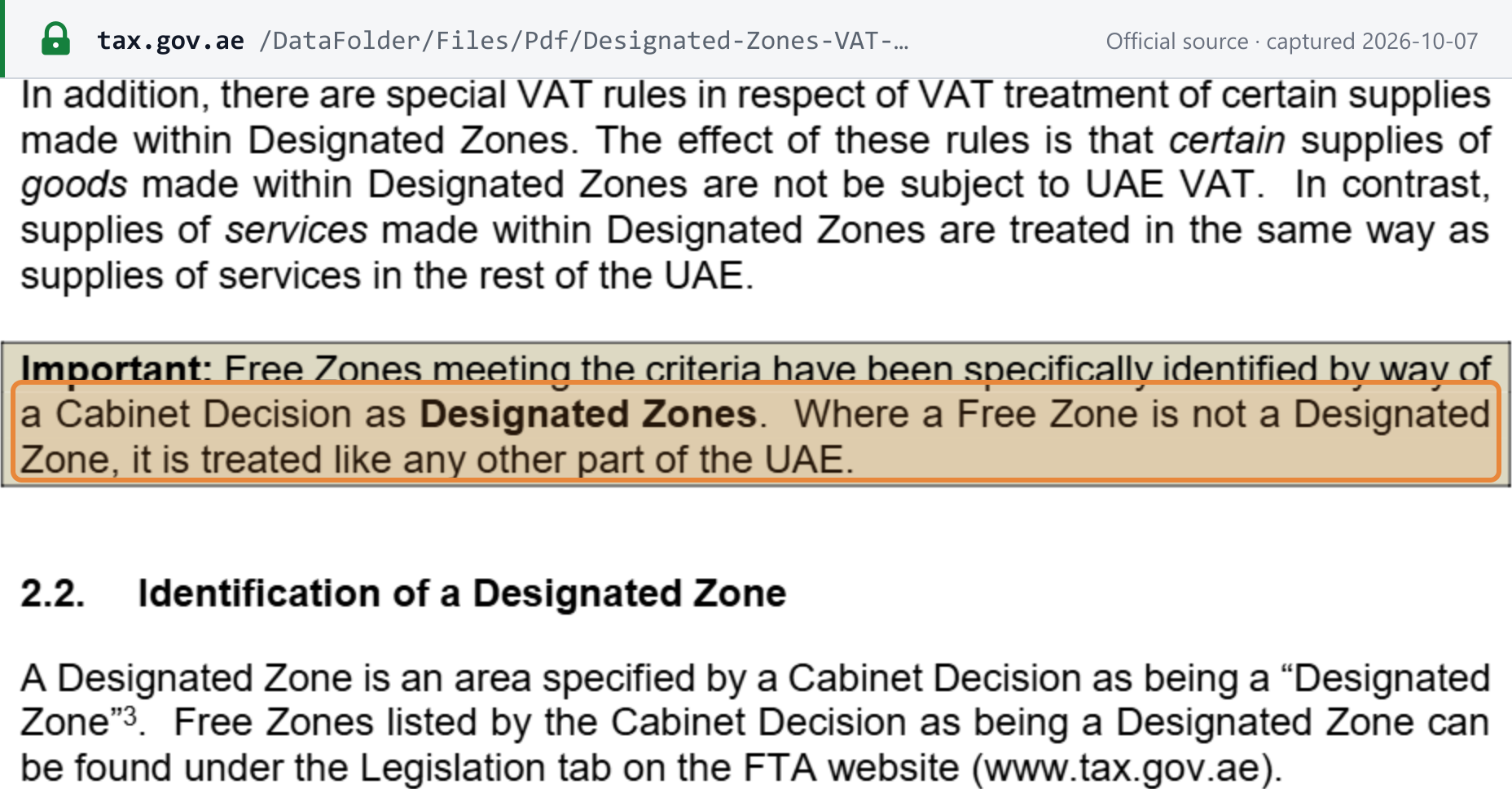
The FTA's VAT Guide VATGDZ1 (Issue 1, July 2018, §2.1) puts it plainly: free zones meeting the criteria are identified by Cabinet Decision as Designated Zones, and "Where a Free Zone is not a Designated Zone, it is treated like any other part of the UAE."
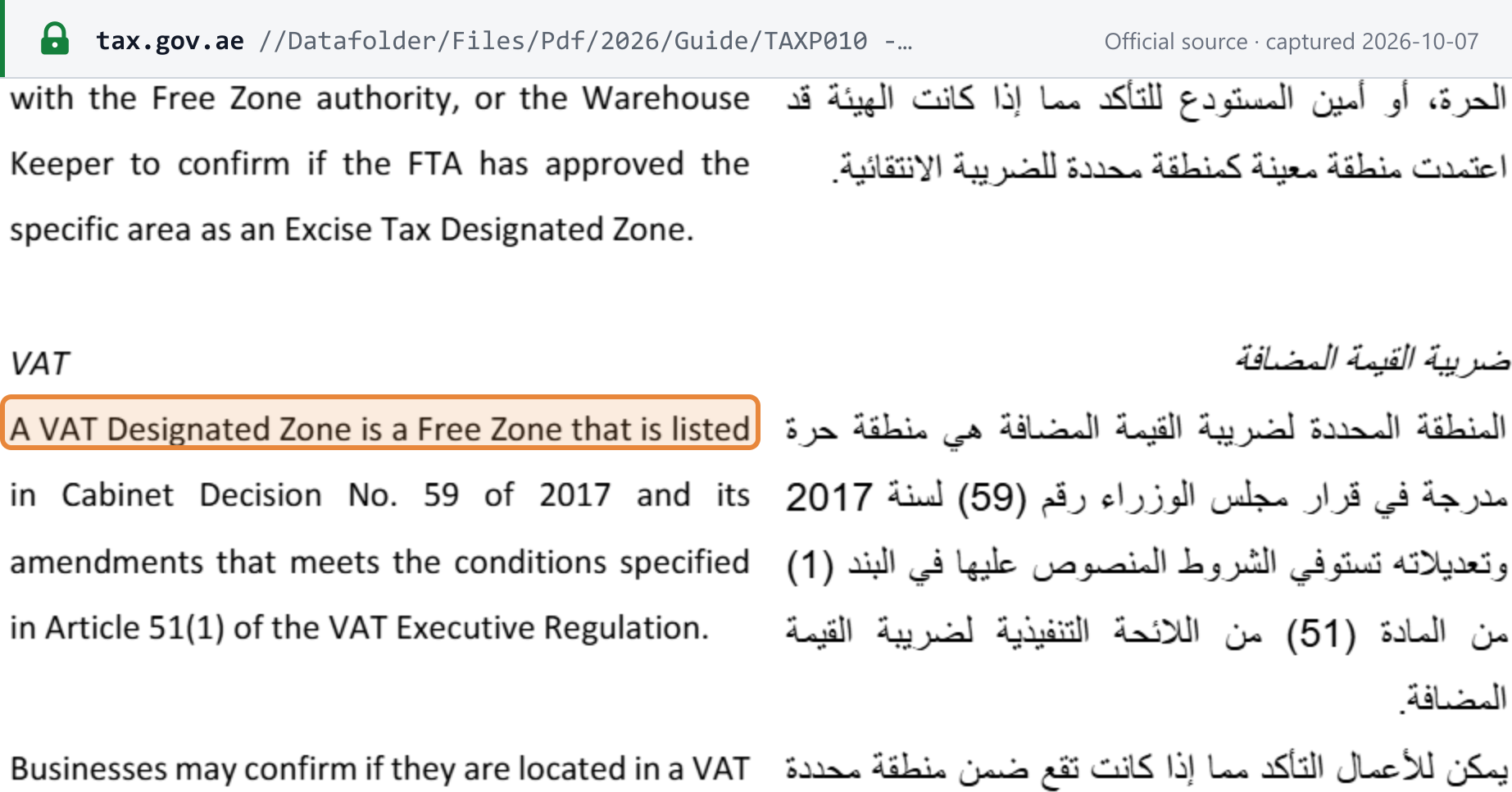
Corporate Tax, Excise Tax and VAT each define "Free Zone" and "Designated Zone" differently, so a business must test its status under each law separately. The FTA public clarification TAXP010 (file dated October 2026, pp.1 and 3) restates the VAT test: "A VAT Designated Zone is a Free Zone that is listed in Cabinet Decision No. 59 of 2017 and its amendments that meets the conditions specified in Article 51(1) of the VAT Executive Regulation."
 Source snapshot captured 2026-10-07 — original
How it works
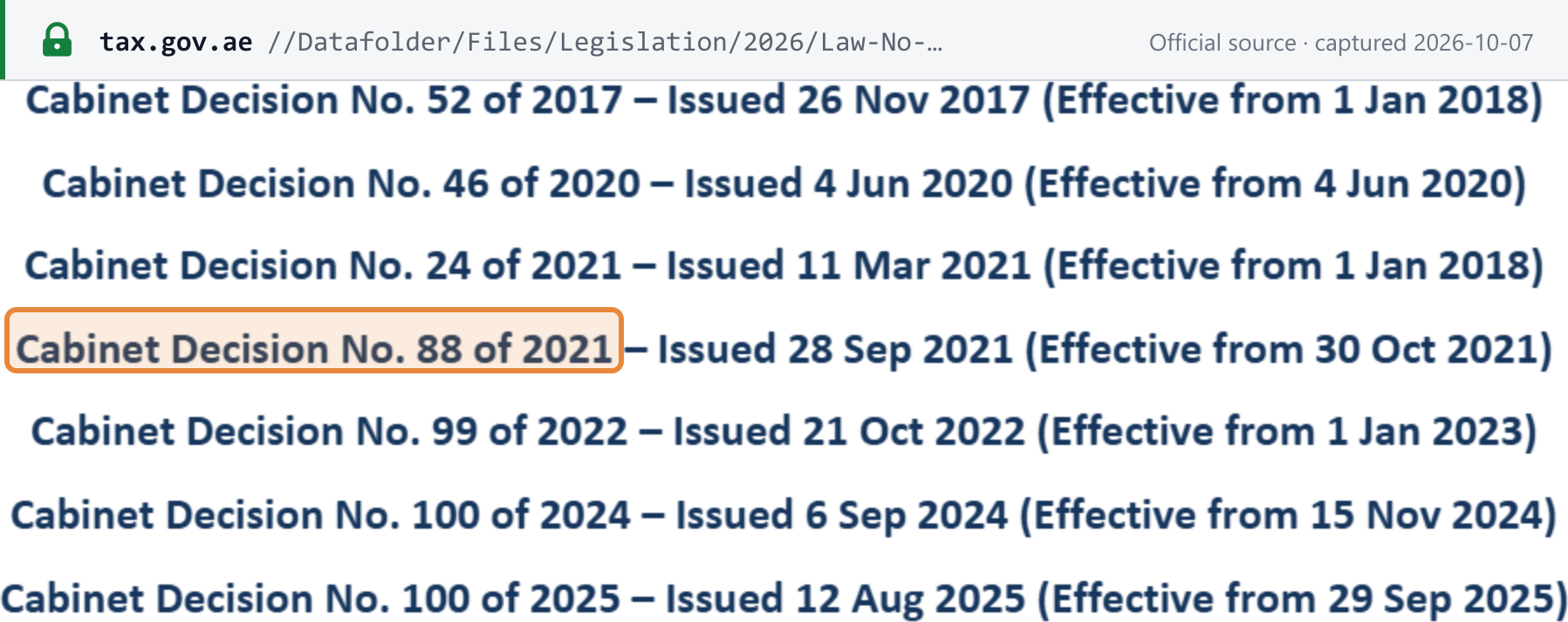
The detailed rules sit in Article 51 of the VAT Executive Regulation (Cabinet Decision No. 52 of 2017), with two supporting rules in Articles 30 and 47. Article 51 was last rewritten by Cabinet Decision No. 88 of 2021, issued 28 September 2021 and in force from 30 October 2021. Clause numbers below follow the FTA's current consolidated Executive Regulation (amended through Cabinet Decision No. 149 of 2026) (FTA, consolidated Executive Regulation, footnote 30 to Art 51). The 2018 guide VATGDZ1 predates that rewrite and uses older clause numbers (for example, its 51(4) for zone-to-zone transfers is now 51(3), and its 51(9) on residence is now 51(10)).
Step 1 — Is the zone on the list, and does it meet Article 51(1)?
A zone on the Cabinet list is treated as outside the State and outside the Implementing States only if all three conditions hold (ER Art 51(1)):
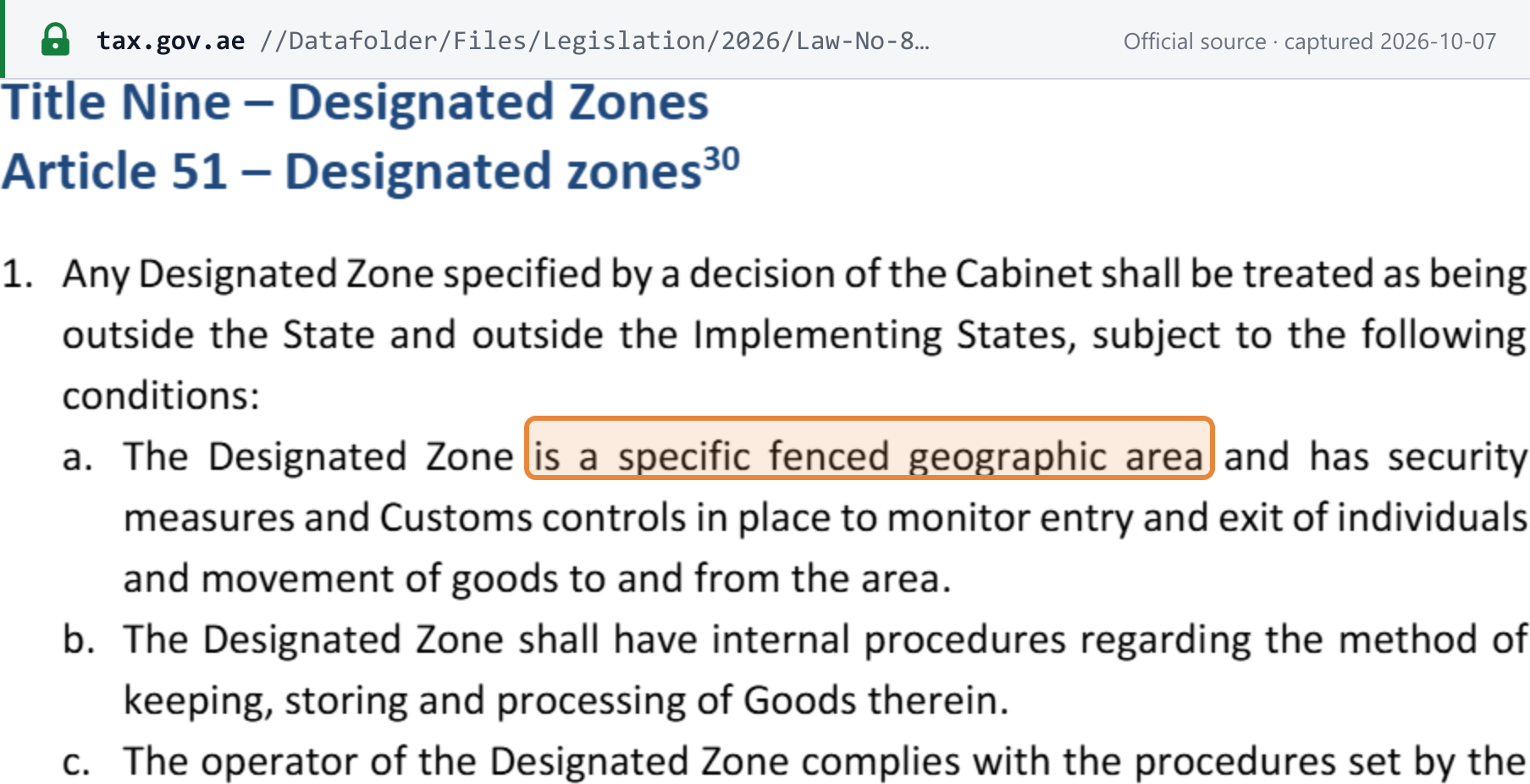
- it is "a specific fenced geographic area and has security measures and Customs controls in place to monitor entry and exit of individuals and movement of goods";
- it has internal procedures for keeping, storing and processing goods; and
- its operator complies with the FTA's procedures.
Where part of a zone meets these conditions and part does not, the zone is outside the UAE "only to the extent that the requirements are met" (VATGDZ1 §2.2). A zone that changes the way it operates or breaches a condition "will be treated as if inside the State" (ER Art 51(2)). TAXP010 tells businesses to make two checks: read the FTA list, and confirm with the free-zone authority that the specific area where they are based meets Article 51(1) (TAXP010 p.8).
 Source snapshot captured 2026-10-07 — original
Goods: what is outside VAT and what is not
| Movement or supply | VAT treatment | Rule |
|---|---|---|
| Goods brought into a Designated Zone from outside the UAE | Not an import; no import VAT | ER Art 47(1)(b) |
| Goods moved between Designated Zones, not released, used or altered, under GCC customs-suspension rules | Not subject to VAT; the FTA may require a financial guarantee | ER Art 51(3)–(4) |
| Goods sold within a Designated Zone, not for consumption (resale counts as not consumed) | Outside the scope of VAT | ER Art 51(5); VATGDZ1 §3.3.2 |
| Goods sold within a Designated Zone to be consumed by the buyer or anyone else | Place of supply is the UAE; VAT applies | ER Art 51(5) |
| Goods moved or supplied from the mainland into a Designated Zone | Not an export; a local supply, normally at 5% | ER Art 30(3) |
| Goods moved from a Designated Zone into the mainland | An import; the importer pays import VAT | VATGDZ1 §3.5.1 |
| Untaxed goods in a zone that the owner consumes, or that go missing | Treated as imported into the State | ER Art 51(9) |
The consumption override (Art 51(5)). A supply within a zone "to a Person to be consumed by him or another person" has its place of supply in the UAE, except where:
- (a) the goods are incorporated into, or used to produce, another good in the same Designated Zone, and that good is not consumed;
- (b) the goods are delivered outside the State, and the supplier keeps commercial or official evidence of that, plus customs evidence that the goods left the zone; or
- (c) the goods are moved into the mainland, and the supplier keeps official evidence that import VAT was applied.
Exceptions (b) and (c) came in with Cabinet Decision No. 88 of 2021. The FTA said the change aims "to avoid VAT Double Taxation on supplied goods in the Designated Zones and facilitate procedures to non-resident suppliers operating in the Designated Zones" (FTA news, 30 October 2021). The FTA's guide gives examples: stock bought for resale, steel used to make equipment, and work tools are outside scope; office computers, food, stationery, a company car and its fuel are within scope (VATGDZ1 pp.9–10). The supplier carries the burden of treating each supply correctly; in most arm's-length cases the FTA expects a written statement from the buyer that the goods will not be consumed to be enough (VATGDZ1 §3.3.3).
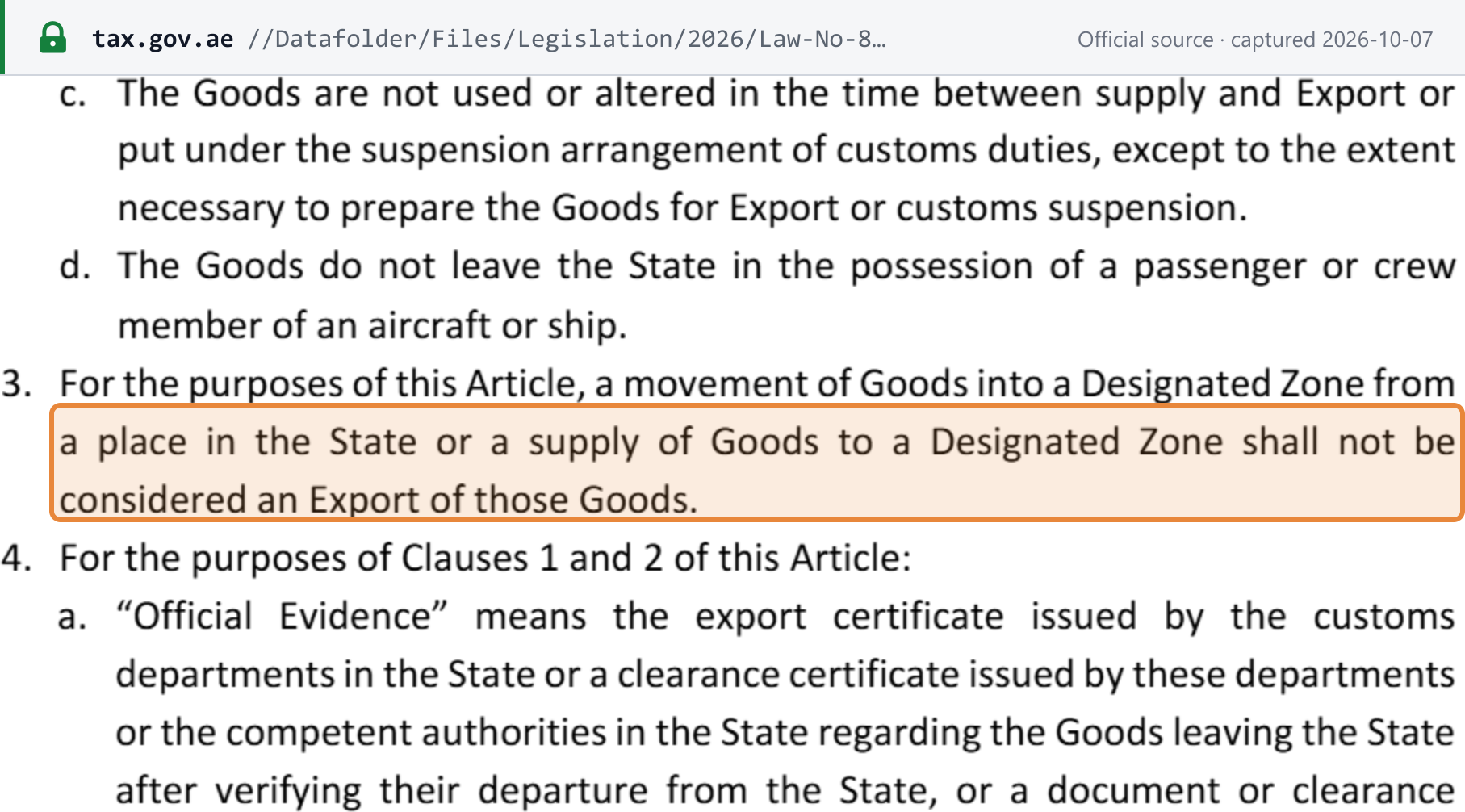
Mainland into the zone is not an export. ER Art 30(3): "a movement of Goods into a Designated Zone from a place in the State or a supply of Goods to a Designated Zone shall not be considered an Export of those Goods." A mainland supplier delivering into JAFZA charges VAT as on any local sale.
 Source snapshot captured 2026-10-07 — original
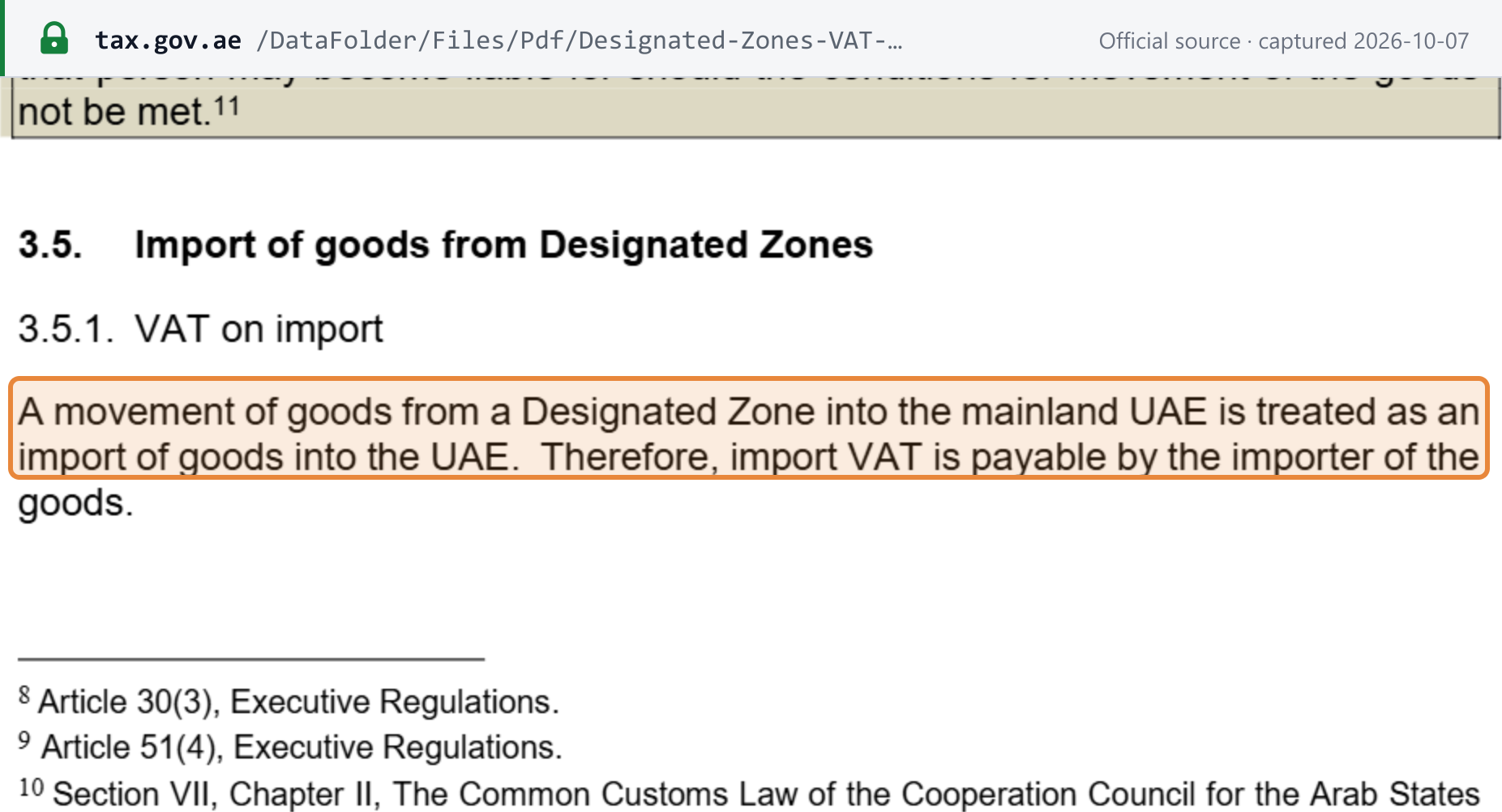
Zone into the mainland is an import. "A movement of goods from a Designated Zone into the mainland UAE is treated as an import of goods into the UAE. Therefore, import VAT is payable by the importer of the goods." A VAT-registered importer accounts for that VAT on its VAT return; an unregistered importer pays it before the goods are released from the zone (VATGDZ1 §§3.5.1 and 4.4).
 Source snapshot captured 2026-10-07 — original
Services: taxed as in the mainland
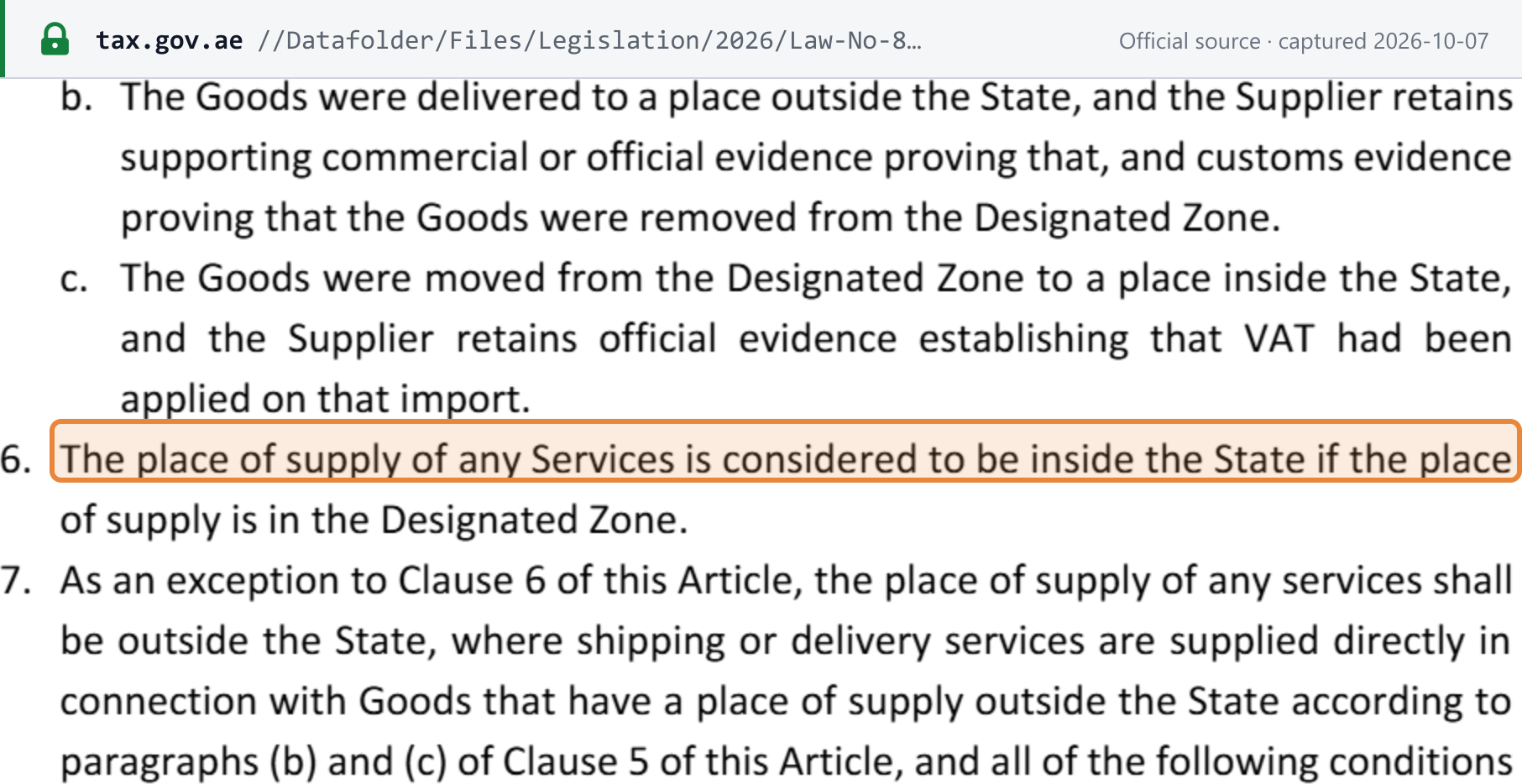
ER Art 51(6): "The place of supply of any Services is considered to be inside the State if the place of supply is in the Designated Zone."
 Source snapshot captured 2026-10-07 — original
Services performed in a Designated Zone therefore take the standard 5% rate, or the zero rate where the ordinary export-of-services conditions are met. The FTA guide: "most services will be liable to VAT at the standard rate, as would be the case were they performed within the UAE" (VATGDZ1 §3.2). Water and energy supplied in a zone are likewise inside the State (Art 51(8)). The one carve-out, added in 2021, is Art 51(7): shipping or delivery of goods that fall outside scope under exceptions (b) or (c) is also outside scope when the same supplier provides goods and shipping, the supplier is non-resident and not VAT-registered, the goods are sold through an electronic sales platform, and the platform owner is not the supplier.
The 5% standard rate is set by Article 3 of the Decree-Law and has applied since 1 January 2018 (see the UAE VAT guide).
Worked example — a Jebel Ali trading company
A VAT-registered trading company is established in Jebel Ali Free Zone (JAFZA), which is on the FTA list. Assume its plot meets Article 51(1).
- Goods arrive from abroad. It ships AED 100,000 of goods from Shanghai into JAFZA. Goods brought into a Designated Zone from outside the State are not imported (ER Art 47(1)(b)): no import VAT.
- Sale within JAFZA for resale. It sells the goods to a VAT-registered distributor in JAFZA, which will resell them. Resale is not consumption (VATGDZ1 §3.3.2), so the sale is outside the scope of VAT.
- Transfer to another zone. It moves part of the stock, unaltered and under customs suspension, to its unit in Dubai Airport Free Zone, also on the list. Not subject to VAT (ER Art 51(3)); the FTA may ask for a guarantee (Art 51(4)).
- Release to the mainland. The distributor moves AED 40,000 of the goods to its warehouse in mainland Dubai. That is an import: 5% × AED 40,000 = AED 2,000 of import VAT, which the distributor accounts for on its VAT return (VATGDZ1 §§3.5.1 and 4.4).
- Services inside the zone. The JAFZA company charges the distributor AED 10,000 for warehousing in JAFZA. Services in a Designated Zone are inside the State (ER Art 51(6)): 5% VAT, AED 500.
- Contrast — a free zone that is not on the list. A sister company in DMCC sells AED 100,000 of goods to another DMCC company. DMCC does not appear on the FTA list (file dated 21 September 2021), so this is an ordinary domestic supply: AED 5,000 of VAT (VATGDZ1 §2.1).
- Contrast — mainland into the zone. A mainland Dubai supplier delivers AED 20,000 of goods into JAFZA. That is not an export (ER Art 30(3)): 5% VAT, AED 1,000.
Who it affects
-
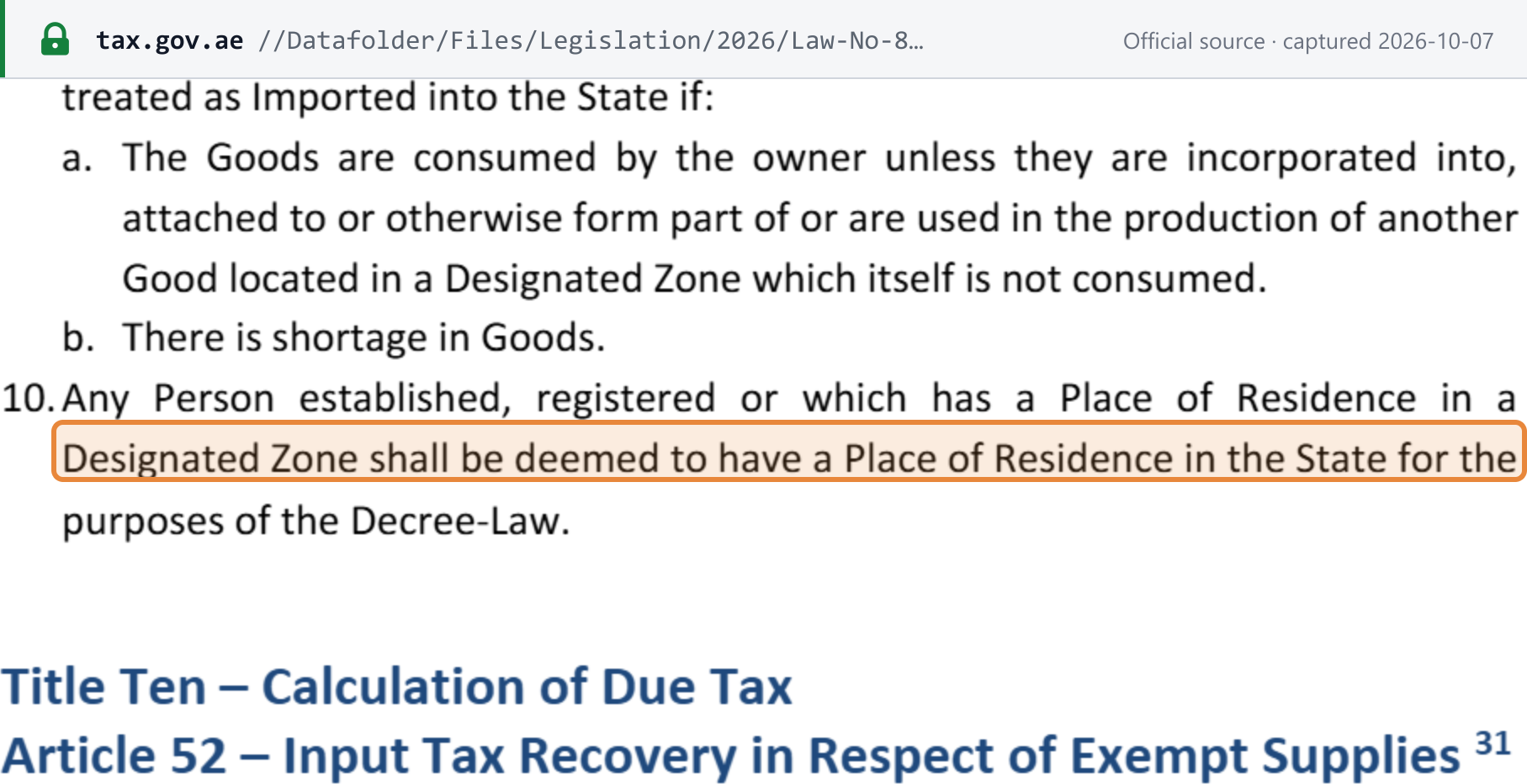
Every business in a Designated Zone is UAE-resident for VAT. "Any Person established, registered or which has a Place of Residence in a Designated Zone shall be deemed to have a Place of Residence in the State" (ER Art 51(10)). The FTA guide: Designated Zone businesses "have the same obligations as non-Designated Zone businesses and have to register, report and account for VAT under the normal rules", and may join a VAT group if they meet the conditions (VATGDZ1 §2.4).
 Source snapshot captured 2026-10-07 — original
 -
Normal registration thresholds apply. A UAE-resident business must register once its taxable supplies and imports exceed AED 375,000 over the previous 12 months, or are expected to within the next 30 days; voluntary registration is available where taxable supplies or taxable expenses are in excess of AED 187,500 (FTA registration page).
 Source snapshot captured 2026-07-19 — original
A registered Designated Zone business holds an ordinary TRN, which can be checked like any other (verify a UAE TRN).
-
Businesses in free zones that are not Designated Zones are treated like mainland businesses for VAT. DMCC and DIFC do not appear on the FTA Designated Zones list (file dated 21 September 2021), so for VAT they are treated like the mainland.
-
Mainland suppliers selling into zones charge VAT as on a local supply (ER Art 30(3)).
-
Non-resident e-commerce sellers holding stock in a Designated Zone can fall outside scope, with no VAT registration needed for those goods, under the Art 51(5)(b)–(c) and 51(7) conditions.
-
Owners of untaxed goods in a zone must track their status: consumption or shortage turns them into imports (ER Art 51(9)), and failing to comply with the conditions for keeping goods in a zone or moving them between zones is a ground for an administrative penalty (Decree-Law Art 76(3)).
Current status and dates
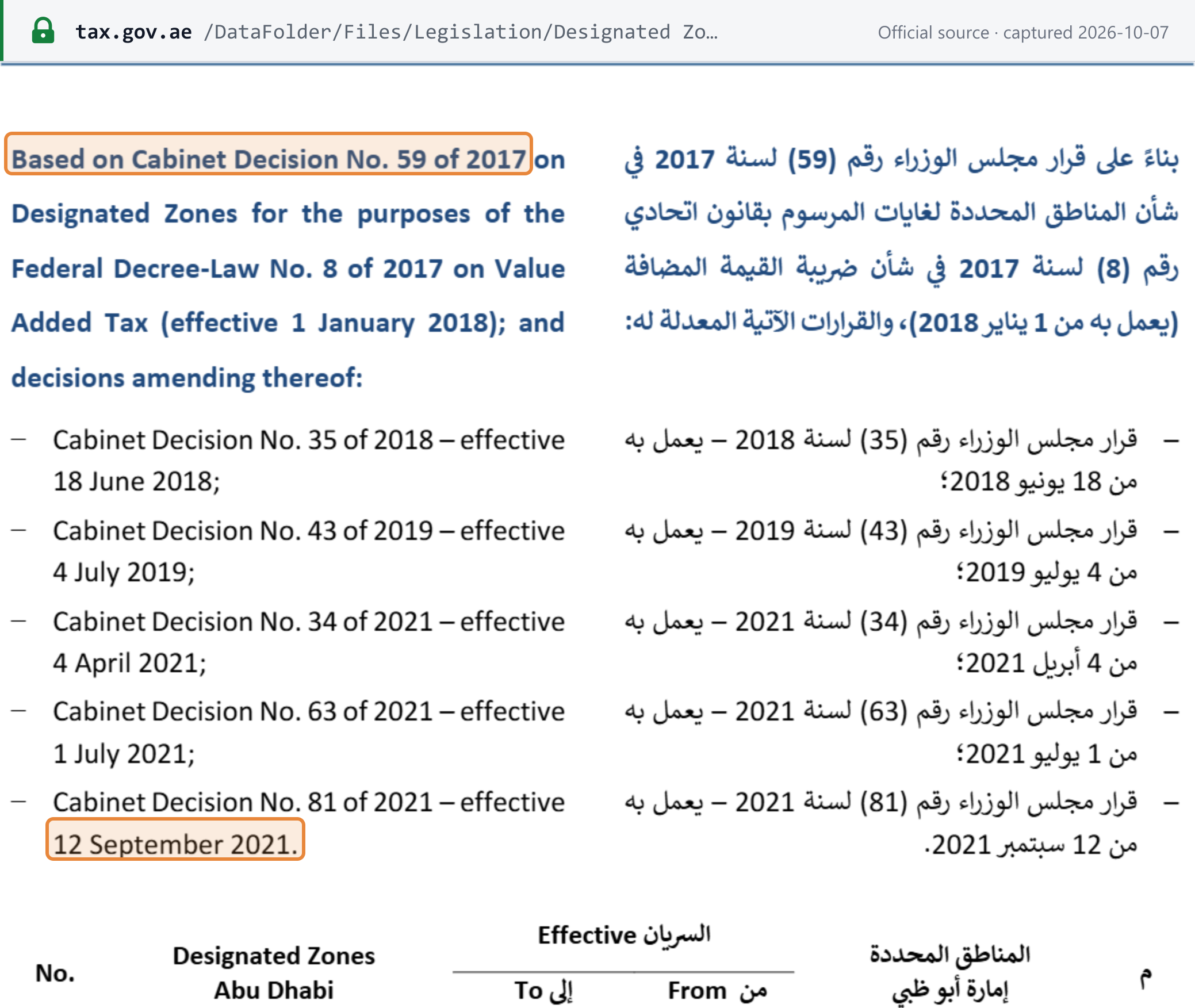
In force since 1 January 2018; the Article 51 rules in their current form since 30 October 2021; the FTA list of Designated Zones (file dated 21 September 2021) (as at 2026-10-07). The list rests on Cabinet Decision No. 59 of 2017 (effective 1 January 2018), as amended by Cabinet Decisions No. 35 of 2018, 43 of 2019, 34 of 2021, 63 of 2021 and 81 of 2021. Each row on the list carries an "Effective From" date and, where the zone has left the list, a "To" date (FTA, List of Designated Zones). TAXP010 refers readers to "the List of Designated Zones published by the FTA".
The FTA's consolidated Executive Regulation records Cabinet Decision No. 88 of 2021 as issued 28 September 2021 and effective from 30 October 2021 (FTA, consolidated Executive Regulation). The Art 1 definition of Designated Zone, Arts 50–52 and Art 76(3) are unchanged by Federal Decree-Law No. 16 of 2024 and Federal Decree-Law No. 16 of 2025 (FTA VATP046 lists the amendments made by both) (FTA, VATP046).
 Source snapshot captured 2026-10-07 — original
 Source snapshot captured 2026-10-07 — original
| Date | Event | Source |
|---|---|---|
| 1 Jan 2018 | VAT and the Designated Zones regime start; Cabinet Decision No. 59 of 2017 list takes effect | Decree-Law, as amended through FDL 18/2022; FTA list |
| 18 Jun 2018 | Cabinet Decision No. 35 of 2018 amends the list (International Humanitarian City – Jebel Ali carries this From date) | FTA list |
| Jul 2018 | FTA publishes VAT Guide VATGDZ1, Issue 1 | VATGDZ1 |
| 4 Jul 2019 | Cabinet Decision No. 43 of 2019 amends the list | FTA list |
| 1 Jan 2021 | Dubai CommerCity's From date on the list | FTA list |
| 4 Apr 2021 | Cabinet Decision No. 34 of 2021 effective; Dubai Textile City's To date | FTA list |
| 1 Jul 2021 | Cabinet Decision No. 63 of 2021 effective; Free Zone Area in Al Quoz's To date | FTA list |
| 12 Sep 2021 | Cabinet Decision No. 81 of 2021 effective | FTA list |
| 21 Sep 2021 | Date in the file name of the FTA list | FTA list |
| 30 Oct 2021 | Cabinet Decision No. 88 of 2021 rewrites ER Art 51 (double-taxation fix; e-commerce shipping rule) | FTA news; Executive Regulation |
| 1 Jun 2023 | Corporate Tax applies to Tax Periods starting on or after this date, including the Qualifying Free Zone Person regime | FDL 47/2022, Art 69 |
| Oct 2026 | Date in the file name of FTA cross-tax clarification TAXP010 | TAXP010 |
The list gives each row's "Effective From" and "To" dates and does not name the decision behind each row.
Dubai Designated Zones — the FTA list
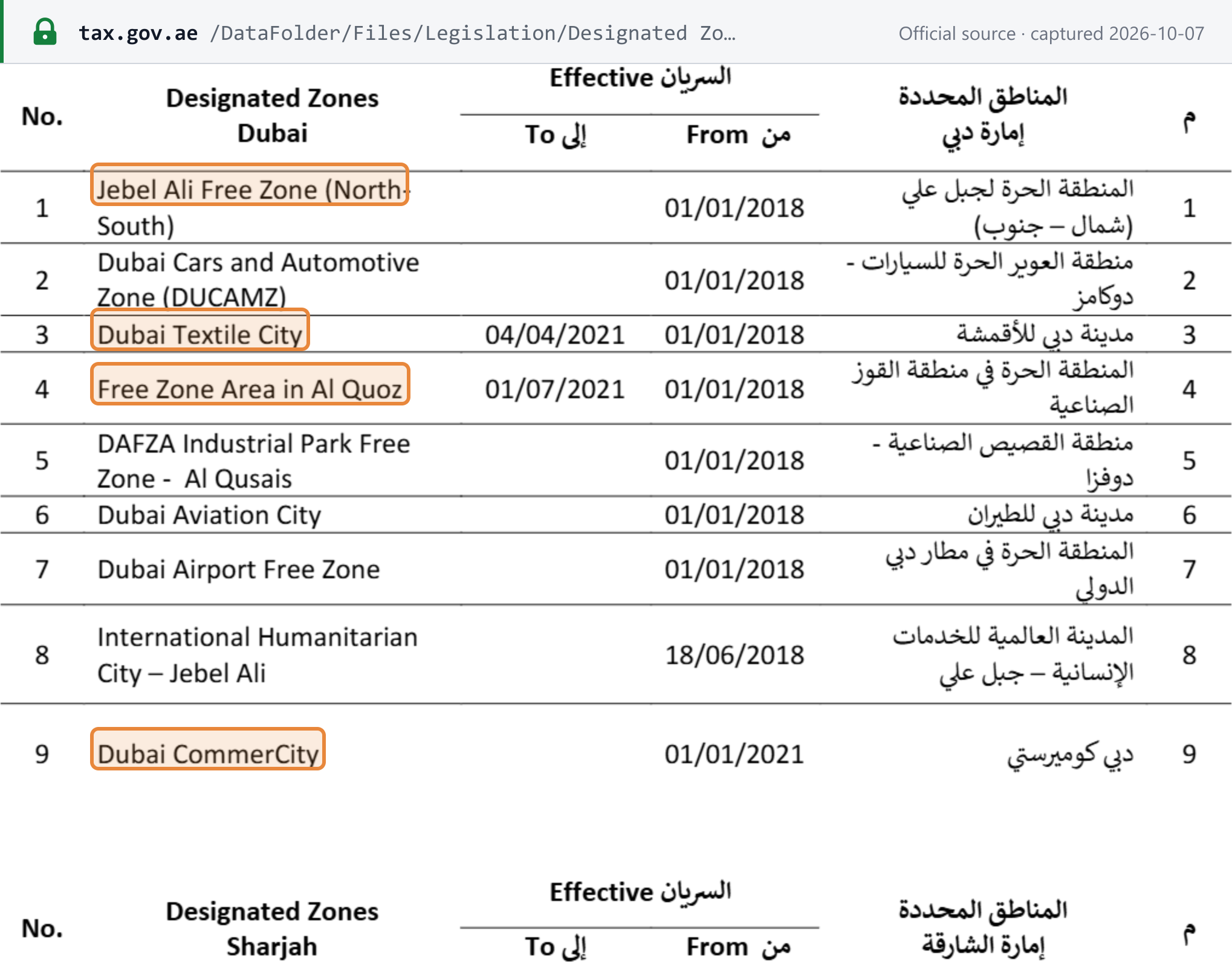
The Dubai section of the FTA's List of Designated Zones (file dated 21 September 2021) has nine rows. Seven carry no end date; two left the list in 2021. Every page of the list notes that "The English section is an unofficial translation". Zone names are as printed on the list.
| # | Zone (as named on the list) | Effective from | To | Designated Zone for VAT? | Last confirmed | Source |
|---|---|---|---|---|---|---|
| 1 | Jebel Ali Free Zone (North-South) | 01/01/2018 | — | Yes | 2026-10-07 | FTA list, p.2 |
| 2 | Dubai Cars and Automotive Zone (DUCAMZ) | 01/01/2018 | — | Yes | 2026-10-07 | FTA list, p.2 |
| 3 | Dubai Textile City | 01/01/2018 | 04/04/2021 | No — off the list with effect from 4 April 2021 | 2026-10-07 | FTA list, p.2 |
| 4 | Free Zone Area in Al Quoz | 01/01/2018 | 01/07/2021 | No — off the list with effect from 1 July 2021 | 2026-10-07 | FTA list, p.2 |
| 5 | DAFZA Industrial Park Free Zone - Al Qusais | 01/01/2018 | — | Yes | 2026-10-07 | FTA list, p.2 |
| 6 | Dubai Aviation City | 01/01/2018 | — | Yes | 2026-10-07 | FTA list, p.2 |
| 7 | Dubai Airport Free Zone | 01/01/2018 | — | Yes | 2026-10-07 | FTA list, p.2 |
| 8 | International Humanitarian City – Jebel Ali | 18/06/2018 | — | Yes | 2026-10-07 | FTA list, p.2 |
| 9 | Dubai CommerCity | 01/01/2021 | — | Yes | 2026-10-07 | FTA list, p.2 |
| — | DMCC (Dubai Multi Commodities Centre) | not listed | — | No — treated as mainland for VAT | 2026-10-07 | FTA list; VATGDZ1 §2.1 |
| — | DIFC (Dubai International Financial Centre) | not listed | — | No — treated as mainland for VAT | 2026-10-07 | FTA list; VATGDZ1 §2.1 |
 Source snapshot captured 2026-10-07 — original
-
DMCC and DIFC. Neither appears on the FTA list (file dated 21 September 2021). The same holds for Dubai Silicon Oasis, Dubai Internet City, Dubai Media City, Meydan, IFZA, Dubai World Trade Centre and Dubai Maritime City. Supplies by and to businesses there follow the mainland rules: per VATGDZ1 §2.1, where a Free Zone is not a Designated Zone, "it is treated like any other part of the UAE".
 Source snapshot captured 2026-10-07 — original
 -
Dubai South. The FTA list (file dated 21 September 2021) has a row for "Dubai Aviation City" (from 1 January 2018) and no row under the name Dubai South (as at 2026-10-07). A business licensed by Dubai South should confirm with the zone authority whether its premises fall within the designated Dubai Aviation City area, as TAXP010 p.8 advises for any zone.
-
Other emirates. Across all seven emirates the list has 27 rows: Abu Dhabi 5, Dubai 9, Sharjah 2, Ajman 1, Umm Al Quwain 2, Ras Al Khaimah 6 and Fujairah 2. Three rows carry an end date (Dubai Textile City, Free Zone Area in Al Quoz and RAK Airport Free Zone), so 24 rows have no end date. The FTA's own 30 October 2021 news item refers to "all 27 Designated Zones".
-
The list is not the whole test. A listed zone is outside the UAE only where it meets Article 51(1), and only to the extent it does.
Corporate Tax is a separate regime
Corporate Tax free-zone relief does not change VAT. Under Federal Decree-Law No. 47 of 2022, a Qualifying Free Zone Person pays 0% Corporate Tax on Qualifying Income and 9% on other taxable income (Art 3(2)), provided it maintains adequate substance, derives Qualifying Income, has not elected to be taxed at the standard rates, complies with the transfer-pricing and documentation rules, and meets any other conditions the Minister sets (Art 18(1)) (MoF, FDL 47/2022). Qualifying Income is defined by Cabinet Decision No. 100 of 2023 (issued 25 October 2023, effective 1 June 2023) (FTA). Qualifying and Excluded Activities are set by Ministerial Decision No. 229 of 2025 (issued 28 August 2025, effective 1 June 2023), which repealed Ministerial Decision No. 265 of 2023; its de minimis test allows non-qualifying revenue of up to 5% of total revenue or AED 5,000,000, whichever is lower (MoF, MD 229/2025).
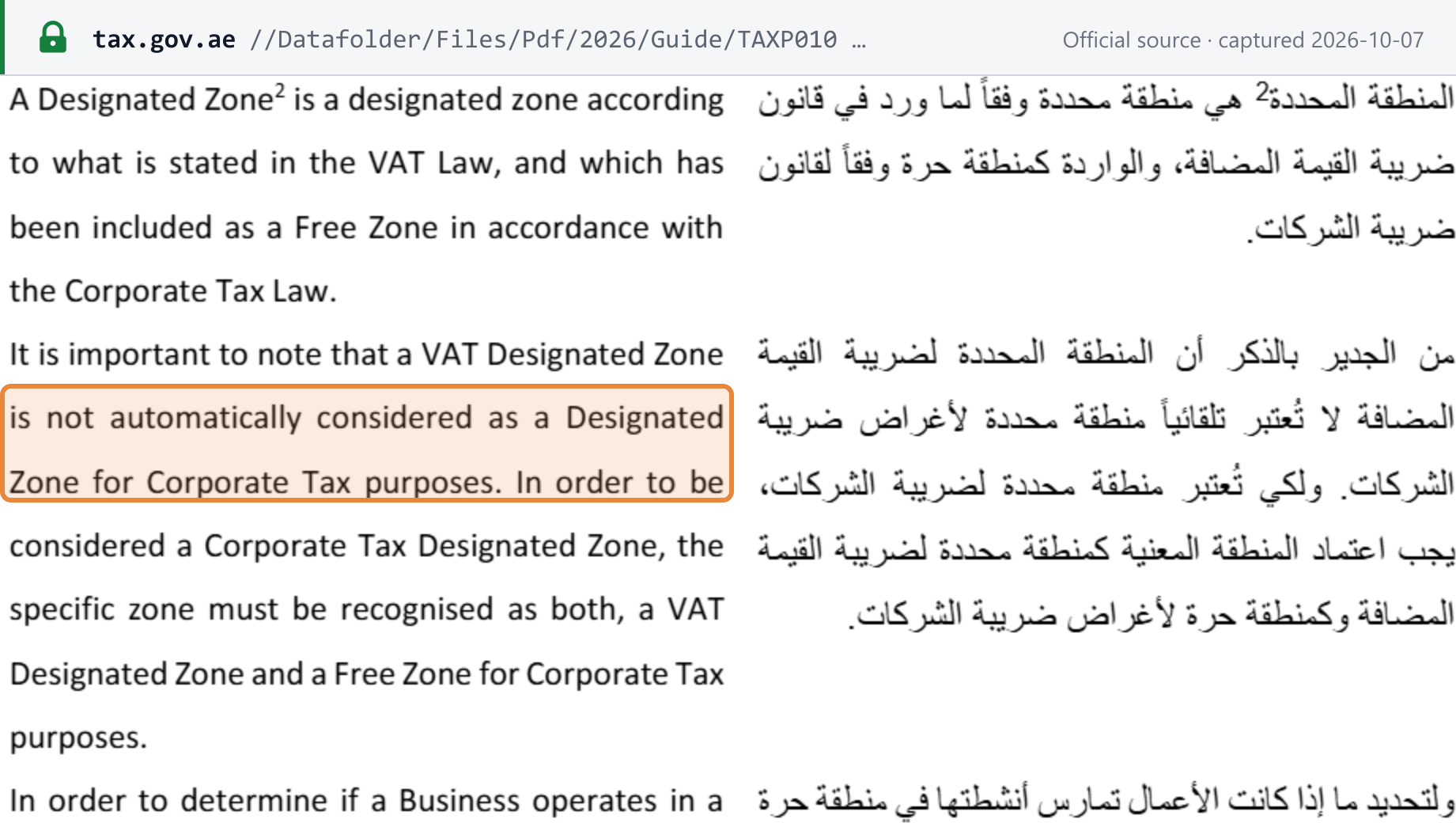
The bridge between the two taxes runs one way. TAXP010: "a VAT Designated Zone is not automatically considered as a Designated Zone for Corporate Tax purposes. In order to be considered a Corporate Tax Designated Zone, the specific zone must be recognised as both, a VAT Designated Zone and a Free Zone for Corporate Tax purposes." Only a Corporate Tax Designated Zone supports the "distribution of goods or materials in or from a Designated Zone" Qualifying Activity (MD 229/2025 Art 2(1)(l)). Excise Tax uses a third definition, tied to fenced areas with a Warehouse Keeper, confirmed with the free-zone authority or Warehouse Keeper rather than from the VAT list (TAXP010 pp.3 and 6–7).
 Source snapshot captured 2026-10-07 — original
Related changes from the feed
No change to UAE Designated Zones has been recorded in the weekly tax-changes feed (as at 2026-10-07). Cabinet Decision No. 149 of 2026, which amended the VAT Executive Regulation from 1 October 2026, left Article 51 as amended by Cabinet Decision No. 88 of 2021. Every tracked UAE change is on the UAE tax-change chronology.
Frequently asked questions
Is my Dubai free zone company exempt from VAT?
Not because it is in a free zone. For VAT a free zone is part of the UAE unless it is on the Cabinet's List of Designated Zones and meets Article 51(1) of the VAT Executive Regulation. Even in a Designated Zone, only certain supplies of goods fall outside VAT; services are taxed at 5% as in the mainland, and the business registers under the normal rules (AED 375,000 mandatory threshold). (VATGDZ1 §2.1; ER Art 51(1), (6) and (10); FTA registration page)
Which Dubai free zones are VAT Designated Zones?
On the FTA's list (file dated 21 September 2021), seven Dubai rows carry no end date: Jebel Ali Free Zone (North-South), Dubai Cars and Automotive Zone (DUCAMZ), DAFZA Industrial Park Free Zone - Al Qusais, Dubai Aviation City, Dubai Airport Free Zone, International Humanitarian City – Jebel Ali and Dubai CommerCity. Dubai Textile City left the list with effect from 4 April 2021 and the Free Zone Area in Al Quoz with effect from 1 July 2021. (FTA List of Designated Zones)
Are DMCC and DIFC Designated Zones for VAT?
No. Neither appears on the FTA's List of Designated Zones (file dated 21 September 2021; checked 2026-10-07). A free zone that is not a Designated Zone is treated like any other part of the UAE, so DMCC and DIFC businesses charge and account for VAT as mainland businesses do. (FTA List of Designated Zones; VATGDZ1 §2.1)
Is a sale from the mainland into JAFZA zero-rated as an export?
No. Article 30(3) of the VAT Executive Regulation says a movement or supply of goods into a Designated Zone from a place in the State is not an export. The mainland supplier charges VAT as on a local supply, normally 5%. Goods moving the other way, from a Designated Zone into the mainland, are an import, and the importer pays import VAT. (ER Art 30(3); VATGDZ1 §3.5.1)
Is a business licensed by Dubai South in a Designated Zone?
The FTA list (file dated 21 September 2021) includes Dubai Aviation City (from 1 January 2018) and has no row under the name Dubai South. A Dubai South business should confirm with the zone authority whether its premises fall within the designated Dubai Aviation City area; the FTA's TAXP010 advises confirming with the free-zone authority that the specific area meets Article 51(1). (FTA List of Designated Zones; TAXP010 p.8; checked 2026-10-07)
Does Corporate Tax free-zone status make my company outside VAT?
No. The 0% Corporate Tax rate for a Qualifying Free Zone Person on Qualifying Income (Federal Decree-Law No. 47 of 2022, Art 3) has no effect on VAT. The FTA's TAXP010 also says a VAT Designated Zone is not automatically a Designated Zone for Corporate Tax: it must be both a VAT Designated Zone and a Free Zone for Corporate Tax purposes. Status must be tested under each tax law separately. (TAXP010 pp.1 and 4)
Related resources
- UAE VAT guide — rates, registration, invoicing and recent FTA decisions
- UAE e-invoicing guide — the PINT AE mandate, including the "Free Zone" transaction-type flag
- UAE TRN guide and how to verify a UAE TRN — Designated Zone businesses hold ordinary TRNs
- Reverse charge — how imports of services and goods are self-accounted
- Special Economic Zones in India — a comparable zone regime under GST
- Worldwide VAT/GST rates and VAT registration thresholds — the global tables
- UAE tax-change chronology — every tracked UAE change
Reference links
- FTA — List of Designated Zones (file dated 21 September 2021)
- FTA — consolidated VAT Executive Regulation (Cabinet Decision No. 52 of 2017, amended through Cabinet Decision No. 149 of 2026)
- FTA — Federal Decree-Law No. 8 of 2017 on VAT (as amended through Federal Decree-Law No. 18 of 2022)
- FTA — VAT Guide VATGDZ1, Designated Zones (Issue 1, July 2018)
- FTA — TAXP010, Free Zones and Designated Zones for Tax Purposes (file dated October 2026)
- FTA — news on Cabinet Decision No. 88 of 2021 (30 October 2021)