Marketplace deemed supplier rules
A marketplace deemed-supplier rule makes an online marketplace or platform, not the seller using it, liable for VAT/GST on the facilitated sales the rule covers. The platform is treated as the supplier to the customer for VAT/GST purposes; in the EU and UK, as having bought the goods from the seller and sold them on. The EU (since 1 July 2021), UK, Australia, New Zealand, Canada, Singapore, Norway, Switzerland and India all use a version of the rule.
It is a legal fiction that works only inside VAT law. The ViDA directive calls the deemed-supplier model "a legal fiction having no impact on rules outside the VAT legislation" (Directive (EU) 2025/516, recital 27). The seller's contract with its customer does not change; the VAT consequences do. In the EU the rule sits in Article 14a of the VAT Directive (Directive 2006/112/EC), inserted by Council Directive (EU) 2017/2455. The European Commission puts it this way: "Online marketplaces/platforms facilitating supplies of goods are, in certain circumstances, deemed for VAT purposes to have received and supplied the goods themselves (“deemed supplier”)." (European Commission, VAT e-commerce, checked 2026-09-24)
Three neighbouring regimes are often confused with it. None of them is a deemed supply:
- Platform reporting. DAC7 makes platforms report seller data to tax authorities. It moves information, not tax liability.
- Withholding or collection by a platform or payment intermediary. Mexico's platforms withhold IVA from sellers; Chilean and Colombian card and payment-method issuers withhold from foreign digital-service providers that are on the SII list of non-registered providers (Chile) or that opt into withholding (Colombia); Nepal's ride-sharing platforms collect VAT on drivers' fees. The seller stays the taxpayer; someone else collects part or all of the tax. (Since 25 October 2025 Chile also has a deemed-supplier rule for digital intermediation platforms, D.L. 825 art. 3 bis — see the table below.)
- Non-resident registration. Many countries make a foreign seller of digital services register and charge VAT itself. That is the subject of VAT on digital services by non-resident suppliers. This page covers the case where the platform becomes the supplier.
How it works — one sale, two supplies
The EU mechanism (Article 14a)
Article 14a has two limbs, both in force since 1 July 2021:
- Art 14a(1) — imports up to EUR 150. Where a taxable person facilitates, through an electronic interface, "distance sales of goods imported from third territories or third countries in consignments of an intrinsic value not exceeding EUR 150, that taxable person shall be deemed to have received and supplied those goods himself." This limb applies whether the seller is established inside or outside the EU. The marketplace normally declares these sales through the Import One Stop Shop (IOSS).
- Art 14a(2) — goods already in the EU, sold by non-EU sellers. Where an interface facilitates "the supply of goods within the Community by a taxable person not established within the Community to a non-taxable person", the interface is deemed to have received and supplied the goods. There is no value limit. Stock held in an EU fulfilment warehouse by a seller from outside the EU is caught.
(Council Directive (EU) 2017/2455, Article 2(2), checked 2026-09-24)
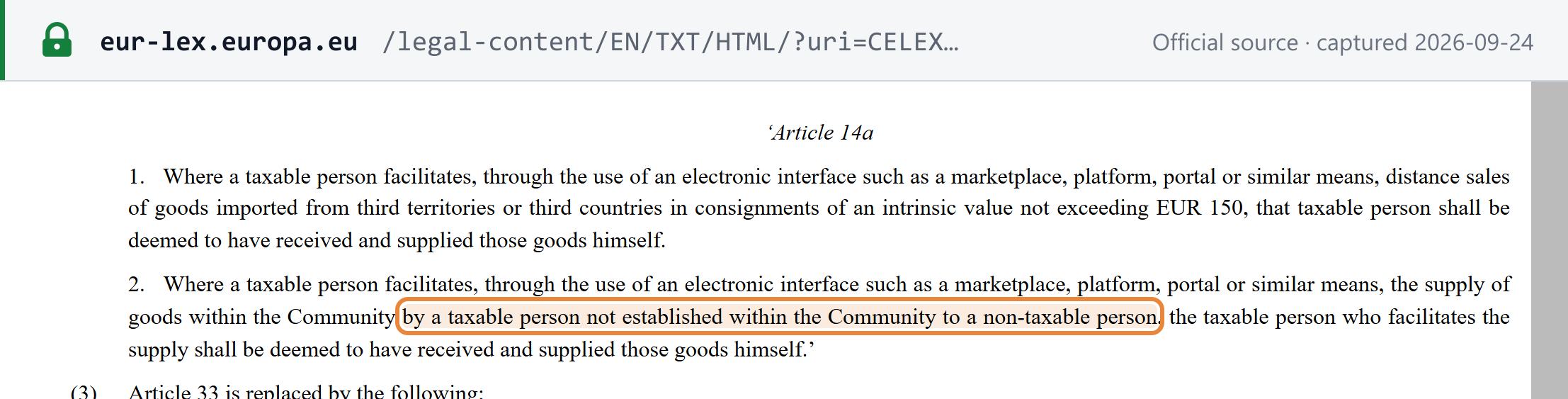 Source snapshot captured 2026-09-24 — original
The 1 July 2021 date comes from Council Decision (EU) 2020/1109, which postponed the e-commerce package by six months because of COVID-19: "With effect from 1 July 2021, Directive 2006/112/EC is amended as follows:" (Council Decision (EU) 2020/1109, Article 1, checked 2026-09-24)
The Commission's explanatory notes list what is in and out of scope. The interface becomes a deemed supplier for imported consignments of EUR 150 or less, "irrespective of whether the underlying supplier/seller is established in the EU or outside the EU", and for goods "located in the EU ... irrespective of their value, when the underlying supplier/seller is not established in the EU". It does not become one for imported consignments above EUR 150, or for goods in the EU sold by EU-established sellers.
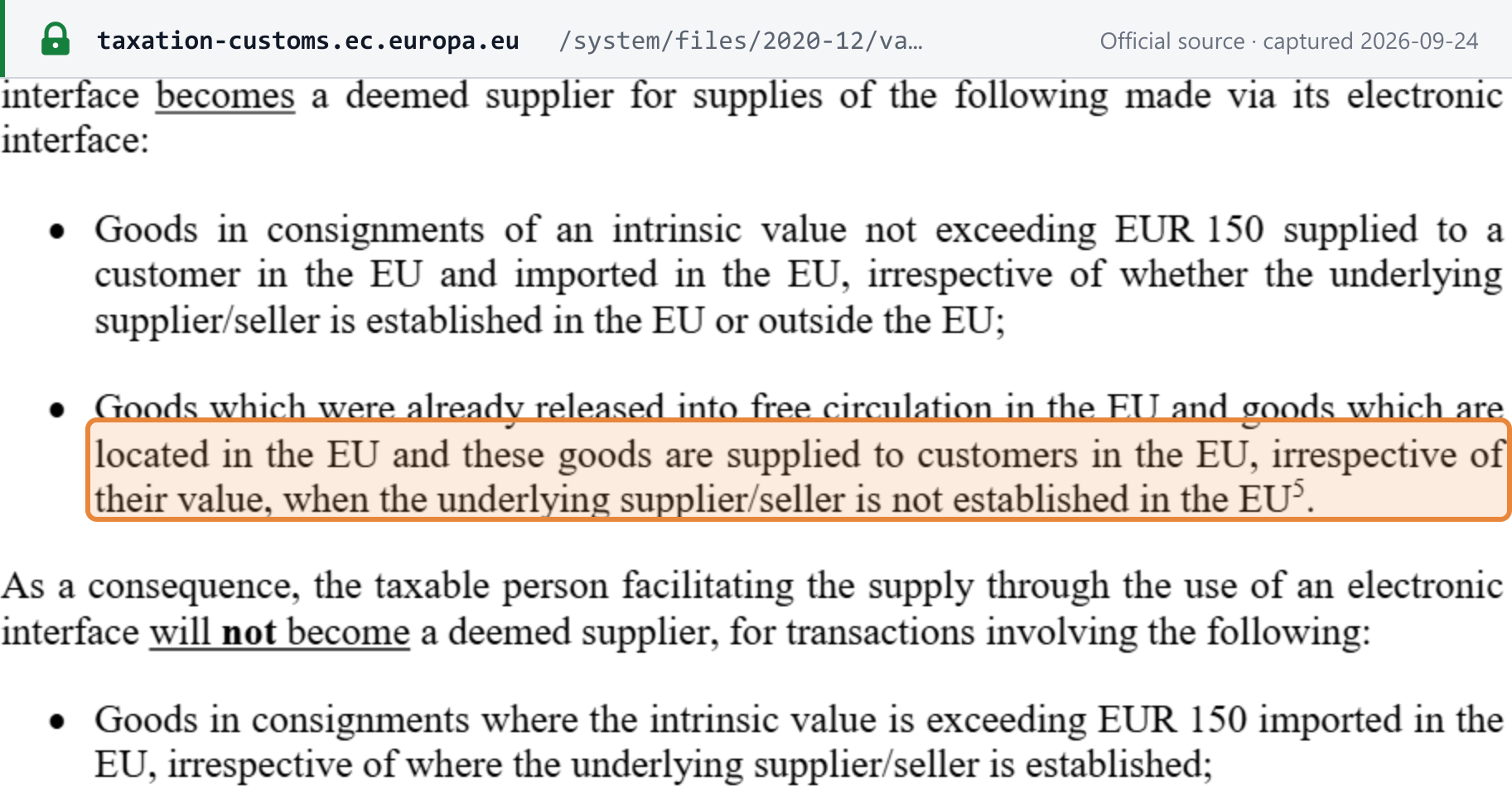 Source snapshot captured 2026-09-24 — original
The two supplies
The Commission's notes describe the fiction precisely: "the single supply from the supplier (the so-called underlying supplier) selling goods via an electronic interface to the final consumer (B2C supply) is split into two supplies". (Explanatory Notes on VAT e-commerce rules, section 2.1.4, checked 2026-09-24)
- Seller → platform. A deemed B2B supply, treated as a supply without transport. Under Art 14a(2) it is exempt with the right of deduction (Articles 136a and 169(b) of the VAT Directive), so the seller charges no VAT but can still recover its input VAT. The Commission's notes say the seller must still issue an invoice to the interface; the Art 220(2) waiver for exempt supplies does not apply.
- Platform → customer. The platform's supply to the consumer. The transport is allocated to this supply, and the platform charges and accounts for the VAT. As the notes' glossary puts it, "Thus a deemed supplier has the same rights and obligations for VAT purposes as the supplier." (Explanatory Notes, definitions, checked 2026-09-24)
For both supplies, VAT becomes chargeable "at the time when the payment has been accepted" (Article 66a). (Council Directive (EU) 2019/1995, Article 1, checked 2026-09-24)
Worked example
A US company with no EU establishment keeps stock in a German fulfilment warehouse. A consumer in France buys a EUR 200 item through an online marketplace, and the item ships from Germany to France.
| Step | Without the rule | With Art 14a(2) |
|---|---|---|
| Who sells to the consumer for VAT purposes | The US company | The marketplace |
| US company → marketplace | — | Deemed B2B supply in Germany; exempt with right of deduction (Arts 136a, 169(b)); invoice still required |
| Marketplace → French consumer | — | Supply with transport from Germany to France; the marketplace charges the VAT due and can declare it through the Union OSS |
| When VAT is chargeable | On supply | When the marketplace accepts the payment (Art 66a) |
| Value limit | — | None: EUR 200 or EUR 20,000, the rule is the same |
If the same US company instead shipped a EUR 60 parcel from the United States to the French consumer through the marketplace, Art 14a(1) would apply: an imported consignment of EUR 150 or less, so the marketplace is the deemed supplier and normally uses IOSS. A EUR 400 parcel from the United States is outside Art 14a entirely: the marketplace is not the deemed supplier, and the ordinary import VAT rules apply.
Who counts as "facilitating"
Implementing Regulation 282/2011, Article 5b (inserted by Council Implementing Regulation (EU) 2019/2026, postponed by Council Implementing Regulation (EU) 2020/1112, and applying with Art 14a since 1 July 2021) defines the term. "Facilitates" means "the use of an electronic interface to allow a customer and a supplier offering goods for sale through the electronic interface to enter into contact which results in a supply of goods through that electronic interface." Two groups escape:
- Interfaces that meet all three conditions: they set no terms and conditions for the supply, are not involved in authorising the charge to the customer, and are not involved in ordering or delivering the goods.
- Interfaces that only do one of the following: "(a) the processing of payments in relation to the supply of goods; (b) the listing or advertising of goods; (c) the redirecting or transferring of customers to other electronic interfaces where goods are offered for sale, without any further intervention in the supply."
Article 5c limits a deemed supplier's liability when it acted in good faith on wrong information from the seller. Under Article 5d, unless it has contrary information, the platform treats the seller as a taxable person and the buyer as a non-taxable person. (Council Implementing Regulation (EU) 2019/2026, Article 1(1)(b), checked 2026-09-24)
Platforms also carry a record-keeping duty, even when they are not deemed suppliers. In the Commission's words, "Article 242a of the VAT Directive imposes on those electronic interfaces an obligation to keep records on the supplies they facilitate for a period of 10 years from the end of the year in which the supply was carried out." (Explanatory Notes, section 2.2.2, checked 2026-09-24)
Electronic services: an older, separate presumption (Art 9a)
Since 1 January 2015, a different rule has covered electronically supplied services sold through app stores and portals. Implementing Regulation 282/2011, Article 9a, presumes the intermediary acts in its own name, and so is the supplier to the customer, "unless that provider is explicitly indicated as the supplier by that taxable person and that is reflected in the contractual arrangements between the parties." An intermediary that authorises the charge, authorises delivery, or sets the general terms and conditions cannot name someone else as the supplier. (Council Implementing Regulation (EU) No 1042/2013, checked 2026-09-24)
This is a presumption for services, not the goods deemed supply of Art 14a. For how the underlying foreign service provider is taxed when no platform steps in, see VAT on digital services by non-resident suppliers.
Who it affects
- Operators of electronic interfaces that facilitate sales. In practice these are platforms that set the terms, authorise the charge, or take part in ordering or delivery. That covers the EU's Art 5b test, Canada's "distribution platform operator" (a person that "controls or sets the essential elements of the transaction between the supplier and the recipient", Excise Tax Act s 211.1) and Australia's "electronic distribution platform" (GST Act s 84-70). Pure payment processors, pure listing or advertising sites and pure referral links are outside the EU and Canadian rules. Australia's definition (GST Act s 84-70(2)) expressly excludes only services that provide access to a payment system or process payments (and carriage services).
- Sellers not established where they sell. In the EU, a non-EU seller's B2C sales through a marketplace shift to the marketplace. The seller's own deemed sale to the marketplace is exempt with deduction, so it may still need a VAT number to invoice the marketplace and recover input VAT. Singapore and Switzerland also catch some sales by local sellers (see the table).
- Customers. Consumers in every regime. From 1 January 2027 the EU rule also covers taxable persons and non-taxable legal persons whose intra-Community acquisitions of goods are not subject to VAT under Article 3(1) of the VAT Directive (see Current status).
- Sector platforms. Accommodation, ride-hailing and food-delivery platforms have their own rules in New Zealand (since 1 April 2024), Canada (accommodation platform operators) and India (notified services under CGST Act s 9(5)). In the EU they arrive between 1 July 2028 and 1 January 2030.
Thresholds that decide scope (each is cited in the table below): EU imports ≤ EUR 150 and goods in the EU at any value; UK imports of £135 or less and goods in the UK at any value; Australian low value goods with a customs value of A$1,000 or less; New Zealand low value goods of NZ$1,000 or less; Singapore low-value goods not exceeding S$400; Norwegian goods under NOK 3,000 per item.
Current status and dates
As at 2026-09-24. The EU dates come from the directives themselves; national rules are in the jurisdiction table.
| Date | What changes | Status | Source |
|---|---|---|---|
| 1 Jan 2015 | Art 9a presumption: app stores and portals are the supplier of electronically supplied services | In force | IR (EU) 1042/2013 |
| 1 Jul 2021 | Art 14a(1) (imports ≤ EUR 150) and Art 14a(2) (goods in the EU sold by non-EU sellers to non-taxable persons); Arts 5b–5d (postponed by IR (EU) 2020/1112); record-keeping | In force | Dir (EU) 2017/2455; IR (EU) 2020/1112; Dec (EU) 2020/1109 |
| 1 Jan 2027 | Recast Art 14a(2): the customer group widens to Art 3(1) taxable persons and non-taxable legal persons | Adopted EU law; national laws due by 31 Dec 2026 | Dir (EU) 2025/516, Arts 2(1), 6(2) |
| 1 Jul 2027 | Commission assessment report on the Art 14a(2) rule, with a possible proposal for "its further extension" | Scheduled | Dir (EU) 2025/516, Art 2(1) |
| 21 Sep 2027 | New Union Customs Code: the facilitator of distance sales can be the "importer" | Enacted; applies from this date | Reg (EU) 2026/2108, Art 5(14) |
| 1 Jul 2028 | Art 46a: the platform's own facilitation service to a non-taxable person is taxed where the underlying transaction is supplied | Adopted EU law | Dir (EU) 2025/516, Arts 3, 6(3) |
| 1 Jul 2028 – 1 Jan 2030 | Art 28a: platforms are deemed suppliers of short-term accommodation and road passenger transport; each member state starts within this window | Adopted EU law | Dir (EU) 2025/516, Arts 3(1), 6(3) |
1 January 2027: ViDA widens the customer group — it does not add intra-EU sales
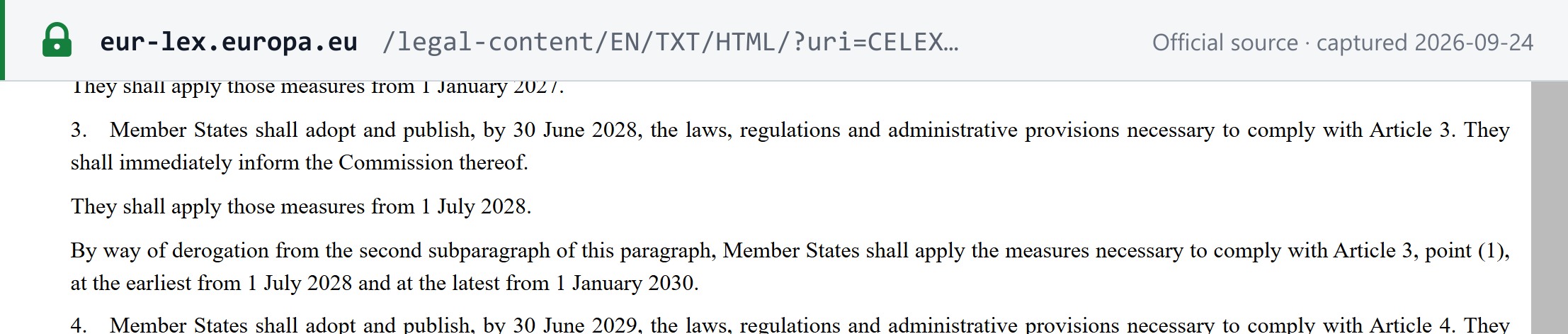
Intra-EU sales by non-EU sellers through marketplaces have been caught since 1 July 2021. What Council Directive (EU) 2025/516 changes from 1 January 2027 is who the buyer can be. The recast Art 14a(2) keeps the non-EU-seller condition and extends the rule to supplies "to a taxable person, or a non-taxable legal person, whose intra-Community acquisitions of goods are not subject to VAT pursuant to Article 3(1), or to any other non-taxable person". These are buyers such as businesses making only exempt supplies, flat-rate farmers and non-taxable legal persons that stay under the intra-Community acquisition threshold. German practice calls them Schwellenerwerber. The import limb, Art 14a(1), is unchanged apart from wording. Member states had to adopt and publish their laws "by 31 December 2026" and "shall apply those measures from 1 January 2027". (Council Directive (EU) 2025/516, Articles 2(1) and 6(2), checked 2026-09-24)
 Source snapshot captured 2026-09-24 — original
National transposition, as at 2026-09-24:
- Malta — enacted. Act III of 2026 substitutes item 12A(2) of the Second Schedule to the VAT Act. The Malta Tax and Customs Administration's notes say it "essentially extends the deemed supplier rule for e-commerce platforms facilitating supplies of goods within the EU made to taxable persons, or a non-taxable legal person, whose intra-community acquisitions of goods are not subject to VAT pursuant to article 3(1) of the EU VAT Directive", and that the ViDA amendments "shall come into force on 1st January 2027". (MTCA explanatory notes; Act III of 2026, checked 2026-09-24)
- Germany — draft. The Jahressteuergesetz 2026 government draft (Federal Cabinet, 12 August 2026) would amend § 3(3a) UStG. Its explanatory memorandum records that the rule now applies to non-EU sellers "nur dann, wenn die Lieferung an Nichtsteuerpflichtige ausgeführt wird" (only when the supply is made to non-taxable persons), and the draft would bring supplies to Schwellenerwerber into the fiction from 1 January 2027. Not enacted. (Bundesministerium der Finanzen, Regierungsentwurf, checked 2026-08-31)
- Poland — draft. On 2 September 2026 the Council of Ministers backed a draft VAT Act amendment that, among other points, clarifies which supplies count as facilitated by electronic interfaces. It is planned for 1 January 2027. Proposed, not enacted. (Ministerstwo Finansów, checked 2026-09-12)
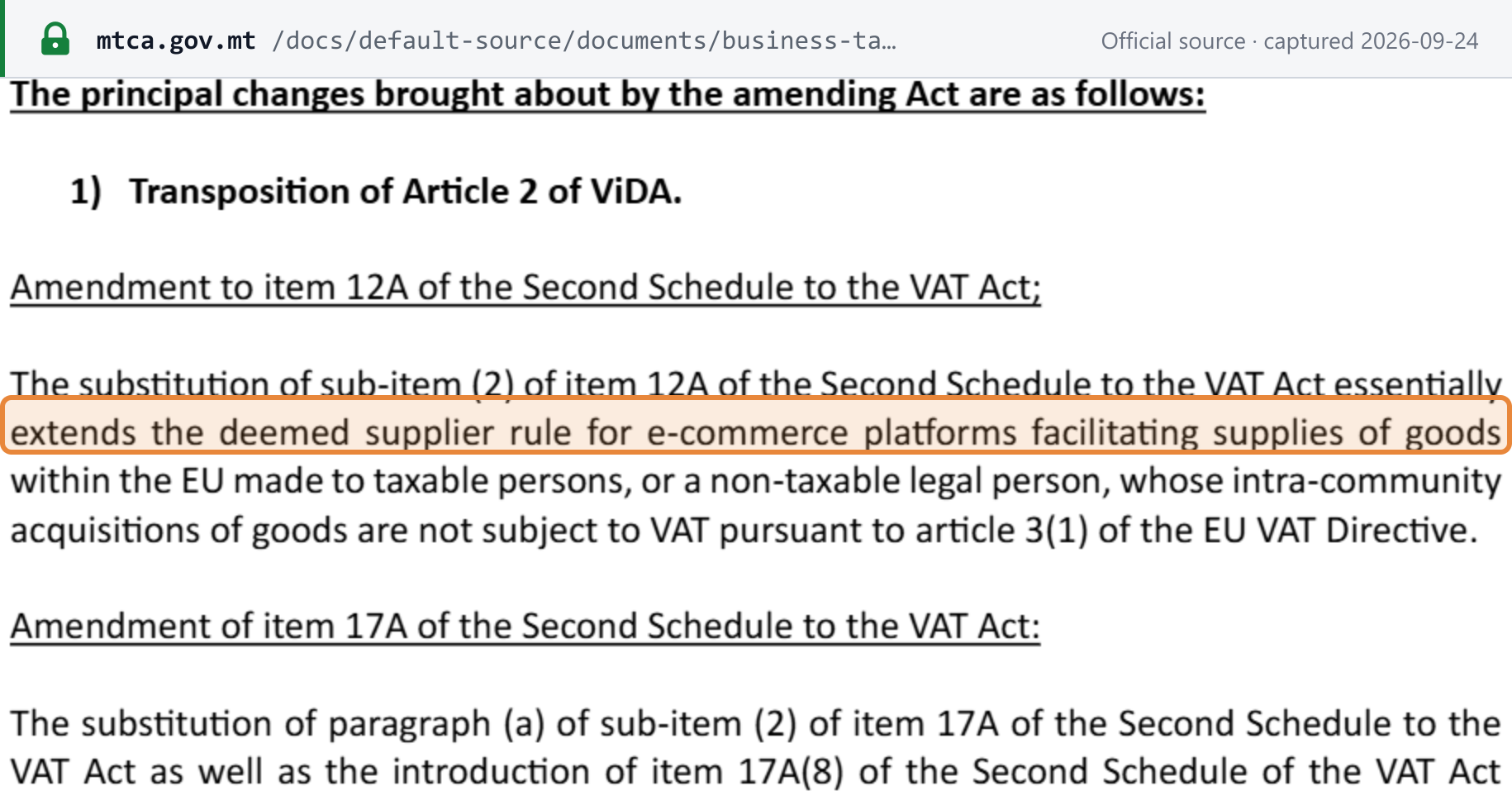 Source snapshot captured 2026-09-24 — original
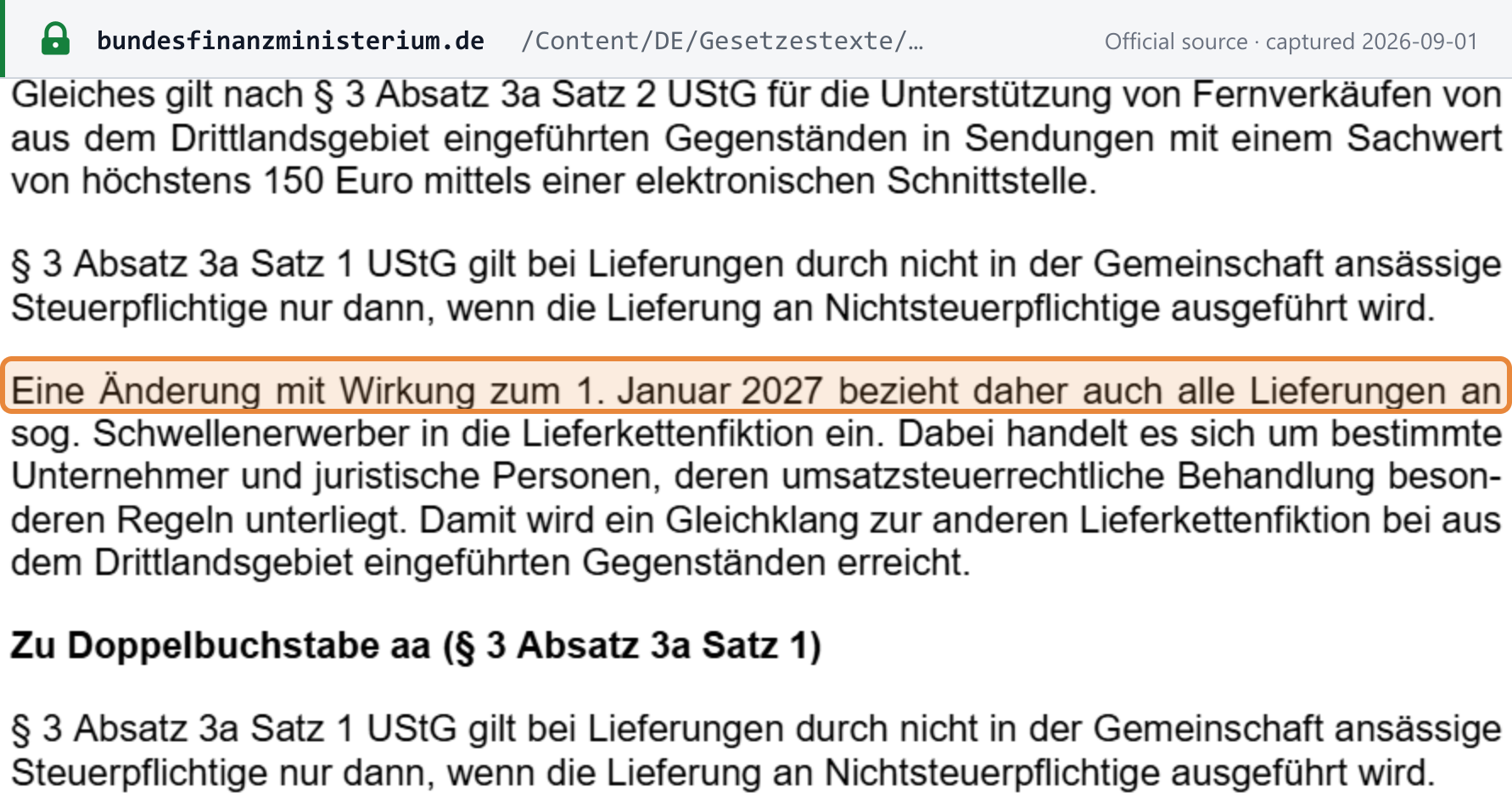 Source snapshot captured 2026-09-01 — original
1 July 2028 to 1 January 2030: accommodation and passenger-transport platforms (Art 28a)
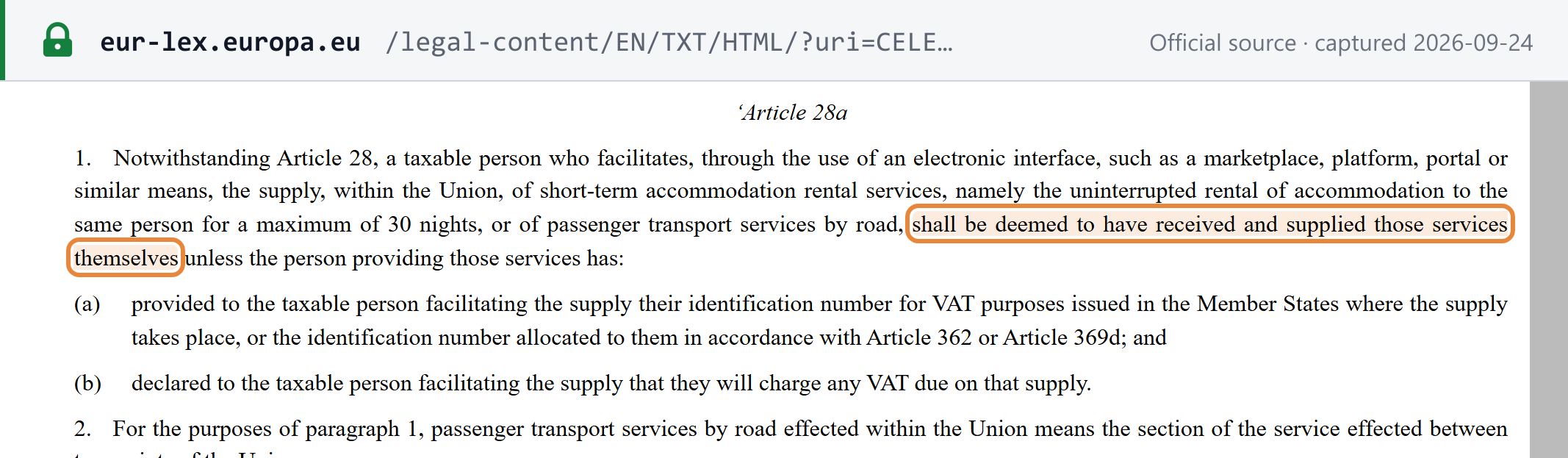
ViDA adds a deemed-supplier rule for services. A platform that facilitates "short-term accommodation rental services, namely the uninterrupted rental of accommodation to the same person for a maximum of 30 nights, or of passenger transport services by road" within the EU "shall be deemed to have received and supplied those services themselves". The exception applies only when the provider both gives the platform a VAT identification number issued in the Member State where the supply takes place (or an OSS scheme identification number allocated under Article 362 or 369d) and declares that it will charge the VAT itself.
- Member states may require the platform to validate the VAT number (Art 28a(4)).
- Member states may exclude suppliers that use the SME scheme (Art 28a(5)).
- Supplies under the travel agents' margin scheme are outside the rule (Art 28a(3)).
- Timing: "Member States shall apply the measures necessary to comply with Article 3, point (1), at the earliest from 1 July 2028 and at the latest from 1 January 2030."
 Source snapshot captured 2026-09-24 — original
Which member states will start early, and which will use the SME exclusion, has not been published.
The directive explains the target: platforms "should be required to charge VAT where underlying suppliers do not charge VAT because they are, for example, non-taxable persons or taxable persons availing themselves of the special scheme for small enterprises" (recital 27). (Council Directive (EU) 2025/516, Articles 3(1) and 6(3), checked 2026-09-24)
 Source snapshot captured 2026-09-24 — original
For the rest of the ViDA package, see ViDA — VAT in the Digital Age.
Customs: the facilitator as importer (from 21 September 2027)
The new Union Customs Code, Regulation (EU) 2026/2108 (Official Journal, 19 September 2026), defines the importer for distance sales in Article 5(14) as either the person supplying the goods or the person facilitating the distance sales. It applies from 21 September 2027, with listed exceptions. This is customs law, not VAT, but it follows the same logic as Art 14a(1). (EUR-Lex, checked 2026-09-21)
United Kingdom: extending liability to UK sellers (proposed)
In its Tax Update 2026 (23 June 2026) the UK government "published a consultation seeking views on the proposed extension of the VAT online marketplace liability rules to UK based businesses". It is a proposal: the current rule, described in the table below, still applies only to overseas sellers' goods in the UK and to imports of £135 or less. (HM Treasury / HMRC, checked 2026-09-24)
Jurisdiction table
Every row cites an official source; Last confirmed is the date that source was read. Rows marked Withholding or Collection are shown for contrast: they are not deemed-supplier rules.
| Jurisdiction | Mechanism | Scope | Since / status | Last confirmed | Source |
|---|---|---|---|---|---|
| EU (all 27) | Deemed supplier (Art 14a) | Imported consignments ≤ EUR 150; goods in the EU sold by non-EU sellers to non-taxable persons, any value | In force since 1 Jul 2021 | 2026-09-24 | Dir (EU) 2017/2455; Dec (EU) 2020/1109 |
| EU | Recast Art 14a(2) | Same goods limb, now also sales to Art 3(1) taxable persons and non-taxable legal persons | Applies 1 Jan 2027 (Malta enacted; Germany and Poland drafts) | 2026-09-24 | Dir (EU) 2025/516 Arts 2, 6(2); MTCA |
| EU | Deemed supplier (Art 28a, ViDA) | Short-term accommodation (max 30 nights); road passenger transport | Each member state between 1 Jul 2028 and 1 Jan 2030 | 2026-09-24 | Dir (EU) 2025/516 Arts 3(1), 6(3) |
| EU | Presumption (IR 282/2011 Art 9a) | Electronically supplied services through app stores and portals | Since 1 Jan 2015 | 2026-09-24 | IR (EU) 1042/2013 |
| United Kingdom | Online marketplace (OMP) liable | Imports of £135 or less to Great Britain; goods in the UK sold by overseas businesses, any value; B2B sales with a UK VAT number excluded | Since 1 Jan 2021; extension to UK sellers consulted on in 2026 | 2026-09-24 | HMRC |
| Australia | Platform operator treated as supplier | Inbound intangible consumer supplies; offshore low value goods (customs value A$1,000 or less, excluding tobacco and alcohol) | Tax periods from 1 Jul 2017; from 1 Jul 2018 for goods | 2026-09-24 | GST Act ss 84-55, 84-79, 84-81 |
| New Zealand | Marketplace collects and pays GST | Listed services (ride-sharing, food and beverage delivery, short-stay and visitor accommodation) at 15%; low value goods of NZ$1,000 or less | Listed services from 1 Apr 2024; low value goods from 1 Dec 2019 | 2026-09-24 | Inland Revenue — listed services; Inland Revenue — low value goods |
| Canada | Platform operator deemed supplier | Digital supplies by non-resident suppliers; goods in Canada sold by unregistered vendors; short-term accommodation | In effect since July 1, 2021 | 2026-09-24 | ETA s 211.13; CRA |
| Singapore | Marketplace operator regarded as supplier | Remote services by overseas suppliers; low-value goods not exceeding S$400 by local and overseas suppliers | Digital services from 1 Jan 2020; all remote services from 1 Jan 2023; low-value goods in force | 2026-09-24 | IRAS |
| Norway | Intermediary is the supplier (mandatory) | Low value goods under NOK 3,000 per item (VOEC) | VOEC in force; the first 12-month threshold period started 1 Apr 2020 | 2026-09-24 | Skatteetaten VOEC guide |
| Switzerland | Platform operator is the supplier (Art. 20a MWSTG) | Supplies of goods only | Since 1 Jan 2025 | 2026-09-24 | ESTV VAT Sector Info 27 |
| India | E-commerce operator pays "as if he is the supplier" (CGST Act s 9(5)) | Notified services, including restaurant service (Notification 17/2021-Central Tax (Rate), 18 Nov 2021) | In force | 2026-09-24 | CBIC; Circular 167/23/2021-GST |
| Japan | Specified platform operator deemed supplier | B2C electronic services by foreign businesses, where the operator collects the consideration | From 1 Apr 2025 | 2026-09-24 | NTA Tax Answer 6568 |
| South Africa | Intermediary deemed supplier (VAT Act s 54(2B)) | Electronic services of non-resident principals not registered in South Africa | From 1 Apr 2019 | 2026-09-24 | SARS VAT Connect Issue 9 |
| Brazil | Platform responsible (LC 214 of 16 January 2025, Art. 22, as amended by LC 227/2026) | IBS and CBS on operations and imports through digital platforms; replaces a supplier abroad | Enacted; applies as IBS and CBS phase in | 2026-09-24 | Planalto |
| United States — CA, TX, NY, FL | Marketplace facilitator treated as seller/retailer (sales tax) | Third-party sales facilitated through the marketplace | California from 1 Oct 2019; Florida from 1 Jul 2021; Texas and New York in force | 2026-09-24 | CDTFA; Texas Comptroller; NY DTF; Florida DOR |
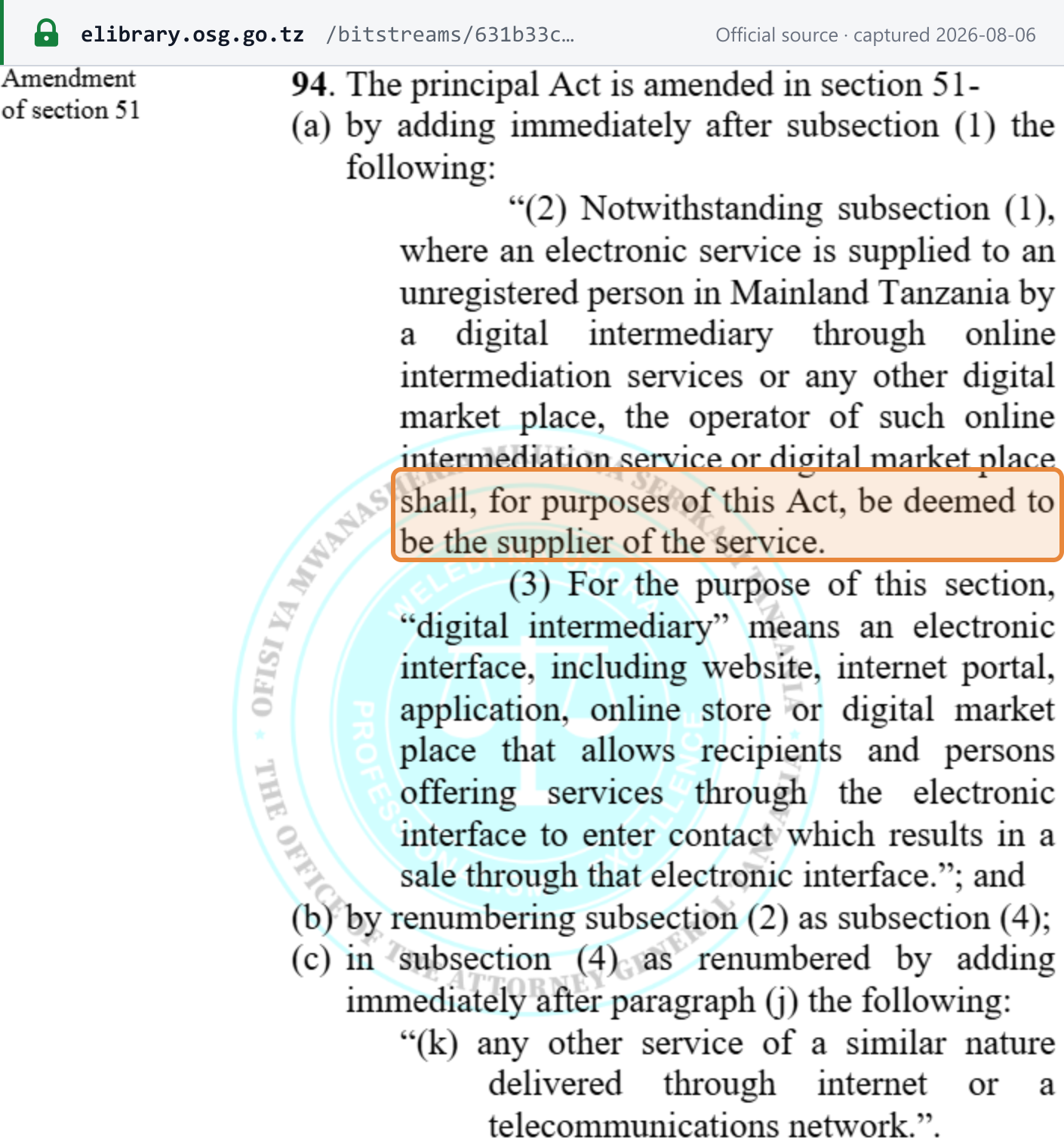
| Tanzania | Deemed supplier | Electronic services to unregistered persons in Mainland Tanzania through digital intermediaries | In force 1 Jul 2026 | 2026-08-06 | Finance Act 2026 |
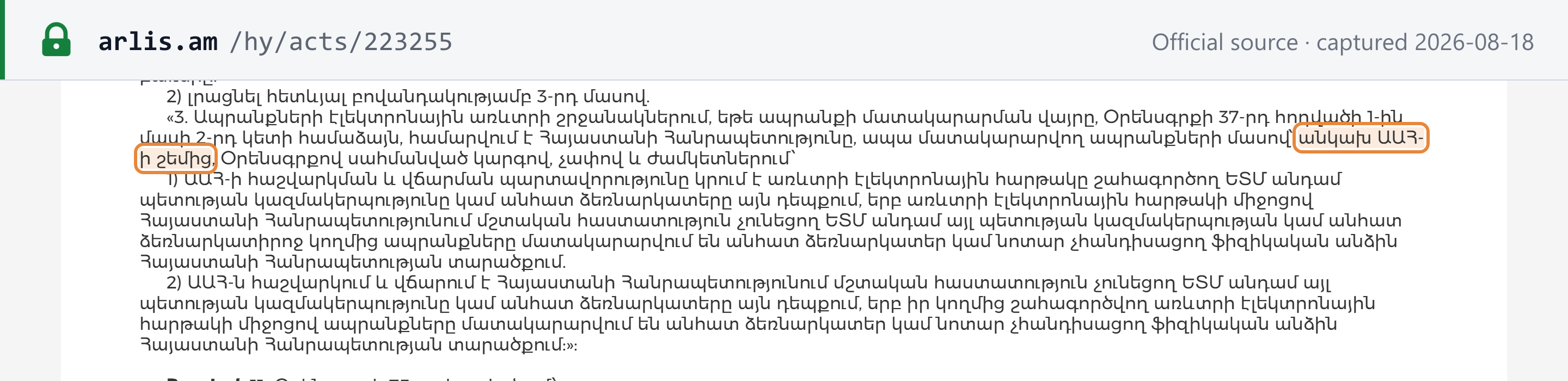
| Armenia | EAEU platform operator liable | Goods sold through the platform to individuals in Armenia by sellers from another EAEU state with no Armenian permanent establishment; the operator is an organisation or entrepreneur of an EAEU state | Law adopted 4 Mar 2026, published 31 Mar 2026; in force 1 Jan 2027 | 2026-08-18 | ARLIS, Law ՀՕ-83-Ն |
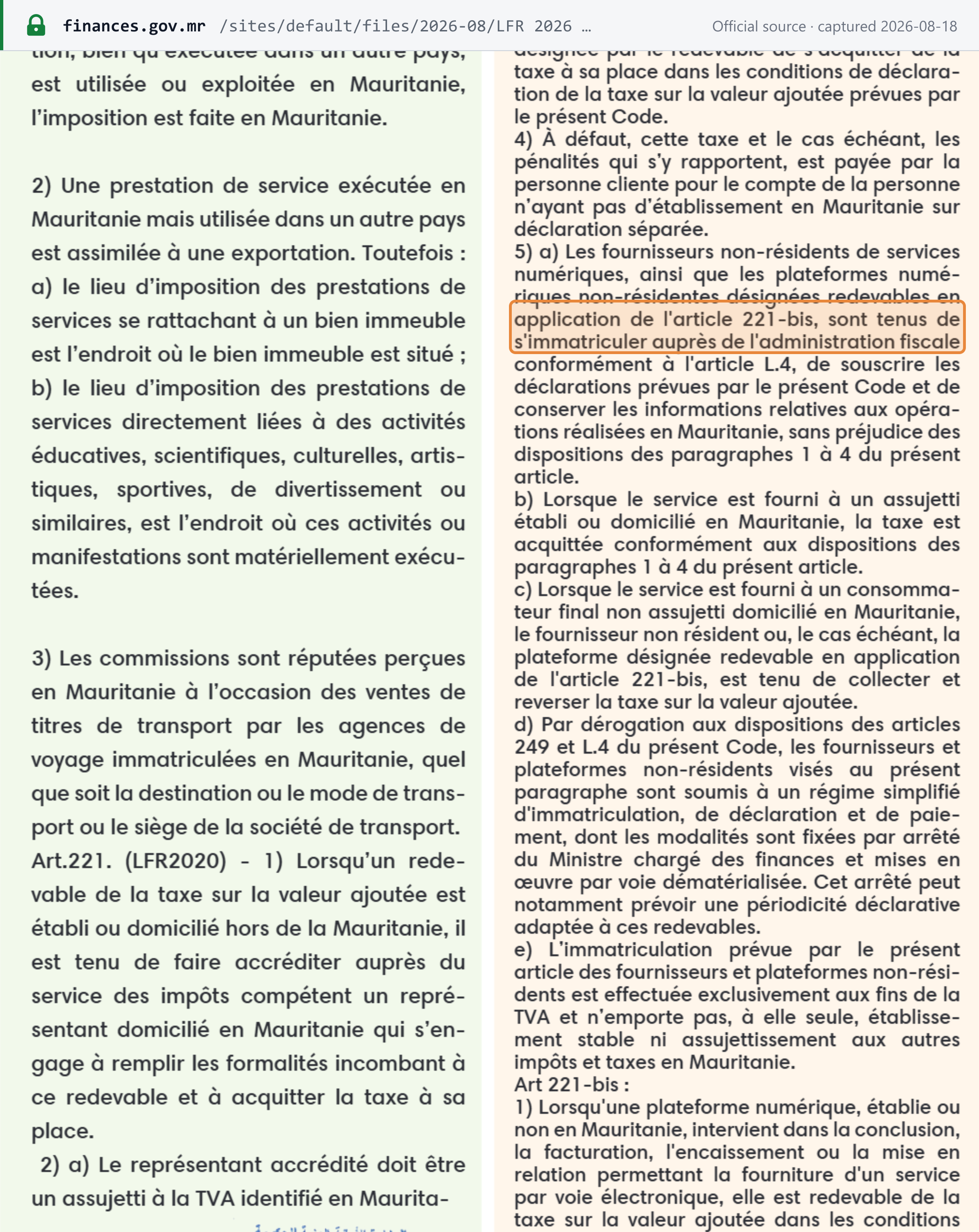
| Mauritania | Platform sole liable party, when conditions are met | Electronically supplied services through digital platforms that collect payment, set essential terms or act as the contractual interface | LFR 2026 (Art. 221-bis), published by the Ministry of Finance on 10 Aug 2026; implementing arrêté pending | 2026-08-18 | Ministère des Finances |
| Chile | Platform operator taxed as the seller | Operators of digital intermediation platforms are liable for IVA "como si fuera un vendedor habitual del bien o prestador del servicio que se concluye a través de la plataforma digital que opere" on taxed operations, except where the underlying seller or buyer is an IVA taxpayer | D.L. 825 art. 3 bis, added by Ley 21.713 (Diario Oficial 24 Oct 2024), in force 25 Oct 2025; card and payment-method issuer withholding continues as a fallback for unregistered foreign providers (art. 3) | 2026-10-07 | BCN Ley Chile — D.L. 825 art. 3 bis |
| Mexico / Chile / Colombia | Withholding (not deemed supply) | Platforms withhold from sellers (MX); card and payment-method issuers withhold from foreign digital-service providers that are on the SII list of non-registered providers (CL) or that opt into withholding (CO) | MX from 1 Jun 2020; CL under SII Res. Ex. 46 of 2022; CO under DIAN Res. 000049 of 2019 | 2026-09-24 | SAT; SII; DIAN |
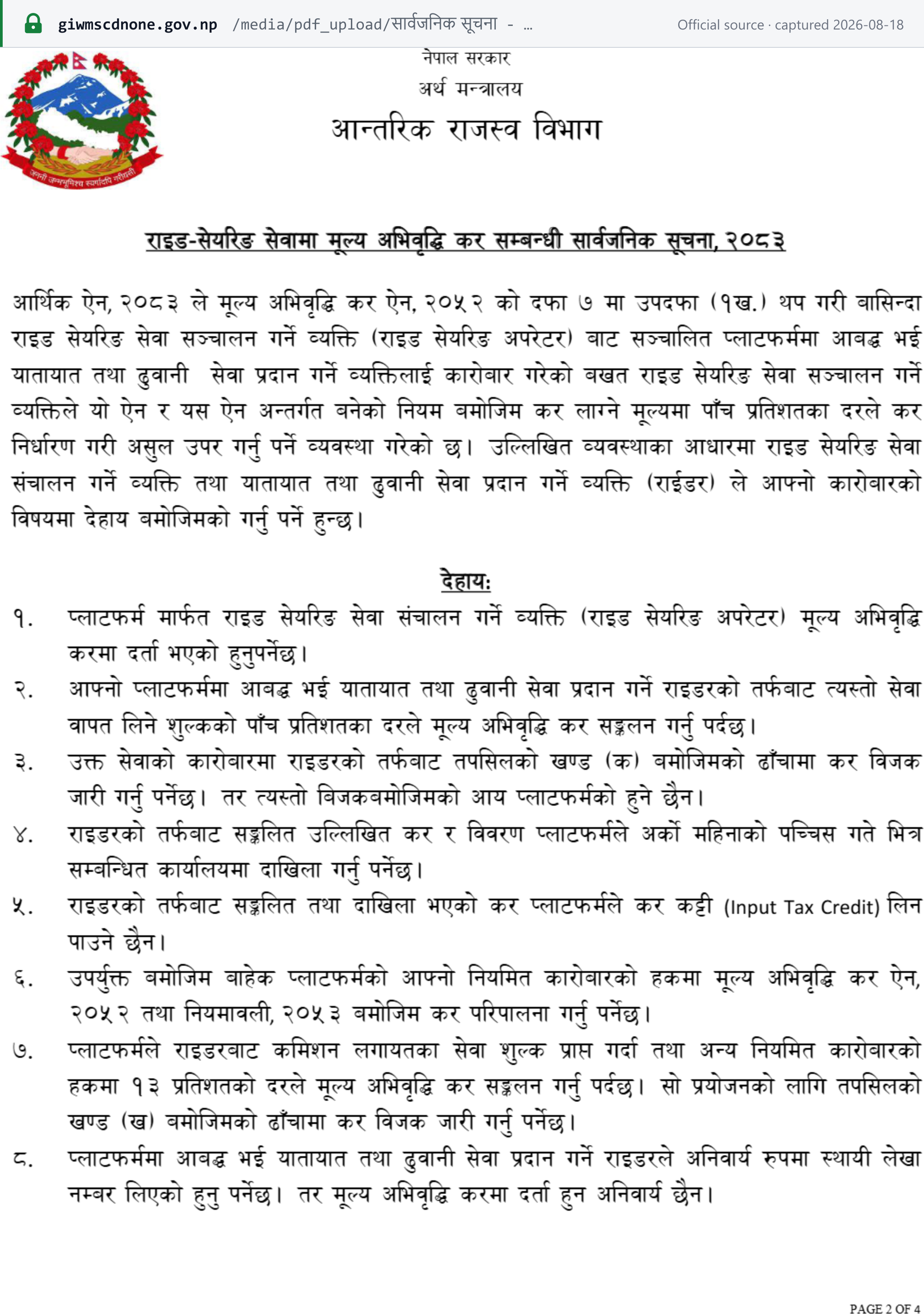
| Nepal | Collection by platform (not deemed supply) | Ride-sharing and delivery platforms collect 5% VAT on drivers' fees | From 17 Jul 2026 | 2026-08-18 | Inland Revenue Department |
The United States row shows four large states; others have their own marketplace facilitator laws, with their own thresholds and start dates; check the state's revenue department. Kentucky, for example, moved its remote seller and marketplace provider nexus test to USD 100,000 of sales only from 1 August 2026 (HB 757).
Notes by jurisdiction
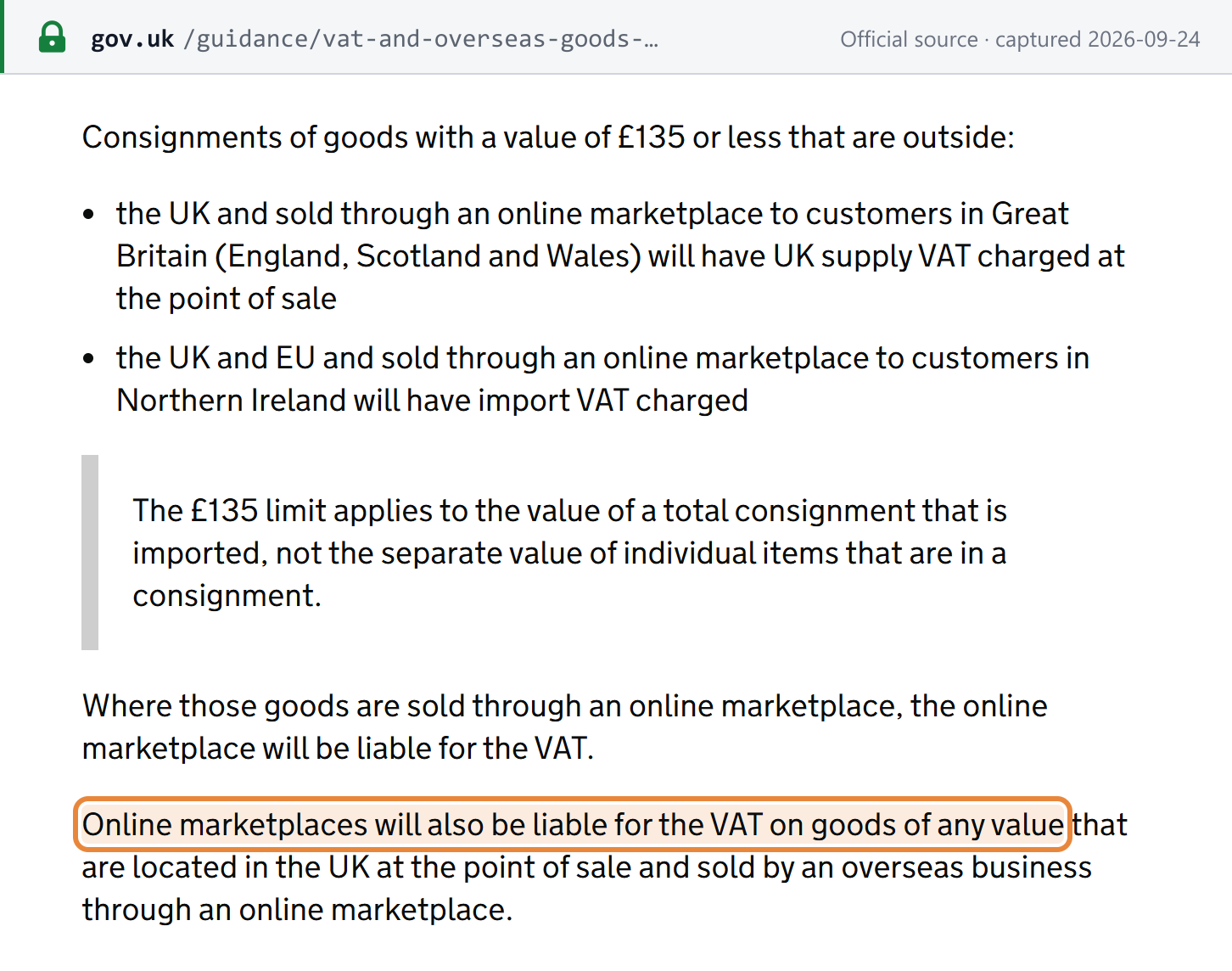
United Kingdom. HMRC: "Where those goods are sold through an online marketplace, the online marketplace will be liable for the VAT. Online marketplaces will also be liable for the VAT on goods of any value that are located in the UK at the point of sale and sold by an overseas business through an online marketplace." The marketplace charges VAT at the point of sale "unless the consignment is a business to business sale and the customer has given their UK VAT registration number". Northern Ireland follows EU-style import VAT for goods from outside the UK and EU. (HMRC, checked 2026-09-24) See the UK VAT guide.
 Source snapshot captured 2026-09-24 — original
Australia. Under GST Act s 84-55(1), "If an inbound intangible consumer supply is made through an electronic distribution platform, the operator of the platform, instead of the supplier, is treated, for the purposes of the GST law: (a) as being the supplier of, and as making, the supply". The operator is the supplier, not an agent collecting on the seller's behalf. Section 84-81(3) extends this to offshore supplies of low value goods, where "the customs value of the goods is $1,000 or less" and the goods "are not tobacco, tobacco products or alcoholic beverages" (s 84-79(3)). An operator can shift liability back to the supplier only if the documents name the supplier, a written agreement makes the supplier responsible, and the operator does not authorise the charge, authorise delivery or set the terms (s 84-55(4)). The digital rule applies to tax periods starting on or after 1 July 2017; the goods rule to tax periods starting on or after 1 July 2018 (Act No. 52, 2016; Act No. 77, 2017). (Federal Register of Legislation, compilation of 1 January 2026, checked 2026-09-24) See the Australia GST guide.
 Source snapshot captured 2026-09-24 — original
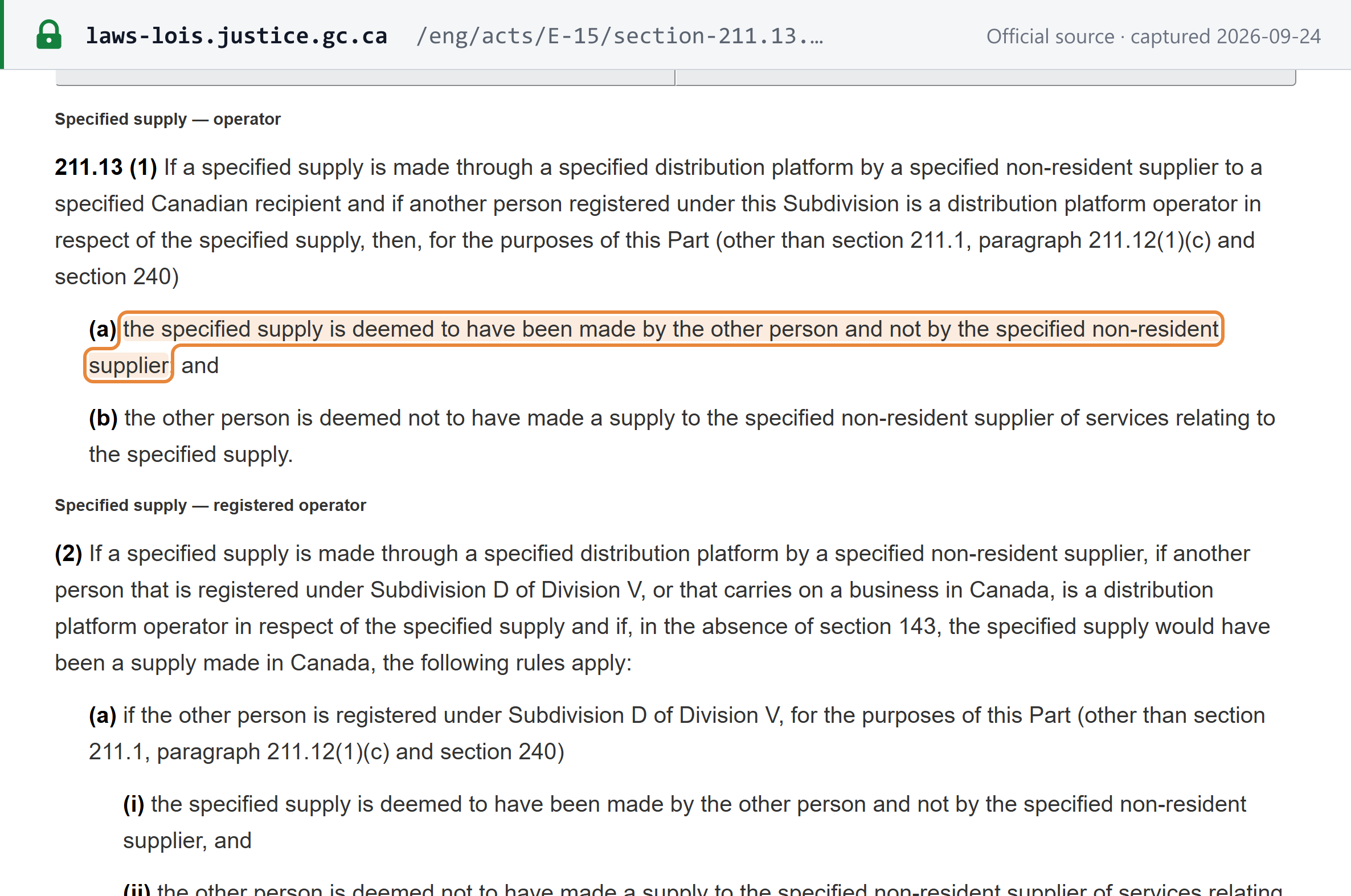
Canada. The Excise Tax Act has three platform rules. For digital supplies: when a specified supply is made through a specified distribution platform by a specified non-resident supplier to a specified Canadian recipient, and a registered person is the distribution platform operator, "the specified supply is deemed to have been made by the other person and not by the specified non-resident supplier" (s 211.13(1)). For goods: qualifying tangible personal property supplies by vendors not registered under the normal regime, such as goods shipped from Canadian fulfilment warehouses, are deemed made by the operator (s 211.23(1)). Short-term accommodation has an accommodation platform operator rule (s 211.13(3)). The CRA states: "Measures for digital-economy businesses are in effect as of July 1, 2021." (Justice Laws; CRA, checked 2026-09-24) See the Canada GST/HST guide.
 Source snapshot captured 2026-09-24 — original
New Zealand. "Online marketplaces (resident or non-resident for tax purposes) who facilitate the sale of listed services, must collect and pay GST of 15% when the service is performed, provided, or received in New Zealand. This applies whether the seller is GST-registered or not." For sellers who are not registered, the marketplace passes on a flat-rate credit: "They will pay 6.5% to us and will pass on 8.5% to you." This is the working precedent for the EU's Art 28a model. (Inland Revenue; sellers' page, checked 2026-09-24)
Singapore. "Under certain conditions, local and overseas operators of electronic marketplaces may also be regarded as the supplier of (i) remote services made by the overseas suppliers or (ii) low-value goods made by overseas and local suppliers, through these marketplaces. In such cases, the operators are required to register, charge and account for GST on these supplies, instead of the suppliers." Low-value goods are those that "have a value not exceeding the GST import relief threshold of S$400." (IRAS, checked 2026-09-24) See the Singapore GST guide.
Norway. "If the supply of the goods is facilitated with the use of an intermediary, the intermediary shall be regarded as the supplier for VAT purposes, instead of the underlying supplier of the goods." "The supplier provision is mandatory." "The less than NOK 3,000 threshold is applied per item – not per consignment." (Skatteetaten VOEC guide, checked 2026-09-24)
Switzerland. Sales of goods where seller and buyer conclude the contract on an electronic platform "are to be allocated to the platform operator as the supplier in accordance with Art. 20a of the VATA". The rule covers goods only; platforms facilitating services are not deemed suppliers. "This VAT Sector Info applies from 1 January 2025." (ESTV, VAT Sector Info 27, checked 2026-09-24)
India. Under CGST Act s 9(5), for services notified on the GST Council's recommendation, "all the provisions of this Act shall apply to such electronic commerce operator as if he is the supplier liable for paying the tax in relation to the supply of such services". Restaurant service was notified by Notification 17/2021 of 18 November 2021 (CBIC Circular 167/23/2021-GST). Separately, s 52 makes operators collect tax at source (TCS) on other sellers' supplies; that is a collection duty, not a deemed supply. (CBIC, checked 2026-09-24) See the India GST guide and OIDAR services.
Japan. From 1 April 2025, for consumer electronic services that foreign businesses supply through a digital platform, where the consideration is received through a specified platform operator, "当該特定プラットフォーム事業者が当該役務の提供を行ったものとみなして申告・納税を行う必要があります" (that specified platform operator is deemed to have made the supply and must file and pay). B2B electronic services and goods are outside the rule. The National Tax Agency publishes the list of designated operators. (National Tax Agency, Tax Answer No. 6568, checked 2026-09-24)
South Africa. SARS: "a new section 54(2B) has been introduced to deem the intermediary to be the supplier of electronic services in certain instances." The intermediary charges VAT as principal "if the non-resident principal is not registered for VAT in South Africa." (SARS, VAT Connect Issue 9, February 2019, checked 2026-09-24) See the South Africa VAT guide.
Brazil. Lei Complementar 214/2025, Art. 22: "As plataformas digitais, ainda que domiciliadas no exterior, são responsáveis pelo pagamento do IBS e da CBS relativos às operações e importações realizadas por seu intermédio" (digital platforms, even if domiciled abroad, are responsible for paying IBS and CBS on operations and imports carried out through them). Where the supplier is abroad, the platform is liable jointly with the buyer and in place of the supplier. A platform is covered when it controls at least one of billing, payment, terms and conditions, or delivery. (Planalto, checked 2026-09-24) For when IBS and CBS apply, see the Brazil guide.
United States. US states treat the marketplace as the seller for sales and use tax. It is the same idea as a deemed supplier, under state sales-tax law. California: "Beginning October 1, 2019, the marketplace facilitator is the retailer responsible for collecting and paying the tax to CDTFA on those facilitated sales for delivery in California." (CDTFA, checked 2026-09-24). Texas: "Marketplace providers engaged in business in Texas must collect, report and remit state and local sales and use tax on all sales made through a marketplace" (Texas Comptroller, checked 2026-09-24). New York: "You must collect tax on all taxable sales of tangible personal property delivered to a New York State address, regardless of the location of the marketplace seller" (NY DTF, checked 2026-09-24). Florida: "Beginning July 1, 2021, marketplace providers who have a physical presence in Florida or who make or facilitate a substantial number of remote sales, as defined above, through a marketplace, are required to register with the Department and collect and remit tax" (Florida DOR, TIP 21A01-03, checked 2026-09-24). Background: South Dakota v. Wayfair, the Streamlined Sales Tax project and the US sales tax guide.
Tanzania, Armenia and Mauritania. Three recent adopters. Tanzania's Finance Act 2026 amends VAT Act s 51: where an electronic service is supplied to an unregistered person through a digital intermediary, the platform operator "shall, for purposes of this Act, be deemed to be the supplier of the service" (in force 1 July 2026; see the Tanzania VAT guide). Under Armenia's Law ՀՕ-83-Ն (adopted 4 March 2026, published 31 March 2026, in force 1 January 2027), the platform operator (an organisation or entrepreneur of an EAEU state) is liable for VAT on goods sold through its platform to individuals in Armenia by sellers from another EAEU state with no Armenian permanent establishment. Mauritania's LFR 2026, published by the Ministry of Finance on 10 August 2026, makes digital platforms liable for VAT on their commission in all cases, and the sole liable party for electronically supplied services through them when they collect payment, set the essential terms or act as the contractual interface; the implementing arrêté is pending.
 Source snapshot captured 2026-08-06 — original
 Source snapshot captured 2026-08-18 — original
 Source snapshot captured 2026-08-18 — original
Withholding and collection, for contrast. In Mexico, the SAT announced that from 1 June 2020 digital platforms must "retener y enterar el IVA" (withhold and pay over the IVA). Platforms withhold 50% of the IVA charged by individual sellers, and 100% where the seller has not given the platform its RFC (LIVA arts 1o.-A BIS and 18-J, Cámara de Diputados); details and the 2026 extensions are in the Mexico VAT guide (updated 2026-09-23). In Chile, SII Resolución Exenta 46 of 2022 made payment-method issuers the VAT withholding agents for foreign digital-service providers on the SII list of providers that should register but do not (SII, checked 2026-09-24). In Colombia, card issuers and others withhold IVA when paying foreign providers of listed digital services that opt into the alternative payment system (Estatuto Tributario art. 437-2 num. 8; DIAN Resolución 000049 of 2019, checked 2026-09-24). In Nepal, from 17 July 2026 ride-sharing and delivery platforms collect 5% VAT on the fee drivers charge, issue the invoice on the rider's behalf, remit by the 25th of the following month and get no input credit on it; the platform's own commission bears 13% VAT (see the Nepal VAT guide). In all four, the seller stays the supplier.
 Source snapshot captured 2026-08-18 — original
Related changes from the feed
- 2026-09-19 — Regulation (EU) 2026/2108, the new Union Customs Code, was published; Article 5(14) defines the importer for distance sales as the person supplying or the person facilitating the distance sales, applying from 21 September 2027. (Publications Office of the EU) — see event
- 2026-09-16 — Ukraine's Verkhovna Rada passed at first reading bills 16051-1 and 15460, which would end the VAT exemption for marketplace-bought parcels up to EUR 150, no earlier than July 2027, with a Ukrainian equivalent of IOSS; proposed. (Cabinet of Ministers of Ukraine) — see event
- 2026-09-02 — Poland's Council of Ministers backed a draft VAT Act amendment transposing ViDA's e-commerce changes, including which supplies count as facilitated by electronic interfaces, planned for 1 January 2027; proposed. (Ministerstwo Finansów) — see event
- 2026-08-12 — Germany's Jahressteuergesetz 2026 government draft would extend the § 3(3a) UStG deemed-supplier fiction to supplies to Schwellenerwerber from 1 January 2027; proposed. (Bundesministerium der Finanzen) — see event
- 2026-08-10 — Mauritania's LFR 2026, published by the Ministry of Finance, makes digital platforms liable for VAT on their commission and the sole liable party for electronically supplied services through them where they collect payment, set essential terms or act as the contractual interface. (Ministère des Finances) — see event
- 2026-07-29 — Ukraine's Cabinet approved a companion Customs Code bill to draft law 15112-д (already before the Verkhovna Rada) to charge VAT from EUR 0 on goods bought through foreign marketplaces. (Cabinet of Ministers of Ukraine) — see event
- 2026-07-17 — Nepal's ride-sharing and delivery platforms began collecting 5% VAT on drivers' fees, with no input credit on the collected amount; this is collection, not deemed supply. (Inland Revenue Department) — see event
- 2026-07-15 — Nepal's Inland Revenue Department decided (decision of 2083/03/31 BS) to issue guidelines for VAT collection in ride-sharing services under the new section 7(1kha) of the VAT Act. (Inland Revenue Department) — see event
- 2026-07-01 — Tanzania's Finance Act 2026 made the operator of a digital marketplace the deemed supplier of electronic services supplied through it to unregistered persons. (Government Printer / OSG e-Library) — see event
- 2026-06-23 — The UK opened a consultation on extending online-marketplace VAT liability to UK-based sellers. (HM Treasury / HMRC) — see event
- 2026-06-19 — Nepal's House of Representatives approved the Finance Bill 2083, with 5% VAT on ride-hailing and ride-sharing platform services collected by the platform operator from 17 July 2026. (Nepal House of Representatives) — see event
- 2026-03-31 — Armenia published Law ՀՕ-83-Ն, making the platform operator (an organisation or entrepreneur of an EAEU state) liable for VAT on goods sold through its platform to individuals in Armenia by sellers from another EAEU state with no Armenian permanent establishment, from 1 January 2027. (ARLIS) — see event
- 2026-03-10 — Malta's Act III of 2026 was published, transposing the recast Art 14a(2) (supplies to Article 3(1) customers) from 1 January 2027. (Malta Tax and Customs Administration) — see event
Frequently asked questions
I'm a non-EU seller using a marketplace with stock in an EU warehouse. Who charges the VAT?
The marketplace does, at any value, when the customer is a non-taxable person. Article 14a(2) of the VAT Directive has covered goods in the EU sold through an electronic interface by a seller not established in the EU since 1 July 2021. Your own sale to the marketplace is a deemed B2B supply that is exempt with the right of deduction (Articles 136a and 169(b)), and VAT becomes chargeable when the payment is accepted (Article 66a). (Directive (EU) 2017/2455; Directive (EU) 2019/1995; Commission explanatory notes, checked 2026-09-24)
Does ViDA make marketplaces liable for intra-EU sales from 2027?
Marketplaces are already liable for intra-EU sales by non-EU sellers to consumers; that has applied since 1 July 2021. What Directive (EU) 2025/516 changes from 1 January 2027 is the customer group: the recast Article 14a(2) also covers sales to taxable persons and non-taxable legal persons whose intra-Community acquisitions of goods are not subject to VAT under Article 3(1), known in Germany as Schwellenerwerber. The seller must still be established outside the EU. Malta has enacted the change (Act III of 2026); Germany's and Poland's bills are drafts. (Directive (EU) 2025/516, Arts 2(1), 6(2); MTCA explanatory notes, checked 2026-09-24)
When do accommodation and ride-hailing platforms become the VAT payer in the EU?
Each member state must apply Article 28a no earlier than 1 July 2028 and no later than 1 January 2030. The platform is the deemed supplier of short-term accommodation (up to 30 nights) and road passenger transport within the EU unless the host or driver gives it a VAT identification number issued in the Member State where the supply takes place (or an OSS scheme number) and declares that they will charge the VAT. Member states may exclude suppliers using the SME scheme. New Zealand has applied a comparable marketplace rule to listed services since 1 April 2024. (Directive (EU) 2025/516, Arts 28a, 6(3); Inland Revenue, checked 2026-09-24)
Is a payment processor or a price-comparison site a deemed supplier?
No. In the EU, an interface that only processes payments, only lists or advertises goods, or only redirects customers to other interfaces without further intervention is outside Article 14a (Implementing Regulation 282/2011, Article 5b). Canada's "excluded operator" definition (Excise Tax Act s 211.1) carves out the same activities. Australia's definition (GST Act s 84-70(2)) expressly excludes only services that provide access to a payment system or process payments (and carriage services). (checked 2026-09-24)
Is Mexico's platform withholding the same as a deemed-supplier rule?
No. Under a deemed-supplier rule the platform becomes the supplier. Under Mexico's rule the seller remains the taxpayer and the platform withholds part or all of the IVA: 50% of the IVA charged by individual sellers, and 100% where the seller has not given the platform its RFC. Chile and Colombia go a step further back: card and payment-method issuers withhold VAT from foreign digital-service providers that are on the SII list of non-registered providers (Chile) or that opt into withholding (Colombia). Chile also has a deemed-supplier rule: since 25 October 2025, D.L. 825 art. 3 bis (added by Ley 21.713) taxes the operator of a digital intermediation platform as if it were the seller, except where the underlying seller or buyer is an IVA taxpayer. (SAT communiqué 015/2020; LIVA arts 1o.-A BIS and 18-J; SII, 1 August 2022; DIAN Resolución 000049 of 2019)
If the marketplace pays the VAT, do I still need to register?
Often yes, and the answer is jurisdiction-specific. In the EU your deemed supply to the marketplace under Article 14a(2) is exempt but must still be invoiced, and a VAT number is usually needed to recover input VAT. In the UK, when goods in the UK are sold through a marketplace, the overseas seller is treated as making a zero-rated deemed supply to the marketplace and does not have to invoice it; a seller that only makes such zero-rated deemed supplies can either register for VAT or apply for exemption from registration. A registered overseas seller can reclaim the import VAT it paid when the goods were first imported. (Commission explanatory notes, section 2.1.4; HMRC, checked 2026-09-24)
Related resources
- Import One Stop Shop (IOSS) — how marketplaces declare Art 14a(1) imports of EUR 150 or less
- VAT One Stop Shop (OSS) — the Union OSS, where Art 14a(2) deemed suppliers declare
- ViDA — VAT in the Digital Age — the 2027 recast and the 2028–2030 platform rule
- DAC7 — platform reporting, the data-only counterpart
- VAT on digital services by non-resident suppliers — when the foreign seller, not the platform, registers
- Reverse charge — the other main way VAT liability moves away from the seller
- Country guides: Germany, Malta, Poland, Ireland, United Kingdom, Australia, Canada, Singapore, India, South Africa, Brazil, Mexico, Tanzania, Nepal, United States
- Tax-change chronologies: European Union, United Kingdom, Germany, Malta, Poland, Tanzania, Armenia, Mauritania, Nepal
Reference links
- Council Directive (EU) 2017/2455 — inserts Article 14a
- Council Directive (EU) 2019/1995 — Articles 66a and 136a
- Council Decision (EU) 2020/1109 — the 1 July 2021 start date
- Council Implementing Regulation (EU) 2019/2026 — Articles 5b to 5d
- Council Directive (EU) 2025/516 — ViDA: recast Article 14a and new Article 28a
- European Commission — Explanatory Notes on VAT e-commerce rules
- European Commission — VAT e-commerce
- Irish Revenue — Deemed supplier — a member-state tax authority's guidance