Singapore GST guidelines
| FACTSHEET | |
|---|---|
| Country code | SG |
| Tax name | Goods and Services Tax (GST) |
| Tax Authority | Inland Revenue Authority of Singapore (IRAS) |
Overview
Singapore levies Goods and Services Tax (GST) under the Goods and Services Tax Act 1993, administered by the Inland Revenue Authority of Singapore (IRAS), specifically the Comptroller of GST. GST is charged on the supply of goods and services made in Singapore by a GST-registered person in the course of business, and on the importation of goods. [1]
Currency. All values in this guide are in Singapore Dollars (SGD). [1]
Tax period basis. The standard prescribed accounting period is a calendar quarter — January–March, April–June, July–September, October–December — though some businesses file monthly (see Filing and payment). Both GST returns and payment are due one month after the end of the accounting period covered by the return. The retrospective registration-liability test separately runs on the calendar year. [2]
Layering. Singapore is a unitary city-state with no state, provincial or municipal layer — GST is imposed solely at the national level. [1]
A note on sourcing: the figures, thresholds and dates in this guide are drawn from IRAS's own published e-Tax Guides and web pages — official guidance that quotes and applies the GST Act — rather than from the Act's operative text directly (with the Act's own text consulted directly where it settles a point). Where a specific GST Act section number appears below, it is as cited within an IRAS e-Tax Guide.
Registration
Who should register
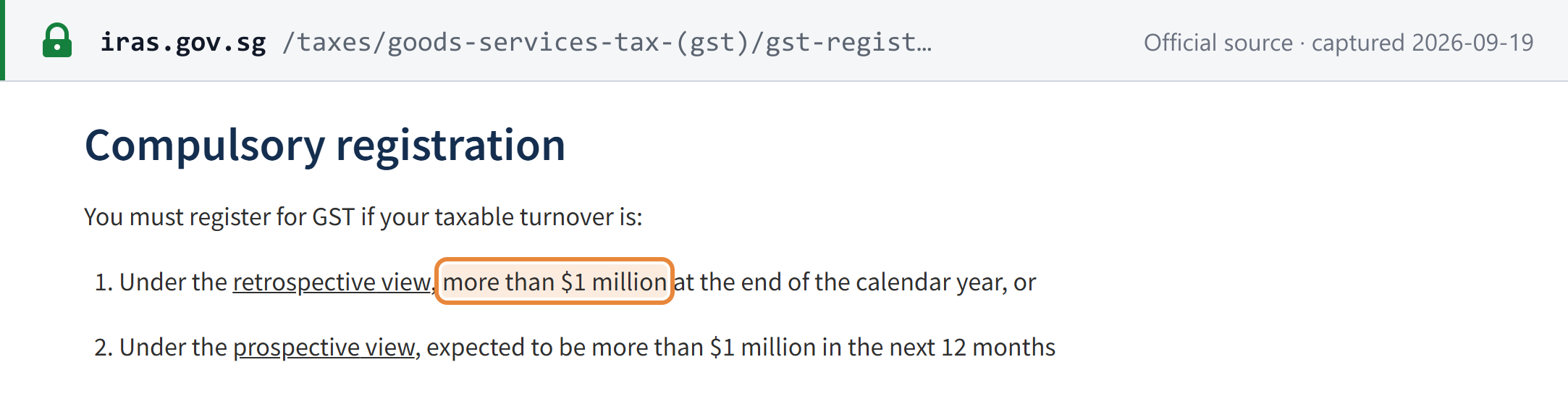
Compulsory registration applies where taxable turnover exceeds SGD 1 million, tested two ways: [1]
- Retrospective basis — turnover for the calendar year (1 January–31 December) exceeded SGD 1 million. Apply between 1 and 30 January of the following year; registration takes effect from 1 March.
- Prospective basis — turnover is reasonably expected to exceed SGD 1 million in the next 12 months. Apply within 30 days of the forecast date.
IRAS states the rule directly: "You must register for GST if your taxable turnover is: Under the retrospective view, more than $1 million at the end of the calendar year, or Under the prospective view, expected to be more than $1 million in the next 12 months." [1]
The effective date of registration under the prospective basis depends on when the forecast was made. For forecasts made on or after 1 July 2025, registration takes effect 2 months after the forecast date — a grace period the Second Minister for Finance announced on 28 February 2025 to give businesses more time to start charging GST. For forecasts made before that date, the effective date is the 31st day after the forecast. The 30-day application deadline itself is unchanged either way. [1]
Foreign digital-service and remote-service suppliers face a separate, non-resident registration regime with different thresholds — see Foreign companies selling into Singapore — B2B and B2C.
Registration threshold
| Trigger | Threshold | Measurement period | Notes |
|---|---|---|---|
| Compulsory registration (retrospective) | SGD 1,000,000 | Calendar year (1 Jan–31 Dec) | Apply 1–30 Jan of the following year; registered from 1 Mar. [1] |
| Compulsory registration (prospective) | SGD 1,000,000 expected | Any forward-looking 12-month period | Apply within 30 days of the forecast; registered 2 months after the forecast date (forecasts from 1 Jul 2025) or 31 days after (earlier forecasts). [1] |
| Overseas Vendor Registration (B2C, non-resident) | SGD 1,000,000 global turnover and SGD 100,000 Singapore B2C sales | 12-month period, both thresholds must be met | See Cross-border rules. [3] |
| Non-GST-registered person liable under reverse charge | SGD 1,000,000 in imported services/low-value goods over 12 months | Where the person would not be entitled to full input tax credit if registered | See Cross-border rules. [4] |
| Voluntary registration | Below SGD 1,000,000 | — | Available to businesses making taxable, out-of-scope, or certain exempt supplies; see below. [5] |
For the format of the GST Registration Number and the UEN, and how the two relate, see Lookuptax's Singapore TIN number guide. To verify a counterparty's number, see How to verify a GST Reg No in Singapore and How to verify a UEN in Singapore, or use Lookuptax's Singapore GST validator and UEN validator.
How to register
Registration is completed on IRAS's myTax Portal, using CorpPass. Foreign digital-service and remote-service suppliers under Overseas Vendor Registration follow a dedicated non-resident registration process on the same portal. IRAS does not publish a fixed processing timeline. [1]
Voluntary registration
Available to businesses making taxable supplies, out-of-scope supplies, or exempt international-services/financial supplies, and to businesses that procure overseas services or import low-value goods without full input-tax entitlement. Once voluntarily registered, a business must remain registered for at least 2 years before it may apply to cancel — IRAS's own guidance advises weighing the costs and benefits over that full 2-year period before registering. [5]
Deregistration
Compulsory cancellation is required within 30 days of: ceasing to make or intend to make taxable supplies; ceasing business; transferring the whole business as a going concern; or a change of legal form. Voluntary cancellation is possible once no longer liable to be registered, subject to the 2-year minimum for those who registered voluntarily. [6]
A final return (GST F8) must be filed within one month of the end of the last prescribed accounting period. In that final return, output tax must be accounted for on business assets held at deregistration where their total open-market value exceeds SGD 10,000. Records must still be kept for 5 years from the transaction date, even after cancellation. [6]
Group registration
Available. One member is nominated as the representative member, and GST registration is issued in its name; all members of the group are jointly and severally liable for the representative member's tax debt, and a former member remains liable for the tax due during its own period of membership even after leaving. [7]
Conditions: every member must already be individually GST-registered; each member must either be Singapore-resident or have an established Singapore place of business, or otherwise meet one of — annual turnover of at least SGD 1 million, listed on a securities exchange, a subsidiary of a body that meets those, or venture-capital-financed by an entity that meets those; the representative member itself must be Singapore-resident or have an established Singapore place of business; and a control relationship must exist between members. Applications are made on form GST G1 at least 90 days before the proposed effective date, and the Comptroller may refuse an application on revenue-protection grounds. [7]
Rates
| Rate | Applies to | Effective |
|---|---|---|
| 9% (standard) | Most taxable goods and services not specifically zero-rated or exempt | Since 1 January 2024 [8] |
| 0% (zero-rated) | Exports of goods and international services (GST Act s.21(3)) | — [9] |
| Exempt (no GST charged, no input-tax recovery) | See Exemptions | — [9] |
Singapore has no reduced or super-reduced rate distinct from the standard rate — the rate structure is standard (9%), zero (0%), or exempt.
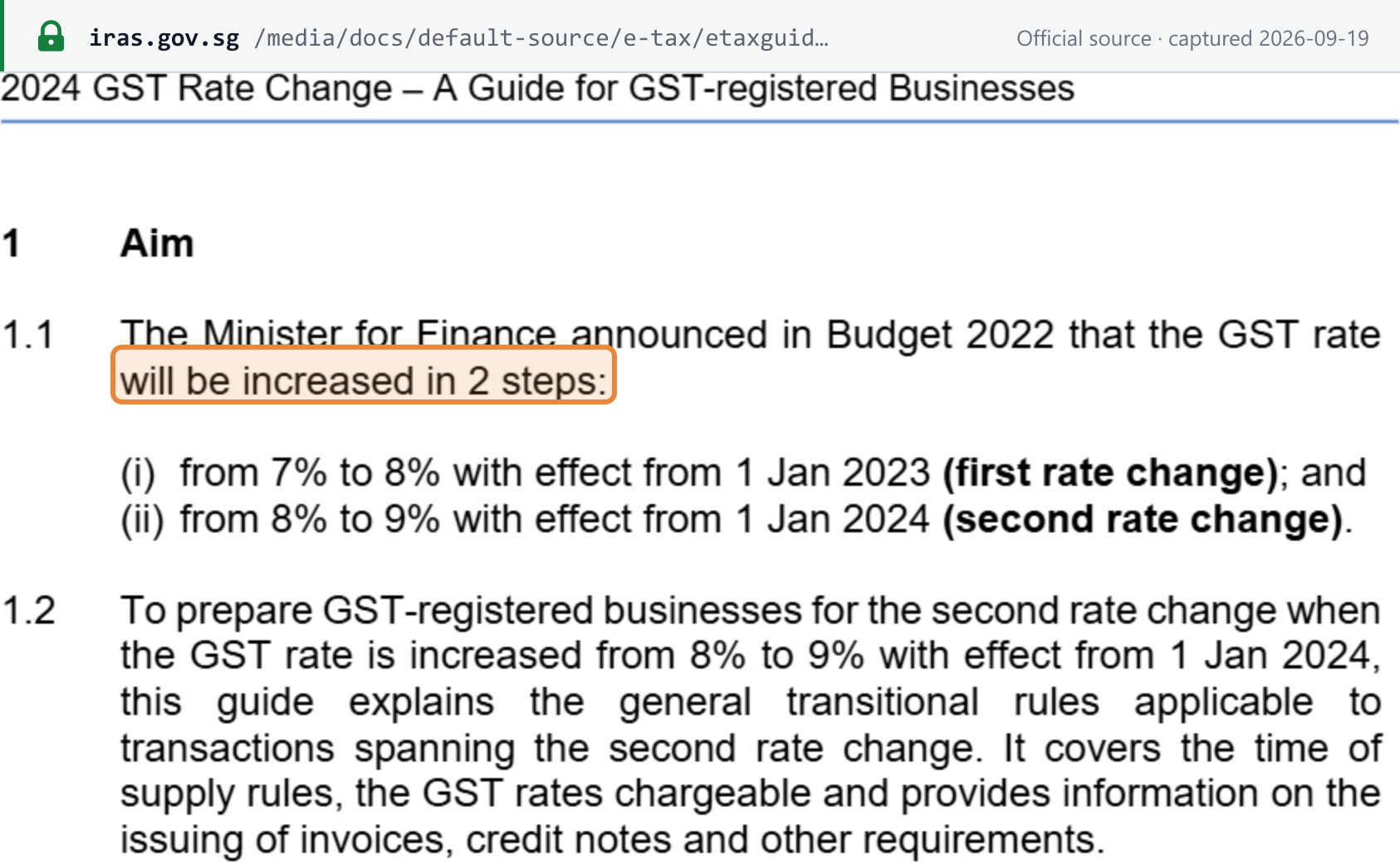
Rate history. The standard rate reached 9% in two Budget-announced steps: 7% until 31 December 2022, 8% from 1 January 2023 to 31 December 2023 (the "first rate change"), and 9% from 1 January 2024 (the "second rate change"). IRAS's own e-Tax Guide states: "The Minister for Finance announced in Budget 2022 that the GST rate will be increased in 2 steps: (i) from 7% to 8% with effect from 1 Jan 2023 (first rate change); and (ii) from 8% to 9% with effect from 1 Jan 2024 (second rate change)." Before that, the GST Act 1993 (2020 Revised Edition, s.16) records the earlier ladder: 4% from 1 January 2003, 5% from 1 January 2004 to 30 June 2007, and 7% from 1 July 2007 to 31 December 2022. [Act] [8]
Announced future rates. None currently scheduled.
Cross-border rules
Imports and exports
- Exports — goods exported from Singapore and international services are zero-rated under GST Act s.21(3): still taxable supplies, with full input-tax recovery for the exporter. [9]
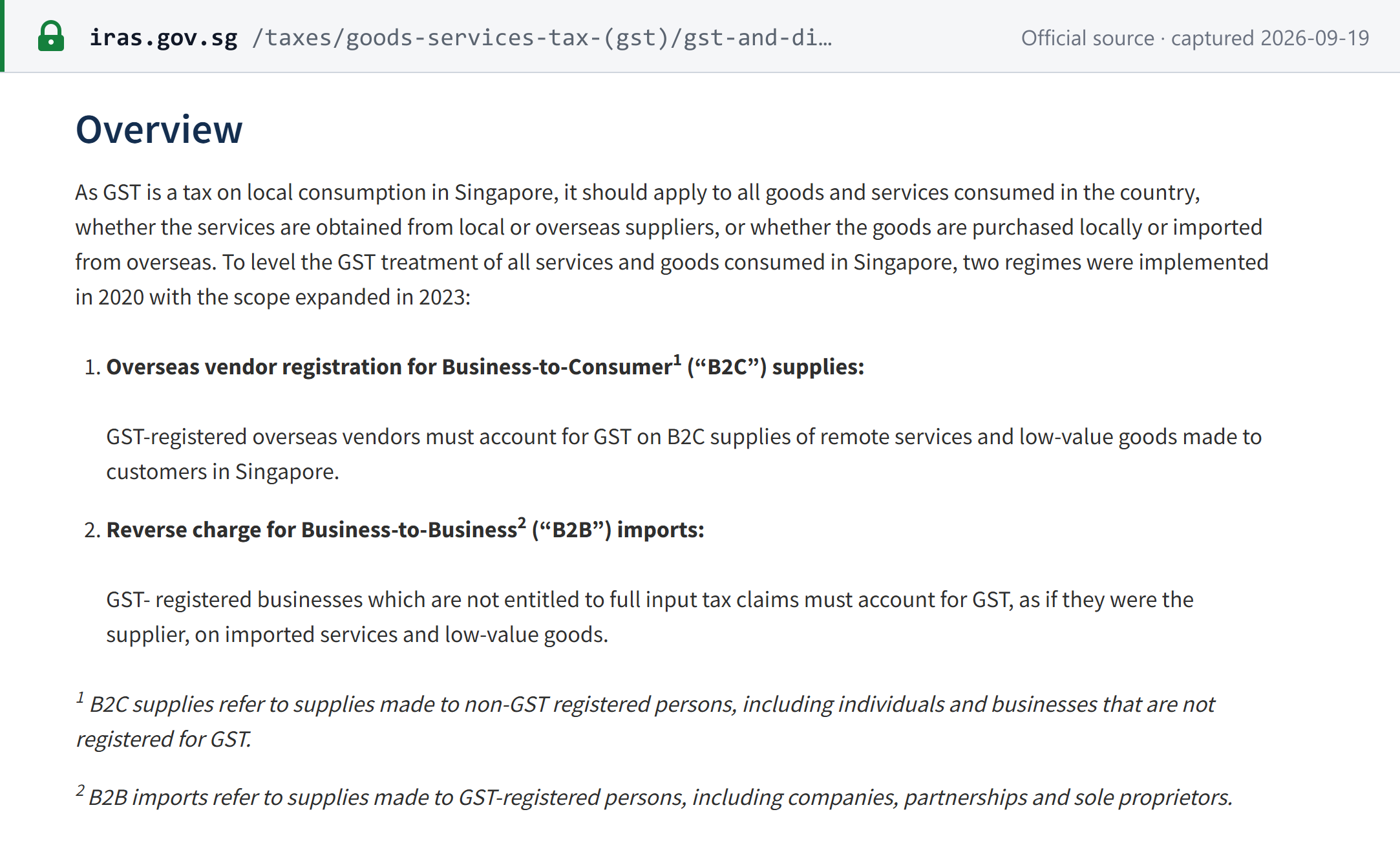
- Reverse charge on imported services (B2B) — since 1 January 2020, a GST-registered person not entitled to full input-tax credit (fails the de-minimis rule, or belongs to a GST group where any member fails it) must self-account for GST on imported services as if it were the supplier ("RC Business"). This was extended to low-value goods (LVG) from 1 January 2023. IRAS's Reverse Charge e-Tax Guide states: "Under the reverse charge mechanism, when a supplier who belongs outside Singapore makes a B2B supply of services to a GST-registered person who belongs in Singapore, the GST-registered recipient would be required to account for GST on the value of his imported services as if he were the supplier." A business with fluctuating exempt supplies may elect annually to test reverse-charge liability over a "longer period" instead of every accounting period, with the election due within 1 month of that longer period's first accounting period. [10]
- Reverse charge — non-registered persons — a person not yet GST-registered is also liable to register under reverse charge if it procures overseas services and imports low-value goods exceeding SGD 1 million in a 12-month period, and would not be entitled to full input-tax credit even if registered. [10]
- De-minimis — not confirmed against an official source in this research pass; not stated here rather than guessed.
Digital products and services
Digital and remote services are not a separate, lower-threshold category in Singapore's GST rules — they fall under the same Overseas Vendor Registration (OVR) thresholds described in Foreign companies selling into Singapore — B2B and B2C below. Digital services (e.g. streaming, software, apps) were caught from 1 January 2020; the OVR regime was extended to all remote services (digital and non-digital, such as online counselling and consultancy) and to low-value goods from 1 January 2023. [3]
Foreign companies selling into Singapore — B2B and B2C
The two tracks are answered separately, and the counterparty type decides which applies:
- B2B — where a Singapore-registered business is not entitled to full input-tax credit, it self-accounts for GST on imported services and low-value goods under the reverse charge described above. The overseas supplier itself generally does not need to register for that transaction. [10]
- B2C — overseas businesses (and, under conditions, electronic marketplace operators and "redeliverers") must register under Overseas Vendor Registration if global annual turnover exceeds SGD 1 million AND B2C supplies of remote services and/or low-value goods to Singapore customers exceed SGD 100,000 annually. Both thresholds must be met. Registration is on a simplified pay-only basis, with no input-tax claims. IRAS states: "Under the overseas vendor registration ('OVR') regime, overseas businesses with an annual global turnover exceeding S$1 million and that make B2C supplies of remote services and/or low-value goods to customers in Singapore exceeding S$100,000 annually, will be required to register for GST in Singapore." Low-value goods caught are those valued at or below the SGD 400 import-relief threshold and delivered by air or post. [3]
Where a GST-registered overseas supplier itself belongs in Singapore for the services it provides — for example, through a fixed establishment here — neither reverse charge nor OVR applies; the supplier instead charges output GST directly at the prevailing rate. [10]
Marketplace / platform deemed-supplier liability
An electronic marketplace operator can be treated as the deemed supplier of (i) low-value goods sold through its marketplace by both local and overseas underlying suppliers, and (ii) remote services sold through its marketplace by overseas underlying suppliers, where it meets IRAS's specified conditions. In that case, the operator must include the value of those supplies in its own OVR registration-liability test and account for GST on them once registered — regardless of whether the underlying suppliers are themselves GST-registered. A "redeliverer" (a freight-forwarding or mail-redirection intermediary) can similarly be treated as the deemed supplier of low-value goods. [3]
Place of supply
The GST Act does not use a dedicated destination/origin "place of supply" test the way EU-style VAT law does; instead the operative question throughout the reverse-charge and OVR regimes is where the customer belongs — broadly, whether its usual residence or establishment is inside or outside Singapore. Per IRAS's Reverse Charge e-Tax Guide: "if the GST-registered overseas supplier belongs in Singapore for the services provided (e.g., it is supplying the services through its fixed establishment in Singapore), the remote services would not be subject to reverse charge. As the place of supply is in Singapore, the GST-registered overseas supplier would have charged GST on such supplies at the prevailing standard-rate." [10]
Invoice requirements
Mandatory content
A full tax invoice must contain the following, per IRAS's published requirements: [11]
| Required field | Notes |
|---|---|
| The words "Tax Invoice" | — |
| Supplier's name and address | — |
| GST registration number | — |
| Invoice date | — |
| An invoice identifying number | — |
| Customer's name and address | — |
| Description of goods and services | — |
| GST rate | — |
| Total amount payable excluding GST | — |
| Total GST | — |
| Total amount payable including GST | — |
| Gross amount for each treatment, where mixed | Where a supply mixes exempt, zero-rated, and standard-rated items, each type's gross amount is stated separately |
A tax invoice is required only where the customer is GST-registered; it is not required for zero-rated, exempt, or deemed supplies, or where the customer is not GST-registered. [11]
Issuance deadline
A tax invoice must generally be issued within 30 days of the time of supply. [11]
Numbering and sequencing
Every tax invoice must carry an identifying number — IRAS does not publish a further prescribed sequencing format beyond this requirement in the guidance reviewed for this page. [11]
Credit and debit notes
A credit note must show: an identifying number; date of issue; the supplier's name, address and GST registration number; the customer's name and address; the reason for the credit; a description; the quantity and amount credited per line; the total credited excluding tax; the rate and amount of tax credited; the total credited including tax; and a reference back to the original tax invoice's number and date. Debit notes are used only for non-GST transactions or supplier credits — a standard-rated supply to a GST-registered customer still needs a (simplified) tax invoice rather than a debit note. [11]
Currency and language
A foreign-currency invoice must convert the total excluding GST, the total GST, and the total including GST into SGD, using IRAS-approved exchange rates. [11]
Document types
A simplified tax invoice may be used where the total amount payable, including GST, does not exceed SGD 1,000. It requires only: supplier name, address and GST registration number; issue date; an identifying number; a description of the goods or services; the total amount payable including GST; and a statement that the price payable includes GST. A serially printed receipt (not a tax invoice) may instead be issued to customers who are not GST-registered. [11]
Self-billing
Permitted. A GST-registered customer may prepare the supplier's tax invoice on the supplier's behalf, provided the customer submits a self-review or declaration form; no further approval from IRAS is required beyond that. [11]
Retention and audit trail
Tax invoices and records must be kept for at least 5 years, with no submission to IRAS required as a matter of course outside the GST InvoiceNow mandate described below. IRAS's Record Keeping Guide for GST-Registered Businesses additionally requires "a well-documented audit trail to show that all income transactions are correctly recorded and declared for tax purposes", and internal controls ensuring the "integrity, completeness, accuracy, availability and reliability of the electronic records". IRAS does not use the phrase "tamper-evidence", but that is the functional requirement. [11]
A specimen of a compliant invoice
No officially annotated specimen was located for the ordinary section 20-style tax invoice. All names, numbers and figures below are fictional, for illustration only:
Tax Invoice
| Description | Quantity | Value (excl. GST) |
|---|---|---|
| Office furniture | 20 units | SGD 8,000.00 |
- Total excluding GST
- SGD 8,000.00
- GST at 9%
- SGD 720.00
- Total including GST
- SGD 8,720.00
- The words "Tax Invoice" must appear on the document.
- A tax invoice is only required where the customer is GST-registered; otherwise a receipt suffices.
- Where total payable including GST does not exceed SGD 1,000, a simplified tax invoice with fewer fields may be issued instead.
E-invoicing status
Status: phased, tied to GST registration, and mandatory once a taxpayer's phase is reached. The system is InvoiceNow, launched in 2019 and built on the international Peppol network — Singapore was the first non-European jurisdiction to adopt Peppol. IMDA (Infocomm Media Development Authority) is Singapore's Peppol Authority. [12]
Phase timeline. The GST InvoiceNow Requirement rolls out as follows: [12]
| Phase | Who | From |
|---|---|---|
| (a) | Newly incorporated companies (incorporated within 6 months of their GST application) registering voluntarily | 1 Nov 2025 |
| (b) | All new voluntary GST registrants, regardless of incorporation date or structure | 1 Apr 2026 |
| (c) | All new compulsory GST registrants; existing GST-registered businesses with total annual supplies ≤ SGD 200,000 | 1 Apr 2028 |
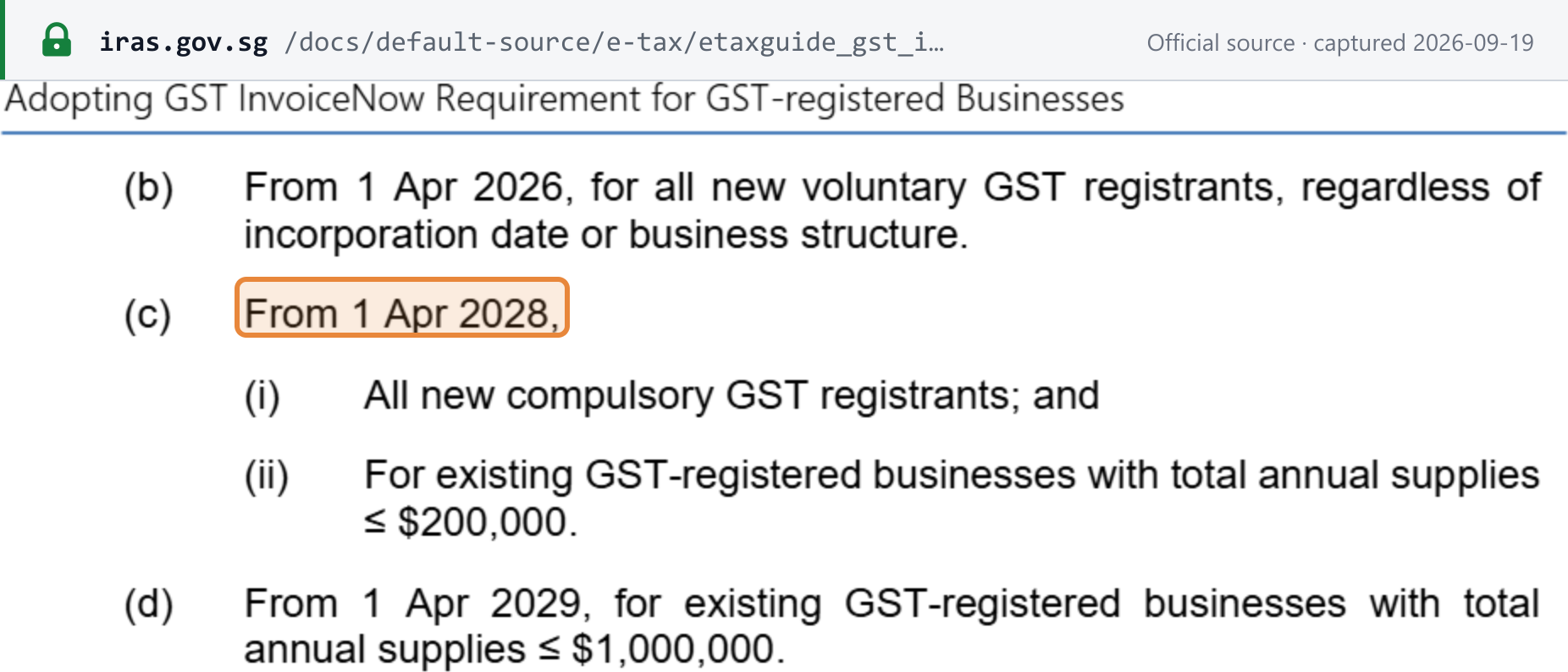
| (d) | Existing GST-registered businesses with total annual supplies ≤ SGD 1,000,000 | 1 Apr 2029 | | (e) | Existing GST-registered businesses with total annual supplies ≤ SGD 4,000,000 | 1 Apr 2030 | | (f) | Existing GST-registered businesses with total annual supplies > SGD 4,000,000 | 1 Apr 2031 |
For phases (d)–(f), the applicable band is set by an existing business's total supplies (standard-rated, zero-rated and exempt combined — Box 4 of the GST return) across accounting periods ending in calendar year 2025. Excluded, regardless of phase: overseas entities required to appoint a local section 33(1) agent, and Overseas Vendors registered under the OVR pay-only or full regime. IRAS's own e-Tax Guide notes that the legislative amendments implementing phases (c)–(f) for existing GST-registered businesses will be enacted at a later date — the timeline above is published administrative guidance, with the underlying legislation for that stretch still to follow. [12]
Format and standard. Invoices exchange as structured XML, using Peppol BIS Billing 3.0 UBL; an upgraded PINT-SG (Singapore Peppol International) specification launched in February 2024 and is the base data format for the GST InvoiceNow Requirement. Sending a PDF invoice by email is explicitly not e-invoicing under this framework. IRAS receives a copy of invoice data via a "5th corner" added to the standard 4-corner Peppol model. [12]
Scope. Confirmed as B2B / GST-reporting: GST-registered businesses transmit invoice data — both sales and purchase invoices, including non-InvoiceNow source documents like POS receipts once recorded in accounting systems — to IRAS via the InvoiceNow network. This guide could not independently confirm, against primary IRAS or IMDA text, whether transmission to government agencies is mandatory under this specific GST-reporting regime, as distinct from IMDA's separate, older InvoiceNow programme under which government agencies are able to receive e-invoices. Treat B2G status under this regime as not independently verified, as of 2026-09-20. [12]
Filing and payment
Filing frequency
Default filing is quarterly — the standard prescribed accounting periods run January–March, April–June, July–September and October–December. Some businesses file monthly instead, either by arrangement or as a condition of certain schemes such as the Import GST Deferment Scheme. [2]
Return due date
Both the GST F5 return and the payment are due one month after the end of the accounting period — 30 April, 31 July, 31 October and 31 January for the four standard quarters respectively. IRAS states this directly: "Both GST returns and payment are due one month after the end of the accounting period covered by the return." Extensions are not granted as a matter of course; limited exceptions exist (first-time filers, IT breakdowns, restructuring), with requests due at least 5 working days before the filing deadline. [2]
Payment due date and method
Payment falls due alongside the return. On the GIRO payment plan, deduction occurs on the 15th of the month after the due date. [2]
Additional listings
Not documented as a distinct requirement in the sources reviewed for this guide, beyond the return itself.
Input-tax recovery and blocked items
Input tax is specifically disallowed, regardless of business purpose, under Regulations 26 and 27 of the GST (General) Regulations, for: benefits provided to staff family members; costs and running expenses on private motor cars (unless the vehicle is excluded from the Regulation 25(1) "motor car" definition); club subscription and transfer fees for sports and recreation clubs; expenses on company cars whose Certificate of Entitlement (COE) was renewed or extended on or after 1 April 1998; rental-car expenses for hire on or after 1 July 1999; and staff medical expenses and medical/accident insurance premiums, unless the employer is statutorily obliged to provide them (for example under the Work Injury Compensation Act, a collective agreement, or specified COVID-19-related exceptions). [13]
Refunds
Refunds are paid via GIRO or PayNow only — IRAS stopped issuing refund cheques from 3 January 2022. A refund is made within a period equivalent to the taxpayer's prescribed accounting period, counted from the date the Comptroller receives the GST return: a quarterly filer's refund, for example, is made within 3 months of the Comptroller receiving the return. Exceptions apply where returns are outstanding or the return is under audit review. [2]
Exemptions
Exempt supplies
Zero-rated (0%, taxable, input tax recoverable): exports of goods and international services under GST Act s.21(3). Exempt (no GST charged, input tax not recoverable): financial services listed in the Fourth Schedule to the GST Act; digital payment tokens (exchange for fiat or other tokens, and provision of loans of tokens, since 1 January 2020); the sale and lease of residential properties (the bare unit only — rental of furniture and fittings remains taxable); and the import and local supply of Investment Precious Metals (IPM — gold at least 99.5% pure, silver at least 99.9% pure, or platinum at least 99% pure, meeting LBMA/LPPM criteria). [9]
Exempt is not the same as zero-rated. A zero-rated supply is still a taxable supply — GST is charged at 0%, and input tax incurred in making it remains claimable. An exempt supply is outside GST altogether: no GST is charged, but input tax incurred in making it is not claimable. IRAS states this distinction directly: "Like standard-rated supplies, supplies that are zero-rated are part of taxable supplies ... input tax incurred in the making of zero-rated supplies is claimable. GST is not chargeable on exempt supplies. Input tax incurred in the making of exempt supplies is not claimable." [9]
Special regimes
- Major Exporter Scheme (MES) — suspends GST at import (and on removal of goods from Zero-GST warehouses) for approved businesses with substantial import/export activity, easing the cash-flow cost of paying import GST upfront while exports are zero-rated. Applied for via form GST F10; a bank or financial-institution guarantee may be required. Validity is usually 3 years for a first grant, extendable to 5 years on successful renewal. [14]
- Import GST Deferment Scheme (IGDS) — approved GST-registered businesses defer import GST, normally due at the point of importation, until their monthly GST return is due, then account for and claim it as input tax in the same return. Qualifying conditions include GST registration for at least 3 years (shorter periods may still be approved by the Comptroller), monthly filing, interbank GIRO for GST payments, and a clean compliance history. Applied for via form GST F22. [15]
- Tourist Refund Scheme (eTRS) — tourists (non-citizen/non-permanent-resident, aged 16 or older on the purchase date, not aircrew, and not a "Specified Person" such as a work-pass holder or accredited diplomat) may reclaim GST paid at participating eTRS retailers, on spend of at least SGD 100 (including GST; up to 3 same-day receipts from the same shop and GST number may be combined). Goods must leave Singapore within 2 months of purchase, with the claim made within 12 hours of approval — and separately claim the payout from the central refund counter operator within 2 months of approval. (The 12-hour window is for departing with the goods, not for making the claim.) Services, goods consumed in Singapore, freight-exported goods, and hotel accommodation are excluded, and the actual refund is reduced by a handling fee. [16]
Offences and penalties
Offences
IRAS's General Guide for Businesses publishes offence provisions with statutory sections attached. Selected figures: [17]
| Offence | Conviction penalty |
|---|---|
| Failure to keep records ≥ 5 years (s.46(6)) | Fine up to SGD 5,000 or imprisonment up to 6 months, or both, on first conviction; up to SGD 10,000 or 3 years on a second or subsequent conviction |
| Incorrect return without reasonable excuse or through negligence (s.59(2)) | Penalty equal to 2x the tax undercharged, plus a fine up to SGD 5,000 or imprisonment up to 3 years, or both |
| Failure to register (s.61) | Fine up to SGD 10,000; penalty of 10% of the tax due per year (or part) from the date registration was required; a further SGD 50 per day the offence continues after conviction |
| Wilful evasion or assisting evasion (s.62) | Penalty equal to 3x the tax evaded, plus a fine up to SGD 10,000 or imprisonment up to 7 years, or both |
| Fraudulently obtaining a refund (s.63) | Penalty equal to 3x the excess refund, plus a fine up to SGD 10,000 or imprisonment up to 3 years, or both |
| Issuing a tax invoice without authorisation (s.64A) | Fine up to SGD 10,000, plus 3x the tax shown on the invoice |
| Obstructing the Comptroller (s.66) | Fine up to SGD 10,000 or imprisonment up to 12 months, or both (as amended by Act 34 of 2016). Note IRAS's own General Guide for Businesses still prints the pre-amendment SGD 5,000 / 6 months; the Act governs. |
Tourist Refund Scheme fraud (separate from the table above): a penalty of 3x the refund amount, plus a fine of up to SGD 10,000 and/or imprisonment of up to 7 years. [16]
Penalties
| Default | Penalty |
|---|---|
| Late submission of a return (GST F5/F8) | SGD 200 immediately on becoming overdue, plus a further SGD 200 per completed month outstanding, capped at SGD 10,000 per return (s.60(2)) |
| Late or non-payment | 5% of the estimated tax on an IRAS Notice of Assessment (s.60(1)); a further 2% per month on tax unpaid 60+ days after the due date, capped at 50% of the outstanding tax |
| Missing Trader Fraud | Input-tax surcharge of 10% of the input tax denied |
Repeated non-filing can trigger a Notice to Attend Court; conviction can carry a fine up to SGD 5,000 per offence, with a warrant-of-arrest risk for a sole proprietor, partner or director who ignores a summons. [18]
Frequently asked questions
I sell software subscriptions from overseas to Singapore customers — do I need to register under Overseas Vendor Registration (OVR), or does reverse charge cover it?
It depends on who your customer is. Two separate regimes apply to the same kind of cross-border digital sale, and IRAS treats them as distinct. For B2B sales — to a GST-registered Singapore business — the recipient self-accounts for GST under the reverse charge mechanism where it is not entitled to full input-tax credit; you, the overseas supplier, generally do not need to register for that transaction. For B2C sales — to a Singapore customer who is not GST-registered — the Overseas Vendor Registration regime applies instead: you must register if your global annual turnover exceeds SGD 1 million AND your B2C supplies of remote services and/or low-value goods to Singapore customers exceed SGD 100,000 in a 12-month period. Both thresholds must be met simultaneously. Once registered under OVR, you operate on a simplified pay-only basis with no input-tax claims. [3] [10]
What is Singapore's GST rate today, and has it changed recently?
The standard rate is 9%, effective 1 January 2024. It reached that level in two Budget-announced steps: 7% until 31 December 2022, 8% from 1 January 2023 to 31 December 2023 (the "first rate change"), and 9% from 1 January 2024 (the "second rate change"). Both increases were announced together in Budget 2022. IRAS's own e-Tax Guide states the rate "will be increased in 2 steps: (i) from 7% to 8% with effect from 1 Jan 2023 ... and (ii) from 8% to 9% with effect from 1 Jan 2024." No further rate change is currently scheduled. [8]
My taxable turnover just crossed SGD 1 million — what exactly do I need to do, and by when?
It depends on which basis triggered the liability. Under the retrospective basis, if your taxable turnover for the calendar year (1 January–31 December) exceeded SGD 1 million, apply between 1 and 30 January of the following year; registration takes effect from 1 March. Under the prospective basis, if you reasonably expect turnover to exceed SGD 1 million in the next 12 months, apply within 30 days of that forecast date; registration then takes effect 2 months after the forecast date for forecasts made on or after 1 July 2025 (a grace period the Second Minister for Finance announced on 28 February 2025), or 31 days after for earlier forecasts. The 30-day application window itself did not change. [1]
What happens to my GST InvoiceNow obligation if my business is small — do the phased 2028–2031 e-invoicing dates apply to me?
Yes, eventually, and the date depends on your total annual supplies rather than a single cutover for everyone. IRAS's e-Tax Guide sets a size-banded rollout for existing GST-registered businesses: from 1 April 2028, businesses with total annual supplies of SGD 200,000 or less (plus all new compulsory GST registrants from that date); from 1 April 2029, businesses at or below SGD 1,000,000; from 1 April 2030, businesses at or below SGD 4,000,000; and from 1 April 2031, businesses above SGD 4,000,000. The band is set by total supplies (standard-rated, zero-rated and exempt combined, Box 4 of the GST return) across accounting periods ending in calendar year 2025. IRAS's guide notes that the legislative amendments implementing this phase for existing GST-registered businesses will be enacted at a later date — the timeline is published guidance, with the underlying legislation still to follow. [12]
Is a simplified tax invoice ever enough in Singapore, or do I always need the full set of tax invoice particulars?
A simplified tax invoice is allowed where the total amount payable, including GST, does not exceed SGD 1,000. It needs only the supplier's name, address and GST registration number, the issue date, an identifying number, a description of the goods or services, the total amount payable including GST, and a statement that the price payable includes GST. Above that threshold, or wherever the customer is GST-registered and requests a full tax invoice, the complete particulars apply: the words "Tax Invoice", supplier and customer details, invoice date, an identifying number, description, GST rate, and the amount payable excluding GST, the GST amount, and the amount payable including GST, each shown separately. A tax invoice is not required at all for zero-rated, exempt or deemed supplies, or where the customer is not GST-registered. [11]
I run an electronic marketplace with both local and overseas sellers on it — am I liable for GST on their sales, or just my own commission?
It depends on whether you meet the conditions to be treated as the deemed supplier. If your marketplace meets IRAS's specified conditions, you can be treated — for GST purposes — as the supplier of low-value goods sold through your platform by both local and overseas sellers, and of remote services sold by overseas sellers through your platform, regardless of whether those underlying sellers are themselves GST-registered. In that case, you must include the value of those supplies in your own Overseas Vendor Registration liability test and account for GST on them once registered. Separately, and regardless of deemed-supplier status, the commission, fee or other consideration you earn as a marketplace operator is itself a service you supply, which can independently bring you into the GST net. [3]
What are the actual penalties if I file or pay my GST F5 return late?
Two separate penalties can apply. A late submission penalty of SGD 200 is imposed immediately once the return is overdue, with a further SGD 200 for every completed month it remains outstanding, capped at SGD 10,000 per return (s.60(2)). Separately, for late or non-payment, IRAS may issue an estimated Notice of Assessment carrying a 5% late-payment penalty on the estimated tax (s.60(1)), plus an additional 2% per month on tax still unpaid 60 days after the due date, capped at 50% of the outstanding tax. Repeated non-filing can escalate to a Notice to Attend Court, and conviction can carry a fine of up to SGD 5,000 per offence, with a warrant-of-arrest risk if a summons is ignored. [18]
Important websites
| Site | Purpose |
|---|---|
| IRAS myTax Portal | GST registration, return filing and payment |
| IRAS GST Registration Search (myTax Portal) | Verifying a counterparty's GST Registration Number |
| Singapore UEN portal | Verifying a UEN and basic entity information |
| IRAS GST InvoiceNow Requirement | GST InvoiceNow (Peppol) e-invoicing guidance and onboarding |
| IRAS Goods and Services Tax (GST) hub | GST rates, guides, forms and FAQs |
Also see Lookuptax's own Singapore GST validator and UEN validator.
Recent changes
- 2026-04-01 — The GST InvoiceNow Requirement extends to all new voluntary GST registrants, regardless of incorporation date or business structure, following the 1 November 2025 start for newly incorporated companies registering voluntarily. Non-compliant voluntary registrants risk revocation of their GST registration. (Inland Revenue Authority of Singapore)
- 2025-11-01 — The GST InvoiceNow Requirement takes effect for newly incorporated companies (incorporated within 6 months of their GST application) registering for GST voluntarily. (Inland Revenue Authority of Singapore)
- 2025-07-01 — A 2-month grace period applies to the effective date of GST registration on the prospective basis for forecasts made on or after this date — registration now takes effect 2 months after the forecast date, rather than the 31st day after it. Announced by the Second Minister for Finance on 28 February 2025. (Inland Revenue Authority of Singapore)
- 2024-02-01 (system) — The PINT-SG (Singapore Peppol International) Specification launched, becoming the base data format for the GST InvoiceNow Requirement. (Inland Revenue Authority of Singapore)
- 2024-01-01 — The GST standard rate rose from 8% to 9% (the "second rate change" announced in Budget 2022). (Inland Revenue Authority of Singapore)
- 2023-01-01 — The GST standard rate rose from 7% to 8% (the "first rate change" announced in Budget 2022); the Overseas Vendor Registration regime was extended to all remote services and to low-value goods, alongside the reverse-charge extension to low-value goods for B2B imports. (Inland Revenue Authority of Singapore)
- 2022-01-03 (system) — IRAS stopped issuing GST refund cheques; refunds are paid via GIRO or PayNow only. (Inland Revenue Authority of Singapore)
- 2020-01-01 — Reverse charge on imported services (B2B) and Overseas Vendor Registration (B2C, digital services) both took effect, alongside the exemption of digital payment tokens from GST. (Inland Revenue Authority of Singapore)
Ahead — 1 April 2028 to 1 April 2031, the GST InvoiceNow Requirement extends in size bands to all remaining existing GST-registered businesses; see E-invoicing status. For the full chronology, see Singapore tax changes on Lookuptax.
Reference links
- IRAS — Do I Need to Register for GST
- IRAS — Cancelling GST Registration
- IRAS — Factors to Consider Before Registering Voluntarily for GST
- IRAS — Group Registration
- IRAS — Due Dates and Requests for Extension
- IRAS — Late Filing or Non-Filing of GST Returns (F5/F8)
- IRAS — 2024 GST Rate Change: A Guide for GST-registered Businesses (PDF)
- IRAS — Supplies Exempt from GST
- IRAS — Overseas Businesses (Overseas Vendor Registration)
- IRAS — GST: Taxing Imported Services by Way of Reverse Charge (PDF)
- IRAS — Invoicing Customers
- IRAS — Adopting GST InvoiceNow Requirement for GST-registered Businesses (PDF)
- IRAS — How Do I Prepare My GST Return? (PDF)
- IRAS — Major Exporter Scheme (MES)
- IRAS — Import GST Deferment Scheme (PDF)
- IRAS — Tourist Refund Scheme
- IRAS — GST: General Guide for Businesses (PDF)
- Lookuptax — Singapore TIN number guide
- Lookuptax — How to verify a GST Reg No in Singapore
- Lookuptax — How to verify a UEN in Singapore
- Lookuptax — Official links to check VAT numbers worldwide
- Lookuptax — E-invoicing status and the networks worldwide