Azerbaijan VAT guidelines
| FACTSHEET | |
|---|---|
| Country code | AZ |
| Tax name | Value Added Tax (VAT) — Əlavə dəyər vergisi (ƏDV) |
| Tax Authority | State Tax Service under the Ministry of Economy (Dövlət Vergi Xidməti) |
Overview
Azerbaijan levies Value Added Tax (VAT) — Azerbaijani: Əlavə dəyər vergisi (ƏDV) — under Chapter XI (Articles 153–181) of the Tax Code of the Republic of Azerbaijan (Vergi Məcəlləsi, adopted 11 July 2000), whose consolidated text is published on the Ministry of Justice's legal register, e-qanun.az. [1] The tax is administered by the State Tax Service under the Ministry of Economy (Dövlət Vergi Xidməti), with VAT on imports collected by the customs authorities (Article 177.4). [2] [1]
VAT is charged on supplies of goods, works and services in Azerbaijan, on taxable imports, and on the trade mark-up applied in the retail sale of agricultural products (Article 159.1). It is a single national tax: municipal taxes are administered separately by municipalities (Article 33.9), but there is no regional or municipal VAT layer. The rate is 18% (see Rates), amounts are in the Azerbaijani manat (AZN), and VAT is reported for each calendar month (Article 178). [1]
Two features shape almost every transaction. First, the time of supply is generally the time of payment, not the time of delivery (Article 166.1). Second, input VAT is recoverable only where the purchase price is paid by bank transfer and the VAT is paid into the supplier's VAT deposit account (Article 175.1) — see Filing and payment. [1]
Recent changes concern the non-resident e-commerce regime: Law No. 355-VIIQD of 13 February 2026 restated Article 33.8-1 with a USD 10,000 registration trigger, and Cabinet Resolution No. 295 of 14 September 2026 aligned the implementing Rules with it. See Recent changes.
Registration
Who should register. A person carrying on business must apply for VAT registration within 10 days from the first day of the month following the month in which its taxable transactions exceed AZN 200,000 (counted over any month or months of a consecutive 12-month period; Articles 155.1 and 157.3.1); the same applies to trade and catering businesses that do not use the simplified-tax option in Article 218.1 (Article 155.1). A single transaction or contract worth more than AZN 200,000 is a VAT-taxable transaction in itself, and the person must apply for registration before the day it is carried out. Producers of excisable goods and of goods subject to mandatory marking, and building-construction businesses that do not use the simplified tax, are VAT payers regardless of turnover and apply with their state or tax registration (Articles 154.6 and 155.1). Importers are VAT payers on their taxable imports (Article 154.3). [1]
Threshold. AZN 200,000 of taxable transactions in any month of a rolling 12-month period (Article 155.1). Registration takes effect on the first day of the following month; for the single-contract trigger, before the day of the transaction (Article 157.3.1). For retail trade and services to persons not registered with the tax authorities, turnover received by non-cash POS-terminal payment counts at a 0.5 coefficient when measuring the threshold (Article 155.1-1). [1]
Non-resident threshold. Two separate rules apply:
- A non-resident's supplies count toward the AZN 200,000 threshold only if made through a permanent establishment in Azerbaijan (Article 155.2). Without one, B2B services are taxed through the reverse charge in Cross-border rules. [1]
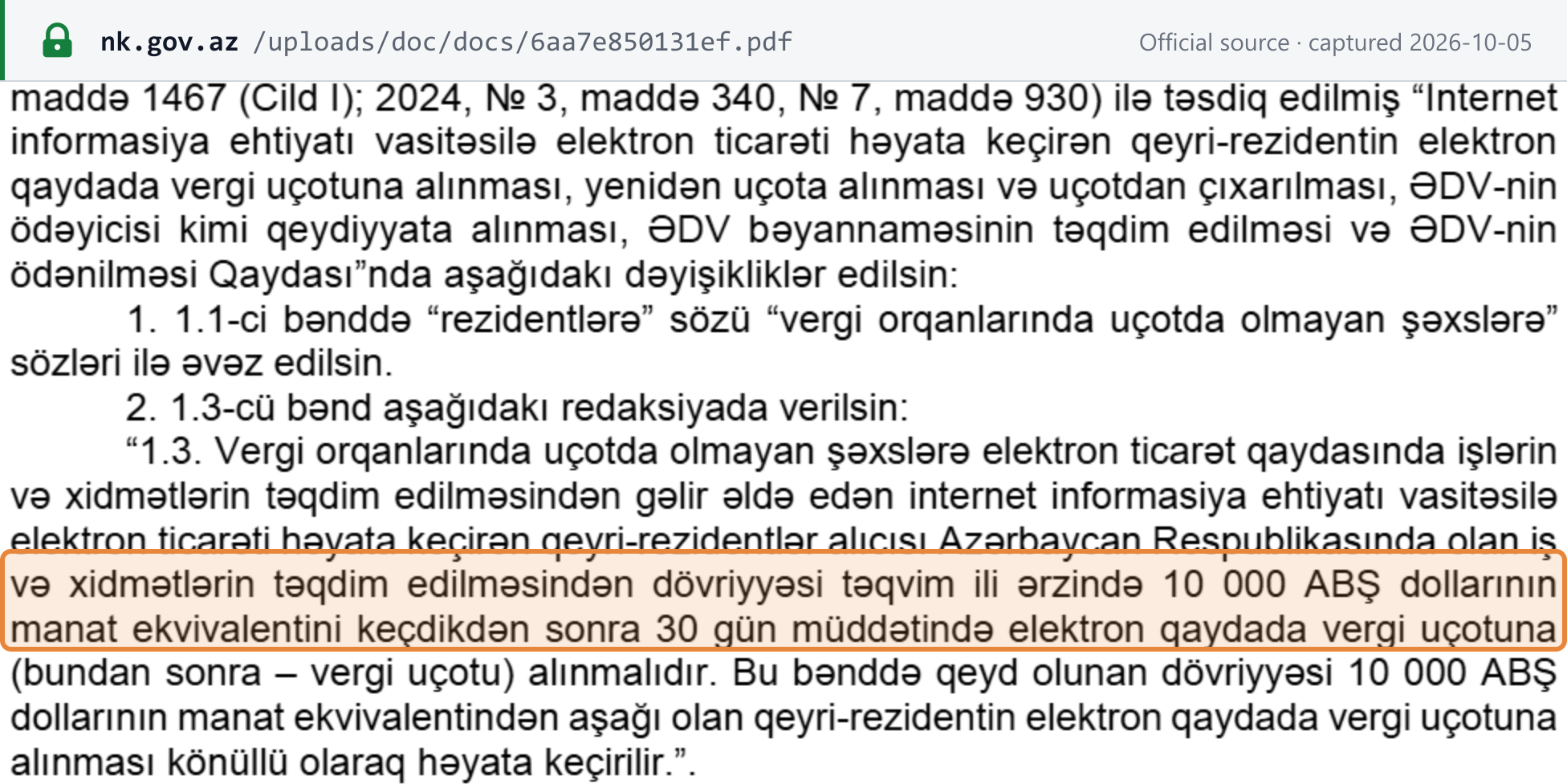
- A non-resident e-commerce supplier of works and services to persons not registered with the tax authorities must register electronically within 30 days after its turnover from supplies to buyers in Azerbaijan exceeds the manat equivalent of USD 10,000 in a calendar year; below that amount registration is voluntary (Article 33.8-1, restated by Law No. 355-VIIQD; mirrored in point 1.3 of the Cabinet Rules as amended by Resolution No. 295). Such a person is a VAT payer (Article 154.7). [1] [3]
Tax registration number. Every taxpayer is identified by its VÖEN (Vergi ödəyicisinin eyniləşdirmə nömrəsi), a taxpayer identification number used for all taxes; there is no separate VAT number. Per the State Tax Service's submission to the OECD, it is ten digits: two for the territorial administrative unit, six for a serial number, a ninth computed by algorithm, and a tenth showing legal status (1 for legal persons, 2 for natural persons). The VAT registration notice states the taxpayer's name, the date the registration takes effect and its VÖEN (Article 157.2). [1] [4] For the structure and check digit, see Lookuptax's Azerbaijan VÖEN guide; to check a counterparty, use the Azerbaijan VÖEN validator or follow how to verify a VÖEN.
How to register. The application for mandatory or voluntary VAT registration is made on the form set by the relevant executive authority. The tax authority enters the person in the state register of VAT payers and issues the registration notice no later than 5 business days after the application (Article 157.2). Where the authority finds a taxpayer that should have registered but did not, it registers it on its own initiative (Article 157.5). Non-resident e-commerce suppliers register online through the State Tax Service's e-commerce portal, ecommerce.e-taxes.gov.az. [1] [5]
Voluntary registration. A business that is not required to register may apply voluntarily (Article 156.1); the registration takes effect on the first day of the reporting period following the month of application (Article 157.3.2). Registration allows input VAT recovery and the issue of electronic tax invoices, which an unregistered person may not issue (Article 176.1). [1]
Deregistration. A VAT payer that stops making taxable transactions must apply for deregistration, which takes effect on the day those transactions fully stop (Article 158.1). Separately, a VAT payer whose taxable transactions did not exceed AZN 100,000 over the previous full 12 calendar months may apply to deregister at any time after one year from its latest registration, effective on the day of application (Article 158.2). Goods held on deregistration are treated as supplied in a taxable transaction (Article 159.6), and a final return is due within 30 days when a legal entity is liquidated or an individual entrepreneur ceases business (Article 177.2). [1]
Group registration. Not available. Chapter XI of the Tax Code (Articles 153–181) contains no VAT-group provision; each person registers individually. The only grouping rule is that a joint activity carried on without forming a legal entity is treated as a separate person for VAT, registered by the participant that keeps its accounts (Articles 154.5 and 155.3). (Checked 2026-10-05.) [1]
Rates
| Rate | Applies to |
|---|---|
| 18% (standard) | The value of every taxable transaction and every taxable import (Article 173.1). [1] |
| 0% (zero-rated) | The closed list in Article 165.1, including: exports of goods and of the services listed in Article 168.1.5; supplies of goods to duty-free shops; international and transit carriage of goods and passengers (except international postal services), and works and services directly linked to international and transit flights; supplies for the official use of accredited international organisations and diplomatic and consular missions, subject to reciprocity (Article 165.2); goods and services funded by foreign grants; supplies of gold and other valuables to the Central Bank; and repair of ships and other vessels ordered by a non-resident. [1] |
| Exempt | The list in Article 164.1 — see Exemptions. [1] |
Azerbaijan has no reduced or super-reduced rate: Article 173 sets the single 18% rate. Retail sellers of agricultural products produced in Azerbaijan instead calculate VAT on the trade mark-up rather than on the full price, and from 1 January 2022 for five years this mark-up basis also covers wholesale and retail sales of local and imported agricultural products (except imported fish products), subject to separate accounting and electronic documentation of purchases and sales (Articles 153.2–153.3, 159.1 and 174.3–174.4). This changes the tax base, not the rate. [1]
Consumer VAT refunds. Individual consumers receive back part of the VAT on certain retail and catering purchases and services: 17.5% of the VAT paid by non-cash payment and 5% of the VAT paid in cash, and 50% of the VAT paid by non-cash payment for theatre, cinema, museum and symphony-concert services (Article 165.5). These are refunds to consumers, not rates the seller charges. [1]
Cross-border rules
Imports. Imports of goods are taxable unless exempt; goods in transit, goods temporarily imported, and goods not treated under customs law as imported for domestic consumption are not imports for VAT (Article 159.3). The taxable value is the customs value plus the taxes and duties payable on import (Article 162.1), and import VAT is calculated and collected by the customs authorities under the procedure for customs duties (Article 177.4). Import documents issued by customs showing VAT paid support an input VAT offset whatever the form of payment (Article 175.10). [1]
Exports. Exports of goods, and of the services listed in Article 168.1.5, are zero-rated (Article 165.1.3), and input VAT on zero-rated transactions is recoverable (Article 175.7). [1]
Reverse charge on imported services. Where a non-resident that is not registered for VAT performs works or supplies services in Azerbaijan to a tax agent — any person registered for VAT (Article 169.2) — the VAT is charged at 18% on the amount payable to the non-resident, with the time of supply being the time of payment (Articles 169.1 and 169.3). A VAT-registered agent pays this VAT with its return for the month of the transaction, and the payment document becomes the electronic invoice that supports its input offset (Article 169.4). An agent not registered for VAT pays within 7 days of paying the non-resident and files a VAT return by the 20th of the following month (Articles 169.5 and 169.7). E-commerce bookings of hotel services abroad and of air tickets are excluded from this rule (Article 169.1). [1]
Foreign companies selling in — B2B vs B2C.
- B2B (to a VAT-registered Azerbaijani business): the reverse charge above applies; the customer accounts for the VAT as tax agent, and the non-resident's supplies do not count toward the AZN 200,000 threshold unless made through a permanent establishment (Article 155.2). [1]
- B2C (to persons not registered with the tax authorities): a non-resident e-commerce supplier of works and services must register electronically within 30 days of exceeding the manat equivalent of USD 10,000 of calendar-year turnover from buyers in Azerbaijan (Article 33.8-1). Once registered, it calculates and pays the VAT itself instead of having it withheld (Article 169.8), and pays by the last day of the month following each reporting period (Article 177.1.4). Until it registers, the local payment-service provider (or the Azerbaijani branch of a foreign one) that processes the buyer's payment calculates the VAT and pays it to the budget out of the buyer's funds (Article 169.3). The State Tax Service states that banks do not withhold VAT on payments to registered suppliers. [1] [6]
Digital products and services. Services supplied by computer, internet and other electronic networks, electronic mail or similar means, the grant of rights to use such networks, and works and services supplied by e-commerce sellers are supplied where the recipient is located or registered (Article 168.1.5). The State Tax Service's guidance on the Cabinet Rules describes the e-commerce scope as including e-books, virtual games, software downloads and advertising placement, and treats the buyer as in Azerbaijan where any one of four indicators applies: payment through a bank in Azerbaijan, the buyer's location, the device's IP address, or the mobile operator's country code. [1] [7] Resolution No. 295 of 14 September 2026 adds point 1.4-1 to the Rules: consulting, legal, financial, accounting, design and engineering services supplied by e-mail or other interactive means, real-time online teaching and training, and online booking of tickets for science, education, culture, sport and entertainment events are not e-commerce services for Article 33.8-1. The same text is now part of Article 33.8-1 itself. See event record. [3] [1]
Marketplace / platform deemed-supplier liability. This guide found no provision in Chapter XI that makes an online marketplace the deemed supplier of goods or services sold on it by third parties. The e-commerce regime places the obligation on the non-resident seller of works and services, with payment-service providers collecting VAT where the seller is not registered (Articles 33.8-1 and 169.3). (Checked 2026-10-05.) [1]
Place of supply. Goods: supplied where they are handed over; where the goods are dispatched or transported, where dispatch or transport begins; where the supplier installs or assembles them, where they are installed (Article 167). Works and services: in this order of priority (Article 168.2), where immovable property is located for services connected with it; where works on movable property are actually performed; where cultural, artistic, educational, sports and similar services are actually performed; where transport actually takes place; where the recipient is located or registered for the services listed in Article 168.1.5 (intellectual-property rights, consulting, legal, accounting, engineering, advertising and data-processing services, staff supply, hire of movable property, telecommunications, broadcasting, electronic services and e-commerce); and otherwise where the supplier carries on its activity (Articles 168.1.1–168.1.6). [1]
Invoice requirements
VAT-registered taxpayers document supplies with electronic tax invoices (elektron vergi hesab-fakturası, Article 176) and electronic invoices / waybills (elektron qaimə-faktura, Article 71-1), both issued through the State Tax Service's electronic system. A person not registered for VAT has no right to issue an electronic tax invoice (Article 176.1). [1]
Mandatory content
Article 176.2 lists the particulars of an electronic tax invoice, which is a strict-reporting form prepared on the form set by the relevant executive authority:
| Required field | Provision |
|---|---|
| Name of the taxpayer (supplier) and of the buyer (customer) | Article 176.2.1 |
| Identification number (VÖEN) of the taxpayer and of the buyer | Article 176.2.2 |
| Name of the goods dispatched, works performed or services supplied | Article 176.2.3 |
| Consideration for the taxable transaction, and the volume of the transaction | Article 176.2.4 |
| Excise amount, for excisable goods | Article 176.2.5 |
| VAT payable on the transaction | Article 176.2.6 |
| Date of issue | Article 176.2.7 |
| Invoice number | Article 176.2.8 |
| Name of the tax authority that issued the VAT registration notice, and the notice's date and number | Article 176.2.9 |
| Position, surname, name and patronymic of the responsible person who signed the invoice | Article 176.2.10 |
Issuance deadline and numbering
An electronic tax invoice must be issued no later than 5 days after the goods are dispatched, the works performed or the services supplied (Article 176.3). The electronic qaimə-faktura follows the deadlines in Article 71-1.1: when goods are dispatched, for most goods transactions; within 5 days of the delivery document for goods not ordered in advance, and of performance for works and services; before carriage starts, for international transport; at the start of each calendar month, for regular and continuous services; within 3 days, for returns and turnover adjustments. [1] Invoice numbers are assigned within the State Tax Service's system; the Code requires the number as a mandatory particular (Article 176.2.8) and leaves the rules on form, application and accounting of electronic invoices to the executive authority (Articles 71-1.2 and 176.3-1). [1]
Credit and debit notes
Corrections are made with dedicated types of electronic qaimə-faktura rather than separate credit notes: one for returns of goods (Article 71-1.5.2) and one for adjustments of taxable turnover under Article 163 (Article 71-1.5.3), each issued within 3 days of the return or adjustment (Article 71-1.1.4). The Code also provides types for supplies by and returns to agents and commission agents, goods sent for processing or storage, internal movements of excisable goods, sales with an export mark, and advance payments received (Article 71-1.5). [1]
Currency and language
Where a taxpayer's accounting documents are drawn up in a foreign language, the tax authorities require an official translation into Azerbaijani (Article 71.3). The VAT chapter of the Tax Code does not set a currency-conversion rule for foreign-currency consideration; confirm the applicable Central Bank rate rules with an adviser. [1]
Simplified invoices
For retail supplies to buyers who are not VAT payers, a qaimə-faktura, an electronic qaimə-faktura, a receipt or a cheque may be issued instead of an electronic tax invoice (Article 176.4). Documents recording cash transactions do not support an input VAT offset, and an offset claimed on them is invalid. Cash settlements with the public must go through cash-register machines or strict-reporting forms (Article 58.7). [1]
Retention
Accounting documents, including data in electronic and paper form, must be kept fully legible for not less than 5 years (Article 71.4). The general limitation period for tax violations is 3 years from the violation (Article 56.1). [1]
What a compliant invoice looks like
No State Tax Service annotated specimen is cited here. The illustration below lays out the Article 176.2 particulars as a document; the layout is LookupTax's own.
Electronic tax invoice (elektron vergi hesab-fakturası) — illustration
| Goods, works or servicesArt. 176.2.3 | VolumeArt. 176.2.4 | ConsiderationArt. 176.2.4 | VAT 18%Arts. 173.1, 176.2.6 |
|---|---|---|---|
| Equipment maintenance service (fictional) | 1 | AZN 1,000.00 | AZN 180.00 |
- Consideration excluding VATArt. 176.2.4
- AZN 1,000.00
- VAT payableArt. 176.2.6
- AZN 180.00
- Total
- AZN 1,180.00
- Signed by the responsible person: position, surname, name and patronymic — Art. 176.2.10.
- Excise amount shown only for excisable goods — Art. 176.2.5.
- For the buyer to offset the AZN 180.00, the price is paid by bank transfer and the VAT into the supplier's VAT deposit account — Art. 175.1.
E-invoicing status
Status (as of 2026-10-05): mandatory electronic documents through the tax authority's own system; no Peppol-style network.
- System. Electronic tax invoices (Article 176) and electronic qaimə-faktura (Article 71-1) are issued through the State Tax Service's electronic system on forms and rules set by the relevant executive authority (Articles 71-1.2 and 176.3-1). Delivering goods without an electronic qaimə-faktura where the Code requires one is sanctioned (Article 58.13). [1]
- Formats and standards. The Code prescribes the content and leaves the form to the executive authority; this guide found no requirement for UBL, Peppol BIS or another international format.
- Scope. B2B: electronic tax invoices and qaimə-faktura, linked to input VAT recovery (Articles 175 and 176). B2C / retail: cash-register receipts or strict-reporting forms for cash settlements with the public (Article 58.7), with the qaimə-faktura, receipt or cheque option for retail supplies to non-VAT payers (Article 176.4). B2G: this guide found no separate B2G e-invoicing mandate in the Tax Code; purchases by state-majority-owned entities and budget organisations follow the VAT deposit-account rules in Article 175.8. [1]
- Phasing. No phase timeline by taxpayer size applies; the obligation follows VAT registration.
Filing and payment
Filing frequency. Monthly. The VAT reporting period is the calendar month (Article 178). [1]
Return due date. The VAT return is filed no later than the 20th of the month following the reporting period (Article 177.2). On liquidation of a legal entity or cessation of an individual entrepreneur's business, the return is filed within 30 days (Article 177.2). [1]
Payment due date and method. VAT is paid within the return deadline for each reporting period (Article 177.1.3). Non-residents registered for e-commerce under Article 33.8-1 pay by the last day of the month following the reporting period (Article 177.1.4). Import VAT is collected by customs (Article 177.4). Buyers that are VAT payers, legal entities more than 50% state-owned and budget organisations transfer the VAT shown on electronic invoices into the VAT deposit account, as do buyers of residential and non-residential premises from construction businesses (Article 175.8). [1] From 1 January 2027, for four years, non-oil-and-gas private-sector taxpayers may transfer funds from the VAT deposit account to the State Social Protection Fund on terms set by the designated authority (Article 175.8, third sentence, added by Law No. 445-VIIQD of 13 July 2026, published 28 July 2026). [1]
Input-tax recovery and blocked items. Input VAT is offset when the price is paid from the buyer's bank or payment account to the supplier's and the VAT into the VAT deposit account (Article 175.1), with the VAT due in the deposit account within one business day of paying the price (Article 175.1.3). Mixed-use and partly exempt purchases are apportioned (Articles 175.2 and 175.4). No offset is allowed for: expenses listed in Article 109.3 (other than those in Articles 109.4 and 119.2) (Article 175.3); purchases by persons making only exempt or non-taxable transactions, and purchases funded from the state budget (Article 175.6); receipts, cheques, cash-transaction documents and improperly issued electronic invoices (Article 175.9); documents from transactions with no actual goods (Article 175.11); and, for five years from 1 January 2022, agricultural products bought by wholesale and retail traders (Article 175.12, subject to the import option in Article 175.13). [1]
Refunds. Where creditable VAT exceeds output VAT, a taxpayer with at least 50% of its taxable turnover at the zero rate in the period receives the excess within 20 days of applying (Article 179.1); other taxpayers receive it no later than 4 months after their electronic application (Article 179.2). For taxpayers classed as risky, these periods run only after the related tax audits and controls finish (Article 179.4). Foreign nationals and stateless persons can reclaim VAT on goods bought for non-commercial purposes under a Cabinet procedure (Article 165.3). This guide found no bad-debt relief provision in Chapter XI; Article 166.1.3 instead treats a receivable from a supply as paid, and therefore taxable, when its limitation period expires. [1]
Exemptions
Article 164.1 lists the exempt supplies and imports. Examples include: financial services, including financial leasing (164.1.2); supplies and imports of national or foreign currency and securities (164.1.3); listed media products and books (excluding e-books) and textbook sets (164.1.7); editorial, publishing and printing of media, books and textbooks (164.1.8); funeral services (164.1.9); metro passenger transport (164.1.12); paid preschool education (164.1.13); supplies of shares or participation interests (164.1.17); sales by agricultural producers of their own produce (164.1.18); humanitarian and charitable aid (164.1.20–164.1.21); goods imported into a special economic zone, excluding excisable goods (164.1.24); civil aircraft and parts imported for civil aviation (164.1.38); private veterinary services (164.1.58); and imports of works of art, collectors' items and antiques on a Ministry of Culture confirmation (164.1.64). [1]
The Article 164.1.64 exemption was added by Law No. 355-VIIQD; Cabinet Resolution No. 268 of 8 September 2026 approves its list of commodity codes and applies from 1 January 2026. See event record. [1] [8]
Liberated territories. Imports of listed machinery, technological equipment, installations, raw materials and materials for listed economic activities in the territories liberated from occupation are exempt from VAT and customs duty under Cabinet Resolution No. 269 of 5 August 2023. Resolution No. 264 of 8 September 2026 adds activity lines to that list, including cattle and buffalo breeding, freshwater fish farming, meat, fish, fat, dairy, feed and wine processing, and pharmaceutical production. See event record. [9]
Exempt is not zero-rated. A person making only exempt or non-taxable supplies cannot offset input VAT on its purchases (Article 175.6), and a person making both taxable and exempt supplies offsets only the share matching its taxable turnover, unless it keeps separate records (Article 175.4). Zero-rated transactions are taxable transactions, and input VAT on them is offset in full (Article 175.7). [1]
Special regimes. Businesses below the VAT threshold may be subject to the simplified tax instead (Article 218); special economic zones and the agricultural mark-up basis are covered above. A full comparison of the simplified tax is outside the scope of this VAT guide.
Offences and penalties
Offences. Evading taxes in a significant amount (over AZN 50,000 up to AZN 200,000) is a crime under Article 213.1 of the Criminal Code, punishable by a fine of two to three times the damage, corrective work of up to two years, or imprisonment of up to three years. Evasion by an organised group or in a large amount (over AZN 200,000 up to AZN 500,000) carries three to five years' imprisonment or a fine of three times the damage (Article 213.2), and evasion in an especially large amount (over AZN 500,000) carries five to seven years or a fine of four times the damage (Article 213.3). A first-time offender under Articles 213.1–213.2 who fully pays the damage is released from criminal liability. [10] Under the Tax Code, the sanctioned conduct includes operating without mandatory VAT registration, issuing electronic tax invoices while not registered, delivering goods without a required electronic qaimə-faktura, and settling with the public without a cash register (Articles 58.4, 58.5, 58.7 and 58.13). [1]
Penalties. Under the Tax Code: [1]
- Late payment — interest of 0.1% per day on the unpaid tax (Article 59.1); for amounts found in an audit, it runs for the whole overdue period but not more than one year (Article 59.2).
- Late return — AZN 40 for failing to file a tax return on time without good reason (Article 57.1).
- Understatement or evasion — 50% of the tax understated or evaded (Article 58.1).
- Failure to apply for tax registration — AZN 200 (Article 58.2).
- Trading without mandatory VAT registration — 50% of the VAT payable for the whole unregistered period (Article 58.4).
- Issuing an electronic tax invoice before registration takes effect or after it is cancelled — 100% of the VAT shown on the invoice (Article 58.5).
- Not paying VAT into the deposit account within one business day of paying the price — 50% of the VAT paid late (Article 58.6).
- Delivering goods without a required electronic qaimə-faktura — 10% of the sale price for the first case in a calendar year, 20% for the second, 40% for the third and later (Article 58.13).
Frequently asked questions
What is the standard VAT rate in Azerbaijan?
18% of the value of every taxable transaction and every taxable import (Article 173.1). There is no reduced rate; the alternatives are the zero rate for the transactions in Article 165 (mainly exports of goods and of Article 168.1.5 services, and international and transit transport) and the exemptions in Article 164. [1]
What is the VAT registration threshold in Azerbaijan?
Apply within 10 days from the first day of the month following the month in which taxable transactions exceed AZN 200,000 (over a consecutive 12-month period); registration takes effect on the first day of the next month (Articles 155.1 and 157.3.1). A single transaction or contract over AZN 200,000 requires registration before the day it is carried out. Voluntary registration is available below the threshold (Article 156.1). [1]
Do foreign digital-service providers have to register for VAT in Azerbaijan?
Yes, once they pass USD 10,000. A non-resident without a permanent establishment selling works and services by e-commerce to persons not registered with the tax authorities must register electronically within 30 days after its calendar-year turnover from buyers in Azerbaijan exceeds the manat equivalent of USD 10,000; below that, registration is voluntary (Article 33.8-1, as restated by Law No. 355-VIIQD). It then calculates and pays the VAT itself (Article 169.8), by the last day of the month after each reporting period (Article 177.1.4). Until it registers, the local payment-service provider charges the VAT out of the buyer's funds (Article 169.3). Resolution No. 295 of 14 September 2026 carves out consulting, legal, financial, accounting, design and engineering services delivered by e-mail or other interactive means, real-time online teaching and training, and online event-ticket booking. [1] [3]
When are VAT returns and payments due in Azerbaijan?
The reporting period is the calendar month (Article 178). The return is filed by the 20th of the following month and the tax paid within the same deadline (Articles 177.1.3 and 177.2). Non-residents registered for e-commerce pay by the last day of the following month (Article 177.1.4). Import VAT is collected by customs (Article 177.4). [1]
Why is input VAT tied to the VAT deposit account in Azerbaijan?
Input VAT is offset only when the price is paid by bank transfer to the supplier and the VAT is paid into the supplier's VAT deposit account (Article 175.1), within one business day of paying the price under the electronic invoice (Article 175.1.3). Missing that deadline costs 50% of the VAT paid late (Article 58.6), and receipts, cheques and cash documents never support an offset (Article 175.9). [1]
Important websites
- State Tax Service — main site — news, guidance, legislation and the entry point to online services.
- Internet Tax Office — e-taxes.gov.az — the State Tax Service's online tax office for taxpayers' electronic services, including electronic invoices.
- E-commerce non-residents VAT portal — ecommerce.e-taxes.gov.az — electronic registration, re-registration and deregistration, returns and payment for non-resident e-commerce suppliers (support: [email protected]). [5]
- e-qanun.az — legal register of the Ministry of Justice — the consolidated Tax Code and amending laws.
- Cabinet of Ministers — resolutions — implementing resolutions such as Nos. 264, 268 and 295 of 2026.
- LookupTax — Azerbaijan VÖEN validator — checks the format of a counterparty's VÖEN.
Recent changes
Dates below are each instrument's adoption or publication date; effective dates, where different, are in the text.
- 2026-09-14 — Cabinet Resolution No. 295 amends the Rules approved by Resolution No. 387 of 30 October 2023 for non-resident e-commerce suppliers: the Rules now cover supplies to persons not registered with the tax authorities, registration is due within 30 days of exceeding the manat equivalent of USD 10,000 in a calendar year (voluntary below it), and new point 1.4-1 excludes e-mailed professional services, real-time online teaching and online event-ticket booking. (Cabinet of Ministers) — see event
- 2026-09-08 — Cabinet Resolution No. 268 approves the commodity-code list of works of art, collectors' items and antiques whose import is VAT-exempt on a Ministry of Culture confirmation, applying from 1 January 2026. (Cabinet of Ministers) — see event
- 2026-09-08 — Cabinet Resolution No. 264 extends the list of activities and goods whose import into the liberated territories is exempt from VAT and customs duty (Resolution No. 269 of 2023). (Cabinet of Ministers) — see event
- 2026-08-13 — The State Tax Service announces that electronic registration becomes mandatory from September 2026 for non-resident digital-service providers with annual turnover in Azerbaijan above USD 10,000, and that registered providers calculate, declare and pay VAT themselves. (State Tax Service) — see event
- 2026-02-23 — Law No. 355-VIIQD of 13 February 2026, amending the Tax Code and the laws on banks and on the customs tariff, is published; it restates Article 33.8-1 with the USD 10,000 registration trigger, and its non-resident e-commerce provisions enter into force on 23 August 2026. (e-qanun.az) — see event
Reference links
- e-qanun.az — Tax Code of the Republic of Azerbaijan (consolidated text)
- e-qanun.az — Law No. 355-VIIQD of 13 February 2026
- e-qanun.az — Criminal Code of the Republic of Azerbaijan
- Cabinet of Ministers — Resolution No. 295 of 14 September 2026
- Cabinet of Ministers — Resolution No. 268 of 8 September 2026
- Cabinet of Ministers — Resolution No. 264 of 8 September 2026
- State Tax Service — Electronic registration of non-residents carrying out electronic trade
- State Tax Service — New rules for non-residents carrying out e-commerce (27 November 2023)
- State Tax Service — Four more international companies registered for VAT (13 August 2026)
- OECD — Azerbaijan TIN information sheet
- LookupTax — Azerbaijan VÖEN guide
- LookupTax — How to verify a VÖEN in Azerbaijan
- LookupTax — Azerbaijan tax-change chronology