Croatia VAT guidelines
| FACTSHEET | |
|---|---|
| Country code | HR |
| Tax name | Value Added Tax (porez na dodanu vrijednost, PDV) |
| Tax Authority | Ministry of Finance, Tax Administration (Porezna uprava) |
Overview
Croatia levies value added tax (Croatian: porez na dodanu vrijednost, PDV) under the Zakon o porezu na dodanu vrijednost (VAT Act), published in Narodne novine (NN) 73/2013 and amended many times since, most recently by NN 48/2026. It is administered by the Ministry of Finance, Tax Administration (Porezna uprava), Boškovićeva 5, 10 000 Zagreb. Porezna uprava's VAT page, updated 15 May 2026, lists the Act's amendment chain up to NN 48/26. [1]
Currency. All amounts are in euro (EUR). Croatia adopted the euro on 1 January 2023, and NN 113/2022 converted every kuna amount in the VAT Act into euro from that day. [5]
Tax period. The tax period is the calendar month. A taxpayer whose prior-year supplies, including VAT, were below EUR 110,000 may file quarterly (Art 84(2), as amended by NN 114/2023 from 1 January 2024). The quarterly option does not apply to a taxpayer carrying out intra-EU transactions, and a non-established taxpayer registered for VAT in Croatia files monthly (Art 84(3)–(4), as amended by NN 143/2014). [6] [22]
Layering. PDV is a single national tax with no regional or municipal VAT. Local taxes such as the consumption tax (porez na potrošnju) exist but are not VAT.
Registration
Who should register
A taxable person established in Croatia is exempt from VAT under the small-business scheme while its annual domestic turnover does not exceed EUR 60,000. Turnover is the value of supplies excluding VAT over the calendar year (VAT Act Arts 89.a and 90(1), as replaced by NN 152/2024 from 1 January 2025; the threshold was EUR 40,000 before). The exemption stops "from the moment" the threshold is exceeded (Art 90.f(2)). [3]
- Crossing the threshold during the year. The business is entered in the VAT register from the first day after the day it exceeded EUR 60,000. It must notify its Porezna uprava office within 8 days by filing form P-PDV. If it does not, the office registers it ex officio from the same date (VAT Rulebook Art 186(1) and (5)–(7), as replaced by NN 16/2025). [4]
- No separate 15 January deadline. Some older Porezna uprava guidance for craftsmen still says registration is due by 15 January after a year over the threshold; the current Rulebook (Art 186, as replaced by NN 16/2025) has no such date — registration runs from the day after the threshold is crossed, with the 8-day notice above. [4]
Registration threshold
| Trigger | Threshold | Measurement period | Notes |
|---|---|---|---|
| Residents (domestic small-business scheme) | EUR 60,000 | Calendar year, supplies excluding VAT | Registered from the day after crossing; notify within 8 days (Rulebook Art 186). [3] [4] |
| Businesses established in another EU Member State | May use the Croatian exemption if EU turnover ≤ EUR 100,000 and Croatian supplies ≤ EUR 60,000 | Calendar year | Cross-border SME scheme, since 1 January 2025 (Art 90(2)). [3] |
| Businesses established outside the EU | None | — | Cannot use the small-business scheme (Rulebook Art 186.d(1)). [4] |

Non-resident registration
There is no registration threshold for a business established outside Croatia unless it qualifies for the small-business scheme, which only EU-established businesses can. Porezna uprava lists among those who must register: "Porezni obveznici bez sjedišta, prebivališta ili uobičajenog boravišta u tuzemstvu, koji su obvezni platiti PDV u RH na obavljene isporuke dobara ili usluga, ako ne primjenjuju posebni postupak oporezivanja za male porezne obveznike u RH ili ako zato nisu ispunjeni uvjeti" (taxable persons without seat, residence or habitual residence in Croatia who are liable to pay VAT in Croatia on their supplies, if they do not apply the small-business scheme in Croatia or do not meet its conditions). The Rulebook closes the scheme to third-country businesses: "Porezni obveznik koji ima sjedište, prebivalište ili uobičajeno boravište u trećoj zemlji ne može primjenjivati posebni postupak oporezivanja iz članka 90. Zakona" (Art 186.d(1)). [1] [4]
Tax representative (VAT Act Art 126). [2]
- A business established in another EU Member State may appoint a tax representative (porezni zastupnik).
- A business established outside the EU must appoint one only if Croatia has not concluded mutual-assistance agreements with its country "similar in scope" to Directive 2010/24/EU and Regulation (EU) No 904/2010. It is not an automatic requirement for every non-EU business.
- Even then, no representative is needed by a business using the non-Union OSS scheme (Art 119 point 1) or one that carries out only occasional international road passenger transport in Croatia (Art 126(2), second sentence, as amended by NN 138/2020). [24]
- The representative must be established in Croatia and is liable as guarantor-payer (jamac platac) for the VAT.
Tax identification number
The Croatian VAT number (PDV-ID) is the 11-digit personal identification number (OIB) prefixed with "HR". VAT Act Art 77(6): "PDV identifikacijski broj je osobni identifikacijski broj (OIB) kojemu se dodaje predznak »HR«." [2]
For the OIB's format, check digit and a worked example, see Lookuptax's Croatia tax ID guide (OIB and PDV-ID). To check a number, use Lookuptax's Croatia OIB validator or see how to verify an EU VAT number in VIES.
How to register
Registration is requested on form P-PDV at the competent Porezna uprava office (Rulebook Art 186(7)). The online channel is ePorezna, which requires a login. For foreign persons, Porezna uprava says: "P-PDV Form (Application for Registration for VAT Purposes) and PDV Form (VAT Return) are available in English and German". [4] [13]
Processing time. The only statutory timing found is for voluntary registration: the request is deemed approved if Porezna uprava issues no decision within 8 days (Art 90.h). Porezna uprava does not publish a processing time for non-resident registration. [3]
Voluntary registration
Available. A new business may register at the start of trading, "najkasnije prije prve isporuke dobara i usluga" (at the latest before the first supply of goods and services). [12]
A business under the small-business scheme may elect normal VAT taxation, and must then apply it in the current and the following calendar year (Art 90.h). The usual reason to opt in is input VAT: a small business "nema pravo iskazivati PDV na izdanim računima i nema pravo na odbitak pretporeza" (has no right to show VAT on invoices issued and no right to deduct input VAT) (Art 90.g). [3]
Deregistration
Rulebook Art 186.e (NN 16/2025) sets two routes: [4]
- On request, by 15 January. A registered taxpayer may apply in writing to its office by 15 January of the current year if two conditions are met: "a) u prethodnoj kalendarskoj godini ostvario je promet manji od iznosa propisanog u članku 90. stavku 1. Zakona, i b) u prethodnoj kalendarskoj godini nije upisan u registar obveznika PDV-a." (a) in the previous calendar year its turnover was below the amount in Art 90(1) of the Act [EUR 60,000], and b) in the previous calendar year it was not entered in the VAT register.)
- Ex officio. A taxpayer that carries on no economic activity for more than one calendar year is removed from the register; Porezna uprava may remove a taxpayer sooner if it takes part in fraud.
Group registration
Not available. The VAT Act (NN 73/2013 as amended to NN 48/2026) contains no VAT grouping provision (checked 2026-09-29).
Rates
Porezna uprava lists four rates: "Porezne stope PDV-a: 0% 5%, 13% i 25%" (VAT Act Art 38). [1]

| Rate | Applies to (examples) | Legal basis and effective date |
|---|---|---|
| 25% (standard) | All taxable supplies not listed elsewhere | Art 38(1). 25% since 1 March 2012 (raised from 23% by NN 22/2012); current wording set by NN 39/2022. [8] [9] |
| 13% (reduced) | Hotel and similar accommodation, campsites; newspapers and periodicals outside the 5% list; child car seats and nappies; menstrual products; public water supply (not bottled); electricity; natural gas and district heating; firewood, pellets, briquettes and chips; public municipal-waste collection; urns and coffins; preparation and serving of food and desserts | Art 38(3), NN 39/2022; point (i) (waste collection) replaced by NN 152/2024. [9] [3] |
| 5% (reduced) | All bread; milk (not yoghurt, kefir, chocolate milk or other dairy products) and breast-milk substitutes; professional, scientific, artistic, cultural and educational books and textbooks; approved medicines; cinema, concert, sports and cultural event tickets; baby food; edible oils and fats, butter and margarine; fresh or chilled meat, fish, vegetables, fruit and nuts; fresh eggs; seedlings and seeds; fertilisers and pesticides; animal feed (not pet food) | Art 38(2), NN 39/2022, in force 1 April 2022. [9] |
| 5% (temporary) | Natural gas; heating from heating stations; firewood, pellets, briquettes and chips | Art 38(4)–(5), until 31 March 2027 (NN 32/2026). [10] |
| 0% | Supply and installation of solar panels on private homes, residential premises and public-interest buildings, and near them | Art 38(6), added by NN 113/2022, in force 1 October 2022. [5] |
| Exempt (no VAT, no input-VAT deduction) | See Exemptions | — |
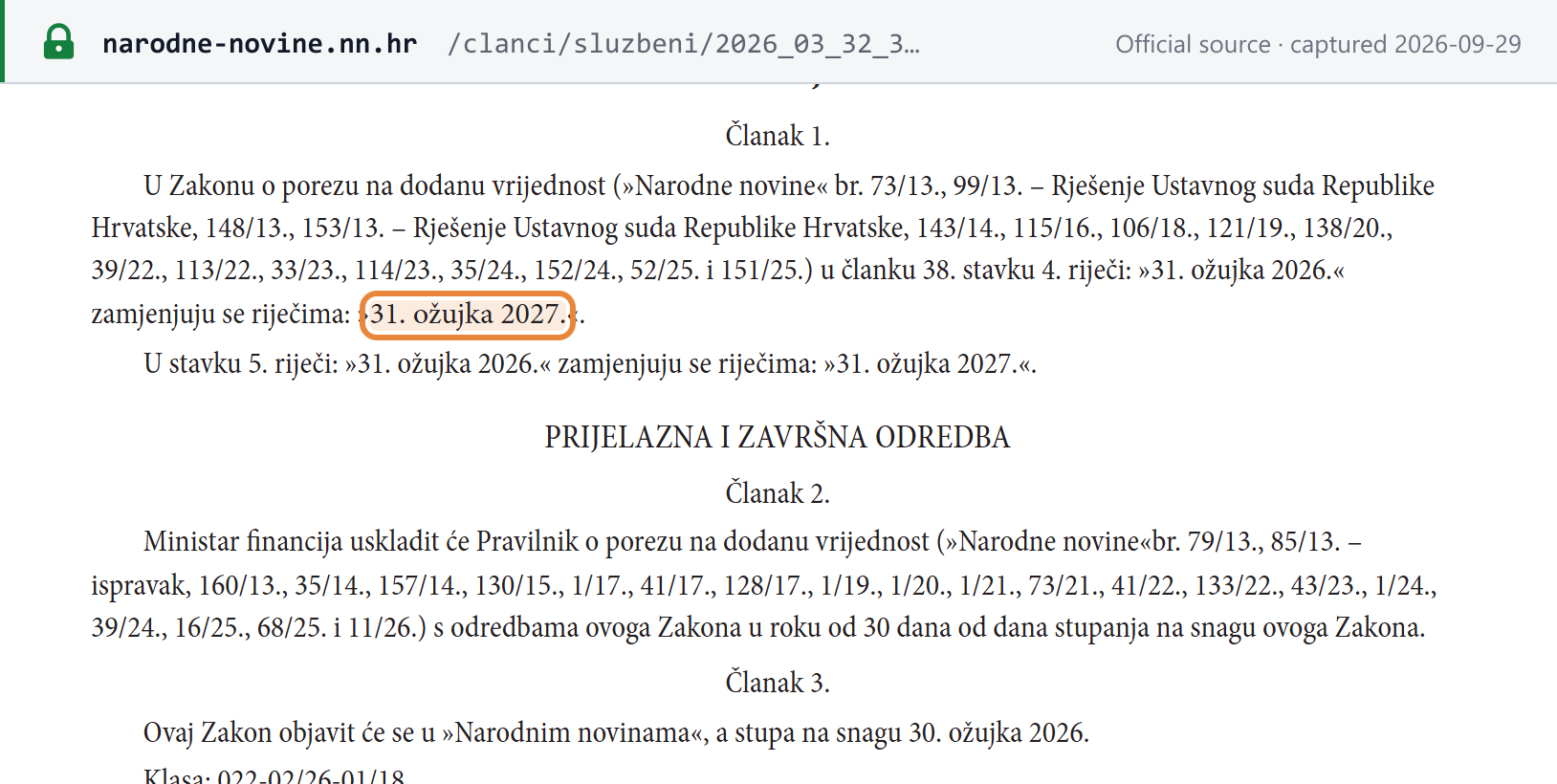
The temporary 5% energy rate runs to 31 March 2027. The VAT Act lists natural gas, district heating and firewood at 13%, but Art 38(4) and (5) tax them at 5% for a fixed window. NN 32/2026 replaced "31. ožujka 2026." with "31. ožujka 2027." in both paragraphs, and entered into force on 30 March 2026. The window has been extended every year since 2023 (NN 33/2023, NN 35/2024, NN 52/2025, NN 32/2026). [10]
The 0% rate is a real rate, not an exemption. Art 38(6): "PDV se obračunava i plaća po stopi od 0% na isporuku i ugradnju solarnih ploča na privatne stambene objekte, prostore za stanovanje te javne i druge zgrade koje se koriste za aktivnosti od javnog interesa te isporuku i ugradnju solarnih ploča u blizini takvih objekata, prostora i zgrada." The supplier keeps its right to deduct input VAT. [5]
Announced future rates. No rate change is scheduled. Since 9 May 2026, a new Art 38.a (NN 48/2026) lets the Government set, by decree and for a limited time, the VAT rate on energy products that are subject to excise duty, in special circumstances and particularly in an energy-market disruption. The statute sets no floor or cap on that rate. No decree under Art 38.a had been published in Narodne novine when checked on 2026-09-29. [11]
Not a VAT change: fuel excise. The EU Council authorised Croatia to cut excise duty on motor fuels below the EU minimum from 1 August 2026 to 31 January 2027. That is an excise measure and does not change any VAT rate. [19]
For Croatia alongside other jurisdictions, see Lookuptax's worldwide tax rates table and VAT registration thresholds table.
Cross-border rules
Imports and exports
- Imports of goods. Import VAT is charged at the rate that applies to the same goods domestically: "Na uvoz dobara primjenjuje se stopa PDV-a koja se za takva dobra primjenjuje u tuzemstvu" (Art 37(4), NN 152/2024, from 1 January 2025). It is payable by the importer or customs debtor (Art 75(1) point 2), within the customs-duty payment deadline. A VAT-registered importer with a full right of deduction may instead report import VAT as a liability in its VAT return by requesting this in the customs declaration (Art 76(8), as amended by NN 138/2020). This deferral does not apply to declarations for low-value consignments or for goods in postal consignments (Art 76(10)). [3] [2] [24]
- Low-value imports. Consignments with an intrinsic value up to EUR 150 can go through IOSS or the special import arrangement. Under the special arrangement, VAT is declared in a monthly return filed by the last day of the month for the previous month and paid by the customs-duty deadline. [14] See Lookuptax's IOSS explainer.
- Exports. Exports are exempt with the right to deduct input VAT. Goods taken out in a non-EU traveller's personal luggage are exempt only if the traveller has no EU residence, the supply exceeds EUR 100 including VAT, the goods leave the EU within three months after the month of supply, and there is customs-certified proof of export. [1]
- Reverse charge on imported services. A Croatian taxable person, or a VAT-registered non-taxable legal person, self-assesses VAT on general B2B services received from a supplier with no seat, residence or habitual residence in Croatia (Art 75(1) point 6). The reverse-charged VAT is deemed paid if the liability is shown in the VAT return (Art 76(4)). [2] See Lookuptax's reverse charge explainer.
Digital products and services
B2C telecommunications, broadcasting and electronically supplied services are taxed where the consumer is (Art 26). A supplier established in Croatia keeps Croatian VAT on its cross-border B2C electronic services and intra-EU distance sales while those sales stay at or below EUR 10,000 (excluding VAT) in the current and the previous calendar year (Art 26.a(1)(c): wording per NN 138/2020, amount per NN 113/2022). A supplier established outside the EU has no threshold: it registers in Croatia or uses the non-Union OSS scheme. [24] [5] [14]
Foreign companies selling into Croatia — B2B and B2C
- B2B: the Croatian customer usually accounts for the VAT. For general B2B services, the Croatian customer reverse-charges (Art 75(1) point 6). For other taxable supplies in Croatia by a supplier that is neither established nor VAT-registered there, the VAT is paid by the customer if it is a taxable person or a VAT-registered legal person (Art 75(2), as amended by NN 106/2018). The invoice must carry the words "prijenos porezne obveze" or "reverse charge" (Art 79(7)). [23] [2]
- B2C: the seller registers, or uses OSS/IOSS. A non-established seller liable to Croatian VAT must register (see Non-resident registration). OSS and IOSS are optional: "Primjena navedenih postupaka predstavlja mogućnost, a ne obvezu poreznih obveznika." A seller that does not use them must "registrirati se za potrebe PDV-a u svakoj državi članici u kojoj je mjesto oporezivanja isporuka koje obavljaju" (register for VAT in every Member State where its supplies are taxable). [1] [14] See Lookuptax's OSS explainer.
Marketplace / platform deemed-supplier liability
Applies. An electronic interface (marketplace, platform or portal) is treated as the supplier when it facilitates (1) distance sales of goods imported from outside the EU in consignments with an intrinsic value up to EUR 150, and (2) supplies of goods within the EU by a seller established outside the EU to consumers (Art 7.b: wording per NN 138/2020, amount per NN 113/2022). [24] [5] See Lookuptax's marketplace deemed-supplier explainer.
Place of supply
- Services, B2B (Art 17(1)). Supplied where the customer has its seat: "Mjestom obavljanja usluga poreznom obvezniku koji djeluje kao takav smatra se mjesto sjedišta tog poreznog obveznika."
- Services, B2C (Art 17(2)). Supplied where the supplier has its seat: "Mjestom obavljanja usluga osobi koja nije porezni obveznik smatra se mjesto u kojem porezni obveznik koji obavlja usluge ima sjedište."
- Exceptions (Arts 18–26). Immovable property, events, transport, restaurant services and B2C telecom, broadcasting and electronic services have their own rules. Since 1 January 2025, virtual-event services to consumers are taxed where the customer is (Art 21(4), NN 152/2024).
- Goods. Intra-EU distance sales follow the EUR 10,000 rule above.
Invoice requirements
Invoice rules sit in VAT Act Arts 78–82. Receipts that are fiscalised in real time, and eRačun between businesses, add requirements under the Fiscalization Act (Zakon o fiskalizaciji, NN 89/2025).
Mandatory content
A full invoice must carry the following particulars (VAT Act Art 79(1)–(2), NN 73/2013): [2]
| # | Required field | Legal cite |
|---|---|---|
| 1 | Invoice number and date of issue | Art 79(1) point 1 |
| 2 | Supplier's name, address and OIB or PDV-ID | Art 79(1) point 2 |
| 3 | Customer's name, address and OIB or PDV-ID | Art 79(1) point 3 |
| 4 | Quantity (or extent) and usual trade name of the goods; type and quantity of the services | Art 79(1) point 4 |
| 5 | Date of supply, or of receipt of an advance payment, where it differs from the issue date | Art 79(1) point 5 |
| 6 | Unit price excluding VAT, or the consideration, broken down by VAT rate | Art 79(1) point 6 |
| 7 | Discounts and rebates not included in the unit price | Art 79(1) point 7 |
| 8 | VAT rate | Art 79(1) point 8 |
| 9 | VAT amount by rate | Art 79(1) point 9 |
| 10 | Total of consideration plus VAT | Art 79(1) point 10 |
| 11 | The OIB always; the PDV-ID for intra-EU transactions | Art 79(2) |
Conditional wording. [2]
- Exempt supplies: cite the exempting provision, and show only the total consideration, not a rate or VAT amount (Art 79(3)).
- Reverse charge: "prijenos porezne obveze" or "reverse charge" (Art 79(7)).
- Self-billing: "samoizdavanje računa" (Art 79(6)).
- Travel agents and margin schemes: the prescribed "posebni postupak oporezivanja" wording (Art 79(4)–(5)).
Issuance deadline
For intra-EU supplies of goods and for B2B services where the customer in another Member State pays the VAT, the invoice is due by the 15th of the month after the month of the tax point (Art 78). The VAT Act sets no general deadline for domestic invoices (checked 2026-09-29). For domestic B2B transactions in scope of Fiskalizacija 2.0, the eRačun is fiscalised when issued; see E-invoicing status. [2]
Numbering and sequencing
The VAT Act requires an invoice number (Art 79(1) point 1). For fiscalised receipts, the Fiscalization Act (Art 9) requires a three-part number: numeric number / business-premises mark / issuing-device number. The numeric part "mora slijediti neprekinuti numerički redoslijed, bez praznina" (must follow an unbroken numeric sequence without gaps) per business premises or per device, and the sequencing rules must be set in an internal act shown at a tax audit. [15]
Credit and debit notes
"Svaka isprava ili obavijest koja mijenja prvobitni račun i koja se izričito i nedvojbeno odnosi na njega smatra se računom" (any document or notice that amends the original invoice and refers to it specifically and unambiguously is treated as an invoice) (Art 78). A simplified invoice may be used for such an amending document (Art 79(12)), and it must reference the original invoice and the details changed. [2] [3]
Document types
- Full invoice. The Art 79(1) particulars above.
- Simplified invoice. Allowed where the invoice amount is not more than EUR 100, where the document amends an earlier invoice, or where the issuer uses the small-business scheme (Art 79(12), as reworded by NN 152/2024 from 1 January 2025). It is not allowed for intra-EU supplies where the customer pays the VAT (Art 79(13)). [3]
- Fiscalised receipt (B2C). Besides the invoice particulars, a fiscalised receipt must show the time of issue, the operator mark, the payment method, the Unique Invoice Identifier (JIR), the issuer's protective code (ZKI) and a QR code (Fiscalization Act Art 7(1)). [15]
Self-billing
Permitted where the parties have agreed it and there is a procedure for the supplier to accept each invoice (Art 78). The invoice must say "samoizdavanje računa" (Art 79(6)). [2]
Currency and language
- Currency. Invoice amounts are stated in euro. They may also be shown in another currency, provided the VAT payable is stated in euro at the Art 36(2) exchange rate (Art 81). NN 113/2022 replaced "kune" with "eure" in Art 36(2). [5]
- Language. The VAT Act's invoice articles (Arts 78–82) set no language requirement (checked 2026-09-29). Art 79(7) expressly allows the English words "reverse charge".
Retention, electronic invoices and audit trail
- Retention. Issued and received invoices, correction documents, import and export evidence, exemption documents and VAT calculations must be kept for the periods set by the General Tax Act (Opći porezni zakon), on paper or electronically (VAT Act Art 82). [2]
- eRačun. Issued and received eRačun are kept in original form for six years from the end of the year of issue, provided they were fiscalised (Fiscalization Act Art 35(1)). [15]
- Electronic invoices and consent. An electronic invoice needs the recipient's consent (Art 80(1)). From 1 January 2026, consent is not needed where the Fiscalization Act makes the eRačun mandatory (new Art 80(2), NN 151/2025). [7]
- Integrity. Authenticity of origin, integrity of content and legibility must be ensured from issue until the end of the storage period, whether on paper or electronic. This can be done by EDI, an advanced electronic signature or any business control that links the invoice to the supply (Art 80). [2]
- Receipt audit trail. Gap-free numbering per premises or device, documented in an internal act (Fiscalization Act Art 9), and an operator mark on each receipt (Art 7). [15]
Specimen invoice
Official specimen for B2C receipts. Porezna uprava publishes an annotated example of a fiscalised receipt, labelling the invoice number, time of issue, payment method, operator mark, ZKI, JIR and QR code. [16]
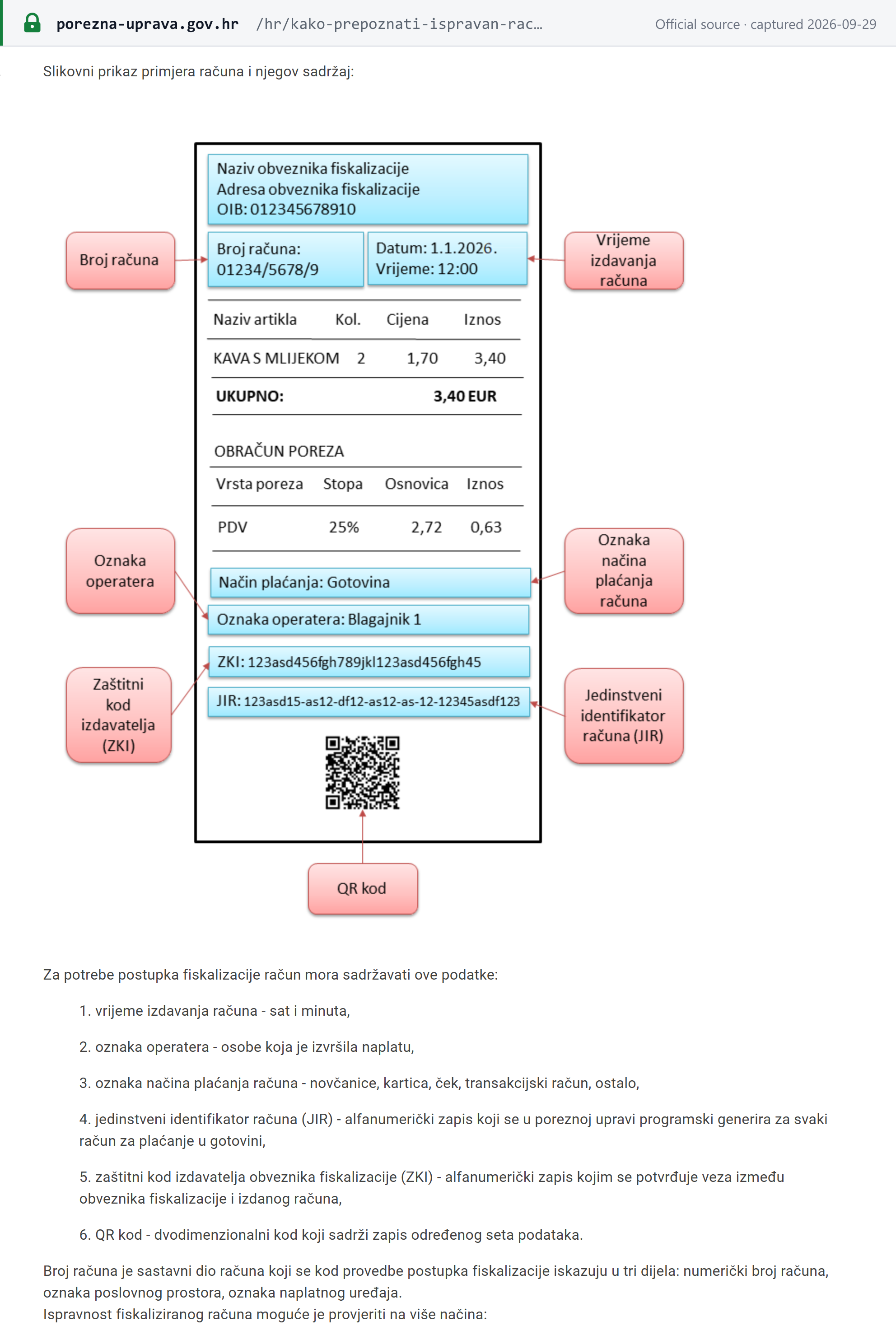
The sample's own figures do not add up: it shows VAT of 0.63 on a base of 2.72 at 25%, but 25% of 2.72 is 0.68. Use it for the layout, not the arithmetic.
That page's list of payment methods also still includes cheques ("ček"). The Fiscalization Act lists "novčanice, kartica, transakcijski račun, ostalo" (banknotes, card, transaction account, other) (Art 7(1) point 3). [15]
Illustrative B2B invoice. No official specimen of a B2B VAT invoice was found, so the example below is built by Lookuptax from Art 79(1).
Račun (Invoice)
| DescriptionArt 79(1) pt 4 | QuantityArt 79(1) pt 4 | Unit price (excl. VAT)Art 79(1) pt 6 | Amount (excl. VAT) |
|---|---|---|---|
| Office chairs | 10 | EUR 120.00 | EUR 1,200.00 |
- Discount not in unit priceArt 79(1) pt 7
- EUR 0.00
- Taxable amount at 25%Art 79(1) pt 6
- EUR 1,200.00
- VAT rateArt 79(1) pt 8
- 25%
- VAT amount at 25%Art 79(1) pt 9
- EUR 300.00
- Total including VATArt 79(1) pt 10
- EUR 1,500.00
- Amounts are stated in euro; another currency may be added if the VAT is also stated in euro — Art 81.
- For an intra-EU supply, the PDV-ID (HR + OIB) is shown, and the invoice is issued by the 15th of the month after the supply — Arts 78 and 79(2).
- Where the customer pays the VAT, the invoice states "prijenos porezne obveze" or "reverse charge" — Art 79(7).
- An exempt supply cites the exempting provision and shows only the total consideration — Art 79(3).
E-invoicing status
Status (as of 2026-09-29): mandatory and phased (Fiskalizacija 2.0 / eRačun). This section summarises; the full rules are in Lookuptax's Croatia e-invoicing guide (Fiskalizacija 2.0). [15]
| Scope | Obligation | From |
|---|---|---|
| B2B and B2G, Phase 1 | VAT-registered taxpayers established in Croatia issue, receive and fiscalise structured eRačun for domestic transactions | 1 January 2026 |
| Phase 2 | Non-VAT income-tax and profit-tax payers and non-VAT public bodies must also issue (Fiscalization Act Art 38(1) points 2–3) | 1 January 2027 |
| B2C | Real-time fiscalisation of receipts; from 1 January 2027, fiscalisation certificates may come from any provider on an eIDAS trusted list (NN 97/2026) [20] | In force |
| Non-established, VAT-registered businesses | Out of scope: no obligation to issue, receive or fiscalise eRačun (Porezna uprava FAQ) [21] | — |
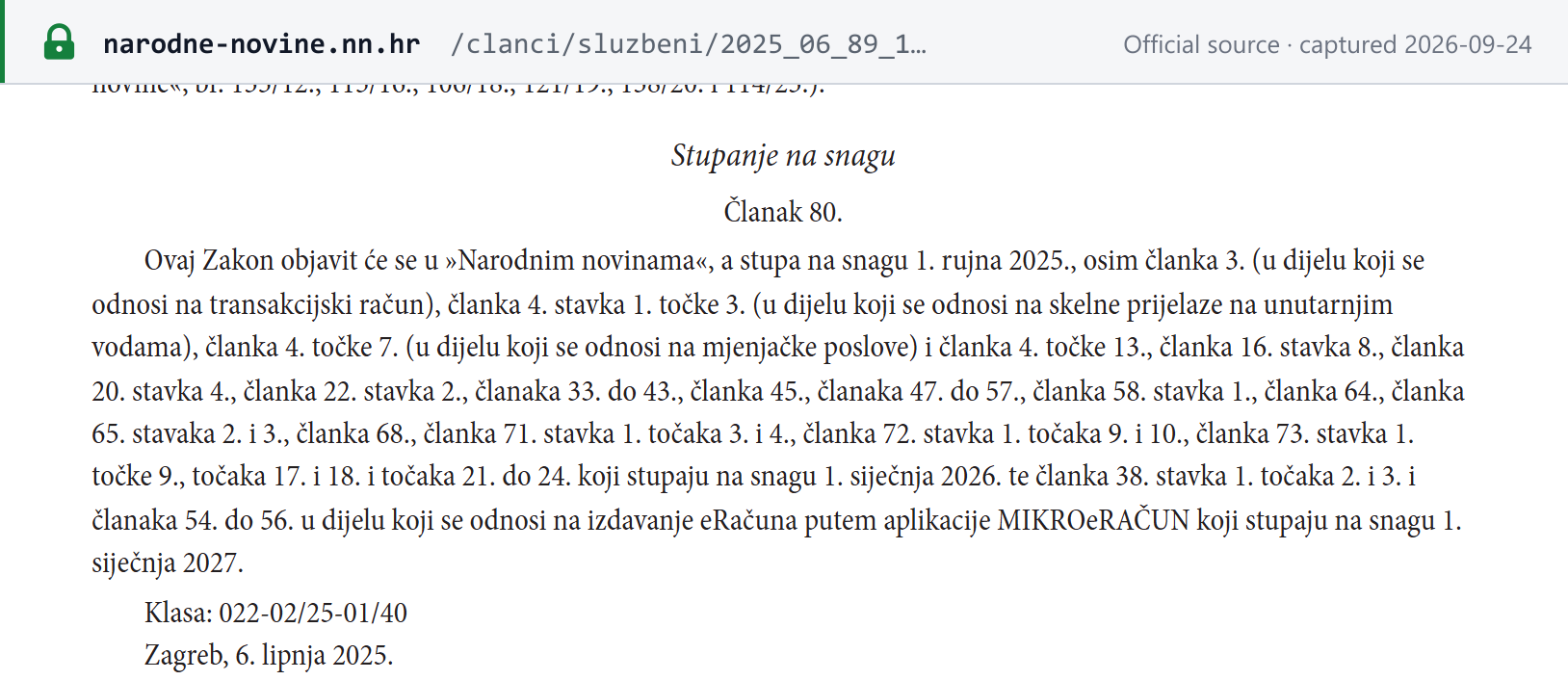
Format and network. EN 16931 with the Croatian CIUS (CIUS-HR), exchanged over the national eRačun network; Porezna uprava offers the free MIKROeRAČUN app. Do not confuse the eRačun e-reporting deadline (the 20th of the following month) with the VAT return deadline (the last day of the following month). The e-invoicing guide covers formats, access points, reporting and penalties in detail.
See also Lookuptax's e-invoicing status and networks worldwide.
Filing and payment
The VAT return, the return on EU acquisitions and services received, and the EC Sales List are now due by the last day of the month following the tax period, not the 20th. NN 151/2025 made the change from 1 January 2026. Returns for the last tax period of 2025 still followed the old deadlines. [7]
Filing frequency
Monthly by default. Quarterly where prior-year supplies, including VAT, were below EUR 110,000, except for taxpayers carrying out intra-EU transactions. A non-established taxpayer registered for Croatian VAT files monthly. See Overview. [6]
Return due date
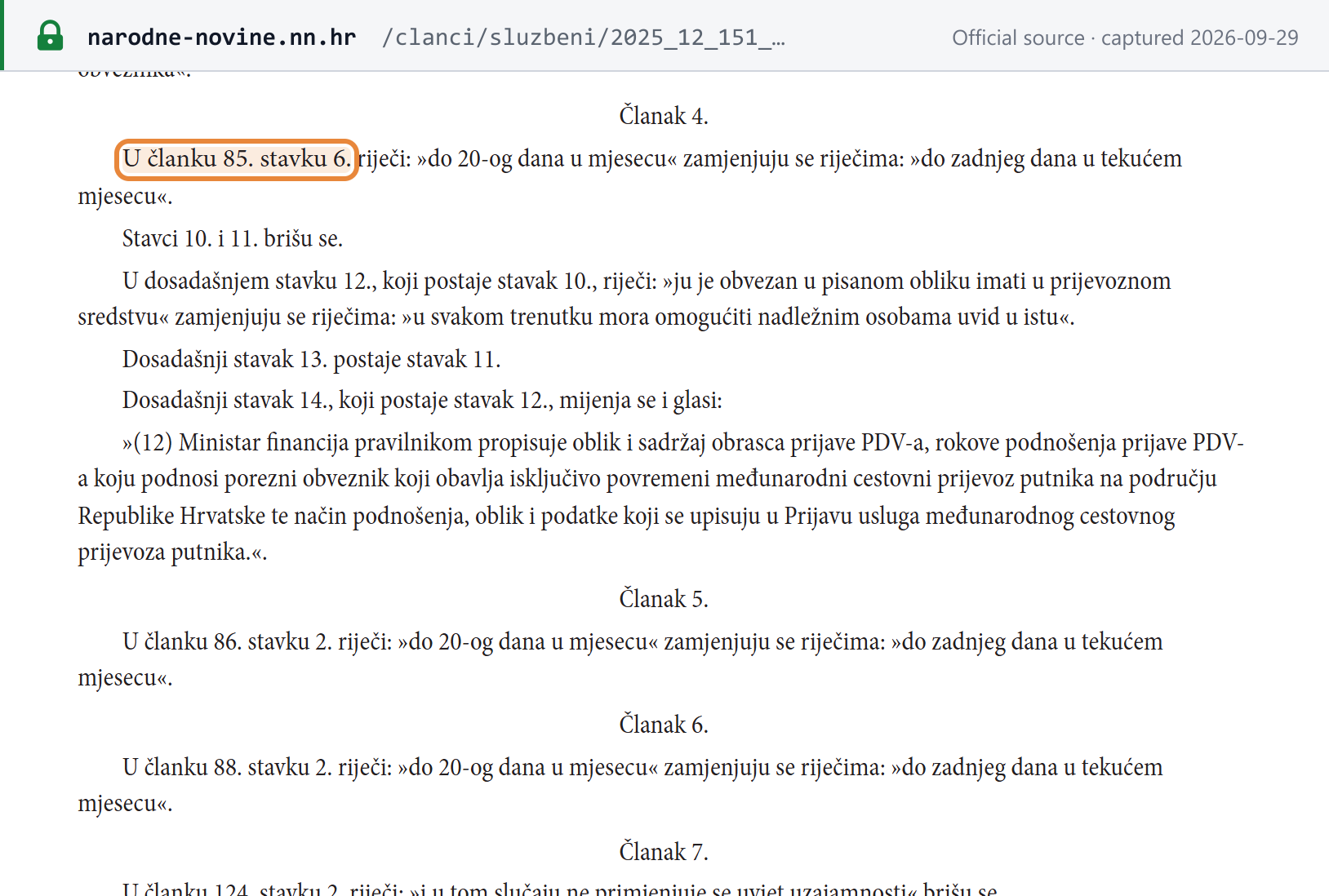
The VAT return (form PDV) is due by the last day of the month following the tax period, whether monthly or quarterly. NN 151/2025 Art 4: "U članku 85. stavku 6. riječi: »do 20-og dana u mjesecu« zamjenjuju se riječima: »do zadnjeg dana u tekućem mjesecu«" (in Art 85(6), "by the 20th of the month" is replaced by "by the last day of the current month"). A return is due even for a period with no taxable supplies. [7] [12]
Payment due date and method
VAT is paid by the last day of the month following the tax period, so from 2026 the filing and payment deadlines coincide. Porezna uprava: "PDV se plaća do posljednjeg dana u mjesecu koji slijedi po proteku razdoblja oporezivanja (mjesečnog ili tromjesečnog)." Payment is made to the prescribed payment account (VAT Act Art 76). Reverse-charged VAT counts as paid when shown in the return (Art 76(4)). [1] [2]
Additional listings
All moved to the last day of the following month from 1 January 2026 (NN 151/2025 Arts 1, 5 and 6): [7]
| Listing | What it reports | Legal basis |
|---|---|---|
| Return on intra-EU acquisitions and services received | Acquisitions of goods and services received from other Member States | Art 86(2) |
| Recapitulative statement (EC Sales List, zbirna prijava) | Intra-EU supplies of goods and services, call-off stock and triangulation; filed for monthly periods | Art 88(2) |
| Listing for customs procedures 42/63 | Onward intra-EU supplies of goods imported under those procedures | Art 44(3) |
For background, see Lookuptax's VIES and Intrastat guide.
Input-tax recovery and blocked items
- Entertainment (reprezentacija): no deduction. This covers hosting and gifts for business partners, their holidays, sport and leisure, and hire of cars, boats, aircraft and holiday homes for them (VAT Act Art 61(1), as replaced by NN 115/2016 from 1 January 2017). [25]
- Passenger cars: 50% non-deductible. Porezna uprava: 50% of input VAT on the purchase or lease of passenger cars (category M1, at most eight seats besides the driver), including all related goods and services, cannot be deducted. The former EUR 53,089.12 value cap was abolished from 1 January 2019. [1]
Refunds
- Residents. Excess input VAT may be refunded or carried forward. If a refund is requested, Porezna uprava must pay it "u roku od 30 dana od dana predaje prijave PDV-a, a najkasnije u roku od 90 dana od dana pokretanja poreznog nadzora" (within 30 days of filing the return, and at the latest within 90 days of the start of a tax audit). [1]
- Non-EU businesses. A business with no seat, fixed establishment, residence or habitual residence in the EU may, under prescribed conditions, reclaim VAT charged on goods and services supplied to it in Croatia or on its imports. [1]
- EU businesses. Reclaim through the EU VAT refund procedure; see Porezna uprava's EU VAT refund page.
- Bad-debt relief. Not covered in this guide.
Exemptions
Exempt supplies
VAT Act Art 40(1) exempts, without the right to deduct input VAT, among others: insurance and reinsurance; granting credit and loans; supplies of buildings after first occupation, where more than two years have passed since then; land other than building land; and letting of residential premises. Public-interest exemptions (medical, educational, social, cultural and similar) are in Art 39. [2]
Exempt is not the same as 0%. An exempt supplier charges no VAT and cannot deduct the input VAT attributable to those supplies. Its invoice must cite the exempting provision and must not show a rate or VAT amount (Art 79(3)). The 0% solar-panel supply (Art 38(6)) is taxable at 0%, so the supplier keeps its right to deduct. Exports and intra-EU supplies of goods are exempt with the right to deduct. [2] [5]
Special regimes
- Small-business scheme. Domestic turnover up to EUR 60,000: no VAT charged, no deduction (Arts 90 and 90.g). Since 1 January 2025 the EU cross-border SME scheme also applies: its exemption number is the OIB with the suffix "EX" (Art 90(6)), and the quarterly report is due within one month of the end of the quarter (Art 90.b(2)). [3] See Lookuptax's EU VAT SME scheme explainer.

- Cash accounting (postupak oporezivanja prema naplaćenim naknadama). Open to Croatian-established taxpayers whose prior-year supplies were no more than EUR 2,000,000 excluding VAT (Art 125.i(1): wording per NN 143/2014, amount per NN 113/2022). VAT is due when payment is received. [22] [5]
- Margin schemes. Second-hand goods, works of art, collectors' items and antiques (Art 95 and following), and travel agents (Art 91), each with mandatory invoice wording (Art 79(4)–(5)). [2]
- Free zones. Not covered in this guide.
Offences and penalties
Offences
- VAT Act misdemeanours (prekršaji), Arts 130 and 131. The conduct includes: failing to report a change or cessation of activity, or to request a PDV-ID (Art 130(1) point 3); an invoice missing prescribed particulars (Art 130(1) point 4); not issuing an invoice or issuing it late; not paying VAT, or paying late; and not filing the VAT return, or filing it late. NN 151/2025 reworded the late-return offence: "ne podnese ili ne podnese u propisanom roku nadležnoj ispostavi Porezne uprave prijavu PDV-a (članak 85. stavak 6.)" (Art 131(1) point 10). [2] [7]
- Fiscalization Act offences. Not issuing, receiving or fiscalising an eRačun (Art 71), and failures in fiscalising receipts (Art 72). [15]
- Criminal offence: tax evasion (Criminal Code Art 256). Giving false or incomplete information, or failing to report, so as to evade tax, where the tax evaded exceeds EUR 2,654.46, carries six months to five years' imprisonment. Evasion on a large scale carries one to ten years. The euro threshold replaced HRK 20,000 from 1 January 2023 (NN 114/2022). [17] [18]
Penalties
| Default | Fine | Source |
|---|---|---|
| Art 130 offences (registration and PDV-ID failures, missing invoice particulars, and others) | Taxable person EUR 130–26,540; responsible person in a legal entity EUR 60–5,300 | VAT Act Art 130, amounts set by NN 113/2022 [5] |
| Art 131 offences (late or missing return or payment, failure to invoice, and others) | Taxable person EUR 260–66,360; responsible person EUR 130–6,630 | VAT Act Art 131, amounts set by NN 113/2022 [5] |
| Not issuing, receiving or fiscalising an eRačun | Legal person EUR 3,980–66,360; responsible person EUR 660–6,630; craftsman or self-employed person EUR 3,980–39,810 | Fiscalization Act Art 71 [15] |
| Late registration | Ex officio registration from the day after the threshold was crossed (Rulebook Art 186(6)), plus the Art 130 fine | [4] |
| Late payment | Interest is charged under the General Tax Act; the rate is not covered in this guide. | — |
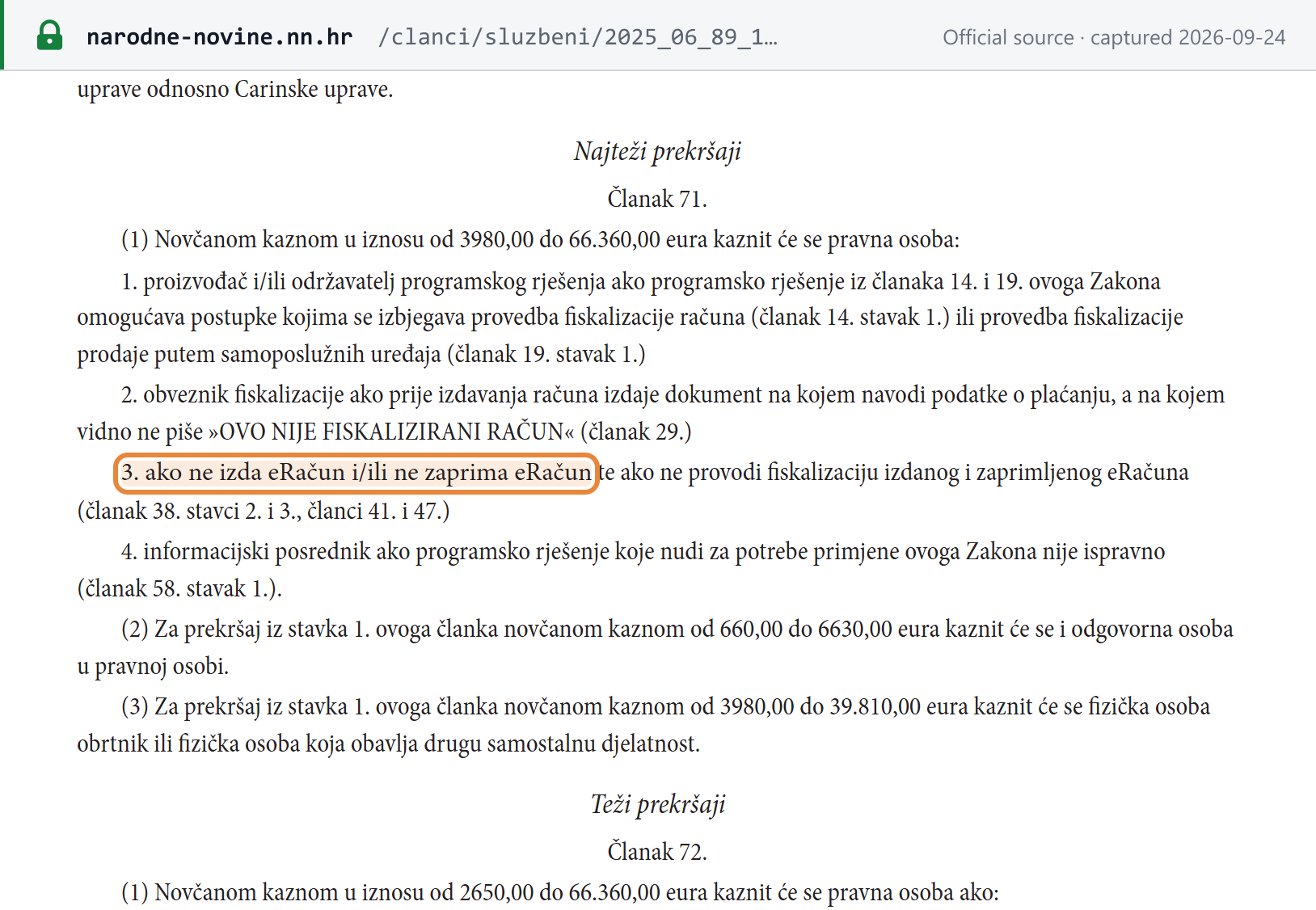
Porezna uprava has said that misdemeanour proceedings under the Fiscalization Act will not be brought in the initial phase of its application; see the e-invoicing guide.
Frequently asked questions
Is the Croatian VAT return still due on the 20th of the following month?
No. From 1 January 2026, NN 151/2025 moved the deadline in VAT Act Art 85(6) from the 20th to the last day of the month following the tax period. The same act moved the return on acquisitions and services received from other EU Member States (Art 86(2)), the recapitulative statement or EC Sales List (Art 88(2)) and the listing for customs procedures 42/63 (Art 44(3)) to the last day of the following month. VAT is also paid by the last day of the following month. Returns for the last tax period of 2025 still followed the old deadlines. Do not confuse this with the eRačun e-reporting deadline under the Fiscalization Act, which is the 20th of the following month and is a separate obligation. [7]
We are a non-EU company selling to consumers in Croatia. Is there a registration threshold we can stay under?
No. The EUR 60,000 threshold belongs to the small-business scheme, and the VAT Rulebook (Art 186.d(1)) says a business established in a third country cannot use that scheme. Porezna uprava states that a business with no seat, residence or habitual residence in Croatia that is liable to pay Croatian VAT on its supplies must register unless it applies the small-business scheme. In practice a non-EU seller to Croatian consumers either registers in Croatia or uses the optional OSS or IOSS schemes. A non-EU business must appoint a tax representative only if Croatia has no mutual-assistance agreement with its country similar in scope to Directive 2010/24/EU and Regulation 904/2010 (VAT Act Art 126(2)). [1] [4]
Is gas, district heating and firewood taxed at 13% or 5% in Croatia?
At 5%, until 31 March 2027. The VAT Act lists natural gas, heating from heating stations, and firewood, pellets, briquettes and chips at 13% (Art 38(3)(g)-(h)), but Art 38(4) and (5) apply a temporary 5% rate to these supplies. NN 32/2026 moved the end date of both paragraphs from 31 March 2026 to 31 March 2027, with effect from 30 March 2026. The window has been extended every year since 2023. [10]
Does Croatia have a 0% VAT rate, and is it the same as an exemption?
Yes, Croatia has a 0% rate, and no, it is not an exemption. Since 1 October 2022 the supply and installation of solar panels on private homes, residential premises and public-interest buildings, and near them, is taxed at 0% (VAT Act Art 38(6), added by NN 113/2022). A 0% supply is taxable, so the supplier keeps its right to deduct input VAT. Exempt supplies under Art 40, such as insurance, credit and residential letting, carry no right to deduct, and the invoice must cite the exempting provision without showing a rate or VAT amount (Art 79(3)). [5]
We are a foreign company registered for Croatian VAT. Do we have to issue eRačun under Fiskalizacija 2.0?
No. Porezna uprava's e-invoicing FAQ says a VAT-registered taxpayer with no seat, residence or habitual residence in Croatia is not obliged to issue, receive or fiscalise eRačun under the Fiscalization Act. The issuing obligation in Fiscalization Act Art 38(1) applies to VAT-registered taxpayers established in Croatia from 1 January 2026, and to non-VAT income-tax and profit-tax payers and public bodies from 1 January 2027. Your ordinary VAT Act invoicing duties still apply. [21]
Important websites
Checked 2026-09-29 unless noted.
| Site | Purpose |
|---|---|
| ePorezna | Online registration requests, filing returns and listings (login required) |
| VAT register check (Provjera obveznika u sustavu PDV-a) | Checking whether a Croatian business is VAT-registered |
| Checking foreign VAT numbers | Porezna uprava guidance on checking EU VAT numbers |
| Forms (obrasci) | P-PDV registration form, PDV return and other forms |
| VAT for foreign persons | English guidance; P-PDV and PDV forms in English and German |
| OSS and IOSS | Registration and guidance for the EU special schemes |
| VAT refunds and EU VAT refund | Refund procedures |
| VAT overview | Porezna uprava's summary of rates, registration and filing |
| Fiscalisation portal and MIKROeRAČUN | eRačun and receipt fiscalisation |
| Check a receipt | Verifying a fiscalised receipt by QR code or app |
| Narodne novine | Official gazette: the VAT Act and every amending act |
| Customs Administration | Import VAT and customs declarations |
Also see Lookuptax's own Croatia OIB validator.
Recent changes
- 2026-09-02 — NN 97/2026 printed: the amended receipt-fiscalisation Rulebook accepts certificates from any eIDAS trusted-list provider, in force 1 January 2027. Certificates issued earlier stay valid until they expire. (Narodne novine) — see event
- 2026-08-01 — Excise, not VAT: the EU Council's authorisation for Croatia to cut motor-fuel excise below EU minima runs from 1 August 2026 to 31 January 2027. No VAT rate changed. (Council of the EU) — see event
- 2026-05-09 — NN 48/2026 in force: new Art 38.a lets the Government set the VAT rate on excise-duty energy products by decree for a limited time. No decree had been published as of 2026-09-29. (Narodne novine)
- 2026-03-30 — NN 32/2026 in force: the temporary 5% rate on natural gas, district heating and firewood is extended to 31 March 2027. (Narodne novine)
- 2026-01-01 — NN 151/2025 in force: the VAT return, the return on EU acquisitions and the EC Sales List move from the 20th to the last day of the following month, and recipient consent is no longer needed for mandatory eRačun. Fiskalizacija 2.0 Phase 1 starts the same day. (Narodne novine)
- 2025-01-01 — NN 152/2024 in force: the small-business threshold rises from EUR 40,000 to EUR 60,000, the EU cross-border SME scheme starts, and the simplified-invoice grounds are widened. (Narodne novine)
Ahead — scheduled changes that have not yet taken effect:
- 2027-01-01 — Fiskalizacija 2.0 Phase 2: non-VAT income-tax and profit-tax payers and public bodies must also issue eRačun; the NN 97/2026 certificate rules apply. (Narodne novine) — see event
- 2027-03-31 — The temporary 5% rate on natural gas, district heating and firewood ends unless extended again. (Narodne novine)
For the full chronology, see Croatia tax changes on Lookuptax.
Reference links
- Porezna uprava — Porez na dodanu vrijednost (VAT overview, updated 15 May 2026)
- Narodne novine 73/2013 — Zakon o porezu na dodanu vrijednost (VAT Act, original text)
- Narodne novine 152/2024 — VAT Act amendments in force 1 January 2025
- Narodne novine 16/2025 — amendments to the VAT Rulebook (Pravilnik o PDV-u)
- Narodne novine 113/2022 — VAT Act amendments (euro conversion, 0% solar panels)
- Narodne novine 114/2023 — VAT Act amendments (EUR 110,000 quarterly threshold)
- Narodne novine 151/2025 — VAT Act amendments in force 1 January 2026 (filing deadlines)
- Narodne novine 22/2012 — standard rate raised to 25%
- Narodne novine 39/2022 — VAT Act amendments (Art 38 rates)
- Narodne novine 32/2026 — 5% energy rate extended to 31 March 2027
- Narodne novine 48/2026 — new Art 38.a (VAT on energy products by decree)
- Porezna uprava — Obrtnici: 3. Porez na dodanu vrijednost
- Porezna uprava — VAT for foreign persons
- Porezna uprava — Posebni postupak oporezivanja PDV-a (OSS)
- Narodne novine 89/2025 — Zakon o fiskalizaciji (Fiscalization Act)
- Porezna uprava — Kako prepoznati ispravan račun? (annotated receipt)
- Narodne novine 125/2011 — Kazneni zakon (Criminal Code)
- Narodne novine 114/2022 — Criminal Code amendments (euro thresholds)
- Council of the EU — ST-10873/26, fuel excise derogation for Croatia (PDF)
- Narodne novine 97/2026 — amended receipt-fiscalisation Rulebook
- Porezna uprava — eRačun issuing, receiving and fiscalisation FAQ
- Narodne novine 143/2014 — VAT Act amendments (tax periods, cash accounting)
- Narodne novine 106/2018 — VAT Act amendments (Art 75(2))
- Narodne novine 138/2020 — VAT Act amendments (e-commerce package, import VAT deferral, tax representative)
- Narodne novine 115/2016 — VAT Act amendments (Art 61 input-VAT restrictions)
Related Lookuptax pages