Austria VAT guidelines
| FACTSHEET | |
|---|---|
| Country code | AT |
| Tax name | Umsatzsteuer (USt) — Value Added Tax (VAT) |
| Tax Authority | Bundesministerium für Finanzen (BMF), operationally via Finanzamt Österreich |
Overview
Austria levies Umsatzsteuer (USt) — Value Added Tax — under the Umsatzsteuergesetz 1994 (UStG 1994). The joint BMF/BMAW business portal USP (Unternehmensserviceportal) states the liability rule directly: "Umsatzsteuerpflichtig sind in Österreich grundsätzlich alle Unternehmen," with an enterprise (Unternehmer) existing wherever "eine gewerbliche oder berufliche Tätigkeit selbständig ausgeübt wird" — a commercial or professional activity carried on independently. [1]
Administering authority. VAT is administered by the Bundesministerium für Finanzen (BMF), operationally through the Finanzamt Österreich — the single national tax office created by the 2020 tax-office reform — and filed through the FinanzOnline e-tax portal. Taxpayer-facing guidance is published jointly by BMF and the Bundesministerium für Arbeit und Wirtschaft on usp.gv.at. [1]
Currency. All figures in this guide are in euro (EUR, €).
Tax period basis. The VAT assessment period (Veranlagungszeitraum) is the calendar year. The return period for advance returns (Voranmeldungszeitraum) is monthly by default, or quarterly for businesses under a turnover threshold — see Filing and payment.
Layering. Austrian VAT is a single federal tax. There is no state (Land) or municipal VAT layer and no regional surcharge — every rate and threshold in this guide applies uniformly across all nine Bundesländer, with one narrow territorial exception (see Rates). As an EU member state, the UStG 1994 implements Directive 2006/112/EC, so the EU-level machinery — intra-Community supplies, the cross-border reverse charge, OSS/IOSS — applies here as elsewhere in the single market.
What is different about Austria. Three features have no close equivalent in most peer EU jurisdictions covered on this site: a 19% rate that applies only inside the Jungholz and Mittelberg enclaves (see Rates); a Kleinunternehmer threshold that changed both its figure and how it is measured in 2025 (see Registration); and a domestic reverse charge applied more broadly than in most EU states, extending to construction services (Bauleistungen) (see Cross-border rules).
Registration
Who should register
An Unternehmer — anyone independently carrying on a commercial or professional activity — is within the scope of Austrian VAT from the first taxable transaction. [1] There is no separate registration threshold that determines whether the activity is taxable — the Kleinunternehmer threshold below is an exemption available to businesses established in Austria, not a permission to trade untaxed until it is reached. A business with no Austrian establishment has no equivalent de-minimis at all (see below).
Registration threshold
| Trigger | Threshold | Measurement period | Notes |
|---|---|---|---|
| Kleinunternehmer exemption — business established in Austria (§ 6 Abs. 1 Z 27 UStG) | €55,000, counting the full agreed consideration | Neither the previous nor the current calendar year exceeded | Up from €35,000 net, effective 1 January 2025, under § 6 Abs. 1 Z 27 UStG 1994 as rebuilt by the Abgabenänderungsgesetz 2024 (BGBl. I Nr. 113/2024), with the €55,000 figure set by the Progressionsabgeltungsgesetz 2025 (BGBl. I Nr. 144/2024). Measured on the full agreed consideration (USP: "es ist das gesamte vereinbarte Entgelt zu berücksichtigen"; § 6 Abs. 1 Z 27 UStG) — no notional VAT is stripped out first, unlike the pre-2025 rule. A 10% tolerance band applies: exceeding €55,000 by ≤10% (up to €60,500) in a calendar year preserves the exemption through year-end but ends it from 1 January of the following year; exceeding it by more than 10% voids the exemption retroactively, from the transaction that breached it and for every subsequent transaction that same year. [2] |
| Business not established in Austria | Zero | — | Liability to register attaches from the first taxable transaction. This is the figure readers most often assume matches the Kleinunternehmer figure — it does not. [1] |
| EU cross-border SME scheme | €55,000 Austrian turnover and €100,000 EU-wide turnover, both simultaneously | Current or prior calendar year | Since 1 January 2025, open only to a business established in another EU member state, and only once its home tax authority has issued an SME identification number with an "-EX" suffix — the Austrian exemption is valid from that issue date, not from application. [3] |
Tax registration number
Austria's VAT identifier for intra-EU transactions is the UID (Umsatzsteuer-Identifikationsnummer): the format ATU + 8 digits (^ATU\d{8}$), verified via VIES or FinanzOnline. For the full format walkthrough, the related Abgabenkontonummer (Steuernummer) and Firmenbuchnummer, and common ERP formatting errors, see Lookuptax's Austria tax ID guide. To check a counterparty's number, use the Austria UID validator.
How to register
Non-resident businesses that must charge Austrian VAT apply to a single centralised office — Finanzamt Österreich, Dienststelle Graz-Stadt, not the nearest local Finanzamt — by submitting Form Verf 19 with supporting documents by post. Typical processing time is 7–8 weeks; there is no statutory deadline compelling faster issuance. A newly issued UID takes additional business days to propagate to VIES — invoicing a UID before VIES can confirm it voids the counterparty's input-tax deduction right. [5]
Voluntary registration
Available. A business under the Kleinunternehmer threshold may waive the exemption (Verzicht auf die Kleinunternehmerbefreiung / Regelbesteuerung) to opt into full VAT liability — typically to recover input tax on significant startup investment. Some published the waiver binds the business for a minimum of five calendar years under § 6 Abs. 3 UStG 1994. BMF's own form U12 states it verbatim: "Die Erklärung bindet dieden Unternehmerin mindestens für fünf Kalenderjahre." Returning to the exemption requires an explicit revocation effective from the start of a calendar year, due by 31 January of that year. [U12]
Deregistration
BMF form Verf 25 — Fragebogen anlässlich der Aufgabe einer gewerblichen oder beruflichen Tätigkeit — is the questionnaire for ceasing activity, to be returned to the Finanzamt within one month; it also triggers cancellation of the UID number. [Verf25]
A business ceasing activity must notify the Finanzamt — mandatory regardless of the reason: "Gibt jemand seine unternehmerische Tätigkeit auf — egal aus welchen Gründen —, muss diese Tatsache dem zuständigen Finanzamt mitgeteilt werden." Sole proprietors file the notification titled "Finanzamt-Anzeige Einzelunternehmen", submittable in person, by post, by fax, or via FinanzOnline. [6] In parallel, a departing business typically also has to: return or suspend the trade licence (Gewerbeberechtigung); request deletion from the Firmenbuch (companies); notify social insurance (SVS) within one month; and deregister any employees. This guide's source did not state a specific numbered deregistration form (a "Verf25" designation is reported by some secondary sources but is not confirmed on an official page) or a fixed final-VAT-return deadline — treat both as open questions rather than settled facts pending confirmation.
Group registration
Available, as an Umsatzsteuergruppe (Organschaft). The instrument is identified as § 2 Abs. 2 Z 2 UStG 1994, transposing Article 11 of the EU VAT Directive: an entity financially, economically and organisationally integrated into another entrepreneur's business ceases to be an independent taxable person, the group is treated as a single entrepreneur (Organträger), and transactions between group members fall outside the scope of VAT as non-taxable internal transactions, confined to domestic operations. This citation is drawn from secondary legal commentary rather than an independently fetched RIS text — confirm the current wording of § 2 UStG directly before relying on edge-case detail.
Rates
| Rate | Applies to | Legal basis and effective date |
|---|---|---|
| 20% (standard) | Every taxable supply not specifically reduced, zero-rated or exempt | Long-standing, unchanged. [8] |
| 10% (reduced) | Residential rent; accommodation and catering (subject to conditions); books and newspapers; public transport; medical and care services; food listed in Anlage 1 | Anlage 1 to the UStG 1994. [8] |
| 13% (reduced) | Live animals, plants and firewood; artistic performances; film, circus, theatre and zoo admission; sports-event tickets; wine from fresh grapes sold by the producing agricultural operation | Anlage 2 to the UStG 1994. [8] |
| 4.9% (super-reduced) | Specified staple foods: bread, butter, eggs, milk, rice, wheat flour and semolina, most fresh and frozen vegetables, apples, pears and stone fruit (CN 0808/0809 — not bananas, citrus or berries), yoghurt, table salt, plain pasta. Hospitality supplies are excluded. | Effective 1 July 2026. Corroborated by two independent official sources: USP's own rate page ("Der 4,9-prozentige Steuersatz gilt für ausgewählte Nahrungsmittel, wie z.B. Brot, Butter, Eier, Milch") and the Austrian Parliament's own record of the amendment's Bundesrat confirmation on 3 June 2026. [8] [9] |
| 19% (Jungholz and Mittelberg only) | All supplies made in the two Alpine enclaves by an entrepreneur with a seat, habitual abode or business establishment there, in place of the ordinary 20% standard rate. The 10%/13% reduced rates continue to apply normally inside the enclaves. Vehicle sales and rentals revert to 20% where the buyer or lessee is established elsewhere in Austria. | § 10 Abs. 4 UStG 1994. Jungholz (Tyrol) and Mittelberg (in the Kleinwalsertal, Vorarlberg) are practically accessible only via German territory and are treated as inside the German VAT customs area for this purpose, so the rate tracks Germany's unchanged 19% standard rate rather than Austria's 20%. [7] |
| Exempt | See Exemptions — no VAT charged, no input-tax recovery | § 6 UStG 1994. |
Freshness note on the 19% enclave rate. The RIS document snapshot cited above for § 10 UStG 1994 is dated as in force for the period 1 January–31 December 2020 — RIS versions this provision by amendment date-range rather than as one evergreen page, and a current-dated NOR identifier could not be resolved within budget. No change to the Jungholz/Mittelberg mechanism has been reported since 2020, and it tracks Germany's own unchanged 19% rate, so this guide treats the figure as current with high confidence — but a reader relying on it for a specific transaction should re-pull the "tagesaktuelle Fassung" of § 10 UStG on ogd.ris.bka.gv.at before relying on it.
Announced future rates. None to the 20%, 13% or 10% figures. The 4.9% super-reduced rate above is already in force as of this guide's update date.
Cross-border rules
Imports and exports
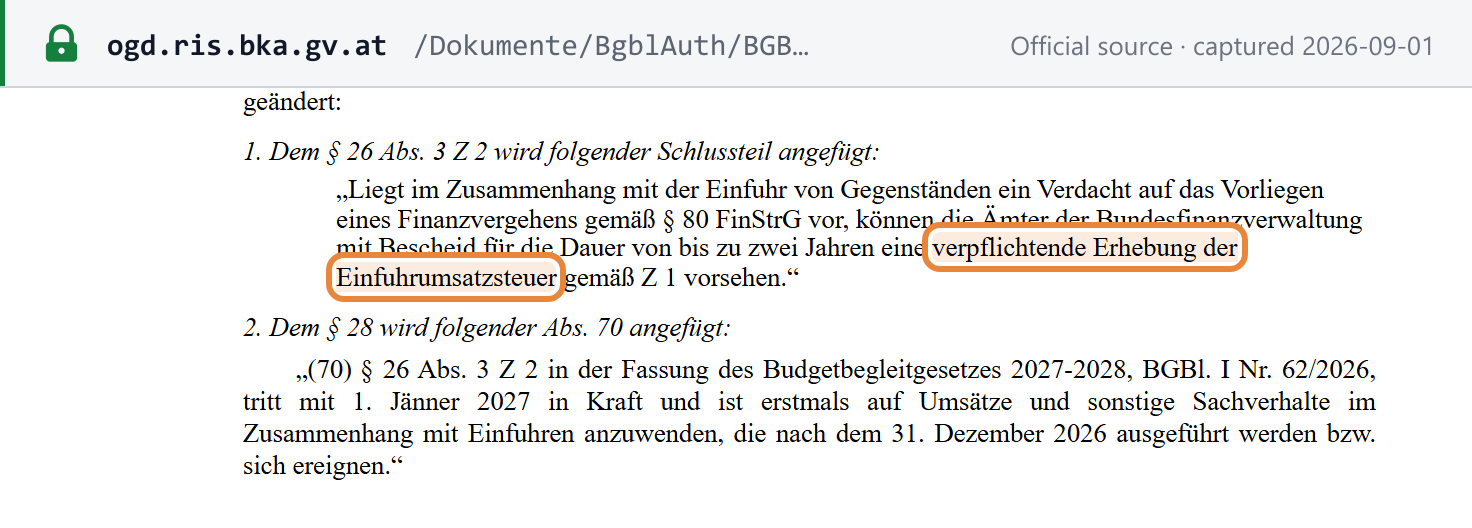
A person liable for import VAT is generally the importer of record. From 1 January 2027, the offices of the Federal Finance Administration (Ämter der Bundesfinanzverwaltung) gain a new compliance power: where there is suspicion of a financial offence under § 80 FinStrG connected with the import of goods, they may by decision (Bescheid) order mandatory collection of import VAT under the amended § 26 Abs. 3 Z 2 UStG 1994 for up to two years, rather than allowing the ordinary deferred-accounting treatment to apply. This was enacted by the Budgetbegleitgesetz 2027-2028, published as BGBl. I Nr. 62/2026 on 29 July 2026. [27]
 Source snapshot captured 2026-09-01 — original
Reverse charge on services from abroad. Where a supplier with no Austrian seat or establishment supplies a service to an Austrian entrepreneur, the Austrian recipient generally self-accounts for the VAT as the person liable — the ordinary B2B reverse-charge mechanism described in the same official guidance covering the domestic reverse-charge categories below. [10]
Domestic reverse charge — broader than most EU states. Beyond the cross-border case, Austria shifts VAT liability to the domestic recipient for several enumerated categories under § 19 Abs. 1a–1e UStG 1994 and two implementing regulations: the Schrott-Umsatzsteuerverordnung (scrap metal) and the Umsatzsteuerbetrugsbekämpfungsverordnung (VAT fraud-prevention regulation — mobile phones, integrated circuits, greenhouse-gas emission certificates, and gas/electricity in certain cases). [10]
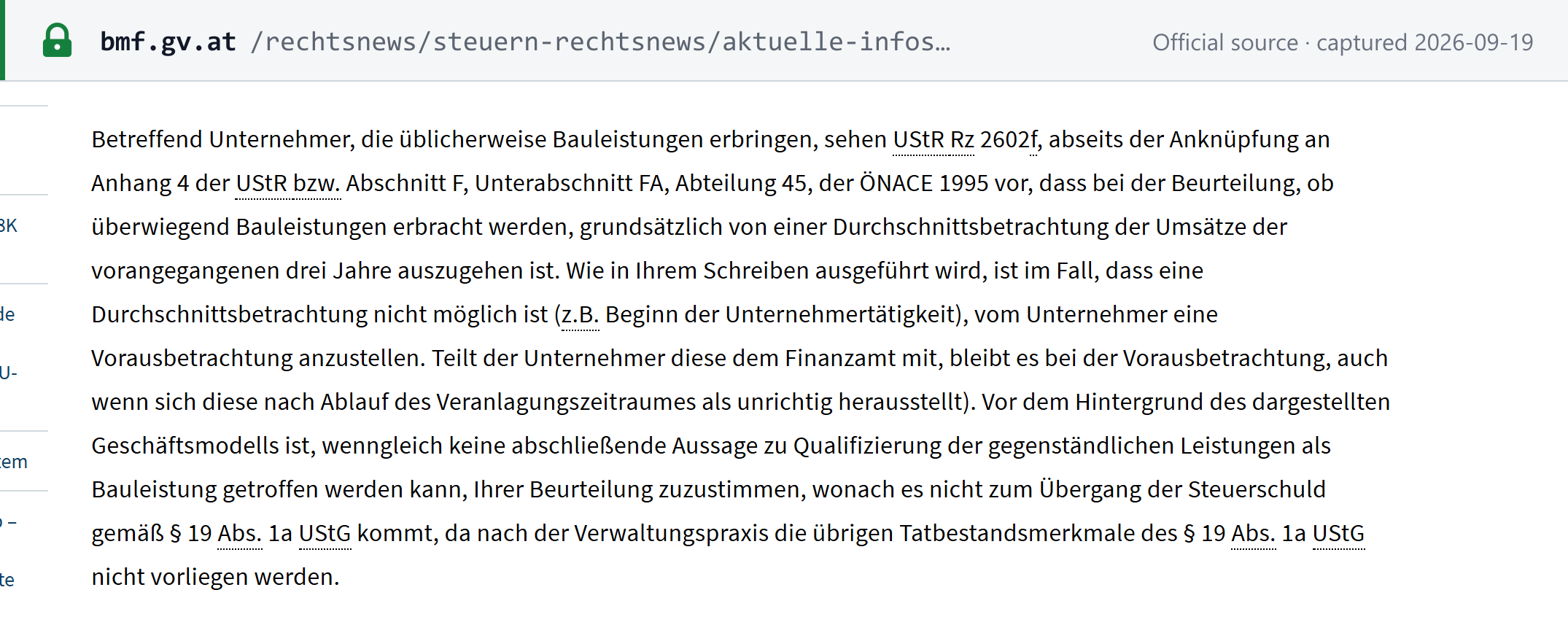
Construction services (Bauleistungen) — § 19 Abs. 1a UStG. The recipient becomes liable for the VAT where the recipient either was itself commissioned to provide construction services, or itself typically/predominantly performs construction services — tested on a three-year turnover average, with the threshold at more than 50% construction turnover: "Bei Bauleistungen kommt es zum Übergang der Steuerschuld, wenn die Empfängerin/der Empfänger selbst mit der Bauleistung beauftragt wurde oder üblicherweise selbst Bauleistungen erbringt" and "[ist] grundsätzlich von einer Durchschnittsbetrachtung der Umsätze der vorangegangenen drei Jahre auszugehen." The invoice is issued net of VAT, must carry both parties' UIDs, and must state the reverse-charge notice — the standard wording is "Steuerschuldnerschaft des Leistungsempfängers (§ 19 Abs. 1a UStG)." [10] [11]
Digital products and services
Digital, telecommunications and broadcasting services follow the EU-wide place-of-supply and One Stop Shop framework transposed into the UStG's Binnenmarkt provisions. For B2C intra-EU distance sales and digital services, the practical dividing line is the EU-wide €10,000 combined cross-border threshold under the OSS scheme — below it a single-member-state-established supplier may keep taxing in its home state, above it the supply is taxed where the customer belongs. The €10,000 figure is confirmed as the EU Directive-level threshold but did not independently reproduce Austria's own transposing text in the UStG's Binnenmarkt Anhang; treat the figure as correct in substance pending a fresh domestic citation.
Foreign companies selling into Austria — B2B and B2C
- B2B — services. Where a foreign supplier has no Austrian seat or establishment, the Austrian business recipient generally self-accounts for VAT under the reverse-charge mechanism described above; the foreign supplier does not need to register in Austria for that transaction. [10]
- B2C. There is no reverse charge, because a consumer cannot self-account. A foreign seller without Austrian establishment making B2C supplies into Austria generally must register once liable — for intra-EU distance sales of goods the EU-wide €10,000 combined threshold (see above) governs whether Austrian VAT or the seller's home-state VAT applies; above it, OSS registration in any one member state, or direct Austrian registration, is required.
- Any other taxable supply made in Austria by a non-established seller carries no threshold at all — liability to register attaches from the first transaction (see Registration), and a non-EU-established seller must additionally appoint a fiscal representative (see Fiscal representative).
Marketplace / platform deemed-supplier liability
An electronic-interface operator (a marketplace, platform or portal) is deemed the supplier — and becomes liable for the VAT — for (a) import distance sales where the individual consignment value does not exceed €150, and (b) intra-EU goods supplies facilitated for non-EU-established businesses to non-taxable persons. Legal basis: § 3 Abs. 3a UStG 1994, implementing Article 5d of EU Implementing Regulation 282/2011, with record-keeping duties under § 18 Abs. 1/12 UStG requiring 10-year retention of platform transaction records. [12]
Parcel delivery tax (Paketsteuer)
From 1 October 2026, a EUR 2 parcel delivery tax applies per parcel on the domestic delivery of parcels made in the course of distance sales of goods, under the Paketsteuergesetz enacted by the Budgetbegleitgesetz 2027-2028 (BGBl. I Nr. 62/2026, published 29 July 2026). It applies to distance sellers whose Austrian distance-sales revenue exceeded EUR 100 million in the previous year, and online marketplaces are liable where they are the deemed supplier under the Paketsteuergesetz's own, wider attribution rule — a platform-facilitated distance sale counts toward the platform's own EUR 100 million threshold. This is a broader rule than the VAT deemed-supplier rule described above, which covers only imports of EUR 150 or less and non-EU sellers' intra-EU supplies. The parcel tax is separate from and additional to standard VAT on the underlying supply. [28]
Place of supply
Austria's UStG 1994 transposes the EU Directive's general split: goods dispatched or transported are supplied where dispatch begins; goods not moved are supplied where they are located at the time of supply; services supplied B2B are generally taxed where the business customer is established, and services supplied B2C are generally taxed where the supplier is established, subject to the specific overriding rules (immovable property, passenger transport, events, restaurant and catering, short-term vehicle hire, and telecommunications/broadcasting/electronic services to consumers) that the Directive carries through every member state. Austria's specific place-of-supply article numbers are not sourced here; confirm edge cases directly against the UStG before relying on them.
Invoice requirements
Mandatory content
§ 11 UStG 1994 sets the full-invoice mandatory-content list:
| Field | Required content |
|---|---|
| Supplier | Name and address of the supplying/performing entrepreneur |
| Recipient | Name and address; the recipient's UID is additionally required once the invoice exceeds €10,000 gross |
| Goods/services | Quantity and commercial description of goods, or the type and scope of services |
| Date | The date of delivery or of the other service (or the period covered) |
| Consideration | The net consideration (Entgelt), broken out by tax rate |
| Tax rate | The applicable rate(s) |
| Tax amount | Shown separately from the net amount |
| Issue date | — |
| Invoice number | A sequential number, uniquely assigned |
| Supplier's own UID | — |
Source quotes: "den Namen und die Anschrift des liefernden oder leistenden Unternehmers," "die Menge und die handelsübliche Bezeichnung der gelieferten Gegenstände," "den Tag der Lieferung oder der sonstigen Leistung," "das Ausstellungsdatum." [13]
Simplified invoice (Kleinbetragsrechnung). Below €400 gross (raised from a lower figure effective 1 March 2014), only the supplier's name and address, a description of the goods or services, the date, and a combined gross amount plus tax rate are required — recipient details, the supplier's or recipient's UID, an invoice number and the net/tax split are not required. [13]
Issuance deadline
General rule: within six months of the transaction — "innerhalb von sechs Monaten nach Ausführung des Umsatzes." Cross-border B2B services where the recipient is the person liable for VAT: by the 15th of the month following the month of supply — "spätestens am fünfzehnten Tag des Kalendermonates, der auf den Kalendermonat folgt." [13]
Numbering and sequencing
§ 11 UStG requires a sequential invoice number, uniquely identifying the invoice, as one of the mandatory particulars listed above. [13]
Credit and debit notes
Not confirmed against a current official text: Austria's current corrective-invoice provision against a fresh RIS text; § 16 UStG 1994 is generally understood to govern adjustments to the taxable amount and corresponding input tax where consideration changes, is cancelled, or a supply is returned, but that has not been independently verified. Confirm directly before relying on the mechanics of a specific correction.
Currency and language
For invoices not denominated in EUR, the tax amount must additionally be stated in euro, using a conversion method consistent with § 20 Abs. 6 UStG: "ist der Steuerbetrag nach Anwendung einer dem § 20 Abs. 6 entsprechenden Umrechnungsmethode zusätzlich in Euro anzugeben." [13] This guide's sources did not confirm a mandated invoice language.
Document types
Austria distinguishes the full § 11 invoice described above from the Kleinbetragsrechnung (simplified invoice), permitted below the €400 gross threshold. [13] Reverse-charge invoices — for example under the Bauleistungen construction rule — carry the additional requirement that both parties' UIDs and the express reverse-charge notice appear on the document (see Cross-border rules).
Self-billing
Not documented. No official Austrian source was located for an official Austrian self-billing provision; it is not stated here rather than assumed.
Retention and audit trail
Austrian records and invoices are commonly cited as subject to a seven-year retention period under the Bundesabgabenordnung (BAO) § 132 — but no current official source run did not independently re-fetch the current RIS text of § 132 to confirm that figure, so treat it as directionally correct pending verification rather than as a sourced fact on this page.
A specimen of a compliant invoice
No official annotated specimen invoice is published by BMF or USP. The layout below is Lookuptax's own, built from the § 11 UStG mandatory-content list above. All names, numbers and figures are fictional:
Rechnung (VAT invoice)
| Description | Quantity | Net amount (excl. VAT) |
|---|---|---|
| Office furniture — desks | 10 units | EUR 4,500.00 |
- Net consideration (Entgelt)
- EUR 4,500.00
- VAT at 20%
- EUR 900.00
- Total amount due
- EUR 5,400.00
- A recipient UID is only mandatory once the invoice exceeds €10,000 gross — this example shows it anyway as good practice for a B2B supply.
- Below €400 gross, Austria permits a simplified Kleinbetragsrechnung: supplier name/address, a description, the date, and a combined gross-plus-rate figure, with no invoice number, no UID and no net/tax split required.
- A construction-services (Bauleistungen) invoice under the domestic reverse charge would instead show both UIDs, no VAT charged, and the statutory notice "Steuerschuldnerschaft des Leistungsempfängers (§ 19 Abs. 1a UStG)".
E-invoicing status
B2G — mandatory since 1 January 2014. Suppliers to federal government (Bund) bodies must submit electronic invoices, extended — to the extent technically feasible — even to foreign contractors of federal agencies: "Die verpflichtende Übermittlung von e-Rechnungen im Waren- und Dienstleistungsverkehr an den Bund ab 1.1.2014" and "Ausländische Vertragspartner von Bundesdienststellen sind nach Maßgabe der technischen Möglichkeit zur Ausstellung und Übermittlung von e-Rechnungen verpflichtet." Legal basis: the IKT-Konsolidierungsgesetz (IKTKonG). Portal: e-Rechnung.gv.at, operated by BMF with the Bundesrechenzentrum (BRZ) as technical operator; registration requires FinanzOnline credentials. Accepted formats: ebInterface (Austria's own national XML standard) and Peppol BIS Billing 3.0, both aligned to EN 16931. [14]

B2B — no mandate exists. As of this guide's update date of 20 September 2026, the official e-Rechnung.gv.at legal page and BMF publish no B2B e-invoicing obligation. Austria has not adopted implementing legislation for a domestic B2B continuous-transaction-controls mandate. Some advisory commentary expects a future Peppol-based B2B proposal aligned with the EU's ViDA package, with reported timing estimates ranging from 2027 to the early 2030s — none of it backed by adopted Austrian legislation, and none of it is stated here as fact. For the directive-level EU timetable that any future Austrian B2B mandate would sit inside, see Lookuptax's ViDA — VAT in the Digital Age, explained. [14]
Filing and payment
Filing frequency
The VAT advance return (Umsatzsteuervoranmeldung, UVA) period is monthly by default. Businesses whose turnover under § 1 Abs. 1 Z 1–2 UStG did not exceed €100,000 in the prior calendar year file quarterly instead: "Für Unternehmer, deren Umsätze nach § 1 Abs. 1 Z 1 und 2 im vorangegangenen Kalenderjahr 100.000 Euro nicht überstiegen haben, ist das Kalendervierteljahr der Voranmeldungszeitraum." [15]
 Source snapshot captured 2026-09-06 — original
Return due date and payment
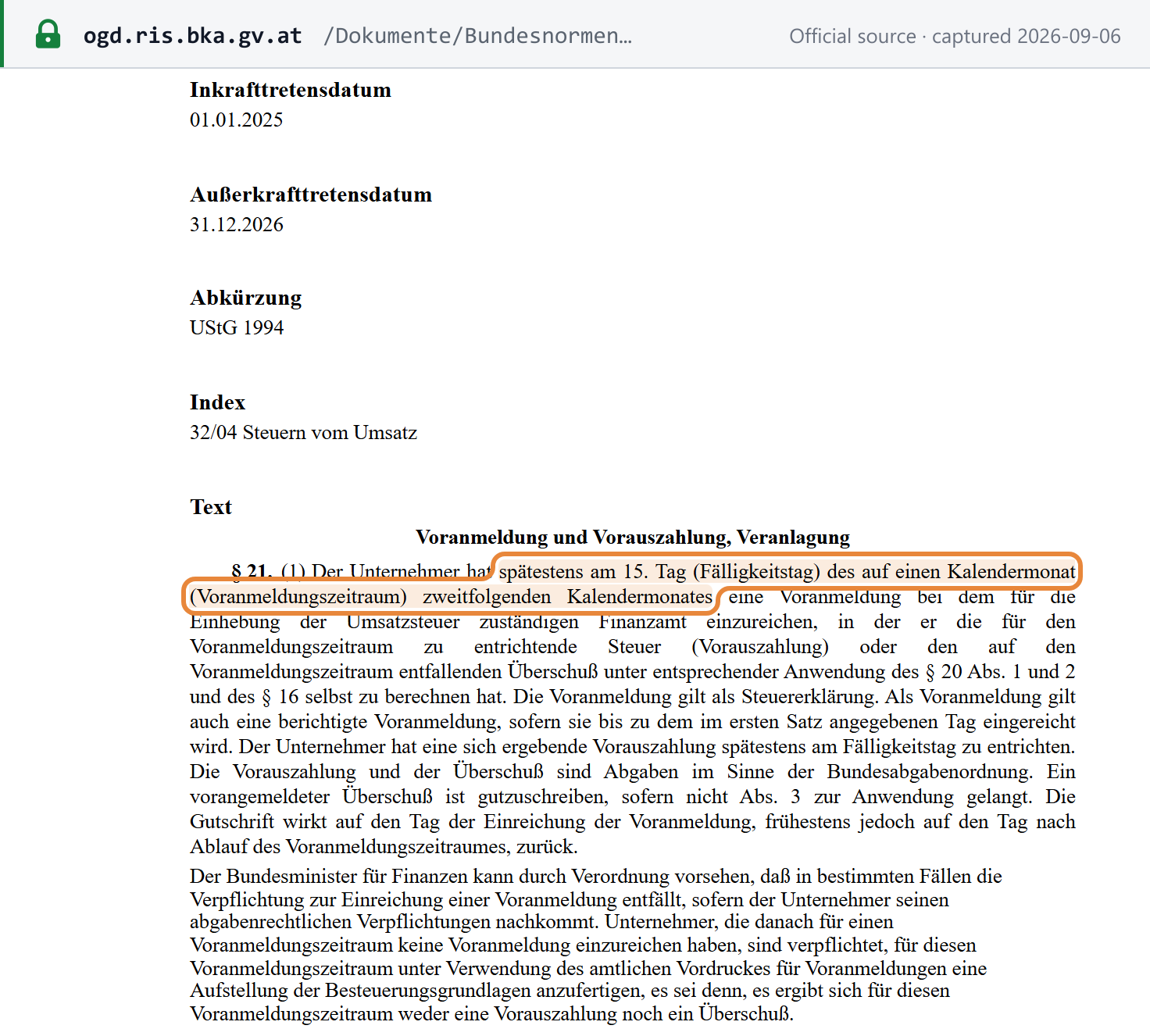
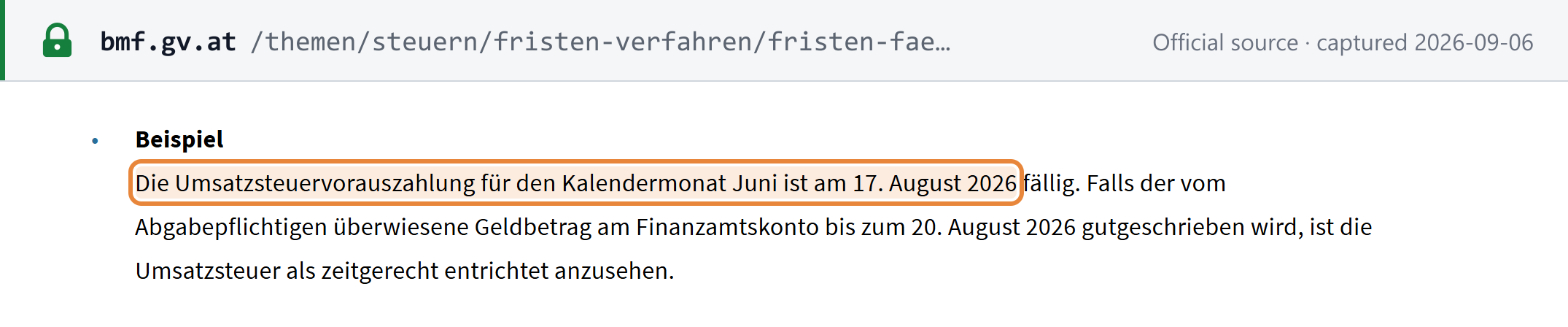
Both the return and the payment are due by the 15th of the second calendar month following the return period: "Der Unternehmer hat spätestens am 15. Tag (Fälligkeitstag) des auf einen Kalendermonat (Voranmeldungszeitraum) zweitfolgenden Kalendermonates eine Voranmeldung... einzureichen." BMF's own worked example: the advance payment for the calendar month of June is due on 15 August, shown in its 2026 illustration as falling due on 17 August once the weekend/holiday shift below is applied. [15] [16]
 Source snapshot captured 2026-09-06 — original
Weekend and holiday deadline shift
Where a filing or payment deadline falls on a Saturday, Sunday, statutory public holiday, Good Friday, or 24 December, it moves to the next day that is none of those — BAO § 108 Abs. 3 for filing deadlines and § 210 Abs. 3 for payment due dates (excluding import/export duties). Good Friday has not been a statutory public holiday since it was repealed from the holiday list by BGBl. I Nr. 22/2019 following the ECJ's Cresco Investigation ruling — yet it still moves a tax deadline, a genuine trap for anyone relying on a generic Austrian holiday calendar. § 211 Abs. 2 gives payments a further three-day grace tolerance: late but without legal consequence, though the due date itself does not move. [17] [18]
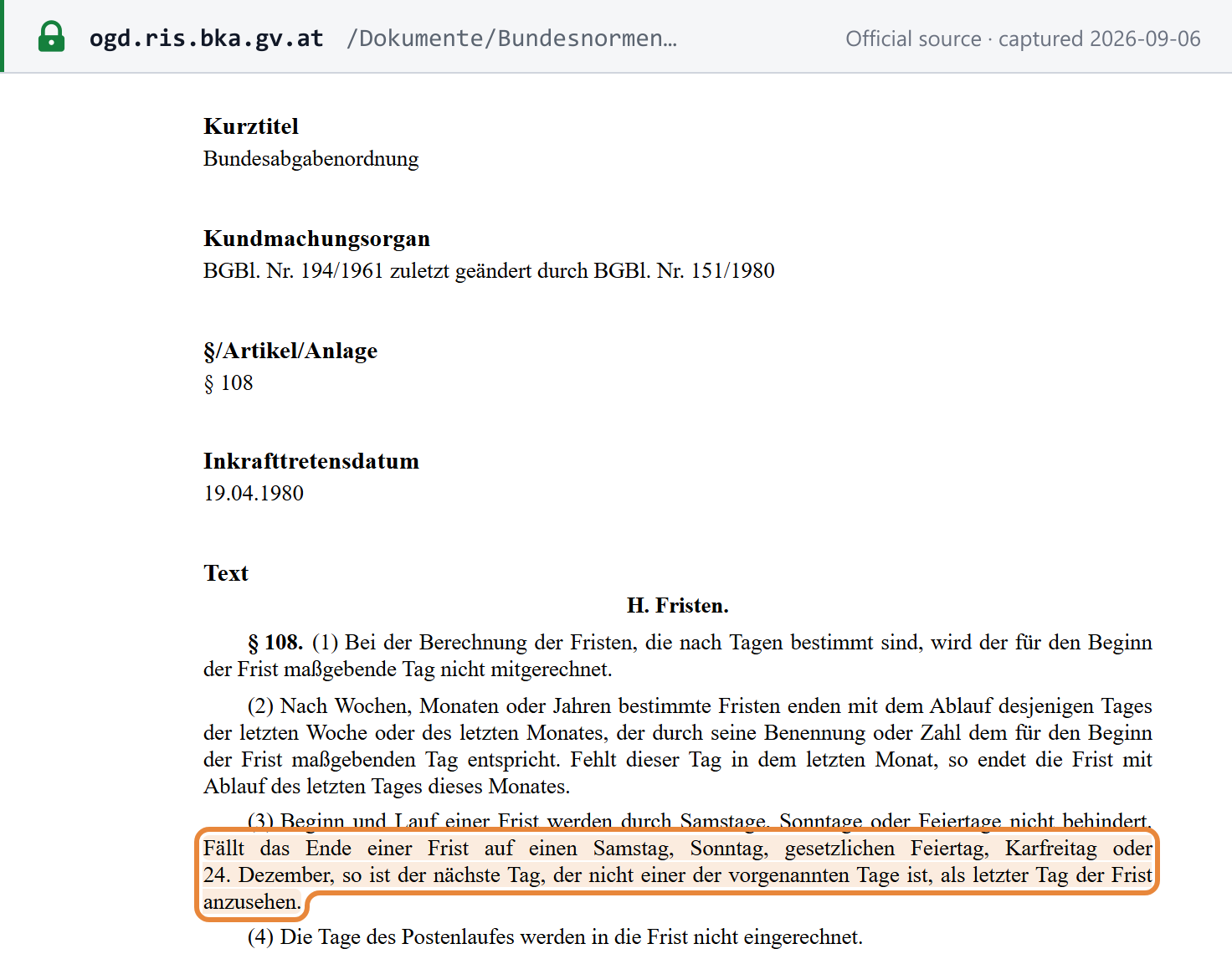 Source snapshot captured 2026-09-06 — original
Annual return
Standard deadline: end of April of the following year, or end of June where filed electronically (BAO § 134 Abs. 1). Where a professional tax adviser represents the taxpayer, the automated quota arrangement (Quotenregelung, BAO § 134a) pushes the deadline to 31 March of the second calendar year following the assessment period — so the 2025 return is due 31 March 2027 — and, where this applies, the ordinary § 134/135 dates fall away entirely for that taxpayer. The tax office may further extend to 30 June for an adviser's whole client portfolio. [19] [20]
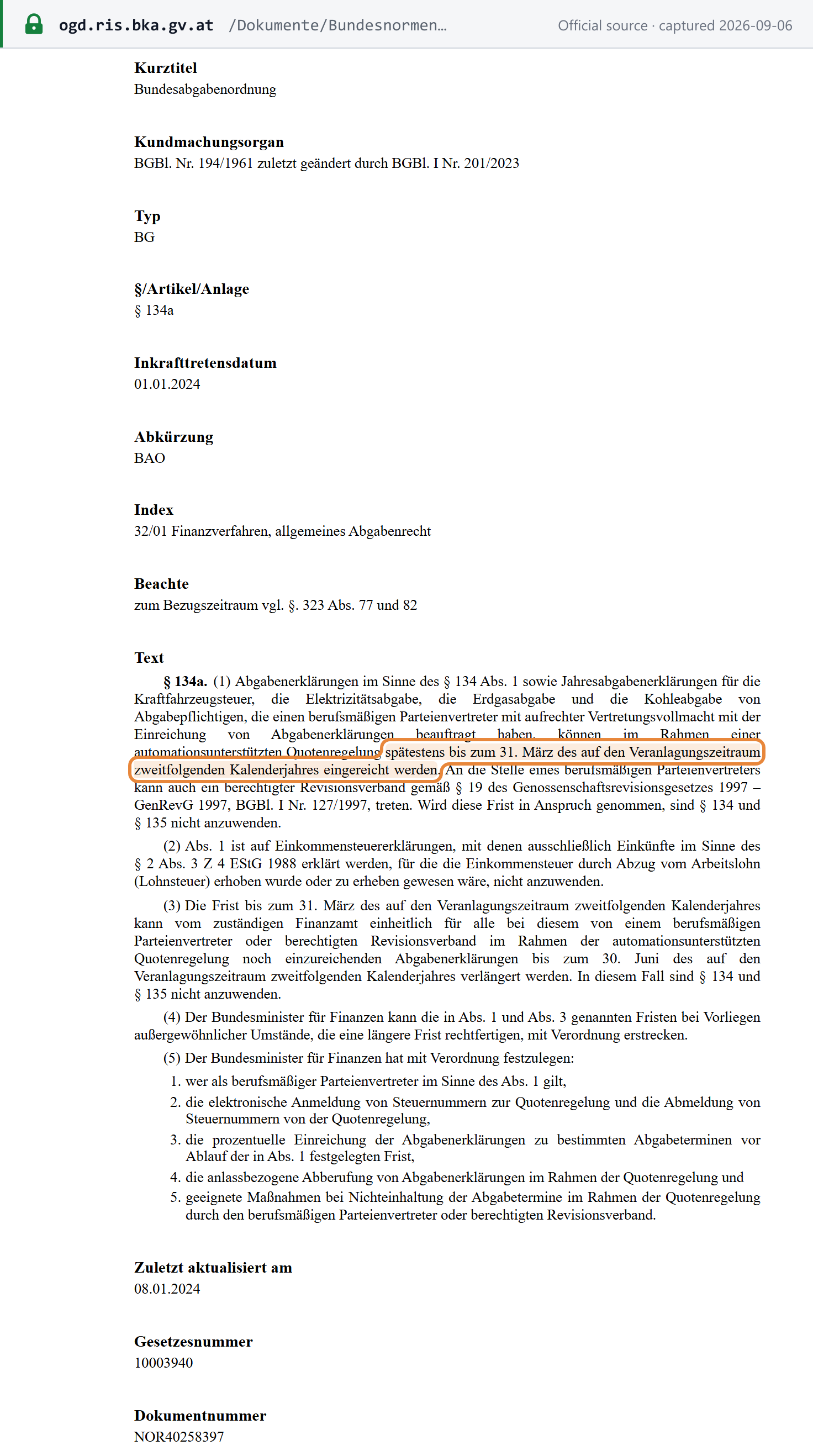 Source snapshot captured 2026-09-06 — original
Additional listings — recapitulative statement and OSS
The Zusammenfassende Meldung (ZM) — the EC sales list — is due by the end of the month following the reporting period; quarterly UVA filers follow their advance-return period for the ZM too (UStG 1994 Anhang (Binnenmarkt) Art. 21 Abs. 3). [21] OSS (One Stop Shop) returns and payment are due by the last day of the month following the reporting period, which is the calendar quarter (UStG Art. 25a Abs. 3). [22]
Input-tax recovery and blocked items
Passenger cars with a combustion engine (Personenkraftwagen) are commonly reported as subject to a blanket input-tax block under § 12 Abs. 2 Z 2 lit. b UStG — no input VAT recoverable on acquisition, lease instalments or running costs — with exceptions for driving-school vehicles, demonstration vehicles, vehicles held exclusively for commercial resale, vehicles used at least 80% for commercial passenger transport or rental, and vehicles with 0 g/km CO2 emissions (battery-electric vehicles are carved back out of the block). Business entertainment expenses without a predominantly advertising purpose (Repräsentationsaufwendungen), gifts and invitations are also commonly reported as excluded from input-tax recovery. The legal basis here rests on secondary tax-advisory synthesis rather than an independently fetched USP or RIS page — confirm directly before relying on edge cases.
Refunds
Not covered here. No official source was identified for the resident credit/refund timing mechanism or Austria's non-resident VAT refund route (the EU's 13th-Directive-equivalent process for non-EU claimants). Flagged here as a genuine gap rather than written around.
Exemptions
Exempt supplies
The UStG 1994's exemption catalogue (§ 6 Abs. 1) follows the EU-harmonised categories under the VAT Directive — commonly including financial and insurance services, real estate transactions and leasing (with an option to tax available under § 6 Abs. 2), medical and hospital services, education, and small-scale cultural and charitable activities among them. The full § 6 list is not reproduced here from an official source; treat the category headings above as directionally correct pending a fresh citation.
Exempt is not zero-rated
An exempt supply carries no VAT charged and no input-tax recovery on the costs used to make it — a structurally different (and less favourable) position than a zero-rated supply, which is still a taxable supply and keeps full input-tax recovery.
Special regimes
The Kleinunternehmer small-business exemption is covered in full under Registration — it is not repeated here. Other Austrian special regimes are not covered here (cash accounting, margin schemes, sector-specific rules); flagged as a gap rather than assumed.
Offences and penalties
Offences
Intentional tax evasion (Abgabenhinterziehung, § 33 FinStrG) — including intentional breach of UVA disclosure and truthfulness obligations under § 21 UStG — is punishable by a fine of up to 200% (double) the evaded tax amount: "bis zum Doppelten des hinterzogenen Steuerbetrages." [23] This guide's sources gave contradictory imprisonment figures for judicially prosecuted cases — one official BMF page states up to 4 years alongside up to 3 months' substitute imprisonment for non-payment of an administrative fine, while a separate secondary source cited up to 2 years — and this page could not reconcile the discrepancy (it may reflect a split between the administrative Finanzstrafbehörde and the criminal courts, gated by a value threshold that was not confirmed). No imprisonment term is stated on this page pending that reconciliation; the 200% fine figure above is solid and independently sourced. This guide also did not locate a distinct official enumeration of conduct-based offences (failure to register, failure to issue a compliant invoice, false invoicing) separate from the § 33 FinStrG evasion provisions and the BAO surcharges below — flagged as a gap for further research.
For judicially prosecuted Abgabenhinterziehung under § 33 FinStrG the custodial maximum is up to four years. An apparent two-year figure in circulation is the pre-2019 law: BGBl I 2019/62 raised the maximum from two years to four with effect from 23 July 2019, so the lower number is superseded rather than an alternative reading. In administrative (non-judicial) proceedings, substitute imprisonment for non-payment of a fine is capped at three months. [BMF]
Penalties
Late payment (Säumniszuschlag, BAO § 217). A first surcharge of 2% of the unpaid amount applies from the day after the due date: "Der erste Säumniszuschlag beträgt 2% des nicht zeitgerecht entrichteten Abgabenbetrages." A second and third surcharge of 1% each apply if the amount remains unpaid more than three months after becoming enforceable, and again three months after the second surcharge obligation arose — a maximum total exposure of 4%. No first surcharge is levied if the delay is five days or less and the taxpayer had no arrears anywhere in the preceding six months (the "Respirofrist," § 217 Abs. 5). [24]
Late filing (Verspätungszuschlag, BAO § 135). Reported as up to 10% of the assessed tax where the filing delay is inexcusable, with surcharges below €50 not imposed. This figure is corroborated through secondary legal-database mirrors of the RIS text rather than an independently fetched RIS page — treat as high-confidence but not independently verified.
Fiscal representative for non-EU-established businesses
A non-EU-established entrepreneur making taxable Austrian supplies must appoint a fiscal representative established in Austria (§ 27 UStG 1994), unless the recipient bears liability instead under § 27 Abs. 4, or Austria has a mutual-assistance agreement with the entrepreneur's home state comparable in scope to EU Directives 2010/24/EU and 2011/16/EU. Authorised fiscal representatives are Wirtschaftstreuhänder (tax/business advisers), Rechtsanwälte (lawyers) and Notare (notaries) established in Austria, plus freight forwarders (Spediteure): "Zugelassene Fiskalvertreter sind Wirtschaftstreuhänder, Rechtsanwälte und Notare mit Wohnsitz oder Sitz im Inland sowie Spediteure." Any other Austria-established entrepreneur may be approved by the Graz-Stadt tax office on application. Under § 27 Abs. 4, where a non-resident supplies taxable services and the recipient (a public body or entrepreneur) fails to withhold or remit the VAT due, the recipient itself becomes liable for the resulting shortfall — "haftet er für den hiedurch entstehenden Steuerausfall." [25]
UID confirmation — Stufe 1 and Stufe 2
For the ATU number format itself, see Registration and Lookuptax's Austria tax ID guide. Austria's UID-Bestätigungsverfahren (VAT-number confirmation procedure) runs at two levels: Stufe 1 confirms only that a UID issued by another member state is currently valid — "Hier wird lediglich die Gültigkeit einer von einem anderen Mitgliedstaat vergebenen UID-Nummer überprüft." Stufe 2 additionally confirms that UID against a specific counterparty name and address, recommended for new business relationships or where the accuracy of stated details is in doubt — "meist nur dann sinnvoll, wenn Zweifel an der Richtigkeit der Angaben... bestehen oder wenn mit einer Geschäftspartnerin/einem Geschäftspartner erstmals Geschäftsbeziehungen aufgenommen werden." For Austrian businesses the query runs through FinanzOnline; the EU-side equivalent is VIES. [26]
Frequently asked questions
The Kleinunternehmer threshold changed to €55,000 — is that measured gross or net, and what happens if I go over by a little?
It counts the full agreed consideration (USP: "es ist das gesamte vereinbarte Entgelt zu berücksichtigen"; § 6 Abs. 1 Z 27 UStG), and the tolerance band is what catches most businesses at the boundary. Since 1 January 2025 the Kleinunternehmer exemption threshold is €55,000 in annual turnover, up from €35,000, under § 6 Abs. 1 Z 27 UStG 1994 as rebuilt by the Abgabenänderungsgesetz 2024 (BGBl. I Nr. 113/2024), with the €55,000 figure set by the Progressionsabgeltungsgesetz 2025 (BGBl. I Nr. 144/2024). USP's own guidance states it directly — the exemption applies where the threshold was neither exceeded in the previous nor the current calendar year, and critically, "es ist das gesamte vereinbarte Entgelt zu berücksichtigen" — the full agreed consideration counts, with no notional VAT stripped out first, unlike the pre-2025 net-based test. A 10% tolerance band then decides what happens on breach: exceed €55,000 by 10% or less (up to €60,500) in a calendar year and the exemption survives through the end of that year but is lost from 1 January of the next; exceed it by more than 10% and the exemption falls away retroactively — from the transaction that crossed the line and for every transaction after it in that same year. [2]

I'm an EU business below both thresholds — can I sell into Austria without an Austrian UID?
Yes, since 1 January 2025 — but two separate caps have to hold at once, and they aren't the same figure as the Austrian domestic threshold. A business established in another EU member state may apply Austria's small-business exemption to its Austrian sales without registering for a full Austrian UID, provided its Austrian turnover does not exceed €55,000 in the current or prior year and its total EU-wide turnover does not exceed €100,000 in the current or prior year. The mechanism runs through your home member state, not Austria: you notify your own tax authority first, and it issues an SME identification number carrying the suffix "-EX" — the Austrian exemption is valid only once that number has actually issued, not from the date you apply. [3]
My business is physically located in Jungholz — why does my invoice show 19% instead of Austria's 20%?
Because Jungholz and Mittelberg are treated as part of the German VAT customs area, not because of an error. Both are Alpine enclaves — Jungholz in Tyrol, Mittelberg within the Kleinwalsertal in Vorarlberg — practically reachable only through German territory, and § 10 Abs. 4 UStG 1994 responds by reducing the rate to 19% for supplies made there by a business with its seat, habitual abode or a business establishment in one of the two enclaves. That 19% tracks Germany's own unchanged standard rate — it is Austria applying Germany's rate inside German customs territory, not a discount off Austria's 20%. Austria's reduced rates of 10% and 13% still apply as normal inside the enclaves; Germany's reduced rate of 7% does not travel into Jungholz or Mittelberg. One carve-out reverses the whole mechanism: vehicle sales and rentals revert to the ordinary 20% wherever the buyer or lessee is established elsewhere in Austria. [7]
I'm a subcontractor on an Austrian construction site — do I charge VAT on my invoice to the main contractor?
Usually not — the recipient accounts for it, not you. Under § 19 Abs. 1a UStG 1994, construction services (Bauleistungen) shift VAT liability to the recipient wherever the recipient either was itself commissioned to provide construction services on the same job, or itself typically supplies construction services as a matter of course. Official guidance runs a three-year turnover average to decide the second limb: construction turnover exceeding 50% of that three-year average puts the recipient on the hook. Where it applies, you invoice net of VAT, show both parties' UID numbers, and print the statutory notice — "Steuerschuldnerschaft des Leistungsempfängers (§ 19 Abs. 1a UStG)" — rather than charging VAT yourself. [10] [11]
Austria has an e-invoicing mandate — does that mean I need to issue structured B2B e-invoices to my customers now?
No — and this is the most common misreading of Austria's e-invoicing rules. Austria has required electronic invoicing to federal government bodies since 1 January 2014, through the e-Rechnung.gv.at portal, in ebInterface or Peppol BIS Billing 3.0 format — and that obligation extends, to the extent technically feasible, even to foreign contractors invoicing federal agencies directly. None of that is a B2B mandate. As of this guide's update date, Austria has not adopted implementing legislation requiring structured e-invoices between ordinary businesses. Advisory commentary expects a future Peppol-based B2B proposal aligned with the EU's ViDA timetable, but published timing estimates range widely and none of it is enacted Austrian law — see Lookuptax's ViDA guide for the directive-level milestones that any future mandate would sit inside. [14]
My June VAT falls due when exactly, and does Good Friday push Austrian tax deadlines even though it isn't a public holiday?
The 15th of the second calendar month after the period — so June's advance return and payment both fall due on 15 August, moved to 17 August in BMF's own 2026 worked example. § 21 Abs. 1 UStG 1994 sets the general monthly rule; businesses whose turnover did not exceed €100,000 in the prior calendar year file quarterly instead under the same paragraph. On the shift itself: yes, Good Friday moves an Austrian tax deadline even though it has not been a statutory public holiday since BGBl. I Nr. 22/2019 repealed it following the ECJ's Cresco Investigation ruling. BAO § 108 Abs. 3 (filing) and § 210 Abs. 3 (payment) both move a deadline landing on a Saturday, Sunday, statutory public holiday, Good Friday or 24 December forward to the next day that is none of those — wider than Austria's actual public-holiday list. § 211 Abs. 2 layers on a further three-day grace tolerance for payments. [15] [16] [17]
I'm a US company selling into Austria — do I need to appoint a fiscal representative?
In most cases, yes. § 27 UStG 1994 requires a non-EU-established entrepreneur making taxable Austrian supplies to appoint a fiscal representative established in Austria, unless the recipient bears the liability instead under § 27 Abs. 4, or Austria has a mutual-assistance agreement with your home state comparable in scope to the EU's own Directives 2010/24/EU and 2011/16/EU. Eligible representatives are narrow by design: Wirtschaftstreuhänder (tax and business advisers), Rechtsanwälte (lawyers) and Notare (notaries) established in Austria, plus freight forwarders (Spediteure); any other Austria-established entrepreneur can apply to the Graz-Stadt tax office for individual approval. The stakes for getting this wrong sit with the other side of the transaction too: where a non-resident supplies taxable services and the recipient fails to withhold and remit the VAT due, the recipient itself becomes liable for the shortfall. [25]
Important websites
| Site | Purpose |
|---|---|
| FinanzOnline | Registration, UVA filing, payment and UID-Bestätigungsverfahren queries |
| USP — Unternehmensserviceportal | Official business/tax guidance for registration, thresholds and cross-border rules |
| BMF — Bundesministerium für Finanzen | Tax authority policy, forms and rate guidance |
| e-Rechnung.gv.at | Austria's B2G e-invoicing portal |
| RIS — Rechtsinformationssystem des Bundes | Consolidated Austrian legislation (UStG, BAO) |
| Firmenbuch via JustizOnline | Austrian commercial register lookup |
| EU VIES VAT number validation | Cross-border UID confirmation |
Also see Lookuptax's own Austria UID validator.
Recent changes
- 2026-10-01 — Under § 132a BAO, the electronic receipt for a cash payment recorded in a cash register may be provided either by sending it into the recipient's immediate sphere of control (for example by e-mail or app) or by letting the recipient read it on site with a device (for example a QR code on screen). The receipt-issuance obligation continues regardless of amount, and the customer or a tax authority official keeps the right to a paper receipt, which may be requested up to the end of business on the day of the transaction. (BMF; BMF press release, 29 September 2026) — see the event record
- 2026-07-01 — Where the tax on an intra-Community acquisition is calculated and paid by a Parteienvertreter under § 11(5) NoVAG 1991, the acquirer's tax declaration may be omitted (new second subparagraph of Art. 21 para. 2 of the UStG 1994 Annex, Binnenmarktregelung, via Art. 2 of the Budgetmaßnahmengesetz 2026, BGBl. I Nr. 43/2026); it applies to supplies and other events after 30 June 2026. (Rechtsinformationssystem des Bundes) — see the event record
- 2026-07-01 — A new 4.9% super-reduced VAT rate took effect on specified staple foods — bread, butter, eggs, milk, rice, wheat flour and semolina, most fresh and frozen vegetables, apples, pears and stone fruit (CN 0808/0809), yoghurt, table salt, and plain pasta — down from 10%. Hospitality supplies are excluded. Confirmed by the Bundesrat on 3 June 2026. (Parlament Österreich) — see the event record
- 2025-01-01 — The Kleinunternehmer threshold rose to €55,000 (from €35,000 net), counting the full agreed consideration, measured without stripping out notional VAT, under § 6 Abs. 1 Z 27 UStG 1994 as rebuilt by the Abgabenänderungsgesetz 2024 (BGBl. I Nr. 113/2024), with the €55,000 figure set by the Progressionsabgeltungsgesetz 2025 (BGBl. I Nr. 144/2024); the same date extended the EU cross-border SME scheme to Austrian sales by EU-established businesses under the dual €55,000 / €100,000 caps. (USP)
Ahead — scheduled changes that have not yet taken effect:
- 2027-01-01 (scheduled) — The offices of the Federal Finance Administration (Ämter der Bundesfinanzverwaltung) gain the power to order mandatory collection of import VAT for up to two years where a financial offence under § 80 FinStrG is suspected in connection with an import, under the amended § 26 Abs. 3 Z 2 UStG 1994 (Budgetbegleitgesetz 2027-2028, BGBl. I Nr. 62/2026, published 29 July 2026). (Rechtsinformationssystem des Bundes) — see the event record
- 2026-10-01 — A new EUR 2 parcel delivery tax applies per parcel on domestic deliveries made in the course of distance sales of goods, for distance sellers with Austrian distance-sales revenue exceeding EUR 100 million in the previous year (marketplaces liable under the Paketsteuergesetz's own deemed-supplier rule), under the Paketsteuergesetz (Budgetbegleitgesetz 2027-2028, BGBl. I Nr. 62/2026). (BMF) — see event and issue
Reference links
- USP — Umsatzsteuerpflicht (VAT liability overview)
- USP — Kleinunternehmer (small-business exemption)
- USP — Kleinunternehmerbefreiung für EU-Unternehmen (EU cross-border SME scheme)
- USP (EN) — Umsatzsteuer-Identifikationsnummer (UID registration for foreign businesses)
- USP — UID-Bestätigungsverfahren (Stufe 1 / Stufe 2 VAT-number confirmation)
- USP — Betriebsauflösung Einzelunternehmen (deregistration)
- USP — Steuersätze und Steuerbefreiungen der Umsatzsteuer (rates)
- Parlament Österreich — 4.9% super-reduced rate, Bundesrat confirmation
- USP — Reverse Charge
- BMF — Bauleistungen und Reverse Charge
- USP — Aufzeichnungspflichten für Plattformen (platform deemed-supplier rules)
- Rechtsinformationssystem des Bundes (RIS) — § 10 UStG 1994 (rates incl. Jungholz/Mittelberg)
- RIS — § 11 UStG 1994 (invoice requirements)
- RIS — § 21 UStG 1994 (advance returns, UVA)
- RIS — BAO § 108 (filing-deadline shift)
- RIS — BAO § 211 (payment grace tolerance)
- RIS — BAO § 134 (annual return)
- RIS — BAO § 134a (Quotenregelung)
- RIS — UStG 1994 Anhang (Binnenmarkt) Art. 21 (recapitulative statement)
- RIS — UStG 1994 Art. 25a (OSS)
- RIS — BAO § 217 (Säumniszuschlag)
- BMF — Höhe der Strafen (financial-offence penalties)
- RIS — § 27 UStG 1994 (fiscal representative)
- RIS — BGBl. I Nr. 62/2026 (mandatory import VAT collection, from 2027)
- BMF — Parcel Delivery Tax: Overview and FAQs
- BMF — Fristen und Fälligkeiten
- e-Rechnung.gv.at — Legal basis
- Lookuptax — Austria Tax ID & UID Number Guide
- Lookuptax — How to verify a VAT number via VIES (EU-wide)
- Lookuptax — ViDA, VAT in the Digital Age, explained
- Lookuptax — E-invoicing status and the networks worldwide