Luxembourg VAT guidelines
| FACTSHEET | |
|---|---|
| Country code | LU |
| Tax name | Value Added Tax (VAT) — taxe sur la valeur ajoutée (TVA) |
| Tax Authority | Administration de l'enregistrement, des domaines et de la TVA (AED) |
Overview
Luxembourg levies value added tax — in French, the taxe sur la valeur ajoutée (TVA) — under the amended law of 12 February 1979 (the "VAT law"). It is administered by the Administration de l'enregistrement, des domaines et de la TVA (AED). The AED describes the tax this way: « La taxe sur la valeur ajoutée (TVA) est un impôt sur le chiffre d'affaires. L'assujetti à la TVA, qui doit préalablement s'immatriculer à la TVA auprès de l'Administration de l'enregistrement, des domaines et de la TVA (AED), facture à ses clients un impôt proportionnel au prix des biens qu'il leur vend et des services qu'il leur preste. » ("VAT is a tax on turnover. The taxable person, who must first register with the AED, charges customers a tax proportional to the price of the goods and services supplied.") [2]
Currency. All amounts in this guide are in euros (EUR). VAT returns are filed in euros. [9]
Tax year and periods. The tax period for the annual return is the calendar year — art. 64(7) speaks of « chaque période d'imposition qui correspond à l'année civile » ("each tax period corresponding to the calendar year"). Monthly or quarterly returns are filed inside it; see Filing and payment. [1]
Layering. VAT is a single national tax. The VAT law sets no regional or municipal rate (checked 2026-09-23). [1]
A note on the law text. Article references on this page come from the AED's consolidated text of the VAT law as at 1 January 2026 (« Texte coordonné — 1er janvier 2026 »). The AED warns that this text is for information: « Le présent texte coordonné, élaboré par l'Administration de l'enregistrement, des domaines et de la TVA, n'est pas opposable à l'administration. Seuls font foi les textes légaux et réglementaires publiés au Journal Officiel » ("This coordinated text cannot be relied on against the administration. Only the legal texts published in the Journal Officiel are authoritative"). The text records the law as last amended by the law of 20 December 2024. [1]
Registration
Who should register
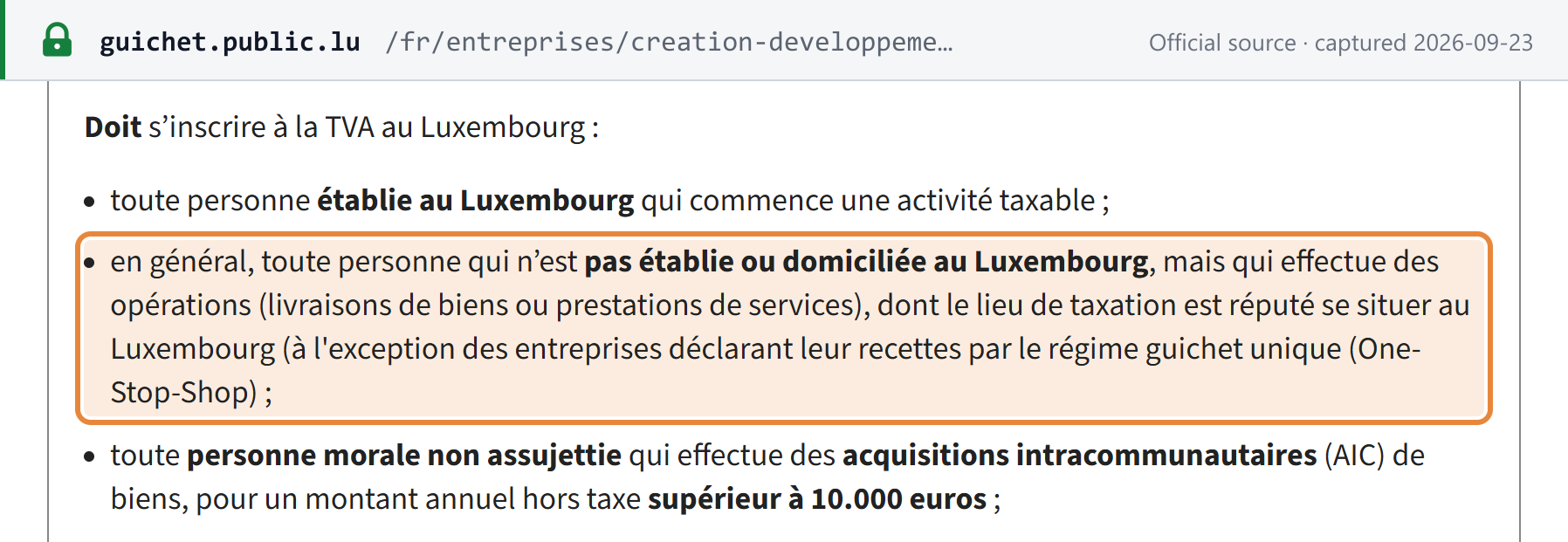
Liability follows from being a taxable person (assujetti): anyone carrying on an economic activity independently and on a habitual basis. Guichet.lu, the State's business portal, sets out who must register (page last modified 23 January 2025): [5]
« Doit s'inscrire à la TVA au Luxembourg : toute personne établie au Luxembourg qui commence une activité taxable ; en général, toute personne qui n'est pas établie ou domiciliée au Luxembourg, mais qui effectue des opérations (livraisons de biens ou prestations de services), dont le lieu de taxation est réputé se situer au Luxembourg (à l'exception des entreprises déclarant leur recettes par le régime guichet unique (One-Stop-Shop) … »
In English: anyone established in Luxembourg who starts a taxable activity must register, and so, in general, must anyone not established in Luxembourg whose supplies of goods or services are taxed in Luxembourg — unless they declare those supplies through the One-Stop-Shop. The same list catches a non-taxable legal person whose intra-EU acquisitions exceed EUR 10,000 a year, and a business making only non-deductible supplies that receives services from abroad on which it owes the tax. The statutory duty to declare the start, change and end of activity is art. 62(1) of the VAT law. [1]
Registration threshold
| Rule | Amount | Measured over | Who it applies to |
|---|---|---|---|
| Small-business franchise (art. 57bis) | EUR 50,000 since 1 January 2025 (was EUR 35,000) | Annual Luxembourg turnover, calendar year | Businesses established in Luxembourg |
| Franchise tolerance (art. 57bis(6)) | Up to EUR 55,000 (10% over EUR 50,000) | The calendar year in which the threshold is crossed | See below |
| Inbound cross-border SME scheme (art. 57ter) | Luxembourg turnover not over EUR 50,000 and EU-wide turnover not over EUR 100,000 | Calendar year | Businesses established in another Member State and identified there for the scheme (an "EX" number) |
| Outbound cross-border SME scheme (art. 57quater) | EUR 100,000 EU-wide turnover, plus the other State's own threshold | Calendar year | Luxembourg businesses using another Member State's franchise |
| Non-established businesses | None | — | Non-EU businesses, and EU businesses outside the cross-border SME scheme — see Non-resident registration |
| Intra-EU acquisitions (art. 2(2)(b)) | EUR 10,000 | Annual, excluding VAT | Non-taxable legal persons, and taxable persons with no right of deduction (exempt-only businesses, franchise businesses, flat-rate farmers) |
Figures as at 23 September 2026. [1] [6]
The franchise is an exemption, not a registration threshold. Art. 57bis(1): « Sont exonérées de la taxe sur la valeur ajoutée les livraisons de biens et les prestations de services effectuées à l'intérieur du pays par un assujetti établi au Grand-Duché de Luxembourg dont le chiffre d'affaires annuel au Grand-Duché de Luxembourg n'excède pas le seuil de 50 000 euros. » ("Supplies of goods and services within the country by a taxable person established in Luxembourg whose annual Luxembourg turnover does not exceed EUR 50,000 are exempt from VAT.") The law of 20 December 2024 raised the threshold from EUR 35,000 with effect from 1 January 2025. [1] [31]

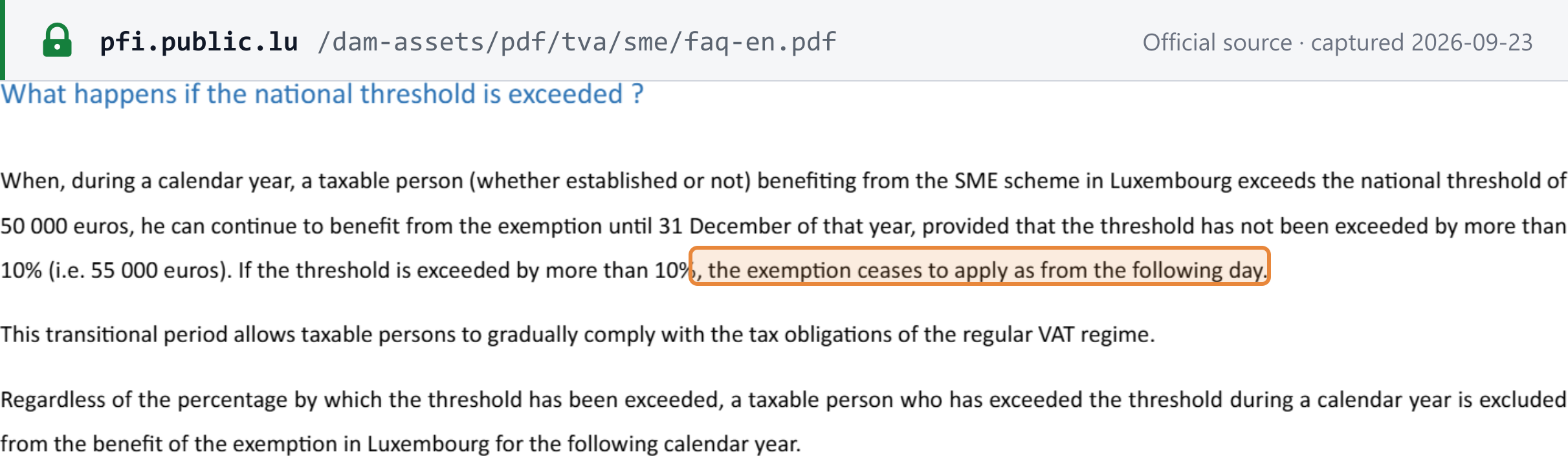
Crossing the threshold. Art. 57bis(6) sets the rule. Its first subparagraph bars the franchise for a year after any overrun: « L'assujetti ne peut pas bénéficier de la franchise … pendant une période d'une année civile lorsque le seuil … a été dépassé au cours de l'année civile précédente. » ("The taxable person cannot benefit from the franchise … for one calendar year where the threshold … was exceeded in the previous calendar year.") The next subparagraph deals with the year of the overrun: « Lorsqu'au cours d'une année civile, le seuil prévu au paragraphe 1er est dépassé : a) de 10 pour cent au maximum, l'assujetti peut continuer de bénéficier de la franchise … pendant cette année civile ; b) de plus de 10 pour cent, la franchise … cesse de s'appliquer à partir du premier jour qui suit celui au cours duquel le seuil est dépassé. » [1]
- Turnover up to EUR 55,000 (over by 10% or less) — the franchise continues until the end of that calendar year.
- Turnover above EUR 55,000 (over by more than 10%) — the franchise stops from the next day. The AED's SME FAQ: "If the threshold is exceeded by more than 10%, the exemption ceases to apply as from the following day." Its example: turnover reaches EUR 56,000 on 8 September 2025, and the business is outside the franchise from 9 September 2025. VAT applies from then on; it does not wait for 31 December. [39]
- The following calendar year — in both cases, the business cannot use the franchise for the next calendar year (art. 57bis(6), first subparagraph). [1]
What a franchise business still has to do. It cannot deduct input VAT or show VAT on its invoices. Its invoices must carry the legend « TVA non applicable – Article 57bis de la loi modifiée du 12 février 1979 » (art. 57bis(5)). And it must report its turnover every year: « Avant le premier mars de l'année civile, l'assujetti soumis au seul régime de franchise national informe l'administration, par écrit, du montant du chiffre d'affaires annuel au Grand-Duché de Luxembourg réalisé au cours de l'année civile précédente. » ("Before 1 March, a business under the national franchise only must tell the AED in writing its Luxembourg turnover for the previous calendar year" — art. 57bis(4).) The franchise covers only its own supplies in Luxembourg. A franchise business that owes VAT as a customer — for example on goods or services bought from abroad — or that supplies services taxable in another Member State must still register and declare those transactions. [1] [5]
Using another Member State's franchise. Projet de loi n° 8812 would amend the franchise rules from 2027 if adopted — see Pending bill: Projet de loi 8812. As the law stands, a Luxembourg small business can register with the AED, through MyGuichet.lu, for the cross-border SME scheme. The AED's conditions: it stays under the other State's national threshold, and its turnover in all Member States stays under EUR 100,000. It then files no returns in those States, but it must report its turnover in each Member State to the AED quarterly. [6]
Non-resident registration
For a business established outside the EU, and for an EU business outside the cross-border SME scheme, there is no registration threshold. The registration rule quoted above has no amount in it: such a business must register as soon as it makes a supply taxed in Luxembourg for which it is the person liable. The national EUR 50,000 franchise does not help, because art. 57bis(1) grants it only to a taxable person « établi au Grand-Duché de Luxembourg » — established in Luxembourg.
The exception: EU small businesses in the cross-border SME scheme (art. 57ter). A business established in another Member State, identified there for the scheme (with an "EX" number), whose Luxembourg turnover does not exceed EUR 50,000 and whose EU-wide turnover does not exceed EUR 100,000, is exempt in Luxembourg and « pas tenu d'être identifié à la TVA conformément à l'article 62 » — not required to register for VAT in Luxembourg — provided it « n'effectue pas d'acquisitions intracommunautaires imposables à l'intérieur du pays » (makes no taxable intra-EU acquisitions in Luxembourg). Whether a foreign business is "the person liable" depends on who the customer is — see Foreign companies selling into Luxembourg. [1] [5]
Businesses with a registered office elsewhere in the EU are handled by one tax office: « les assujettis ayant une activité économique au Luxembourg et dont le siège social se trouve en dehors du Luxembourg, mais à l'intérieur de l'UE, sont immatriculés auprès du bureau d'imposition Luxembourg 10. » [5]
Guarantees and fiscal representatives. A person liable for the tax that is established outside the EU may be required by the AED to lodge a deposit or bank guarantee, within one month of the AED's request (art. 66). A fiscal representative is possible only for imports by a business neither established nor identified in Luxembourg (art. 66bis). The representative must be established in Luxembourg and approved by the AED, and must lodge a guarantee of at least 50% of the net output tax of the last three monthly periods, with a floor of EUR 10,000. The represented business remains jointly and severally liable. There is no general requirement to appoint a fiscal representative to register. [1] [29]
Tax identification number
A registered business receives « un n° d'identification à la TVA composé d'un groupe identique et unique de 8 chiffres précédé des lettres "LU" » — a VAT number of LU followed by 8 digits. This is the number that goes on invoices (art. 63(8) 3°) and is used in intra-EU trade. [5]
Watch the second number. For dealings with the AED itself, the business uses a different identifier: « Pour les communications avec l'administration, l'assujetti utilise néanmoins le numéro de matricule national à 13 chiffres » ("For communications with the administration, the taxable person nevertheless uses the 13-digit national matricule"). VAT payments must quote the VAT matricule and the return period. [5] [11]
For the format of each Luxembourg identifier, see Lookuptax's Luxembourg tax ID guide. The AED publishes no national VAT-number lookup; its online-services page links the EU's VIES service instead. See how to verify an EU VAT number in VIES, or check a number with Lookuptax's Luxembourg VAT number validator. [30]
How to register
- File a déclaration initiale with the competent tax office, online through MyGuichet.lu or on the AED form.
- Deadline: « L'inscription à la TVA doit se faire : dans les 15 jours suivant le début de l'activité » — within 15 days of starting the activity.
- Bank account: in principle one must already be open (Luxembourg or foreign; IBAN and BIC).
- Documents: legal persons attach the constitutive deed in French or German and identification of the named partners or managers; natural persons attach identification.
- Filing frequency is set by the tax office — see Filing and payment.
- Timeline: the authority publishes no processing time. Guichet.lu says only that « Le bureau d'imposition compétent statuera sur la demande d'immatriculation du requérant » ("the competent tax office will decide on the application") (checked 2026-09-23).
Voluntary registration
Available. Guichet.lu lists who may register without being obliged to, including anyone who wants to waive the exemption on supplies and lettings of immovable property; a business that is wholly exempt without credit, or under the franchise or a flat-rate regime; a non-taxable legal person with intra-EU acquisitions below EUR 10,000 that wants them taxed in Luxembourg; an EU-established seller whose distance sales or services to Luxembourg consumers are below EUR 10,000 and who wants to apply Luxembourg VAT; and farmers and foresters leaving the flat-rate regime. A franchise business that opts into normal taxation is locked in « pendant au moins une année civile » — for at least one calendar year (art. 57bis(8)). [5] [1]
Deregistration
- Cessation declaration within 15 days. « En cas de cessation totale ou partielle de l'activité, une déclaration de cessation doit être envoyée dûment remplie et signée auprès du bureau d'imposition compétent dans les quinze jours de la cessation totale ou partielle. » [7]
- Final return within two months. A business that stops during the year files the return that stands in for the annual return « dans les deux mois de la cessation » — within two months of cessation (art. 64(7)). The duty to declare cessation is art. 62(6). [1]
Group registration
Available — the « groupe TVA » (art. 60ter). « Les personnes établies à l'intérieur du pays et étroitement liées entre elles sur les plans financier, économique et de l'organisation peuvent opter pour être considérées comme un assujetti unique, ci-après dénommé « groupe TVA ». » ("Persons established in Luxembourg and closely bound by financial, economic and organisational links may opt to be treated as a single taxable person.") [1]
- Members must be established in Luxembourg. Every eligible person must opt in; a person belongs to one group only.
- Participation lasts at least two calendar years (art. 60ter(4)).
- Transactions between members are treated as internal (art. 60ter(5)).
- The group cannot be combined with the small-business franchise or the farming flat-rate regime (art. 60ter(7)).
- Members are jointly and severally liable for the group's VAT, default interest, fines and costs (art. 60ter(22)).
- The financial link is certified by a réviseur d'entreprises or expert-comptable. An entity that meets the conditions later, or falls out, is declared within 15 days; a change of group representative within 3 working days. [8]
A VAT group is not the same thing as an independent group of persons (groupement autonome de personnes), which is a cost-sharing exemption between separate taxable persons — see Exemptions.
Rates
In force as at 2026-09-23: 17% standard, 14% intermediate, 8% reduced, 3% super-reduced. These rates have applied since 1 January 2024. Art. 39(3) of the VAT law: « Le taux normal de la taxe sur la valeur ajoutée applicable aux opérations imposables est fixé à dix-sept pour cent … Le taux réduit de la taxe est fixé à huit pour cent … Le taux super-réduit de la taxe est fixé à trois pour cent … Le taux intermédiaire de la taxe est fixé à quatorze pour cent de ladite base d'imposition. » [1] [3]
| Rate | Band | Examples (annex to the VAT law) | In force |
|---|---|---|---|
| 17% | Standard (taux normal) | All taxable supplies not listed below | Since 1 January 2024 |
| 14% | Intermediate (taux intermédiaire) — annex C | Wines of fresh grapes of 13° or less; solid mineral fuels and mineral oils; washing and cleaning preparations; advertising print and commercial catalogues; heat, cold and steam not supplied through a heating network; safekeeping and management of securities; management of credit and credit guarantees by someone other than the lender | Since 1 January 2024 |
| 8% | Reduced (taux réduit) — annex A | Gas for heating and lighting; electricity; heat from a heating network; firewood; live plants and flowers; hairdressing; repair of shoes, clothing and household appliances; cleaning of private homes; bicycles, including pedal-assisted, and their hire and repair; works of art, collectors' items and antiques | Since 1 January 2024 |
| 3% | Super-reduced (taux super-réduit) — annex B | Food (not alcoholic drinks); water supply; pharmaceutical products; books, newspapers and periodicals, printed or electronic; children's clothing and footwear; restaurant and catering services (not the alcohol element); passenger accommodation and transport; admission to cultural events; access to and use of sports installations; supply and installation of solar panels; the housing regime below | Unchanged throughout, including 2023 |
| Exempt with credit | — | Exports and intra-EU supplies (art. 43) — see Cross-border rules | — |
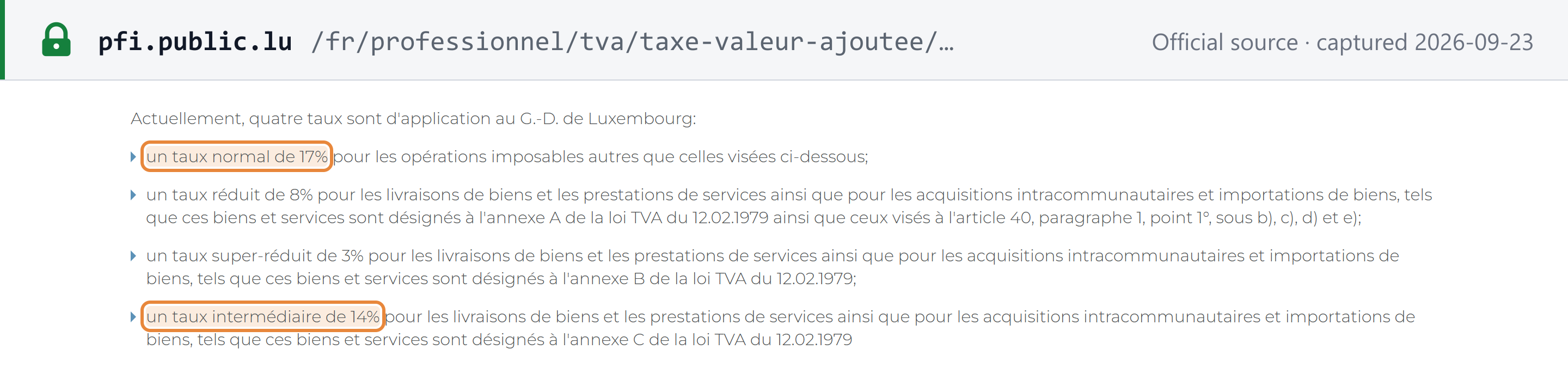
Why a financial-services invoice can carry 14%. Fund management is exempt (see Exemptions), but annex C taxes « 6° Garde et gestion de titres 7° Gestion de crédits et de garanties de crédits par une personne ou un organisme autre que ceux ayant accordé les crédits » ("safekeeping and management of securities; management of credit and credit guarantees by a person other than the lender") at the intermediate rate. Readers who assume finance is exempt end to end get this wrong. [1]
Housing at 3%. Creating or renovating a dwelling used as a main residence is taxed at 3%, either applied directly with the AED's prior approval or by a refund of the difference. The total advantage is capped: « Le montant total de la faveur fiscale ne peut pas excéder 50.000 euros par logement créé et/ou rénové. » — EUR 50,000 per dwelling, as at 2026-09-23. The AED's FAQ gives the same figure. [27] [28]
Expired: the 2023 temporary cut
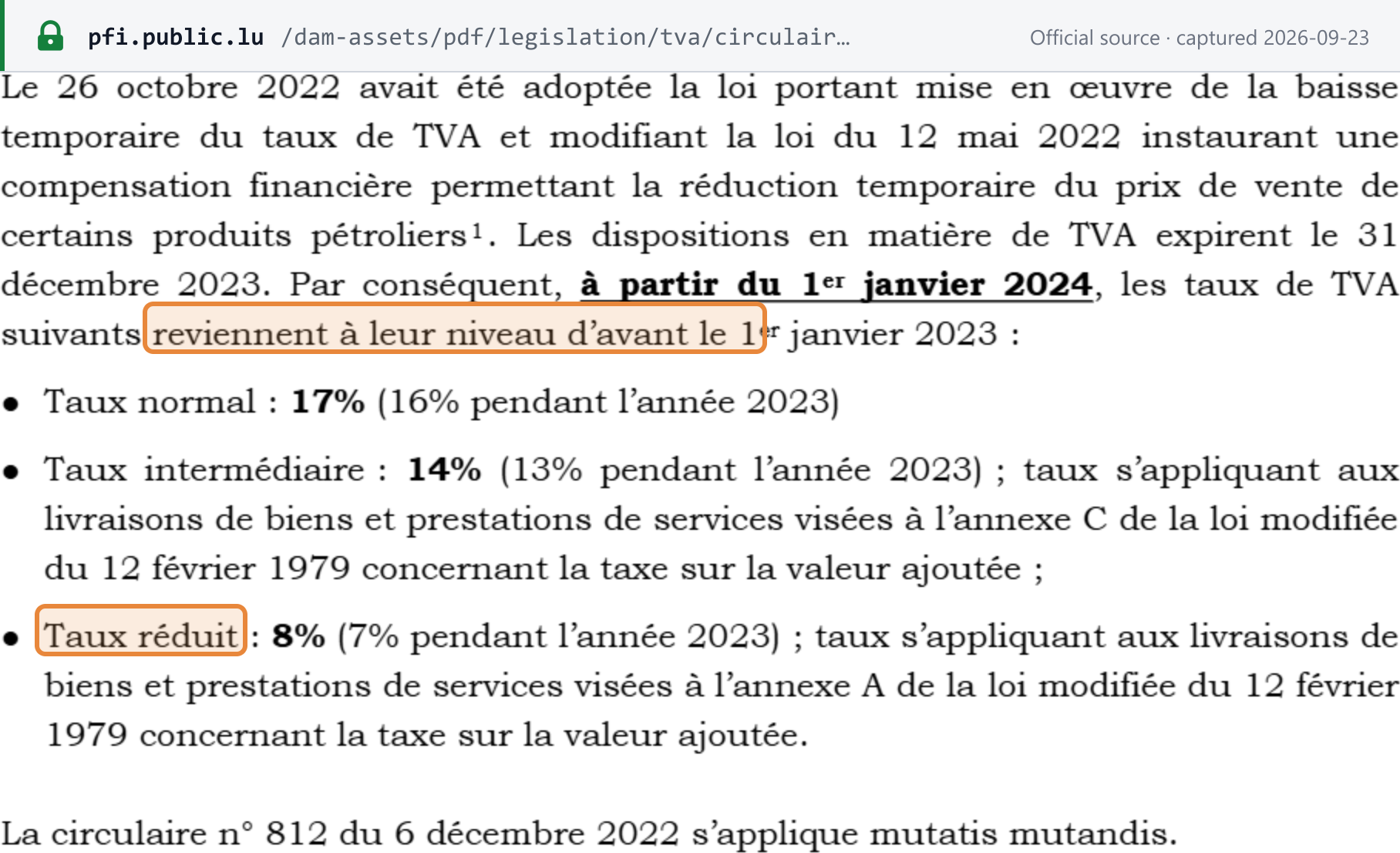
Historical only — not in force. For calendar year 2023 only, the law of 26 October 2022 cut the standard rate to 16%, the intermediate rate to 13% and the reduced rate to 7%. Those provisions expired on 31 December 2023. The 3% rate was never changed. AED Circular No. 812-1 of 27 December 2023: « Les dispositions en matière de TVA expirent le 31 décembre 2023. Par conséquent, à partir du 1er janvier 2024, les taux de TVA suivants reviennent à leur niveau d'avant le 1er janvier 2023 » ("The VAT provisions expire on 31 December 2023. Consequently, from 1 January 2024, the following VAT rates return to their pre-1 January 2023 level"). Any source still quoting 16% for Luxembourg is out of date. [4] [38]
Announced future rates
None announced as at 23 September 2026. The consolidated VAT law as at 1 January 2026 still reads 17 / 14 / 8 / 3. Neither of the two VAT bills before Parliament changes a rate: Projet de loi n° 8815 deals with e-invoicing, and Projet de loi n° 8812 with platforms, the One-Stop-Shop, distance sales and the small-business franchise (see Pending bill: Projet de loi 8812). [1] [24] [40]
For Luxembourg alongside other jurisdictions, see Lookuptax's worldwide tax rates table and VAT registration thresholds table.
Cross-border rules
Scope and place of supply
Luxembourg VAT covers supplies of goods and services for consideration within the country by a taxable person acting as such; intra-Community acquisitions of goods; intra-Community acquisitions of new means of transport; and imports from outside the EU. [11]
- Goods (art. 14). Supplied where the goods are when dispatch or transport to the customer begins; where they are installed or assembled; or where they are when supplied, if not transported. Gas, electricity, heat and cooling through networks have their own rules.
- Services (art. 17). The general business-to-business rule, art. 17(1)(b), places the supply where the customer is. This is the rule the reverse charge in art. 61(5) refers to.
Imports and exports
- Exports and intra-EU supplies are exempt with the right to deduct input VAT kept (arts. 43(1) and 49(2)(a)).
- Import VAT is owed by the importer, the person in whose name the goods are declared (art. 61(7)).
- Postponed accounting for registered importers. An importer identified for VAT in Luxembourg does not pay import VAT at the border. It declares it in its next VAT return and deducts it in the same return, as for intra-EU acquisitions. The AED: « Les mêmes dispositions sont valables pour les importations de biens au Grand-Duché de Luxembourg par une personne identifiée à la TVA au Grand-Duché de Luxembourg. » [26]
- Import exemptions are in art. 46. Suspension regimes — customs warehouses, free zones, inward processing and a VAT warehouse for the commodities in annex D — are in art. 60bis.
- Low-value consignments. Goods imported in consignments with an intrinsic value of up to EUR 150 and sold through a platform fall under the platform deemed-supplier rule — see Marketplace / platform deemed-supplier liability.
Reverse charge
- Services from abroad. The Luxembourg business customer owes the VAT on general-rule services from a supplier not established in Luxembourg (art. 61(5)). A Luxembourg fixed establishment that takes no part in the supply does not count (art. 61(9)).
- Domestic reverse charge (art. 61(3)). Between Luxembourg-identified businesses (other than franchise businesses), the customer owes the VAT on: greenhouse-gas emission allowances; gas and electricity certificates; mobile phones; integrated circuits before incorporation into end-user products; games consoles, tablets, laptops and headphones; and the raw and semi-finished metals in annex F, including precious metals. For the last four categories the supplier stays liable where the invoiced consideration does not exceed EUR 10,000 excluding VAT.
- Other cases. Triangular transactions (art. 61(2)); network gas, electricity, heat and cooling from a non-established supplier (art. 61(4)).
- VAT shown is VAT owed. Anyone who shows VAT on an invoice is liable for it (art. 61(8)).
- Invoice wording. A reverse-charged invoice must carry « Autoliquidation » (art. 63(8) 14°) — or the equivalent term in another EU language version of the VAT Directive, such as "Reverse charge".
[1] See Lookuptax's reverse charge explainer.
Digital products and services
Luxembourg applies the EU rules for telecommunications, broadcasting and electronic services and for distance sales to consumers. An EU seller established in a single Member State stays taxable in that State while its total cross-border sales of these services and distance sales to consumers in other Member States stay within EUR 10,000 a year: « la valeur totale, hors TVA, … ne dépasse pas, au cours de l'année civile en cours, 10 000 euros, et n'a pas dépassé ce seuil au cours de l'année civile précédente » (art. 19quater(1)(c)). Above that, the supply is taxable in Luxembourg and the seller either registers in Luxembourg or declares through the One-Stop-Shop. Below it, the seller may opt to apply Luxembourg VAT. [1] [5]
The AED runs the OSS through its VATMOSS platform. See Lookuptax's One-Stop-Shop guide and Import One-Stop-Shop guide.
One AED web page, Doit s'inscrire à la TVA (last updated 28 October 2020), still describes a distance-selling threshold from before the EU's July 2021 e-commerce reform. It is out of date on that point; the law now uses the EUR 10,000 EU-wide threshold above. Projet de loi n° 8812 would amend these rules from 2027 if adopted — see Pending bill: Projet de loi 8812.
Foreign companies selling into Luxembourg — B2B and B2C
The answer turns on the customer.
- B2B services — the customer self-accounts; the seller does not register. A non-established supplier of general-rule services to a Luxembourg taxable person does not register. The customer accounts for the VAT under art. 61(5).
- B2B goods — often the seller registers. For goods physically in Luxembourg sold to a Luxembourg customer, the reverse charge applies only in the specific cases in art. 61(2)–(4). Otherwise the foreign seller is the person liable and must register, with no threshold.
- B2C — no reverse charge. A private consumer cannot self-account. Either the EUR 10,000 EU-wide threshold (art. 19quater) keeps the supply taxable in an EU seller's own State, or the supply is taxable in Luxembourg and the seller registers in Luxembourg or uses the One-Stop-Shop.
- Non-EU sellers may be asked for a deposit or bank guarantee (art. 66), as above.
Marketplace / platform deemed-supplier liability
Applies (art. 10bis). A platform that facilitates certain sales is treated as the seller: « Lorsqu'un assujetti facilite, par l'utilisation d'une interface électronique telle qu'une place de marché, une plateforme, un portail ou un dispositif similaire, les ventes à distance de biens importés de territoires tiers ou de pays tiers contenus dans des envois d'une valeur intrinsèque ne dépassant pas 150 euros, cet assujetti est réputé avoir reçu et livré ces biens lui-même. » The rule also covers supplies of goods within the EU by a seller not established in the EU to a non-taxable person. Facilitating platforms must keep records of those supplies for ten years from 31 December of the year of the transaction (art. 65(2bis)). Payment service providers have separate CESOP record-keeping and reporting duties (art. 70ter). [1]
Pending bill: Projet de loi 8812
Proposed, not law. Projet de loi n° 8812, deposited on 30 July 2026, would amend the VAT law to transpose art. 2 of Directive (EU) 2025/516 (ViDA). As deposited, it covers platform duties (art. 10bis(2)), an extension of the One-Stop-Shop, distance sales (art. 19quater), the small-business franchise rules, and the phasing-out of call-off stock arrangements, mainly « à partir du 1er janvier 2027 » (from 1 January 2027); the call-off stock phase-out uses a cut-off of 30 June 2028. It changes no rate. On 18 September 2026 a rapporteur was appointed and the bill was presented. Its content and dates can change before any vote. [40] [41]
For neighbouring rules, see Lookuptax's France VAT guide and Germany VAT guide.
Invoice requirements
Invoice rules sit in art. 63 of the VAT law. For invoices over EUR 100, Luxembourg commercial law adds further particulars on top — see below.
Mandatory content
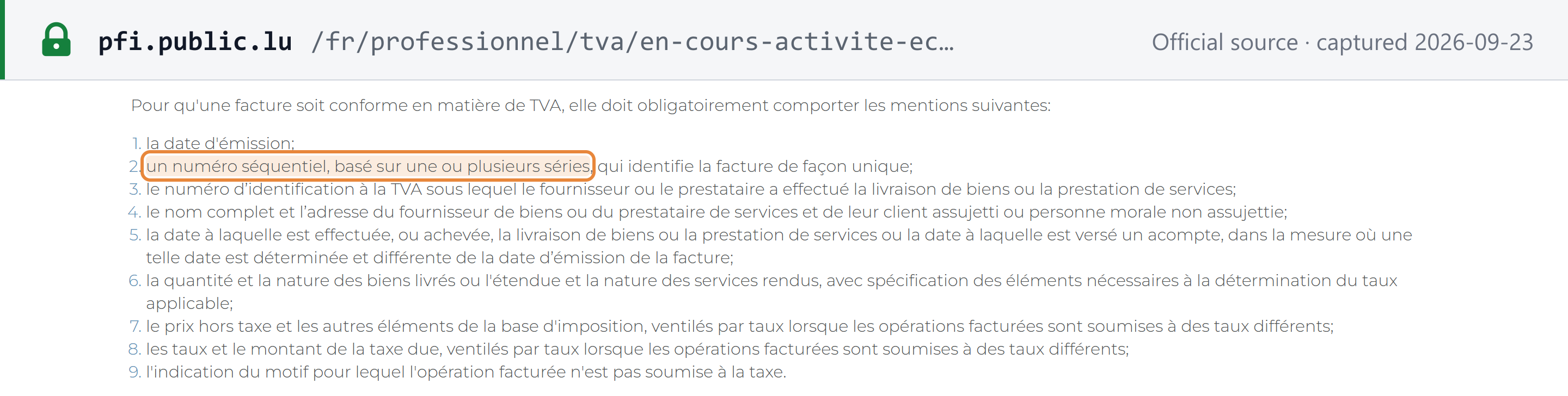
Art. 63(8) lists what an invoice must state « aux fins de l'application de la taxe sur la valeur ajoutée » (for VAT purposes). The list opens: « 1° la date d'émission de la facture ; 2° un numéro séquentiel, basé sur une ou plusieurs séries, qui identifie la facture de façon unique ; … » [1]
| # | Required field | When | Legal cite |
|---|---|---|---|
| 1 | Date of issue | Always | Art. 63(8) 1° |
| 2 | Sequential number, in one or more series, identifying the invoice uniquely | Always | Art. 63(8) 2° |
| 3 | Supplier's VAT identification number | Always | Art. 63(8) 3° |
| 4 | Customer's VAT identification number | Customer is liable for the tax, or receives an exempt intra-EU supply | Art. 63(8) 4° |
| 5 | Full name and address of supplier and customer | Always | Art. 63(8) 5° |
| 6 | Quantity and nature of goods, or extent and nature of services | Always | Art. 63(8) 6° |
| 7 | Date of supply, or of a payment on account | Where determined and different from the invoice date | Art. 63(8) 7° |
| 8 | « Comptabilité de caisse » | Cash-accounting scheme (art. 25) | Art. 63(8) 8° |
| 9 | Taxable amount per rate or exemption; unit price excluding VAT; discounts not in the unit price | Always | Art. 63(8) 9° |
| 10 | VAT rate | Always | Art. 63(8) 10° |
| 11 | VAT amount payable | Unless a special scheme excludes it | Art. 63(8) 11° |
| 12 | « Autofacturation » | Customer issues the invoice (self-billing) | Art. 63(8) 12° |
| 13 | Reference to the exempting provision, or other indication of exemption | Exempt supply | Art. 63(8) 13° |
| 14 | « Autoliquidation » | Customer is liable for the VAT | Art. 63(8) 14° |
| 15 | New-means-of-transport data (art. 4(4)(b)) | New means of transport | Art. 63(8) 15° |
| 16 | « Régime particulier - agences de voyages » | Travel agents' scheme | Art. 63(8) 16° |
| 17 | « Régime particulier - Biens d'occasion » / « Régime particulier Objets d'arts » / « Régime particulier - Objets de collection et d'antiquité » | Margin schemes | Art. 63(8) 17° |
| 18 | Fiscal representative's VAT number, full name and address | Person liable is a fiscal representative (art. 66bis) | Art. 63(8) 18° |
The legends in items 8, 12, 14 and 17 may be given in another EU language version of art. 226 of the VAT Directive (art. 63(8), last paragraph) — so "Reverse charge" and "Self-billing" are acceptable. A franchise business uses the art. 57bis(5) legend instead of showing VAT. [1]
Commercial-law particulars for invoices over EUR 100. Guichet.lu (page last modified 5 October 2023): « La facture d'un montant supérieur à 100 euros TTC (toutes taxes comprises) doit obligatoirement mentionner : l'identification du vendeur ou du prestataire de service à savoir : la dénomination et/ou la raison sociale ; la forme juridique ; l'indication précise du siège social ; les mots "Registre de commerce et des sociétés, Luxembourg" ou les initiales "R.C.S. Luxembourg" suivis du numéro d'immatriculation (ne s'applique pas aux sociétés coopératives) ; le numéro d'autorisation d'établissement ; … » An invoice over EUR 100 including tax must therefore also show the supplier's company name, legal form, registered office, R.C.S. Luxembourg number (not for cooperatives) and business-permit number. Sole traders and craftspeople state their trade and permit number. The page adds: « Elle doit être rédigée en 2 exemplaires, un pour chacune des parties » — two copies, one for each party. [17]
Before invoicing an EU business without VAT, the same page says to check the customer's VAT number in VIES first, and preferably print and keep the result page showing the number and the date of the check. [17]
Issuance deadline
By the 15th day of the following month. Art. 63(5): « La facture visée au présent article doit être émise au plus tard le quinzième jour du mois qui suit celui au cours duquel la livraison de biens ou la prestation de services sur laquelle porte la facture a été effectuée et, en cas de versement d'un acompte … au plus tard lors de l'encaissement de cet acompte. » For a payment on account, the invoice is due no later than receipt of the payment. Periodic invoices covering several supplies are allowed if all of them became chargeable in the same calendar month (art. 63(6)). [1]
When VAT becomes due (arts 21, 24 and 25). VAT generally becomes chargeable when the supply is made, or when a payment on account is received. Where an invoice is required, it becomes chargeable when the invoice is issued, « étant entendu que l'exigibilité a lieu au plus tard le 15 du mois qui suit celui de la réalisation de l'opération imposable » — so no later than the 15th of the month after the supply. That invoicing rule does not apply to services for which the Luxembourg customer owes the VAT under the reverse charge (art. 61(5)), or to supplies of goods to a platform deemed to have received and supplied them (art. 10bis): for those, VAT becomes chargeable when the supply is made. Under cash accounting (art. 25), VAT becomes chargeable when payment is received. [1] [11]
A separate commercial-law point for B2C sales: to claim statutory late-payment interest from a consumer, the supplier must issue the invoice within one month of delivery or completion and say on it that it intends to claim that interest. [17]
Numbering and sequencing
One sequential number per invoice, from one or more series, identifying it uniquely (art. 63(8) 2°). Several series are allowed, provided each number identifies one invoice only. [1]
Credit and debit notes
Art. 63(2): « Est assimilé à une facture tout document ou message qui modifie la facture initiale et y fait référence de façon spécifique et non équivoque. » A credit or debit note is treated as an invoice if it amends the original and refers to it specifically and unambiguously. It may take the simplified form, but must carry that reference and the particulars changed (art. 63(10)–(11)). In public procurement, a credit note is legally an invoice and must also be sent as a compliant e-invoice. [1] [19]
Currency and language
- Currency. Any currency, provided the VAT is stated in euros: « Les montants figurant sur la facture peuvent être exprimés dans toute monnaie, pour autant que le montant de taxe à payer ou à régulariser soit exprimé en euros en utilisant le mécanisme de conversion prévu à l'article 37. » (art. 63(12) 1°).
- Exchange rate (art. 37). For anything other than an import, the rate is the last selling rate determined by reference to the rate published by the Banque centrale du Luxembourg, or by an authorised bank from the ECB rate, or published by the ECB, at the time the tax becomes chargeable. [9]
- Language. No language is imposed, but the AED may require a French or German translation of an invoice drawn up in a language other than an official language of Luxembourg (art. 63(12) 2°).
Document types
| Document | When it is used | Cite |
|---|---|---|
| Full invoice | Default for every taxable supply | Art. 63(8) |
| Simplified invoice | Total including VAT not more than EUR 100; a document amending an earlier invoice; or an issuer under the art. 284 small-business exemption | Art. 63(10) |
| Periodic invoice | Several supplies that became chargeable in the same calendar month | Art. 63(6) |
| Self-billed invoice | Issued by the customer under a prior agreement | Art. 63(7) |
| Credit or debit note | Amends an earlier invoice | Art. 63(2) |
A simplified invoice needs at least the date of issue, the supplier's identification, the type of goods or services, and the VAT payable or the data to compute it. It may not be used for exempt intra-EU supplies of goods or new means of transport, for distance sales of goods (art. 63(10) 2°, via art. 63(4) 1°), or for the cross-border cases in art. 63(3). The AED's own guidance on the EUR 100 limit adds a condition: the invoice must not involve another Member State. [1] [16]
Bill of supply. Not applicable — the VAT law defines no such document (checked 2026-09-23).
Self-billing
Permitted. Art. 63(7): self-billing is allowed « lorsqu'il existe un accord préalable entre les deux parties, et sous réserve que chaque facture fasse l'objet d'une procédure d'acceptation par l'assujetti effectuant la livraison » — with a prior agreement between the parties and an acceptance procedure for each invoice by the supplier. The AED adds that the agreement and the acceptance procedure must exist on paper or electronically. The invoice carries « Autofacturation » (art. 63(8) 12°). [1] [34]
Retention and audit trail
- Retention: ten years. « Ces factures et copies de factures doivent être stockées pendant une période de dix ans à partir de leur date d'émission. » (art. 65(4)). Books are kept ten years from closure, other documents ten years from their date.
- Electronic storage is valid if the data guaranteeing authenticity of origin and integrity of content are also stored electronically (art. 65(5)).
- Where. The business chooses where to store its records, provided it can produce them to the AED without undue delay. It may not store them in a country with no mutual-assistance instrument of comparable scope (art. 65(6)).
- Audit trail. Art. 63(14): « L'authenticité de l'origine, l'intégrité du contenu et la lisibilité d'une facture, que celle-ci se présente sur papier ou sous forme électronique, sont assurées à compter du moment de son émission et jusqu'à la fin de sa période de conservation. Chaque assujetti détermine la manière dont [elles] sont assurées. » The business must guarantee the three properties from issue to the end of retention, and chooses how.
- FAIA — Luxembourg's SAF-T. The AED can require a standard audit file, the Fichier d'Audit Informatisé AED: « tout assujetti qui dispose d'un système de comptabilité informatique, est tenu, sous peine de sanctions, de délivrer des données par la voie électronique, dans les cas où cette demande est exprimée par l'administration. » The current version is FAIA 2.01. It does not currently apply to businesses outside the standard chart of accounts, on a simplified VAT regime, with turnover of EUR 112,000 or less, or with fewer than 500 accounting transactions a year. See Lookuptax's SAF-T explainer.
A specimen of a compliant invoice
The AED publishes the mandatory particulars as a list and publishes no annotated specimen invoice; Guichet.lu's Facture page does the same for the commercial-law particulars (checked 2026-09-23). The layout below is Lookuptax's own illustration of a domestic B2B invoice. It combines the art. 63(8) VAT particulars with the Guichet.lu commercial-law particulars. Every name, number and amount in it is fictional:
Facture — Invoice
| DescriptionArt. 63(8) 6° | Quantity | Unit price excl. VATArt. 63(8) 9° | VAT rateArt. 63(8) 10° | Amount excl. VAT |
|---|---|---|---|---|
| Accounting advisory, hours | 10 | EUR 120.00 | 17% | EUR 1,200.00 |
| Printed reference books | 5 | EUR 40.00 | 3% | EUR 200.00 |
- Taxable amount at 17%Art. 63(8) 9°
- EUR 1,200.00
- VAT at 17%Art. 63(8) 11°
- EUR 204.00
- Taxable amount at 3%Art. 63(8) 9°
- EUR 200.00
- VAT at 3%Art. 63(8) 11°
- EUR 6.00
- Total including VAT
- EUR 1,610.00
- The taxable amount is broken down by rate, as art. 63(8) 9° requires when lines carry different rates.
- Issued by the 15th day of the month after the supply — art. 63(5).
- The customer’s VAT number is not required on this domestic supply. It is required where the customer owes the tax or receives an exempt intra-EU supply — art. 63(8) 4°.
- If the customer owed the VAT, the invoice would carry « Autoliquidation » (or "Reverse charge") — art. 63(8) 14°.
- A franchise business would show no VAT and print « TVA non applicable – Article 57bis de la loi modifiée du 12 février 1979 » — art. 57bis(5).
- Drawn up in two copies, one for each party — Guichet.lu, Facture.
E-invoicing status
Status (as of 2026-09-23): B2G mandatory and fully phased in since 18 March 2023. B2B is a bill, not law. No B2C obligation.
B2G — mandatory for every supplier since 18 March 2023
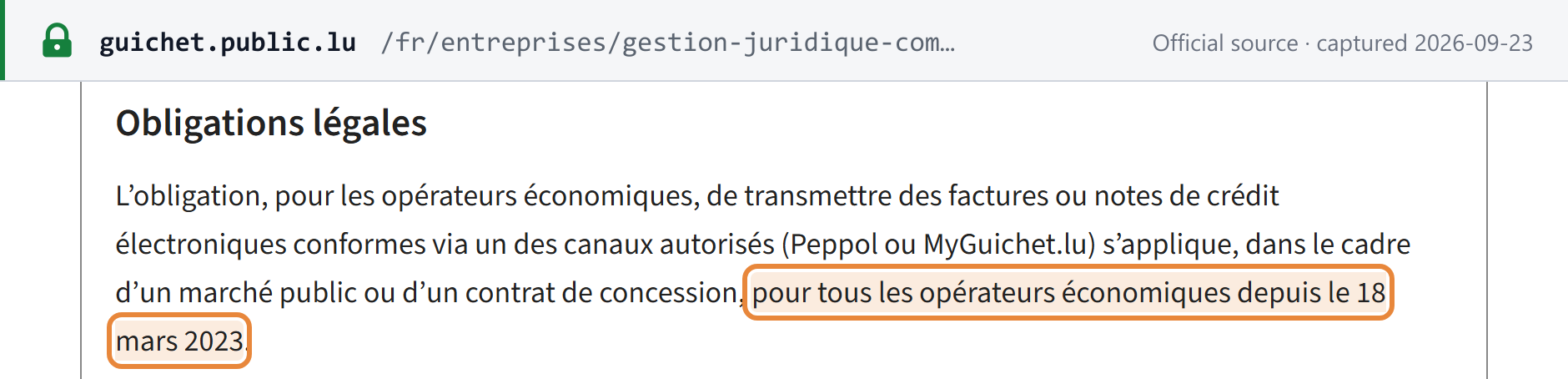
Invoices under public contracts and concession contracts must be compliant electronic invoices sent through an authorised channel. Guichet.lu (page last modified 8 June 2026): « L'obligation, pour les opérateurs économiques, de transmettre des factures ou notes de crédit électroniques conformes via un des canaux autorisés (Peppol ou My Guichet.lu) s'applique, dans le cadre d'un marché public ou d'un contrat de concession, pour tous les opérateurs économiques depuis le 18 mars 2023. » [19]
- Email is not allowed. « D'autres canaux de transmission que Peppol ou My Guichet.lu ne sont pas autorisés. Il n'est donc, par exemple, pas permis de transmettre des factures ou notes de crédit électroniques conformes via e-mail. »
- Every economic operator, small contracts included. The obligation covers every « opérateur économique » invoicing under a public contract or concession. A public contract includes « contrats qui concernent seulement des petites sommes, par exemple 1.000 euros ou même moins » and contracts awarded without a public tender.
- Exclusions. Guichet.lu lists contracts for development cooperation, for diplomatic missions and consulates, for international exhibitions abroad, and for State, official or working visits abroad.
- Credit notes too — see Credit and debit notes.
How the phases ran. The law of 13 December 2021 phased the obligation by company size, counted from the law's entry into force: 5 months for large operators; 10 months for operators not exceeding two of three limits at their 2019 balance-sheet date (balance-sheet total EUR 20 million, net turnover EUR 40 million, 250 full-time staff); 15 months for small and newly created operators (limits EUR 4.4 million, EUR 8.8 million, 50 staff), or those unable to give 2019 figures. The government's communiqué of 15 March 2022 gives the calendar: the law « est entrée en vigueur le 18 décembre 2021 » and applies « selon un échéancier fixé selon la taille des entreprises entre le 18 mai 2022 et le 18 mars 2023 ». So the phases fell on 18 May 2022, 18 October 2022 (18 December 2021 plus 10 months; no official source states this middle date verbatim) and 18 March 2023, the date Guichet.lu also gives. All three phases are complete. [20] [42]
Network, channels and formats
- Network: Peppol. A grand-ducal regulation designates it because it meets the seven statutory criteria: « tous les pouvoirs adjudicateurs et entités adjudicatrices l'utilisent comme réseau de livraison commun pour la réception automatisée de factures électroniques » — all contracting authorities use it as the common delivery network. [21]
- Without a Peppol access point: two MyGuichet.lu online forms — one for keying an invoice manually, one for uploading an already-compliant file.
- Formats accepted for the MyGuichet.lu upload form: Peppol BIS Billing 3.0 (XML UBL); XRechnung 3.0.1 (XML UBL); XRechnung 3.0.1 (XML UN/CEFACT CII) — for invoices and credit notes. Every invoice must follow the European standard on e-invoicing.
- From 1 October 2026, XRechnung versions older than 3.0 are refused. Guichet.lu: « à partir du 1er octobre 2026, les formats XRechnung plus anciens que la version 3.0 ne seront plus acceptés » — XRechnung 2.2.0 and 2.3.1 are not accepted from that date. The cut-off is not limited to the upload form: the ministry's notice says it « vaut aussi bien pour les factures directement transmises par Peppol que pour celles qui seraient téléchargées via le formulaire web ». (The notice's body gives 1 September 2026, but its title and Guichet.lu give 1 October 2026.) [43] [19]
- Peppol addressing. A Luxembourg body is addressed by its VAT number or its 11-digit legal-persons matricule, always under code list 9938 (LU:VAT): « La codelist à utiliser dans Peppol pour les 2 types de numéros est toujours la liste 9938, c'est-à-dire LU:VAT. » The State publishes a list of public bodies and their Peppol identifiers on its e-invoicing portal. [22]
See Lookuptax's Peppol guide and Peppol requirements by country.
B2B — proposed, not law: Projet de loi n° 8815
There is no B2B e-invoicing obligation in force. Finance Minister Gilles Roth deposited Projet de loi n° 8815 with the Chamber of Deputies on 30 July 2026. It would extend the 2019 e-invoicing law to invoices between businesses in Luxembourg, and amend the VAT law to transpose art. 1 of Directive (EU) 2025/516 (ViDA). The Council of Government had approved the draft on 17 July 2026. [23] [25] [33]
Where the bill stands (as at 23 September 2026). The dossier shows the bill as Déposé(e) (deposited). Its latest entry, dated 18 September 2026, reads « Nomination d'un rapporteur / Présentation du projet de loi » in the Commission des Finances — a rapporteur was appointed and the bill presented in committee. No opinion of the Conseil d'État appears in the dossier. [23]

What the bill proposes, as deposited on 30 July 2026. These are the bill's own dates. They are not law and can change in committee or in the vote. [24]
| Proposed step | Proposed date | Bill article |
|---|---|---|
| Entry into force of the law (except art. 4, on publication) | 1 January 2028 | Art. 13 |
| Obligation to receive and process compliant e-invoices | 1 January 2028 | Art. 6 (new art. 4 of the 2019 law), with art. 13 |
| Obligation to issue and transmit — issuers exceeding two of three limits at their 2026 balance-sheet date: balance-sheet total EUR 7,500,000; net turnover EUR 15,000,000; 50 full-time staff | 1 July 2028 | Art. 12 |
| Obligation to issue and transmit — all other issuers, and those unable to give 2026 figures | 1 January 2029 | Art. 12 |
| End of transitional non-automated reception — recipients that are not small | 30 June 2028 | Art. 9 |
| End of transitional non-automated reception — small recipients, or those unable to give 2026 figures | 31 December 2028 | Art. 9 |
Art. 12 of the bill reads: « l'article 7 de la présente loi s'applique : 1° au plus tard le 1er juillet 2028 à la condition qu'à la date de clôture du bilan de l'année 2026, l'émetteur de la facture a dépassé les limites chiffrées d'au moins deux des trois critères suivants … 2° au plus tard le 1er janvier 2029 … »
Other points in the bill as deposited:
- Scope (art. 2): invoices from an issuer established in Luxembourg to a recipient established in Luxembourg, for supplies taxable in Luxembourg. It excludes transactions under art. 262 of the VAT Directive, certain occasional taxable persons, and distance sales under art. 14(3)(a).
- No right to refuse (art. 10, 7°): « l'émission d'une facture électronique conforme conformément au paragraphe 4bis n'est pas soumise à l'acceptation du destinataire » — the recipient's acceptance would not be needed.
- Why: the explanatory memorandum presents the bill as preparation for ViDA's transaction-level digital reporting « à partir du 1er juillet 2030 ».
See Lookuptax's ViDA explainer, and the full Luxembourg e-invoicing guide for channels, formats, onboarding and the bill's usage fees.
B2C
No B2C e-invoicing obligation is in force, and the bill as deposited is framed as a business-to-business extension (checked 2026-09-23).
For Luxembourg alongside other mandates, see Lookuptax's e-invoicing status and networks table.
Filing and payment
Filing frequency
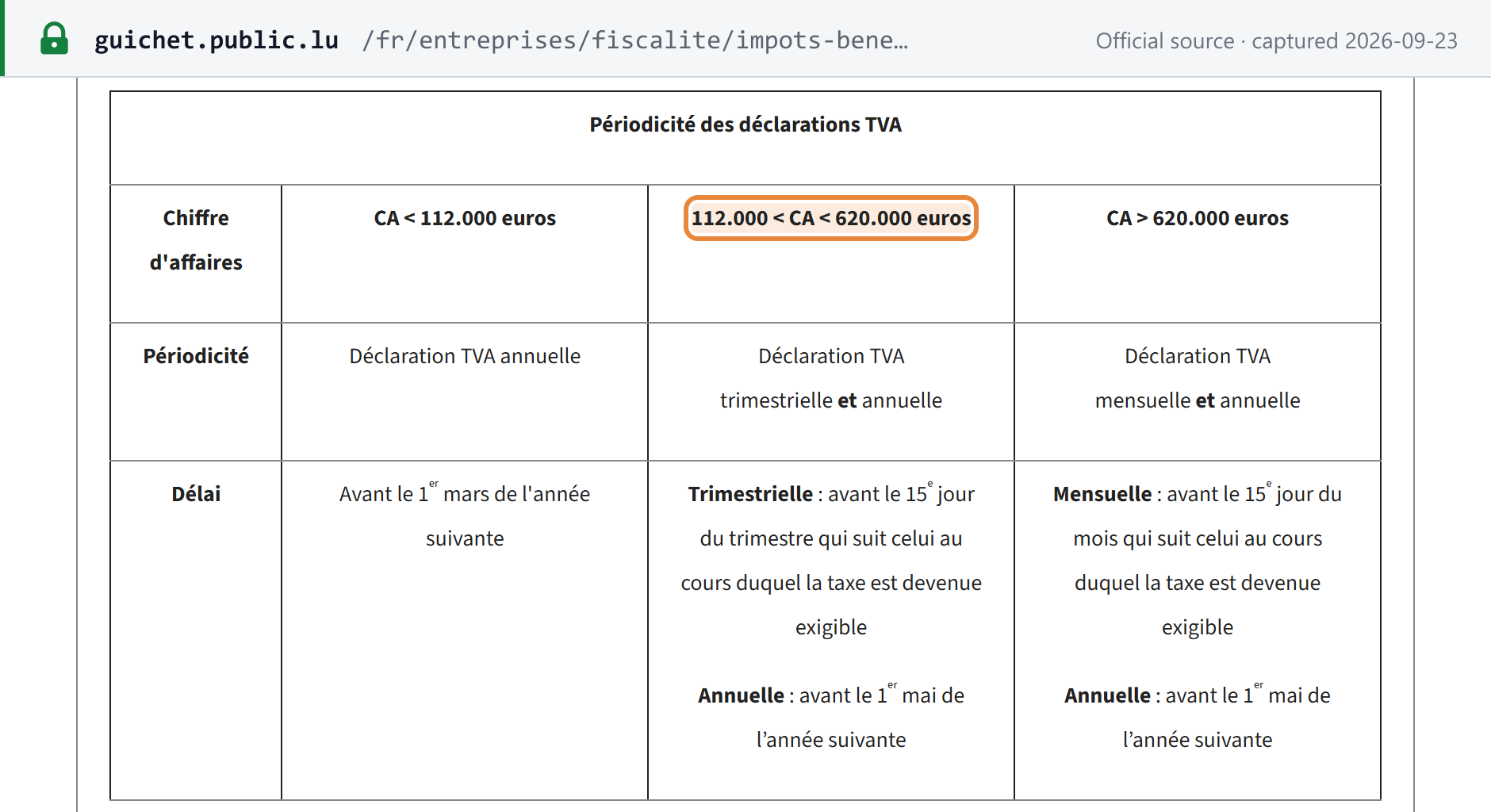
The frequency depends on the turnover excluding VAT in the previous calendar year — or, if higher, the total of intra-EU acquisitions of goods and intra-EU services received. Monthly filing is the statutory default, and the AED alone decides which frequency applies: « En principe, le régime mensuel est légalement prévu par défaut et l'administration est seule apte à déterminer la périodicité de dépôt applicable. » [9] [5]
| Prior-year turnover excl. VAT | Returns | Periodic return due | Annual return due |
|---|---|---|---|
| Above EUR 620,000 | Monthly + annual | Before the 15th day of the following month | Before 1 May of the following year |
| Above EUR 112,000, up to EUR 620,000 | Quarterly + annual | Before the 15th day of the following quarter | Before 1 May of the following year |
| EUR 112,000 or less | Annual only | — | Before 1 March of the following year |
As at 2026-09-23. [10]
Two points that trip up foreign businesses:
- The AED reviews the frequency every year. « L'administration procède à la fin de chaque année à une révision de la périodicité déclarative appliquée. »
- A return for the wrong period does not count. « Les déclarations portant sur des périodes autres que celles sous lesquelles les assujettis se trouvent enregistrés … ne sont pas prises en compte. » File for the period you are registered for, even if your turnover has changed.
The bands come from the grand-ducal regulation of 23 December 1992 on VAT returns and payment, under art. 64(9)(a) of the VAT law. The regulation's published text states them in francs; the euro figures are those the AED and Guichet.lu publish. [36]
Return due date
- Periodic returns: before the 15th day of the month (or quarter) following the period. Art. 64(6): « Elle doit être déposée avant le quinzième jour du mois qui suit la période imposable. »
- Annual return: every monthly and quarterly filer also files an annual return, which reconciles the year and carries any adjustments, « avant le premier mai de l'année qui suit la période imposable » (art. 64(7)). Annual-only filers file before 1 March.
- Electronic filing is compulsory. « Depuis le 1er janvier 2020, toutes les déclarations de TVA (mensuelles, trimestrielles et annuelle) devront obligatoirement être déposées par transfert électronique » — through the eCDF platform, with a LuxTrust certificate, after opening an eCDF account.
Payment due date and method
Same date as the return, by bank transfer. « L'échéance pour le paiement de la taxe est identique à l'échéance prévue pour le dépôt des déclarations. » Payment goes to the Recette Centrale account: AED-RECETTE CENTRALE-TVA, IBAN LU35 0019 5655 0668 3000, BIC BCEELULL, quoting the VAT matricule and the return period. Businesses can view their VAT account through eTVA-C on MyGuichet.lu. A request to defer payment can be made online through the AED's online services. [11] [12] [30]
Additional listings
- EC sales list (état récapitulatif). Every business identified in Luxembourg files a monthly statement of intra-EU supplies of goods and of intra-EU services on which the customer owes the tax. Art. 64bis(3): « Il doit être déposé avant le vingt-cinquième jour du mois qui suit le mois sur lequel porte l'état récapitulatif. » — before the 25th day of the following month when filed electronically. For services, monthly or quarterly filing is « au choix » — the business chooses. For goods, a quarterly statement is allowed only where intra-EU supplies of goods are under EUR 50,000. [1] [13]
- Intrastat — filed with STATEC, not the AED. No declaration is due below EUR 250,000 of annual intra-EU arrivals or EUR 200,000 of dispatches, counted per flow: « Sont dispensés de la déclaration périodique les redevables de l'information statistique dont le montant annuel des acquisitions intracommunautaires ne dépasse pas 250.000 euros et ceux dont les expéditions intra-communautaires ne dépassent pas 200.000 euros. » Declarations are monthly. The form and channel are not a free choice: they depend on the business's annual trade value, with a simplified declaration for flows below EUR 375,000. Deadlines are the 6th working day of the following month on paper and the 16th working day online through IDEP.WEB. Triangular movements and services are out of scope. [14] [15]
See Lookuptax's guides to VAT listings and VIES and Intrastat.
Input-tax recovery and blocked items
Input VAT on goods and services used for taxable business supplies is deductible (art. 48). It is not deductible:
- on goods and services used for exempt or out-of-scope supplies (art. 49(1));
- on expenditure that is not strictly business-related — art. 54(1): « N'est pas déductible la taxe sur la valeur ajoutée ayant grevé des dépenses qui n'ont pas un caractère strictement professionnel, telles que les dépenses somptuaires, de divertissement ou de représentation. » (luxury, entertainment and representation expenditure).
A grand-ducal regulation may exclude further categories, notably goods usable privately. Where a business makes both taxable and exempt supplies, it deducts by an annual pro rata, expressed as a percentage and rounded up to the next whole number. [1] [37]
Refunds
- Residents. Excess input VAT is carried forward (art. 55(1)). A repayment can be requested by registered post to the Recette Centrale TVA (art. 55(3)). The AED must accept or refuse within four months, extendable if it asks for more information, and pays an accepted refund within ten working days of that period ending. Silence counts as refusal and can be appealed. Late repayment earns interest at the art. 85 rate. [1] [35]
- EU businesses reclaim under the EU refund procedure, Directive 2008/9/EC (art. 55bis), through the AED's VAT refund portal. Non-EU businesses reclaim under art. 55ter. [1]
- Bad-debt relief. The supplier-side basis is art. 33, third subparagraph: « Un règlement grand-ducal arrêtera des dispositions particulières concernant les régularisations de la base d'imposition… lorsque… le montant facturé ou convenu… ne correspond pas à la rémunération effectivement encaissée » — a grand-ducal regulation sets the rules for adjusting the taxable amount where the amount invoiced or agreed does not match the consideration actually received. The customer's deduction is adjusted under art. 53. [1]
Cash accounting
Available on request below EUR 500,000 of annual turnover excluding VAT (imposition d'après les recettes, art. 25). VAT then becomes due when payment is received, and the business's own right to deduct waits until it has paid its supplier. Invoices must carry « Comptabilité de caisse » (art. 63(8) 8°). [11] [1]
Exemptions
Exempt is not zero-rated
Art. 39(3) sets no 0% rate; its equivalent is an exemption with the right to deduct. The difference that matters is art. 49(1): « N'est pas déductible la taxe sur la valeur ajoutée ayant grevé les biens et les services qui sont utilisés pour effectuer des livraisons de biens et des prestations de services exonérées ou ne rentrant pas dans le champ d'application de la taxe. » Input VAT on costs used for exempt or out-of-scope supplies cannot be recovered. The exceptions — exempt with credit — are exports and intra-EU supplies (art. 43(1)), supplies abroad that would be deductible if made in Luxembourg, and certain financial and insurance services linked to exports or to customers outside the EU (art. 49(2)). [1]
Exempt supplies
Art. 44(1) exempts, among others: insurance and reinsurance; financial services including credit, payments, currency and securities dealing; supplies and lettings of immovable property; medical and dental care; charitable, cultural, sporting and non-profit activities; lotteries whose proceeds serve a general-interest purpose; and goods used exclusively for an exempt activity where no deduction was taken. [1]
Fund management (art. 44(1)(d)). Exempt: the management of undertakings for collective investment (law of 17 December 2010), specialised investment funds (law of 13 February 2007), SICARs (law of 15 June 2004), pension funds supervised by the CSSF (sepcav and assep) or by the Commissariat aux assurances, and internal collective life-assurance funds where subscribers bear the risk (point (i)). It also exempts the management of equivalent undertakings in other Member States subject to comparable supervision (point (ii)), of securitisation vehicles (point (iii)), and of alternative investment funds under the law of 12 July 2013 (point (iv)). The same article exempts dealings in securities « y compris la négociation mais à l'exception de la garde et de la gestion » — including negotiation but not safekeeping and management, which annex C taxes at 14%. [1]
Independent groups of persons (art. 44(1)(y)). Services from a groupement autonome de personnes to its members are exempt where the members carry on an exempt or non-taxable activity, the services are directly necessary to it, the group claims only the exact reimbursement of each member's share of joint costs, and the exemption does not distort competition. This is a cost-sharing exemption between separate taxable persons. A VAT group (art. 60ter) is different: it is a single taxable person. [1]
Option to tax property. A business letting or selling immovable property to another taxable person may waive the exemption and charge VAT, within the limits set by grand-ducal regulation (art. 45). [1]
Special regimes
- Small-business franchise — EUR 50,000; see Registration threshold.
- Cash accounting — below EUR 500,000; see Cash accounting.
- Margin schemes — second-hand goods, works of art, collectors' items and antiques (arts. 56ter to 56ter-3, categories in annex E); investment gold (art. 56quater); travel agents (art. 56bis). Each has its own invoice legend (art. 63(8) 16°–17°).
- Farming — flat-rate regime for agriculture and forestry, with an option out (arts. 58–60).
- VAT warehouse and customs regimes — art. 60bis; see Imports and exports.
Offences and penalties
Offences
- Administrative breaches (art. 77(1)). Breaching the special-scheme articles, the VAT-warehouse rule (60bis), the VAT-group rule (60ter), arts. 62 to 66bis — registration, invoicing, returns, EC sales lists, accounting and storage, fiscal representation — or the audit-cooperation and payment-provider duties (arts. 70, 70bis, 70ter, 71) is punishable by a fiscal fine. Where the fine is for inaccurate particulars on invoices, the customer is jointly and severally liable if it took part.
- Evasion (art. 77(3)). A breach committed with the aim or result of evading tax or obtaining an undue refund.
- Aggravated tax fraud (art. 80). Evasion that, per return period, concerns more than a quarter of the VAT due and at least EUR 10,000, or more than EUR 200,000.
- Tax swindling (art. 80). Systematic use of fraudulent contrivances to conceal facts from the AED, or to persuade it of false ones, involving a significant amount.
- False certificates (art. 80). Drawing up or using a false certificate capable of harming the Treasury.
- Directors. Managing directors, managers and any de jure or de facto manager are personally liable where the company's VAT obligations are culpably not performed (arts. 67-1 to 67-4).
Penalties
| Exposure | Amount | Source |
|---|---|---|
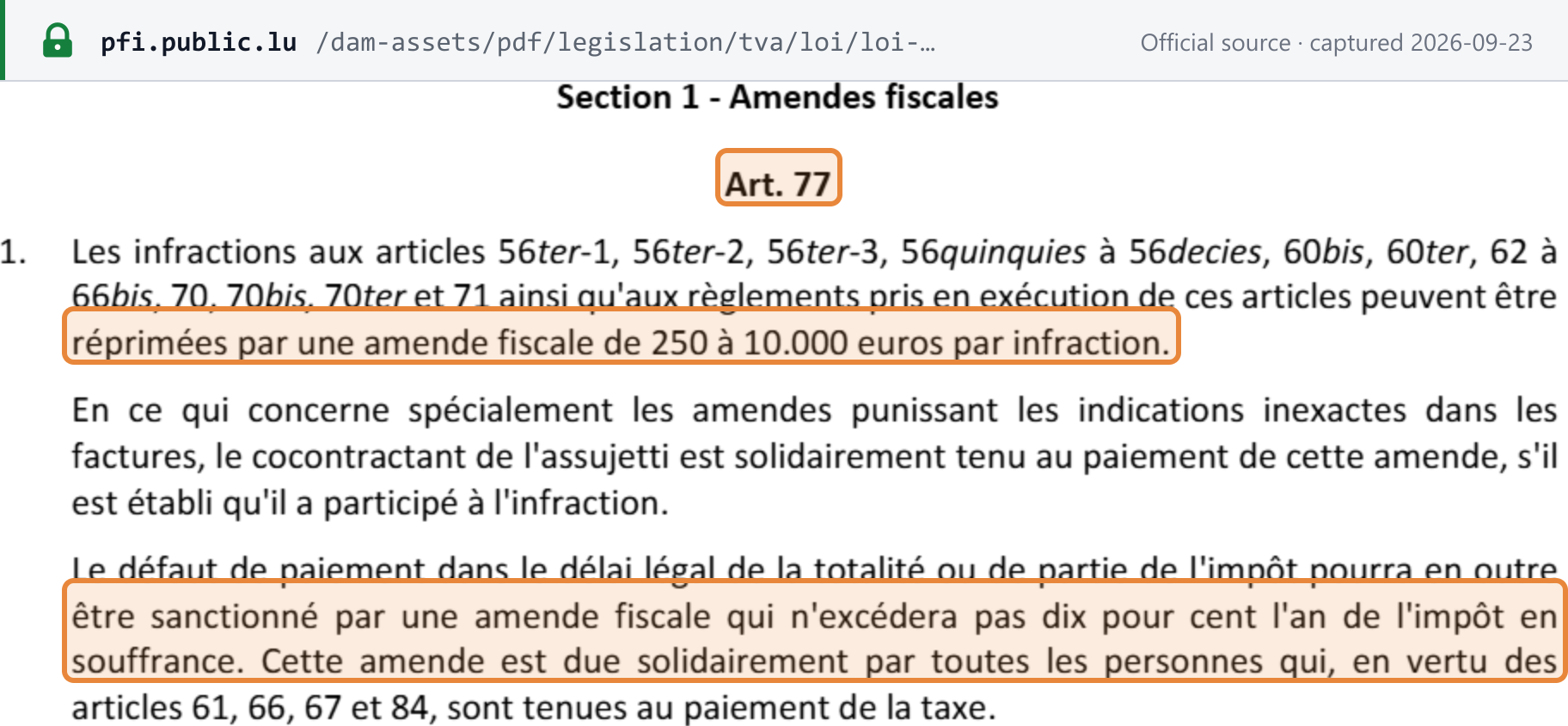
| Fixed fiscal fine, per infringement | EUR 250 to EUR 10,000 | Art. 77(1) |
| Late payment | Fiscal fine up to 10% a year of the unpaid tax | Art. 77(1) |
| Daily fines (audit cooperation, logistics warehouses, payment service providers) | Up to EUR 25,000 per day, after a registered-post warning at least 15 days before the deadline | Art. 77(2) |
| Evasion or undue refund | 10% to 50% of the VAT evaded or refund obtained, minimum EUR 125 | Art. 77(3) |
| Default interest | 7.2% a year from the day the enforcement order (contrainte) is served | Art. 85 |
| Aggravated tax fraud | 1 month to 4 years' imprisonment and a fine of EUR 25,000 up to six times the VAT evaded | Art. 80 |
| Tax swindling | 1 month to 5 years' imprisonment and a fine of EUR 25,000 up to ten times the VAT evaded; possible loss of civic rights for 5 to 10 years | Art. 80 |
| Offences within a criminal organisation | Minimum sentence of 2 years | Art. 80 |
| False certificates | Criminal fine of EUR 251 to EUR 12,500 | Art. 80 |
Art. 77(1): « … peuvent être réprimées par une amende fiscale de 250 à 10.000 euros par infraction. … Le défaut de paiement dans le délai légal de la totalité ou de partie de l'impôt pourra en outre être sanctionné par une amende fiscale qui n'excédera pas dix pour cent l'an de l'impôt en souffrance. »
Interest is not the late-payment fine. Art. 85: « Des intérêts moratoires sont dus au taux de sept virgule deux pour cent l'an à partir du jour de la signification de la contrainte. » The 7.2% runs from service of the enforcement order, not from the due date. Before that point, the exposure for paying late is the art. 77(1) fine. [1]
Who decides, and time limits. Fiscal fines are imposed by the director of the AED or a delegate (art. 78) and can be appealed (art. 79). Criminal cases are for the courts alone. The Treasury's claim for tax and fines is time-barred after five years (art. 81), as is a claim for restitution (art. 82). A réclamation against an AED decision is lodged in writing within three months of notification (art. 76). [1]
Frequently asked questions
Is the standard VAT rate in Luxembourg 16% or 17%?
17%. Article 39(3) of the VAT law sets the standard rate at seventeen per cent, alongside an intermediate rate of 14%, a reduced rate of 8% and a super-reduced rate of 3%. The 16%, 13% and 7% rates applied only during calendar year 2023, under the law of 26 October 2022. Those provisions expired on 31 December 2023, and AED Circular No. 812-1 confirms that the rates returned to 17%, 14% and 8% on 1 January 2024. The 3% rate did not change. These are the rates in force as at 23 September 2026. [1] [4]
My Luxembourg turnover is under EUR 50,000 — do I still have VAT obligations?
Yes, a few. If you are established in Luxembourg and your annual Luxembourg turnover does not exceed EUR 50,000, your supplies are exempt under the small-business franchise (Article 57bis of the VAT law). You charge no VAT and cannot deduct input VAT. Your invoices must carry the words « TVA non applicable – Article 57bis de la loi modifiée du 12 février 1979 ». Before 1 March each year you must tell the AED in writing what your Luxembourg turnover was in the previous calendar year. The franchise does not cover VAT you owe yourself: if you buy goods or services from abroad on which you owe the VAT under the reverse charge, or supply services taxable in another Member State, you must still register and declare those transactions. You may opt into normal VAT, but you then stay in it for at least one calendar year. [1] [5]
I crossed the EUR 50,000 franchise threshold during the year — when do I start charging VAT?
It depends on how far you went over. Under Article 57bis(6) of the VAT law, if your turnover exceeds EUR 50,000 by no more than 10%, so that it stays at or below EUR 55,000, you keep the franchise for the rest of that calendar year. If it goes above EUR 55,000, the franchise stops applying from the next day, so VAT applies from that point, part-way through the year. The AED's SME FAQ gives an example: turnover reaches EUR 56,000 on 8 September 2025, and the business is outside the franchise from 9 September 2025. In both cases, the same article bars the franchise for the following calendar year. [1] [39]
We are a foreign company with no establishment in Luxembourg — do we have to register for VAT?
It depends on where you are established, what you sell and to whom. For a business established outside the EU, or an EU business that has not joined the cross-border SME scheme, there is no turnover threshold. If you supply services to Luxembourg businesses under the general business-to-business rule, you do not register: your customer accounts for the VAT under the reverse charge (Article 61(5) of the VAT law). If you make supplies taxable in Luxembourg for which you are the person liable, such as sales of goods located in Luxembourg or sales to consumers, you must register, unless you declare them through the One-Stop-Shop. An EU seller established in a single Member State whose cross-border sales to consumers stay within the EUR 10,000 EU-wide threshold (Article 19quater) charges its home-country VAT instead. The exception is the cross-border SME scheme (Article 57ter): a business established in another Member State and identified there for the scheme, with Luxembourg turnover of no more than EUR 50,000 and EU-wide turnover of no more than EUR 100,000, is exempt in Luxembourg and does not have to register there, provided it makes no taxable intra-EU acquisitions in Luxembourg. [1] [5]
Which VAT return frequency applies in Luxembourg, and when is the return due?
The AED sets your filing frequency from your turnover excluding VAT in the previous calendar year. Above EUR 620,000 you file monthly returns, before the 15th day of the following month, plus an annual return before 1 May of the following year. Above EUR 112,000 and up to EUR 620,000 you file quarterly returns, before the 15th day of the following quarter, plus the annual return before 1 May. At EUR 112,000 or less you file only an annual return, before 1 March of the following year. Payment is due on the same date as the return. The AED reviews the frequency at the end of each year, and returns filed for a period other than the one you are registered for are not taken into account. [9] [10]
Can we send an invoice to a Luxembourg public body by email as a PDF?
No. Since 18 March 2023, every economic operator invoicing under a Luxembourg public contract or concession contract must send a compliant electronic invoice or credit note through Peppol or through the MyGuichet.lu online forms. Guichet.lu states that other channels are not allowed and gives email as an example. The rule covers every economic operator, and small contracts too: Guichet.lu cites contracts worth 1,000 euros or even less. [19]
Is B2B e-invoicing mandatory in Luxembourg yet?
No. As at 23 September 2026 there is no B2B e-invoicing obligation in force. Projet de loi n° 8815, deposited with the Chamber of Deputies on 30 July 2026, would extend mandatory e-invoicing to invoices between businesses established in Luxembourg. As deposited, the bill proposes an obligation to receive compliant e-invoices from 1 January 2028, and an obligation to issue them from 1 July 2028 for larger issuers and from 1 January 2029 for all others. On 18 September 2026 the Chamber's Commission des Finances appointed a rapporteur and the bill was presented. These dates are proposals and can change before any vote. [23] [24]
Which number do we use with the AED — the LU VAT number or the 13-digit matricule?
Both exist, for different purposes. On registration a business receives a VAT identification number made of 8 digits preceded by LU; that is the number that goes on invoices and is used in intra-EU trade. For correspondence with the AED, Guichet.lu says the business uses its 13-digit national matricule instead, and a VAT payment to the AED must quote the VAT matricule and the return period. [5] [11]
Important websites
| Site | Purpose |
|---|---|
| AED — indirect-tax portal | The authority's VAT hub: rates, law texts, franchise, FAIA, OSS |
| AED — national VAT rates | The four rates and the annex each applies to |
| AED — consolidated VAT law, 1 January 2026 (PDF) | Article text of the VAT law |
| MyGuichet.lu | VAT registration (déclaration initiale), eTVA-C account view, cross-border SME scheme, B2G e-invoice forms |
| eCDF | Filing VAT returns and EC sales lists (mandatory since 1 January 2020) |
| VIES | Validating a LU or other EU VAT number — the service the AED itself links |
| AED — paying VAT | Bank details for payment: AED-RECETTE CENTRALE-TVA, IBAN LU35 0019 5655 0668 3000, BIC BCEELULL |
| AED — online services | Payment-deferral request, mandates, account statements and other AED procedures |
| EU VAT refund portal | Luxembourg businesses reclaiming VAT paid in other Member States |
| VATMOSS | Registering and filing under the One-Stop-Shop |
| efacturation.public.lu | State B2G e-invoicing portal: guides, FAQs, public bodies' Peppol identifiers |
| MyGuichet.lu e-invoice upload · manual keying | Sending a compliant B2G e-invoice without a Peppol access point |
| Peppol Directory | Finding a public body's Peppol participant ID (code list 9938) |
| STATEC — Intrastat | Intrastat declarations |
| Luxembourg Business Registers | The R.C.S. number that must appear on invoices |
Also see Lookuptax's Luxembourg VAT number validator.
Recent changes
- 2026-09-18 — Projet de loi n° 8815 (B2B e-invoicing): the Commission des Finances appointed a rapporteur and the bill was presented. The same day, a rapporteur was appointed for Projet de loi n° 8812 and that bill was presented. Both are still bills. (Chambre des Députés — 8815, 8812)
- 2026-07-30 — Finance Minister Gilles Roth deposited Projet de loi n° 8815, which would extend mandatory e-invoicing to domestic B2B. As deposited, it proposes reception from 1 January 2028 and issuing from 1 July 2028 or 1 January 2029. It is a bill, not law. (Chambre des Députés) — see the event record
- 2026-07-30 — Projet de loi n° 8812 deposited the same day. As deposited, it would transpose art. 2 of Directive (EU) 2025/516, mainly from 1 January 2027 — platform duties, an extended One-Stop-Shop, distance sales, franchise rules, and the phasing-out of call-off stock. It is a bill, not law, and changes no rate. (Chambre des Députés)
- 2026-07-17 — The Council of Government approved the draft law extending e-invoicing to B2B and transposing art. 1 of Directive (EU) 2025/516. (Gouvernement du Grand-Duché de Luxembourg) — see the event record
- 2025-01-01 — The small-business franchise threshold rose from EUR 35,000 to EUR 50,000, with a 10% tolerance, under the law of 20 December 2024. (AED)
- 2024-01-01 — The 2023 temporary rate cut expired; the rates returned to 17%, 14% and 8%. The 3% rate was unchanged. (AED Circular No. 812-1)
- 2023-03-18 — B2G e-invoicing through Peppol or MyGuichet.lu became mandatory for all economic operators, completing the phased roll-out. (Guichet.lu)
From 1 October 2026, XRechnung versions older than 3.0 are refused for B2G e-invoices, over Peppol and on the upload form alike; see Network, channels and formats. For the full chronology, see Luxembourg tax changes on Lookuptax.
Reference links
- [1] AED — Loi modifiée du 12 février 1979 concernant la TVA, texte coordonné au 1er janvier 2026 (PDF)
- [2] AED — Portail de la fiscalité indirecte, TVA
- [3] AED — Taux nationaux applicables
- [4] AED — Circulaire n° 812-1 du 27 décembre 2023, taux applicables à partir du 1er janvier 2024 (PDF)
- [5] Guichet.lu — Inscription à la TVA
- [6] AED — SME, le nouveau régime de franchise des petites entreprises
- [7] AED — Cessation de l'activité économique
- [8] Guichet.lu — Groupe TVA
- [9] AED — Déclarations TVA
- [10] Guichet.lu — Déclaration de TVA
- [11] Guichet.lu — La TVA (notions)
- [12] AED — Au sujet du paiement de la taxe
- [13] AED — État récapitulatif
- [14] STATEC — Notice explicative Intrastat 2025 (PDF)
- [15] Guichet.lu — Déclarations Intrastat
- [16] AED — Que doivent contenir les factures
- [17] Guichet.lu — Facture
- [18] AED — FAIA
- [19] Guichet.lu — Transmission d'une facture électronique dans le cadre d'un marché public ou d'un contrat de concession
- [20] Legilux — Loi du 13 décembre 2021 modifiant la loi du 16 mai 2019 relative à la facturation électronique
- [21] Legilux — Règlement grand-ducal du 13 décembre 2021 portant fixation du réseau de livraison commun
- [22] efacturation.public.lu — Dossiers thématiques
- [23] Chambre des Députés — Dossier parlementaire n° 8815
- [24] Chambre des Députés — Projet de loi n° 8815, document de dépôt, 30 July 2026 (PDF)
- [25] efacturation.public.lu — Dépôt d'un projet de loi sur la facturation électronique entre entreprises
- [26] AED — Débiteur de la taxe
- [27] Guichet.lu — Remboursement de la TVA au taux réduit (logement)
- [28] AED — FAQ TVA
- [29] AED — Dispositions spéciales
- [30] AED — Démarches en ligne
- [31] Legilux — Loi du 20 décembre 2024 (Mémorial A n° 574)
- [32] Gouvernement du Grand-Duché de Luxembourg — Facturation électronique obligatoire, communiqué du 14 décembre 2021
- [33] Gouvernement du Grand-Duché de Luxembourg — Conseil de gouvernement du 17 juillet 2026
- [34] AED — Obligations de l'assujetti
- [35] AED — Remboursement de l'excédent de taxe
- [36] Legilux — Règlement grand-ducal du 23 décembre 1992 ayant trait à la déclaration et au paiement de la TVA
- [37] Legilux — Règlement grand-ducal du 21 décembre 1979 relatif au prorata de déduction
- [38] Legilux — Loi du 26 octobre 2022 portant mise en œuvre de la baisse temporaire du taux de TVA
- [39] AED — SME scheme FAQ, English (PDF)
- [40] Chambre des Députés — Dossier parlementaire n° 8812
- [41] Chambre des Députés — « Trois nouveaux projets de loi … » (news, 18 September 2026)
- [42] Gouvernement du Grand-Duché de Luxembourg — communiqué du 15 mars 2022 (facturation électronique)
- [43] efacturation.public.lu — Fin du support pour les formats XRechnung 2.2 et 2.3.1
- Lookuptax — Luxembourg e-invoicing guide
- Lookuptax — Luxembourg tax ID guide
- Lookuptax — How to verify an EU VAT number in VIES
- Lookuptax — Luxembourg VAT number validator
- Lookuptax — Luxembourg tax changes
- Lookuptax — Reverse charge explainer
- Lookuptax — VAT One-Stop-Shop guide
- Lookuptax — SAF-T explainer
- Lookuptax — ViDA explainer
- Lookuptax — Peppol e-invoicing guide
- Lookuptax — E-invoicing status and the networks worldwide
- Lookuptax — VAT registration thresholds worldwide
- Lookuptax — Worldwide tax rates