Burundi VAT guidelines
| FACTSHEET | |
|---|---|
| Country code | BI |
| Tax name | Value Added Tax — Taxe sur la Valeur Ajoutée (TVA) |
| Tax Authority | Office Burundais des Recettes (OBR) |
Overview
Burundi levies Value Added Tax — Taxe sur la Valeur Ajoutée (TVA), in Kirundi itagisi nyongeragaciro — under Loi n°1/10 du 16 novembre 2020 (the "VAT law"). It is a full 73-article restatement of the 2013 VAT law and came into force six months after promulgation (art. 72). The VAT law describes the tax as "un impôt général sur la consommation, proportionnel au prix des biens et services", charged on imports and "jusqu'au commerce de détail" (art. 1). [1] [8]
Two other laws matter as much as the VAT law:
- Tax-procedure law — Loi n°1/12 du 25 novembre 2020 relative aux procédures fiscales et non fiscales (the "LPF"): registration, bookkeeping, record retention, offences and general penalties. [2]
- Finance Law 2026/2027 — Loi n°1/10 du 30 juin 2026 (the "Finance Law"), in force from 1 July 2026 (art. 277). Each annual finance law sets the registration thresholds and changes VAT rules for that budget year. [3]
All three are published by OBR as scanned PDFs with no text layer. Page references below are PDF page numbers, which match the printed page numbers.
Authority. The tax is administered by the Office Burundais des Recettes (OBR) — "Administration fiscale : l'Office Burundais des Recettes" (VAT law art. 2 b). As at 2026-10-07, every HTML page on obr.bi returns an "Application Instantiation Error"; the PDFs under obr.bi/images/ still load. Where OBR has removed a PDF, this guide cites an archived copy of OBR's own file on the Internet Archive and labels it as such.
Currency. Amounts are in Burundian francs (BIF). OBR's communiqués often write FBU for the same currency.
Tax period. One calendar month: "La taxe est déclarée par période imposable qui est … fixée à un mois" (VAT law art. 52). The budget and finance-law year runs from 1 July to 30 June. [1]
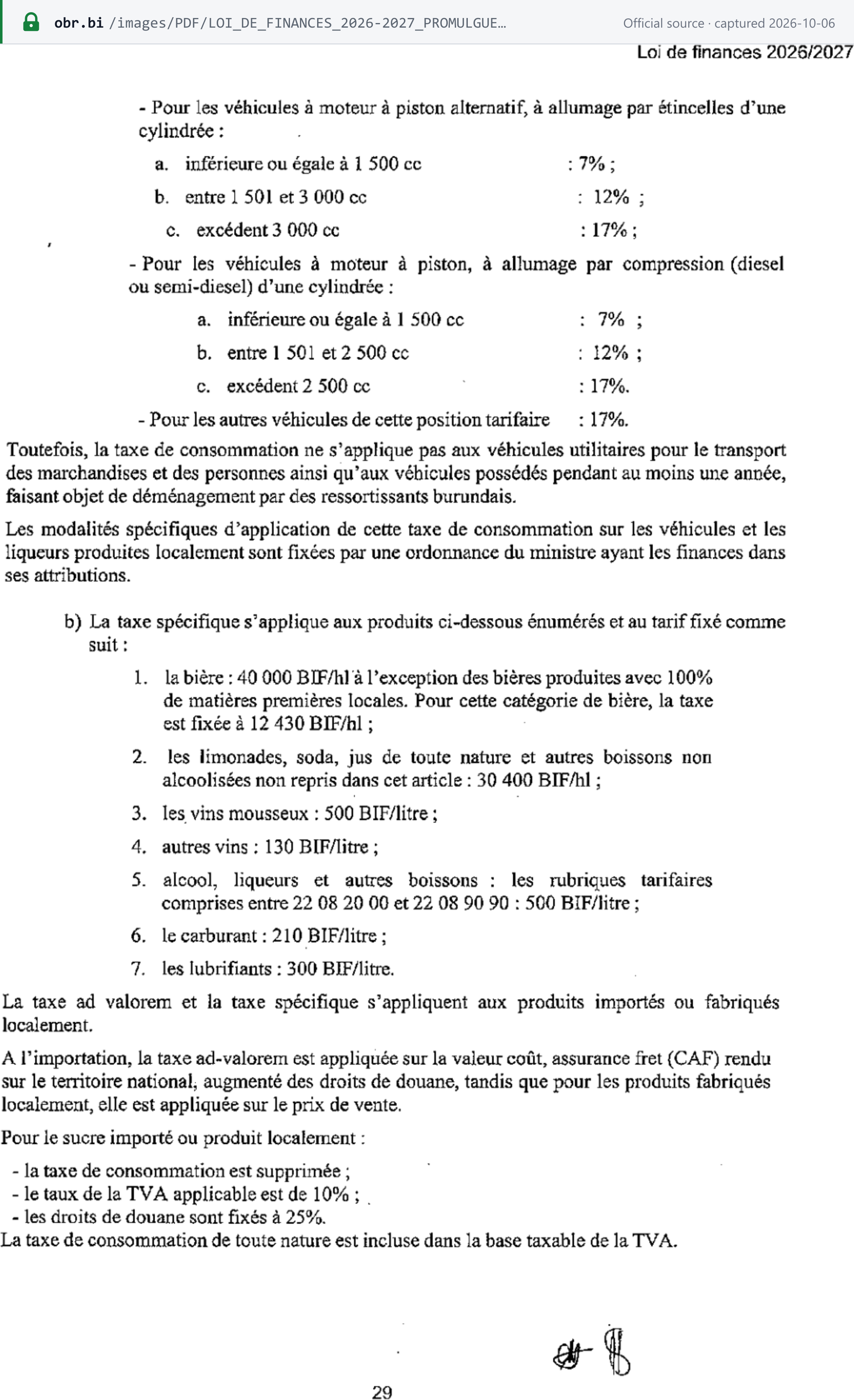
Layering. VAT is a single national tax. A separate excise-type taxe de consommation sits alongside it and forms part of the VAT base: "La taxe de consommation de toute nature est incluse dans la base taxable de la TVA" (Finance Law art. 90, p. 29). The VAT law and the Finance Law provide for no regional or communal VAT. [3]
For neighbouring East African systems, see the Tanzania VAT guide and the Kenya VAT guide.
Registration
Who should register
Burundi has two registration steps:
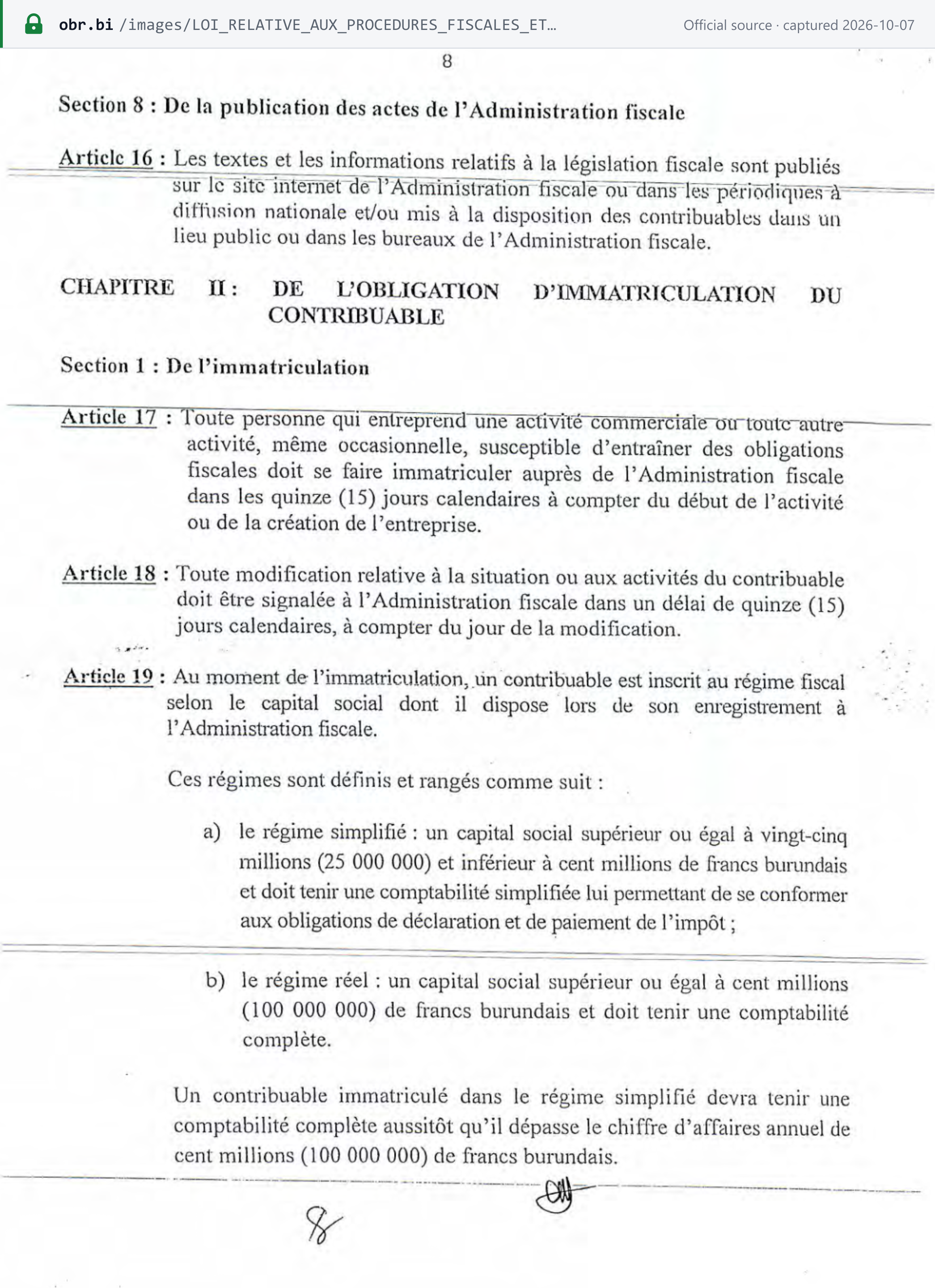
- Tax registration (NIF). Anyone who starts a commercial or other activity, even an occasional one, "susceptible d'entraîner des obligations fiscales" registers with the tax administration within 15 calendar days of starting the activity or creating the business (LPF art. 17). Changes are reported within 15 days (art. 18). [2]
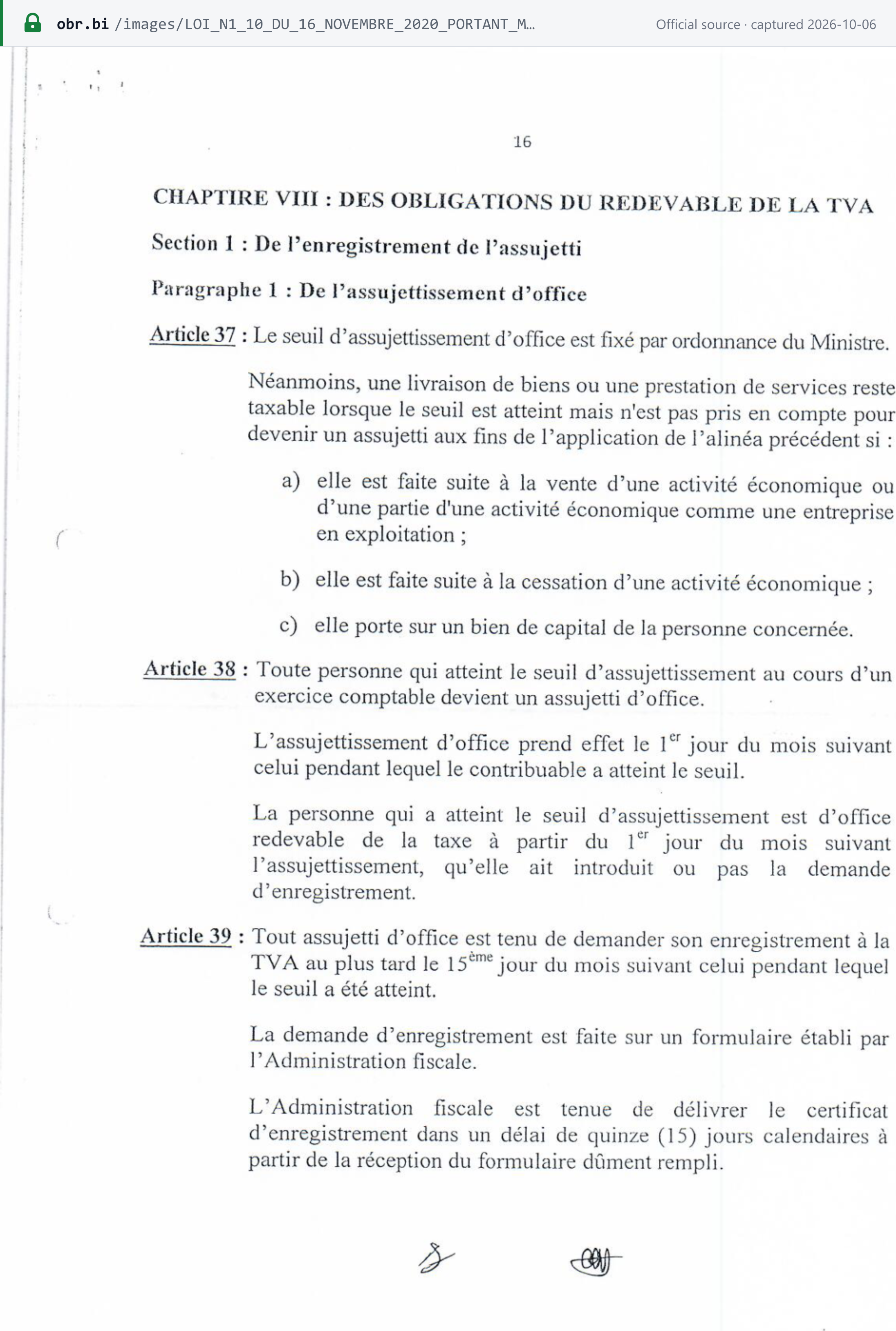
- VAT registration. A person who reaches the compulsory threshold below becomes liable for VAT ("assujetti d'office").
Liability does not wait for the application. "La personne qui a atteint le seuil d'assujettissement est d'office redevable de la taxe à partir du 1er jour du mois suivant l'assujettissement, qu'elle ait introduit ou pas la demande d'enregistrement" (VAT law art. 38). [1]
Registration threshold
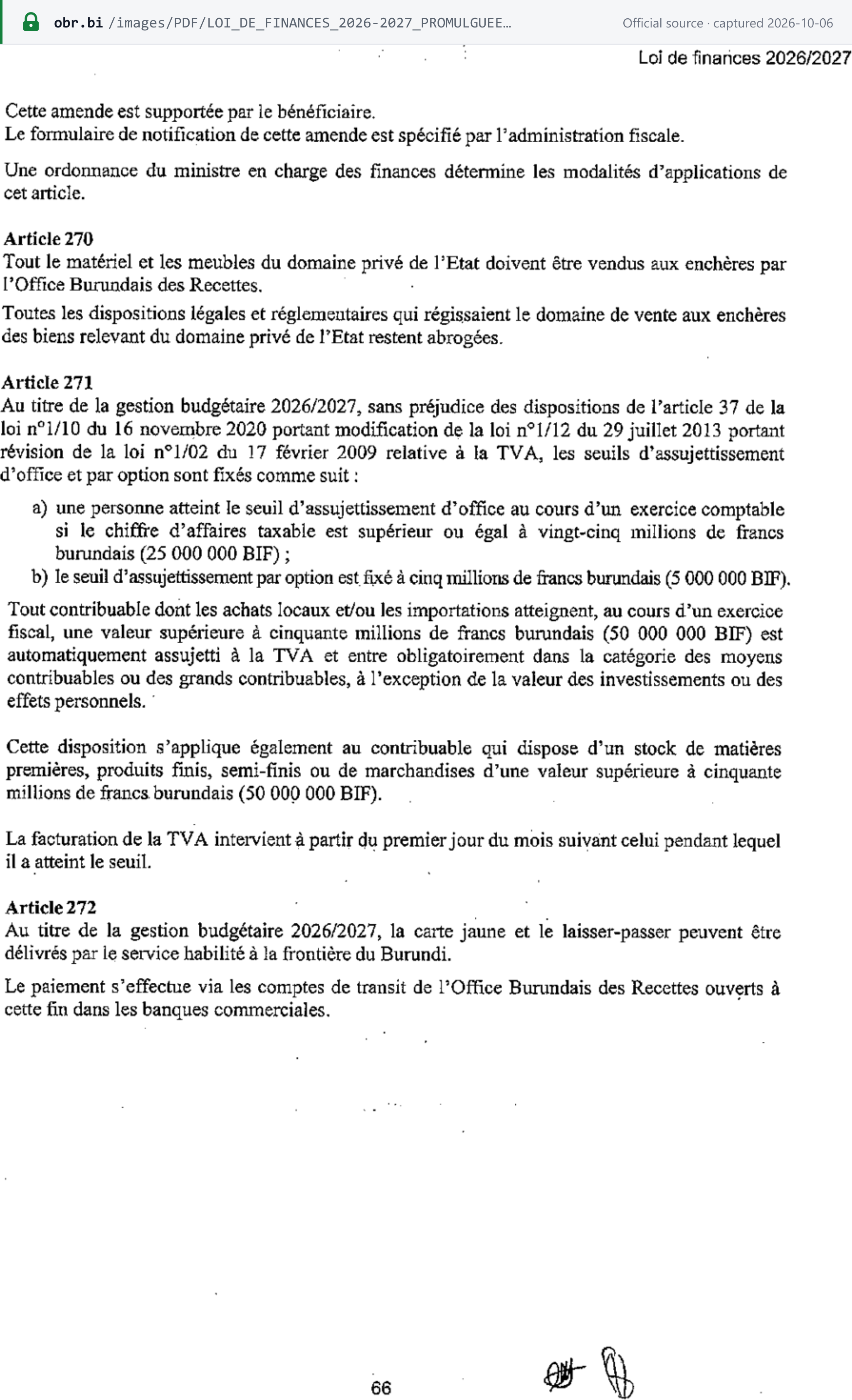
For the 2026/2027 budget year (as at 2026-10-07), article 271 of the Finance Law (p. 66) sets: [3]
| Trigger | Amount | Effect |
|---|---|---|
| Taxable turnover in a financial year ("au cours d'un exercice comptable") | BIF 25,000,000 or more | Compulsory VAT registration |
| Optional registration | BIF 5,000,000 | Voluntary registration threshold |
| Local purchases and/or imports in a fiscal year (excluding investments and personal effects) | More than BIF 50,000,000 | Automatic VAT liability, and mandatory move into the medium or large taxpayer category |
| Stock of raw materials, finished or semi-finished goods or merchandise | More than BIF 50,000,000 | Same as above |
"a) une personne atteint le seuil d'assujettissement d'office au cours d'un exercice comptable si le chiffre d'affaires taxable est supérieur ou égal à vingt-cinq millions de francs burundais (25 000 000 BIF) ; b) le seuil d'assujettissement par option est fixé à cinq millions de francs burundais (5 000 000 BIF)." (Finance Law art. 271)
- The measurement period is the financial year, not a rolling 12 months.
- VAT starts on the first day of the month after the month the threshold is reached: "La facturation de la TVA intervient à partir du premier jour du mois suivant celui pendant lequel il a atteint le seuil" (art. 271, last paragraph; VAT law art. 38).
- The thresholds are set each year. Article 271 applies "au titre de la gestion budgétaire 2026/2027". Check the next Finance Law before relying on these figures after 30 June 2027.
- OBR confirmed the article 271 thresholds in a communiqué of 24 July 2026 (ref. 540/92/CG/01/4947/EM/2026). [5]
Non-resident registration
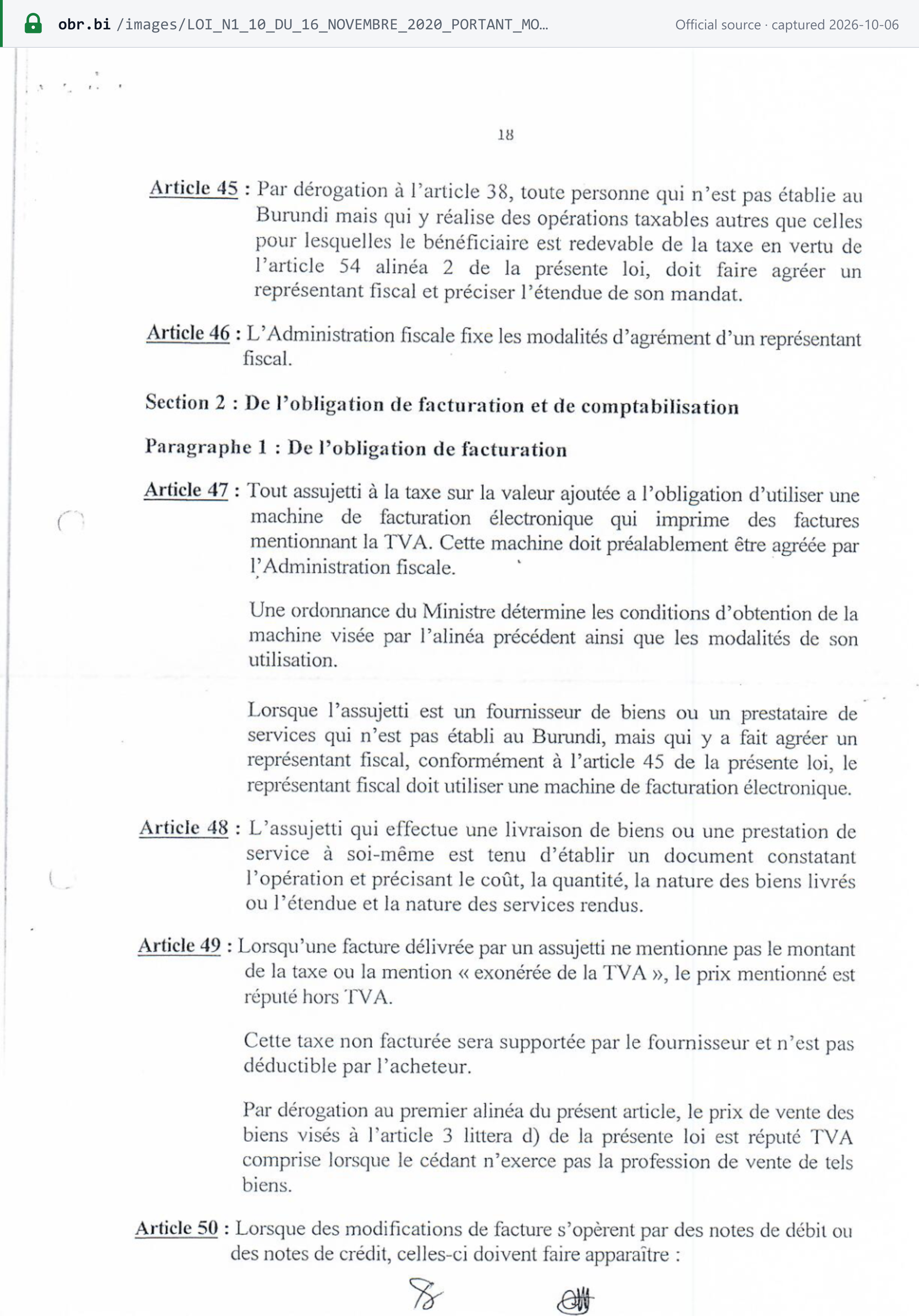
A non-resident has no threshold. A person not established in Burundi who makes taxable supplies there must appoint an approved fiscal representative. The only exception is supplies on which the Burundian customer self-accounts for the VAT (art. 54 al. 2; see Cross-border rules). The rule applies "par dérogation à l'article 38", so the turnover threshold plays no part: [1]
"Par dérogation à l'article 38, toute personne qui n'est pas établie au Burundi mais qui y réalise des opérations taxables autres que celles pour lesquelles le bénéficiaire est redevable de la taxe en vertu de l'article 54 alinéa 2 de la présente loi, doit faire agréer un représentant fiscal et préciser l'étendue de son mandat." (VAT law art. 45)
The fiscal representative must itself use an electronic invoicing machine (art. 47 al. 3).
Tax identification number
The tax number is the NIF (Numéro d'Identification Fiscale). OBR issues it to every registered person "à utiliser pour tous les types d'impôts" (LPF art. 21), so one NIF covers VAT and every other tax. The NIF must appear on returns and commercial documents (art. 22), and banks must record it for their account holders (art. 22 al. 2). [2]
Format. The NIF's length, structure and any check digit are not set out in the LPF, the VAT law, OBR's registration manual or the January 2022 EBMS interfacing specification (as at 2026-10-07). EBMS has a checkTin function for confirming that a NIF is valid. That function sits inside the e-invoicing interface and is not a public lookup; for the public NIF check on OBR's e-KORI portal, see How to verify in the Burundi TIN guide. [9]
Most of the examples OBR itself uses are 10-digit numbers beginning with 4, such as 4005864068 — an observation, not an official rule. See the Burundi TIN guide for the NIF in detail.
How to register
-
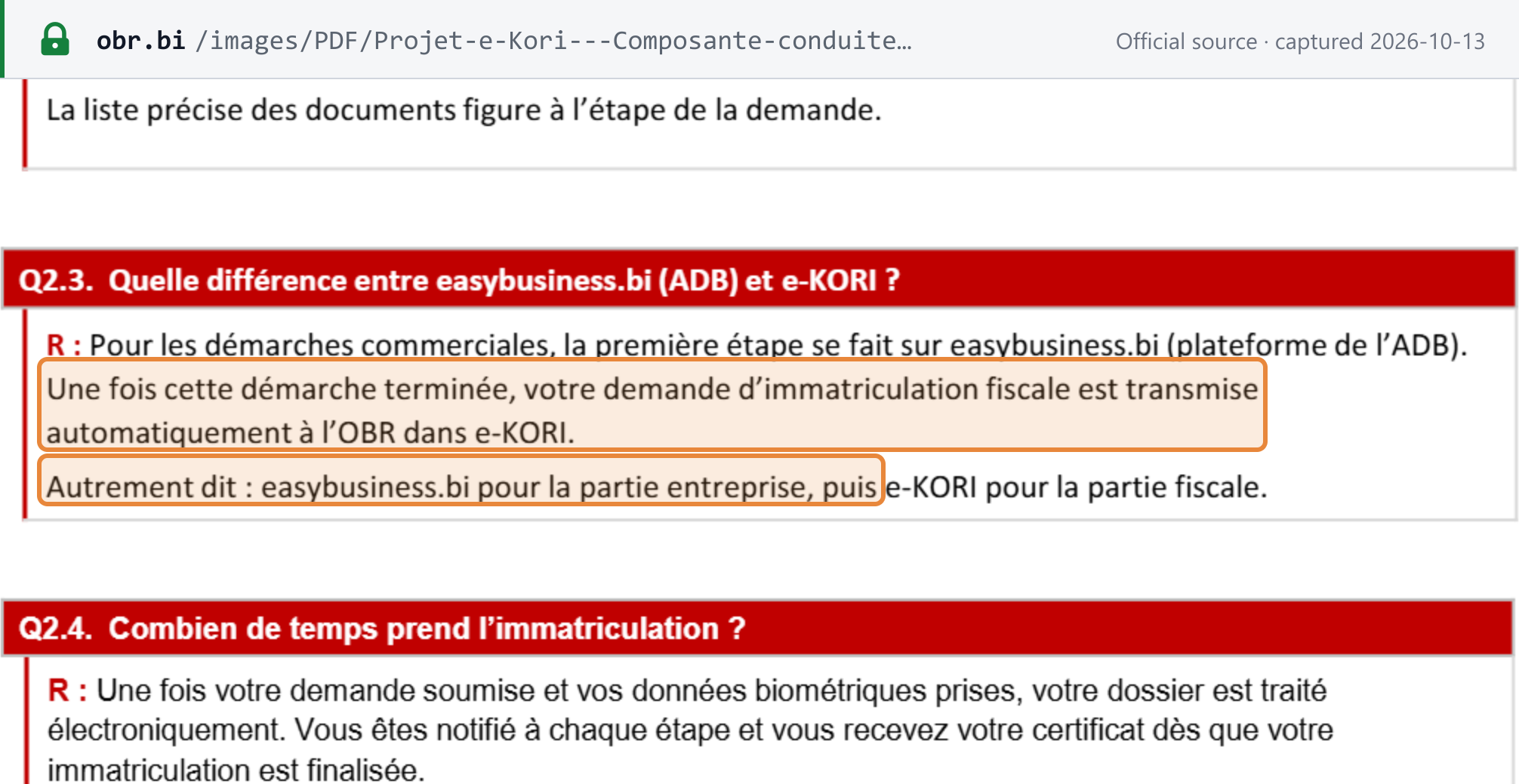
NIF. Registration is now online through OBR's e-KORI portal. Businesses with a commercial activity start on the Burundi Development Agency's one-stop shop, easybusiness.bi, and the tax registration then passes to OBR in e-KORI; individuals give their fingerprints and photo at OBR, and the certificate is emailed. Tax registration (the NIF) is free, and existing NIFs stay valid. [15]
-
Documents (OBR's pre-e-KORI registration manual; e-KORI now shows the exact list during the application, and photos are taken biometrically at OBR):
- individuals: commercial register extract, national ID card or passport, two colour photos;
- companies: statutes, commercial register extract, IDs of the three main shareholders, two photos of the sole partner;
- associations: statutes plus a "texte d'engagement". [6]
-
VAT registration. A person who reaches the threshold applies "au plus tard le 15ème jour du mois suivant celui pendant lequel le seuil a été atteint". OBR must issue the registration certificate within 15 calendar days of receiving the completed form (VAT law art. 39). The certificate must be displayed (art. 43); failing to display it costs BIF 500,000 (art. 62). [1]
Accounting regimes. The LPF links the bookkeeping regime to share capital (art. 19): [2]
- Régime simplifié: capital from BIF 25,000,000 up to BIF 100,000,000; simplified accounts.
- Régime réel: capital of BIF 100,000,000 or more; full accounts.
A simplified-regime taxpayer must keep full accounts once its turnover passes BIF 100,000,000. Taxpayer categories (small, medium, large) are set by ministerial order (art. 23); no copy of that order was found among OBR's published PDFs (as at 2026-10-07).
Voluntary registration
Available, from BIF 5,000,000 of turnover in 2026/2027 (Finance Law art. 271 b). Under VAT law art. 41 the applicant must: [1]
- carry on a real economic activity independently;
- have reached the optional threshold;
- keep full accounts;
- have a stable address; and
- have met its filing obligations in the previous year.
OBR answers within 30 days (art. 42). The usual reason to opt in is input-VAT recovery. VAT paid to an unregistered supplier is not deductible (art. 21 c), and buyers must check that a supplier is registered (art. 32), so registered customers may prefer registered suppliers.
Deregistration
- Voluntary. After 24 consecutive months below the compulsory or optional threshold, a taxpayer may apply for deregistration, from the month after that period (VAT law art. 67). A written request is also possible in a case of force majeure.
- Within 15 days of deregistration, the taxpayer returns the VAT certificate, files a final return and pays the net tax still due (art. 68 al. 2).
- Ex officio. OBR may also deregister a taxpayer itself (art. 69). [1]
Group registration
Not available. The VAT law (arts. 1–73) contains no VAT grouping provision. (Checked 2026-10-06.)
Rates
| Rate | Applies to | Source |
|---|---|---|
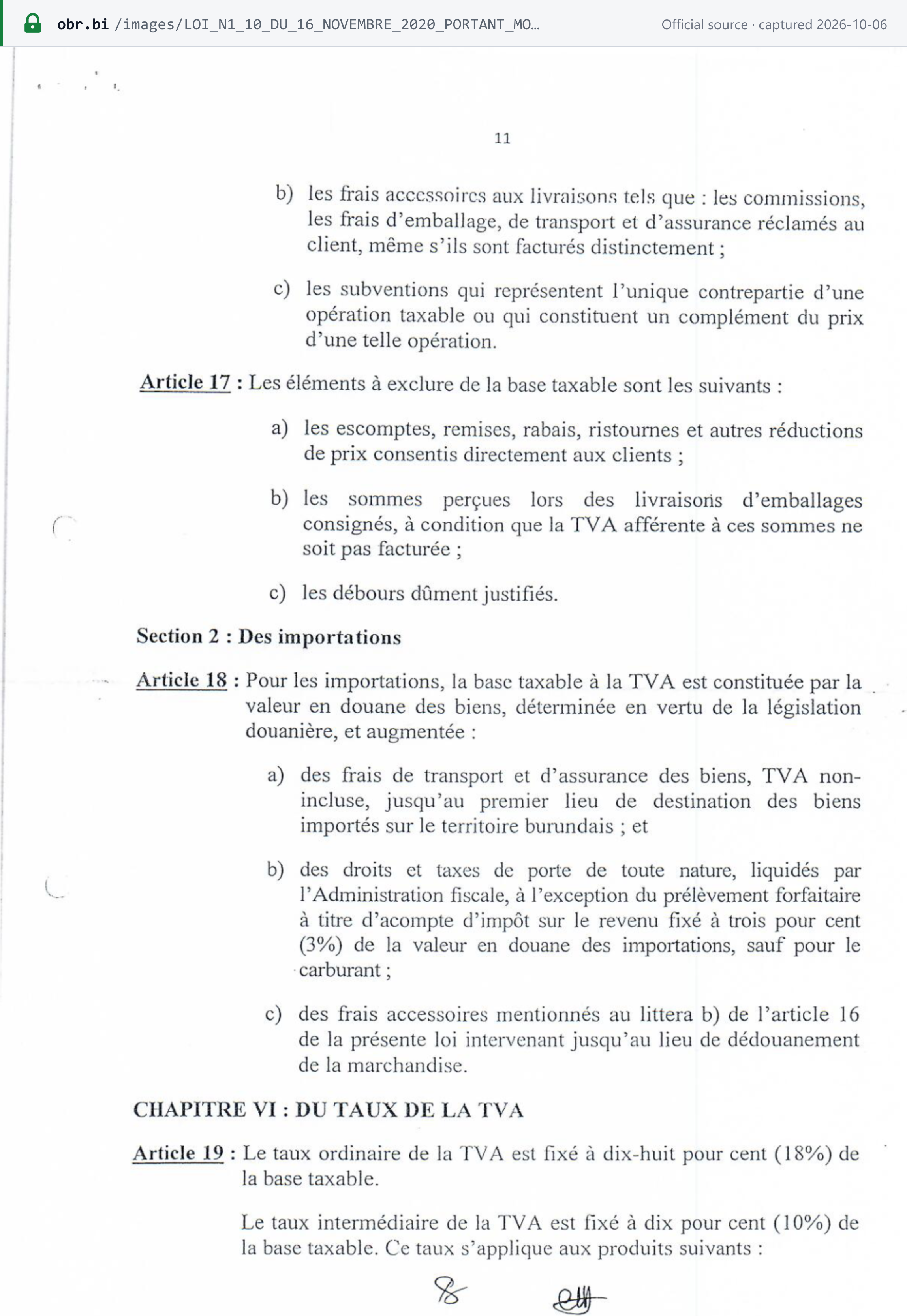
| 18% (ordinary rate, taux ordinaire) | All taxable supplies and imports not given another rate | VAT law art. 19 |
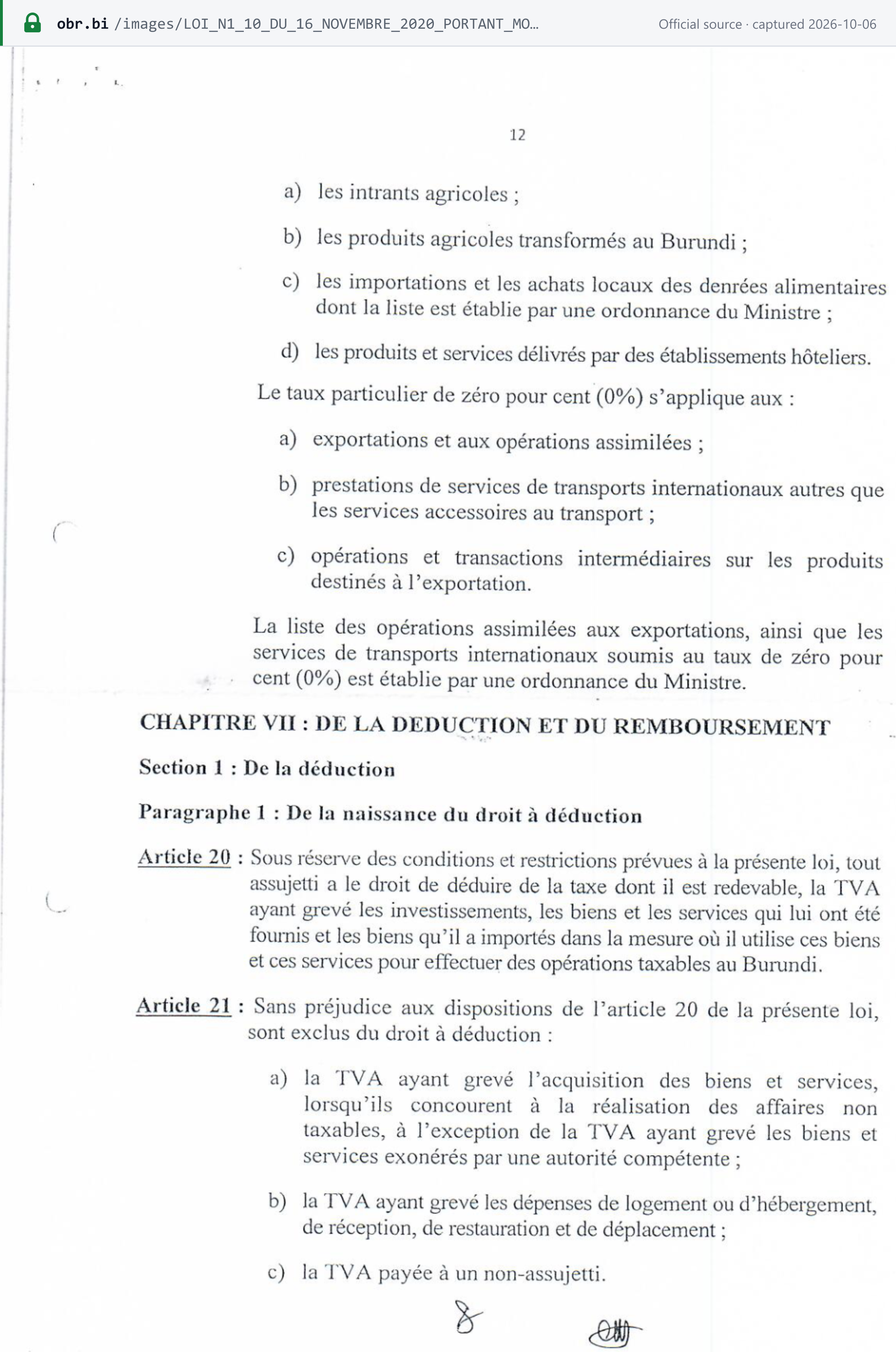
| 10% (intermediate rate, taux intermédiaire) | Agricultural inputs; agricultural products processed in Burundi; imports and local purchases of foodstuffs on a list set by ministerial order; products and services of hotels | VAT law art. 19 |
| 10% — sugar | Imported or locally produced sugar, from 1 July 2026 | Finance Law art. 90 |
| 0% (taux particulier) | Exports and assimilated operations; international transport services other than ancillary services; intermediate operations on goods for export | VAT law art. 19 |
Rates as at 2026-10-07. [1] [3]
"Le taux ordinaire de la TVA est fixé à dix-huit pour cent (18%) de la base taxable. Le taux intermédiaire de la TVA est fixé à dix pour cent (10%) de la base taxable." (VAT law art. 19)
The 2020 law replaces the earlier VAT law, Loi n°1/12 du 29 juillet 2013 (title of Loi n°1/10 of 16 November 2020). The list of foodstuffs at 10% is set by a ministerial order, not by the law itself (as at 2026-10-07).
Sugar (Finance Law art. 90, p. 29). "Pour le sucre importé ou produit localement : - la taxe de consommation est supprimée ; - le taux de la TVA applicable est de 10% ; - les droits de douane sont fixés à 25%." [3]
Announced future rates. None found in Finance Law pp. 26–33 and 60–67 (checked 2026-10-06).
Cross-border rules
Imports and exports
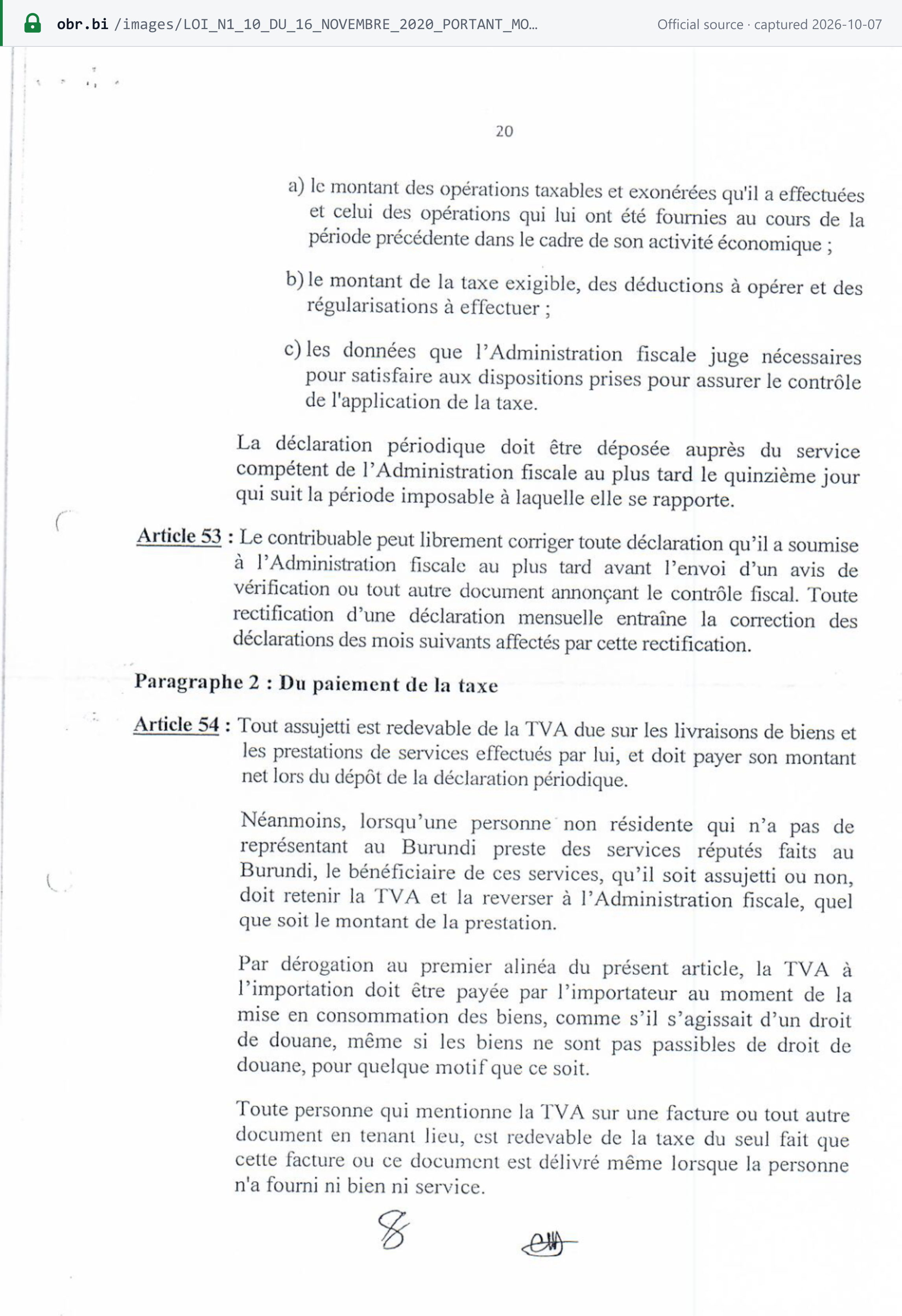
- Imports are taxable whoever imports (VAT law art. 3 b). VAT becomes chargeable when goods are released for consumption (art. 12 d), and "la TVA à l'importation doit être payée par l'importateur au moment de la mise en consommation des biens, comme s'il s'agissait d'un droit de douane" (art. 54 al. 3). [1]
- Import base (art. 18): the customs value, plus transport and insurance to the first destination in Burundi, plus import duties and taxes. The 3% income-tax prepayment on imports is left out of the base, except on fuel. For petroleum products, Finance Law art. 97 sets the base at CIF value plus duties and port taxes. [3]
- Duty-free imports under customs franchise are exempt (art. 10 m). To deduct import VAT, the importer needs an import document in its name showing payment (art. 22 b).
- De-minimis. The VAT law and the Finance Law VAT articles set no low-value import relief (checked 2026-10-06).
- Importers' e-invoicing system. "Tout importateur de marchandises ou matières premières destinées à la revente ou à l'usage industriel, doit prouver qu'il possède un système de facturation électronique reconnue par l'administration fiscale" (Finance Law art. 100, p. 32). Earlier, in a communiqué of 19 September 2025, OBR told taxpayers using their own invoicing systems that anyone who had not updated their stock-management module by 20 October 2025 "ne pourra plus dédouaner ses marchandises". [3] [13]
- Exports are zero-rated, and the exporter keeps the right to deduct input VAT (arts. 19–20). OBR's FAQ lists an operating licence, a commercial invoice, a tax certificate and a bank payment slip for export fees. [14]
Reverse charge on services from non-residents
"Néanmoins, lorsqu'une personne non résidente qui n'a pas de représentant au Burundi preste des services réputés faits au Burundi, le bénéficiaire de ces services, qu'il soit assujetti ou non, doit retenir la TVA et la reverser à l'Administration fiscale, quel que soit le montant de la prestation." (VAT law art. 54 al. 2)
The customer withholds the VAT whatever the amount, and whether or not it is VAT-registered. A registered customer can deduct the VAT once it has been paid, on the strength of the invoice (art. 22 c). [1] For how the mechanism works in general, see Lookuptax's reverse charge explainer.
Digital products and services
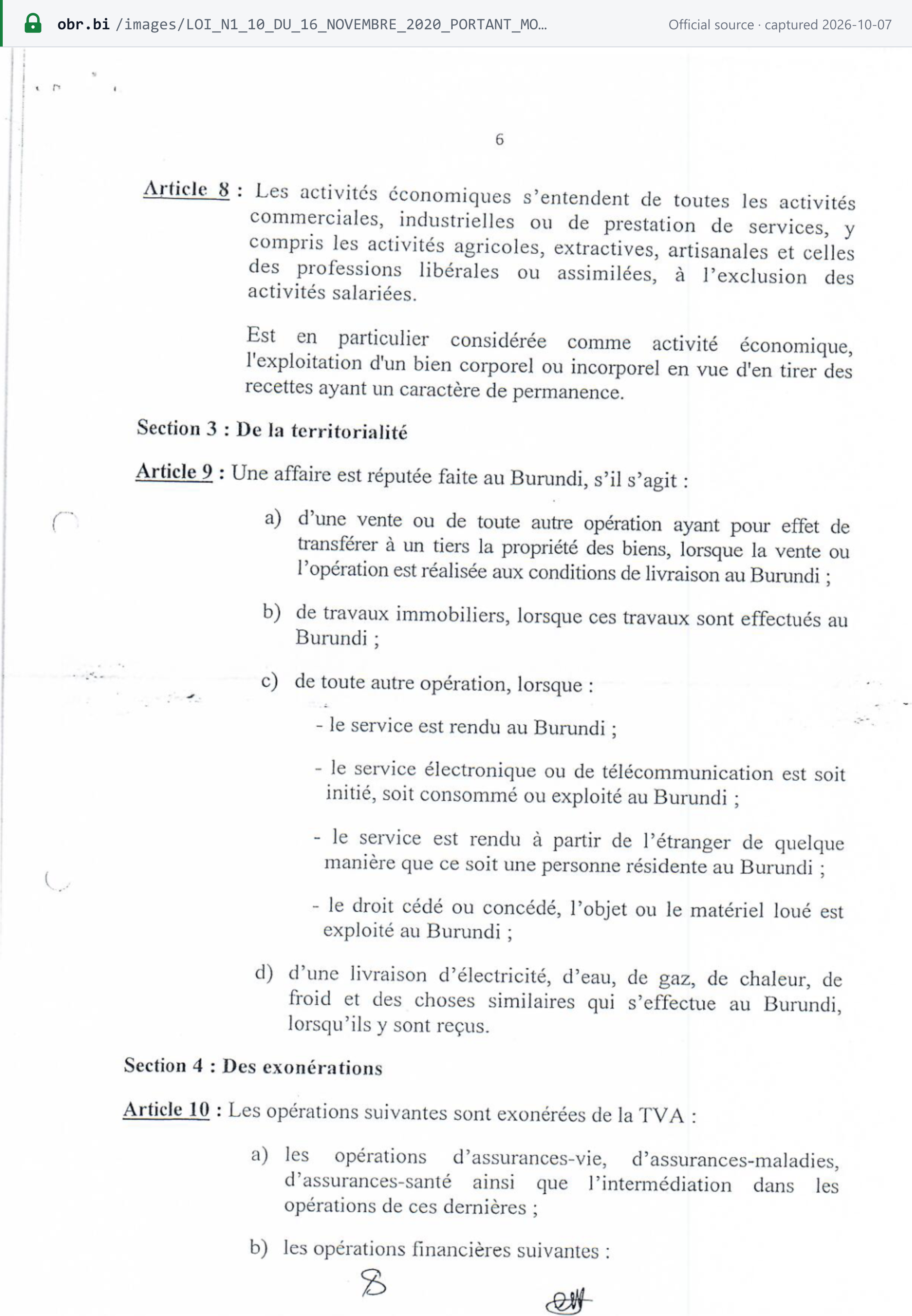
Electronic and telecommunication services are deemed supplied in Burundi when they are "soit initié, soit consommé ou exploité au Burundi" (art. 9 c). Article 2 h defines electronic services to include hosting, remote maintenance, software and its updates, audiovisual content, databases, games including gambling, and distance teaching. [1]
Neither the VAT law nor the Finance Law VAT articles provide a simplified registration scheme for non-resident digital suppliers (checked 2026-10-06). The legal duty to account for VAT on these services falls on the Burundian recipient under art. 54 al. 2. OBR publishes no guidance on how that is enforced for private consumers. For how other countries tax this, see Lookuptax's guide to VAT on digital services by non-resident suppliers.
Foreign companies selling into Burundi — B2B and B2C
| Supply by a non-resident | Who accounts for the VAT |
|---|---|
| Services to a business (B2B) | The Burundian customer withholds and pays the VAT (art. 54 al. 2). The supplier needs no fiscal representative for these supplies (art. 45 carve-out) |
| Services, including electronic services, to a consumer (B2C) | In law, also the recipient: art. 54 al. 2 applies "qu'il soit assujetti ou non". No non-resident registration scheme exists |
| Goods and other taxable supplies in Burundi | The supplier, through an approved fiscal representative who uses an e-invoicing machine (arts. 45, 47) |
| Goods imported by a Burundian customer | The importer pays import VAT at release for consumption (art. 54 al. 3) |
Marketplace / platform deemed-supplier liability
Not applicable. The VAT law and the Finance Law 2026/2027 contain no deemed-supplier rule for marketplaces or platforms (checked 2026-10-06).
Place of supply
An operation is deemed made in Burundi (art. 9): [1]
- Goods: where a sale or other transfer of ownership is made on delivery terms in Burundi.
- Construction work: where the work is carried out in Burundi.
- Services and other operations, where:
- the service is rendered in Burundi;
- an electronic or telecommunication service is initiated, consumed or used in Burundi;
- the service is rendered from abroad to a person resident in Burundi; or
- a right assigned, or an object or equipment hired out, is used in Burundi.
- Utilities: where they are received.
Invoice requirements
Burundi regulates both what the invoice looks like and how it is produced:
- The model. Input VAT is deductible only on "une facture conforme au modèle établi par l'administration fiscale" (VAT law art. 22 a). Supplying without "une facture conforme au modèle initié par l'Administration fiscale" is an offence (LPF art. 129 10°). [1] [2]
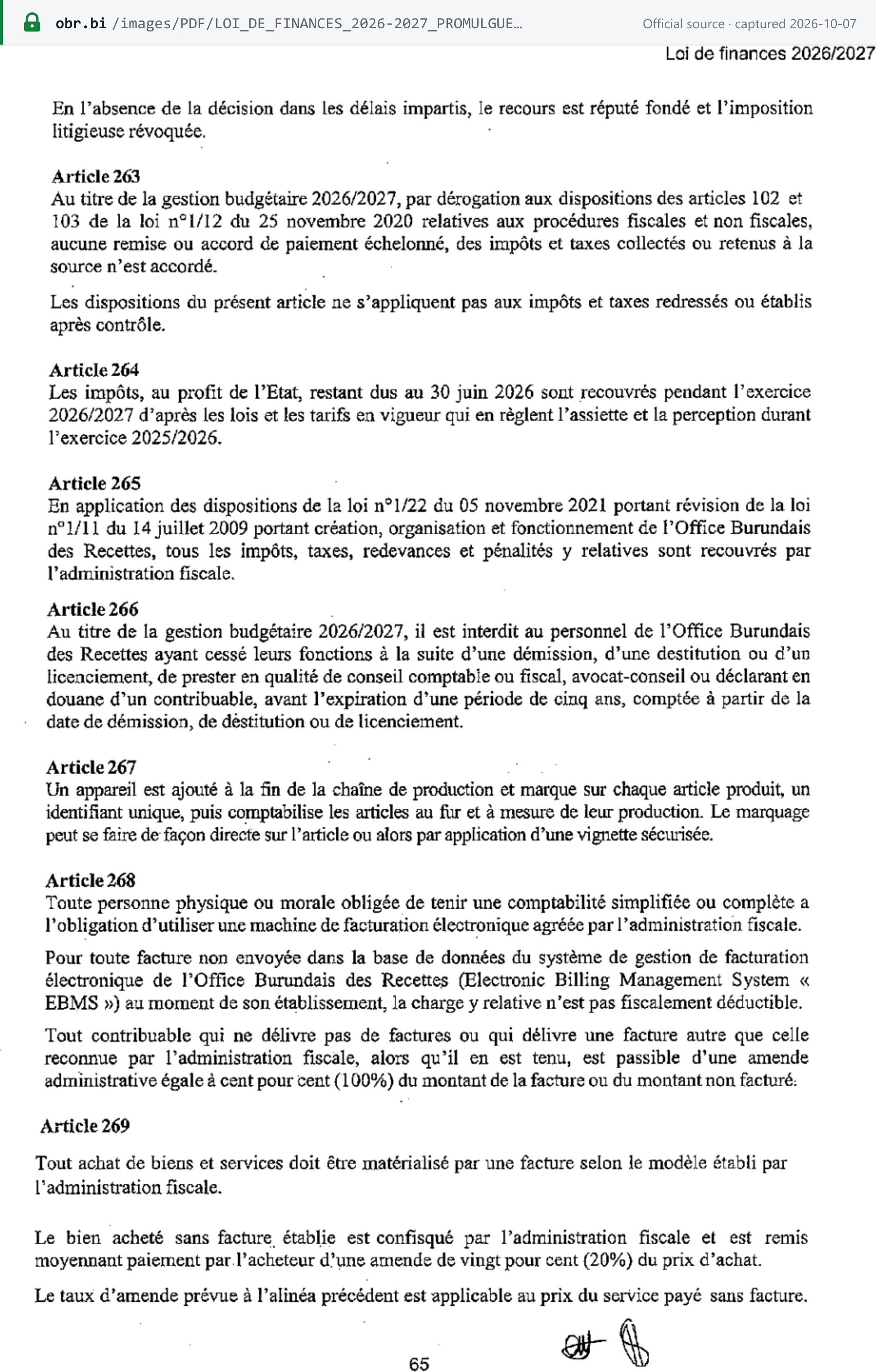
- Every purchase. Since 1 July 2026, "Tout achat de biens et services doit être matérialisé par une facture selon le modèle établi par l'administration fiscale" (Finance Law art. 269). [3]
- The machine. "Tout assujetti à la taxe sur la valeur ajoutée a l'obligation d'utiliser une machine de facturation électronique qui imprime des factures mentionnant la TVA. Cette machine doit préalablement être agréée par l'Administration fiscale" (VAT law art. 47). From 1 July 2026, Finance Law art. 268 extends the obligation to every person required to keep simplified or full accounts. See E-invoicing status. [1]
Mandatory content
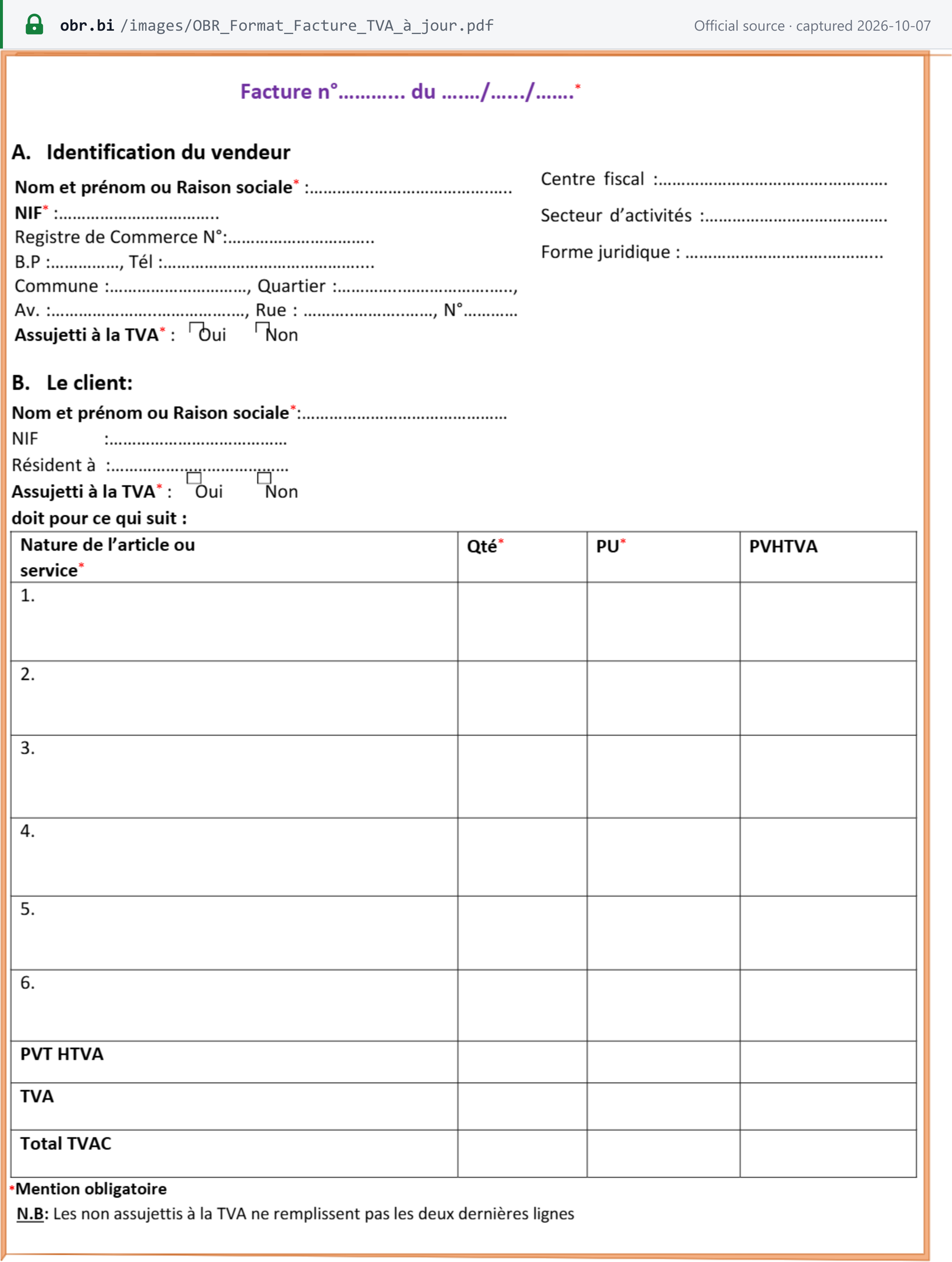
OBR publishes an official VAT invoice model ("Format Facture TVA", current version). It marks the mandatory fields with an asterisk ("*Mention obligatoire"). [4]
| Block | Field | Mandatory (*) |
|---|---|---|
| Head | Facture n° … du …/…/… (number and date) | Yes |
| A. Seller (Identification du vendeur) | Name or company name (Nom et prénom ou Raison sociale) | Yes |
| NIF | Yes | |
| Commercial register number | — | |
| P.O. box, telephone | — | |
| Address: commune, quarter, avenue, street, number | — | |
| VAT-registered: yes / no (Assujetti à la TVA : Oui / Non) | Yes | |
| Tax centre (Centre fiscal), business sector, legal form | — | |
| B. Client (Le client) | Name or company name | Yes |
| NIF | — | |
| Resident at (Résident à) | — | |
| VAT-registered: yes / no | Yes | |
| Lines | Nature of the goods or service | Yes |
| Quantity (Qté) | Yes | |
| Unit price (PU) | Yes | |
| Price excluding VAT (PVHTVA) | — | |
| Totals | Total excluding VAT (PVT HTVA), VAT (TVA), total including VAT (Total TVAC) | — |
The model's footnote: "N.B: Les non assujettis à la TVA ne remplissent pas les deux dernières lignes" — a seller not registered for VAT leaves the VAT and VAT-inclusive total lines empty. OBR also publishes the model in Kirundi. [8]
Prices without VAT shown are treated as VAT-exclusive. "Lorsqu'une facture délivrée par un assujetti ne mentionne pas le montant de la taxe ou la mention « exonérée de la TVA », le prix mentionné est réputé hors TVA. Cette taxe non facturée sera supportée par le fournisseur et n'est pas déductible par l'acheteur" (VAT law art. 49). One exception: for the goods in art. 3 d, the price is deemed VAT-inclusive when the seller is not in the trade of selling such goods (art. 49, last paragraph). And VAT shown is VAT owed: whoever shows VAT on an invoice owes it, even if nothing was supplied (art. 54 al. 4). [1]
Issuance deadline
There is no calendar deadline after the supply. The invoice must reach EBMS "au moment de son établissement" — when it is drawn up (Finance Law arts. 99 and 268). OBR's e-invoicing FAQ adds: "L'envoi des données doit être automatique dès qu'une facture est validée dans le système." [3] [7]
Numbering and sequencing
The model requires an invoice number ("Facture n°"), and credit and debit notes must carry a number "dans une série continue" (VAT law art. 50 a). The VAT law states no separate continuous-series rule for invoices themselves (checked 2026-10-06). In practice the approved machine or system numbers each invoice: the EBMS invoice signature ends with the invoice number. [9]
Credit and debit notes
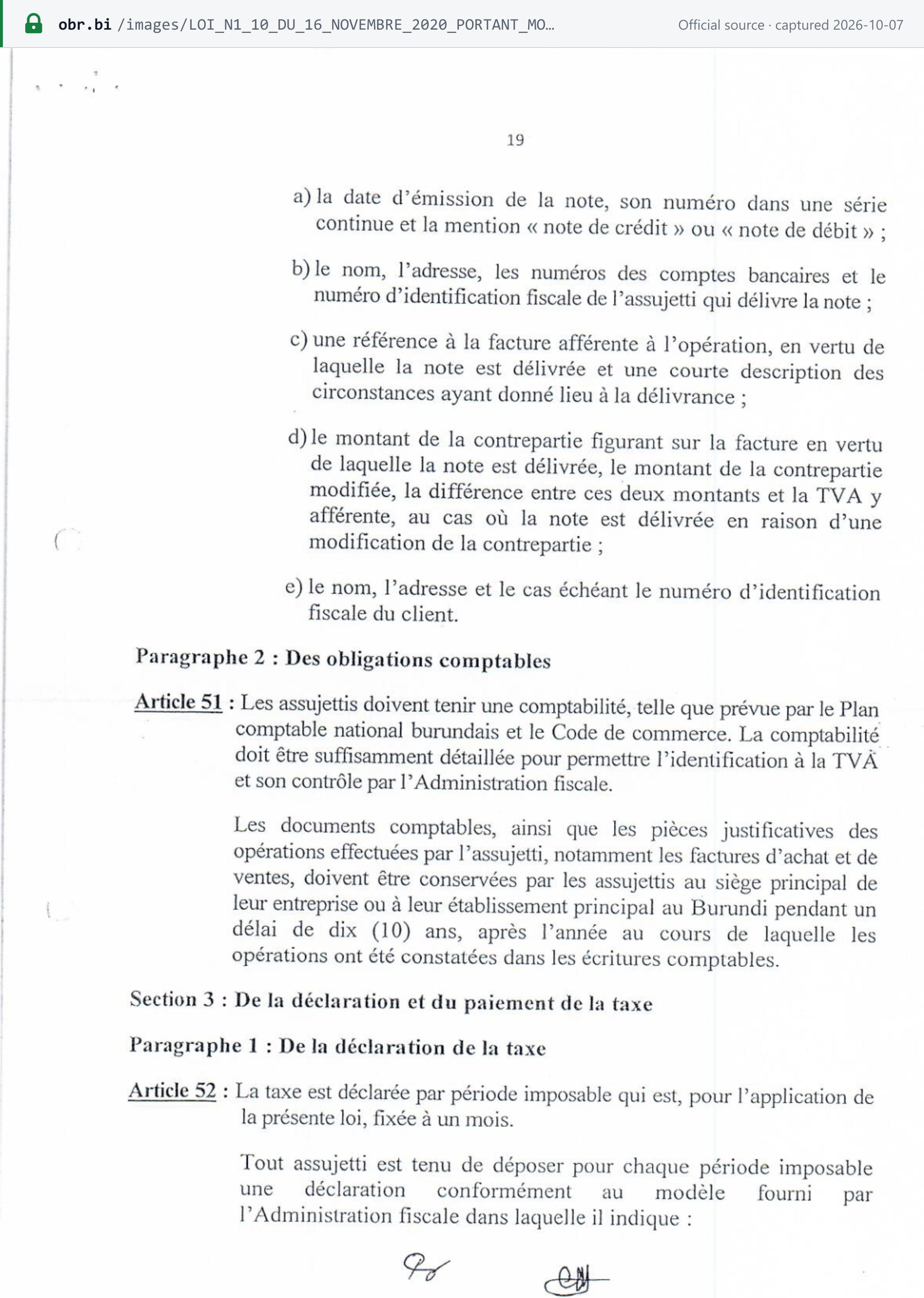
Under VAT law art. 50, a credit or debit note must show: [1]
- the date of issue, its number in a continuous series, and the words "note de crédit" or "note de débit";
- the issuer's name, address, bank account numbers and NIF;
- a reference to the original invoice and a short description of why the note is issued;
- where the price changes, the original amount, the revised amount, the difference, and the VAT on that difference;
- the customer's name, address and, where applicable, NIF.
In EBMS, a cancelled invoice is flagged as type "FA" (facture annulée), with a cancelled_invoice_ref field pointing to it. The interfacing specification describes no separate credit-note invoice type. [9]
Currency and language
No rule. Neither the VAT law, the LPF nor the Finance Law 2026/2027 sets an invoice currency, language or foreign-currency conversion rule (as at 2026-10-07). OBR's official models are in French and Kirundi.
Document types
- Full VAT invoice on the OBR model, issued from an approved machine or system. This is the only document that supports input-VAT deduction.
- Non-registrant invoice: the same model without the VAT and VAT-inclusive total lines (model footnote).
- Simplified invoice: the VAT law sets no simplified-invoice form or value threshold (checked 2026-10-06).
- Banks and other non-invoicing businesses do not issue invoices for their operations but send transaction data to EBMS in OBR's format (e-invoicing FAQ, Q6). [7]
Self-billing
Not provided for. The VAT law contains no self-billing provision (checked 2026-10-06).
Retention and audit trail
- Retention: 10 years. Accounting documents and supporting records, "notamment les factures d'achat et de ventes", are kept "au siège principal de leur entreprise ou à leur établissement principal au Burundi pendant un délai de dix (10) ans, après l'année au cours de laquelle les opérations ont été constatées dans les écritures comptables" (VAT law art. 51 al. 2). The LPF also sets 10 years from the end of the fiscal year, at premises in Burundi (art. 32). [1] [2]
- Electronic-only archiving: the VAT law and the LPF do not say whether a paper-free archive satisfies these rules (as at 2026-10-07).
- Integrity. OBR's e-invoicing FAQ requires an electronic invoice to guarantee the authenticity of its origin, the integrity of its content ("qui ne doit pas être modifiable") and its legibility. [7]
- Acknowledgement. Since 1 June 2024, EBMS has refused invoices from taxpayers' own systems that cannot handle its acknowledgement of receipt (OBR communiqué of 22 March 2024). [12]
- Signature. Each EBMS invoice carries a signature in the form
<NIF>/<system id>/<date and time>/<invoice number>, which ties the document to the issuer and the moment of issue. [9]
A specimen of a compliant invoice
OBR's own model, pictured above, is the official specimen. Below, Lookuptax fills that model's fields in for an illustrative domestic B2B sale at 18%. Every name, number and amount is fictional:
Facture — VAT invoice (OBR model)
| Nature de l'article ou service* | Qté* | PU* | PVHTVA |
|---|---|---|---|
| Ciment, sac de 50 kg | 10 | BIF 40,000 | BIF 400,000 |
| Livraison sur chantier | 1 | BIF 100,000 | BIF 100,000 |
- PVT HTVA
- BIF 500,000
- TVA (18%)VAT law art. 19
- BIF 90,000
- Total TVAC
- BIF 590,000
- * Mention obligatoire — fields marked with an asterisk on the OBR model are mandatory.
- A seller not registered for VAT leaves the TVA and Total TVAC lines empty (model footnote). If a registered seller shows no VAT, the price is deemed VAT-exclusive and the seller bears the VAT — VAT law art. 49.
- Issued from an approved e-invoicing machine or system and sent to EBMS when issued (VAT law art. 47; Finance Law arts. 99, 268). EBMS adds an invoice signature of the form NIF/system id/date-time/invoice number.
- The VAT-inclusive total of BIF 590,000 is above BIF 500,000, so the customer needs a bank or electronic payment trail to deduct the VAT — Finance Law art. 99.
E-invoicing status
Status (as at 2026-10-07): mandatory. Every VAT taxpayer must use an OBR-approved electronic invoicing machine (machine de facturation électronique, MFE / EBM) under VAT law art. 47. From 1 July 2026 the duty also covers every person required to keep simplified or full accounts (Finance Law art. 268). The machines send each invoice to OBR's Electronic Billing Management System (EBMS). [1] [3]
- Model. Real-time reporting: OBR's January 2022 communiqué on EBMS describes the "transfert des données, en temps réel, vers les serveurs de l'OBR". No OBR source describes pre-issue approval of invoices, so this is real-time reporting, not clearance. [9]
- How to comply (e-invoicing FAQ, Q7): connect your own invoicing software to EBMS through OBR's interface, or buy an OBR-approved machine. The conditions for obtaining and using a machine are set by ministerial order n°540/678 of 4 July 2022 (FAQ Q4). OBR no longer hosts that order on its site (as at 2026-10-07). [7]
- Format. A JSON web interface, with functions to log in, add an invoice, retrieve an invoice and check a NIF (January 2022 interfacing specification). It is not UBL or Peppol. [9]
- Scope. All sales by an in-scope taxpayer — B2B, B2G and B2C alike. OBR has published no separate phases by customer type (checked 2026-10-06). In September 2022 OBR's FAQ put "tous les contribuables exerçant les activités génératrices des revenus" in scope, except taxpayers filing quarterly returns, who would join "progressivement". Banks and similar businesses send transaction data rather than invoices (FAQ Q6). [7]
- Outages. If the machine or the connection fails, the taxpayer may issue manual invoices, must tell OBR immediately and enters the invoices afterwards (FAQ Q11). A malfunction must be reported within three working days (VAT law art. 58). [7]
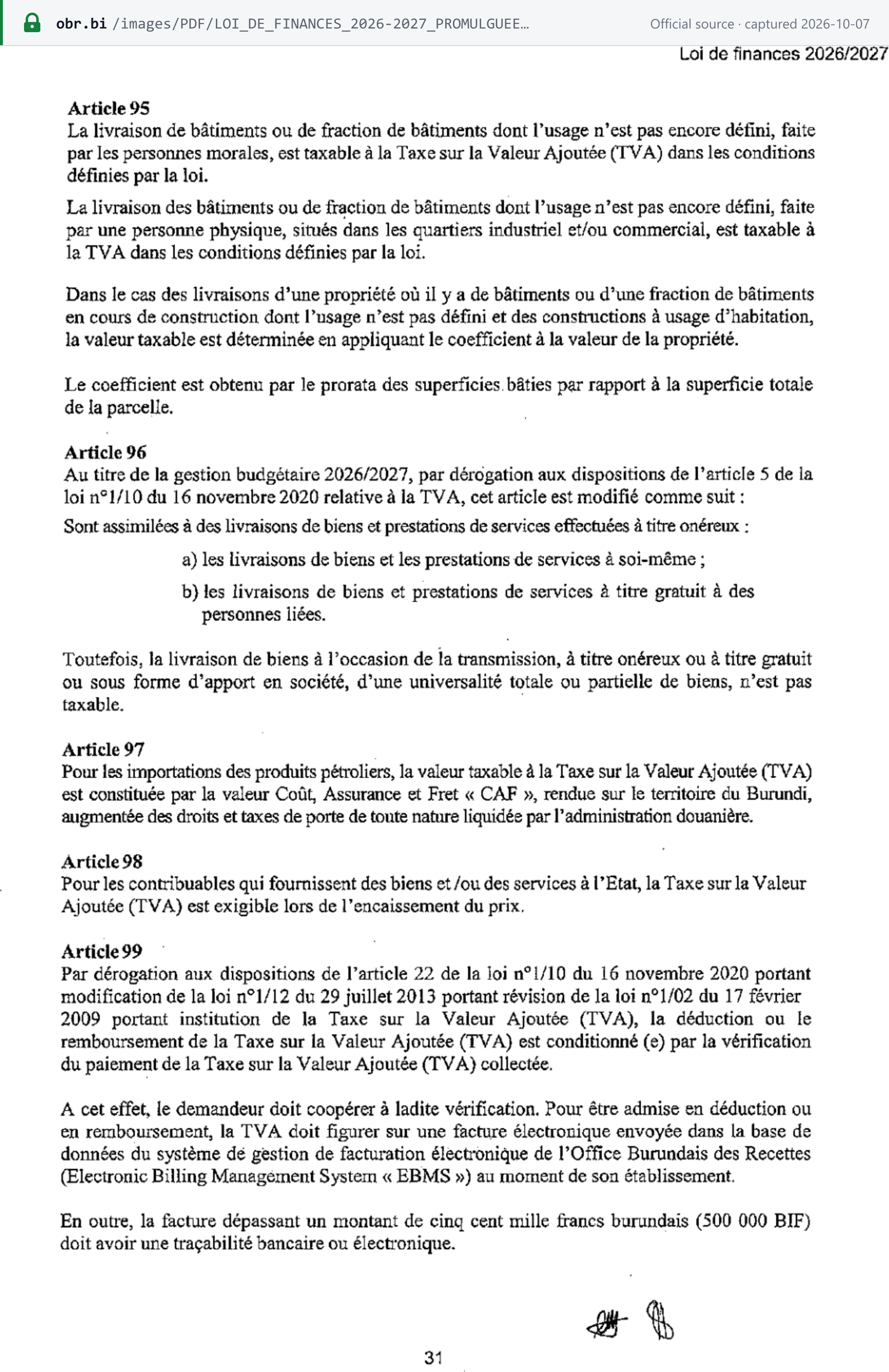
Input VAT only on EBMS invoices (from 1 July 2026). Finance Law art. 99, p. 31: [3]
"Pour être admise en déduction ou en remboursement, la TVA doit figurer sur une facture électronique envoyée dans la base de données du système de gestion de facturation électronique de l'Office Burundais des Recettes (Electronic Billing Management System « EBMS ») au moment de son établissement. En outre, la facture dépassant un montant de cinq cent mille francs burundais (500 000 BIF) doit avoir une traçabilité bancaire ou électronique."
| Date | Step |
|---|---|
| 2020 VAT law (art. 47) | Approved e-invoicing machine mandatory for every VAT taxpayer |
| 4 July 2022 | Ministerial order n°540/678 sets the conditions for obtaining and using the machine |
| 15 September 2022 | OBR FAQ: all income-generating taxpayers in scope, except quarterly filers, who join progressively |
| 1 June 2024 | Taxpayers' own systems must handle EBMS acknowledgements, or their invoices are rejected [12] |
| 20 October 2025 | Own-system users must have updated their stock module, or they cannot clear goods through customs [13] |
| 1 July 2026 | Finance Law 2026/2027: input VAT only on EBMS invoices and the BIF 500,000 traceability rule (art. 99); importers must have a recognised system (art. 100); obligation extended to all bookkeeping taxpayers, and non-EBMS expenses non-deductible (art. 268) |
Lookuptax has no dedicated Burundi e-invoicing guide yet. For Burundi alongside other jurisdictions, see Lookuptax's e-invoicing status and networks table.
Filing and payment
Filing frequency
Monthly. The tax period is one month for every VAT taxpayer (VAT law art. 52). The law sets no quarterly or annual VAT option. [1]
Return due date
The return is due by the 15th of the month after the tax period: "La déclaration périodique doit être déposée auprès du service compétent de l'Administration fiscale au plus tard le quinzième jour qui suit la période imposable à laquelle elle se rapporte" (art. 52). A return may be corrected free of charge before an audit notice (art. 53). [1]
Payment due date and method
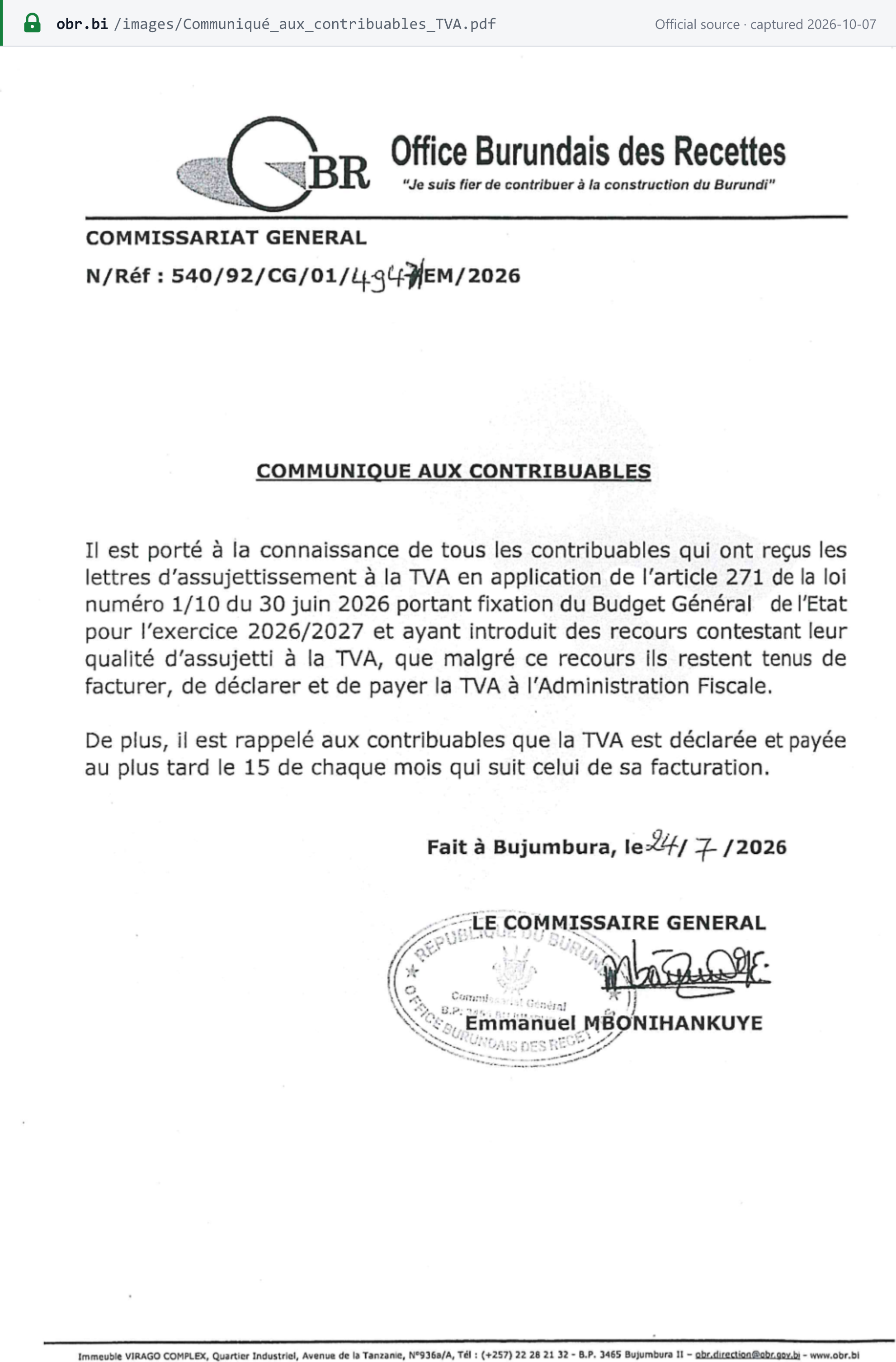
- Same day as the return. VAT is paid by the 15th as well (art. 54 al. 1). OBR repeated this on 24 July 2026: "la TVA est déclarée et payée au plus tard le 15 de chaque mois qui suit celui de sa facturation". [5]
- An appeal does not suspend VAT. The same communiqué says that taxpayers contesting their 2026/2027 VAT liability "restent tenus de facturer, de déclarer et de payer la TVA". [5]
- E-filing. Large and medium taxpayers must file and pay through the Umutangakori portal. Ordonnance ministérielle n°540/1377 du 31/10/2023: "Ils sont tenus d'utiliser le portail « UMUTANGAKORI » pour la déclaration et le paiement des impôts et taxes" (art. 4). Force majeure must be notified within 48 hours (art. 6), and paper filing is allowed during a portal outage (art. 7). [11]
- Cash basis for some suppliers. VAT on services becomes due when the price is received, with an option to account on invoices (art. 12 b, e). Suppliers to the State also account on receipt of the price (art. 12 f). Finance Law art. 98 restates this rule for 2026/2027; it does not introduce it. [1] [3]
Additional listings
Service providers and suppliers to the State, who account on a cash basis, file a monthly statement of unpaid invoices (art. 12). The VAT law sets no annual VAT return or sales and purchase listing (checked 2026-10-06). [1]
Input-tax recovery and blocked items
Input VAT is deductible under art. 20, on an invoice that follows the OBR model (art. 22 a). From 1 July 2026, the invoice must also have been sent to EBMS when issued, and an invoice above BIF 500,000 must have a bank or electronic payment trail (Finance Law art. 99). Blocked under art. 21: [1]
- VAT on goods and services used for non-taxable business, except VAT on goods and services exempted by a competent authority;
- VAT on lodging or accommodation, receptions, meals and travel;
- VAT paid to a person not registered for VAT.
VAT on petroleum products sold at regulated prices is not deductible (art. 66). Mixed taxable and exempt businesses deduct pro rata (art. 23). Buyers must check that their supplier is VAT-registered (art. 32).
Refunds
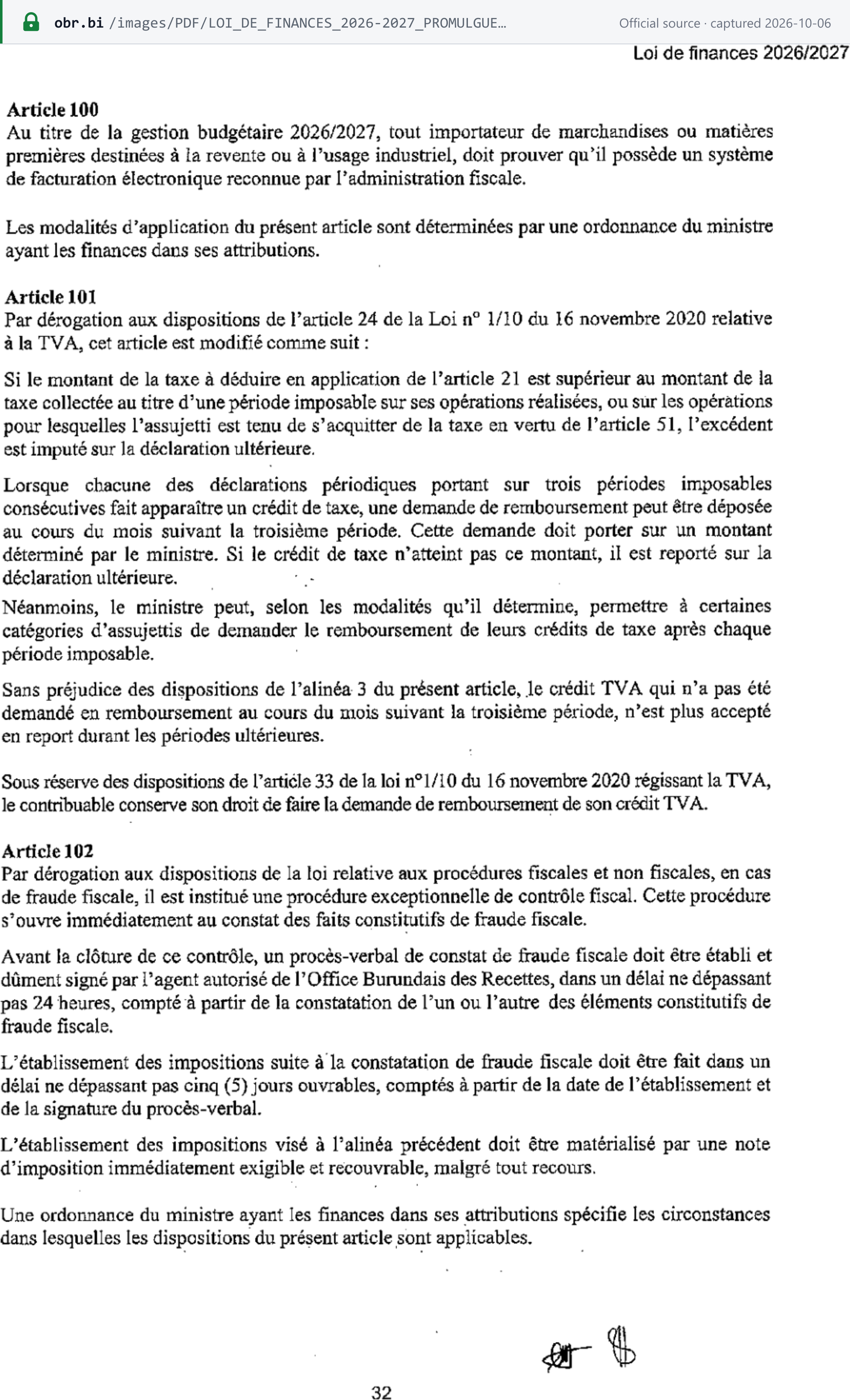
- Credits. An excess credit is carried forward. After three consecutive credit periods, the taxpayer may claim a refund in the month after the third, above a minimum set by ministerial order (art. 24, as replaced by Finance Law art. 101). The minimum is not stated in the law itself (as at 2026-10-07). [3]
- No carry-forward after the claim window. "Le crédit TVA qui n'a pas été demandé en remboursement au cours du mois suivant la troisième période, n'est plus accepté en report durant les périodes ultérieures" (Finance Law art. 101 al. 4). The credit is not lost: the article's last paragraph keeps the right to request its refund, subject to the three-year limit in VAT law art. 33. Article 101 restates the carry-forward bar: OBR has applied it since 1 January 2025, under art. 72 al. 5 of Loi n°1/27 du 30 décembre 2024 (OBR communiqué ref. 540/92/CG/01/1833/EM/2025 of 6 March 2025). [10]
- Timing. A claim may be filed from the 15th (VAT law art. 27). OBR must pay "dans 90 jours calendaires à compter du lendemain du dépôt du dossier complet de la demande" (art. 28). Refunds go only to compliant filers and are offset against tax debts (art. 30). The right to a refund lapses after three years (art. 33). [1]
- Non-residents. Travellers are entitled to a refund (art. 31), on terms set by ministerial order. Diplomatic missions and NGOs under convention pay VAT and reclaim it (arts. 10 i–j, 25). The law has no general refund scheme for foreign businesses.
- Bad-debt relief. None. The VAT law allows only the adjustments in art. 35 b (checked 2026-10-06).
Exemptions
Exempt supplies
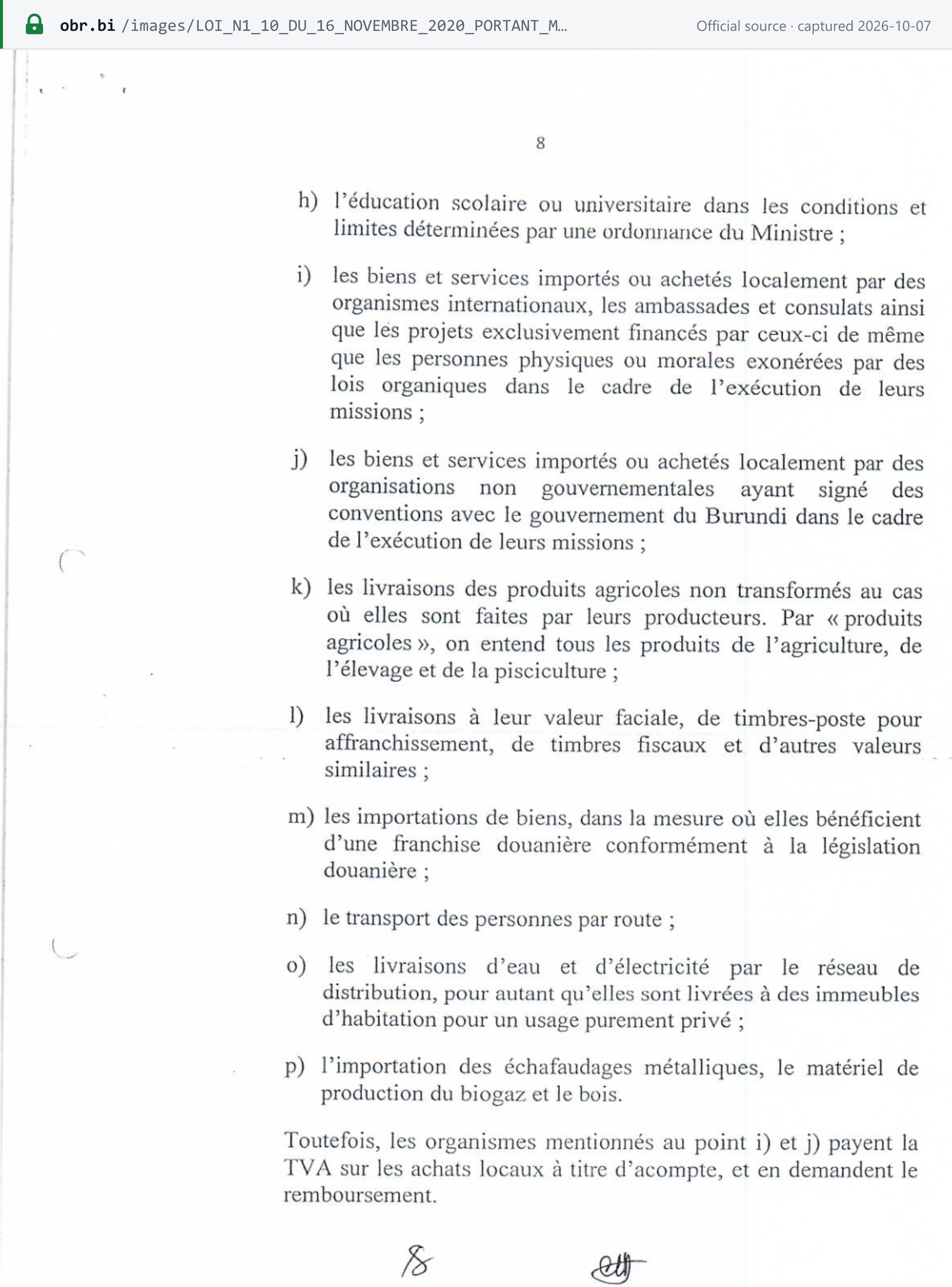
VAT law art. 10 exempts, among others: [1]
- (a) life, health and sickness insurance;
- (b) credit (not the enforcement of security), foreign exchange, securities, bank investment products and financial intermediation. The banking operations that are taxable are listed by ministerial order;
- (c) leasing without a purchase option;
- (d) residential buildings and land, and (e) undeveloped land other than serviced plots;
- (f) letting of immovable property, except parking, storage, hotel and furnished lets of up to three months, and non-residential lets;
- (g) medical care and medicines, and (h) education, within the limits the article sets;
- (i) international organisations, embassies and their projects, and (j) NGOs under convention;
- (k) unprocessed agricultural products sold by their producers;
- (l) postage stamps at face value;
- (m) imports under customs franchise;
- (n) road passenger transport;
- (o) water and electricity supplied to private dwellings;
- (p) imported metal scaffolding, biogas equipment and wood.
2026/2027 changes. For the budget year, the Finance Law makes these taxable: [3]
- supplies of mixed-use buildings ("les livraisons des bâtiments à usage mixte sont taxables à la TVA", art. 247);
- buildings whose use is not defined (art. 95);
- gifts of non-residential buildings or undeveloped land between related parties, other than relatives in the first degree (art. 246).
Exempt is not zero-rated. An exempt supply carries no VAT, but the supplier cannot deduct the input VAT on its costs (art. 21 a). A zero-rated supply — an export, for example — also carries no VAT, and the supplier keeps its right to deduct (arts. 19–20). An exporter can therefore be in a refund position, while an exempt bank or school bears its input VAT as a cost.
Special regimes
- Transfer of a going concern is outside the scope of VAT (arts. 5–6). Insurance indemnities follow art. 65.
- Cash accounting: for services and State suppliers (art. 12 b, e, f; see Payment due date and method).
- No other special scheme: there is no margin scheme, flat-rate or small-business VAT scheme, or free-zone VAT regime. Neither the VAT law nor the Finance Law VAT articles provide one (as at 2026-10-07). Below the BIF 25,000,000 threshold a business simply stays unregistered, unless the BIF 50,000,000 purchases or stock trigger applies.
Offences and penalties
Offences
- Tax offences (LPF art. 129): [2]
- late filing; failure to file or to operate withholding;
- failing to answer an information request or to cooperate with an audit;
- not notifying a change of function;
- failure to register (arts. 17, 20);
- breaching the bookkeeping rules (arts. 28–32);
- unpaid quarterly instalments, and other obligations;
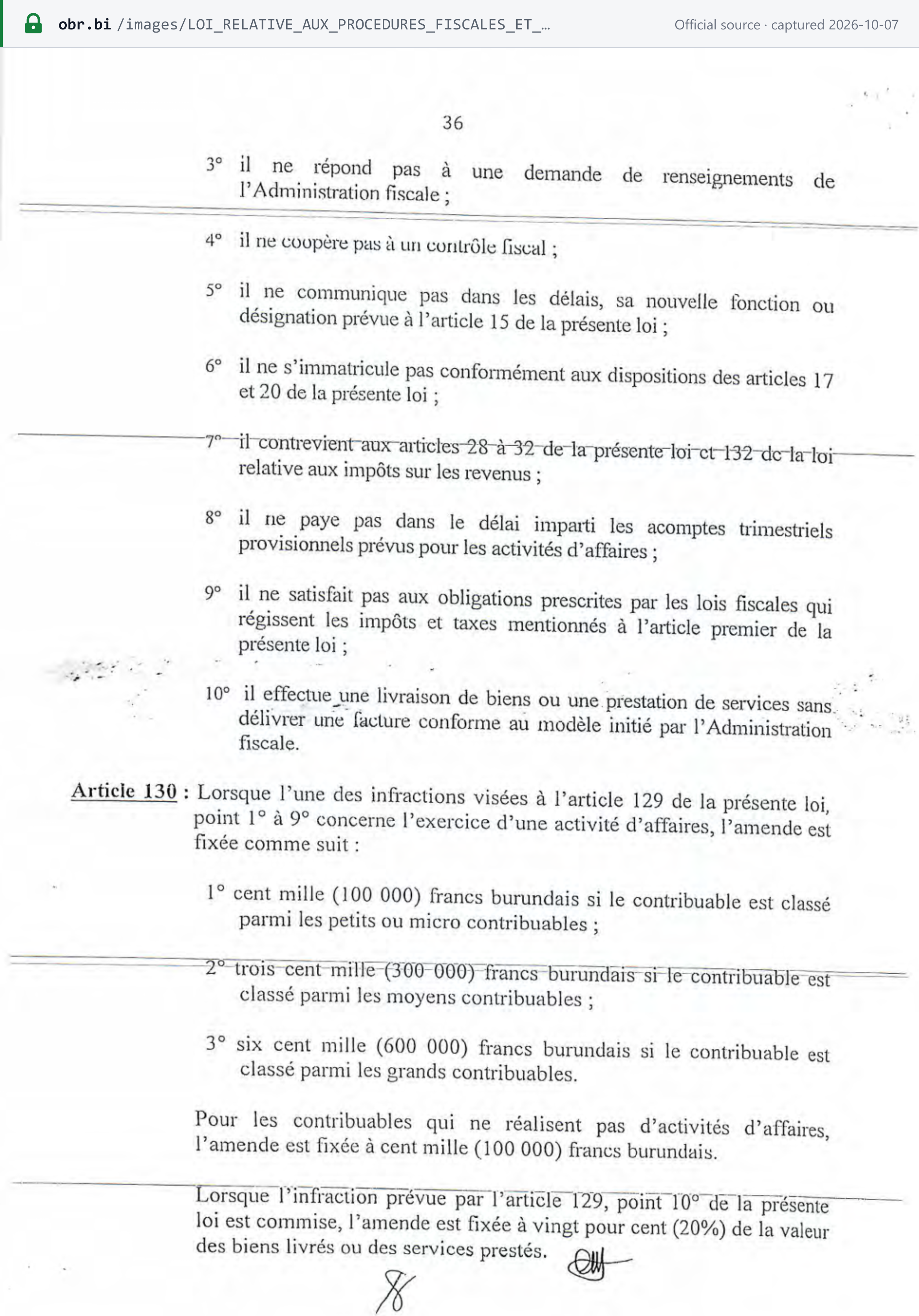
- 10° supplying goods or services "sans délivrer une facture conforme au modèle initié par l'Administration fiscale".
- Fraud. A fine of 100% of the tax evaded (LPF art. 134), with the Penal Code applying (art. 135). The Commissioner General may refer a case to the public prosecutor (art. 138). Prosecution is possible until the end of the fifth year (art. 139), and the penalties double for a repeat within five years (art. 140). Obstruction and complicity attract the same penalties (art. 143).
- Invoicing without stock. "Un contribuable qui émet une facture alors qu'il ne dispose d'aucun stock est passible des sanctions pénales" — the Commissioner General refers the case to the public prosecutor (VAT law art. 58). [1]
- Buying without an invoice. From 1 July 2026 the goods are confiscated, and are returned only once the buyer pays a 20% fine. The same applies to services (Finance Law art. 269). [3]
- Ancillary sanctions:
- suspension from public procurement, and publication of repeat offenders (LPF art. 144);
- closure of a defaulter's establishment (art. 146);
- closure for refusing compliance checks (Finance Law art. 245).
- Imprisonment. The VAT law, the LPF and the Finance Law set no prison term themselves. Criminal exposure comes through referral to the public prosecutor under the Penal Code (as at 2026-10-07).
Penalties
VAT-specific penalties sit in the VAT law, and general procedural penalties in the LPF. Neither law says which prevails where both could apply. Payments are allocated to interest first, then fines, then tax (LPF art. 127). Figures as at 2026-10-07: [1] [2]
| Conduct | Penalty | Source |
|---|---|---|
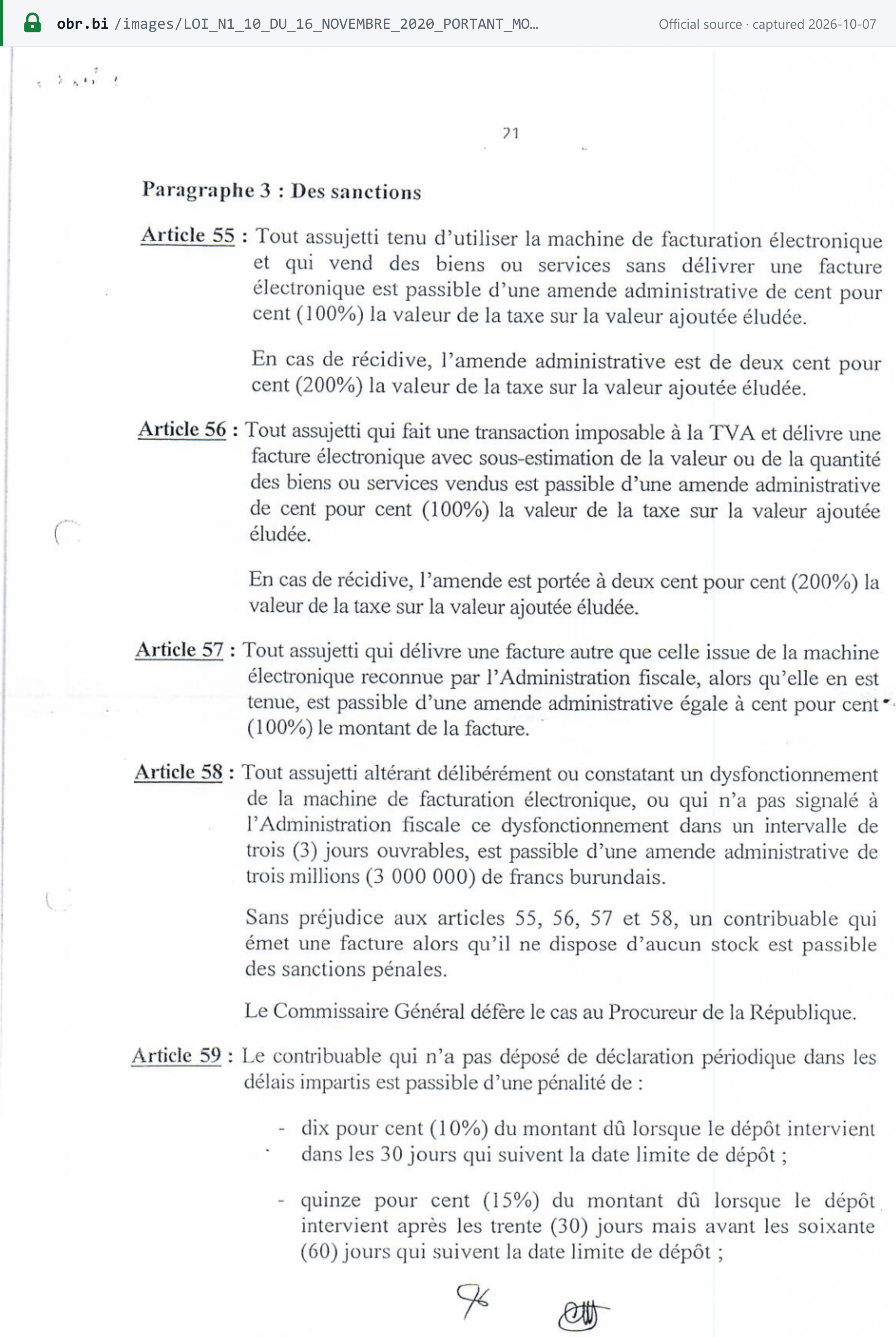
| Selling without issuing an e-invoice | 100% of the VAT evaded; 200% on a repeat | VAT law art. 55 |
| E-invoice showing an understated value | 100%; 200% on a repeat | VAT law art. 56 |
| Invoice not issued from the recognised machine | 100% of the invoice amount | VAT law art. 57; Finance Law art. 268 |
| Tampering with the machine, or not reporting a malfunction within 3 working days | BIF 3,000,000 | VAT law art. 58 |
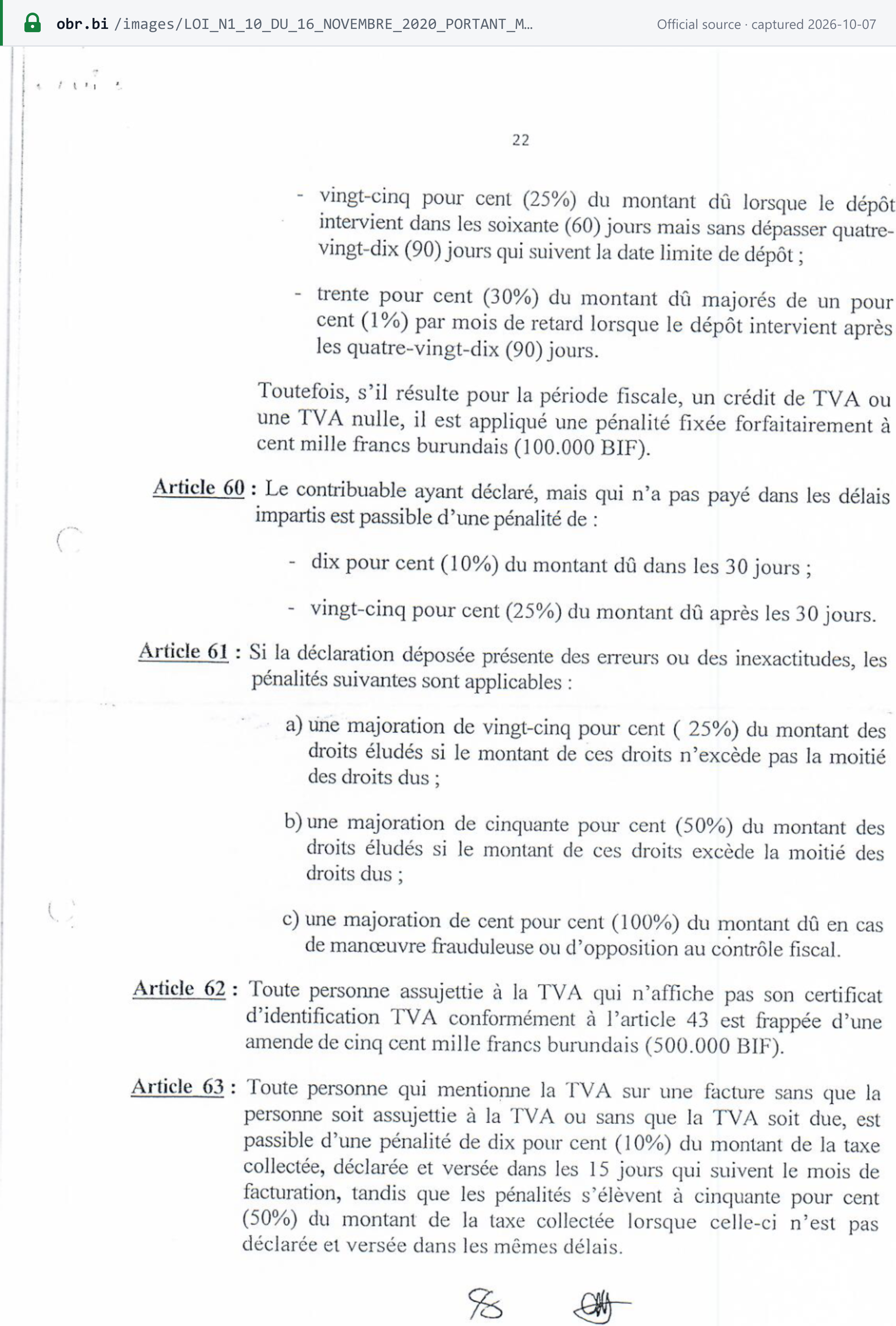
| Late VAT return | 10% (up to 30 days late) · 15% (31–60) · 25% (61–90) · 30% plus 1% a month (over 90). BIF 100,000 flat if the return shows a credit or nil | VAT law art. 59 |
| Late payment of declared VAT | 10% within 30 days; 25% after | VAT law art. 60 |
| Errors in the return | +25% (error up to half the tax due) · +50% (more than half) · +100% (fraud or obstruction) | VAT law art. 61 |
| Registration certificate not displayed | BIF 500,000 | VAT law art. 62 |
| VAT shown on an invoice by a person not registered or not liable | 10% if declared and paid within 15 days after the month of invoicing; otherwise 50% | VAT law art. 63 |
| Other procedural offences (LPF art. 129 1°–9°) | BIF 100,000 (small and micro taxpayers) · BIF 300,000 (medium) · BIF 600,000 (large) · BIF 100,000 (non-business) | LPF art. 130 |
| Supplying without an invoice on the official model (art. 129 10°) | 20% of the value of the goods or services | LPF art. 130 |
| Late payment (general) | 10% | LPF art. 131 |
| Under-estimation of tax | 5%, 10%, 20% or 50%, by band | LPF art. 132 |
| Default assessment | 75% | LPF art. 133 |
| Late-payment interest | The rate set by ministerial order on the first day of each fiscal year, plus 1.5 points; simple interest, monthly, with part months counted in full | LPF art. 126 |
The 2026/2027 interest rate is set by ministerial order, not by the LPF itself (as at 2026-10-07). The Finance Law 2026/2027 also rules out remission or instalments for taxes collected or withheld (art. 263). It sets up an exceptional fraud audit whose assessment is immediately enforceable (art. 102), and gives a three-year reassessment window (art. 251). [3]
Frequently asked questions
Our supplier gave us a paper or spreadsheet invoice. Can we still deduct the VAT in Burundi?
Not for 2026/2027. Article 99 of the Finance Law 2026/2027 allows VAT to be deducted or refunded only if it appears on an electronic invoice sent to OBR's Electronic Billing Management System (EBMS) when the invoice was issued, and an invoice above BIF 500,000 must also be traceable through a bank or electronic payment. Article 268 adds that an expense on an invoice not sent to EBMS when issued is not deductible for tax purposes either. [3]
Our turnover is below BIF 25 million. Can we still be liable for VAT in Burundi?
Yes. Under article 271 of the Finance Law 2026/2027, a taxpayer whose local purchases and/or imports exceed BIF 50,000,000 in a fiscal year is automatically liable for VAT and enters the medium or large taxpayer category, leaving out the value of investments and personal effects. The same applies to a taxpayer holding stock of raw materials, finished or semi-finished goods or merchandise worth more than BIF 50,000,000. [3]
We have appealed OBR's decision that we are VAT-liable. Do we have to charge VAT while the appeal is pending?
Yes. In a communiqué dated 24 July 2026, OBR told taxpayers who have contested their VAT liability for 2026/2027 that, despite the appeal, they remain bound to invoice, declare and pay VAT. The same communiqué recalls that VAT is declared and paid no later than the 15th of the month after the month of invoicing. [5]
A foreign company sells us software or consulting services. Who pays the Burundi VAT?
The Burundian customer. Under article 54 of the VAT law, where a non-resident with no representative in Burundi supplies services deemed made in Burundi, the recipient, whether VAT-registered or not, must withhold the VAT and pay it to the tax administration, whatever the amount. Electronic and telecommunication services initiated, consumed or used in Burundi are deemed supplied there (article 9). [1]
Why can't we carry our VAT credit forward any more?
A credit that is not claimed for refund in the month after the third consecutive credit period can no longer be carried forward to later periods. The credit itself is not lost: article 101 of the Finance Law 2026/2027 keeps the right to request a refund of it, subject to the three-year limit in article 33 of the VAT law. OBR has applied the carry-forward bar since 1 January 2025, under article 72 of Loi n°1/27 of 30 December 2024, and article 101 restates it. Separately, VAT on lodging, receptions, meals and travel is never deductible (VAT law article 21), and from 1 July 2026 neither is VAT on supplier invoices that were not sent to EBMS. [3] [10]
What if our e-invoicing machine breaks down?
Report the malfunction to OBR within three working days: article 58 of the VAT law fines a taxpayer BIF 3,000,000 for failing to do so, or for deliberately tampering with the machine. OBR's e-invoicing FAQ allows manual invoices during an outage, provided OBR is told immediately and the invoices are entered into the system afterwards. [1] [7]
Important websites
As at 2026-10-07, OBR's HTML pages return an error. The PDF links below load; the portal links are given for navigation only.
| Site | Purpose |
|---|---|
| OBR — Office Burundais des Recettes | Tax authority home page (HTML pages currently erroring) |
| Umutangakori portal | E-filing and e-payment of VAT and other taxes (mandatory for large and medium taxpayers) |
| OBR — Registration of taxpayers | NIF registration information |
| OBR — Registration procedures manual (PDF) | Pre-e-KORI registration procedures and document lists |
| OBR — e-KORI | Online NIF registration and the public "Contrôle de NIF en ligne" check |
| easybusiness.bi (Burundi Development Agency) | Company registration one-stop shop; the tax registration then passes to e-KORI |
| OBR — EBMS | E-invoicing system: legal provisions, connection guide, FAQ, machine breakdown procedure |
| OBR — Official invoice model, French (PDF) · Kirundi (PDF) | The invoice layout OBR requires |
| OBR — Document verification | Legacy check of OBR-issued documents, with a "NIF contribuable" option; e-KORI now also offers a document check ("Contrôle des documents émis par l'OBR") |
| OBR — Tax forms | Return and registration forms |
| OBR — Laws and regulations · Ordinances | Legal texts, including ministerial orders |
| OBR — ASYCUDA World | Customs declarations and import VAT |
OBR also runs a free helpline on 500 (OBR FAQ, Q14). [14] For e-invoicing, OBR's e-invoicing FAQ gives tél. 22 28 24 59 and [email protected]. There is no official rate-lookup tool; the rates are in VAT law art. 19 and the Finance Law.
Recent changes
- 2026-07-24 — OBR communiqué: an appeal against VAT liability under article 271 does not suspend the duty to invoice, declare and pay VAT, which is due by the 15th of the following month. (OBR)
- 2026-07-01 — Compulsory VAT registration at BIF 25,000,000 of taxable turnover in a financial year, optional from BIF 5,000,000, plus automatic liability where purchases, imports or stock exceed BIF 50,000,000 (Finance Law 2026/2027 art. 271). (OBR) — see event
- 2026-07-01 — Sugar taxed at the 10% rate, with its consumption tax abolished (Finance Law art. 90). (OBR) — see event
- 2026-07-01 — Input VAT deductible only on invoices sent to EBMS when issued, with bank or electronic traceability above BIF 500,000; importers must hold a recognised e-invoicing system (Finance Law arts. 99–100). (OBR) — see event
- 2026-07-01 — E-invoicing machine obligation extended to everyone keeping simplified or full accounts; expenses on non-EBMS invoices made non-deductible (Finance Law art. 268). (OBR)
- 2026-07-01 — Finance Law arts. 98 and 101 restate the cash basis for State suppliers and the bar on carrying forward VAT credits not claimed for refund after three credit periods (in force since 1 January 2025); the right to request a refund remains. (OBR) — see event
For the full chronology, see Burundi tax changes on Lookuptax.
Reference links
- OBR — Loi n°1/10 du 16 novembre 2020 portant modification de la Loi n°1/12 du 29 juillet 2013 relative à la TVA (VAT law, scanned PDF)
- OBR — Loi n°1/12 du 25 novembre 2020 relative aux procédures fiscales et non fiscales (scanned PDF)
- OBR — Loi de finances 2026/2027, Loi n°1/10 du 30 juin 2026 (Finance Law, scanned PDF)
- OBR — Format Facture TVA (official invoice model, current version)
- OBR — Communiqué aux contribuables, 24 July 2026 (VAT liability appeals, due date)
- OBR — Manuel des procédures d'immatriculation des contribuables
- OBR — Foire aux questions, facturation électronique (15 September 2022) — archived copy
- OBR — Invoice model in Kirundi
- OBR — Communiqué aux contribuables on EBMS, with the interfacing specification v0.1 (January 2022) — archived copy
- OBR — Communiqué on VAT credits (6 March 2025) — archived copy
- Ordonnance ministérielle n°540/1377 du 31/10/2023 on the Umutangakori portal — archived copy
- OBR — Communiqué on EBMS acknowledgements (22 March 2024) — archived copy
- OBR — Communiqué to taxpayers with their own e-invoicing machines (19 September 2025) — archived copy
- OBR — FAQs page — archived copy (August 2026)
- OBR — FAQ e-KORI: new registration routes
Related on Lookuptax: