Zimbabwe VAT guidelines
| FACTSHEET | |
|---|---|
| Country code | ZW |
| Tax name | Value Added Tax (VAT) |
| Tax Authority | Zimbabwe Revenue Authority (ZIMRA) |
Overview
Zimbabwe levies Value Added Tax under the Value Added Tax Act [Chapter 23:12], administered by the Zimbabwe Revenue Authority (ZIMRA). VAT is charged on taxable supplies of goods and services made by registered operators, on imported goods, and on imported services. [1]
The standard VAT rate is 15.5%, raised from 15% with effect from 1 January 2026 under the Finance Act, 2025 (Act No. 7 of 2025). Many third-party references — and older cached pages — still quote 15%; the current rate published by ZIMRA is 15.5%. [1] [2]
Two further changes define compliance in Zimbabwe in 2026. First, from 1 January 2026 the Finance Act, 2025 (Act No. 7 of 2025) substituted section 13A of the VAT Act, replacing self-registration by non-resident digital-services suppliers with a Digital Services Withholding Tax collected by financial intermediaries. [3] Second, input tax is now driven entirely by the Fiscalisation Data Management System (FDMS) — for tax periods from 1 January 2026, manual input tax schedules are discontinued and only invoices validated on FDMS support a claim. [4]
Most tax registration, returns and payments run through the Tax and Revenue Management System (TaRMS) Self-Service Portal at mytaxselfservice.zimra.co.zw — but not all of them. Digital Services Tax is the live exception: as at ZIMRA Public Notice No. 43 of 2026, issued 24 July 2026, "the return form is not yet configured for online submission in TaRMS", so DST returns must be lodged manually at the nearest ZIMRA office and DST payments made through the Single Account System. Treat TaRMS as the default channel and check the current monthly ZIMRA notice before assuming a given tax type is filable online. [4] [5]
Tax ID and VAT registration
Zimbabwe uses two distinct identifiers, and foreign businesses routinely confuse them:
- Taxpayer Identification Number (TIN) — issued by ZIMRA on registration through the TaRMS Self-Service Portal, and mandatory for all ZIMRA transactions. Taxpayers who held a Business Partner Number (BP number / BPN) under ZIMRA's pre-TaRMS systems register through the "Register with existing BP Number" route in TaRMS to obtain their TIN; after the TaRMS go-live on 12 October 2023 ZIMRA told taxpayers already in its master database to claim their TIN and on-board to TaRMS, and told those never issued a BP number to register in TaRMS from scratch. ZIMRA does not describe the TIN as having abolished the BP number, and the existing-BP-Number option is still one of the four registration routes offered alongside Individual, Organisation and representative-of-a-deceased-taxpayer — so treat the BP number as the legacy key that routes a pre-2023 taxpayer to their TIN, not as a discontinued identifier. [1] [2] [4]
- VAT registration number — a separate identifier issued when the operator is registered for VAT. ZIMRA's fiscal-invoice rules list the buyer's TIN and the buyer's VAT registration number (if applicable) as two different fields, so a business can hold a TIN without being VAT registered. [3]
How to register. All individuals, companies, partnerships and cooperatives must register with ZIMRA before commencing business. Registration is done at mytaxselfservice.zimra.co.zw by creating and activating an account, completing the registration form (Individual, Organisation or other), attaching the supporting documents and awaiting ZIMRA approval, at which point the TIN is allocated. VAT is then added as a tax type in TaRMS: the operator selects local/export sales, sets the effective date of registration — the first day of the month after the threshold is reached — states whether registration is compulsory or voluntary, and uploads sales schedules and supporting documents. [1] [4] [5]
How a Zimbabwean tax identity is verified. There is no public ZIMRA lookup that returns a trading name from a bare TIN or VAT number. In practice, verification runs through two official channels:
- The FDMS validation portal at
fdms.zimra.co.zw— every compliant fiscal tax invoice, debit note and credit note carries a verifiable QR code. Scanning it, or entering the invoice on the portal, returns "Valid" where the document was genuinely generated by a device interfaced with FDMS, and the "REVIEW" button shows the transmitted transaction details — including buyer details — which must match the printed document. This is the practical way to confirm that an invoice you have been handed will support your input tax claim. Note its limit: PN 30 of 2025 describes the portal as validating a specific document, not the supplier — it is not a registration-status lookup, and a "Valid" result is not a statement that the counterparty is in good standing. [3] - The TaRMS Self-Service Portal — a counterparty's Tax Clearance Certificate (ITF263) can be authenticated before it is accepted; from 1 January 2024 ITF263s are issued only through TaRMS and only to compliant taxpayers. [2]
Registration thresholds
| Trigger | Threshold | Notes |
|---|---|---|
| Compulsory VAT registration | Taxable supplies exceed, or are expected to exceed, US$25,000 (or ZiG equivalent) in any 12 months | In force from 1 January 2024. Persons dealing solely in exempt supplies, private hobbies, or below the threshold are excluded. [1] |
| Voluntary registration | Below US$25,000 | Available subject to the minimum turnover set by the Commissioner and the conditions in the VAT Act. [1] |
| Non-resident digital-services supplier | Turnover from Zimbabwean supplies exceeds, or is expected to exceed, USD 25,000 in any 12-month period | Registration through the TaRMS simplified e-commerce module. [2] |
| Fiscalisation | Applies below the VAT threshold too | Fiscalisation covers all VAT registered operators under SI 104 of 2010 and all taxpayers under section 90 of the Income Tax Act, including those with turnover below the USD 25,000 VAT threshold. [3] |
VAT categories and filing frequency. Categories A and B file and pay bi-monthly; Category C files and pays monthly; Category D covers special tax periods allocated by the Commissioner. ZIMRA's VAT registration page lists a Category C turnover threshold of US$240,000.00 or ZiG equivalent and a Category D threshold of US$120,000.00 or ZiG equivalent. [1] [4]
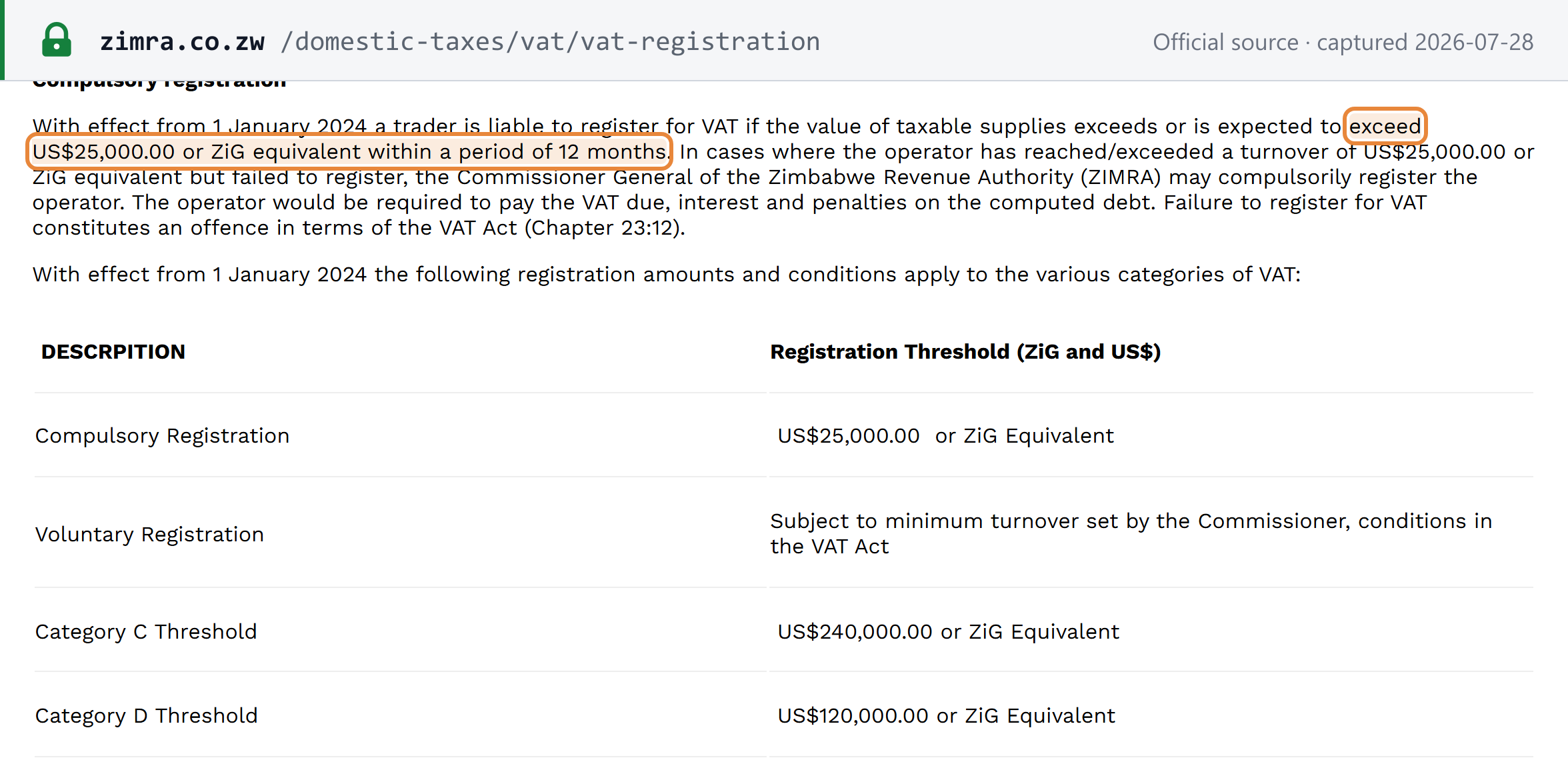 Source snapshot captured 2026-07-28 — original
Rates
| Rate | Applies to |
|---|---|
| 15.5% (standard) | Most taxable supplies of goods and services, and imports. Raised from 15% with effect from 1 January 2026 under the Finance Act, 2025 (Act No. 7 of 2025). [1] [2] |
| 0% (zero-rated) | Mainly exports and related services, under section 10 of the VAT Act. The zero-rated items previously listed in the regulations were repealed with effect from 1 January 2024. [1] |
| Exempt | No VAT charged and no input tax recovery — including accommodation in dwellings, educational services from pre-school to secondary level, medical services, and financial services. [1] |
 Source snapshot captured 2026-07-28 — original
The 15% → 15.5% transition. ZIMRA Public Notice No. 7 of 2026, issued 9 February 2026, sets the rate by VAT category for the changeover period: Categories B, C and D at 15.5%, and Category A at 15% for December 2025 and 15.5% for January 2026. Because the December/January 2026 return in TaRMS is hard-configured to compute tax at 15.5%, affected operators must gross up: take the December 2025 output tax at 15%, work backwards to the value of supply that produces the same output tax at 15.5%, and add the January 2026 value of supply. ZIMRA's worked example: output tax of $300.00 (from $2,000.00 of supplies at 15%) is redeclared as a value of supply of $1,935.48 (300 × 100 ÷ 15.5). The same grossing-up applies to any 2026 period in which section 8 time-of-supply rules require output tax on a pre-2026 supply to be accounted for. Taxpayers must attach a summary of December 2025 and January 2026 sales showing the value of supply and output tax before and after the computation. [2]
A new "Supply of goods/services at 10% (Exports)" line appeared in TaRMS — what does it mean?
Be careful here: this is a system-deployment notice, not a new rate stated in the Act. ZIMRA Public Notice 50 of 2026, issued 4 September 2026, announces that "the following 2026 legislation changes effective 01.01.2026 have now been configured in TaRMS" — a list of items the Finance Act, 2025 (Act No. 7 of 2025) already introduced but that TaRMS is only now catching up to operationally. Among the changes to existing tax types and returns, item (c) states, in full: "A new rate for 'Supply of goods/services at 10% (Exports)' under the Return for Remittance of Value Added Tax, Declaration of Output Tax." [8]
The notice cites no section of the VAT Act or the Finance Act for this line — none of the items in its "changes to existing tax types" list carry a statutory citation, including the new 3% Levy on Specified Minerals rate for coal and dimensional stone and the new gold-royalty rate bands listed alongside it. It is announcing what a taxpayer will now find as a selectable option on the Declaration of Output Tax section of the VAT return, not restating the underlying law. Exports of goods and services are otherwise zero-rated under section 10 of the VAT Act (see the Rates table above) — a standing positive rate specifically on exports would be a departure from that general rule, and this guide has not located the provision that would authorise it. Until ZIMRA or the Finance Act text identifies which export supplies this line covers and why, treat "Supply of goods/services at 10% (Exports)" as a new field now present in TaRMS rather than as a general 10% export VAT rate, and confirm directly with ZIMRA which supplies it applies to before selecting it on a return. [8]
Returns, payment and currency
- Returns are completed in full and submitted online in TaRMS through the Self-Service Portal. The standing rule, in force since 28 August 2025, comes from Statutory Instrument 81 of 2025 (the Finance (Due Dates for Submission of Returns and References to the Zimbabwe Dollar) Regulations, 2025) and is published in ZIMRA Public Notice No. 53 of 2025: the Return for Remittance of Value Added Tax is due by the 10th day of the following month. Payment is due on or before the 15th. [6] [7]
- The 10th and the 15th come from different places. PN 53 states expressly that "SI 81 of 2025 separated the due date of Tax Returns from the due date of Tax Payments. Therefore, Tax Returns are submitted first as per the new dates listed below and Tax Payments are made on the usual due dates for tax payments." The SI moved only the return to the 10th; the 15th payment date is not in SI 81 and is instead restated month by month in ZIMRA's VAT notices. The rule is still running unchanged — for the tax period ended 31 July 2026, Public Notice No. 43 of 2026 set returns for Categories A and C on or before 10 August 2026 and payment on or before 15 August 2026. Related returns carry their own SI 81 dates: VAT on imported services and the special VAT return are also due by the 10th, while the Value Added Withholding Tax return is due by the 5th. [6] [7]
- Value Added Withholding Tax certificate schedules must be attached to the VAT return in support of any credit for VAT withheld by appointed agents. [1] ZIMRA's standing "Mechanics of VAT" web page still refers to remittance by the 25th day of the month following the tax period. That page has not been updated for SI 81 of 2025 — the 10th/15th in the SI and in the current monthly notice govern, and the conflict is a live trap for anyone diarising deadlines from the web guidance rather than the notices. [2]
- Currency. Tax must be declared and paid in the currency of the transaction — section 4A of the Finance Act and section 38(4) of the VAT Act. ZIMRA has publicly identified converting foreign-currency sales into local currency for tax purposes, declaring only a portion of forex sales, and receipting forex sales outside the fiscal device as malpractices in breach of those provisions. Its 2026 notices repeat that payments for all taxes must be remitted "in full, on time and in the currency of trade". Statutory thresholds are expressed as a US dollar figure "or ZiG equivalent". [1] [3] [4]
- Records must be kept for at least six years after the tax period to which they relate. [5]
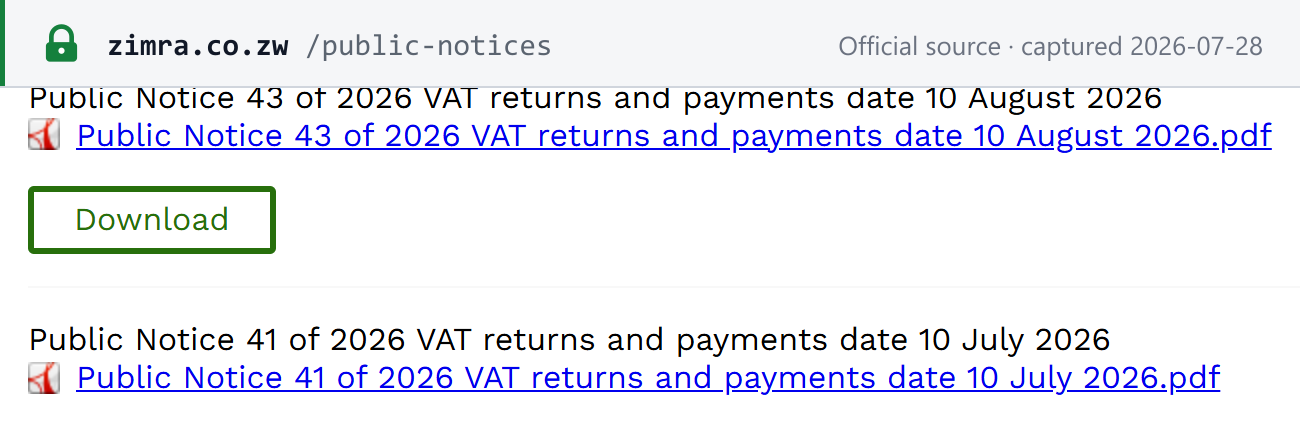 Source snapshot captured 2026-07-28 — original
Digital Services Withholding Tax on non-resident suppliers
With effect from 1 January 2026, the Finance Act, 2025 (Act No. 7 of 2025) amended and substituted section 13A of the Value Added Tax Act [Chapter 23:12]. The scope of electronic services is unchanged, but the collection mechanism is not: instead of relying on non-resident suppliers to register and self-account, ZIMRA now requires intermediaries to withhold tax when a consumer in Zimbabwe pays a foreign supplier for digital services. [1]
Withholding rates. The intermediary withholds, at the time of processing the foreign payment: [1]
| Status of the foreign supplier | Amount withheld |
|---|---|
| Not registered for VAT in Zimbabwe | 15.5% of the payment amount |
| Registered for VAT in Zimbabwe | Tax fraction of 3/23 |
Payments to local suppliers of electronic services do not attract Digital Services Tax.
Who is an intermediary. Financial institutions as defined in the VAT Act: banking institutions; building societies; the Reserve Bank of Zimbabwe; POSB; the Infrastructure Development Bank of Zimbabwe; Agricultural Finance successor institutions; licensed postal service providers; mobile banking service providers; mobile money transfer platform operators; registered money transfer services; and microfinance institutions. Each must remit the tax to the Commissioner-General, issue the consumer a certificate of withholding (transaction date, supplier name, payer name, amount paid, tax withheld, payment reference), keep records of payments to foreign suppliers, and cooperate with ZIMRA verification. [1]
How a withholding agent actually files. DST returns are due by the 10th of the following month and payment by the 15th — but, unlike VAT, DST is not yet a TaRMS filing. Public Notice No. 43 of 2026, issued 24 July 2026, tells appointed withholding agents that "as the return form is not yet configured for online submission in TaRMS, all returns must be submitted manually at the nearest ZIMRA office". The prescribed form is downloaded from ZIMRA's domestic-taxes library at zimra.co.zw/downloads/category/9-domestic-taxes, and "payments for Digital Services Tax (DST) must continue to be made through the Single Account System" — not through the TaRMS payment flow used for VAT. Budget for a physical monthly lodgement, and re-check each month's ZIMRA notice, since the manual route is expressly framed as an interim measure pending TaRMS configuration. [1] [2]
Scope. Digital Services Tax applies where the services are supplied electronically, the supplier is non-resident, and the services are consumed or utilised in Zimbabwe. ZIMRA's examples include online subscriptions and platform access; streaming, cloud computing and hosting; online advertising and digital marketplace commissions; downloadable content (apps, e-books, films); OTT services; software, drivers, firewalls and filters; electronic data management, cloud storage and file-sharing; search-engine and automated helpdesk services; electronically supplied event tickets; platform-based transport hailing; and services supplied by artificial intelligence platforms. It does not apply to imported physical goods (still taxed under section 6(1)(b) at the port of entry), to services rendered physically and taxed under section 13, or to services consumed outside Zimbabwe. Where an electronic service would be zero-rated or exempt if supplied locally — educational, medical and financial services as defined in section 2 of the VAT Act — the same treatment applies. [1]
Obligations of the non-resident supplier. Register for VAT under section 13A(2) read with section 23 where turnover from Zimbabwean supplies exceeds or is expected to exceed USD 25,000 in any twelve-month period; register through the TaRMS simplified e-commerce module; charge VAT-inclusive prices; issue fiscalised tax invoices and be onboarded onto the FDMS; file VAT returns by the 10th of the following month and pay by the 15th; and claim any Digital Services Withholding Tax withheld in Zimbabwe as a credit on the return, paying only the balance — ZIMRA reconciles returns against amounts withheld by intermediaries. Suppliers previously registered under the old section 13A remain registered. Where the service is consumed or utilised in Zimbabwe but payment is made outside Zimbabwe through a foreign payment platform, no intermediary is in the payment chain to withhold, and section 9 of PN 05 of 2026 puts the obligation back on the supplier: the non-resident supplier is required to charge and account for VAT directly to ZIMRA if it is registered for VAT in Zimbabwe. Digital Services Tax is payable in United States Dollars. Local VAT-registered operators may claim input tax on valid invoices issued by non-resident suppliers, subject to sections 15 and 16 of the VAT Act. [1]
Invoice requirements
Zimbabwe's invoice rules are unusually strict because the document and the device are the same thing: since 1 January 2022 a registered operator can claim input tax only on a valid fiscal tax invoice. A hand-typed PDF, however complete, does not qualify. [1]
A fiscal tax invoice is a tax invoice printed from a fiscal device used by a VAT registered operator, with the words "Fiscal Tax Invoice" in a prominent place, bearing all the features required by section 20 of the VAT Act read with paragraph 23 of Finance Act number 7 of 2021. [1]
Mandatory content
| Required feature | Notes |
|---|---|
| The words "Fiscal Tax Invoice" | Must appear in a prominent place |
| Name, address, VAT number and Business Partner number of the supplier | Zimbabwe requires both the VAT and the BP registration number |
| Name and address of the recipient | Always required |
| VAT and Business Partner number of the recipient | Required only where the recipient is a registered operator |
| Individual serialised number and date of issue | — |
| Description of the goods or services supplied | — |
| Quantity or volume supplied | — |
| The currency used in the transaction | Explicit requirement — see the currency note below |
| Either the value of the supply, the tax charged and the consideration; or the consideration plus either the tax amount or a statement that it includes tax, and the rate at which tax was charged | Two permitted presentations |
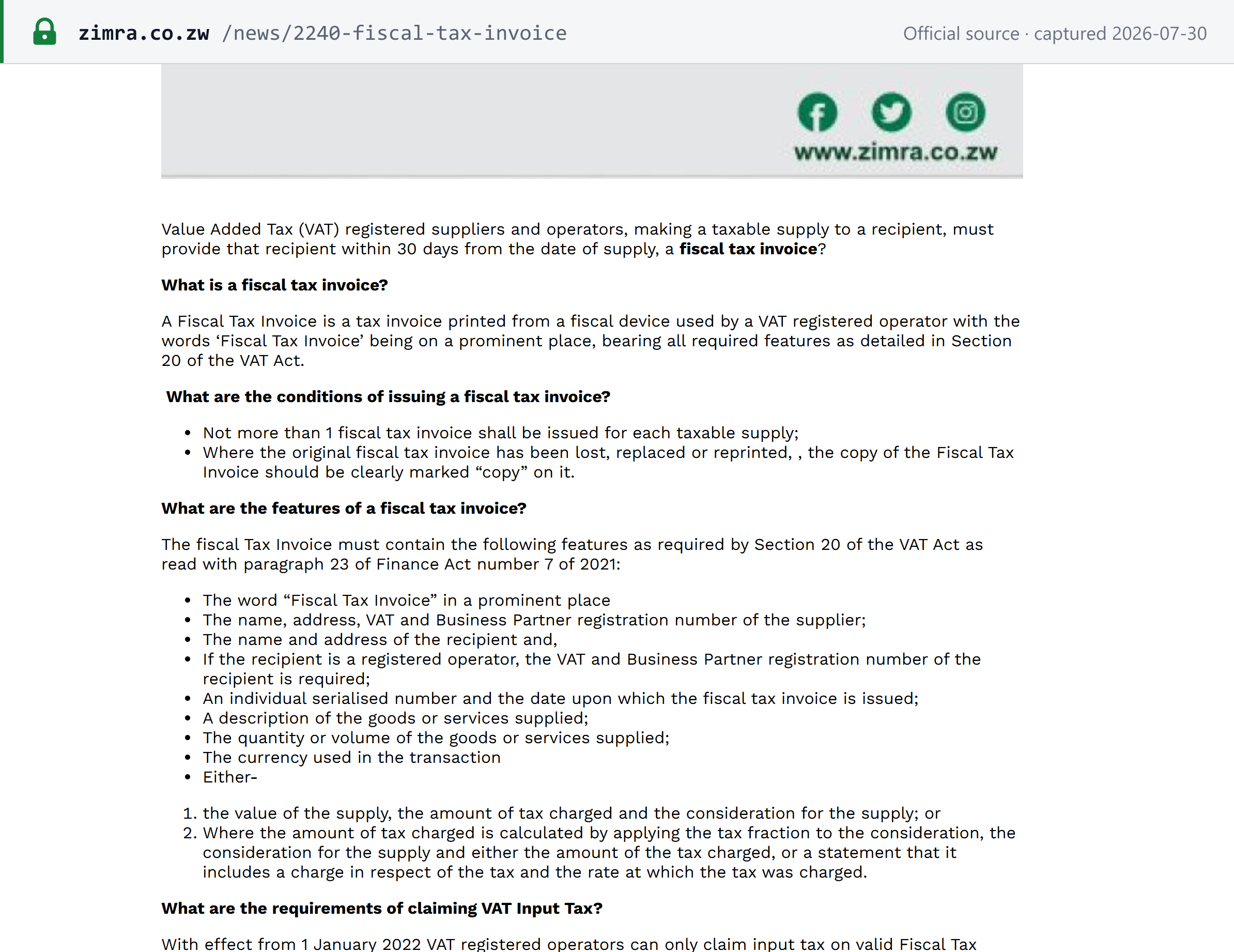 Source snapshot captured 2026-07-30 — original
What a compliant fiscal invoice looks like
ZIMRA publishes the fullest set of invoice templates of any authority in this guide set, in section 10 of the Fiscal Device Gateway API Specification (v7.2), under "Standard fiscal receipt, invoice and report views". It gives six laid-out documents: the 48-character thermal fiscal tax invoice and its credit-note variant, and A4 tax-inclusive and tax-exclusive invoices with matching credit notes. Each carries a numbered field legend — the A4 views place the callout numbers inline beside the fields — and the templates are followed by a field-by-field description of every numbered element, then the receipt QR-code rules. [7]
The thermal template shows the taxpayer logo, TIN and VAT number, the FISCAL TAX INVOICE heading, the buyer block, invoice number, fiscal day number, device serial number and fiscal device ID, item lines with tax codes, the tax table, a QR code, and a verification code with the note that the receipt can be checked manually at receipt.zimra.org. [7]
No snapshot is embedded here: ZIMRA serves the specification as a forced file download rather than a viewable page, so it cannot be captured in a browser the way our other source snapshots are. Open the link above and turn to section 10.
Note the contrast with ZIMRA's public-facing fiscalisation pages, which carry prose only — the templates live in the developer documentation.
Issuance deadline and duplicates
- The supplier must provide the recipient with a fiscal tax invoice within 30 days from the date of supply. [1]
- Not more than one fiscal tax invoice may be issued for each taxable supply. [1]
- Where the original has been lost, replaced or reprinted, the copy must be clearly marked "copy". [1]
Buyer details
Since 31 May 2025 fiscal devices must transmit buyer details to FDMS — buyer address, name, TIN, contact details and VAT registration number where applicable — under section 20(4) of the VAT Act. Where the buyer has no TIN, their details belong elsewhere on the receipt, not in the device's buyer block. See Fiscalisation and e-invoicing status below. [2]
Currency
Because Zimbabwe operates a dual-currency system, the transaction currency is a named mandatory field on the invoice rather than a formatting choice. Invoices must state the currency used; VAT is accounted for in the currency of the transaction. Digital Services Tax is payable in United States Dollars. [1] [3]
Retention for input tax
To claim input tax, registered operators must hold the fiscal tax invoice within the period a return is required to be furnished, or 12 months, whichever is the longer period. [1]
Fiscalisation and e-invoicing status (FDMS)
Zimbabwe does not operate a Peppol- or EN 16931-style clearance network. It runs a fiscalisation regime: fiscal devices are configured to record and transmit sales and other tax information to ZIMRA servers at the time of sale, through the Fiscalisation Data Management System (FDMS). Four device categories are approved — fiscalised electronic registers, fiscalised printers, electronic signature devices (ESDs), and software-based Virtual Fiscal Devices (VFD) that interface directly with FDMS via API. ZIMRA publishes the fiscalisation API documentation free of charge. [1]
- Who must fiscalise: all VAT registered operators under SI 104 of 2010, and all taxpayers under section 90 of the Income Tax Act — including those below the USD 25,000 VAT registration threshold. Every point of sale operated by a registered operator must use a compliant device interfaced with FDMS. [1] [2]
- Buyer details: registered operators were required to upgrade fiscal devices to mandatorily transmit buyer details to FDMS on or before 31 May 2025 — buyer address, name, TIN, contact details and VAT registration number (if applicable), per section 20(4) of the VAT Act. If the buyer has no TIN, their details go elsewhere on the receipt, not in the fiscal device's buyer block. [3]
- Input tax now depends on FDMS. For tax periods from 1 January 2026, manual input tax schedules are discontinued unless approved by the Commissioner. Fiscal tax invoices auto-populate from FDMS into the Invoice Management Module in TaRMS, and only invoices showing "Valid" on the FDMS validation portal, with correct buyer details transmitted, are considered for an input tax claim — per the definition of a fiscal tax invoice promulgated by the Finance Act 7 of 2025. [2]
- Incentives: 50% of the cost of a fiscal device may be claimed as input tax on the VAT return, with the remaining 50% spread over two years as capital allowances; local supply of fiscal devices is zero-rated. [1]
Features of a valid fiscal tax invoice. ZIMRA requires the words "Fiscal Tax Invoice" in a prominent place; the name, address and registration number of the supplier; the name, address and registration number of the recipient if the recipient is a registered operator; an individual serialised number and the date of issue; a description of the goods or services; the quantity or volume supplied; and the value of the supply, the amount of tax charged and the consideration — or, where tax is computed by applying the tax fraction, the consideration together with either the tax amount or a statement that the consideration includes tax and the rate charged. [4]
Two more features are now statutory — and ZIMRA's page has not caught up. Section 45 of the Finance Act, 2025 (Act No. 7 of 2025) amended section 20(4) of the VAT Act with effect from 1 January 2026 by inserting two paragraphs after paragraph (g): "(h) the Tax payer identification number; and (i) a Quick Response code (QR code) readable by cameras or scanners or an authentication code for the purposes of reviewing and verifying the authenticity of invoices on FDMS (Fiscalisation Data Management System)." So from 1 January 2026 the TIN and the QR code are statutory contents of a tax invoice, not merely FDMS conventions or ZIMRA practice — which is why an invoice without a scannable QR code cannot support an input tax claim. ZIMRA's refund-of-VAT web page still lists only the pre-2026 paragraphs (a) to (g), so rely on the Act rather than that page. [4] [5]
Recent changes
- 2026-01-01 — Zimbabwe's standard VAT rate rose from 15% to 15.5% under the Finance Act, 2025 (Act No. 7 of 2025); ZIMRA Public Notice No. 7 of 2026 (issued 9 February 2026) sets the transitional treatment, including the grossing-up computation for Category A's combined December 2025 / January 2026 return. (Zimbabwe Revenue Authority) — see issue
- 2026-01-01 — The Finance Act, 2025 (Act No. 7 of 2025) substituted section 13A of the VAT Act [Chapter 23:12], replacing self-registration by non-resident digital suppliers with a Digital Services Withholding Tax: intermediaries withhold 15.5% of payments to non-resident digital suppliers not registered for VAT in Zimbabwe, or a tax fraction of 3/23 where the supplier is registered; non-residents must register above USD 25,000 of Zimbabwean turnover in any 12 months and issue fiscalised invoices through the FDMS. (Zimbabwe Revenue Authority) — see issue
- 2026-01-01 — Manual input tax schedules discontinued for tax periods from 1 January 2026 (unless approved by the Commissioner); fiscal tax invoices auto-populate from FDMS into the TaRMS Invoice Management Module, and only invoices showing "Valid" on the FDMS portal with correct buyer details support an input tax claim. (Zimbabwe Revenue Authority)
- 2026-07-24 — ZIMRA Public Notice No. 43 of 2026 confirms that the Digital Services Tax return is still not configured for online submission in TaRMS: appointed withholding agents must submit DST returns manually at the nearest ZIMRA office using the downloadable prescribed form, and DST payments must be made through the Single Account System. (Zimbabwe Revenue Authority)
- 2026-01-01 — Section 45 of the Finance Act, 2025 (Act No. 7 of 2025) inserted paragraphs (h) the taxpayer identification number and (i) a Quick Response (QR) code readable by cameras or scanners, or an authentication code for verifying invoice authenticity on FDMS, into section 20(4) of the VAT Act — making the TIN and QR code statutory contents of a tax invoice. (Veritas Zimbabwe — Finance Act, Act No. 7 of 2025)
- 2025-08-28 — SI 81 of 2025 took effect, moving the VAT return due date to the 10th day of the following month and expressly separating return due dates from payment due dates; ZIMRA Public Notice No. 53 of 2025 (9 September 2025) publishes the full table. ZIMRA's "Mechanics of VAT" web page still shows the superseded 25th. (Zimbabwe Revenue Authority)
- 2026-09-04 — ZIMRA Public Notice 50 of 2026 confirms the 2026 legislative changes introduced by the Finance Act, 2025 (Act No. 7 of 2025), effective 1 January 2026, are now configured in TaRMS — including a new "Supply of goods/services at 10% (Exports)" selectable rate line on the Declaration of Output Tax section of the VAT return. The notice is a system-deployment announcement and cites no statutory section for that line; this guide has not confirmed the underlying legal basis and does not assert a general 10% export VAT rate — see the caution in Rates above. (Zimbabwe Revenue Authority) — see issue
- 2025-05-31 — Deadline for VAT registered operators to upgrade fiscal devices so that buyer details (address, name, TIN, contact details and VAT registration number where applicable) are mandatorily transmitted to FDMS, per section 20(4) of the VAT Act. (Zimbabwe Revenue Authority)
Reference links
- ZIMRA — Mechanics of VAT (rates, exemptions, obligations)
- ZIMRA — VAT Registration (threshold, categories, TaRMS process)
- ZIMRA — Public Notice No. 7 of 2026: Implications of Change of VAT Rate on Return Submission in TaRMS
- ZIMRA — Public Notice No. 05 of 2026: Digital Services Tax (VAT)
- ZIMRA — Public Notice No. 11 of 2026: VAT returns and payment, Categories A & C
- ZIMRA — Public Notice No. 43 of 2026: VAT and Digital Services Tax returns, due dates August 2026 (DST filed manually; Single Account System)
- ZIMRA — Public Notice No. 53 of 2025: Due dates for submission of returns under SI 81 of 2025
- Finance Act, 2025 (Act No. 7 of 2025) — s.45 amends s.20(4) of the VAT Act (TIN and QR code on tax invoices)
- ZIMRA — Public Notice No. 30 of 2025: Upgrade of fiscal devices to transmit buyer details to FDMS
- ZIMRA — Fiscalisation explained
- ZIMRA — Refund of VAT (features of a valid fiscal tax invoice)
- ZIMRA — Requirements for new businesses (TIN, record keeping)
- ZIMRA — All public notices
- ZIMRA — Public Notice 50 of 2026: New 2026 legislation changes deployed in TaRMS
Frequently Asked Questions
What is the standard VAT rate in Zimbabwe in 2026 — 15% or 15.5%?
15.5%. The rate rose from 15% to 15.5% with effect from 1 January 2026 under the Finance Act, 2025 (Act No. 7 of 2025), and ZIMRA's own VAT guidance now publishes the standard rate as 15.5%. Many third-party references still show 15%. ZIMRA Public Notice No. 7 of 2026 (9 February 2026) sets the transitional treatment: Categories B, C and D apply 15.5% throughout, while Category A applies 15% to December 2025 supplies and 15.5% to January 2026 supplies inside the combined December/January return. Since the TaRMS return computes at 15.5%, operators gross up any 15% output tax to the equivalent 15.5% value of supply — ZIMRA's example turns $300.00 of December output tax into a declared value of supply of $1,935.48. The same treatment applies where section 8 time-of-supply rules push a 2025 supply into a 2026 tax period. [1] [2]
Why did a Zimbabwean bank withhold 15.5% of the payment to my non-resident digital business?
Because of the Digital Services Withholding Tax. From 1 January 2026 the Finance Act, 2025 (Act No. 7 of 2025) substituted section 13A of the VAT Act [Chapter 23:12], moving collection from supplier self-accounting to withholding at source. Intermediaries — banking institutions, building societies, the Reserve Bank of Zimbabwe, POSB, the Infrastructure Development Bank of Zimbabwe, Agricultural Finance successor institutions, licensed postal service providers, mobile banking providers, mobile money transfer platform operators, registered money transfer services and microfinance institutions — withhold 15.5% of the payment where the foreign supplier is not registered for VAT in Zimbabwe, or a tax fraction of 3/23 where it is registered. The intermediary must issue a certificate of withholding showing the date, supplier, payer, amount paid, tax withheld and payment reference. A registered non-resident claims the withheld amount as a credit on its VAT return and pays only the balance. Registering therefore cuts the deduction from 15.5% of the gross payment to the 3/23 tax fraction. [1]
When must a non-resident digital supplier register for VAT in Zimbabwe?
Where turnover from Zimbabwean supplies exceeds or is expected to exceed USD 25,000 in any twelve-month period. Registration is made in TaRMS through the simplified e-commerce module. Registered non-residents must charge VAT-inclusive prices, issue fiscalised tax invoices and be onboarded onto the FDMS, file VAT returns by the 10th of the following month and pay by the 15th. Digital Services Tax is payable in United States Dollars. Suppliers already registered under the previous section 13A remain registered. If the service is consumed in Zimbabwe but paid for outside Zimbabwe through a foreign payment platform — so no Zimbabwean intermediary can withhold — the non-resident supplier is required to charge and account for the VAT directly to ZIMRA if it is registered for VAT in Zimbabwe. One practical wrinkle for withholding agents: the DST return is not yet available online. Public Notice No. 43 of 2026 (24 July 2026) requires DST returns to be submitted manually at the nearest ZIMRA office on the form published at zimra.co.zw/downloads/category/9-domestic-taxes, with payment through the Single Account System rather than TaRMS. [1] [2]
Why has ZIMRA disallowed my input tax claim on a supplier's invoice?
Almost always because the invoice is not a compliant fiscal tax invoice on the FDMS. For tax periods from 1 January 2026 ZIMRA no longer accepts manual input tax schedules unless the Commissioner approves them; fiscal tax invoices auto-populate from FDMS into the Invoice Management Module in TaRMS, and only invoices showing "Valid" on the FDMS validation portal, with correct buyer details transmitted, are considered for a claim — following the definition of a fiscal tax invoice promulgated by the Finance Act 7 of 2025. The invoice must satisfy section 20(4) of the VAT Act, including the buyer's address, name, TIN, contact details and VAT registration number where applicable; devices had to be upgraded to transmit those buyer details by 31 May 2025. If the buyer has no TIN, their details must be captured elsewhere on the receipt rather than in the fiscal device's buyer block. Check the invoice's QR code on the FDMS portal before you file. [1] [2]
Do I declare and pay Zimbabwe VAT in USD or in ZiG?
In the currency of the transaction. Section 4A of the Finance Act and section 38(4) of the VAT Act require tax to be paid in the currency in which the transaction took place, and ZIMRA has publicly flagged converting foreign-currency sales into local currency for tax purposes, declaring only a portion of forex sales, and receipting forex sales outside the fiscal device as breaches of those provisions. Its 2026 VAT notices repeat that payments must be remitted "in full, on time and in the currency of trade". Statutory thresholds are stated as a US dollar amount "or ZiG equivalent" — for example the US$25,000 registration threshold and the US$240,000 Category C threshold — and Digital Services Tax specifically is payable in United States Dollars. [1] [2] [3]
I saw a new "Supply of goods/services at 10% (Exports)" rate line in TaRMS — does Zimbabwe now charge 10% VAT on exports?
This guide cannot confirm that, and treats it as an open question rather than a settled fact. ZIMRA Public Notice 50 of 2026, issued 4 September 2026, announces that the 2026 legislative changes made by the Finance Act, 2025 (Act No. 7 of 2025), effective 1 January 2026, have now been configured in TaRMS. One item in its list of changes to existing tax types and returns reads, in full: "A new rate for 'Supply of goods/services at 10% (Exports)' under the Return for Remittance of Value Added Tax, Declaration of Output Tax." The notice cites no section of the VAT Act or the Finance Act for this line — none of the items in that list carry a statutory citation. Exports of goods and services are otherwise zero-rated under section 10 of the VAT Act (see Rates above), so a standing positive rate specifically on exports would depart from that general rule, and this guide has not located the provision authorising it. Treat the new TaRMS field as confirmed to exist — ZIMRA's own notice says so — but treat any explanation of why it exists, or which export supplies it covers, as unverified until ZIMRA or the Finance Act text says so directly. [8]