Kenya VAT guidelines
| FACTSHEET | |
|---|---|
| Country code | KE |
| Tax name | Value Added Tax (VAT) |
| Tax Authority | Kenya Revenue Authority (KRA) |
Overview
Kenya levies Value Added Tax under the Value Added Tax Act, 2013 (CAP 476), administered by the Kenya Revenue Authority (KRA). VAT is charged on taxable supplies of goods and services made in Kenya and on imported goods and services, and is collected at designated points by VAT-registered persons acting as agents of the Government. [1] [2]
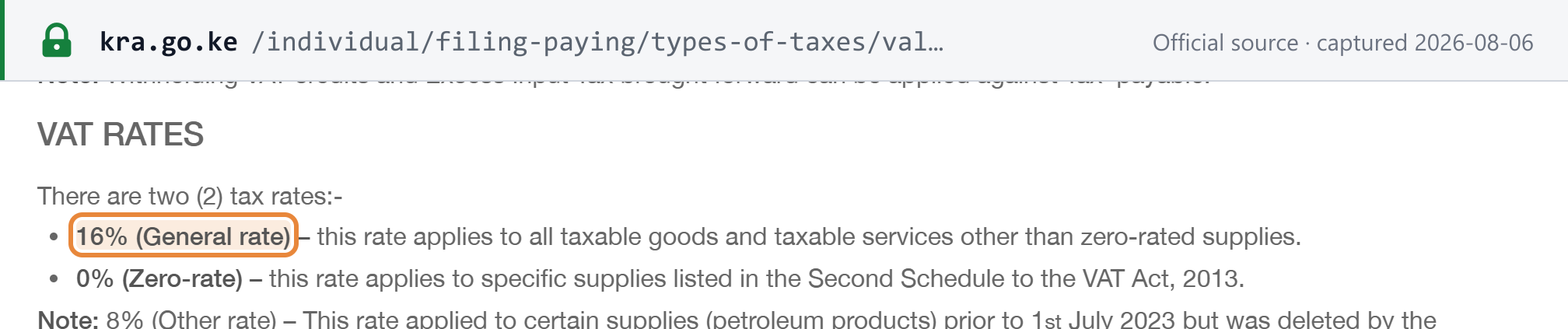
The standard rate is 16%, applied to all taxable goods and services other than zero-rated supplies. [1] A distinct, temporary 8% rate applies to specified petroleum products only (see Rates below) — it does not change the general standard rate.
 Source snapshot captured 2026-08-03 — original
Kenya's Finance Act, 2026 (Act No. 19 of 2026), assented to on 23 June 2026, made several changes to the VAT Act, CAP 476, effective 1 July 2026: it excludes pass-through employee costs from the taxable value of labour-outsourcing and staffing services, allows full input VAT recovery on qualifying supplies to the defence and security sector, reverts the VAT bad-debt refund window from two years back to three, and adds new First Schedule exemptions for public-private-partnership and large infrastructure projects. It also brought previously-exempt digital financial-platform services — money transfer, payment processing, merchant acquiring and similar fee/commission-based services supplied through a digital platform — into VAT at 16%. See Finance Act, 2026 VAT changes below. [4] [5]
Most registration, filing and payment runs through KRA's iTax portal (itax.kra.go.ke), while invoicing runs through the separate eTIMS e-invoicing platform (etims.kra.go.ke) — both are mandatory regardless of VAT registration status for eTIMS. [1] [6]
Tax ID and VAT registration
Kenya uses a single identifier across all tax heads:
- KRA PIN (Personal Identification Number) — issued by KRA to individuals aged 18 and above and to all registered entities, and used for VAT, income tax, Turnover Tax, Withholding Tax and excise duty alike. It is an 11-character alphanumeric identifier: one leading letter (A for individuals, P for entities), nine system-generated digits, and one trailing check letter — for example
A012345678X— always uppercase, with no hyphens or spaces. [1] A full walkthrough of PIN formats, foreigner registration categories, and related obligations (including the separate income-tax Significant Economic Presence (SEP) regime for non-resident digital businesses) is in Lookuptax's dedicated Kenya KRA PIN guide — SEP is an income tax, not a VAT, obligation, and is not repeated here. - VAT registration — a separate obligation added on top of the PIN once a person meets the VAT threshold (see Registration thresholds); KRA does not issue a distinct "VAT number" format beyond the PIN itself. [2]
How to register. All PIN and VAT registration is done online through iTax at itax.kra.go.ke. An applicant selects New PIN Registration, then Individual or Non-Individual, and completes the form; the PIN certificate is emailed and available for download from the iTax profile once approved. VAT is then added to the PIN as a tax obligation once the person is liable to register — within 30 days of the taxable-supplies threshold being reached or expected to be reached. [1] [7]
How a Kenyan PIN is verified. KRA publishes a public PIN Checker on the iTax portal (itax.kra.go.ke/KRA-Portal/pinChecker.htm) that confirms whether a PIN is valid and returns the associated taxpayer name — the practical way to confirm a counterparty's PIN before relying on an invoice or contract. You can also check a Kenyan PIN with Lookuptax's own Kenya PIN validator. For this week's roundup of Kenya's Finance Act, 2026 VAT changes and other jurisdictions, see Last Week in Taxes.
Registration thresholds
| Trigger | Threshold | Notes |
|---|---|---|
| Compulsory VAT registration | Taxable supplies of KES 5,000,000 or more, made or expected, in any 12-month period | Must apply within 30 days of becoming liable. [1] [2] |
| Voluntary registration | Below KES 5,000,000 | Available subject to the Commissioner's conditions. [1] |
| Non-resident digital marketplace supplier | No threshold | A non-resident supplying over the internet, an electronic network or a digital marketplace must register regardless of turnover, via a simplified iTax registration, filing and payment framework, and cannot deduct Kenyan input VAT against the output tax due. [3] |
| Deregistration | Turnover falls below KES 5,000,000/year (optional), or the person ceases making taxable supplies | [2] |
Rates
| Rate | Applies to |
|---|---|
| 16% (standard) | Most taxable goods and services, other than zero-rated supplies. [1] |
| 0% (zero-rated) | Exports and other supplies listed in the Second Schedule to the VAT Act, 2013. Input tax on zero-rated supplies remains deductible. [1] |
| Exempt | Supplies listed in the First Schedule; no input tax deduction on exempt supplies. Persons making only exempt supplies are not required to register. [2] |
| 8% (temporary, petroleum only) | Premium motor spirit, diesel and illuminating kerosene, cut from 16% in two steps by Legal Notice No. 69 and No. 70 of 2026 (effective 15/16 April 2026). Originally due to expire 14 July 2026, the reduced rate was extended a further three months, to 14 October 2026, per the Cabinet Secretary for Energy and Petroleum's 14 July 2026 announcement — treat this as a live, time-boxed exception rather than the general standard rate. [4] A prior 8% petroleum rate had been deleted from the VAT Act by the Finance Act, 2023, effective 1 July 2023, before this 2026 temporary measure was introduced. [5] |
| 16% (digital financial-platform services, from 1 July 2026) | Money transfer, payment processing, settlement, merchant acquiring, payment gateway and aggregation services supplied through software or a digital platform for a fee or commission — previously exempt, brought into VAT by the Finance Act, 2026. Person-to-person mobile money transfers remain exempt. [6] |
The extension to 14 October 2026 comes from press reporting of a Cabinet Secretary announcement (allAfrica.com, 14 July 2026), not yet from a KRA public notice or Gazette Legal Notice this guide could independently verify. Reconfirm the current petroleum rate against KRA's public notices page before relying on it for pricing or filings.
Finance Act, 2026 VAT changes
The Finance Act, 2026 (Act No. 19 of 2026) was assented to on 23 June 2026; the VAT changes below took effect 1 July 2026. The Act's own text sits at the Kenya Law permalink cited throughout this section, which returned an HTTP 403 error when this guide was researched; the provisions below are therefore sourced from PwC Kenya's tax alert (which reproduces the enacted section text) and independently corroborated by an EY Kenya summary of the same Act. [1] [2] [3]
Outsourcing and labour-placement services
New sections 13(5A) and 13(5B) of the VAT Act provide that where a supplier of labour, outsourcing or employee placement services incurs employee-related costs — salaries, wages, statutory deductions and other related costs — those costs are deemed disbursements made on behalf of the client and are excluded from the taxable value of the supply. VAT applies only to the supplier's service fee or margin. This removes the need to establish a conventional principal–agent disbursement relationship and reverses recent High Court decisions that had treated the full recharge, including payroll costs, as taxable. [2] [3]
Input VAT on supplies to the defence and security sector
Section 17 is amended to insert a new paragraph (5)(e) and new subsections (7) and (8): a registered person may deduct input tax directly attributable to supplies made to the Kenya Defence Forces (KDF), the Defence Forces Welfare Services (DEFWES), the National Intelligence Service (NIS) and the National Police Service (NPS), where those supplies are exempt under First Schedule paragraphs 57 and 101. That input tax was previously irrecoverable. The deduction requires documentation prescribed by the Commissioner and is not subject to apportionment where the input tax is wholly attributable to those supplies. [2] [3]
Bad-debt VAT refund window reverts to three years
Section 31(1) is amended by deleting "two years" and substituting "three years", reverting the minimum qualifying period for a VAT refund on bad debts to the position that applied before the Finance Act 2025 temporarily shortened it to two years. Businesses will need to wait longer — three years from the date of supply — before applying to KRA for a bad-debt VAT refund, subject to the four-year long-stop for lodging the claim. [2] [3] [4]
New First Schedule exemptions for PPP and large infrastructure projects
Three new paragraphs are added to the First Schedule: [2]
- Goods for PPP infrastructure projects — goods for the direct and exclusive use of infrastructure projects undertaken under a public-private partnership (PPP) framework, on approval by the Cabinet Secretary on the recommendation of the Cabinet Secretary responsible for the project's implementing ministry.
- Goods for National Infrastructure Fund projects — goods for infrastructure projects undertaken and funded by the National Infrastructure Fund, on approval by the Cabinet Secretary for the National Treasury.
- Plant and machinery for large projects — plant, machinery, equipment and spare parts, imported or purchased locally, for a project with a total investment value of at least KES 3 billion, on approval by the Cabinet Secretaries for the National Treasury and for Trade and Investment Promotion.
A related exemption covers services for the direct and exclusive use of PPP infrastructure projects on the same approval basis, giving PPP projects end-to-end VAT relief on both goods and services. The specific First Schedule paragraph numbers circulating for these exemptions appear in a single advisory alert and could not be corroborated independently, so they are deliberately not stated here. [2]
VAT on digital marketplace and digital financial-platform supplies
Two distinct VAT regimes apply to digital businesses in Kenya — do not confuse them with the Significant Economic Presence (SEP) tax, which is an income tax, not VAT, and is covered separately in Lookuptax's Kenya KRA PIN guide.
- VAT on Digital Marketplace Supply, in force since 2020: a non-resident person supplying digital services in Kenya over the internet, an electronic network or a digital marketplace must register for VAT and charge 16%, regardless of turnover. Registration uses a simplified iTax framework or a locally appointed tax representative; non-resident suppliers are exempt from the eTIMS electronic-invoice requirement but must issue an invoice or receipt showing the value of supply and the tax charged, and must pay tax in Kenyan Shillings by the 20th day of the month following the earliest of the digital service being performed, the invoice being raised, or payment being made. Input VAT incurred locally cannot be deducted against this output tax. [1]
- VAT on digital financial-platform services, from 1 July 2026: the Finance Act, 2026 removed the VAT exemption for money transfer, payment processing, settlement, merchant acquiring, payment gateway and aggregation services supplied through software or a digital platform for a fee or commission, bringing them into VAT at 16%. Ordinary person-to-person mobile money transfers remain exempt. [2]
Invoice requirements
Mandatory content
| Required field | Notes |
|---|---|
| Supplier's PIN | Under the Electronic Tax Invoice Regulations, every invoice must show the seller's PIN; the VAT Act separately restricts an invoice showing an amount that purports to be tax to a taxable supply issued by a registered person (s.42). [1] [2] |
| Buyer's PIN | Required only where the buyer intends to claim the expense or the input tax. [1] [3] |
| Date and time of issue, and a serial/invoice number | Every tax invoice must be serially numbered. [4] [1] |
| Description, item code, quantity and unit of measure of the goods or services | Item codes follow KRA's own classification for eTIMS. [1] |
| Tax rate applied, total gross amount and total tax amount | — [1] |
| QR code and a unique system/invoice identifier | Generated by the eTIMS device or software at the point of issue; see E-invoicing status below. [1] |
These particulars come from the Tax Procedures (Electronic Tax Invoice) Regulations, 2024 (Legal Notice No. 64 of 2024, gazetted 3 May 2024), reported here via EY and CM Advocates because the underlying Kenya Law legal-notice page could not be reached directly from this environment (HTTP 403). [1] [3]
What a compliant invoice looks like
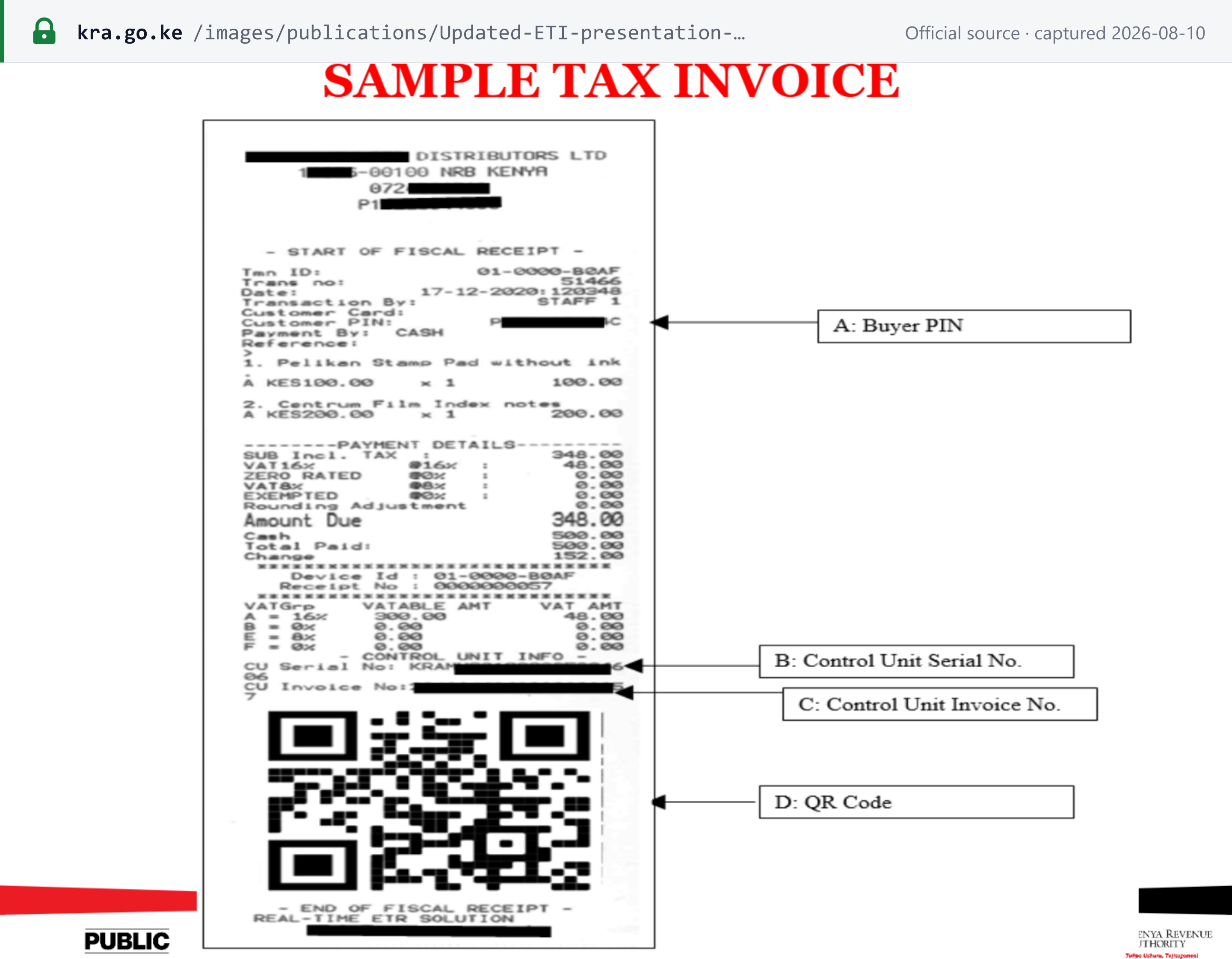
KRA publishes an annotated sample tax invoice in its electronic-tax-invoice taxpayer-education material, calling out by letter the four things that distinguish a fiscalised invoice from an ordinary receipt: A the buyer PIN, B the Control Unit serial number, C the Control Unit invoice number, and D the QR code. The identifying details are blacked out by KRA itself, so what the sample teaches is placement, not a set of real values.
Read it as a device print-out rather than a prescribed layout. The picture is a thermal fiscal receipt bounded by - START OF FISCAL RECEIPT - and - END OF FISCAL RECEIPT -, with the trader's own header above and, below the payment lines, a CONTROL UNIT INFO block and the QR. The regulations fix the particulars listed above and the fiscalisation, not the paper design — so an eTIMS invoice from an ERP will look nothing like this one and still be valid, provided the same elements are present.
One caveat on vintage: this material dates from the TIMS rollout of May 2022, before eTIMS. The control-unit and QR elements it labels carried across to eTIMS, but treat the item-code and rate lines against the current rules above rather than against this picture.
 Source snapshot captured 2026-08-10 — original
Issuance deadline and numbering
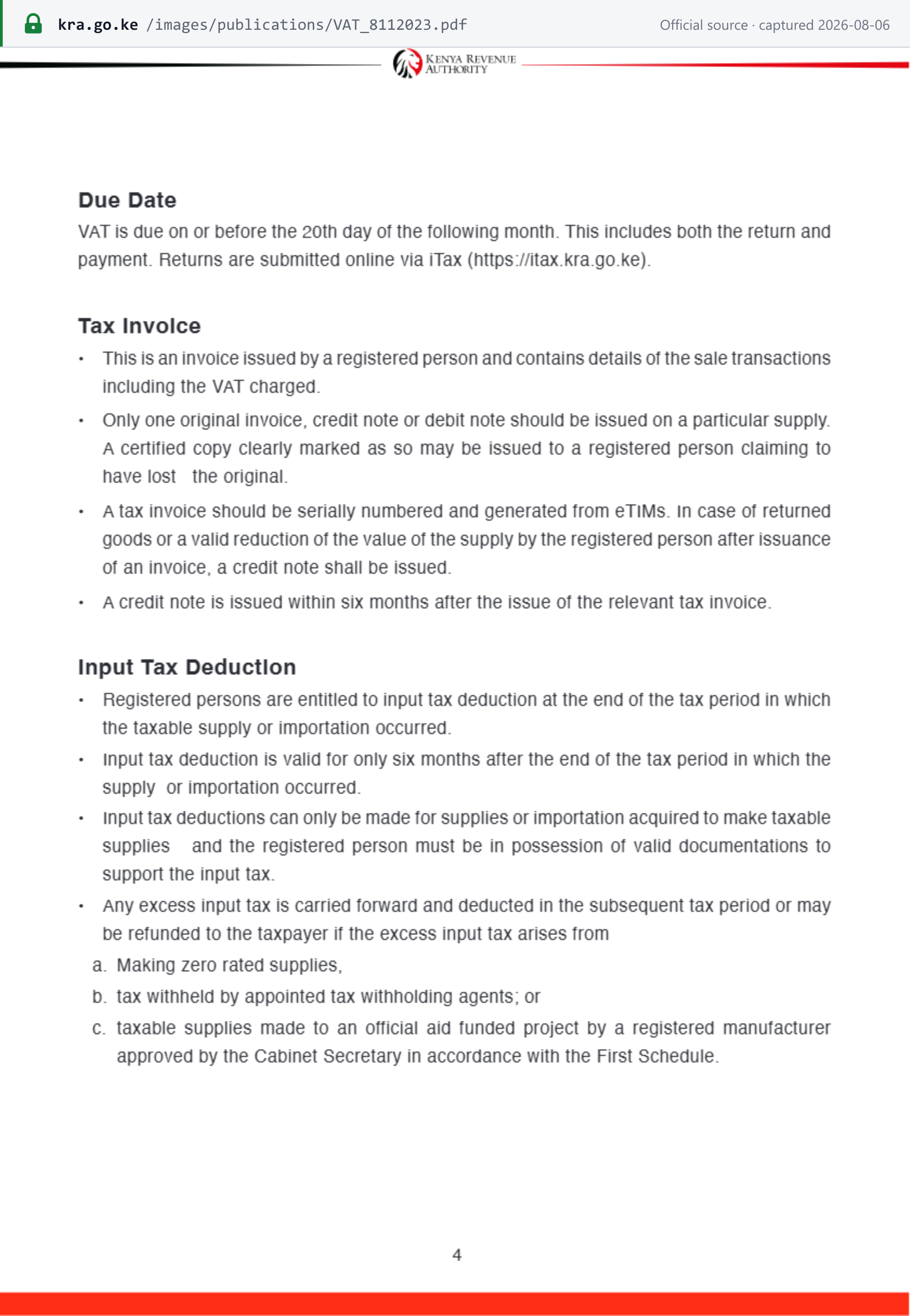
A registered person must furnish the purchaser with the tax invoice at the time of the supply. Only one original tax invoice, credit note or debit note may be issued for a given supply; a certified copy clearly marked "copy" may be issued to a registered person who claims to have lost the original. [2]
 Source snapshot captured 2026-08-03 — original
Credit and debit notes
Where goods are returned, or the value of a supply is reduced for good reason after a tax invoice has been issued, a credit note must be issued — but only within six months of the original tax invoice (or within 30 days of a court determination, where the price is the subject of a commercial dispute). A debit note is issued for any further charge relating to an already-invoiced supply, showing the details of the original invoice. Both must be in the prescribed form, and under the 2024 Electronic Tax Invoice Regulations must reference the original invoice number. [2] [1]
Currency and language
Tax payable by a non-resident supplier under the VAT on Digital Marketplace Supply rules must be paid in Kenyan Shillings to authorised KRA bank accounts — the one currency rule this guide could confirm directly against a KRA source. [6] Beyond that, secondary VAT-compliance guides disagree on whether and how a foreign-currency tax invoice is permitted more generally, so this guide does not state a specific rule here rather than guess between conflicting third-party sources — confirm the position for a specific transaction with KRA or a local adviser. Records must be kept in English or Kiswahili. [2]
Simplified invoices
The VAT Act refers to "simplified tax invoices" as a record category alongside ordinary tax invoices, but this guide could not confirm an official KRA-published de-minimis value threshold or reduced field set for them — that detail is omitted here rather than guessed. [2]
Retention
Records — including copies of tax invoices, credit and debit notes issued, and purchase invoices received — must be kept in Kenya, in English or Kiswahili, for five years from the date of the last entry made in them. [2]
Technical format
A tax invoice must be serially numbered and generated from eTIMS; see E-invoicing status below for the platform and onboarding options. [4]
E-invoicing status
Kenya runs a continuous, real-time e-invoicing regime through the electronic Tax Invoice Management System (eTIMS), not a periodic-reporting or clearance-only model. [1]
- Who must use it: every person carrying on business in Kenya — companies, partnerships, sole proprietorships and trusts, including informal and non-VAT-registered businesses — regardless of VAT registration status or turnover, effective 1 September 2023 under section 23A of the Tax Procedures Act as amended by the Finance Act 2023. The Tax Procedures (Electronic Tax Invoice) Regulations, 2024 (Legal Notice No. 64 of 2024) confirm the same broad scope and list specific exemptions (imports, emoluments, investment allowances, airline ticketing, interest and bank fees, final withholding-tax expenses, and services from non-residents without a Kenyan permanent establishment). [1] [2]
- Deductibility link: from 1 January 2024, a business expense not supported by a valid eTIMS invoice is non-deductible for income tax — the main reason corporate buyers reject non-compliant invoices. [1]
- Low-turnover options: businesses with annual turnover below KES 5 million can comply free of charge via eTIMS Lite (USSD
*222#, or the web portal) or the Buyer Initiated Invoicing solution, where the corporate buyer raises the eTIMS invoice on the supplier's behalf. [1] - Penalties: under section 86 of the Tax Procedures Act, failing to issue a required electronic invoice attracts a penalty of twice the tax due on the transaction; the 2024 Electronic Tax Invoice Regulations separately penalise non-compliance or system tampering with a fine of up to KES 100,000. [3]
- Non-resident digital-marketplace suppliers are exempt from eTIMS specifically, but must still issue an invoice or receipt showing the value of supply and VAT charged — see VAT on digital marketplace and digital financial-platform supplies above. [4]
- eTIMS–IFMIS integration for government suppliers, from 31 August 2026: KRA announced the integration of eTIMS with the government's Integrated Financial Management Information System (IFMIS). A supplier to a government entity must generate a valid eTIMS invoice for every supply before submitting it for payment through IFMIS, and the invoice details submitted for payment must match those recorded in eTIMS — IFMIS payment processing is now gated on a matching eTIMS invoice. [7]
- Stock management functionality (announced 7 September 2026): a KRA public notice states that taxpayers using TIMS/eTIMS must maintain accurate and up-to-date stock records, announces implementation of the stock management functionality for electronic invoicing, and says consultative forums with the business community were expected to begin in September 2026. No go-live date is stated. [8]
Recent changes
- 2026-09-07 — KRA public notice: taxpayers using TIMS/eTIMS must maintain accurate and up-to-date stock records; the notice announces implementation of the stock management functionality for electronic invoicing and says consultative forums with the business community were expected to begin in September 2026. No go-live date is stated. See E-invoicing status. (Kenya Revenue Authority) — see event
- 2026-08-31 — KRA announced the integration of eTIMS with the government's Integrated Financial Management Information System (IFMIS): suppliers to government entities must generate valid eTIMS invoices for all supplies before submitting them for payment through IFMIS, and invoice details submitted for payment must match those recorded in eTIMS. (Kenya Revenue Authority) — see the event record and the issue
- 2026-07-01 — Finance Act, 2026 (Act No. 19 of 2026) VAT Act, CAP 476 changes took effect: employee-related costs in labour-outsourcing/staffing arrangements excluded from taxable value (new s.13(5A)/(5B)); input VAT recoverable, without apportionment, on qualifying supplies to the Kenya Defence Forces, DEFWES, the National Intelligence Service and the National Police Service (s.17(5)(e), (7), (8)); VAT bad-debt refund window reverted from two years back to three (s.31(1), updated from the Finance Act 2025's two-year rule); and new First Schedule exemptions for PPP and National-Infrastructure-Fund infrastructure projects and for projects with at least KES 3 billion investment (paragraphs 39, 162–164). (PwC Kenya; Kenya Law permalink cited but returned HTTP 403 to this environment: new.kenyalaw.org) — see issue
- 2026-07-01 — Finance Act, 2026 applied 16% VAT to previously-exempt digital financial-platform services — money transfer, payment processing, settlement, merchant acquiring, payment gateway and aggregation services supplied through a digital platform for a fee or commission; person-to-person mobile money transfers remain exempt. (KPMG, citing Finance Act 2026 / KRA)
- 2026-07-14 — The temporary 8% VAT rate on petrol, diesel and illuminating kerosene, due to expire 14 July 2026, was extended a further three months through 14 October 2026, alongside a KES 945 million Petroleum Development Levy subsidy to hold pump prices steady. (allAfrica.com, reporting the Cabinet Secretary for Energy and Petroleum's announcement)
- 2026-04-15 — VAT on premium motor spirit, diesel and illuminating kerosene was temporarily cut from 16% to 8% in two steps — Legal Notice No. 69 (16% to 13%) and Legal Notice No. 70 (13% to 8%) — to ease fuel-price pressure. (updated from the 16% general rate on these products) (Kenya Law legal notice, cited via VATCalc)
- 2024-05-03 — Tax Procedures (Electronic Tax Invoice) Regulations, 2024 (Legal Notice No. 64 of 2024) gazetted, extending mandatory electronic invoicing to all persons conducting business and setting the current mandatory invoice-particulars list. (EY)
- 2024-01-01 — Business expenses not supported by a valid eTIMS invoice became non-deductible for income tax purposes. (Kenya Revenue Authority)
- 2023-09-01 — eTIMS e-invoicing became mandatory for all persons carrying on business in Kenya, regardless of VAT registration status. (Kenya Revenue Authority)
Reference links
- KRA — Value Added Tax (VAT) overview
- KRA — Value Added Tax FAQ (PDF)
- KRA — Value Added Tax e-brochure 2023/24 (PDF)
- KRA — Value Added Tax Act, 2013, Revised Edition 2021 (PDF)
- KRA — What is eTIMS
- KRA — VAT on Digital Marketplace Supply FAQ
- KRA — Requirements for KRA PIN Registration
- Finance Act, 2026 (Act No. 19 of 2026) — Kenya Law permalink (HTTP 403 to this environment; cited as the canonical authority)
- PwC Kenya — Tax Alert: Highlights of the Finance Act, 2026 (PDF)
- EY — Kenya enacts Finance Act, 2026
- KPMG — Kenya: Tax proposals in Finance Bill, 2026
- EY — Kenya gazettes Tax Procedures (Electronic Tax Invoice) Regulations, 2024
- CM Advocates LLP — The Tax Procedures (Electronic Tax Invoice) Regulations 2024
- KRA — Implementation of the eTIMS - IFMIS Integration (public notice)
- KRA — Implementation of the stock management functionality for electronic invoicing (public notice)
- Lookuptax — Kenya KRA PIN: Complete Tax ID Guide (PIN format, SEP tax, withholding tax)
Frequently Asked Questions
What is the standard VAT rate in Kenya, and is the 8% fuel rate different?
The standard rate is 16%, applied to all taxable goods and services other than zero-rated supplies. A separate, temporary 8% rate applies only to specified petroleum products (premium motor spirit, diesel and illuminating kerosene). That reduction started in two steps under Legal Notice No. 69 and Legal Notice No. 70 of 2026 (16% → 13% → 8%, effective mid-April 2026), was due to expire 14 July 2026, and was then extended a further three months through 14 October 2026 following the Cabinet Secretary for Energy and Petroleum's 14 July 2026 announcement. It is a targeted, time-boxed exception — the general standard rate remains 16%. [1] [2]
What is a KRA PIN and how do I register for one?
The KRA PIN is Kenya's tax identification number, issued to individuals and registered entities and used across VAT, income tax, Turnover Tax and Withholding Tax. It is an 11-character identifier — one leading letter (A individual, P entity), nine digits, one trailing check letter, e.g. A012345678X — with no hyphens or spaces. Register online via iTax at itax.kra.go.ke, selecting New PIN Registration and the applicant category; VAT is then added as a separate obligation once the registration threshold is reached. Full detail on foreigner registration and related regimes is in Lookuptax's Kenya KRA PIN guide. [1]
What is the VAT registration threshold in Kenya, and does it apply to foreign digital suppliers?
Mandatory VAT registration applies once taxable supplies reach KES 5,000,000 in any 12-month period, with an application due within 30 days. Voluntary registration is available below that figure. There is no threshold for non-resident suppliers of digital services through the internet, an electronic network or a digital marketplace — they must register regardless of turnover, using a simplified iTax framework, and cannot deduct Kenyan input VAT against the resulting output tax. [1] [2]
How does Kenya's Finance Act, 2026 change VAT for labour-outsourcing and staffing arrangements?
From 1 July 2026, new sections 13(5A) and 13(5B) of the VAT Act treat employee-related costs (salaries, wages, statutory deductions) incurred by a supplier of labour, outsourcing or employee placement services as disbursements made on behalf of the client — excluded from the taxable value of the supply. VAT applies only to the supplier's service fee or margin, reversing recent High Court decisions that had treated the full recharge as taxable. The Act also, from the same date, allows suppliers to recover input VAT on qualifying supplies to the Kenya Defence Forces, DEFWES, the National Intelligence Service and the National Police Service, and reverts the VAT bad-debt refund window from two years back to three. [1] [2]
Is eTIMS e-invoicing mandatory in Kenya, and what happens if my invoice is not eTIMS-compliant?
Yes — since 1 September 2023, every person carrying on business in Kenya, regardless of VAT registration status or turnover, must generate and transmit invoices electronically through eTIMS. From 1 January 2024, an expense without a valid eTIMS invoice is non-deductible for income tax, which is why corporate buyers reject non-compliant invoices. Businesses under KES 5 million turnover can use the free eTIMS Lite USSD service (*222#) or Buyer Initiated Invoicing. Failing to issue a required electronic invoice carries a penalty of twice the tax due, under section 86 of the Tax Procedures Act. [1]