Slovakia VAT guidelines
| FACTSHEET | |
|---|---|
| Country code | SK |
| Tax name | Daň z pridanej hodnoty (DPH) — Value Added Tax (VAT) |
| Tax Authority | Finančná správa Slovenskej republiky (Financial Administration of the Slovak Republic), under the Ministerstvo financií SR |
Overview
Slovakia levies daň z pridanej hodnoty (DPH) — value added tax — under Zákon č. 222/2004 Z. z. o dani z pridanej hodnoty (the VAT Act), which transposes Council Directive 2006/112/EC into Slovak law. [1]
Administering authority. DPH is administered by Finančná správa Slovenskej republiky (the Financial Administration of the Slovak Republic), which operates through local daňové úrady (tax offices) for ordinary registration, returns and assessment, and through the single Daňový úrad Bratislava for the registration of foreign persons with no Slovak establishment and for the OSS/IOSS special schemes. Central functions — including the register of certified e-invoicing delivery-service providers — sit with the Finančné riaditeľstvo SR (Financial Directorate). Policy sits with the Ministerstvo financií SR. Taxpayer-facing guidance is published at financnasprava.sk. [1]
Currency. All figures in this guide are in euro (EUR, €). Slovakia adopted the euro on 1 January 2009, and the VAT Act's monetary thresholds and rates are denominated in euro throughout.
Tax period basis. There is no annual VAT return. The operative unit is the zdaňovacie obdobie (taxable period) — a calendar month by default under §77(1), with a calendar-quarter election available under the conditions in §77(2) (see Filing and payment). [1]
Layering. Slovak VAT is a single national tax — there is no regional or municipal VAT layer. As an EU and eurozone member state, Slovakia's VAT Act carries the same EU-level machinery as its peers: intra-Community supplies and acquisitions, reverse charge on cross-border services, and the OSS/IOSS one-stop-shop schemes.
What is different about Slovakia. Two developments dominate current compliance planning: eFaktúra, the structured e-invoicing regime moving from a voluntary 2026 transitional period to a mandatory domestic B2B/B2G obligation from 1 January 2027 (see E-invoicing status), and the 1 January 2026 rate and threshold reset — the standard rate structure of 23%/19%/5% (up from the older 20%/10% structure), several categories of foodstuff GOODS reclassified from 19% to 23% (restaurant and catering services were not changed), and the domestic registration threshold set at €50,000 (see Rates and Registration).
Registration
Who should register
§3(1) of the VAT Act defines a zdaniteľná osoba (taxable person) as anyone independently carrying out an economic activity, regardless of its purpose or result. A taxable person with a Slovak seat, place of business, establishment, domicile or habitual presence becomes a platiteľ (VAT payer) under §4(1) on any of several triggers — most commonly:
- §4(1)(a) — turnover from the preceding calendar year exceeded €50,000: the person becomes a payer on the first day of the following calendar year.
- §4(1)(b) — turnover in the current calendar year exceeds €62,500: the person becomes a payer immediately, from the supply that breaches the figure.
- Other triggers cover succession without liquidation, acquiring a business or an organisational unit of a payer's business, certain corporate splits, and supplying immovable property that itself breaches the turnover figure.
§4(2) requires the registration application to be filed with the local tax office within five working days of the triggering event, and §4(4)(a) requires the tax office to issue its registration decision, and assign the identifikačné číslo pre daň (IČ DPH), no later than ten days after receiving the application. [1]
Registration threshold
| Trigger | Threshold | Measurement period | Notes |
|---|---|---|---|
| Domestic threshold — Slovak-established person (§4(1)(a)) | €50,000, excluding tax | Preceding calendar year | Payer status starts the following 1 January. Raised from €49,790 with effect from 1 January 2025 (§85kn transitional provision). [1] |
| Immediate trigger — same-year breach (§4(1)(b)) | €62,500, excluding tax | Current calendar year | Payer status starts from the transaction that breaches the figure — no waiting for the following year. [1] |
| Business NOT established in Slovakia (§5) | Zero | — | The figure most readers get wrong. See below. [1] |
| EU cross-border SME scheme — foreign EU business using the SK exemption (§68f) | Same €50,000 / €62,500 Slovak figures | Current and preceding calendar year | Only for a business established in another EU member state, using the EU SME identification (EX) mechanism rather than an ordinary Slovak registration. [1] |
| EU cross-border SME scheme — Slovak business using the exemption elsewhere (§68g) | €100,000 EU-wide annual turnover | Current and preceding calendar year | Lets a Slovak-established small business apply another member state's small-business exemption to its supplies there. [1] |
| Distance sales of goods / TBE services (B2C, single member state of establishment) (§16(1)) | €10,000, EU-wide combined | Current and preceding calendar year | Below it, place of supply stays in the supplier's own member state; above it, or by election, the destination-country rule applies and OSS becomes the practical route. [1] |
The non-resident threshold is zero — say it plainly
Readers routinely assume the €50,000 figure protects any small seller. It does not. §5(1) applies to a zahraničná osoba — a person with no seat, place of business, establishment, domicile or habitual presence in Slovakia — and makes it a payer on its first taxable supply, its receipt of an advance payment before that supply, or an intra-Community acquisition, subject only to narrow carve-outs (mainly reverse-charge scenarios) in §5(2). There is no de-minimis at all. The application goes to Daňový úrad Bratislava — the single tax office with nationwide jurisdiction over foreign persons — within five working days of becoming a payer, and that office decides within ten days. A foreign person that misses this cannot simply wait: §69(13) and §78(9) require it to self-assess the tax it should have charged, via an additional return, for the whole period it should have been registered, while also gaining the matching right to deduct input tax for that period. [1] [2]
Tax registration number
Slovakia uses two related but distinct identifiers. The DIČ (Daňové identifikačné číslo) is the general tax identifier the tax office assigns to every registered taxpayer under the Tax Code, covering income tax and other obligations regardless of VAT status. The IČ DPH (identifikačné číslo pre daň) is the VAT-specific number assigned under §4, §4a–§4c or §5 of the VAT Act once a person becomes a platiteľ, in the SK + 10 digits format used across VIES. Article 74(1)(a)–(b) requires the IČ DPH, not the bare DIČ, on a VAT invoice.
For the full format walkthrough and how the DIČ and IČ DPH relate to each other, see Lookuptax's Slovakia TIN number guide. To check a counterparty's number, see the Slovakia IČ DPH validator.
How to register
- Application. A registration application (žiadosť o registráciu pre daň) is filed with the locally competent tax office (or, for a foreign person, with Daňový úrad Bratislava), stating the fact and date that triggered the obligation. [1]
- Channel. Electronically, through Finančná správa's e-services — the e-Forms portal at pfseform.financnasprava.sk and the general elektronické služby hub — after activating an electronic mailbox for communication with the tax authority.
- Timeline. 10 working days from a complete application where a mandatory threshold has been crossed (§4(4)(a), §5(3)); 21 days where the applicant is registering voluntarily before crossing a threshold (§4(7)).
- Fiscal representative. The VAT Act does not condition registration on appointing a Slovak fiscal representative the way some member states do for non-EU businesses; a non-established person registers and deals with Daňový úrad Bratislava directly under §5.
Voluntary registration
Available. §4(6)–(7) let a Slovak-established taxable person apply to become a payer before reaching either the €50,000 or the €62,500 trigger. The tax office decides within 21 days, and payer status begins on the date stated in the decision. Voluntary registration is worth considering where input VAT is significant relative to turnover (equipment purchases, imported stock) and customers are themselves VAT-registered; it is a cost where the customer base is private consumers. [1]
Deregistration
- On request. §81(1)(a) lets a §4 payer apply to deregister once it has been a payer for at least one calendar year and its turnover in the preceding calendar year did not exceed €50,000. §81(2) makes deregistration mandatory once the person stops carrying on business.
- Tax-office-initiated. §81(3)(b) lets the tax office cancel registration where the payer has stopped trading, or has repeatedly, within a calendar year, failed to file a return or control statement, failed to pay its own tax liability, been unreachable at its registered addresses, or repeatedly obstructed a tax audit.
- Final closing charge. §81(5) deems, in the last taxable period, a self-supply of any remaining business assets on which input tax was fully or partly deducted — a closing-stock charge to budget for before the final return, calculated up to the amount of tax originally deducted. [1]
Group registration
Available. §4a permits a skupina (VAT group): taxable persons with a Slovak seat, place of business or establishment that are financially, economically and organisationally linked may be treated as a single taxable person. Financial linkage means one entity is controlled by a controlling person; economic linkage means the members' main activities are interdependent, share a common economic goal, or one acts substantially for the others; organisational linkage means at least one person shares in managing or controlling all members. A taxable person may belong to only one group, and a member under bankruptcy or restructuring cannot join. §4b has the members apply jointly through a designated zástupca skupiny (group representative), who administers the group's VAT obligations; members remain jointly and severally liable for the group's VAT debts even after leaving. [1]
Rates
| Rate | Applies to | Legal basis |
|---|---|---|
| 23% (základná sadzba — standard) | Every taxable supply not specifically reduced, zero-rated or exempt | §27(1). [1] |
| 19% (znížená sadzba — reduced) | Goods listed in Annex 7 point 1 (chiefly foodstuffs for human consumption from customs-tariff chapters such as meat, fish, dairy, cereals, sugar and confectionery, and prepared foods, subject to the exclusions in the Annex) and services listed in Annex 7a point 1 | §27(2). [1] |
| 5% (znížená sadzba — second reduced rate) | Goods in Annex 7 points 2 and 3, services in Annex 7a point 2, supplies by a registered social enterprise that applies 100% of its after-tax profit to its main social objective, and the construction, renovation or conversion of buildings meeting the conditions for state-supported rental housing | §27(3). [1] |
| 0% / exempt-with-credit | Intra-Community supplies of goods (§43) and exports of goods (§47), each subject to evidence conditions | §43, §47. Input tax remains fully recoverable. [1] |
| Exempt | See Exemptions — no VAT charged and no input-tax recovery, subject to the §49(3) financial/insurance-services carve-out for export-linked supplies | §28–§42, read with §49(3). [1] |
The older 20%/10% structure is gone — verify against the current text rather than assume it. The 23% standard rate and 19%/5% reduced-rate structure are the figures actually in force in the VAT Act's consolidated text as of this guide's update date; an earlier 20% standard rate (with a 10% reduced rate) applied under a now-superseded version of §27 and remains visible only in historical/transitional provisions of the Act (e.g. §85j, which describes the conditions under which 20% applied before the current structure took over). [1]
Food reclassification, effective 1 January 2026 — goods only, not gastro services. Zákon č. 261/2025 Z. z. and Zákon č. 385/2025 Z. z., both effective 1 January 2026, amended Annex 7 point 1, moving several categories of foodstuff goods — in practice high-sugar and high-salt items such as confectionery, cakes, ice cream, jams, sweetened drinks and salty snacks, with a carve-out for dietetic and no-added-sugar products — from the 19% reduced rate to the 23% standard rate. Restaurant and catering (gastro) services under Annex 7a were not touched by this change: Finančná správa's own decision aid confirms that serving food stays at 5%, serving a non-alcoholic drink stays at 19%, and alcohol stays at 23%. Finančná správa published a dedicated information note and a practical "correct rate" aid for gastro and food-retail businesses. Businesses should check the current Annex 7 wording for a given product rather than assume a 19% rate that applied before 2026 still applies. [3] [4]
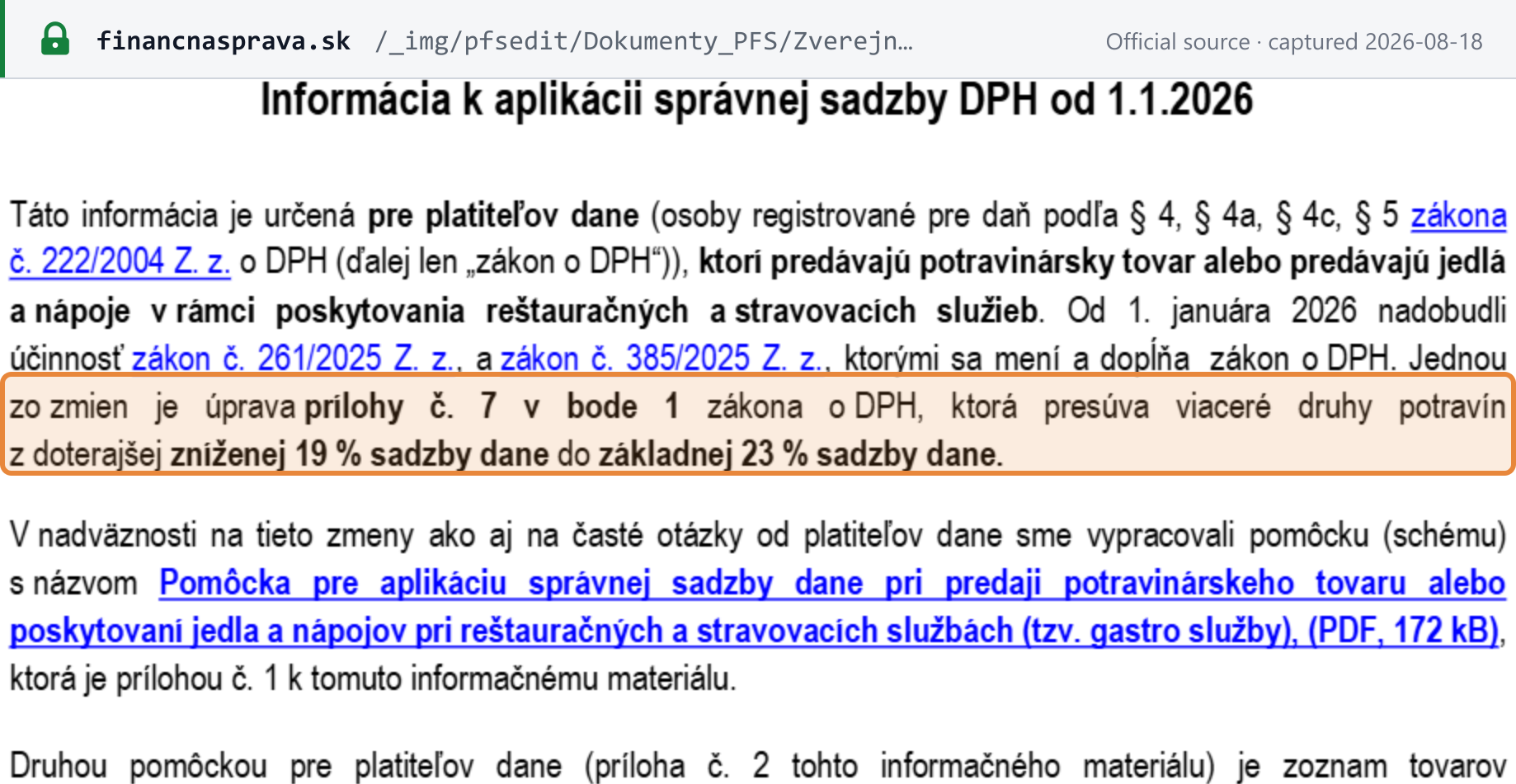 Source snapshot captured 2026-08-18 — original
Cross-border rules
Imports and exports
- Imports of goods. §12 makes import of goods from outside the EU a taxable transaction; §69(8) makes the person liable for the customs debt also liable for the import VAT, collected alongside duty under customs procedures.
- Exports of goods. Zero-rated with credit under §47, subject to evidence that the goods left the EU.
- Reverse charge on imported services and goods. §69(2)(a) shifts the tax to a Slovak-established taxable-person recipient where a foreign person from another member state (that is not a small enterprise using the §68f exemption) or a foreign person from a third country supplies services with a Slovak place of supply. §69(2)(b) applies the same shift for goods already in Slovakia supplied by such a foreign person, subject to listed exclusions (notably distance sales). [1]
- Low-value consignments. §68cb provides a simplified declare-and-pay arrangement for non-excise goods imported in consignments with an intrinsic value not exceeding €150 that do not use the IOSS import scheme under §68c.
Digital products and services
Slovakia has no separate stand-alone "digital services" registration regime — electronically supplied, telecommunications and broadcasting services follow the EU place-of-supply rules transposed into the VAT Act:
- B2B — §16: taxed where the business customer is established, with the Slovak business customer self-accounting for VAT by reverse charge under §69(2)(a).
- B2C — taxed where the consumer belongs. Below the §16(1) combined €10,000 EU-wide threshold, a supplier established in a single member state may keep taxing in its own state; above it, the destination-country rule applies.
- The practical route is the One Stop Shop: §68a (non-Union scheme, for businesses with no EU establishment), §68b (Union scheme, for EU-established sellers' distance sales and B2C services), and §68c (import scheme / IOSS, for distance sales of imported goods not exceeding €150). Correspondence about these schemes runs through Daňový úrad Bratislava.
Foreign companies selling into Slovakia — B2B and B2C answered separately
B2B — services. For services under the general place-of-supply rule, the Slovak business customer self-accounts for VAT under §69(2)(a). The foreign supplier does not register in Slovakia for that transaction alone.
B2B — goods already in Slovakia. §69(2)(b) applies the same reverse-charge shift where a foreign person with no Slovak establishment supplies goods already located in Slovakia — subject to the exclusions in that provision, notably distance sales.
B2C. There is no reverse charge, because a consumer cannot self-account. A foreign business selling to Slovak consumers has three positions:
- Goods dispatched from another member state — intra-Community distance sales. Above the §16 combined €10,000 threshold, the seller declares Slovak VAT through the Union OSS in its own member state (or registers directly in Slovakia).
- Goods dispatched from outside the EU — distance sales of imported goods, declared through IOSS (§68c) or the simplified import arrangement (§68cb) for consignments up to €150.
- Services taxed in Slovakia under the B2C place-of-supply rules — declared through OSS, or via a direct Slovak registration.
- Any other taxable supply made in Slovakia — §5 applies with no threshold, requiring registration from the first transaction.
Marketplace / platform deemed-supplier liability
Yes — the EU deemed-supplier rules are transposed, chiefly in §8(7): a taxable person that facilitates, through an electronic interface, distance sales of goods imported in consignments not exceeding €150, or (for a non-EU underlying seller) intra-Community distance sales or domestic supplies to non-taxable persons, is deemed to have received and supplied the goods itself. §42a exempts the corresponding "supply" from the underlying seller to the facilitating platform, consistent with the EU e-commerce package. [1]
Place of supply
Goods and services run on different tests:
- Goods — §13: goods not dispatched are supplied where they are located; dispatched or transported goods are supplied where dispatch begins, subject to the distance-selling override in §14.
- Distance sales of goods — §14: place of supply moves to the customer's member state once the §16(1) combined threshold is crossed (or by election).
- Services, general B2B/B2C rule — §15/§16: broadly, B2B services are taxed where the business customer is established; B2C services are taxed where the supplier is established, subject to numerous overriding specific rules (immovable property, passenger transport, admission to events, restaurant and catering, short-term means-of-transport hire, and telecommunications/broadcasting/electronic services to consumers) that displace the general position.
- Intra-Community acquisitions — §17: the place of acquisition of goods from another member state. [1]
Invoice requirements
Mandatory content
§74(1) lists the particulars a full faktúra (invoice) must contain:
| # | Required field (§74(1)) | Notes |
|---|---|---|
| 1 | Supplier's name/business name and address, and its identifikačné číslo pre daň | Point (a) |
| 2 | Customer's name/business name and address, and its identifikačné číslo pre daň (if used for the transaction) | Point (b) |
| 3 | Sequential invoice number | Point (c) |
| 4 | Date of supply or date payment received, if determinable and different from the issue date | Point (d) |
| 5 | Date of issue | Point (e) |
| 6 | Quantity and kind of goods, or scope and kind of services | Point (f) |
| 7 | Taxable amount per rate, unit price excluding tax, discounts and rebates if not already reflected | Point (g) |
| 8 | Rate applied, or the exemption, with the statutory or Directive reference, or the words "dodanie je oslobodené od dane" for an exempt supply | Point (h) |
| 9 | Total tax due in euro | Point (i) |
| 10 | "vyhotovenie faktúry odberateľom" | Point (j) — where the customer self-bills under §72(6) |
| 11 | "prenesenie daňovej povinnosti" | Point (k) — reverse charge, customer liable for the tax |
| 12 | New-means-of-transport data | Point (l) |
| 13 | "úprava zdaňovania prirážky — cestovné kancelárie" | Point (m) — travel-agent margin scheme |
| 14 | Margin-scheme wording for used goods, art, or collectors'/antique items | Point (n) |
| 15 | Fiscal representative's details, where applicable | Point (o) |
Issuance deadline
§73(1): within 15 days of the supply (or of the end of the month, for certain payment-before-supply and exempt-supply cases). §73(2) gives a payer who met its registration deadline but has not yet been assigned an IČ DPH 5 working days from receiving the registration decision instead. [1]
Numbering and sequencing
§74(1)(c) requires a sequential number that identifies the invoice; the Act prescribes no fixed format, so a per-branch, per-series or per-document-type prefix is permitted provided uniqueness is preserved.
Credit and debit notes
Slovakia does not use separate "credit note"/"debit note" instruments. Any document that changes an original invoice and specifically and unambiguously relates to it is itself treated as a faktúra under §71(2). For bad-debt relief specifically, §25a(7)–(10) requires a distinct opravný doklad (corrective document) referencing the original invoice, its own sequential identifier, the amount of the correction, and — for a base-of-tax correction — the words "oprava základu dane podľa § 25a". [1]
Currency and language
- Currency. VAT figures are computed and expressed in euro; §22's rounding rule applies eurocent rounding to the tax computed. The VAT Act does not itself impose a general foreign-currency invoicing prohibition, but the tax amount ultimately reported must be in euro.
- Language. The Act does not prescribe a mandatory invoice language, but §76(7) entitles the tax office, for audit purposes, to require a Slovak translation of an invoice issued or received in a foreign language, at the taxpayer's cost. [1]
Document types
- Full faktúra — the §74(1) particulars above; required for B2B and any supply where the customer needs to support input-tax deduction.
- Simplified invoice (zjednodušená faktúra) — §74(3)(a): a receipt for goods or services with a VAT-inclusive price not exceeding €100 may omit the customer's identity and the unit price. §74(3)(b): a document issued by an e-kasa klient cash register, or by an unattended fuel pump paid electronically, may omit the same fields where the VAT-inclusive price does not exceed €400. Neither simplified form is available for intra-Community distance sales, exempt supplies of goods to another member state, or exports (§74(4)). [1]
- Súhrnná faktúra (summary invoice) — §75 allows one invoice covering several separate supplies or advance payments over up to one calendar month, issued within 15 days of the month's end; periodic-supply payment agreements (electricity, gas, water, heat, rent) covering up to 12 months can substitute for repeat invoicing where they already carry the §74(1) particulars.
Self-billing
Permitted. §72(6) lets the customer, or a third party, issue the invoice on the supplier's behalf under a written agreement setting the conditions for the supplier's acceptance; the invoice must carry the words "vyhotovenie faktúry odberateľom" (§74(1)(j)). The supplier remains responsible for the invoice's accuracy and timeliness even when someone else issues it (§72(7)). [1]
Retention and audit trail
§76(1) requires a payer to keep copies of invoices it issued (or that were issued in its name) and invoices it received for 10 years following the year they concern — extended for capital-goods invoices to the end of the input-tax adjustment period under §54/§54a where longer. §71(3) requires the taxpayer to ensure the authenticity of origin, integrity of content and legibility of every invoice from issue to the end of its retention period, by business controls, a qualified electronic signature, agreed EDI safeguards, or another equivalent method — the audit-trail obligation. §76(5) requires electronically stored invoices to remain downloadable and usable by the tax office on request. [1]
A specimen invoice
Finančná správa does not publish a single official annotated specimen invoice, so the sheet below is one we built, placing each §74(1) field where it sits on an issued faktúra. Every name, number and amount is fictional.
Faktúra — VAT invoice
| Kind and scope of service§74(1)(f) | Unit price (net) | Net amount |
|---|---|---|
| Grafický dizajn — 10 hodín | 25 €/hod | 250 € |
- Taxable amount§74(1)(g)
- 250 €
- Rate applied§74(1)(h)
- 23 %
- Tax due§74(1)(i)
- 57,50 €
- Total payable
- 307,50 €
- Conditional wording sits on the face of the invoice, not in a schedule: "prenesenie daňovej povinnosti" for a reverse-charge supply §74(1)(k), "vyhotovenie faktúry odberateľom" where the customer self-bills §74(1)(j), and the exemption reference for an exempt supply §74(1)(h).
- Names, addresses and both IČ DPH values above are invented. A real domestic B2B invoice carries the counterparties' actual SK-prefixed numbers.
E-invoicing status
Status as of 2026-10-05: voluntary/transitional, moving to mandatory domestic B2B/B2G from 1 January 2027.
- 2026 transitional period. §85o of the VAT Act, inserted by Zákon č. 385/2025 Z. z., runs from 1 January 2026 to 31 December 2026. During this window, an electronic invoice sent through a certified doručovacia služba ("Digitálny poštár" / Digital Postman) does not need the recipient's separate §71(1)(b) consent, provided the recipient can accept delivery-service invoices; sending outside a delivery service still needs consent. [1] (Slov-Lex, Zákon č. 385/2025 Z. z., §85o(21)–(22))
- System and network. Certified delivery-service providers (multiple competing "Digitálni poštári", not a single state platform) exchange EN 16931-conformant structured XML invoices over the Peppol network, registered with and monitored by the Finančné riaditeľstvo SR under §76a.
- Mandatory domestic phase. From 1 January 2027, a Slovak VAT payer must issue a structured e-invoice for domestic B2B and B2G supplies of goods or services with a Slovak place of supply to Slovak taxable persons and non-taxable legal persons, and must report the invoice data to the Financial Directorate at the time of issue, a duty met by handing the e-invoice to its certified delivery-service provider (§85o(2), (9), (11)). Every legal person and taxable person, VAT-registered or not, must be able to receive; businesses not established in Slovakia are out of scope until 30 June 2030. Reporting fines reach €10,000, or €100,000 if repeated (§85o(12)–(13)). (Slov-Lex, VAT Act version from 1 January 2027; FR SR eFaktúra FAQ, 15 September 2026) A provider that has not proven full compliance with the §76a(2)(e) conditions by 15 December 2026 is struck from the register on 1 January 2027.
- Cross-border phase. A further set of requirements to §80 and §80a takes effect from 1 July 2030, aligned with the EU's ViDA (VAT in the Digital Age) cross-border digital-reporting timeline.
- Scope. Domestic B2C invoicing is not currently brought into the mandate; B2C sales recorded through eKasa cash registers under the sales-recording act, Zákon č. 384/2025 Z. z. (in force 1 January 2026), sit outside eFaktúra as of this guide's update date. [1] (Slov-Lex, Zákon č. 384/2025 Z. z.)
- Pending bill. Government bill print 1454, at first reading in the National Council as at 2026-10-05, proposes a no-fines period from 1 January to 30 June 2027 (covering both late issuance of e-invoices and the new invoice-data reporting fines) and deleting the enacted buyer-side reporting duty; the same bill carries ViDA second-step changes from 1 January 2027, with repeal of the call-off stock scheme (§8a) from 1 July 2028 (run-off to 30 June 2029). It is not law. (NR SR, print 1454) Full detail: E-invoicing in Slovakia.
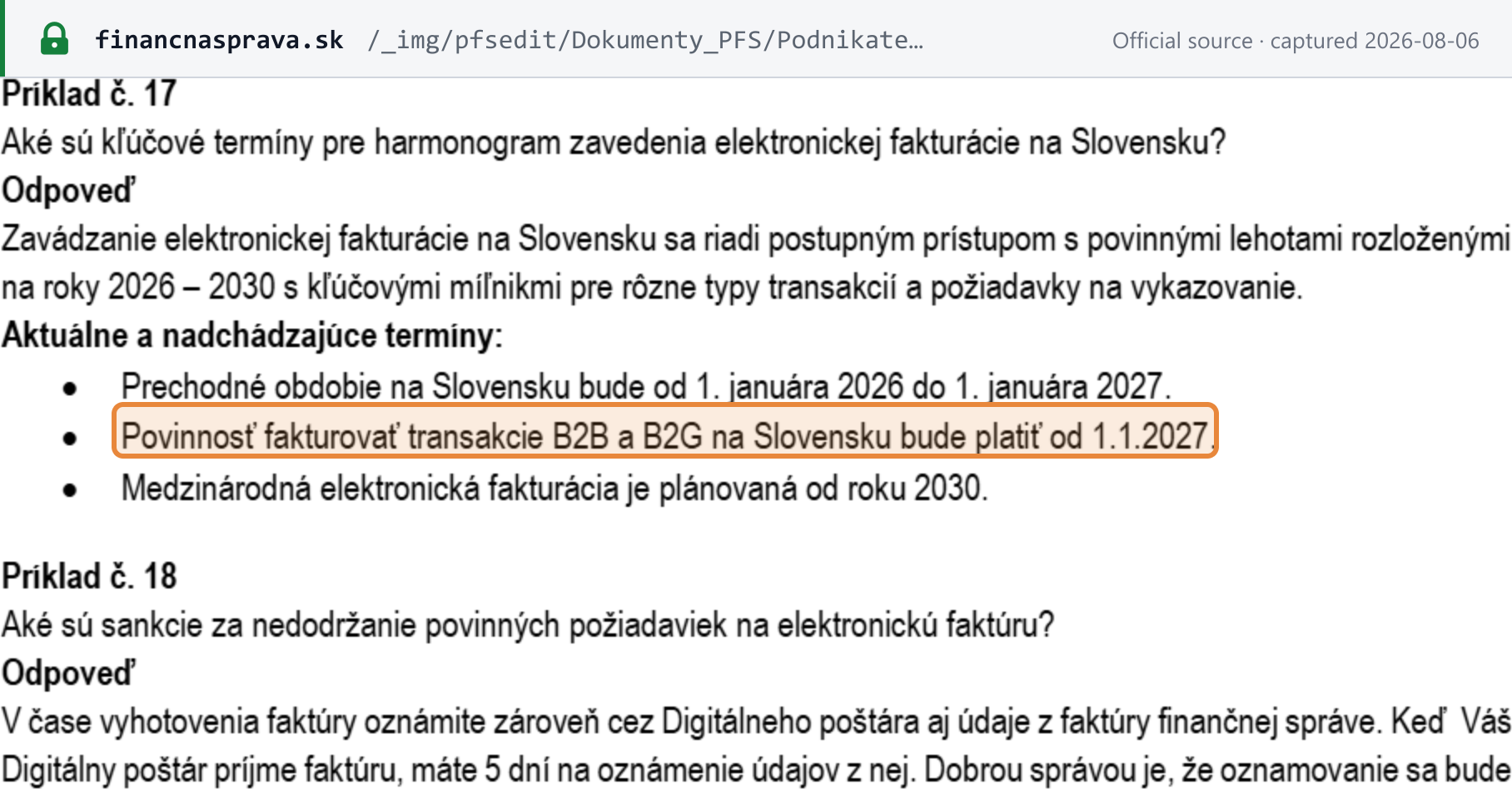 Source snapshot captured 2026-08-06 — original (the July 2026 FAQ edition; current edition: 15 September 2026)
Filing and payment
Filing frequency. §77(1) sets the default taxable period as the calendar month. §77(2) allows a quarterly election once more than 12 calendar months have passed since the taxpayer became a payer under §4, §4b, §4c or §5, and turnover in the preceding 12 consecutive calendar months did not reach €100,000. The change must be notified within 25 days of the month in which the conditions were met, and takes effect from the following calendar quarter. [1]
Return due date and payment. §78(1)–(2): the return is due, and the payer's own tax liability is payable, within 25 days after the end of the taxable period.
Control statement (kontrolný výkaz). §78a(1): a payer must file a kontrolný výkaz — an invoice-level ledger of output tax and input-tax deduction — electronically, for every period for which a return is due, within the same 25-day deadline, unless the period has no reportable transactions or contains only exempt export/intra-EU supplies with no deduction claimed. §78a(2) requires it to break down, invoice by invoice, both issued invoices carrying domestic output tax and received invoices where the recipient self-accounts for tax. [1]
Additional listings. Businesses making intra-EU supplies file a súhrnný výkaz (EC recapitulative statement) under §80, alongside the return.
Input-tax recovery and blocked items. §49(2) gives the general right to deduct tax on goods and services used for taxable supplies. §49(3) blocks deduction for goods/services used for exempt supplies under §28–§42 (with a carve-out preserving deduction for insurance/financial services connected to exports or to non-EU customers). §49(7)(a) specifically blocks deduction on goods and services acquired for hospitality and entertainment purposes (pohostenie a zábava). Mixed business/private use of capital goods, including passenger vehicles, is handled through the apportionment and adjustment mechanism in §49(4)–(6) and §54/§54d rather than a blanket vehicle-purchase block. [1]
Refunds. Where deductible input tax exceeds output tax, §79(1) carries the nadmerný odpočet (excess deduction) forward against the following period's liability by default; any amount still unabsorbed is refunded within 30 days of the return for that following period. §79(2) allows a same-period 30-day refund instead where the payer is a monthly filer, has held its IČ DPH for at least 12 calendar months, and has no tax, customs or social-contribution arrears exceeding €1,000 in the preceding six months. A non-established EU business reclaims Slovak input VAT through its home member state's portal under the EU cross-border refund Directive (2008/9/EC); a non-EU business follows Slovakia's 13th-Directive-equivalent route under §55a/§56. [1]
Exemptions
Slovakia exempts supplies by activity, under §28–§42: postal services (§28); healthcare (§29); social welfare services (§30); educational services (§31); membership services to certain non-profit bodies (§32); sport and physical-education services (§33); cultural services (§34); fundraising activities (§35); public-service broadcasting (§36); insurance services (§37); the supply and lease of immovable property (§38, with an option to tax in defined cases); financial services (§39); postage stamps and duty stamps (§40); lotteries and similar games (§41); and the disposal of goods on which input tax could not be deducted (§42). Exports of goods (§47) and intra-Community supplies (§43) are exempt with credit and sit outside this list.
Exempt is not the same as zero-rated. A §28–§42 exempt supply carries no output VAT, and under §49(3) the supplier generally cannot deduct the related input VAT — a real cost embedded in the price. A zero-rated/exempt-with-credit supply (exports, most intra-EU supplies) also carries no output VAT, but the supplier can still deduct the related input VAT in full.
Special regimes. Slovakia operates the standard EU-aligned margin scheme for travel agencies and for used goods, art, collectors' items and antiques (§65–§66, referenced in the invoice wording at §74(1)(m)–(n)), and a cash-accounting scheme available to smaller payers who account for output VAT only once payment is actually received. The EU cross-border SME scheme (§68f–§68g, see Registration) functions as Slovakia's small-business exemption mechanism for cross-border cases. [1]
Offences and penalties
Slovakia keeps unlawful conduct (offences, prosecuted under the Criminal Code) distinct from monetary sanctions (administrative fines and interest under the Tax Code) — two separate exposures a compliance plan needs to cover.
Offences (Trestný zákon, Zákon č. 300/2005 Z. z.). Tax evasion and related conduct carry criminal exposure, scaled to the monetary "rozsah" (scale) involved — over €700 is "malý rozsah" (small scale), over €20,000 is "väčší rozsah" (larger scale), over €250,000 is "značný rozsah" (substantial scale), and over €650,000 is "veľký rozsah" (large scale), per §125(1):
| Offence | Base penalty | Aggravated (larger scale / repeat / organised) | Substantial scale | Large scale |
|---|---|---|---|---|
| §276 — Skrátenie dane (understating/evading tax) | 6 months–3 years | 1–5 years | 2–8 years | 3–10 years |
| §277 — Neodvedenie dane (withholding and not remitting tax collected from another) | 6 months–3 years | 1–5 years | 2–8 years | 3–10 years |
| §277a — Daňový podvod (VAT/excise refund fraud) | 6 months–3 years | 2–8 years | — | 3–10 years |
| §278 — Nezaplatenie dane (mere non-payment of due tax, no fraudulent intent) | up to 2 years | 6 months–3 years (significant scale) | — | 1–5 years |
Penalties (Zákon č. 563/2009 Z. z., Daňový poriadok). §154 defines the administrative offences — late filing of a return, failure to meet the registration deadline, failure to meet a notification duty, non-compliance with a tax-office decision, and understating tax, among others. §155 sets the fine bands:
- €100–€30,000 for filing a return late (§154(1)(a), first/second grounds).
- €100–€60,000 for still not filing after a second tax-office summons.
- €100–€30,000 for failing to meet the registration deadline (§154(1)(b)) — the specific late-registration penalty.
- €100–€10,000 for failing a notification duty (§154(1)(c)) or breaching a tax-office decision.
- For a tax shortfall raised on assessment: a penalty of 3× the ECB base rate per year (minimum 10% per year if 3× the ECB rate does not reach it) on the increased amount.
Late-payment interest. §156(2) sets the úrok z omeškania (late-payment interest) at 4× the ECB base rate per year, with a minimum 15% per year if 4× the ECB rate does not reach that figure, accruing daily from the day after the payment was due. [7]
Frequently asked questions
What is the difference between DIČ and IČ DPH, and which one goes on a Slovak B2B invoice?
DIČ is the general tax identifier every registered taxpayer holds under the Tax Code, regardless of VAT status. IČ DPH is the VAT-specific number (SK + 10 digits) assigned under §4, §4a–§4c or §5 of the VAT Act once a person becomes a payer. §74(1)(a)–(b) requires the IČ DPH — not the bare DIČ — on a VAT invoice. [1]
Does a foreign company have to register for Slovak VAT immediately, with no minimum turnover threshold?
Yes. Under §5(1), a person with no Slovak seat, establishment, domicile or habitual presence becomes a payer on its first taxable supply — there is no threshold. The application goes to Daňový úrad Bratislava within five working days, decided within ten. Missing the deadline still leaves the foreign person liable to self-assess tax from the date it should have registered. [1]
Has the older 20%/10% rate structure actually been replaced by 23%/19%/5%?
Yes, in the version of the VAT Act currently in force: §27 sets a 23% standard rate, a 19% reduced rate, and a 5% second reduced rate. A further change effective 1 January 2026 (Zákon č. 261/2025 Z. z. and Zákon č. 385/2025 Z. z.) moved several categories of foodstuff goods (high-sugar and high-salt items) out of the 19% reduced rate and into the 23% standard rate, leaving restaurant and catering services unchanged at 5% for food and 19% for non-alcoholic drinks — check the current Annex 7 wording for a given product rather than assume an older rate still applies. [1] [3] [4]
What applies during 2026 for e-invoicing, and who counts as a certified provider?
§85o sets a transitional period from 1 January to 31 December 2026, during which sending an electronic invoice through a certified "Digitálny poštár" delivery-service provider does not need the recipient's separate consent, provided the recipient can receive delivery-service invoices. From 1 January 2027, domestic B2B and B2G invoicing must go through a certified provider on the Peppol network in EN 16931 format; cross-border requirements follow from 1 July 2030. Any provider registered with Finančná správa's Digital Postman register can be used — the obligation is to use a certified provider, not a specific one. [1]
Can a business below the €50,000 threshold still register for Slovak VAT voluntarily?
Yes. §4(6)–(7) let a Slovak-established taxable person apply before crossing either the €50,000 or €62,500 trigger; the tax office decides within 21 days, and payer status starts on the date in the decision. It is generally worth doing where input VAT is significant relative to turnover and customers are themselves VAT-registered. [1]
Important websites
| Purpose | Site |
|---|---|
| Registration / e-filing / e-services | pfseform.financnasprava.sk and financnasprava.sk — elektronické služby |
| General VAT guidance and news | financnasprava.sk |
| eFaktúra / e-invoicing (Digitálny poštár registry, standards) | Finančná správa's eFaktúra programme, reached via financnasprava.sk |
| VAT number verification (Slovakia and EU-wide) | Slovakia IČ DPH validator on Lookuptax, and the EU VIES portal — see our EU VAT verification guide |
| Business register | Obchodný register SR (orsr.sk) |
| Legislation (VAT Act, Tax Code, Criminal Code) | Slov-Lex — Slovakia's official consolidated legal database |
Recent changes
Dated, officially-sourced changes to Slovak VAT. Entries link to Lookuptax's event record where one exists; otherwise they cite the official source directly. The full feed is on the worldwide tax-updates page.
- 2026-08-27 — Proposed, not law. Government bill print 1454 amending the VAT Act was delivered to the National Council (first reading stage). It would keep mandatory eFaktúra from 1 January 2027, add a no-fines period from 1 January to 30 June 2027 for late issuance of e-invoices and for the new data-reporting fines, delete the buyer's data-reporting duty (§85o(10)), set fines of up to EUR 10,000 (EUR 100,000 if repeated) for failures to report invoice data under §85o(9) from 1 July 2027, and carry ViDA second-step changes from 1 January 2027, with repeal of the call-off stock scheme (§8a) from 1 July 2028 (run-off to 30 June 2029). Committee deadlines are 13 and 16 November 2026. (NR SR, print 1454) — see event
- 2026-01-01 — Several categories of foodstuff goods (high-sugar and high-salt items) moved from the 19% reduced VAT rate to the 23% standard rate; restaurant and catering services were not changed, under Annex 7 point 1 as amended by Zákon č. 261/2025 Z. z. and Zákon č. 385/2025 Z. z. — see Rates. (Finančná správa SR; Slov-Lex, 261/2025; Slov-Lex, 385/2025)
- 2026-01-01 — The eFaktúra transitional period began: electronic invoices sent through a certified delivery-service provider no longer need the recipient's separate consent, ahead of the 1 January 2027 mandatory domestic B2B/B2G structured e-invoicing obligation — see E-invoicing status. (Slov-Lex, VAT Act §85o as inserted by 385/2025)
- 2025-01-01 — The standard VAT rate rose to 23% (from 20%), a 19% reduced rate replaced the former 10% rate, and the domestic registration threshold rose to €50,000 (from €49,790) — see Rates and Registration. (Slov-Lex, VAT Act §§4, 27, 85kn)
Reference links
- Zákon č. 222/2004 Z. z. o dani z pridanej hodnoty (VAT Act, consolidated text) — Slov-Lex
- Zákon č. 563/2009 Z. z. o správe daní (daňový poriadok) (Tax Code) — Slov-Lex
- Zákon č. 300/2005 Z. z. Trestný zákon (Criminal Code) — Slov-Lex
- Zákon č. 261/2025 Z. z. — Slov-Lex
- Zákon č. 385/2025 Z. z. — Slov-Lex
- Finančná správa SR — Value Added Tax overview
- Finančná správa SR — Rights and Obligations of Foreign Persons
- Finančná správa SR — aktuálne informácie (news, including eFaktúra and the 2026 rate-application guidance)
For the Slovak tax identifier formats — the general DIČ and the VAT-specific IČ DPH — see our Slovakia TIN number guide. To verify a Slovak VAT number, see the Slovakia IČ DPH validator or our EU VAT verification guide.