Slovenia VAT guidelines
| FACTSHEET | |
|---|---|
| Country code | SI |
| Tax name | Value Added Tax — Davek na dodano vrednost (DDV) |
| Tax Authority | Financial Administration of the Republic of Slovenia — Finančna uprava Republike Slovenije (FURS) |
Overview
Slovenia levies Value Added Tax — in Slovenian davek na dodano vrednost (DDV) — under the Value Added Tax Act (Zakon o davku na dodano vrednost, ZDDV-1). The tax is administered by the Financial Administration of the Republic of Slovenia (FURS) (Finančna uprava Republike Slovenije). [21]
Currency. All amounts in this guide are in euros (EUR). An invoice may be made out in any currency, but FURS's invoice guidance (9th edition, May 2026) says the VAT amount must be shown "v eurih in centih" — in euros and cents. [8]
Tax period. The standard tax period is the calendar month. It is the calendar quarter where taxable turnover in the previous calendar year was up to and including EUR 210,000, but only for a business that makes no intra-EU transactions and has no recapitulative-statement duty. The first 12 months after VAT registration are always monthly, and so are taxpayers not established in Slovenia and VAT groups (FURS general VAT guide, 10th edition, January 2026, §6.2). [4]
Layering. DDV is a national tax. There is no regional or municipal VAT layer. [4]
Registration
Who should register
A business established in Slovenia is exempt from charging VAT under the small-business scheme while its annual turnover in Slovenia stays within EUR 60,000. The rule, rewritten by ZDDV-1O (Art. 32, new Art. 94 ZDDV-1), applies from 1 January 2025 and is measured per calendar year, not on a rolling 12 months: [1]
"(1) Davčni zavezanec, ki ima sedež … v Sloveniji, je oproščen obračunavanja DDV, če v predhodnem koledarskem letu ni presegel zneska 60.000 eurov letnega prometa na ozemlju Slovenije in tega zneska prometa ne presega v tekočem koledarskem letu."
(A taxable person established in Slovenia is exempt from charging VAT if it did not exceed EUR 60,000 of annual turnover in Slovenia in the previous calendar year and does not exceed it in the current calendar year.)
The same article lets a business that crosses EUR 60,000 during the year keep the exemption until its turnover passes EUR 66,000. That gives two outcomes (checked 2026-09-29): [1] [2]
| Turnover in Slovenia in the current calendar year | What happens |
|---|---|
| Up to EUR 60,000 (and up to EUR 60,000 last year) | Exempt small taxpayer: no VAT charged, no input VAT deducted |
| Above EUR 60,000 but not above EUR 66,000 | Apply in time to hold a VAT ID from 1 January of the following year |
| Above EUR 66,000 | Apply no later than the month in which EUR 66,000 is crossed, and charge VAT from the supply that crosses it |
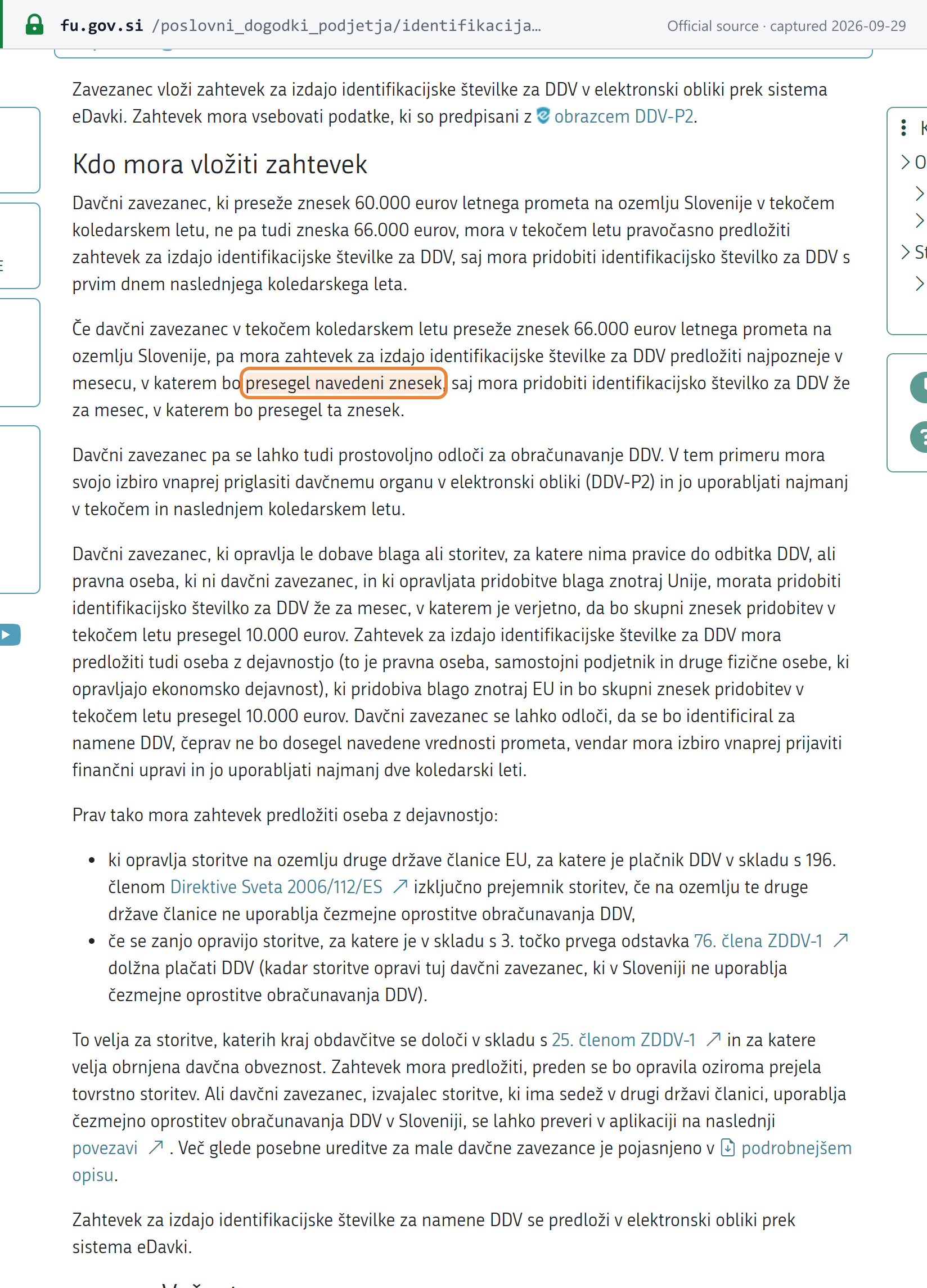
FURS's VAT registration page (last refreshed 16 April 2025) states the timing: "Če davčni zavezanec v tekočem koledarskem letu preseže znesek 66.000 eurov letnega prometa na ozemlju Slovenije, pa mora zahtevek za izdajo identifikacijske številke za DDV predložiti najpozneje v mesecu, v katerem bo presegel navedeni znesek" (if the taxpayer exceeds EUR 66,000 of annual turnover in Slovenia in the current calendar year, it must file the VAT-ID application no later than the month in which it exceeds that amount). [2]
FURS's registration guide (April 2026) adds that a taxpayer crossing EUR 66,000 "mora že od prve obdavčene dobave, s katero preseže to vrednost, obračunati DDV. Navedeno velja tudi, če še nima identifikacijske številke" — it must charge VAT from the first taxable supply that takes it over that value, even if it does not yet have a VAT ID. [3]
A Slovenian business must also register, whatever its turnover, before it receives services from a foreign supplier on which it must self-account under Art. 76(1)(3) ZDDV-1, and before it supplies services in another member state where the customer is liable for the VAT. [2]
Non-resident registration
There is no threshold for non-residents. FURS's registration guide (April 2026) says that for a business established outside the EU, or in another member state and not using the cross-border SME exemption, "ni določenega limita za oprostitev obračunavanja DDV" — no exemption threshold is set. It must obtain a Slovenian VAT ID before its first taxable supply in Slovenia, filing form DDV-P3 at least 15 days before that supply. [3]
- Exception — reverse-charged supplies only. Since 22 January 2022, a non-established business has no obligation to register if all its Slovenian supplies are ones on which the customer pays the VAT (Art. 78(2)(d) ZDDV-1). [3]
- Fiscal representative. Appointing a tax representative (davčni zastopnik) is mandatory for a business established outside the EU and optional for one established in another member state: "obvezno imenovanje davčnega zastopnika za davčne zavezance, ki imajo sedež v tretji državi". The representative must be established and VAT-registered in Slovenia and "ne more biti podružnica tuje osebe" — cannot be a branch of a foreign person. FURS lists exceptions for non-Union OSS users, the occasional international bus-transport scheme, and businesses in third countries that have a mutual-assistance agreement with the EU. [3]
- Documents. With DDV-P3 the applicant attaches a certificate from its home tax authority that it is liable to charge VAT there, or a register extract proving it trades there, plus a contract or other evidence that it intends to trade in Slovenia. [3]
Tax identification number
Slovenia uses the taxpayer's tax number (davčna številka) as its VAT ID, with the prefix SI: "V Sloveniji se kot identifikacijska številka za namene DDV uporablja davčna številka … s predpono SI". FURS's own examples take the form SI12345678; a business using the EU cross-border SME scheme receives the suffix -EX (SI12345678-EX). [3] [22]
To check a number, use Lookuptax's Slovenia DDV number validator, or see how to verify an EU VAT number in VIES and the list of official VAT-number lookups.
How to register
Applications are filed electronically through eDavki: "Zahtevek za izdajo identifikacijske številke za namene DDV se predloži v elektronski obliki prek sistema eDavki." A business established in Slovenia uses form DDV-P2; a non-established business uses DDV-P3. [2] [3]
Timeline. Per FURS's registration guide, the VAT ID is issued no later than the last day of the month following the month in which the application was filed. [3]
Voluntary registration
Available at any turnover. The choice must be notified in advance on DDV-P2 and applied "najmanj v tekočem in naslednjem koledarskem letu" — for at least the current and the following calendar year. The reason to opt in is input-VAT recovery: an exempt small taxpayer "nima pravice do odbitka DDV, niti ga ne sme izkazovati na izdanih računih" (has no right to deduct VAT and may not show it on its invoices). [2] [4]
Deregistration
- On request. A Slovenian-established taxpayer may apply to cancel its VAT registration if its turnover did not exceed EUR 60,000 in the previous calendar year and does not exceed it in the current one. [6]
- Ex officio. FURS may cancel the registration if the taxpayer stops trading without telling it, or has filed no VAT return for 6 months — 3 months for a taxpayer not established in Slovenia. [6] [3]
- Final return. When VAT identification ends, the final return is due by the last working day of the month after the month in which the identification ended (Art. 88(5) ZDDV-1). [14]
Group registration
Available from 1 January 2026. ZDDV-1O inserted Art. 5.a, which lets two or more taxpayers established in Slovenia (including Slovenian fixed establishments) that are financially, economically and organisationally linked register as a single VAT group (skupina za DDV). A financial link means owning, directly or indirectly, more than 50% of another's capital or voting rights. [1]
- The group has one VAT ID and files monthly (Art. 89(10)). [1]
- A member must stay in for the current and the two following calendar years, and members are jointly and severally liable for the group's VAT (FURS legislative-changes guide, 34th edition, December 2025). [6]
- UJP's news of 6 August 2026 confirms that "s 1. januarjem 2026 uvedena možnost oblikovanja skupine za DDV" (the option to form a VAT group was introduced on 1 January 2026), and explains how group data is recorded in an e-SLOG 2.0 e-invoice. [23]
Rates
| Rate | Applies to | Effective |
|---|---|---|
| 22% (general) | All taxable supplies not listed in Annex I or Annex IV to ZDDV-1 | Since 1 July 2013 [6] |
| 9.5% (reduced) | Goods and services in Annex I — see below | Since 1 July 2013 [6] |
| 5% (special reduced) | Goods and services in Annex IV — books, newspapers and periodicals; firefighting vehicles and equipment | Since 1 January 2020 (books and press); 2 September 2023 (firefighting) [6] |
| Exempt | See Exemptions | — |
FURS's rates guide (14th edition, June 2026): "DDV se obračunava in plačuje po splošni, 22 % stopnji … za dobave blaga in storitev iz Priloge I k ZDDV-1 … po nižji, 9,5 % stopnji …, za dobave blaga in storitev iz Priloge IV pa po posebni nižji stopnji 5 %" (VAT is charged at the general 22% rate; Annex I supplies at the reduced 9.5% rate; Annex IV supplies at the special reduced 5% rate). (Checked 2026-09-29.) [5]
When the rates were set. The general rate rose from 20% to 22%, and the reduced rate from 8.5% to 9.5%, on 1 July 2013 under Article 10 of ZIPRS1314-A. The 5% rate was introduced on 1 January 2020 by ZDDV-1L (Uradni list RS 72/2019) for books, newspapers and periodicals, printed or electronic, including library lending; firefighting vehicles and equipment followed from 2 September 2023. [6]
What the 9.5% rate covers. FURS's general guide lists, among others: food and non-alcoholic drink — excluding alcoholic drinks and drinks with added sugar or sweeteners; water supply; medicines and medical devices; passenger transport; restaurant and catering services; admission to cultural and sporting events; authors' rights; social housing and the renovation of private dwellings; hotel accommodation; funeral services; hairdressing; minor repairs; domestic care; and window and household cleaning. Mineral and chemical fertilisers and chemical plant-protection products stay at 9.5% only until 31 December 2031. [4]
Sugary drinks moved to 22% on 1 January 2025. ZDDV-1O took drinks with added sugar or sweeteners, and preparations for making them, out of the reduced rate. Its transitional Art. 47 says that for a partly performed supply of such drinks "davčni zavezanec obračuna DDV za celotno dobavo teh pijač po splošni stopnji DDV" (the taxpayer charges VAT on the whole supply at the general rate). [1]
Zero rate. Slovenia has no statutory zero rate. Exports and intra-EU supplies are instead exempt with the right to deduct — see Exemptions.
Announced future rates. No rate change has been announced in FURS news (as of 29 September 2026). [21]
For Slovenia alongside other jurisdictions, see Lookuptax's worldwide tax rates table and VAT registration thresholds table. The EU-wide small-business rules behind the EUR 60,000 threshold are explained in Lookuptax's EU VAT SME scheme guide.
Cross-border rules
Imports and exports
- Imports of goods. Import VAT is collected as if it were an import duty. A VAT-registered importer may instead report it in its VAT return (deferred accounting); a non-established importer that does so must first appoint a tax representative, who is jointly and severally liable for the import VAT. The taxable amount on import is the customs value. [4]
- De minimis. FURS's VAT guidance sets no Slovenia-specific VAT de minimis for imported goods. The EU-wide Import One-Stop Shop covers consignments of intrinsic value up to EUR 150 (excluding excise goods) — see Lookuptax's IOSS guide. [4]
- Exports and intra-EU supplies. Both are exempt with the right to deduct — a "true" exemption (prava oprostitev). Intra-EU B2B supplies are reported on the recapitulative statement RP-O by the 20th of the following month. [4]
- Reverse charge on imported services. A Slovenian VAT-registered customer self-assesses VAT on services taxed in Slovenia that a foreign supplier provides (Art. 76(1)(3) ZDDV-1). A Slovenian small taxpayer receiving such services must hold a VAT ID even though it is otherwise exempt. See Lookuptax's reverse charge explainer. [2]
Digital products and services
Telecommunications, broadcasting and electronically supplied services to consumers are taxed where the customer is. For an EU supplier, they count, together with intra-EU distance sales of goods, towards the EU-wide EUR 10,000 threshold; above it, the supplier charges Slovenian VAT and may report it through the Union OSS (unijska ureditev) instead of registering. A supplier established outside the EU uses the non-Union OSS (neunijska ureditev) for all its B2C services, with no threshold. [4] See Lookuptax's One-Stop Shop guide.
Foreign companies selling into Slovenia — B2B and B2C
The answer depends on who the customer is:
- B2B — usually no Slovenian registration. For services taxed where the customer is established, the Slovenian VAT-registered customer self-assesses. A non-established supplier whose Slovenian supplies are all reverse-charged to the customer has had no registration obligation since 22 January 2022. Domestic-sector reverse charge (construction and similar) is described under Filing and payment. [3] [4]
- B2C — register, or use an OSS scheme. Goods held in or delivered within Slovenia require registration from the first supply, with no threshold. Distance sales of goods from another EU state and TBE services to consumers are taxed in Slovenia above the EUR 10,000 EU-wide threshold and can be declared through the Union OSS. Non-EU suppliers of B2C services use the non-Union OSS; imported goods in consignments up to EUR 150 can go through IOSS. [3] [4]
Marketplace / platform deemed-supplier liability
Applies. FURS's OSS guide (6th edition, February 2026, §4.0) makes an electronic interface — "trg, platforma, portal ali podobno sredstvo" (a marketplace, platform, portal or similar means) — the deemed supplier in two cases: [19]
- distance sales of goods imported from outside the EU in consignments of intrinsic value up to EUR 150;
- supplies of goods within the EU by a supplier not established in the EU to non-taxable persons, whatever the value.
See Lookuptax's marketplace deemed-supplier explainer.
Place of supply
- Goods. Where the goods are when the supply is made; for transported goods, where transport begins; installed goods where installed; distance sales where transport ends, subject to the EUR 10,000 threshold. [4]
- Services, B2B. Where the customer is established: "Po splošnem pravilu se kraj opravljanja storitev, ki jih prejme davčni zavezanec kot tak, določa glede na sedež naročnika storitev." [4]
- Services, B2C. Where the supplier is established. [4]
- Exceptions. Services connected with immovable property (where the property is); passenger transport (the distance covered); events (where held); restaurant services (where performed); short-term hire of means of transport (where made available — up to 30 days, 90 for vessels); TBE services to consumers (where the customer is). [4]
Invoice requirements
The invoice rules sit in Articles 81–84 ZDDV-1. ZDDV-1G (Uradni list RS 83/2012) rewrote them in 2012, and ZDDV-1O (Uradni list RS 104/2024) amended them again from 1 January 2025: its Art. 23 rewrote Art. 81(2) and deleted Art. 81(5), Art. 24 inserted a new Art. 81.a on exemptions from the duty to invoice, Art. 25 added item 18 to Art. 82(1), and Art. 26 amended Art. 83. FURS's invoice guide ("Računi – Podrobnejši opis", 9th edition, May 2026) gives the current consolidated list. [7] [1] [8]
Mandatory content
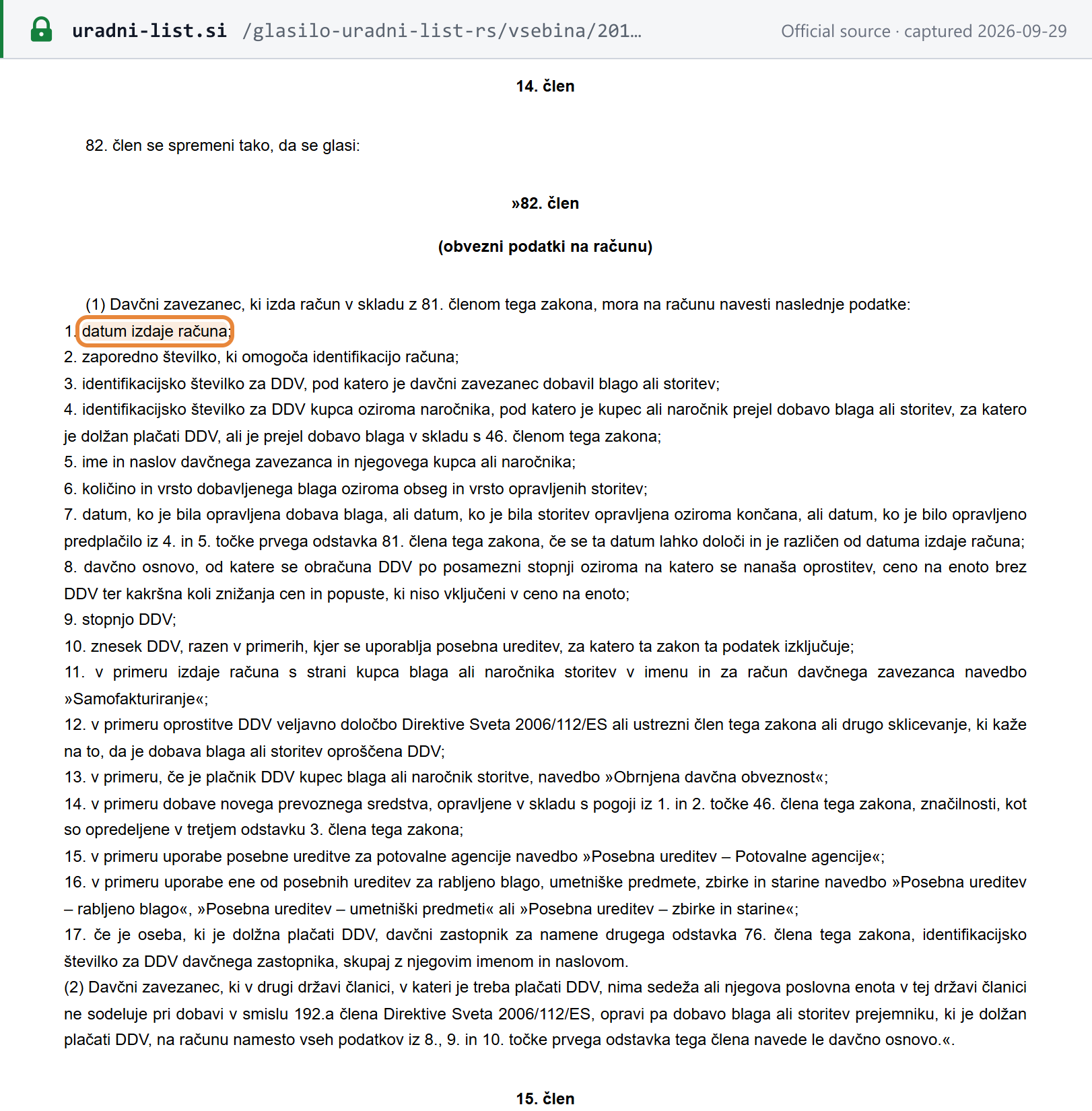
A VAT-registered taxpayer issuing an invoice under Art. 81 must show the following particulars (Art. 82(1) ZDDV-1): [7] [1] [8]
| # | Required field | Legal cite |
|---|---|---|
| 1 | Date of issue | Art. 82(1)(1) |
| 2 | Sequential number that uniquely identifies the invoice | Art. 82(1)(2) |
| 3 | Supplier's VAT ID | Art. 82(1)(3) |
| 4 | Customer's VAT ID, where the customer is liable for the VAT or receives an intra-EU supply under Art. 46 | Art. 82(1)(4) |
| 5 | Names and addresses of supplier and customer | Art. 82(1)(5) |
| 6 | Quantity and type of goods, or extent and type of services | Art. 82(1)(6) |
| 7 | Date of supply, completion or advance payment, where it differs from the issue date | Art. 82(1)(7) |
| 8 | Taxable amount per rate or exemption, unit price excluding VAT, and discounts not in the unit price | Art. 82(1)(8) |
| 9 | VAT rate | Art. 82(1)(9) |
| 10 | VAT amount | Art. 82(1)(10) |
| 11 | "Samofakturiranje" (self-billing), where the customer issues the invoice | Art. 82(1)(11) |
| 12 | Reference to the exemption provision (Directive or ZDDV-1 article) | Art. 82(1)(12) |
| 13 | "Obrnjena davčna obveznost" (reverse charge), where the customer pays the VAT | Art. 82(1)(13) |
| 14 | Details of a new means of transport supplied intra-EU | Art. 82(1)(14) |
| 15 | "Posebna ureditev – Potovalne agencije" (travel agents' scheme) | Art. 82(1)(15) |
| 16 | "Posebna ureditev – rabljeno blago / umetniški predmeti / zbirke in starine" (margin schemes) | Art. 82(1)(16) |
| 17 | Tax representative's VAT ID, name and address, where the representative pays the VAT | Art. 82(1)(17) |
| 18 | "Posebna ureditev – Plačana realizacija" (cash-accounting scheme) | Art. 82(1)(18), added by ZDDV-1O Art. 25 |
Where the customer self-assesses in another member state, the supplier shows only the taxable amount instead of items 8–10 (Art. 82(2)). [7]
Issuance deadline
FURS's invoice guide states two explicit deadlines: [8] [9]
- Intra-EU supplies of goods (Art. 46) and cross-border B2B services where the customer pays the VAT under Art. 196 of the VAT Directive: "najkasneje 15. dan v mesecu, ki sledi mesecu, v katerem nastane obdavčljivi dogodek" — no later than the 15th day of the month after the chargeable event.
- Sales paid in cash under the fiscal cash register law (ZDavPR): at the latest when the supply is made and payment is received.
FURS's invoice guide sets no separate general issuance deadline for other domestic invoices.
Numbering and sequencing
Each invoice carries a sequential number that uniquely identifies it (Art. 82(1)(2)). Cash-paid invoices also carry the fiscal-verification marks described under Fiscal cash registers below. [7]
Credit and debit notes
"Kot račun se šteje tudi vsak dokument oziroma sporočilo, ki spreminja prvoten račun in se nanj nedvoumno nanaša" — any document or message that amends the original invoice and unambiguously refers to it counts as an invoice, and it may take the simplified form. [8]
Advance payments. An invoice is required for every advance received from a business or legal person. The final invoice deducts the VAT already charged on the advance and cites the number of the advance-payment invoice. [8]
Currency and language
- Currency. Any currency, but the VAT amount must be expressed in euros and cents: "Znesek DDV na računu mora biti izkazan v eurih in centih." [8]
- Language. FURS's invoice guide sets no invoice-language rule; it addresses only currency. [8]
Document types
| Document | When it is used | Cite |
|---|---|---|
| Full invoice | Default for every taxable supply by a VAT-registered taxpayer | Art. 82 |
| Simplified invoice | To final consumers, any amount; to businesses or legal persons where the total excluding VAT is up to EUR 100; and for documents amending an original invoice. Not allowed for intra-EU supplies where the customer pays the VAT. | Art. 83 |
| Small taxpayer's document | Issued by a business not registered for VAT: shows its tax number and no VAT. FURS recommends the clause "ni zavezanec za DDV" or "Oproščeno plačila DDV po prvem odstavku 94. člena ZDDV-1". | Art. 94 |
| Amending document | Credit or debit adjustments | Art. 81 |
| Fiscally verified invoice | Any invoice paid wholly or partly in cash, including by card | ZDavPR |
A simplified invoice must show at least the date, sequential number, supplier name, address and VAT ID, the goods or services, the VAT amount or the data needed to compute it, and, for an amending document, a reference to the original invoice. [7] [8] [4]
Self-billing
Permitted with a prior agreement. FURS: the customer may issue the invoice only "če se obe stranki o tem predhodno dogovorita in … če se še posebej dogovorita o načinu sprejema vsakega računa" — if both parties agree in advance and specifically agree how the supplier accepts each invoice. The invoice carries "Samofakturiranje" (Art. 82(1)(11)). [8]
Retention and audit trail
- Retention. "Rok za hrambo izdanih in prejetih računov je 10 let, za račune v zvezi z nepremičninami pa 20 let" — 10 years, and 20 years for invoices relating to immovable property. [4]
- Electronic archiving. Paper and electronic invoices are equivalent. Invoices may be kept in their original paper or electronic form, or on microfilm or electronically where the method prevents alteration or deletion; data guaranteeing authenticity and integrity must be kept with electronic invoices. [4] [8]
- Storage abroad. A Slovenian-established taxpayer that stores invoices outside Slovenia must notify FURS in advance. [4]
- Audit trail. Authenticity of origin, integrity of content and legibility must be ensured from issue to the end of retention — through business controls creating "zanesljivo revizijsko sled med računom in dobavo" (a reliable audit trail between invoice and supply), an advanced electronic signature, or EDI. [8]
Fiscal cash registers (davčne blagajne)
Since 2 January 2016, under the Fiscal Verification of Invoices Act (ZDavPR), every invoice paid wholly or partly in cash must be fiscally verified in real time with FURS before it is handed to the buyer. FURS's page on fiscal cash registers: "Finančna uprava potrjuje in shranjuje podatke o računih pri gotovinskem poslovanju v postopku njihove izdaje v realnem času" — FURS verifies and stores invoice data for cash transactions in real time, as the invoices are issued. [10] [9]
- What counts as cash. Notes and coins, payment and credit cards, cheques, and certain payment services acting as agents — "Plačilo računa s plačilno ali kreditno kartico … se za namene ZDavPR šteje za gotovinsko plačilo." Direct bank transfers do not count. [9]
- Extra particulars. On top of the Art. 82 fields, the invoice shows the time of issue (hour and minute), the identifier of the person issuing it, the EOR (the unique invoice identifier FURS returns) and the ZOI (the issuer's protective mark). [9]
- Fallback. If the device or connection fails, the seller uses a FURS-certified bound invoice book (vezana knjiga računov, VKR). [8]
- Buyer's duty. A buyer who does not take and keep the invoice on leaving the premises can be fined EUR 40. [9]
- From 1 January 2026, sales through vending machines must also be reported under ZDavPR (FURS fiscal-register guide, 4th edition, August 2026). [9]
A specimen of a compliant invoice
FURS publishes no annotated specimen invoice in its invoice or fiscal-register guidance. The layout below is Lookuptax's own illustration of the Art. 82 particulars for a domestic B2B supply paid by bank transfer, so no EOR or ZOI is needed. Every name, number and amount in it is fictional:
Račun — Invoice
| DescriptionArt. 82(1)(6) | QuantityArt. 82(1)(6) | Unit price (excl. VAT)Art. 82(1)(8) | VAT rateArt. 82(1)(9) | Value (excl. VAT) |
|---|---|---|---|---|
| IT consulting (hours) | 10 | EUR 100.00 | 22% | EUR 1,000.00 |
| Catering for workshop | 1 | EUR 200.00 | 9.5% | EUR 200.00 |
- Taxable amount at 22%Art. 82(1)(8)
- EUR 1,000.00
- VAT at 22%Art. 82(1)(10)
- EUR 220.00
- Taxable amount at 9.5%Art. 82(1)(8)
- EUR 200.00
- VAT at 9.5%Art. 82(1)(10)
- EUR 19.00
- Total including VAT
- EUR 1,439.00
- The VAT amounts must be shown in euros and cents, even if the rest of the invoice is in another currency.
- Where the customer pays the VAT, the invoice carries "Obrnjena davčna obveznost" instead of charging it — Art. 82(1)(13); where the customer issues the invoice, "Samofakturiranje" — Art. 82(1)(11).
- If this invoice were paid in cash or by card, it would also need the time of issue, the issuing person's identifier, the EOR returned by FURS and the ZOI protective mark — ZDavPR.
- From 1 January 2028 a domestic B2B invoice like this one must be exchanged as a structured e-invoice (e-SLOG or an EN 16931 syntax), not as a PDF or on paper — ZIERDED Art. 7(1).
E-invoicing status
Status (as of 2026-09-30): B2G mandatory since 2015; B2B enacted, mandatory from 1 January 2028; B2C voluntary. For the full picture — providers, formats, the free FURS app, retention and fines — see Lookuptax's Slovenia e-invoicing guide. For Slovenia alongside other mandates, see Lookuptax's e-invoicing status and networks table.
B2G — mandatory since 1 January 2015
Suppliers to budget users (proračunski uporabniki) must send e-invoices only. ZOPSPU-A (Uradni list RS 111/2013) requires budget users to receive invoices "izključno v elektronski obliki" (exclusively in electronic form), with the rule applying from 1 January 2015. ZOPSPU-1 (Uradni list RS 77/2016) carried the rule from 2016 until ZPJS (Uradni list RS 85/2025) repealed it on 21 November 2025; the rule now sits in ZPJS Arts. 44–50, under which suppliers "proračunskim uporabnikom izdajajo izključno e-račune" (issue exclusively e-invoices to budget users), exchanged only through UJP. [25] [13] [24]
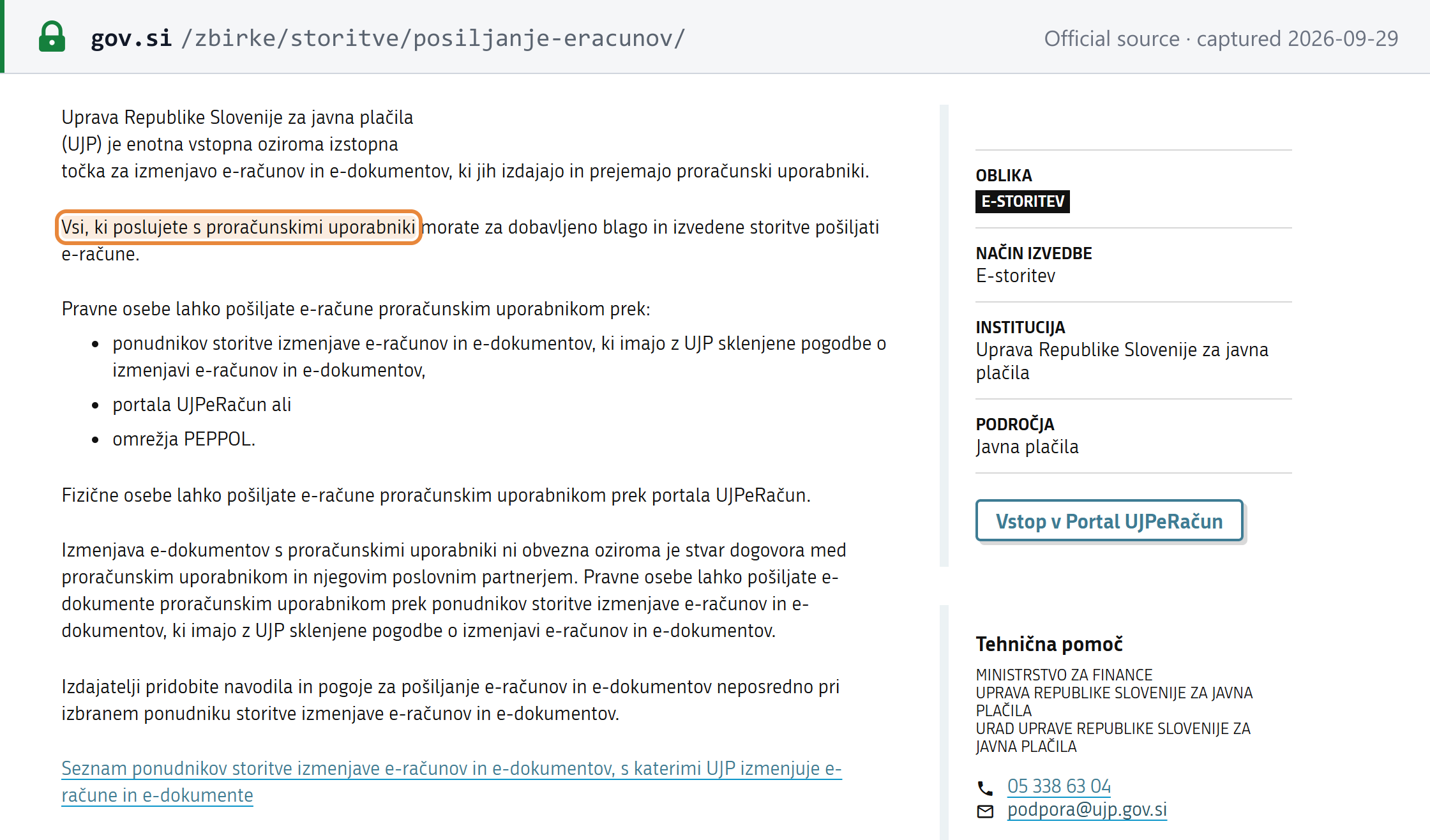
The Public Payments Administration (UJP) is the single entry and exit point. Its service page states: "Vsi, ki poslujete s proračunskimi uporabniki morate za dobavljeno blago in izvedene storitve pošiljati e-račune" — everyone doing business with budget users must send e-invoices. Legal persons send them through a contracted exchange provider, the UJPeRačun portal (at most 100 e-invoices a year), or Peppol; UJP is the certified Peppol access point for all Slovenian budget users (participant ID 9949:si10641424). [12]
B2B — mandatory from 1 January 2028
The Act on the Exchange of Electronic Invoices and Other Electronic Documents (ZIERDED) was published in Uradni list RS 85/2025 on 6 November 2025 and entered into force on the thirtieth day after publication, 6 December 2025. Art. 7(1): business entities "za medsebojne dobave blaga in storitev, opravljene v Sloveniji, izmenjujejo izključno e-račune" — exchange exclusively e-invoices for supplies of goods and services between them made in Slovenia. Art. 28 sets the dates: [11]
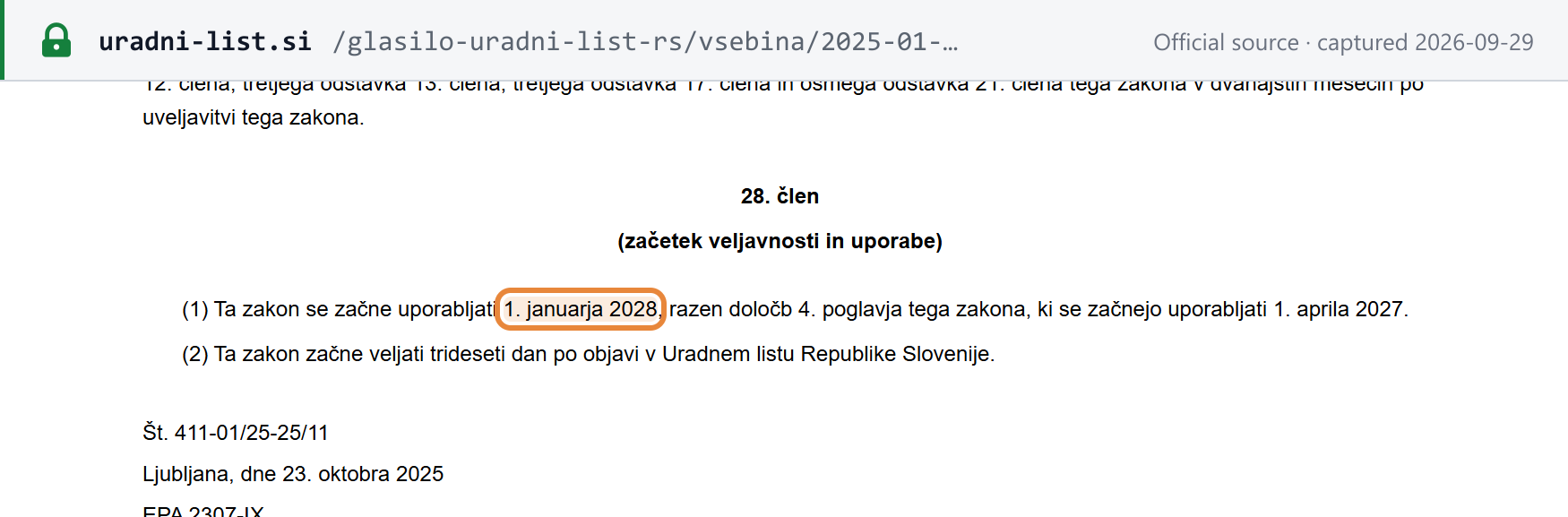
"(1) Ta zakon se začne uporabljati 1. januarja 2028, razen določb 4. poglavja tega zakona, ki se začnejo uporabljati 1. aprila 2027."
(This Act applies from 1 January 2028, except the provisions of Chapter 4, which apply from 1 April 2027.)
| Date | What happens |
|---|---|
| 6 December 2025 | ZIERDED in force |
| 1 April 2027 | Chapter 4 (e-route providers) applies |
| 1 October 2027 | The list of e-route providers is due (Art. 26) |
| 1 January 2028 | Exclusive B2B e-invoicing applies |
The Act requires its implementing regulations within 12 months of entry into force (Art. 27). [11]
Channels (Art. 9 and 11). Businesses exchange e-invoices through: [11]
- registered e-route providers (ponudniki e-poti) on the list kept by UJP;
- the Peppol network or certified Peppol access points — see Lookuptax's Peppol guide;
- their own direct-exchange systems, with both parties' consent;
- a free FURS application, routed through UJP, meant for businesses with few or simple, repetitive transactions.
Every business must choose at least one e-route provider; for users of the FURS application, UJP plays that role. E-mail exchange is not allowed: "Izmenjava e-računov in e-dokumentov med poslovnimi subjekti in ponudniki e-poti ni dovoljena po elektronski pošti." [11]
Formats (Art. 5). E-invoices are exchanged in (1) the national e-SLOG standard, (2) a syntax compliant with the European standard EN 16931 on the Commission's list, or (3) another international standard if agreed in advance by contract. The FURS application accepts only (1) or (2). Art. 2(15) defines e-SLOG as the national standard, aligned in content with the European standard. [11]
No clearance or e-reporting. ZIERDED sets no real-time clearance or e-reporting of B2B invoices to FURS. Real-time reporting exists only for cash-paid invoices under ZDavPR (see Invoice requirements). [11]
Penalties (Arts. 23–24). From 2028, breaching the exclusive-e-invoice duty (Art. 7(1)) or the channel rules (Art. 9(1)) costs a legal person EUR 1,000–3,000, a sole trader EUR 500–1,500 and a responsible person EUR 100–500 (Art. 24). FURS supervises Art. 7(1) (Art. 23(3)). [11]
For the EU-level reform of digital reporting and e-invoicing, see Lookuptax's ViDA guide.
B2C — voluntary
E-invoices go to consumers only "če se stranki o tem predhodno izrecno dogovorita" — if the parties have expressly agreed in advance (ZIERDED Art. 8). [11]
Filing and payment
Filing frequency
Monthly by default; quarterly only where last year's taxable turnover was up to EUR 210,000 and the business makes no intra-EU transactions — and never in the first 12 months after registration, for non-established taxpayers, or for VAT groups. See Overview. [4]
Return due date
The VAT return (DDV-O) is filed electronically through eDavki. Art. 88 ZDDV-1 (2011 consolidated text): [14]
- General rule: "do zadnjega delovnega dne naslednjega meseca po poteku davčnega obdobja" — by the last working day of the month after the tax period.
- Intra-EU traders that must file the recapitulative statement: by the 20th day of the month after the tax period (Art. 88(3)).
A return is due even for a period with no transactions. FURS's legislative-changes guide (December 2025) and its 2026 deadline calendar apply the same two dates — for example, DDV-O due on 30 January, 27 February and 31 March 2026, and RP-O on the 20th. [6] [21]
Payment due date and method
VAT is paid by the last working day of the month after the tax period — including by taxpayers that file on the 20th (Art. 77(2) ZDDV-1). Payment goes to the state-budget transit account SI56 0110 0888 1000 030 with reference SI19 [tax number]-62006. [14] [4]
Additional listings
| Filing | Content | Due |
|---|---|---|
| Evidenca obračunanega DDV and evidenca odbitka DDV | Output-VAT and input-VAT records, filed for every tax period since 1 July 2025 (Art. 85.b) | With the DDV-O |
| RP-O | Recapitulative statement (EC sales list) | 20th of the following month |
| PD-O | Domestic reverse-charge supplies: construction work, construction staffing, opted land and buildings, scrap metal, emission allowances | With the DDV-O |
| Distance-sales report | Distance sales to other member states outside OSS | 31 January |
| DDV-TBE | TBE services and distance sales under the EUR 10,000 threshold | 31 January |
| DDV-SezPR | Unpaid invoices under cash accounting | 31 January |
| Flat-rate compensation return | Flat-rate farmers | 31 January |
Pre-filled returns. If the two VAT records are filed at least three working days before the return deadline, FURS prepares a pre-filled DDV-O from them; if the taxpayer files nothing itself, the pre-filled return counts as filed. [1] [4]
Input-tax recovery and blocked items
Input VAT is deductible on purchases used for taxed transactions and certain exempt transactions with credit; a business with mixed activity deducts by a deduction ratio (odbitni delež). [4]
FURS lists these blocked items in its refund guidance, where it applies them as the Art. 66 ZDDV-1 limitation: [20]
- yachts and pleasure boats, aircraft, passenger cars and motorcycles, and their fuel, parts and related services — unless used for passenger or goods transport, hire, or resale;
- representation costs — "zgolj stroški pogostitve in zabave ob poslovnih in družabnih stikih" (only hospitality and entertainment in business and social contacts);
- food, drink and accommodation, except where the business incurs them in making such supplies itself.
Refunds
- Excess credit. Carried forward, or refunded on request within 21 days of filing the return. For periods from 1 January 2025, an excess can be claimed only within five years of the return that established it; excesses from earlier returns can be carried forward until 31 December 2029 (ZDDV-1O Art. 46). [4] [1]
- Slovenian businesses claiming VAT in other EU states: by 30 September of the following year. [21]
- EU businesses claim Slovenian VAT through their home-state portal. [20]
- Non-EU businesses: only on reciprocity — "Vračilo DDV davčnim zavezancem s sedežem v tretji državi se prizna samo, če je izpolnjen pogoj vzajemnosti." The minimum claim is EUR 400 for a period under a year, or EUR 50 for a full year; FURS's calendar lists the deadline as 30 June. [20] [21]
- Correcting errors. Past-period errors can be corrected in the current return (Art. 88.b), and a missed return filed late (Art. 88.c), before an inspection or proceedings begin; 3% a year interest is charged on the under-declared VAT, and the taxpayer is relieved of offence liability (Art. 141.a). [4] [1]
Exemptions
Exempt supplies
FURS's general guide distinguishes two kinds of exemption: [4]
- Exempt without the right to deduct (neprave oprostitve): health care, social care, education, religious bodies, sport, culture and universal postal services; insurance and reinsurance; letting of immovable property; financial services; betting and gaming; supply of buildings other than new buildings, and of land (with an option to tax); gold supplied to the Bank of Slovenia.
- Exempt with the right to deduct (prave oprostitve): exports; intra-EU supplies of goods and equivalent transactions; services performed or used outside Slovenia for a VAT-registered customer; supplies in customs and tax warehouses.
Exempt is not zero-rated. FURS puts the difference in exactly these terms: "Neprave oprostitve … pomenijo, da davčni zavezanci … od svojih dobav ne obračunavajo davka, pa tudi nimajo pravice do odbitka davka … Prava oprostitev pa pomeni, da davčni zavezanec DDV ne obračuna in plača, hkrati pa ima pravico do odbitka davka." An exempt supplier charges no VAT and cannot recover the related input VAT; a supplier making exports or intra-EU supplies charges no VAT but keeps its right to deduct. [4]
Special regimes
- Small-business exemption: EUR 60,000 / EUR 66,000 — see Registration. The EU cross-border SME scheme is available from 2025, with the "-EX" identification number. [1] [22]
- Flat-rate farmers: VAT-exempt farmers receive an 8% flat-rate compensation from VAT-registered buyers, who may deduct it. [4]
- Travel agents: VAT on the margin, with no input deduction. [4]
- Margin scheme for second-hand goods, works of art, collectors' items and antiques; VAT is not shown separately on the invoice. [4]
- Investment gold: exempt, with an option to tax. [4]
- Cash accounting (plačana realizacija): optional for taxpayers whose taxable turnover does not exceed EUR 400,000 (excluding VAT) and is unlikely to exceed it in the next 12 months. [4]
- OSS, non-Union OSS and IOSS: see Cross-border rules. [4]
- Free zones. FURS's general VAT guide describes no free-zone VAT regime; it covers customs and tax warehouses. [4]
Offences and penalties
The offence provisions sit in Articles 140–142 ZDDV-1, as replaced by ZDDV-1K (Uradni list RS 59/2019, applying from 1 January 2020). ZDDV-1O added new offence items in 2024 without changing the fine amounts. [15] [1]
Offences
| Tier | Examples of the conduct | Cite |
|---|---|---|
| Tax offence (davčni prekršek) | Not charging VAT when due; charging the wrong rate; unjustified exemptions; showing incomplete, incorrect or untrue data on an invoice, contrary to Art. 82 | Art. 140 |
| Serious tax offence (hujši davčni prekršek) | Wrong taxable amount; not filing the DDV-O, or filing it late or incorrectly; not paying VAT, or paying late; failing to apply for a VAT ID on time; failing to ensure an invoice is issued; not keeping invoices; not filing the RP-O or PD-O; a small taxpayer showing VAT; since 2025, not filing the VAT records | Art. 141 |
| Especially serious offence | An Art. 141 offence that causes, or could cause, unpaid VAT above EUR 5,000 (individual), EUR 8,000 (sole trader), EUR 10,000 (legal person) or EUR 25,000 (medium or large company), or committed with intent | Art. 142 |
Criminal exposure. ZDDV-1 treats the start of criminal proceedings (kazenski postopek) as closing the self-correction window, which confirms that criminal liability exists. [4]
Penalties
| Offence | Legal person | Medium or large company | Sole trader | Individual |
|---|---|---|---|---|
| Art. 140 (tax offence) | EUR 1,200–15,000 | EUR 3,200–30,000 | EUR 800–10,000 | EUR 250–400 |
| Art. 141 (serious) | EUR 4,000–75,000 | EUR 10,000–125,000 | EUR 3,000–50,000 | EUR 400–5,000 |
| Art. 142 (especially serious) | EUR 4,500–100,000 | EUR 10,500–150,000 | EUR 3,500–75,000 | EUR 2,500–15,000 |
Responsible persons of a legal person are fined separately — for example EUR 1,000–10,000 under Art. 141 (EUR 1,200–10,000 for a medium or large company). FURS's OSS guide (February 2026) quotes the Art. 141 amounts unchanged. [15] [19]
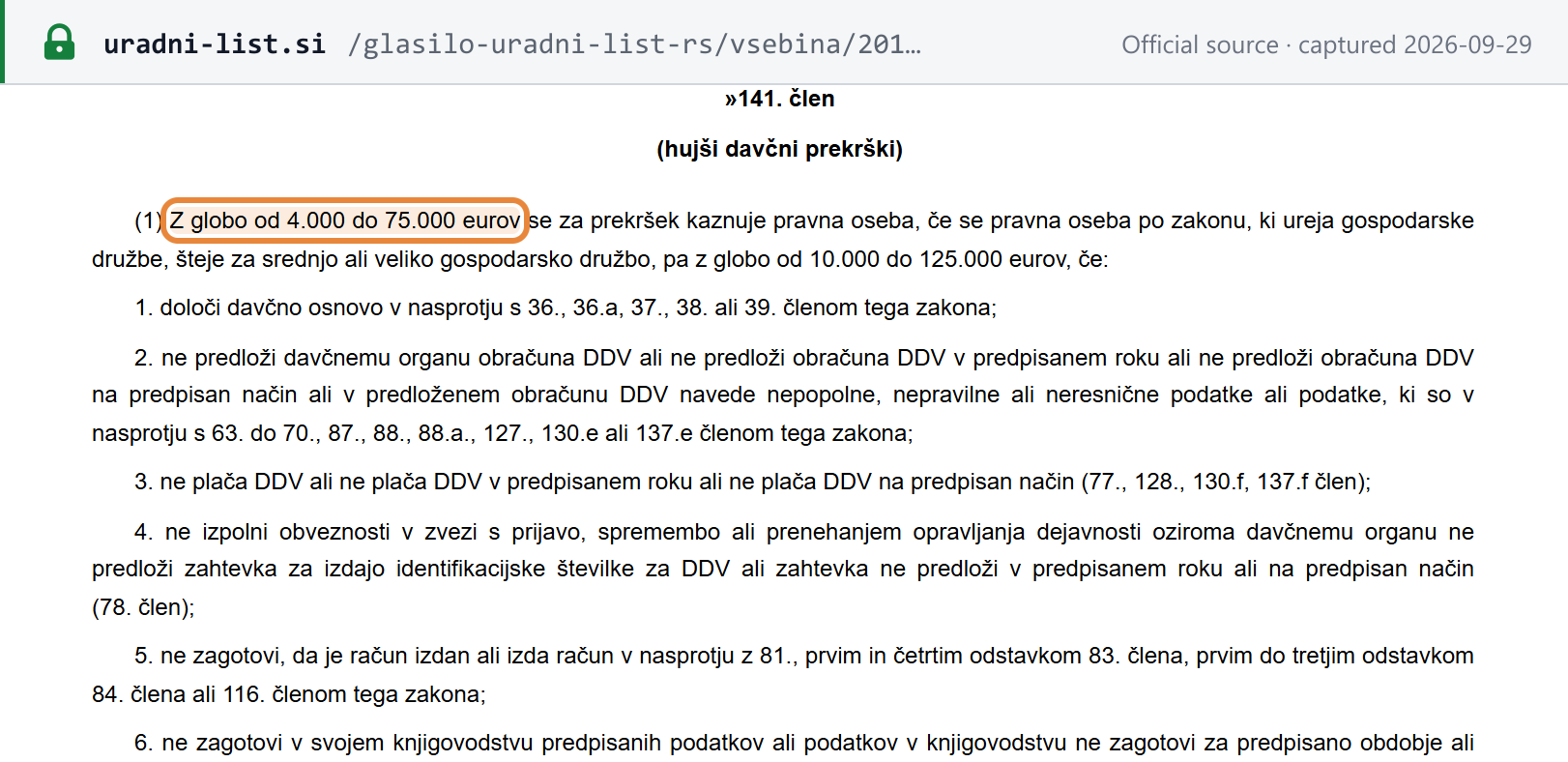
Self-report relief. A taxpayer that corrects its errors in a later return (Art. 88.b) or files a missed return late (Art. 88.c) before an inspection, assessment or proceedings begin is relieved of offence liability (Art. 141.a, re-enacted by ZDDV-1O). [1]
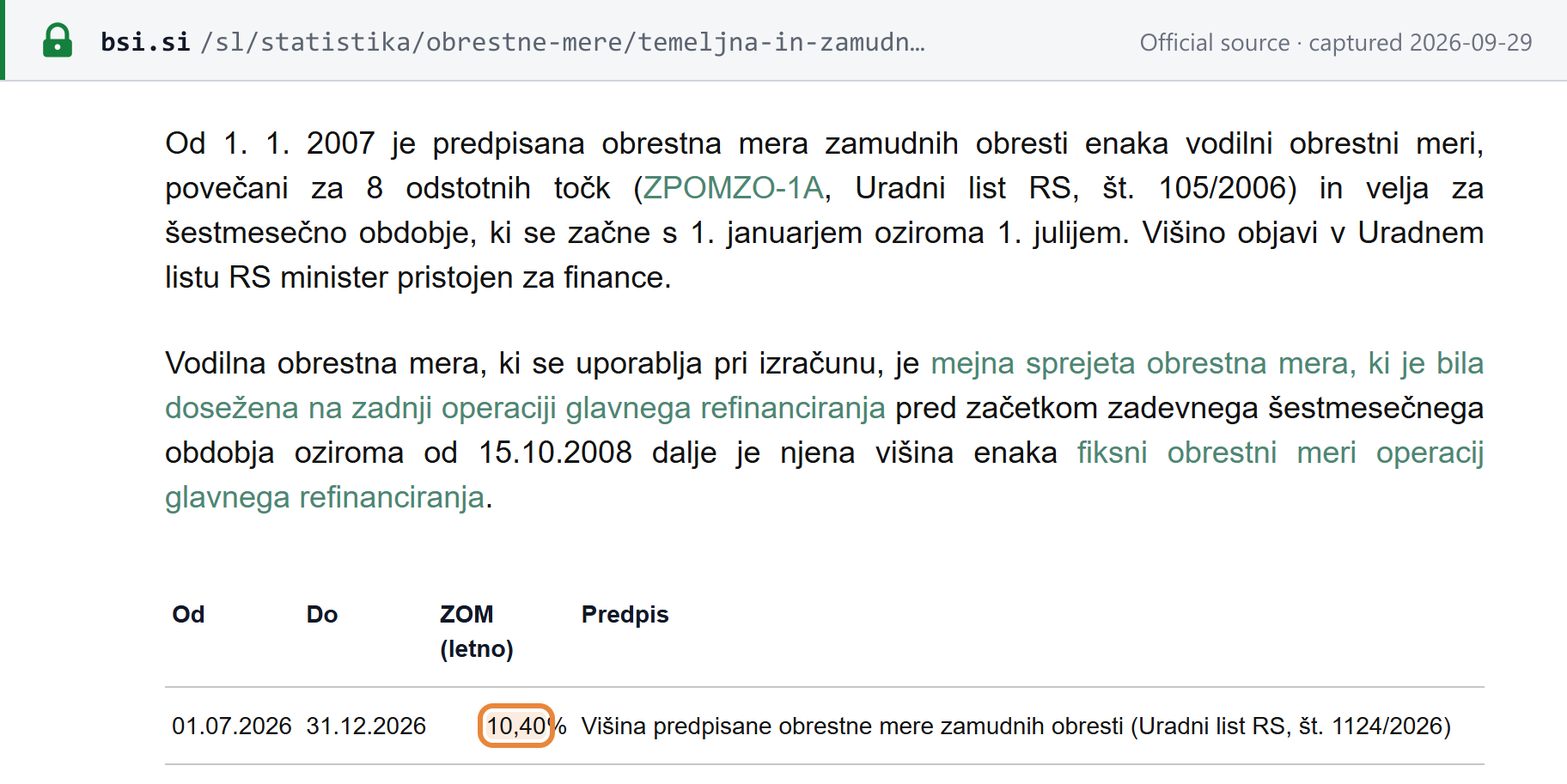
Late-payment interest. Unpaid tax bears default interest at the statutory default-interest rate (ZDavP-2 Art. 96(1), as amended by ZDavP-2O with effect from 27 November 2024; previously a fixed daily rate). That rate is the ECB main refinancing rate plus 8 percentage points, set for each half-year (ZPOMZO-1 Art. 2). Banka Slovenije publishes it: 10.40% a year for 1 July–31 December 2026 (10.15% for the first half of 2026; checked 2026-09-29). [16] [17] [18]
Interest on self-corrections. 3% a year on the under-declared VAT — see Refunds. [4]
E-invoicing fines from 2028. See E-invoicing status.
Frequently asked questions
We are a non-EU company selling only to VAT-registered businesses in Slovenia — do we need a Slovenian VAT number?
Usually not. Since 22 January 2022, a business not established in Slovenia has no obligation to register for VAT there if all of its Slovenian supplies are ones on which the customer pays the VAT under the reverse charge (Art. 78(2)(d) ZDDV-1). If you also sell to consumers, or make any supply on which you are liable, there is no threshold: you must obtain a Slovenian VAT ID before your first taxable supply, filing form DDV-P3 at least 15 days beforehand, and as a business established outside the EU you must appoint a Slovenian tax representative. Non-EU suppliers of services to consumers can instead declare them through the non-Union One-Stop Shop. [3] [4]
Our turnover in Slovenia passed EUR 60,000 this year — when do we register, and do we charge VAT before the number arrives?
It depends on whether you also pass EUR 66,000 in the same calendar year. Above EUR 60,000 but not above EUR 66,000, you stay exempt for the rest of the year but must apply in time to hold a VAT ID from 1 January of the following year. Above EUR 66,000, you must apply no later than the month in which you cross it, and FURS's April 2026 registration guide says you must charge VAT from the first taxable supply that takes you over EUR 66,000, even if you do not yet have a VAT ID. The test is per calendar year, not a rolling 12 months, and has applied since 1 January 2025 under ZDDV-1O. [1] [2] [3]
Do card payments count as cash for Slovenia's fiscal cash register rules?
Yes. Under the Fiscal Verification of Invoices Act (ZDavPR), payment by debit or credit card and similar methods counts as cash payment, alongside notes, coins and cheques. Every invoice paid wholly or partly in this way must be verified with FURS in real time before it is handed to the buyer, and carries the time of issue, the issuing person's identifier, the EOR code returned by FURS and the ZOI protective mark. Only direct bank transfers fall outside the regime. The obligation has applied since 2 January 2016. [9] [10]
Can we keep emailing PDF invoices to Slovenian business customers after 1 January 2028?
No. From 1 January 2028, ZIERDED Art. 7(1) requires businesses to exchange exclusively e-invoices for supplies of goods and services between them made in Slovenia, and Art. 9(1) states that e-invoices may not be exchanged by e-mail. The permitted channels are a registered e-route provider, the Peppol network, your own direct-exchange system agreed with the customer, or the free FURS application routed through UJP. The e-invoice must be in e-SLOG, an EN 16931 syntax, or another international standard agreed by contract. A legal person that breaches Art. 7(1) or 9(1) faces a fine of EUR 1,000 to EUR 3,000. Invoices to public-sector budget users have had to be e-invoices sent through UJP since 1 January 2015. [11] [12]
Can we file our Slovenian VAT return quarterly?
Only in limited cases. The tax period is the calendar quarter where taxable turnover in the previous calendar year was up to and including EUR 210,000, but only if you make no intra-EU transactions and have no recapitulative-statement duty. The first 12 months after VAT registration are always monthly, and so are taxpayers not established in Slovenia and VAT groups. The DDV-O return is due by the last working day of the month after the period, or by the 20th for intra-EU traders who file the RP-O, and since 1 July 2025 it must be accompanied by the output-VAT and input-VAT records. [4] [14] [1]
Important websites
| Site | Purpose |
|---|---|
| eDavki | VAT registration (DDV-P2 / DDV-P3), DDV-O returns, VAT records, RP-O and PD-O |
| FURS VAT hub | VAT news, guidance and the "Pomembni datumi" deadline calendar |
| FURS — VAT registration | Who must register and how |
| FURS — Issuing invoices | Invoicing rules |
| FURS — Fiscal cash registers and bound invoice books | Real-time verification of cash invoices |
| UJP — Sending e-invoices | B2G e-invoices: UJPeRačun portal and Peppol |
| UJP — e-invoice structure check | Validating an e-SLOG file |
| e-VEM | Business registration one-stop shop (linked from the FURS VAT hub) |
| AJPES | Slovenian business register |
| VIES | EU VAT-number check |
| Payment | State-budget transit account SI56 0110 0888 1000 030, reference SI19 [tax number]-62006 |
Also see Lookuptax's own Slovenia DDV number validator.
Recent changes
- 2026-01-01 — VAT groups (skupina za DDV) became available under Art. 5.a ZDDV-1, inserted by ZDDV-1O; vending-machine sales came under the fiscal-verification rules. (Uradni list RS)
- 2025-12-06 — ZIERDED entered into force, making structured e-invoices mandatory between businesses from 1 January 2028. (Uradni list RS) — see event
- 2025-07-01 — Output-VAT and input-VAT records must be filed with every DDV-O, and FURS began pre-filling returns (Art. 85.b ZDDV-1). (Uradni list RS)
- 2025-01-01 — ZDDV-1O applied: the small-business threshold became EUR 60,000 per calendar year (EUR 66,000 tolerance); drinks with added sugar or sweeteners moved from 9.5% to 22%; excess VAT became claimable for five years only. (Uradni list RS)
- 2024-11-27 — Late-payment interest on tax switched from a fixed daily rate to the statutory default-interest rate, the ECB rate plus 8 points (ZDavP-2O Art. 20). (Uradni list RS)
Ahead — scheduled changes that have not yet taken effect:
- 2027-04-01 — Chapter 4 of ZIERDED (e-route providers) applies; the provider list is due from 1 October 2027. (Uradni list RS)
- 2028-01-01 — Exclusive B2B e-invoicing applies under ZIERDED Art. 7(1). (Uradni list RS) — see event
For the full chronology, see Slovenia tax changes on Lookuptax.
Reference links
- Uradni list RS 104/2024 — ZDDV-1O, amending the VAT Act
- Uradni list RS 59/2019 — ZDDV-1K (offence Articles 140–142)
- Uradni list RS 83/2012 — ZDDV-1G (invoice Articles 82–84)
- Uradni list RS 13/2011 — ZDDV-1 consolidated text UPB3 (Articles 77 and 88)
- Uradni list RS 85/2025 — ZIERDED, the e-invoicing Act
- Uradni list RS 111/2013 — ZOPSPU-A (B2G e-invoices from 2015)
- Uradni list RS 85/2025 — ZPJS (B2G e-invoicing, Arts. 44–50; repealed ZOPSPU-1)
- Uradni list RS 77/2016 — ZOPSPU-1 (B2G basis 2016–2025, repealed)
- Uradni list RS 100/2024 — ZDavP-2O (default interest)
- Uradni list RS — ZPOMZO-1-UPB1 (statutory default-interest rate)
- FURS — General VAT description, 10th edition, January 2026 (.doc)
- FURS — Invoices, 9th edition, May 2026 (.doc)
- FURS — VAT rates, 14th edition, June 2026 (.docx)
- FURS — Taxable persons and VAT registration, April 2026 (.doc)
- FURS — Special scheme for small taxpayers (SME scheme) (.docx)
- FURS — VAT legislative changes, 34th edition, December 2025 (.zip)
- FURS — VAT refunds, 7th edition, January 2025 (.doc)
- FURS — OSS special schemes, 6th edition, February 2026 (.docx)
- FURS — Fiscal cash registers and fiscal verification, 4th edition, August 2026 (.docx)
- UJP (gov.si) — VAT group data in an e-SLOG 2.0 e-invoice, 6 August 2026
- Banka Slovenije — base and default interest rates
- PISRS — consolidated ZDDV-1
- Lookuptax — How to verify an EU VAT number in VIES
- Lookuptax — EU VAT SME scheme
- Lookuptax — VIES and Intrastat
- Lookuptax — Slovenia e-invoicing guide
- Lookuptax — Peppol e-invoicing guide
- Lookuptax — E-invoicing status and networks worldwide
- Lookuptax — VAT registration thresholds worldwide
- Lookuptax — Worldwide tax rates