Romania VAT guidelines
| FACTSHEET | |
|---|---|
| Country code | RO |
| Tax name | Value Added Tax — Taxa pe valoarea adăugată (TVA) |
| Tax Authority | National Agency for Fiscal Administration — Agenția Națională de Administrare Fiscală (ANAF) |
Overview
Romania levies Value Added Tax — in Romanian taxa pe valoarea adăugată (TVA) — under Title VII (art. 265–334) of the Fiscal Code, Legea nr. 227/2015 privind Codul fiscal. The Methodological Norms that implement it are approved by Government Decision HG 1/2016. ANAF's consolidated text of the Code, annotated with the Norms, is current to Emergency Ordinance OUG 38/2026 (Monitorul Oficial 393, 8 May 2026). [1]
Authority. The tax is administered by the National Agency for Fiscal Administration (ANAF) (Agenția Națională de Administrare Fiscală), under the Ministry of Finance. VAT on imports is paid to the customs authority (art. 326(3)). Procedure, interest and administrative penalties are governed by the Fiscal Procedure Code (Codul de procedură fiscală, Law 207/2015). [1] [2]
Currency. Amounts in this guide are in Romanian lei (RON), the currency in which the Code sets most thresholds. A few are set in euros: the EUR 100,000 quarterly-filing test, the EUR 100 simplified-invoice limit and the EU-wide EUR 10,000 distance-selling threshold, which the Code fixes at RON 46,337. An invoice may be made out in any currency, but the VAT must be shown in lei (art. 319(23)). [1]
Tax period. The VAT period is the calendar month. It is the calendar quarter for a taxable person whose turnover in the previous calendar year did not exceed EUR 100,000 and who made no intra-EU acquisitions of goods that year (art. 322(1)–(2)). See Filing and payment. [1]
Layering. TVA is a national tax. The Fiscal Code contains no regional or municipal VAT layer. [1]
Registration
Who should register
A taxable person established in Romania may apply the special exemption regime for small businesses (regim special de scutire) while its annual turnover stays within RON 395,000. Once turnover passes that ceiling, it must register. Art. 310(1) of the Fiscal Code: [1]
"Persoana impozabilă stabilită în România … a cărei cifră de afaceri anuală, declarată sau realizată, nu depășește plafonul de 395.000 lei, poate aplica scutirea de taxă, denumită în continuare regim special de scutire"
(A taxable person established in Romania whose annual turnover, declared or achieved, does not exceed the ceiling of RON 395,000 may apply the exemption, referred to as the special exemption regime.)
- Measurement period. The calendar year, not a rolling 12 months. [1]
- Since when. Government Ordinance OG 22/2025 (Monitorul Oficial 806, 29 August 2025), transposing Directive (EU) 2020/285, raised the ceiling from RON 300,000 to RON 395,000 with effect from 1 September 2025. [27] [25]
- What counts. The calendar-year total, excluding VAT, of taxable supplies (including those that would be taxable without the exemption) and exempt-with-credit supplies, plus — unless they are ancillary — exempt financial, insurance, letting and immovable-property supplies, all with their place of supply in Romania. Disposals of fixed assets and intangibles are left out. A person making only exempt-without-credit supplies is deemed never to exceed the ceiling (art. 310(2)–(3)). [1]

When to register and when VAT starts. Registration must be requested "cel târziu la data depășirii plafonului" — at the latest on the date the ceiling is exceeded — and "regimul normal de taxare se aplică din data depășirii plafonului …, începând cu tranzacția care conduce la depășirea plafonului": the normal regime applies from that date, starting with the transaction that crosses the ceiling (art. 310(6)). Registration is valid from the same date (art. 316(1^1)(b)). ANAF's July 2026 guidance on the 2026 fiscal changes illustrates it: a business that crosses the ceiling on 17 March 2026 files electronic form 700 at once and charges VAT from 17 March, even if the registration declaration is filed late. [1] [5]
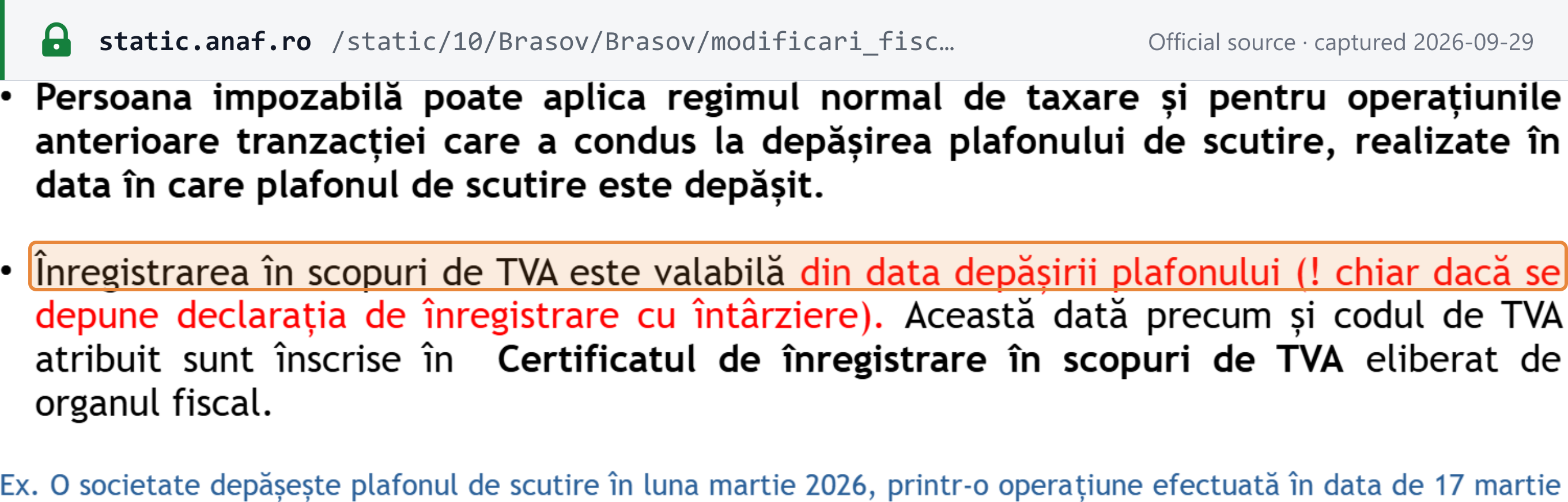
Late registration. If ANAF finds that a business crossed the ceiling without registering, it registers it ex officio from the crossing date and assesses the difference between the VAT it should have collected and the VAT it would have been entitled to deduct (art. 310(6^1)). Interest and penalties apply on top — see Offences and penalties. [1]
Non-resident registration
There is no threshold for non-residents. A taxable person not established in Romania must register before it makes supplies in Romania that carry a right of deduction (art. 316(4)): [1]
"O persoană impozabilă care nu este stabilită în România … va solicita înregistrarea în scopuri de TVA … pentru operațiuni realizate pe teritoriul României care dau drept de deducere a taxei … înainte de efectuarea respectivelor operațiuni, cu excepția situațiilor în care persoana obligată la plata taxei este beneficiarul, conform art. 307 alin. (2)-(6) și a situației în care persoana impozabilă aplică regimul special de scutire prevăzut la art. 310^2."
(A taxable person not established in Romania shall apply for VAT registration for operations in Romania that give a right of deduction, before carrying them out, except where the customer is liable for the tax under art. 307(2)–(6), and where the person applies the special exemption regime in art. 310^2.)
- Exception — the customer pays the VAT. No registration is needed where every Romanian supply is one on which the customer is liable under the reverse charge — see Cross-border rules. An EU small business using the cross-border SME scheme (art. 310^2) is also exempt from registering. [1]
- Other triggers. Registration is also required before an intra-EU acquisition for which the non-established person is liable, before an exempt intra-EU supply, and before intra-EU distance sales dispatched from Romania where the person opts to use OSS (art. 316(6)). It is optional for imports and opted-in real-estate supplies. [1]
- OSS and IOSS users. A person registered in another member state for one of the special schemes (Union OSS, non-Union OSS or IOSS) does not register in Romania for B2C services or distance sales to Romanian customers (art. 316(5)). [1]
Fiscal representative
- EU businesses may register directly or appoint a fiscal representative (reprezentant fiscal). A direct registrant must declare a Romanian address where its records can be examined.
- Non-EU businesses must appoint one: "Persoana impozabilă nestabilită în Uniunea Europeană care are obligația să se înregistreze în scopuri de TVA în România este obligată … să se înregistreze prin desemnarea unui reprezentant fiscal" (art. 316(7)).
- One representative covers all of the business's Romanian operations, and it must itself be established in Romania and registered for VAT. Once accepted, it takes on all VAT rights and obligations for the operations it is mandated for (Norms pt. 89(4)).
- The file comprises a start-of-activity declaration, the constitutive act, the representative's written acceptance and the mandate contract. ANAF communicates its decision "în termen de cel mult 30 de zile" — within 30 days of receiving the application (Norms pt. 89(3)).

Tax identification number
Romanian entities carry a fiscal identification code, the CIF (cod de identificare fiscală); for companies registered with the Trade Register this is the CUI (cod unic de înregistrare). A VAT-registered person quotes it with the prefix RO. Individuals use the 13-digit personal numeric code (CNP), and non-resident individuals receive a 13-digit NIF whose first digit is always "9". [7]
The full formats, structure rules and lookup sources are on Lookuptax's Romania tax identification number guide. To check a number, use the Romania VAT number validator, ANAF's VAT register search, or see how to verify an EU VAT number in VIES and the list of official VAT-number lookups.
How to register
- Romanian entities file form 010.
- Non-residents without a permanent establishment file form 015. ANAF's forms catalogue: the declaration is also filed "de către contribuabilii nerezidenți stabiliți în spațiul comunitar, care se înregistrează în scopuri de TVA direct, în temeiul dispozițiilor art. 316 alin. (4) sau (6) din Codul fiscal, sau prin reprezentant fiscal" — by non-resident taxpayers established in the EU registering directly under art. 316(4) or (6), or through a fiscal representative. Non-residents attach the contracts or orders for their planned Romanian supplies (Norms pt. 88(6)(c)).
- Later changes, including registration after crossing the ceiling, go through electronic form 700.
- Timeline. 30 days for a fiscal-representative file (above). Otherwise the Fiscal Procedure Code's general deadline for deciding a taxpayer's request applies — 45 days from registration of the request, extendable when ANAF asks for evidence (CPF art. 77(1)); it is a general procedural deadline, not a VAT-specific one. Companies set up under Law 31/1990 undergo a fiscal-risk analysis after they are registered for VAT (art. 316(9)).
Voluntary registration
Available. A business under the ceiling "poate opta oricând pentru aplicarea regimului normal de taxă" — may opt for the normal VAT regime at any time (art. 310(3)), and registration is valid from the date of the request (art. 316(1^1)(c)). The reason to opt in is input-VAT recovery: a business using the exemption "nu are dreptul la deducerea taxei" and "nu are voie să menționeze taxa pe factură" — it may not deduct input VAT or show VAT on its invoices (art. 310(10)). [1]
Deregistration
- Returning to the exemption. A business whose turnover in the previous year was below RON 395,000, and which has not crossed it in the current year, may apply to leave the normal regime. It files between the 1st and the 10th of the month after a tax period; ANAF decides by the end of that month, and the registration is cancelled from the date the decision is communicated (art. 310(7)).
- Ceasing activity. A business that stops trading must request cancellation within 15 days (Norms pt. 88(12)).
- Ex officio. ANAF cancels registrations on risk grounds listed in art. 316(11), and publishes cancelled numbers in a public register within 3 days (art. 316(15)).
- Final return. The last D300 is due "până la data de 25 a lunii următoare celei în care a fost comunicată decizia de anulare" — by the 25th of the month after the cancellation decision is communicated, whatever the business's usual tax period (art. 316(13)).
Group registration
Available, but only as a consolidation mechanism. Taxable persons established in Romania that are closely linked — more than 50% of their capital held, directly or indirectly, by the same associates — may form a single fiscal group (grup fiscal unic) (art. 269(9); Norms pt. 5(5)). Unlike a single-entity VAT group elsewhere in the EU: [1]
- supplies between members remain taxable — "fiecare membru al grupului fiind considerat o persoană impozabilă separată" (each member is treated as a separate taxable person, Norms pt. 5(15));
- each member prepares its own return and files its own D390, and a representative member files a consolidated return and pays or reclaims the net amount;
- members are jointly and severally liable (Norms pt. 5(13)–(14)).
Rates
| Rate | Applies to | Effective |
|---|---|---|
| 21% (standard) | All taxable supplies not exempt and not on the reduced-rate list | Since 1 August 2025 (previously 19%) [3] |
| 11% (reduced) | The goods and services listed in art. 291(2) — see below | Since 1 August 2025, replacing the former 9% and 5% rates [3] |
| Exempt | See Exemptions | — |
Law 141/2025 (Monitorul Oficial 699, 25 July 2025) rewrote art. 291 of the Fiscal Code (art. II pt. 42): "Cota standard se aplică … iar nivelul acesteia este 21%. (2) Cota redusă de 11% se aplică asupra bazei de impozitare pentru următoarele prestări de servicii şi/sau livrări de bunuri". Art. VII(1): "Prevederile art. II - VI intră în vigoare la data de 1 august 2025 …" ANAF's rates brochure (September 2025) sums it up: "Începând cu data de 1 august 2025, se aplică o singură cotă redusă de TVA de 11%" — from 1 August 2025 a single reduced VAT rate of 11% applies. The consolidated Code, current to OUG 38/2026, still shows 21% and 11%. [3] [4] [1]
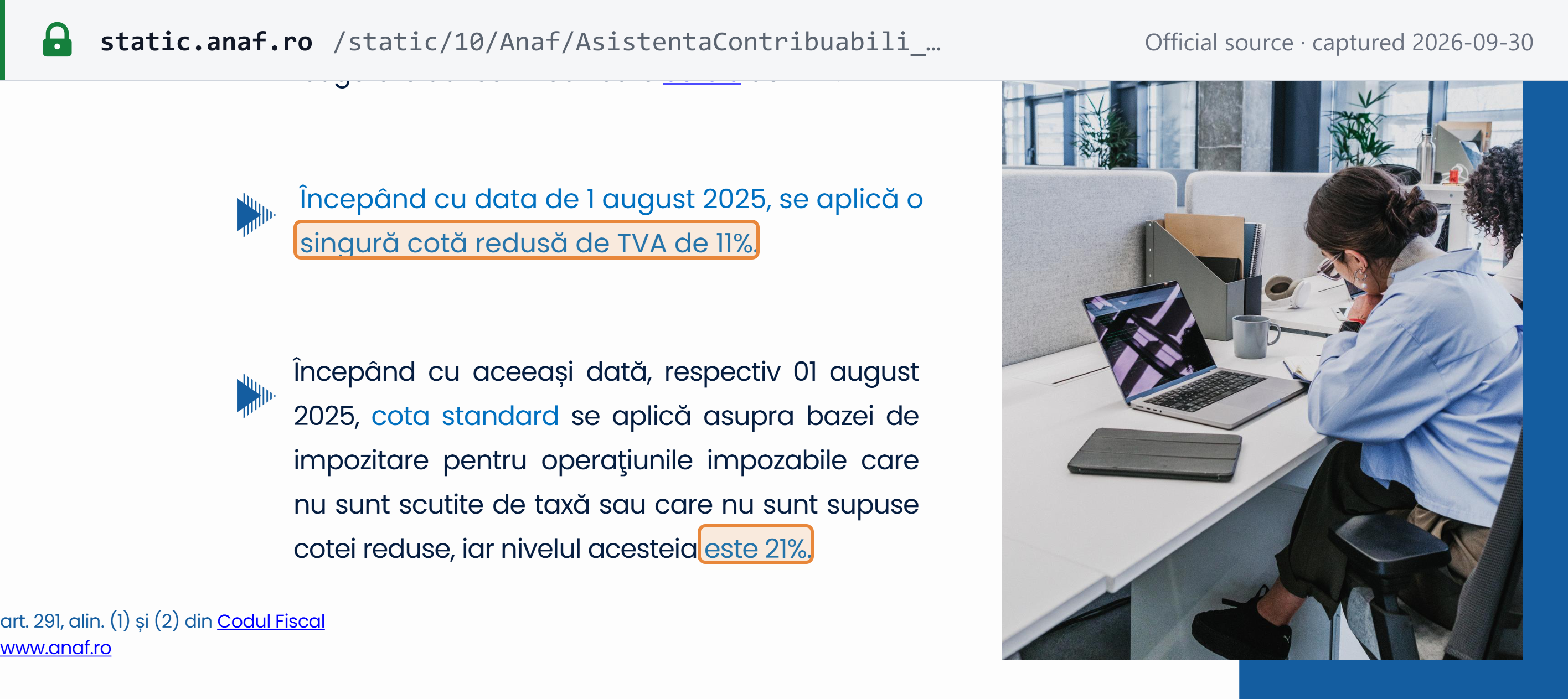
What the 11% rate covers (art. 291(2) lit. a)–n)): [1] [4]
- human medicines;
- food, including drinks, for human and animal consumption, and live domestic animals — excluding alcoholic drinks, NC 2202 soft drinks, foods with added sugar of 10 g or more per 100 g (other than infant milk powder), and food supplements;
- water supply and sewerage, and irrigation water;
- fertilisers, pesticides and seeds (chemical fertilisers and pesticides stay at 11% until 31 December 2031);
- school textbooks, books, newspapers and magazines, printed or electronic, other than those consisting mainly of video or music content or advertising;
- admission to castles, museums, memorial houses, monuments, zoos and botanical gardens;
- firewood and wood pellets (until 31 December 2029);
- heating energy in the cold season (1 November – 31 March) for households, hospitals, schools, NGOs and social-service providers;
- social housing in the narrow sense — old-age homes, children's homes and rehabilitation centres;
- hotel accommodation, including campsites;
- restaurant and catering services, except alcoholic drinks and NC 2202 soft drinks.
Anything not on the list is taxed at 21%.
Former 9% housing rate — expired. Law 141/2025 art. III kept a transitional 9% rate for one home per individual (up to 120 m² and RON 600,000 excluding VAT) bought under an advance contract signed by 1 August 2025 and delivered by 31 July 2026, and for buildings sold to municipalities for subsidised rent until 1 August 2026. Both windows have closed; 9% no longer applies to new supplies. [3]
Zero rate. Romania has no statutory zero rate and no super-reduced or parking rate: art. 291 has two rates only. Exports, intra-EU supplies and international transport are instead exempt with the right of deduction (art. 294) — see Exemptions. [1]
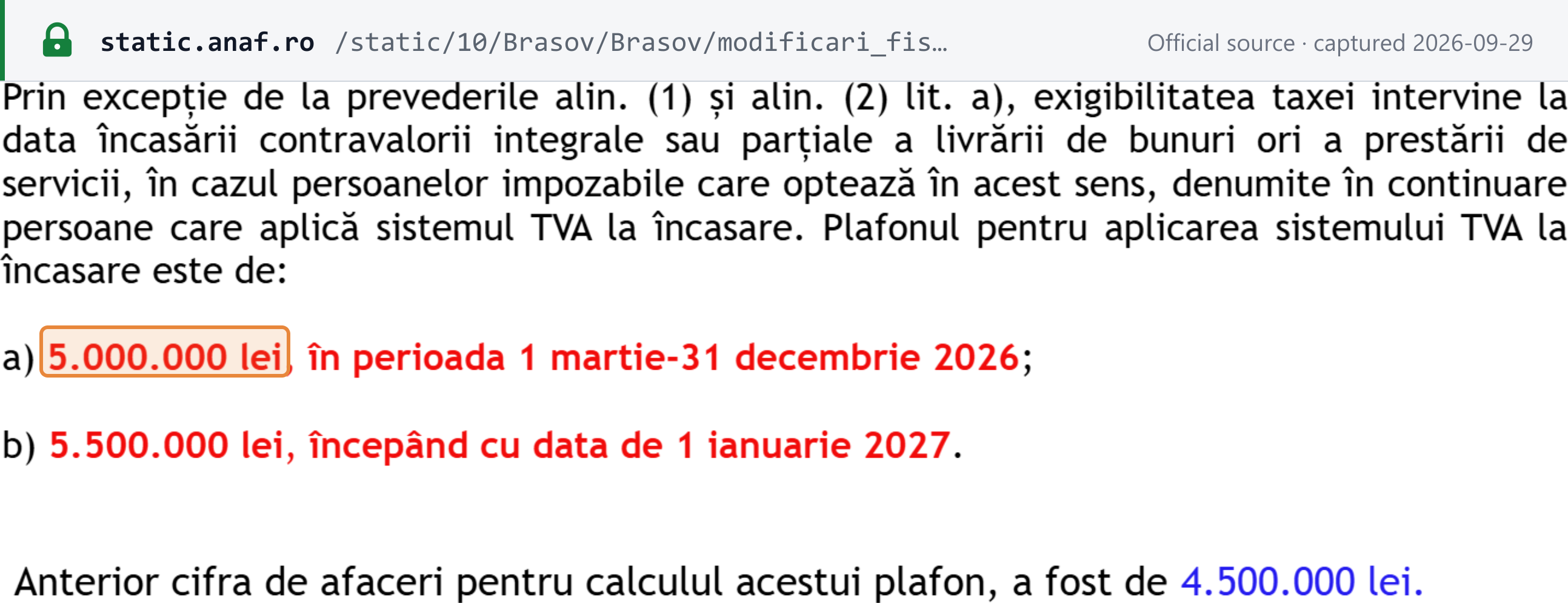
Announced future rates. As at 29 September 2026, no rate change appears in the Code as consolidated to OUG 38/2026, or in ANAF's 21 July 2026 synthesis of the 2026 fiscal changes. Two related dates are scheduled: the domestic reverse charge on several goods categories expires on 31 December 2026 unless extended (see Cross-border rules), and the cash-accounting ceiling rises to RON 5,500,000 on 1 January 2027 (see Exemptions). [1] [5]
For Romania alongside other jurisdictions, see Lookuptax's worldwide tax rates table and VAT registration thresholds table. The EU-wide small-business rules behind the RON 395,000 ceiling are explained in Lookuptax's EU VAT SME scheme guide.
Cross-border rules
Foreign companies selling into Romania — B2B and B2C
The answer depends on who the customer is.
B2B — usually no Romanian registration; the customer self-accounts. [1]
- Services. For services taxed where the customer is established (art. 278(2)), a Romanian taxable customer — or a VAT-registered non-taxable legal person — pays the VAT on services bought from a non-established supplier, "chiar dacă este înregistrată în România" — even if the supplier is registered in Romania (art. 307(2)).
- Goods and other local supplies. Where a non-established supplier is not registered for VAT in Romania, the Romanian-established customer is liable, whether or not it is itself VAT-registered: "persoana obligată la plata taxei este persoana impozabilă ori persoana juridică neimpozabilă, stabilită în România, indiferent dacă este sau nu înregistrată în scopuri de TVA" (art. 307(6)). This broad residual reverse charge is why a foreign seller making only B2B supplies generally need not register.
- Once registered, the foreign supplier charges Romanian VAT on its local supplies of goods, except items under the domestic reverse charge (below).

B2C — register, or use an OSS scheme. [1]
- An EU seller whose intra-EU distance sales of goods and telecom, broadcasting and electronic (TBE) services to consumers stay within the EU-wide EUR 10,000 threshold taxes them in its home state (art. 278^1). "Pentru România, valoarea echivalentă în moneda națională este de 46.337 lei" — for Romania, the equivalent in national currency is RON 46,337 (art. 278^1(5)).
- Above it, Romanian VAT is due. The seller either declares it through the Union OSS in its home state, with no Romanian registration (art. 316(5)), or registers in Romania.
- A non-EU seller of services to consumers uses the non-Union OSS (art. 314). Goods imported in consignments of up to EUR 150 can go through IOSS (art. 315^2) or the special customs arrangement (art. 315^3).
- Goods held in or delivered within Romania to consumers need Romanian registration before the first supply, with no threshold (art. 316(4)).

See Lookuptax's One-Stop Shop guide, IOSS guide and reverse charge explainer.
Digital products and services
Telecommunications, broadcasting and electronically supplied services to non-taxable persons are taxed where the customer is (art. 278(5)(h)). For an EU supplier they count, with intra-EU distance sales of goods, towards the EUR 10,000 (RON 46,337) threshold above; a non-EU supplier has no threshold and uses the non-Union OSS. B2B supplies of the same services fall under the general customer-location rule and the reverse charge. [1]
Marketplace / platform deemed-supplier liability
Applies. A taxable person that facilitates a sale through an electronic interface — "o piață online, o platformă, un portal sau alte mijloace similare" (an online marketplace, platform, portal or similar means) — is deemed to have bought and resold the goods itself in two cases: [1]
- distance sales of goods imported from outside the EU in consignments of intrinsic value up to EUR 150 (art. 270(15));
- supplies of goods within the EU by a seller not established in the EU to non-taxable persons (art. 270(16)).
Platforms can declare these supplies through OSS or IOSS. See Lookuptax's marketplace deemed-supplier explainer.
Imports and exports
- Imports of goods. VAT is paid to customs, at the rate that applies to the same goods supplied domestically (art. 291(7), 326(3)). [1]
- Import-VAT deferral. Instead of paying at the border, the importer accounts for import VAT in its D300 (reverse charge on import) if it holds an import-VAT deferral certificate — which requires, among other conditions, imports of at least RON 50 million in the previous 6 months and 6 months of VAT registration — or uses centralised clearance or entry in the declarant's records under the Union Customs Code, or imports certain domestic-reverse-charge goods (art. 326(4)–(5)). [1]
- De minimis. The Code sets no Romania-specific VAT de minimis for imported goods; low-value consignments up to EUR 150 use IOSS or the special customs arrangement. [1]
- Exports and intra-EU supplies. Both are exempt with the right of deduction (art. 294). Intra-EU supplies are listed on the D390 recapitulative statement — see Filing and payment. [1]
- Imported services. A Romanian taxable customer self-accounts for services bought from a non-established supplier (art. 307(2)). [1]
Domestic reverse charge
Between two VAT-registered persons, the customer pays the VAT on these supplies (art. 331): [1]
- ferrous and non-ferrous waste and scrap, and recyclable materials;
- timber;
- buildings and land taxed by law or by option;
- investment gold and gold of 325 thousandths or more;
- until 31 December 2026 only (art. 331(6)): grain and technical plants; greenhouse-gas emission certificates; electricity and gas supplied to traders; green certificates; and mobile phones, integrated circuits, games consoles, tablets and laptops where the goods on one invoice are worth RON 22,500 or more excluding VAT (art. 331(7)).
The invoice shows no VAT and carries the words "taxare inversă".

Place of supply
- Services, B2B. "Locul de prestare a serviciilor către o persoană impozabilă … este locul unde respectiva persoană care primește serviciile își are stabilit sediul activității sale economice" — where the customer is established (art. 278(2)).
- Services, B2C. Where the supplier is established (art. 278(3)).
- Exceptions (art. 278(4)–(5)): services connected with immovable property, including hotel accommodation, where the property is; passenger transport where it takes place; restaurant services where performed; short-term hire of a means of transport where it is put at the customer's disposal; TBE services to consumers where the customer is.
- Goods. The place of supply of goods is set by art. 275, which this guide does not reproduce; intra-EU distance sales of goods to Romanian consumers are taxed in Romania above the EUR 10,000 (RON 46,337) threshold (art. 278^1).
RO e-Transport
Emergency Ordinance OUG 41/2022 created the RO e-Transport system for monitoring road transport of goods that ANAF designates by order as high fiscal risk. As enacted in OUG 41/2022, each such transport — including intra-EU acquisitions from the border to unloading, intra-EU deliveries, and import and export legs — needs a UIT code generated in advance and carried with the transport documents. As enacted, the UIT could be declared up to 3 calendar days before the transport started and was valid for 5 calendar days. Transporting without a UIT, or with incorrect data, is an offence; the fines are set in art. 13 of OUG 41/2022 as amended. [23]
This describes the ordinance as published in 2022; later amendments to scope, deadlines and fines are not reflected here.
Invoice requirements
Mandatory content
An invoice must contain the following particulars (Fiscal Code art. 319(20)). The letters follow the statute, which skips "q": [1]
| Lit. | Required field |
|---|---|
| a) | Sequential number, in one or more series, that identifies the invoice uniquely |
| b) | Date of issue |
| c) | Date of supply, or of the advance payment, where that date is earlier than the issue date |
| d) | Supplier's name, address and VAT code (or other fiscal identification code) |
| e) | Where a non-established supplier has a fiscal representative: the supplier's name and the representative's name, address and VAT code |
| f) | Customer's name, address and VAT code or fiscal identification code, where the customer is a taxable person or non-taxable legal person |
| g) | The customer's fiscal representative, if any |
| h) | Description and quantity of the goods or services (details required for new means of transport) |
| i) | Taxable amount per rate or exemption, unit price excluding VAT, and discounts not included in the unit price |
| j) | VAT rate and VAT amount, expressed in lei, per rate |
| k) | "autofactură", where the customer issues the invoice |
| l) | Reference to the exemption provision |
| m) | "taxare inversă", where the customer is liable for the VAT |
| n) | "regimul marjei - agenții de turism" (travel agents' margin scheme) |
| o) | The margin-scheme wording for second-hand goods, works of art, collectors' items or antiques |
| p) | "TVA la încasare", under the cash-accounting scheme |
| r) | Reference to earlier invoices issued for the same operation |
"Semnarea și ștampilarea facturilor nu constituie elemente obligatorii" — a signature and a stamp are not mandatory (art. 319(29)). [1]

The e-invoice data model. For supplies between taxable persons established in Romania, "sunt considerate facturi numai facturile care îndeplinesc condițiile prevăzute de Ordonanța de urgență a Guvernului nr. 120/2021" — only invoices that meet OUG 120/2021 count as invoices (art. 319(1^1)). ANAF's RO e-Factura guide defines that invoice as an XML file built on the European standard EN 16931-1+A1 and the national rules RO_CIUS, and says the original is "fișierul de tip XML însoțit de sigiliul electronic al Ministerului Finanțelor" — the XML file with the Ministry of Finance's electronic seal. Invoices to public bodies must also carry CPV codes from 1 January 2025 (OUG 138/2024). See E-invoicing status. [1] [8] [11]
Issuance deadline
An invoice must be issued "cel târziu până în cea de-a 15-a zi a lunii următoare celei în care ia naștere faptul generator al taxei" — by the 15th day of the month after the chargeable event, unless already issued (art. 319(16)). The same deadline applies to advances received and to exempt intra-EU supplies. For e-invoices, a separate upload deadline follows: 5 working days from issue, and no later than 5 working days after the 15th-of-month limit (see E-invoicing status). [1] [9]
Numbering and sequencing
- Each invoice carries a sequential number, in one or more series, that identifies it uniquely (art. 319(20)(a)).
- A summary invoice may cover several supplies to one customer within one calendar month, with the delivery documents attached (art. 319(17)).
Credit and debit notes
Romania uses invoices, not separately named credit notes. A document that amends the original invoice and refers to it specifically has the status of an invoice (art. 319(2)). Under art. 330: [1]
- Correcting an error. If the invoice has not yet been sent, it is cancelled and reissued. If it has been sent, the supplier issues a new invoice that repeats the original's data, references its number and date, shows the values with a minus sign, and then shows the correct values — or issues a negative invoice followed by a new correct one.
- Reducing the taxable amount (returns, discounts, cancellations and the other art. 287 cases): the supplier issues an invoice "cu valorile înscrise cu semnul minus" — with the values shown as negative (art. 330(2)).
- If the supplier fails to correct, the customer must self-invoice by the 15th of the following month (art. 319(3)).
Currency and language
- Currency. "Sumele indicate pe factură se pot exprima în orice monedă cu condiția ca valoarea TVA colectată sau de regularizat să fie exprimată în lei" — amounts may be in any currency provided the VAT is expressed in lei (art. 319(23)).
- Exchange rate. The latest rate published by the National Bank of Romania (BNR) or the European Central Bank, or the rate used by the bank that settles the payment, valid on the date the VAT becomes chargeable (art. 290(2)).
- Language. The Code sets no Romanian-language requirement at issue; for audit purposes ANAF may require a Romanian translation (art. 319(36)).
Document types
| Document | When it is used | Cite |
|---|---|---|
| Full invoice | Default for every supply by a taxable person. Between Romanian-established taxable persons, it must be an RO e-Factura XML invoice | Art. 319(20), 319(1^1) |
| Simplified invoice | Where the value including VAT is not more than EUR 100 (converted at the art. 290 rate); for documents that amend an invoice; and for issuers using the small-business exemption. The Ministry of Finance may by order allow it between EUR 100 and EUR 400 | Art. 319(12)–(13) |
| Fiscal receipt (bon fiscal) | Retail sales recorded on an electronic fiscal cash register; no invoice is needed unless the customer asks for one. A fiscal receipt that meets the simplified-invoice conditions is not sent to RO e-Factura | Art. 319(10)(a); OUG 120/2021 art. 10^1(2) |
| Self-billed invoice | Issued by the customer in the supplier's name, marked "autofactură" | Art. 319(18), 319(20)(k) |
| No invoice | Exempt-without-credit supplies under art. 292 | Art. 319(7) |
A simplified invoice shows at least the date of issue, the supplier's identification, the type of goods or services, the VAT amount or the data needed to compute it, and the customer's VAT code or fiscal code where the customer is a taxable person (art. 319(21)). [1] [11]

Self-billing
Permitted. "Pot fi emise facturi de către beneficiar în numele și în contul furnizorului/prestatorului în condițiile stabilite prin normele metodologice" — the customer may issue invoices in the name and on behalf of the supplier, under the conditions in the Norms (art. 319(18)). The invoice carries "autofactură". A third party may also issue invoices on the supplier's behalf, unless it is established in a country with which Romania has no mutual-assistance instrument (art. 319(19)). [1]
Retention and audit trail
- Integrity and audit trail. "Autenticitatea originii, integritatea conținutului și lizibilitatea unei facturi … trebuie garantate de la momentul emiterii până la sfârșitul perioadei de stocare" — authenticity of origin, integrity of content and legibility must be guaranteed from issue until the end of the storage period, which "poate fi realizat prin controale de gestiune care stabilesc o pistă fiabilă de audit" — by business controls that create a reliable audit trail between invoice and supply, by an advanced electronic signature, or by EDI (art. 319(25)–(26)). [1]
- Where invoices are kept. A Romanian-established person stores its invoices in Romania, except electronic invoices to which online access is guaranteed; storage abroad must be notified to ANAF (art. 319(33)–(34)). [1]
- Paper or electronic. Invoices may be stored on paper or electronically, whatever their original form; electronic storage is exempt from Law 135/2007 on electronic archiving (art. 319(35)). [1]
- Software. A taxpayer that archives data electronically must also keep and present "aplicațiile informatice cu ajutorul cărora le-a generat" — the software used to generate it (CPF art. 109(4)). [2]
- RO e-Factura copies. ANAF's guide says XML files stay downloadable from the system for 60 days after publication, so businesses must archive their own copies. [8]
- Retention period. The Fiscal Procedure Code (art. 109(3)) refers to the rules of the accounting law for how long records are kept. The period is therefore set by Accounting Law 82/1991, not by the Fiscal Code. [2]
A specimen of a compliant invoice
ANAF publishes the RO e-Factura XML guide and code lists, not an annotated specimen invoice. The layout below is Lookuptax's own illustration of the art. 319(20) particulars for a domestic B2B supply invoiced in euros. Between Romanian-established businesses the legal invoice is the RO e-Factura XML file; this shows the data it carries, laid out as a document. Every name, number and amount is fictional:
Factură — Invoice
| DescriptionArt. 319(20)(h) | QuantityArt. 319(20)(h) | Unit price (excl. VAT)Art. 319(20)(i) | VAT rateArt. 319(20)(j) | Value (excl. VAT) |
|---|---|---|---|---|
| IT consulting (hours) | 10 | EUR 100.00 | 21% | EUR 1,000.00 |
| Catering for workshop | 1 | EUR 200.00 | 11% | EUR 200.00 |
- Taxable amount at 21%Art. 319(20)(i)
- EUR 1,000.00
- VAT at 21%Art. 319(20)(j)
- EUR 210.00 = RON 1,050.00
- Taxable amount at 11%Art. 319(20)(i)
- EUR 200.00
- VAT at 11%Art. 319(20)(j)
- EUR 22.00 = RON 110.00
- Total including VAT
- EUR 1,432.00
- The VAT must be expressed in lei even when the invoice is in another currency — Art. 319(23).
- Where the customer pays the VAT, the invoice carries "taxare inversă" and shows no VAT — Art. 319(20)(m); under cash accounting, "TVA la încasare" — Art. 319(20)(p); where the customer issues the invoice, "autofactură" — Art. 319(20)(k).
- No signature or stamp is required — Art. 319(29).
- Between Romanian-established businesses, this data must be sent as an EN 16931 / RO_CIUS XML invoice through RO e-Factura within 5 working days of issue — OUG 120/2021 art. 10(7).
E-invoicing status
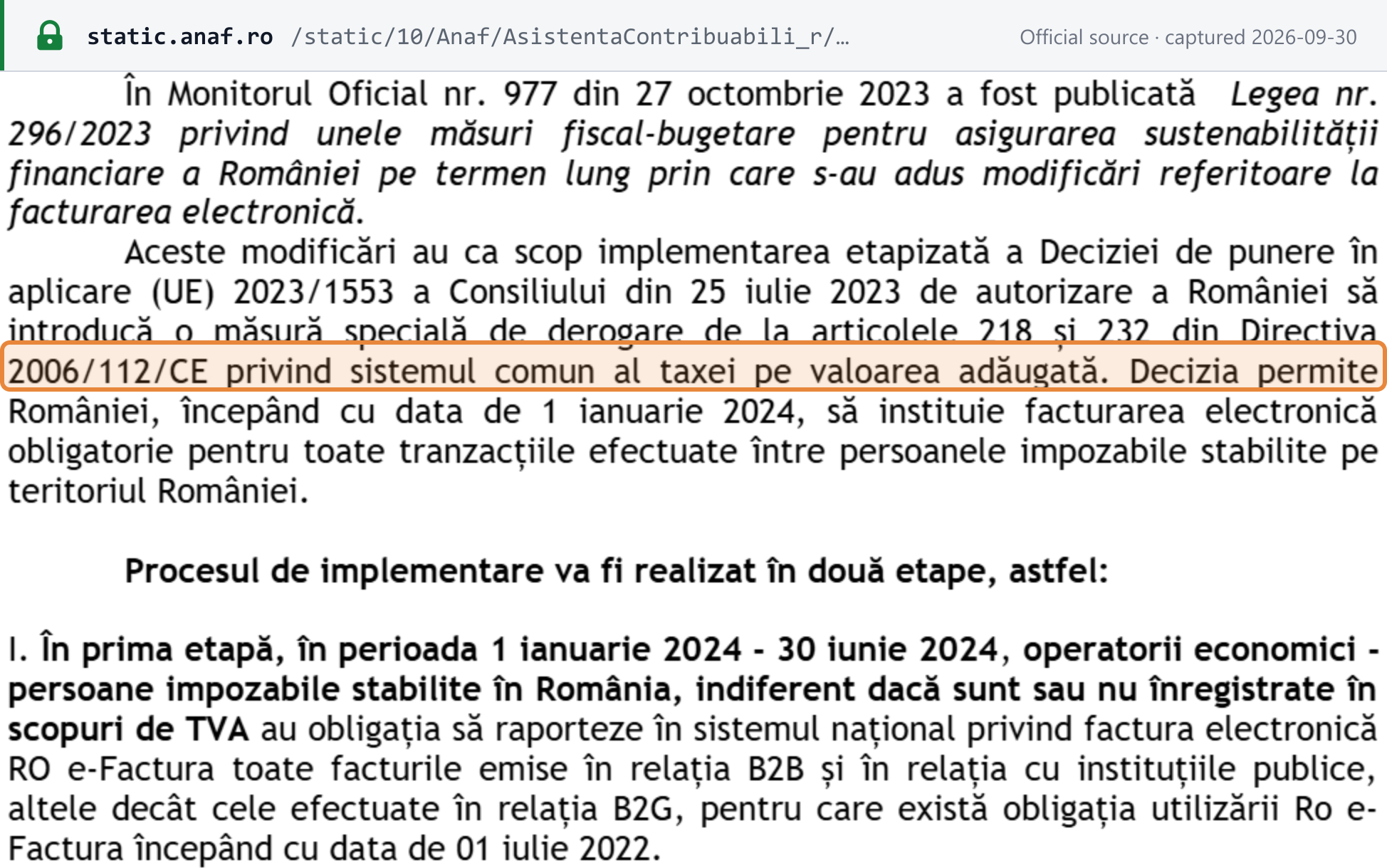
Status (as of 2026-09-30): mandatory clearance, live. Romania's national e-invoicing system, RO e-Factura, run by ANAF and the Ministry of Finance, has been mandatory for invoices to public bodies since 1 July 2022 and for B2B supplies between Romanian-established taxable persons since 1 January 2024 (reporting), becoming full clearance from 1 July 2024; B2C invoices have been reported since 1 January 2025. Invoices are XML files on EN 16931-1+A1 with the national RO_CIUS rules, exchanged through ANAF's SPV (Spațiul Privat Virtual). The EU legal basis is Council Implementing Decision (EU) 2023/1553 of 25 July 2023, which derogates from art. 218 and 232 of the VAT Directive. ANAF's guide: "Decizia permite României, începând cu data de 1 ianuarie 2024, să instituie facturarea electronică obligatorie pentru toate tranzacțiile efectuate între persoanele impozabile stabilite pe teritoriul României" — the Decision allows Romania, from 1 January 2024, to make e-invoicing mandatory for all transactions between taxable persons established in Romania. [8]
Scope, onboarding, the XML specification and the full fine scale are covered in Lookuptax's guide to e-invoicing in Romania. For Romania alongside other mandates, see the e-invoicing status and networks table.
Timeline
| Date | What applies | Source |
|---|---|---|
| 1 July 2022 | B2G: invoices to contracting authorities go through RO e-Factura; public bodies may pay only invoices received through the system | OUG 120/2021 art. 13^1 [15] |
| 1 January 2024 | B2B reporting: Romanian-established taxable persons, VAT-registered or not, report every B2B invoice to RO e-Factura while still delivering it by the usual route; non-established persons registered for Romanian VAT report their B2B invoices for local supplies. No late-upload fines until 31 March 2024 | Law 296/2023 [8] |
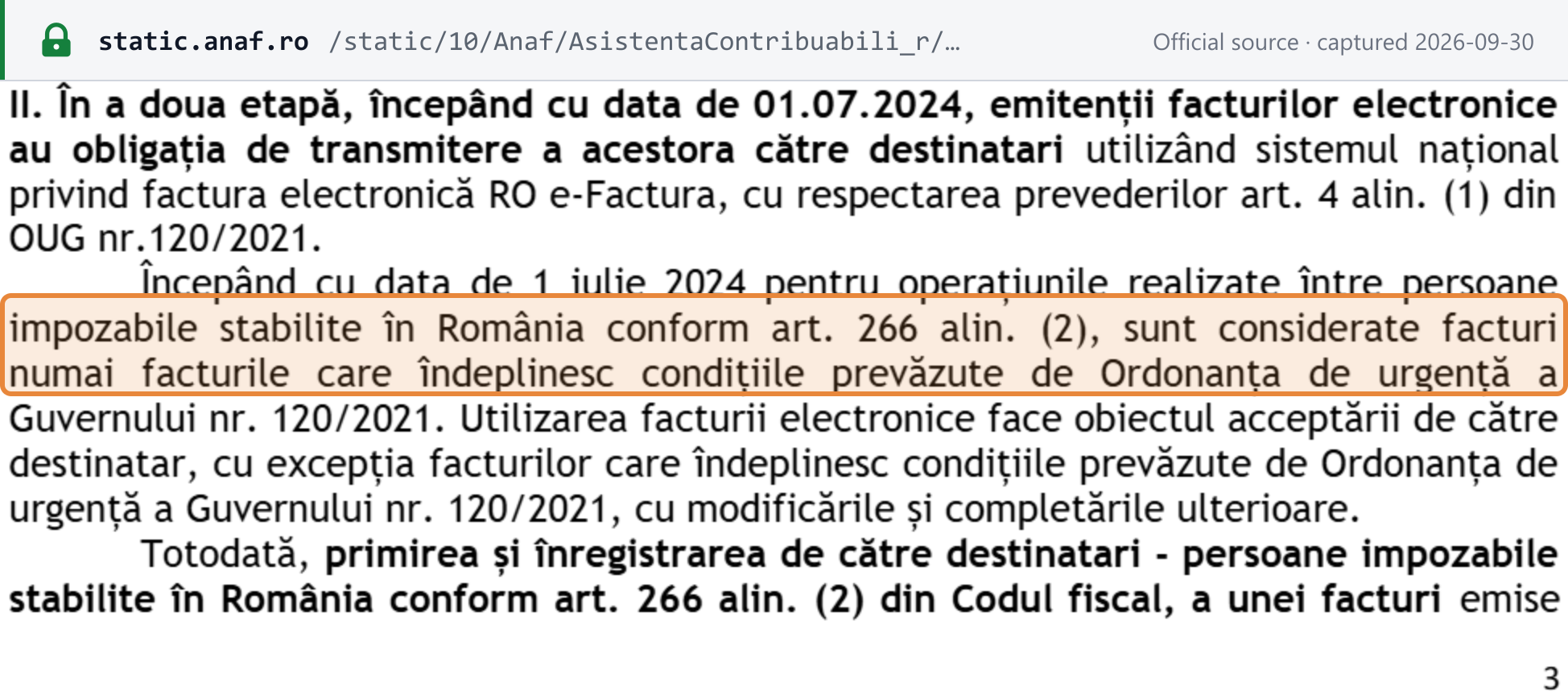
| 1 July 2024 | B2B clearance: the issuer transmits the invoice to the customer through RO e-Factura; between established persons only an OUG 120/2021 invoice is an invoice. The 15% fine applies | Fiscal Code art. 319(1^1); OUG 115/2023 [8] [14] |
| 1 January 2025 | B2C reporting: B2C invoices go to RO e-Factura, with a thirteen-zero code where the consumer gives no tax code; CPV codes required on B2G invoices | OUG 138/2024 [11] |
| 1 July 2025 | Late or missing B2C uploads become fineable; unregistered non-profits carrying on economic activity brought into scope | OUG 69/2024 [12] [15] |
| 1 October 2025 | Special-regime farmers brought into scope (removed again from 1 June 2026) | ANAF [15] |
| 1 January 2026 | Upload deadline becomes 5 working days; Romanian suppliers report invoices to non-established, Romania-VAT-registered customers | OUG 89/2025 [9] |
| 1 June 2026 | Law 88/2026: CNP-identified suppliers and special-regime farmers leave the mandatory scope, with an opt-in | Law 88/2026 [13] |
Scope — B2G, B2B and B2C
- B2G. Public entities "efectuează plăți din bugetul propriu numai dacă facturile sunt emise şi transmise/primite electronic" — pay only invoices issued and received electronically, on pain of a RON 500–1,000 fine on the public body (OUG 120/2021 art. 13^1). [15]
- B2B, between Romanian-established taxable persons. Clearance since 1 July 2024: the invoice reaches the customer through the system, and a paper or PDF invoice is not an invoice for VAT purposes (Fiscal Code art. 319(1^1)). [1] [8]
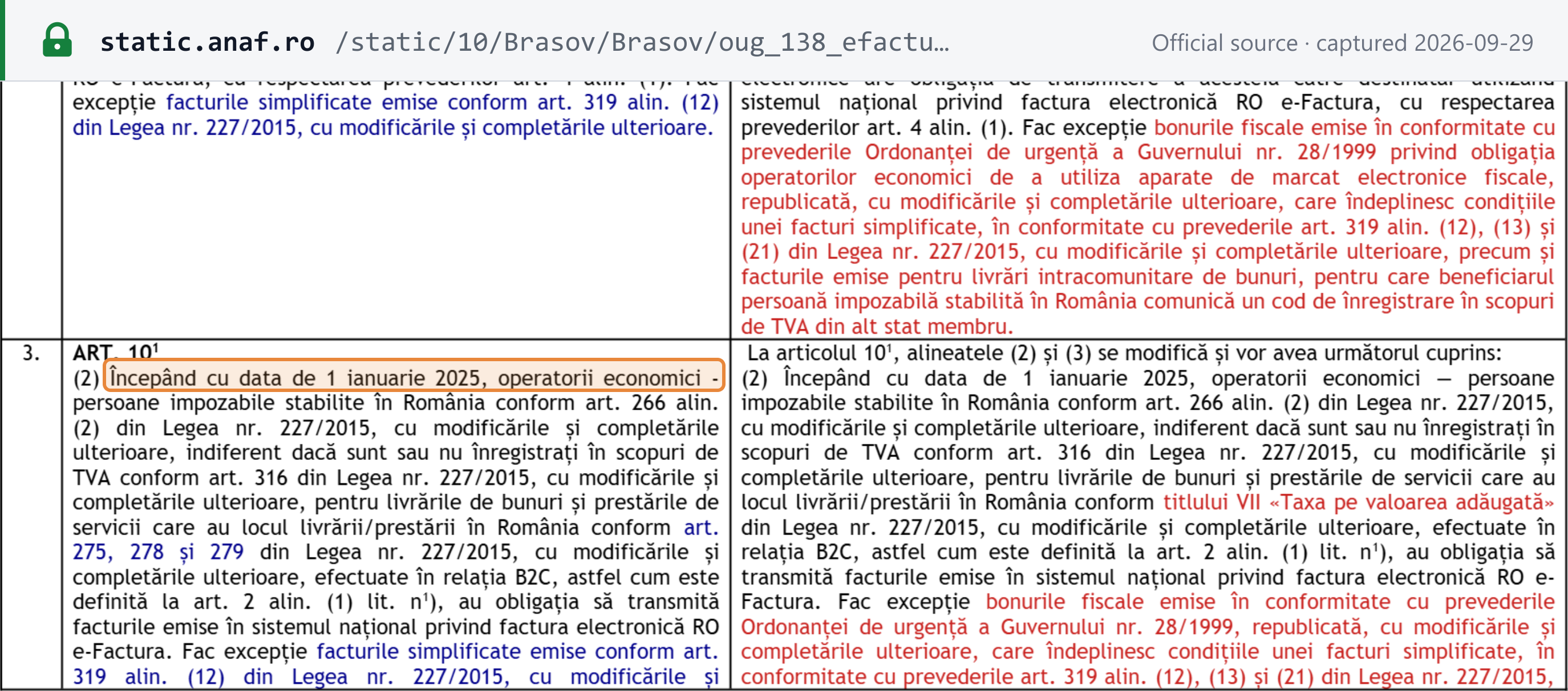
- B2C. "Începând cu data de 1 ianuarie 2025, operatorii economici — persoane impozabile stabilite în România … au obligația să transmită facturile emise" in RO e-Factura — Romanian-established businesses, VAT-registered or not, transmit their B2C invoices to the system; the consumer still receives the invoice by the usual route. Fiscal receipts that meet the simplified-invoice conditions are excluded (OUG 120/2021 art. 10^1(2)). Since 1 January 2025 (OUG 138/2024), where the individual customer gives no tax code, the invoice uses a code of thirteen zeros in place of the customer's code. Law 88/2026 re-enacted art. 10^1(3)–(4) from 1 June 2026: an individual identified by CNP who is enrolled in the optional register (previously, the mandatory register) is treated as a system user, and invoices to them go through the system. [11] [13]
- Out of scope. Exports and intra-EU supplies where the customer gives another member state's VAT number, and fiscal receipts meeting simplified-invoice conditions. [9] [11]
Non-established businesses
- As suppliers. Non-established persons registered for Romanian VAT had to report their B2B invoices for local supplies from 1 January 2024. Since 1 July 2024 they are not in the mandatory B2B clearance scope; they may opt in through the optional register (form 081) (Law 296/2023 art. LIX(3^1), inserted by OUG 69/2024). ANAF Brașov's June 2025 guidance labels RO e-Factura use for this group "Opțional". The 15% fines in OUG 120/2021 art. 13^2(1)(a)–(b) are drafted for issuers and recipients established in Romania. [15] [12] [14]
- As customers. From 1 January 2026, a Romanian-established supplier must transmit to RO e-Factura its invoices for supplies in Romania "către persoane impozabile nestabilite, dar înregistrate în scopuri de TVA în România" — to non-established persons registered for VAT in Romania (OUG 120/2021 art. 10(1^1), inserted by OUG 89/2025). The customer still receives the invoice by the usual route. [9] [10]
Upload deadline — 5 working days since 1 January 2026
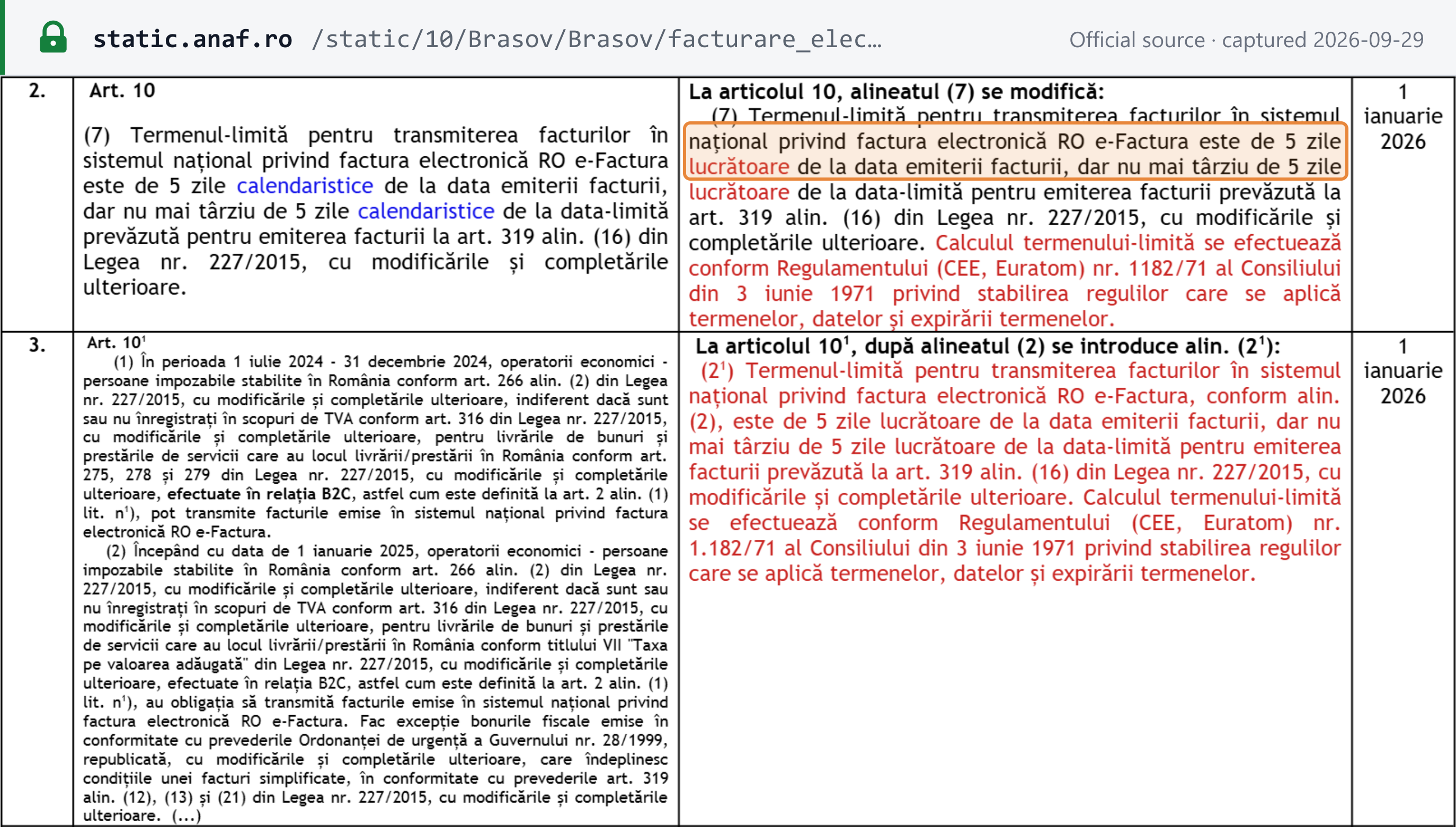
"Termenul-limită pentru transmiterea facturilor în sistemul naţional privind factura electronică RO e-Factura este de 5 zile lucrătoare de la data emiterii facturii, dar nu mai târziu de 5 zile lucrătoare de la data-limită pentru emiterea facturii prevăzută la art. 319 alin. (16)" — invoices must reach RO e-Factura within 5 working days of issue, and no later than 5 working days after the invoice-issuance deadline (the 15th of the following month). The count follows Regulation (EEC, Euratom) No 1182/71. This is OUG 120/2021 art. 10(7) as amended by OUG 89/2025 (Monitorul Oficial 1203, 24 December 2025), in force 1 January 2026; the same deadline applies to B2C invoices (art. 10^1(2^1)). From 1 July 2024 to 31 December 2025 the limit was 5 calendar days. [9] [10]
System outage. If RO e-Factura is not working "timp de minimum 24 de ore" — for at least 24 hours — the transmission obligation is suspended until the system is restored; invoices are issued under art. 319 in the meantime and uploaded afterwards (OUG 115/2023 art. LXXI). [16]
Registers and the 2026 carve-outs
- Registers. Businesses that opt in join the optional register (form 081), from the 1st of the following month; the mandatory register uses form 082. Since OPANAF 1021/2026 (Monitorul Oficial 743, 3 September 2026), form 081 covers both registration in and removal from the optional register, and suppliers identified by a CNP are an eligible optional category. [15] [24] [29]
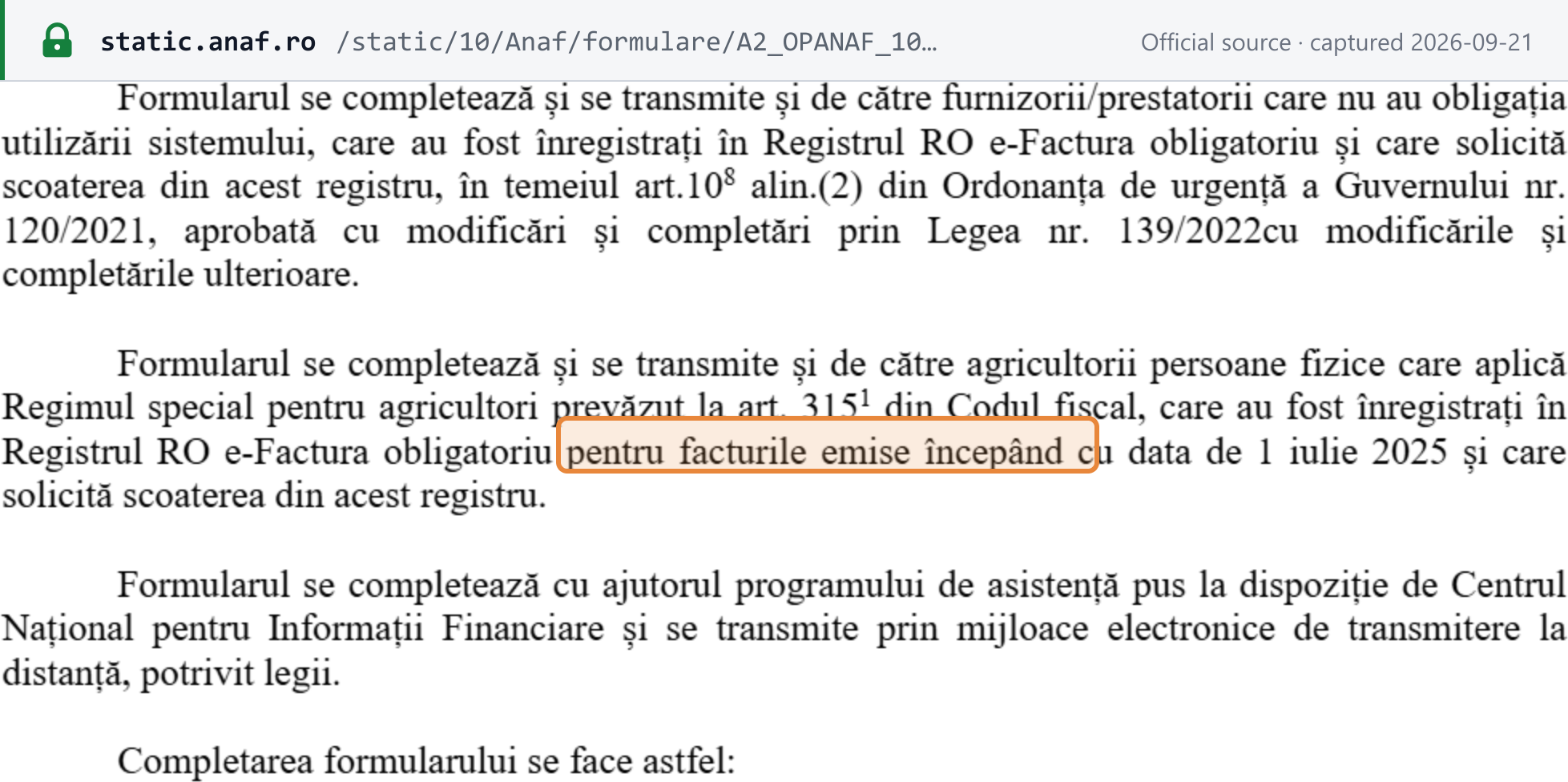
- Non-profits — associations, foundations and similar bodies not registered for VAT that carry on economic activity — have been in scope since 1 July 2025, and remain so. Under OPANAF 1021/2026 (in force 3 September 2026), associations, foundations, other non-profit bodies, political parties and religious denominations that are not VAT-registered under art. 316 of the Fiscal Code and were in the optional register are removed from it by the IT system and entered in the mandatory register. [15] [29]
- Law 88/2026 (Monitorul Oficial 459, 29 May 2026; in force 1 June 2026) removed three groups from the mandatory scope: [13]
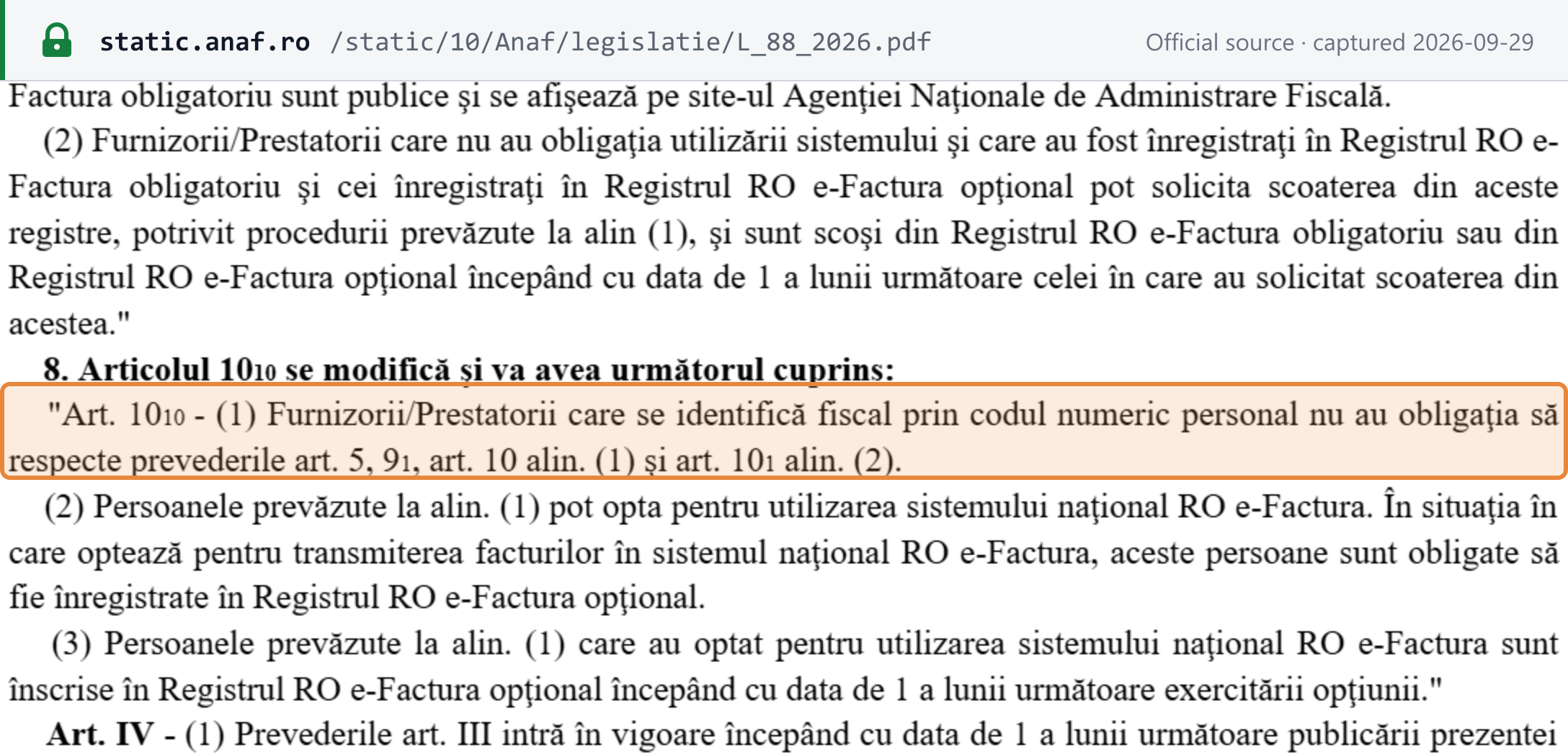
- suppliers identified by a CNP — individuals such as those earning copyright income or letting rooms: "Furnizorii/Prestatorii care se identifică fiscal prin codul numeric personal nu au obligaţia să respecte prevederile art. 5, 9^1, art. 10 alin. (1) şi art. 10^1 alin. (2)" (art. 10^10(1), as amended by Law 88/2026 art. III). They "pot opta pentru utilizarea sistemului" — may opt in, through the optional register (art. 10^10(2)). Art. 10^10 was introduced by OUG 89/2025, whose art. XI required CNP-identified suppliers to enrol in the mandatory register from 15 January 2026; OG 6/2026 suspended that until 1 June 2026, and ANAF's OPANAF 378/2026 set a form-082 deadline of 26 May 2026. Law 88/2026 then removed the obligation from 1 June 2026;
- special-regime farmers;
- foreign cultural institutes, for which use of the system is optional.
- Leaving a register. Suppliers that are not obliged to use the system may ask to be removed from the mandatory or optional register, with effect from the 1st of the following month (art. 10^8(2), as amended by Law 88/2026); OPANAF 1021/2026 lets optional-register suppliers request removal on form 081. ANAF amended form 082 accordingly by OPANAF 1.020/2026 (August 2026) — see the event record. [13] [28] [29]
Access and format
- Access. The business must be enrolled in SPV. Invoices are sent by web service / API (OAuth applications registered on the ANAF portal) or by free web upload; the Ministry of Finance also provides free XML generation and validation tools. [8]
- Format. XML under EN 16931-1+A1 with the national RO_CIUS rules; the XML file carrying the Ministry of Finance's electronic seal is the original invoice. [8]
- Retrieval. Files remain downloadable for 60 days. [8]
E-invoicing penalties
OUG 120/2021 art. 13^2, as rewritten by OUG 115/2023 from 1 July 2024 and amended by OUG 69/2024: [14] [12] [26]
| Breach | Fine |
|---|---|
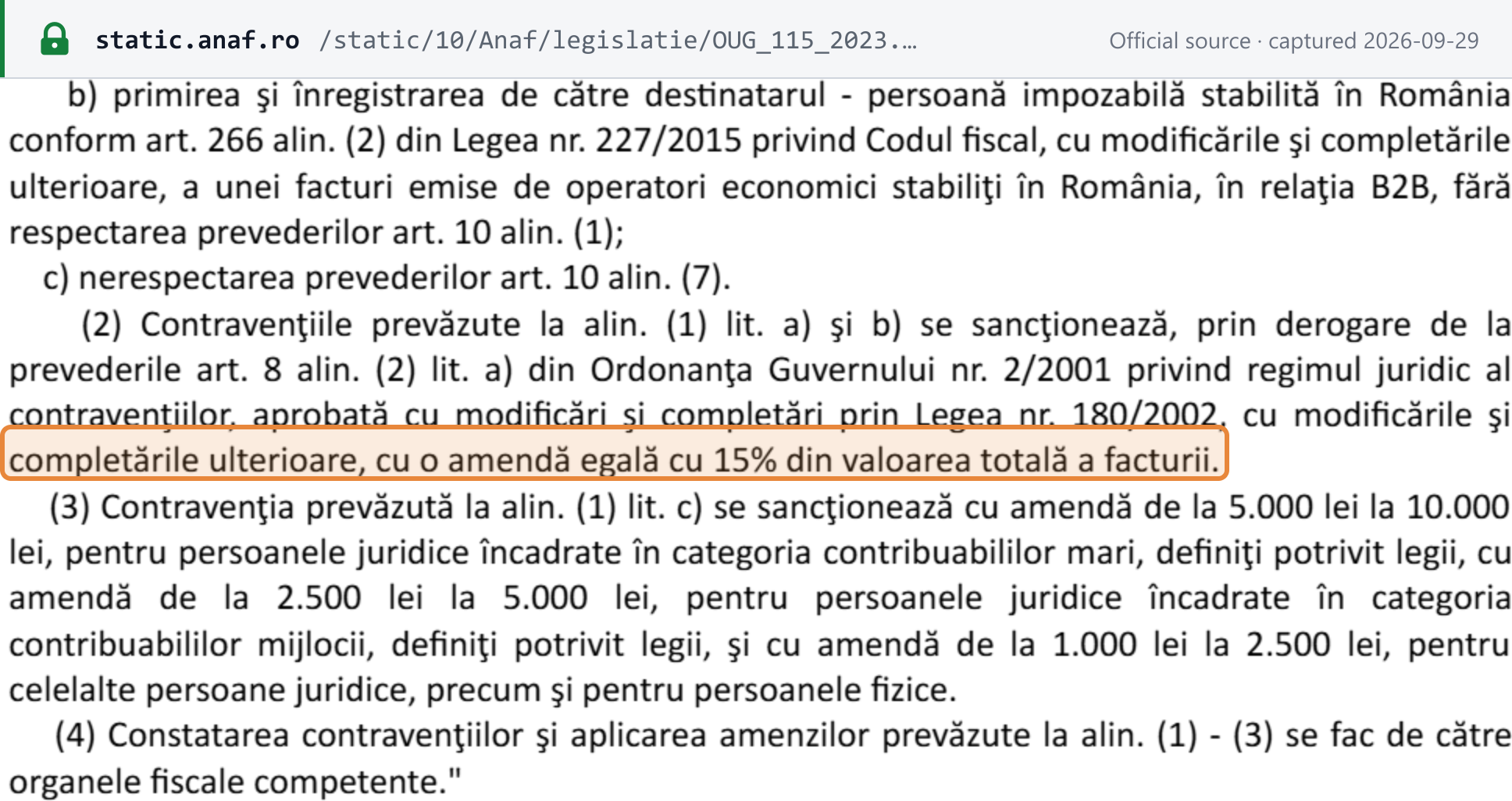
| (a) An issuer established in Romania does not transmit a B2B invoice through RO e-Factura | "o amendă egală cu 15% din valoarea totală a facturii" — 15% of the invoice's total value |
| (b) A recipient established in Romania receives and records a B2B invoice outside the system | 15% of the invoice's total value |
| (c) Late upload (B2B) and (d) late or missing upload of B2C invoices (from 1 July 2025) — per calendar month in which one or more deadlines fall | RON 5,000–10,000 for large taxpayers; RON 2,500–5,000 for medium taxpayers; RON 1,000–2,500 for other legal persons and for individuals |
The 15% fines replaced, before it took effect, Law 296/2023's original fine equal to the VAT shown on the invoice. The option to pay half the minimum fine within 15 days does not apply to these fines (Law 296/2023 art. LVIII). [14] [16]
Adjacent digital reporting — SAF-T D406 and RO e-TVA
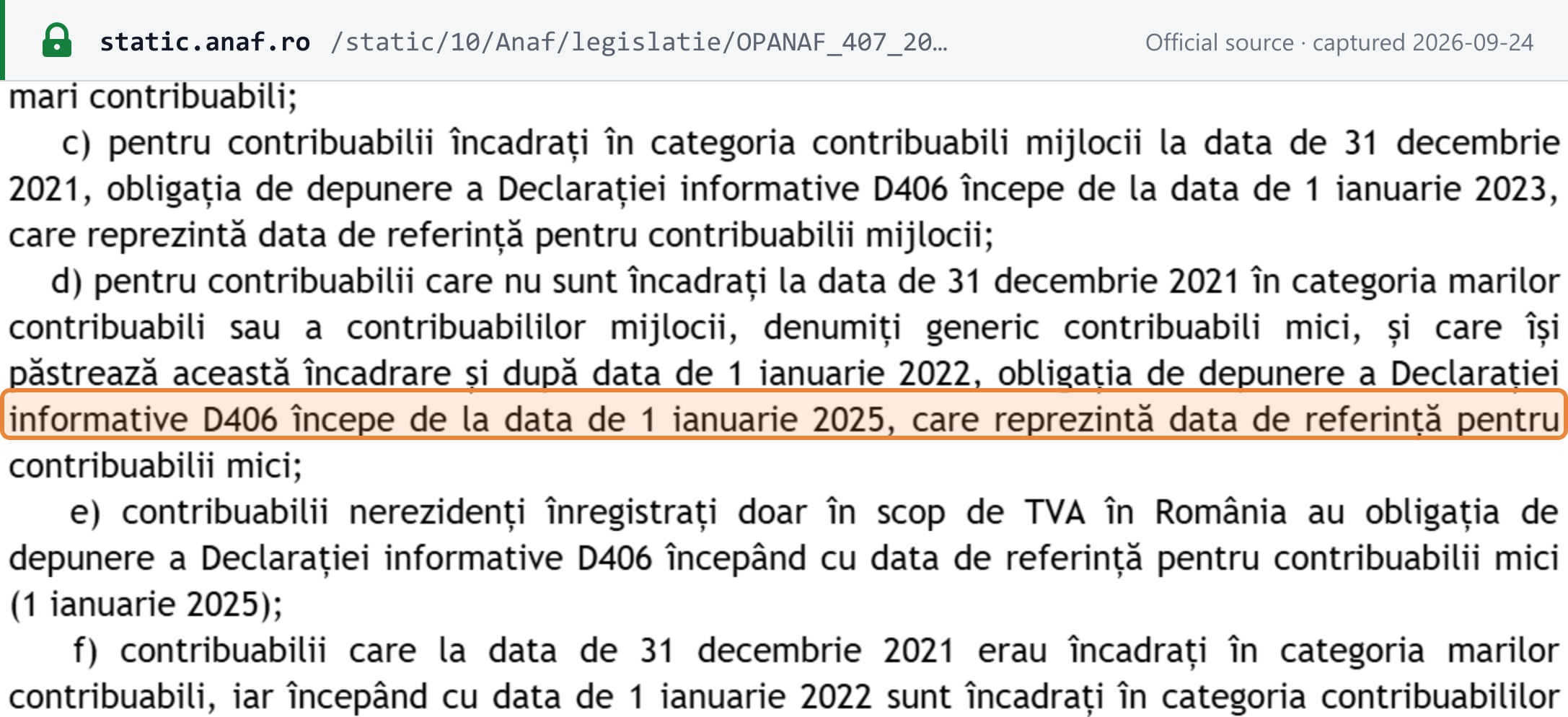
- SAF-T (D406). Phased in for large taxpayers from 1 January 2022, medium taxpayers from 1 January 2023, and small taxpayers and non-residents registered only for VAT from 1 January 2025: "contribuabilii nerezidenţi înregistraţi doar în scop de TVA în România au obligaţia de depunere a Declaraţiei informative D406 începând cu data de referinţă pentru contribuabilii mici (1 ianuarie 2025)" (OPANAF 407/2025, amending OPANAF 1783/2021). New filers first file by the last day of the month after the reporting period (OPANAF 407/2025 pt. 1.1(g)). Late filing is fined RON 1,000–5,000 and incorrect or incomplete filing RON 500–1,500; correcting before the next due date avoids the fine (CPF art. 337^1). See Lookuptax's SAF-T explainer. [17] [2]
- RO e-TVA. For operations from 1 July 2024, ANAF sends a pre-filled VAT return through SPV by the 20th of the month after each period (OUG 70/2024 art. 3). Where the filed D300 differs from it by at least 20% and at least RON 1,000, ANAF issues a compliance notification (art. 5(1)); it is not a tax assessment. [18]
For the EU-level reform that removes the need for derogations such as Romania's, see Lookuptax's ViDA guide.
Filing and payment
Filing frequency
- Monthly by default.
- Quarterly where the previous year's turnover — taxable, exempt-with-credit and deductible-right supplies outside Romania — was not more than EUR 100,000, and the business made no intra-EU acquisitions of goods that year (art. 322(2)). Quarterly filers file a mentions declaration by 25 January confirming both conditions (art. 322(6)).
- A quarterly filer that makes a taxable intra-EU acquisition of goods switches to monthly for the current and the following year (art. 322(7)–(8)).
- A semester or annual period requires ANAF's approval (Norms pt. 103).
Return due date
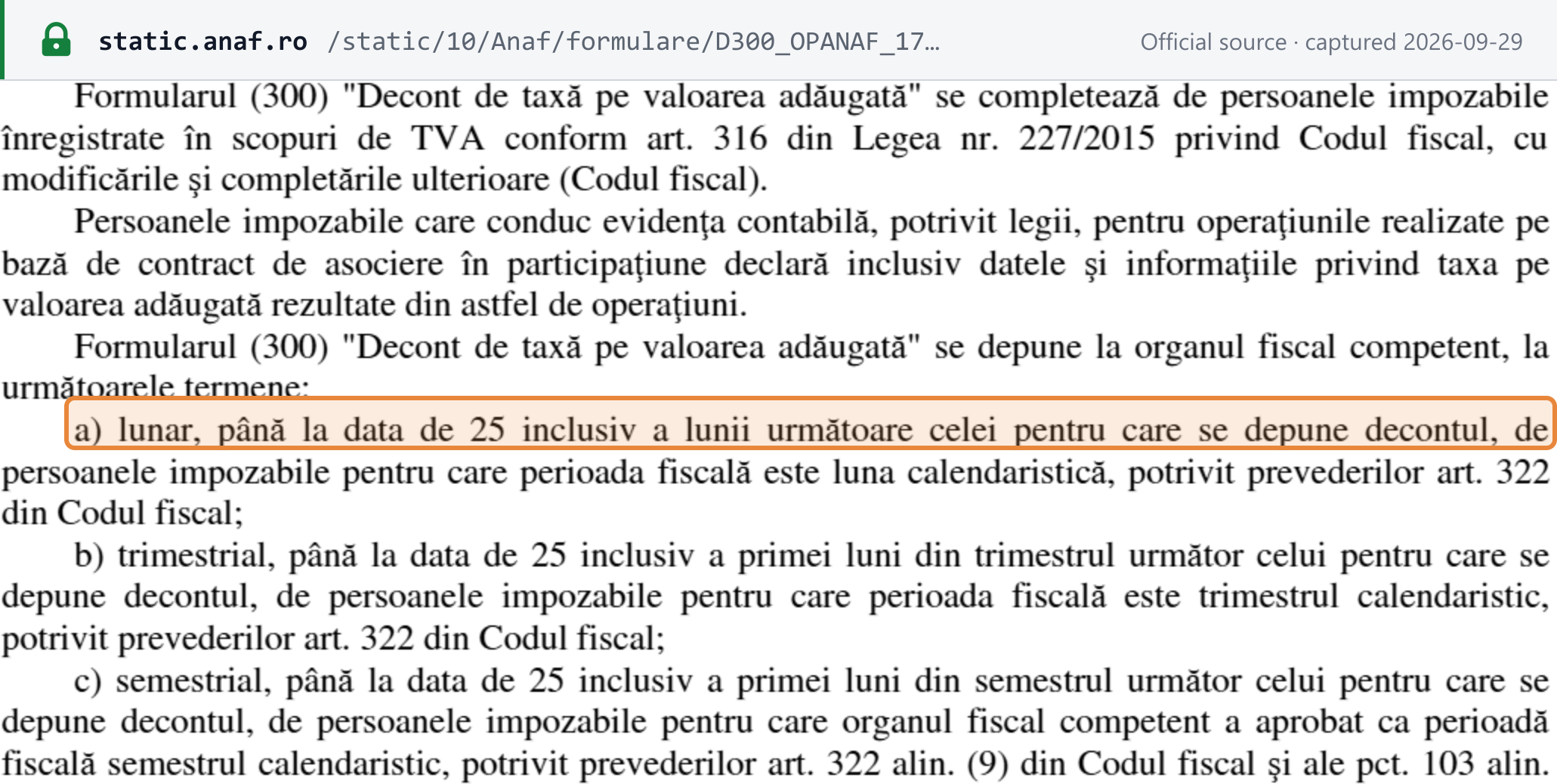
The VAT return (D300, decont de taxă) is filed "până la data de 25 inclusiv a lunii următoare celei în care se încheie perioada fiscală respectivă" — by the 25th of the month after the period ends (art. 323(1)); for quarterly filers, the 25th of the first month of the next quarter. ANAF's D300 instructions add that a deadline falling on 25 December moves to 21 December — and if the 21st is not a working day, to the last working day before it (Fiscal Procedure Code art. 155(2)); ANAF's calendars keep the D390 VIES statement after Christmas instead. The current form model is approved by OPANAF 174/2026. [1] [2] [19] [30]
Payment due date and method
VAT is paid by the same deadline as the return: "Orice persoană trebuie să achite taxa de plată organelor fiscale până la data la care are obligația depunerii unuia dintre deconturile sau declarațiile prevăzute la art. 323 și 324" (art. 326(1)). Reverse-charged VAT and VAT on intra-EU acquisitions are declared as both output and input VAT in the D300 (art. 326(2)). Payment is made to the state treasury; the account details are published by ANAF and are not reproduced here. [1]
Additional listings
| Filing | Content | Due |
|---|---|---|
| D390 (recapitulative statement) | Intra-EU supplies and acquisitions of goods, B2B services, triangulation and call-off stock | Monthly, by the 25th of the following month, only for months in which such operations become chargeable (ANAF forms catalogue, form 390, OPANAF 705/2020) |
| D394 (domestic sales and purchases listing) | Supplies and acquisitions on Romanian territory | By the 30th of the month after the reporting period used for the D300, even for a period with no operations |
| D301 (special VAT return) | For persons not registered under art. 316 that make intra-EU acquisitions or are liable under the reverse charge | By the 25th (art. 324(1)–(2)) |
| D406 (SAF-T) | Accounting and tax data file | See E-invoicing status |
| 392A / 392B / 393 | Annual informative returns | Suspended until 31 December 2026 (OUG 115/2023 art. LXII) |
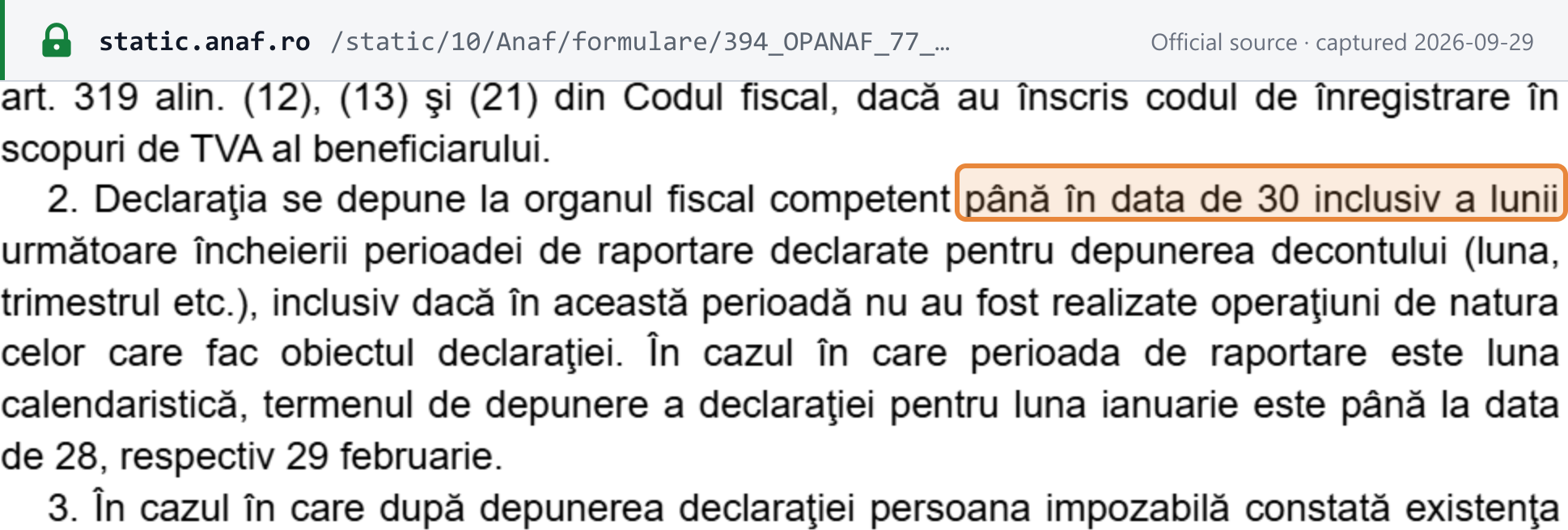
For the D390, ANAF's forms catalogue says it "Se depune lunar până la data de 25 inclusiv a lunii următoare unei luni calendaristice" — it is filed monthly by the 25th of the month after a calendar month; art. 325(2) of the Code leaves the deadline to an ANAF order. ANAF's D394 instructions: "Declaraţia se depune la organul fiscal competent până în data de 30 inclusiv a lunii următoare încheierii perioadei de raportare declarate pentru depunerea decontului (luna, trimestrul etc.), inclusiv dacă în această perioadă nu au fost realizate operaţiuni" — the declaration is filed by the 30th of the month after the end of the reporting period declared for the VAT return (month, quarter, etc.), including if no operations took place. For a monthly filer, January's D394 is due by the end of February. See Lookuptax's VAT listings explainer and VIES and Intrastat guide. [20] [6] [1]
Input-tax recovery and blocked items
- Right to deduct on purchases used for taxable supplies, exempt-with-credit supplies and certain supplies outside Romania (art. 297(4)).
- Invoice condition. The buyer must hold an invoice that meets art. 319 — which, for a purchase from a Romanian-established supplier, means an RO e-Factura invoice (art. 299(1)(a)). A buyer using cash accounting, or buying from a supplier that does, deducts only when the invoice is paid (art. 297(2)–(3)).
- Road vehicles — 50%. Deduction "se limitează la 50%" — is limited to 50% — for VAT on the purchase, hire or leasing of motor road vehicles, and on their running costs, where they are not used exclusively for business (art. 298(1)). Vehicles over 3,500 kg or with more than 9 seats, and vehicles used for emergency, security, courier, sales-agent, taxi, driving-school, rental and leasing purposes or held as stock, are excepted (art. 298(2)–(3)).
- Alcohol and tobacco — not deductible unless bought for resale or to make supplies (art. 297(7)(b)).

Refunds
- Excess input VAT (sumă negativă) is carried forward, or claimed as a refund by ticking the refund option in the D300 (art. 303). [1]
- EU businesses not registered in Romania reclaim Romanian VAT through their home-state portal under the EU refund procedure (art. 302(1)(a)). [1]
- Non-EU businesses may claim only on reciprocity — "dacă, în conformitate cu legile țării unde este stabilită, o persoană impozabilă stabilită în România ar avea același drept" (if a Romanian business would have the same right under the law of the claimant's country) (art. 302(1)(b)). [1]
- Bad debts. The taxable amount may be reduced when the price cannot be collected because the customer is bankrupt, or under a court-confirmed reorganisation plan that reduces the claim (art. 287(d)). There is no general relief for simple non-payment. [1]
Exemptions
Exempt supplies
- Exempt without the right of deduction (art. 292): hospital and medical care, dental care and care by medical staff; social welfare; education and private tutoring; certain cultural and sports services by non-profit bodies; financial and banking services; insurance; gambling; postage stamps; letting of immovable property; and supplies of buildings other than new buildings, and of land other than building land. An option to tax is available for letting and property supplies (art. 292(3)). No invoice is required for these supplies (art. 319(7)).
- Exempt with the right of deduction (art. 294): exports, intra-EU supplies of goods and international transport — "zero-rated" in substance.
Exempt is not zero-rated. A business making exempt-without-credit supplies charges no VAT and cannot recover the input VAT on the related costs; a business with mixed activity recovers by pro-rata (art. 300). A business making exports or intra-EU supplies charges no VAT but keeps full recovery. [1]
Special regimes
- Small-business exemption — RON 395,000; see Registration. Since 1 September 2025 (OG 22/2025), Romanian small businesses may also use the exemption in other member states where their EU-wide turnover is not more than EUR 100,000 and they stay under each state's national threshold (art. 310^1), and EU small businesses may apply Romania's (art. 310^2). [1] [5]
- Cash accounting (TVA la încasare) — optional for Romanian-established VAT-registered businesses whose previous-year turnover did not exceed the ceiling. Output VAT becomes chargeable on collection, invoices carry "TVA la încasare", and buyers deduct only on payment. The ceiling, raised by OUG 8/2026 (Monitorul Oficial 147, 25 February 2026), is "5.000.000 lei, în perioada 1 martie - 31 decembrie 2026" and "5.500.000 lei, începând cu data de 1 ianuarie 2027" — RON 5,000,000 from 1 March to 31 December 2026 and RON 5,500,000 from 1 January 2027, up from RON 4,500,000 (art. 282(3)). A business opts in by notification by the 20th of the month before the period starts (art. 324(12)); ANAF keeps a public register (art. 324(16)). [1] [5] [21]
- Margin schemes and sector regimes — travel agents (art. 311); second-hand goods, works of art, collectors' items and antiques (art. 312); investment gold (art. 313); flat-rate farmers, with a public register (art. 315^1); and the VAT rules for the SGR deposit-return system (art. 315^5). [1]
- OSS, non-Union OSS and IOSS — see Cross-border rules.
- Split VAT payment — repealed. The split-payment mechanism (OG 23/2017) was repealed by OUG 78/2019 (Monitorul Oficial 1031, 23 December 2019) with effect from 1 February 2020; it no longer applies. [22]
Offences and penalties
Offences
Administrative offences (contravenții) under the Fiscal Procedure Code and the special laws include: [2]
| Conduct | Cite |
|---|---|
| Late filing of registration, amendment or deregistration declarations | CPF art. 336(1)(a) |
| Late filing of tax returns and declarations, including the D300 and D394 | CPF art. 336(1)(b) |
| Refusing to produce records and documents to the tax authority | CPF art. 336(1)(c) |
| Failing to keep electronic archives and the software that generated them | CPF art. 336(1)(f) |
| Not filing, or filing incorrectly, the D390 recapitulative statement | CPF art. 337 |
| Not filing, or filing incorrectly, the SAF-T D406 | CPF art. 337^1 |
| Not transmitting an invoice through RO e-Factura, receiving one outside the system, or uploading late | OUG 120/2021 art. 13^2 |
| Road transport of high-risk goods without a UIT code, or with incorrect data | OUG 41/2022 art. 13 |
Criminal exposure. Tax evasion is a criminal offence under Law 241/2005 on preventing and combating tax evasion. This guide does not state the sentence ranges.
Penalties
| Breach | Fine or charge | Cite |
|---|---|---|
| Late filing of a return or declaration (D300, D394), or of a registration or mentions declaration | RON 1,000–5,000 for medium and large taxpayers; RON 500–1,000 for other legal persons and for individuals | CPF art. 336(2)(d) |
| D390 | Late filing RON 1,000–5,000; incorrect filing RON 500–1,500 | CPF art. 337(2) |
| D406 | Late filing RON 1,000–5,000; incorrect or incomplete filing RON 500–1,500 | CPF art. 337^1(2) |
| Refusing to produce records | RON 25,000–27,000 for medium and large taxpayers; RON 6,000–8,000 for others | CPF art. 336(2)(a) |
| Late payment — interest | "Nivelul dobânzii este de 0,02% pentru fiecare zi de întârziere" — 0.02% per day | CPF art. 174(5) |
| Late payment — penalty | 0.01% per day, on top of interest | CPF art. 176(2) |
| Tax undeclared or wrongly declared, then assessed by ANAF — non-declaration penalty | 0.08% per day; reduced by 75% if paid by the due date in the decision or scheduled; doubled where evasion is established by a court; not imposed under RON 50 | CPF art. 181(1)–(3) |
| RO e-Factura | 15% of the invoice total; RON 1,000–10,000 per month for late upload — see E-invoicing status | OUG 120/2021 art. 13^2 |
| RO e-Transport | Set in OUG 41/2022 art. 13, as amended — see Cross-border rules | OUG 41/2022 art. 13 |
Where ANAF assesses tax after a return was not filed, only the non-declaration penalty applies for that failure (CPF art. 181(9)). [2]


Frequently asked questions
Our Romanian supplier emailed us a PDF invoice — can we deduct the VAT on it?
Not if you are both established in Romania. Since 1 July 2024, for supplies between taxable persons established in Romania, only an invoice that meets Emergency Ordinance (OUG) 120/2021 — an XML file transmitted through RO e-Factura — counts as an invoice for VAT purposes (Fiscal Code art. 319(1^1)), and input VAT is deducted on the basis of an art. 319 invoice. A recipient established in Romania that receives and records a B2B invoice outside the system also faces a fine equal to 15% of the invoice's total value (OUG 120/2021 art. 13^2). Ask the supplier to upload the invoice to RO e-Factura, and download it from the system through SPV. [1] [14]
Is the RO e-Factura upload deadline 5 calendar days or 5 working days?
It depends on the invoice date. From 1 January 2026, invoices must reach RO e-Factura within 5 working days of issue, and no later than 5 working days after the deadline for issuing the invoice (the 15th of the month after the chargeable event), under OUG 89/2025. From 1 July 2024 to 31 December 2025 the limit was 5 calendar days. Late upload is fined per calendar month in which one or more deadlines were missed: RON 5,000–10,000 for large taxpayers, RON 2,500–5,000 for medium taxpayers, and RON 1,000–2,500 for other legal persons and for individuals. [9] [12]
We are a foreign company registered for Romanian VAT — do we have to use RO e-Factura?
Not as a supplier, unless you opt in. The mandatory B2B clearance and the 15% fines in OUG 120/2021 art. 13^2 are drafted for issuers and recipients established in Romania. Non-established persons registered for Romanian VAT had to report their B2B invoices from 1 January 2024; since 1 July 2024 they are not in the mandatory B2B clearance scope and may opt into RO e-Factura through the optional register (form 081). As a customer, your invoices will reach the system anyway: since 1 January 2026, Romanian-established suppliers must transmit to RO e-Factura their invoices for local supplies to non-established, Romania-VAT-registered customers, while still sending you the invoice by the usual route. A non-resident registered only for VAT also files SAF-T D406 from 1 January 2025. [12] [9] [17]
Our turnover crossed RON 395,000 part-way through the year — from when do we charge Romanian VAT?
From the transaction that crosses it. A Romanian-established business must apply for VAT registration at the latest on the date its calendar-year turnover exceeds RON 395,000, and the normal VAT regime applies from that date, starting with the transaction that takes it over the ceiling (Fiscal Code art. 310(6)). ANAF's 2026 guidance gives the example of a business crossing on 17 March 2026: it files form 700 at once and charges VAT from 17 March, even if the registration declaration is filed late. If ANAF finds the crossing later, it registers the business ex officio from the crossing date and assesses the VAT that should have been collected, less the VAT that could have been deducted, with interest and penalties on top. The ceiling was RON 300,000 until 31 August 2025. [1] [5]
Can we file the Romanian VAT return (D300) quarterly?
Only if your turnover in the previous calendar year did not exceed EUR 100,000 and you made no intra-EU acquisitions of goods that year (Fiscal Code art. 322). Quarterly filers confirm both conditions in a mentions declaration by 25 January, and a quarterly filer that makes a taxable intra-EU acquisition of goods switches to monthly for the current and the following year. Otherwise the D300 is monthly. Either way it is due, and the VAT is payable, by the 25th of the month after the period ends; a deadline falling on 25 December moves to 21 December (or the last working day before it, if the 21st is not a working day); the D390 VIES statement is not brought forward. [1] [19]
Do we have to file a D394 for a period with no transactions?
Yes. ANAF's D394 instructions say the declaration is filed by the 30th of the month after the reporting period used for the VAT return, including where no operations covered by the declaration took place in that period. Late filing of a tax return or declaration is fined RON 1,000–5,000 for medium and large taxpayers and RON 500–1,000 for other legal persons and for individuals (Fiscal Procedure Code art. 336). [20] [2]
I invoice as an individual identified by my CNP — do I have to use RO e-Factura?
Not since 1 June 2026. Law 88/2026, published on 29 May 2026, provides that suppliers identified for tax purposes by their personal numeric code (CNP) are not obliged to use RO e-Factura, with effect from 1 June 2026. OUG 89/2025 had required them to enrol in the mandatory register from 15 January 2026, and OG 6/2026 suspended that until 1 June 2026; Law 88/2026 then removed the obligation from that date. They may opt in through the optional RO e-Factura register. The same law took special-regime farmers out of the mandatory scope. The carve-out covers only CNP-identified suppliers; businesses identified by a CUI or CIF remain in scope. [13] [24]
Important websites
| Site | Purpose |
|---|---|
| ANAF — SPV enrolment | Enrol in the Virtual Private Space (SPV), needed for e-filing and RO e-Factura |
| ANAF — RO e-Factura project page | Guides, clarifications, code lists and the RO_CIUS specification |
| ANAF — RO e-Factura web invoice tool | Free tool to generate and upload an e-invoice |
| ANAF — forms and programs | Registration forms 010, 015 and 700; D300, D390, D394 and D406; registers 081 and 082 |
| ANAF — VAT register search | Check whether a business is registered for VAT |
| ANAF — VAT-number check request | Request confirmation of a VAT code |
| Ministry of Finance — company lookup by CUI | Look up any Trade Register entity, VAT-registered or not (intermittently unavailable) |
| ANAF — VAT rates brochure (21% / 11%) | The reduced-rate list with NC codes |
| ANAF — consolidated Fiscal Code with Norms | Current statutory text |
| VIES | EU VAT-number check |
| EU VAT refund | EU businesses claim Romanian VAT through their home-state refund portal |
Also see Lookuptax's own Romania VAT number validator and Romania tax identification number guide.
Recent changes
- 2026-09-03 — OPANAF 1021/2026 (Monitorul Oficial 743) amended the optional RO e-Factura register procedure: form 081 now covers registration and removal, CNP-identified suppliers are an eligible optional category, and non-VAT-registered non-profit bodies in the optional register are moved to the mandatory register. It does not change VAT rates or the VAT return. (ANAF) — see event
- 2026-06-01 — Law 88/2026 took CNP-identified suppliers, special-regime farmers and foreign cultural institutes out of mandatory RO e-Factura, with an opt-in. (ANAF) — see event
- 2026-03-31 — OPANAF 378/2026 revised the mandatory-register procedure and form 082, with a 26 May 2026 deadline for CNP-identified suppliers; that obligation was removed by Law 88/2026 from 1 June 2026. (ANAF) — see event
- 2026-03-01 — The cash-accounting ceiling rose from RON 4,500,000 to RON 5,000,000, and rises to RON 5,500,000 on 1 January 2027 (OUG 8/2026). (ANAF)
- 2026-01-01 — The RO e-Factura upload deadline became 5 working days, and invoices to non-established, Romania-VAT-registered customers entered the system (OUG 89/2025). (ANAF)
- 2025-09-01 — The small-business ceiling rose from RON 300,000 to RON 395,000, and the EU cross-border SME scheme became available (OG 22/2025). (ANAF)
- 2025-08-01 — The standard rate rose from 19% to 21%, and a single 11% reduced rate replaced the 9% and 5% rates (Law 141/2025). (ANAF)
Ahead — scheduled changes that have not yet taken effect:
- 2026-12-31 — The domestic reverse charge on grain, emission and green certificates, electricity and gas to traders, and mobile phones, chips, consoles, tablets and laptops ends unless extended; the suspension of the 392A/392B/393 annual returns also runs to this date. (ANAF)
- 2027-01-01 — The cash-accounting ceiling rises to RON 5,500,000. (ANAF)
For the full chronology, see Romania tax changes on Lookuptax.
Reference links
- ANAF — Fiscal Code (Law 227/2015), consolidated to OUG 38/2026, with the Methodological Norms (HG 1/2016)
- ANAF — Fiscal Procedure Code (Law 207/2015), consolidated to OUG 38/2026
- Law 141/2025 — fiscal-budgetary measures (21% and 11% rates from 1 August 2025)
- ANAF — VAT rates brochure, September 2025
- ANAF DGRFP Brașov — synthesis of 2026 fiscal changes, 21 July 2026
- ANAF — catalogue of forms and programs
- OECD — Romania TIN information sheet (supplied by Romania)
- ANAF — Guide to the RO e-Factura national e-invoicing system, 2023
- ANAF DGRFP Brașov — RO e-Factura changes under OUG 89/2025, before/after table, 8 January 2026
- OUG 89/2025
- ANAF DGRFP Brașov — RO e-Factura changes under OUG 138/2024
- ANAF DGRFP Brașov — RO e-Factura changes under OUG 69/2024
- Law 88/2026
- OUG 115/2023
- ANAF DGRFP Brașov — electronic invoicing, 27 June 2025
- ANAF DGRFP Iași — informational material, 13 August 2024
- OPANAF 407/2025 — SAF-T D406
- OUG 70/2024 — RO e-TVA
- ANAF — D300 form and instructions (OPANAF 174/2026)
- ANAF — D394 form and instructions (OPANAF 77/2022)
- OUG 8/2026
- OUG 78/2019 — repeal of split VAT payment
- OUG 41/2022 — RO e-Transport (as published)
- OPANAF 378/2026 — RO e-Factura mandatory register procedure
- Ministry of Finance — VAT exemption ceiling raised to RON 395,000
- ANAF DGRFP Galați (Vrancea) — RO e-Factura deadlines
- OG 22/2025 — SME scheme
- ANAF — form 082 instructions (OPANAF 1.020/2026)
- ANAF DGRFP Brașov — note on OPANAF 1021/2026, amendment of the optional RO e-Factura register procedure (Monitorul Oficial 743/2026)
- ANAF — Calendarul obligațiilor fiscale 2024 (D300/D301 on Friday 20 December, D390 on 27 December)
Related Lookuptax pages: