VAT listings in the EU
A VAT listing is a periodic report, filed with the tax authority in addition to the VAT return, of a business's transactions with named trading partners. The EU has two kinds: the recapitulative statement (EC Sales List) of intra-EU B2B supplies, required by Articles 262–271 of the VAT Directive until 30 June 2030, and national domestic listings such as Belgium's annual client listing or the Czech control statement. From 1 July 2030, Council Directive (EU) 2025/516 (ViDA) deletes the recapitulative statement and replaces it with per-transaction digital reporting.
The EU-level listing is set by Council Directive 2006/112/EC (the VAT Directive), Title XI, Chapter 6 (EUR-Lex, consolidated text of 14 April 2025, checked 2026-09-24). Domestic listings are national measures that each Member State adopts under Article 273 of the same Directive, so their names, scope and deadlines differ from country to country.
Both kinds exist for the same reason: to let a tax authority match what a supplier declares against what its customer declares. The ViDA directive's recitals put the size of the problem at "EUR 93 billion in the Union" of lost VAT in 2020, with missing trader intra-Community fraud "estimated in the range of EUR 40–60 billion" (Directive (EU) 2025/516, recital 3, checked 2026-09-24).
How it works
The recapitulative statement (EC Sales List)
Every taxable person identified for VAT must file a recapitulative statement listing (VAT Directive Art 262, checked 2026-09-24):
- customers it made exempt intra-EU supplies of goods to under Article 138, including transfers of its own goods to another Member State;
- customers it made onward supplies to in a triangular transaction (Article 42);
- customers it supplied B2B services to where the customer accounts for the VAT under the Article 196 reverse charge;
- call-off-stock movements (Article 262(2)).
For each customer VAT number, the statement gives the total value of goods and the total value of services supplied in the period (Art 264(1)(d)). It is a per-customer summary, not an invoice list.
Frequency. The Directive's default is monthly, filed "within a period not exceeding one month" (Art 263(1)). A Member State may allow quarterly filing where intra-EU supplies of goods exceeded EUR 50,000 neither in the current quarter nor in any of the previous four quarters. That option ends after the month in which the threshold is crossed (Art 263(1a)). Member States may also allow quarterly filing for services (Art 263(1c)). Quarterly filing is therefore a national choice, not a right. Poland, for example, requires its VAT-UE statement monthly only: "za okresy miesięczne", for monthly periods (VAT Act art. 100 ust. 3, Sejm ELI, consolidated VAT Act, checked 2026-09-24). Member States must allow electronic filing and may require it (Art 263(2)).
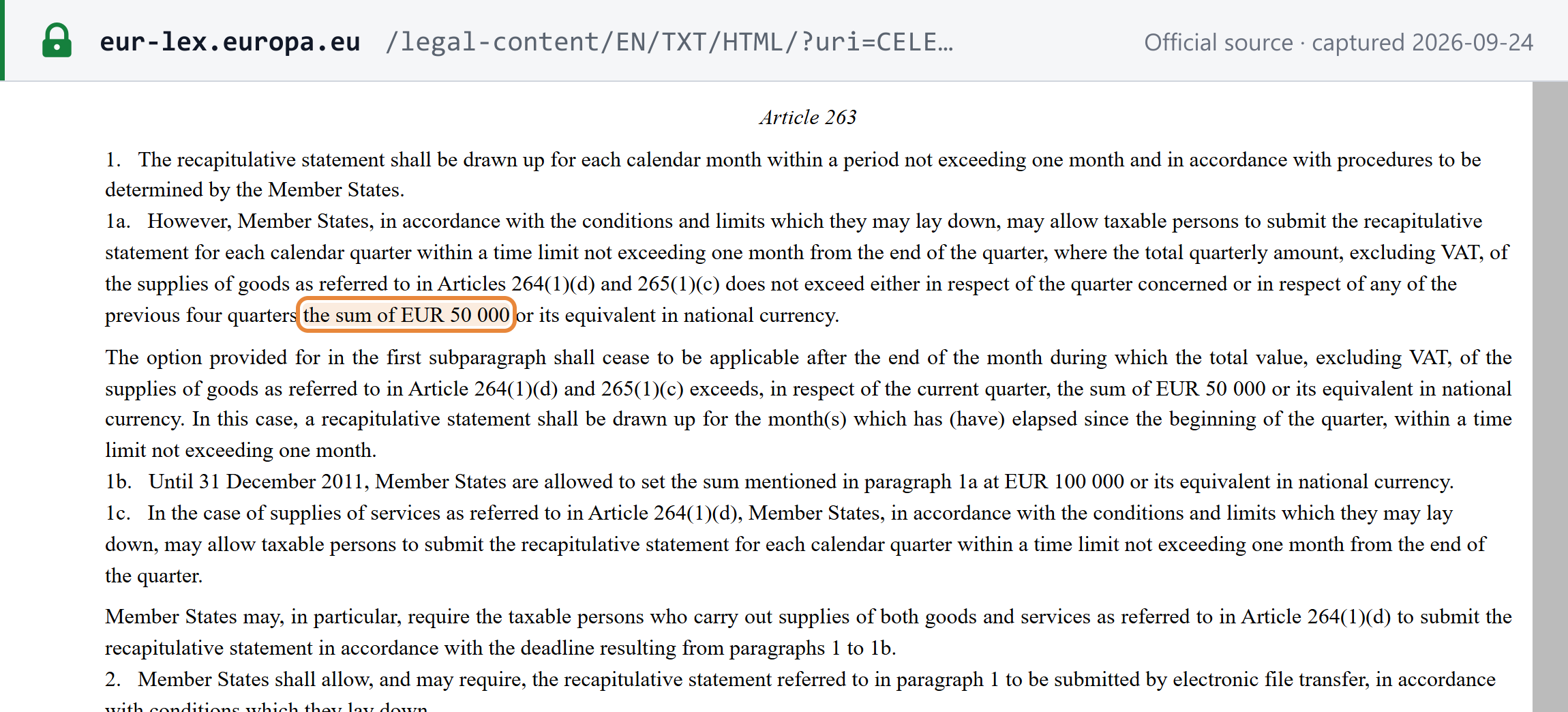 Source snapshot captured 2026-09-24 — original
National rules also differ on details the Directive leaves open, such as the exact due day and whether a nil statement is required. Check the national rule before assuming one.
Worked example. A company registered for VAT in Member State A sells machinery to a VAT-registered customer in Member State B in March. It invoices without VAT because the sale is an exempt intra-EU supply under Article 138, and the customer self-accounts for acquisition VAT in Member State B. On its March recapitulative statement, filed in Member State A, the seller lists the customer's Member State B VAT number and the total March value of goods supplied to that customer. That is the figure the tax authorities can set against the intra-EU acquisition the customer declares in Member State B.
Domestic listings
A domestic listing applies the same matching logic to domestic B2B trade. It is not harmonised. The Directive lets each Member State impose "other obligations which they deem necessary to ensure the correct collection of VAT and to prevent evasion" (Art 273), may require extra details in the recapitulative statement (Art 266), and may require statements of intra-EU acquisitions, but not more often than monthly (Art 268) (VAT Directive, checked 2026-09-24).
National designs fall into three rough groups (details and sources in the jurisdiction table below):
- Annual per-customer totals: Belgium's client listing, Spain's modelo 347.
- Periodic invoice-level listings filed with or next to the return: the Czech and Slovak control statements, Estonia's KMD INF annex, Lithuania's i.SAF.
- Invoice data sent in real time or near real time, which has replaced the classic listing in several countries: Hungary's Online Számla, Spain's SII, Portugal's e-Fatura communication, and Italy's SdI e-invoicing.
Who has to file
The recapitulative statement is filed by every VAT-identified business that makes the transactions in Article 262: intra-EU B2B supplies of goods (including own-goods transfers), onward supplies in triangulation, reverse-charged B2B services, and call-off-stock movements. Where a customer is liable for the VAT under Articles 194 or 204 in place of a non-established supplier, Member States must also make sure the statement obligation is met (Art 267). The Directive sets no value floor. The EUR 50,000 figure only decides whether quarterly filing may be allowed. A business with only domestic sales, or only B2C cross-border sales, has nothing to report on it.
Domestic listings have national scope. For example, Belgium's client listing covers every taxable person with customers identified for Belgian VAT to whom it supplied more than EUR 250 in the year. Estonia's KMD INF covers every VAT payer, for partners with a combined total of at least EUR 1,000; from 1 January 2027 Estonia folds both the KMD INF annex and its VD recapitulative statement into the VAT return itself, keeping the EUR 1,000 threshold (RT I, 03.12.2024, 2). Lithuania's i.SAF covers all VAT payers except those in the SVS small-business scheme. Each figure is sourced in the table below.
Current status and dates
As at 2026-09-24, the recapitulative-statement regime in Articles 262–271 is in force in every Member State. Council Directive (EU) 2025/516, in force since 14 April 2025, changes it in three steps. These are enacted law with future dates, not proposals (Directive (EU) 2025/516, Arts 3–6, checked 2026-09-24). The table also lists national milestones for the Czech Republic, Italy, Poland and Belgium:
| Applies from | What changes for VAT listings | Status (as at 2026-09-24) | Legal basis |
|---|---|---|---|
| 1 Jan 2016 | Czech Republic: VAT control statement (kontrolní hlášení) starts | In force since then | Finanční správa |
| 1 Jan 2019 | Italy: domestic B2B invoices go only through SdI e-invoicing; the old data-invoice communication (spesometro) was repealed by Law 205/2017, final filing due 30 Apr 2019 | In force since then | Normattiva |
| 1 Oct 2020 | Poland: the VAT-27 domestic listing is gone; transaction records go monthly inside JPK_V7M/K | In force since then | KAS |
| 14 Apr 2025 | Directive (EU) 2025/516 (ViDA) enters into force | In force | EUR-Lex |
| 2028 (planned) | Belgium: near-real-time e-reporting to replace the annual client listing, from 2028 (the 2025–2029 coalition agreement's timing) | Draft only — not law | FPS e-invoicing FAQ |
| 1 Jul 2028 | The recapitulative statement also covers supplies where the customer pays the VAT under the Article 194 reverse charge | Enacted | Dir 2025/516 Art 3, Art 6(3) |
| 1 Jul 2029 | Call-off-stock information leaves the recapitulative statement (Art 262(2) deleted) | Enacted | Dir 2025/516 Art 4, Art 6(4) |
| 1 Jul 2030 | Recapitulative statements abolished (Arts 265–271 deleted); intra-EU supplies and acquisitions are reported per transaction; recast Article 273 limits domestic listings; central VIES receives the data | Enacted | Dir 2025/516 Art 5, Art 6(5); Reg (EU) 2025/517 Art 4 |
| 1 Jan 2035 | Domestic real-time reporting systems in place on 1 January 2024 (or authorised or legislated before then) must meet Arts 218 and 271a–271b | Enacted | Dir 2025/516 Art 6(5) |
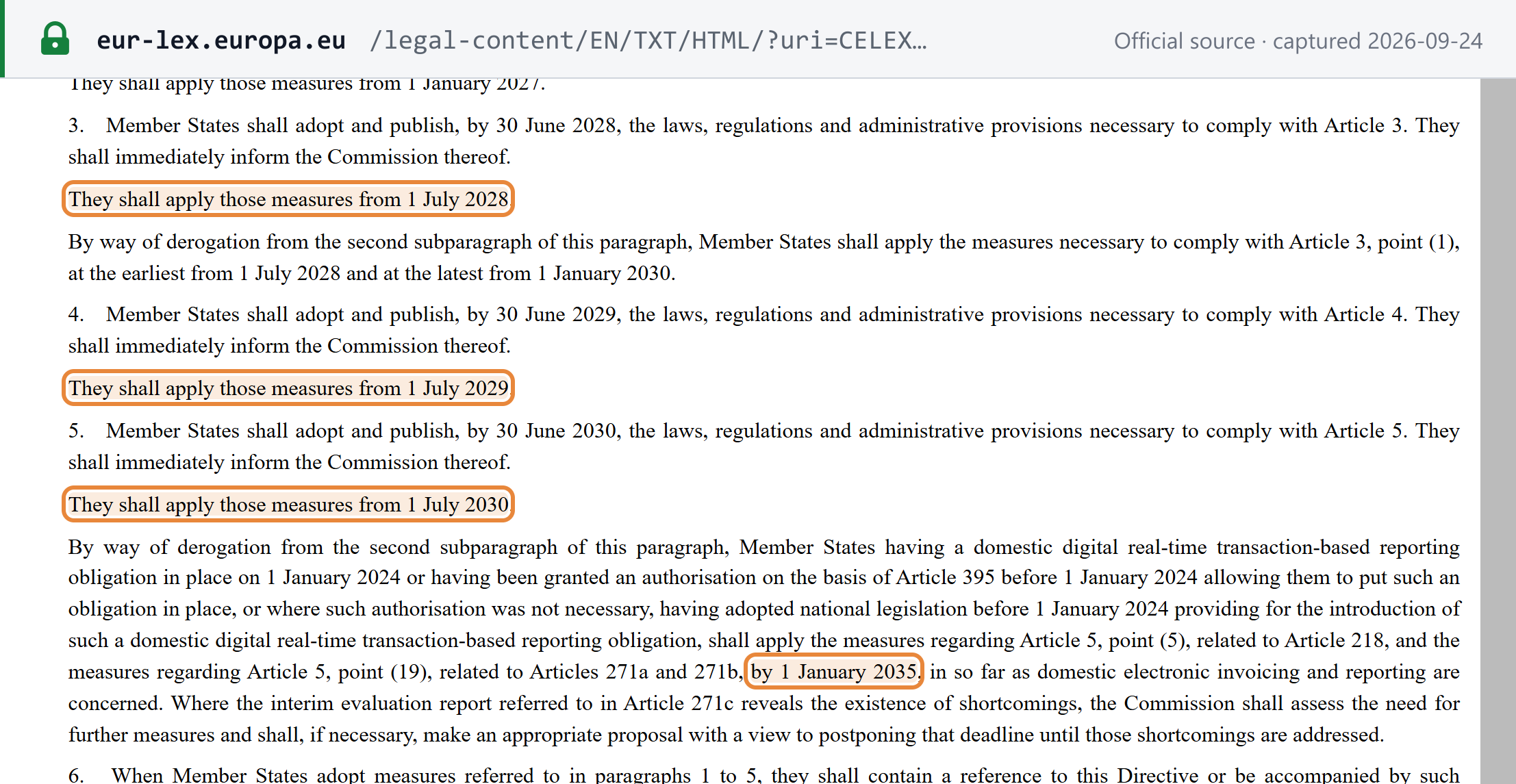 Source snapshot captured 2026-09-24 — original
1 July 2030: from recapitulative statement to per-transaction reporting
From 1 July 2030, Title XI Chapter 6 of the VAT Directive becomes "Digital reporting requirements" and Articles 265 to 271 are deleted. The duty to report intra-EU trade does not disappear. The recast Article 262 still requires every VAT-identified person to submit data, but the data now go per transaction. The supplier transmits them when the invoice is issued or should have been issued. Where the customer issues the invoice (self-billing), and on the acquisition side, the deadline is 5 days (recast Art 263). The recast rules also bring intra-EU acquisitions into scope, although Member States may waive acquisition-side reporting (recast Art 262(4)). What ends is the periodic per-customer summary. The recitals say intra-EU transactions "will be covered under the scope of the digital reporting requirements for cross-border supplies of goods and services, but with more detailed and timelier information" (recital 14).
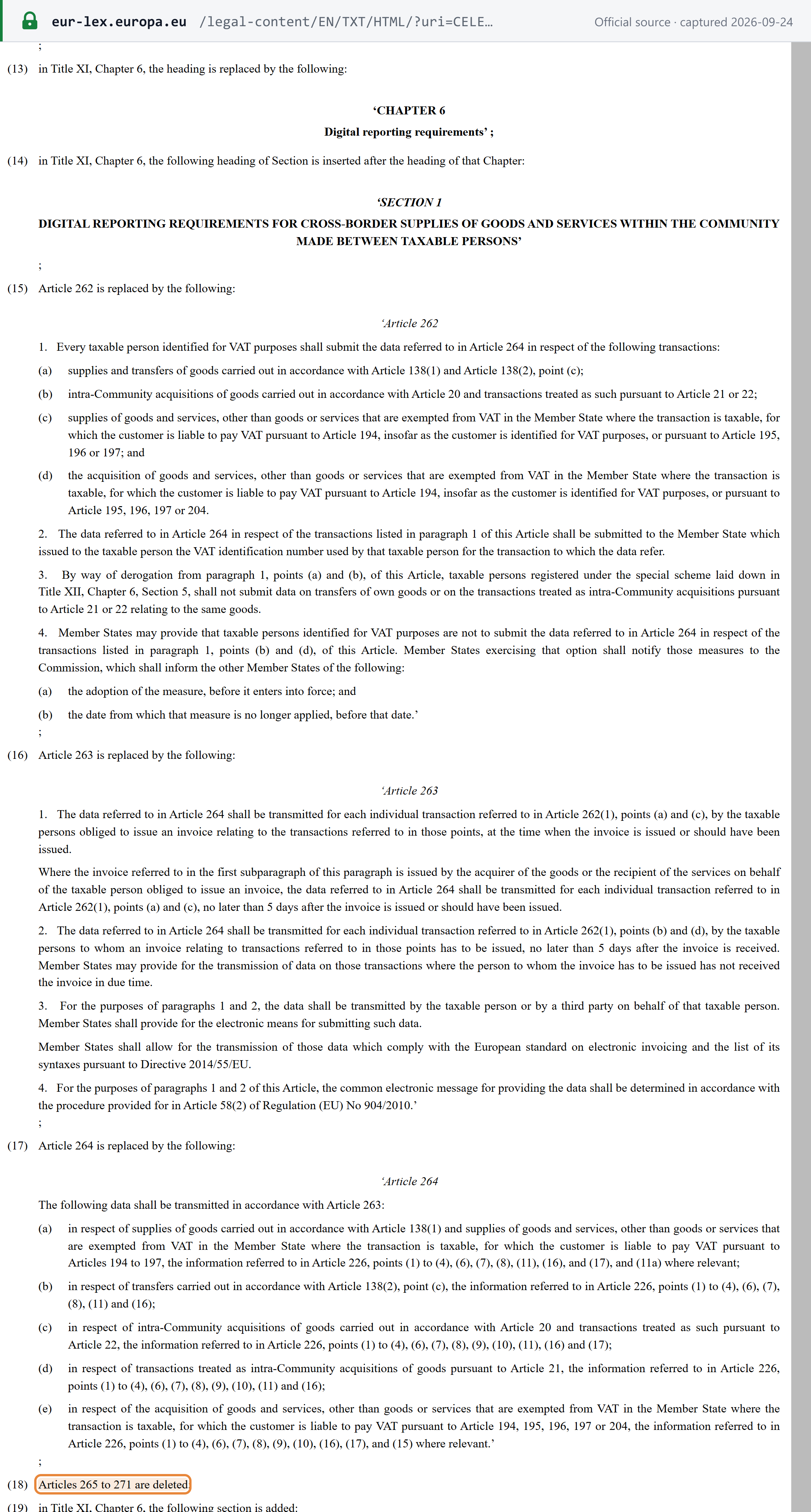 Source snapshot captured 2026-09-24 — original
The ViDA explainer covers the wider package, including the 10-day e-invoicing rule for intra-EU B2B supplies: ViDA — VAT in the Digital Age.
What happens to domestic listings
The recast Article 273 (from 1 July 2030) stops Member States using Article 273 "to implement new additional general transaction-based reporting obligations" for B2B supplies or acquisitions beyond those in Chapter 6. Three things are still allowed (Directive (EU) 2025/516, Art 5 point (20) and recital 23, checked 2026-09-24):
- Keeping an existing obligation for now. A Member State that had a general transaction-based reporting obligation on 1 January 2024 may keep it until it implements a digital real-time reporting system that meets Chapter 6, Section 2 (Articles 271a–271b). The same rule applies separately to supplies and to acquisitions.
- Storing data. Member States may still require businesses to store transaction data to prepare the VAT return or for audits. Recital 23 names SAF-T-based tools as an example.
- Non-general reporting. Obligations that are not general, such as cash-register reporting, are unaffected.
Domestic real-time reporting under Article 271a is optional. A Member State may require it, and if it does, the data go per transaction at invoice issuance (or within 5 days of receipt), and it may limit the scope to certain taxpayers or transactions (Art 271b). Systems that were in place, legislated or authorised before 1 January 2024 have until 1 January 2035 to align.
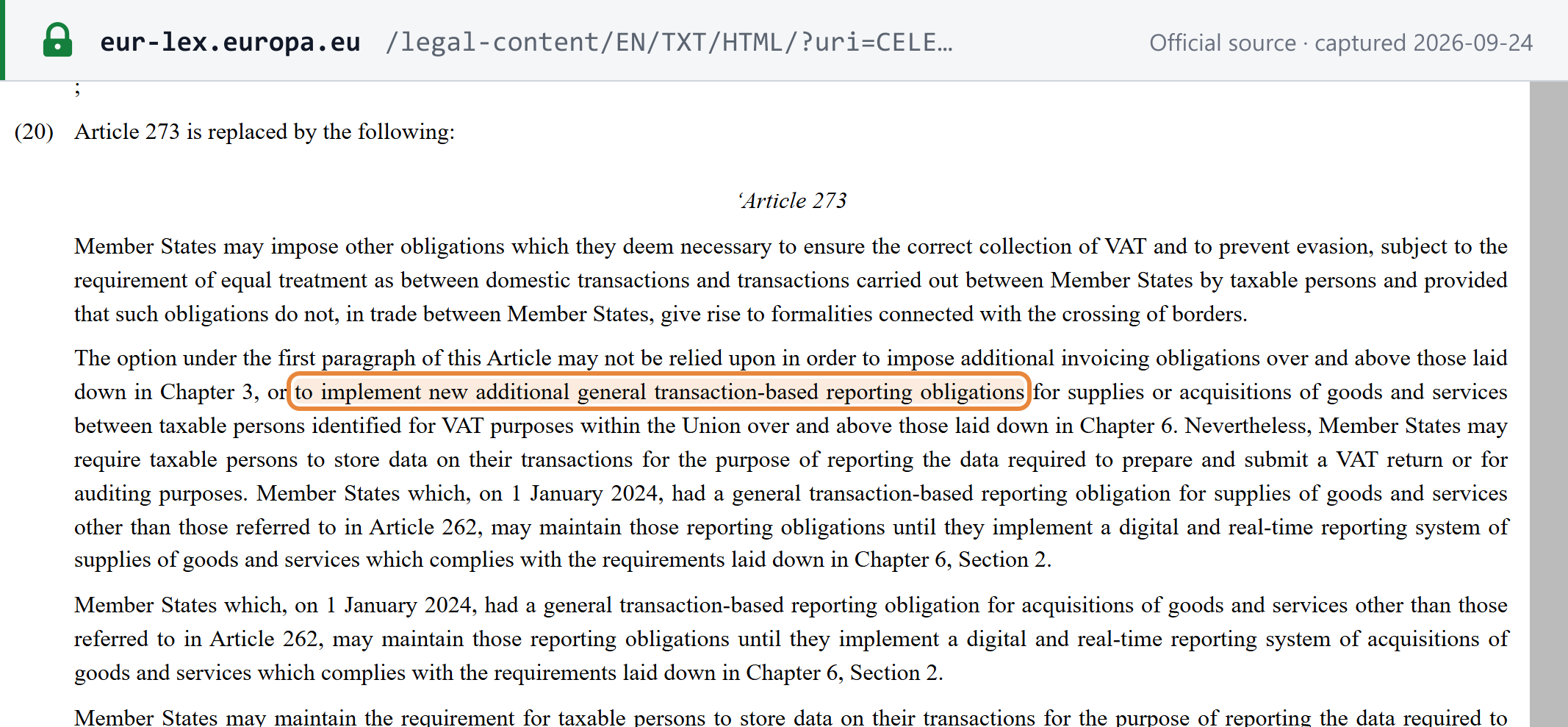 Source snapshot captured 2026-09-24 — original
The Directive does not say which existing national listings count as "general transaction-based reporting obligations".
Belgium: a draft to replace the client listing
Belgium's annual client listing is still required: before 31 March each year, for the previous year. The federal e-invoicing FAQ says near-real-time transactional e-reporting is planned to replace it (efactuur.belgium.be, FPS Finance / FPS BOSA, checked 2026-09-24):
"Die maatregel is wel opgenomen in het federale regeerakkoord 2025-2029 met als timing 2028, maar ze moet nog worden omgezet in Belgische wetgeving."
"De elektronische near real-time transactionele rapportering zal de jaarlijkse klantenlisting vervangen."
In English: the measure is in the 2025–2029 federal coalition agreement with a 2028 timing, but it still has to be written into Belgian law, and near-real-time transactional reporting will replace the annual client listing. The same FAQ says Belgium will implement the ViDA reporting for intra-EU transactions by 1 July 2030 at the latest.
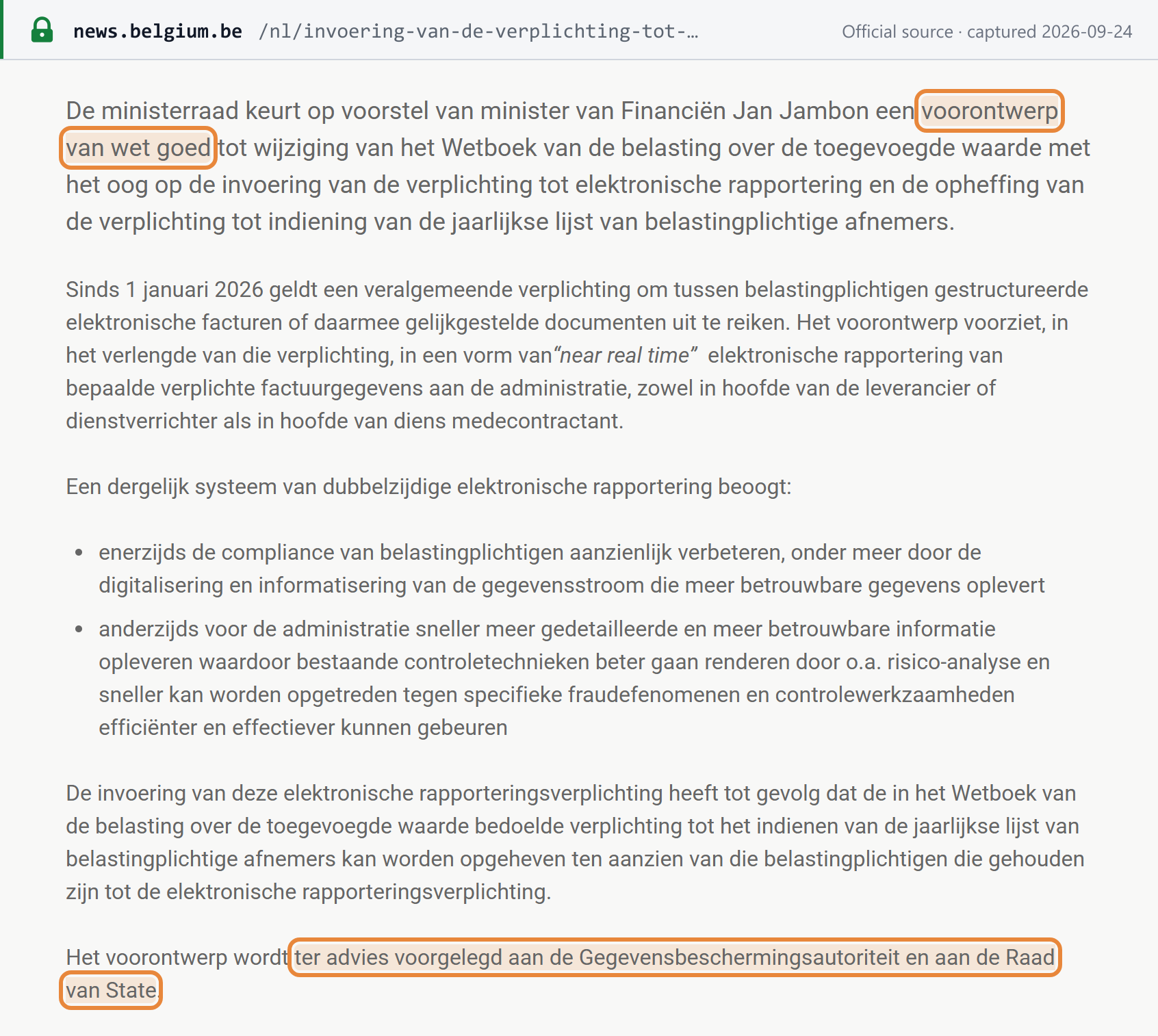
On 18 July 2026 the Council of Ministers approved a preliminary draft law (voorontwerp van wet) introducing electronic reporting of invoice data (planned for 2028 under the 2025–2029 coalition agreement), and abolishing the client listing for taxpayers within the new regime. As at 2026-09-24 this is a draft, not law. Until a law is published, plan on filing the client listing as usual.
 Source snapshot captured 2026-09-24 — original
 Source snapshot captured 2026-09-24 — original
Where each Member State stands
Domestic listings and their real-time successors in 11 EU Member States. Each row was confirmed against the official source named, on the date shown. Other Member States are not covered here.
| Country | Domestic listing today | Cadence / threshold | Status | Last confirmed | Source |
|---|---|---|---|---|---|
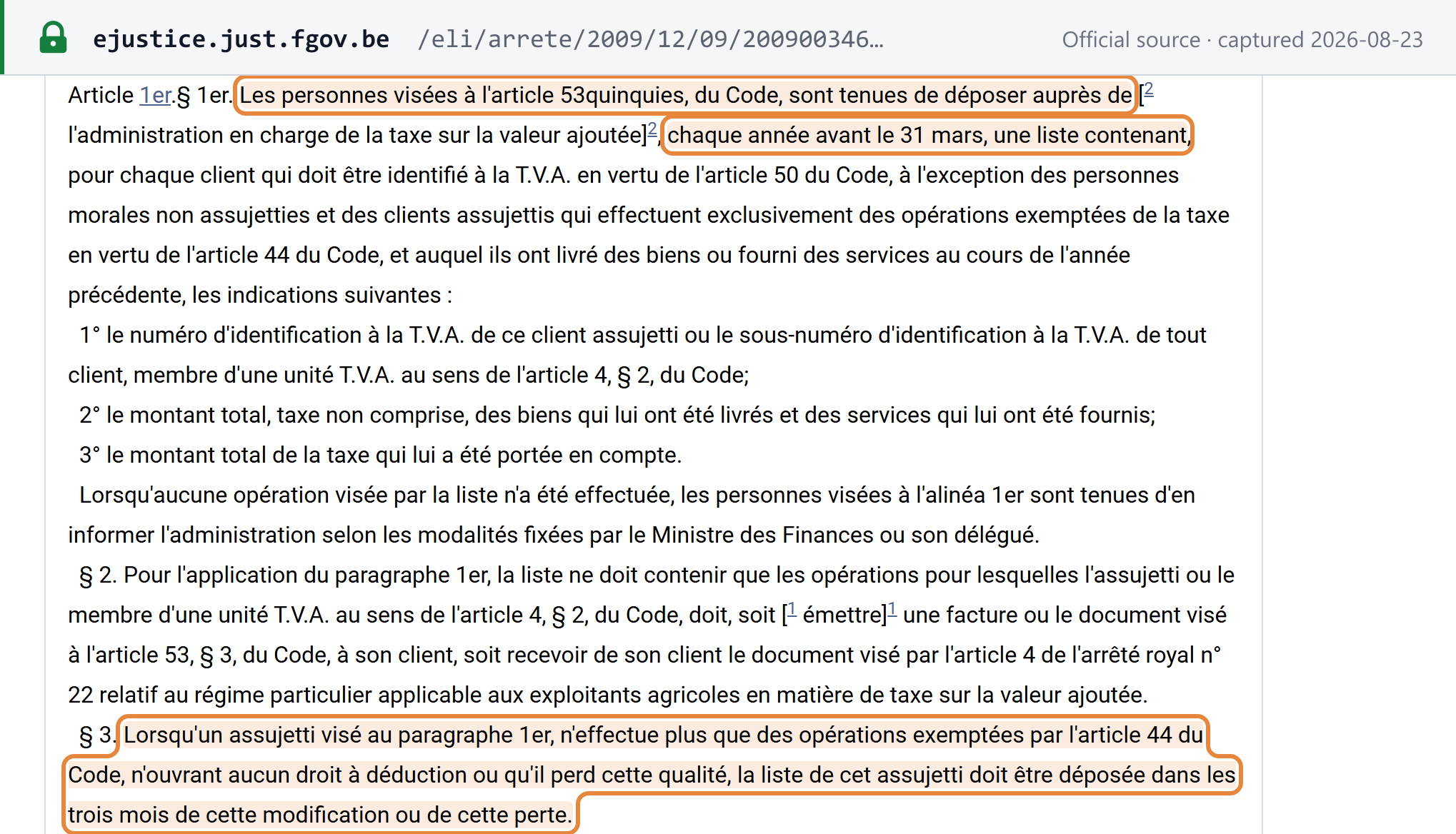
| Belgium | Annual client listing (listing clients): each customer identified for Belgian VAT, with its VAT number, total base and total VAT | Annual, before 31 March (AR n° 23); customers supplied for more than EUR 250 excl. VAT in the year (SPF Finances) | In force. Draft e-reporting to replace it from 2028 (the 2025–2029 coalition agreement's timing); not law | 2026-08-23 (listing); 2026-09-24 (draft) | SPF Finances; Justel, AR n° 23; efactuur.belgium.be |
| Czech Republic | VAT control statement (kontrolní hlášení): data from issued and received tax documents on domestic transactions | Legal persons monthly, by the 25th day after month end (even with a quarterly VAT period); natural persons with the return | In force since 1 Jan 2016; separate from the VAT return and the EC Sales List | 2026-09-24 | Finanční správa |
| Estonia | KMD INF annex to the VAT return: Part A sales invoices, Part B purchase invoices | Monthly, by the 20th of the following month; partners with a total of at least EUR 1,000 excl. VAT | In force until 31 Dec 2026 (merged into the return from 1 Jan 2027) | 2026-09-24 | Maksu- ja Tolliamet |
| Hungary | Online Számla invoice data (suppliers) plus the M-sheets of return 2665 (received invoices on which deduction is claimed) | Invoice data immediately after issue; M-sheets with each return, no value threshold | In force. The stricter July 2026 M-sheet format was reversed by Act XXXV of 2026 | 2026-08-19 (rules); 2026-09-21 (reversal) | NAV Online Számla manual; NAV 2665 filling instructions; NAV |
| Italy | No listing of the old kind. Domestic B2B invoices go through SdI e-invoicing; cross-border data also go through SdI | SdI at invoicing; cross-border data through SdI for operations from 1 Jul 2022 | Spesometro repealed by Law 205/2017 (final filing due 30 Apr 2019); SdI e-invoicing mandatory since 1 Jan 2019 | 2026-09-24 | Normattiva, DL 78/2010 art. 21; Normattiva, D.Lgs. 127/2015 art. 1 |
| Lithuania | i.SAF: data from the registers of VAT invoices issued and received | Legal persons monthly, by the 20th of the following month; all VAT payers except those in the SVS scheme | In force | 2026-09-23 | VMI |
| Poland | JPK_V7M / JPK_V7K records part; the VAT-27 domestic listing (Art. 101a) was repealed | Records monthly, by the 25th (quarterly filers send months 1 and 2 separately) | JPK_V7M in force since 1 Oct 2020; KSeF e-invoicing mandatory since 2026 | 2026-08-23 | Dziennik Ustaw 2019 poz. 1520; KAS |
| Portugal | Communication of invoice data to AT (e-Fatura): real-time webservice, SAF-T (PT) file or Portal entry | Monthly, by day 5 of the month after issue | In force (day 5 since invoices issued from 1 Jan 2023) | 2026-08-31 | Portal das Finanças |
| Romania | D394, informative declaration of supplies and acquisitions on national territory | Same period as the VAT return (monthly or quarterly), by the 30th of the following month, even for a period with no operations (ANAF instructions, OPANAF 77/2022) | In force; current form used from the reporting of August 2025 obligations | 2026-09-24 (form); 2026-09-30 (deadline) | ANAF; ANAF, D394 instructions |
| Slovakia | VAT control statement (kontrolný výkaz) | Electronically, for every period in which a return is due, within 25 days of the period end | In force | 2026-09-07 | Slov-Lex, Act 222/2004 § 78a |
| Spain | SII (VAT books kept on the AEAT portal) for monthly filers; modelo 347 annual return for others | SII: within 4 days of issue, excluding weekends and national holidays (RD 1624/1992 art. 69 bis); modelo 347: annual, where dealings with one counterparty exceed EUR 3,005.06; SII filers are exempt from 347 | SII mandatory since 1 Jul 2017 for monthly filers (large businesses over EUR 6,010,121.04, VAT groups, REDEME) | 2026-08-19 (SII); 2026-09-24 (347) | AEAT; BOE, RD 1624/1992; BOE, RD 1065/2007 |
Romania: ANAF's form page confirms that D394 is in force and which version applies. The deadline comes from ANAF's D394 instructions (OPANAF 77/2022): the declaration is filed "până în data de 30 inclusiv a lunii următoare încheierii perioadei de raportare declarate pentru depunerea decontului" — by the 30th of the month after the reporting period used for the VAT return — including when no operations took place. See the Romania VAT guide.
 Source snapshot captured 2026-08-23 — original
 Source snapshot captured 2026-09-23 — original
Background: the 2018 Fiscalis study of domestic listings
The most detailed official comparison of domestic listings is still a study by tax-administration experts: "VAT listings – implementation in EU Member States", written by Fiscalis Project Group 074 and published by the European Commission's DG TAXUD in January 2018. The cover is dated 26 January 2017, but the text uses data from 2017 (report PDF, checked 2026-09-24). The report states that its views "do not necessarily reflect the official opinion of the Commission". Read it as a snapshot of 2017, not a description of today: Italy and Poland have since abolished the listings it describes, and ViDA now limits new ones.
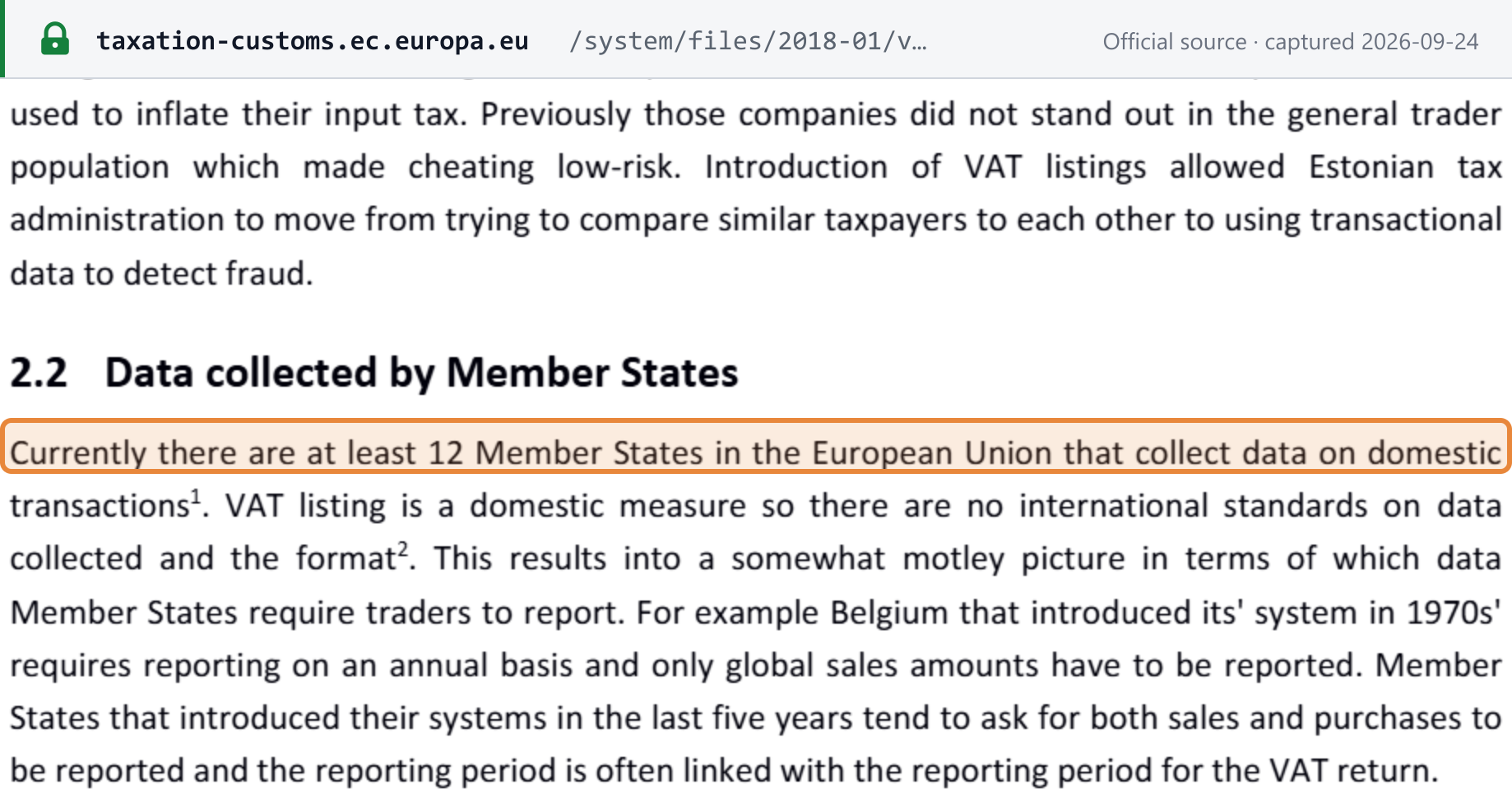
At the time, the report counted "at least 12 Member States in the European Union that collect data on domestic transactions": Belgium, Bulgaria, Czech Republic, Estonia, Hungary, Italy, Latvia, Lithuania, Poland, Romania, Slovakia and Spain. Belgium's system dated from the 1970s.
 Source snapshot captured 2026-09-24 — original
What the participating administrations reported (figures from 2014–2017):
- More VAT collected. All Member States in the study saw VAT collection rise. The report says the largest effect came from "largely compliant businesses that used to optimise their VAT payable by inflating input VAT or under reporting turnover", not from organised fraud (§5.1).
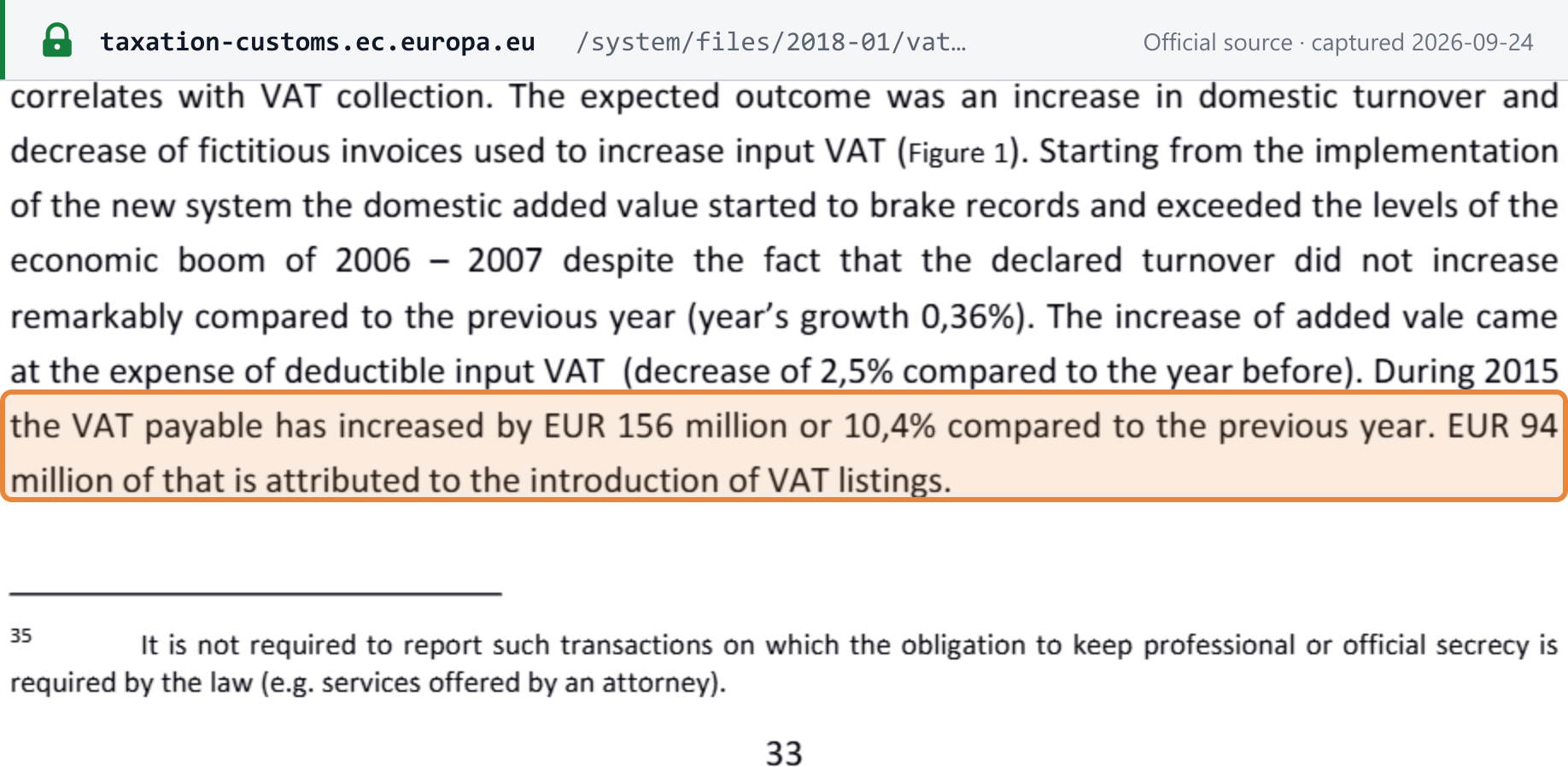
- Estonia. VAT payable rose by EUR 156 million (10.4%) in 2015 compared with the year before. Of that, EUR 94 million was attributed to the introduction of listings. Declared turnover grew only 0.36%, while deductible input VAT fell 2.5% (§8.4.3). In other words, sales stayed flat and declared purchases dropped.
- Estonian refunds. In 2014, claims worth about 20–25% of the total took longer than 9 days to process. By 2017 that amount had fallen by almost 80%, to EUR 5.5 million a month, with 90–95% of claims repaid within 9 days of the VAT return (§8.4.3). This is a fall in the value of delayed claims, not in processing time as such.
- Hungary. In the five years after listings were introduced, the number of VAT audits fell by more than 70% while the average assessment almost doubled (§5.1).
- Czech Republic. Rebuilding a supply chain took months before listings, and a few days with listing data (§5.2).
 Source snapshot captured 2026-09-24 — original
The report's design recommendations (chapter 6) still explain why national listings look the way they do:
- Collect data at invoice level rather than as totals (§6.1.1).
- Tie the listing to the VAT return (§6.1.2).
- Avoid thresholds. If one is unavoidable, set it per trading partner, not per invoice (§6.1.3).
- Allow machine-to-machine filing. Flag mistakes, but do not block the report from being submitted (§6.1.4).
- Reuse data businesses already keep, consult them, and give them lead time (§4, §6.1.5).
- Give taxpayers feedback on mismatches (§6.2.1).
The report also suggested that Member States explore ways to share domestic listing data on intra-EU trade. At EU level that idea was overtaken by ViDA: per-transaction reporting of intra-EU supplies feeds a central VIES from 1 July 2030 (Council Regulation (EU) 2025/517, Art 4).
Related changes from the feed
- 2026-08-03 — Cyprus extended the deadline for the July 2026 VIES recapitulative statement, together with the VAT return for the period ended 30 June 2026, to 20 August 2026; late VIES filing carries a EUR 50 penalty. (Cyprus Tax Department) — see event
- 2026-07-31 — Hungary's Act XXXV of 2026 came into force, so the stricter M-sheet format for received invoices never took effect and the pre-July reporting rules continue. (NAV) — see event
- 2026-07-18 — Belgium's Council of Ministers approved a preliminary draft law for electronic reporting of invoice data, abolishing the annual client listing for taxpayers within the new regime; proposed, not law. (Belgian Federal Government) — see event
- 2026-05-20 — Cyprus extended the April 2026 VIES recapitulative statements, and VAT returns for the period ending 31 March 2026, to 20 May 2026 because of a planned Tax For All shutdown from 7 to 12 May. (Cyprus Tax Department) — see event
Frequently asked questions
Is an EC Sales List the same as a VAT listing?
It is the EU-wide kind. "EC Sales List" and "VIES return" are common names for the recapitulative statement required by Articles 262–271 of the VAT Directive, which reports intra-EU B2B supplies per customer. Domestic listings, such as Belgium's client listing or the Czech control statement, are separate national obligations that Member States add under Article 273. (VAT Directive, consolidated text of 14 April 2025; checked 2026-09-24)
Can I file my EC Sales List quarterly?
Only if your Member State allows it. The default is monthly. A Member State may allow quarterly filing for goods where intra-EU supplies did not exceed EUR 50,000 in the current quarter or in any of the previous four quarters, and may allow it for services. Some, such as Poland, allow no quarterly option. (VAT Directive Art 263(1)–(1c); checked 2026-09-24)
When do EC Sales Lists disappear?
On 1 July 2030, when Directive (EU) 2025/516 deletes Articles 265 to 271 and intra-EU supplies are reported per transaction when the invoice is issued. Two earlier changes come first: supplies reverse-charged under Article 194 are added from 1 July 2028, and call-off-stock information is dropped from 1 July 2029. (Directive (EU) 2025/516, Arts 3–6; checked 2026-09-24)
Do I still have to file Belgium's annual client listing?
Yes. It is due before 31 March each year for customers identified for Belgian VAT that you supplied for more than EUR 250 excluding VAT in the previous year. A preliminary draft law approved by the Council of Ministers on 18 July 2026 would replace it with near-real-time e-reporting from 2028 (the 2025–2029 coalition agreement's timing), but as at 2026-09-24 it is a draft, not law. (SPF Finances; efactuur.belgium.be, checked 2026-09-24)
Can a Member State introduce a new domestic listing after ViDA?
From 1 July 2030, not a new general transaction-based reporting obligation for B2B supplies or acquisitions beyond the EU digital reporting rules. A Member State that had one on 1 January 2024 may keep it until it implements a real-time system meeting Articles 271a–271b. Data-storage duties such as SAF-T and non-general reporting such as cash registers stay allowed. (Directive (EU) 2025/516, recast Art 273 and recital 23; checked 2026-09-24)
Does Italy still have the spesometro or the esterometro?
No. The spesometro article was repealed by Law 205/2017, with the final filing due 30 April 2019, and domestic B2B invoices have gone only through the SdI e-invoicing system since 1 January 2019. Cross-border data have also gone through SdI for operations from 1 July 2022. (Normattiva, checked 2026-09-24)
Related resources
- ViDA — VAT in the Digital Age — the 2030 digital reporting rules that replace recapitulative statements
- VIES and Intrastat — how VIES validation and intra-EU statistics sit alongside the EC Sales List
- SAF-T reporting — the data-storage model ViDA's recast Article 273 still allows
- Reverse charge — the Article 194 and 196 supplies that appear on the EC Sales List
- E-invoicing systems that replaced or sit next to domestic listings: Italy (SdI), Poland (KSeF), Belgium (Peppol)
- Country guides: Belgium, Hungary, Italy, Lithuania, Poland, Portugal, Slovakia, Spain, Cyprus
- Tax-change chronologies: European Union, Belgium, Hungary, Cyprus
Reference links
- Council Directive 2006/112/EC (VAT Directive), consolidated text of 14 April 2025 — Articles 262–273 (EUR-Lex)
- Council Directive (EU) 2025/516 — ViDA; Articles 3–6 (EUR-Lex)
- Council Regulation (EU) 2025/517 — central VIES (EUR-Lex)
- VAT listings – implementation in EU Member States — Fiscalis Project Group 074, DG TAXUD, January 2018 (historical)