Portugal VAT (IVA) guidelines
| FACTSHEET | |
|---|---|
| Country code | PT |
| Tax name | Imposto sobre o Valor Acrescentado (IVA) — Value Added Tax |
| Tax Authority | Autoridade Tributária e Aduaneira (AT) |
Overview
Portugal levies IVA — Imposto sobre o Valor Acrescentado under the Código do IVA (CIVA), approved by Decreto-Lei n.º 394-B/84 and consolidated many times since (the current text reflects Decreto-Lei n.º 97/2026, de 20 de maio). It is administered by the Autoridade Tributária e Aduaneira (AT), part of the Ministério das Finanças. [1]
Currency and period basis. All figures in this guide are in euro (EUR). There is no annual VAT return in the ordinary sense — VAT is accounted for over recurring tax periods, monthly or quarterly depending on turnover (CIVA artigo 41.º; see Filing and payment). A separate annual filing, the IES/Declaração Anual, carries the IVA annexes and is due once a year — also covered below.
Layering — a single national tax with two regional rate schedules. Portugal is not a federal VAT jurisdiction: the CIVA, its registration, filing and offences rules are uniform across the whole country. The one thing that is genuinely regional is the rate. CIVA artigo 18.º n.º 3 lets the regional legislative assemblies of the Açores and Madeira fix reduced VAT rates for operations treated as taking place in those autonomous regions, under the Lei das Finanças das Regiões Autónomas (Lei Orgânica n.º 2/2013). Getting the three-region rate structure right is the single most important thing on this page — see Rates below. As an EU member state, Portugal's CIVA implements Council Directive 2006/112/EC, so the EU-level machinery — intra-Community supplies and acquisitions, the reverse charge on cross-border services, OSS and IOSS — applies here as in the rest of the single market. [2]
Registration
Who should register
CIVA artigo 2.º n.º 1 alínea a) states the liability rule broadly: anyone who independently and habitually carries out production, trade or service activities — including extractive, agricultural and liberal-profession activities — or who performs even a single taxable operation connected with such an activity, is a sujeito passivo (taxable person). Separate limbs sweep in importers, intra-EU traders, and recipients of reverse-charged services from abroad. There is no general "register once you cross a threshold" rule for VAT itself — liability attaches to carrying on the activity. What the EUR 15,000 figure below controls is exemption from charging VAT, not the underlying registration duty. [3]
Registration threshold
| Trigger | Threshold | Measurement period | Notes |
|---|---|---|---|
| Small-business exemption — established in Portugal (artigo 53.º n.º 1) | EUR 15,000, national annual turnover, and no export/export-connected activity | Previous calendar year | Current since Decreto-Lei n.º 35/2025, de 24 de março — an older EUR 13,500 figure is superseded. Exempt traders have no periodic return, no payment and no annual IVA declaration duty (artigo 57.º n.º 1). [4] |
| EU cross-border SME scheme (artigo 53.º n.º 2 alínea a)) | EUR 100,000 EU-wide annual turnover | Previous and current year | Only for a taxpayer established in another EU member state, using an EX-suffixed identification number issued by its home state. [4] |
| Business NOT established in Portugal or the EU | Zero | — | This is the figure readers most often get wrong. See below. |
The non-resident threshold is zero — say it plainly. Because the artigo 53.º exemption is available only to a person with "sede ou domicílio em território nacional" (or, narrowly, an EU-established business under the cross-border scheme), a non-EU-established seller with no Portuguese establishment has no domestic de-minimis at all — any taxable supply it makes in Portugal requires registration and normal-regime treatment from the first euro, unless the transaction is itself reverse-charged to a Portuguese business customer. [4]
Tax registration number (NIF)
Portugal identifies taxpayers — individuals and companies alike — with the NIF (Número de Identificação Fiscal), a 9-digit number with a check digit, whose first digits indicate the holder's category (individuals, non-resident individuals, companies, state entities, and so on). Companies obtain their number through the Registo Nacional de Pessoas Coletivas (RNPC), where it also functions as the company registry number (NIPC). For the full format walkthrough, the digit-series table and worked examples, see LookupTax's Portugal TIN number guide rather than duplicating it here. To check a counterparty's number, use the Portugal NIF validator.
How to register
Registration is via the declaração de início de atividade, filed electronically through the Portal das Finanças, before the activity starts — not "within N days of starting" (CIVA artigo 31.º n.º 1). No filing is required for a person liable only because of a single isolated taxable operation. Company incorporation through the Balcão do Empreendedor / "Empresa na Hora" process folds this declaration into the same session and issues the NIPC/VAT number automatically. [5]
Voluntary registration
Available. A taxable person eligible for the artigo 53.º exemption may waive it and opt into the normal VAT regime (or, for a retailer, into the artigo 60.º pequenos retalhistas regime), by filing the início or alterações declaration. Having opted in, the trader must stay in the chosen regime for at least five years before reverting, unless an "essential change" in how the business operates justifies an earlier reversion. This is worthwhile where inputs are largely standard-rated and customers are themselves VAT-registered. [6]
Deregistration
Within 30 days of ceasing the activity, the taxable person must file the declaração de cessação de atividade (CIVA artigo 33.º). Changes to registered details are notified within 15 days, unless another period is expressly given (artigo 32.º n.º 2). [7]
Group registration
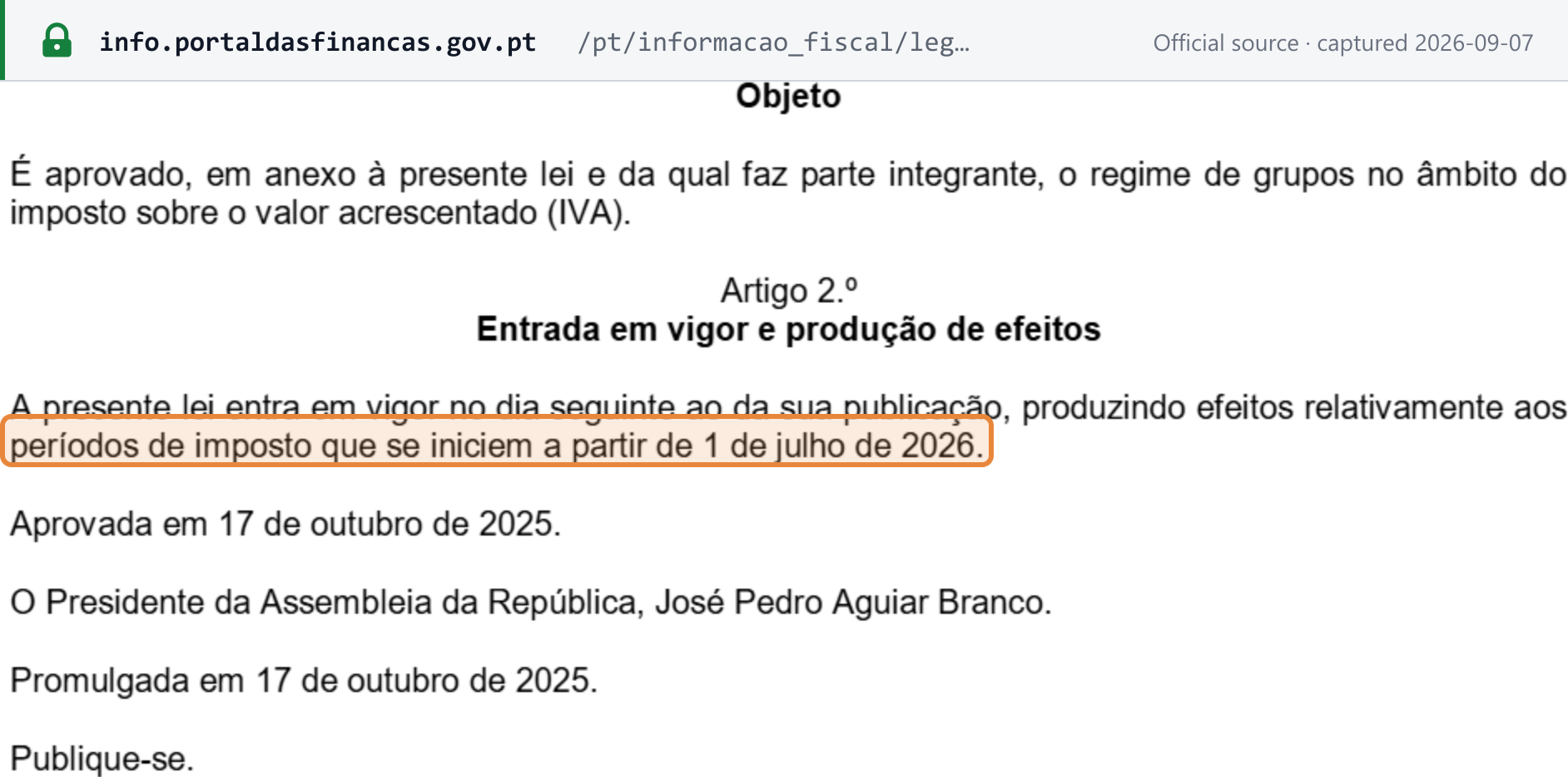
Available, and brand new. Portugal introduced a VAT grouping regime (Regime de Grupos de IVA) by Lei n.º 62/2025, in force for tax periods beginning on or after 1 July 2026. The dominant entity must hold at least 75% of the capital and more than 50% of the voting rights in each dominated entity, with financial, economic and organisational links between them, and the group commits for a minimum of three years. Each member still calculates and files its own periodic return individually — but by day 10 of the second following month, ten days ahead of the ordinary artigo 41.º deadline. The dominant entity then confirms an AT-prepared group declaration by the ordinary day-20 deadline and pays the group's tax by day 25, with dominated entities jointly and severally liable. [8]
 Source snapshot captured 2026-09-07 — original
Rates
Mainland (Continente)
| Rate | Applies to |
|---|---|
| 23% (standard) | Everything not listed in Lista I or Lista II. In force since 1 January 2011 (CIVA artigo 18.º n.º 1 alínea c), wording of Lei n.º 55-A/2010). |
| 13% (intermediate, taxa intermédia) | Lista II items, including restaurant and catering services — food and drink for consumption, excluding alcoholic beverages and soft drinks (item 3.1, wording of Lei n.º 82/2023) — ordinary wines, ready-to-eat/takeaway/delivery meals, canned molluscs, coloured/marked diesel and fuel oil for authorised uses, and agricultural machinery. |
| 6% (reduced, taxa reduzida) | Lista I items — basic foodstuffs: cereals, rice, bread, pasta, fresh/frozen meat and fish, dairy, eggs, vegetables and fruit, mineral water. |
Azores and Madeira — the regions genuinely differ, get all three right
| Autonomous region | Reduced | Intermediate | Standard | In force since |
|---|---|---|---|---|
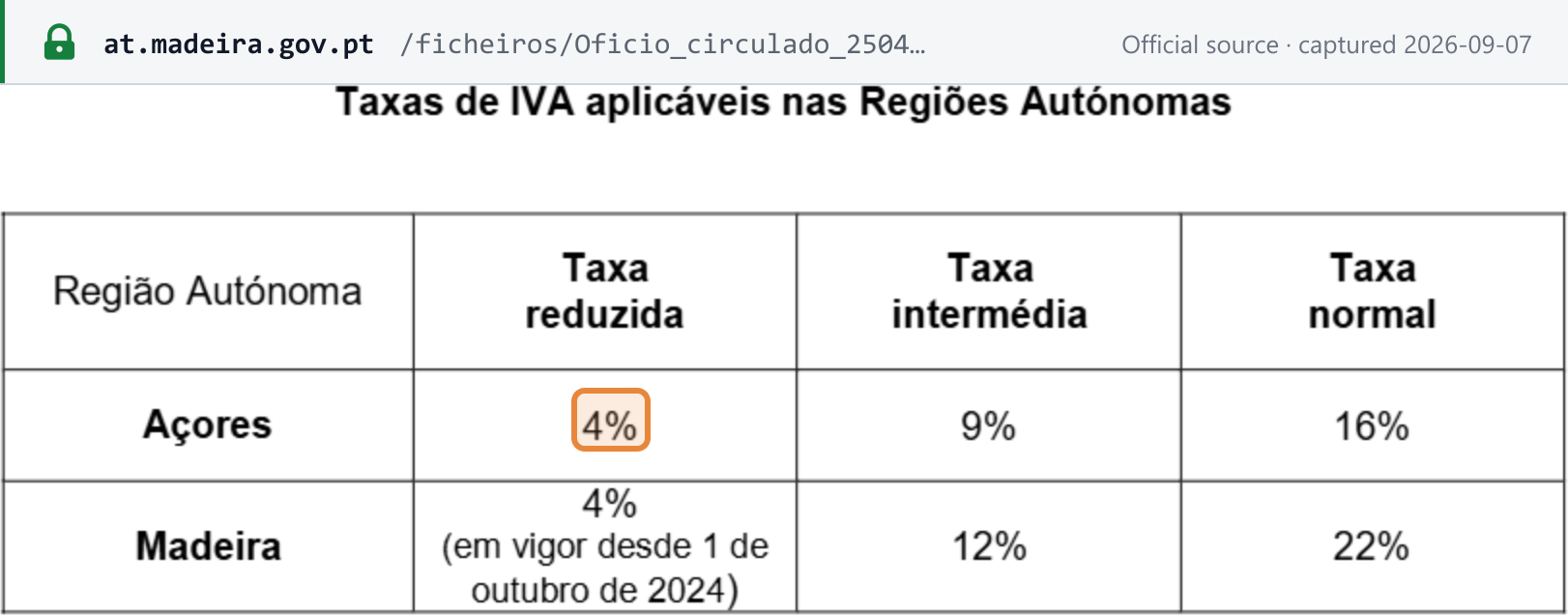
| Açores | 4% | 9% | 16% | 1 July 2021 — a flat 30% cut from the (then) mainland percentages, set by Decreto Legislativo Regional n.º 15-A/2021/A |
| Madeira | 4% | 12% | 22% | Intermediate and standard since 1 April 2012 (Lei n.º 14-A/2012); the reduced rate moved to 4% on 1 October 2024 (Decreto Legislativo Regional n.º 6/2024/M) |
These figures are officially tabulated together by AT itself in Ofício Circulado n.º 25045 (6 December 2024), and the enabling provision is CIVA artigo 18.º n.º 3, which lets the regional legislative assemblies of the Açores and Madeira fix reduced rates under the Lei das Finanças das Regiões Autónomas (Lei Orgânica n.º 2/2013). [11] [9]
 Source snapshot captured 2026-09-07 — original
Announced future rates
None found. No AT, CIVA-amendment or regional-decree announcement of a forthcoming change to any of the nine mainland/Açores/Madeira percentages was identified as of this guide's update date. The most recent rate-affecting instrument is the Madeira reduced-rate change of 1 October 2024.
Cross-border rules
Place of supply
- Goods — taxable where the goods are located when transport to the customer begins, or, absent transport, where they are made available (CIVA artigo 6.º n.º 1) — an origin-based rule, overridden by the distance-selling/OSS regime above the thresholds described below.
- Services, B2B — taxed where the business customer is established (artigo 6.º n.º 6 alínea a)), with the tax shifted to that customer by reverse charge where the supplier has no Portuguese establishment.
- Services, B2C — taxed where the supplier is established (artigo 6.º n.º 6 alínea b)), subject to specific carve-outs for immovable-property services, passenger transport, restaurant services, admission to events, short-term means-of-transport hire, and telecommunications/broadcasting/electronic services to consumers.
Imports and exports
Imports are exempt where the equivalent domestic supply would be exempt, plus specific reliefs including goods re-imported by the original exporter and imports where VAT is instead declared under the IOSS distance-selling scheme (CIVA artigo 13.º). Exports are exempt with the right to deduct input VAT — true zero-rating in substance, not merely an exemption — covering goods dispatched out of the EU by the seller or a non-established buyer, related processing services, and international-transport, bunkering and aircraft/vessel-servicing operations (artigo 14.º). [13]
Reverse charge on imported services
A Portuguese taxable person receiving services from a supplier with no Portuguese establishment self-accounts for VAT via the reverse charge (CIVA artigo 2.º n.º 1 alínea e)), matching the B2B place-of-supply rule above. The foreign supplier does not need to register in Portugal for services caught by this rule. The invoice, whoever issues it, must carry the words "IVA - autoliquidação" (artigo 36.º n.º 13). [3]
Digital products and services
Below an EU-wide combined EUR 10,000 threshold (current or preceding calendar year), a supplier established in a single member state may continue taxing telecommunications, broadcasting and electronically supplied services — and intra-EU distance sales of goods — in its own state (CIVA artigo 6.º-A). Above that figure, VAT is due where the customer belongs, reportable through OSS without registering separately in every destination state. [14]
Foreign companies selling into Portugal — B2B and B2C answered separately
- B2B, services. Reverse charge to the Portuguese business customer (above) — the foreign supplier generally does not register.
- B2B, goods already in Portugal. Artigo 2.º n.º 1 alínea g) shifts liability to a Portuguese-established, VAT-registered acquirer where the seller has no Portuguese establishment and no fiscal representative — registering in Portugal switches this reverse charge off and puts the charging obligation back on the seller.
- B2C, digital services and intra-EU distance sales of goods (EU-established sellers). Charge Portuguese VAT once the EU-wide combined EUR 10,000 threshold above is crossed; below it, the seller may tax in its own member state instead. Reportable through OSS.
- B2C, non-EU sellers. No threshold — registration (directly, or via the OSS non-Union scheme for services, or IOSS for imported goods of EUR 150 or less) is required from the first sale.
Marketplace / platform deemed-supplier liability
Yes — the EU deemed-supplier rules apply. CIVA artigo 3.º n.os 9 to 11 (added by Lei n.º 47/2020, in force from 1 January 2021): where a taxable person facilitates — via an interface eletrónica (marketplace, platform, portal or similar) — distance sales of goods imported in consignments of intrinsic value not exceeding EUR 150, or intra-EU supplies of goods by a non-EU-established seller to a non-taxable person, the platform itself is deemed to have received and supplied the goods and becomes the person liable for the VAT. [6]
OSS/IOSS
Portugal implements the EU One-Stop-Shop schemes through Anexo I to Lei n.º 47/2020, in force from 1 January 2021, administered through the same Portal das Finanças used for domestic VAT — there is no separate OSS-specific portal. The Union and non-Union schemes file quarterly; the Import scheme (IOSS) files monthly; all are due by the end of the month following the period, with payment riding the same deadline and nil returns compulsory. [15]
Invoice requirements
Mandatory content
CIVA artigo 36.º n.º 5 requires every invoice to be dated and sequentially numbered, and to state:
| Required field | Notes |
|---|---|
| Supplier and customer names and addresses, plus their NIFs | Alínea a). |
| Quantity and usual description of the goods/services, with detail enough to fix the applicable rate | Alínea b). |
| The taxable amount, net of VAT | Alínea c). |
| The applicable rate(s) and the VAT amount due — split by rate where a single invoice covers different rates | Alínea d). |
| The reason VAT was not charged (exemption or reverse charge), where relevant | Alínea e). |
| The date the goods were made available, the service performed, or an advance payment received, if different from the invoice date | Alínea f). |
A non-established supplier with a Portuguese fiscal representative must also show the representative's name, address and NIF (n.º 9). Electronic invoices are permitted subject to the recipient's acceptance (n.º 10). [16]
Issuance deadline
A full invoice must be issued by the 5th business day following the chargeable event (artigo 36.º n.º 1 alínea a)); by the 15th day of the following month for intra-EU B2B services taxable in another member state under the general B2B place-of-supply rule (alínea b)); or on the date of receipt for advance payments (alínea c)). Global (batch) invoices cannot be processed more than 5 business days after the period they cover ends (n.º 2). [16]
Numbering and sequencing
Invoices must be dated and numbered sequentially (artigo 36.º n.º 5, chapeau) and issued in duplicate — original to the customer, copy retained by the supplier (n.º 4). No particular numbering format is prescribed beyond sequence and uniqueness.
Credit and debit notes
Correcting documents (guias ou notas de devolução e outros documentos retificativos de faturas) must carry the same date/sequential-numbering discipline as an invoice, plus the supplier's identification particulars, and must reference the original invoice and state exactly which of its elements are being changed (artigo 36.º n.º 6). [16]
Document types — the simplified-invoice thresholds
A fatura simplificada may replace the full invoice in three cases (CIVA artigo 40.º n.º 1):
- Retail or street-vendor sales to non-taxable persons, where the invoice value does not exceed EUR 1,000.
- Any other supply where the invoice amount does not exceed EUR 100.
- Any supply by a trader covered by the artigo 53.º small-business exemption — no monetary cap on this limb, added by Decreto-Lei n.º 35/2025.
 Source snapshot captured 2026-09-07 — original
A simplified invoice must still be dated and sequentially numbered, and show the supplier's name/NIF, quantity and usual description, price with rate(s) and VAT amount, the customer's NIF if they are a taxable person, and the exemption reason if applicable. [17]
Self-billing (autofaturação)
The customer may draw up the invoice on the supplier's behalf only where: (a) there is a prior written agreement between the two; (b) the customer can prove the supplier was made aware of and accepted the invoice's content; and (c) the invoice bears the word "autofaturação" (CIVA artigo 36.º n.º 11). This guide could not independently confirm from an official source whether AT additionally requires the self-billing agreement and document series to be pre-registered on the Portal das Finanças before use — that operational detail is well attested by professional-body guidance but is not restated here as verified. [6]
Currency and language
This guide could not locate a specific CIVA provision fixing an invoice language or a foreign-currency conversion rule for domestic invoices, and does not state one rather than guess. As an EU member state applying Directive 2006/112/EC, Portugal is understood to follow the Directive's general FX-conversion machinery (the latest rate published by the European Central Bank, or a member state's own central bank rate), but the specific transposing CIVA article was not confirmed in this research pass.
Retention and audit trail
All records and supporting documents must be archived and kept in good order for the following 10 civil years (CIVA artigo 52.º n.º 1, as raised/relabelled by Decreto-Lei n.º 49/2025, effective 1 July 2025). For records tied to capital-goods deduction adjustments, the 10-year clock runs from the date of the last such adjustment (n.º 2). Tamper-evidence and sequential integrity are delivered structurally, through the ATCUD/certified-software architecture described next, rather than by a separate CIVA audit-trail clause. [18]
ATCUD, QR code and certified invoicing software
Three related but distinct requirements sit on top of the mandatory-content rules above:
- ATCUD (Código Único de Documento). A per-invoice-series registration event, not a periodic filing: before using any invoice series, the taxpayer must communicate its identification to AT electronically and receive back a validation code that becomes part of the ATCUD printed on the document. Mandatory since 1 January 2023 (Decreto-Lei n.º 28/2019 artigo 35.º, as amended by Decreto-Lei n.º 48/2020). [19]
- QR code. Mandatory on fiscal documents since 1 January 2022, generated only by AT-certified billing software under Portaria n.º 195/2020.
- Certified invoicing software (software de faturação certificado). Invoicing programs must be certified by AT before commercial use. Portaria n.º 363/2010, de 23 de junho (still in force, amended several times, most recently referencing Decreto-Lei n.º 28/2019) sets the certification requirements: the ability to export the SAF-T (PT) file, a tamper-evident recording system using an asymmetric cipher and a private key known only to the software producer, per-user access authentication, and no function able to alter fiscal data without generating evidence of the change. This guide could not officially verify a specific penalty figure for using non-certified software — figures circulating elsewhere (commonly cited as EUR 3,000 to EUR 18,750) trace back to advisory sources, not to an RGIT article or the Portaria itself, in the research done for this page, so none is stated here. [20]
Specimen invoice
No AT-published annotated specimen invoice was found for this guide (unlike, for example, Germany's Bavarian Landesamt für Steuern examples). The specimen below is ours, built to map the mandatory particulars above onto where they actually sit on a document.
Fatura — full VAT invoice
| Descriçãoart. 36.º n.º 5(b) | Quantidadeart. 36.º n.º 5(b) | Preço unitárioart. 36.º n.º 5(c) | Valor líquidoart. 36.º n.º 5(c) | Taxaart. 36.º n.º 5(d) |
|---|---|---|---|---|
| Serviços de consultoria — consulting services | 20 h | €100,00 | €2.000,00 | 23% |
| Licença anual — annual licence | 1 | €500,00 | €500,00 | 23% |
- Valor tributável (23%)art. 36.º n.º 5(c)
- €2.500,00
- IVA (23%)art. 36.º n.º 5(d)
- €575,00
- Total a pagar
- €3.075,00
- The QR code (mandatory since 1 January 2022, Portaria n.º 195/2020) and the ATCUD are printed together on the face of the document — both can only be produced by AT-certified invoicing software.
- If this were a reverse-charge supply, the invoice would instead carry the words "IVA - autoliquidação" (art. 36.º n.º 13) in place of a rate and VAT amount.
- If the total did not exceed EUR 1,000 and the customer were a non-taxable person, a fatura simplificada could be issued instead, omitting some of the fields above (art. 40.º).
- This guide could not confirm an official invoice-language or FX-conversion rule for domestic invoices; none is asserted here.
E-invoicing status
| Status — B2G | Mandatory by supplier size: large companies since 1 January 2021; SMEs, micro-enterprises and public entities acting as suppliers from 1 January 2027 |
| Status — B2B | Voluntary |
| Status — B2C | Voluntary |
| Network | eSPap (public procurement) |
| Formats | UBL 2.1 CIUS-PT or CEFACT CIUS-PT (B2G) |
Portugal has a dedicated e-invoicing guide covering the B2G eSPap mandate in depth — access, formats, who must issue and when, and the onboarding flow. Read it at E-invoicing in Portugal — eSPap. This section states only what belongs alongside the rest of the country guide: the SAF-T (PT) communication cadence, and the current status of two obligations that have been repeatedly deferred.
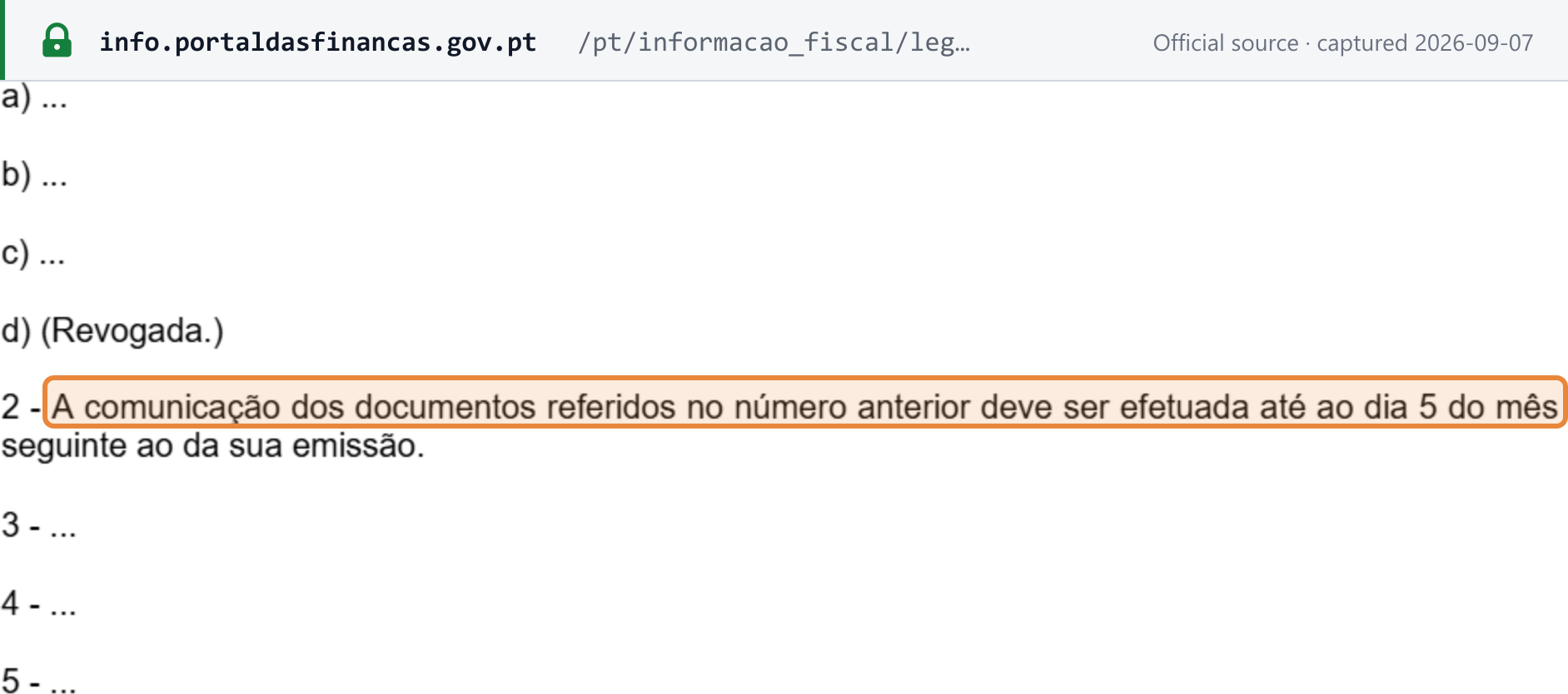
A deadline that is widely misquoted. The SAF-T (PT) invoice-data communication deadline has been day 5 of the following month since 1 January 2023 (during 2023 the AT accepted communication up to day 8 without penalty), under Decreto-Lei n.º 198/2012 artigo 3.º n.º 2 in the wording given by Lei n.º 12/2022 artigo 317.º. Guidance still quoting the 20th or the 12th describes a rule that has been replaced. The current rule is stated below. [21]
 Source snapshot captured 2026-09-07 — original
- SAF-T (PT) — the monthly invoice-data communication. Everyone subject to Portugal's invoicing rules must transmit to AT, electronically, the elements of every invoice issued — by day 5 of the month following issuance, since 1 January 2023 (Decreto-Lei n.º 198/2012 artigo 3.º, as amended by Lei n.º 12/2022 artigo 317.º). This is a distinct obligation from the annual accounting SAF-T file below, and is confirmed in AT's own words: "Os documentos emitidos a partir de 01 de janeiro de 2023, deverão ser comunicadas à AT até ao dia 05 do mês seguinte." [21]
- SAF-T (PT) da contabilidade — the annual accounting audit file. A separate, IRC-adjacent filing, not yet in force: deferred, for the fourth consecutive year, to periods of 2027 onward, to be submitted in 2028 or later (Lei n.º 73-A/2025, Orçamento do Estado para 2026, artigo 95.º n.º 2). [22]
- PDF invoices treated as electronic invoices. Accepted for tax purposes until 31 December 2026 (Lei n.º 73-A/2025 artigo 95.º n.º 3) — again the fourth consecutive one-year extension of this grace period. Describe this as a recurring deferral rather than a settled cut-over date: the pattern of the last three budgets is another extension, not a hard mandatory-signature start on 1 January 2027. [22]
Filing and payment
Filing frequency and return due date
Taxable persons with turnover at or above EUR 650,000 in the previous calendar year file monthly; below that, quarterly (CIVA artigo 41.º n.º 1). The periodic return is due by day 20 of the second following month (monthly) or day 20 of the second month after the quarter (quarterly) — the June/Q2 period is deferred to 20 September (artigo 41.º n.os 1 and 10). Nil returns are compulsory (artigo 29.º n.º 2). A quarterly filer that crosses EUR 650,000 must move to monthly filing from the following January (artigo 41.º n.º 5). [23]
VAT-group members file individually by day 10 of the second following month — ten days ahead of everyone else — with the dominant entity confirming the group declaration by the ordinary day-20 deadline (Lei n.º 62/2025; see Group registration above). [8]
Payment due date
Payment is due five days after the return — day 25 of the second following month or quarter, with the same June/Q2 deferral to 25 September (CIVA artigo 27.º n.os 1 and 10). Where the amount paid falls short of the amount declared, AT issues a certidão de dívida for the shortfall (n.º 6). [24]
Additional listings
- Declaração recapitulativa (EC sales list, RITI artigo 30.º). Due by day 20 of the month following the operations (monthly filers) or day 20 of the month following the quarter (quarterly filers) — one month earlier than the periodic return itself. A quarterly filer whose intra-EU supplies exceed EUR 50,000 in the current or any of the four preceding quarters must switch to monthly recapitulativas. No nil-return duty.
- Annual IES/DA IVA annexes. The declaração de informação contabilística e fiscal, including the mapa recapitulativo de fornecedores (suppliers with more than EUR 25,000 of domestic operations in the previous year), is due by 15 July, and this date does not shift for weekends or holidays (CIVA artigo 29.º n.º 1 alíneas d), f) and h)). The equivalent customers map was repealed from 1 July 2025.
Input-tax recovery and blocked items
CIVA artigo 21.º excludes input VAT from deduction on: passenger vehicles, pleasure boats, helicopters, aircraft and motorcycles (with exceptions, e.g. heavy passenger vehicles, licensed public-transport vehicles other than rent-a-car, and goods vehicles over 3,500 kg); fuel for passenger vehicles (diesel, LPG, natural gas and biofuels are 50% deductible generally, fully deductible for the excepted vehicle categories); business travel and transport expenses, including tolls; accommodation, food, drink, tobacco and reception/entertainment expenses; and luxury or entertainment expenses generally. Exceptions restore deductibility where, for example, the expense relates to goods whose sale or exploitation is the trader's own business, or where it is re-invoiced to a third party for reimbursement. [25]
Refunds
Excess input VAT is carried forward against future periods (CIVA artigo 22.º n.º 4). Once 12 months have passed since the credit first arose and it exceeds EUR 250, the taxpayer may request a refund (n.º 5). An earlier refund can be requested — on cessation of activity, or on moving into certain other regimes — where the amount is at least EUR 25, or in any case where the credit exceeds EUR 3,000 (n.º 6). AT may require a guarantee for refunds above EUR 30,000 (n.º 7). Refunds are due within the 2nd month following the request, or within 30 days for taxpayers on the monthly-refund register, after which the taxpayer may claim statutory interest (n.º 8). [26]
Cash accounting
Available. The regime de IVA de caixa (Decreto-Lei n.º 71/2013) lets a taxable person with prior-year turnover not exceeding EUR 2,000,000 account for VAT when payment is received rather than on invoice, elected electronically during October, effective the following January, with a two-year lock-in. It changes when VAT becomes chargeable, not the filing or payment deadlines themselves.
For the full set of Portuguese IVA filing dates — including monthly/quarterly grids, the summer deferral and public-holiday shifts — see the Portugal compliance calendar.
Exemptions
CIVA artigo 9.º lists supplies exempt without the right to deduct input VAT — medical and paramedical services, hospital and clinical services, human organ/blood/milk transfusions, ambulance transport, social-security and welfare-connected supplies, childcare/eldercare, education (school and vocational, by recognised institutions), museum/library/cultural admission by public or non-profit bodies, insurance and reinsurance, and residential property leasing (with carve-outs). [27]
Exempt is not zero-rated — say the distinction explicitly, since it is the most common reader misunderstanding. A supplier under artigo 9.º cannot recover input VAT on its own costs. A zero-rated export or international-transport supply under artigo 14.º is different: the supply carries no VAT, but the right to deduct input VAT is preserved. Confusing the two overstates or understates a business's real VAT position.
Special regimes
- Small-business exemption (artigo 53.º). EUR 15,000 domestic threshold — see Registration above. Exempt traders have no periodic return, payment or annual IVA declaration duty, limited to início/alterações/cessação declarations and the duty to issue invoices marked "IVA - regime de isenção" (artigo 57.º n.º 1).
- Cash accounting (regime de IVA de caixa). Exists — see Filing and payment above.
- Margin scheme, second-hand goods / works of art / antiques. Exists — CIVA artigo 18.º n.º 10 confirms goods taxed under this special regime are taxed at the applicable region's standard rate on the margin, regardless of the underlying good's normal classification. This guide did not independently trace the dedicated margin-scheme decree's exact number and mechanics to an official source in this pass, so none is asserted beyond what artigo 18.º n.º 10 itself states.
- Pequenos retalhistas (small retailers, artigo 60.º and following). Exists, with its own quarterly confirm-by-day-20/pay-by-day-25 cadence.
- Zona Franca da Madeira. This guide could not verify the VAT treatment of supplies within, into or out of the Madeira Free Trade Zone against an official source in this research pass — it is understood to be primarily a corporate-tax (IRC) incentive regime, but that is not restated here as a VAT finding. Treat this as an open item rather than a confirmed rule.
Offences and penalties
Portugal keeps administrative offences (coimas) and criminal exposure distinct, under the Regime Geral das Infrações Tributárias (RGIT).
Offences (administrative)
| Conduct | Penalty | Basis |
|---|---|---|
| Failure to remit VAT collected, up to 90 days (or longer, if not criminal) | Fine between the amount due and double that amount; 15%–50% of the tax short if merely negligent | RGIT artigo 114.º |
| Paying VAT via an unauthorised method | EUR 75 to EUR 2,000 | RGIT artigo 114.º |
| Late or missing declarations generally | EUR 150 to EUR 3,750 | RGIT artigo 117.º n.º 1 |
| Late or missing início/alterações/cessação declarations specifically | EUR 300 to EUR 7,500 | RGIT artigo 117.º n.º 2 |
| Failure to issue an invoice/receipt, or issuing one late | EUR 150 to EUR 3,750 | RGIT artigo 123.º n.º 1 |
| Failure to demand or retain an invoice for the required period | EUR 75 to EUR 2,000 | RGIT artigo 123.º n.º 2 |
| Wilfully refusing to hand over accounting records/documents to AT | EUR 375 to EUR 75,000 | RGIT artigo 113.º |
Offences (criminal)
- Abuso de confiança (RGIT artigo 105.º). Failing to remit VAT collected/withheld exceeding EUR 7,500: prison up to 3 years, or a fine up to 360 days. Only punishable once more than 90 days have passed since the legal delivery deadline and the declared-but-unpaid amount remains unpaid 30 days after notification. Where the unremitted amount exceeds EUR 50,000: prison 1 to 5 years for individuals, or a fine of 240 to 1,200 days for companies. This is the provision that criminalises VAT that was charged but never handed over. [32]
- Fraude fiscal (RGIT artigo 103.º). Concealing or altering accounting facts, or simulated transactions, aimed at non-payment or improper refunds: prison up to 3 years or a fine up to 360 days. Not punishable if the illegitimate advantage is under EUR 15,000. [33]
Interest on late payment
Interest accrues on unpaid tax from the legal due date until payment, at the rate fixed for debts to the State — a rate the LGT does not itself state a figure for, but sets periodically by separate instrument (Lei Geral Tributária artigo 44.º n.º 3). This guide could not independently fetch the current rate from an official gazette source, so no specific percentage is stated here — check the AT portal or the current Diário da República Aviso before relying on a figure you see elsewhere. [34]
Frequently asked questions
I'm a small non-resident business selling into Portugal — does the EUR 15,000 small-business exemption threshold protect me?
No, and this is the single most common misreading of Portuguese VAT. CIVA artigo 53.º n.º 1 grants the isenção only to a taxpayer with sede ou domicílio em território nacional — established in Portugal. A business with no Portuguese establishment has no domestic de-minimis at all: any taxable supply it makes in Portugal requires registration and normal-regime VAT treatment from the first euro, unless the transaction is itself reverse-charged to a Portuguese customer. The one relief that reaches a non-resident is narrower and EU-only: a taxable person established in another EU member state may use the same artigo 53.º exemption for its Portuguese sales under the EU-wide SME scheme, but only where its EU-wide annual turnover does not exceed EUR 100,000 and it holds an EX-suffixed identification number issued by its home member state. A non-EU-established seller has neither route. [4]
What are the IVA rates in mainland Portugal versus the Azores and Madeira?
Three separate rate schedules apply. Mainland Portugal (Continente): 23% standard, 13% intermediate, 6% reduced — unchanged since 1 January 2011. The Azores: 16% standard, 9% intermediate, 4% reduced, set at a flat 30% cut from the mainland rates from 1 July 2021. Madeira: 22% standard, 12% intermediate (both since 1 April 2012), and a 4% reduced rate since 1 October 2024. CIVA artigo 18.º n.º 3 is the enabling provision; the current figures are officially tabulated together in AT's Ofício Circulado n.º 25045 of 6 December 2024. [9] [11]
What is ATCUD, and do I need AT-certified invoicing software to issue compliant invoices in Portugal?
ATCUD (Código Único de Documento) is a unique code printed on every Portuguese fiscal document. Before using any invoice series, the issuer must communicate it electronically to AT and receive back a validation code that becomes part of the printed ATCUD — mandatory since 1 January 2023 (Decreto-Lei n.º 28/2019 artigo 35.º). A QR code encoding the invoice's key fields has been mandatory since 1 January 2022. Both can only be generated by invoicing software AT has certified under Portaria n.º 363/2010 — tamper-evident recording of invoices, per-user access authentication, and no function able to alter fiscal data without leaving evidence. This guide could not independently verify a specific penalty figure for non-certified software from an official source, so none is stated here. [19] [20]
When can I issue a simplified invoice (fatura simplificada) instead of a full invoice in Portugal?
CIVA artigo 40.º n.º 1 allows a simplified invoice in three cases: retail or street-vendor sales to non-taxable persons where the invoice value does not exceed EUR 1,000; any other supply where the invoice amount does not exceed EUR 100; and, since Decreto-Lei n.º 35/2025, any supply made by a trader covered by the artigo 53.º small-business exemption, with no monetary cap on that third limb. A simplified invoice must still be dated, sequentially numbered, and show the supplier's name and NIF, a description of the goods or services, the price with rate(s) and VAT amount, and the customer's NIF where they are a taxable person. [17]
Is B2B e-invoicing mandatory in Portugal, and has the PDF-invoice deadline finally arrived?
B2B and B2C e-invoicing remain voluntary in Portugal as of this guide's update date — only B2G e-invoicing through the eSPap platform is mandatory. Separately, PDF invoices continue to be accepted as electronic invoices until 31 December 2026 under Lei n.º 73-A/2025 artigo 95.º n.º 3 — the fourth consecutive one-year extension of that grace period, so treat it as a recurring deferral rather than a settled cut-over date. Note also that Portugal's monthly invoice-data communication to AT is due by day 5 of the following month, not the 20th — a figure that changed on 1 January 2023 and that a lot of third-party guidance still quotes at its older value. [22] [21]
How does Portugal's new VAT Grouping regime work, and does each member still file its own return?
Yes. Under the Regime de Grupos de IVA (Lei n.º 62/2025), live for tax periods beginning on or after 1 July 2026, a dominant entity holding at least 75% of the capital and more than 50% of the voting rights of each dominated entity — with financial, economic and organisational links between them — may form a VAT group, with a minimum three-year commitment. Each member still calculates and files its own periodic return individually, but by day 10 of the second following month, ten days earlier than the ordinary artigo 41.º deadline. The dominant entity then confirms an AT-prepared group declaration by the ordinary day-20 deadline and pays the group's tax by day 25, with the dominated entities jointly and severally liable. [8]
Important websites
| Purpose | URL | Notes |
|---|---|---|
| Registration, VAT return filing and payment | portaldasfinancas.gov.pt | One portal covers the declaração de início de atividade, periodic-return filing and payment — there is no separate filing-only site. |
| Company incorporation (Empresa na Hora) | gov.pt — Criar uma empresa na hora | Incorporates the company and registers it on the spot; the início de atividade declaration (VAT registration) is a separate step, through a certified accountant or at a Finanças office within 15 days of incorporation. |
| E-invoicing / monthly invoice-data communication (e-Fatura) | faturas.portaldasfinancas.gov.pt | The current e-Fatura domain — use this one, not older efatura. subdomains referenced elsewhere. |
| B2G e-invoicing (public procurement) | eSPap — FAQ Fatura Eletrónica (FE-AP) | See the Portugal e-invoicing guide for the full onboarding flow. |
| EU VAT-number validation (VIES) | ec.europa.eu/taxation_customs/vies | EU-level tool; the standard way to confirm a Portuguese VAT/NIF number for intra-EU purposes. |
| NIF / VAT number validator | lookuptax.com/validate/portugal/nif | LookupTax's own validator. |
| CIVA / RITI / RGIT / LGT consolidated legal texts | info.portaldasfinancas.gov.pt | AT's own consolidated PDFs of every tax code cited on this page. |
| Portugal compliance calendar | lookuptax.com/compliance-calendar/portugal | Full set of IVA filing/payment dates, including holiday shifts. |
Recent changes
Dated, officially-sourced changes to Portuguese IVA compliance.
- Regime de Grupos de IVA (Lei n.º 62/2025) — Portugal's new VAT grouping regime, taking effect for tax periods beginning on or after 1 July 2026. Qualifying groups (dominant entity holding at least 75% of capital and over 50% of voting rights, minimum three-year commitment) may consolidate VAT obligations into a joint return, while each member still files individually by day 10 of the second following month. (Autoridade Tributária e Aduaneira, AT-published text of Lei n.º 62/2025)
Reference links
- Código do IVA (CIVA) — consolidated text
- Regime do IVA nas Transações Intracomunitárias (RITI) — current republication
- Regime Geral das Infrações Tributárias (RGIT) — article index
- Lei Geral Tributária (LGT) artigo 44.º — juros de mora
- Lei n.º 62/2025 — Regime de Grupos de IVA
- Decreto-Lei n.º 35/2025 — small-business exemption and simplified-invoice update
- Decreto-Lei n.º 49/2025 — retention period and periodic-return rewrite
- Lei n.º 73-A/2025 (Orçamento do Estado para 2026) — SAF-T and PDF-invoice deferrals
- Lei n.º 12/2022 artigo 317.º — the day-5 SAF-T communication deadline
- Decreto-Lei n.º 28/2019 — ATCUD
- Portaria n.º 363/2010 — certified invoicing software
- AT Ofício Circulado n.º 25045 — Açores and Madeira VAT rates
- Lei n.º 47/2020 — OSS/IOSS and marketplace deemed-supplier rules
For the NIF format, digit series and worked examples, see our Portugal TIN number guide. To verify a Portuguese VAT/NIF number, use our Portugal NIF validator. For B2G e-invoicing, see the Portugal e-invoicing guide. For the full set of filing and payment dates, see the Portugal compliance calendar.